ISSUE ADVOCACY
INTRODUCTION TO ADVOCACY
GROUPS
 When you want to spend money getting your voice heard on an

issue or a candidate, the best thing to do is form your own issue
advocacy group.
 There are so many different kinds of groups, & they all have their

own laws guiding them.
 Congress and the FEC (Federal Elections Commission) make the

rules for all of the different groups and make sure they don’t break
the rules.
FEC & CONGRESS RULES
Expenditure reports.
Fundraising details:

a. Who raised the money.
b. How much was raised
List of donor names
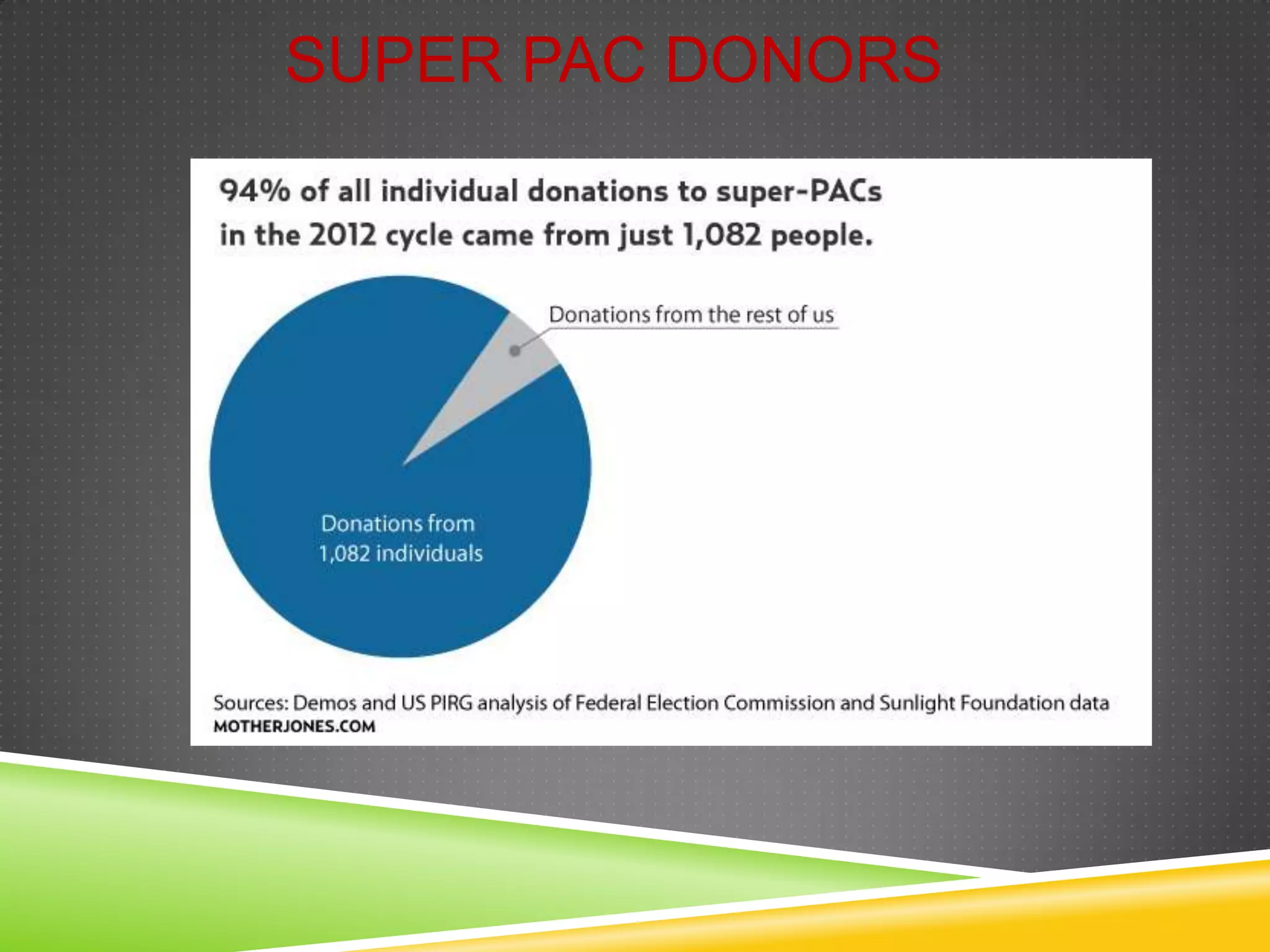
SUPER PAC DONORS
BRIEF HISTORY
 Spending large amounts of money to influence voters for specific issues has

been around for a long time.
 As the U.S. has grown and technology has increased, so has modern election

spending.
 “527 groups” are relatively new to American politics, as are PACS, or Super

PACS.
 “527 groups” are named for the section of USA tax code that is relevant to

them.
 PAC stands for Political Action Committee.
 Super PAC is a bigger version of Political Action Committee.
DIFFERENT TYPES OF GROUPS
The Center for Responsive Politics has a
website, www.opensecrets.org, which gives great information about
the different sorts of groups that spend money in elections to
advocate for different causes. These include the following• 501( c) groups.

• 527 group.
• Political Action Committee (PAC).
• Super PACS.
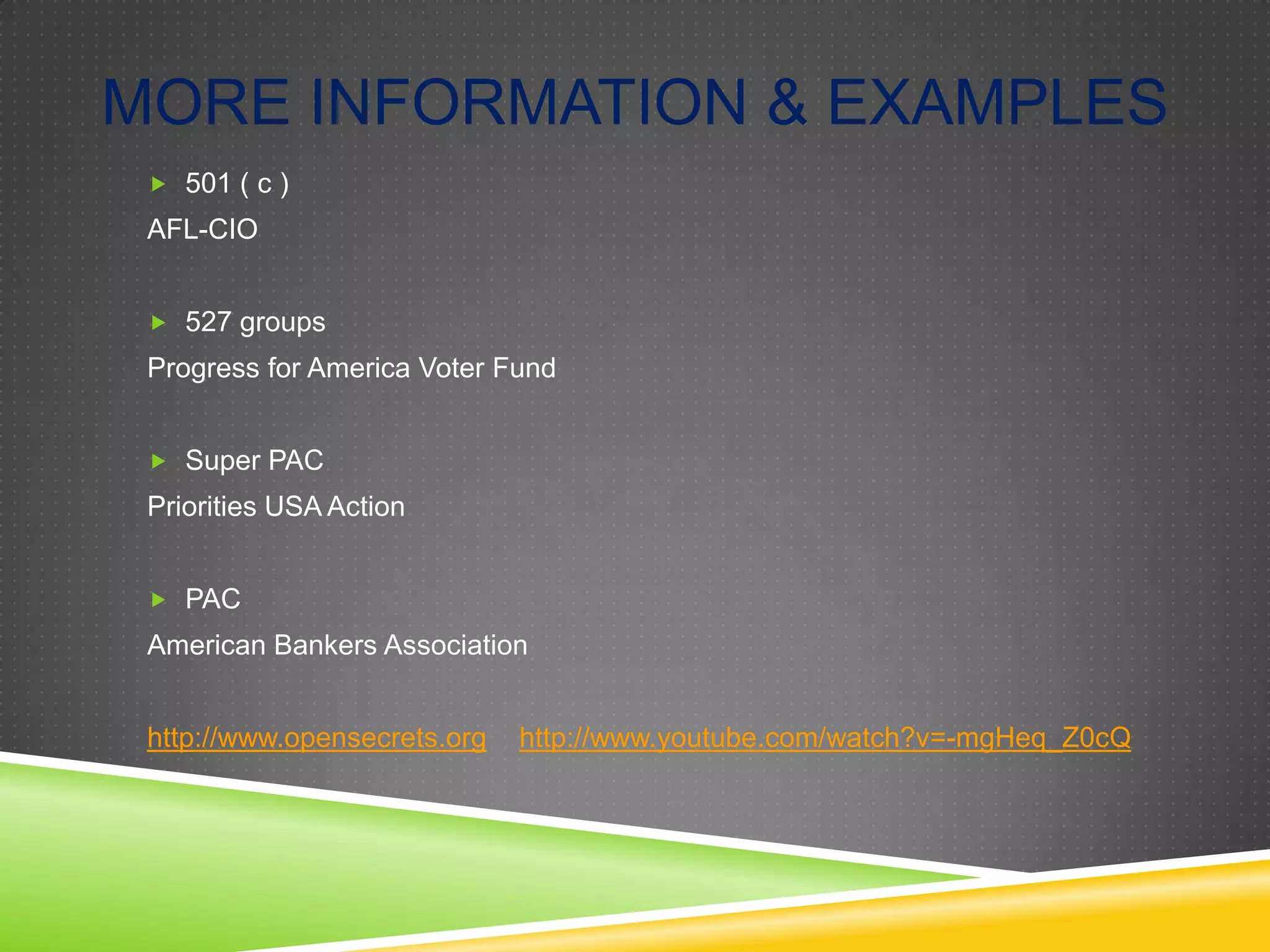
MORE INFORMATION & EXAMPLES
 501 ( c )

AFL-CIO
 527 groups

Progress for America Voter Fund
 Super PAC

Priorities USA Action
 PAC

American Bankers Association
http://www.opensecrets.org

http://www.youtube.com/watch?v=-mgHeq_Z0cQ
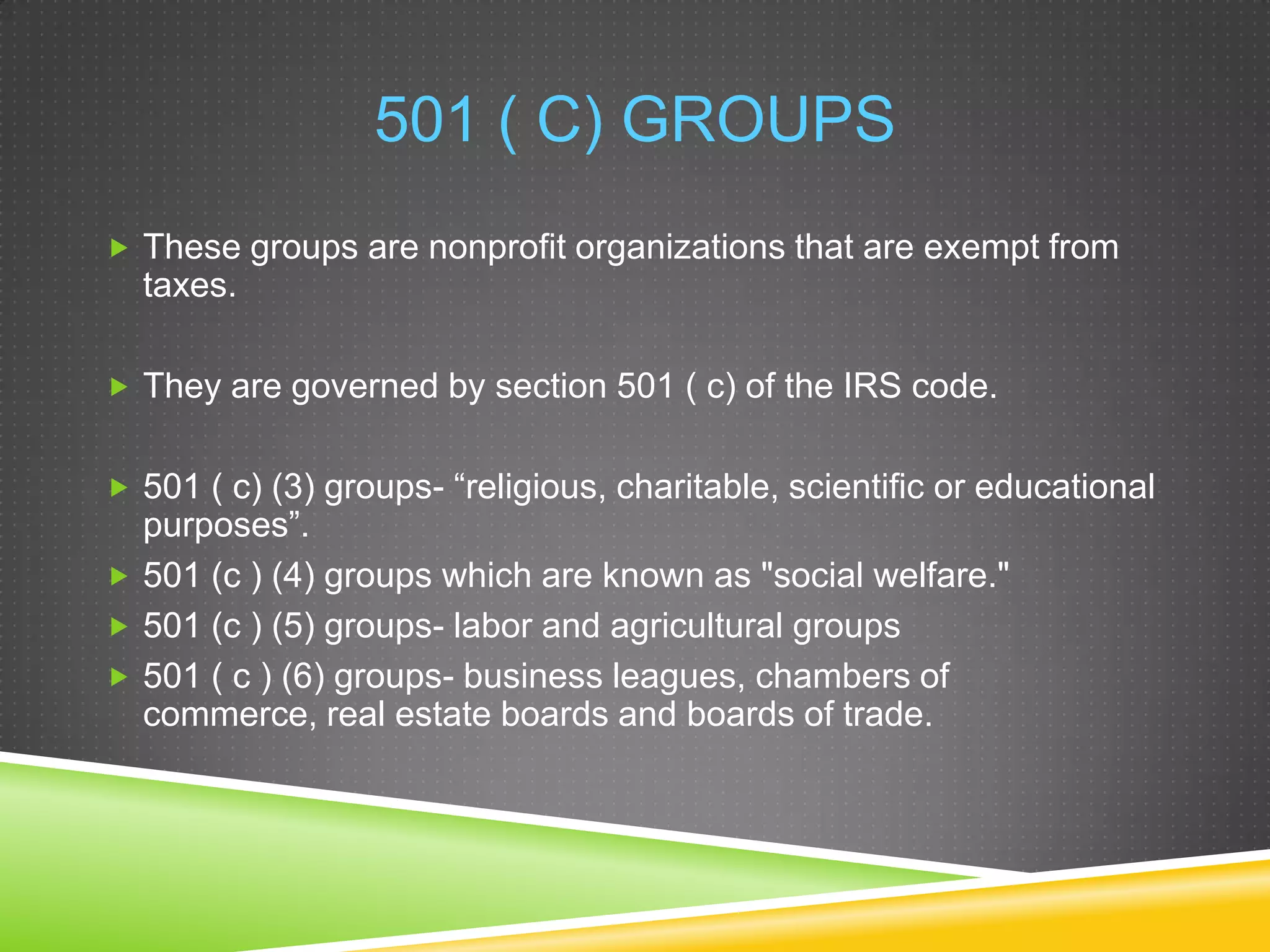
501 ( C) GROUPS
 These groups are nonprofit organizations that are exempt from

taxes.
 They are governed by section 501 ( c) of the IRS code.
 501 ( c) (3) groups- “religious, charitable, scientific or educational

purposes”.
 501 (c ) (4) groups which are known as "social welfare."
 501 (c ) (5) groups- labor and agricultural groups
 501 ( c ) (6) groups- business leagues, chambers of
commerce, real estate boards and boards of trade.
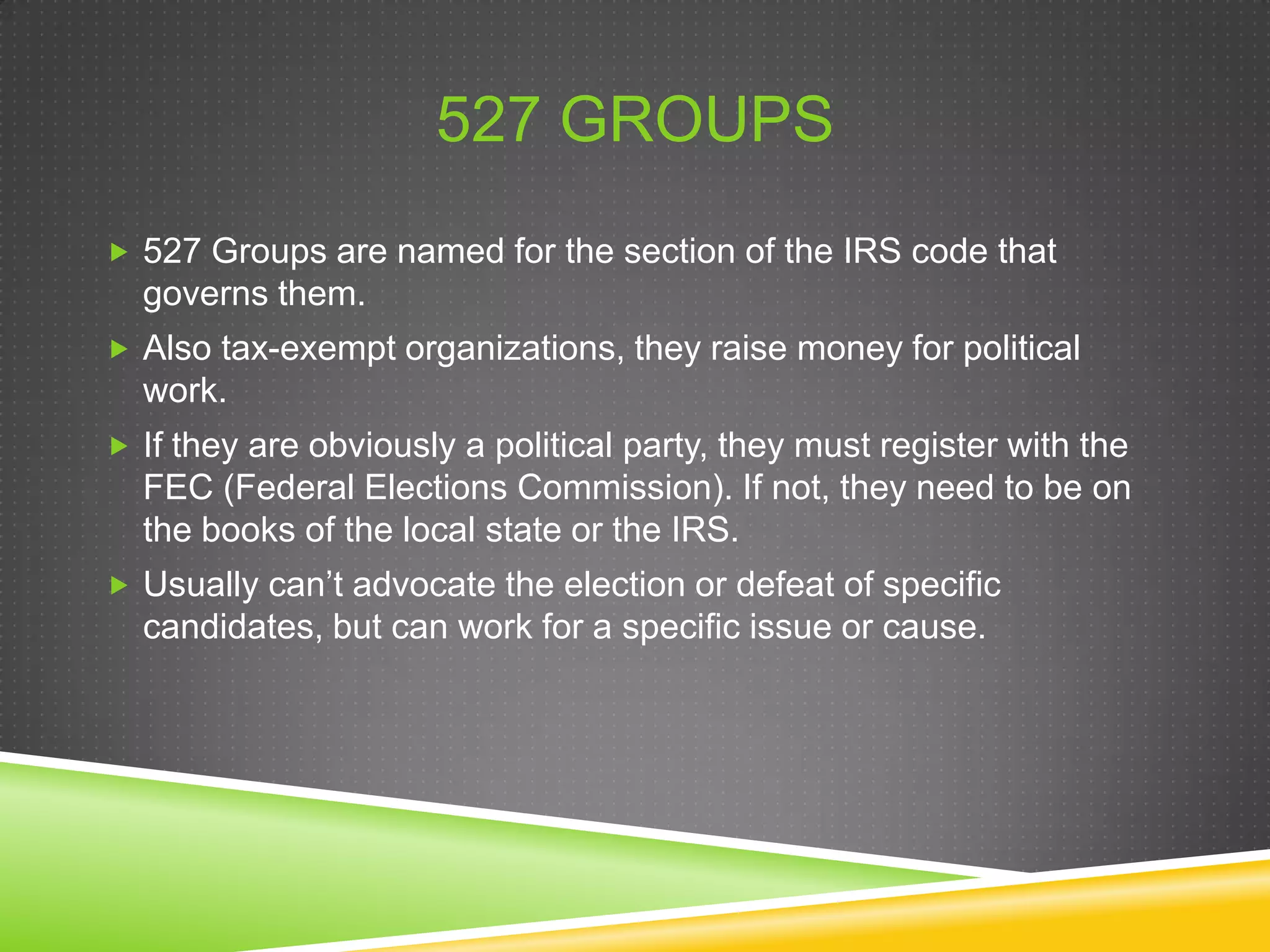
527 GROUPS
 527 Groups are named for the section of the IRS code that

governs them.
 Also tax-exempt organizations, they raise money for political

work.
 If they are obviously a political party, they must register with the

FEC (Federal Elections Commission). If not, they need to be on
the books of the local state or the IRS.
 Usually can’t advocate the election or defeat of specific

candidates, but can work for a specific issue or cause.
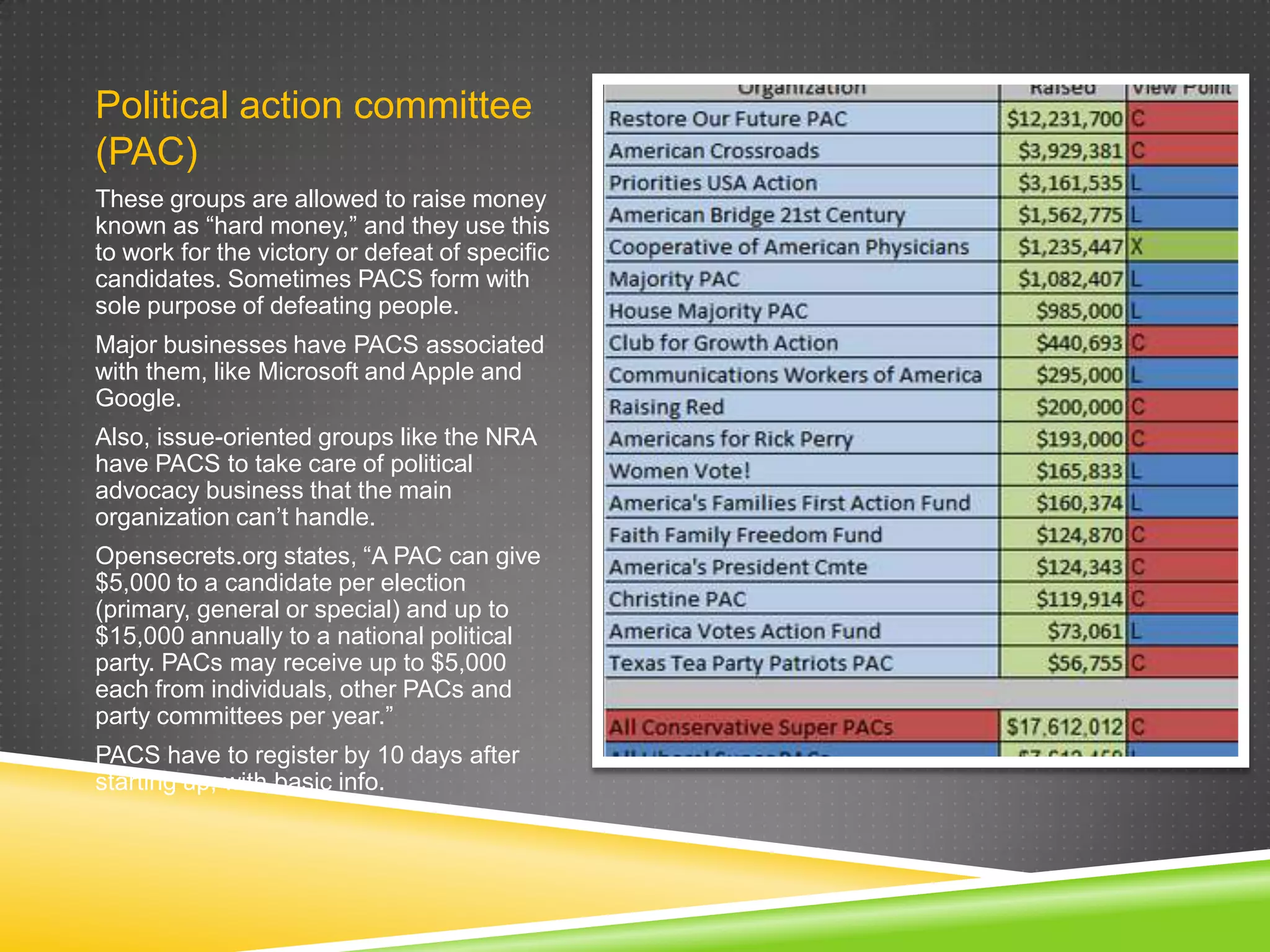
Political action committee
(PAC)
These groups are allowed to raise money
known as “hard money,” and they use this
to work for the victory or defeat of specific
candidates. Sometimes PACS form with
sole purpose of defeating people.
Major businesses have PACS associated
with them, like Microsoft and Apple and
Google.
Also, issue-oriented groups like the NRA
have PACS to take care of political
advocacy business that the main
organization can’t handle.

Opensecrets.org states, “A PAC can give
$5,000 to a candidate per election
(primary, general or special) and up to
$15,000 annually to a national political
party. PACs may receive up to $5,000
each from individuals, other PACs and
party committees per year.”
PACS have to register by 10 days after
starting up, with basic info.
WORKS CITED
 http://www.opensecrets.org
 Federal Elections Commission

Issue adovacy- 527s, PACs and Super PACs

  • 1.
  • 2.
    INTRODUCTION TO ADVOCACY GROUPS When you want to spend money getting your voice heard on an issue or a candidate, the best thing to do is form your own issue advocacy group.  There are so many different kinds of groups, & they all have their own laws guiding them.  Congress and the FEC (Federal Elections Commission) make the rules for all of the different groups and make sure they don’t break the rules.
  • 3.
    FEC & CONGRESSRULES Expenditure reports. Fundraising details: a. Who raised the money. b. How much was raised List of donor names
  • 4.
  • 5.
    BRIEF HISTORY  Spendinglarge amounts of money to influence voters for specific issues has been around for a long time.  As the U.S. has grown and technology has increased, so has modern election spending.  “527 groups” are relatively new to American politics, as are PACS, or Super PACS.  “527 groups” are named for the section of USA tax code that is relevant to them.  PAC stands for Political Action Committee.  Super PAC is a bigger version of Political Action Committee.
  • 6.
    DIFFERENT TYPES OFGROUPS The Center for Responsive Politics has a website, www.opensecrets.org, which gives great information about the different sorts of groups that spend money in elections to advocate for different causes. These include the following• 501( c) groups. • 527 group. • Political Action Committee (PAC). • Super PACS.
  • 7.
    MORE INFORMATION &EXAMPLES  501 ( c ) AFL-CIO  527 groups Progress for America Voter Fund  Super PAC Priorities USA Action  PAC American Bankers Association http://www.opensecrets.org http://www.youtube.com/watch?v=-mgHeq_Z0cQ
  • 8.
    501 ( C)GROUPS  These groups are nonprofit organizations that are exempt from taxes.  They are governed by section 501 ( c) of the IRS code.  501 ( c) (3) groups- “religious, charitable, scientific or educational purposes”.  501 (c ) (4) groups which are known as "social welfare."  501 (c ) (5) groups- labor and agricultural groups  501 ( c ) (6) groups- business leagues, chambers of commerce, real estate boards and boards of trade.
  • 9.
    527 GROUPS  527Groups are named for the section of the IRS code that governs them.  Also tax-exempt organizations, they raise money for political work.  If they are obviously a political party, they must register with the FEC (Federal Elections Commission). If not, they need to be on the books of the local state or the IRS.  Usually can’t advocate the election or defeat of specific candidates, but can work for a specific issue or cause.
  • 10.
    Political action committee (PAC) Thesegroups are allowed to raise money known as “hard money,” and they use this to work for the victory or defeat of specific candidates. Sometimes PACS form with sole purpose of defeating people. Major businesses have PACS associated with them, like Microsoft and Apple and Google. Also, issue-oriented groups like the NRA have PACS to take care of political advocacy business that the main organization can’t handle. Opensecrets.org states, “A PAC can give $5,000 to a candidate per election (primary, general or special) and up to $15,000 annually to a national political party. PACs may receive up to $5,000 each from individuals, other PACs and party committees per year.” PACS have to register by 10 days after starting up, with basic info.
  • 11.

Editor's Notes

  • #9 http://www.opensecrets.org/527s/types.php