
Predicting Defects Using
Change Genealogies
Kim Herzig*, Sascha Just†, Andreas Rau†, Andreas Zeller†
* Microsoft Research, UK

† Saarland University,

Germany
Prediction Models
• Goal: determine the likelihood of bugs in

code entities

 Quality assurance limited by time and money.
 Can be helpful for project outsiders.

• Trained on “ground truth”
 Known instances and their properties.
 Idea: learning from past for future.

• Predicting / estimating defect likelihood of

new, unknown code entities
Fine-Tuning Prediction Models
Machine Learner

Training Methods
Metrics (independent variables)
Prediction Target
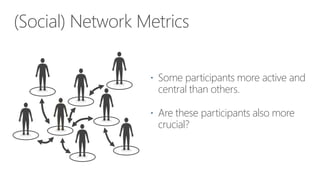
(Social) Network Metrics
 Some participants more active and

central than others.

 Are these participants also more

crucial?
Code Network Metrics

[2008] Zimmermann and Nagappan: “Predicting Defects using Network Analysis on Dependency Graphs”

10100
10010
1101011000
1001011001
0001010111
1001011001

10100
10010
1101011000
1001011001
0001010111
1001011001

10100
10010
1101011000
1001011001
0001010111
1001011001

10100
10010
1101011000
1001011001
0001010111
1001011001

 Code entities communicate with

each other.

Call graphs do not
change significantly  Use call graph network to
compute network metrics.
over time!
10100
10010
1101011000
1001011001
0001010111
1001011001

10100
10010
1101011000
1001011001
0001010111
1001011001

10100
10010
1101011000
1001011001
0001010111
1001011001

10100
10010
1101011000
1001011001
0001010111
1001011001

 Assumption: “Central binaries tend to

be defect-prone”.
Change Network Metrics
Idea: Use dependencies between code changes
 Code changes depend on each

other.

 Central code changes tend to be

crucial.

Change Genealogies

 Assumption: “Code being crucially

changed tend to be defect prone”.
Change Genealogies (in a nutshell)
[2013] Kim Herzig: “Mining and Untangling Change Genealogies” (PhD thesis)

Directed graph structure
Method level dependencies

Multi-dimensional (space & time)
Change Genealogy Metrics
 EGO network metrics
 Measures the immediate impact of changes on other changes.

 GLOBAL network metrics
 Express the long-term impact of changes on other changes.

 Considering the type of the change
 Adding method definition, modifying method call

 Considering parent age
 How old are the parent changes a change depends on.

Change genealogy metrics must be aggregated to source file level.
Experimental Setup
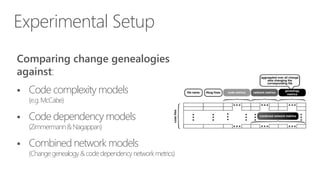
Comparing change genealogies
against:


Code complexity models
(e.g. McCabe)



Code dependency models
(Zimmermann & Nagappan)



Combined network models

(Change genealogy & code dependency network metrics)
Experimental Setup

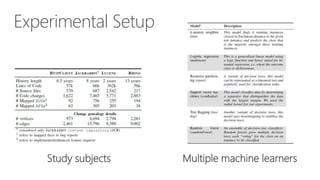
Study subjects

Multiple machine learners
Prediction Precision

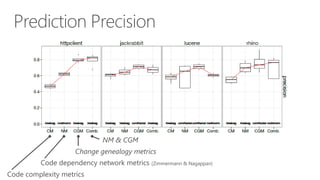
NM & CGM

Change genealogy metrics
Code dependency network metrics (Zimmermann & Nagappan)
Code complexity metrics
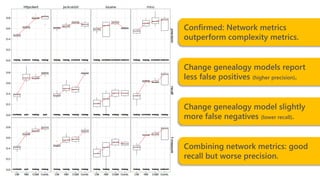
Confirmed: Network metrics
outperform complexity metrics.
Change genealogy models report
less false positives (higher precision).
Change genealogy model slightly
more false negatives (lower recall).
Combining network metrics: good
recall but worse precision.
Influential Metrics
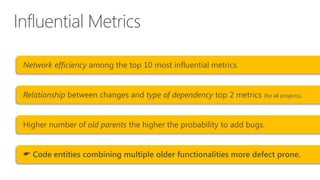
Network efficiency among the top 10 most influential metrics.
Relationship between changes and type of dependency top 2 metrics (for all projects).
Higher number of old parents the higher the probability to add bugs.
 Code entities combining multiple older functionalities more defect prone.
Summary

Adapting social network metrics

to change dependency graphs.

Comparing prediction models.

 Change genealogies are well suited for defect prediction

(better precision, close recall).

 Code entities combining multiple older functionalities more defect prone.

Predicting Defects Using Change Genealogies (ISSE 2013)

  • 1.
    Predicting Defects Using ChangeGenealogies Kim Herzig*, Sascha Just†, Andreas Rau†, Andreas Zeller† * Microsoft Research, UK † Saarland University, Germany
  • 2.
    Prediction Models • Goal:determine the likelihood of bugs in code entities  Quality assurance limited by time and money.  Can be helpful for project outsiders. • Trained on “ground truth”  Known instances and their properties.  Idea: learning from past for future. • Predicting / estimating defect likelihood of new, unknown code entities
  • 3.
    Fine-Tuning Prediction Models MachineLearner Training Methods Metrics (independent variables) Prediction Target
  • 4.
    (Social) Network Metrics Some participants more active and central than others.  Are these participants also more crucial?
  • 5.
    Code Network Metrics [2008]Zimmermann and Nagappan: “Predicting Defects using Network Analysis on Dependency Graphs” 10100 10010 1101011000 1001011001 0001010111 1001011001 10100 10010 1101011000 1001011001 0001010111 1001011001 10100 10010 1101011000 1001011001 0001010111 1001011001 10100 10010 1101011000 1001011001 0001010111 1001011001  Code entities communicate with each other. Call graphs do not change significantly  Use call graph network to compute network metrics. over time! 10100 10010 1101011000 1001011001 0001010111 1001011001 10100 10010 1101011000 1001011001 0001010111 1001011001 10100 10010 1101011000 1001011001 0001010111 1001011001 10100 10010 1101011000 1001011001 0001010111 1001011001  Assumption: “Central binaries tend to be defect-prone”.
  • 6.
    Change Network Metrics Idea:Use dependencies between code changes  Code changes depend on each other.  Central code changes tend to be crucial. Change Genealogies  Assumption: “Code being crucially changed tend to be defect prone”.
  • 7.
    Change Genealogies (ina nutshell) [2013] Kim Herzig: “Mining and Untangling Change Genealogies” (PhD thesis) Directed graph structure Method level dependencies Multi-dimensional (space & time)
  • 8.
    Change Genealogy Metrics EGO network metrics  Measures the immediate impact of changes on other changes.  GLOBAL network metrics  Express the long-term impact of changes on other changes.  Considering the type of the change  Adding method definition, modifying method call  Considering parent age  How old are the parent changes a change depends on. Change genealogy metrics must be aggregated to source file level.
  • 9.
    Experimental Setup Comparing changegenealogies against:  Code complexity models (e.g. McCabe)  Code dependency models (Zimmermann & Nagappan)  Combined network models (Change genealogy & code dependency network metrics)
  • 10.
  • 11.
    Prediction Precision NM &CGM Change genealogy metrics Code dependency network metrics (Zimmermann & Nagappan) Code complexity metrics
  • 12.
    Confirmed: Network metrics outperformcomplexity metrics. Change genealogy models report less false positives (higher precision). Change genealogy model slightly more false negatives (lower recall). Combining network metrics: good recall but worse precision.
  • 13.
    Influential Metrics Network efficiencyamong the top 10 most influential metrics. Relationship between changes and type of dependency top 2 metrics (for all projects). Higher number of old parents the higher the probability to add bugs.  Code entities combining multiple older functionalities more defect prone.
  • 14.
    Summary Adapting social networkmetrics to change dependency graphs. Comparing prediction models.  Change genealogies are well suited for defect prediction (better precision, close recall).  Code entities combining multiple older functionalities more defect prone.