MINING APPS FOR ABNORMAL USAGE OF SENSITIVE DATA
By Anik Ralhan(Paper 8 – Security)
Course Name: SENG 607 L01 - Special
Topics in Software Engineering
Supervisor: Prof. Hadi Hemmati
1
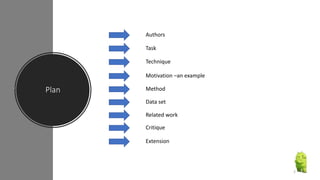
Plan
Authors
Task
Technique
Motivation –an example
Method
Data set
Related work
Critique
Extension
2
Authors
PhD student, Since summer
2014 I'm working as a
research assistant at
Software Engineering chair
Saarland University
Vitalii Avdiienko Konstantin Kuznetsov
PhD student in the
Software
Engineering Chair
at Saarland
University
Alessandra Gorla
Assistant researcher
professor at
the IMDEA Software
Institute in Madrid,
Spain.
3
Authors
Contd.
Andreas Zeller
Full professor for Software Engineering at Saarland University in Germany
4
Authors
Contd.
Head of Department
Secure Software
Engineering at Fraunhofer
SIT
Steven Arzt Siegfried Rasthofer
Researcher,
Fraunhofer
Institute for
Secure
Information
Technology
Head of program
committee of ACM
International
Symposium on
Engineering Secure
Software and
Systems (ESSoS)
Prof. Dr. Eric Bodden
5
Task
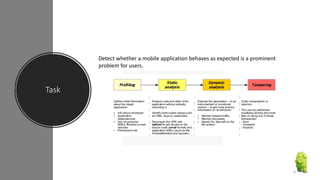
Detect whether a mobile application behaves as expected is a prominent
problem for users.
6
Technique
7
Technique
Contd.
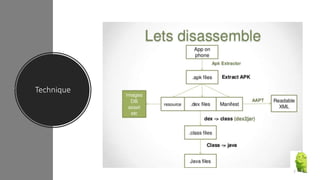
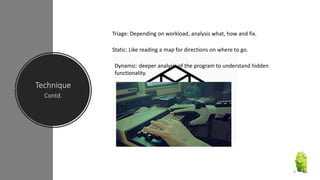
Triage: Depending on workload, analysis what, how and fix.
Static: Like reading a map for directions on where to go.
Dynamic: deeper analysis of the program to understand hidden
functionality.
8
Technique:
MUDFLOW
Not just a pattern match.
Trained with flow of data in benign apps.
compares behavior of mined large set of benign apps.
If abnormal, it declares as
Malicious!!!!!!!!!
9
Motivation
10
Motivation
Contd.
11
Motivation
Contd.
12
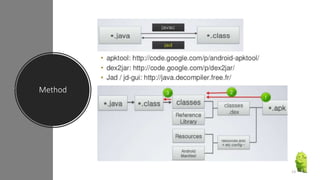
Method
13
Method
Contd.
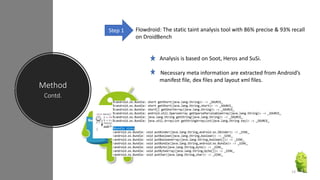
Flowdroid: The static taint analysis tool with 86% precise & 93% recall
on DroidBench
Analysis is based on Soot, Heros and SuSi.
Necessary meta information are extracted from Android’s
manifest file, dex files and layout xml files.
Step 1
14
Method
Contd.
15
Method
Contd.
16
Method
Contd.
java -Xmx4g -cp soot-trunk.jar;soot-infoflow.jar;soot-infoflow-
android.jar;slf4j-api-1.7.5.jar;slf4j-simple-1.7.5.jar;axml-2.0.jar
soot.jimple.infoflow.android.TestApps.Test "InsecureBank.apk"
C:UsersanikDownloadssdkplatforms
Heap size dependencies
Input file
17
Method
Contd.
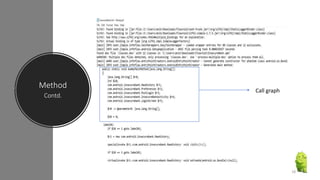
Call graph
18
Method
Contd.
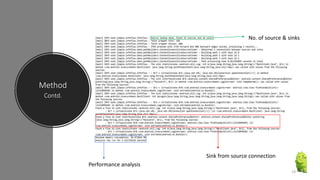
No. of source & sinks
Sink from source connection
Performance analysis
19
Method
Contd.
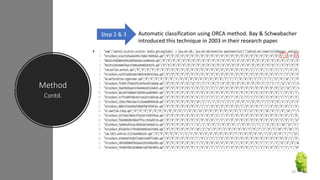
Automatic classification using ORCA method. Bay & Schwabacher
introduced this technique in 2003 in their research paper.
Step 2 & 3
20
Data
The initial test was conducted in March 2014 on 2950 apps from 30
app category. 2866 apps they could test.
Benign
25,577 apps selected from VirusShare and Genom malware projects .
15,338 apps were actually test.
Malicious
21
Data
Contd.
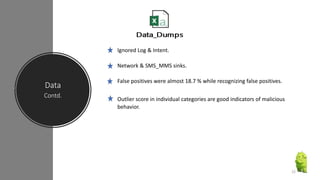
Ignored Log & Intent.
Network & SMS_MMS sinks.
False positives were almost 18.7 % while recognizing false positives.
Outlier score in individual categories are good indicators of malicious
behavior.
22
Related
Work
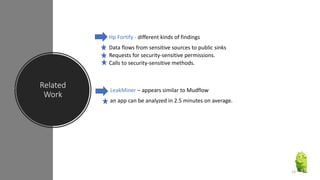
Hp Fortify - different kinds of findings
Data flows from sensitive sources to public sinks
Requests for security-sensitive permissions.
Calls to security-sensitive methods.
LeakMiner – appears similar to Mudflow
an app can be analyzed in 2.5 minutes on average.
23
Critique
FlowDroid performance tuning technique is not used to fix 16
apps RAM size issue.
24
Extension
Optimize analysis so that apps of varied sizes can be analyzed.1
Provide results in comparison commercial tools available in market like
we discussed and conduct a survey with industry experts.
2
25
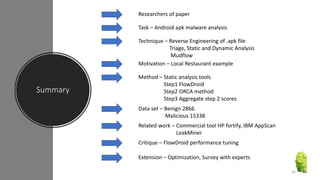
Summary
Researchers of paper
Task – Android apk malware analysis
Technique – Reverse Engineering of .apk file
Triage, Static and Dynamic Analysis
Mudflow
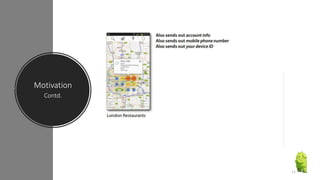
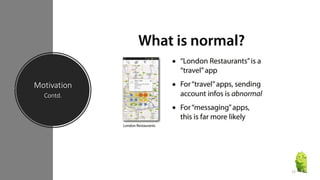
Motivation – Local Restaurant example
Method – Static analysis tools
Step1 FlowDroid
Step2 ORCA method
Step3 Aggregate step 2 scores
Data set – Benign 2866
Malicious 15338
Related work – Commercial tool HP fortify, IBM AppScan
LeakMiner
Critique – FlowDroid performance tuning
Extension – Optimization, Survey with experts
26

Reverse Engineering android Malware analysis

  • 1.
    MINING APPS FORABNORMAL USAGE OF SENSITIVE DATA By Anik Ralhan(Paper 8 – Security) Course Name: SENG 607 L01 - Special Topics in Software Engineering Supervisor: Prof. Hadi Hemmati 1
  • 2.
  • 3.
    Authors PhD student, Sincesummer 2014 I'm working as a research assistant at Software Engineering chair Saarland University Vitalii Avdiienko Konstantin Kuznetsov PhD student in the Software Engineering Chair at Saarland University Alessandra Gorla Assistant researcher professor at the IMDEA Software Institute in Madrid, Spain. 3
  • 4.
    Authors Contd. Andreas Zeller Full professorfor Software Engineering at Saarland University in Germany 4
  • 5.
    Authors Contd. Head of Department SecureSoftware Engineering at Fraunhofer SIT Steven Arzt Siegfried Rasthofer Researcher, Fraunhofer Institute for Secure Information Technology Head of program committee of ACM International Symposium on Engineering Secure Software and Systems (ESSoS) Prof. Dr. Eric Bodden 5
  • 6.
    Task Detect whether amobile application behaves as expected is a prominent problem for users. 6
  • 7.
  • 8.
    Technique Contd. Triage: Depending onworkload, analysis what, how and fix. Static: Like reading a map for directions on where to go. Dynamic: deeper analysis of the program to understand hidden functionality. 8
  • 9.
    Technique: MUDFLOW Not just apattern match. Trained with flow of data in benign apps. compares behavior of mined large set of benign apps. If abnormal, it declares as Malicious!!!!!!!!! 9
  • 10.
  • 11.
  • 12.
  • 13.
  • 14.
    Method Contd. Flowdroid: The statictaint analysis tool with 86% precise & 93% recall on DroidBench Analysis is based on Soot, Heros and SuSi. Necessary meta information are extracted from Android’s manifest file, dex files and layout xml files. Step 1 14
  • 15.
  • 16.
  • 17.
    Method Contd. java -Xmx4g -cpsoot-trunk.jar;soot-infoflow.jar;soot-infoflow- android.jar;slf4j-api-1.7.5.jar;slf4j-simple-1.7.5.jar;axml-2.0.jar soot.jimple.infoflow.android.TestApps.Test "InsecureBank.apk" C:UsersanikDownloadssdkplatforms Heap size dependencies Input file 17
  • 18.
  • 19.
    Method Contd. No. of source& sinks Sink from source connection Performance analysis 19
  • 20.
    Method Contd. Automatic classification usingORCA method. Bay & Schwabacher introduced this technique in 2003 in their research paper. Step 2 & 3 20
  • 21.
    Data The initial testwas conducted in March 2014 on 2950 apps from 30 app category. 2866 apps they could test. Benign 25,577 apps selected from VirusShare and Genom malware projects . 15,338 apps were actually test. Malicious 21
  • 22.
    Data Contd. Ignored Log &Intent. Network & SMS_MMS sinks. False positives were almost 18.7 % while recognizing false positives. Outlier score in individual categories are good indicators of malicious behavior. 22
  • 23.
    Related Work Hp Fortify -different kinds of findings Data flows from sensitive sources to public sinks Requests for security-sensitive permissions. Calls to security-sensitive methods. LeakMiner – appears similar to Mudflow an app can be analyzed in 2.5 minutes on average. 23
  • 24.
    Critique FlowDroid performance tuningtechnique is not used to fix 16 apps RAM size issue. 24
  • 25.
    Extension Optimize analysis sothat apps of varied sizes can be analyzed.1 Provide results in comparison commercial tools available in market like we discussed and conduct a survey with industry experts. 2 25
  • 26.
    Summary Researchers of paper Task– Android apk malware analysis Technique – Reverse Engineering of .apk file Triage, Static and Dynamic Analysis Mudflow Motivation – Local Restaurant example Method – Static analysis tools Step1 FlowDroid Step2 ORCA method Step3 Aggregate step 2 scores Data set – Benign 2866 Malicious 15338 Related work – Commercial tool HP fortify, IBM AppScan LeakMiner Critique – FlowDroid performance tuning Extension – Optimization, Survey with experts 26