1
ISOTOPE RATIO MASS SPECTROMETER (IRMS)
Isotope ratio mass spectrometry is a technique for measuring the quantity of stable isotopes in a
sample in order to determine the characteristics of the sample, including its composition and
origin. This technique is applied in the IRMS to measure environmental isotopes, measuring the
amount of stable isotopes in elements such as hydrogen, oxygen, carbon, nitrogen and sulfur.
Although often presumed to be constant and stable, natural isotope abundance ratios show
significant and characteristic variations when measured very precisely. In isotope ratio mass
spectrometry, element isotope ratios are determined very accurately and precisely. Typically, a
single focusing magnetic sector mass spectrometers with fixed multiple detectors (one per
isotope) are used. Complex compounds are reduced to simple molecules prior to measurement;
for example, organic compounds are combusted to CO2, SO2, H2 and N2 gaseous.
STABLE ISOTOPE ANALYSIS (2H, 13C, 15N, 18O and 34S)
Stable isotope analyses were performed using SERCON GEO 20–20 Continuous Flow Isotope
Ratio Mass Spectrometer (CF–IRMS). The continuous flow mass spectrometry offers on–line
sample preparation, smaller sample size, faster and simpler analysis and cost effective compared
to Dual Inlet Isotope Ratio Mass Spectrometer (DI–IRMS). CF–IRMS also can be interfaced
with other preparation techniques, including elemental analyzer (EA), gas chromatography (GC)
and recently, liquid chromatography (LC).
Stable isotope compositions are generally reported as  (pronounced delta) values in units of
parts per thousand (denoted as ‰ or permil / per mill), relative to a standard of known
composition (e.g. Vienna Standard Mean Ocean Water (VSMOW) for 2H and 18O analyses, Pee–
Dee Belemnite (PDB) for 13C analysis, air or known secondary standard for 15N and Canyon
Diablo Troilite (CDT) for 34S). The  values are calculated using by Equation 1, in this case, for
deuterium:
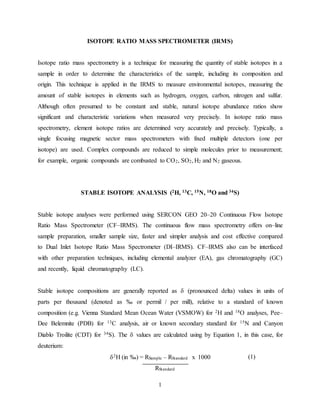
2H (in ‰) = RSample – RStandard x 1000
RStandard
(1)
2
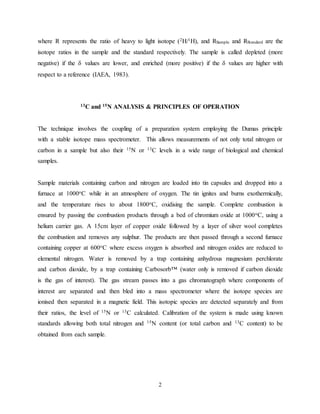
where R represents the ratio of heavy to light isotope (2H/1H), and RSample and RStandard are the
isotope ratios in the sample and the standard respectively. The sample is called depleted (more
negative) if the  values are lower, and enriched (more positive) if the  values are higher with
respect to a reference (IAEA, 1983).
13C and 15N ANALYSIS & PRINCIPLES OF OPERATION
The technique involves the coupling of a preparation system employing the Dumas principle
with a stable isotope mass spectrometer. This allows measurements of not only total nitrogen or
carbon in a sample but also their 15N or 13C levels in a wide range of biological and chemical
samples.
Sample materials containing carbon and nitrogen are loaded into tin capsules and dropped into a
furnace at 1000oC while in an atmosphere of oxygen. The tin ignites and burns exothermically,
and the temperature rises to about 1800oC, oxidising the sample. Complete combustion is
ensured by passing the combustion products through a bed of chromium oxide at 1000oC, using a
helium carrier gas. A 15cm layer of copper oxide followed by a layer of silver wool completes
the combustion and removes any sulphur. The products are then passed through a second furnace
containing copper at 600oC where excess oxygen is absorbed and nitrogen oxides are reduced to
elemental nitrogen. Water is removed by a trap containing anhydrous magnesium perchlorate
and carbon dioxide, by a trap containing Carbosorb™ (water only is removed if carbon dioxide
is the gas of interest). The gas stream passes into a gas chromatograph where components of
interest are separated and then bled into a mass spectrometer where the isotope species are
ionised then separated in a magnetic field. This isotopic species are detected separately and from
their ratios, the level of 15N or 13C calculated. Calibration of the system is made using known
standards allowing both total nitrogen and 15N content (or total carbon and 13C content) to be
obtained from each sample.
3
2H and 18O ANALYSES & PRINCIPLES OF OPERATION
Samples for 2H–H2O and 18O–H2O analyses were treated in the SERCON Water Equilibration
System (WES) prior to analysis through the IRMS. Only 0.5ml of water samples in a vial were
used for each analysis. The 18O–H2O values were measured via equilibration with CO2 at 50oC
for 8 hours, and 2H–H2O values were measured via equilibration with H2 and its reaction with
the Platinum stick catalyst at 50oC for 1 hour. In the 2H–H2O analysis, a platinum catalyst stick
was used to accelerate the reaction, and gas exchange equilibrium took place between the
introduced pure H2 gas and water vapour. This gas exchange equilibrium caused the water
vapour to emit a signature to the introduced pure H2 gas, which represents the isotopic
composition of the water before the H2 gas is analysed by the IRMS.
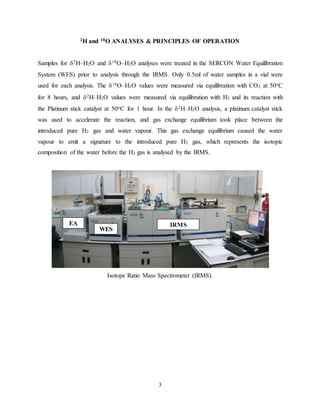
Isotope Ratio Mass Spectrometer (IRMS).
EA
WES
IRMS
4
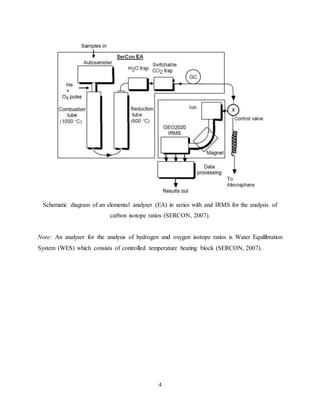
Schematic diagram of an elemental analyser (EA) in series with and IRMS for the analysis of
carbon isotope ratios (SERCON, 2007).
Note: An analyser for the analysis of hydrogen and oxygen isotope ratios is Water Equilibration
System (WES) which consists of controlled temperature heating block (SERCON, 2007).
5
SAMPLE SIZE
Nitrogen
Samples would normally contain approximately 100µg N. The system linearity has been checked
for samples in the range of 200µg N to 40ug N. Samples within this range will give to correct
results.
It is possible to analyse samples of both higher and lower Nitrogen content. The user should
determine linearity and precision levels at higher and lower N values. Note: The oxygen blank (N
Content) is very low. It should be possible to reliably measure samples containing as low as 5 or
10µg N.
CO2
Samples would normally contain approximately 400ug C. The system linearity has been checked
for samples in the range of 800ug down to 200ug C. Samples within this range should give
correct results.
It is possible to analyse samples of both higher and lower C content. The user should determine
linearity and precision levels at higher and lower C values. To increase sensitivity for smaller C
samples, the trap current can be increased from 150 to a maximum of 600.
Enriched samples
The SERCON instrument can measure natural abundance and enriched samples. No memory
effect (carry over) is present in the mass spectrometer but there can always be a little from the
elemental analyser. Carry over is negligible for natural abundance or low enriched samples. The
instrument precision at natural abundance means that lower enrichments can be used in tracer
studies. If highly enriched samples are to be run, it is advisable to run one or two extra natural
abundance test samples before any natural abundance references in your sample setup.
6
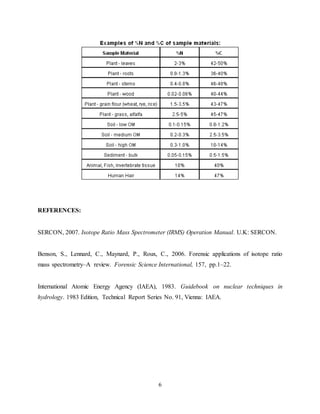
REFERENCES:
SERCON, 2007. Isotope Ratio Mass Spectrometer (IRMS) Operation Manual. U.K: SERCON.
Benson, S., Lennard, C., Maynard, P., Roux, C., 2006. Forensic applications of isotope ratio
mass spectrometry–A review. Forensic Science International, 157, pp.1–22.
International Atomic Energy Agency (IAEA), 1983. Guidebook on nuclear techniques in
hydrology. 1983 Edition, Technical Report Series No. 91, Vienna: IAEA.

Isotope ratio mass spectrometer description

  • 1.
    1 ISOTOPE RATIO MASSSPECTROMETER (IRMS) Isotope ratio mass spectrometry is a technique for measuring the quantity of stable isotopes in a sample in order to determine the characteristics of the sample, including its composition and origin. This technique is applied in the IRMS to measure environmental isotopes, measuring the amount of stable isotopes in elements such as hydrogen, oxygen, carbon, nitrogen and sulfur. Although often presumed to be constant and stable, natural isotope abundance ratios show significant and characteristic variations when measured very precisely. In isotope ratio mass spectrometry, element isotope ratios are determined very accurately and precisely. Typically, a single focusing magnetic sector mass spectrometers with fixed multiple detectors (one per isotope) are used. Complex compounds are reduced to simple molecules prior to measurement; for example, organic compounds are combusted to CO2, SO2, H2 and N2 gaseous. STABLE ISOTOPE ANALYSIS (2H, 13C, 15N, 18O and 34S) Stable isotope analyses were performed using SERCON GEO 20–20 Continuous Flow Isotope Ratio Mass Spectrometer (CF–IRMS). The continuous flow mass spectrometry offers on–line sample preparation, smaller sample size, faster and simpler analysis and cost effective compared to Dual Inlet Isotope Ratio Mass Spectrometer (DI–IRMS). CF–IRMS also can be interfaced with other preparation techniques, including elemental analyzer (EA), gas chromatography (GC) and recently, liquid chromatography (LC). Stable isotope compositions are generally reported as  (pronounced delta) values in units of parts per thousand (denoted as ‰ or permil / per mill), relative to a standard of known composition (e.g. Vienna Standard Mean Ocean Water (VSMOW) for 2H and 18O analyses, Pee– Dee Belemnite (PDB) for 13C analysis, air or known secondary standard for 15N and Canyon Diablo Troilite (CDT) for 34S). The  values are calculated using by Equation 1, in this case, for deuterium: 2H (in ‰) = RSample – RStandard x 1000 RStandard (1)
  • 2.
    2 where R representsthe ratio of heavy to light isotope (2H/1H), and RSample and RStandard are the isotope ratios in the sample and the standard respectively. The sample is called depleted (more negative) if the  values are lower, and enriched (more positive) if the  values are higher with respect to a reference (IAEA, 1983). 13C and 15N ANALYSIS & PRINCIPLES OF OPERATION The technique involves the coupling of a preparation system employing the Dumas principle with a stable isotope mass spectrometer. This allows measurements of not only total nitrogen or carbon in a sample but also their 15N or 13C levels in a wide range of biological and chemical samples. Sample materials containing carbon and nitrogen are loaded into tin capsules and dropped into a furnace at 1000oC while in an atmosphere of oxygen. The tin ignites and burns exothermically, and the temperature rises to about 1800oC, oxidising the sample. Complete combustion is ensured by passing the combustion products through a bed of chromium oxide at 1000oC, using a helium carrier gas. A 15cm layer of copper oxide followed by a layer of silver wool completes the combustion and removes any sulphur. The products are then passed through a second furnace containing copper at 600oC where excess oxygen is absorbed and nitrogen oxides are reduced to elemental nitrogen. Water is removed by a trap containing anhydrous magnesium perchlorate and carbon dioxide, by a trap containing Carbosorb™ (water only is removed if carbon dioxide is the gas of interest). The gas stream passes into a gas chromatograph where components of interest are separated and then bled into a mass spectrometer where the isotope species are ionised then separated in a magnetic field. This isotopic species are detected separately and from their ratios, the level of 15N or 13C calculated. Calibration of the system is made using known standards allowing both total nitrogen and 15N content (or total carbon and 13C content) to be obtained from each sample.
  • 3.
    3 2H and 18OANALYSES & PRINCIPLES OF OPERATION Samples for 2H–H2O and 18O–H2O analyses were treated in the SERCON Water Equilibration System (WES) prior to analysis through the IRMS. Only 0.5ml of water samples in a vial were used for each analysis. The 18O–H2O values were measured via equilibration with CO2 at 50oC for 8 hours, and 2H–H2O values were measured via equilibration with H2 and its reaction with the Platinum stick catalyst at 50oC for 1 hour. In the 2H–H2O analysis, a platinum catalyst stick was used to accelerate the reaction, and gas exchange equilibrium took place between the introduced pure H2 gas and water vapour. This gas exchange equilibrium caused the water vapour to emit a signature to the introduced pure H2 gas, which represents the isotopic composition of the water before the H2 gas is analysed by the IRMS. Isotope Ratio Mass Spectrometer (IRMS). EA WES IRMS
  • 4.
    4 Schematic diagram ofan elemental analyser (EA) in series with and IRMS for the analysis of carbon isotope ratios (SERCON, 2007). Note: An analyser for the analysis of hydrogen and oxygen isotope ratios is Water Equilibration System (WES) which consists of controlled temperature heating block (SERCON, 2007).
  • 5.
    5 SAMPLE SIZE Nitrogen Samples wouldnormally contain approximately 100µg N. The system linearity has been checked for samples in the range of 200µg N to 40ug N. Samples within this range will give to correct results. It is possible to analyse samples of both higher and lower Nitrogen content. The user should determine linearity and precision levels at higher and lower N values. Note: The oxygen blank (N Content) is very low. It should be possible to reliably measure samples containing as low as 5 or 10µg N. CO2 Samples would normally contain approximately 400ug C. The system linearity has been checked for samples in the range of 800ug down to 200ug C. Samples within this range should give correct results. It is possible to analyse samples of both higher and lower C content. The user should determine linearity and precision levels at higher and lower C values. To increase sensitivity for smaller C samples, the trap current can be increased from 150 to a maximum of 600. Enriched samples The SERCON instrument can measure natural abundance and enriched samples. No memory effect (carry over) is present in the mass spectrometer but there can always be a little from the elemental analyser. Carry over is negligible for natural abundance or low enriched samples. The instrument precision at natural abundance means that lower enrichments can be used in tracer studies. If highly enriched samples are to be run, it is advisable to run one or two extra natural abundance test samples before any natural abundance references in your sample setup.
  • 6.
    6 REFERENCES: SERCON, 2007. IsotopeRatio Mass Spectrometer (IRMS) Operation Manual. U.K: SERCON. Benson, S., Lennard, C., Maynard, P., Roux, C., 2006. Forensic applications of isotope ratio mass spectrometry–A review. Forensic Science International, 157, pp.1–22. International Atomic Energy Agency (IAEA), 1983. Guidebook on nuclear techniques in hydrology. 1983 Edition, Technical Report Series No. 91, Vienna: IAEA.