5th BAERA Training Course on Radiation Protection
for Radiation Control Officers (RCO) of Industrial
Practices
06-9 November 2017
L17: QA for Industrial Practices
Md Mustafijur Rahman
Principal Engineer
Bangladesh Atomic Energy Regulatory Authority
What is a QA/QC program?
• A Quality Assurance program is a set of processes that
help to ensure a desirable outcome by reducing defects
and non-conformance. The program starts at the design
phase and includes the specification, procurement,
manufacturing, fabrication, installation, and
commissioning of materials and/or equipment.
• Quality Control is a component of the Quality Assurance
program, and involves inspections and testing to identify
defects and non-conforming items. Quality Control also
provides a valuable feedback loop to improve the Quality
Assurance process
2
What is a QA/QC program?
• “All those planned and systematic actions necessary to
provide confidence that a product or service will satisfy
given requirements for quality.” (ISO 9000)
3
Legal basis for QA
• Rule-19.1 of NSRC Rules-1997
• “ A Licensee shall establish an appropriate
Quality assurance (QA) programme following
standard, code and guide in order to ensure
the implementation of all nuclear safety and
radiation protection requirement.
4
Purpose of QA
To provide:
• A quality product or quality services for
customer satisfaction
• Reduce radiation exposure to workers to a
level As Low As Reasonably Achievable
(ALARA).
5
Principles and Criteria for good practice
• Mission and vision of the radiation facility
• Quality management system
• Structure of the facility
• Equipment
• Documentation control
• Consumer feedback and complaints
• Communication
• The audit programme
6
A Comprehensive QA Program typically
comprises of
• Quality Assurance Committee
• Policies and Procedures Manual
• Quality Assurance team
• Quality audit
• Resources
7
Benefits of an Effective QA/QC Program
• Reduced defects & rework
• Assurance payments are in lock-step with work
• Quicker holdback release (bill more confidently; pay
more confidently)
• Better insurance and performance security terms
• Lower asset lifecycle costs
• Enhanced reputation and improved client and
subcontractor relations
• Greater certainty of project success
8
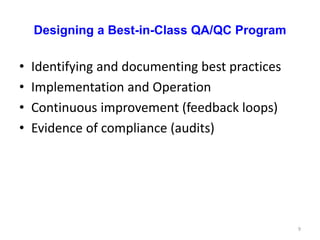
Designing a Best-in-Class QA/QC Program
• Identifying and documenting best practices
• Implementation and Operation
• Continuous improvement (feedback loops)
• Evidence of compliance (audits)
9
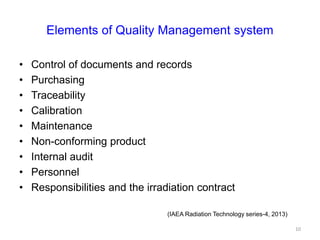
Elements of Quality Management system
• Control of documents and records
• Purchasing
• Traceability
• Calibration
• Maintenance
• Non-conforming product
• Internal audit
• Personnel
• Responsibilities and the irradiation contract
(IAEA Radiation Technology series-4, 2013)
10
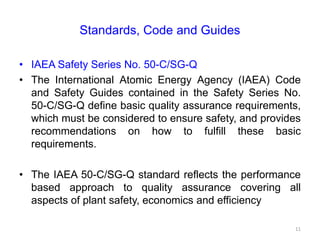
Standards, Code and Guides
• IAEA Safety Series No. 50-C/SG-Q
• The International Atomic Energy Agency (IAEA) Code
and Safety Guides contained in the Safety Series No.
50-C/SG-Q define basic quality assurance requirements,
which must be considered to ensure safety, and provides
recommendations on how to fulfill these basic
requirements.
• The IAEA 50-C/SG-Q standard reflects the performance
based approach to quality assurance covering all
aspects of plant safety, economics and efficiency
11
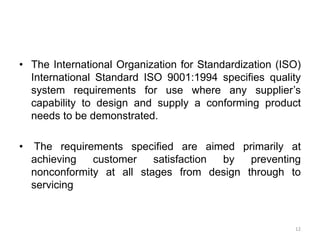
• The International Organization for Standardization (ISO)
International Standard ISO 9001:1994 specifies quality
system requirements for use where any supplier’s
capability to design and supply a conforming product
needs to be demonstrated.
• The requirements specified are aimed primarily at
achieving customer satisfaction by preventing
nonconformity at all stages from design through to
servicing
12
The comparison of the following publications
• IAEA Safety Series No. 50-C/SG-Q (1996), Quality
Assurance for Safety in Nuclear Power Plants and other
Nuclear Installations, Code and Safety Guides Q1–Q14
• ISO 9001:1994, Quality Systems — Model for Quality
Assurance in Design, Development, Production,
Installation and Servicing
• ISO 9002:1994, Quality Systems — Model for Quality
Assurance in Production, Installation and Servicing
• ISO 9003:1994, Quality Systems — Model for Quality
Assurance in Final Inspection and Test
13
IAEA The quality assurance Code 50-C-Q consists of 10
basic requirements (BR);
1. Management
• BR 1: Quality Assurance Programme
• BR 2: Training and Qualification
• BR 3: Non-Conformance Control and Corrective Actions
• BR 4: Document Control and Records
14
2. Performance
• BR 5: Work
• BR 6: Design
• BR 7: Procurement
• BR 8: Inspection and Testing for Acceptance
3. Assessment
• BR 9: Management Self-Assessment
• BR 10: Independent Assessment
15
Quality System Standard ISO 9001:1994
The clauses of ISO 9001:1994 are:
• 4.1 Management Responsibility
• 4.2 Quality System
• 4.3 Contract Review
• 4.4 Design Control
• 4.5 Document and Data Control
• 4.6 Purchasing
• 4.7 Control of Customer-Supplied Product
• 4.8 Product Identification and Traceability
• 4.9 Process Control
• 4.10 Inspection and Testing
16
• 4.11 Control of Inspection, Measuring and Test Equipment
• 4.12 Inspection and Test Status
• 4.13 Control of Nonconforming Product
• 4.14 Corrective and Preventive Action
• 4.15 Handling, Storage, Packaging, Preservation and
Delivery
• 4.16 Control of Quality Records
• 4.17 Internal Quality Audits
• 4.18 Training
• 4.19 Servicing
• 4.20 Statistical Techniques
17
18

L17 qa in industrial practices

  • 1.
    5th BAERA TrainingCourse on Radiation Protection for Radiation Control Officers (RCO) of Industrial Practices 06-9 November 2017 L17: QA for Industrial Practices Md Mustafijur Rahman Principal Engineer Bangladesh Atomic Energy Regulatory Authority
  • 2.
    What is aQA/QC program? • A Quality Assurance program is a set of processes that help to ensure a desirable outcome by reducing defects and non-conformance. The program starts at the design phase and includes the specification, procurement, manufacturing, fabrication, installation, and commissioning of materials and/or equipment. • Quality Control is a component of the Quality Assurance program, and involves inspections and testing to identify defects and non-conforming items. Quality Control also provides a valuable feedback loop to improve the Quality Assurance process 2
  • 3.
    What is aQA/QC program? • “All those planned and systematic actions necessary to provide confidence that a product or service will satisfy given requirements for quality.” (ISO 9000) 3
  • 4.
    Legal basis forQA • Rule-19.1 of NSRC Rules-1997 • “ A Licensee shall establish an appropriate Quality assurance (QA) programme following standard, code and guide in order to ensure the implementation of all nuclear safety and radiation protection requirement. 4
  • 5.
    Purpose of QA Toprovide: • A quality product or quality services for customer satisfaction • Reduce radiation exposure to workers to a level As Low As Reasonably Achievable (ALARA). 5
  • 6.
    Principles and Criteriafor good practice • Mission and vision of the radiation facility • Quality management system • Structure of the facility • Equipment • Documentation control • Consumer feedback and complaints • Communication • The audit programme 6
  • 7.
    A Comprehensive QAProgram typically comprises of • Quality Assurance Committee • Policies and Procedures Manual • Quality Assurance team • Quality audit • Resources 7
  • 8.
    Benefits of anEffective QA/QC Program • Reduced defects & rework • Assurance payments are in lock-step with work • Quicker holdback release (bill more confidently; pay more confidently) • Better insurance and performance security terms • Lower asset lifecycle costs • Enhanced reputation and improved client and subcontractor relations • Greater certainty of project success 8
  • 9.
    Designing a Best-in-ClassQA/QC Program • Identifying and documenting best practices • Implementation and Operation • Continuous improvement (feedback loops) • Evidence of compliance (audits) 9
  • 10.
    Elements of QualityManagement system • Control of documents and records • Purchasing • Traceability • Calibration • Maintenance • Non-conforming product • Internal audit • Personnel • Responsibilities and the irradiation contract (IAEA Radiation Technology series-4, 2013) 10
  • 11.
    Standards, Code andGuides • IAEA Safety Series No. 50-C/SG-Q • The International Atomic Energy Agency (IAEA) Code and Safety Guides contained in the Safety Series No. 50-C/SG-Q define basic quality assurance requirements, which must be considered to ensure safety, and provides recommendations on how to fulfill these basic requirements. • The IAEA 50-C/SG-Q standard reflects the performance based approach to quality assurance covering all aspects of plant safety, economics and efficiency 11
  • 12.
    • The InternationalOrganization for Standardization (ISO) International Standard ISO 9001:1994 specifies quality system requirements for use where any supplier’s capability to design and supply a conforming product needs to be demonstrated. • The requirements specified are aimed primarily at achieving customer satisfaction by preventing nonconformity at all stages from design through to servicing 12
  • 13.
    The comparison ofthe following publications • IAEA Safety Series No. 50-C/SG-Q (1996), Quality Assurance for Safety in Nuclear Power Plants and other Nuclear Installations, Code and Safety Guides Q1–Q14 • ISO 9001:1994, Quality Systems — Model for Quality Assurance in Design, Development, Production, Installation and Servicing • ISO 9002:1994, Quality Systems — Model for Quality Assurance in Production, Installation and Servicing • ISO 9003:1994, Quality Systems — Model for Quality Assurance in Final Inspection and Test 13
  • 14.
    IAEA The qualityassurance Code 50-C-Q consists of 10 basic requirements (BR); 1. Management • BR 1: Quality Assurance Programme • BR 2: Training and Qualification • BR 3: Non-Conformance Control and Corrective Actions • BR 4: Document Control and Records 14
  • 15.
    2. Performance • BR5: Work • BR 6: Design • BR 7: Procurement • BR 8: Inspection and Testing for Acceptance 3. Assessment • BR 9: Management Self-Assessment • BR 10: Independent Assessment 15
  • 16.
    Quality System StandardISO 9001:1994 The clauses of ISO 9001:1994 are: • 4.1 Management Responsibility • 4.2 Quality System • 4.3 Contract Review • 4.4 Design Control • 4.5 Document and Data Control • 4.6 Purchasing • 4.7 Control of Customer-Supplied Product • 4.8 Product Identification and Traceability • 4.9 Process Control • 4.10 Inspection and Testing 16
  • 17.
    • 4.11 Controlof Inspection, Measuring and Test Equipment • 4.12 Inspection and Test Status • 4.13 Control of Nonconforming Product • 4.14 Corrective and Preventive Action • 4.15 Handling, Storage, Packaging, Preservation and Delivery • 4.16 Control of Quality Records • 4.17 Internal Quality Audits • 4.18 Training • 4.19 Servicing • 4.20 Statistical Techniques 17
  • 18.