1 Page
PM Academy - An Enabling Platform for
    Project Managers


Raghunandan Menon – Advisory Consultant, UST Global
Contents
 1. Abstract ........................................................................................................................................... 4
 2. Design Principles ............................................................................................................................ 4
    2.1 Alignment with Industry Standards and Needs of the Organization ......................................... 5
    2.2 Sustain Enablement .................................................................................................................. 6
 3. Strategy to encourage “Adoption” ................................................................................................... 6
    3.1 What is in it for me?................................................................................................................... 6
      For the Executive Management: ...................................................................................................... 6

      For Business Unit Leadership: ......................................................................................................... 6

      For the Coaches: ............................................................................................................................. 6

      For the Participants: ......................................................................................................................... 7

    3.2 The PM Community................................................................................................................... 7
 4. Challenges Faced and Insights Gained .......................................................................................... 7
      Align Courses to Organization’s Relationship Model: ...................................................................... 7

      Coaches not Trainers: ...................................................................................................................... 8

      Course Delivery: .............................................................................................................................. 8

      Encourage continuous learning: ...................................................................................................... 8

 5. Conclusion....................................................................................................................................... 9
 6. References ...................................................................................................................................... 9
 7. Author’s Profile .............................................................................................................................. 10


3 Page
1. Abstract
In today’s global project environment, project management is a very complex job. IT Service providers
have additional challenges in terms adapting to different engagement / delivery models. Project
management competency development should ensure that talent is nurtured to deliver effectively in a
distributed environment. We established the PM Academy to enable PMs (including aspiring PMs)
with the competencies needed to successfully deliver IT projects in this distributed global project
environment.

The PM Academy was designed to bring in best of proven industry standards like that of Project
Management Institute, blended with internal dynamics of the project environment within the
organization. It was also designed as an institution owned and managed by experts within the
organization, who are willing to nurture and grow talent through continuous mentoring. In our
experience of setting up the PM Academy within our organization, one fact that became very obvious
was that real adoption of the PM competency framework depends heavily on how open we are to
understand the aspirations of our employees and the business objectives of our organization, and
how nimble and balanced we are in adapting to those needs.

In this paper we will present an outline of how to setup a PM Academy. We will share some of the
challenges we faced and the insights we gained during the process. By sharing our experiences and
insights, we hope to contribute to the larger cause of refining PM competency and career
management         frameworks          to     benefit      a     larger      PM       community.


2. Design Principles
The key high level objectives we had set up for the PM Academy were:

         Align with proven industry standards like that of Project Management Body of Knowledge
         (PMBOK) from Project Management Institute (PMI)
         Blend with the vision and internal dynamics of the organization
         Sustain enablement; i.e., enablement cannot end with a onetime effort like training

The micro level objectives aligned to the high level objectives were:

         Program should cater to a global audience – onsite and offshore
         Should be flexible to fit into the schedules of the participants with minimum impact on
         billability
         Benchmarking competencies through pre and post training assessments
         Certifying trainees from a competency assurance, pride of completion standpoint
         Showcasing the business value/ROI to business units so that we have a steady flow of talent
         Optimum mix of online learning and instructor led workshops
         Use of social media tools – online content, videos, webex etc.


4 Page
2.1 Alignment with Industry Standards and Needs of the Organization

We surveyed the Project Management landscape for proven industry standards / frameworks for PM
                                                                        [1]
Competency definition and assessment. We found GAPPS                        (Global Alliance for Project
                                                          [2, 3]
Performance Standards) and the PM Career framework               defined by Project Management Institute
as a good starting point to build an appropriate platform for our needs. In the IT services industry, we
often have to execute projects of different scales. PMI and GAPPS framework have defined the
competency levels with clarity on expectations and the assessment parameters at each level. But to
meet the needs of medium to large IT Services companies, we determined that PM Competency
levels have to be developed at a more granular level. Figure 1 illustrates the five PM Competency
levels we defined to meet our needs.


                                 Figure 1: Five PM Competency Levels

As you can see, this framework provides a clear career path for people who have opted for Project
Management as a career. An organization can decide what is a “Small”, “Medium”, or “Large” project
based on the scale of projects being managed.

Like a true academy, participants need to enroll for each level if they satisfy the entry criteria;
complete the courses defined in the curriculum for the enrolled level; and then get assessed at that
level. Upon successful assessment, they are certified at that level. The curriculum is designed with a
balanced approach towards e-learning and instructor led class room learning with an ideal mix of
theory and case study based hands-on exercises.

5 Page
For example, Level 1 is focused purely to introduce the fundamentals of project management to an
aspiring PM, Here we leveraged the elearning courses aligned fully with PMBOK. For higher levels,
the focus shifts to practical application of project management concepts and advanced topics. This
ensures that the participants of this program graduate through a competency maturity model fully
aligned to industry standards and objectives of the organization.

2.2 Sustain Enablement

This should be a key design principle when you design a platform like the PM Academy. The PM
Academy should not just be a competency framework with the purpose of providing training and
assessment. It should be designed as an institution which is owned and managed by experts and
practitioners within the organization, who are willing to nurture and grow talent through continuous
coaching / mentoring. Only then will the target audience see it as a true “enablement” platform.


3. Strategy to encourage “Adoption”
In any organization, adoption of key initiatives hinges on a good change management strategy or
rather the “Adoption Strategy”, as we would like to call it. When we think of change management as
“Adoption”, our focus will automatically shift to answering the question “What is in it for me?” from
each stakeholder’s perspective. The key stakeholders of a program like the PM Academy are the
participants (PMs and aspiring PMs), the coaches, the business unit leadership, and the executive
management of the organization. Another key element of the adoption strategy is to sell the idea of
the “PM Community”.

3.1 What is in it for me?

For the Executive Management: First step is to convince the executive management on how the PM
Academy aligns with and contributes to the corporate vision and goals. In our case, in the year 2010,
we could demonstrate how the success of this initiative was integral to achieving our company’s 2012
vision. We also prepared a detailed plan on how the PM Academy aligns and ties into the company’s
strategy to achieve the vision.

For Business Unit Leadership: The leadership of the business units should be able to see how this
academy will contribute to their revenue and margin targets. In our case, each business unit had
targets aligned to the corporate strategy to achieve the 2012 vision. Although the leadership
understood that talent development is critical for them to achieve their targets, they were expecting to
know in detail, how our plans for the PM Academy would impact them in terms of the cost and
benefits. We were able to present them with the specific areas of how the PM Academy could help
them to convert more opportunities to real projects and reduce the losses due to failures in execution.

For the Coaches: The coaches are pivots around which the PM Academy model revolves. They
should clearly understand how much they individually benefit, apart from contributing to the corporate
vision, by partnering with this initiative. Apart from monetary incentives and recognition within the
organization, we helped them understand how they could

         Enhance their own knowledge and competency through sharing
6 Page
Gain through the opportunity to network with a large pool of PM’s and aspiring PM’s, and
         other leaders in the organization
         Gain respect of the participants and be seen as transforming their lives

For the Participants: The participants need to be assured on how the PM Academy will help in their
career progression; how continuous mentoring by coaches will help them tide over challenges during
project execution; and how they benefit from the opportunity for peer level interactions.

3.2 The PM Community

Another key aspect of the adoption strategy is presenting the idea of building the “PM Community”.
Instead of a top down approach of building such a community, the idea that needs to be sold is one of
a democratic bottom up approach. PM community should be seen by PMs and aspiring PMs as a
platform to collaborate on a regular basis to share experiences and learn about new trends, and to
find solutions to problems which need collective wisdom. By building it through a bottom approach,
participants will feel that they own the platform and will value it for the opportunity to help oneself by
helping others.

Social Media, being a highly democratic platform, is an ideal tool for building the PM Community.
Hence it is important to watch the emerging trends in the social media space and have a plan to
adopt what suits the organization’s culture to facilitate a viral growth of the PM Community.


4. Challenges Faced and Insights Gained
The challenges of catering to a global audience and flexibility to fit into the schedules of the
participants with minimum impact on billability are well known. In this section we will focus on some of
the other unique challenges for IT Services organizations.

Align Courses to Organization’s Relationship Model: This is a very interesting challenge. We
need to clearly understand our organization’s model for relationship with the customers. The design of
the courseware, and delivering it in a fashion to help the participants understand project management
practices in that context, is critical in meeting the success criteria of the program.

We shall take a simple example to help understand this. The relationship model of our organization is
“Customer Intimacy”. The focus is to build long term partnerships with our customers, and not just the
cost or benefit of any single transaction. Employees are persuaded to live and breathe this model in
every transaction with the customer. The major pain points in this context were that PMs perceived
this as:
            Saying “Yes” to everything the customer wanted. They thought that saying “No” would
            hurt the process of building long term relationship
            Delivering additional product features, assuming that they were adding value, even
            though the customers never asked for those features

The courses had to be designed and delivered in such a way that, the participants understood the
spirit of the “Customer Intimacy” model and how PM practices should be interpreted in this context.
7 Page
For example, they should understand why “Gold Plating” is a big NO when delivering a product and
how it hurts the very relationship model we vouch for.

Organizations which have adopted other relationship models should ensure that they design and
deliver the courseware aligning it to their model.

Coaches not Trainers: The PM Academy, as mentioned in earlier sections, should be seen as an
institution which will nurture and grow talent, thereby enabling PMs and aspiring PMs to target
excellence. In this context, the experts within the organization who volunteer to teach should not see
themselves as just trainers who deliver various courses depending on their expertise. They should go
beyond this traditional approach and have to consider themselves as facilitators and mentors, or in
short “Coaches”. Their approach should be to build a long term relationship with the participants, so
that the participants see them as true mentors who can help them succeed.

Seeing oneself as a coach is not easy. It takes significant commitment and time to understand the
strengths and areas of improvements of each participant and be a facilitator and mentor to each one
of them. The challenge is to identify experts who imbibe this spirit and provide them the space and
time to evolve. In our organization we designed a model, where a pair of coaches was assigned to a
group of participants. These coaches were selected to complement each other and conduct all the
sessions for this group of participants. This model helped in developing strong bonds between the
coaches and the participants, which met our objective of coaches being true mentors for the
participants.

Course Delivery: For participants to feel excited about the program and spread the good word to
encourage their peers to participate, it is important that they value the takeaways from the program.
The courses should be structured to be a dialogue rather than a monologue from the coaches.
Participants should be actively engaged by forcing them to think about the “why” of each PM process
and practice.

In our courseware design we took take care of this by identifying real project scenarios for each
process and practice and posed them as problem to be solved by participants. The advantage we
found was that there would be at least few participants within the group who would have come across
such situations before and had solved it. Most of the times, they would have adopted different
approaches. This helped them to understand that as a Project Manager, problem resolution is highly
contextual and there are more than one ways to solve a problem. Another advantage was that they
became more confident in their individual abilities and saw the value of collaboration as they had
solutions for most of the problems. This also helped them see the value of building the PM community
as a perfect collaboration platform.

Encourage continuous learning: As the intent of the program is sustained enablement, it is
imperative that it is structured in a way to promote continuous learning and contributions to the
program. The certification process from Level 3 and above was designed with this objective in mind.
We recommend a credit points system along the lines of the PDU model of Project Management
Institute to retain the certification at each level. The points could be earned by attending courses
offered by the PM Academy, volunteering as coaches, contributing to the organizations process
improvement efforts, efforts to build the PM community, etc.

8 Page
5. Conclusion
From our experience of setting up the PM Academy within our organization, one fact that became
very obvious was that real adoption of the PM competency framework depends heavily on how open
we are to understand the aspirations of our employees and the business objectives of our
organization, and how nimble and balanced we are in adapting to those needs. Another important
aspect is that the overall framework and curriculum should be based strongly on the organization’s
culture for successful adoption.


6. References
   1. GAPPS (2007) A Framework for Performance Based Competency Standards for Global Level
      1 and 2 Project Managers Sydney: Global Alliance for Project Performance Standards

   2. Project Management Institute, "About Career Framework" -
      https://pathpro.pmi.org/WhyCareerFramework.aspx

                                              TM
   3. Project Management Institute, PathPro        - https://pathpro.pmi.org/cf/FrameworkDisplay.aspx


9 Page
7. Author’s Profile

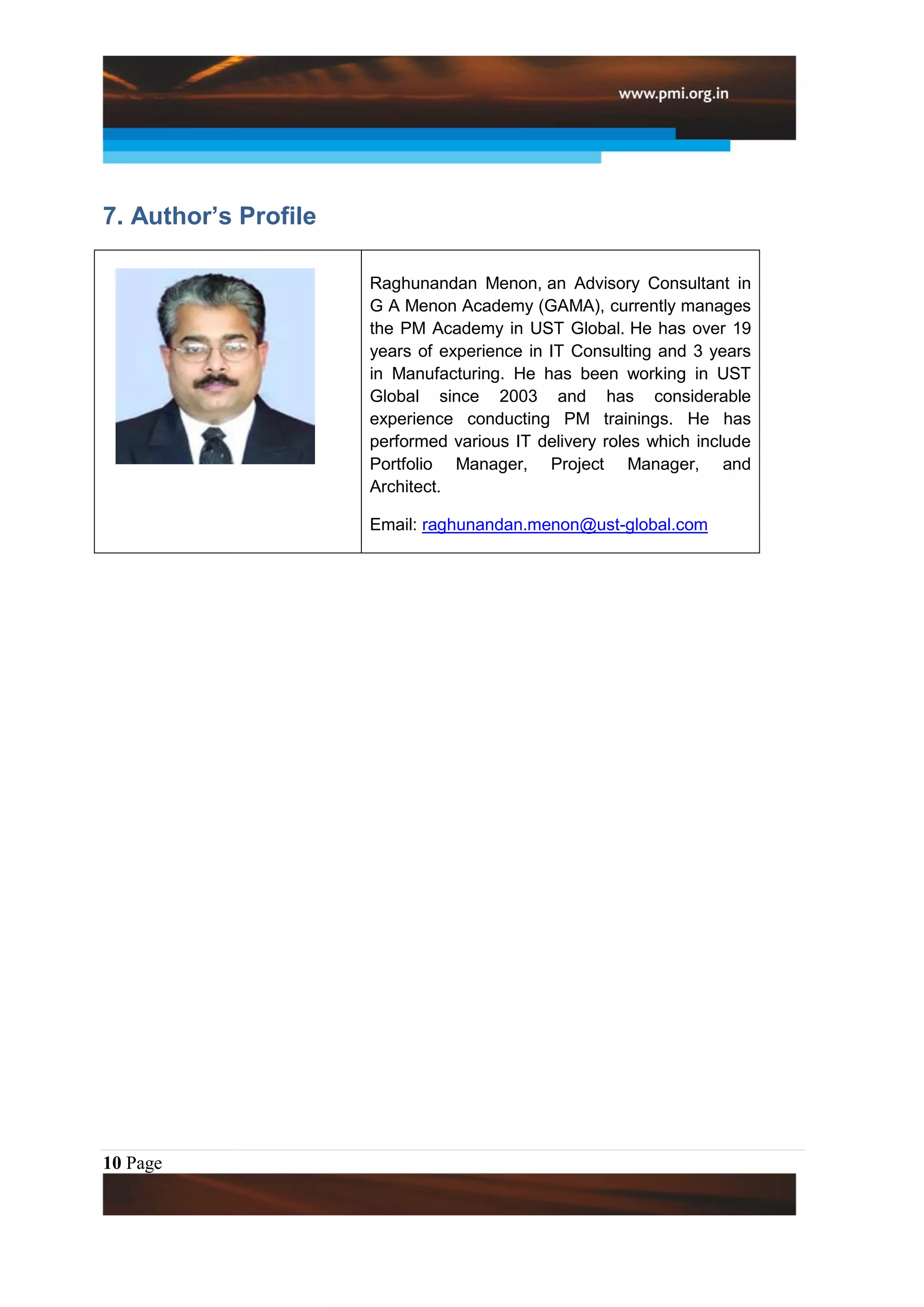
                      Raghunandan Menon, an Advisory Consultant in
                      G A Menon Academy (GAMA), currently manages
                      the PM Academy in UST Global. He has over 19
                      years of experience in IT Consulting and 3 years
                      in Manufacturing. He has been working in UST
                      Global since 2003 and has considerable
                      experience conducting PM trainings. He has
                      performed various IT delivery roles which include
                      Portfolio Manager, Project Manager, and
                      Architect.

                      Email: raghunandan.menon@ust-global.com


10 Page

ISO_5

  • 1.
  • 2.
    PM Academy -An Enabling Platform for Project Managers Raghunandan Menon – Advisory Consultant, UST Global
  • 3.
    Contents 1. Abstract........................................................................................................................................... 4 2. Design Principles ............................................................................................................................ 4 2.1 Alignment with Industry Standards and Needs of the Organization ......................................... 5 2.2 Sustain Enablement .................................................................................................................. 6 3. Strategy to encourage “Adoption” ................................................................................................... 6 3.1 What is in it for me?................................................................................................................... 6 For the Executive Management: ...................................................................................................... 6 For Business Unit Leadership: ......................................................................................................... 6 For the Coaches: ............................................................................................................................. 6 For the Participants: ......................................................................................................................... 7 3.2 The PM Community................................................................................................................... 7 4. Challenges Faced and Insights Gained .......................................................................................... 7 Align Courses to Organization’s Relationship Model: ...................................................................... 7 Coaches not Trainers: ...................................................................................................................... 8 Course Delivery: .............................................................................................................................. 8 Encourage continuous learning: ...................................................................................................... 8 5. Conclusion....................................................................................................................................... 9 6. References ...................................................................................................................................... 9 7. Author’s Profile .............................................................................................................................. 10 3 Page
  • 4.
    1. Abstract In today’sglobal project environment, project management is a very complex job. IT Service providers have additional challenges in terms adapting to different engagement / delivery models. Project management competency development should ensure that talent is nurtured to deliver effectively in a distributed environment. We established the PM Academy to enable PMs (including aspiring PMs) with the competencies needed to successfully deliver IT projects in this distributed global project environment. The PM Academy was designed to bring in best of proven industry standards like that of Project Management Institute, blended with internal dynamics of the project environment within the organization. It was also designed as an institution owned and managed by experts within the organization, who are willing to nurture and grow talent through continuous mentoring. In our experience of setting up the PM Academy within our organization, one fact that became very obvious was that real adoption of the PM competency framework depends heavily on how open we are to understand the aspirations of our employees and the business objectives of our organization, and how nimble and balanced we are in adapting to those needs. In this paper we will present an outline of how to setup a PM Academy. We will share some of the challenges we faced and the insights we gained during the process. By sharing our experiences and insights, we hope to contribute to the larger cause of refining PM competency and career management frameworks to benefit a larger PM community. 2. Design Principles The key high level objectives we had set up for the PM Academy were: Align with proven industry standards like that of Project Management Body of Knowledge (PMBOK) from Project Management Institute (PMI) Blend with the vision and internal dynamics of the organization Sustain enablement; i.e., enablement cannot end with a onetime effort like training The micro level objectives aligned to the high level objectives were: Program should cater to a global audience – onsite and offshore Should be flexible to fit into the schedules of the participants with minimum impact on billability Benchmarking competencies through pre and post training assessments Certifying trainees from a competency assurance, pride of completion standpoint Showcasing the business value/ROI to business units so that we have a steady flow of talent Optimum mix of online learning and instructor led workshops Use of social media tools – online content, videos, webex etc. 4 Page
  • 5.
    2.1 Alignment withIndustry Standards and Needs of the Organization We surveyed the Project Management landscape for proven industry standards / frameworks for PM [1] Competency definition and assessment. We found GAPPS (Global Alliance for Project [2, 3] Performance Standards) and the PM Career framework defined by Project Management Institute as a good starting point to build an appropriate platform for our needs. In the IT services industry, we often have to execute projects of different scales. PMI and GAPPS framework have defined the competency levels with clarity on expectations and the assessment parameters at each level. But to meet the needs of medium to large IT Services companies, we determined that PM Competency levels have to be developed at a more granular level. Figure 1 illustrates the five PM Competency levels we defined to meet our needs. Figure 1: Five PM Competency Levels As you can see, this framework provides a clear career path for people who have opted for Project Management as a career. An organization can decide what is a “Small”, “Medium”, or “Large” project based on the scale of projects being managed. Like a true academy, participants need to enroll for each level if they satisfy the entry criteria; complete the courses defined in the curriculum for the enrolled level; and then get assessed at that level. Upon successful assessment, they are certified at that level. The curriculum is designed with a balanced approach towards e-learning and instructor led class room learning with an ideal mix of theory and case study based hands-on exercises. 5 Page
  • 6.
    For example, Level1 is focused purely to introduce the fundamentals of project management to an aspiring PM, Here we leveraged the elearning courses aligned fully with PMBOK. For higher levels, the focus shifts to practical application of project management concepts and advanced topics. This ensures that the participants of this program graduate through a competency maturity model fully aligned to industry standards and objectives of the organization. 2.2 Sustain Enablement This should be a key design principle when you design a platform like the PM Academy. The PM Academy should not just be a competency framework with the purpose of providing training and assessment. It should be designed as an institution which is owned and managed by experts and practitioners within the organization, who are willing to nurture and grow talent through continuous coaching / mentoring. Only then will the target audience see it as a true “enablement” platform. 3. Strategy to encourage “Adoption” In any organization, adoption of key initiatives hinges on a good change management strategy or rather the “Adoption Strategy”, as we would like to call it. When we think of change management as “Adoption”, our focus will automatically shift to answering the question “What is in it for me?” from each stakeholder’s perspective. The key stakeholders of a program like the PM Academy are the participants (PMs and aspiring PMs), the coaches, the business unit leadership, and the executive management of the organization. Another key element of the adoption strategy is to sell the idea of the “PM Community”. 3.1 What is in it for me? For the Executive Management: First step is to convince the executive management on how the PM Academy aligns with and contributes to the corporate vision and goals. In our case, in the year 2010, we could demonstrate how the success of this initiative was integral to achieving our company’s 2012 vision. We also prepared a detailed plan on how the PM Academy aligns and ties into the company’s strategy to achieve the vision. For Business Unit Leadership: The leadership of the business units should be able to see how this academy will contribute to their revenue and margin targets. In our case, each business unit had targets aligned to the corporate strategy to achieve the 2012 vision. Although the leadership understood that talent development is critical for them to achieve their targets, they were expecting to know in detail, how our plans for the PM Academy would impact them in terms of the cost and benefits. We were able to present them with the specific areas of how the PM Academy could help them to convert more opportunities to real projects and reduce the losses due to failures in execution. For the Coaches: The coaches are pivots around which the PM Academy model revolves. They should clearly understand how much they individually benefit, apart from contributing to the corporate vision, by partnering with this initiative. Apart from monetary incentives and recognition within the organization, we helped them understand how they could Enhance their own knowledge and competency through sharing 6 Page
  • 7.
    Gain through theopportunity to network with a large pool of PM’s and aspiring PM’s, and other leaders in the organization Gain respect of the participants and be seen as transforming their lives For the Participants: The participants need to be assured on how the PM Academy will help in their career progression; how continuous mentoring by coaches will help them tide over challenges during project execution; and how they benefit from the opportunity for peer level interactions. 3.2 The PM Community Another key aspect of the adoption strategy is presenting the idea of building the “PM Community”. Instead of a top down approach of building such a community, the idea that needs to be sold is one of a democratic bottom up approach. PM community should be seen by PMs and aspiring PMs as a platform to collaborate on a regular basis to share experiences and learn about new trends, and to find solutions to problems which need collective wisdom. By building it through a bottom approach, participants will feel that they own the platform and will value it for the opportunity to help oneself by helping others. Social Media, being a highly democratic platform, is an ideal tool for building the PM Community. Hence it is important to watch the emerging trends in the social media space and have a plan to adopt what suits the organization’s culture to facilitate a viral growth of the PM Community. 4. Challenges Faced and Insights Gained The challenges of catering to a global audience and flexibility to fit into the schedules of the participants with minimum impact on billability are well known. In this section we will focus on some of the other unique challenges for IT Services organizations. Align Courses to Organization’s Relationship Model: This is a very interesting challenge. We need to clearly understand our organization’s model for relationship with the customers. The design of the courseware, and delivering it in a fashion to help the participants understand project management practices in that context, is critical in meeting the success criteria of the program. We shall take a simple example to help understand this. The relationship model of our organization is “Customer Intimacy”. The focus is to build long term partnerships with our customers, and not just the cost or benefit of any single transaction. Employees are persuaded to live and breathe this model in every transaction with the customer. The major pain points in this context were that PMs perceived this as: Saying “Yes” to everything the customer wanted. They thought that saying “No” would hurt the process of building long term relationship Delivering additional product features, assuming that they were adding value, even though the customers never asked for those features The courses had to be designed and delivered in such a way that, the participants understood the spirit of the “Customer Intimacy” model and how PM practices should be interpreted in this context. 7 Page
  • 8.
    For example, theyshould understand why “Gold Plating” is a big NO when delivering a product and how it hurts the very relationship model we vouch for. Organizations which have adopted other relationship models should ensure that they design and deliver the courseware aligning it to their model. Coaches not Trainers: The PM Academy, as mentioned in earlier sections, should be seen as an institution which will nurture and grow talent, thereby enabling PMs and aspiring PMs to target excellence. In this context, the experts within the organization who volunteer to teach should not see themselves as just trainers who deliver various courses depending on their expertise. They should go beyond this traditional approach and have to consider themselves as facilitators and mentors, or in short “Coaches”. Their approach should be to build a long term relationship with the participants, so that the participants see them as true mentors who can help them succeed. Seeing oneself as a coach is not easy. It takes significant commitment and time to understand the strengths and areas of improvements of each participant and be a facilitator and mentor to each one of them. The challenge is to identify experts who imbibe this spirit and provide them the space and time to evolve. In our organization we designed a model, where a pair of coaches was assigned to a group of participants. These coaches were selected to complement each other and conduct all the sessions for this group of participants. This model helped in developing strong bonds between the coaches and the participants, which met our objective of coaches being true mentors for the participants. Course Delivery: For participants to feel excited about the program and spread the good word to encourage their peers to participate, it is important that they value the takeaways from the program. The courses should be structured to be a dialogue rather than a monologue from the coaches. Participants should be actively engaged by forcing them to think about the “why” of each PM process and practice. In our courseware design we took take care of this by identifying real project scenarios for each process and practice and posed them as problem to be solved by participants. The advantage we found was that there would be at least few participants within the group who would have come across such situations before and had solved it. Most of the times, they would have adopted different approaches. This helped them to understand that as a Project Manager, problem resolution is highly contextual and there are more than one ways to solve a problem. Another advantage was that they became more confident in their individual abilities and saw the value of collaboration as they had solutions for most of the problems. This also helped them see the value of building the PM community as a perfect collaboration platform. Encourage continuous learning: As the intent of the program is sustained enablement, it is imperative that it is structured in a way to promote continuous learning and contributions to the program. The certification process from Level 3 and above was designed with this objective in mind. We recommend a credit points system along the lines of the PDU model of Project Management Institute to retain the certification at each level. The points could be earned by attending courses offered by the PM Academy, volunteering as coaches, contributing to the organizations process improvement efforts, efforts to build the PM community, etc. 8 Page
  • 9.
    5. Conclusion From ourexperience of setting up the PM Academy within our organization, one fact that became very obvious was that real adoption of the PM competency framework depends heavily on how open we are to understand the aspirations of our employees and the business objectives of our organization, and how nimble and balanced we are in adapting to those needs. Another important aspect is that the overall framework and curriculum should be based strongly on the organization’s culture for successful adoption. 6. References 1. GAPPS (2007) A Framework for Performance Based Competency Standards for Global Level 1 and 2 Project Managers Sydney: Global Alliance for Project Performance Standards 2. Project Management Institute, "About Career Framework" - https://pathpro.pmi.org/WhyCareerFramework.aspx TM 3. Project Management Institute, PathPro - https://pathpro.pmi.org/cf/FrameworkDisplay.aspx 9 Page
  • 10.
    7. Author’s Profile Raghunandan Menon, an Advisory Consultant in G A Menon Academy (GAMA), currently manages the PM Academy in UST Global. He has over 19 years of experience in IT Consulting and 3 years in Manufacturing. He has been working in UST Global since 2003 and has considerable experience conducting PM trainings. He has performed various IT delivery roles which include Portfolio Manager, Project Manager, and Architect. Email: raghunandan.menon@ust-global.com 10 Page