1 Page
A New Dimension in Project Management -
The "Value" Diamond


Muktha Kartik – Consultant, Mahindra Satyam
Deborah Devadason – Consultant, Mahindra Satyam
Contents
 1. Abstract ......................................................................................................................................... 4
 2. Background ................................................................................................................................... 4
 3. Key triggers for innovation .......................................................................................................... 5
 4. Our approach ................................................................................................................................ 6
 5. Critical Success Factors ........................................................................................................... 10
 6. Key Challenges During Implementation ................................................................................. 11
 7. Quantified Benefits To Business ............................................................................................. 11
 8. Case Study ................................................................................................................................. 12
 9. Lessons Learnt ........................................................................................................................... 13
 10. Conclusion ................................................................................................................................ 13
 11. Bibliography .............................................................................................................................. 14
 12. Author’s Profile: ........................................................................................................................ 15
 13. Special Acknowledgement ..................................................................................................... 15


3 Page
1. Abstract
         st
In the 21 century, Customer-centric Project Management will outpace the triple constraints of cost,
scope and schedule and true success will be determined by the Business Value generated by the
project.

This paper explores an avant-garde approach to include a fourth dimension of “Business Value” to
create the Project Management Diamond. The focus of the approach is customer delight while
focusing on generating business value and this transformation will be a competitive advantage in the
   st
21 century. The paper discusses innovative techniques to ingrain business value in all stages of the
project lifecycle and the breakthrough concept of “Value Management”. Real case examples
highlighting the implementation aspects from a Consulting Team, with a varied and global client base
cutting across multiple domains, which has resulted in multi Million value generation, add substance
to the paper. The paper shares simple powerful tools like Value Register which aid the computation
of true business value for all types of projects, taking into consideration a variety of aspects ranging
from knowledge enhancement to branding and shareholder value. The authors explore the re-
evaluation of the Project Management processes and procedures as well as the role of the new
Manager in instilling this new dimension.

The authors demonstrate how this “Value” Diamond Transformation marks a new era in Project
Management and how it can be easily adopted by any organisation irrespective of the size, domain
and culture.

2. Background
Traditional Project Management has relied on the triple constraints of cost, scope and schedule to
measure success (Appelo). Project Managers have balanced these parameters against each other to
steer the project to success. This concept of Iron Triangle has evolved over the years (Zwikael and
Smyrk) and the focus on customer delight has increased. However, futuristic Project Management
should aim to achieve business success and this is possible only though a value proposition for all
stakeholders. The right project selection is highly critical when running large programs and projects.
It is imperative that the selected projects create the most compelling value to excite the end
customers and provide the right value for the investments organisations make. While the primary
focus is on customer value, long term value creation for the business organisation and society should
be given importance. The triple constraints thus expand to include a fourth dimension of Business
Value to form the Project Management Diamond. The investment in this dimension will ensure a
handsome return for the organisation in the long run.

Just as an athlete cannot make it to the Olympics without extraordinary physical ability, a good
Manager must master the four dimensions of Project Management to be successful. (Gerstenmaier)


4 Page
3. Key triggers for innovation
Being the Best is Not Good Enough

In the 21st century, business demands are changing by the minute. This rapid change in market place
is accompanied by customer demands that require a high level of customisation. One single strategy
does not guarantee success in all situations. A product or service may be the best and most
innovative in the market; yet may not be valued by the customer. On the other hand, a project may
be successful even when violating the time and cost estimates so long as the customer judges it as
successful against their criteria.

Lagging Vs. Leading Indicators

The traditional Project Management dimensions concentrate on the outcomes of project activity and
are lagging indicators of performance. The need of the hour is a better understanding of the drivers of
Business Value and a means to track measure and compare this across projects (Smith, Apfel and
Mitchell). These leading indicators should be the key to project selection and prioritisation and need to
be inbuilt into the Project Management principles.

Alignment of Technical Capabilities to Business Vision

Technological advancements have made projects unique and project execution requires high levels of
innovation and application of learning. Investments done in R&D and training for project purposes
should be evaluated for long term Business Value. Project Managers need to provide special focus on
applied learning and innovation which can be leveraged in future projects and thus provide the link
between technical capabilities and Business vision. (Liebowitz and Megbolugbe)

Go Green

Sustainability is central to the new age Business. Population explosion, plunder of natural resources
and allied climate changes has put the planet at risk. All projects have a responsibility to address
such risks on environmental, socio-economic, ethical and health and safety concerns and need to be
inbuilt into the value delivered by the project (Global Reporting Initiative). The ideal starting point is
the project which funnels into the Business level to make meaningful impact in the long run.

Happiness Index

The Harvard Business Review has quoted that happy employees are the key to happy customers
(Gretchen and Christine). Employee Happiness Index is fast becoming the by-word in the new
millennium. Employee engagement and happiness should start at project level and value creation
should include this aspect. In the dynamic environment of changing nature of workforce, this area will
determine futuristic success.

Project Manager Evaluation

When Project Management needs to expand to a futuristic dimension, the evaluation of projects and
Project Managers also need to be aligned to this perspective. Projects fetching a higher Business
Value proposition should be given weightage when evaluating for approval. Project Managers also
5 Page
need to be trained to ingrain Business Value in the project lifecycle and their success measured by
the Business Value they can create.

4. Our approach
The Value Management Methodology is an innovative approach that aims to maximise the value
delivered by a project for the Customer, Organisation and the Society. The approach re-defines the
Project Management process in ensuring a win-win situation for all the stakeholders. The
methodology has been named “DART”

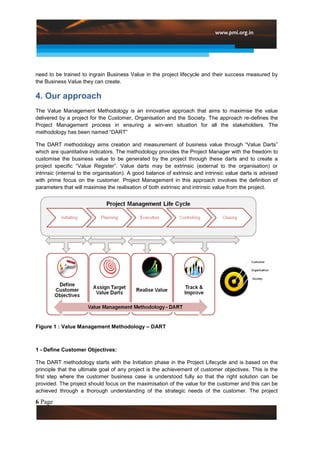
The DART methodology aims creation and measurement of business value through “Value Darts”
which are quantitative indicators. The methodology provides the Project Manager with the freedom to
customise the business value to be generated by the project through these darts and to create a
project specific “Value Register”. Value darts may be extrinsic (external to the organisation) or
intrinsic (internal to the organisation). A good balance of extrinsic and intrinsic value darts is advised
with prime focus on the customer. Project Management in this approach involves the definition of
parameters that will maximise the realisation of both extrinsic and intrinsic value from the project.


Figure 1 : Value Management Methodology – DART


1 - Define Customer Objectives:

The DART methodology starts with the Initiation phase in the Project Lifecycle and is based on the
principle that the ultimate goal of any project is the achievement of customer objectives. This is the
first step where the customer business case is understood fully so that the right solution can be
provided. The project should focus on the maximisation of the value for the customer and this can be
achieved through a thorough understanding of the strategic needs of the customer. The project

6 Page
requirements should be evolved from these customer requirements and the success of the DART
methodology will depend on how well this step is performed. The key is to articulate the objectives as
outcomes and finalise the baselined set in conjunction with the customer.

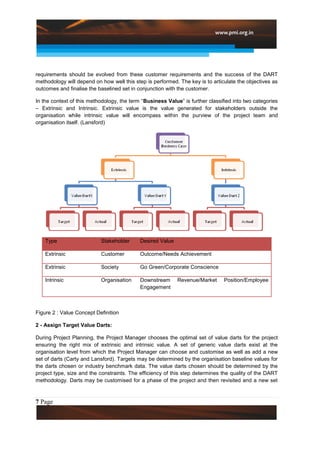
In the context of this methodology, the term “Business Value” is further classified into two categories
– Extrinsic and Intrinsic. Extrinsic value is the value generated for stakeholders outside the
organisation while intrinsic value will encompass within the purview of the project team and
organisation itself. (Lansford)


    Type                   Stakeholder      Desired Value

    Extrinsic              Customer         Outcome/Needs Achievement

    Extrinsic              Society          Go Green/Corporate Conscience

    Intrinsic              Organisation     Downstream      Revenue/Market      Position/Employee
                                            Engagement


Figure 2 : Value Concept Definition

2 - Assign Target Value Darts:

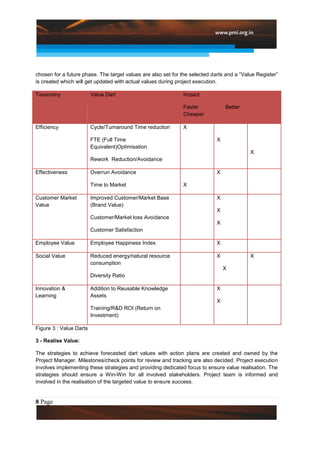
During Project Planning, the Project Manager chooses the optimal set of value darts for the project
ensuring the right mix of extrinsic and intrinsic value. A set of generic value darts exist at the
organisation level from which the Project Manager can choose and customise as well as add a new
set of darts (Carty and Lansford). Targets may be determined by the organisation baseline values for
the darts chosen or industry benchmark data. The value darts chosen should be determined by the
project type, size and the constraints. The efficiency of this step determines the quality of the DART
methodology. Darts may be customised for a phase of the project and then revisited and a new set


7 Page
chosen for a future phase. The target values are also set for the selected darts and a “Value Register”
is created which will get updated with actual values during project execution.

Taxonomy                 Value Dart                           Impact

                                                              Faster             Better
                                                              Cheaper

Efficiency               Cycle/Turnaround Time reduction      X

                         FTE (Full Time                                      X
                         Equivalent)Optimisation
                                                                                           X
                         Rework Reduction/Avoidance

Effectiveness            Overrun Avoidance                                   X

                         Time to Market                       X

Customer Market          Improved Customer/Market Base                       X
Value                    (Brand Value)
                                                                             X
                         Customer/Market loss Avoidance
                                                                             X
                         Customer Satisfaction

Employee Value           Employee Happiness Index                            X

Social Value             Reduced energy/natural resource                     X             X
                         consumption
                                                                                 X
                         Diversity Ratio

Innovation &             Addition to Reusable Knowledge                      X
Learning                 Assets
                                                                             X
                         Training/R&D ROI (Return on
                         Investment)

Figure 3 : Value Darts

3 - Realise Value:

The strategies to achieve forecasted dart values with action plans are created and owned by the
Project Manager. Milestones/check points for review and tracking are also decided. Project execution
involves implementing these strategies and providing dedicated focus to ensure value realisation. The
strategies should ensure a Win-Win for all involved stakeholders. Project team is informed and
involved in the realisation of the targeted value to ensure success.


8 Page
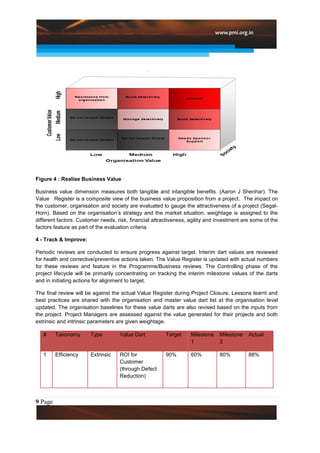
Figure 4 : Realise Business Value

Business value dimension measures both tangible and intangible benefits. (Aaron J Shenhar). The
Value Register is a composite view of the business value proposition from a project. The impact on
the customer, organisation and society are evaluated to gauge the attractiveness of a project (Segal-
Horn). Based on the organisation’s strategy and the market situation, weightage is assigned to the
different factors. Customer needs, risk, financial attractiveness, agility and investment are some of the
factors feature as part of the evaluation criteria.

4 - Track & Improve:

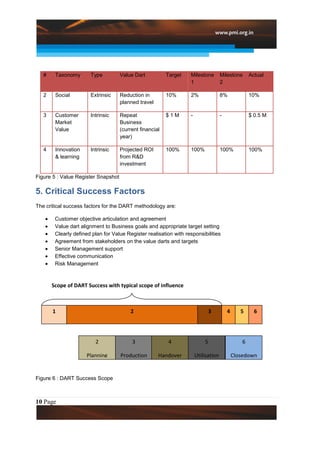
Periodic reviews are conducted to ensure progress against target. Interim dart values are reviewed
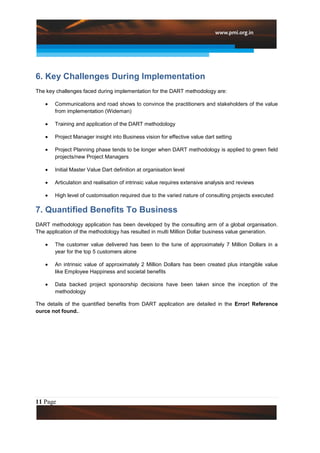
for health and corrective/preventive actions taken. The Value Register is updated with actual numbers
for these reviews and feature in the Programme/Business reviews. The Controlling phase of the
project lifecycle will be primarily concentrating on tracking the interim milestone values of the darts
and in initiating actions for alignment to target.

The final review will be against the actual Value Register during Project Closure. Lessons learnt and
best practices are shared with the organisation and master value dart list at the organisation level
updated. The organisation baselines for these value darts are also revised based on the inputs from
the project. Project Managers are assessed against the value generated for their projects and both
extrinsic and intrinsic parameters are given weightage.

   #     Taxonomy      Type         Value Dart          Target     Milestone   Milestone    Actual
                                                                   1           2

   1     Efficiency    Extrinsic    ROI for             90%        60%         80%          88%
                                    Customer
                                    (through Defect
                                    Reduction)


9 Page
#    Taxonomy       Type          Value Dart           Target   Milestone         Milestone      Actual
                                                                   1                 2

   2    Social         Extrinsic     Reduction in         10%      2%                8%             10%
                                     planned travel

   3    Customer       Intrinsic     Repeat               $1M      -                 -              $ 0.5 M
        Market                       Business
        Value                        (current financial
                                     year)

   4    Innovation     Intrinsic     Projected ROI        100%     100%              100%           100%
        & learning                   from R&D
                                     investment

Figure 5 : Value Register Snapshot

5. Critical Success Factors
The critical success factors for the DART methodology are:

        Customer objective articulation and agreement
        Value dart alignment to Business goals and appropriate target setting
        Clearly defined plan for Value Register realisation with responsibilities
        Agreement from stakeholders on the value darts and targets
        Senior Management support
        Effective communication
        Risk Management


       Scope of DART Success with typical scope of influence


       1                                 2                                     3         4      5     6


                         2                3                4               5                    6

                     Planning        Production       Handover         Utilisation           Closedown


Figure 6 : DART Success Scope


10 Page
6. Key Challenges During Implementation
The key challenges faced during implementation for the DART methodology are:

       Communications and road shows to convince the practitioners and stakeholders of the value
       from implementation (Wideman)

       Training and application of the DART methodology

       Project Manager insight into Business vision for effective value dart setting

       Project Planning phase tends to be longer when DART methodology is applied to green field
       projects/new Project Managers

       Initial Master Value Dart definition at organisation level

       Articulation and realisation of intrinsic value requires extensive analysis and reviews

       High level of customisation required due to the varied nature of consulting projects executed

7. Quantified Benefits To Business
DART methodology application has been developed by the consulting arm of a global organisation.
The application of the methodology has resulted in multi Million Dollar business value generation.

       The customer value delivered has been to the tune of approximately 7 Million Dollars in a
       year for the top 5 customers alone

       An intrinsic value of approximately 2 Million Dollars has been created plus intangible value
       like Employee Happiness and societal benefits

       Data backed project sponsorship decisions have been taken since the inception of the
       methodology

The details of the quantified benefits from DART application are detailed in the Error! Reference
ource not found..


11 Page
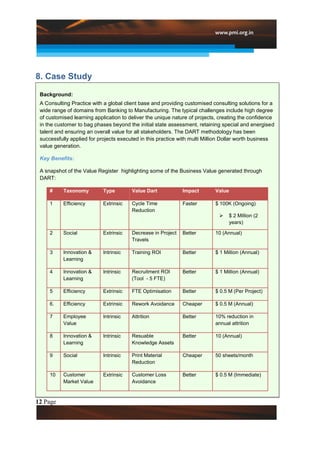
8. Case Study
 Background:
 A Consulting Practice with a global client base and providing customised consulting solutions for a
 wide range of domains from Banking to Manufacturing. The typical challenges include high degree
 of customised learning application to deliver the unique nature of projects, creating the confidence
 in the customer to bag phases beyond the initial state assessment, retaining special and energised
 talent and ensuring an overall value for all stakeholders. The DART methodology has been
 successfully applied for projects executed in this practice with multi Million Dollar worth business
 value generation.

 Key Benefits:

 A snapshot of the Value Register highlighting some of the Business Value generated through
 DART:

     #     Taxonomy         Type        Value Dart            Impact       Value

     1     Efficiency       Extrinsic   Cycle Time            Faster       $ 100K (Ongoing)
                                        Reduction
                                                                                $ 2 Million (2
                                                                                 years)

     2     Social           Extrinsic   Decrease in Project   Better       10 (Annual)
                                        Travels

     3     Innovation &     Intrinsic   Training ROI          Better       $ 1 Million (Annual)
           Learning

     4     Innovation &     Intrinsic   Recruitment ROI       Better       $ 1 Million (Annual)
           Learning                     (Tool - 5 FTE)

     5     Efficiency       Extrinsic   FTE Optimisation      Better       $ 0.5 M (Per Project)

     6.    Efficiency       Extrinsic   Rework Avoidance      Cheaper      $ 0.5 M (Annual)

     7     Employee         Intrinsic   Attrition             Better       10% reduction in
           Value                                                           annual attrition

     8     Innovation &     Intrinsic   Resuable              Better       10 (Annual)
           Learning                     Knowledge Assets

     9     Social           Intrinsic   Print Material        Cheaper      50 sheets/month
                                        Reduction

     10    Customer         Extrinsic   Customer Loss         Better       $ 0.5 M (Immediate)
           Market Value                 Avoidance


12 Page
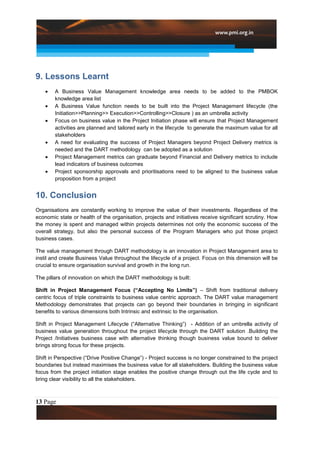
9. Lessons Learnt
        A Business Value Management knowledge area needs to be added to the PMBOK
        knowledge area list
        A Business Value function needs to be built into the Project Management lifecycle (the
        Initiation>>Planning>> Execution>>Controlling>>Closure ) as an umbrella activity
        Focus on business value in the Project Initiation phase will ensure that Project Management
        activities are planned and tailored early in the lifecycle to generate the maximum value for all
        stakeholders
        A need for evaluating the success of Project Managers beyond Project Delivery metrics is
        needed and the DART methodology can be adopted as a solution
        Project Management metrics can graduate beyond Financial and Delivery metrics to include
        lead indicators of business outcomes
        Project sponsorship approvals and prioritisations need to be aligned to the business value
        proposition from a project


10. Conclusion
Organisations are constantly working to improve the value of their investments. Regardless of the
economic state or health of the organisation, projects and initiatives receive significant scrutiny. How
the money is spent and managed within projects determines not only the economic success of the
overall strategy, but also the personal success of the Program Managers who put those project
business cases.

The value management through DART methodology is an innovation in Project Management area to
instil and create Business Value throughout the lifecycle of a project. Focus on this dimension will be
crucial to ensure organisation survival and growth in the long run.

The pillars of innovation on which the DART methodology is built:

Shift in Project Management Focus (“Accepting No Limits”) – Shift from traditional delivery
centric focus of triple constraints to business value centric approach. The DART value management
Methodology demonstrates that projects can go beyond their boundaries in bringing in significant
benefits to various dimensions both Intrinsic and extrinsic to the organisation.

Shift in Project Management Lifecycle (“Alternative Thinking”) - Addition of an umbrella activity of
business value generation throughout the project lifecycle through the DART solution .Building the
Project /Initiatives business case with alternative thinking though business value bound to deliver
brings strong focus for these projects.

Shift in Perspective (“Drive Positive Change”) - Project success is no longer constrained to the project
boundaries but instead maximises the business value for all stakeholders. Building the business value
focus from the project initiation stage enables the positive change through out the life cycle and to
bring clear visibility to all the stakeholders.


13 Page
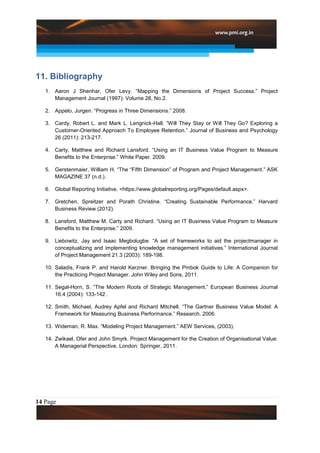
11. Bibliography
   1. Aaron J Shenhar, Ofer Levy. “Mapping the Dimensions of Project Success.” Project
      Management Journal (1997): Volume 28, No.2.

   2. Appelo, Jurgen. “Progress in Three Dimensions.” 2008.

   3. Cardy, Robert L. and Mark L. Lengnick-Hall. “Will They Stay or Will They Go? Exploring a
      Customer-Oriented Approach To Employee Retention.” Journal of Business and Psychology
      26 (2011): 213-217.

   4. Carty, Matthew and Richard Lansford. “Using an IT Business Value Program to Measure
      Benefits to the Enterprise.” White Paper. 2009.

   5. Gerstenmaier, William H. “The “Fifth Dimension” of Program and Project Management.” ASK
      MAGAZINE 37 (n.d.).

   6. Global Reporting Initiative. <https://www.globalreporting.org/Pages/default.aspx>.

   7. Gretchen, Spreitzer and Porath Christine. “Creating Sustainable Performance.” Harvard
      Business Review (2012).

   8. Lansford, Matthew M. Carty and Richard. “Using an IT Business Value Program to Measure
      Benefits to the Enterprise.” 2009.

   9. Liebowitz, Jay and Isaac Megbolugbe. “A set of frameworks to aid the projectmanager in
      conceptualizing and implementing knowledge management initiatives.” International Journal
      of Project Management 21.3 (2003): 189-198.

   10. Saladis, Frank P. and Harold Kerzner. Bringing the Pmbok Guide to Life: A Companion for
       the Practicing Project Manager. John Wiley and Sons, 2011.

   11. Segal-Horn, S. “The Modern Roots of Strategic Management.” European Business Journal
       16.4 (2004): 133-142 .

   12. Smith, Michael, Audrey Apfel and Richard Mitchell. “The Gartner Business Value Model: A
       Framework for Measuring Business Performance.” Research. 2006.

   13. Wideman, R. Max. “Modeling Project Management.” AEW Services, (2003).

   14. Zwikael, Ofer and John Smyrk. Project Management for the Creation of Organisational Value:
       A Managerial Perspective. London: Springer, 2011.


14 Page
12. Author’s Profile:
                            Muktha Kartik, Process Consultant of Business Value
                            Enhancement (BVE) at Mahindra Satyam with +10 years of
                            experience in the Software Industry. She has proven expertise
                            in Process and Quality Assurance. She is an active member of
                            the ISO/IEC JTC1/SC7 working group. She holds Engineering
                            and Management degrees and certified in collaborative
                            programme by Harvard Business School.


                            Deborah Devadason, Principal Consultant – BVE at Mahindra
                            Satyam with +16yrs experience. She has consulted US, Europe
                            and other clients in Process Integration and implementation on
                            various Quality models. She holds dual Master degree in
                            Technology and Science. She is certified in ITIL, PMP, CQM,
                            and CSSBB.


13. Special Acknowledgement
We would like to acknowledge the motivation and support from Business Leader Murali
Gopalaswamy and Team Lead Ranjini Balaraman for the effective review and support and to
Ratnesh Saxena and Sonia Rao for helping us with the paper format.

Also we would like to acknowledge all the Business Value Enhanacement team consultants who have
supported in implementing this innovative approach at various stages.


15 Page

ETCA_2

  • 1.
  • 2.
    A New Dimensionin Project Management - The "Value" Diamond Muktha Kartik – Consultant, Mahindra Satyam Deborah Devadason – Consultant, Mahindra Satyam
  • 3.
    Contents 1. Abstract......................................................................................................................................... 4 2. Background ................................................................................................................................... 4 3. Key triggers for innovation .......................................................................................................... 5 4. Our approach ................................................................................................................................ 6 5. Critical Success Factors ........................................................................................................... 10 6. Key Challenges During Implementation ................................................................................. 11 7. Quantified Benefits To Business ............................................................................................. 11 8. Case Study ................................................................................................................................. 12 9. Lessons Learnt ........................................................................................................................... 13 10. Conclusion ................................................................................................................................ 13 11. Bibliography .............................................................................................................................. 14 12. Author’s Profile: ........................................................................................................................ 15 13. Special Acknowledgement ..................................................................................................... 15 3 Page
  • 4.
    1. Abstract st In the 21 century, Customer-centric Project Management will outpace the triple constraints of cost, scope and schedule and true success will be determined by the Business Value generated by the project. This paper explores an avant-garde approach to include a fourth dimension of “Business Value” to create the Project Management Diamond. The focus of the approach is customer delight while focusing on generating business value and this transformation will be a competitive advantage in the st 21 century. The paper discusses innovative techniques to ingrain business value in all stages of the project lifecycle and the breakthrough concept of “Value Management”. Real case examples highlighting the implementation aspects from a Consulting Team, with a varied and global client base cutting across multiple domains, which has resulted in multi Million value generation, add substance to the paper. The paper shares simple powerful tools like Value Register which aid the computation of true business value for all types of projects, taking into consideration a variety of aspects ranging from knowledge enhancement to branding and shareholder value. The authors explore the re- evaluation of the Project Management processes and procedures as well as the role of the new Manager in instilling this new dimension. The authors demonstrate how this “Value” Diamond Transformation marks a new era in Project Management and how it can be easily adopted by any organisation irrespective of the size, domain and culture. 2. Background Traditional Project Management has relied on the triple constraints of cost, scope and schedule to measure success (Appelo). Project Managers have balanced these parameters against each other to steer the project to success. This concept of Iron Triangle has evolved over the years (Zwikael and Smyrk) and the focus on customer delight has increased. However, futuristic Project Management should aim to achieve business success and this is possible only though a value proposition for all stakeholders. The right project selection is highly critical when running large programs and projects. It is imperative that the selected projects create the most compelling value to excite the end customers and provide the right value for the investments organisations make. While the primary focus is on customer value, long term value creation for the business organisation and society should be given importance. The triple constraints thus expand to include a fourth dimension of Business Value to form the Project Management Diamond. The investment in this dimension will ensure a handsome return for the organisation in the long run. Just as an athlete cannot make it to the Olympics without extraordinary physical ability, a good Manager must master the four dimensions of Project Management to be successful. (Gerstenmaier) 4 Page
  • 5.
    3. Key triggersfor innovation Being the Best is Not Good Enough In the 21st century, business demands are changing by the minute. This rapid change in market place is accompanied by customer demands that require a high level of customisation. One single strategy does not guarantee success in all situations. A product or service may be the best and most innovative in the market; yet may not be valued by the customer. On the other hand, a project may be successful even when violating the time and cost estimates so long as the customer judges it as successful against their criteria. Lagging Vs. Leading Indicators The traditional Project Management dimensions concentrate on the outcomes of project activity and are lagging indicators of performance. The need of the hour is a better understanding of the drivers of Business Value and a means to track measure and compare this across projects (Smith, Apfel and Mitchell). These leading indicators should be the key to project selection and prioritisation and need to be inbuilt into the Project Management principles. Alignment of Technical Capabilities to Business Vision Technological advancements have made projects unique and project execution requires high levels of innovation and application of learning. Investments done in R&D and training for project purposes should be evaluated for long term Business Value. Project Managers need to provide special focus on applied learning and innovation which can be leveraged in future projects and thus provide the link between technical capabilities and Business vision. (Liebowitz and Megbolugbe) Go Green Sustainability is central to the new age Business. Population explosion, plunder of natural resources and allied climate changes has put the planet at risk. All projects have a responsibility to address such risks on environmental, socio-economic, ethical and health and safety concerns and need to be inbuilt into the value delivered by the project (Global Reporting Initiative). The ideal starting point is the project which funnels into the Business level to make meaningful impact in the long run. Happiness Index The Harvard Business Review has quoted that happy employees are the key to happy customers (Gretchen and Christine). Employee Happiness Index is fast becoming the by-word in the new millennium. Employee engagement and happiness should start at project level and value creation should include this aspect. In the dynamic environment of changing nature of workforce, this area will determine futuristic success. Project Manager Evaluation When Project Management needs to expand to a futuristic dimension, the evaluation of projects and Project Managers also need to be aligned to this perspective. Projects fetching a higher Business Value proposition should be given weightage when evaluating for approval. Project Managers also 5 Page
  • 6.
    need to betrained to ingrain Business Value in the project lifecycle and their success measured by the Business Value they can create. 4. Our approach The Value Management Methodology is an innovative approach that aims to maximise the value delivered by a project for the Customer, Organisation and the Society. The approach re-defines the Project Management process in ensuring a win-win situation for all the stakeholders. The methodology has been named “DART” The DART methodology aims creation and measurement of business value through “Value Darts” which are quantitative indicators. The methodology provides the Project Manager with the freedom to customise the business value to be generated by the project through these darts and to create a project specific “Value Register”. Value darts may be extrinsic (external to the organisation) or intrinsic (internal to the organisation). A good balance of extrinsic and intrinsic value darts is advised with prime focus on the customer. Project Management in this approach involves the definition of parameters that will maximise the realisation of both extrinsic and intrinsic value from the project. Figure 1 : Value Management Methodology – DART 1 - Define Customer Objectives: The DART methodology starts with the Initiation phase in the Project Lifecycle and is based on the principle that the ultimate goal of any project is the achievement of customer objectives. This is the first step where the customer business case is understood fully so that the right solution can be provided. The project should focus on the maximisation of the value for the customer and this can be achieved through a thorough understanding of the strategic needs of the customer. The project 6 Page
  • 7.
    requirements should beevolved from these customer requirements and the success of the DART methodology will depend on how well this step is performed. The key is to articulate the objectives as outcomes and finalise the baselined set in conjunction with the customer. In the context of this methodology, the term “Business Value” is further classified into two categories – Extrinsic and Intrinsic. Extrinsic value is the value generated for stakeholders outside the organisation while intrinsic value will encompass within the purview of the project team and organisation itself. (Lansford) Type Stakeholder Desired Value Extrinsic Customer Outcome/Needs Achievement Extrinsic Society Go Green/Corporate Conscience Intrinsic Organisation Downstream Revenue/Market Position/Employee Engagement Figure 2 : Value Concept Definition 2 - Assign Target Value Darts: During Project Planning, the Project Manager chooses the optimal set of value darts for the project ensuring the right mix of extrinsic and intrinsic value. A set of generic value darts exist at the organisation level from which the Project Manager can choose and customise as well as add a new set of darts (Carty and Lansford). Targets may be determined by the organisation baseline values for the darts chosen or industry benchmark data. The value darts chosen should be determined by the project type, size and the constraints. The efficiency of this step determines the quality of the DART methodology. Darts may be customised for a phase of the project and then revisited and a new set 7 Page
  • 8.
    chosen for afuture phase. The target values are also set for the selected darts and a “Value Register” is created which will get updated with actual values during project execution. Taxonomy Value Dart Impact Faster Better Cheaper Efficiency Cycle/Turnaround Time reduction X FTE (Full Time X Equivalent)Optimisation X Rework Reduction/Avoidance Effectiveness Overrun Avoidance X Time to Market X Customer Market Improved Customer/Market Base X Value (Brand Value) X Customer/Market loss Avoidance X Customer Satisfaction Employee Value Employee Happiness Index X Social Value Reduced energy/natural resource X X consumption X Diversity Ratio Innovation & Addition to Reusable Knowledge X Learning Assets X Training/R&D ROI (Return on Investment) Figure 3 : Value Darts 3 - Realise Value: The strategies to achieve forecasted dart values with action plans are created and owned by the Project Manager. Milestones/check points for review and tracking are also decided. Project execution involves implementing these strategies and providing dedicated focus to ensure value realisation. The strategies should ensure a Win-Win for all involved stakeholders. Project team is informed and involved in the realisation of the targeted value to ensure success. 8 Page
  • 9.
    Figure 4 :Realise Business Value Business value dimension measures both tangible and intangible benefits. (Aaron J Shenhar). The Value Register is a composite view of the business value proposition from a project. The impact on the customer, organisation and society are evaluated to gauge the attractiveness of a project (Segal- Horn). Based on the organisation’s strategy and the market situation, weightage is assigned to the different factors. Customer needs, risk, financial attractiveness, agility and investment are some of the factors feature as part of the evaluation criteria. 4 - Track & Improve: Periodic reviews are conducted to ensure progress against target. Interim dart values are reviewed for health and corrective/preventive actions taken. The Value Register is updated with actual numbers for these reviews and feature in the Programme/Business reviews. The Controlling phase of the project lifecycle will be primarily concentrating on tracking the interim milestone values of the darts and in initiating actions for alignment to target. The final review will be against the actual Value Register during Project Closure. Lessons learnt and best practices are shared with the organisation and master value dart list at the organisation level updated. The organisation baselines for these value darts are also revised based on the inputs from the project. Project Managers are assessed against the value generated for their projects and both extrinsic and intrinsic parameters are given weightage. # Taxonomy Type Value Dart Target Milestone Milestone Actual 1 2 1 Efficiency Extrinsic ROI for 90% 60% 80% 88% Customer (through Defect Reduction) 9 Page
  • 10.
    # Taxonomy Type Value Dart Target Milestone Milestone Actual 1 2 2 Social Extrinsic Reduction in 10% 2% 8% 10% planned travel 3 Customer Intrinsic Repeat $1M - - $ 0.5 M Market Business Value (current financial year) 4 Innovation Intrinsic Projected ROI 100% 100% 100% 100% & learning from R&D investment Figure 5 : Value Register Snapshot 5. Critical Success Factors The critical success factors for the DART methodology are: Customer objective articulation and agreement Value dart alignment to Business goals and appropriate target setting Clearly defined plan for Value Register realisation with responsibilities Agreement from stakeholders on the value darts and targets Senior Management support Effective communication Risk Management Scope of DART Success with typical scope of influence 1 2 3 4 5 6 2 3 4 5 6 Planning Production Handover Utilisation Closedown Figure 6 : DART Success Scope 10 Page
  • 11.
    6. Key ChallengesDuring Implementation The key challenges faced during implementation for the DART methodology are: Communications and road shows to convince the practitioners and stakeholders of the value from implementation (Wideman) Training and application of the DART methodology Project Manager insight into Business vision for effective value dart setting Project Planning phase tends to be longer when DART methodology is applied to green field projects/new Project Managers Initial Master Value Dart definition at organisation level Articulation and realisation of intrinsic value requires extensive analysis and reviews High level of customisation required due to the varied nature of consulting projects executed 7. Quantified Benefits To Business DART methodology application has been developed by the consulting arm of a global organisation. The application of the methodology has resulted in multi Million Dollar business value generation. The customer value delivered has been to the tune of approximately 7 Million Dollars in a year for the top 5 customers alone An intrinsic value of approximately 2 Million Dollars has been created plus intangible value like Employee Happiness and societal benefits Data backed project sponsorship decisions have been taken since the inception of the methodology The details of the quantified benefits from DART application are detailed in the Error! Reference ource not found.. 11 Page
  • 12.
    8. Case Study Background: A Consulting Practice with a global client base and providing customised consulting solutions for a wide range of domains from Banking to Manufacturing. The typical challenges include high degree of customised learning application to deliver the unique nature of projects, creating the confidence in the customer to bag phases beyond the initial state assessment, retaining special and energised talent and ensuring an overall value for all stakeholders. The DART methodology has been successfully applied for projects executed in this practice with multi Million Dollar worth business value generation. Key Benefits: A snapshot of the Value Register highlighting some of the Business Value generated through DART: # Taxonomy Type Value Dart Impact Value 1 Efficiency Extrinsic Cycle Time Faster $ 100K (Ongoing) Reduction  $ 2 Million (2 years) 2 Social Extrinsic Decrease in Project Better 10 (Annual) Travels 3 Innovation & Intrinsic Training ROI Better $ 1 Million (Annual) Learning 4 Innovation & Intrinsic Recruitment ROI Better $ 1 Million (Annual) Learning (Tool - 5 FTE) 5 Efficiency Extrinsic FTE Optimisation Better $ 0.5 M (Per Project) 6. Efficiency Extrinsic Rework Avoidance Cheaper $ 0.5 M (Annual) 7 Employee Intrinsic Attrition Better 10% reduction in Value annual attrition 8 Innovation & Intrinsic Resuable Better 10 (Annual) Learning Knowledge Assets 9 Social Intrinsic Print Material Cheaper 50 sheets/month Reduction 10 Customer Extrinsic Customer Loss Better $ 0.5 M (Immediate) Market Value Avoidance 12 Page
  • 13.
    9. Lessons Learnt A Business Value Management knowledge area needs to be added to the PMBOK knowledge area list A Business Value function needs to be built into the Project Management lifecycle (the Initiation>>Planning>> Execution>>Controlling>>Closure ) as an umbrella activity Focus on business value in the Project Initiation phase will ensure that Project Management activities are planned and tailored early in the lifecycle to generate the maximum value for all stakeholders A need for evaluating the success of Project Managers beyond Project Delivery metrics is needed and the DART methodology can be adopted as a solution Project Management metrics can graduate beyond Financial and Delivery metrics to include lead indicators of business outcomes Project sponsorship approvals and prioritisations need to be aligned to the business value proposition from a project 10. Conclusion Organisations are constantly working to improve the value of their investments. Regardless of the economic state or health of the organisation, projects and initiatives receive significant scrutiny. How the money is spent and managed within projects determines not only the economic success of the overall strategy, but also the personal success of the Program Managers who put those project business cases. The value management through DART methodology is an innovation in Project Management area to instil and create Business Value throughout the lifecycle of a project. Focus on this dimension will be crucial to ensure organisation survival and growth in the long run. The pillars of innovation on which the DART methodology is built: Shift in Project Management Focus (“Accepting No Limits”) – Shift from traditional delivery centric focus of triple constraints to business value centric approach. The DART value management Methodology demonstrates that projects can go beyond their boundaries in bringing in significant benefits to various dimensions both Intrinsic and extrinsic to the organisation. Shift in Project Management Lifecycle (“Alternative Thinking”) - Addition of an umbrella activity of business value generation throughout the project lifecycle through the DART solution .Building the Project /Initiatives business case with alternative thinking though business value bound to deliver brings strong focus for these projects. Shift in Perspective (“Drive Positive Change”) - Project success is no longer constrained to the project boundaries but instead maximises the business value for all stakeholders. Building the business value focus from the project initiation stage enables the positive change through out the life cycle and to bring clear visibility to all the stakeholders. 13 Page
  • 14.
    11. Bibliography 1. Aaron J Shenhar, Ofer Levy. “Mapping the Dimensions of Project Success.” Project Management Journal (1997): Volume 28, No.2. 2. Appelo, Jurgen. “Progress in Three Dimensions.” 2008. 3. Cardy, Robert L. and Mark L. Lengnick-Hall. “Will They Stay or Will They Go? Exploring a Customer-Oriented Approach To Employee Retention.” Journal of Business and Psychology 26 (2011): 213-217. 4. Carty, Matthew and Richard Lansford. “Using an IT Business Value Program to Measure Benefits to the Enterprise.” White Paper. 2009. 5. Gerstenmaier, William H. “The “Fifth Dimension” of Program and Project Management.” ASK MAGAZINE 37 (n.d.). 6. Global Reporting Initiative. <https://www.globalreporting.org/Pages/default.aspx>. 7. Gretchen, Spreitzer and Porath Christine. “Creating Sustainable Performance.” Harvard Business Review (2012). 8. Lansford, Matthew M. Carty and Richard. “Using an IT Business Value Program to Measure Benefits to the Enterprise.” 2009. 9. Liebowitz, Jay and Isaac Megbolugbe. “A set of frameworks to aid the projectmanager in conceptualizing and implementing knowledge management initiatives.” International Journal of Project Management 21.3 (2003): 189-198. 10. Saladis, Frank P. and Harold Kerzner. Bringing the Pmbok Guide to Life: A Companion for the Practicing Project Manager. John Wiley and Sons, 2011. 11. Segal-Horn, S. “The Modern Roots of Strategic Management.” European Business Journal 16.4 (2004): 133-142 . 12. Smith, Michael, Audrey Apfel and Richard Mitchell. “The Gartner Business Value Model: A Framework for Measuring Business Performance.” Research. 2006. 13. Wideman, R. Max. “Modeling Project Management.” AEW Services, (2003). 14. Zwikael, Ofer and John Smyrk. Project Management for the Creation of Organisational Value: A Managerial Perspective. London: Springer, 2011. 14 Page
  • 15.
    12. Author’s Profile: Muktha Kartik, Process Consultant of Business Value Enhancement (BVE) at Mahindra Satyam with +10 years of experience in the Software Industry. She has proven expertise in Process and Quality Assurance. She is an active member of the ISO/IEC JTC1/SC7 working group. She holds Engineering and Management degrees and certified in collaborative programme by Harvard Business School. Deborah Devadason, Principal Consultant – BVE at Mahindra Satyam with +16yrs experience. She has consulted US, Europe and other clients in Process Integration and implementation on various Quality models. She holds dual Master degree in Technology and Science. She is certified in ITIL, PMP, CQM, and CSSBB. 13. Special Acknowledgement We would like to acknowledge the motivation and support from Business Leader Murali Gopalaswamy and Team Lead Ranjini Balaraman for the effective review and support and to Ratnesh Saxena and Sonia Rao for helping us with the paper format. Also we would like to acknowledge all the Business Value Enhanacement team consultants who have supported in implementing this innovative approach at various stages. 15 Page