Transforming to Learning Organization:
Converting ‘Bench’ Threat into Great Opportunity
Vineet Jain
Deputy General Manager, B.E., M.S., EPBM.
12-Jun-13
Submitted to
PMI's National Conference 2013 – Gurgaon
© 2013, Vineet Jain
Originally published as part of PMI's National Conference 2013 – Gurgaon, India
Page 2
Contents
Abstract....................................................................................................................................................3
Keywords.................................................................................................................................................3
Author’s Profile .......................................................................................................................................3
Acknowledgement..................................................................................................................................4
Introduction..............................................................................................................................................5
Problem Faced – What went wrong?..................................................................................................6
Solution Approach - Best Practices Developed.................................................................................7
Organization Change Management ..................................................................................................10
Key Benefits..........................................................................................................................................11
Learning/ Improvements .....................................................................................................................14
Applicability to Other Organization ....................................................................................................14
Annexure ...............................................................................................................................................14
Glossary.................................................................................................................................................15
© 2013, Vineet Jain
Originally published as part of PMI's National Conference 2013 – Gurgaon, India
Page 3
Abstract
In IT Services organizations "bench" is one of the designed parameters, for its long term success and
scalability. One key issue associated with this "best practice" is to manage the associates on bench
productively. The youth often feels suffocated for want of getting gainfully engaged; besides bench is also
considered a major social stigma within the organizations. On the other side, most organizations are
finding it difficult to continuously enhance the skills of their employees, one of them being costs involved,
often resulting in dis-satisfaction, and attrition.
This paper is a real-life successfully implemented case-study, completed in a span of about 14 months, in
a highly distributed environment comprising of more than 400 consultants to manage, nurture and mature
talent, in order to bridge the above two key issues.
The paper explains how a capability based organization with different development managers, different
business and technology tracks, diverse in nature and geographically spread were brought together to
convert threat into opportunity of creating a learning organization. This also resulted in great amount of
talent building, reusable sharing, white paper publishing, training, coaching and mentoring and achieved
quantitative benefits to organization such as reduced attrition, increased productivity, better deployability,
value creation to customer and qualitative improvements such as increased passion, better employee
satisfaction and higher motivation.
Keywords
IT Organization, Bench, Learning Organization, Transforming, Talent Management, Capability Building
Author’s Profile
Vineet Jain is a seasoned program and project management professional with
extensive experience in IT and ERP Implementation. With a Masters in Software
Systems from BITS, Pilani and Executive Program in Business Management from IIM
Calcutta, he has program-managed implementation of large transformational ERP
projects across North America, Europe and APAC for global companies. Vineet has
presented multiple white papers in various internal forums and external conference,
the recent one being the PMI Global Conference at Vancouver, NA (Paper: “Creating
Successful Integrated PMO in Adverse Distributed Environment”)
Other Details
Address (Postal Communication):
502, Ranjit Apartment, 38, Jeremiah Road, Vepery,
Chennai – 600007, Tamil Nadu, India
Name of the Organization
HCL Technologies
Email Address justvineet@gmail.com ; vineetkhj@hcl.com
© 2013, Vineet Jain
Originally published as part of PMI's National Conference 2013 – Gurgaon, India
Page 4
Phone (+91) 98841-86330; (044) 43235062
Acknowledgement
I would like to offer my special thanks to Dr. Subhash Chandra Rastogi, M.Tech, PMP, PMI-ACP, Ph.D
for his valuable and constructive suggestions to prepare this white paper. It would not have been possible
to prepare this White Paper without his willingness to give time, knowledge, expertise and experience.
© 2013, Vineet Jain
Originally published as part of PMI's National Conference 2013 – Gurgaon, India
Page 5
Introduction
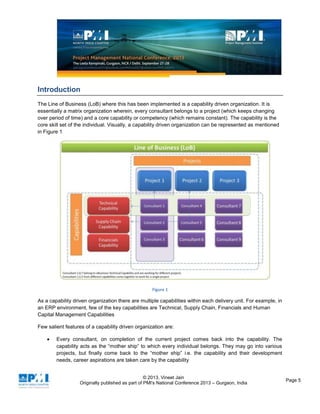
The Line of Business (LoB) where this has been implemented is a capability driven organization. It is
essentially a matrix organization wherein, every consultant belongs to a project (which keeps changing
over period of time) and a core capability or competency (which remains constant). The capability is the
core skill set of the individual. Visually, a capability driven organization can be represented as mentioned
in Figure 1
Figure 1
As a capability driven organization there are multiple capabilities within each delivery unit. For example, in
an ERP environment, few of the key capabilities are Technical, Supply Chain, Financials and Human
Capital Management Capabilities
Few salient features of a capability driven organization are:
Every consultant, on completion of the current project comes back into the capability. The
capability acts as the “mother ship” to which every individual belongs. They may go into various
projects, but finally come back to the “mother ship” i.e. the capability and their development
needs, career aspirations are taken care by the capability
© 2013, Vineet Jain
Originally published as part of PMI's National Conference 2013 – Gurgaon, India
Page 6
Yearly performance appraisal is done by the capability (Appraised by Development Manager and
reviewed by Capability Leader) with relevant inputs coming from the multiple projects in which the
consultant has worked upon
The KRA of each consultant includes contribution towards the capability building (on various
aspects such as creating reusable components, conducting training & getting trained, knowledge
sharing etc.) apart from the project specific KRAs.
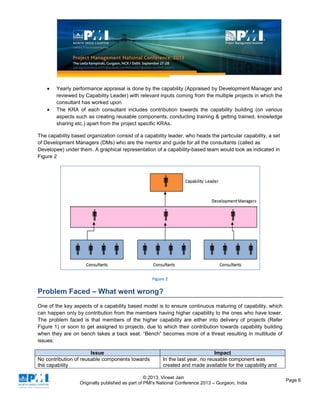
The capability based organization consist of a capability leader, who heads the particular capability, a set
of Development Managers (DMs) who are the mentor and guide for all the consultants (called as
Developee) under them. A graphical representation of a capability-based team would look as indicated in
Figure 2
Figure 2
Problem Faced – What went wrong?
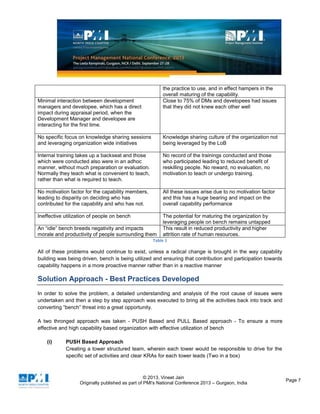
One of the key aspects of a capability based model is to ensure continuous maturing of capability, which
can happen only by contribution from the members having higher capability to the ones who have lower.
The problem faced is that members of the higher capability are either into delivery of projects (Refer
Figure 1) or soon to get assigned to projects, due to which their contribution towards capability building
when they are on bench takes a back seat. “Bench” becomes more of a threat resulting in multitude of
issues:
Issue Impact
No contribution of reusable components towards
the capability
In the last year, no reusable component was
created and made available for the capability and
© 2013, Vineet Jain
Originally published as part of PMI's National Conference 2013 – Gurgaon, India
Page 7
the practice to use, and in effect hampers in the
overall maturing of the capability.
Minimal interaction between development
managers and developee, which has a direct
impact during appraisal period, when the
Development Manager and developee are
interacting for the first time.
Close to 75% of DMs and developees had issues
that they did not knew each other well
No specific focus on knowledge sharing sessions
and leveraging organization wide initiatives
Knowledge sharing culture of the organization not
being leveraged by the LoB
Internal training takes up a backseat and those
which were conducted also were in an adhoc
manner, without much preparation or evaluation.
Normally they teach what is convenient to teach,
rather than what is required to teach.
No record of the trainings conducted and those
who participated leading to reduced benefit of
reskilling people. No reward, no evaluation, no
motivation to teach or undergo training.
No motivation factor for the capability members,
leading to disparity on deciding who has
contributed for the capability and who has not.
All these issues arise due to no motivation factor
and this has a huge bearing and impact on the
overall capability performance
Ineffective utilization of people on bench The potential for maturing the organization by
leveraging people on bench remains untapped
An “idle” bench breeds negativity and impacts
morale and productivity of people surrounding them
This result in reduced productivity and higher
attrition rate of human resources.
Table 1
All of these problems would continue to exist, unless a radical change is brought in the way capability
building was being driven, bench is being utilized and ensuring that contribution and participation towards
capability happens in a more proactive manner rather than in a reactive manner
Solution Approach - Best Practices Developed
In order to solve the problem, a detailed understanding and analysis of the root cause of issues were
undertaken and then a step by step approach was executed to bring all the activities back into track and
converting “bench” threat into a great opportunity.
A two thronged approach was taken - PUSH Based and PULL Based approach - To ensure a more
effective and high capability based organization with effective utilization of bench
(i) PUSH Based Approach
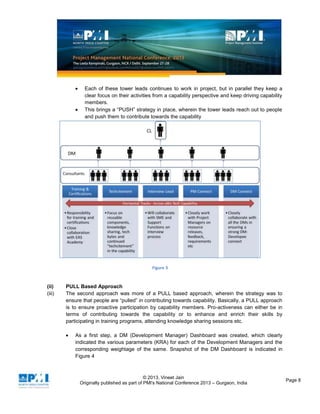
Creating a tower structured team, wherein each tower would be responsible to drive for the
specific set of activities and clear KRAs for each tower leads (Two in a box)
© 2013, Vineet Jain
Originally published as part of PMI's National Conference 2013 – Gurgaon, India
Page 8
Each of these tower leads continues to work in project, but in parallel they keep a
clear focus on their activities from a capability perspective and keep driving capability
members.
This brings a “PUSH” strategy in place, wherein the tower leads reach out to people
and push them to contribute towards the capability
Figure 3
(ii) PULL Based Approach
(iii) The second approach was more of a PULL based approach, wherein the strategy was to
ensure that people are “pulled” in contributing towards capability. Basically, a PULL approach
is to ensure proactive participation by capability members. Pro-activeness can either be in
terms of contributing towards the capability or to enhance and enrich their skills by
participating in training programs, attending knowledge sharing sessions etc.
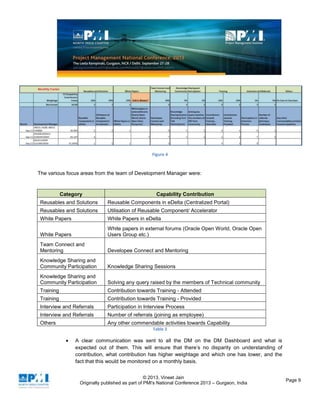
As a first step, a DM (Development Manager) Dashboard was created, which clearly
indicated the various parameters (KRA) for each of the Development Managers and the
corresponding weightage of the same. Snapshot of the DM Dashboard is indicated in
Figure 4
© 2013, Vineet Jain
Originally published as part of PMI's National Conference 2013 – Gurgaon, India
Page 9
Figure 4
The various focus areas from the team of Development Manager were:
Category Capability Contribution
Reusables and Solutions Reusable Components in eDelta (Centralized Portal)
Reusables and Solutions Utilisation of Reusable Component/ Accelerator
White Papers White Papers in eDelta
White Papers
White papers in external forums (Oracle Open World, Oracle Open
Users Group etc.)
Team Connect and
Mentoring Developee Connect and Mentoring
Knowledge Sharing and
Community Participation Knowledge Sharing Sessions
Knowledge Sharing and
Community Participation Solving any query raised by the members of Technical community
Training Contribution towards Training - Attended
Training Contribution towards Training - Provided
Interview and Referrals Participation in Interview Process
Interview and Referrals Number of referrals (joining as employee)
Others Any other commendable activities towards Capability
Table 2
A clear communication was sent to all the DM on the DM Dashboard and what is
expected out of them. This will ensure that there’s no disparity on understanding of
contribution, what contribution has higher weightage and which one has lower, and the
fact that this would be monitored on a monthly basis.
© 2013, Vineet Jain
Originally published as part of PMI's National Conference 2013 – Gurgaon, India
Page 10
This DM dashboard was then monitored on a month on month basis. The DMs used to
send their teams contribution by end of the month and the same was then published
across the entire capability and the leadership team to bring in complete transparency
and a healthy competition amongst the development managers. This also sent the
message loud and clear, that this DM Dashboard is here to stay and not just another
initiative.
For the first month the contribution was low, but as the dashboard was published across
the capability, it sensitized people on contribution and from 2
nd
month onwards, people
started contributing towards the capability in a more proactive manner.
The DM dashboard also started becoming a single source of truth indicating who is
contributing for the capability and who is not. Also, in an attempt to increase the score for
their respective teams, the DM themselves became ambassador of this initiative and they
ensured that their respective teams are contributing for the capability.
(iv) Last but not the least; a rigorous change management initiative was conducted across the
capability. People were constantly updated on the upcoming trainings, the knowledge sharing
sessions, reusable components and quarterly update. This helped in bringing increased
seriousness about capability contribution
Organization Change Management
One of the most important aspect of transforming to a learning organization, was to ensure change
management across the organization, to create awareness, sensitize people about various KRAs for
Development Managers and Developees, the various initiatives which they utilize to leverage their bench
time and their role in maturing the capability,
Change management was done during various stages of this initiative, right from ideation stage at the
beginning to the launch stage. Be it whether it was defining the KRAs, converting development
components as reusable, standardizing documents and templates, at every stage sensitization was done
on the benefit derived to the individual and to the organization. As part of change management, webinars
were run across the capability, business benefit awareness sessions were conducted, regular emails
were sent, frequent updates via newsletters were shared, Organization wide daily communication were
done. All this in order to ensure that all the key stakeholder understands, utilize and contribute towards
the capability. Of course, one of the most important aspects for the success of this was leadership
sponsorship and their presence and vouching in many of these discussions.
© 2013, Vineet Jain
Originally published as part of PMI's National Conference 2013 – Gurgaon, India
Page 11
Key Benefits
This good practice on transforming a capability based organization and converting bench threat into
opportunity, has helped in multiple ways, right from maturing of capability, contribution from people, right
up to impact on project and ensuring delivery excellence. Few of the benefits are tangible and few are
non-tangible. Listed in Table 3 are few of the key benefits:
Benefit Positive Impact
In a very short span we already have
close to 15 reusable components. 5 out
of this (on Data Conversion) have
already been made generic and are
available in centralized quality portal.
The remaining are on the verge of
completion and will soon be available for
the practice to use
These reusable components greatly help the projects and delivery team
in improving the productivity. Especially for fixed bid projects, these
reusable component reduce the data conversion activity for each of the
business entity by about 30% and only the customer specific validation
needs to be included
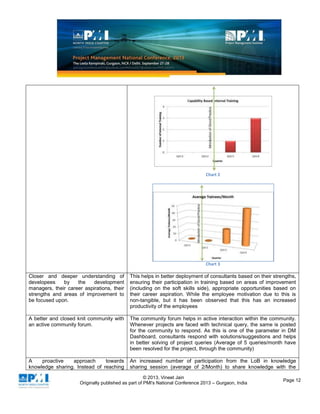
Chart 1
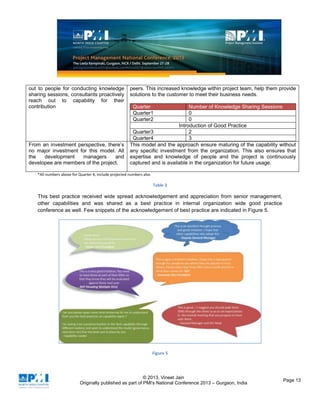
Average of two internal trainings/month
has been conducted. Close to 75
participants have participated in it and
there’s a clear track of who is getting
reskilled and can be appropriately
deployed
These internal trainings help in reskilling the people on various
technologies, increasing their deployability in projects. This has help in
reduced hiring on niche skills (such as OAF, Discoverer etc.) due to
internal training
© 2013, Vineet Jain
Originally published as part of PMI's National Conference 2013 – Gurgaon, India
Page 12
Chart 2
Chart 3
Closer and deeper understanding of
developees by the development
managers, their career aspirations, their
strengths and areas of improvement to
be focused upon.
This helps in better deployment of consultants based on their strengths,
ensuring their participation in training based on areas of improvement
(including on the soft skills side), appropriate opportunities based on
their career aspiration. While the employee motivation due to this is
non-tangible, but it has been observed that this has an increased
productivity of the employees
A better and closed knit community with
an active community forum.
The community forum helps in active interaction within the community.
Whenever projects are faced with technical query, the same is posted
for the community to respond. As this is one of the parameter in DM
Dashboard, consultants respond with solutions/suggestions and helps
in better solving of project queries (Average of 5 queries/month have
been resolved for the project, through the community)
A proactive approach towards
knowledge sharing. Instead of reaching
An increased number of participation from the LoB in knowledge
sharing session (average of 2/Month) to share knowledge with the
© 2013, Vineet Jain
Originally published as part of PMI's National Conference 2013 – Gurgaon, India
Page 13
out to people for conducting knowledge
sharing sessions, consultants proactively
reach out to capability for their
contribution
peers. This increased knowledge within project team, help them provide
solutions to the customer to meet their business needs.
Quarter Number of Knowledge Sharing Sessions
Quarter1 0
Quarter2 0
Introduction of Good Practice
Quarter3 2
Quarter4 3
From an investment perspective, there’s
no major investment for this model. All
the development managers and
developee are members of the project.
This model and the approach ensure maturing of the capability without
any specific investment from the organization. This also ensures that
expertise and knowledge of people and the project is continuously
captured and is available in the organization for future usage.
*All numbers above for Quarter 4, include projected numbers also
Table 3
This best practice received wide spread acknowledgement and appreciation from senior management,
other capabilities and was shared as a best practice in internal organization wide good practice
conference as well. Few snippets of the acknowledgement of best practice are indicated in Figure 5.
Figure 5
© 2013, Vineet Jain
Originally published as part of PMI's National Conference 2013 – Gurgaon, India
Page 14
Learning/ Improvements
Automation: Currently the record of contribution by individual to capability and the effectiveness of
Development Manager is recorded, measured and monitored manually. The tower leads, capture each of
the data manually, which is validated at the end of the month by the validation team and is then published
for the practice.
The improvement that can be brought in is to automate this complete process, right from initiation,
recording, validation and publishing. An internal initiative was initiated to develop an application for the
same. Once completed, this system would be a major improvement of transforming the capability based
organization.
Applicability to Other Organization
This model and approach of transforming a capability based organization and converting bench threat
into opportunity can very well be leveraged by other IT organizations to ensure effective utilization of
bench and making the bench more productive. This can be at a “Line of Business” Level, “Business Unit”
Level or even at specific customer portfolios level. This can be looked at by industry, beyond software
industry also, with the essence on how bench/idle time can be converted tapped and converted to
effective utilization to mature various competencies within an organization.
Annexure
Monthly Tracker template for monitoring the Development Manager and their team
of developees, contributing towards transformation
Development
Manager - Transformation Tracker.xlsx
© 2013, Vineet Jain
Originally published as part of PMI's National Conference 2013 – Gurgaon, India
Page 15
Glossary
IT Information Technology
LoB Line of Business
KRA Key Result Area
CL Capability Leader
DM Development Manager
eDelta Centralized Delivery Portal
BU Business Unit
SDU Strategic Delivery Unit
DU Delivery Unit

Vineet jain

  • 1.
    Transforming to LearningOrganization: Converting ‘Bench’ Threat into Great Opportunity Vineet Jain Deputy General Manager, B.E., M.S., EPBM. 12-Jun-13 Submitted to PMI's National Conference 2013 – Gurgaon
  • 2.
    © 2013, VineetJain Originally published as part of PMI's National Conference 2013 – Gurgaon, India Page 2 Contents Abstract....................................................................................................................................................3 Keywords.................................................................................................................................................3 Author’s Profile .......................................................................................................................................3 Acknowledgement..................................................................................................................................4 Introduction..............................................................................................................................................5 Problem Faced – What went wrong?..................................................................................................6 Solution Approach - Best Practices Developed.................................................................................7 Organization Change Management ..................................................................................................10 Key Benefits..........................................................................................................................................11 Learning/ Improvements .....................................................................................................................14 Applicability to Other Organization ....................................................................................................14 Annexure ...............................................................................................................................................14 Glossary.................................................................................................................................................15
  • 3.
    © 2013, VineetJain Originally published as part of PMI's National Conference 2013 – Gurgaon, India Page 3 Abstract In IT Services organizations "bench" is one of the designed parameters, for its long term success and scalability. One key issue associated with this "best practice" is to manage the associates on bench productively. The youth often feels suffocated for want of getting gainfully engaged; besides bench is also considered a major social stigma within the organizations. On the other side, most organizations are finding it difficult to continuously enhance the skills of their employees, one of them being costs involved, often resulting in dis-satisfaction, and attrition. This paper is a real-life successfully implemented case-study, completed in a span of about 14 months, in a highly distributed environment comprising of more than 400 consultants to manage, nurture and mature talent, in order to bridge the above two key issues. The paper explains how a capability based organization with different development managers, different business and technology tracks, diverse in nature and geographically spread were brought together to convert threat into opportunity of creating a learning organization. This also resulted in great amount of talent building, reusable sharing, white paper publishing, training, coaching and mentoring and achieved quantitative benefits to organization such as reduced attrition, increased productivity, better deployability, value creation to customer and qualitative improvements such as increased passion, better employee satisfaction and higher motivation. Keywords IT Organization, Bench, Learning Organization, Transforming, Talent Management, Capability Building Author’s Profile Vineet Jain is a seasoned program and project management professional with extensive experience in IT and ERP Implementation. With a Masters in Software Systems from BITS, Pilani and Executive Program in Business Management from IIM Calcutta, he has program-managed implementation of large transformational ERP projects across North America, Europe and APAC for global companies. Vineet has presented multiple white papers in various internal forums and external conference, the recent one being the PMI Global Conference at Vancouver, NA (Paper: “Creating Successful Integrated PMO in Adverse Distributed Environment”) Other Details Address (Postal Communication): 502, Ranjit Apartment, 38, Jeremiah Road, Vepery, Chennai – 600007, Tamil Nadu, India Name of the Organization HCL Technologies Email Address justvineet@gmail.com ; vineetkhj@hcl.com
  • 4.
    © 2013, VineetJain Originally published as part of PMI's National Conference 2013 – Gurgaon, India Page 4 Phone (+91) 98841-86330; (044) 43235062 Acknowledgement I would like to offer my special thanks to Dr. Subhash Chandra Rastogi, M.Tech, PMP, PMI-ACP, Ph.D for his valuable and constructive suggestions to prepare this white paper. It would not have been possible to prepare this White Paper without his willingness to give time, knowledge, expertise and experience.
  • 5.
    © 2013, VineetJain Originally published as part of PMI's National Conference 2013 – Gurgaon, India Page 5 Introduction The Line of Business (LoB) where this has been implemented is a capability driven organization. It is essentially a matrix organization wherein, every consultant belongs to a project (which keeps changing over period of time) and a core capability or competency (which remains constant). The capability is the core skill set of the individual. Visually, a capability driven organization can be represented as mentioned in Figure 1 Figure 1 As a capability driven organization there are multiple capabilities within each delivery unit. For example, in an ERP environment, few of the key capabilities are Technical, Supply Chain, Financials and Human Capital Management Capabilities Few salient features of a capability driven organization are: Every consultant, on completion of the current project comes back into the capability. The capability acts as the “mother ship” to which every individual belongs. They may go into various projects, but finally come back to the “mother ship” i.e. the capability and their development needs, career aspirations are taken care by the capability
  • 6.
    © 2013, VineetJain Originally published as part of PMI's National Conference 2013 – Gurgaon, India Page 6 Yearly performance appraisal is done by the capability (Appraised by Development Manager and reviewed by Capability Leader) with relevant inputs coming from the multiple projects in which the consultant has worked upon The KRA of each consultant includes contribution towards the capability building (on various aspects such as creating reusable components, conducting training & getting trained, knowledge sharing etc.) apart from the project specific KRAs. The capability based organization consist of a capability leader, who heads the particular capability, a set of Development Managers (DMs) who are the mentor and guide for all the consultants (called as Developee) under them. A graphical representation of a capability-based team would look as indicated in Figure 2 Figure 2 Problem Faced – What went wrong? One of the key aspects of a capability based model is to ensure continuous maturing of capability, which can happen only by contribution from the members having higher capability to the ones who have lower. The problem faced is that members of the higher capability are either into delivery of projects (Refer Figure 1) or soon to get assigned to projects, due to which their contribution towards capability building when they are on bench takes a back seat. “Bench” becomes more of a threat resulting in multitude of issues: Issue Impact No contribution of reusable components towards the capability In the last year, no reusable component was created and made available for the capability and
  • 7.
    © 2013, VineetJain Originally published as part of PMI's National Conference 2013 – Gurgaon, India Page 7 the practice to use, and in effect hampers in the overall maturing of the capability. Minimal interaction between development managers and developee, which has a direct impact during appraisal period, when the Development Manager and developee are interacting for the first time. Close to 75% of DMs and developees had issues that they did not knew each other well No specific focus on knowledge sharing sessions and leveraging organization wide initiatives Knowledge sharing culture of the organization not being leveraged by the LoB Internal training takes up a backseat and those which were conducted also were in an adhoc manner, without much preparation or evaluation. Normally they teach what is convenient to teach, rather than what is required to teach. No record of the trainings conducted and those who participated leading to reduced benefit of reskilling people. No reward, no evaluation, no motivation to teach or undergo training. No motivation factor for the capability members, leading to disparity on deciding who has contributed for the capability and who has not. All these issues arise due to no motivation factor and this has a huge bearing and impact on the overall capability performance Ineffective utilization of people on bench The potential for maturing the organization by leveraging people on bench remains untapped An “idle” bench breeds negativity and impacts morale and productivity of people surrounding them This result in reduced productivity and higher attrition rate of human resources. Table 1 All of these problems would continue to exist, unless a radical change is brought in the way capability building was being driven, bench is being utilized and ensuring that contribution and participation towards capability happens in a more proactive manner rather than in a reactive manner Solution Approach - Best Practices Developed In order to solve the problem, a detailed understanding and analysis of the root cause of issues were undertaken and then a step by step approach was executed to bring all the activities back into track and converting “bench” threat into a great opportunity. A two thronged approach was taken - PUSH Based and PULL Based approach - To ensure a more effective and high capability based organization with effective utilization of bench (i) PUSH Based Approach Creating a tower structured team, wherein each tower would be responsible to drive for the specific set of activities and clear KRAs for each tower leads (Two in a box)
  • 8.
    © 2013, VineetJain Originally published as part of PMI's National Conference 2013 – Gurgaon, India Page 8 Each of these tower leads continues to work in project, but in parallel they keep a clear focus on their activities from a capability perspective and keep driving capability members. This brings a “PUSH” strategy in place, wherein the tower leads reach out to people and push them to contribute towards the capability Figure 3 (ii) PULL Based Approach (iii) The second approach was more of a PULL based approach, wherein the strategy was to ensure that people are “pulled” in contributing towards capability. Basically, a PULL approach is to ensure proactive participation by capability members. Pro-activeness can either be in terms of contributing towards the capability or to enhance and enrich their skills by participating in training programs, attending knowledge sharing sessions etc. As a first step, a DM (Development Manager) Dashboard was created, which clearly indicated the various parameters (KRA) for each of the Development Managers and the corresponding weightage of the same. Snapshot of the DM Dashboard is indicated in Figure 4
  • 9.
    © 2013, VineetJain Originally published as part of PMI's National Conference 2013 – Gurgaon, India Page 9 Figure 4 The various focus areas from the team of Development Manager were: Category Capability Contribution Reusables and Solutions Reusable Components in eDelta (Centralized Portal) Reusables and Solutions Utilisation of Reusable Component/ Accelerator White Papers White Papers in eDelta White Papers White papers in external forums (Oracle Open World, Oracle Open Users Group etc.) Team Connect and Mentoring Developee Connect and Mentoring Knowledge Sharing and Community Participation Knowledge Sharing Sessions Knowledge Sharing and Community Participation Solving any query raised by the members of Technical community Training Contribution towards Training - Attended Training Contribution towards Training - Provided Interview and Referrals Participation in Interview Process Interview and Referrals Number of referrals (joining as employee) Others Any other commendable activities towards Capability Table 2 A clear communication was sent to all the DM on the DM Dashboard and what is expected out of them. This will ensure that there’s no disparity on understanding of contribution, what contribution has higher weightage and which one has lower, and the fact that this would be monitored on a monthly basis.
  • 10.
    © 2013, VineetJain Originally published as part of PMI's National Conference 2013 – Gurgaon, India Page 10 This DM dashboard was then monitored on a month on month basis. The DMs used to send their teams contribution by end of the month and the same was then published across the entire capability and the leadership team to bring in complete transparency and a healthy competition amongst the development managers. This also sent the message loud and clear, that this DM Dashboard is here to stay and not just another initiative. For the first month the contribution was low, but as the dashboard was published across the capability, it sensitized people on contribution and from 2 nd month onwards, people started contributing towards the capability in a more proactive manner. The DM dashboard also started becoming a single source of truth indicating who is contributing for the capability and who is not. Also, in an attempt to increase the score for their respective teams, the DM themselves became ambassador of this initiative and they ensured that their respective teams are contributing for the capability. (iv) Last but not the least; a rigorous change management initiative was conducted across the capability. People were constantly updated on the upcoming trainings, the knowledge sharing sessions, reusable components and quarterly update. This helped in bringing increased seriousness about capability contribution Organization Change Management One of the most important aspect of transforming to a learning organization, was to ensure change management across the organization, to create awareness, sensitize people about various KRAs for Development Managers and Developees, the various initiatives which they utilize to leverage their bench time and their role in maturing the capability, Change management was done during various stages of this initiative, right from ideation stage at the beginning to the launch stage. Be it whether it was defining the KRAs, converting development components as reusable, standardizing documents and templates, at every stage sensitization was done on the benefit derived to the individual and to the organization. As part of change management, webinars were run across the capability, business benefit awareness sessions were conducted, regular emails were sent, frequent updates via newsletters were shared, Organization wide daily communication were done. All this in order to ensure that all the key stakeholder understands, utilize and contribute towards the capability. Of course, one of the most important aspects for the success of this was leadership sponsorship and their presence and vouching in many of these discussions.
  • 11.
    © 2013, VineetJain Originally published as part of PMI's National Conference 2013 – Gurgaon, India Page 11 Key Benefits This good practice on transforming a capability based organization and converting bench threat into opportunity, has helped in multiple ways, right from maturing of capability, contribution from people, right up to impact on project and ensuring delivery excellence. Few of the benefits are tangible and few are non-tangible. Listed in Table 3 are few of the key benefits: Benefit Positive Impact In a very short span we already have close to 15 reusable components. 5 out of this (on Data Conversion) have already been made generic and are available in centralized quality portal. The remaining are on the verge of completion and will soon be available for the practice to use These reusable components greatly help the projects and delivery team in improving the productivity. Especially for fixed bid projects, these reusable component reduce the data conversion activity for each of the business entity by about 30% and only the customer specific validation needs to be included Chart 1 Average of two internal trainings/month has been conducted. Close to 75 participants have participated in it and there’s a clear track of who is getting reskilled and can be appropriately deployed These internal trainings help in reskilling the people on various technologies, increasing their deployability in projects. This has help in reduced hiring on niche skills (such as OAF, Discoverer etc.) due to internal training
  • 12.
    © 2013, VineetJain Originally published as part of PMI's National Conference 2013 – Gurgaon, India Page 12 Chart 2 Chart 3 Closer and deeper understanding of developees by the development managers, their career aspirations, their strengths and areas of improvement to be focused upon. This helps in better deployment of consultants based on their strengths, ensuring their participation in training based on areas of improvement (including on the soft skills side), appropriate opportunities based on their career aspiration. While the employee motivation due to this is non-tangible, but it has been observed that this has an increased productivity of the employees A better and closed knit community with an active community forum. The community forum helps in active interaction within the community. Whenever projects are faced with technical query, the same is posted for the community to respond. As this is one of the parameter in DM Dashboard, consultants respond with solutions/suggestions and helps in better solving of project queries (Average of 5 queries/month have been resolved for the project, through the community) A proactive approach towards knowledge sharing. Instead of reaching An increased number of participation from the LoB in knowledge sharing session (average of 2/Month) to share knowledge with the
  • 13.
    © 2013, VineetJain Originally published as part of PMI's National Conference 2013 – Gurgaon, India Page 13 out to people for conducting knowledge sharing sessions, consultants proactively reach out to capability for their contribution peers. This increased knowledge within project team, help them provide solutions to the customer to meet their business needs. Quarter Number of Knowledge Sharing Sessions Quarter1 0 Quarter2 0 Introduction of Good Practice Quarter3 2 Quarter4 3 From an investment perspective, there’s no major investment for this model. All the development managers and developee are members of the project. This model and the approach ensure maturing of the capability without any specific investment from the organization. This also ensures that expertise and knowledge of people and the project is continuously captured and is available in the organization for future usage. *All numbers above for Quarter 4, include projected numbers also Table 3 This best practice received wide spread acknowledgement and appreciation from senior management, other capabilities and was shared as a best practice in internal organization wide good practice conference as well. Few snippets of the acknowledgement of best practice are indicated in Figure 5. Figure 5
  • 14.
    © 2013, VineetJain Originally published as part of PMI's National Conference 2013 – Gurgaon, India Page 14 Learning/ Improvements Automation: Currently the record of contribution by individual to capability and the effectiveness of Development Manager is recorded, measured and monitored manually. The tower leads, capture each of the data manually, which is validated at the end of the month by the validation team and is then published for the practice. The improvement that can be brought in is to automate this complete process, right from initiation, recording, validation and publishing. An internal initiative was initiated to develop an application for the same. Once completed, this system would be a major improvement of transforming the capability based organization. Applicability to Other Organization This model and approach of transforming a capability based organization and converting bench threat into opportunity can very well be leveraged by other IT organizations to ensure effective utilization of bench and making the bench more productive. This can be at a “Line of Business” Level, “Business Unit” Level or even at specific customer portfolios level. This can be looked at by industry, beyond software industry also, with the essence on how bench/idle time can be converted tapped and converted to effective utilization to mature various competencies within an organization. Annexure Monthly Tracker template for monitoring the Development Manager and their team of developees, contributing towards transformation Development Manager - Transformation Tracker.xlsx
  • 15.
    © 2013, VineetJain Originally published as part of PMI's National Conference 2013 – Gurgaon, India Page 15 Glossary IT Information Technology LoB Line of Business KRA Key Result Area CL Capability Leader DM Development Manager eDelta Centralized Delivery Portal BU Business Unit SDU Strategic Delivery Unit DU Delivery Unit