TOPIC :-
L&T REALTY – Building a Workforce for Future through Training and
Development
RESHMITHA RANGANAYAKULA
DARSHAN GUNDECHA
KEVIN PUNNEN
MILIND JAGTAP
Why does L&T need to develop competent workforce?
How does it help Organisation achieving their
Strategic Objective?
 L&T realty has attained the position of market leader in 7 years .
 They have strong presence in many parts of India.
 It has redefined Indian real estate industry its transparency, customer-
focussed approach and top class quality.
 Maintaining this ethics and work approach of company can only be done
with competent workforce.
 Competent workforce also helps in achieving the present goals and future
needs of the business .
 Moreover having competent workforce helps company to have a edge over
other companies.
Delivering Training to Impact Business Performance
Every training initiative focuses upon business benefit which ultimately results
in improving the business bottom line (Company’s Net Income).
To meet present Goals & future needs of the Business by
following steps :
 Training strategy is drawn keeping the improvement targets in mind and
devised during the creation of Balanced Scorecard (BSC) by the BU.
 Identification of the training needs (TNI identification) is done through
various modes - confirmation forms, PMS review data, regular interaction
with the functional heads etc.
 Inputs on learning & growth perspective are acquired from BSC and future
plans of the business on the basis of which HR scorecard is crafted.
To meet present Goals & future needs of the Business by
following steps :
 Philosophy with which T&D department works is - Conducting training for
business impact and not for only meeting man day’s target.
 Meetings are conducted to finalize on the design of program involving
trainers, HR & managers/ functional heads.
 Post training, a feedback form is given to each participant at the end of any
training program which captures information on course content, reading
material, faculty, infrastructure, ambience, etc.
 Regular meeting with the functional heads to design and conduct function
specific training.
 For some of the technical programs business does pre and post training
feedback analysis to measure effectiveness and efficiency.
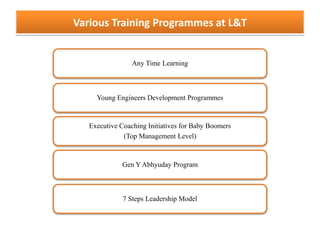
Various Training Programmes at L&T
Any Time Learning
Young Engineers Development Programmes
Executive Coaching Initiatives for Baby Boomers
(Top Management Level)
Gen Y Abhyuday Program
7 Steps Leadership Model
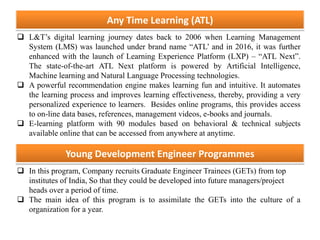
Any Time Learning (ATL)
 L&T’s digital learning journey dates back to 2006 when Learning Management
System (LMS) was launched under brand name “ATL’ and in 2016, it was further
enhanced with the launch of Learning Experience Platform (LXP) – “ATL Next”.
The state-of-the-art ATL Next platform is powered by Artificial Intelligence,
Machine learning and Natural Language Processing technologies.
 A powerful recommendation engine makes learning fun and intuitive. It automates
the learning process and improves learning effectiveness, thereby, providing a very
personalized experience to learners. Besides online programs, this provides access
to on-line data bases, references, management videos, e-books and journals.
 E-learning platform with 90 modules based on behavioral & technical subjects
available online that can be accessed from anywhere at anytime.
Young Development Engineer Programmes
 In this program, Company recruits Graduate Engineer Trainees (GETs) from top
institutes of India, So that they could be developed into future managers/project
heads over a period of time.
 The main idea of this program is to assimilate the GETs into the culture of a
organization for a year.
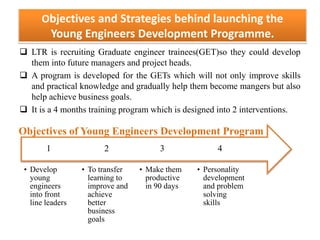
Objectives and Strategies behind launching the
Young Engineers Development Programme.
 LTR is recruiting Graduate engineer trainees(GET)so they could develop
them into future managers and project heads.
 A program is developed for the GETs which will not only improve skills
and practical knowledge and gradually help them become mangers but also
help achieve business goals.
 It is a 4 months training program which is designed into 2 interventions.
• Personality
development
and problem
solving
skills
4
• Make them
productive
in 90 days
3
• To transfer
learning to
improve and
achieve
better
business
goals
2
• Develop
young
engineers
into front
line leaders
1
Objectives of Young Engineers Development Program
Objectives and Strategies behind launching the
Young Engineers Development Programme.
STRATEGIES
 There are few strategies followed to develop the program they are:
 Interaction with senior managements, immediate superiors and mentors
at actual level.
 Focused on group discussion with participants
 Assigning new challenges or project to the participants and to review
and use their analytical and innovative skills.
 Training on project management, six sigma, self-awareness, lean
management tools, value engineering etc.
 Learning through online portals, projects etc
 Projects reviewed by COO and showcased to CEO.
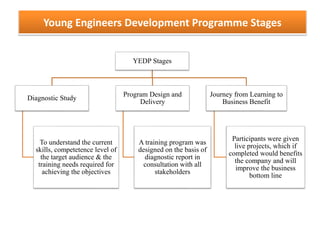
Young Engineers Development Programme Stages
YEDP Stages
Diagnostic Study
To understand the current
skills, competetence level of
the target audience & the
training needs required for
achieving the objectives
Program Design and
Delivery
A training program was
designed on the basis of
diagnostic report in
consultation with all
stakeholders
Journey from Learning to
Business Benefit
Participants were given
live projects, which if
completed would benefits
the company and will
improve the business
bottom line
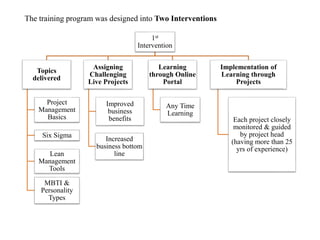
The training program was designed into Two Interventions
1st
Intervention
Topics
delivered
Project
Management
Basics
Six Sigma
Lean
Management
Tools
MBTI &
Personality
Types
Assigning
Challenging
Live Projects
Improved
business
benefits
Increased
business bottom
line
Learning
through Online
Portal
Any Time
Learning
Implementation of
Learning through
Projects
Each project closely
monitored & guided
by project head
(having more than 25
yrs of experience)
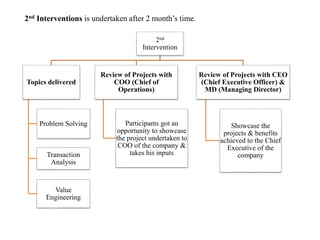
2nd
Intervention
Topics delivered
Problem Solving
Transaction
Analysis
Value
Engineering
Review of Projects with
COO (Chief of
Operations)
Participants got an
opportunity to showcase
the project undertaken to
COO of the company &
takes his inputs
Review of Projects with CEO
(Chief Executive Officer) &
MD (Managing Director)
Showcase the
projects & benefits
achieved to the Chief
Executive of the
company
2nd Interventions is undertaken after 2 month’s time.
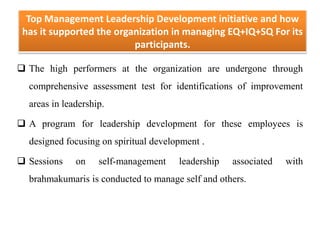
Top Management Leadership Development initiative and how
has it supported the organization in managing EQ+IQ+SQ For its
participants.
 The high performers at the organization are undergone through
comprehensive assessment test for identifications of improvement
areas in leadership.
 A program for leadership development for these employees is
designed focusing on spiritual development .
 Sessions on self-management leadership associated with
brahmakumaris is conducted to manage self and others.
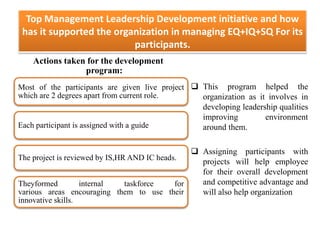
Top Management Leadership Development initiative and how
has it supported the organization in managing EQ+IQ+SQ For its
participants.
Actions taken for the development
program:
 This program helped the
organization as it involves in
developing leadership qualities
improving environment
around them.
 Assigning participants with
projects will help employee
for their overall development
and competitive advantage and
will also help organization
Most of the participants are given live project
which are 2 degrees apart from current role.
Each participant is assigned with a guide
The project is reviewed by IS,HR AND IC heads.
Theyformed internal taskforce for
various areas encouraging them to use their
innovative skills.
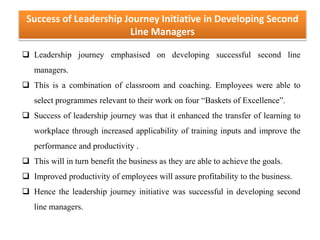
Success of Leadership Journey Initiative in Developing Second
Line Managers
 Leadership journey emphasised on developing successful second line
managers.
 This is a combination of classroom and coaching. Employees were able to
select programmes relevant to their work on four “Baskets of Excellence”.
 Success of leadership journey was that it enhanced the transfer of learning to
workplace through increased applicability of training inputs and improve the
performance and productivity .
 This will in turn benefit the business as they are able to achieve the goals.
 Improved productivity of employees will assure profitability to the business.
 Hence the leadership journey initiative was successful in developing second
line managers.
L&T Realty Case Study

L&T Realty Case Study

  • 1.
    TOPIC :- L&T REALTY– Building a Workforce for Future through Training and Development RESHMITHA RANGANAYAKULA DARSHAN GUNDECHA KEVIN PUNNEN MILIND JAGTAP
  • 2.
    Why does L&Tneed to develop competent workforce? How does it help Organisation achieving their Strategic Objective?  L&T realty has attained the position of market leader in 7 years .  They have strong presence in many parts of India.  It has redefined Indian real estate industry its transparency, customer- focussed approach and top class quality.  Maintaining this ethics and work approach of company can only be done with competent workforce.  Competent workforce also helps in achieving the present goals and future needs of the business .  Moreover having competent workforce helps company to have a edge over other companies.
  • 3.
    Delivering Training toImpact Business Performance Every training initiative focuses upon business benefit which ultimately results in improving the business bottom line (Company’s Net Income). To meet present Goals & future needs of the Business by following steps :  Training strategy is drawn keeping the improvement targets in mind and devised during the creation of Balanced Scorecard (BSC) by the BU.  Identification of the training needs (TNI identification) is done through various modes - confirmation forms, PMS review data, regular interaction with the functional heads etc.  Inputs on learning & growth perspective are acquired from BSC and future plans of the business on the basis of which HR scorecard is crafted.
  • 4.
    To meet presentGoals & future needs of the Business by following steps :  Philosophy with which T&D department works is - Conducting training for business impact and not for only meeting man day’s target.  Meetings are conducted to finalize on the design of program involving trainers, HR & managers/ functional heads.  Post training, a feedback form is given to each participant at the end of any training program which captures information on course content, reading material, faculty, infrastructure, ambience, etc.  Regular meeting with the functional heads to design and conduct function specific training.  For some of the technical programs business does pre and post training feedback analysis to measure effectiveness and efficiency.
  • 5.
    Various Training Programmesat L&T Any Time Learning Young Engineers Development Programmes Executive Coaching Initiatives for Baby Boomers (Top Management Level) Gen Y Abhyuday Program 7 Steps Leadership Model
  • 6.
    Any Time Learning(ATL)  L&T’s digital learning journey dates back to 2006 when Learning Management System (LMS) was launched under brand name “ATL’ and in 2016, it was further enhanced with the launch of Learning Experience Platform (LXP) – “ATL Next”. The state-of-the-art ATL Next platform is powered by Artificial Intelligence, Machine learning and Natural Language Processing technologies.  A powerful recommendation engine makes learning fun and intuitive. It automates the learning process and improves learning effectiveness, thereby, providing a very personalized experience to learners. Besides online programs, this provides access to on-line data bases, references, management videos, e-books and journals.  E-learning platform with 90 modules based on behavioral & technical subjects available online that can be accessed from anywhere at anytime. Young Development Engineer Programmes  In this program, Company recruits Graduate Engineer Trainees (GETs) from top institutes of India, So that they could be developed into future managers/project heads over a period of time.  The main idea of this program is to assimilate the GETs into the culture of a organization for a year.
  • 7.
    Objectives and Strategiesbehind launching the Young Engineers Development Programme.  LTR is recruiting Graduate engineer trainees(GET)so they could develop them into future managers and project heads.  A program is developed for the GETs which will not only improve skills and practical knowledge and gradually help them become mangers but also help achieve business goals.  It is a 4 months training program which is designed into 2 interventions. • Personality development and problem solving skills 4 • Make them productive in 90 days 3 • To transfer learning to improve and achieve better business goals 2 • Develop young engineers into front line leaders 1 Objectives of Young Engineers Development Program
  • 8.
    Objectives and Strategiesbehind launching the Young Engineers Development Programme. STRATEGIES  There are few strategies followed to develop the program they are:  Interaction with senior managements, immediate superiors and mentors at actual level.  Focused on group discussion with participants  Assigning new challenges or project to the participants and to review and use their analytical and innovative skills.  Training on project management, six sigma, self-awareness, lean management tools, value engineering etc.  Learning through online portals, projects etc  Projects reviewed by COO and showcased to CEO.
  • 9.
    Young Engineers DevelopmentProgramme Stages YEDP Stages Diagnostic Study To understand the current skills, competetence level of the target audience & the training needs required for achieving the objectives Program Design and Delivery A training program was designed on the basis of diagnostic report in consultation with all stakeholders Journey from Learning to Business Benefit Participants were given live projects, which if completed would benefits the company and will improve the business bottom line
  • 10.
    The training programwas designed into Two Interventions 1st Intervention Topics delivered Project Management Basics Six Sigma Lean Management Tools MBTI & Personality Types Assigning Challenging Live Projects Improved business benefits Increased business bottom line Learning through Online Portal Any Time Learning Implementation of Learning through Projects Each project closely monitored & guided by project head (having more than 25 yrs of experience)
  • 11.
    2nd Intervention Topics delivered Problem Solving Transaction Analysis Value Engineering Reviewof Projects with COO (Chief of Operations) Participants got an opportunity to showcase the project undertaken to COO of the company & takes his inputs Review of Projects with CEO (Chief Executive Officer) & MD (Managing Director) Showcase the projects & benefits achieved to the Chief Executive of the company 2nd Interventions is undertaken after 2 month’s time.
  • 12.
    Top Management LeadershipDevelopment initiative and how has it supported the organization in managing EQ+IQ+SQ For its participants.  The high performers at the organization are undergone through comprehensive assessment test for identifications of improvement areas in leadership.  A program for leadership development for these employees is designed focusing on spiritual development .  Sessions on self-management leadership associated with brahmakumaris is conducted to manage self and others.
  • 13.
    Top Management LeadershipDevelopment initiative and how has it supported the organization in managing EQ+IQ+SQ For its participants. Actions taken for the development program:  This program helped the organization as it involves in developing leadership qualities improving environment around them.  Assigning participants with projects will help employee for their overall development and competitive advantage and will also help organization Most of the participants are given live project which are 2 degrees apart from current role. Each participant is assigned with a guide The project is reviewed by IS,HR AND IC heads. Theyformed internal taskforce for various areas encouraging them to use their innovative skills.
  • 14.
    Success of LeadershipJourney Initiative in Developing Second Line Managers  Leadership journey emphasised on developing successful second line managers.  This is a combination of classroom and coaching. Employees were able to select programmes relevant to their work on four “Baskets of Excellence”.  Success of leadership journey was that it enhanced the transfer of learning to workplace through increased applicability of training inputs and improve the performance and productivity .  This will in turn benefit the business as they are able to achieve the goals.  Improved productivity of employees will assure profitability to the business.  Hence the leadership journey initiative was successful in developing second line managers.