Valtteri Laine
Project Manager
Captain/M.Sc.
Lisbon the 12th October 2017
ISO31000
Risk Management Standard
Implementation in
Pollution Prevention and Response
Floris Goerlandt, D.Sc. (Tech.)
Project Researcher
Tel: +358 50 343 1186
E-mail: floris.goerlandt@helcom.fi
OVERVIEW
• ISO31000 Risk Management Standard
Why implementing this for Pollution Prevention and Response?
• ISO31000:2009 Risk Management Standard
Overview
• ISO31000:2009 & ISO31000:2018 Risk Management Standard
Implementation in Pollution Prevention and Response: A suggested approach
Valtteri Laine
Project Manager
Captain/M.Sc.
WHY ISO31000?
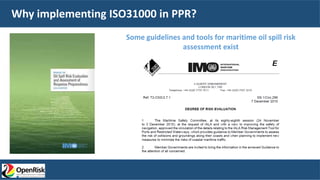
Why implementing ISO31000 in PPR?
Some guidelines and tools for maritime oil spill risk
assessment exist
Why implementing ISO31000 in PPR?
• HELCOM and its member states [*] has
identified a need for a wider and integrated
set of tools for managing maritime risk, for
pollution prevention and response.
• All major risk management standards stress
the need for linking the application of tools to
organizational commitment and processes for
effective risk management.
• Current maritime PPR risk guidelines do not
cover links to organizational issues, and lack a
coherent set of tools for executing risk analysis
for different decision making contexts.
[*] With support from BONN Agreement, the Copenhagen Agreement,
REMPEC and the Norwegian Coastal Administration
Why implementing ISO31000 in PPR?
First and Second OpenRisk Workshop
EMSA Risk assessment Workshop
• Needs of the users at the strategic end and those at the
operational end are different, but complementary.
• It is important to consider risk-based tools and methods
which can fulfil user needs at either end of the spectrum
• While also focusing on how to consider risk assessment
in different decision contexts and time scales.
ISO31000:2009
WS1 & WS2
EMSA WS
HELCOM RESPONSE
12.04.2018
ISO31000:2018
Valtteri Laine
Project Manager
Captain/M.Sc.
WHAT IS
ISO31000(:2009)?
ISO: International Organization for Standardization
• International Organization for Standardization (ISO) is the world's largest developer and
publisher of International Standards.
• ISO is a specialized international organization founded in Geneva in 1947 and concerned
with standardization in all technical and non-technical fields except electrical and
electronic engineering.
• Upon request, the ISO establishes international technical committees to investigate and
resolve specific issues of standardization.
ISO31000:2009: Development process
• ISO31000:2009 was published in November 2009 and it is the result of four years of
consultation between risk and standards experts in 30 countries.
• It pulls together and replaces a number of similar international standards.
AS/NZS 4360:2004, which was due for revision in 2009, formed the basis of ISO31000.
• This new standard was prepared by the
ISO Technical Management Board Working Group on risk management.
• Updated guidelines ISO31000:2018 adopted in 02.2018.
ISO31000:2009: status and characteristics
• ISO 31000 is not intended for certification.
• It does not contain compulsory requirements.
• It is a collection of suggested best practices.
Guide to develop
area-specific processes.
Flexibile application.
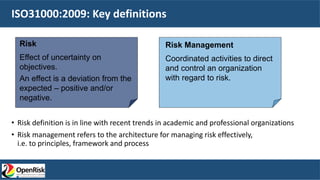
ISO31000:2009: Key definitions
• Risk definition is in line with recent trends in academic and professional organizations
• Risk management refers to the architecture for managing risk effectively,
i.e. to principles, framework and process
Risk
Effect of uncertainty on
objectives.
An effect is a deviation from the
expected – positive and/or
negative.
Risk Management
Coordinated activities to direct
and control an organization
with regard to risk.
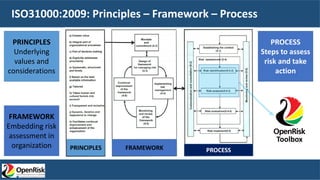
ISO31000:2009: Principles – Framework – Process
PRINCIPLES
Underlying
values and
considerations
PRINCIPLES FRAMEWORK PROCESS
FRAMEWORK
Embedding risk
assessment in
organization
PROCESS
Steps to assess
risk and take
action
Toolbox
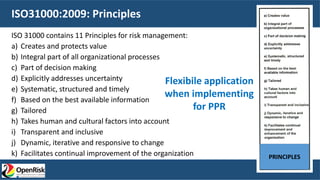
ISO31000:2009: Principles
ISO 31000 contains 11 Principles for risk management:
a) Creates and protects value
b) Integral part of all organizational processes
c) Part of decision making
d) Explicitly addresses uncertainty
e) Systematic, structured and timely
f) Based on the best available information
g) Tailored
h) Takes human and cultural factors into account
i) Transparent and inclusive
j) Dynamic, iterative and responsive to change
k) Facilitates continual improvement of the organization
Flexibile application
when implementing
for PPR
PRINCIPLES
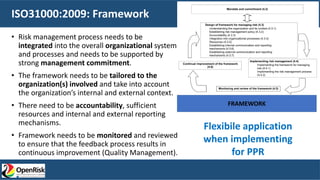
ISO31000:2009: Framework
• Risk management process needs to be
integrated into the overall organizational system
and processes and needs to be supported by
strong management commitment.
• The framework needs to be tailored to the
organization(s) involved and take into account
the organization’s internal and external context.
• There need to be accountability, sufficient
resources and internal and external reporting
mechanisms.
• Framework needs to be monitored and reviewed
to ensure that the feedback process results in
continuous improvement (Quality Management).
Flexibile application
when implementing
for PPR
FRAMEWORK
ISO31000:2009: Process
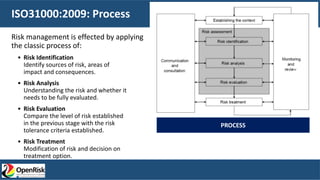
Risk management is effected by applying
the classic process of:
• Risk Identification
Identify sources of risk, areas of
impact and consequences.
• Risk Analysis
Understanding the risk and whether it
needs to be fully evaluated.
• Risk Evaluation
Compare the level of risk established
in the previous stage with the risk
tolerance criteria established.
• Risk Treatment
Modification of risk and decision on
treatment option.
PROCESS
ISO31000:2009: Process
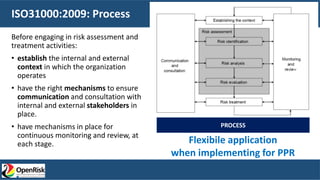
Before engaging in risk assessment and
treatment activities:
• establish the internal and external
context in which the organization
operates
• have the right mechanisms to ensure
communication and consultation with
internal and external stakeholders in
place.
• have mechanisms in place for
continuous monitoring and review, at
each stage.
PROCESS
Flexibile application
when implementing for PPR
ISO31000:2009: Complementing documents
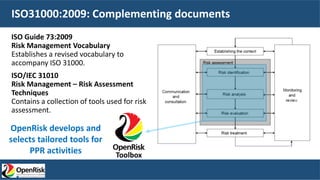
ISO Guide 73:2009
Risk Management Vocabulary
Establishes a revised vocabulary to
accompany ISO 31000.
ISO/IEC 31010
Risk Management – Risk Assessment
Techniques
Contains a collection of tools used for risk
assessment.
OpenRisk develops and
selects tailored tools for
PPR activities Toolbox
Valtteri Laine
Project Manager
Captain/M.Sc.
OpenRisk
objectives
in context of
ISO310000
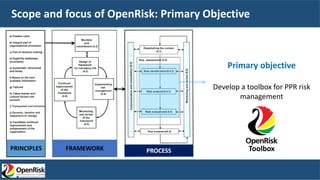
Scope and focus of OpenRisk: Primary Objective
PRINCIPLES FRAMEWORK PROCESS Toolbox
Primary objective
Develop a toolbox for PPR risk
management
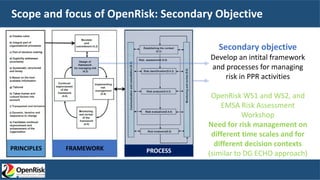
Scope and focus of OpenRisk: Secondary Objective
PRINCIPLES FRAMEWORK PROCESS
Secondary objective
Develop an intital framework
and processes for managing
risk in PPR activities
OpenRisk WS1 and WS2, and
EMSA Risk Assessment
Workshop
Need for risk management on
different time scales and for
different decision contexts
(similar to DG ECHO approach)
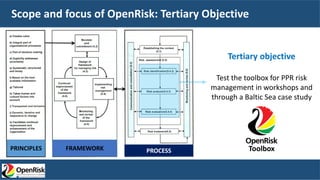
Scope and focus of OpenRisk: Tertiary Objective
PRINCIPLES FRAMEWORK PROCESS Toolbox
Tertiary objective
Test the toolbox for PPR risk
management in workshops and
through a Baltic Sea case study
Valtteri Laine
Project Manager
Captain/M.Sc.
IMPLEMENTING
ISO31000 IN PPR
A SUGGESTION
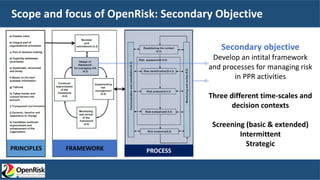
Scope and focus of OpenRisk: Secondary Objective
PRINCIPLES FRAMEWORK PROCESS
Secondary objective
Develop an intital framework
and processes for managing risk
in PPR activities
Three different time-scales and
decision contexts
Screening (basic & extended)
Intermittent
Strategic
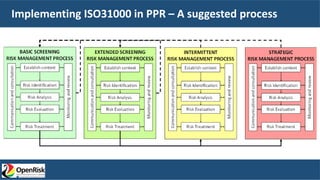
Implementing ISO31000 in PPR – A suggested process
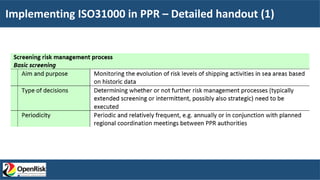
Implementing ISO31000 in PPR – Detailed handout (1)
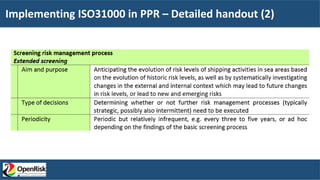
Implementing ISO31000 in PPR – Detailed handout (2)
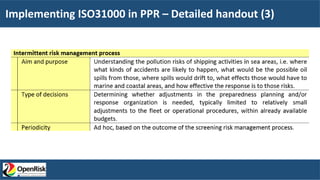
Implementing ISO31000 in PPR – Detailed handout (3)
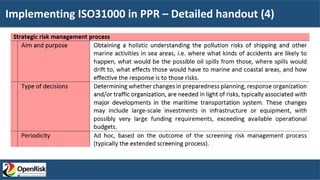
Implementing ISO31000 in PPR – Detailed handout (4)
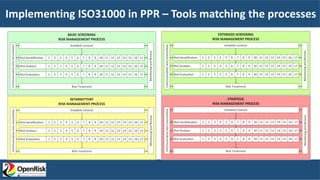
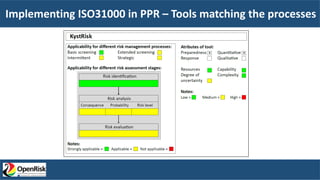
Implementing ISO31000 in PPR – Tools matching the processes
THANK YOU!
Floris Goerlandt, D.Sc. (Tech.)
Project Researcher
Tel: +358 50 343 1186
E-mail: floris.goerlandt@helcom.fi
Copyright: J. Brancanti 2017

ISO 31000 principles.pdf

  • 1.
    Valtteri Laine Project Manager Captain/M.Sc. Lisbonthe 12th October 2017 ISO31000 Risk Management Standard Implementation in Pollution Prevention and Response Floris Goerlandt, D.Sc. (Tech.) Project Researcher Tel: +358 50 343 1186 E-mail: floris.goerlandt@helcom.fi
  • 2.
    OVERVIEW • ISO31000 RiskManagement Standard Why implementing this for Pollution Prevention and Response? • ISO31000:2009 Risk Management Standard Overview • ISO31000:2009 & ISO31000:2018 Risk Management Standard Implementation in Pollution Prevention and Response: A suggested approach
  • 3.
  • 4.
    Why implementing ISO31000in PPR? Some guidelines and tools for maritime oil spill risk assessment exist
  • 5.
    Why implementing ISO31000in PPR? • HELCOM and its member states [*] has identified a need for a wider and integrated set of tools for managing maritime risk, for pollution prevention and response. • All major risk management standards stress the need for linking the application of tools to organizational commitment and processes for effective risk management. • Current maritime PPR risk guidelines do not cover links to organizational issues, and lack a coherent set of tools for executing risk analysis for different decision making contexts. [*] With support from BONN Agreement, the Copenhagen Agreement, REMPEC and the Norwegian Coastal Administration
  • 6.
    Why implementing ISO31000in PPR? First and Second OpenRisk Workshop EMSA Risk assessment Workshop • Needs of the users at the strategic end and those at the operational end are different, but complementary. • It is important to consider risk-based tools and methods which can fulfil user needs at either end of the spectrum • While also focusing on how to consider risk assessment in different decision contexts and time scales. ISO31000:2009 WS1 & WS2 EMSA WS HELCOM RESPONSE 12.04.2018 ISO31000:2018
  • 7.
  • 8.
    ISO: International Organizationfor Standardization • International Organization for Standardization (ISO) is the world's largest developer and publisher of International Standards. • ISO is a specialized international organization founded in Geneva in 1947 and concerned with standardization in all technical and non-technical fields except electrical and electronic engineering. • Upon request, the ISO establishes international technical committees to investigate and resolve specific issues of standardization.
  • 9.
    ISO31000:2009: Development process •ISO31000:2009 was published in November 2009 and it is the result of four years of consultation between risk and standards experts in 30 countries. • It pulls together and replaces a number of similar international standards. AS/NZS 4360:2004, which was due for revision in 2009, formed the basis of ISO31000. • This new standard was prepared by the ISO Technical Management Board Working Group on risk management. • Updated guidelines ISO31000:2018 adopted in 02.2018.
  • 10.
    ISO31000:2009: status andcharacteristics • ISO 31000 is not intended for certification. • It does not contain compulsory requirements. • It is a collection of suggested best practices. Guide to develop area-specific processes. Flexibile application.
  • 11.
    ISO31000:2009: Key definitions •Risk definition is in line with recent trends in academic and professional organizations • Risk management refers to the architecture for managing risk effectively, i.e. to principles, framework and process Risk Effect of uncertainty on objectives. An effect is a deviation from the expected – positive and/or negative. Risk Management Coordinated activities to direct and control an organization with regard to risk.
  • 12.
    ISO31000:2009: Principles –Framework – Process PRINCIPLES Underlying values and considerations PRINCIPLES FRAMEWORK PROCESS FRAMEWORK Embedding risk assessment in organization PROCESS Steps to assess risk and take action Toolbox
  • 13.
    ISO31000:2009: Principles ISO 31000contains 11 Principles for risk management: a) Creates and protects value b) Integral part of all organizational processes c) Part of decision making d) Explicitly addresses uncertainty e) Systematic, structured and timely f) Based on the best available information g) Tailored h) Takes human and cultural factors into account i) Transparent and inclusive j) Dynamic, iterative and responsive to change k) Facilitates continual improvement of the organization Flexibile application when implementing for PPR PRINCIPLES
  • 14.
    ISO31000:2009: Framework • Riskmanagement process needs to be integrated into the overall organizational system and processes and needs to be supported by strong management commitment. • The framework needs to be tailored to the organization(s) involved and take into account the organization’s internal and external context. • There need to be accountability, sufficient resources and internal and external reporting mechanisms. • Framework needs to be monitored and reviewed to ensure that the feedback process results in continuous improvement (Quality Management). Flexibile application when implementing for PPR FRAMEWORK
  • 15.
    ISO31000:2009: Process Risk managementis effected by applying the classic process of: • Risk Identification Identify sources of risk, areas of impact and consequences. • Risk Analysis Understanding the risk and whether it needs to be fully evaluated. • Risk Evaluation Compare the level of risk established in the previous stage with the risk tolerance criteria established. • Risk Treatment Modification of risk and decision on treatment option. PROCESS
  • 16.
    ISO31000:2009: Process Before engagingin risk assessment and treatment activities: • establish the internal and external context in which the organization operates • have the right mechanisms to ensure communication and consultation with internal and external stakeholders in place. • have mechanisms in place for continuous monitoring and review, at each stage. PROCESS Flexibile application when implementing for PPR
  • 17.
    ISO31000:2009: Complementing documents ISOGuide 73:2009 Risk Management Vocabulary Establishes a revised vocabulary to accompany ISO 31000. ISO/IEC 31010 Risk Management – Risk Assessment Techniques Contains a collection of tools used for risk assessment. OpenRisk develops and selects tailored tools for PPR activities Toolbox
  • 18.
  • 19.
    Scope and focusof OpenRisk: Primary Objective PRINCIPLES FRAMEWORK PROCESS Toolbox Primary objective Develop a toolbox for PPR risk management
  • 20.
    Scope and focusof OpenRisk: Secondary Objective PRINCIPLES FRAMEWORK PROCESS Secondary objective Develop an intital framework and processes for managing risk in PPR activities OpenRisk WS1 and WS2, and EMSA Risk Assessment Workshop Need for risk management on different time scales and for different decision contexts (similar to DG ECHO approach)
  • 21.
    Scope and focusof OpenRisk: Tertiary Objective PRINCIPLES FRAMEWORK PROCESS Toolbox Tertiary objective Test the toolbox for PPR risk management in workshops and through a Baltic Sea case study
  • 22.
  • 23.
    Scope and focusof OpenRisk: Secondary Objective PRINCIPLES FRAMEWORK PROCESS Secondary objective Develop an intital framework and processes for managing risk in PPR activities Three different time-scales and decision contexts Screening (basic & extended) Intermittent Strategic
  • 24.
    Implementing ISO31000 inPPR – A suggested process
  • 25.
    Implementing ISO31000 inPPR – Detailed handout (1)
  • 26.
    Implementing ISO31000 inPPR – Detailed handout (2)
  • 27.
    Implementing ISO31000 inPPR – Detailed handout (3)
  • 28.
    Implementing ISO31000 inPPR – Detailed handout (4)
  • 29.
    Implementing ISO31000 inPPR – Tools matching the processes
  • 30.
    Implementing ISO31000 inPPR – Tools matching the processes
  • 31.
    THANK YOU! Floris Goerlandt,D.Sc. (Tech.) Project Researcher Tel: +358 50 343 1186 E-mail: floris.goerlandt@helcom.fi Copyright: J. Brancanti 2017