Clean rooms applications :
 Pharmaceuticals
 Microelectronics
 Aerospace
 Medical devices
 Healthcare and food
ISO 14644-1
Second edition 2015-12-15
Prepared by: Nazim Hussain
Pansuvi
Cleanrooms and associated controlled environments
ISO 14644-1
Second edition 2015-12-15
ISO 14644 consists of the following parts, under the general title Cleanrooms and
associated controlled environments:
• Part 1: Classification of air cleanliness by particle concentration
• Part 2: Monitoring to provide evidence of cleanroom performance related to air
cleanliness by particle concentration
• Part 3: Test methods
• Part 4: Design, construction and start-up
• Part 5: Operations
• Part 7: Separative devices (clean air hoods, gloveboxes, isolators and mini-environments)
• Part 8: Classification of air cleanliness by chemical concentration (ACC)
• Part 9: Classification of surface cleanliness by particle concentration
• Part 10: Classification of surface cleanliness by chemical concentration
ISO 14644-1
Second edition 2015-12-15
Part 1:
Classification of air cleanliness by particle concentration
1.Scope:
• This part of ISO 14644 specifies the classification of air cleanliness in terms of
concentration of airborne particles in cleanrooms and clean zones; and separative
devices as defined in ISO 14644-7.
• Only particle populations having cumulative distributions based on threshold (lower
limit) particle sizes ranging from 0,1 µm to 5 µm are considered for classification
purposes.
• The use of light scattering (discrete) airborne particle counters (LSAPC) is the basis for
determination of the concentration of airborne particles, equal to and greater than the
specified sizes, at designated sampling locations.
• This part of ISO 14644 cannot be used to characterize the physical, chemical, radiological,
viable or other nature of airborne particles.
ISO 14644-1
Second edition 2015-12-15
2. Normative references
• ISO 14644-2:2015, Cleanrooms and associated controlled
environments — Part 2: Monitoring to provide evidence of cleanroom
performance related to air cleanliness by particle concentration
• ISO 14644-7, Cleanrooms and associated controlled environments —
Part 7: Separative devices (clean air hoods, gloveboxes, isolators and
mini-environments)
ISO 14644-1
Second edition 2015-12-15
3.Terms and definitions
3.1.1 cleanroom
• room within which the number concentration of airborne particles is
controlled and classified, and which is designed, constructed and operated
in a manner to control the introduction, generation and retention of
particles inside the room
• 3.1.2 clean zone
• defined space within which the number concentration of airborne particles
is controlled and classified, and which is constructed and operated in a
manner to control the introduction, generation and retention of
contaminants inside the space
ISO 14644-1
Second edition 2015-12-15
3.1.3 installation
• cleanroom or one or more clean zones, together with all associated
structures, air-treatment systems, services and utilities
3.1.4 classification
• method of assessing level of cleanliness against a specification for a
cleanroom or clean zone
ISO 14644-1
Second edition 2015-12-15
3.2 Airborne particles
3.2.1 particle
• minute piece of matter with defined physical boundaries
3.2.2 particle size
• diameter of a sphere that produces a response, by a given particle-sizing
instrument, that is equivalent to the response produced by the particle being
measured
3.2.3 particle concentration
• number of individual particles per unit volume of air
3.2.4 particle size distribution
• cumulative distribution of particle concentration as a function of particle size
3.2.5 macroparticle
• particle with an equivalent diameter greater than 5 µm
ISO 14644-1
Second edition 2015-12-15
3.2.6 M descriptor
• designation for measured or specified concentration of macroparticles per
cubic metre of air, expressed in terms of the equivalent diameter that is
characteristic of the measurement method used
3.2.7 unidirectional airflow
• controlled airflow through the entire cross-section of a cleanroom or a
clean zone with a steady velocity and airstreams that are considered to be
parallel
3.2.8 non-undirectional airflow
• air distribution where the supply air entering the cleanroom or clean zone
mixes with the internal air by means of induction
ISO 14644-1
Second edition 2015-12-15
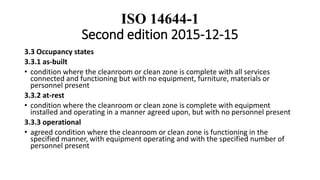
3.3 Occupancy states
3.3.1 as-built
• condition where the cleanroom or clean zone is complete with all services
connected and functioning but with no equipment, furniture, materials or
personnel present
3.3.2 at-rest
• condition where the cleanroom or clean zone is complete with equipment
installed and operating in a manner agreed upon, but with no personnel present
3.3.3 operational
• agreed condition where the cleanroom or clean zone is functioning in the
specified manner, with equipment operating and with the specified number of
personnel present
ISO 14644-1
Second edition 2015-12-15
3.4 Testing instrumentation
3.4.1 resolution
• smallest change in a quantity being measured that causes a perceptible
change in the corresponding indication
• [SOURCE: ISO/IEC Guide 99:2007, 4.14]
3.4.2 maximum permissible measurement error
• extreme value of measurement error, with respect to a known reference
quantity value, permitted by specifications or regulations for a given
measurement, measuring instrument, or measuring system
• [SOURCE: ISO/IEC Guide 99:2007, 4.26]
ISO 14644-1
Second edition 2015-12-15
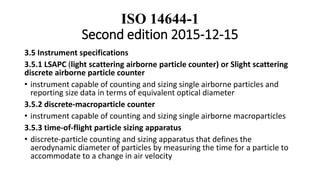
3.5 Instrument specifications
3.5.1 LSAPC (light scattering airborne particle counter) or Slight scattering
discrete airborne particle counter
• instrument capable of counting and sizing single airborne particles and
reporting size data in terms of equivalent optical diameter
3.5.2 discrete-macroparticle counter
• instrument capable of counting and sizing single airborne macroparticles
3.5.3 time-of-flight particle sizing apparatus
• discrete-particle counting and sizing apparatus that defines the
aerodynamic diameter of particles by measuring the time for a particle to
accommodate to a change in air velocity
ISO 14644-1
Second edition 2015-12-15
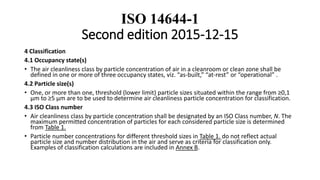
4 Classification
4.1 Occupancy state(s)
• The air cleanliness class by particle concentration of air in a cleanroom or clean zone shall be
defined in one or more of three occupancy states, viz. “as-built,” “at-rest” or “operational” .
4.2 Particle size(s)
• One, or more than one, threshold (lower limit) particle sizes situated within the range from ≥0,1
µm to ≥5 µm are to be used to determine air cleanliness particle concentration for classification.
4.3 ISO Class number
• Air cleanliness class by particle concentration shall be designated by an ISO Class number, N. The
maximum permitted concentration of particles for each considered particle size is determined
from Table 1.
• Particle number concentrations for different threshold sizes in Table 1. do not reflect actual
particle size and number distribution in the air and serve as criteria for classification only.
Examples of classification calculations are included in Annex B.
ISO 14644-1
Second edition 2015-12-15
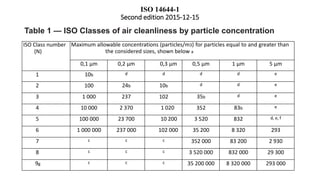
Table 1 — ISO Classes of air cleanliness by particle concentration
ISO Class number
(N)
Maximum allowable concentrations (particles/m3) for particles equal to and greater than
the considered sizes, shown below a
0,1 µm 0,2 µm 0,3 µm 0,5 µm 1 µm 5 µm
1 10b d d d d e
2 100 24b 10b d d e
3 1 000 237 102 35b d e
4 10 000 2 370 1 020 352 83b e
5 100 000 23 700 10 200 3 520 832 d, e, f
6 1 000 000 237 000 102 000 35 200 8 320 293
7 c c c 352 000 83 200 2 930
8 c c c 3 520 000 832 000 29 300
9g c c c 35 200 000 8 320 000 293 000
ISO 14644-1
Second edition 2015-12-15
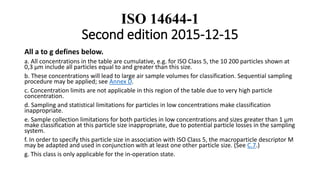
All a to g defines below.
a. All concentrations in the table are cumulative, e.g. for ISO Class 5, the 10 200 particles shown at
0,3 µm include all particles equal to and greater than this size.
b. These concentrations will lead to large air sample volumes for classification. Sequential sampling
procedure may be applied; see Annex D.
c. Concentration limits are not applicable in this region of the table due to very high particle
concentration.
d. Sampling and statistical limitations for particles in low concentrations make classification
inappropriate.
e. Sample collection limitations for both particles in low concentrations and sizes greater than 1 μm
make classification at this particle size inappropriate, due to potential particle losses in the sampling
system.
f. In order to specify this particle size in association with ISO Class 5, the macroparticle descriptor M
may be adapted and used in conjunction with at least one other particle size. (See C.7.)
g. This class is only applicable for the in-operation state.
ISO 14644-1
Second edition 2015-12-15
Thanks

ISO 14644-1.pptx.Cleanrooms and associated controlled environments

  • 1.
    Clean rooms applications:  Pharmaceuticals  Microelectronics  Aerospace  Medical devices  Healthcare and food ISO 14644-1 Second edition 2015-12-15 Prepared by: Nazim Hussain Pansuvi Cleanrooms and associated controlled environments
  • 2.
    ISO 14644-1 Second edition2015-12-15 ISO 14644 consists of the following parts, under the general title Cleanrooms and associated controlled environments: • Part 1: Classification of air cleanliness by particle concentration • Part 2: Monitoring to provide evidence of cleanroom performance related to air cleanliness by particle concentration • Part 3: Test methods • Part 4: Design, construction and start-up • Part 5: Operations • Part 7: Separative devices (clean air hoods, gloveboxes, isolators and mini-environments) • Part 8: Classification of air cleanliness by chemical concentration (ACC) • Part 9: Classification of surface cleanliness by particle concentration • Part 10: Classification of surface cleanliness by chemical concentration
  • 3.
    ISO 14644-1 Second edition2015-12-15 Part 1: Classification of air cleanliness by particle concentration 1.Scope: • This part of ISO 14644 specifies the classification of air cleanliness in terms of concentration of airborne particles in cleanrooms and clean zones; and separative devices as defined in ISO 14644-7. • Only particle populations having cumulative distributions based on threshold (lower limit) particle sizes ranging from 0,1 µm to 5 µm are considered for classification purposes. • The use of light scattering (discrete) airborne particle counters (LSAPC) is the basis for determination of the concentration of airborne particles, equal to and greater than the specified sizes, at designated sampling locations. • This part of ISO 14644 cannot be used to characterize the physical, chemical, radiological, viable or other nature of airborne particles.
  • 4.
    ISO 14644-1 Second edition2015-12-15 2. Normative references • ISO 14644-2:2015, Cleanrooms and associated controlled environments — Part 2: Monitoring to provide evidence of cleanroom performance related to air cleanliness by particle concentration • ISO 14644-7, Cleanrooms and associated controlled environments — Part 7: Separative devices (clean air hoods, gloveboxes, isolators and mini-environments)
  • 5.
    ISO 14644-1 Second edition2015-12-15 3.Terms and definitions 3.1.1 cleanroom • room within which the number concentration of airborne particles is controlled and classified, and which is designed, constructed and operated in a manner to control the introduction, generation and retention of particles inside the room • 3.1.2 clean zone • defined space within which the number concentration of airborne particles is controlled and classified, and which is constructed and operated in a manner to control the introduction, generation and retention of contaminants inside the space
  • 6.
    ISO 14644-1 Second edition2015-12-15 3.1.3 installation • cleanroom or one or more clean zones, together with all associated structures, air-treatment systems, services and utilities 3.1.4 classification • method of assessing level of cleanliness against a specification for a cleanroom or clean zone
  • 7.
    ISO 14644-1 Second edition2015-12-15 3.2 Airborne particles 3.2.1 particle • minute piece of matter with defined physical boundaries 3.2.2 particle size • diameter of a sphere that produces a response, by a given particle-sizing instrument, that is equivalent to the response produced by the particle being measured 3.2.3 particle concentration • number of individual particles per unit volume of air 3.2.4 particle size distribution • cumulative distribution of particle concentration as a function of particle size 3.2.5 macroparticle • particle with an equivalent diameter greater than 5 µm
  • 8.
    ISO 14644-1 Second edition2015-12-15 3.2.6 M descriptor • designation for measured or specified concentration of macroparticles per cubic metre of air, expressed in terms of the equivalent diameter that is characteristic of the measurement method used 3.2.7 unidirectional airflow • controlled airflow through the entire cross-section of a cleanroom or a clean zone with a steady velocity and airstreams that are considered to be parallel 3.2.8 non-undirectional airflow • air distribution where the supply air entering the cleanroom or clean zone mixes with the internal air by means of induction
  • 9.
    ISO 14644-1 Second edition2015-12-15 3.3 Occupancy states 3.3.1 as-built • condition where the cleanroom or clean zone is complete with all services connected and functioning but with no equipment, furniture, materials or personnel present 3.3.2 at-rest • condition where the cleanroom or clean zone is complete with equipment installed and operating in a manner agreed upon, but with no personnel present 3.3.3 operational • agreed condition where the cleanroom or clean zone is functioning in the specified manner, with equipment operating and with the specified number of personnel present
  • 10.
    ISO 14644-1 Second edition2015-12-15 3.4 Testing instrumentation 3.4.1 resolution • smallest change in a quantity being measured that causes a perceptible change in the corresponding indication • [SOURCE: ISO/IEC Guide 99:2007, 4.14] 3.4.2 maximum permissible measurement error • extreme value of measurement error, with respect to a known reference quantity value, permitted by specifications or regulations for a given measurement, measuring instrument, or measuring system • [SOURCE: ISO/IEC Guide 99:2007, 4.26]
  • 11.
    ISO 14644-1 Second edition2015-12-15 3.5 Instrument specifications 3.5.1 LSAPC (light scattering airborne particle counter) or Slight scattering discrete airborne particle counter • instrument capable of counting and sizing single airborne particles and reporting size data in terms of equivalent optical diameter 3.5.2 discrete-macroparticle counter • instrument capable of counting and sizing single airborne macroparticles 3.5.3 time-of-flight particle sizing apparatus • discrete-particle counting and sizing apparatus that defines the aerodynamic diameter of particles by measuring the time for a particle to accommodate to a change in air velocity
  • 12.
    ISO 14644-1 Second edition2015-12-15 4 Classification 4.1 Occupancy state(s) • The air cleanliness class by particle concentration of air in a cleanroom or clean zone shall be defined in one or more of three occupancy states, viz. “as-built,” “at-rest” or “operational” . 4.2 Particle size(s) • One, or more than one, threshold (lower limit) particle sizes situated within the range from ≥0,1 µm to ≥5 µm are to be used to determine air cleanliness particle concentration for classification. 4.3 ISO Class number • Air cleanliness class by particle concentration shall be designated by an ISO Class number, N. The maximum permitted concentration of particles for each considered particle size is determined from Table 1. • Particle number concentrations for different threshold sizes in Table 1. do not reflect actual particle size and number distribution in the air and serve as criteria for classification only. Examples of classification calculations are included in Annex B.
  • 13.
    ISO 14644-1 Second edition2015-12-15 Table 1 — ISO Classes of air cleanliness by particle concentration ISO Class number (N) Maximum allowable concentrations (particles/m3) for particles equal to and greater than the considered sizes, shown below a 0,1 µm 0,2 µm 0,3 µm 0,5 µm 1 µm 5 µm 1 10b d d d d e 2 100 24b 10b d d e 3 1 000 237 102 35b d e 4 10 000 2 370 1 020 352 83b e 5 100 000 23 700 10 200 3 520 832 d, e, f 6 1 000 000 237 000 102 000 35 200 8 320 293 7 c c c 352 000 83 200 2 930 8 c c c 3 520 000 832 000 29 300 9g c c c 35 200 000 8 320 000 293 000
  • 14.
    ISO 14644-1 Second edition2015-12-15 All a to g defines below. a. All concentrations in the table are cumulative, e.g. for ISO Class 5, the 10 200 particles shown at 0,3 µm include all particles equal to and greater than this size. b. These concentrations will lead to large air sample volumes for classification. Sequential sampling procedure may be applied; see Annex D. c. Concentration limits are not applicable in this region of the table due to very high particle concentration. d. Sampling and statistical limitations for particles in low concentrations make classification inappropriate. e. Sample collection limitations for both particles in low concentrations and sizes greater than 1 μm make classification at this particle size inappropriate, due to potential particle losses in the sampling system. f. In order to specify this particle size in association with ISO Class 5, the macroparticle descriptor M may be adapted and used in conjunction with at least one other particle size. (See C.7.) g. This class is only applicable for the in-operation state.
  • 15.
    ISO 14644-1 Second edition2015-12-15 Thanks