Tour-based Travel Mode Choice Estimation 
based on 
Data Mining and Fuzzy Techniques 
Nagesh Shukla, Jun Ma, Rohan Wickramasuriya, Nam Huynh, Pascal Perez 
Presented by: 
Pascal Perez 
Research Director 
perez@uow.edu.au
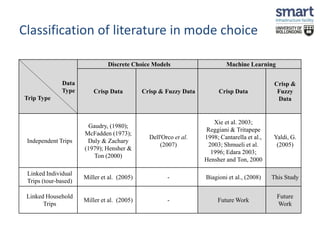
Classification of literature in mode choice 
Data 
Type 
Trip Type 
Discrete Choice Models Machine Learning 
Crisp Data Crisp & Fuzzy Data Crisp Data 
Crisp & 
Fuzzy 
Data 
Independent Trips 
Gaudry, (1980); 
McFadden (1973); 
Daly & Zachary 
(1979); Hensher & 
Ton (2000) 
Dell'Orco et al. 
(2007) 
Xie et al. 2003; 
Reggiani & Tritapepe 
1998; Cantarella et al., 
2003; Shmueli et al. 
1996; Edara 2003; 
Hensher and Ton, 2000 
Yaldi, G. 
(2005) 
Linked Individual 
Trips (tour-based) 
Miller et al. (2005) - Biagioni et al., (2008) This Study 
Linked Household 
Trips 
Miller et al. (2005) - Future Work 
Future 
Work
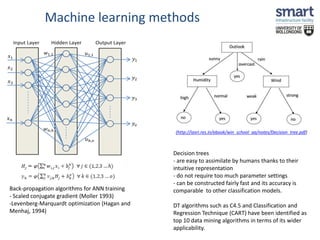
Machine learning methods 
Input Layer Hidden Layer Output Layer 
Back-propagation algorithms for ANN training 
- Scaled conjugate gradient (Moller 1993) 
-Levenberg-Marquardt optimization (Hagan and 
Menhaj, 1994) 
(http://iasri.res.in/ebook/win_school_aa/notes/Decision_tree.pdf) 
Decision trees 
- are easy to assimilate by humans thanks to their 
intuitive representation 
- do not require too much parameter settings 
- can be constructed fairly fast and its accuracy is 
comparable to other classification models. 
DT algorithms such as C4.5 and Classification and 
Regression Technique (CART) have been identified as 
top 10 data mining algorithms in terms of its wider 
applicability.
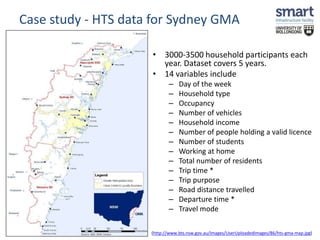
Case study - HTS data for Sydney GMA 
• 3000-3500 household participants each 
year. Dataset covers 5 years. 
• 14 variables include 
– Day of the week 
– Household type 
– Occupancy 
– Number of vehicles 
– Household income 
– Number of people holding a valid licence 
– Number of students 
– Working at home 
– Total number of residents 
– Trip time * 
– Trip purpose 
– Road distance travelled 
– Departure time * 
– Travel mode 
(http://www.bts.nsw.gov.au/Images/UserUploadedImages/86/hts-gma-map.jpg)
Data pre-processing 
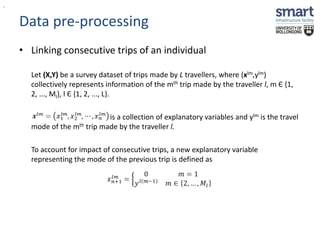
• Linking consecutive trips of an individual 
Let (X,Y) be a survey dataset of trips made by L travellers, where (xlm,ylm) 
collectively represents information of the mth trip made by the traveller l, m Є {1, 
2, ..., Ml}, l Є {1, 2, ..., L}. 
is a collection of explanatory variables and ylm is the travel 
mode of the mth trip made by the traveller l. 
To account for impact of consecutive trips, a new explanatory variable 
representing the mode of the previous trip is defined as 
,
Data preprocessing (cont.) 
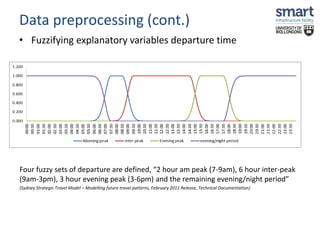
• Fuzzifying explanatory variables departure time 
Four fuzzy sets of departure are defined, “2 hour am peak (7-9am), 6 hour inter-peak 
(9am-3pm), 3 hour evening peak (3-6pm) and the remaining evening/night period” 
(Sydney Strategic Travel Model – Modelling future travel patterns, February 2011 Release, Technical Documentation)
Data preprocessing (cont.) 
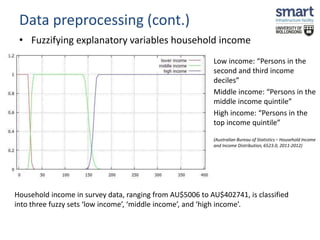
• Fuzzifying explanatory variables household income 
Low income: “Persons in the 
second and third income 
deciles” 
Middle income: “Persons in the 
middle income quintile” 
High income: “Persons in the 
top income quintile” 
(Australian Bureau of Statistics – Household Income 
and Income Distribution, 6523.0, 2011-2012) 
Household income in survey data, ranging from AU$5006 to AU$402741, is classified 
into three fuzzy sets ‘low income’, ‘middle income’, and ‘high income’.
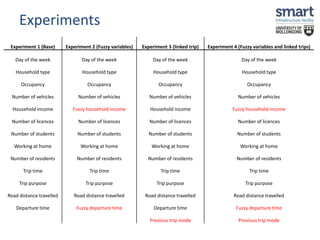
Experiments 
Experiment 1 (Base) Experiment 2 (Fuzzy variables) Experiment 3 (linked trip) Experiment 4 (Fuzzy variables and linked trips) 
Day of the week Day of the week Day of the week Day of the week 
Household type Household type Household type Household type 
Occupancy Occupancy Occupancy Occupancy 
Number of vehicles Number of vehicles Number of vehicles Number of vehicles 
Household income Fuzzy household income Household income Fuzzy household income 
Number of licences Number of licences Number of licences Number of licences 
Number of students Number of students Number of students Number of students 
Working at home Working at home Working at home Working at home 
Number of residents Number of residents Number of residents Number of residents 
Trip time Trip time Trip time Trip time 
Trip purpose Trip purpose Trip purpose Trip purpose 
Road distance travelled Road distance travelled Road distance travelled Road distance travelled 
Departure time Fuzzy departure time Departure time Fuzzy departure time 
Previous trip mode Previous trip mode
Results 
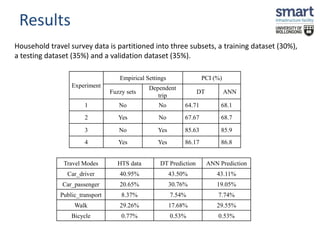
Household travel survey data is partitioned into three subsets, a training dataset (30%), 
a testing dataset (35%) and a validation dataset (35%). 
Experiment 
Empirical Settings PCI (%) 
Fuzzy sets 
Dependent 
trip 
DT ANN 
1 No No 64.71 68.1 
2 Yes No 67.67 68.7 
3 No Yes 85.63 85.9 
4 Yes Yes 86.17 86.8 
Travel Modes HTS data DT Prediction ANN Prediction 
Car_driver 40.95% 43.50% 43.11% 
Car_passenger 20.65% 30.76% 19.05% 
Public_transport 8.37% 7.54% 7.74% 
Walk 29.26% 17.68% 29.55% 
Bicycle 0.77% 0.53% 0.53%
Conclusions 
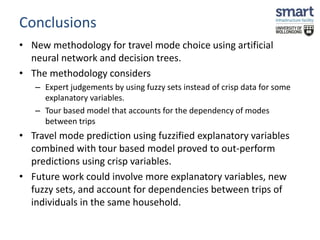
• New methodology for travel mode choice using artificial 
neural network and decision trees. 
• The methodology considers 
– Expert judgements by using fuzzy sets instead of crisp data for some 
explanatory variables. 
– Tour based model that accounts for the dependency of modes 
between trips 
• Travel mode prediction using fuzzified explanatory variables 
combined with tour based model proved to out-perform 
predictions using crisp variables. 
• Future work could involve more explanatory variables, new 
fuzzy sets, and account for dependencies between trips of 
individuals in the same household.
Questions

Tour-based Travel Mode Estimation based on Data Mining and Fuzzy Techniques

  • 1.
    Tour-based Travel ModeChoice Estimation based on Data Mining and Fuzzy Techniques Nagesh Shukla, Jun Ma, Rohan Wickramasuriya, Nam Huynh, Pascal Perez Presented by: Pascal Perez Research Director perez@uow.edu.au
  • 2.
    Classification of literaturein mode choice Data Type Trip Type Discrete Choice Models Machine Learning Crisp Data Crisp & Fuzzy Data Crisp Data Crisp & Fuzzy Data Independent Trips Gaudry, (1980); McFadden (1973); Daly & Zachary (1979); Hensher & Ton (2000) Dell'Orco et al. (2007) Xie et al. 2003; Reggiani & Tritapepe 1998; Cantarella et al., 2003; Shmueli et al. 1996; Edara 2003; Hensher and Ton, 2000 Yaldi, G. (2005) Linked Individual Trips (tour-based) Miller et al. (2005) - Biagioni et al., (2008) This Study Linked Household Trips Miller et al. (2005) - Future Work Future Work
  • 3.
    Machine learning methods Input Layer Hidden Layer Output Layer Back-propagation algorithms for ANN training - Scaled conjugate gradient (Moller 1993) -Levenberg-Marquardt optimization (Hagan and Menhaj, 1994) (http://iasri.res.in/ebook/win_school_aa/notes/Decision_tree.pdf) Decision trees - are easy to assimilate by humans thanks to their intuitive representation - do not require too much parameter settings - can be constructed fairly fast and its accuracy is comparable to other classification models. DT algorithms such as C4.5 and Classification and Regression Technique (CART) have been identified as top 10 data mining algorithms in terms of its wider applicability.
  • 4.
    Case study -HTS data for Sydney GMA • 3000-3500 household participants each year. Dataset covers 5 years. • 14 variables include – Day of the week – Household type – Occupancy – Number of vehicles – Household income – Number of people holding a valid licence – Number of students – Working at home – Total number of residents – Trip time * – Trip purpose – Road distance travelled – Departure time * – Travel mode (http://www.bts.nsw.gov.au/Images/UserUploadedImages/86/hts-gma-map.jpg)
  • 5.
    Data pre-processing •Linking consecutive trips of an individual Let (X,Y) be a survey dataset of trips made by L travellers, where (xlm,ylm) collectively represents information of the mth trip made by the traveller l, m Є {1, 2, ..., Ml}, l Є {1, 2, ..., L}. is a collection of explanatory variables and ylm is the travel mode of the mth trip made by the traveller l. To account for impact of consecutive trips, a new explanatory variable representing the mode of the previous trip is defined as ,
  • 6.
    Data preprocessing (cont.) • Fuzzifying explanatory variables departure time Four fuzzy sets of departure are defined, “2 hour am peak (7-9am), 6 hour inter-peak (9am-3pm), 3 hour evening peak (3-6pm) and the remaining evening/night period” (Sydney Strategic Travel Model – Modelling future travel patterns, February 2011 Release, Technical Documentation)
  • 7.
    Data preprocessing (cont.) • Fuzzifying explanatory variables household income Low income: “Persons in the second and third income deciles” Middle income: “Persons in the middle income quintile” High income: “Persons in the top income quintile” (Australian Bureau of Statistics – Household Income and Income Distribution, 6523.0, 2011-2012) Household income in survey data, ranging from AU$5006 to AU$402741, is classified into three fuzzy sets ‘low income’, ‘middle income’, and ‘high income’.
  • 8.
    Experiments Experiment 1(Base) Experiment 2 (Fuzzy variables) Experiment 3 (linked trip) Experiment 4 (Fuzzy variables and linked trips) Day of the week Day of the week Day of the week Day of the week Household type Household type Household type Household type Occupancy Occupancy Occupancy Occupancy Number of vehicles Number of vehicles Number of vehicles Number of vehicles Household income Fuzzy household income Household income Fuzzy household income Number of licences Number of licences Number of licences Number of licences Number of students Number of students Number of students Number of students Working at home Working at home Working at home Working at home Number of residents Number of residents Number of residents Number of residents Trip time Trip time Trip time Trip time Trip purpose Trip purpose Trip purpose Trip purpose Road distance travelled Road distance travelled Road distance travelled Road distance travelled Departure time Fuzzy departure time Departure time Fuzzy departure time Previous trip mode Previous trip mode
  • 9.
    Results Household travelsurvey data is partitioned into three subsets, a training dataset (30%), a testing dataset (35%) and a validation dataset (35%). Experiment Empirical Settings PCI (%) Fuzzy sets Dependent trip DT ANN 1 No No 64.71 68.1 2 Yes No 67.67 68.7 3 No Yes 85.63 85.9 4 Yes Yes 86.17 86.8 Travel Modes HTS data DT Prediction ANN Prediction Car_driver 40.95% 43.50% 43.11% Car_passenger 20.65% 30.76% 19.05% Public_transport 8.37% 7.54% 7.74% Walk 29.26% 17.68% 29.55% Bicycle 0.77% 0.53% 0.53%
  • 10.
    Conclusions • Newmethodology for travel mode choice using artificial neural network and decision trees. • The methodology considers – Expert judgements by using fuzzy sets instead of crisp data for some explanatory variables. – Tour based model that accounts for the dependency of modes between trips • Travel mode prediction using fuzzified explanatory variables combined with tour based model proved to out-perform predictions using crisp variables. • Future work could involve more explanatory variables, new fuzzy sets, and account for dependencies between trips of individuals in the same household.
  • 11.

Editor's Notes

  • #4 An ANN consists of a set of interconnected processing nodes called neurons that is used to estimate the mapping between explanatory variables and the responses. In this diagram, the explanatory variables (the 12-13 attributes from HTS data) are x1 to xn. The value of each node in the hidden layer is estimated by equation 1, and the value of each node of the output layer is estimated by equation 2. Phi are predetermined transfer function. Weights and bias values are iteratively estimated during the training until satisfactory output layer is achieved. A decision tree is used to learn a classification function which predicts the value of a dependent attribute given the values of independent attributes. In a decision trees, an instance is classified by sorting it through the tree to the appropriate leaf node, then returning the classification associated with this leaf (in this case different transport modes)
  • #5 Trip time and departure time are categorical variables (originally continuous variables) Trip times are grouped into blocks of 20 minutes. Departure times are grouped into blocks of 1 hour (?) The common conclusions in machine learning are that categorising continuous variables helps increase the accuracy of classification problems.
  • #7 Vertical axis is membership. According to this new graph of fuzzified departure time, the departure time of a trip is classified into the category with higher membership. For example, departure time 6.30 is classified as ‘evening/night period’ rather than ‘morning peak’ because 6.30 has a higher membership in the former category.