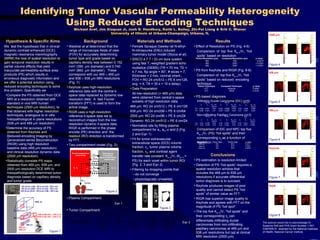
Identifying Tumor Vascular Permeability Heterogeneity Using Reduced Encoding Techniques Michael Aref, Jim Xiuquan Ji, Josh D. Handbury, Keith L. Bailey, Zhi-Pei Liang & Erik C. Wiener University of Illinois at Urbana-Champaign, Urbana, IL Hypothesis & Specific Aims We  test the hypothesis  that  in clinical dynamic contrast enhanced (DCE) magnetic resonance mammography (MRM)  the loss of spatial resolution to gain temporal resolution results  in partial volume effects that yield inaccurate permeability-surface area products (PS) which results in erroneous diagnostic information and we offer a potential solution using reduced encoding techniques to solve this problem. Specifically we Compare the PS obtained from DCE MRI at a resolution obtained with standard  in vivo  MRI   human techniques (2500   m resolution), to that obtained with higher resolution techniques, analogous to  in vitro  histopathological in plane resolutions (938   m and 469   m resolution)  Determine the accuracy of PS obtained from Keyhole and  R educed-encoding  I maging by  G eneralized-series  R econstruction (RIGR) using high resolution baseline data (469   m resolution) and clinical resolution dynamic data (2500   m resolution). Statistically correlate PS maps obtained from 469   m, 938   m, and 2500   m resolution DCE MRI to histopathologically determined tumor diagnosis based on capillary density and tumor grade. Background Weidner  et al  determined that the range of microscope fields of view (FOV) for accurately determining tumor type and grade based on capillary density was between 0.152 mm 2  (390.   m diameter) and 0.740 mm 2  (860.   m diameter).  These correspond with our 469    469   m and 938    938   m MRI resolutions (Fig. 1). Keyhole uses high-resolution reference data with the central k-space data replaced by dynamic low-resolution data.  A  fast Fourier transform (FFT) is used to form the active image. RIGR uses a high-resolution reference k-space data set to reconstruct images from the low-resolution dynamic k-space data. RIGR is performed in the phase encode (PE) direction and  the readout (RO) direction is transformed by FFT. Two compartment model (Fig. 2): Plasma Compartment: Tumor Compartment: Boreal Research Microscope courtesy of Sciencekit.com Materials and Methods Female Sprague Dawley rat N-ethyl-N-nitrosourea (ENU) induced mammary tumor model (Stoica  et al ). SISCO 4.7 T / 33 cm bore system using fast T 1 -weighted gradient echo multislice (GEMS) (TR = 70 ms, TE = 4.7 ms, flip angle = 80°, # slices = 7, thickness = 2 mm, coronal orient., FOV = RO 24 cm/512    PE 6 cm/128, avg. = 4, TA = 35 s + 10 s delay). Data Preparation All low-resolution (> 469   m) data were obtained from central k-space subsets of high-resolution data. 469   m: RO 24 cm/512    PE 6 cm/128 938   m: RO 24 cm/256    PE 6 cm/64 2500   m: RO 24 cm/96    PE 6 cm/24 Dynamic: RO 24 cm/512    PE 6 cm/24 Normalize rats by fitting plasma compartment for a 1 , a 2 ,    and    (Fig. 2 and Eqn 1) Fit for tumor extravascular extracellular space (EES) volume fraction, v p , tumor plasma volume fraction, v e , and contrast agent transfer rate constant  K p  t /V T  (K p  t  = PS) for each voxel within tumor ROI (Fig. 2, 3 and Eqn 2) Filtering by dropping points that do not converge physiologically unrealistic were poorly fit (r 2  ≤ 0.5) Results Effect of Resolution on PS (Fig. 4-6) Comparison of top five K p  t /V T  “hot spots” based on resolution. PS from Keyhole and RIGR (Fig. 6-8) Comparison of  top five K p  t /V T  “hot spots” based on reduced  encoding technique. PS-based diagnosis Infiltrating Ductal Carcinoma (IDC) (n=5) Non-infiltrating Papillary Carcinoma (n=3) Comparison of IDC and NPC top five K p  t /V T  (PS) “hot spots” and their corresponding v e  as a function of resolution.  Conclusions PS estimation is resolution-limited. Detection of PS “hot spots” requires a spatial resolution window that includes the 469   m to 938   m resolutions if accurate differential tumor diagnosis is to succeed. Keyhole produces images of poor quality and cannot detect PS “hot spots” of similar value as FFT. RIGR has superior image quality to Keyhole and agrees with FFT on the magnitude of PS “hot spot”. The top five K p  t /V T  “hot spots” and their corresponding v e  can differentiate infiltrating ductal carcinomas from non-infiltrating papillary carcinomas at 469   m and 938   m resolutions but  not  at clinical MRI resolution (2500   m) Figure 1 Figure 2 Figure 3 Eqn 1 Eqn 2 The authors would like to acknowledge Dr. Susanne Aref and  PHS Grant Number 1 R01 CA87009-01, awarded by the National Institutes of Health, National Cancer Institute 2500   m Keyhole RIGR 469   m 938   m Figure 4 Figure 6 Figure 7 Figure 8 Figure 5

ISMRM 2003 Poster: Spatial Resolution Effects on Permeability-Surface Area Estimation

  • 1.
    Identifying Tumor VascularPermeability Heterogeneity Using Reduced Encoding Techniques Michael Aref, Jim Xiuquan Ji, Josh D. Handbury, Keith L. Bailey, Zhi-Pei Liang & Erik C. Wiener University of Illinois at Urbana-Champaign, Urbana, IL Hypothesis & Specific Aims We test the hypothesis that in clinical dynamic contrast enhanced (DCE) magnetic resonance mammography (MRM) the loss of spatial resolution to gain temporal resolution results in partial volume effects that yield inaccurate permeability-surface area products (PS) which results in erroneous diagnostic information and we offer a potential solution using reduced encoding techniques to solve this problem. Specifically we Compare the PS obtained from DCE MRI at a resolution obtained with standard in vivo MRI human techniques (2500  m resolution), to that obtained with higher resolution techniques, analogous to in vitro histopathological in plane resolutions (938  m and 469  m resolution) Determine the accuracy of PS obtained from Keyhole and R educed-encoding I maging by G eneralized-series R econstruction (RIGR) using high resolution baseline data (469  m resolution) and clinical resolution dynamic data (2500  m resolution). Statistically correlate PS maps obtained from 469  m, 938  m, and 2500  m resolution DCE MRI to histopathologically determined tumor diagnosis based on capillary density and tumor grade. Background Weidner et al determined that the range of microscope fields of view (FOV) for accurately determining tumor type and grade based on capillary density was between 0.152 mm 2 (390.  m diameter) and 0.740 mm 2 (860.  m diameter). These correspond with our 469  469  m and 938  938  m MRI resolutions (Fig. 1). Keyhole uses high-resolution reference data with the central k-space data replaced by dynamic low-resolution data. A fast Fourier transform (FFT) is used to form the active image. RIGR uses a high-resolution reference k-space data set to reconstruct images from the low-resolution dynamic k-space data. RIGR is performed in the phase encode (PE) direction and the readout (RO) direction is transformed by FFT. Two compartment model (Fig. 2): Plasma Compartment: Tumor Compartment: Boreal Research Microscope courtesy of Sciencekit.com Materials and Methods Female Sprague Dawley rat N-ethyl-N-nitrosourea (ENU) induced mammary tumor model (Stoica et al ). SISCO 4.7 T / 33 cm bore system using fast T 1 -weighted gradient echo multislice (GEMS) (TR = 70 ms, TE = 4.7 ms, flip angle = 80°, # slices = 7, thickness = 2 mm, coronal orient., FOV = RO 24 cm/512  PE 6 cm/128, avg. = 4, TA = 35 s + 10 s delay). Data Preparation All low-resolution (> 469  m) data were obtained from central k-space subsets of high-resolution data. 469  m: RO 24 cm/512  PE 6 cm/128 938  m: RO 24 cm/256  PE 6 cm/64 2500  m: RO 24 cm/96  PE 6 cm/24 Dynamic: RO 24 cm/512  PE 6 cm/24 Normalize rats by fitting plasma compartment for a 1 , a 2 ,  and  (Fig. 2 and Eqn 1) Fit for tumor extravascular extracellular space (EES) volume fraction, v p , tumor plasma volume fraction, v e , and contrast agent transfer rate constant K p  t /V T (K p  t = PS) for each voxel within tumor ROI (Fig. 2, 3 and Eqn 2) Filtering by dropping points that do not converge physiologically unrealistic were poorly fit (r 2 ≤ 0.5) Results Effect of Resolution on PS (Fig. 4-6) Comparison of top five K p  t /V T “hot spots” based on resolution. PS from Keyhole and RIGR (Fig. 6-8) Comparison of top five K p  t /V T “hot spots” based on reduced encoding technique. PS-based diagnosis Infiltrating Ductal Carcinoma (IDC) (n=5) Non-infiltrating Papillary Carcinoma (n=3) Comparison of IDC and NPC top five K p  t /V T (PS) “hot spots” and their corresponding v e as a function of resolution. Conclusions PS estimation is resolution-limited. Detection of PS “hot spots” requires a spatial resolution window that includes the 469  m to 938  m resolutions if accurate differential tumor diagnosis is to succeed. Keyhole produces images of poor quality and cannot detect PS “hot spots” of similar value as FFT. RIGR has superior image quality to Keyhole and agrees with FFT on the magnitude of PS “hot spot”. The top five K p  t /V T “hot spots” and their corresponding v e can differentiate infiltrating ductal carcinomas from non-infiltrating papillary carcinomas at 469  m and 938  m resolutions but not at clinical MRI resolution (2500  m) Figure 1 Figure 2 Figure 3 Eqn 1 Eqn 2 The authors would like to acknowledge Dr. Susanne Aref and PHS Grant Number 1 R01 CA87009-01, awarded by the National Institutes of Health, National Cancer Institute 2500  m Keyhole RIGR 469  m 938  m Figure 4 Figure 6 Figure 7 Figure 8 Figure 5