MOOCS by Dr. Subir Maitra
Course Name: M.Com Year: First
Session: 2017-18
Paper- 1.3
Macroeconomics and Business Environment
Module: One
University of Calcutta
Department of Commerce
MOOCS by Dr. Subir Maitra, Associate Professor of Economics, HCC, subirmaitra.wixsite.com/moocs
General Equilibrium: Aspects of Closed
Economy--Commodity Market and Money
Market Equilibrium--IS-LM Approach.
LECTURE-10
IS-LM MODEL: IS AND LM CURVES
MOOCS by Dr. Subir Maitra, Associate Professor of Economics, HCC, subirmaitra.wixsite.com/moocs
IS Curve: Definition
We know that the condition for equilibrium in the product market
is Y = C + I + G
Also, from NI Accounting, we get:
Y ≡ C + S + T
Combining these two conditions, we get the Product Market
equilibrium condition as I + G = S + T i.e.
I(r) + G0 = S(Y-T(Y)) + T(Y)
Since all these variables are measured in real terms, to avoid
confusion we may write the above equation as:
i(r) + g0 = s(y – t(y)) + t(y)
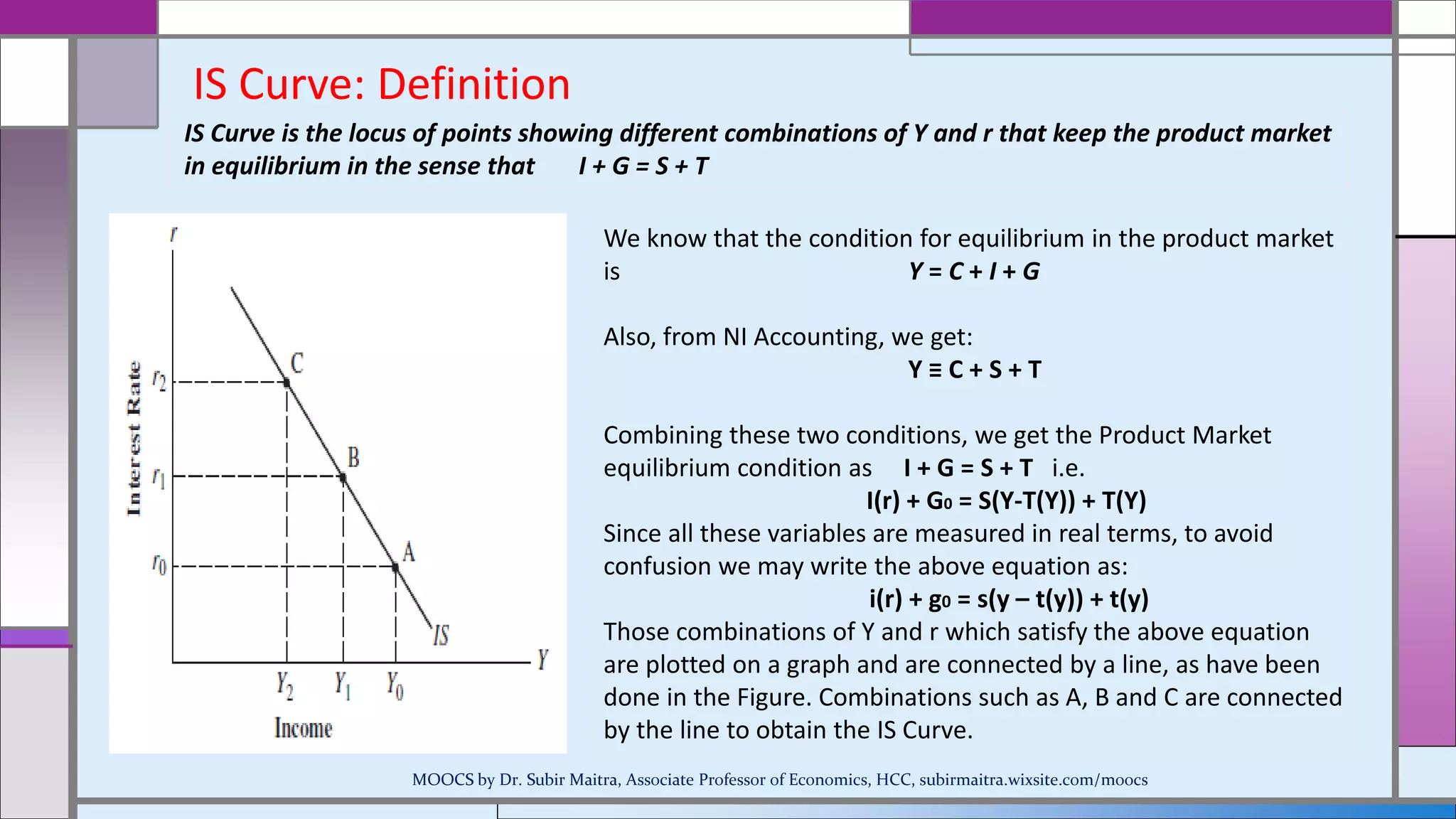
Those combinations of Y and r which satisfy the above equation
are plotted on a graph and are connected by a line, as have been
done in the Figure. Combinations such as A, B and C are connected
by the line to obtain the IS Curve.
IS Curve is the locus of points showing different combinations of Y and r that keep the product market
in equilibrium in the sense that I + G = S + T
MOOCS by Dr. Subir Maitra, Associate Professor of Economics, HCC, subirmaitra.wixsite.com/moocs
IS Curve: Derivation
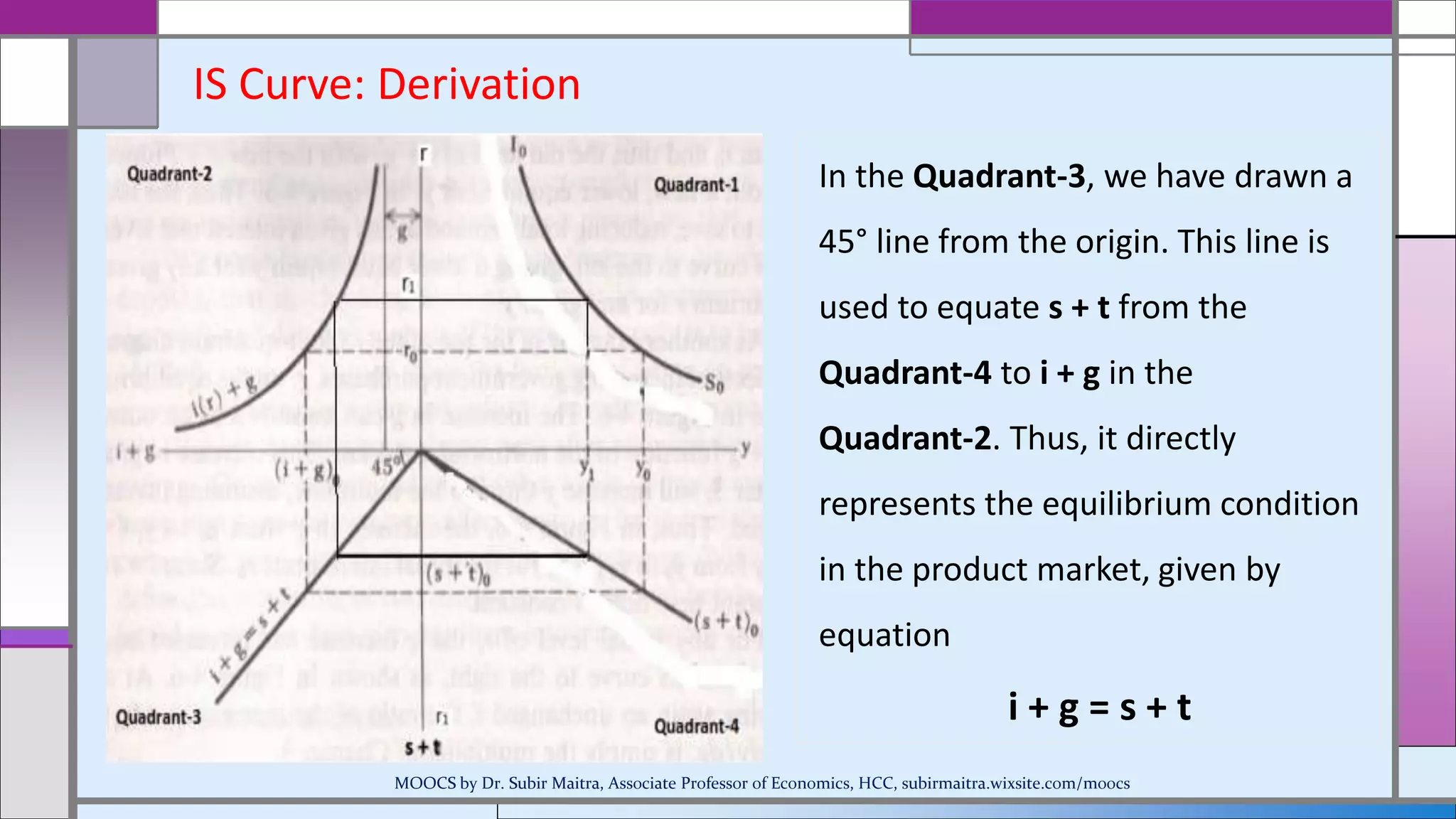
All the relationships discussed so far
are shown in the Figure to derive the
IS curve.
In Quadrant-2, we have plotted
government spending, which is fixed
by the budget and therefore
a vertical line, plus investment, which
is a decreasing function of r. The
values g and i(r) are summed
horizontally in this quadrant to give
the i(r) + g line which represent total
expenditure on i plus g as a function of
r.
MOOCS by Dr. Subir Maitra, Associate Professor of Economics, HCC, subirmaitra.wixsite.com/moocs
IS Curve: Derivation
In the Quadrant-3, we have drawn a
45° line from the origin. This line is
used to equate s + t from the
Quadrant-4 to i + g in the
Quadrant-2. Thus, it directly
represents the equilibrium condition
in the product market, given by
equation
i + g = s + t
MOOCS by Dr. Subir Maitra, Associate Professor of Economics, HCC, subirmaitra.wixsite.com/moocs
IS Curve: Derivation
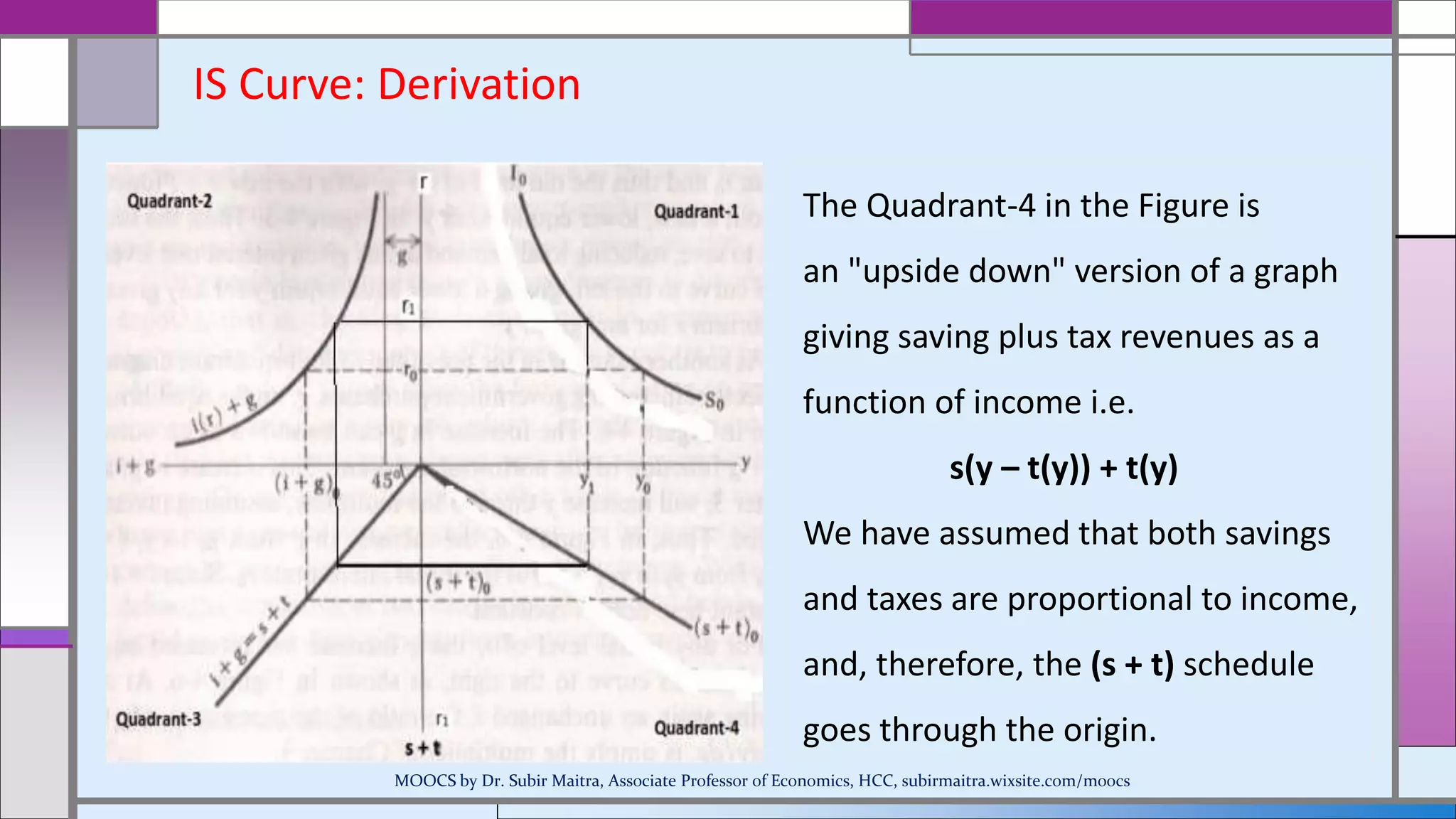
The Quadrant-4 in the Figure is
an "upside down" version of a graph
giving saving plus tax revenues as a
function of income i.e.
s(y – t(y)) + t(y)
We have assumed that both savings
and taxes are proportional to income,
and, therefore, the (s + t) schedule
goes through the origin.
MOOCS by Dr. Subir Maitra, Associate Professor of Economics, HCC, subirmaitra.wixsite.com/moocs
IS Curve: Derivation
To derive this, we first choose a level of
interest rate on the r-axis, then we trace
through the three quadrants following the
dashed line to locate the equilibrium income
level for that interest rate. For example, at
interest rate r0, i + g is (i + g)0. To generate an
equal amount of (s + t), the income level
would have to be at y0. This procedure can
be followed for any level of r, say r1, to obtain
the corresponding level of y, i.e. y1.
In the Quadrant-1, the IS curve, representing equilibrium pairs of r and y, has been derived.
MOOCS by Dr. Subir Maitra, Associate Professor of Economics, HCC, subirmaitra.wixsite.com/moocs
IS Curve: Derivation
This procedure can be followed for any
level of r, say r1, to obtain the
corresponding level of y, i.e. y1. If we join
combinations like, (y0, r0), (y1, r1) as
plotted in Quadrant-1 by a line, we get
the IS curve, I0S0.
The IS curve, thus, represents all those
pairs of r and y which maintain
equilibrium in the product market.
MOOCS by Dr. Subir Maitra, Associate Professor of Economics, HCC, subirmaitra.wixsite.com/moocs
IS Curve: Slope
The slope of the IS curve can also be derived with some simple
mathematics. Totally differentiating the product market
equilibrium condition i.e. y = c(y-t(y)) + i(r) + g
=> dy = cy (dy – ty dy) + ir dr + g
Assuming g constant i.e. dg = 0, we get [dy – cy (1 – ty)dy] = ir dr
=> [1 –cy (1 - ty)] dy = ir dr
=>
𝒅𝒓
𝒅𝒚
=
[1 –cy (1 −ty)]
ir
Since we know that [1 –cy (1 - ty)] > 0, and ir < 0, it is clear
that
𝒅𝒓
𝒅𝒚
< 0. This shows that the slope the IS curve in Figure is
negative.
MOOCS by Dr. Subir Maitra, Associate Professor of Economics, HCC, subirmaitra.wixsite.com/moocs
Shift of IS Curve: Increase in Thriftiness
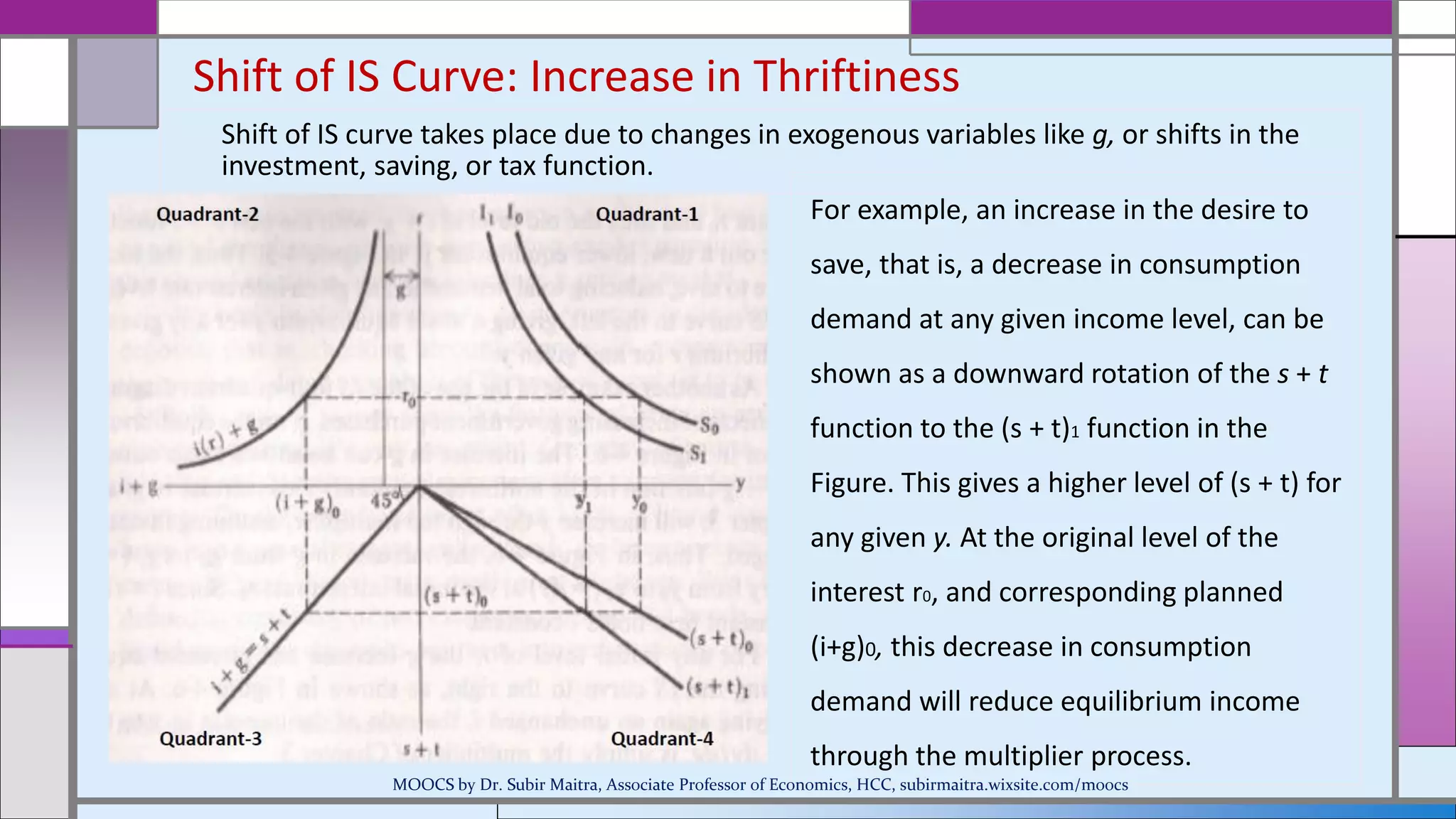
For example, an increase in the desire to
save, that is, a decrease in consumption
demand at any given income level, can be
shown as a downward rotation of the s + t
function to the (s + t)1 function in the
Figure. This gives a higher level of (s + t) for
any given y. At the original level of the
interest r0, and corresponding planned
(i+g)0, this decrease in consumption
demand will reduce equilibrium income
through the multiplier process.
Shift of IS curve takes place due to changes in exogenous variables like g, or shifts in the
investment, saving, or tax function.
MOOCS by Dr. Subir Maitra, Associate Professor of Economics, HCC, subirmaitra.wixsite.com/moocs
Shift of IS Curve: Increase in Thriftiness
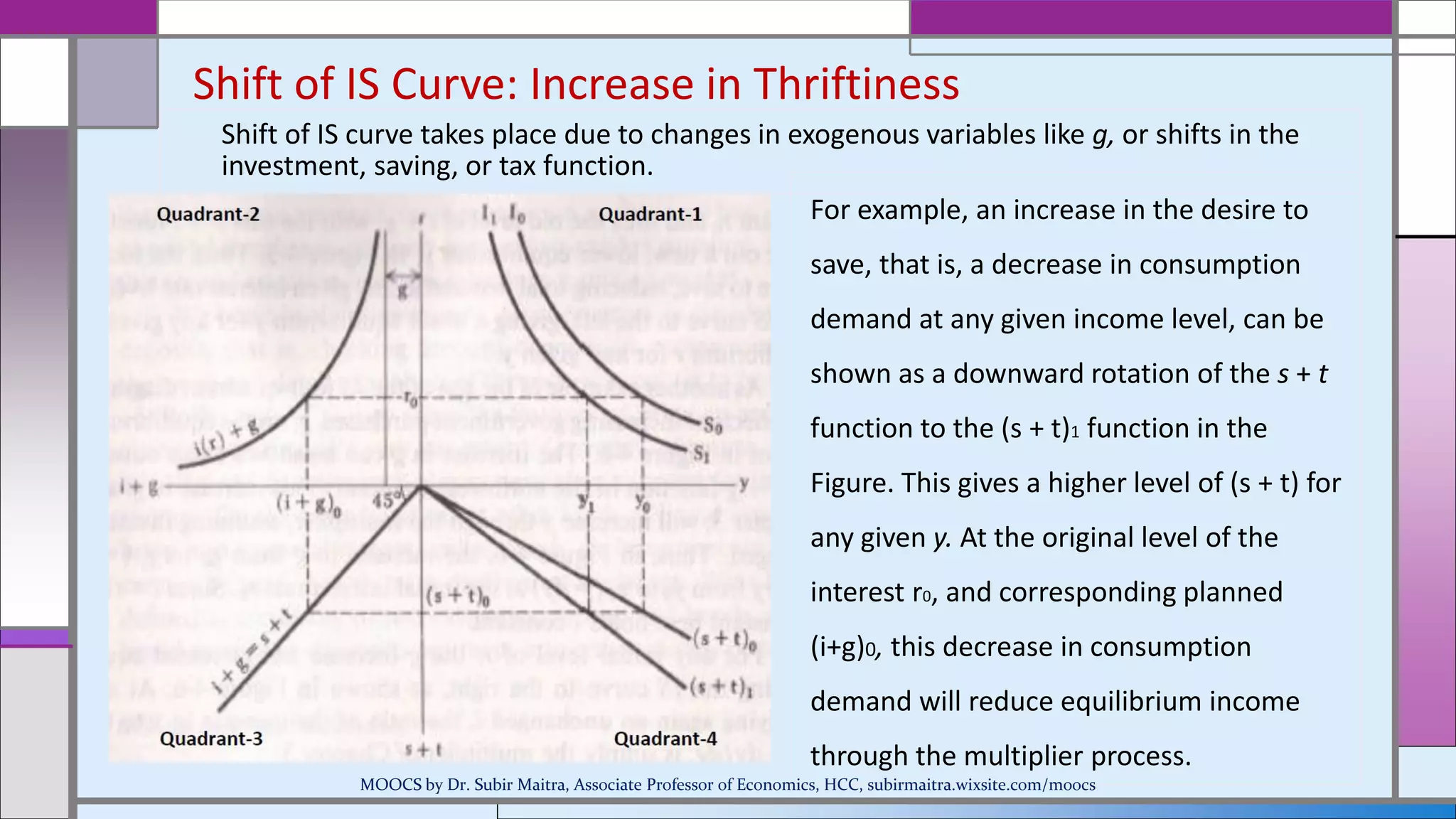
For example, an increase in the desire to
save, that is, a decrease in consumption
demand at any given income level, can be
shown as a downward rotation of the s + t
function to the (s + t)1 function in the
Figure. This gives a higher level of (s + t) for
any given y. At the original level of the
interest r0, and corresponding planned
(i+g)0, this decrease in consumption
demand will reduce equilibrium income
through the multiplier process.
Shift of IS curve takes place due to changes in exogenous variables like g, or shifts in the
investment, saving, or tax function.
MOOCS by Dr. Subir Maitra, Associate Professor of Economics, HCC, subirmaitra.wixsite.com/moocs
Shift of IS Curve: Increase in Thriftiness
Graphically, at old interest rate r0 and thus the old
level of (i + g) i.e. (i + g)0, with the new (s + t)
function, (s + t)1 the new income level which will
maintain equilibrium in the product market is
found to be y1 . Thus, the increase in the desire to
save (thriftiness) of the people, reducing total
demand at any given interest rate level, shifts the
IS curve to the left, giving a lower equilibrium y
for any given r, or lower equilibrium r for any
given y.
Similarly, it can be shown that a reduction in the
desire to save shifts the IS curve upward.
MOOCS by Dr. Subir Maitra, Associate Professor of Economics, HCC, subirmaitra.wixsite.com/moocs
Shift of IS Curve: Increase in Government Expenditure
The shift in IS curve may also take place
due to the effects of increasing
government purchases, g, on the
equilibrium r and y pairs, as shown in this
Figure. The increase in g can be shown as
an outward shift in the i + g function in the
northwest quadrant (Quadrant-2). This
increase in g, will increase y through the
multiplier effect, assuming investment is
unchanged.
MOOCS by Dr. Subir Maitra, Associate Professor of Economics, HCC, subirmaitra.wixsite.com/moocs
Shift of IS Curve: Increase in Government Expenditure
Thus, in this Figure, the increase in g from
g0 to g1, raises y from y0 to y1 at the initial
interest rate r0. Since i = i(r), holding r
constant, i(r) also remains constant. For
any initial level of r, say r0, the g increase
increases equilibrium y, through
multiplier effect, shifting the IS curve to
the right, as shown in the Figure.
It can also be shown that a reduction in g
shifts the IS curve downward.
MOOCS by Dr. Subir Maitra, Associate Professor of Economics, HCC, subirmaitra.wixsite.com/moocs
Shift of IS Curve: Change in Tax Rate
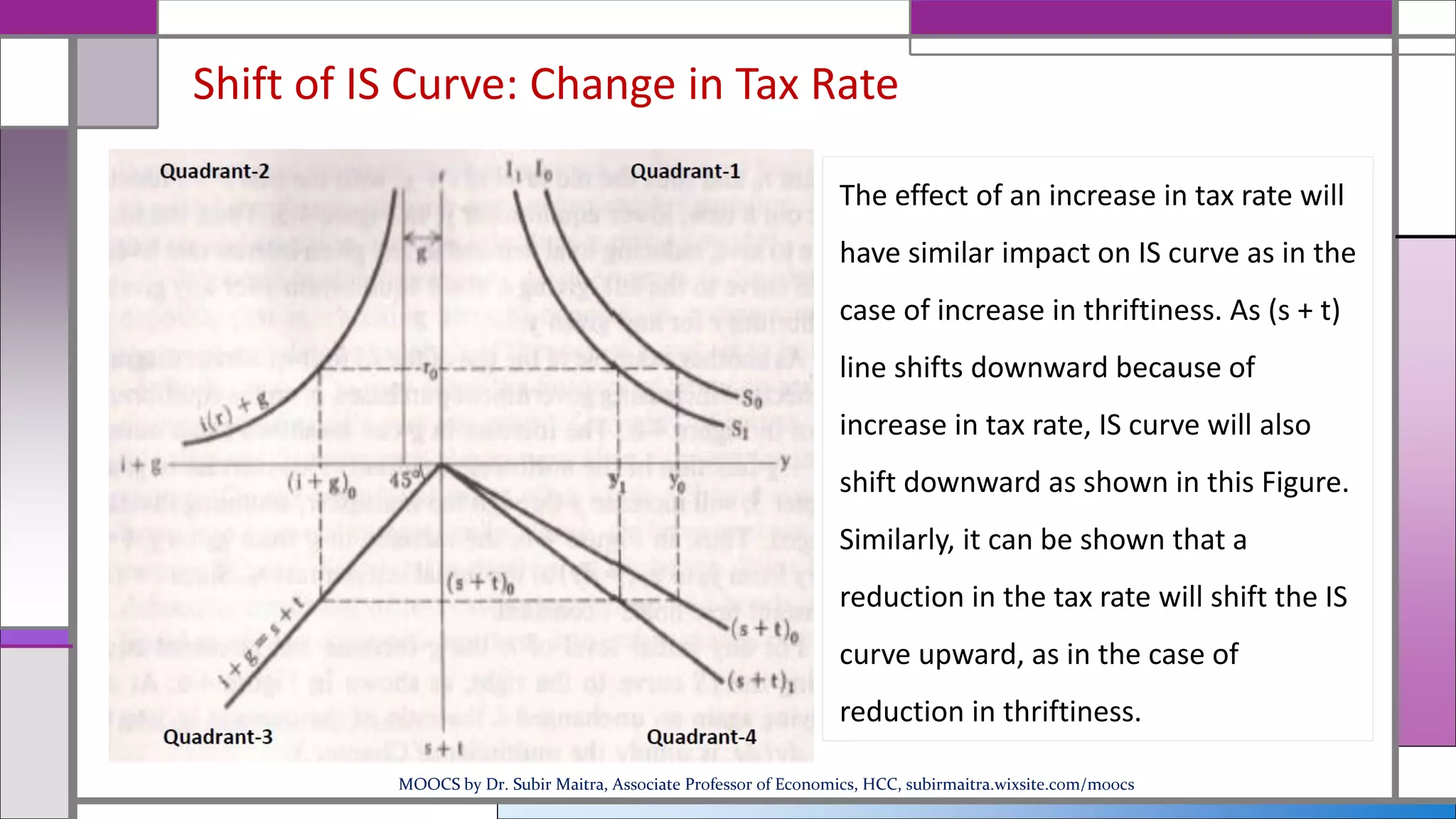
The effect of an increase in tax rate will
have similar impact on IS curve as in the
case of increase in thriftiness. As (s + t)
line shifts downward because of
increase in tax rate, IS curve will also
shift downward as shown in this Figure.
Similarly, it can be shown that a
reduction in the tax rate will shift the IS
curve upward, as in the case of
reduction in thriftiness.
MOOCS by Dr. Subir Maitra, Associate Professor of Economics, HCC, subirmaitra.wixsite.com/moocs
Shift of IS Curve: Change in Investors’ Willingness to Invest
The effect of an increase in investors’ willingness to
invest at a given interest rate, may be because of
government offering some incentives, will have similar
impact on IS curve as in the case of increase in
government expenditure. Here g line remains same,
but (i + g) line shifts outward because of a shift in i(r).
As a result, IS curve shifts upward as shown in this
Figure.
Similarly, if the investors are willing to invest less at the
prevailing interest rate, may be because of some
economic uncertainties, the IS curve will downward, as
in the case of reduction in government expenditure.
MOOCS by Dr. Subir Maitra, Associate Professor of Economics, HCC, subirmaitra.wixsite.com/moocs
LM Curve: Definition
We know that the condition for equilibrium in the money
market is k(y) + l(r) = 𝑀
𝑃
k(y) + l(r) gives the demand for real money balances, k(y)
and l(r) measured in real terms. 𝑀
𝑃
stands for supply of real
money balances.
Those combinations of Y and r which satisfy the above
equation are plotted on a graph and are connected by a
line, as have been done in this Figure. Combinations such
as (y0,r0), (y1,r1) and (y2,r2) are connected by the line to
obtain the LM Curve.
LM Curve is the locus of points showing different combinations of Y and r that keep the money market in
equilibrium in the sense that the demand for real money balances is just equal to the real supply of money,
with a given level money supply, M, and a given price level, P.
MOOCS by Dr. Subir Maitra, Associate Professor of Economics, HCC, subirmaitra.wixsite.com/moocs
LM Curve: Derivation
All the relationships discussed so
far are shown in the Figure to
derive the LM curve.
In Quadrant-2, we have plotted
speculative demand for money,
l(r) which is a decreasing function
of r.
In Quadrant-4 the line k(y) gives
transactions demand as an
increasing function of income,
measured downward.
MOOCS by Dr. Subir Maitra, Associate Professor of Economics, HCC, subirmaitra.wixsite.com/moocs
LM Curve: Derivation
In Quadrant-3, we have used a
geometric ‘trick’, which represents the
equilibrium condition, equating total
real supply of money to total demand
for real money balances. Here we have
drawn a line which makes a 45° angle to
each axis. The line is drawn at a distance
from the origin on each axis equal to the
total exogenously given real money
supply, 𝑀
𝑃
.
MOOCS by Dr. Subir Maitra, Associate Professor of Economics, HCC, subirmaitra.wixsite.com/moocs
LM Curve: Derivation
Because of the geometric nature of the
45° triangle, the transactions demand
and the speculative demand always
add up to the total money supply on
each axis, so that this 45° line directly
represents money market equilibrium
condition. Any point on this 45° line
gives a transactions demand plus a
speculative demand that just add up to
the total money supply.
MOOCS by Dr. Subir Maitra, Associate Professor of Economics, HCC, subirmaitra.wixsite.com/moocs
LM Curve: Derivation
Now we locate in Quadrant-1 of the Figure
the r and y pairs that maintain equilibrium in
the money market. At a given level of income
such as y0, we can find transactions demand
for money from the k(y) function. By following
the dashed line, we subtract this from supply,
𝑀
𝑃
, to see what level of speculative demand
this implies if the money market is to be in
equilibrium.
MOOCS by Dr. Subir Maitra, Associate Professor of Economics, HCC, subirmaitra.wixsite.com/moocs
LM Curve: Derivation
This level of speculative demand shows us, in
turn, the level of interest rate ro that will
maintain equilibrium in the money market
with income level yo· Having located one
money market equilibrium pair, (ro, yo), we can
locate another by beginning with y1 in the
same Figure. Repeating this process, we can
find out all those combinations of (r,y) which
maintain money market equilibrium.
Connecting all such points by a line, we get the
LM curve, as derived in the Figure.
MOOCS by Dr. Subir Maitra, Associate Professor of Economics, HCC, subirmaitra.wixsite.com/moocs
LM Curve: Slope
The slope of the LM curve can also be derived
with some simple mathematics. We take total
differentiation of the money market equilibrium
condition i.e. k(y) + l(r) = 𝑴
𝑷
Thus we get: ky.dy +lr.dr = d( 𝑴
𝑷
)
Since along an LM curve money supply remains
constant,
d( 𝑴
𝑷
) = 0 => ky.dy +lr.dr = 0 =>
𝒅𝒓
𝒅𝒚
=-- ky/lr
𝒅𝒓
𝒅𝒚
gives the slope of the LM curve.
Since ky > 0 and lr < 0,
𝒅𝒓
𝒅𝒚
> 0,
that is, the LM curve is positively sloped.
MOOCS by Dr. Subir Maitra, Associate Professor of Economics, HCC, subirmaitra.wixsite.com/moocs
Shift of LM Curve: Increase in Money Supply
An increase in the money
supply creates an excess
supply of money at the old
level of income and interest
rate, This excess supply pushes
the equilibrium interest rate
down, given the income level.
An increase in the money
supply will shift the
𝑴
𝑷
line out.
Shift of LM curve takes place due to changes in exogenous variables like money supply, or shifts in
the speculative demand or transactions demand functions.
MOOCS by Dr. Subir Maitra, Associate Professor of Economics, HCC, subirmaitra.wixsite.com/moocs
Shift of LM Curve: Increase in Money Supply
With the increase in the real
money supply, at any given level of
income, corresponding to a given
level of transactions demand,
there is excess money supply to
accommodate an increased
speculative demand. This implies,
for money market equilibrium, a
lower interest rate at each income
level. This increase in the money
supply thus shifts the LM curve to
the right.
A reduction in money supply acts
in the opposite fashion and shifts
the LM curve to the left.
MOOCS by Dr. Subir Maitra, Associate Professor of Economics, HCC, subirmaitra.wixsite.com/moocs
Shift of LM Curve: Other reasons
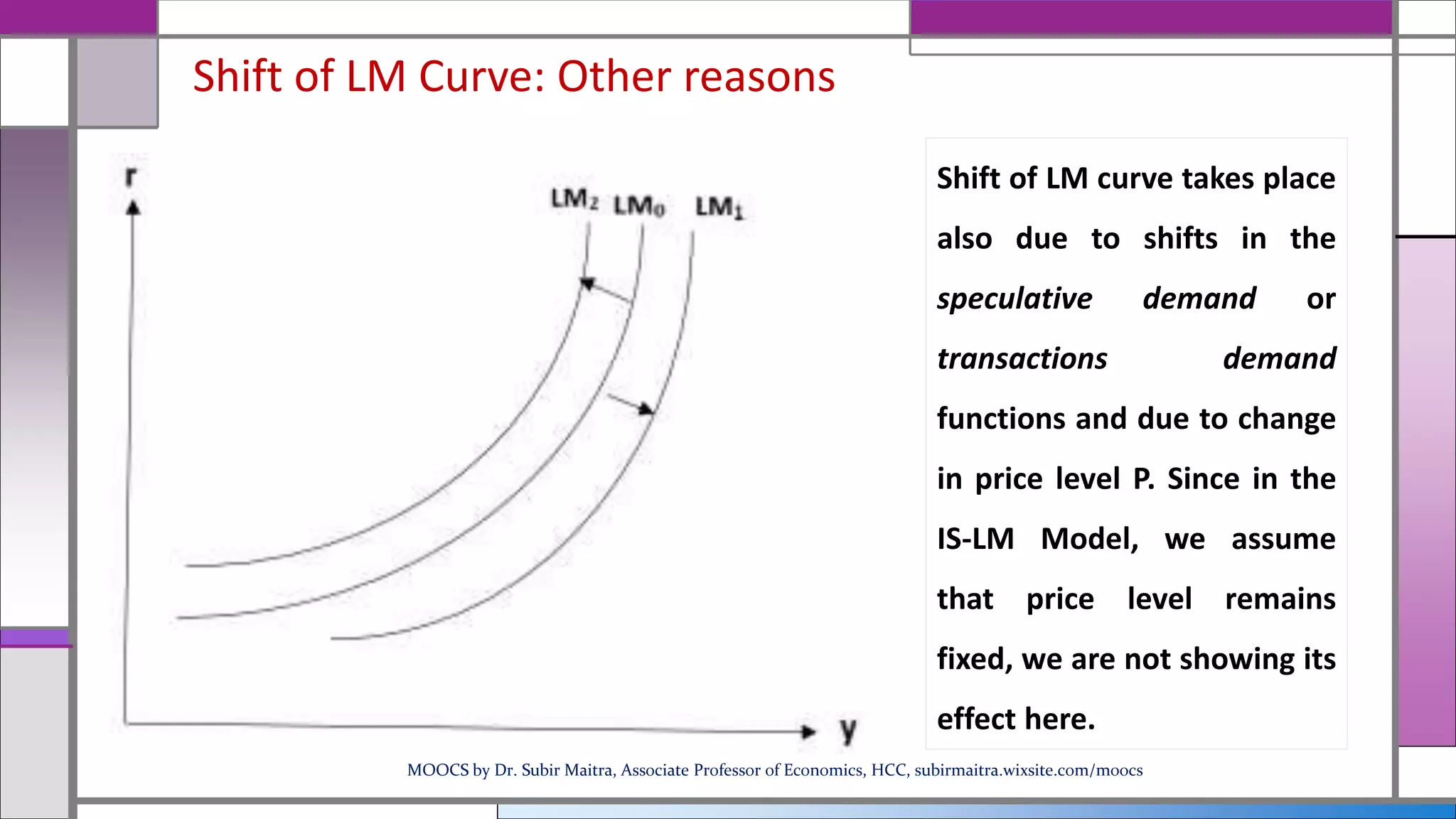
Shift of LM curve takes place
also due to shifts in the
speculative demand or
transactions demand
functions and due to change
in price level P. Since in the
IS-LM Model, we assume
that price level remains
fixed, we are not showing its
effect here.
MOOCS by Dr. Subir Maitra, Associate Professor of Economics, HCC, subirmaitra.wixsite.com/moocs
Shift of LM Curve: Other reasons
LM curve shifts to its left/right if
speculative demand for money function
l(r) in Quadrant 2 shifts outward/ inward
as shown in the earlier Figure.
Similarly, if transaction demand for
money function k(y) shown in Quadrant
4 of earlier Figure rotates clockwise/
anti-clockwise, LM curve shifts to left /
right.
MOOCS by Dr. Subir Maitra, Associate Professor of Economics, HCC, subirmaitra.wixsite.com/moocs
End of Lecture
MOOCS by Dr. Subir Maitra, Associate Professor of Economics, HCC, subirmaitra.wixsite.com/moocs
Write to me: smaitra.hcc@gmail.com

IS-LM Model 2

  • 1.
    MOOCS by Dr.Subir Maitra Course Name: M.Com Year: First Session: 2017-18 Paper- 1.3 Macroeconomics and Business Environment Module: One University of Calcutta Department of Commerce MOOCS by Dr. Subir Maitra, Associate Professor of Economics, HCC, subirmaitra.wixsite.com/moocs
  • 2.
    General Equilibrium: Aspectsof Closed Economy--Commodity Market and Money Market Equilibrium--IS-LM Approach. LECTURE-10 IS-LM MODEL: IS AND LM CURVES MOOCS by Dr. Subir Maitra, Associate Professor of Economics, HCC, subirmaitra.wixsite.com/moocs
  • 3.
    IS Curve: Definition Weknow that the condition for equilibrium in the product market is Y = C + I + G Also, from NI Accounting, we get: Y ≡ C + S + T Combining these two conditions, we get the Product Market equilibrium condition as I + G = S + T i.e. I(r) + G0 = S(Y-T(Y)) + T(Y) Since all these variables are measured in real terms, to avoid confusion we may write the above equation as: i(r) + g0 = s(y – t(y)) + t(y) Those combinations of Y and r which satisfy the above equation are plotted on a graph and are connected by a line, as have been done in the Figure. Combinations such as A, B and C are connected by the line to obtain the IS Curve. IS Curve is the locus of points showing different combinations of Y and r that keep the product market in equilibrium in the sense that I + G = S + T MOOCS by Dr. Subir Maitra, Associate Professor of Economics, HCC, subirmaitra.wixsite.com/moocs
  • 4.
    IS Curve: Derivation Allthe relationships discussed so far are shown in the Figure to derive the IS curve. In Quadrant-2, we have plotted government spending, which is fixed by the budget and therefore a vertical line, plus investment, which is a decreasing function of r. The values g and i(r) are summed horizontally in this quadrant to give the i(r) + g line which represent total expenditure on i plus g as a function of r. MOOCS by Dr. Subir Maitra, Associate Professor of Economics, HCC, subirmaitra.wixsite.com/moocs
  • 5.
    IS Curve: Derivation Inthe Quadrant-3, we have drawn a 45° line from the origin. This line is used to equate s + t from the Quadrant-4 to i + g in the Quadrant-2. Thus, it directly represents the equilibrium condition in the product market, given by equation i + g = s + t MOOCS by Dr. Subir Maitra, Associate Professor of Economics, HCC, subirmaitra.wixsite.com/moocs
  • 6.
    IS Curve: Derivation TheQuadrant-4 in the Figure is an "upside down" version of a graph giving saving plus tax revenues as a function of income i.e. s(y – t(y)) + t(y) We have assumed that both savings and taxes are proportional to income, and, therefore, the (s + t) schedule goes through the origin. MOOCS by Dr. Subir Maitra, Associate Professor of Economics, HCC, subirmaitra.wixsite.com/moocs
  • 7.
    IS Curve: Derivation Toderive this, we first choose a level of interest rate on the r-axis, then we trace through the three quadrants following the dashed line to locate the equilibrium income level for that interest rate. For example, at interest rate r0, i + g is (i + g)0. To generate an equal amount of (s + t), the income level would have to be at y0. This procedure can be followed for any level of r, say r1, to obtain the corresponding level of y, i.e. y1. In the Quadrant-1, the IS curve, representing equilibrium pairs of r and y, has been derived. MOOCS by Dr. Subir Maitra, Associate Professor of Economics, HCC, subirmaitra.wixsite.com/moocs
  • 8.
    IS Curve: Derivation Thisprocedure can be followed for any level of r, say r1, to obtain the corresponding level of y, i.e. y1. If we join combinations like, (y0, r0), (y1, r1) as plotted in Quadrant-1 by a line, we get the IS curve, I0S0. The IS curve, thus, represents all those pairs of r and y which maintain equilibrium in the product market. MOOCS by Dr. Subir Maitra, Associate Professor of Economics, HCC, subirmaitra.wixsite.com/moocs
  • 9.
    IS Curve: Slope Theslope of the IS curve can also be derived with some simple mathematics. Totally differentiating the product market equilibrium condition i.e. y = c(y-t(y)) + i(r) + g => dy = cy (dy – ty dy) + ir dr + g Assuming g constant i.e. dg = 0, we get [dy – cy (1 – ty)dy] = ir dr => [1 –cy (1 - ty)] dy = ir dr => 𝒅𝒓 𝒅𝒚 = [1 –cy (1 −ty)] ir Since we know that [1 –cy (1 - ty)] > 0, and ir < 0, it is clear that 𝒅𝒓 𝒅𝒚 < 0. This shows that the slope the IS curve in Figure is negative. MOOCS by Dr. Subir Maitra, Associate Professor of Economics, HCC, subirmaitra.wixsite.com/moocs
  • 10.
    Shift of ISCurve: Increase in Thriftiness For example, an increase in the desire to save, that is, a decrease in consumption demand at any given income level, can be shown as a downward rotation of the s + t function to the (s + t)1 function in the Figure. This gives a higher level of (s + t) for any given y. At the original level of the interest r0, and corresponding planned (i+g)0, this decrease in consumption demand will reduce equilibrium income through the multiplier process. Shift of IS curve takes place due to changes in exogenous variables like g, or shifts in the investment, saving, or tax function. MOOCS by Dr. Subir Maitra, Associate Professor of Economics, HCC, subirmaitra.wixsite.com/moocs
  • 11.
    Shift of ISCurve: Increase in Thriftiness For example, an increase in the desire to save, that is, a decrease in consumption demand at any given income level, can be shown as a downward rotation of the s + t function to the (s + t)1 function in the Figure. This gives a higher level of (s + t) for any given y. At the original level of the interest r0, and corresponding planned (i+g)0, this decrease in consumption demand will reduce equilibrium income through the multiplier process. Shift of IS curve takes place due to changes in exogenous variables like g, or shifts in the investment, saving, or tax function. MOOCS by Dr. Subir Maitra, Associate Professor of Economics, HCC, subirmaitra.wixsite.com/moocs
  • 12.
    Shift of ISCurve: Increase in Thriftiness Graphically, at old interest rate r0 and thus the old level of (i + g) i.e. (i + g)0, with the new (s + t) function, (s + t)1 the new income level which will maintain equilibrium in the product market is found to be y1 . Thus, the increase in the desire to save (thriftiness) of the people, reducing total demand at any given interest rate level, shifts the IS curve to the left, giving a lower equilibrium y for any given r, or lower equilibrium r for any given y. Similarly, it can be shown that a reduction in the desire to save shifts the IS curve upward. MOOCS by Dr. Subir Maitra, Associate Professor of Economics, HCC, subirmaitra.wixsite.com/moocs
  • 13.
    Shift of ISCurve: Increase in Government Expenditure The shift in IS curve may also take place due to the effects of increasing government purchases, g, on the equilibrium r and y pairs, as shown in this Figure. The increase in g can be shown as an outward shift in the i + g function in the northwest quadrant (Quadrant-2). This increase in g, will increase y through the multiplier effect, assuming investment is unchanged. MOOCS by Dr. Subir Maitra, Associate Professor of Economics, HCC, subirmaitra.wixsite.com/moocs
  • 14.
    Shift of ISCurve: Increase in Government Expenditure Thus, in this Figure, the increase in g from g0 to g1, raises y from y0 to y1 at the initial interest rate r0. Since i = i(r), holding r constant, i(r) also remains constant. For any initial level of r, say r0, the g increase increases equilibrium y, through multiplier effect, shifting the IS curve to the right, as shown in the Figure. It can also be shown that a reduction in g shifts the IS curve downward. MOOCS by Dr. Subir Maitra, Associate Professor of Economics, HCC, subirmaitra.wixsite.com/moocs
  • 15.
    Shift of ISCurve: Change in Tax Rate The effect of an increase in tax rate will have similar impact on IS curve as in the case of increase in thriftiness. As (s + t) line shifts downward because of increase in tax rate, IS curve will also shift downward as shown in this Figure. Similarly, it can be shown that a reduction in the tax rate will shift the IS curve upward, as in the case of reduction in thriftiness. MOOCS by Dr. Subir Maitra, Associate Professor of Economics, HCC, subirmaitra.wixsite.com/moocs
  • 16.
    Shift of ISCurve: Change in Investors’ Willingness to Invest The effect of an increase in investors’ willingness to invest at a given interest rate, may be because of government offering some incentives, will have similar impact on IS curve as in the case of increase in government expenditure. Here g line remains same, but (i + g) line shifts outward because of a shift in i(r). As a result, IS curve shifts upward as shown in this Figure. Similarly, if the investors are willing to invest less at the prevailing interest rate, may be because of some economic uncertainties, the IS curve will downward, as in the case of reduction in government expenditure. MOOCS by Dr. Subir Maitra, Associate Professor of Economics, HCC, subirmaitra.wixsite.com/moocs
  • 17.
    LM Curve: Definition Weknow that the condition for equilibrium in the money market is k(y) + l(r) = 𝑀 𝑃 k(y) + l(r) gives the demand for real money balances, k(y) and l(r) measured in real terms. 𝑀 𝑃 stands for supply of real money balances. Those combinations of Y and r which satisfy the above equation are plotted on a graph and are connected by a line, as have been done in this Figure. Combinations such as (y0,r0), (y1,r1) and (y2,r2) are connected by the line to obtain the LM Curve. LM Curve is the locus of points showing different combinations of Y and r that keep the money market in equilibrium in the sense that the demand for real money balances is just equal to the real supply of money, with a given level money supply, M, and a given price level, P. MOOCS by Dr. Subir Maitra, Associate Professor of Economics, HCC, subirmaitra.wixsite.com/moocs
  • 18.
    LM Curve: Derivation Allthe relationships discussed so far are shown in the Figure to derive the LM curve. In Quadrant-2, we have plotted speculative demand for money, l(r) which is a decreasing function of r. In Quadrant-4 the line k(y) gives transactions demand as an increasing function of income, measured downward. MOOCS by Dr. Subir Maitra, Associate Professor of Economics, HCC, subirmaitra.wixsite.com/moocs
  • 19.
    LM Curve: Derivation InQuadrant-3, we have used a geometric ‘trick’, which represents the equilibrium condition, equating total real supply of money to total demand for real money balances. Here we have drawn a line which makes a 45° angle to each axis. The line is drawn at a distance from the origin on each axis equal to the total exogenously given real money supply, 𝑀 𝑃 . MOOCS by Dr. Subir Maitra, Associate Professor of Economics, HCC, subirmaitra.wixsite.com/moocs
  • 20.
    LM Curve: Derivation Becauseof the geometric nature of the 45° triangle, the transactions demand and the speculative demand always add up to the total money supply on each axis, so that this 45° line directly represents money market equilibrium condition. Any point on this 45° line gives a transactions demand plus a speculative demand that just add up to the total money supply. MOOCS by Dr. Subir Maitra, Associate Professor of Economics, HCC, subirmaitra.wixsite.com/moocs
  • 21.
    LM Curve: Derivation Nowwe locate in Quadrant-1 of the Figure the r and y pairs that maintain equilibrium in the money market. At a given level of income such as y0, we can find transactions demand for money from the k(y) function. By following the dashed line, we subtract this from supply, 𝑀 𝑃 , to see what level of speculative demand this implies if the money market is to be in equilibrium. MOOCS by Dr. Subir Maitra, Associate Professor of Economics, HCC, subirmaitra.wixsite.com/moocs
  • 22.
    LM Curve: Derivation Thislevel of speculative demand shows us, in turn, the level of interest rate ro that will maintain equilibrium in the money market with income level yo· Having located one money market equilibrium pair, (ro, yo), we can locate another by beginning with y1 in the same Figure. Repeating this process, we can find out all those combinations of (r,y) which maintain money market equilibrium. Connecting all such points by a line, we get the LM curve, as derived in the Figure. MOOCS by Dr. Subir Maitra, Associate Professor of Economics, HCC, subirmaitra.wixsite.com/moocs
  • 23.
    LM Curve: Slope Theslope of the LM curve can also be derived with some simple mathematics. We take total differentiation of the money market equilibrium condition i.e. k(y) + l(r) = 𝑴 𝑷 Thus we get: ky.dy +lr.dr = d( 𝑴 𝑷 ) Since along an LM curve money supply remains constant, d( 𝑴 𝑷 ) = 0 => ky.dy +lr.dr = 0 => 𝒅𝒓 𝒅𝒚 =-- ky/lr 𝒅𝒓 𝒅𝒚 gives the slope of the LM curve. Since ky > 0 and lr < 0, 𝒅𝒓 𝒅𝒚 > 0, that is, the LM curve is positively sloped. MOOCS by Dr. Subir Maitra, Associate Professor of Economics, HCC, subirmaitra.wixsite.com/moocs
  • 24.
    Shift of LMCurve: Increase in Money Supply An increase in the money supply creates an excess supply of money at the old level of income and interest rate, This excess supply pushes the equilibrium interest rate down, given the income level. An increase in the money supply will shift the 𝑴 𝑷 line out. Shift of LM curve takes place due to changes in exogenous variables like money supply, or shifts in the speculative demand or transactions demand functions. MOOCS by Dr. Subir Maitra, Associate Professor of Economics, HCC, subirmaitra.wixsite.com/moocs
  • 25.
    Shift of LMCurve: Increase in Money Supply With the increase in the real money supply, at any given level of income, corresponding to a given level of transactions demand, there is excess money supply to accommodate an increased speculative demand. This implies, for money market equilibrium, a lower interest rate at each income level. This increase in the money supply thus shifts the LM curve to the right. A reduction in money supply acts in the opposite fashion and shifts the LM curve to the left. MOOCS by Dr. Subir Maitra, Associate Professor of Economics, HCC, subirmaitra.wixsite.com/moocs
  • 26.
    Shift of LMCurve: Other reasons Shift of LM curve takes place also due to shifts in the speculative demand or transactions demand functions and due to change in price level P. Since in the IS-LM Model, we assume that price level remains fixed, we are not showing its effect here. MOOCS by Dr. Subir Maitra, Associate Professor of Economics, HCC, subirmaitra.wixsite.com/moocs
  • 27.
    Shift of LMCurve: Other reasons LM curve shifts to its left/right if speculative demand for money function l(r) in Quadrant 2 shifts outward/ inward as shown in the earlier Figure. Similarly, if transaction demand for money function k(y) shown in Quadrant 4 of earlier Figure rotates clockwise/ anti-clockwise, LM curve shifts to left / right. MOOCS by Dr. Subir Maitra, Associate Professor of Economics, HCC, subirmaitra.wixsite.com/moocs
  • 28.
    End of Lecture MOOCSby Dr. Subir Maitra, Associate Professor of Economics, HCC, subirmaitra.wixsite.com/moocs Write to me: smaitra.hcc@gmail.com