MUSLIM LAW
Udayasimha N G
Assistant Professor
CMR Law School
 The word "Muslim" means one who submits
to the will of God. The first principle of
Islam is known as the Shahaadah(Testimony
of Faith), and is as follows: "There is no
one worthy of worship except Allah
(God) and Muhammad is the Final Apostle
(Messenger) of God.”
In a broader sense, anyone who willingly
submits to the will of God is a Muslim.
Thus, all the prophets preceding Prophet
Muhammad, are considered as Muslims.
 By Birth : Even in the case one of the
parents are Muslim than the person has to
be considered as a Muslim .
 By Conversion : Any person of sound mind
and has attained the age of majority after
renouncing his religion.
 Public declaration
 Following the rituals ( reading Kaleema)
 “La ilaha illa Allah, Muhammadur rasoolu
Allah,” one converts to Islam and becomes a
Muslim This saying means “There is no true god
(deity) but God (Allah),1and Muhammad is the
Messenger (Prophet) of God.” The first part,
“There is no true god but God,” means that none has
the right to be worshipped but God alone, and that
God has neither partner nor son. To be a Muslim, one
should also:
 Believe that the Holy Quran is the literal word of
God, revealed by Him.
Believe that the Day of Judgment (the Day of
Resurrection) is true and will come, as God promised
in the Quran.
 Accept Islam as his or her religion.
 Not worship anything nor anyone except God.
 Hindu converted into Islam and married a
Muslim lady without divorcing the first wife.
 S.C held that the second marriage is not a
valid marriage.
 Second marriage punishable under bigamy
u/s 494 of IPC.
 It is not the object of Islam to encourage the
Hindus to evade their personal law
 Sushmitha Ghose and G.C Ghose got married
in the year 1984 as per Hindu law
 G.C Ghose got converted to Islam and
renamed himself to Mhd. Karim Ghazi
 Ghose alias Karim married Vanita Gupta
 S.C held that the conversion was an illegal
conversion
 Husband convicted for the offence of bigamy.
 7th Century in Arabia
 Not an easy life
 Many lead a nomadic life
 No common religion
 No common govt. or administrative
machinery
 Elected leaders of the tribes controlled
 Emphasis on courage , freedom and vengance
 Rich in literature
 Manliness bravery and hospitality
 Unreasonable customs with no restrictions on
marriage
 No women rights
 Female infanticide was rampant
 Degeneration in morality religion and
freedom
 Quran : Derived from Arabic word Qurra
which refers to ‘the reading’. The first wahi
(revelation) came to the Prophet in 609.
 These delivered messages were reduced on
animal skin, palm leaves etc.,
Salient features :-
 Divine origin
 First source
 Mixture of religion, law and morality
 Unchangeable
 Structure :- 6237 Ayat (verse) 114 chapters (Sura)
 Sunnah :- Traditions of the Prophet
“Whatever the prophet said and did without
the reference to god is his tradition”
Sunnat –ul-Qual:- Words spoken by Prophet
Sunnat –ul-Fail:- Conduct and behaviour
Sunnat-ul- Taqrir:- Silence of Prophet
 Ijma :- Unanimous decisions of the Jurists
 A consensual opinion by knowledgeable persons
in law.
Kinds of Ijma:-
 Ijma of the companions :- Very accurate
 Ijma of the Jurists:- Opinion of learned
scholars
 Ijma of the people :- Mass acceptance of a
principle as law.
 Qiyas :- Analogical Deductions
 “Measurement”
 Comparing a thing in relation to a standard or to
establish an analogy
 A method of comparing a problem in present
times to a similar problem for which the solution
is provided in the text.
 Urf (Taamul) or Customs:-
 Prophet abolished certain practices which were
prevaling in Arabia as it was considered as un-
islamic .
 Hanafi school:- 699-767A.D
 Founded by Abu Hanifa
 Laid emphasis on Qiyas
 Followed only certain traditions
 Advocated Ijma
 Iraq to Arabia, Syria, Afghanistan, Central Asia
and India.
 The Maliki School:- 713-795A.D
 Malik Ibn Anas ( Medina School)
 Collected about 300 traditions of Prophet
 Developed legal system
 Not very rigid about traditions
 He professed Ijma
 Spain, Moracco, North and East Africa
 The Shafie School :- 767-20A.D
 Muhammed Ibn Idrish- ash-Shafie
 Expert in Jurisprudence and Law
 Advocated Ijma
 Followed juristic principles
 Critical analysis of traditions
 Egypt, South Arabia, East Africa, Iraq, Persia,
Western and Southern India.
 The Hanbali School:- 780-855 A.D
 Not an actual founder
 Pupils gathered and founded this school
 A strict follower of tradition
 He did not advocate Ijma
 Arabia , Siriya and Palestine
 Imamat :-
 Advocated the principle of succession for the
appointment of Imamat.
 They are the spiritual leaders of Islam or the
higher preist at a Mosque.
 Imam is the final interpreter of the law on the
earth.
 He is the leader by divine right
 Believed to be the descendant of the Prophet
 Article 25(1)
“Subject to public order, morality and health
and to the other provisions of this part, all
persons are equally entitled to freedom of
conscience and the right freely to profess,
practice and propagate religion”.
 Belief in oneness of god
 Public declaration
 Conversion is invalid if its only for pretence,
fraud.
“…the meaning of the phrase ‘professes a
religion’ in the aforementioned provision is
to enter publicity into a religious state and
that for this purpose a mere declaration by a
person that he has ceased to belong to a
particular religion and embraced another
religion would not be sufficient.
 By Husband & Wife
 A husband converting will not dissolve his
previous marriage.
 The conversion of a non-Muslim wife to Islam
does not dissolve her marriage with her husband
 The succession to the estate will be governed by
Muslim Laws
 Apostasy has an immediate and prospective
effect from the moment of his conversion and is
not retrospective.
“ Marriage is a legal process by which the sexual
intercourse and procreation and legitimation of
children between man and women is perfectly
lawful and valid”.
Section 2 of Law of Marriage (AIMPLB) :-
“Marriage is an agreement between man a
women, based on the Shariat principles as a
result of which mutual sexual relation becomes
legitimate, paternity of obligations become
enforceable”.
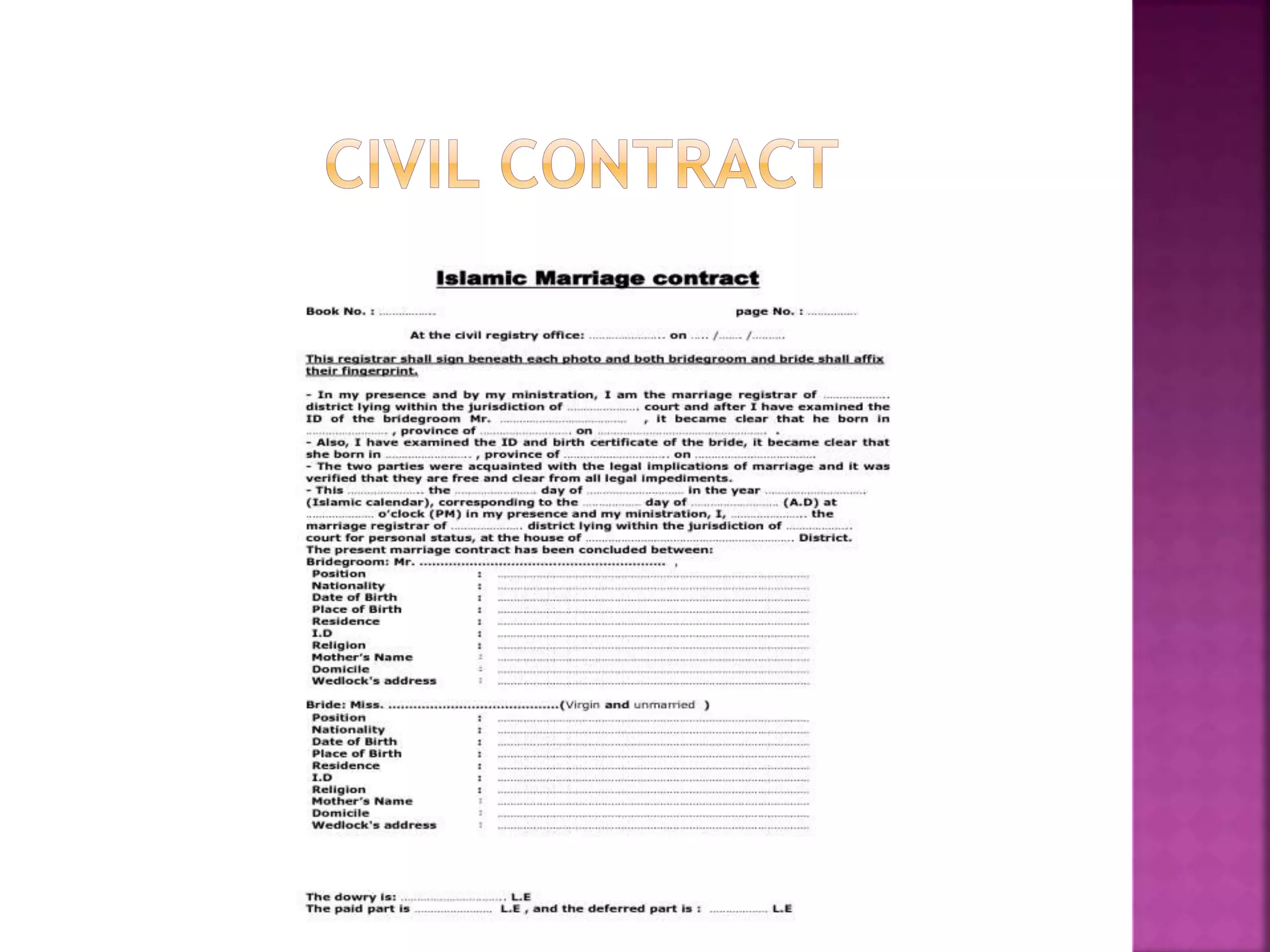
“Marriage is a contract underlying permanent
relationship based on mutual consent on the part
of a man and women”.
 Promotion of a normal family life
 Legalizing sexual intercourse
 Legitimacy of children
 Domestic and social life
 Respect towards spouse and children
 Guarding the humans from foulness and
unchasity
Saburannissa v. Sabdu Shiek
AIR 1934 Cal. 693
“The marriage under Muslim law is a civil
contract and is like a contract of sale. Sale is
a transfer of property for a price. In the
contract of marriage the wife is the property
and dower is the price”.
 Proposal and acceptance in one meeting
 Proposal is made by the bridegroom (Ijab)
 Made before the Kazi and two witnesses
 The acceptance is called as ‘Qabool’
 Free consent
 Competency of the parties
 Puberty

Muslim law

  • 1.
    MUSLIM LAW Udayasimha NG Assistant Professor CMR Law School
  • 2.
     The word"Muslim" means one who submits to the will of God. The first principle of Islam is known as the Shahaadah(Testimony of Faith), and is as follows: "There is no one worthy of worship except Allah (God) and Muhammad is the Final Apostle (Messenger) of God.” In a broader sense, anyone who willingly submits to the will of God is a Muslim. Thus, all the prophets preceding Prophet Muhammad, are considered as Muslims.
  • 3.
     By Birth: Even in the case one of the parents are Muslim than the person has to be considered as a Muslim .  By Conversion : Any person of sound mind and has attained the age of majority after renouncing his religion.  Public declaration  Following the rituals ( reading Kaleema)
  • 4.
     “La ilahailla Allah, Muhammadur rasoolu Allah,” one converts to Islam and becomes a Muslim This saying means “There is no true god (deity) but God (Allah),1and Muhammad is the Messenger (Prophet) of God.” The first part, “There is no true god but God,” means that none has the right to be worshipped but God alone, and that God has neither partner nor son. To be a Muslim, one should also:  Believe that the Holy Quran is the literal word of God, revealed by Him. Believe that the Day of Judgment (the Day of Resurrection) is true and will come, as God promised in the Quran.  Accept Islam as his or her religion.  Not worship anything nor anyone except God.
  • 5.
     Hindu convertedinto Islam and married a Muslim lady without divorcing the first wife.  S.C held that the second marriage is not a valid marriage.  Second marriage punishable under bigamy u/s 494 of IPC.  It is not the object of Islam to encourage the Hindus to evade their personal law
  • 6.
     Sushmitha Ghoseand G.C Ghose got married in the year 1984 as per Hindu law  G.C Ghose got converted to Islam and renamed himself to Mhd. Karim Ghazi  Ghose alias Karim married Vanita Gupta  S.C held that the conversion was an illegal conversion  Husband convicted for the offence of bigamy.
  • 7.
     7th Centuryin Arabia  Not an easy life  Many lead a nomadic life  No common religion  No common govt. or administrative machinery  Elected leaders of the tribes controlled  Emphasis on courage , freedom and vengance  Rich in literature  Manliness bravery and hospitality
  • 8.
     Unreasonable customswith no restrictions on marriage  No women rights  Female infanticide was rampant  Degeneration in morality religion and freedom
  • 9.
     Quran :Derived from Arabic word Qurra which refers to ‘the reading’. The first wahi (revelation) came to the Prophet in 609.  These delivered messages were reduced on animal skin, palm leaves etc., Salient features :-  Divine origin  First source  Mixture of religion, law and morality  Unchangeable  Structure :- 6237 Ayat (verse) 114 chapters (Sura)
  • 10.
     Sunnah :-Traditions of the Prophet “Whatever the prophet said and did without the reference to god is his tradition” Sunnat –ul-Qual:- Words spoken by Prophet Sunnat –ul-Fail:- Conduct and behaviour Sunnat-ul- Taqrir:- Silence of Prophet
  • 11.
     Ijma :-Unanimous decisions of the Jurists  A consensual opinion by knowledgeable persons in law. Kinds of Ijma:-  Ijma of the companions :- Very accurate  Ijma of the Jurists:- Opinion of learned scholars  Ijma of the people :- Mass acceptance of a principle as law.
  • 12.
     Qiyas :-Analogical Deductions  “Measurement”  Comparing a thing in relation to a standard or to establish an analogy  A method of comparing a problem in present times to a similar problem for which the solution is provided in the text.
  • 13.
     Urf (Taamul)or Customs:-  Prophet abolished certain practices which were prevaling in Arabia as it was considered as un- islamic .
  • 14.
     Hanafi school:-699-767A.D  Founded by Abu Hanifa  Laid emphasis on Qiyas  Followed only certain traditions  Advocated Ijma  Iraq to Arabia, Syria, Afghanistan, Central Asia and India.
  • 15.
     The MalikiSchool:- 713-795A.D  Malik Ibn Anas ( Medina School)  Collected about 300 traditions of Prophet  Developed legal system  Not very rigid about traditions  He professed Ijma  Spain, Moracco, North and East Africa
  • 16.
     The ShafieSchool :- 767-20A.D  Muhammed Ibn Idrish- ash-Shafie  Expert in Jurisprudence and Law  Advocated Ijma  Followed juristic principles  Critical analysis of traditions  Egypt, South Arabia, East Africa, Iraq, Persia, Western and Southern India.
  • 17.
     The HanbaliSchool:- 780-855 A.D  Not an actual founder  Pupils gathered and founded this school  A strict follower of tradition  He did not advocate Ijma  Arabia , Siriya and Palestine
  • 18.
     Imamat :- Advocated the principle of succession for the appointment of Imamat.  They are the spiritual leaders of Islam or the higher preist at a Mosque.  Imam is the final interpreter of the law on the earth.  He is the leader by divine right  Believed to be the descendant of the Prophet
  • 20.
     Article 25(1) “Subjectto public order, morality and health and to the other provisions of this part, all persons are equally entitled to freedom of conscience and the right freely to profess, practice and propagate religion”.  Belief in oneness of god  Public declaration  Conversion is invalid if its only for pretence, fraud.
  • 21.
    “…the meaning ofthe phrase ‘professes a religion’ in the aforementioned provision is to enter publicity into a religious state and that for this purpose a mere declaration by a person that he has ceased to belong to a particular religion and embraced another religion would not be sufficient.
  • 22.
     By Husband& Wife  A husband converting will not dissolve his previous marriage.  The conversion of a non-Muslim wife to Islam does not dissolve her marriage with her husband  The succession to the estate will be governed by Muslim Laws  Apostasy has an immediate and prospective effect from the moment of his conversion and is not retrospective.
  • 24.
    “ Marriage isa legal process by which the sexual intercourse and procreation and legitimation of children between man and women is perfectly lawful and valid”. Section 2 of Law of Marriage (AIMPLB) :- “Marriage is an agreement between man a women, based on the Shariat principles as a result of which mutual sexual relation becomes legitimate, paternity of obligations become enforceable”. “Marriage is a contract underlying permanent relationship based on mutual consent on the part of a man and women”.
  • 25.
     Promotion ofa normal family life  Legalizing sexual intercourse  Legitimacy of children  Domestic and social life  Respect towards spouse and children  Guarding the humans from foulness and unchasity
  • 27.
    Saburannissa v. SabduShiek AIR 1934 Cal. 693 “The marriage under Muslim law is a civil contract and is like a contract of sale. Sale is a transfer of property for a price. In the contract of marriage the wife is the property and dower is the price”.
  • 28.
     Proposal andacceptance in one meeting  Proposal is made by the bridegroom (Ijab)  Made before the Kazi and two witnesses  The acceptance is called as ‘Qabool’  Free consent  Competency of the parties  Puberty