Paper money
Author : Akincana Krishna Das
E-mail : akd.brs@gmail.com
Editor : Vrindavan Lila Devi Dasi
Date Produced : 2017
Serial No : 25 of 54
Paper currency
and
its flaws
If you put bad money, just like nowadays the currency is some paper, paper
currency, so drives away good money. Good money means gold coins. They are
not to be seen. That's economic law. As soon as you put bad money, the good
money will vanish.
~ Srila Prabhupada
Morning Walk, LA, Dec 31, 1973
Index
• What is Money?
• Commodity money
• Fiat money
• Debasement of currency
• Modern day debasement
• Solution by Srila Prabhupada
• Conclusion
What is Money?
• Dictionary definition:
– Money is used to intermediate the exchange of goods and
services, it is performing a function as a medium of
exchange.
• Used to buy or sell goods and services.
• To pay or get paid.
• Critical aspect of modern day economy.
• Types of money:
– Commodity
– FIAT /FLAT
– REPRESENTATIVE
– ELECTRONIC MONEY etc.
Commodity Money
• Money whose value comes from the commodity
of which it is made.
• Commodity money consists of objects that have
value in themselves as well as value in their use
as money.
• The chosen “medium of exchange” has real,
intrinsic value (gold, silver, etc.).
• Help people to have confidence that they will be
able to exchange them for other goods in future.
Srila Prabhupada
– SB Lecture 5.5.3, Vrndavan, Oct 25, 1976
“Formerly even in the villages you would see that a common man has very
good stock of food grains and cows, dhanvena dhanavan, gavaya dhanavan.
Formerly the standard of richness was considered how many morai, the bank,
what is called? Where grain is stocked? Silo. So in India it is called morai, grain
stock. And how many cows one has got in stock. Then he is rich man.
Nowadays how much paper money he has got. Actually it has no value.
Suppose you have got some papers. Each paper it is written there "one
thousand dollars." But if there is no grain, what will this one-thousand-dollars
paper will do? It actually so happened in the last war in Germany. Their
money was thrown in the street. Nobody cared to take it, because it has no
exchange. So long the paper money you can exchange, there is value.
Otherwise it is paper only. But if you have got actual commodity—grains and
cows—then you can eat in any circumstances. Never mind war is going on;
you don't care. You get sufficient food. What you will do with the paper
money? So this paper currency is useless. If the things are going on nicely it
has value, but in times of crisis it has no value.”
Fiat Money
• Is a currency which derives its value from the
government regulation or law.
• It differs from commodity money, which is based
on a good, often precious metal such as gold or
silver.
• The value of fiat money is based largely on public
faith in the issuer.
• Fiat money does not have intrinsic value.
• Changes in public confidence in a government
issuing fiat money may be enough to make the
fiat currency worthless.
Srila Prabhupada - SB 05.16.20-21 (Purport)
Unfortunately, on earth there is such a scarcity of gold that the
governments of the world try to keep it in reserve and issue paper
currency. Because that currency is not backed up by gold, the paper
they distribute as money is worthless, but nevertheless the people on
earth are very proud of material advancement. In modern times, girls
and ladies have ornaments made of plastic instead of gold, and plastic
utensils are used instead of golden ones, yet people are very proud of
their material wealth. Therefore the people of this age are described
as mandāḥ sumanda-matayo manda-bhāgyā hy upadrutāḥ (Bhāg.
1.1.10). In other words, they are extremely bad and slow to
understand the opulence of the Supreme Personality of Godhead.
They have been described as sumanda-matayaḥ because their
conceptions are so crippled that they accept a bluffer who produces a
little gold to be God. Because they have no gold in their possession,
they are actually poverty-stricken, and therefore they are considered
unfortunate.
Debasement of Currency
• The practice of lowering the value of currency. It is particularly used in
connection with commodity money such as gold or silver coins. A coin
is said to be debased if the quantity of gold, silver, copper or nickel is
reduced. – Wikipedia
• Debasement lowers the intrinsic value of the coinage and so more
coins can be made with the same quantity of precious metal.
• Governments will debase its currency for financial gain for the
sovereign at the expense of its citizens.
• By reducing the silver or gold content of a coin, a government can
make more coins out of a given amount of specie.
• The purchasing power of the citizens currency gets reduced.
• Inflation follows.
Debasement of Currency
• Methods to achieve debasement
– Eliminating Commodity Backing
• The only backing is by government decree.
– Deficit Spending (Inflation)
• Governments print excessive amounts of money.
• Inflation occurs when the supply of money outpaces the demand
for money.
– Fractional Reserve Lending
• By creating money out of thin air banks lend out much more
money than they have.
• This can be a factor of 10 to 1 or more.
– Currency Redenomination
• A new unit of currency replaces an old unit.
Modern day debasement
• In 1932, Argentina had the eighth largest economy in the world before
its currency collapsed.
• In 1992, Finland, Italy, and Norway had currency shocks that spread
through Europe.
• In 1994, Mexico went through the infamous “Tequila Hangover,” which
sent the peso tumbling and spread economic hardships throughout
Latin America.
• In 1997, the Thai baht fell through the floor and the effects spread to
Malaysia, the Philippines, Indonesia, Hong Kong, and South Korea.
• The devaluation of Russian rouble in 1998 led to economic recession.
• Most recently, Zimbabwe is facing chronic inflation crisis and complete
debasement of its currency.
Srila Prabhupada - SB 04.16.10 (Purport)
The idea is that not only the king but everyone should keep his hard-
earned money confidentially and secretly so that in due course of time
the money can be spent for good, practical purposes. In Kali-yuga,
however, the king or government has no well-protected treasury, and
the only means of circulation is currency notes made of paper. Thus in
times of distress the government artificially inflates the currency by
simply printing papers, and this artificially raises the price of
commodities, and the general condition of the citizens becomes very
precarious. Thus keeping one’s money very secretly is an old practice,
for we find this practice present even during the reign of Mahārāja
Pṛthu. Just as the king has the right to keep his treasury confidential
and secret, the people should also keep their individual earnings a
secret. There is no fault in such dealings. The main point is that
everyone should be trained in the system of varṇāśrama-dharma so
that the money is spent only for good causes and nothing else.
Money is required for purchasing food. Why
don't you produce food directly? That is
intelligence.
~ Srila Prabhupada
BG Lecture, Melbourne April 22, 1976
Solution by Srila Prabhupada
- Morning Walk at Villa Borghese, Rome May 25, 1974
Because I did not earn this money, I have printed. I am prepared to twenty rupees. So
he says, "Why shall I pay ten rupees? I must wait for the customer, for twenty rupees,
and hoard it." Even there is sufficient stock, he will not sell. Therefore the other man,
who is honest, he is suffering. This is going on. So to stop this inflation, the
government must stop this paper currency. Then the inflation... There will be no more
inflation. But that they will not do. They want to cheat people. "In God I trust. Take
this paper and you be satisfied that you have got thousand dollars." That's all. This
cheating is going on. Why should you pay me paper? Give me real dollar, in gold. That
they have none. They haven't got. That's all. They will employ laborers and cheat them
by paying these papers, and this rascal will think that "I am getting more money."
That's all. Since this world has taken this paper currency, the situation has degraded.
Formerly there was barter exchange. That was very good thing. Still in Indian villages,
the remote villages, there is barter. Yes. He has produced some grains, paddy. He will
bring to the storekeeper. And the storekeeper will take, "For so much oil, you have to
give me so much paddy." So he will weigh and keep it and give him oil. So he will
arrange to sell the paddy. But for the villagers, he brings the paddy and he takes. They
require little salt, little oil, some spices. That's all. Otherwise they have got their own
thing. They have got dahl, their rice, wheat, everything. They have produced. In this
way, still there are, Indian villages. There is no question of scarcity.
Solution by Srila Prabhupada
• “That is the tendency, not to work hard, but live peacefully. That can be done. Everyone can do that,
provided he lives in the village, he lives in the village and produces his own food, little labor, vegetable,
food grains. Anyone can produce. This is human civilization.” ~ SB Lecture 6.1.52, Detroit Aug 5, 1975.
• That is our question. How long? What stock you have got in your store, so that you can continually, you
can go on? What you, what is the answer? You must have rain, and produce grain. Now you have got
some stock of grain, you are distributing. That's all right, you have got money, that's all right. But when
there will be all stock finished, and still there is no rain, what you will do? Because rain is not in your
hand. Rain is not in your hand. It is in higher authorities. So what you will do? But the process is given
there in the Bhagavad-gītā, yajñād bhavati parjanyo parjanyād anna-sambhavaḥ. Yajña, but they will not
take the yajña. They have made a vow, (indistinct). No, we are not going to make any yajña. We are
requesting, that you are distributing, at the same time perform yajña. Yajña, not that you have to expend
so much money. Simply this saṅkīrtana-yajña. Yajñaiḥ saṅkīrtana-prāyair yajanti hi su-medhasaḥ [SB
11.5.32]. Simply chanting. ~ Nectar of Devotion Lecture, Bombay Jan 8, 1973.
• Actually, everyone should be engaged to produce food, but the modern set-up of civilization is that few
people are engaged in producing food, and others are eating. They are offering... They are artificially
getting money. So they are offering paper, "Here is ten dollars." Although it is a paper, cheating. And they
are captivated by cheating. They, they are thinking, "I have got now hundred dollars." What is this
hundred dollars? It is paper. So some people are cheating and some people are being cheated. This is the
society. ~ Garden Conversation, July 25, 1973.
Solution by Srila Prabhupada
• The real business is that you produce enough food grains, as much
as possible, and you eat and distribute. That's all. This is business.
He does not require any so high technical education. Anyone can till
the ground and grow food. Is it difficult? This is the business. The
first thing is that everyone, man and animal, especially the cows,
they must be properly fed so become very stout and strong. Cows
will supply milk, and man will work hard, without being suffered by
dysentery. He must work hard. Any capacity. Work as a teacher or
work as a kṣatriya, work as a ploughman. Or work as general
assistant. He must work. Everyone should be employed. And his
employment will be provided from any of these groups, according
to his capacity. Either as a brāhmaṇa, or as a kṣatriya, or as a vaiśya,
or as a śūdra.
~ Morning Walk, Vrindavan March 14, 1974.
Conclusion
• History has shown time and time again that Fiat money
system always encourages corruption.
• Governments run by corrupt politicians can anytime
debase a currency and spiral the economy forcing
inflation to rise.
• Srila Prabhupada has rightly stated that real wealth as
enunciated in the Vedas is of land and cows.
– Produce your own food and eat sumptuously, be healthy
and chant Hare Kṛṣṇa. This is civilization. This is civilization.
– BG Lecture 9.4 – Melbourne, April 22, 1976
• Commodity based economy and barter system will
encourage “Simple living & High thinking” under
qualified leadership.
Hare Krishna Hare Krishna
Krishna Krishna Hare Hare
Hare Rama Hare Rama
Rama Rama Hare Hare
• ISKCON Daiva Varnasrama Ministry
Promoting Rural Development in India
www.iskconvarnasrama.com
• OM Sri Surabhi Campaign
www.srisurabhi.org
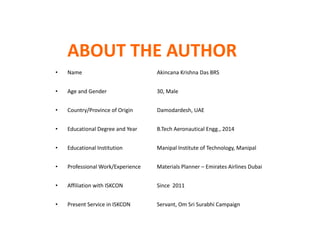
ABOUT THE AUTHOR
• Name Akincana Krishna Das BRS
• Age and Gender 30, Male
• Country/Province of Origin Damodardesh, UAE
• Educational Degree and Year B.Tech Aeronautical Engg., 2014
• Educational Institution Manipal Institute of Technology, Manipal
• Professional Work/Experience Materials Planner – Emirates Airlines Dubai
• Affiliation with ISKCON Since 2011
• Present Service in ISKCON Servant, Om Sri Surabhi Campaign
Paper money and its flaws

Paper money and its flaws

  • 2.
    Paper money Author :Akincana Krishna Das E-mail : akd.brs@gmail.com Editor : Vrindavan Lila Devi Dasi Date Produced : 2017 Serial No : 25 of 54
  • 3.
  • 4.
    If you putbad money, just like nowadays the currency is some paper, paper currency, so drives away good money. Good money means gold coins. They are not to be seen. That's economic law. As soon as you put bad money, the good money will vanish. ~ Srila Prabhupada Morning Walk, LA, Dec 31, 1973
  • 5.
    Index • What isMoney? • Commodity money • Fiat money • Debasement of currency • Modern day debasement • Solution by Srila Prabhupada • Conclusion
  • 6.
    What is Money? •Dictionary definition: – Money is used to intermediate the exchange of goods and services, it is performing a function as a medium of exchange. • Used to buy or sell goods and services. • To pay or get paid. • Critical aspect of modern day economy. • Types of money: – Commodity – FIAT /FLAT – REPRESENTATIVE – ELECTRONIC MONEY etc.
  • 7.
    Commodity Money • Moneywhose value comes from the commodity of which it is made. • Commodity money consists of objects that have value in themselves as well as value in their use as money. • The chosen “medium of exchange” has real, intrinsic value (gold, silver, etc.). • Help people to have confidence that they will be able to exchange them for other goods in future.
  • 8.
    Srila Prabhupada – SBLecture 5.5.3, Vrndavan, Oct 25, 1976 “Formerly even in the villages you would see that a common man has very good stock of food grains and cows, dhanvena dhanavan, gavaya dhanavan. Formerly the standard of richness was considered how many morai, the bank, what is called? Where grain is stocked? Silo. So in India it is called morai, grain stock. And how many cows one has got in stock. Then he is rich man. Nowadays how much paper money he has got. Actually it has no value. Suppose you have got some papers. Each paper it is written there "one thousand dollars." But if there is no grain, what will this one-thousand-dollars paper will do? It actually so happened in the last war in Germany. Their money was thrown in the street. Nobody cared to take it, because it has no exchange. So long the paper money you can exchange, there is value. Otherwise it is paper only. But if you have got actual commodity—grains and cows—then you can eat in any circumstances. Never mind war is going on; you don't care. You get sufficient food. What you will do with the paper money? So this paper currency is useless. If the things are going on nicely it has value, but in times of crisis it has no value.”
  • 9.
    Fiat Money • Isa currency which derives its value from the government regulation or law. • It differs from commodity money, which is based on a good, often precious metal such as gold or silver. • The value of fiat money is based largely on public faith in the issuer. • Fiat money does not have intrinsic value. • Changes in public confidence in a government issuing fiat money may be enough to make the fiat currency worthless.
  • 10.
    Srila Prabhupada -SB 05.16.20-21 (Purport) Unfortunately, on earth there is such a scarcity of gold that the governments of the world try to keep it in reserve and issue paper currency. Because that currency is not backed up by gold, the paper they distribute as money is worthless, but nevertheless the people on earth are very proud of material advancement. In modern times, girls and ladies have ornaments made of plastic instead of gold, and plastic utensils are used instead of golden ones, yet people are very proud of their material wealth. Therefore the people of this age are described as mandāḥ sumanda-matayo manda-bhāgyā hy upadrutāḥ (Bhāg. 1.1.10). In other words, they are extremely bad and slow to understand the opulence of the Supreme Personality of Godhead. They have been described as sumanda-matayaḥ because their conceptions are so crippled that they accept a bluffer who produces a little gold to be God. Because they have no gold in their possession, they are actually poverty-stricken, and therefore they are considered unfortunate.
  • 11.
    Debasement of Currency •The practice of lowering the value of currency. It is particularly used in connection with commodity money such as gold or silver coins. A coin is said to be debased if the quantity of gold, silver, copper or nickel is reduced. – Wikipedia • Debasement lowers the intrinsic value of the coinage and so more coins can be made with the same quantity of precious metal. • Governments will debase its currency for financial gain for the sovereign at the expense of its citizens. • By reducing the silver or gold content of a coin, a government can make more coins out of a given amount of specie. • The purchasing power of the citizens currency gets reduced. • Inflation follows.
  • 12.
    Debasement of Currency •Methods to achieve debasement – Eliminating Commodity Backing • The only backing is by government decree. – Deficit Spending (Inflation) • Governments print excessive amounts of money. • Inflation occurs when the supply of money outpaces the demand for money. – Fractional Reserve Lending • By creating money out of thin air banks lend out much more money than they have. • This can be a factor of 10 to 1 or more. – Currency Redenomination • A new unit of currency replaces an old unit.
  • 13.
    Modern day debasement •In 1932, Argentina had the eighth largest economy in the world before its currency collapsed. • In 1992, Finland, Italy, and Norway had currency shocks that spread through Europe. • In 1994, Mexico went through the infamous “Tequila Hangover,” which sent the peso tumbling and spread economic hardships throughout Latin America. • In 1997, the Thai baht fell through the floor and the effects spread to Malaysia, the Philippines, Indonesia, Hong Kong, and South Korea. • The devaluation of Russian rouble in 1998 led to economic recession. • Most recently, Zimbabwe is facing chronic inflation crisis and complete debasement of its currency.
  • 14.
    Srila Prabhupada -SB 04.16.10 (Purport) The idea is that not only the king but everyone should keep his hard- earned money confidentially and secretly so that in due course of time the money can be spent for good, practical purposes. In Kali-yuga, however, the king or government has no well-protected treasury, and the only means of circulation is currency notes made of paper. Thus in times of distress the government artificially inflates the currency by simply printing papers, and this artificially raises the price of commodities, and the general condition of the citizens becomes very precarious. Thus keeping one’s money very secretly is an old practice, for we find this practice present even during the reign of Mahārāja Pṛthu. Just as the king has the right to keep his treasury confidential and secret, the people should also keep their individual earnings a secret. There is no fault in such dealings. The main point is that everyone should be trained in the system of varṇāśrama-dharma so that the money is spent only for good causes and nothing else.
  • 15.
    Money is requiredfor purchasing food. Why don't you produce food directly? That is intelligence. ~ Srila Prabhupada BG Lecture, Melbourne April 22, 1976
  • 16.
    Solution by SrilaPrabhupada - Morning Walk at Villa Borghese, Rome May 25, 1974 Because I did not earn this money, I have printed. I am prepared to twenty rupees. So he says, "Why shall I pay ten rupees? I must wait for the customer, for twenty rupees, and hoard it." Even there is sufficient stock, he will not sell. Therefore the other man, who is honest, he is suffering. This is going on. So to stop this inflation, the government must stop this paper currency. Then the inflation... There will be no more inflation. But that they will not do. They want to cheat people. "In God I trust. Take this paper and you be satisfied that you have got thousand dollars." That's all. This cheating is going on. Why should you pay me paper? Give me real dollar, in gold. That they have none. They haven't got. That's all. They will employ laborers and cheat them by paying these papers, and this rascal will think that "I am getting more money." That's all. Since this world has taken this paper currency, the situation has degraded. Formerly there was barter exchange. That was very good thing. Still in Indian villages, the remote villages, there is barter. Yes. He has produced some grains, paddy. He will bring to the storekeeper. And the storekeeper will take, "For so much oil, you have to give me so much paddy." So he will weigh and keep it and give him oil. So he will arrange to sell the paddy. But for the villagers, he brings the paddy and he takes. They require little salt, little oil, some spices. That's all. Otherwise they have got their own thing. They have got dahl, their rice, wheat, everything. They have produced. In this way, still there are, Indian villages. There is no question of scarcity.
  • 17.
    Solution by SrilaPrabhupada • “That is the tendency, not to work hard, but live peacefully. That can be done. Everyone can do that, provided he lives in the village, he lives in the village and produces his own food, little labor, vegetable, food grains. Anyone can produce. This is human civilization.” ~ SB Lecture 6.1.52, Detroit Aug 5, 1975. • That is our question. How long? What stock you have got in your store, so that you can continually, you can go on? What you, what is the answer? You must have rain, and produce grain. Now you have got some stock of grain, you are distributing. That's all right, you have got money, that's all right. But when there will be all stock finished, and still there is no rain, what you will do? Because rain is not in your hand. Rain is not in your hand. It is in higher authorities. So what you will do? But the process is given there in the Bhagavad-gītā, yajñād bhavati parjanyo parjanyād anna-sambhavaḥ. Yajña, but they will not take the yajña. They have made a vow, (indistinct). No, we are not going to make any yajña. We are requesting, that you are distributing, at the same time perform yajña. Yajña, not that you have to expend so much money. Simply this saṅkīrtana-yajña. Yajñaiḥ saṅkīrtana-prāyair yajanti hi su-medhasaḥ [SB 11.5.32]. Simply chanting. ~ Nectar of Devotion Lecture, Bombay Jan 8, 1973. • Actually, everyone should be engaged to produce food, but the modern set-up of civilization is that few people are engaged in producing food, and others are eating. They are offering... They are artificially getting money. So they are offering paper, "Here is ten dollars." Although it is a paper, cheating. And they are captivated by cheating. They, they are thinking, "I have got now hundred dollars." What is this hundred dollars? It is paper. So some people are cheating and some people are being cheated. This is the society. ~ Garden Conversation, July 25, 1973.
  • 18.
    Solution by SrilaPrabhupada • The real business is that you produce enough food grains, as much as possible, and you eat and distribute. That's all. This is business. He does not require any so high technical education. Anyone can till the ground and grow food. Is it difficult? This is the business. The first thing is that everyone, man and animal, especially the cows, they must be properly fed so become very stout and strong. Cows will supply milk, and man will work hard, without being suffered by dysentery. He must work hard. Any capacity. Work as a teacher or work as a kṣatriya, work as a ploughman. Or work as general assistant. He must work. Everyone should be employed. And his employment will be provided from any of these groups, according to his capacity. Either as a brāhmaṇa, or as a kṣatriya, or as a vaiśya, or as a śūdra. ~ Morning Walk, Vrindavan March 14, 1974.
  • 19.
    Conclusion • History hasshown time and time again that Fiat money system always encourages corruption. • Governments run by corrupt politicians can anytime debase a currency and spiral the economy forcing inflation to rise. • Srila Prabhupada has rightly stated that real wealth as enunciated in the Vedas is of land and cows. – Produce your own food and eat sumptuously, be healthy and chant Hare Kṛṣṇa. This is civilization. This is civilization. – BG Lecture 9.4 – Melbourne, April 22, 1976 • Commodity based economy and barter system will encourage “Simple living & High thinking” under qualified leadership.
  • 20.
    Hare Krishna HareKrishna Krishna Krishna Hare Hare Hare Rama Hare Rama Rama Rama Hare Hare
  • 21.
    • ISKCON DaivaVarnasrama Ministry Promoting Rural Development in India www.iskconvarnasrama.com • OM Sri Surabhi Campaign www.srisurabhi.org
  • 23.
    ABOUT THE AUTHOR •Name Akincana Krishna Das BRS • Age and Gender 30, Male • Country/Province of Origin Damodardesh, UAE • Educational Degree and Year B.Tech Aeronautical Engg., 2014 • Educational Institution Manipal Institute of Technology, Manipal • Professional Work/Experience Materials Planner – Emirates Airlines Dubai • Affiliation with ISKCON Since 2011 • Present Service in ISKCON Servant, Om Sri Surabhi Campaign