S M BADAR HAYAT
TUTOR
DEPARTMENT OF
ANATOMY
NMCH, JAMUHAR
 INTRODUCTION
 FEATURES
 ACETABULUM
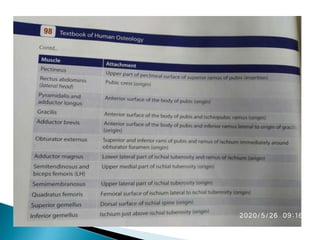
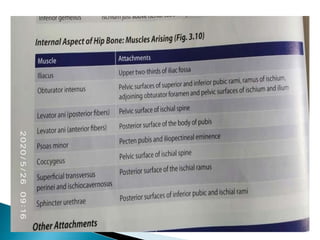
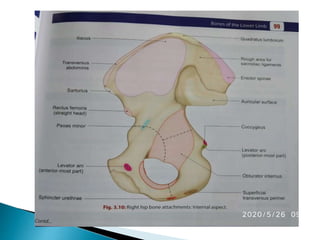
 ATTACHMENTS
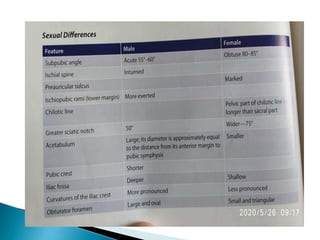
 SEX DIFFERENCE
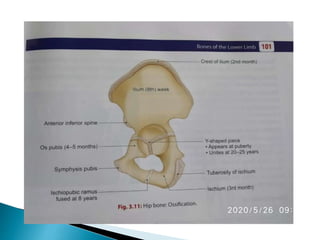
 OSSIFICATION
 APPLIED ANATOMY
 It forms the
lower and
posterior part of
hip bone and
contributes to
form a little more
than lower and
posterior 2/5th of
the articular
surface of
acetabulum.
BODY
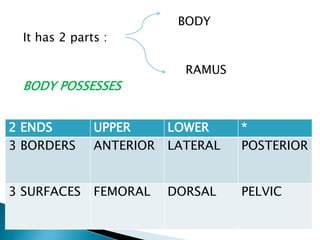
It has 2 parts :
RAMUS
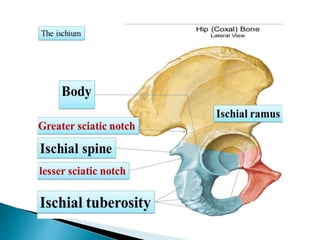
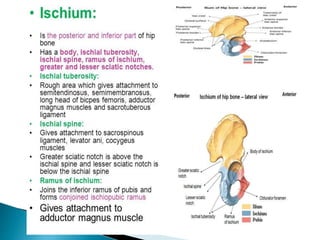
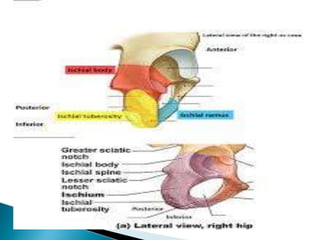
BODY POSSESSES
2 ENDS UPPER LOWER *
3 BORDERS ANTERIOR LATERAL POSTERIOR
3 SURFACES FEMORAL DORSAL PELVIC
 ENDS:
i. UPPER END: Its forms a part of acetabular
cavity and is fused with ilium and pubis.
ii. LOWER END: It gives off the ramus; forms part
of the ischial tuberosity.
 Surfaces:
1) Femoral surface: It faces downwards, forwards
and laterally towards thigh and lies between
the lateral and anterior border.
2) Dorsal surface: It faces upwards, backwards
and laterally and lies between the lateral and
posterior borders. It is continuation above
with the gluteal surface of ilium.
 It is wide near its upper part and tapers
downwards.
 It is divided into an upper quadrilateral and a
lower triangular area by a transverse ridge.
a. Upper area: It is divided by an oblique ridge into
i. Upper lateral part:
ii. Upper medial part:
b. Lower area: It is divided by an irregular vertical
line into
i. Smaller medial part:
ii. Larger lateral part:
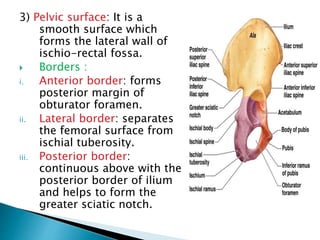
3) Pelvic surface: It is a
smooth surface which
forms the lateral wall of
ischio-rectal fossa.
 Borders :
i. Anterior border: forms
posterior margin of
obturator foramen.
ii. Lateral border: separates
the femoral surface from
ischial tuberosity.
iii. Posterior border:
continuous above with the
posterior border of ilium
and helps to form the
greater sciatic notch.
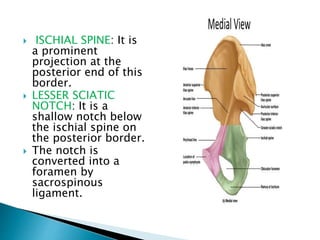
 ISCHIAL SPINE: It is
a prominent
projection at the
posterior end of this
border.
 LESSER SCIATIC
NOTCH: It is a
shallow notch below
the ischial spine on
the posterior border.
 The notch is
converted into a
foramen by
sacrospinous
ligament.
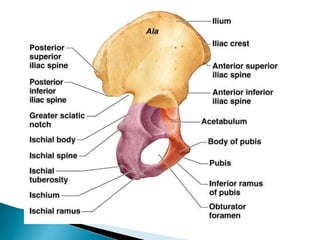
 It passes upwards, forwards and medially
from the body of ischium to join the inferior
ramus of pubis.
2 borders
 It possesses:
2 surfaces
2 borders Upper lower
2 surfaces Anterior posterior
1. Upper border: It helps to bound the
obturator foramen and gives attachment to
obturator membrane
2. Lower border: It forms the lateral boundary
of urogenital traingle.
 It is rough and gives attachment to fascia
lata and membranous layer of superficial
fascia of perineum.
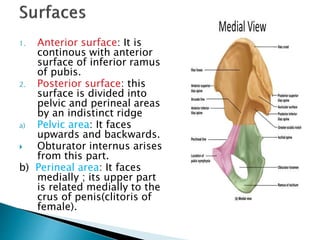
1. Anterior surface: It is
continous with anterior
surface of inferior ramus
of pubis.
2. Posterior surface: this
surface is divided into
pelvic and perineal areas
by an indistinct ridge
a) Pelvic area: It faces
upwards and backwards.
 Obturator internus arises
from this part.
b) Perineal area: It faces
medially ; its upper part
is related medially to the
crus of penis(clitoris of
female).
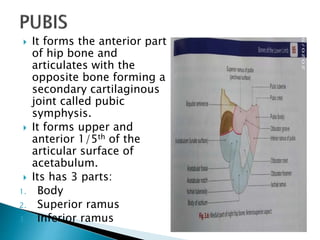
 It forms the anterior part
of hip bone and
articulates with the
opposite bone forming a
secondary cartilaginous
joint called pubic
symphysis.
 It forms upper and
anterior 1/5th of the
articular surface of
acetabulum.
 Its has 3 parts:
1. Body
2. Superior ramus
3. Inferior ramus
 It is flattened from before backwards and
connects the superior ramus with inferior
ramus.
 It possesses:
a) 3 surfaces
 Anterior
 Pelvic (posterior)
 symphysial
b) 1 border- pubic crest
 Anterior surface: It faces downwards and
forwards .
 Posterior surface: It forms the anterior
wall of true pelvis.
 Symphysial surface: It is rough , oval and
elongated surface which articulates with
symphysial surface of the opposite pubis.
It is covered by a layer of hyaline cartilage
.
 Pubic crest: It is the rounded free, upper
border of pubis.
 Pubic tubercle: It is a rounded tubercle at
the lateral end of the pubic crest. It is
crossed by spermatic cord in males and
round ligament of uterus in females
 It passes laterally and backwards from the
upper and lateral part of the body and lies
above the obturator foramen.
 It possesses:
3 BORDERS OBTURATOR
CREST
PECTINEAL
LINE
INFERIOR
3 SURFACES PECTINEAL PELVIC OBTURATOR
 Border:
1. Obturator crest: it is rounded margin which
begins from the anterior part of pubic tuberce
and passes laterally to the anterior part of
acetabular cavity.
 It separetes the pectineal from the obturator
surface.
2. Pectineal line: It is sharp border which begins
from the posterior part of pubic tubercle and
passes laterally and backwards to become
continuous with the arcuate line.
 It separates the pectineal line from the pelvic
surface.
3. Inferior border: it is sharp border and forms
upper boundary of obturator foramen.
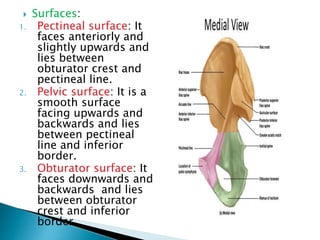
 Surfaces:
1. Pectineal surface: It
faces anteriorly and
slightly upwards and
lies between
obturator crest and
pectineal line.
2. Pelvic surface: It is a
smooth surface
facing upwards and
backwards and lies
between pectineal
line and inferior
border.
3. Obturator surface: It
faces downwards and
backwards and lies
between obturator
crest and inferior
border.
 It springs from the lower and lateral part of the
body and unites with the ramus of ischium on
the medial side of obturator foramen.
 It posses:
2 BORDER MEDIAL LATERAL
2 SURFACES ANTERIOR POSTERIOR
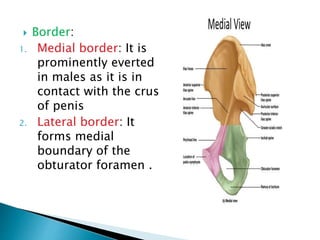
 Border:
1. Medial border: It is
prominently everted
in males as it is in
contact with the crus
of penis
2. Lateral border: It
forms medial
boundary of the
obturator foramen .
 Surfaces:
1. Anterior surface: It is
continuous with anterior surface
of body.
 It faces forwards and laterally
and lies between the two
borders.
2. Posterior surface: It is
continuous above with posterior
suface of the body and below
with posterior surface of the
ramus of ischium.
 This surfaces is divided arbitrarily into 3
area by 2 indistinct ridges-
a. Medial area: It is in contact with crus of
penis.
b. Intermediate area: It is related to dorsal
nerve of penis or clitoris and internal
pudendal vessels. It may be origin to
sphincter urethrae.
c. Lateral area: gives origin to obturator
internus
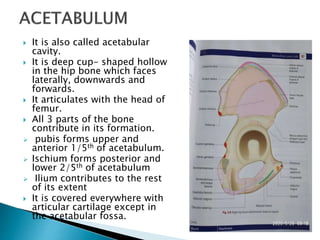
 It is also called acetabular
cavity.
 It is deep cup- shaped hollow
in the hip bone which faces
laterally, downwards and
forwards.
 It articulates with the head of
femur.
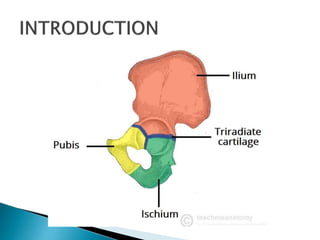
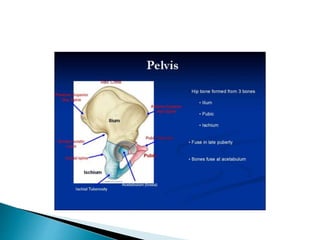
 All 3 parts of the bone
contribute in its formation.
 pubis forms upper and
anterior 1/5th of acetabulum.
 Ischium forms posterior and
lower 2/5th of acetabulum
 Ilium contributes to the rest
of its extent
 It is covered everywhere with
articular cartilage except in
the acetabular fossa.
1. Acetabular notch: It is a gap in the margin of
the cavity inferiorly.
 Two ends of the notch give attachment to
transverse acetabular ligament which bridges
the gap.
2. Acetabular fossa: It is rough, non-articular
floor of the cavity.
 It is covered by a pad of fat.
3. Lunate surface: It is a horse shoe-shaped
articular surface at the sides of the cavity.
 It articulates with the head of femur.
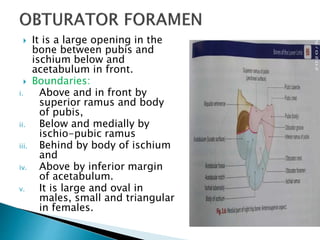
 It is a large opening in the
bone between pubis and
ischium below and
acetabulum in front.
 Boundaries:
i. Above and in front by
superior ramus and body
of pubis,
ii. Below and medially by
ischio-pubic ramus
iii. Behind by body of ischium
and
iv. Above by inferior margin
of acetabulum.
v. It is large and oval in
males, small and triangular
in females.
Ischium & pubic 2
Ischium & pubic 2
Ischium & pubic 2
Ischium & pubic 2
Ischium & pubic 2
Ischium & pubic 2
Ischium & pubic 2
Ischium & pubic 2
Ischium & pubic 2
Ischium & pubic 2
Ischium & pubic 2

Ischium & pubic 2

  • 1.
    S M BADARHAYAT TUTOR DEPARTMENT OF ANATOMY NMCH, JAMUHAR
  • 2.
     INTRODUCTION  FEATURES ACETABULUM  ATTACHMENTS  SEX DIFFERENCE  OSSIFICATION  APPLIED ANATOMY
  • 4.
     It formsthe lower and posterior part of hip bone and contributes to form a little more than lower and posterior 2/5th of the articular surface of acetabulum.
  • 5.
    BODY It has 2parts : RAMUS BODY POSSESSES 2 ENDS UPPER LOWER * 3 BORDERS ANTERIOR LATERAL POSTERIOR 3 SURFACES FEMORAL DORSAL PELVIC
  • 6.
     ENDS: i. UPPEREND: Its forms a part of acetabular cavity and is fused with ilium and pubis. ii. LOWER END: It gives off the ramus; forms part of the ischial tuberosity.  Surfaces: 1) Femoral surface: It faces downwards, forwards and laterally towards thigh and lies between the lateral and anterior border. 2) Dorsal surface: It faces upwards, backwards and laterally and lies between the lateral and posterior borders. It is continuation above with the gluteal surface of ilium.
  • 7.
     It iswide near its upper part and tapers downwards.  It is divided into an upper quadrilateral and a lower triangular area by a transverse ridge. a. Upper area: It is divided by an oblique ridge into i. Upper lateral part: ii. Upper medial part: b. Lower area: It is divided by an irregular vertical line into i. Smaller medial part: ii. Larger lateral part:
  • 8.
    3) Pelvic surface:It is a smooth surface which forms the lateral wall of ischio-rectal fossa.  Borders : i. Anterior border: forms posterior margin of obturator foramen. ii. Lateral border: separates the femoral surface from ischial tuberosity. iii. Posterior border: continuous above with the posterior border of ilium and helps to form the greater sciatic notch.
  • 9.
     ISCHIAL SPINE:It is a prominent projection at the posterior end of this border.  LESSER SCIATIC NOTCH: It is a shallow notch below the ischial spine on the posterior border.  The notch is converted into a foramen by sacrospinous ligament.
  • 10.
     It passesupwards, forwards and medially from the body of ischium to join the inferior ramus of pubis. 2 borders  It possesses: 2 surfaces 2 borders Upper lower 2 surfaces Anterior posterior
  • 11.
    1. Upper border:It helps to bound the obturator foramen and gives attachment to obturator membrane 2. Lower border: It forms the lateral boundary of urogenital traingle.  It is rough and gives attachment to fascia lata and membranous layer of superficial fascia of perineum.
  • 12.
    1. Anterior surface:It is continous with anterior surface of inferior ramus of pubis. 2. Posterior surface: this surface is divided into pelvic and perineal areas by an indistinct ridge a) Pelvic area: It faces upwards and backwards.  Obturator internus arises from this part. b) Perineal area: It faces medially ; its upper part is related medially to the crus of penis(clitoris of female).
  • 17.
     It formsthe anterior part of hip bone and articulates with the opposite bone forming a secondary cartilaginous joint called pubic symphysis.  It forms upper and anterior 1/5th of the articular surface of acetabulum.  Its has 3 parts: 1. Body 2. Superior ramus 3. Inferior ramus
  • 18.
     It isflattened from before backwards and connects the superior ramus with inferior ramus.  It possesses: a) 3 surfaces  Anterior  Pelvic (posterior)  symphysial b) 1 border- pubic crest
  • 19.
     Anterior surface:It faces downwards and forwards .  Posterior surface: It forms the anterior wall of true pelvis.  Symphysial surface: It is rough , oval and elongated surface which articulates with symphysial surface of the opposite pubis. It is covered by a layer of hyaline cartilage .  Pubic crest: It is the rounded free, upper border of pubis.  Pubic tubercle: It is a rounded tubercle at the lateral end of the pubic crest. It is crossed by spermatic cord in males and round ligament of uterus in females
  • 20.
     It passeslaterally and backwards from the upper and lateral part of the body and lies above the obturator foramen.  It possesses: 3 BORDERS OBTURATOR CREST PECTINEAL LINE INFERIOR 3 SURFACES PECTINEAL PELVIC OBTURATOR
  • 21.
     Border: 1. Obturatorcrest: it is rounded margin which begins from the anterior part of pubic tuberce and passes laterally to the anterior part of acetabular cavity.  It separetes the pectineal from the obturator surface. 2. Pectineal line: It is sharp border which begins from the posterior part of pubic tubercle and passes laterally and backwards to become continuous with the arcuate line.  It separates the pectineal line from the pelvic surface. 3. Inferior border: it is sharp border and forms upper boundary of obturator foramen.
  • 22.
     Surfaces: 1. Pectinealsurface: It faces anteriorly and slightly upwards and lies between obturator crest and pectineal line. 2. Pelvic surface: It is a smooth surface facing upwards and backwards and lies between pectineal line and inferior border. 3. Obturator surface: It faces downwards and backwards and lies between obturator crest and inferior border.
  • 23.
     It springsfrom the lower and lateral part of the body and unites with the ramus of ischium on the medial side of obturator foramen.  It posses: 2 BORDER MEDIAL LATERAL 2 SURFACES ANTERIOR POSTERIOR
  • 24.
     Border: 1. Medialborder: It is prominently everted in males as it is in contact with the crus of penis 2. Lateral border: It forms medial boundary of the obturator foramen .
  • 26.
     Surfaces: 1. Anteriorsurface: It is continuous with anterior surface of body.  It faces forwards and laterally and lies between the two borders. 2. Posterior surface: It is continuous above with posterior suface of the body and below with posterior surface of the ramus of ischium.
  • 27.
     This surfacesis divided arbitrarily into 3 area by 2 indistinct ridges- a. Medial area: It is in contact with crus of penis. b. Intermediate area: It is related to dorsal nerve of penis or clitoris and internal pudendal vessels. It may be origin to sphincter urethrae. c. Lateral area: gives origin to obturator internus
  • 28.
     It isalso called acetabular cavity.  It is deep cup- shaped hollow in the hip bone which faces laterally, downwards and forwards.  It articulates with the head of femur.  All 3 parts of the bone contribute in its formation.  pubis forms upper and anterior 1/5th of acetabulum.  Ischium forms posterior and lower 2/5th of acetabulum  Ilium contributes to the rest of its extent  It is covered everywhere with articular cartilage except in the acetabular fossa.
  • 29.
    1. Acetabular notch:It is a gap in the margin of the cavity inferiorly.  Two ends of the notch give attachment to transverse acetabular ligament which bridges the gap. 2. Acetabular fossa: It is rough, non-articular floor of the cavity.  It is covered by a pad of fat. 3. Lunate surface: It is a horse shoe-shaped articular surface at the sides of the cavity.  It articulates with the head of femur.
  • 30.
     It isa large opening in the bone between pubis and ischium below and acetabulum in front.  Boundaries: i. Above and in front by superior ramus and body of pubis, ii. Below and medially by ischio-pubic ramus iii. Behind by body of ischium and iv. Above by inferior margin of acetabulum. v. It is large and oval in males, small and triangular in females.