Professional & effective
communication
(aidet & Isbar)
Objectives
By the end of the training session you will be able to:
Understand interpersonal communication skills in workplace
Define AIDET.
Use AIDET framework with patients, families, visitors and staff visiting the department at all times.
Define ISBAR.
Explain ISBAR steps.
Explore why, when and how to use ISBAR.
Introduction
Interpersonal skills at work directly impact the whole organization.
A strong approach to improve communication between people and
break such barriers will go a long way in assuring the efficiency of the
workplace.
Cooperation with others and supporting them is very important.
It improves communication and leads to a better understand of the
situation and the emotional disposition of people.
Interpersonal communication skills
• Verbal communication
• Non-verbal communication
• Listening skills
• Negotiation
• Problem-solving
• Decision-making
• Assertiveness
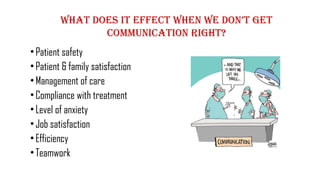
What does it effect when we don’t get
communication right?
•Patient safety
•Patient & family satisfaction
•Management of care
•Compliance with treatment
•Level of anxiety
•Job satisfaction
•Efficiency
•Teamwork
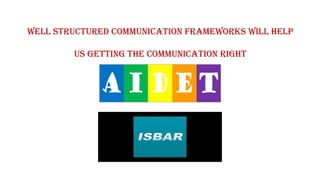
Well structured communication frameworks will help
us getting the communication right
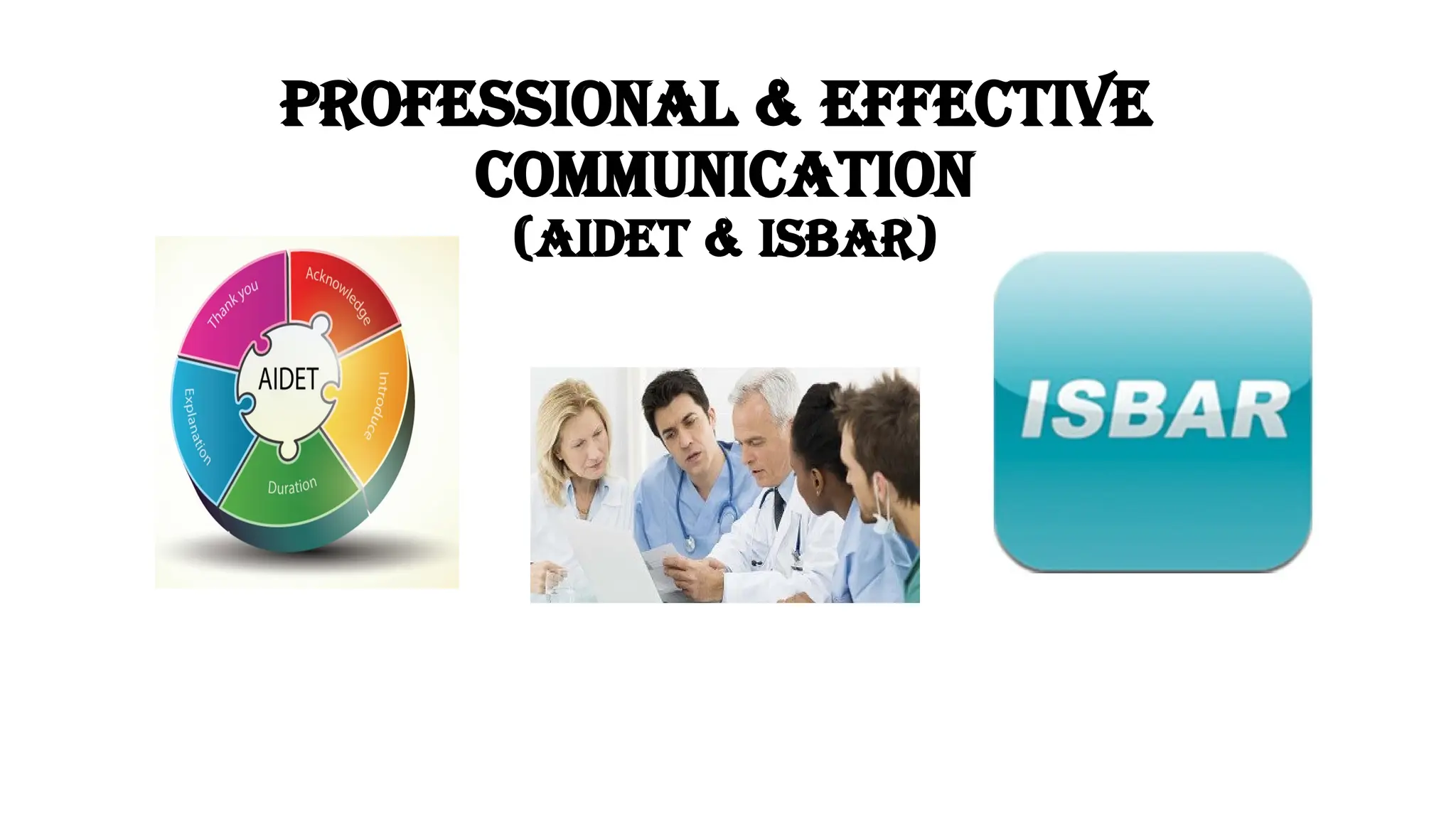
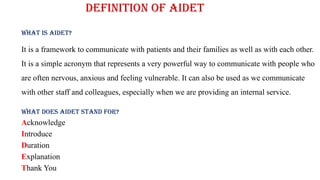
Definition of AIDET
What is AIDET?
It is a framework to communicate with patients and their families as well as with each other.
It is a simple acronym that represents a very powerful way to communicate with people who
are often nervous, anxious and feeling vulnerable. It can also be used as we communicate
with other staff and colleagues, especially when we are providing an internal service.
What does AIDET stand for?
Acknowledge
Introduce
Duration
Explanation
Thank You
How to use AIDET framework
Acknowledge
Greet people with a smile and use their names if you know them.
Attitude is everything so create a lasting impression.
E.g. OPD nurse to a patient: "Good morning Ms. Lina. We've been expecting you and we're glad you are here.
Introduce
Introduce yourself to others politely. Tell them who you are and how you are going to help them.
Escort people where they need to go rather than pointing or giving directions.
E.g. MSW nurse to a patient: "My name is Ali, I am a registered nurse and I am assigned to take care of you
today. If you need my help at any time, please let me know. "
How to use AIDET framework
Duration
Keep in touch to ease waiting times. Let others know if there is a delay and how long it will be.
E.g. OBGYN nurse to a patient: "Dr. Amina had to attend an emergency. She was concerned about you and
wanted you to know that it may be 30 minutes before she can finish your discharge summery. Am sorry for
the inconvenience and I will keep you updated.”
Explanation
Advise others what you are doing, how procedures work and whom to contact if they need assistance.
Communicate any steps they may need to take. Make words work. Talk, listen and learn. Make time to help.
E.g. phlebotomist to a patient: "The test takes about 30 minutes. The first step is drink this solution and then
we will have you wait 20 minutes before we take a blood sample. Would you like to read while waiting?"
How to use AIDET framework
Thank you
Thank people. Foster an attitude of gratitude.
E.g. Pediatric: "Thank you for choosing SKGH. It has been a privilege to care for your
child."
Enjoy watching the following
https://www.youtube.com/watch?v=EP_hYBro_Qw
WE ARE MOVING TO THE NEXT TOPIC
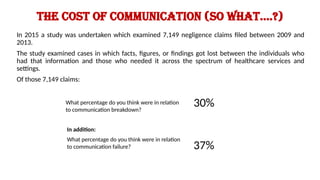
The cost of communication (So what….?)
In 2015 a study was undertaken which examined 7,149 negligence claims filed between 2009 and
2013.
The study examined cases in which facts, figures, or findings got lost between the individuals who
had that information and those who needed it across the spectrum of healthcare services and
settings.
Of those 7,149 claims:
30%
What percentage do you think were in relation
to communication breakdown?
What percentage do you think were in relation
to communication failure?
In addition:
37%
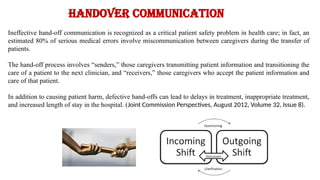
Ineffective hand-off communication is recognized as a critical patient safety problem in health care; in fact, an
estimated 80% of serious medical errors involve miscommunication between caregivers during the transfer of
patients.
The hand-off process involves “senders,” those caregivers transmitting patient information and transitioning the
care of a patient to the next clinician, and “receivers,” those caregivers who accept the patient information and
care of that patient.
In addition to causing patient harm, defective hand-offs can lead to delays in treatment, inappropriate treatment,
and increased length of stay in the hospital. (Joint Commission Perspectives, August 2012, Volume 32, Issue 8).
Handover Communication
Definition of ISBAR?
It is a structured framework for communicating critical information that
requires immediate attention and action. It improves communication, effective
escalation and increased patient safety. ISBAR is a standard mnemonic to
improve clinical communication.
ISBAR use is well established and structured in different settings such as
military and not only limited to health care organizations only.
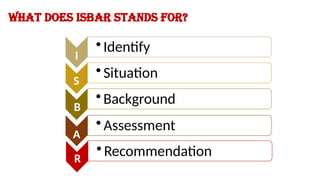
What does ISBAR stands for?
•Identify
•Situation
•Background
A
B
S
I
R
•Recommendation
•Assessment
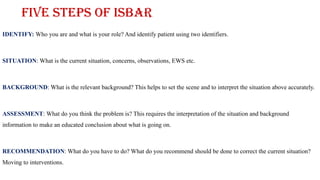
Five Steps of ISBAR
IDENTIFY: Who you are and what is your role? And identify patient using two identifiers.
SITUATION: What is the current situation, concerns, observations, EWS etc.
BACKGROUND: What is the relevant background? This helps to set the scene and to interpret the situation above accurately.
ASSESSMENT: What do you think the problem is? This requires the interpretation of the situation and background
information to make an educated conclusion about what is going on.
RECOMMENDATION: What do you have to do? What do you recommend should be done to correct the current situation?
Moving to interventions.
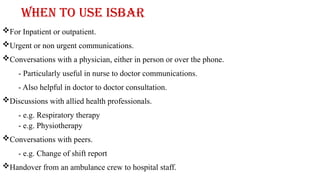
When to use ISBAR
For Inpatient or outpatient.
Urgent or non urgent communications.
Conversations with a physician, either in person or over the phone.
- Particularly useful in nurse to doctor communications.
- Also helpful in doctor to doctor consultation.
Discussions with allied health professionals.
- e.g. Respiratory therapy
- e.g. Physiotherapy
Conversations with peers.
- e.g. Change of shift report
Handover from an ambulance crew to hospital staff.
Escalating a concern – RED FLAG
- Sudden or gradual change in the patient’s condition
- Change in the plan of care made at shift change
- Physician change/handover of care
When to use ISBAR
Why to use ISBAR?
To reduce the barrier to effective communication across different disciplines and levels of staff.
SBAR creates a shared mental model around all patient care handover and situations requiring
escalation, or critical exchange of information (handovers).
SBAR is a memory prompt; easy to remember and encourages prior preparation for communication.
SBAR reduces the incidence of missed communications.
How does it help?
Easy to remember
Clarifies what information needs communicating quickly
Points to action
IT PREVENTS
“HINTING & HOPING”
How to use the framework ISBAR
Before making the call:
1. Assess the patient/situation (physiological parameters)
2. Read the most recent notes/information/results
3. Have the information in front of you
How to use SBAR?
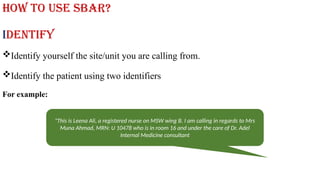
Identify
Identify yourself the site/unit you are calling from.
Identify the patient using two identifiers
For example:
"This is Leena Ali, a registered nurse on MSW wing B. I am calling in regards to Mrs
Muna Ahmad, MRN: U 10478 who is in room 16 and under the care of Dr. Adel
Internal Medicine consultant
How to use SBAR?
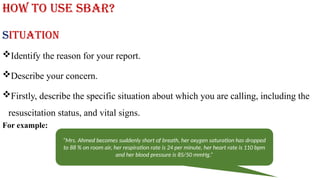
Situation
Identify the reason for your report.
Describe your concern.
Firstly, describe the specific situation about which you are calling, including the
resuscitation status, and vital signs.
For example:
“Mrs. Ahmed becomes suddenly short of breath, her oxygen saturation has dropped
to 88 % on room air, her respiration rate is 24 per minute, her heart rate is 110 bpm
and her blood pressure is 85/50 mmHg.”
Background
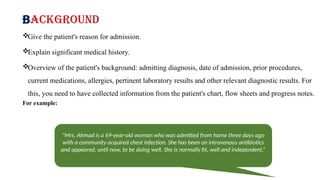
Give the patient's reason for admission.
Explain significant medical history.
Overview of the patient's background: admitting diagnosis, date of admission, prior procedures,
current medications, allergies, pertinent laboratory results and other relevant diagnostic results. For
this, you need to have collected information from the patient's chart, flow sheets and progress notes.
For example:
"Mrs. Ahmad is a 69-year-old woman who was admitted from home three days ago
with a community acquired chest infection. She has been on intravenous antibiotics
and appeared, until now, to be doing well. She is normally fit, well and independent.”
Assessment
Vital signs and EWS
Clinical impressions, concerns
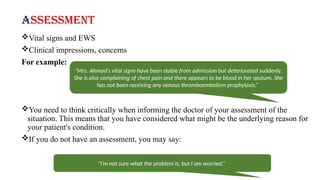
For example:
You need to think critically when informing the doctor of your assessment of the
situation. This means that you have considered what might be the underlying reason for
your patient's condition.
If you do not have an assessment, you may say:
"Mrs. Ahmad’s vital signs have been stable from admission but deteriorated suddenly.
She is also complaining of chest pain and there appears to be blood in her sputum. She
has not been receiving any venous thromboembolism prophylaxis.”
“I’m not sure what the problem is, but I am worried.”
Recommendation
Explain what you need - be specific about request and time frame.
Make suggestions.
Clarify expectations.
Finally, what is your recommendation? That is, what would you like to happen by the end
of the conversation with the physician? Remember telephone orders can only be taken if
the doctor cannot attend immediately and assess the patient.
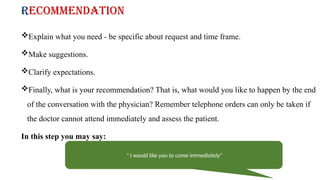
In this step you may say:
" I would like you to come immediately”
Enjoy watching the following
https://www.youtube.com/watch?v=haurNwYB8Ak
Think Talk Write
ISBAR
Remember …
• Focusing on the problem and avoiding the issue of who’s ‘‘right ‘‘and who’s ‘‘wrong’’ is
quite important and a major success factor.
• We often ask or require nurses to provide an objective argument to convince a physician
to see a patient.
• Nurses have license to say: ‘‘I need you to come now and see this patient’’
• “Something’s wrong, I’m not sure what it is, but I need you here now’’
• “I am worried, concerned, scared”
• Coupling this with SBAR helps ensure that communication becomes progressively clearer
Key messages
• Effective teamwork and communication can help prevent these
inevitable mistakes from becoming consequential, and harming
patients and providers.
• Embedding standardized tools and behaviours such as ISBAR
along with appropriate assertion, and critical language can
greatly enhance safety.
•Communication failures account for the overwhelming
majority of unanticipated adverse events in patients.
•Medical care is extremely complex, and this complexity
coupled with inherent human performance limitations,
even in skilled, experienced, highly motivated
individuals, can lead to mistakes.
References
Amato-Vealey, E.J., Barba, M.P., & Vealey, R.J.(2008). Hand-off communication: A requisite for perioperative patient safety.
AORN Journal, 88(5), 763-774.
Beckett, C.D. & Kipnis, G. (2009). Collaborative communication: integrating SBAR to improve quality/patient safety
outcomes. Journal for Healthcare Quality, 31(5).
Clark, E., Squire, S., Heyme, A.,Mickle, M.E., & Petrie, E.(2009). The PACT project : Improving communication at
handover. MJA, 190(11), S125-S127.
Denham, C.R. (2008). SBAR for patients. Journal of Patient safety, 4(1).
Field, T. S. et al.,(2011). Randomized trial of a warfarin communication protocol for nursing homes: An SBAR-based
approach. AJM, 124(2), 179.e1~e7.
JCAHO(2005). The SBAR technique : Improves communication, enhances patient safety. Joint Commission Perspectives on
Patient Safety, 5(2), 1-2,8.
Leonard,M.,Graham,S.,&Bonacum,D.(2004).Thehuman factor: The critical importance of effective teamwork and
communication in providing safe care. Quality and Safety in Health Care, 13(Suppl 1), i85–90. Retrieved September 11,
2006, from www.inti-qhc.bmijournals.com
Mikos, K.(2007). Monitoring handoffs for standardization. Nursing Management, 38(12),16-20.
Powell, S.K.(2007). SBAR-It’s not just another communication tool. Professional Case Management. 12(4), 195-196.
Pothier, D., Monteiro, P., Mooktiar, M., & Shaw, A.(2005), Pilot study to show the loss of important data in nursing handover,
British Journal of Nursing, 14(20), 1090-1093.
Studer, Q., (2003). Hardwiring for Excellence. Fire Starter Publishing.
We hope that you found this enjoyable &
informative

Nursing Preceptor Program - Professional and effective communication

  • 1.
  • 2.
    Objectives By the endof the training session you will be able to: Understand interpersonal communication skills in workplace Define AIDET. Use AIDET framework with patients, families, visitors and staff visiting the department at all times. Define ISBAR. Explain ISBAR steps. Explore why, when and how to use ISBAR.
  • 3.
  • 4.
    Interpersonal skills atwork directly impact the whole organization. A strong approach to improve communication between people and break such barriers will go a long way in assuring the efficiency of the workplace. Cooperation with others and supporting them is very important. It improves communication and leads to a better understand of the situation and the emotional disposition of people. Interpersonal communication skills
  • 5.
    Interpersonal communication skills •Verbal communication • Non-verbal communication • Listening skills • Negotiation • Problem-solving • Decision-making • Assertiveness
  • 6.
    What does iteffect when we don’t get communication right? •Patient safety •Patient & family satisfaction •Management of care •Compliance with treatment •Level of anxiety •Job satisfaction •Efficiency •Teamwork
  • 7.
    Well structured communicationframeworks will help us getting the communication right
  • 8.
    Definition of AIDET Whatis AIDET? It is a framework to communicate with patients and their families as well as with each other. It is a simple acronym that represents a very powerful way to communicate with people who are often nervous, anxious and feeling vulnerable. It can also be used as we communicate with other staff and colleagues, especially when we are providing an internal service. What does AIDET stand for? Acknowledge Introduce Duration Explanation Thank You
  • 9.
    How to useAIDET framework Acknowledge Greet people with a smile and use their names if you know them. Attitude is everything so create a lasting impression. E.g. OPD nurse to a patient: "Good morning Ms. Lina. We've been expecting you and we're glad you are here. Introduce Introduce yourself to others politely. Tell them who you are and how you are going to help them. Escort people where they need to go rather than pointing or giving directions. E.g. MSW nurse to a patient: "My name is Ali, I am a registered nurse and I am assigned to take care of you today. If you need my help at any time, please let me know. "
  • 10.
    How to useAIDET framework Duration Keep in touch to ease waiting times. Let others know if there is a delay and how long it will be. E.g. OBGYN nurse to a patient: "Dr. Amina had to attend an emergency. She was concerned about you and wanted you to know that it may be 30 minutes before she can finish your discharge summery. Am sorry for the inconvenience and I will keep you updated.” Explanation Advise others what you are doing, how procedures work and whom to contact if they need assistance. Communicate any steps they may need to take. Make words work. Talk, listen and learn. Make time to help. E.g. phlebotomist to a patient: "The test takes about 30 minutes. The first step is drink this solution and then we will have you wait 20 minutes before we take a blood sample. Would you like to read while waiting?"
  • 11.
    How to useAIDET framework Thank you Thank people. Foster an attitude of gratitude. E.g. Pediatric: "Thank you for choosing SKGH. It has been a privilege to care for your child."
  • 12.
    Enjoy watching thefollowing https://www.youtube.com/watch?v=EP_hYBro_Qw
  • 13.
    WE ARE MOVINGTO THE NEXT TOPIC
  • 14.
    The cost ofcommunication (So what….?) In 2015 a study was undertaken which examined 7,149 negligence claims filed between 2009 and 2013. The study examined cases in which facts, figures, or findings got lost between the individuals who had that information and those who needed it across the spectrum of healthcare services and settings. Of those 7,149 claims: 30% What percentage do you think were in relation to communication breakdown? What percentage do you think were in relation to communication failure? In addition: 37%
  • 15.
    Ineffective hand-off communicationis recognized as a critical patient safety problem in health care; in fact, an estimated 80% of serious medical errors involve miscommunication between caregivers during the transfer of patients. The hand-off process involves “senders,” those caregivers transmitting patient information and transitioning the care of a patient to the next clinician, and “receivers,” those caregivers who accept the patient information and care of that patient. In addition to causing patient harm, defective hand-offs can lead to delays in treatment, inappropriate treatment, and increased length of stay in the hospital. (Joint Commission Perspectives, August 2012, Volume 32, Issue 8). Handover Communication
  • 16.
    Definition of ISBAR? Itis a structured framework for communicating critical information that requires immediate attention and action. It improves communication, effective escalation and increased patient safety. ISBAR is a standard mnemonic to improve clinical communication. ISBAR use is well established and structured in different settings such as military and not only limited to health care organizations only.
  • 17.
    What does ISBARstands for? •Identify •Situation •Background A B S I R •Recommendation •Assessment
  • 18.
    Five Steps ofISBAR IDENTIFY: Who you are and what is your role? And identify patient using two identifiers. SITUATION: What is the current situation, concerns, observations, EWS etc. BACKGROUND: What is the relevant background? This helps to set the scene and to interpret the situation above accurately. ASSESSMENT: What do you think the problem is? This requires the interpretation of the situation and background information to make an educated conclusion about what is going on. RECOMMENDATION: What do you have to do? What do you recommend should be done to correct the current situation? Moving to interventions.
  • 19.
    When to useISBAR For Inpatient or outpatient. Urgent or non urgent communications. Conversations with a physician, either in person or over the phone. - Particularly useful in nurse to doctor communications. - Also helpful in doctor to doctor consultation. Discussions with allied health professionals. - e.g. Respiratory therapy - e.g. Physiotherapy Conversations with peers. - e.g. Change of shift report Handover from an ambulance crew to hospital staff.
  • 20.
    Escalating a concern– RED FLAG - Sudden or gradual change in the patient’s condition - Change in the plan of care made at shift change - Physician change/handover of care When to use ISBAR
  • 21.
    Why to useISBAR? To reduce the barrier to effective communication across different disciplines and levels of staff. SBAR creates a shared mental model around all patient care handover and situations requiring escalation, or critical exchange of information (handovers). SBAR is a memory prompt; easy to remember and encourages prior preparation for communication. SBAR reduces the incidence of missed communications.
  • 22.
    How does ithelp? Easy to remember Clarifies what information needs communicating quickly Points to action IT PREVENTS “HINTING & HOPING”
  • 23.
    How to usethe framework ISBAR Before making the call: 1. Assess the patient/situation (physiological parameters) 2. Read the most recent notes/information/results 3. Have the information in front of you
  • 24.
    How to useSBAR? Identify Identify yourself the site/unit you are calling from. Identify the patient using two identifiers For example: "This is Leena Ali, a registered nurse on MSW wing B. I am calling in regards to Mrs Muna Ahmad, MRN: U 10478 who is in room 16 and under the care of Dr. Adel Internal Medicine consultant
  • 25.
    How to useSBAR? Situation Identify the reason for your report. Describe your concern. Firstly, describe the specific situation about which you are calling, including the resuscitation status, and vital signs. For example: “Mrs. Ahmed becomes suddenly short of breath, her oxygen saturation has dropped to 88 % on room air, her respiration rate is 24 per minute, her heart rate is 110 bpm and her blood pressure is 85/50 mmHg.”
  • 26.
    Background Give the patient'sreason for admission. Explain significant medical history. Overview of the patient's background: admitting diagnosis, date of admission, prior procedures, current medications, allergies, pertinent laboratory results and other relevant diagnostic results. For this, you need to have collected information from the patient's chart, flow sheets and progress notes. For example: "Mrs. Ahmad is a 69-year-old woman who was admitted from home three days ago with a community acquired chest infection. She has been on intravenous antibiotics and appeared, until now, to be doing well. She is normally fit, well and independent.”
  • 27.
    Assessment Vital signs andEWS Clinical impressions, concerns For example: You need to think critically when informing the doctor of your assessment of the situation. This means that you have considered what might be the underlying reason for your patient's condition. If you do not have an assessment, you may say: "Mrs. Ahmad’s vital signs have been stable from admission but deteriorated suddenly. She is also complaining of chest pain and there appears to be blood in her sputum. She has not been receiving any venous thromboembolism prophylaxis.” “I’m not sure what the problem is, but I am worried.”
  • 28.
    Recommendation Explain what youneed - be specific about request and time frame. Make suggestions. Clarify expectations. Finally, what is your recommendation? That is, what would you like to happen by the end of the conversation with the physician? Remember telephone orders can only be taken if the doctor cannot attend immediately and assess the patient. In this step you may say: " I would like you to come immediately”
  • 29.
    Enjoy watching thefollowing https://www.youtube.com/watch?v=haurNwYB8Ak Think Talk Write ISBAR
  • 30.
    Remember … • Focusingon the problem and avoiding the issue of who’s ‘‘right ‘‘and who’s ‘‘wrong’’ is quite important and a major success factor. • We often ask or require nurses to provide an objective argument to convince a physician to see a patient. • Nurses have license to say: ‘‘I need you to come now and see this patient’’ • “Something’s wrong, I’m not sure what it is, but I need you here now’’ • “I am worried, concerned, scared” • Coupling this with SBAR helps ensure that communication becomes progressively clearer
  • 31.
    Key messages • Effectiveteamwork and communication can help prevent these inevitable mistakes from becoming consequential, and harming patients and providers. • Embedding standardized tools and behaviours such as ISBAR along with appropriate assertion, and critical language can greatly enhance safety. •Communication failures account for the overwhelming majority of unanticipated adverse events in patients. •Medical care is extremely complex, and this complexity coupled with inherent human performance limitations, even in skilled, experienced, highly motivated individuals, can lead to mistakes.
  • 32.
    References Amato-Vealey, E.J., Barba,M.P., & Vealey, R.J.(2008). Hand-off communication: A requisite for perioperative patient safety. AORN Journal, 88(5), 763-774. Beckett, C.D. & Kipnis, G. (2009). Collaborative communication: integrating SBAR to improve quality/patient safety outcomes. Journal for Healthcare Quality, 31(5). Clark, E., Squire, S., Heyme, A.,Mickle, M.E., & Petrie, E.(2009). The PACT project : Improving communication at handover. MJA, 190(11), S125-S127. Denham, C.R. (2008). SBAR for patients. Journal of Patient safety, 4(1). Field, T. S. et al.,(2011). Randomized trial of a warfarin communication protocol for nursing homes: An SBAR-based approach. AJM, 124(2), 179.e1~e7. JCAHO(2005). The SBAR technique : Improves communication, enhances patient safety. Joint Commission Perspectives on Patient Safety, 5(2), 1-2,8. Leonard,M.,Graham,S.,&Bonacum,D.(2004).Thehuman factor: The critical importance of effective teamwork and communication in providing safe care. Quality and Safety in Health Care, 13(Suppl 1), i85–90. Retrieved September 11, 2006, from www.inti-qhc.bmijournals.com Mikos, K.(2007). Monitoring handoffs for standardization. Nursing Management, 38(12),16-20. Powell, S.K.(2007). SBAR-It’s not just another communication tool. Professional Case Management. 12(4), 195-196. Pothier, D., Monteiro, P., Mooktiar, M., & Shaw, A.(2005), Pilot study to show the loss of important data in nursing handover, British Journal of Nursing, 14(20), 1090-1093. Studer, Q., (2003). Hardwiring for Excellence. Fire Starter Publishing.
  • 33.
    We hope thatyou found this enjoyable & informative

Editor's Notes

  • #14 The report highlights the details of miscommunications and identifies specific opportunities to improve skills and systems to bridge the knowledge gaps that exist and keep everyone involved in a patient’s care fully informed in a timely manner.
  • #17 What is SBAR? SBAR stands for S is situation = what is going on with the patient ex- Dr Lee, I’m calling about Mr. Mohammed, who’s having trouble breathing.’’ B is Background = what is the clinical background of context. ex – ‘‘He’s a 54 year old man with chronic lung disease, and now he’s acutely worse.’’ A is assessment = what do I think the problem is? Ex-‘‘I don’t hear any breath sounds in his right chest. I think he has a pneumothorax.’’ R is recommendation = what would I do to correct it? Ex – ‘‘I need you to see him right now. I think he needs a chest tube.’’