ISLAMIC BUSINESS TRANSACTION


                                  
                              CHAPTER THREE

                                  RIBA


           MAHYUDDIN KHALID             emkay@salam.uitm.edu.my
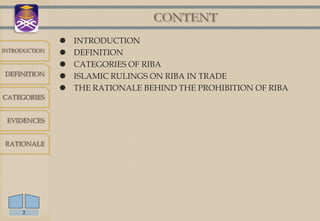
CONTENT
                  INTRODUCTION
INTRODUCTION
                  DEFINITION
                  CATEGORIES OF RIBA
DEFINITION        ISLAMIC RULINGS ON RIBA IN TRADE
                  THE RATIONALE BEHIND THE PROHIBITION OF RIBA
CATEGORIES


 EVIDENCES


RATIONALE


     2
INTRODUCTION
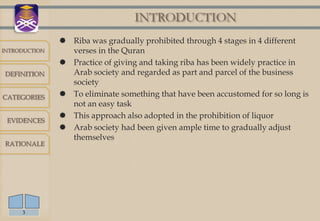
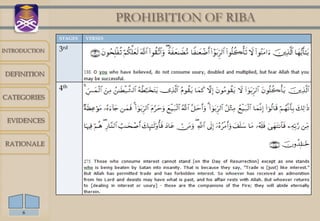
                Riba was gradually prohibited through 4 stages in 4 different
INTRODUCTION     verses in the Quran
                Practice of giving and taking riba has been widely practice in
DEFINITION       Arab society and regarded as part and parcel of the business
                 society
CATEGORIES      To eliminate something that have been accustomed for so long is
                 not an easy task
                This approach also adopted in the prohibition of liquor
 EVIDENCES
                Arab society had been given ample time to gradually adjust
                 themselves
RATIONALE


     3
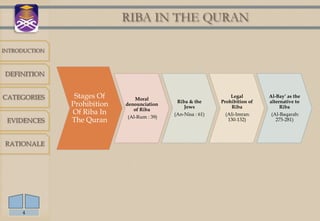
RIBA IN THE QURAN

INTRODUCTION


DEFINITION


CATEGORIES      Stages Of        Moral
                                                                   Legal        Al-Bay’ as the
                                               Riba & the      Prohibition of   alternative to
               Prohibition   denounciation
                                                  Jews              Riba             Riba
                                of Riba
               Of Riba In                     (An-Nisa : 61)     (Ali-Imran:     (Al-Baqarah:
                              (Al-Rum : 39)
 EVIDENCES     The Quran                                          130-132)         275-281)


RATIONALE


     4
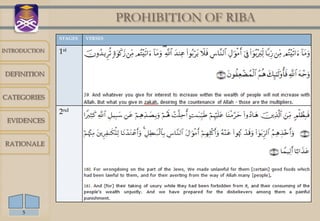
PROHIBITION OF RIBA
               STAGES   VERSES

INTRODUCTION   1st


DEFINITION


CATEGORIES

               2nd
 EVIDENCES


RATIONALE


     5
PROHIBITION OF RIBA
               STAGES   VERSES

INTRODUCTION   3rd


DEFINITION

               4th
CATEGORIES


 EVIDENCES


RATIONALE


     6
DEFINITION
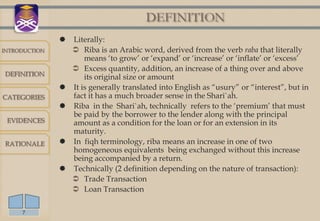
                  Literally:
INTRODUCTION        Riba is an Arabic word, derived from the verb raba that literally
                       means „to grow‟ or „expand‟ or „increase‟ or „inflate‟ or „excess‟
                    Excess quantity, addition, an increase of a thing over and above
DEFINITION
                       its original size or amount
                  It is generally translated into English as “usury” or “interest”, but in
CATEGORIES         fact it has a much broader sense in the Shari`ah.
                  Riba in the Shari`ah, technically refers to the „premium‟ that must
                   be paid by the borrower to the lender along with the principal
 EVIDENCES         amount as a condition for the loan or for an extension in its
                   maturity.
RATIONALE         In fiqh terminology, riba means an increase in one of two
                   homogeneous equivalents being exchanged without this increase
                   being accompanied by a return.
                  Technically (2 definition depending on the nature of transaction):
                    Trade Transaction
                    Loan Transaction

     7
DEFINITION
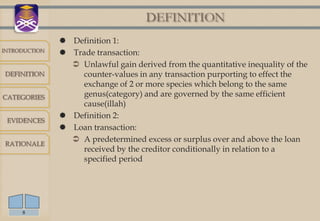
                Definition 1:
INTRODUCTION
                Trade transaction:
                  Unlawful gain derived from the quantitative inequality of the
DEFINITION         counter-values in any transaction purporting to effect the
                   exchange of 2 or more species which belong to the same
CATEGORIES         genus(category) and are governed by the same efficient
                   cause(illah)
                Definition 2:
 EVIDENCES
                Loan transaction:
RATIONALE
                  A predetermined excess or surplus over and above the loan
                   received by the creditor conditionally in relation to a
                   specified period


     8
CATEGORIES OF RIBA
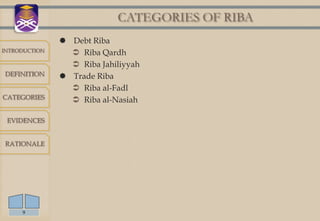
                Debt Riba
INTRODUCTION
                  Riba Qardh
                  Riba Jahiliyyah
DEFINITION      Trade Riba
                  Riba al-Fadl
CATEGORIES        Riba al-Nasiah

 EVIDENCES


RATIONALE


     9
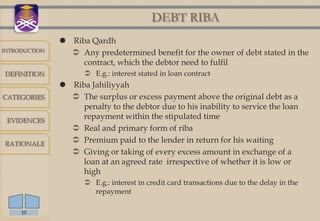
DEBT RIBA
                Riba Qardh
INTRODUCTION
                  Any predetermined benefit for the owner of debt stated in the
                    contract, which the debtor need to fulfil
DEFINITION             E.g.: interest stated in loan contract
                Riba Jahiliyyah
CATEGORIES        The surplus or excess payment above the original debt as a
                    penalty to the debtor due to his inability to service the loan
 EVIDENCES
                    repayment within the stipulated time
                  Real and primary form of riba
RATIONALE         Premium paid to the lender in return for his waiting
                  Giving or taking of every excess amount in exchange of a
                    loan at an agreed rate irrespective of whether it is low or
                    high
                       E.g.: interest in credit card transactions due to the delay in the
                        repayment

     10
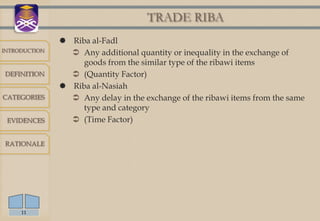
TRADE RIBA
                Riba al-Fadl
INTRODUCTION
                  Any additional quantity or inequality in the exchange of
                    goods from the similar type of the ribawi items
DEFINITION        (Quantity Factor)
                Riba al-Nasiah
CATEGORIES        Any delay in the exchange of the ribawi items from the same
                    type and category
 EVIDENCES        (Time Factor)

RATIONALE


     11
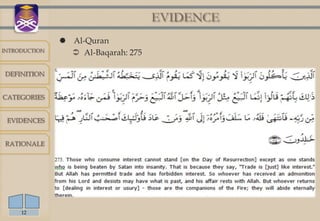
EVIDENCE
                Al-Quran
INTRODUCTION
                  Al-Baqarah: 275

DEFINITION


CATEGORIES


 EVIDENCES


RATIONALE


     12
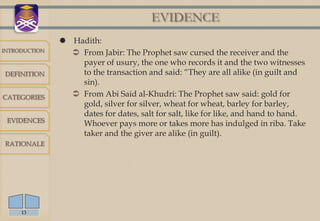
EVIDENCE
                Hadith:
INTRODUCTION
                  From Jabir: The Prophet saw cursed the receiver and the
                   payer of usury, the one who records it and the two witnesses
DEFINITION         to the transaction and said: “They are all alike (in guilt and
                   sin).
CATEGORIES        From Abi Said al-Khudri: The Prophet saw said: gold for
                   gold, silver for silver, wheat for wheat, barley for barley,
                   dates for dates, salt for salt, like for like, and hand to hand.
 EVIDENCES
                   Whoever pays more or takes more has indulged in riba. Take
                   taker and the giver are alike (in guilt).
RATIONALE


     13
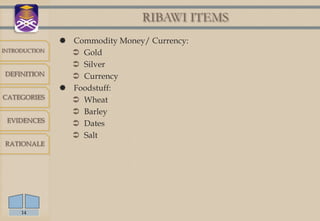
RIBAWI ITEMS
                Commodity Money/ Currency:
INTRODUCTION
                  Gold
                  Silver
DEFINITION        Currency
                Foodstuff:
CATEGORIES        Wheat
                  Barley
 EVIDENCES
                  Dates
                  Salt
RATIONALE


     14
RIBAWI ITEM

INTRODUCTION


DEFINITION


CATEGORIES


 EVIDENCES


RATIONALE


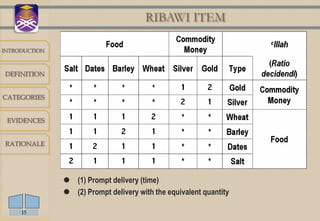
                (1) Prompt delivery (time)
                (2) Prompt delivery with the equivalent quantity

     15
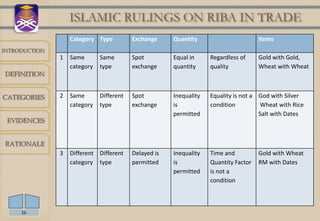
ISLAMIC RULINGS ON RIBA IN TRADE
                   Category Type          Exchange     Quantity                       Items
INTRODUCTION
               1   Same       Same        Spot         Equal in     Regardless of     Gold with Gold,
                   category   type        exchange     quantity     quality           Wheat with Wheat
DEFINITION


CATEGORIES     2   Same       Different   Spot         Inequality   Equality is not a God with Silver
                   category   type        exchange     is           condition         Wheat with Rice
                                                       permitted                      Salt with Dates
 EVIDENCES


RATIONALE
               3   Different Different    Delayed is   Inequality   Time and          Gold with Wheat
                   category type          permitted    is           Quantity Factor   RM with Dates
                                                       permitted    is not a
                                                                    condition


     16
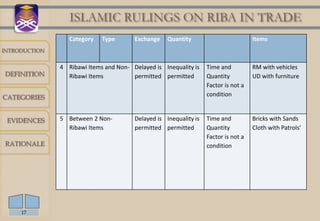
ISLAMIC RULINGS ON RIBA IN TRADE
                  Category   Type       Exchange    Quantity                         Items
INTRODUCTION


               4 Ribawi Items and Non- Delayed is Inequality is    Time and          RM with vehicles
DEFINITION       Ribawi Items          permitted permitted         Quantity          UD with furniture
                                                                   Factor is not a
CATEGORIES                                                         condition


 EVIDENCES     5 Between 2 Non-         Delayed is Inequality is   Time and          Bricks with Sands
                 Ribawi Items           permitted permitted        Quantity          Cloth with Patrols’
                                                                   Factor is not a
RATIONALE                                                          condition


     17
THE RATIONAL BEHIND THE PROHIBITION OF RIBA

                  Barter system is not so favourable from the Shariah point of view.
INTRODUCTION      The impact of riba is on the society at large compared to other
                   crimes prescribed in hudud which impact are restricted to only a
                   few of people.
DEFINITION
                  It is a clear burden on the borrower. In any circumstances, he is
                   obliged to repay the principal and interest charge (Money renting).
CATEGORIES         Money and time cannot grow by themselves.
                  Riba is the main pushing factor for the people with surplus of
                   money to lend their money out to the deficit units in the economy.
 EVIDENCES         However, it could render to exploitation of deficit units by the
                   surplus units.
RATIONALE
                  To prevent any form of injustice, exploitation and manipulation
                   among the parties.
                  The inflexibility of interest charge results in loss and unemployment
                   in comparison with the profit-and-loss sharing system.
                  Security oriented vs Growth oriented. Interest-based system is not
                   for the poor parties with poor creditworthiness.


     18
THE RATIONAL BEHIND THE PROHIBITION OF RIBA

                Inequality in loan distribution makes the rich becomes richer
INTRODUCTION     and the poor becomes poorer.
                Interest-based system impends the innovations amongst the
                 small-scale enterprises particularly.
DEFINITION
                Wealth creation and transfer: Riba activities do not create a new
                 stock of wealth.
CATEGORIES      Borrowers are not exposed to any risk (except credit risk - does
                 not commensurate the profit made).
 EVIDENCES      Money is considered as commodity is an interest-based system
                 and subject to the law of demand and supply (Allowing
                 speculation on money).
RATIONALE
                Interest is a component of costs in an interest-based system.
                Case Studies:
                  Bank interest
                  Riba al-fadl
                  Similarities between trade and riba

     19
CASE 1
                Charging Interest In The Banking Sector
INTRODUCTION    Prohibition of riba would safeguard the interest of both financial
                 institution and customer
                In case of money deposits in savings accounts or fixed deposits, the
DEFINITION
                 interest is unfair because of:
                  Banks:
CATEGORIES             Conventional Bank: Obliged to pay interest to the depositor which is
                        more than the principal amount deposited
                       Islamic Banks: Profit would be given to the depositor only if bank
 EVIDENCES              make profit. If they are making losses, they are not compelled to pay
                        any amount of profit
                    Customers:
RATIONALE
                       Conventional Bank: Customers would be deprived from the high
                        profit gained by bank even though they are guaranteed some form
                        of fixed income (interest), it is rather small compared to the huge
                        profit gained by the banks.
                       Islamic Bank: If bank making huge profits for a certain period,
                        depositor would be given a fair share of profit based on agreed
                        proportion

     20
CASE 2
                Prohibition of Riba al-Fadl
INTRODUCTION    To ban any form of unfair trade practices from the business
                 society – unfair practice in barter transaction
DEFINITION      The Prophet saw was actually trying to discourage barter
                 trading and gradually eliminate barter system while suggesting
                 a better and just monetary system using currency
CATEGORIES      The answer to the question:
                  Why any trader would like to trade 2 similar commodity of
 EVIDENCES          different quality without having gain from the differences in
                    quantity?
                No sensible trader would like to trade at loss, they would avoid
RATIONALE
                 any involvement of barter trading that might lead to either the
                 practice of riba or trade at loss.
                Islam suggested fairer alternative – utilize currency as a medium
                 of exchange that could facilitate a proper flow of trade and
                 accurate market value. This would avoid injustice due to
                 inability to determine fair value for the exchange in barter trade.

     21
CASE 3
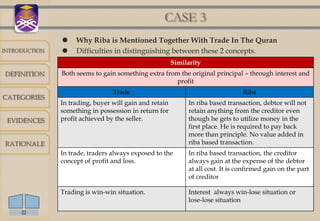
                   Why Riba is Mentioned Together With Trade In The Quran
INTRODUCTION       Difficulties in distinguishing between these 2 concepts.
                                                        Similarity
DEFINITION     Both seems to gain something extra from the original principal – through interest and
                                                      profit
                                 Trade                                           Riba
CATEGORIES
               In trading, buyer will gain and retain        In riba based transaction, debtor will not
               something in possession in return for         retain anything from the creditor even
 EVIDENCES     profit achieved by the seller.                though he gets to utilize money in the
                                                             first place. He is required to pay back
                                                             more than principle. No value added in
RATIONALE                                                    riba based transaction.
               In trade, traders always exposed to the       In riba based transaction, the creditor
               concept of profit and loss.                   always gain at the expense of the debtor
                                                             at all cost. It is confirmed gain on the part
                                                             of creditor

               Trading is win-win situation.                 Interest always win-lose situation or
                                                             lose-lose situation
     22
END OF CHAPTER

INTRODUCTION


DEFINITION


CATEGORIES


 EVIDENCES          
RATIONALE


     23

ISB540 - RIBA

  • 1.
    ISLAMIC BUSINESS TRANSACTION  CHAPTER THREE RIBA MAHYUDDIN KHALID  emkay@salam.uitm.edu.my
  • 2.
    CONTENT  INTRODUCTION INTRODUCTION  DEFINITION  CATEGORIES OF RIBA DEFINITION  ISLAMIC RULINGS ON RIBA IN TRADE  THE RATIONALE BEHIND THE PROHIBITION OF RIBA CATEGORIES EVIDENCES RATIONALE 2
  • 3.
    INTRODUCTION  Riba was gradually prohibited through 4 stages in 4 different INTRODUCTION verses in the Quran  Practice of giving and taking riba has been widely practice in DEFINITION Arab society and regarded as part and parcel of the business society CATEGORIES  To eliminate something that have been accustomed for so long is not an easy task  This approach also adopted in the prohibition of liquor EVIDENCES  Arab society had been given ample time to gradually adjust themselves RATIONALE 3
  • 4.
    RIBA IN THEQURAN INTRODUCTION DEFINITION CATEGORIES Stages Of Moral Legal Al-Bay’ as the Riba & the Prohibition of alternative to Prohibition denounciation Jews Riba Riba of Riba Of Riba In (An-Nisa : 61) (Ali-Imran: (Al-Baqarah: (Al-Rum : 39) EVIDENCES The Quran 130-132) 275-281) RATIONALE 4
  • 5.
    PROHIBITION OF RIBA STAGES VERSES INTRODUCTION 1st DEFINITION CATEGORIES 2nd EVIDENCES RATIONALE 5
  • 6.
    PROHIBITION OF RIBA STAGES VERSES INTRODUCTION 3rd DEFINITION 4th CATEGORIES EVIDENCES RATIONALE 6
  • 7.
    DEFINITION  Literally: INTRODUCTION  Riba is an Arabic word, derived from the verb raba that literally means „to grow‟ or „expand‟ or „increase‟ or „inflate‟ or „excess‟  Excess quantity, addition, an increase of a thing over and above DEFINITION its original size or amount  It is generally translated into English as “usury” or “interest”, but in CATEGORIES fact it has a much broader sense in the Shari`ah.  Riba in the Shari`ah, technically refers to the „premium‟ that must be paid by the borrower to the lender along with the principal EVIDENCES amount as a condition for the loan or for an extension in its maturity. RATIONALE  In fiqh terminology, riba means an increase in one of two homogeneous equivalents being exchanged without this increase being accompanied by a return.  Technically (2 definition depending on the nature of transaction):  Trade Transaction  Loan Transaction 7
  • 8.
    DEFINITION  Definition 1: INTRODUCTION  Trade transaction:  Unlawful gain derived from the quantitative inequality of the DEFINITION counter-values in any transaction purporting to effect the exchange of 2 or more species which belong to the same CATEGORIES genus(category) and are governed by the same efficient cause(illah)  Definition 2: EVIDENCES  Loan transaction: RATIONALE  A predetermined excess or surplus over and above the loan received by the creditor conditionally in relation to a specified period 8
  • 9.
    CATEGORIES OF RIBA  Debt Riba INTRODUCTION  Riba Qardh  Riba Jahiliyyah DEFINITION  Trade Riba  Riba al-Fadl CATEGORIES  Riba al-Nasiah EVIDENCES RATIONALE 9
  • 10.
    DEBT RIBA  Riba Qardh INTRODUCTION  Any predetermined benefit for the owner of debt stated in the contract, which the debtor need to fulfil DEFINITION  E.g.: interest stated in loan contract  Riba Jahiliyyah CATEGORIES  The surplus or excess payment above the original debt as a penalty to the debtor due to his inability to service the loan EVIDENCES repayment within the stipulated time  Real and primary form of riba RATIONALE  Premium paid to the lender in return for his waiting  Giving or taking of every excess amount in exchange of a loan at an agreed rate irrespective of whether it is low or high  E.g.: interest in credit card transactions due to the delay in the repayment 10
  • 11.
    TRADE RIBA  Riba al-Fadl INTRODUCTION  Any additional quantity or inequality in the exchange of goods from the similar type of the ribawi items DEFINITION  (Quantity Factor)  Riba al-Nasiah CATEGORIES  Any delay in the exchange of the ribawi items from the same type and category EVIDENCES  (Time Factor) RATIONALE 11
  • 12.
    EVIDENCE  Al-Quran INTRODUCTION  Al-Baqarah: 275 DEFINITION CATEGORIES EVIDENCES RATIONALE 12
  • 13.
    EVIDENCE  Hadith: INTRODUCTION  From Jabir: The Prophet saw cursed the receiver and the payer of usury, the one who records it and the two witnesses DEFINITION to the transaction and said: “They are all alike (in guilt and sin). CATEGORIES  From Abi Said al-Khudri: The Prophet saw said: gold for gold, silver for silver, wheat for wheat, barley for barley, dates for dates, salt for salt, like for like, and hand to hand. EVIDENCES Whoever pays more or takes more has indulged in riba. Take taker and the giver are alike (in guilt). RATIONALE 13
  • 14.
    RIBAWI ITEMS  Commodity Money/ Currency: INTRODUCTION  Gold  Silver DEFINITION  Currency  Foodstuff: CATEGORIES  Wheat  Barley EVIDENCES  Dates  Salt RATIONALE 14
  • 15.
    RIBAWI ITEM INTRODUCTION DEFINITION CATEGORIES EVIDENCES RATIONALE  (1) Prompt delivery (time)  (2) Prompt delivery with the equivalent quantity 15
  • 16.
    ISLAMIC RULINGS ONRIBA IN TRADE Category Type Exchange Quantity Items INTRODUCTION 1 Same Same Spot Equal in Regardless of Gold with Gold, category type exchange quantity quality Wheat with Wheat DEFINITION CATEGORIES 2 Same Different Spot Inequality Equality is not a God with Silver category type exchange is condition Wheat with Rice permitted Salt with Dates EVIDENCES RATIONALE 3 Different Different Delayed is Inequality Time and Gold with Wheat category type permitted is Quantity Factor RM with Dates permitted is not a condition 16
  • 17.
    ISLAMIC RULINGS ONRIBA IN TRADE Category Type Exchange Quantity Items INTRODUCTION 4 Ribawi Items and Non- Delayed is Inequality is Time and RM with vehicles DEFINITION Ribawi Items permitted permitted Quantity UD with furniture Factor is not a CATEGORIES condition EVIDENCES 5 Between 2 Non- Delayed is Inequality is Time and Bricks with Sands Ribawi Items permitted permitted Quantity Cloth with Patrols’ Factor is not a RATIONALE condition 17
  • 18.
    THE RATIONAL BEHINDTHE PROHIBITION OF RIBA  Barter system is not so favourable from the Shariah point of view. INTRODUCTION  The impact of riba is on the society at large compared to other crimes prescribed in hudud which impact are restricted to only a few of people. DEFINITION  It is a clear burden on the borrower. In any circumstances, he is obliged to repay the principal and interest charge (Money renting). CATEGORIES Money and time cannot grow by themselves.  Riba is the main pushing factor for the people with surplus of money to lend their money out to the deficit units in the economy. EVIDENCES However, it could render to exploitation of deficit units by the surplus units. RATIONALE  To prevent any form of injustice, exploitation and manipulation among the parties.  The inflexibility of interest charge results in loss and unemployment in comparison with the profit-and-loss sharing system.  Security oriented vs Growth oriented. Interest-based system is not for the poor parties with poor creditworthiness. 18
  • 19.
    THE RATIONAL BEHINDTHE PROHIBITION OF RIBA  Inequality in loan distribution makes the rich becomes richer INTRODUCTION and the poor becomes poorer.  Interest-based system impends the innovations amongst the small-scale enterprises particularly. DEFINITION  Wealth creation and transfer: Riba activities do not create a new stock of wealth. CATEGORIES  Borrowers are not exposed to any risk (except credit risk - does not commensurate the profit made). EVIDENCES  Money is considered as commodity is an interest-based system and subject to the law of demand and supply (Allowing speculation on money). RATIONALE  Interest is a component of costs in an interest-based system.  Case Studies:  Bank interest  Riba al-fadl  Similarities between trade and riba 19
  • 20.
    CASE 1  Charging Interest In The Banking Sector INTRODUCTION  Prohibition of riba would safeguard the interest of both financial institution and customer  In case of money deposits in savings accounts or fixed deposits, the DEFINITION interest is unfair because of:  Banks: CATEGORIES  Conventional Bank: Obliged to pay interest to the depositor which is more than the principal amount deposited  Islamic Banks: Profit would be given to the depositor only if bank EVIDENCES make profit. If they are making losses, they are not compelled to pay any amount of profit  Customers: RATIONALE  Conventional Bank: Customers would be deprived from the high profit gained by bank even though they are guaranteed some form of fixed income (interest), it is rather small compared to the huge profit gained by the banks.  Islamic Bank: If bank making huge profits for a certain period, depositor would be given a fair share of profit based on agreed proportion 20
  • 21.
    CASE 2  Prohibition of Riba al-Fadl INTRODUCTION  To ban any form of unfair trade practices from the business society – unfair practice in barter transaction DEFINITION  The Prophet saw was actually trying to discourage barter trading and gradually eliminate barter system while suggesting a better and just monetary system using currency CATEGORIES  The answer to the question:  Why any trader would like to trade 2 similar commodity of EVIDENCES different quality without having gain from the differences in quantity?  No sensible trader would like to trade at loss, they would avoid RATIONALE any involvement of barter trading that might lead to either the practice of riba or trade at loss.  Islam suggested fairer alternative – utilize currency as a medium of exchange that could facilitate a proper flow of trade and accurate market value. This would avoid injustice due to inability to determine fair value for the exchange in barter trade. 21
  • 22.
    CASE 3  Why Riba is Mentioned Together With Trade In The Quran INTRODUCTION  Difficulties in distinguishing between these 2 concepts. Similarity DEFINITION Both seems to gain something extra from the original principal – through interest and profit Trade Riba CATEGORIES In trading, buyer will gain and retain In riba based transaction, debtor will not something in possession in return for retain anything from the creditor even EVIDENCES profit achieved by the seller. though he gets to utilize money in the first place. He is required to pay back more than principle. No value added in RATIONALE riba based transaction. In trade, traders always exposed to the In riba based transaction, the creditor concept of profit and loss. always gain at the expense of the debtor at all cost. It is confirmed gain on the part of creditor Trading is win-win situation. Interest always win-lose situation or lose-lose situation 22
  • 23.