RISK MANAGEMENT
IN
ISLAMIC FINANCE
Mahyuddin Khalid
Risk Management In Takaful Operation
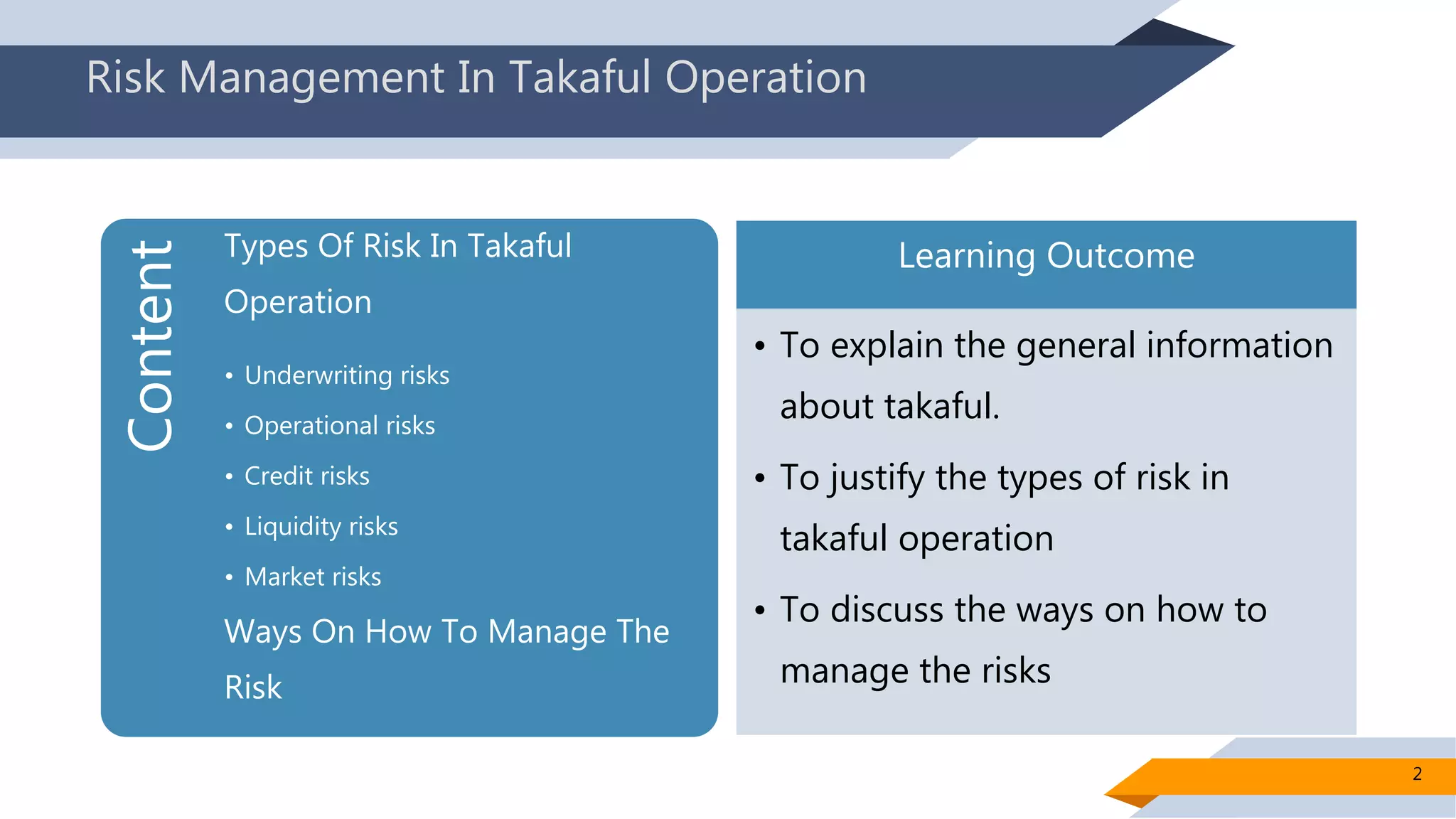
Content
Types Of Risk In Takaful
Operation
• Underwriting risks
• Operational risks
• Credit risks
• Liquidity risks
• Market risks
Ways On How To Manage The
Risk
Learning Outcome
• To explain the general information
about takaful.
• To justify the types of risk in
takaful operation
• To discuss the ways on how to
manage the risks
2
Introduction
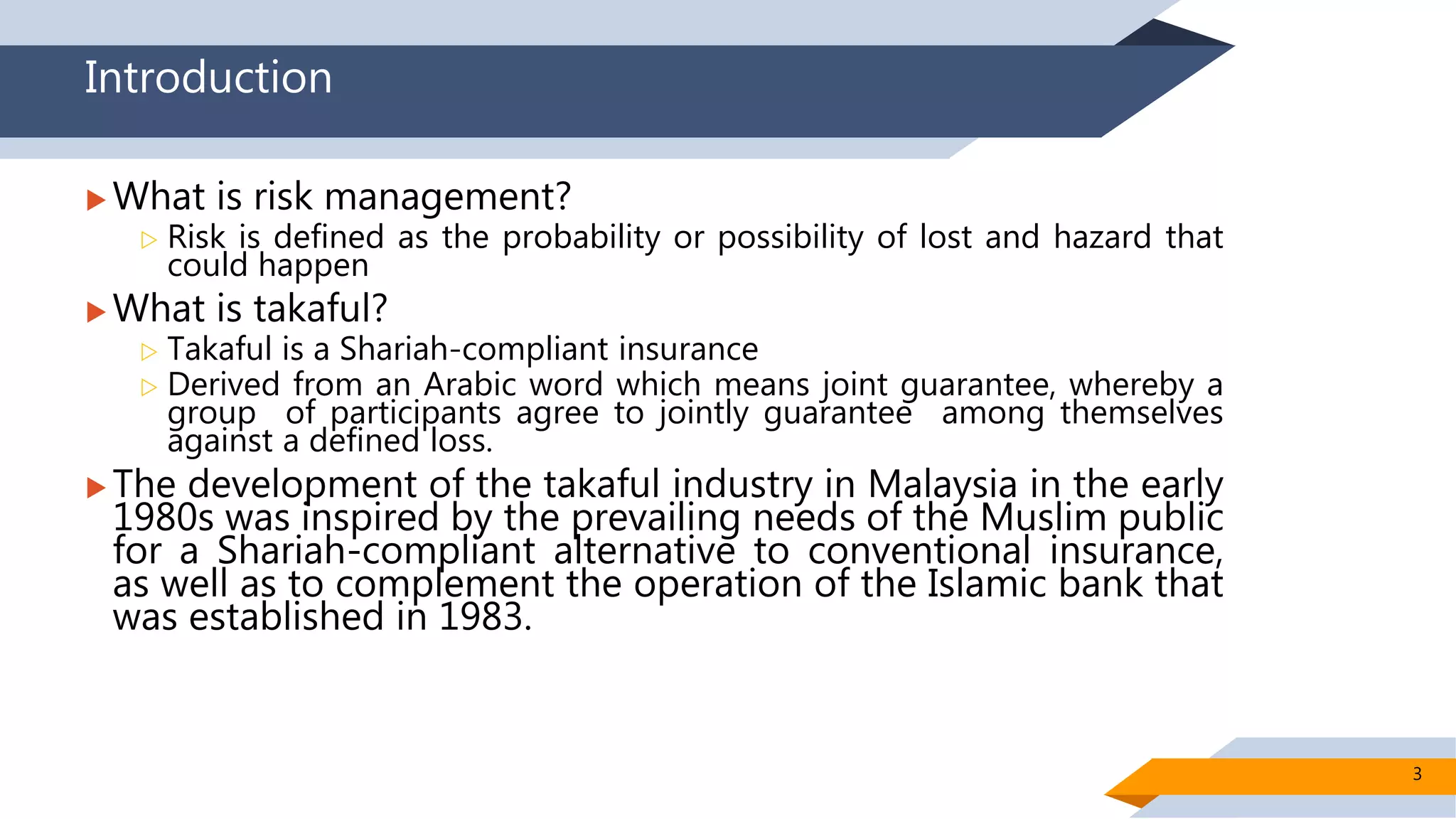
 What is risk management?
 Risk is defined as the probability or possibility of lost and hazard that
could happen
 What is takaful?
 Takaful is a Shariah-compliant insurance
 Derived from an Arabic word which means joint guarantee, whereby a
group of participants agree to jointly guarantee among themselves
against a defined loss.
 The development of the takaful industry in Malaysia in the early
1980s was inspired by the prevailing needs of the Muslim public
for a Shariah-compliant alternative to conventional insurance,
as well as to complement the operation of the Islamic bank that
was established in 1983.
3
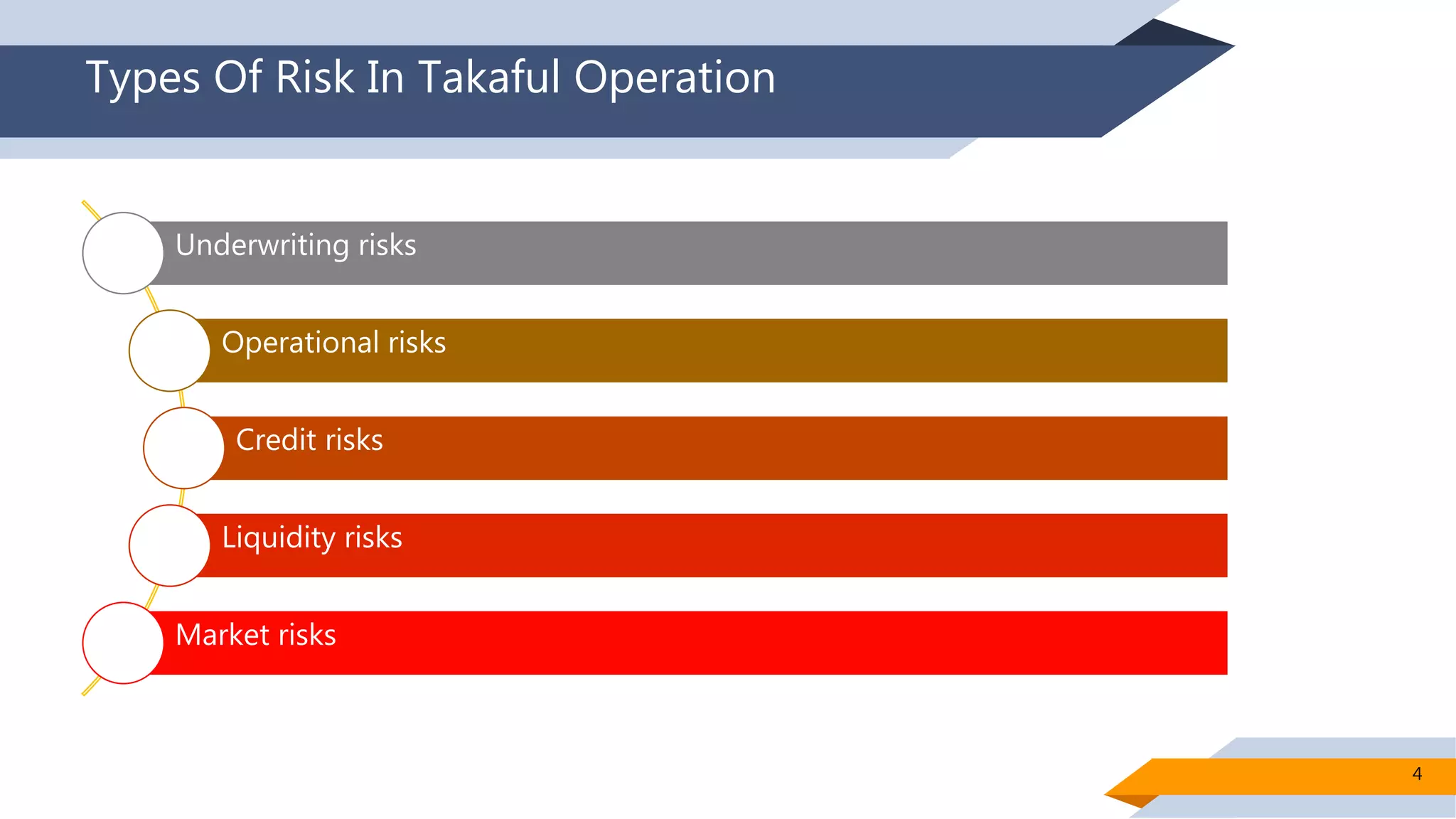
Types Of Risk In Takaful Operation
Underwriting risks
Operational risks
Credit risks
Liquidity risks
Market risks
4
Underwriting Risks
Occurs due to adverse selection of applicants or due to re-
Takaful risk as a result of inability of re-Takaful operator to
meet the obligation towards ceded company under re-
Takaful agreement.
The risk of adverse selection arises when applicants with
higher than average chance of loss succeed in obtaining
Takaful coverage at standard rates.
E.g. farsightedness driver.
5
Operational Risks
 The loss that occurs as a result of insufficient or failed internal
processes, people, technology or from external events.
 Insufficient or failed internal processes
 inaccurate processing of transactions, inefficient recordkeeping.
 People risk
 incompetence of employees.
 Technology risk
 telecommunication system or computer network breakdown.
 External events
 unenforceability of regulatory policies, legislation and regulations that
affect the fulfillment of contracts and transactions
6
Credit Risk
 Result of default of counterparty when it fails to meet its obligations
in time and in accordance with agreed terms.
 May be treated as default risk, migration risk, spread risk or
concentration risk.
 Default risk
 Takaful operator does not receive or partially receive cash flows or assets to
which it is entitled because the other party fails to meet the obligations of the
contract.
 Migration risk
 Probability of a future default of an obligator adversely affect the contract
today.
 Spread risk
 Market perception of increased risk on either macro or micro basis.
 Concentration risk
 Increased exposure to losses due to concentration of investments in a
particular geographical area or economic or industrial sector.
7
Liquidity Risk
 The risk resulting from Takaful company’s inability to meet its
obligations when they fall due.
 Liquidity risk includes liquidation risk, affiliation investment risk
and capital funding risk.
 Liquidation risk
 Risk under circumstance when assets are liquidated below their real
(market) value.
 Affiliation investment risk
 The risk that investment in an affiliated or member company might
result in drain of financial or operating resources.
 Capital funding risk
 The risk that insurance company will not be able to outsource funds in
case of large claims.
8
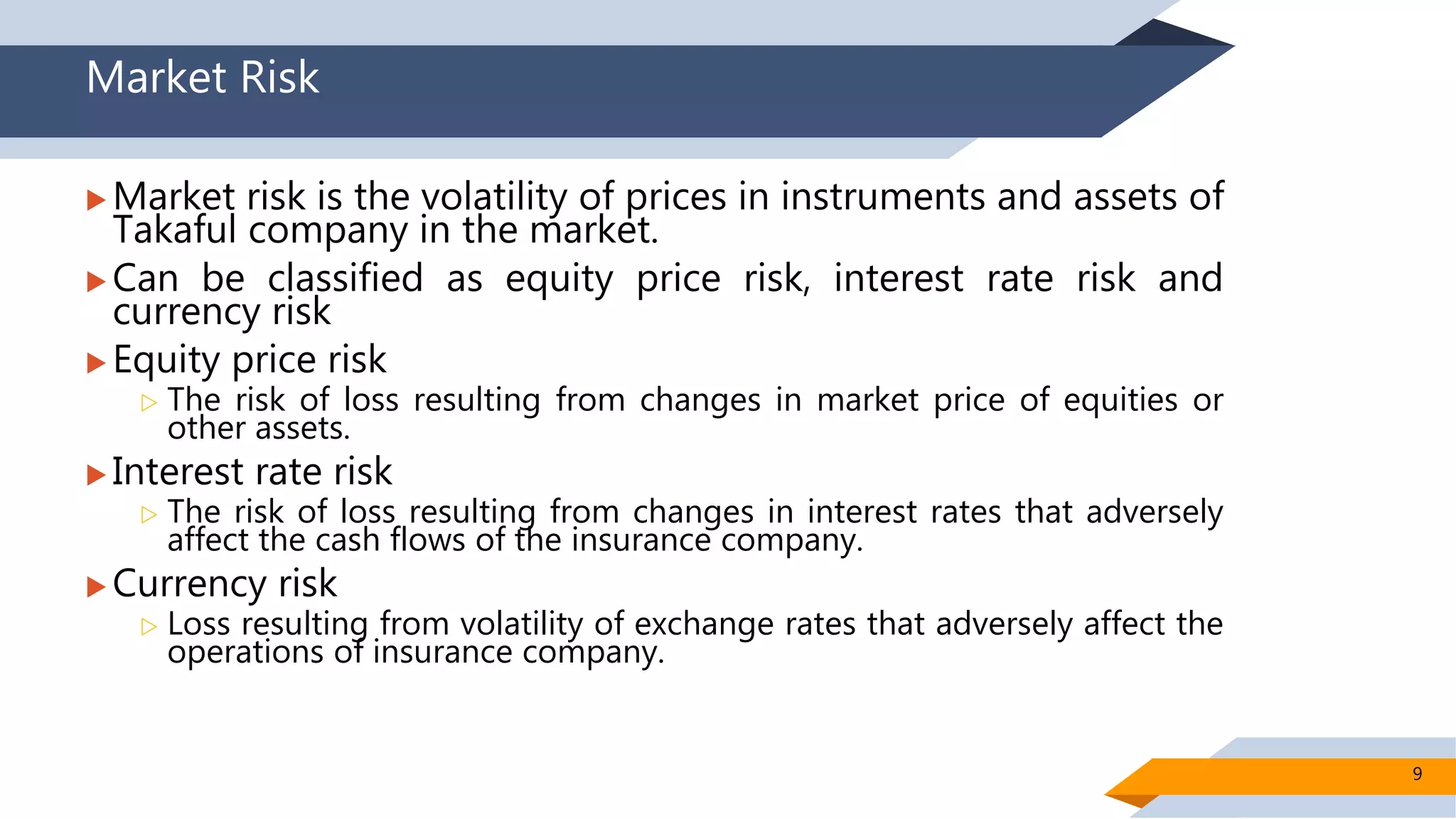
Market Risk
 Market risk is the volatility of prices in instruments and assets of
Takaful company in the market.
 Can be classified as equity price risk, interest rate risk and
currency risk
 Equity price risk
 The risk of loss resulting from changes in market price of equities or
other assets.
 Interest rate risk
 The risk of loss resulting from changes in interest rates that adversely
affect the cash flows of the insurance company.
 Currency risk
 Loss resulting from volatility of exchange rates that adversely affect the
operations of insurance company.
9
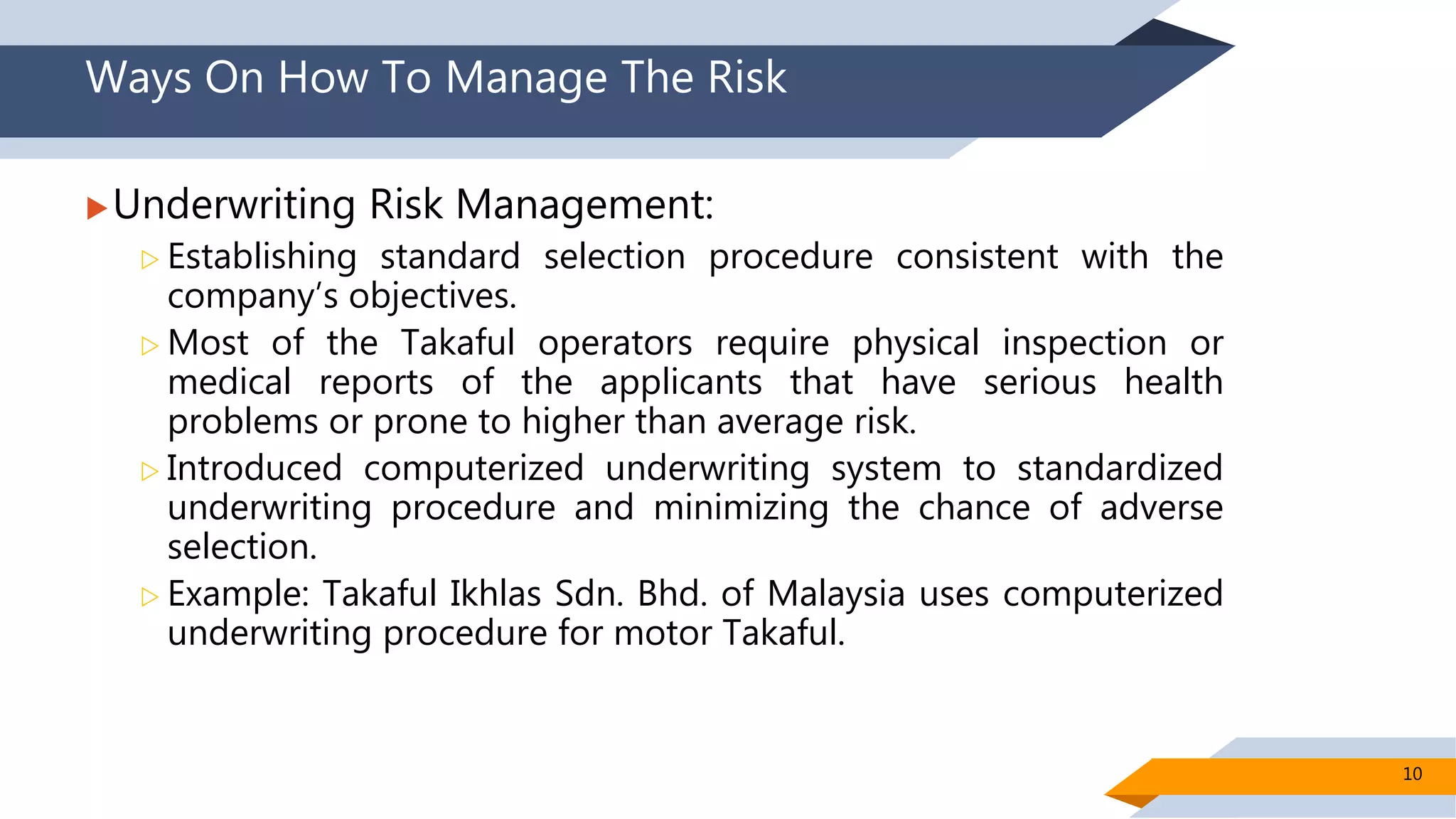
Ways On How To Manage The Risk
Underwriting Risk Management:
 Establishing standard selection procedure consistent with the
company’s objectives.
 Most of the Takaful operators require physical inspection or
medical reports of the applicants that have serious health
problems or prone to higher than average risk.
 Introduced computerized underwriting system to standardized
underwriting procedure and minimizing the chance of adverse
selection.
 Example: Takaful Ikhlas Sdn. Bhd. of Malaysia uses computerized
underwriting procedure for motor Takaful.
10
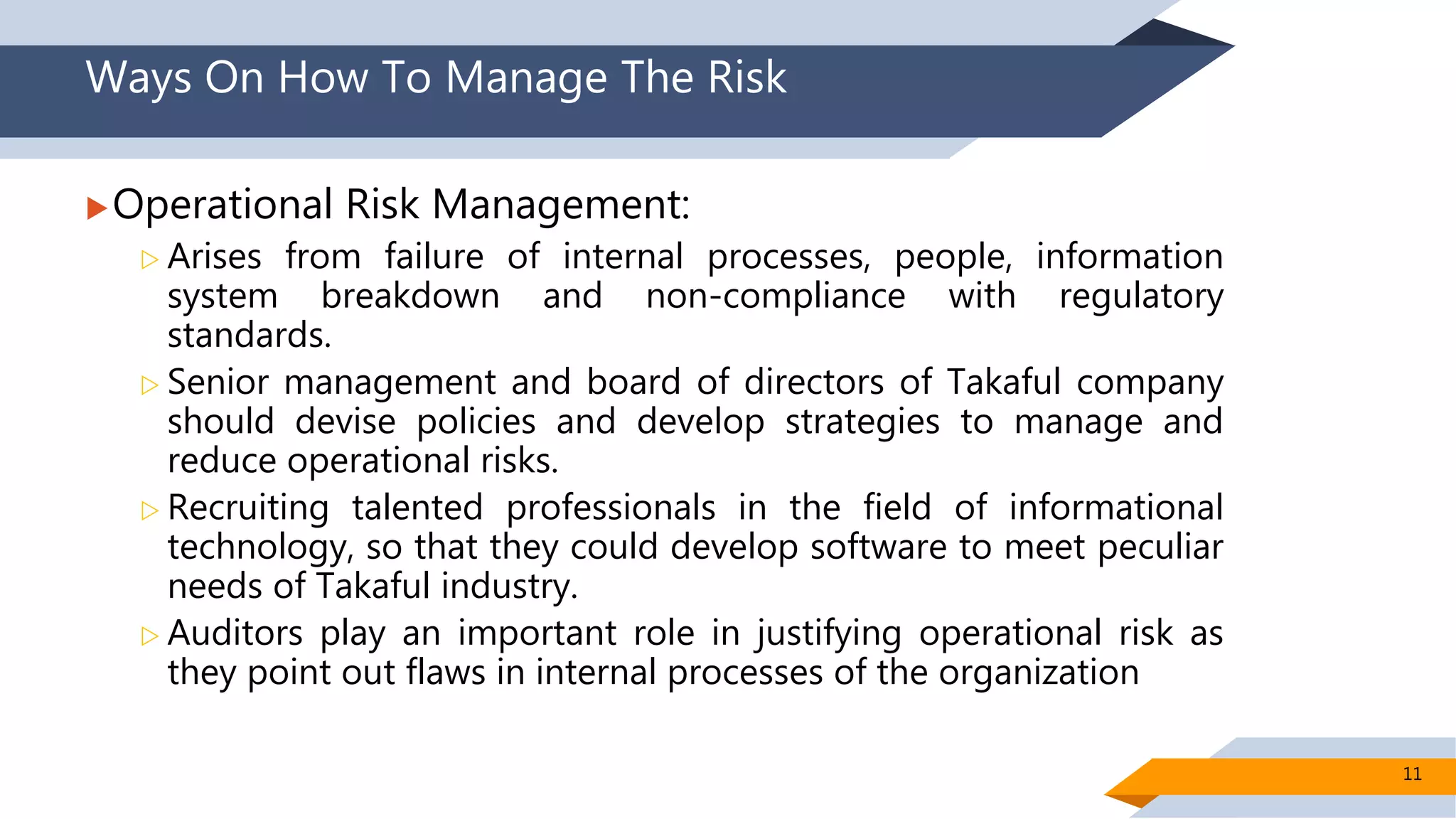
Ways On How To Manage The Risk
Operational Risk Management:
 Arises from failure of internal processes, people, information
system breakdown and non-compliance with regulatory
standards.
 Senior management and board of directors of Takaful company
should devise policies and develop strategies to manage and
reduce operational risks.
 Recruiting talented professionals in the field of informational
technology, so that they could develop software to meet peculiar
needs of Takaful industry.
 Auditors play an important role in justifying operational risk as
they point out flaws in internal processes of the organization
11
Ways On How To Manage The Risk
Credit risk management:
 Limit on maturity of credit facility (prefer short term credit over
long term credit)
 Limit on maximum investment amount or a certain percentage of
investment exposure to a single issuer, industry, geographical
region or some other risk classification
 The non-availability of Islamic derivatives ensures that credit risk
exposures are maintained within limits of prudential standards
defined by internal controls.
12
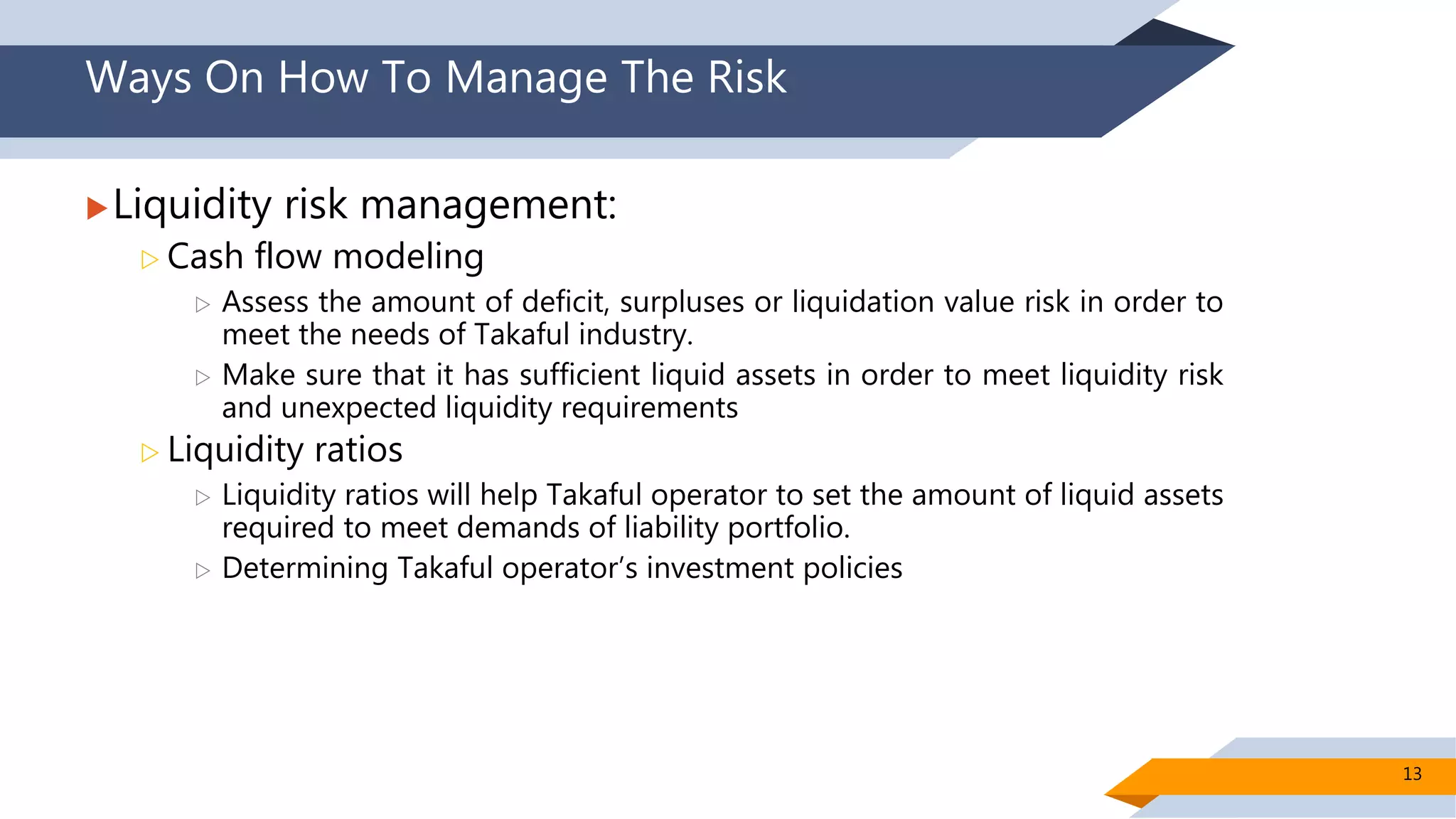
Ways On How To Manage The Risk
Liquidity risk management:
 Cash flow modeling
 Assess the amount of deficit, surpluses or liquidation value risk in order to
meet the needs of Takaful industry.
 Make sure that it has sufficient liquid assets in order to meet liquidity risk
and unexpected liquidity requirements
 Liquidity ratios
 Liquidity ratios will help Takaful operator to set the amount of liquid assets
required to meet demands of liability portfolio.
 Determining Takaful operator’s investment policies
13
Ways On How To Manage The Risk
Market risk management:
 In conventional insurance, management of market risk includes
devising strategies to manage interest rate risk, exchange rate,
and commodity price risk.
 KLIBOR (Kuala Lumpur Inter Bank Offered Rate) can be used as
bench mark for markup in Islamic financial institutions.
 Takaful operators face difficulty in managing market risk as these
financial derivatives are not compatible with Shariah.
 Cooperative hedging and bi-lateral mutual adjustment are
acceptable instruments under shariah to mitigate currency risk
and interest rate risk respectively.
14
Conclusion
 Risk management is important for Takaful to provide a way in
managing risks in Takaful according to Shariah principles.
 Five types of risks have been identified in this study that affect
operational and investment functions of Takaful operator.
 Risks associated to Takaful have raised several challenges that
need to be encountered to enhance risk management practices.
 Regular Shariah audit is found to be an integral part of effective
internal controls that prevent the companies from another
crisis.
 Exploring those solutions will help to meet the challenge of
financial engineering.
 Islamic financial market will greatly facilitate the task of Takaful
companies to invest large portion of their fund in Islamic
financial instruments and increase their efficiency and
competitiveness.
15
Mahyuddin Khalid
End of Chapter
16

Risk Management in Takaful Operation

  • 1.
  • 2.
    Risk Management InTakaful Operation Content Types Of Risk In Takaful Operation • Underwriting risks • Operational risks • Credit risks • Liquidity risks • Market risks Ways On How To Manage The Risk Learning Outcome • To explain the general information about takaful. • To justify the types of risk in takaful operation • To discuss the ways on how to manage the risks 2
  • 3.
    Introduction  What isrisk management?  Risk is defined as the probability or possibility of lost and hazard that could happen  What is takaful?  Takaful is a Shariah-compliant insurance  Derived from an Arabic word which means joint guarantee, whereby a group of participants agree to jointly guarantee among themselves against a defined loss.  The development of the takaful industry in Malaysia in the early 1980s was inspired by the prevailing needs of the Muslim public for a Shariah-compliant alternative to conventional insurance, as well as to complement the operation of the Islamic bank that was established in 1983. 3
  • 4.
    Types Of RiskIn Takaful Operation Underwriting risks Operational risks Credit risks Liquidity risks Market risks 4
  • 5.
    Underwriting Risks Occurs dueto adverse selection of applicants or due to re- Takaful risk as a result of inability of re-Takaful operator to meet the obligation towards ceded company under re- Takaful agreement. The risk of adverse selection arises when applicants with higher than average chance of loss succeed in obtaining Takaful coverage at standard rates. E.g. farsightedness driver. 5
  • 6.
    Operational Risks  Theloss that occurs as a result of insufficient or failed internal processes, people, technology or from external events.  Insufficient or failed internal processes  inaccurate processing of transactions, inefficient recordkeeping.  People risk  incompetence of employees.  Technology risk  telecommunication system or computer network breakdown.  External events  unenforceability of regulatory policies, legislation and regulations that affect the fulfillment of contracts and transactions 6
  • 7.
    Credit Risk  Resultof default of counterparty when it fails to meet its obligations in time and in accordance with agreed terms.  May be treated as default risk, migration risk, spread risk or concentration risk.  Default risk  Takaful operator does not receive or partially receive cash flows or assets to which it is entitled because the other party fails to meet the obligations of the contract.  Migration risk  Probability of a future default of an obligator adversely affect the contract today.  Spread risk  Market perception of increased risk on either macro or micro basis.  Concentration risk  Increased exposure to losses due to concentration of investments in a particular geographical area or economic or industrial sector. 7
  • 8.
    Liquidity Risk  Therisk resulting from Takaful company’s inability to meet its obligations when they fall due.  Liquidity risk includes liquidation risk, affiliation investment risk and capital funding risk.  Liquidation risk  Risk under circumstance when assets are liquidated below their real (market) value.  Affiliation investment risk  The risk that investment in an affiliated or member company might result in drain of financial or operating resources.  Capital funding risk  The risk that insurance company will not be able to outsource funds in case of large claims. 8
  • 9.
    Market Risk  Marketrisk is the volatility of prices in instruments and assets of Takaful company in the market.  Can be classified as equity price risk, interest rate risk and currency risk  Equity price risk  The risk of loss resulting from changes in market price of equities or other assets.  Interest rate risk  The risk of loss resulting from changes in interest rates that adversely affect the cash flows of the insurance company.  Currency risk  Loss resulting from volatility of exchange rates that adversely affect the operations of insurance company. 9
  • 10.
    Ways On HowTo Manage The Risk Underwriting Risk Management:  Establishing standard selection procedure consistent with the company’s objectives.  Most of the Takaful operators require physical inspection or medical reports of the applicants that have serious health problems or prone to higher than average risk.  Introduced computerized underwriting system to standardized underwriting procedure and minimizing the chance of adverse selection.  Example: Takaful Ikhlas Sdn. Bhd. of Malaysia uses computerized underwriting procedure for motor Takaful. 10
  • 11.
    Ways On HowTo Manage The Risk Operational Risk Management:  Arises from failure of internal processes, people, information system breakdown and non-compliance with regulatory standards.  Senior management and board of directors of Takaful company should devise policies and develop strategies to manage and reduce operational risks.  Recruiting talented professionals in the field of informational technology, so that they could develop software to meet peculiar needs of Takaful industry.  Auditors play an important role in justifying operational risk as they point out flaws in internal processes of the organization 11
  • 12.
    Ways On HowTo Manage The Risk Credit risk management:  Limit on maturity of credit facility (prefer short term credit over long term credit)  Limit on maximum investment amount or a certain percentage of investment exposure to a single issuer, industry, geographical region or some other risk classification  The non-availability of Islamic derivatives ensures that credit risk exposures are maintained within limits of prudential standards defined by internal controls. 12
  • 13.
    Ways On HowTo Manage The Risk Liquidity risk management:  Cash flow modeling  Assess the amount of deficit, surpluses or liquidation value risk in order to meet the needs of Takaful industry.  Make sure that it has sufficient liquid assets in order to meet liquidity risk and unexpected liquidity requirements  Liquidity ratios  Liquidity ratios will help Takaful operator to set the amount of liquid assets required to meet demands of liability portfolio.  Determining Takaful operator’s investment policies 13
  • 14.
    Ways On HowTo Manage The Risk Market risk management:  In conventional insurance, management of market risk includes devising strategies to manage interest rate risk, exchange rate, and commodity price risk.  KLIBOR (Kuala Lumpur Inter Bank Offered Rate) can be used as bench mark for markup in Islamic financial institutions.  Takaful operators face difficulty in managing market risk as these financial derivatives are not compatible with Shariah.  Cooperative hedging and bi-lateral mutual adjustment are acceptable instruments under shariah to mitigate currency risk and interest rate risk respectively. 14
  • 15.
    Conclusion  Risk managementis important for Takaful to provide a way in managing risks in Takaful according to Shariah principles.  Five types of risks have been identified in this study that affect operational and investment functions of Takaful operator.  Risks associated to Takaful have raised several challenges that need to be encountered to enhance risk management practices.  Regular Shariah audit is found to be an integral part of effective internal controls that prevent the companies from another crisis.  Exploring those solutions will help to meet the challenge of financial engineering.  Islamic financial market will greatly facilitate the task of Takaful companies to invest large portion of their fund in Islamic financial instruments and increase their efficiency and competitiveness. 15
  • 16.