ISLAMIC FINANCE
DR AMNISUHAILAH
ABARAHAN
SPECIAL LECTURE FOR
HALALAN TAYYIBAN
RESEARCH CENTRE
APRIL 2023
1
SALE DEFINITION
“ To change property for property and it is either mun’aqid
(concluded) or ghayr mun’aqid (concluded).
Some jurists added ‘earning’. “ Change property for property by way
of earning”.
The word ‘property’ excludes exchange of property and usufruct.
Sale means delivery of a definite object which possesses legal value
in exchange for something equivalent in value called price.
Transfer of ownership
2
CONTRACT DEFINITION
“ O you who believe fulfill your contracts.” Surah al-Ma’idah:1
Contract in Arabic is ‘aqd, the plural ‘uqud.
Literal meaning: “ to tie”, “to knot”, “ to join”, “to lock”, “to hold”, “ to
contract” and more.
Technical meaning: “ Conjunction of a proposal or ijab and an
acceptance of qabul”
Also , “Conjunction of the elements of disposition, namely proposal
(ijab) and acceptance (qabul).
3
Example: If someone offers to another: “ I have sold my house to you
with such and such amount.” The other person accepts it and states: “
I have accepted your offer and bought it from you with the said
amount.”
Effect of this contract: ownership transfer
4
FUNDAMENTAL PROHIBITIONS
5
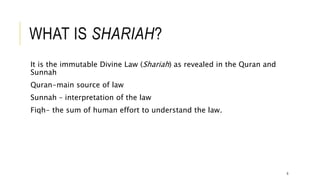
WHAT IS SHARIAH?
It is the immutable Divine Law (Shariah) as revealed in the Quran and
Sunnah
Quran-main source of law
Sunnah – interpretation of the law
Fiqh- the sum of human effort to understand the law.
6
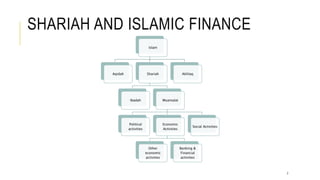
SHARIAH AND ISLAMIC FINANCE
Islam
Aqidah Shariah
Ibadah Muamalat
Political
activities
Economic
Activities
Other
economic
activities
Banking &
Financial
activities
Social Activities
Akhlaq
7
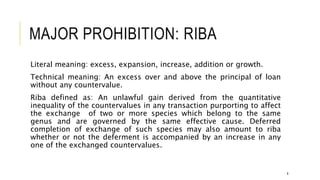
MAJOR PROHIBITION: RIBA
Literal meaning: excess, expansion, increase, addition or growth.
Technical meaning: An excess over and above the principal of loan
without any countervalue.
Riba defined as: An unlawful gain derived from the quantitative
inequality of the countervalues in any transaction purporting to affect
the exchange of two or more species which belong to the same
genus and are governed by the same effective cause. Deferred
completion of exchange of such species may also amount to riba
whether or not the deferment is accompanied by an increase in any
one of the exchanged countervalues.
8
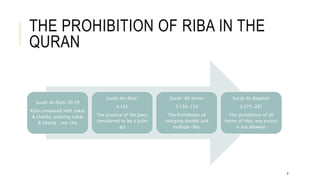
THE PROHIBITION OF RIBA IN THE
QURAN
Surah Ar-Rum 30:39
Riba compared with zakat
& charity, praising zakat
& charity , not riba
Surah An-Nisa’
4:161
The practice of the Jews,
considered to be a zulm
act
Surah ‘Ali Imran
3:130-132
The Prohibition of
charging double and
multiple riba.
Surah Al-Baqarah
2:275-281
The prohibition of all
forms of riba, any excess
is not allowed.
9
QURANIC VERSES ON THE
PROHIBITION OF RIBA
Surah al-Ruum: 39
“That which you lay out for increase through the poperty of (other)
people will have no increase with Allah; but that which you lay out for
charity seeking the countenance of Allah (will increase); it is these
who will get a recompense multiplied.”
Surah al:Nisaa’: 161
“For the inquinity of the Jews We made unlawful for them certain
(foods) good and wholesome which had been lawful for them in that
the hindered man from Allah’s way that they took usury, though they
were forbidden, and that they devoured men’s subtonic wrongfully;
We have prepared for those who reject faith a grievous punishment.”
Surah Ali ‘Imran: 130
“ O you who believe! Devour not usury doubled and multiplied; but
fear Allah; that you may (really prosper.”
10
Surah al-Baqarah: 275-281
“ Those who consume interest cannot stand (on the day of resurrection)except as
one stands who is being beaten by Satan into insanity. That is because they say,”
Trade is (just) like interest.” But Allah ahs permitted trade and has forbidden
interest. So whoever has received an admonition from his Lord and desists may
have what is past, and his affair rests with Allah.But whoever returns to (dealing
in interest and usury)- those are the companions of the Fire; they will abide
eternally therein.
Allah destroys interest and gives increase for charities. And Allah does not like
every sinning disbeliever.
Indeed those who believe and do righteous deeds and establish prayer and give
zakah will have their reward with their Lord, and there will be no fear concerning
them, nor will they grieve.
O you who have believed, And fear Allah and give up what remains (due to you)
of interest, if you should be believers.
And if you do not, then be informed of a war (against you) from Allah and His
messenger. But if you repent, you may have your principal- thus you do no
wrong, nor are you wronged.
And if someone is in hardship, then (let there be) postponement until (a time of)
ease. But if you give (from your right as ) charity then it is better for you, if you
only knew.
And fear a Day when you will be returned to Allah. The every soul will be
compensated for what it earned, and they will not be treated unjustly.
11
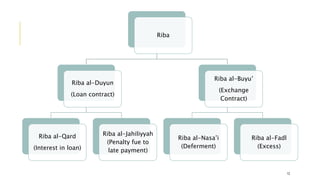
Riba
Riba al-Duyun
(Loan contract)
Riba al-Qard
(Interest in loan)
Riba al-Jahiliyyah
(Penalty fue to
late payment)
Riba al-Buyu’
(Exchange
Contract)
Riba al-Nasa’i
(Deferment)
Riba al-Fadl
(Excess)
12
RIBA AL-DUYUN
It refers to an increment charged on debt principal in consideration of
the repayment period.
 Riba al-qard
The Prophet (SAW) was reported to have said that any added benefit for the
lender that is contractually derived from a loan transaction is riba.
Riba al-Jahiliyyah
Practised during pre-Islamic Arabian society.
“ Trade is similar to riba, while Allah has permitted trade and prohibited riba”
(Al-Baqarah, 2;275).
13
RIBA AL-BUYU’
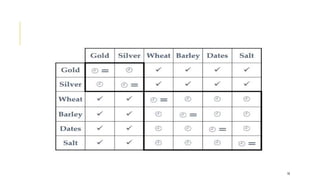
Ubadah Ibn al-Samit reported that the Prophet (SAW) said:
“ Gold for gold, silver for sliver, wheat for wheat, barley for barley,
dates for dates, salt for salt, like for like, equal for equal and hand to
hand, of the commodities differ then you may sell as you wish
provided that the exchange is hand to hand”
( Muslim, hadith no: 2970).
14
RIBA AL-BUYU’
Riba al-Nasa’i
•Delay in delivery and
exchange of ribawi
items involving genus
and within the same
category (eg. Gold and
silver)
Riba al-Fadl
•Exchange of ribawi item
with the same item in
unequal amounts
•Example: Exchange of
20 ounces of gold for 22
ounces of gold.
15
16
PROHIBITION OF GHARAR
Literal: implies risk, uncertainty and hazard.
Technical: According to Ibn Qayyim, it is a sale in which the vendor is
not in a position to hand over the subject matter to the buyer,
regardless if the subject matter is in existence or not.
According to al-Sarakhsi, gharar is a more general term, which refers
to any bargain whereby the result of it is hidden.
The companions related that the Prophet (SAW) has forbidden gharar
in trading.
Abu Hurayrah narrated that the Prophet (SAW) prohibited all sales on
gharar.
17
PROHIBITION OF MAYSIR
Closely associated terms, qimar and maysir.
Literal meaning: Derived from the word qamara, which means betting
something and winning it.
Technical meaning: Betting on one’s asset in order to acquire
another person’s assets, either through competition, conditional
games or other means.
18
CHARACTERISTICS OF MAYSIR
1. Takes place between two or more parties
2. Each participant bets his property.
3. Each participant has equal probability of gain or loss.
4. The winning party’s gain results in the loss of the other party(s).
In Surah al-Ma’idah:
“ O believers, wine and gambling ( maysir), idols and divination by
arrows are but abominations devised by Satan, avoid them so that may
prosper (5:90)”.
19
APPLICABLE CONTRACTS FOR
BUSINESS
20
MUDARABAH
21
The Majelle: “A type of partnership where one
party supplies the capital and the other labour”.
Rab al-Mal: Capital provider
Mudarib: Person who performs the works.
MUSHARAKAH
22
Comes from the derivative sharaka ‫شرك‬
, , al-shirkah means
mixing, joint.
Al-shirkah covers shirkah al-mulk (joint ownership of a
common property) and shirkah al-aqd ( partnership in a
business).
SALAM
23
 Definition: A sale or purchase of deferred item in exchange for
an immediate price.
 “ O you who believe! When you deal with each other in
transactions involving future obligations in a fixed period of
time, put them in writing.” (2:282)
 When the Prophet came to Madinah, and found its inhabitants
using forward contracts in fruits fro one, two or three years, the
Prophet said, “ Whoever enters into a forward contract let him
specify a known volume or weight and a known term of
deferment.”
IJARAH
24
 Literal meaning: ‘to give something on rent’
 Technical meaning:
 1: to employ the services of a person on wages
given to him as consideration for his hired
services.
 2. to transfer the usufruct of a particular property
to another person in exchange for a rent claimed
from him.
ISTISNA’
25
 Literal: derived from the root word sana’, to manufacture
or to construct something.
 Technical: A contract to purchase for a definite price
something that may be manufactured later on according to
agreed specifications between the parties.
 It is an agreement to sell a non-existent asset to be
manufactured according to agreed specifications and
delivered on a specified future date at a predetermined
selling price.
EXAMPLES OF UNETHICAL
BUSINESS PRACTICES
26
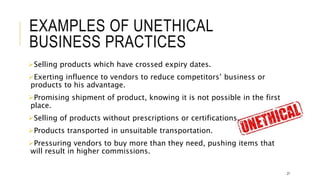
EXAMPLES OF UNETHICAL
BUSINESS PRACTICES
Selling products which have crossed expiry dates.
Exerting influence to vendors to reduce competitors’ business or
products to his advantage.
Promising shipment of product, knowing it is not possible in the first
place.
Selling of products without prescriptions or certifications.
Products transported in unsuitable transportation.
Pressuring vendors to buy more than they need, pushing items that
will result in higher commissions.
27
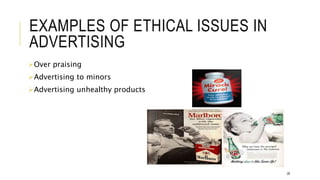
EXAMPLES OF ETHICAL ISSUES IN
ADVERTISING
Over praising
Advertising to minors
Advertising unhealthy products
28
SUBLIMINAL ADVERTISING
29
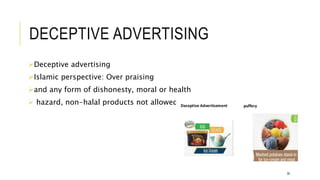
DECEPTIVE ADVERTISING
Deceptive advertising
Islamic perspective: Over praising
and any form of dishonesty, moral or health
 hazard, non-halal products not allowed.
30
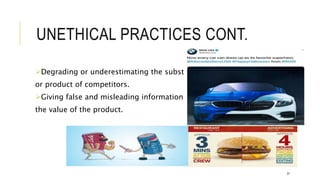
UNETHICAL PRACTICES CONT.
Degrading or underestimating the substitute
or product of competitors.
Giving false and misleading information on
the value of the product.
31
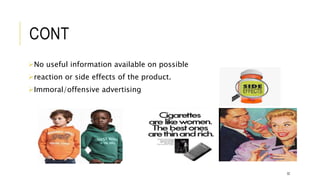
CONT
No useful information available on possible
reaction or side effects of the product.
Immoral/offensive advertising
32

PPHT LECTURE 15042023 recording for class.pptx

  • 1.
    ISLAMIC FINANCE DR AMNISUHAILAH ABARAHAN SPECIALLECTURE FOR HALALAN TAYYIBAN RESEARCH CENTRE APRIL 2023 1
  • 2.
    SALE DEFINITION “ Tochange property for property and it is either mun’aqid (concluded) or ghayr mun’aqid (concluded). Some jurists added ‘earning’. “ Change property for property by way of earning”. The word ‘property’ excludes exchange of property and usufruct. Sale means delivery of a definite object which possesses legal value in exchange for something equivalent in value called price. Transfer of ownership 2
  • 3.
    CONTRACT DEFINITION “ Oyou who believe fulfill your contracts.” Surah al-Ma’idah:1 Contract in Arabic is ‘aqd, the plural ‘uqud. Literal meaning: “ to tie”, “to knot”, “ to join”, “to lock”, “to hold”, “ to contract” and more. Technical meaning: “ Conjunction of a proposal or ijab and an acceptance of qabul” Also , “Conjunction of the elements of disposition, namely proposal (ijab) and acceptance (qabul). 3
  • 4.
    Example: If someoneoffers to another: “ I have sold my house to you with such and such amount.” The other person accepts it and states: “ I have accepted your offer and bought it from you with the said amount.” Effect of this contract: ownership transfer 4
  • 5.
  • 6.
    WHAT IS SHARIAH? Itis the immutable Divine Law (Shariah) as revealed in the Quran and Sunnah Quran-main source of law Sunnah – interpretation of the law Fiqh- the sum of human effort to understand the law. 6
  • 7.
    SHARIAH AND ISLAMICFINANCE Islam Aqidah Shariah Ibadah Muamalat Political activities Economic Activities Other economic activities Banking & Financial activities Social Activities Akhlaq 7
  • 8.
    MAJOR PROHIBITION: RIBA Literalmeaning: excess, expansion, increase, addition or growth. Technical meaning: An excess over and above the principal of loan without any countervalue. Riba defined as: An unlawful gain derived from the quantitative inequality of the countervalues in any transaction purporting to affect the exchange of two or more species which belong to the same genus and are governed by the same effective cause. Deferred completion of exchange of such species may also amount to riba whether or not the deferment is accompanied by an increase in any one of the exchanged countervalues. 8
  • 9.
    THE PROHIBITION OFRIBA IN THE QURAN Surah Ar-Rum 30:39 Riba compared with zakat & charity, praising zakat & charity , not riba Surah An-Nisa’ 4:161 The practice of the Jews, considered to be a zulm act Surah ‘Ali Imran 3:130-132 The Prohibition of charging double and multiple riba. Surah Al-Baqarah 2:275-281 The prohibition of all forms of riba, any excess is not allowed. 9
  • 10.
    QURANIC VERSES ONTHE PROHIBITION OF RIBA Surah al-Ruum: 39 “That which you lay out for increase through the poperty of (other) people will have no increase with Allah; but that which you lay out for charity seeking the countenance of Allah (will increase); it is these who will get a recompense multiplied.” Surah al:Nisaa’: 161 “For the inquinity of the Jews We made unlawful for them certain (foods) good and wholesome which had been lawful for them in that the hindered man from Allah’s way that they took usury, though they were forbidden, and that they devoured men’s subtonic wrongfully; We have prepared for those who reject faith a grievous punishment.” Surah Ali ‘Imran: 130 “ O you who believe! Devour not usury doubled and multiplied; but fear Allah; that you may (really prosper.” 10
  • 11.
    Surah al-Baqarah: 275-281 “Those who consume interest cannot stand (on the day of resurrection)except as one stands who is being beaten by Satan into insanity. That is because they say,” Trade is (just) like interest.” But Allah ahs permitted trade and has forbidden interest. So whoever has received an admonition from his Lord and desists may have what is past, and his affair rests with Allah.But whoever returns to (dealing in interest and usury)- those are the companions of the Fire; they will abide eternally therein. Allah destroys interest and gives increase for charities. And Allah does not like every sinning disbeliever. Indeed those who believe and do righteous deeds and establish prayer and give zakah will have their reward with their Lord, and there will be no fear concerning them, nor will they grieve. O you who have believed, And fear Allah and give up what remains (due to you) of interest, if you should be believers. And if you do not, then be informed of a war (against you) from Allah and His messenger. But if you repent, you may have your principal- thus you do no wrong, nor are you wronged. And if someone is in hardship, then (let there be) postponement until (a time of) ease. But if you give (from your right as ) charity then it is better for you, if you only knew. And fear a Day when you will be returned to Allah. The every soul will be compensated for what it earned, and they will not be treated unjustly. 11
  • 12.
    Riba Riba al-Duyun (Loan contract) Ribaal-Qard (Interest in loan) Riba al-Jahiliyyah (Penalty fue to late payment) Riba al-Buyu’ (Exchange Contract) Riba al-Nasa’i (Deferment) Riba al-Fadl (Excess) 12
  • 13.
    RIBA AL-DUYUN It refersto an increment charged on debt principal in consideration of the repayment period.  Riba al-qard The Prophet (SAW) was reported to have said that any added benefit for the lender that is contractually derived from a loan transaction is riba. Riba al-Jahiliyyah Practised during pre-Islamic Arabian society. “ Trade is similar to riba, while Allah has permitted trade and prohibited riba” (Al-Baqarah, 2;275). 13
  • 14.
    RIBA AL-BUYU’ Ubadah Ibnal-Samit reported that the Prophet (SAW) said: “ Gold for gold, silver for sliver, wheat for wheat, barley for barley, dates for dates, salt for salt, like for like, equal for equal and hand to hand, of the commodities differ then you may sell as you wish provided that the exchange is hand to hand” ( Muslim, hadith no: 2970). 14
  • 15.
    RIBA AL-BUYU’ Riba al-Nasa’i •Delayin delivery and exchange of ribawi items involving genus and within the same category (eg. Gold and silver) Riba al-Fadl •Exchange of ribawi item with the same item in unequal amounts •Example: Exchange of 20 ounces of gold for 22 ounces of gold. 15
  • 16.
  • 17.
    PROHIBITION OF GHARAR Literal:implies risk, uncertainty and hazard. Technical: According to Ibn Qayyim, it is a sale in which the vendor is not in a position to hand over the subject matter to the buyer, regardless if the subject matter is in existence or not. According to al-Sarakhsi, gharar is a more general term, which refers to any bargain whereby the result of it is hidden. The companions related that the Prophet (SAW) has forbidden gharar in trading. Abu Hurayrah narrated that the Prophet (SAW) prohibited all sales on gharar. 17
  • 18.
    PROHIBITION OF MAYSIR Closelyassociated terms, qimar and maysir. Literal meaning: Derived from the word qamara, which means betting something and winning it. Technical meaning: Betting on one’s asset in order to acquire another person’s assets, either through competition, conditional games or other means. 18
  • 19.
    CHARACTERISTICS OF MAYSIR 1.Takes place between two or more parties 2. Each participant bets his property. 3. Each participant has equal probability of gain or loss. 4. The winning party’s gain results in the loss of the other party(s). In Surah al-Ma’idah: “ O believers, wine and gambling ( maysir), idols and divination by arrows are but abominations devised by Satan, avoid them so that may prosper (5:90)”. 19
  • 20.
  • 21.
    MUDARABAH 21 The Majelle: “Atype of partnership where one party supplies the capital and the other labour”. Rab al-Mal: Capital provider Mudarib: Person who performs the works.
  • 22.
    MUSHARAKAH 22 Comes from thederivative sharaka ‫شرك‬ , , al-shirkah means mixing, joint. Al-shirkah covers shirkah al-mulk (joint ownership of a common property) and shirkah al-aqd ( partnership in a business).
  • 23.
    SALAM 23  Definition: Asale or purchase of deferred item in exchange for an immediate price.  “ O you who believe! When you deal with each other in transactions involving future obligations in a fixed period of time, put them in writing.” (2:282)  When the Prophet came to Madinah, and found its inhabitants using forward contracts in fruits fro one, two or three years, the Prophet said, “ Whoever enters into a forward contract let him specify a known volume or weight and a known term of deferment.”
  • 24.
    IJARAH 24  Literal meaning:‘to give something on rent’  Technical meaning:  1: to employ the services of a person on wages given to him as consideration for his hired services.  2. to transfer the usufruct of a particular property to another person in exchange for a rent claimed from him.
  • 25.
    ISTISNA’ 25  Literal: derivedfrom the root word sana’, to manufacture or to construct something.  Technical: A contract to purchase for a definite price something that may be manufactured later on according to agreed specifications between the parties.  It is an agreement to sell a non-existent asset to be manufactured according to agreed specifications and delivered on a specified future date at a predetermined selling price.
  • 26.
  • 27.
    EXAMPLES OF UNETHICAL BUSINESSPRACTICES Selling products which have crossed expiry dates. Exerting influence to vendors to reduce competitors’ business or products to his advantage. Promising shipment of product, knowing it is not possible in the first place. Selling of products without prescriptions or certifications. Products transported in unsuitable transportation. Pressuring vendors to buy more than they need, pushing items that will result in higher commissions. 27
  • 28.
    EXAMPLES OF ETHICALISSUES IN ADVERTISING Over praising Advertising to minors Advertising unhealthy products 28
  • 29.
  • 30.
    DECEPTIVE ADVERTISING Deceptive advertising Islamicperspective: Over praising and any form of dishonesty, moral or health  hazard, non-halal products not allowed. 30
  • 31.
    UNETHICAL PRACTICES CONT. Degradingor underestimating the substitute or product of competitors. Giving false and misleading information on the value of the product. 31
  • 32.
    CONT No useful informationavailable on possible reaction or side effects of the product. Immoral/offensive advertising 32