EducationalProgrammeof
The International School of Astana
AEO «Nazarbayev Intellectual Schools»
Astana, 2013
1
International school: definition
From the Kazakhstani Law «On education»:
«INTERNATIONAL SCHOOL is the educational
organisation that implements independently
developed curriculum that is authorized by
International Baccalaureate Organisation or has the
international institutional accreditation».
2
Curriculum by levels
Primary school
Secondary school
High school
International Primary
Curriculum – IPC
With further authorization
of the IB programme -
Primary Years Programme
(PYP)
IB programme - Middle
Years Program (MYP)
IB Diploma
programme - Diploma
program (DP)
3
Grades 1-5
Grades 6-10
Grades 11-12
Whatis
«Internationalprimarycurriculum»?
• In 1990s, Shell interational schools initiated the development
of curriculum for primary schools that are in line with
international trends.
• The curriculum is developed by Fieldwork Education (branch
of World Class Learning Group) involving the experienced
curriculum developers, school leaders and teachers from all
over the world.
• The curriculum is updated regularly according to the
modern trends.
4
Whatis
«Internationalprimarycurriculum»(IPC)?
This curriculum allows to integrate the content with
national standard of any country.
World known curriculum– one of the most rapidly developing
curricula for primary schools in the world.
Currently it is implemented in 85 countires (UK, USA, China,
Russia, Japan, Korea, Singapore, Sweden and etc.). 250 000
children are studying according to the IPC in more than
1500 schools.
5
IPC - curriculum of the 21st century
6
Specific features
of
IPC
Global topics and
local heritage
Assessment for
learning
Based on
«neuroscience»
research
Creative and
interesting
Skill development
Cross-curricular themes
Personal
development
Глобальное
мышление
Global thinking
InternationalSchoolinAstana
The integration of international curriculum with
Kazakhstani curricula allows to:
develop functionally full educational content to
implement learning in Kazakh-English and Russian-
English strands of education;
divide the curriculum content into two blocks that
will flexibly combine the interests of International
school and the State.
7
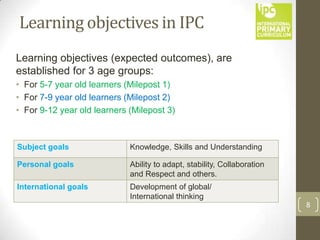
Learning objectives in IPC
Learning objectives (expected outcomes), are
established for 3 age groups:
• For 5-7 year old learners (Milepost 1)
• For 7-9 year old learners (Milepost 2)
• For 9-12 year old learners (Milepost 3)
8
Subject goals Knowledge, Skills and Understanding
Personal goals Ability to adapt, stability, Collaboration
and Respect and others.
International goals Development of global/
International thinking
Cross-curricularthemes
All dressed up – 7 weeks
Buildings – 8
Flowers and insects – 7
From A to B (Transport and travel) - 8
Hooray…let’s go on holiday! - 8
How are you? (Health) - 6
I’m alive– 6-7
Let’s celebrate – 6-7
Media Magic (communications) – 8-9
Our world (the environment) – 7-8
Seeing the light - 7
Sensational (Senses) - 7
9
The circus is coming to town - 8
The magic toymaker – 6-7
The stories people tell – 5-6
The things people do (jobs) – 6-7
Time detectives – 4-5
We are what we eat (food) - 7
Who am I? – 7-8
Science – plants
Science – electricity
Science – sound and light
Science - forces
Science - water
www.greatlearning.com/ipc/the-ipc/units-of-work
More than 80 various modern cross-curricular themes that are selected
and appropriate for primary school learners of different age.
List of IPC themes for 5-7 year old children:
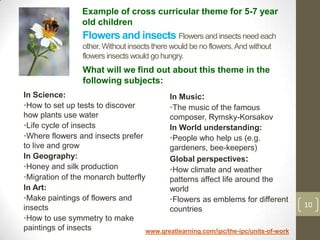
Flowers and insects Flowers and insects need each
other.Without insects there would be no flowers.And without
flowers insects would go hungry.
In Science:
•How to set up tests to discover
how plants use water
•Life cycle of insects
•Where flowers and insects prefer
to live and grow
In Geography:
•Honey and silk production
•Migration of the monarch butterfly
In Art:
•Make paintings of flowers and
insects
•How to use symmetry to make
paintings of insects
Example of cross curricular theme for 5-7 year
old children
10
What will we find out about this theme in the
following subjects:
www.greatlearning.com/ipc/the-ipc/units-of-work
In Music:
•The music of the famous
composer, Rymsky-Korsakov
In World understanding:
•People who help us (e.g.
gardeners, bee-keepers)
Global perspectives:
•How climate and weather
patterns affect life around the
world
•Flowers as emblems for different
countries
Electricity
Electricityis an energy that makes things work. It flows along wires
inside our house and classroom. Our lights,TVs,computers, mobile
phones, cars, and many other things use electricity. Do you know that
thunder and lightning is a type of electricity?
In Science:
• About static electricity
• How we can use static electricity
• How to make our own electrical circuit
• Electricity at home and in the
classroom
• About the dangers of electricity
11
Example of cross curricular theme for 5-7
year old children
What will we find out about this theme in the following subjects :
www.greatlearning.com/ipc/the-ipc/units-of-work
In Technology:
• How to design and make a
torch
In History:
• What we did before electricity
In Global perspectives:
• How people in different
countries use electricity
Learning process
• In IPC the academic content of
the programmes is integrated in
such a way that makes learners
active and interested in learning
the presented material;
• IPС is focused on both wide
aspects of individual learning
and development of wide range
of skills.
12
Entry point
«Knowledge
Harvest»
Explain the
theme
Big PictureResearch activity
Recording
activity
Exit point
Assessment principles in IPC
Learning objectives and standards are clearly stated;
Learners know how to demonstrate what they have
learnt;
Learners know how to correct and improve their own
learning;
Learners are engaged in the process of assessing their
own learning;
The assessment is integrated throughout the whole of
curriculum and not just in some of the subjects. 13
14
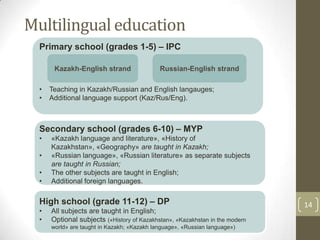
Multilingual education
Primary school (grades 1-5) – IPC
• Teaching in Kazakh/Russian and English langauges;
• Additional language support (Kaz/Rus/Eng).
Secondary school (grades 6-10) – MYP
• «Kazakh language and literature», «History of
Kazakhstan», «Geography» are taught in Kazakh;
• «Russian language», «Russian literature» as separate subjects
are taught in Russian;
• The other subjects are taught in English;
• Additional foreign languages.
High school (grade 11-12) – DP
• All subjects are taught in English;
• Optional subjects («History of Kazakhstan», «Kazakhstan in the modern
world» are taught in Kazakh; «Kazakh language», «Russian language»)
Russian-English strandKazakh-English strand
Extra-curricular activities
• Outdoor/active games
• Sports sections
• Choreography
• Eurhythmics
• Singing, playing musical instruments
• “I look at the world through the eyes of the artist"
• Arts and crafts
• Checkers, chess
• “Entertaining computer”
• Academic clubs
• etc. 15

ISA parents presentation

  • 1.
    EducationalProgrammeof The International Schoolof Astana AEO «Nazarbayev Intellectual Schools» Astana, 2013 1
  • 2.
    International school: definition Fromthe Kazakhstani Law «On education»: «INTERNATIONAL SCHOOL is the educational organisation that implements independently developed curriculum that is authorized by International Baccalaureate Organisation or has the international institutional accreditation». 2
  • 3.
    Curriculum by levels Primaryschool Secondary school High school International Primary Curriculum – IPC With further authorization of the IB programme - Primary Years Programme (PYP) IB programme - Middle Years Program (MYP) IB Diploma programme - Diploma program (DP) 3 Grades 1-5 Grades 6-10 Grades 11-12
  • 4.
    Whatis «Internationalprimarycurriculum»? • In 1990s,Shell interational schools initiated the development of curriculum for primary schools that are in line with international trends. • The curriculum is developed by Fieldwork Education (branch of World Class Learning Group) involving the experienced curriculum developers, school leaders and teachers from all over the world. • The curriculum is updated regularly according to the modern trends. 4
  • 5.
    Whatis «Internationalprimarycurriculum»(IPC)? This curriculum allowsto integrate the content with national standard of any country. World known curriculum– one of the most rapidly developing curricula for primary schools in the world. Currently it is implemented in 85 countires (UK, USA, China, Russia, Japan, Korea, Singapore, Sweden and etc.). 250 000 children are studying according to the IPC in more than 1500 schools. 5
  • 6.
    IPC - curriculumof the 21st century 6 Specific features of IPC Global topics and local heritage Assessment for learning Based on «neuroscience» research Creative and interesting Skill development Cross-curricular themes Personal development Глобальное мышление Global thinking
  • 7.
    InternationalSchoolinAstana The integration ofinternational curriculum with Kazakhstani curricula allows to: develop functionally full educational content to implement learning in Kazakh-English and Russian- English strands of education; divide the curriculum content into two blocks that will flexibly combine the interests of International school and the State. 7
  • 8.
    Learning objectives inIPC Learning objectives (expected outcomes), are established for 3 age groups: • For 5-7 year old learners (Milepost 1) • For 7-9 year old learners (Milepost 2) • For 9-12 year old learners (Milepost 3) 8 Subject goals Knowledge, Skills and Understanding Personal goals Ability to adapt, stability, Collaboration and Respect and others. International goals Development of global/ International thinking
  • 9.
    Cross-curricularthemes All dressed up– 7 weeks Buildings – 8 Flowers and insects – 7 From A to B (Transport and travel) - 8 Hooray…let’s go on holiday! - 8 How are you? (Health) - 6 I’m alive– 6-7 Let’s celebrate – 6-7 Media Magic (communications) – 8-9 Our world (the environment) – 7-8 Seeing the light - 7 Sensational (Senses) - 7 9 The circus is coming to town - 8 The magic toymaker – 6-7 The stories people tell – 5-6 The things people do (jobs) – 6-7 Time detectives – 4-5 We are what we eat (food) - 7 Who am I? – 7-8 Science – plants Science – electricity Science – sound and light Science - forces Science - water www.greatlearning.com/ipc/the-ipc/units-of-work More than 80 various modern cross-curricular themes that are selected and appropriate for primary school learners of different age. List of IPC themes for 5-7 year old children:
  • 10.
    Flowers and insectsFlowers and insects need each other.Without insects there would be no flowers.And without flowers insects would go hungry. In Science: •How to set up tests to discover how plants use water •Life cycle of insects •Where flowers and insects prefer to live and grow In Geography: •Honey and silk production •Migration of the monarch butterfly In Art: •Make paintings of flowers and insects •How to use symmetry to make paintings of insects Example of cross curricular theme for 5-7 year old children 10 What will we find out about this theme in the following subjects: www.greatlearning.com/ipc/the-ipc/units-of-work In Music: •The music of the famous composer, Rymsky-Korsakov In World understanding: •People who help us (e.g. gardeners, bee-keepers) Global perspectives: •How climate and weather patterns affect life around the world •Flowers as emblems for different countries
  • 11.
    Electricity Electricityis an energythat makes things work. It flows along wires inside our house and classroom. Our lights,TVs,computers, mobile phones, cars, and many other things use electricity. Do you know that thunder and lightning is a type of electricity? In Science: • About static electricity • How we can use static electricity • How to make our own electrical circuit • Electricity at home and in the classroom • About the dangers of electricity 11 Example of cross curricular theme for 5-7 year old children What will we find out about this theme in the following subjects : www.greatlearning.com/ipc/the-ipc/units-of-work In Technology: • How to design and make a torch In History: • What we did before electricity In Global perspectives: • How people in different countries use electricity
  • 12.
    Learning process • InIPC the academic content of the programmes is integrated in such a way that makes learners active and interested in learning the presented material; • IPС is focused on both wide aspects of individual learning and development of wide range of skills. 12 Entry point «Knowledge Harvest» Explain the theme Big PictureResearch activity Recording activity Exit point
  • 13.
    Assessment principles inIPC Learning objectives and standards are clearly stated; Learners know how to demonstrate what they have learnt; Learners know how to correct and improve their own learning; Learners are engaged in the process of assessing their own learning; The assessment is integrated throughout the whole of curriculum and not just in some of the subjects. 13
  • 14.
    14 Multilingual education Primary school(grades 1-5) – IPC • Teaching in Kazakh/Russian and English langauges; • Additional language support (Kaz/Rus/Eng). Secondary school (grades 6-10) – MYP • «Kazakh language and literature», «History of Kazakhstan», «Geography» are taught in Kazakh; • «Russian language», «Russian literature» as separate subjects are taught in Russian; • The other subjects are taught in English; • Additional foreign languages. High school (grade 11-12) – DP • All subjects are taught in English; • Optional subjects («History of Kazakhstan», «Kazakhstan in the modern world» are taught in Kazakh; «Kazakh language», «Russian language») Russian-English strandKazakh-English strand
  • 15.
    Extra-curricular activities • Outdoor/activegames • Sports sections • Choreography • Eurhythmics • Singing, playing musical instruments • “I look at the world through the eyes of the artist" • Arts and crafts • Checkers, chess • “Entertaining computer” • Academic clubs • etc. 15