Transition to
        Kindergarten
        Parent Night
         “Talk, Listen, Read, Play …
Learning takes place in everyday moments”.


                            Developed By: Andrea Grucela &
                                      Ashley Paesch
What is Kindergarten?

“Kindergarten forms the basis for the development of the
   critical academic, intellectual, social and emotional
   experiences and learning foundations that will guide and
   inform students throughout the duration of their school
   careers”.
“The experiences are planned using the Maryland State
   Curriculum for Kindergarten and include reading, writing,
   mathematics, social studies, science and health”.

                                           www.pgcps.org/kindergarten
Where will I go to Kindergarten?

• Schools are identified based on boundaries
• You MUST enroll at your boundary school
• Applications are accepted for Kindergarten children to
  attend specialty programs and charter schools (may be
  outside of your boundary school)
   – Application deadline for the 2012-2013 school year is March
     16, 2011
   – A lottery system is used to select applicants
   – Placement notifications will be mailed to parents
   – Early entrance applications are not accepted for
     specialty programs
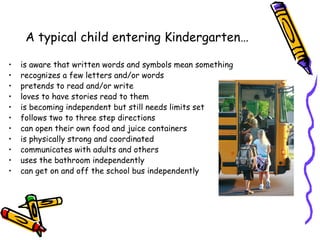
A typical child entering Kindergarten…

•   is aware that written words and symbols mean something
•   recognizes a few letters and/or words
•   pretends to read and/or write
•   loves to have stories read to them
•   is becoming independent but still needs limits set
•   follows two to three step directions
•   can open their own food and juice containers
•   is physically strong and coordinated
•   communicates with adults and others
•   uses the bathroom independently
•   can get on and off the school bus independently
Who’s in a Kindergarten class?

• Students who are 5 years old by September 1, 2012
• 1 teacher (no additional paraprofessional)

• Children in the classroom come from:
   –   PreK
   –   Head Start
   –   Early Childhood Centers (ECC)
   –   Community Daycare Centers
   –   Home
A Day In The Life
•   Arrival
•   Reading/English Language Arts
•   Lunch/Recess
•   Math
•   Specials (such as PE, Music, Technology, Media/Library and
    Art)
•   Health
•   Social Studies
•   Science
•   Dismissal
             *IEP implementation of services will be
             provided throughout the day with support
             from special education teacher
Arrival
Child will learn to INDEPENDENTLY …

• remove backpack/coat (button, zip, etc)
• follow morning unpacking routine (materials to teacher,
  personal materials in cubby/locker, lunch/lunch money to
  designated location)
• complete morning work (journal writing, read a book,
  worksheet/handout)
• attend to school morning announcements

Attendance is mandatory. Students are expected
to arrive on time, daily.
Reading/English Language Arts

• 135 Minute time block
   – Whole Group Instruction
       • Opening routines
       • Comprehension mini-lesson
       • Phonemic awareness/phonics
       • Word work
       • Writing and Language mini-lesson
       • Read aloud
   – Small Group Instruction/Guided Independent Practice
      (20 min each)
       • Teacher guided reading group
       • Literacy activity (independent work)
       • Centers (such as: library, listening, write the room,
         read the room, writing, computers)
A Balanced Reading Program is the core
reading program for Prince George’s County
Public Schools. It combines the development
of phonological awareness skills with literature
rich activities. This consists of:

• Phonemic Awareness – the ability to hear, identify and
  utilize individual sounds in spoken words
• Phonics- the relationship between the letters of written
  language and the sounds of spoken language
• Fluency- the capacity to read text accurately and quickly
• Vocabulary- the words students must know to communicate
  effectively
• Comprehension- the ability to understand and gain meaning
  from what has been read
Lunch/Recess
•   Help your child practice and learn their PIN # for their lunch
    account.
•   Remind your child to give their money to their classroom teacher
    for their lunch account.
•   Children should be able to open all containers independently, if
    bringing a lunch to school.
•   If bringing a lunch to school please remember refrigerators,
    freezers, microwaves and ovens are not available. Use a cold pack
    for items needing refrigeration.
•   Please have labels on lunch box and food items (in addition to all
    other personal items).
•   Adults are available in the cafeteria during lunch. Please teach and
    encourage your child to raise their hand if they need assistance.

Paperwork for Free and Reduced Lunches must be submitted and
   approved before it will be reflected on the students’ lunch
   account. (Remember to submit your forms)
Specials

Children may participate in one or more of the
  following:
•   Music
•   Physical Education/ Adaptive Physical Education (APE)
•   Art
•   Media Center/Library
•   Computer Lab/Technology

In some cases, children will be taught by a teacher (other than
   their classroom teacher), outside of the classroom.
Math

• 75 Minute block
   – Whole Group Instruction
      • Problem of the day
      • Manipulatives/Hands-on materials
      • Literature experience
      • Defining and developing vocabulary
   – Small Group Instruction
      • Teacher guided math group
      • Independent activity (journal, math workbook pages,
        games, etc)
      • Centers
Health
• 25 Minute Block (once a week)
   – Teacher directed and independent activities

             Maryland State Curriculum Standards
     •Mental and Emotional Health
     •Alcohol, Tobacco and other Drugs
     •Personal and Consumer Health
     •Family Law and Human Sexuality (Family Members,
     etc.)
Social Studies
• 45 Minutes (every other day)
   – Teacher directed and independent activities

              Maryland State Curriculum Standards
•   Political Science
•   Peoples of the Nations and World
•   Geography
•   Economics
•   History
•   Social Studies Skills and Processes
Science
• 45 min block
   – Whole class, small groups and lab
   – Open-ended multi level lab activities
   – Science journals

    Maryland State Curriculum Standards
   •Earth and Space
   •Life Science
   •Chemistry
   •Physics
   •Environmental Science
Dismissal


• Children will independently pack up their backpack and
  gather materials to go home.
• Any changes in dismissal routine must be given to the
  teacher in writing (i.e.- Marcus will not be riding the bus
  today, etc.).
• ANY adult picking up the student MUST be listed on their
  Emergency Card in the Main Office. Proper ID will be
  required.
• Check with your school for specific pick up and drop off
  procedures.
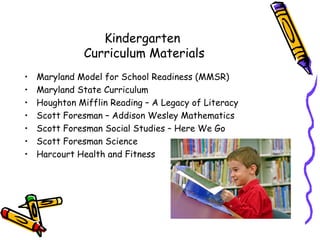
Kindergarten
               Curriculum Materials
•   Maryland Model for School Readiness (MMSR)
•   Maryland State Curriculum
•   Houghton Mifflin Reading – A Legacy of Literacy
•   Scott Foresman – Addison Wesley Mathematics
•   Scott Foresman Social Studies – Here We Go
•   Scott Foresman Science
•   Harcourt Health and Fitness
Kindergarten Assessments

•   Alphabet Identification
•   Concepts of Print
•   Writing Spree
•   Dictation
•   Directed Reading Assessment (DRA)
•   Maryland Model for School Readiness (MMSR)
•   Math Chapter Tests
What is MMSR?


 An assessment and instructional system
 Identifies for parents and teachers, what
  children know and are able to do when they begin
  school
 Composed of seven domains
Seven Domains of MMSR

• Personal and Social Development
   – How a child gets along with others and handles emotions
• Language and Literacy
   – Learning to talk, listen, read and write
   – Expressing himself and learning to understand others
• Mathematical Thinking
   – Using patterns, counting, noticing relationships and
     figuring out how to solve problems
• Scientific Thinking
   – Wondering, asking questions, finding answers and
     collecting information
Seven Domains of MMSR cont.


• Social Studies
   – How people live, work, get along together and solve
     problems
• The Arts
   – Appreciating and participating in dance, drama, music
     and art
• Physical Development
   – Muscle control and coordination
   – Meeting basic needs of food, clothing, shelter and
     regular health care
Grading and Report Cards
• Report cards are sent home quarterly (every 9 weeks)
• Interim progress reports are sent home for each child in
  the middle of each quarter
• IEP progress reports on IEP goals are sent home four times
  during the school year
• Students receive a minimum of 1 grade per week, per
  subject.
Grading Process
• Grading Scale
   –   PR – Proficient – 90-100%
   –   IP – In Process – 80-89%
   –   EM – Emerging – 70-79%
   –   ND – Needs Development – 50-69%


• Final Grades are comprised of:
   – Class work
   – Homework
   – Assessments
Family Portal


• PGCPS uses an online student information system, called
  SchoolMAX, which tracks nearly all student data, including:
       •   Contact information
       •   Attendance
       •   Grades
       •   Discipline
• Directions for use and how to access are located on the
  PGCPS website at:
  http://www1.pgcps.org/schoolmax/family/index.html
Getting Involved at School
• Remember to check the Parent Portal on a regular basis
• Volunteering
   – Check with the teacher about opportunities and/or
     needs for volunteers in the classroom and school
   – ALL volunteers/chaperones who interact with children
     MUST:
       • Have a commercial background check completed by
         Prince Georges County Public Schools
           – Cost $7

• Fingerprinting may be required in special situations
  Please contact the Fingerprinting office for details:
                      14201 School Lane Room #131
                      Upper Marlboro, MD 20772
                      301-952-6775
                      Office Hours: M-F 8am-3:45pm
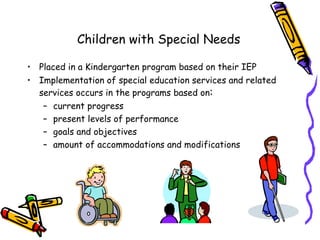
Children with Special Needs

• Placed in a Kindergarten program based on their IEP
• Implementation of special education services and related
  services occurs in the programs based on:
   – current progress
   – present levels of performance
   – goals and objectives
   – amount of accommodations and modifications
Child Find for Parentally Placed Students in
          Private and Religious Schools
                     (PARD)
• IEP students attending a private school MUST contact the
  PARD office
• Current services are provided through a service plan to
  qualified students
• Contact:
  LaRon Martin, Child Find Specialist
  John Carroll Elementary School
  1400 Nalley Terrace
  Landover, MD 20785
  301-618-8342
How to prepare your child for their
          transition to Kindergarten
•   Talk about school in a positive way
•   Visit the school (please make an appointment)
•   Visit the school’s playground
•   Share your child’s IEP with the school principal, special education
    teacher and classroom teacher.
•   Find books at the library about starting school
•   Get organized (plan for bedtime, morning routines, get supplies)
•   Create a plan with your child for the first day of school (dropping
    off, saying goodbye, etc)
•   Review bus safety, if applicable
•   Attend the systemic kindergarten orientation day with your child
•   Practice lunch PIN number during the first month of school
•   Discuss your/child's feelings about starting school; address their
    concerns
•   Inform teacher and school of any special needs/concerns your
    child may have (health, allergies, IEP, 504 plan, etc.)
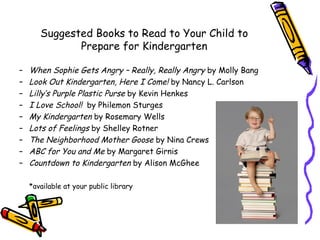
Suggested Books to Read to Your Child to
              Prepare for Kindergarten

–   When Sophie Gets Angry – Really, Really Angry by Molly Bang
–   Look Out Kindergarten, Here I Come! by Nancy L. Carlson
–   Lilly’s Purple Plastic Purse by Kevin Henkes
–   I Love School! by Philemon Sturges
–   My Kindergarten by Rosemary Wells
–   Lots of Feelings by Shelley Rotner
–   The Neighborhood Mother Goose by Nina Crews
–   ABC for You and Me by Margaret Girnis
–   Countdown to Kindergarten by Alison McGhee

    *available at your public library
Resource Websites

Parent and Family
http://www1.pgcps.org/judycenter - parent information center
http://www.familynetworks.com – Children’s Home Society & Family Services
http://www.naeyc.org/families - Nation Association for the Education of Young
         Children
http://www.readyatfive.org/resources/tips.aspx - Ready at Five parent tips


Support Information
http://www.ncpad.org – National Center on Physical Activity and Disability

http://www.nichcy.org – National Dissemination Center for Children with
Disabilities
http://www.ppmd.org – Center for Parents of Special Needs
Websites con’t.

Educational Information

http://www.readyatfive.org/facts/mmsr.aspx - facts about MMSR
http://www.mdk12.org/instruction/ensure/MMSR/index.html - MMSR
http://www.getreadytoread.org – literary activities and online games
http://www.countdowntokindergarten.org – supports transition to
   Kindergarten
http://www.gettingreadytoread.org/matriarch - school readiness
   indicators
http://www.thearcofpgc.org – support for people with disabilities and
   their families
PGCPS Offices


Board of Education – 201-952-6115
Compliance & Due Process – 301-952-6337
Early Childhood Office – 301-808-2707
Even Start – 301-431-6220
Family & Community Outreach – 301-952-2531
Fingerprinting – 301-952-6775
Head Start – 301-408-7100
Home Schooling – 301-333-1001
Judy Hoyer Family Learning Center – 301-408-6860
PGCPS Offices Cont.


Nonpublic Office - 301-985-1775
Partners for Success Parent Center – 301-952-2811
Safety Office – 301-952-6527
Special Education – 301-618-8300
Student Services – 301-952-6384
Talented & Gifted (TAG) – 301-808-3709
Transportation & Central Garage – 301-952-6570
   – Parent Complaint Line 301-780-5800
Walk-In Student Counseling & Family Support Centers –
                                            301-749-4567

Transition to Kindergarten

  • 1.
    Transition to Kindergarten Parent Night “Talk, Listen, Read, Play … Learning takes place in everyday moments”. Developed By: Andrea Grucela & Ashley Paesch
  • 2.
    What is Kindergarten? “Kindergartenforms the basis for the development of the critical academic, intellectual, social and emotional experiences and learning foundations that will guide and inform students throughout the duration of their school careers”. “The experiences are planned using the Maryland State Curriculum for Kindergarten and include reading, writing, mathematics, social studies, science and health”. www.pgcps.org/kindergarten
  • 3.
    Where will Igo to Kindergarten? • Schools are identified based on boundaries • You MUST enroll at your boundary school • Applications are accepted for Kindergarten children to attend specialty programs and charter schools (may be outside of your boundary school) – Application deadline for the 2012-2013 school year is March 16, 2011 – A lottery system is used to select applicants – Placement notifications will be mailed to parents – Early entrance applications are not accepted for specialty programs
  • 4.
    A typical childentering Kindergarten… • is aware that written words and symbols mean something • recognizes a few letters and/or words • pretends to read and/or write • loves to have stories read to them • is becoming independent but still needs limits set • follows two to three step directions • can open their own food and juice containers • is physically strong and coordinated • communicates with adults and others • uses the bathroom independently • can get on and off the school bus independently
  • 5.
    Who’s in aKindergarten class? • Students who are 5 years old by September 1, 2012 • 1 teacher (no additional paraprofessional) • Children in the classroom come from: – PreK – Head Start – Early Childhood Centers (ECC) – Community Daycare Centers – Home
  • 6.
    A Day InThe Life • Arrival • Reading/English Language Arts • Lunch/Recess • Math • Specials (such as PE, Music, Technology, Media/Library and Art) • Health • Social Studies • Science • Dismissal *IEP implementation of services will be provided throughout the day with support from special education teacher
  • 7.
    Arrival Child will learnto INDEPENDENTLY … • remove backpack/coat (button, zip, etc) • follow morning unpacking routine (materials to teacher, personal materials in cubby/locker, lunch/lunch money to designated location) • complete morning work (journal writing, read a book, worksheet/handout) • attend to school morning announcements Attendance is mandatory. Students are expected to arrive on time, daily.
  • 8.
    Reading/English Language Arts •135 Minute time block – Whole Group Instruction • Opening routines • Comprehension mini-lesson • Phonemic awareness/phonics • Word work • Writing and Language mini-lesson • Read aloud – Small Group Instruction/Guided Independent Practice (20 min each) • Teacher guided reading group • Literacy activity (independent work) • Centers (such as: library, listening, write the room, read the room, writing, computers)
  • 9.
    A Balanced ReadingProgram is the core reading program for Prince George’s County Public Schools. It combines the development of phonological awareness skills with literature rich activities. This consists of: • Phonemic Awareness – the ability to hear, identify and utilize individual sounds in spoken words • Phonics- the relationship between the letters of written language and the sounds of spoken language • Fluency- the capacity to read text accurately and quickly • Vocabulary- the words students must know to communicate effectively • Comprehension- the ability to understand and gain meaning from what has been read
  • 10.
    Lunch/Recess • Help your child practice and learn their PIN # for their lunch account. • Remind your child to give their money to their classroom teacher for their lunch account. • Children should be able to open all containers independently, if bringing a lunch to school. • If bringing a lunch to school please remember refrigerators, freezers, microwaves and ovens are not available. Use a cold pack for items needing refrigeration. • Please have labels on lunch box and food items (in addition to all other personal items). • Adults are available in the cafeteria during lunch. Please teach and encourage your child to raise their hand if they need assistance. Paperwork for Free and Reduced Lunches must be submitted and approved before it will be reflected on the students’ lunch account. (Remember to submit your forms)
  • 11.
    Specials Children may participatein one or more of the following: • Music • Physical Education/ Adaptive Physical Education (APE) • Art • Media Center/Library • Computer Lab/Technology In some cases, children will be taught by a teacher (other than their classroom teacher), outside of the classroom.
  • 12.
    Math • 75 Minuteblock – Whole Group Instruction • Problem of the day • Manipulatives/Hands-on materials • Literature experience • Defining and developing vocabulary – Small Group Instruction • Teacher guided math group • Independent activity (journal, math workbook pages, games, etc) • Centers
  • 13.
    Health • 25 MinuteBlock (once a week) – Teacher directed and independent activities Maryland State Curriculum Standards •Mental and Emotional Health •Alcohol, Tobacco and other Drugs •Personal and Consumer Health •Family Law and Human Sexuality (Family Members, etc.)
  • 14.
    Social Studies • 45Minutes (every other day) – Teacher directed and independent activities Maryland State Curriculum Standards • Political Science • Peoples of the Nations and World • Geography • Economics • History • Social Studies Skills and Processes
  • 15.
    Science • 45 minblock – Whole class, small groups and lab – Open-ended multi level lab activities – Science journals Maryland State Curriculum Standards •Earth and Space •Life Science •Chemistry •Physics •Environmental Science
  • 16.
    Dismissal • Children willindependently pack up their backpack and gather materials to go home. • Any changes in dismissal routine must be given to the teacher in writing (i.e.- Marcus will not be riding the bus today, etc.). • ANY adult picking up the student MUST be listed on their Emergency Card in the Main Office. Proper ID will be required. • Check with your school for specific pick up and drop off procedures.
  • 17.
    Kindergarten Curriculum Materials • Maryland Model for School Readiness (MMSR) • Maryland State Curriculum • Houghton Mifflin Reading – A Legacy of Literacy • Scott Foresman – Addison Wesley Mathematics • Scott Foresman Social Studies – Here We Go • Scott Foresman Science • Harcourt Health and Fitness
  • 18.
    Kindergarten Assessments • Alphabet Identification • Concepts of Print • Writing Spree • Dictation • Directed Reading Assessment (DRA) • Maryland Model for School Readiness (MMSR) • Math Chapter Tests
  • 19.
    What is MMSR? An assessment and instructional system  Identifies for parents and teachers, what children know and are able to do when they begin school  Composed of seven domains
  • 20.
    Seven Domains ofMMSR • Personal and Social Development – How a child gets along with others and handles emotions • Language and Literacy – Learning to talk, listen, read and write – Expressing himself and learning to understand others • Mathematical Thinking – Using patterns, counting, noticing relationships and figuring out how to solve problems • Scientific Thinking – Wondering, asking questions, finding answers and collecting information
  • 21.
    Seven Domains ofMMSR cont. • Social Studies – How people live, work, get along together and solve problems • The Arts – Appreciating and participating in dance, drama, music and art • Physical Development – Muscle control and coordination – Meeting basic needs of food, clothing, shelter and regular health care
  • 22.
    Grading and ReportCards • Report cards are sent home quarterly (every 9 weeks) • Interim progress reports are sent home for each child in the middle of each quarter • IEP progress reports on IEP goals are sent home four times during the school year • Students receive a minimum of 1 grade per week, per subject.
  • 23.
    Grading Process • GradingScale – PR – Proficient – 90-100% – IP – In Process – 80-89% – EM – Emerging – 70-79% – ND – Needs Development – 50-69% • Final Grades are comprised of: – Class work – Homework – Assessments
  • 24.
    Family Portal • PGCPSuses an online student information system, called SchoolMAX, which tracks nearly all student data, including: • Contact information • Attendance • Grades • Discipline • Directions for use and how to access are located on the PGCPS website at: http://www1.pgcps.org/schoolmax/family/index.html
  • 25.
    Getting Involved atSchool • Remember to check the Parent Portal on a regular basis • Volunteering – Check with the teacher about opportunities and/or needs for volunteers in the classroom and school – ALL volunteers/chaperones who interact with children MUST: • Have a commercial background check completed by Prince Georges County Public Schools – Cost $7 • Fingerprinting may be required in special situations Please contact the Fingerprinting office for details: 14201 School Lane Room #131 Upper Marlboro, MD 20772 301-952-6775 Office Hours: M-F 8am-3:45pm
  • 26.
    Children with SpecialNeeds • Placed in a Kindergarten program based on their IEP • Implementation of special education services and related services occurs in the programs based on: – current progress – present levels of performance – goals and objectives – amount of accommodations and modifications
  • 27.
    Child Find forParentally Placed Students in Private and Religious Schools (PARD) • IEP students attending a private school MUST contact the PARD office • Current services are provided through a service plan to qualified students • Contact: LaRon Martin, Child Find Specialist John Carroll Elementary School 1400 Nalley Terrace Landover, MD 20785 301-618-8342
  • 28.
    How to prepareyour child for their transition to Kindergarten • Talk about school in a positive way • Visit the school (please make an appointment) • Visit the school’s playground • Share your child’s IEP with the school principal, special education teacher and classroom teacher. • Find books at the library about starting school • Get organized (plan for bedtime, morning routines, get supplies) • Create a plan with your child for the first day of school (dropping off, saying goodbye, etc) • Review bus safety, if applicable • Attend the systemic kindergarten orientation day with your child • Practice lunch PIN number during the first month of school • Discuss your/child's feelings about starting school; address their concerns • Inform teacher and school of any special needs/concerns your child may have (health, allergies, IEP, 504 plan, etc.)
  • 29.
    Suggested Books toRead to Your Child to Prepare for Kindergarten – When Sophie Gets Angry – Really, Really Angry by Molly Bang – Look Out Kindergarten, Here I Come! by Nancy L. Carlson – Lilly’s Purple Plastic Purse by Kevin Henkes – I Love School! by Philemon Sturges – My Kindergarten by Rosemary Wells – Lots of Feelings by Shelley Rotner – The Neighborhood Mother Goose by Nina Crews – ABC for You and Me by Margaret Girnis – Countdown to Kindergarten by Alison McGhee *available at your public library
  • 30.
    Resource Websites Parent andFamily http://www1.pgcps.org/judycenter - parent information center http://www.familynetworks.com – Children’s Home Society & Family Services http://www.naeyc.org/families - Nation Association for the Education of Young Children http://www.readyatfive.org/resources/tips.aspx - Ready at Five parent tips Support Information http://www.ncpad.org – National Center on Physical Activity and Disability http://www.nichcy.org – National Dissemination Center for Children with Disabilities http://www.ppmd.org – Center for Parents of Special Needs
  • 31.
    Websites con’t. Educational Information http://www.readyatfive.org/facts/mmsr.aspx- facts about MMSR http://www.mdk12.org/instruction/ensure/MMSR/index.html - MMSR http://www.getreadytoread.org – literary activities and online games http://www.countdowntokindergarten.org – supports transition to Kindergarten http://www.gettingreadytoread.org/matriarch - school readiness indicators http://www.thearcofpgc.org – support for people with disabilities and their families
  • 32.
    PGCPS Offices Board ofEducation – 201-952-6115 Compliance & Due Process – 301-952-6337 Early Childhood Office – 301-808-2707 Even Start – 301-431-6220 Family & Community Outreach – 301-952-2531 Fingerprinting – 301-952-6775 Head Start – 301-408-7100 Home Schooling – 301-333-1001 Judy Hoyer Family Learning Center – 301-408-6860
  • 33.
    PGCPS Offices Cont. NonpublicOffice - 301-985-1775 Partners for Success Parent Center – 301-952-2811 Safety Office – 301-952-6527 Special Education – 301-618-8300 Student Services – 301-952-6384 Talented & Gifted (TAG) – 301-808-3709 Transportation & Central Garage – 301-952-6570 – Parent Complaint Line 301-780-5800 Walk-In Student Counseling & Family Support Centers – 301-749-4567