www.greenchemistry.net
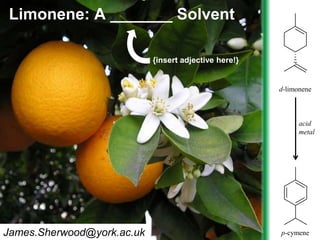
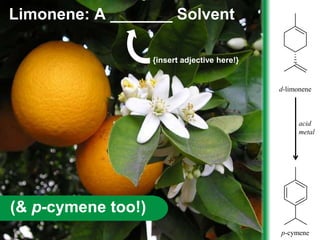
Limonene: A _______ Solvent
acid
metal
James.Sherwood@york.ac.uk
d-limonene
p-cymene
{insert adjective here!}
www.greenchemistry.net
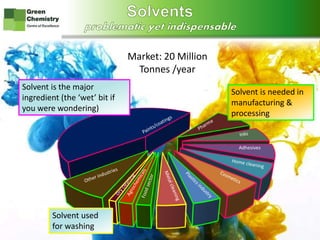
Adhesives
Solvent is the major
ingredient (the ‘wet’ bit if
you were wondering)
Solvent is needed in
manufacturing &
processing
Solvent used
for washing
Market: 20 Million
Tonnes /year
www.greenchemistry.net
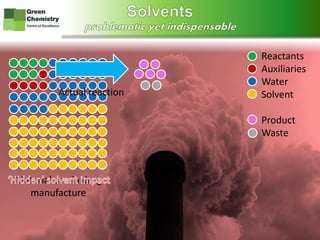
Reactants
Auxiliaries
Water
Solvent
Material use in drug
manufacture
Product
Waste
Actual reaction
www.greenchemistry.net
Water
Solvent
Product
www.greenchemistry.net
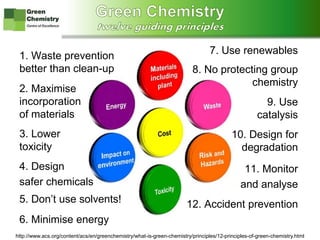
2. Maximise
incorporation
of materials
7. Use renewables
3. Lower
toxicity
4. Design
safer chemicals
12. Accident prevention
11. Monitor
and analyse
1. Waste prevention
better than clean-up
5. Don’t use solvents!
9. Use
catalysis
8. No protecting group
chemistry
6. Minimise energy
10. Design for
degradation
http://www.acs.org/content/acs/en/greenchemistry/what-is-green-chemistry/principles/12-principles-of-green-chemistry.html
www.greenchemistry.netwww.york.ac.uk/res/s4James.Sherwood@york.ac.uk
www.greenchemistry.net
Limonene: A _______ Solvent
acid
metal
d-limonene
p-cymene
(& p-cymene too!)
{insert adjective here!}
www.greenchemistry.net
Limonene: A Superior Solvent
G. Paggiola, A. J. Hunt, C. R. McElroy, J. Sherwood and J. H. Clark, Green Chem., 2014, 16, 2107.
>
>
www.greenchemistry.net
Limonene: A Superior Solvent
J. H. Clark D. J. Macquarrie and J. Sherwood, Chem. Eur. J., 2013, 19, 5174.
Product selectivity
Solvent induced
tautomerisation
www.greenchemistry.net
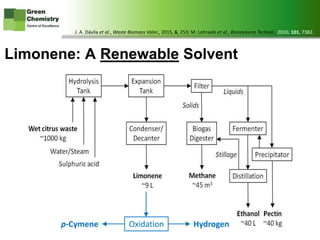
Limonene: A Renewable Solvent
Oxidationp-Cymene Hydrogen
J. A. Dávila et al., Waste Biomass Valor., 2015, 6, 253; M. Lohrasbi et al., Bioresource Technol., 2010, 101, 7382.
www.greenchemistry.net
Limonene: A Green Solvent ?
Limonene n-Hexane p-Cymene Toluene
LD50 (mg/kg) 4,440 25,000 4,750 >5,500
Chronic toxicity Nope Neurotoxic Not known Organs
Aquatic toxicity Very toxic Toxic Toxic Low-mod.
Flash point 48 °C -26 °C 47 °C 4 °C
Boiling point 176 °C 69 °C 177 °C 111 °C
Food safety GRAS - - -
Biodegradability (aerobic) slow readily readily
www.greenchemistry.net
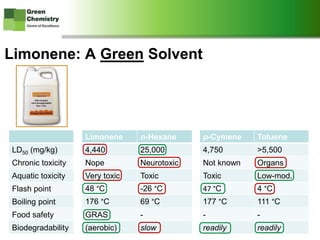
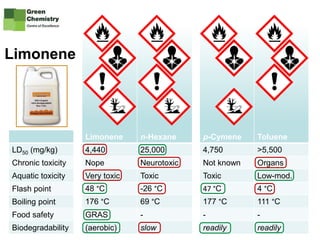
Limonene: A Green Solvent
Limonene n-Hexane p-Cymene Toluene
LD50 (mg/kg) 4,440 25,000 4,750 >5,500
Chronic toxicity Nope Neurotoxic Not known Organs
Aquatic toxicity Very toxic Toxic Toxic Low-mod.
Flash point 48 °C -26 °C 47 °C 4 °C
Boiling point 176 °C 69 °C 177 °C 111 °C
Food safety GRAS - - -
Biodegradability (aerobic) slow readily readily
www.greenchemistry.net
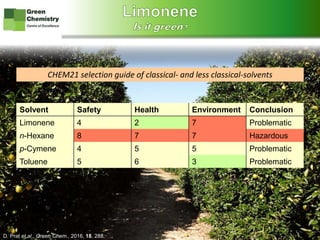
Solvent Safety Health Environment Conclusion
Limonene 4 2 7 Problematic
n-Hexane 8 7 7 Hazardous
p-Cymene 4 5 5 Problematic
Toluene 5 6 3 Problematic
D. Prat et al., Green Chem., 2016, 18, 288.
CHEM21 selection guide of classical- and less classical-solvents
www.greenchemistry.net
Limonene: An Expensive Solvent
Esters and surfactant solutions are now marketed as limonene replacements:
http://goo.gl/9EKWXY
http://goo.gl/68PE7m
http://goo.gl/QLmu8A
http://goo.gl/b0A8ta
Reason: Price
VOC content
Smell
Performance
www.greenchemistry.net
Limonene: An Air Quality Reducing Solvent
Upstream, orange groves emit large amounts of VOC chemicals
http://www.rsc.org/chemistryworld/2013/08/undiscovered-volatile-organic-
compounds-orange-groves-climate-air-pollution
J. -H. Park et al., Science, 2013, 341, 643.
• Limonene itself creates aerosols, resulting in air pollution
• POCP of alkenes (like limonene) > alkane (like n-hexane)
Richard G. Derwent, J. Air Waste Manage. Assoc., 2012, 60, 914.
• Limonene decomposes in contact with ozone to produce formaldehyde
• Using limonene cleaning products indoors can lead to sensory irritation
N. Carslaw, Atmospheric Environment, 2013, 80, 507; P. Wolkoff, Int. J. Hyg. Environ. Health, 2013, 216, 371.
www.greenchemistry.net
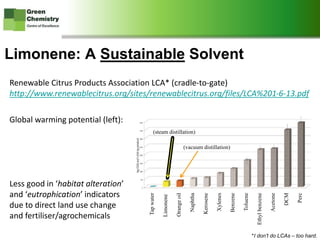
Limonene: A Sustainable Solvent ?
Renewable Citrus Products Association LCA* (cradle-to-gate)
http://www.renewablecitrus.org/sites/renewablecitrus.org/files/LCA%201-6-13.pdf
Global warming potential (left):
Less good in ‘habitat alteration’
and ‘eutrophication’ indicators
due to direct land use change
and fertiliser/agrochemicals
*I don’t do LCAs – too hard.
Tapwater
Limonene
Orangeoil
Naphtha
Kerosene
Xylenes
Benzene
Toluene
Ethylbenzene
Acetone
DCM
Perc
(steam distillation)
(vacuum distillation)
www.greenchemistry.net
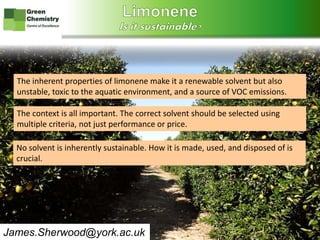
The inherent properties of limonene make it a renewable solvent but also
unstable, toxic to the aquatic environment, and a source of VOC emissions.
The context is all important. The correct solvent should be selected using
multiple criteria, not just performance or price.
No solvent is inherently sustainable. How it is made, used, and disposed of is
crucial.
James.Sherwood@york.ac.uk

Is limonene a sustainable solvent?

  • 1.
    www.greenchemistry.net Limonene: A _______Solvent acid metal James.Sherwood@york.ac.uk d-limonene p-cymene {insert adjective here!}
  • 2.
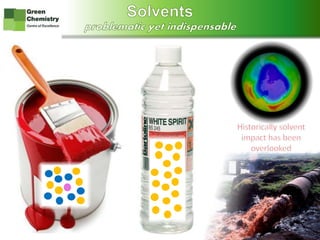
    www.greenchemistry.net Adhesives Solvent is themajor ingredient (the ‘wet’ bit if you were wondering) Solvent is needed in manufacturing & processing Solvent used for washing Market: 20 Million Tonnes /year
  • 3.
  • 4.
  • 5.
  • 6.
    www.greenchemistry.net 2. Maximise incorporation of materials 7.Use renewables 3. Lower toxicity 4. Design safer chemicals 12. Accident prevention 11. Monitor and analyse 1. Waste prevention better than clean-up 5. Don’t use solvents! 9. Use catalysis 8. No protecting group chemistry 6. Minimise energy 10. Design for degradation http://www.acs.org/content/acs/en/greenchemistry/what-is-green-chemistry/principles/12-principles-of-green-chemistry.html
  • 7.
  • 8.
    www.greenchemistry.net Limonene: A _______Solvent acid metal d-limonene p-cymene (& p-cymene too!) {insert adjective here!}
  • 9.
    www.greenchemistry.net Limonene: A SuperiorSolvent G. Paggiola, A. J. Hunt, C. R. McElroy, J. Sherwood and J. H. Clark, Green Chem., 2014, 16, 2107. > >
  • 10.
    www.greenchemistry.net Limonene: A SuperiorSolvent J. H. Clark D. J. Macquarrie and J. Sherwood, Chem. Eur. J., 2013, 19, 5174. Product selectivity Solvent induced tautomerisation
  • 11.
    www.greenchemistry.net Limonene: A RenewableSolvent Oxidationp-Cymene Hydrogen J. A. Dávila et al., Waste Biomass Valor., 2015, 6, 253; M. Lohrasbi et al., Bioresource Technol., 2010, 101, 7382.
  • 12.
    www.greenchemistry.net Limonene: A GreenSolvent ? Limonene n-Hexane p-Cymene Toluene LD50 (mg/kg) 4,440 25,000 4,750 >5,500 Chronic toxicity Nope Neurotoxic Not known Organs Aquatic toxicity Very toxic Toxic Toxic Low-mod. Flash point 48 °C -26 °C 47 °C 4 °C Boiling point 176 °C 69 °C 177 °C 111 °C Food safety GRAS - - - Biodegradability (aerobic) slow readily readily
  • 13.
    www.greenchemistry.net Limonene: A GreenSolvent Limonene n-Hexane p-Cymene Toluene LD50 (mg/kg) 4,440 25,000 4,750 >5,500 Chronic toxicity Nope Neurotoxic Not known Organs Aquatic toxicity Very toxic Toxic Toxic Low-mod. Flash point 48 °C -26 °C 47 °C 4 °C Boiling point 176 °C 69 °C 177 °C 111 °C Food safety GRAS - - - Biodegradability (aerobic) slow readily readily
  • 14.
    www.greenchemistry.net Solvent Safety HealthEnvironment Conclusion Limonene 4 2 7 Problematic n-Hexane 8 7 7 Hazardous p-Cymene 4 5 5 Problematic Toluene 5 6 3 Problematic D. Prat et al., Green Chem., 2016, 18, 288. CHEM21 selection guide of classical- and less classical-solvents
  • 15.
    www.greenchemistry.net Limonene: An ExpensiveSolvent Esters and surfactant solutions are now marketed as limonene replacements: http://goo.gl/9EKWXY http://goo.gl/68PE7m http://goo.gl/QLmu8A http://goo.gl/b0A8ta Reason: Price VOC content Smell Performance
  • 16.
    www.greenchemistry.net Limonene: An AirQuality Reducing Solvent Upstream, orange groves emit large amounts of VOC chemicals http://www.rsc.org/chemistryworld/2013/08/undiscovered-volatile-organic- compounds-orange-groves-climate-air-pollution J. -H. Park et al., Science, 2013, 341, 643. • Limonene itself creates aerosols, resulting in air pollution • POCP of alkenes (like limonene) > alkane (like n-hexane) Richard G. Derwent, J. Air Waste Manage. Assoc., 2012, 60, 914. • Limonene decomposes in contact with ozone to produce formaldehyde • Using limonene cleaning products indoors can lead to sensory irritation N. Carslaw, Atmospheric Environment, 2013, 80, 507; P. Wolkoff, Int. J. Hyg. Environ. Health, 2013, 216, 371.
  • 17.
    www.greenchemistry.net Limonene: A SustainableSolvent ? Renewable Citrus Products Association LCA* (cradle-to-gate) http://www.renewablecitrus.org/sites/renewablecitrus.org/files/LCA%201-6-13.pdf Global warming potential (left): Less good in ‘habitat alteration’ and ‘eutrophication’ indicators due to direct land use change and fertiliser/agrochemicals *I don’t do LCAs – too hard. Tapwater Limonene Orangeoil Naphtha Kerosene Xylenes Benzene Toluene Ethylbenzene Acetone DCM Perc (steam distillation) (vacuum distillation)
  • 18.
    www.greenchemistry.net The inherent propertiesof limonene make it a renewable solvent but also unstable, toxic to the aquatic environment, and a source of VOC emissions. The context is all important. The correct solvent should be selected using multiple criteria, not just performance or price. No solvent is inherently sustainable. How it is made, used, and disposed of is crucial. James.Sherwood@york.ac.uk

Editor's Notes

  • #14 Limonene “May be fatal if swallowed and enters airways.” Hence aspiration toxicity symbol – however “if it is a hydrocarbon and has a kinematic viscosity of 20,5 mm2/s or less, measured at 40 oC.” H304 applies. Cymene is not an irritant so no exclamation mark.