IS HE DEAD ?
Contents
• Introduction
• Anatomy of the brain
• Anatomy of the cranial meninges
• Types of head injury
• Hematoma & Pathophysiology
• Diagnosis
• Treatment
Introduction
Abdulmalik Sultan Alawam
Case (10) -Is he dead?
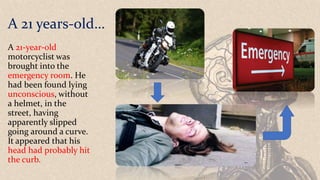
A 21-year-old motorcyclist was brought into the emergency room.
He had been found lying
unconscious, without a helmet, in the street, having apparently
slipped going around a curve. It
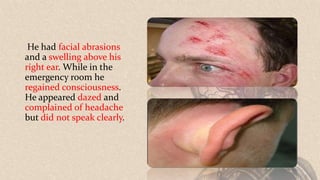
appeared that his head had probably hit the curb. He had facial
abrasions and a swelling above his right ear. While in the
emergency room he regained consciousness. He appeared dazed
and
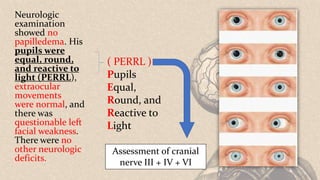
complained of headache but did not speak clearly. Neurologic
examination showed no
papilledema. His pupils were equal, round, and reactive to light
(PERRL), extraocular movements were normal, and there was
questionable left facial weakness. There were no other neurologic
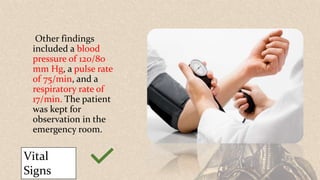
deficits. Other findings included a blood pressure of 120/80 mm
Hg, a pulse rate of 75/min, and a respiratory rate of 17/min. The
patient was kept for observation in the emergency room. Several
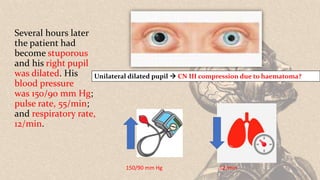
hours later the patient had become stuporous and his right pupil
was dilated. His blood pressure was 150/90 mm Hg; pulse rate,
55/min; and respiratory rate, 12/min. Emergency surgery was
undertaken.
A 21 years-old…
A 21-year-old
motorcyclist was
brought into the
emergency room. He
had been found lying
unconscious, without
a helmet, in the
street, having
apparently slipped
going around a curve.
It appeared that his
head had probably hit
the curb.
He had facial abrasions
and a swelling above his
right ear. While in the
emergency room he
regained consciousness.
He appeared dazed and
complained of headache
but did not speak clearly.
Neurologic
examination
showed no
papilledema. His
pupils were
equal, round,
and reactive to
light (PERRL),
extraocular
movements
were normal, and
there was
questionable left
facial weakness.
There were no
other neurologic
deficits.
( PERRL )
Pupils
Equal,
Round, and
Reactive to
Light
Assessment of cranial
nerve III + IV + VI
Other findings
included a blood
pressure of 120/80
mm Hg, a pulse rate
of 75/min, and a
respiratory rate of
17/min. The patient
was kept for
observation in the
emergency room.
Vital
Signs
Several hours later
the patient had
become stuporous
and his right pupil
was dilated. His
blood pressure
was 150/90 mm Hg;
pulse rate, 55/min;
and respiratory rate,
12/min.
Unilateral dilated pupil  CN III compression due to haematoma?
150/90 mm Hg 12/min
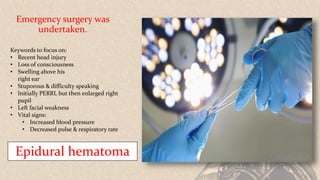
Emergency surgery was
undertaken.
Keywords to focus on:
• Recent head injury
• Loss of consciousness
• Swelling above his
right ear
• Stuporous & difficulty speaking
• Initially PERRL but then enlarged right
pupil
• Left facial weakness
• Vital signs:
• Increased blood pressure
• Decreased pulse & respiratory rate
Epidural hematoma
Anatomy Of The
Brain
Moath Abdullah Alkeaid
The Brain
The brain, a bilaterally symmetric,
soft, gelatinous structure
surrounded by its layers and
enclosed in its bony cranium, is
continuous with the spinal cord at
the foramen magnum at the base
of the skull.
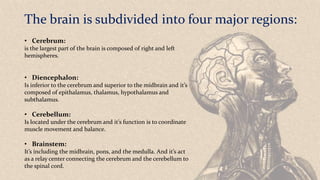
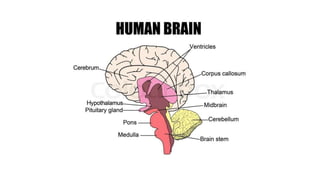
The brain is subdivided into four major regions:
• Cerebrum:
is the largest part of the brain is composed of right and left
hemispheres.
• Diencephalon:
Is inferior to the cerebrum and superior to the midbrain and it’s
composed of epithalamus, thalamus, hypothalamus and
subthalamus.
• Cerebellum:
Is located under the cerebrum and it’s function is to coordinate
muscle movement and balance.
• Brainstem:
It’s including the midbrain, pons, and the medulla. And it’s act
as a relay center connecting the cerebrum and the cerebellum to
the spinal cord.
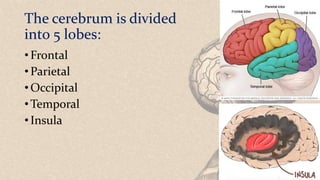
The cerebrum is divided
into 5 lobes:
• Frontal
• Parietal
• Occipital
• Temporal
• Insula
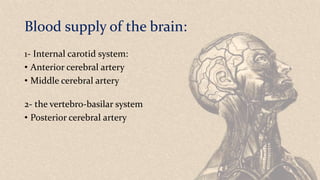
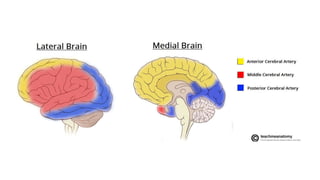
Blood supply of the brain:
1- Internal carotid system:
• Anterior cerebral artery
• Middle cerebral artery
2- the vertebro-basilar system
• Posterior cerebral artery
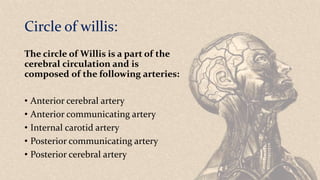
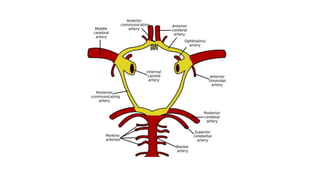
Circle of willis:
The circle of Willis is a part of the
cerebral circulation and is
composed of the following arteries:
• Anterior cerebral artery
• Anterior communicating artery
• Internal carotid artery
• Posterior communicating artery
• Posterior cerebral artery
Anatomy Of The
Cranial Meninges
Saleh Hassan Alorainy
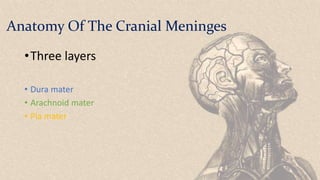
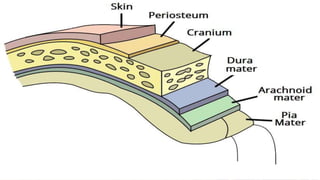
Anatomy Of The Cranial Meninges
•Three layers
• Dura mater
• Arachnoid mater
• Pia mater
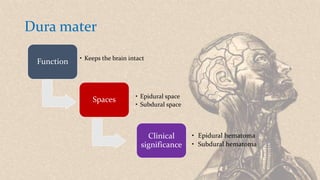
Dura mater
Spaces • Epidural space
• Subdural space
Function • Keeps the brain intact
Clinical
significance
• Epidural hematoma
• Subdural hematoma
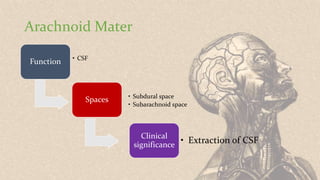
Arachnoid Mater
Spaces • Subdural space
• Subarachnoid space
Function • CSF
Clinical
significance
• Extraction of CSF
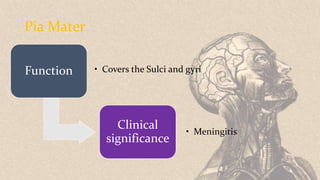
Pia Mater
Function • Covers the Sulci and gyri
Clinical
significance
• Meningitis
Types of head injury
Saleh Alorainy
Types of Head injury
• Hematoma
• Hemorrhage
• Skull fracture
• Concussion
• Diffuse axonal injury
• Edema
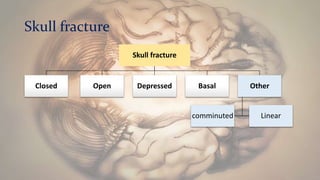
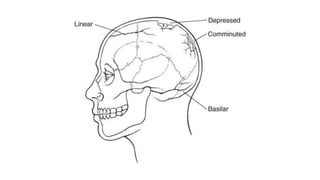
Skull fracture
Skull fracture
Closed Open Depressed Basal Other
Linearcomminuted
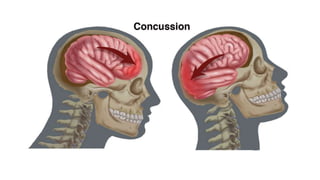
Concussion
• Mild traumatic brain injury
• Rupture of the axons
• caused by a blow to the head or violently shaking the head
• Post-concussion syndrome
Diffuse axonal injury
• Severe traumatic brain injury
• Rupture of the axons , death of the neurons
• caused by a strong blow to the head , usually by car accidents
• Can cause death.
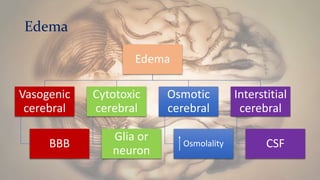
Edema
Edema
Vasogenic
cerebral
BBB
Cytotoxic
cerebral
Glia or
neuron
Osmotic
cerebral
Osmolality
Interstitial
cerebral
CSF
Hematoma and Pathophysiology
Tariq Saleh Dabil
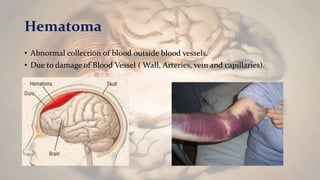
Hematoma
• Abnormal collection of blood outside blood vessels.
• Due to damage of Blood Vessel ( Wall, Arteries, vein and capillaries).
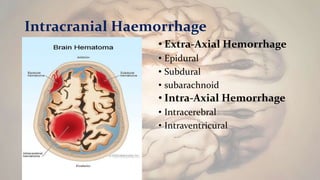
Intracranial Haemorrhage
• Extra-Axial Hemorrhage
• Epidural
• Subdural
• subarachnoid
• Intra-Axial Hemorrhage
• Intracerebral
• Intraventricural
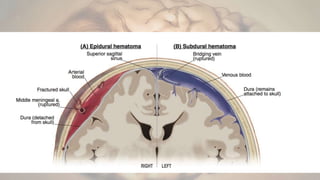
Epidural Haemorrhage
• Accumulation of blood.
• In the potential space of Skull and
Dura mater.
• Note: Spinal epidural hematoma: a hematoma between spinal vertebrae and the outside
lining of the spinal cord.
• half as common as a subdural hematomas.
• Occurs:
• Trauma (separation of periosteal dura from bone
and, indirectly, tears (lacerates) meningeal
vessels.
• Skull Fractions (70-95%)
Source of the blood: Arterial, mostly;( Middle Meningeal artery ),
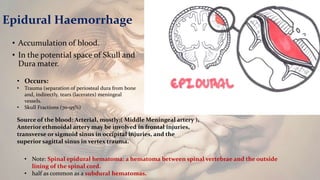
Anterior ethmoidal artery may be involved in frontal injuries,
transverse or sigmoid sinus in occipital injuries, and the
superior sagittal sinus in vertex trauma.
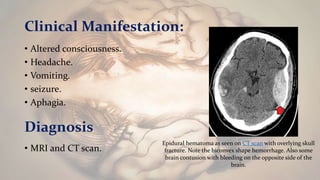
Clinical Manifestation:
• Altered consciousness.
• Headache.
• Vomiting.
• seizure.
• Aphagia.
Diagnosis
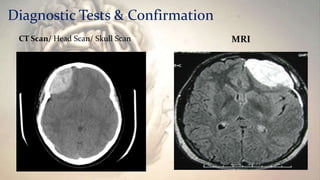
• MRI and CT scan.
Epidural hematoma as seen on CT scan with overlying skull
fracture. Note the biconvex shape hemorrhage. Also some
brain contusion with bleeding on the opposite side of the
brain.
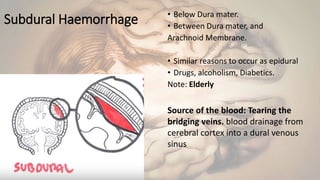
Subdural Haemorrhage • Below Dura mater.
• Between Dura mater, and
Arachnoid Membrane.
• Similar reasons to occur as epidural
• Drugs, alcoholism, Diabetics.
Note: Elderly
Source of the blood: Tearing the
bridging veins. blood drainage from
cerebral cortex into a dural venous
sinus
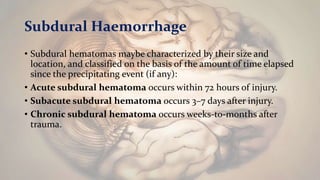
• Subdural hematomas maybe characterized by their size and
location, and classified on the basis of the amount of time elapsed
since the precipitating event (if any):
• Acute subdural hematoma occurs within 72 hours of injury.
• Subacute subdural hematoma occurs 3–7 days after injury.
• Chronic subdural hematoma occurs weeks-to-months after
trauma.
Subdural Haemorrhage
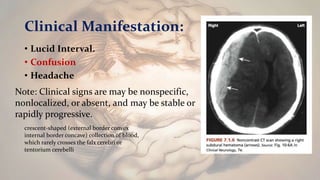
Clinical Manifestation:
• Lucid Interval.
• Confusion
• Headache
Note: Clinical signs are may be nonspecific,
nonlocalized, or absent, and may be stable or
rapidly progressive.
crescent-shaped (external border convex
internal border concave) collection of blood,
which rarely crosses the falx cerebri or
tentorium cerebelli
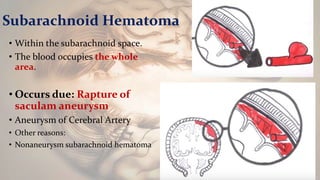
Subarachnoid Hematoma
• Within the subarachnoid space.
• The blood occupies the whole
area.
• Occurs due: Rapture of
saculam aneurysm
• Aneurysm of Cerebral Artery
• Other reasons:
• Nonaneurysm subarachnoid hematoma
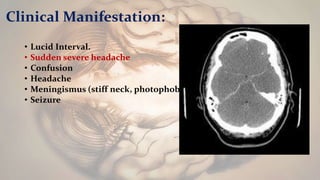
Clinical Manifestation:
• Lucid Interval.
• Sudden severe headache
• Confusion
• Headache
• Meningismus (stiff neck, photophobia)
• Seizure
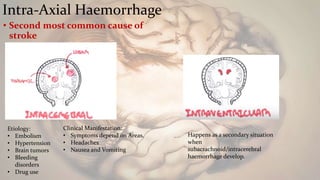
Intra-Axial Haemorrhage
• Second most common cause of
stroke
Etiology:
• Embolism
• Hypertension
• Brain tumors
• Bleeding
disorders
• Drug use
Clinical Manifestation:
• Symptoms depend on Areas.
• Headaches
• Nausea and Vomiting
Happens as a secondary situation
when
subacrachnoid/intracerebral
haemorrhage develop.
Diagnosis
Fahad Sulaiman Alhussainan
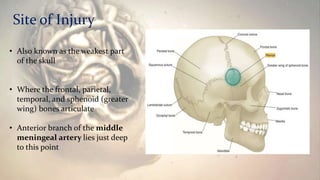
Site of Injury
• Also known as the weakest part
of the skull
• Where the frontal, parietal,
temporal, and sphenoid (greater
wing) bones articulate
• Anterior branch of the middle
meningeal artery lies just deep
to this point
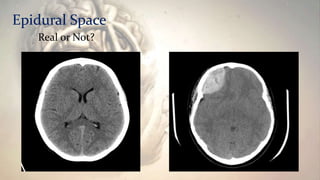
Epidural Space
Real or Not?
Signs and Symptoms
• Head injury
• Loss of consciousness
o Lucid Interval
• Confusion
• Drowsiness or altered level of alertness
• Severe Headache
• Mydriasis of one eye on the side of injury
• Muscle Weakness
o usually contralateral to the injured side
Diagnostic Tests & Confirmation
CT Scan/ Head Scan/ Skull Scan MRI
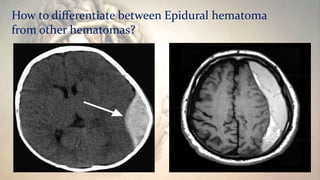
How to differentiate between Epidural hematoma
from other hematomas?
Treatment
Suliman Sultan Abuhaimad
Treatment of Epidural Hematoma
• EDH is a neurologic emergency that often requires
surgical treatment to prevent irreversible brain injury and
death caused by hematoma expansion, elevated
intracranial pressure, and brain herniation.
• Small volume of EDH can be managed non-operatively
as long as the patient remain stable.
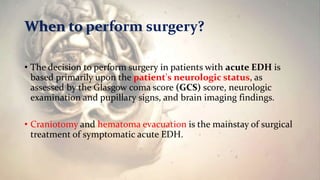
When to perform surgery?
• The decision to perform surgery in patients with acute EDH is
based primarily upon the patient's neurologic status, as
assessed by the Glasgow coma score (GCS) score, neurologic
examination and pupillary signs, and brain imaging findings.
• Craniotomy and hematoma evacuation is the mainstay of surgical
treatment of symptomatic acute EDH.
Treatment of Epidural Hematoma
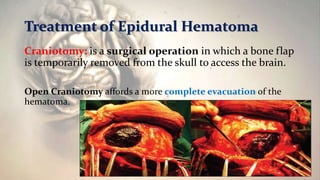
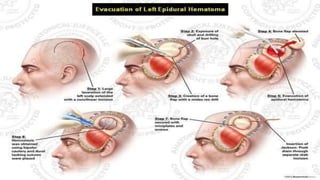
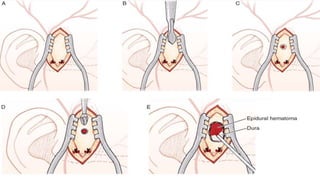
Craniotomy: is a surgical operation in which a bone flap
is temporarily removed from the skull to access the brain.
Open Craniotomy affords a more complete evacuation of the
hematoma.
Treatment of Epidural Hematoma
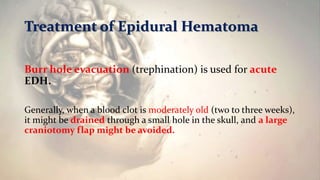
Burr hole evacuation (trephination) is used for acute
EDH.
Generally, when a blood clot is moderately old (two to three weeks),
it might be drained through a small hole in the skull, and a large
craniotomy flap might be avoided.
Medications
Medications used in addition to surgery will vary according to the type
and severity of symptoms and brain damage that occurs.
1-Hyperosmotic agents (like mannitol, glycerol, and hypertonic saline)
may be used to reduce inflammation and swelling in the brain.
2-Anti-seizures medications (such as phenytoin) may be used to
control or prevent seizures.
This Seminar was done by:-
1. Abdulmalik Sultan Alawam
2. Moath Abdullah Alkeaid
3. Saleh Hassan Alorainy
4. Tariq Saleh Dabil
5. Fahad Sulaiman Alhussainan
6. Suliman Sultan Abuhaimad
THANK YOU!

Is he dead ?

  • 1.
  • 2.
    Contents • Introduction • Anatomyof the brain • Anatomy of the cranial meninges • Types of head injury • Hematoma & Pathophysiology • Diagnosis • Treatment
  • 3.
  • 4.
    Case (10) -Ishe dead? A 21-year-old motorcyclist was brought into the emergency room. He had been found lying unconscious, without a helmet, in the street, having apparently slipped going around a curve. It appeared that his head had probably hit the curb. He had facial abrasions and a swelling above his right ear. While in the emergency room he regained consciousness. He appeared dazed and complained of headache but did not speak clearly. Neurologic examination showed no papilledema. His pupils were equal, round, and reactive to light (PERRL), extraocular movements were normal, and there was questionable left facial weakness. There were no other neurologic deficits. Other findings included a blood pressure of 120/80 mm Hg, a pulse rate of 75/min, and a respiratory rate of 17/min. The patient was kept for observation in the emergency room. Several hours later the patient had become stuporous and his right pupil was dilated. His blood pressure was 150/90 mm Hg; pulse rate, 55/min; and respiratory rate, 12/min. Emergency surgery was undertaken.
  • 5.
    A 21 years-old… A21-year-old motorcyclist was brought into the emergency room. He had been found lying unconscious, without a helmet, in the street, having apparently slipped going around a curve. It appeared that his head had probably hit the curb.
  • 6.
    He had facialabrasions and a swelling above his right ear. While in the emergency room he regained consciousness. He appeared dazed and complained of headache but did not speak clearly.
  • 7.
    Neurologic examination showed no papilledema. His pupilswere equal, round, and reactive to light (PERRL), extraocular movements were normal, and there was questionable left facial weakness. There were no other neurologic deficits. ( PERRL ) Pupils Equal, Round, and Reactive to Light Assessment of cranial nerve III + IV + VI
  • 8.
    Other findings included ablood pressure of 120/80 mm Hg, a pulse rate of 75/min, and a respiratory rate of 17/min. The patient was kept for observation in the emergency room. Vital Signs
  • 9.
    Several hours later thepatient had become stuporous and his right pupil was dilated. His blood pressure was 150/90 mm Hg; pulse rate, 55/min; and respiratory rate, 12/min. Unilateral dilated pupil  CN III compression due to haematoma? 150/90 mm Hg 12/min
  • 10.
    Emergency surgery was undertaken. Keywordsto focus on: • Recent head injury • Loss of consciousness • Swelling above his right ear • Stuporous & difficulty speaking • Initially PERRL but then enlarged right pupil • Left facial weakness • Vital signs: • Increased blood pressure • Decreased pulse & respiratory rate Epidural hematoma
  • 11.
  • 12.
    The Brain The brain,a bilaterally symmetric, soft, gelatinous structure surrounded by its layers and enclosed in its bony cranium, is continuous with the spinal cord at the foramen magnum at the base of the skull.
  • 13.
    The brain issubdivided into four major regions: • Cerebrum: is the largest part of the brain is composed of right and left hemispheres. • Diencephalon: Is inferior to the cerebrum and superior to the midbrain and it’s composed of epithalamus, thalamus, hypothalamus and subthalamus. • Cerebellum: Is located under the cerebrum and it’s function is to coordinate muscle movement and balance. • Brainstem: It’s including the midbrain, pons, and the medulla. And it’s act as a relay center connecting the cerebrum and the cerebellum to the spinal cord.
  • 15.
    The cerebrum isdivided into 5 lobes: • Frontal • Parietal • Occipital • Temporal • Insula
  • 16.
    Blood supply ofthe brain: 1- Internal carotid system: • Anterior cerebral artery • Middle cerebral artery 2- the vertebro-basilar system • Posterior cerebral artery
  • 18.
    Circle of willis: Thecircle of Willis is a part of the cerebral circulation and is composed of the following arteries: • Anterior cerebral artery • Anterior communicating artery • Internal carotid artery • Posterior communicating artery • Posterior cerebral artery
  • 20.
    Anatomy Of The CranialMeninges Saleh Hassan Alorainy
  • 21.
    Anatomy Of TheCranial Meninges •Three layers • Dura mater • Arachnoid mater • Pia mater
  • 23.
    Dura mater Spaces •Epidural space • Subdural space Function • Keeps the brain intact Clinical significance • Epidural hematoma • Subdural hematoma
  • 24.
    Arachnoid Mater Spaces •Subdural space • Subarachnoid space Function • CSF Clinical significance • Extraction of CSF
  • 25.
    Pia Mater Function •Covers the Sulci and gyri Clinical significance • Meningitis
  • 26.
    Types of headinjury Saleh Alorainy
  • 27.
    Types of Headinjury • Hematoma • Hemorrhage • Skull fracture • Concussion • Diffuse axonal injury • Edema
  • 28.
    Skull fracture Skull fracture ClosedOpen Depressed Basal Other Linearcomminuted
  • 30.
    Concussion • Mild traumaticbrain injury • Rupture of the axons • caused by a blow to the head or violently shaking the head • Post-concussion syndrome
  • 32.
    Diffuse axonal injury •Severe traumatic brain injury • Rupture of the axons , death of the neurons • caused by a strong blow to the head , usually by car accidents • Can cause death.
  • 34.
  • 35.
  • 36.
    Hematoma • Abnormal collectionof blood outside blood vessels. • Due to damage of Blood Vessel ( Wall, Arteries, vein and capillaries).
  • 37.
    Intracranial Haemorrhage • Extra-AxialHemorrhage • Epidural • Subdural • subarachnoid • Intra-Axial Hemorrhage • Intracerebral • Intraventricural
  • 38.
    Epidural Haemorrhage • Accumulationof blood. • In the potential space of Skull and Dura mater. • Note: Spinal epidural hematoma: a hematoma between spinal vertebrae and the outside lining of the spinal cord. • half as common as a subdural hematomas. • Occurs: • Trauma (separation of periosteal dura from bone and, indirectly, tears (lacerates) meningeal vessels. • Skull Fractions (70-95%) Source of the blood: Arterial, mostly;( Middle Meningeal artery ), Anterior ethmoidal artery may be involved in frontal injuries, transverse or sigmoid sinus in occipital injuries, and the superior sagittal sinus in vertex trauma.
  • 39.
    Clinical Manifestation: • Alteredconsciousness. • Headache. • Vomiting. • seizure. • Aphagia. Diagnosis • MRI and CT scan. Epidural hematoma as seen on CT scan with overlying skull fracture. Note the biconvex shape hemorrhage. Also some brain contusion with bleeding on the opposite side of the brain.
  • 40.
    Subdural Haemorrhage •Below Dura mater. • Between Dura mater, and Arachnoid Membrane. • Similar reasons to occur as epidural • Drugs, alcoholism, Diabetics. Note: Elderly Source of the blood: Tearing the bridging veins. blood drainage from cerebral cortex into a dural venous sinus
  • 41.
    • Subdural hematomasmaybe characterized by their size and location, and classified on the basis of the amount of time elapsed since the precipitating event (if any): • Acute subdural hematoma occurs within 72 hours of injury. • Subacute subdural hematoma occurs 3–7 days after injury. • Chronic subdural hematoma occurs weeks-to-months after trauma. Subdural Haemorrhage
  • 42.
    Clinical Manifestation: • LucidInterval. • Confusion • Headache Note: Clinical signs are may be nonspecific, nonlocalized, or absent, and may be stable or rapidly progressive. crescent-shaped (external border convex internal border concave) collection of blood, which rarely crosses the falx cerebri or tentorium cerebelli
  • 44.
    Subarachnoid Hematoma • Withinthe subarachnoid space. • The blood occupies the whole area. • Occurs due: Rapture of saculam aneurysm • Aneurysm of Cerebral Artery • Other reasons: • Nonaneurysm subarachnoid hematoma
  • 45.
    Clinical Manifestation: • LucidInterval. • Sudden severe headache • Confusion • Headache • Meningismus (stiff neck, photophobia) • Seizure
  • 46.
    Intra-Axial Haemorrhage • Secondmost common cause of stroke Etiology: • Embolism • Hypertension • Brain tumors • Bleeding disorders • Drug use Clinical Manifestation: • Symptoms depend on Areas. • Headaches • Nausea and Vomiting Happens as a secondary situation when subacrachnoid/intracerebral haemorrhage develop.
  • 47.
  • 48.
    Site of Injury •Also known as the weakest part of the skull • Where the frontal, parietal, temporal, and sphenoid (greater wing) bones articulate • Anterior branch of the middle meningeal artery lies just deep to this point
  • 49.
  • 50.
    Signs and Symptoms •Head injury • Loss of consciousness o Lucid Interval • Confusion • Drowsiness or altered level of alertness • Severe Headache • Mydriasis of one eye on the side of injury • Muscle Weakness o usually contralateral to the injured side
  • 51.
    Diagnostic Tests &Confirmation CT Scan/ Head Scan/ Skull Scan MRI
  • 52.
    How to differentiatebetween Epidural hematoma from other hematomas?
  • 53.
  • 54.
    Treatment of EpiduralHematoma • EDH is a neurologic emergency that often requires surgical treatment to prevent irreversible brain injury and death caused by hematoma expansion, elevated intracranial pressure, and brain herniation. • Small volume of EDH can be managed non-operatively as long as the patient remain stable.
  • 55.
    When to performsurgery? • The decision to perform surgery in patients with acute EDH is based primarily upon the patient's neurologic status, as assessed by the Glasgow coma score (GCS) score, neurologic examination and pupillary signs, and brain imaging findings. • Craniotomy and hematoma evacuation is the mainstay of surgical treatment of symptomatic acute EDH.
  • 56.
    Treatment of EpiduralHematoma Craniotomy: is a surgical operation in which a bone flap is temporarily removed from the skull to access the brain. Open Craniotomy affords a more complete evacuation of the hematoma.
  • 58.
    Treatment of EpiduralHematoma Burr hole evacuation (trephination) is used for acute EDH. Generally, when a blood clot is moderately old (two to three weeks), it might be drained through a small hole in the skull, and a large craniotomy flap might be avoided.
  • 60.
    Medications Medications used inaddition to surgery will vary according to the type and severity of symptoms and brain damage that occurs. 1-Hyperosmotic agents (like mannitol, glycerol, and hypertonic saline) may be used to reduce inflammation and swelling in the brain. 2-Anti-seizures medications (such as phenytoin) may be used to control or prevent seizures.
  • 61.
    This Seminar wasdone by:- 1. Abdulmalik Sultan Alawam 2. Moath Abdullah Alkeaid 3. Saleh Hassan Alorainy 4. Tariq Saleh Dabil 5. Fahad Sulaiman Alhussainan 6. Suliman Sultan Abuhaimad
  • 62.

Editor's Notes

  • #37  A hematoma is an abnormal collection of blood outside of a blood vessel. It occurs because the wall of a blood vessel wall, artery, vein, or capillary, has been damaged and blood has leaked into tissues where it does not belong. The hematoma may be tiny, with just a dot of blood, or it can be large and cause significant swelling. Hematomas can be seen under the skin or nails as purplish bruises of different sizes. Skin bruises can also be called contusions. Hematomas can also happen deep inside the body where they may not be visible. Hematomas may sometimes form a mass or lump that can be felt. Sometimes hematomas are named based on their location.
  • #49 The pterion, a point of clinical significance, is a small region on the lateral skull where the frontal, parietal, temporal, and sphenoid (greater wing) bones articulate. The sutures involved in these articulations describe an “H” pattern. The pterion is one of the weakest parts of the skull as the bone is very thin. It is clinically important because the frontal (anterior) branch of the middle meningeal artery lies just deep to this point on the inner aspect of the skull. Trauma at this site may rupture this vessel and cause an epidural hematoma.
  • #51 Head injury: Most commonly, the trauma is in the tem- poroparietal region (pterion) and involves the middle meningeal artery . Pterion (the weakest part of skull) Lucid interval: is a temporary improvement in a patient's condition after a traumatic brain injury, after which the condition deteriorates. Mydriasis due to compression of Oculomotor nerve. Mydriasis = same side of hematoma Weakness = opposite side of hematoma
  • #52 EDHs are usually limited in their extent by the cranial sutures, as the periosteum crosses through the suture continuous with the outer periosteal layer. This is therefore helpful in distinguishing EDHs from subdural haematomas, which are not limited by sutures.
  • #55 Serious epidural hematomas require surgery to drain the blood and release the pressure on the brain. Time is brain in this case, just like for a stroke. Surgeons will typically remove a portion of the skull and drain the hematoma. Afterward, a drain might need to be installed for a day or so to let any additional bleeding out.
  • #56 The Glasgow Coma Scale (GCS) is a neurological scale which aims to give a reliable and objective way of recording the conscious state of a person for initial as well as subsequent assessment
  • #59 Burr hole evacuation is to make an opening in the skull and let the blood drain from it
  • #61 1-(Before surgery). 2-(After surgery). 3- Additionally, a doctor may prescribe or recommend pain medication or anti-inflammatory drugs to ease a person's recovery.