Is Anti-Virus Dead?
Aryeh Goretsky, Distinguished Researcher
October 21, 2015
#ESETCast
Aryeh Goretsky
Distinguished Researcher
Aryeh is ESET’s Distinguished Researcher and
has been with the company for over nine years.
A twenty-six year veteran of fighting viruses,
today he is responsible for threatscape
monitoring, investigations and working with
researchers in and outside of ESET globally.
He was the first employee at McAfee and is a
veteran of several software and networking
startups. He has received industry awards from
Microsoft, Lenovo and Securing our eCity for his
efforts to help make computing safer.
#ESETCast
Agenda
• Overview of the death of AV (1980s-today)
• History of threats
• History of defenses
• What is malware, anyways?
• What is anti-malware?
• Virus Bulletin 2015 highlights (if I have time)
• Q&A
#ESETCast
Not on the Agenda
This is an overview-level presentation, not a deep dive
session. Not going to drill down into:
• history of viruses
• history of anti-virus software
• examples of next-gen technology
• not going to be very ESET-specific
While mentioned in passing, each of these is a multi-hour
discussion by itself.
#ESETCast
Who says ‘AV is dead,’ anyways?
#ESETCast
Why say ‘AV is dead?,’ anyways
The question of anti-malware software being
dead comes up perennially. Why is that?
• those who do not understand the problem
• those who do not understand the solution
• those who are financially motivated
• those who have hidden agendas
#ESETCast
Choice words
“For me for the last three years I’ve been
feeling that the anti-virus industry sucks.
If you have 5.5 million new viruses out
there how can you claim this industry is
doing the right job?”
— Eva Chen (2008)
CEO, Trend Micro
#ESETCast
Choice words
“Antivirus ‘is dead.’ We don’t think of
antivirus as a moneymaker in any way.”
— Brian Dye (2014)
SVP Information Security, Symantec*
*Mr. Dye is no longer with Symantec
#ESETCast
Choice words recontextualized
Sometimes, it comes from within the anti-
malware industry. Why?
• it’s easy to get quoted out of context
– questions get reframed, cherry-picked, etc.
• people have agendas
– responding to criticism
– boosting shareholder value
– getting a lot of page views
#ESETCast
A Quick History of Viruses
#ESETCast
DEFINITION
Virus (n.) – A computer program that modifies
other computer programs to include a copy of
itself, i.e, they exhibit parasitism. Computer
viruses can be said to be recursively self-
replicating.
(a generally-accepted industry definition)
#ESETCast
Fred Cohen’s Ph.D thesis Computer Viruses –
Theory and Experiments is published in 1984.
First definition of a “computer virus” as:
a computer program that can affect other computer programs
by modifying them in such a way as to include a (possibly
evolved) copy of itself *
#ESETCast
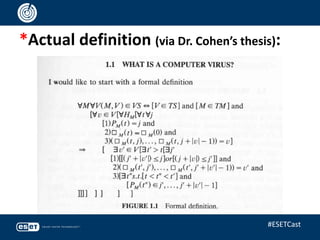
*Actual definition (via Dr. Cohen’s thesis):
#ESETCast
A Quick History of Anti-virus
#ESETCast
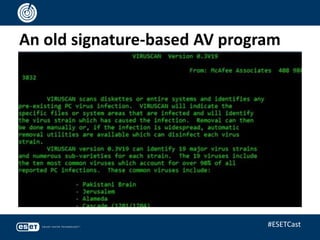
An old signature-based AV program
#ESETCast
Defining Anti-Virus
In 1984, Dr. Cohen also described the three
atomic (or fundamental) techniques used to
detect computer viruses:
• behavior blocking
• change detection
• signature matching
(fingerprint, pattern, hash, etc.)
#ESETCast
Defining Anti-Virus
In 1984, Dr. Cohen also described the three
atomic (or fundamental) techniques used to
detect computer viruses:
• behavior blocking
• change detection
• signature matching
(fingerprint, pattern, hash, etc.)
I don’t have formal mathematical proofs for these. Sorry.
#ESETCast
Defining Anti-Malware
That was over 30 years ago. Today’s threats:
• are more sophisticated
• are more dangerous
– financially motivated (selling spam, bot, DDoS...)
– espionage (economic, intelligence, military…)
• require new concepts & ideas for defending
systems
#ESETCast
Defining Anti-Malware
Today, all modern security programs use a
broad range of techniques to detect these
sophisticated threats using the following
fundamentals:
#ESETCast
Defining Anti-Malware
Today, all modern programs use a broad range
of techniques to detect these sophisticated
threats using the following fundamentals:
• Behavior blocking
• Change detection
• Signature matching
(fingerprint, pattern, hash, etc.)
#ESETCast
Defining Anti-Malware
Today, all modern programs use a broad range
of techniques to detect these sophisticated
threats using the following atomic methods:
• Behavior blocking
• Change detection
• Signature matching
(fingerprint, pattern, hash, etc.)
Often when saying “they’re not AV.” 
#ESETCast
Do you think Anti-virus is dead?
Polling Question
 Yes
 No
 Don’t know
#ESETCast
Malicious Software
• An umbrella term encompassing all malicious
software (malware)
• Overwhelming majority of malware these
days is non-viral in nature:
– not self-replicating
– not parasitic
• Many different types, no universal
agreement about classification
#ESETCast
Some malware types
• Adware
• Agents
• APTs
• Backdoor
• Bootkits
• Bots
• Botnets
• C&C servers
• DDoS
• Dialers
• Downloaders
• Droppers
• Exploit Kits
• Hoaxes
• Keyloggers
• Packers/crypters
• Memory-only processes
• Phishes
• PUAs
• Ransomware
• Remote Access Tools
• Rootkits
• Spyware
• Trojans
• Viruses
• Web Injects
• Worms
• Zero-days
• Zombies
#ESETCast
To put things in perspective:
These days, when people are
talking about computer viruses,
they usually mean some other
kind of malware.
#ESETCast
Why call it Anti-Virus?
Public has awareness of computer viruses:
So they know they need to buy “AV”
software to protect themselves.
#ESETCast
AV Perception
• Lack of understanding how anti-
malware (née -virus) works, even from
other parts of security industry.
• Think that if programs don’t provide
100% protection they provide 0%
protection.
• Assume programs are simply matching
hex strings, checksums, hashes, other
predetermined values.
#ESETCast
What people think signatures are
• Old technologies like fingerprint, pattern-
matching, CRC-driven signatures were getting
phased out in the mid-1990s
• Some were relatively sophisticated (regex,
fuzzy logic, similarity matching, heuristics,
etc.)
• May still be used for legacy detection (DOS,
Classic Mac) in some cases
#ESETCast
What signatures really are
At anti-malware firms, signatures are scripts or
macros written in their proprietary languages used for
describing:
• Packers, cryptors, obfuscators
(automatically detect + decrypt)
• Multiple families of malware
(covers several families + variants, accounts for polymorphism, etc.)
• Heuristics
(behaviors repeatedly observed in malware…)
• Cloud API Calls
(reputational/server-side analysis...)
Think of them as maps of malicious behavior.
#ESETCast
Are Viruses Still Even a Problem?
• Viruses account for <10% threats seen daily
• Viruses are never going to be extinct.
• Attackers will blend techniques from them
and other malicious programs
• Criminals want your money and will look for
ways to continue stealing it
#ESETCast
Building Better Anti-Malware
30-year-old+ ideas can today be applied, used
and even combined in new & interesting ways.
When you get it right you can:
• Improve security
• Increase performance
• Reduce false positives
#ESETCast
‘Modern’ Anti-Malware Techniques
CODE-SIGNING
• change detection
CLOUD-BASED
• client/server computing model
• move CPU intensive activities from local PC
to anti-malware company’s servers
CONTEXT SENSITIVITY
• use riskier signatures, heuristic thresholds
• more likely to generate false positives on
downloads, but that’s OK
#ESETCast
‘Modern’ Anti-Malware Techniques
DETONATION CHAMBER
• behavioral analysis inside emulator or
sandbox
• Determination based on codified set of rules
(aka signatures)
GENERIC DETECTION
• teaching neural networks to…
– create signatures for families (easy)
– but not cause false positives (hard)
INDICATORS OF COMPROMISE (IOCs)
• signatures for evidence of infection
#ESETCast
‘Modern’ Anti-Malware Techniques
HEURISTICS
• metasignatures derived from observed
behavior, other signatures, etc.
• signatures calculated for behaviors
HIPS
• behavior blocking… for applications
NIDS
• signatures… for malicious network traffic
WHITELISTING
• change detection
#ESETCast
How many new malware samples do you
think the ESET virus lab sees per day?
Quiz Question
 250
 2,500
 25,000
 250,000
 2,500,000
#ESETCast
The smörgåsbord of techniques
Can you use new and old tech to protect PCs?
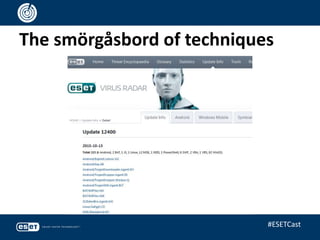
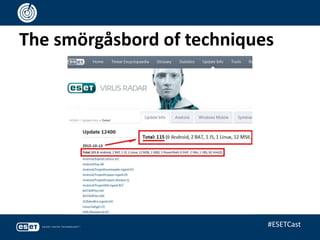
• ESET receives about 250,000 new samples of
malware a day
• ESET does not add 250,000 signatures a day
Would anyone care to make a guess how many
signatures ESET adds a day?
#ESETCast
The smörgåsbord of techniques
#ESETCast
The smörgåsbord of techniques
#ESETCast
The smörgåsbord of techniques
Anti-malware software can
• block 100s-1,000s of malware samples a day
using specific signatures
• block 100,000s of malware samples a day
using other techniques (generic + heuristic signatures, etc.)
*Keep in mind, a single signature might detect a family of
malware that has billions of permutations
#ESETCast
Recap
Next generation security programs are based
on three fundamental, atomic mechanisms:
• Behavior blocking
• Change detection
• Signature matching
So are “old” anti-virus/anti-malware programs.
#ESETCast
Recap
What does this all mean, though?
• Even the oldest technologies can be applied
in novel ways
• It is important to keep track of research
• Innovations can occur both inside and
outside the anti-malware space
• Keep on researchin’
#ESETCast
#ESETCast
Virus Bulletin 2015 highlights
Economic sanctions on malware
Prof. Igor Muttik Intel Security
• increase costs to malware ecosystem
– technologies to de-incentivize malware authors
#ESETCast
Virus Bulletin 2015 highlights
The Kobayashi Maru Dilemma*
Morton Swimmer, Trend Micro; Nick FitzGerald,
independent researcher; Andrew Lee, ESET
• Offensive hacking
– Is attacking the attackers legal? Ethical?
*bonus points for Star trek reference
#ESETCast
Virus Bulletin 2015 highlights
discussions about
• APTs
• Certificate technologies
• Linux malware
• Packers
#ESETCast
I would like to request one of the
following
Polling Question
 Contact from ESET Sales
 Technical Demo
 Business trial
 Information on becoming a Reseller Partner
or MSP
 None of the Above
#ESETCast
Q+A Discussion
#ESETCast
Bibliography
• Dr. Fred Cohen’s web site: http://all.net/
• Paper: Hype heuristics, signatures and the death of AV
(again) – Virus Bulletin
• Presentation: Economic sanctions on malware - Virus
Bulletin
• Presentation: The Kobayashi Maru Dilemma - Virus Bulletin
• Signatures, product testing, and the lingering death of AV –
We Live Security
• Symantec Develops New Attack on Cyberhacking – Wall
Street Journal
• Trend Micro's CEO says 'AV industry sucks' – The Register
#ESETCast
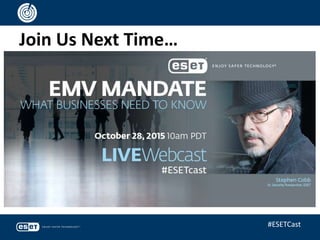
Join Us Next Time…
#ESETCast
Thank You
No presentation gets done in a void, and I’d like to
thank my co-workers for their assistance:
Bruce P. Burrell, Jakub Debski, David Harley, Juraj
Malcho, Roman Kováč & Thomas Uhlemann
And thank you for attending!
#ESETCast
Aryeh Goretsky
WWW.ESET.COM
WWW.WELIVESECURITY.COM
aryeh.goretsky@eset.com
@goretsky (personal) / @esetna / @welivesecurity
/u/goretsky
fb.com/goretsky
#ESETCast

Is Anti-Virus Dead?

  • 1.
    Is Anti-Virus Dead? AryehGoretsky, Distinguished Researcher October 21, 2015 #ESETCast
  • 2.
    Aryeh Goretsky Distinguished Researcher Aryehis ESET’s Distinguished Researcher and has been with the company for over nine years. A twenty-six year veteran of fighting viruses, today he is responsible for threatscape monitoring, investigations and working with researchers in and outside of ESET globally. He was the first employee at McAfee and is a veteran of several software and networking startups. He has received industry awards from Microsoft, Lenovo and Securing our eCity for his efforts to help make computing safer. #ESETCast
  • 3.
    Agenda • Overview ofthe death of AV (1980s-today) • History of threats • History of defenses • What is malware, anyways? • What is anti-malware? • Virus Bulletin 2015 highlights (if I have time) • Q&A #ESETCast
  • 4.
    Not on theAgenda This is an overview-level presentation, not a deep dive session. Not going to drill down into: • history of viruses • history of anti-virus software • examples of next-gen technology • not going to be very ESET-specific While mentioned in passing, each of these is a multi-hour discussion by itself. #ESETCast
  • 5.
    Who says ‘AVis dead,’ anyways? #ESETCast
  • 6.
    Why say ‘AVis dead?,’ anyways The question of anti-malware software being dead comes up perennially. Why is that? • those who do not understand the problem • those who do not understand the solution • those who are financially motivated • those who have hidden agendas #ESETCast
  • 7.
    Choice words “For mefor the last three years I’ve been feeling that the anti-virus industry sucks. If you have 5.5 million new viruses out there how can you claim this industry is doing the right job?” — Eva Chen (2008) CEO, Trend Micro #ESETCast
  • 8.
    Choice words “Antivirus ‘isdead.’ We don’t think of antivirus as a moneymaker in any way.” — Brian Dye (2014) SVP Information Security, Symantec* *Mr. Dye is no longer with Symantec #ESETCast
  • 9.
    Choice words recontextualized Sometimes,it comes from within the anti- malware industry. Why? • it’s easy to get quoted out of context – questions get reframed, cherry-picked, etc. • people have agendas – responding to criticism – boosting shareholder value – getting a lot of page views #ESETCast
  • 10.
    A Quick Historyof Viruses #ESETCast
  • 11.
    DEFINITION Virus (n.) –A computer program that modifies other computer programs to include a copy of itself, i.e, they exhibit parasitism. Computer viruses can be said to be recursively self- replicating. (a generally-accepted industry definition) #ESETCast
  • 12.
    Fred Cohen’s Ph.Dthesis Computer Viruses – Theory and Experiments is published in 1984. First definition of a “computer virus” as: a computer program that can affect other computer programs by modifying them in such a way as to include a (possibly evolved) copy of itself * #ESETCast
  • 13.
    *Actual definition (viaDr. Cohen’s thesis): #ESETCast
  • 14.
    A Quick Historyof Anti-virus #ESETCast
  • 15.
    An old signature-basedAV program #ESETCast
  • 16.
    Defining Anti-Virus In 1984,Dr. Cohen also described the three atomic (or fundamental) techniques used to detect computer viruses: • behavior blocking • change detection • signature matching (fingerprint, pattern, hash, etc.) #ESETCast
  • 17.
    Defining Anti-Virus In 1984,Dr. Cohen also described the three atomic (or fundamental) techniques used to detect computer viruses: • behavior blocking • change detection • signature matching (fingerprint, pattern, hash, etc.) I don’t have formal mathematical proofs for these. Sorry. #ESETCast
  • 18.
    Defining Anti-Malware That wasover 30 years ago. Today’s threats: • are more sophisticated • are more dangerous – financially motivated (selling spam, bot, DDoS...) – espionage (economic, intelligence, military…) • require new concepts & ideas for defending systems #ESETCast
  • 19.
    Defining Anti-Malware Today, allmodern security programs use a broad range of techniques to detect these sophisticated threats using the following fundamentals: #ESETCast
  • 20.
    Defining Anti-Malware Today, allmodern programs use a broad range of techniques to detect these sophisticated threats using the following fundamentals: • Behavior blocking • Change detection • Signature matching (fingerprint, pattern, hash, etc.) #ESETCast
  • 21.
    Defining Anti-Malware Today, allmodern programs use a broad range of techniques to detect these sophisticated threats using the following atomic methods: • Behavior blocking • Change detection • Signature matching (fingerprint, pattern, hash, etc.) Often when saying “they’re not AV.”  #ESETCast
  • 22.
    Do you thinkAnti-virus is dead? Polling Question  Yes  No  Don’t know #ESETCast
  • 23.
    Malicious Software • Anumbrella term encompassing all malicious software (malware) • Overwhelming majority of malware these days is non-viral in nature: – not self-replicating – not parasitic • Many different types, no universal agreement about classification #ESETCast
  • 24.
    Some malware types •Adware • Agents • APTs • Backdoor • Bootkits • Bots • Botnets • C&C servers • DDoS • Dialers • Downloaders • Droppers • Exploit Kits • Hoaxes • Keyloggers • Packers/crypters • Memory-only processes • Phishes • PUAs • Ransomware • Remote Access Tools • Rootkits • Spyware • Trojans • Viruses • Web Injects • Worms • Zero-days • Zombies #ESETCast
  • 25.
    To put thingsin perspective: These days, when people are talking about computer viruses, they usually mean some other kind of malware. #ESETCast
  • 26.
    Why call itAnti-Virus? Public has awareness of computer viruses: So they know they need to buy “AV” software to protect themselves. #ESETCast
  • 27.
    AV Perception • Lackof understanding how anti- malware (née -virus) works, even from other parts of security industry. • Think that if programs don’t provide 100% protection they provide 0% protection. • Assume programs are simply matching hex strings, checksums, hashes, other predetermined values. #ESETCast
  • 28.
    What people thinksignatures are • Old technologies like fingerprint, pattern- matching, CRC-driven signatures were getting phased out in the mid-1990s • Some were relatively sophisticated (regex, fuzzy logic, similarity matching, heuristics, etc.) • May still be used for legacy detection (DOS, Classic Mac) in some cases #ESETCast
  • 29.
    What signatures reallyare At anti-malware firms, signatures are scripts or macros written in their proprietary languages used for describing: • Packers, cryptors, obfuscators (automatically detect + decrypt) • Multiple families of malware (covers several families + variants, accounts for polymorphism, etc.) • Heuristics (behaviors repeatedly observed in malware…) • Cloud API Calls (reputational/server-side analysis...) Think of them as maps of malicious behavior. #ESETCast
  • 30.
    Are Viruses StillEven a Problem? • Viruses account for <10% threats seen daily • Viruses are never going to be extinct. • Attackers will blend techniques from them and other malicious programs • Criminals want your money and will look for ways to continue stealing it #ESETCast
  • 31.
    Building Better Anti-Malware 30-year-old+ideas can today be applied, used and even combined in new & interesting ways. When you get it right you can: • Improve security • Increase performance • Reduce false positives #ESETCast
  • 32.
    ‘Modern’ Anti-Malware Techniques CODE-SIGNING •change detection CLOUD-BASED • client/server computing model • move CPU intensive activities from local PC to anti-malware company’s servers CONTEXT SENSITIVITY • use riskier signatures, heuristic thresholds • more likely to generate false positives on downloads, but that’s OK #ESETCast
  • 33.
    ‘Modern’ Anti-Malware Techniques DETONATIONCHAMBER • behavioral analysis inside emulator or sandbox • Determination based on codified set of rules (aka signatures) GENERIC DETECTION • teaching neural networks to… – create signatures for families (easy) – but not cause false positives (hard) INDICATORS OF COMPROMISE (IOCs) • signatures for evidence of infection #ESETCast
  • 34.
    ‘Modern’ Anti-Malware Techniques HEURISTICS •metasignatures derived from observed behavior, other signatures, etc. • signatures calculated for behaviors HIPS • behavior blocking… for applications NIDS • signatures… for malicious network traffic WHITELISTING • change detection #ESETCast
  • 35.
    How many newmalware samples do you think the ESET virus lab sees per day? Quiz Question  250  2,500  25,000  250,000  2,500,000 #ESETCast
  • 36.
    The smörgåsbord oftechniques Can you use new and old tech to protect PCs? • ESET receives about 250,000 new samples of malware a day • ESET does not add 250,000 signatures a day Would anyone care to make a guess how many signatures ESET adds a day? #ESETCast
  • 37.
    The smörgåsbord oftechniques #ESETCast
  • 38.
    The smörgåsbord oftechniques #ESETCast
  • 39.
    The smörgåsbord oftechniques Anti-malware software can • block 100s-1,000s of malware samples a day using specific signatures • block 100,000s of malware samples a day using other techniques (generic + heuristic signatures, etc.) *Keep in mind, a single signature might detect a family of malware that has billions of permutations #ESETCast
  • 40.
    Recap Next generation securityprograms are based on three fundamental, atomic mechanisms: • Behavior blocking • Change detection • Signature matching So are “old” anti-virus/anti-malware programs. #ESETCast
  • 41.
    Recap What does thisall mean, though? • Even the oldest technologies can be applied in novel ways • It is important to keep track of research • Innovations can occur both inside and outside the anti-malware space • Keep on researchin’ #ESETCast
  • 42.
  • 43.
    Virus Bulletin 2015highlights Economic sanctions on malware Prof. Igor Muttik Intel Security • increase costs to malware ecosystem – technologies to de-incentivize malware authors #ESETCast
  • 44.
    Virus Bulletin 2015highlights The Kobayashi Maru Dilemma* Morton Swimmer, Trend Micro; Nick FitzGerald, independent researcher; Andrew Lee, ESET • Offensive hacking – Is attacking the attackers legal? Ethical? *bonus points for Star trek reference #ESETCast
  • 45.
    Virus Bulletin 2015highlights discussions about • APTs • Certificate technologies • Linux malware • Packers #ESETCast
  • 46.
    I would liketo request one of the following Polling Question  Contact from ESET Sales  Technical Demo  Business trial  Information on becoming a Reseller Partner or MSP  None of the Above #ESETCast
  • 47.
  • 48.
    Bibliography • Dr. FredCohen’s web site: http://all.net/ • Paper: Hype heuristics, signatures and the death of AV (again) – Virus Bulletin • Presentation: Economic sanctions on malware - Virus Bulletin • Presentation: The Kobayashi Maru Dilemma - Virus Bulletin • Signatures, product testing, and the lingering death of AV – We Live Security • Symantec Develops New Attack on Cyberhacking – Wall Street Journal • Trend Micro's CEO says 'AV industry sucks' – The Register #ESETCast
  • 49.
    Join Us NextTime… #ESETCast
  • 50.
    Thank You No presentationgets done in a void, and I’d like to thank my co-workers for their assistance: Bruce P. Burrell, Jakub Debski, David Harley, Juraj Malcho, Roman Kováč & Thomas Uhlemann And thank you for attending! #ESETCast
  • 51.
    Aryeh Goretsky WWW.ESET.COM WWW.WELIVESECURITY.COM aryeh.goretsky@eset.com @goretsky (personal)/ @esetna / @welivesecurity /u/goretsky fb.com/goretsky #ESETCast