

Operation Buhtrap
Jean-Ian Boutin, Anton Cherepanov, Jan Matušík
AVAR – 2015
Outline
• What?
• How?
• Campaigns
• Targets
• Tool
• Evasion
Context: Operation Buthrap you say?
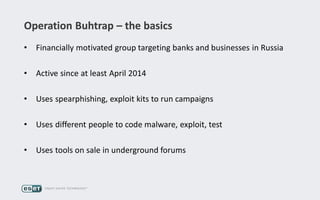
Operation Buhtrap – the basics
• Financially motivated group targeting banks and businesses in Russia
• Active since at least April 2014
• Uses spearphishing, exploit kits to run campaigns
• Uses different people to code malware, exploit, test
• Uses tools on sale in underground forums
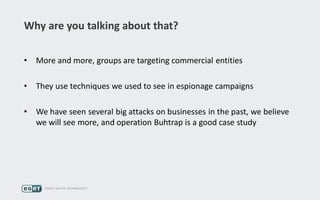
Why are you talking about that?
• More and more, groups are targeting commercial entities
• They use techniques we used to see in espionage campaigns
• We have seen several big attacks on businesses in the past, we believe
we will see more, and operation Buhtrap is a good case study
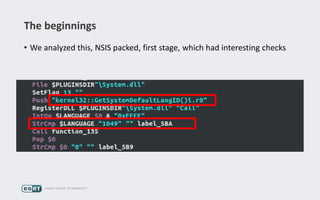
The beginnings
• We analyzed this, NSIS packed, first stage, which had interesting checks
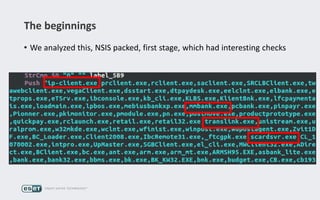
The beginnings
• We analyzed this, NSIS packed, first stage, which had interesting checks
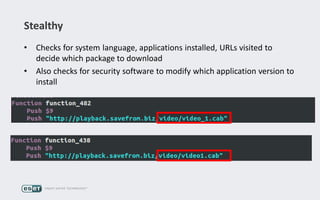
Stealthy
• Checks for system language, applications installed, URLs visited to
decide which package to download
• Also checks for security software to modify which application version to
install
Targets
• Looking at
• Decoy documents
• URLs and application installed
• Domains used
• Businesses and more specifically accounting departments seemed to be
the target of this group
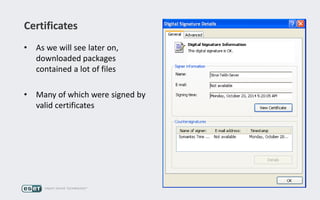
Certificates
• As we will see later on,
downloaded packages
contained a lot of files
• Many of which were signed by
valid certificates
Group
• While we progress in our research it became clear that this was a group
of organized people
• Malware coder
• Exploit coder
• Testers
• As will become apparent, they also had pretty good ties with
cybercriminals selling tools and services in underground forums
This seemed like a suitable research
• Group of people launching spearphishing attacks against Russian
businesses
• Using as much stealth as possible
• Code signing certificate usage
• Using modular code and 3rd party tools
Campaigns
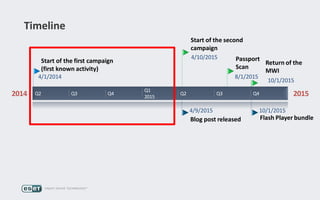
Timeline
2014 2015Q2 Q3 Q4
Q1
2015
Q2 Q3 Q4
Start of the first campaign
(first known activity)
4/1/2014
Start of the second
campaign
4/10/2015 Passport
Scan
8/1/2015
Return of the
MWI
10/1/2015
Blog post released
4/9/2015
Flash Player bundle
10/1/2015
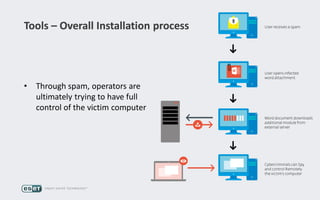
Tools – Overall Installation process
• Through spam, operators are
ultimately trying to have full
control of the victim computer
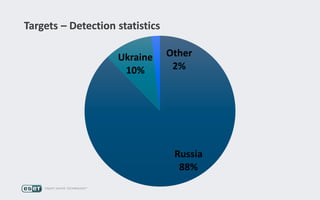
Targets – Detection statistics
Russia
88%
Ukraine
10%
Other
2%
Targets
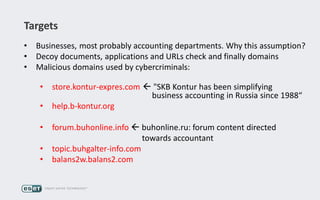
• Businesses, most probably accounting departments. Why this assumption?
• Decoy documents, applications and URLs check and finally domains
• Malicious domains used by cybercriminals:
• store.kontur-expres.com  "SKB Kontur has been simplifying
business accounting in Russia since 1988“
• help.b-kontur.org
• forum.buhonline.info  buhonline.ru: forum content directed
towards accountant
• topic.buhgalter-info.com
• balans2w.balans2.com
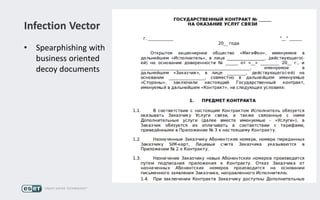
Infection Vector
• Spearphishing with
business oriented
decoy documents
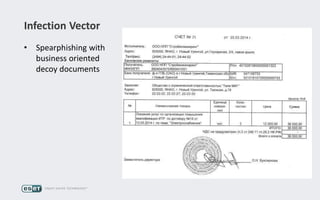
Infection Vector
• Spearphishing with
business oriented
decoy documents
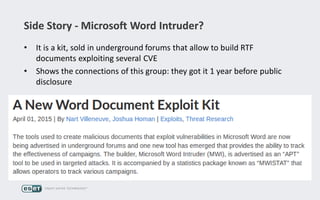
Side Story - Microsoft Word Intruder?
• It is a kit, sold in underground forums that allow to build RTF
documents exploiting several CVE
• Shows the connections of this group: they got it 1 year before public
disclosure
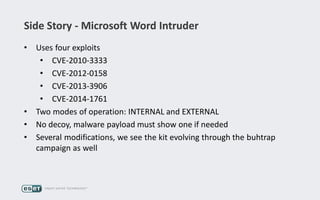
Side Story - Microsoft Word Intruder
• Uses four exploits
• CVE-2010-3333
• CVE-2012-0158
• CVE-2013-3906
• CVE-2014-1761
• Two modes of operation: INTERNAL and EXTERNAL
• No decoy, malware payload must show one if needed
• Several modifications, we see the kit evolving through the buhtrap
campaign as well
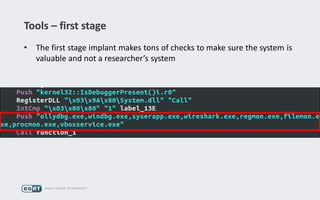
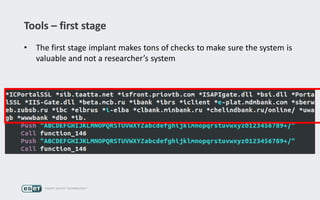
Tools – first stage
• The first stage implant makes tons of checks to make sure the system is
valuable and not a researcher’s system
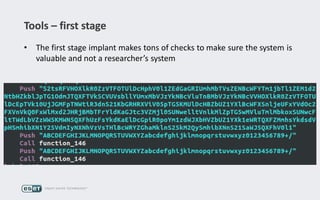
Tools – first stage
• The first stage implant makes tons of checks to make sure the system is
valuable and not a researcher’s system
Tools – first stage
• The first stage implant makes tons of checks to make sure the system is
valuable and not a researcher’s system
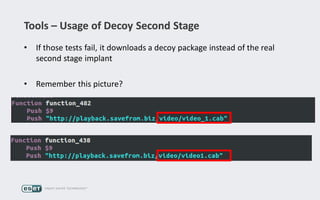
Tools – Usage of Decoy Second Stage
• If those tests fail, it downloads a decoy package instead of the real
second stage implant
• Remember this picture?
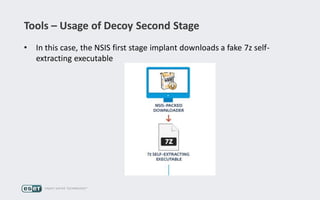
Tools – Usage of Decoy Second Stage
• In this case, the NSIS first stage implant downloads a fake 7z self-
extracting executable
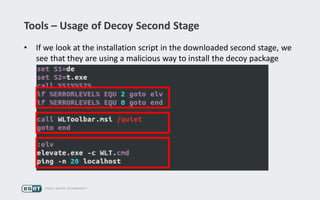
Tools – Usage of Decoy Second Stage
• If we look at the installation script in the downloaded second stage, we
see that they are using a malicious way to install the decoy package
Tools – Local Privilege Exploitation
• They have been using several different exploits
• First campaign was CVE-2013-3660 and Carberp trick in source code
• Then in subsequent campaigns, we saw CVE-2014-4113, CVE-2015-2546
and CVE-2015-2387 (part of the Hacking Team leak)
• Always had the x86 and x64 versions
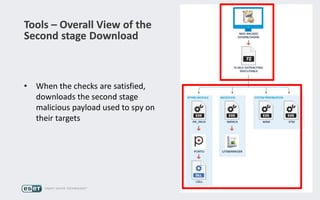
Tools – Overall View of the
Second stage Download
• When the checks are satisfied,
downloads the second stage
malicious payload used to spy on
their targets
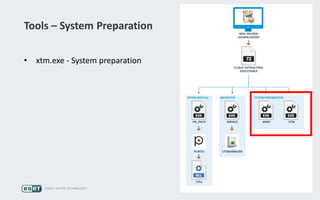
Tools – System Preparation
• xtm.exe - System preparation
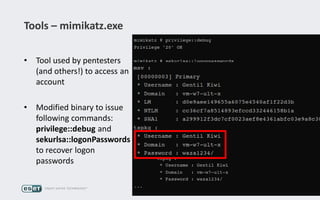
Tools – mimikatz.exe
• Tool used by pentesters
(and others!) to access an
account
• Modified binary to issue
following commands:
privilege::debug and
sekurlsa::logonPasswords
to recover logon
passwords
Tools – xtm.exe
• 1c_export: tries to add a user to system
• This package was no longer seen in later campaigns (NOT necessary for
the initial compromise)
• We have seen them later on they dropping it through the backdoor
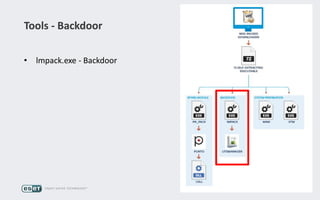
Tools - Backdoor
• lmpack.exe - Backdoor
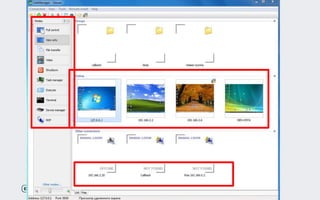
Tools – lmpack.exe
• Silent installation of litemanager, a remote administrator
• Supposedly legit but, why silent installer? Detected as a PUA
(potentially unsafe application)
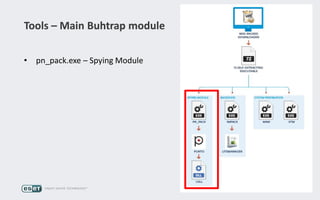
Tools – Main Buhtrap module
• pn_pack.exe – Spying Module
Tools – pn_pack.exe
• Log all keystrokes and copy clipboard content
• Enumerate smart cards present on the system
• Handle C&C communications
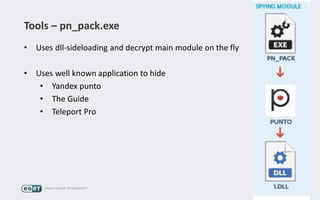
Tools – pn_pack.exe
• Uses dll-sideloading and decrypt main module on the fly
• Uses well known application to hide
• Yandex punto
• The Guide
• Teleport Pro
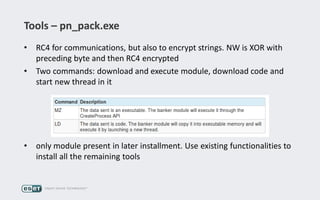
Tools – pn_pack.exe
• RC4 for communications, but also to encrypt strings. NW is XOR with
preceding byte and then RC4 encrypted
• Two commands: download and execute module, download code and
start new thread in it
• only module present in later installment. Use existing functionalities to
install all the remaining tools
New infection vector: Niteris EK
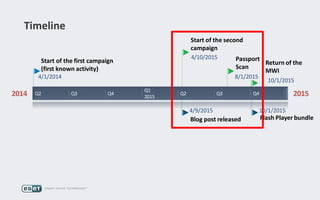
Timeline
2014 2015Q2 Q3 Q4
Q1
2015
Q2 Q3 Q4
Start of the first campaign
(first known activity)
4/1/2014
Start of the second
campaign
4/10/2015 Passport
Scan
8/1/2015
Return of the
MWI
10/1/2015
Blog post released
4/9/2015
Flash Player bundle
10/1/2015
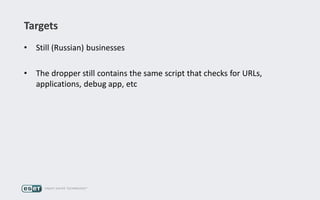
Targets
• Still (Russian) businesses
• The dropper still contains the same script that checks for URLs,
applications, debug app, etc
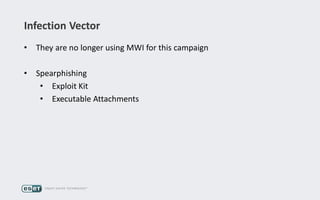
Infection Vector
• They are no longer using MWI for this campaign
• Spearphishing
• Exploit Kit
• Executable Attachments
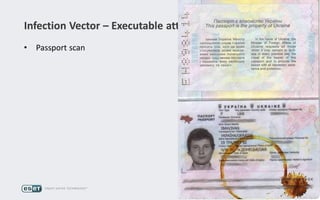
Infection Vector – Executable attachments
• Passport scan
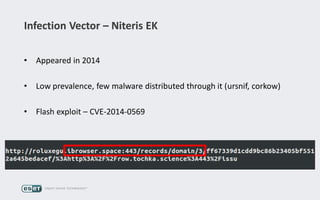
Infection Vector – Niteris EK
• Appeared in 2014
• Low prevalence, few malware distributed through it (ursnif, corkow)
• Flash exploit – CVE-2014-0569
Tools – Evolved First Stage Downloaders
• Distributed as Microsoft KB files
• One dropper was very different, not NSIS, heavy usage of RC4
• LOTS of detection for security products
• Sandbox (Sandboxie, Norman)
• Virtual Machines (VMWare, VirtualBox, QEMU)
• Python/Perl
• Wine
• User interaction
• Downloads second stage if checks are satisfied
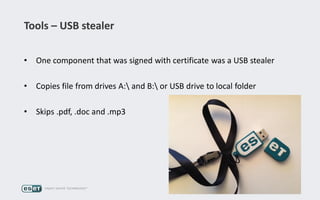
Tools – USB stealer
• One component that was signed with certificate was a USB stealer
• Copies file from drives A: and B: or USB drive to local folder
• Skips .pdf, .doc and .mp3
The return of the MWI kit
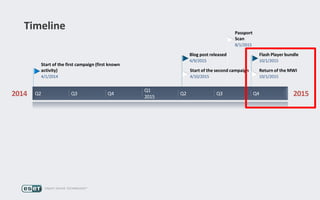
Timeline
2014 2015Q2 Q3 Q4
Q1
2015
Q2 Q3 Q4
Start of the first campaign (first known
activity)
4/1/2014
Blog post released
4/9/2015
Start of the second campaign
4/10/2015
Passport
Scan
8/1/2015
Return of the MWI
10/1/2015
Flash Player bundle
10/1/2015
Targets
• They shifted their focus
• Businesses
• Banks
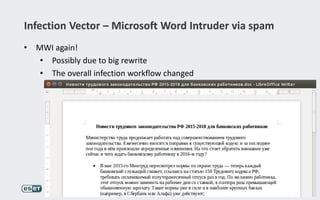
Infection Vector – Microsoft Word Intruder via spam
• MWI again!
• Possibly due to big rewrite
• The overall infection workflow changed
Infection vector – Strategic Web Compromise
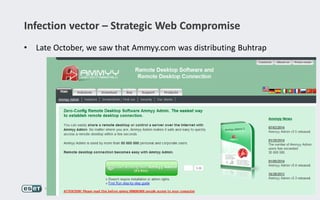
• Late October, we saw that Ammyy.com was distributing Buhtrap
Infection vector – Strategic Web Compromise
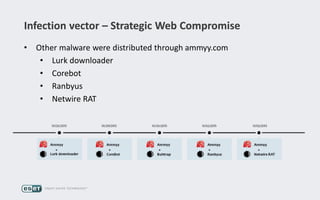
• Other malware were distributed through ammyy.com
• Lurk downloader
• Corebot
• Ranbyus
• Netwire RAT
Evasion
Evasion – bypassing AntiVirus
• Tries to prevent antivirus updates
• Tries to put their malware in exclusion list
• Different packages depending on which internet security product is
installed
Evasion – Anti-Forensics
• mbrkiller.exe : NSIS installer that destroys MBR. Possibly used to wipe
the computer after they are done with it
• damagewindow.exe: shows a pop up screen saying there was a HDD
failure and user should reboot system
Questions ?
@jiboutin
Thank you

Operation Buhtrap - AVAR 2015

  • 1.
    Operation Buhtrap Jean-Ian Boutin,Anton Cherepanov, Jan Matušík AVAR – 2015
  • 2.
    Outline • What? • How? •Campaigns • Targets • Tool • Evasion
  • 3.
  • 4.
    Operation Buhtrap –the basics • Financially motivated group targeting banks and businesses in Russia • Active since at least April 2014 • Uses spearphishing, exploit kits to run campaigns • Uses different people to code malware, exploit, test • Uses tools on sale in underground forums
  • 5.
    Why are youtalking about that? • More and more, groups are targeting commercial entities • They use techniques we used to see in espionage campaigns • We have seen several big attacks on businesses in the past, we believe we will see more, and operation Buhtrap is a good case study
  • 6.
    The beginnings • Weanalyzed this, NSIS packed, first stage, which had interesting checks
  • 7.
    The beginnings • Weanalyzed this, NSIS packed, first stage, which had interesting checks
  • 8.
    Stealthy • Checks forsystem language, applications installed, URLs visited to decide which package to download • Also checks for security software to modify which application version to install
  • 9.
    Targets • Looking at •Decoy documents • URLs and application installed • Domains used • Businesses and more specifically accounting departments seemed to be the target of this group
  • 10.
    Certificates • As wewill see later on, downloaded packages contained a lot of files • Many of which were signed by valid certificates
  • 11.
    Group • While weprogress in our research it became clear that this was a group of organized people • Malware coder • Exploit coder • Testers • As will become apparent, they also had pretty good ties with cybercriminals selling tools and services in underground forums
  • 12.
    This seemed likea suitable research • Group of people launching spearphishing attacks against Russian businesses • Using as much stealth as possible • Code signing certificate usage • Using modular code and 3rd party tools
  • 13.
  • 14.
    Timeline 2014 2015Q2 Q3Q4 Q1 2015 Q2 Q3 Q4 Start of the first campaign (first known activity) 4/1/2014 Start of the second campaign 4/10/2015 Passport Scan 8/1/2015 Return of the MWI 10/1/2015 Blog post released 4/9/2015 Flash Player bundle 10/1/2015
  • 15.
    Tools – OverallInstallation process • Through spam, operators are ultimately trying to have full control of the victim computer
  • 16.
    Targets – Detectionstatistics Russia 88% Ukraine 10% Other 2%
  • 17.
    Targets • Businesses, mostprobably accounting departments. Why this assumption? • Decoy documents, applications and URLs check and finally domains • Malicious domains used by cybercriminals: • store.kontur-expres.com  "SKB Kontur has been simplifying business accounting in Russia since 1988“ • help.b-kontur.org • forum.buhonline.info  buhonline.ru: forum content directed towards accountant • topic.buhgalter-info.com • balans2w.balans2.com
  • 18.
    Infection Vector • Spearphishingwith business oriented decoy documents
  • 19.
    Infection Vector • Spearphishingwith business oriented decoy documents
  • 20.
    Side Story -Microsoft Word Intruder? • It is a kit, sold in underground forums that allow to build RTF documents exploiting several CVE • Shows the connections of this group: they got it 1 year before public disclosure
  • 21.
    Side Story -Microsoft Word Intruder • Uses four exploits • CVE-2010-3333 • CVE-2012-0158 • CVE-2013-3906 • CVE-2014-1761 • Two modes of operation: INTERNAL and EXTERNAL • No decoy, malware payload must show one if needed • Several modifications, we see the kit evolving through the buhtrap campaign as well
  • 22.
    Tools – firststage • The first stage implant makes tons of checks to make sure the system is valuable and not a researcher’s system
  • 23.
    Tools – firststage • The first stage implant makes tons of checks to make sure the system is valuable and not a researcher’s system
  • 24.
    Tools – firststage • The first stage implant makes tons of checks to make sure the system is valuable and not a researcher’s system
  • 25.
    Tools – Usageof Decoy Second Stage • If those tests fail, it downloads a decoy package instead of the real second stage implant • Remember this picture?
  • 26.
    Tools – Usageof Decoy Second Stage • In this case, the NSIS first stage implant downloads a fake 7z self- extracting executable
  • 27.
    Tools – Usageof Decoy Second Stage • If we look at the installation script in the downloaded second stage, we see that they are using a malicious way to install the decoy package
  • 28.
    Tools – LocalPrivilege Exploitation • They have been using several different exploits • First campaign was CVE-2013-3660 and Carberp trick in source code • Then in subsequent campaigns, we saw CVE-2014-4113, CVE-2015-2546 and CVE-2015-2387 (part of the Hacking Team leak) • Always had the x86 and x64 versions
  • 29.
    Tools – OverallView of the Second stage Download • When the checks are satisfied, downloads the second stage malicious payload used to spy on their targets
  • 30.
    Tools – SystemPreparation • xtm.exe - System preparation
  • 31.
    Tools – mimikatz.exe •Tool used by pentesters (and others!) to access an account • Modified binary to issue following commands: privilege::debug and sekurlsa::logonPasswords to recover logon passwords
  • 32.
    Tools – xtm.exe •1c_export: tries to add a user to system • This package was no longer seen in later campaigns (NOT necessary for the initial compromise) • We have seen them later on they dropping it through the backdoor
  • 33.
    Tools - Backdoor •lmpack.exe - Backdoor
  • 34.
    Tools – lmpack.exe •Silent installation of litemanager, a remote administrator • Supposedly legit but, why silent installer? Detected as a PUA (potentially unsafe application)
  • 36.
    Tools – MainBuhtrap module • pn_pack.exe – Spying Module
  • 37.
    Tools – pn_pack.exe •Log all keystrokes and copy clipboard content • Enumerate smart cards present on the system • Handle C&C communications
  • 38.
    Tools – pn_pack.exe •Uses dll-sideloading and decrypt main module on the fly • Uses well known application to hide • Yandex punto • The Guide • Teleport Pro
  • 39.
    Tools – pn_pack.exe •RC4 for communications, but also to encrypt strings. NW is XOR with preceding byte and then RC4 encrypted • Two commands: download and execute module, download code and start new thread in it • only module present in later installment. Use existing functionalities to install all the remaining tools
  • 40.
  • 41.
    Timeline 2014 2015Q2 Q3Q4 Q1 2015 Q2 Q3 Q4 Start of the first campaign (first known activity) 4/1/2014 Start of the second campaign 4/10/2015 Passport Scan 8/1/2015 Return of the MWI 10/1/2015 Blog post released 4/9/2015 Flash Player bundle 10/1/2015
  • 42.
    Targets • Still (Russian)businesses • The dropper still contains the same script that checks for URLs, applications, debug app, etc
  • 43.
    Infection Vector • Theyare no longer using MWI for this campaign • Spearphishing • Exploit Kit • Executable Attachments
  • 44.
    Infection Vector –Executable attachments • Passport scan
  • 45.
    Infection Vector –Niteris EK • Appeared in 2014 • Low prevalence, few malware distributed through it (ursnif, corkow) • Flash exploit – CVE-2014-0569
  • 46.
    Tools – EvolvedFirst Stage Downloaders • Distributed as Microsoft KB files • One dropper was very different, not NSIS, heavy usage of RC4 • LOTS of detection for security products • Sandbox (Sandboxie, Norman) • Virtual Machines (VMWare, VirtualBox, QEMU) • Python/Perl • Wine • User interaction • Downloads second stage if checks are satisfied
  • 47.
    Tools – USBstealer • One component that was signed with certificate was a USB stealer • Copies file from drives A: and B: or USB drive to local folder • Skips .pdf, .doc and .mp3
  • 48.
    The return ofthe MWI kit
  • 49.
    Timeline 2014 2015Q2 Q3Q4 Q1 2015 Q2 Q3 Q4 Start of the first campaign (first known activity) 4/1/2014 Blog post released 4/9/2015 Start of the second campaign 4/10/2015 Passport Scan 8/1/2015 Return of the MWI 10/1/2015 Flash Player bundle 10/1/2015
  • 50.
    Targets • They shiftedtheir focus • Businesses • Banks
  • 51.
    Infection Vector –Microsoft Word Intruder via spam • MWI again! • Possibly due to big rewrite • The overall infection workflow changed
  • 52.
    Infection vector –Strategic Web Compromise • Late October, we saw that Ammyy.com was distributing Buhtrap
  • 53.
    Infection vector –Strategic Web Compromise • Other malware were distributed through ammyy.com • Lurk downloader • Corebot • Ranbyus • Netwire RAT
  • 54.
  • 55.
    Evasion – bypassingAntiVirus • Tries to prevent antivirus updates • Tries to put their malware in exclusion list • Different packages depending on which internet security product is installed
  • 56.
    Evasion – Anti-Forensics •mbrkiller.exe : NSIS installer that destroys MBR. Possibly used to wipe the computer after they are done with it • damagewindow.exe: shows a pop up screen saying there was a HDD failure and user should reboot system
  • 58.