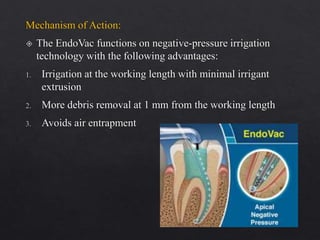
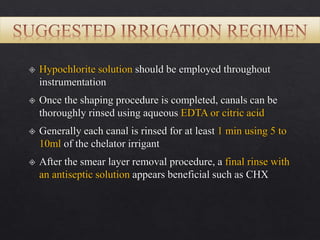
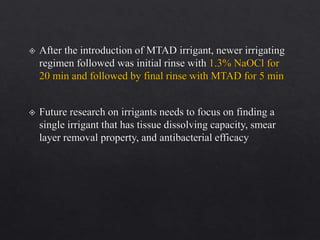
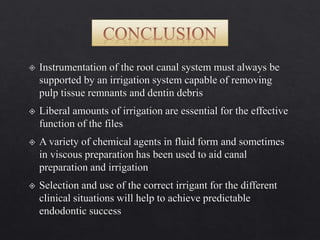
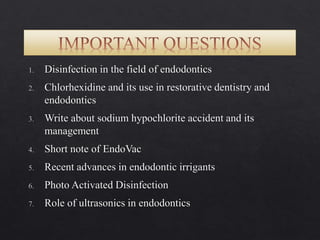
Presented by:
Dr Sahana Umesh
Guided by:
Dr Madhu Pujar
- Cohen 11th ed
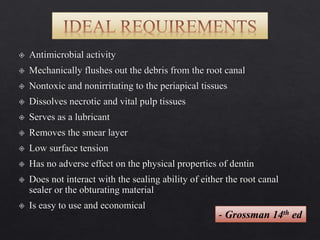
- Grossman 14th ed
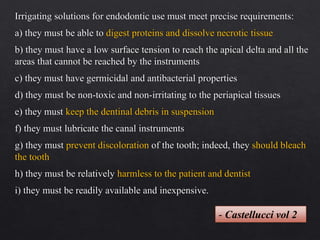
- Castellucci vol 2
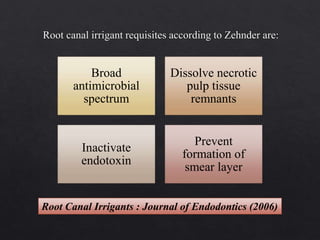
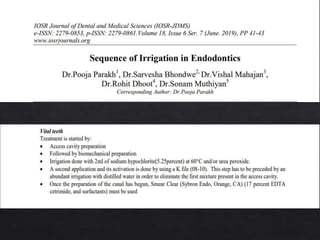
Root Canal Irrigants : Journal of Endodontics (2006)
Broad
antimicrobial
spectrum
Dissolve necrotic
pulp tissue
remnants
Inactivate
endotoxin
Prevent
formation of
smear layer
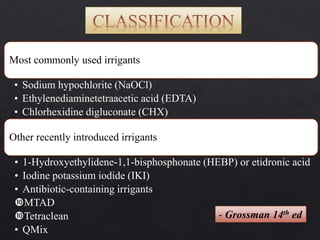
Most commonly used irrigants
• Sodium hypochlorite (NaOCl)
• Ethylenediaminetetraacetic acid (EDTA)
• Chlorhexidine digluconate (CHX)
Other recently introduced irrigants
• 1-Hydroxyethylidene-1,1-bisphosphonate (HEBP) or etidronic acid
• Iodine potassium iodide (IKI)
• Antibiotic-containing irrigants
ď‚•MTAD
ď‚•Tetraclean
• QMix
- Grossman 14th ed
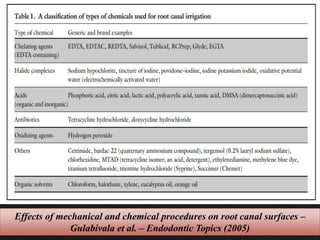
Effects of mechanical and chemical procedures on root canal surfaces –
Gulabivala et al. – Endodontic Topics (2005)
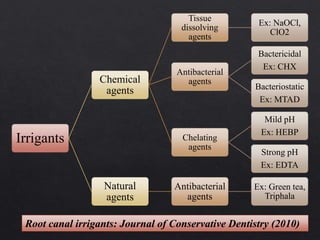
Irrigants
Chemical
agents
Tissue
dissolving
agents
Ex: NaOCl,
ClO2
Antibacterial
agents
Bactericidal
Ex: CHX
Bacteriostatic
Ex: MTAD
Chelating
agents
Mild pH
Ex: HEBP
Strong pH
Ex: EDTA
Natural
agents
Antibacterial
agents
Ex: Green tea,
Triphala
Root canal irrigants: Journal of Conservative Dentistry (2010)
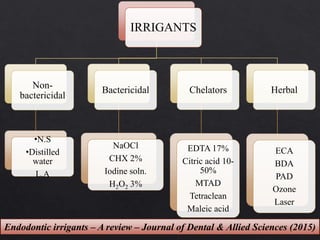
IRRIGANTS
Non-
bactericidal
•N.S
•Distilled
water
L.A
Bactericidal
NaOCl
CHX 2%
Iodine soln.
H2O2 3%
Chelators
EDTA 17%
Citric acid 10-
50%
MTAD
Tetraclean
Maleic acid
Herbal
ECA
BDA
PAD
Ozone
Laser
Endodontic irrigants – A review – Journal of Dental & Allied Sciences (2015)
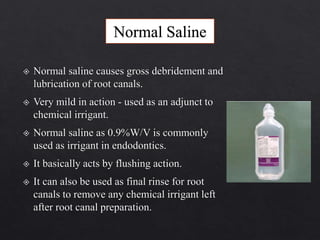
Normal Saline
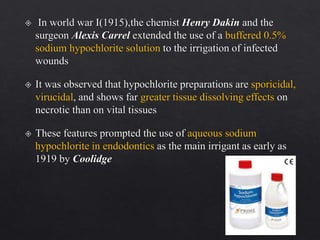
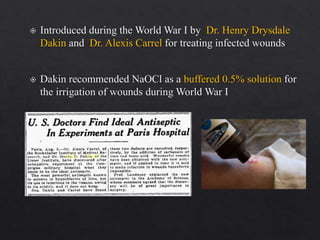
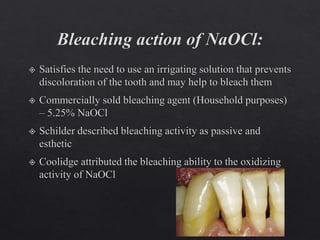
Sodium Hypochlorite
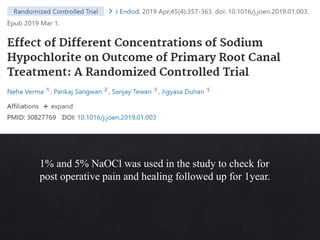
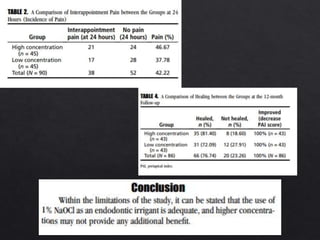
1% and 5% NaOCl was used in the study to check for
post operative pain and healing followed up for 1year.
Effect of NaOCl treatment on bonding to root canal dentin
using a new evaluation method. Dent Mater J. 2001
Bond strengths to endodontically-treated teeth. Am J Dent. 1999
International Endodontic Journal 2001
A Contemporary Overview of Endodontic Irrigants – A Review
– Journal of Dental Applications 2014
The excellent tissue-dissolving capability of sodium
hypochlorite will lead to tissue necrosis.
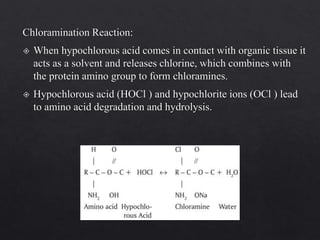
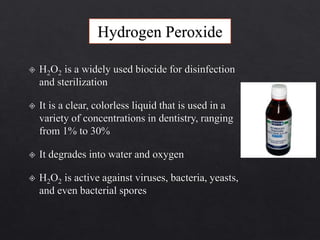
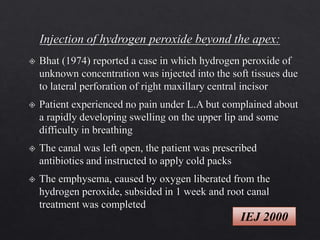
Hydrogen Peroxide
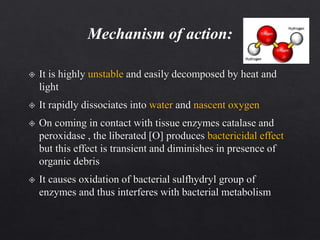
Mechanism of action:
Complications:
• Peroxide must be eliminated from the canal before the crown
is sealed otherwise oxygen may be evolved afterwards as a
result of contact with blood or tissue fluids
IEJ 2000
Urea Peroxide
EDTA – Ethylene Diamine
Tetra Acetic acid
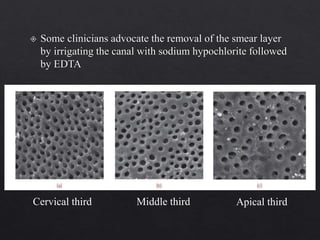
Cervical third Middle third Apical third
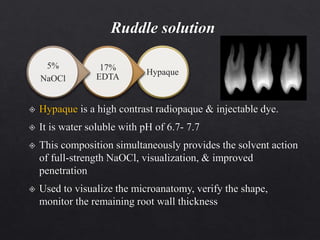
Hypaque
17%
EDTA
5%
NaOCl
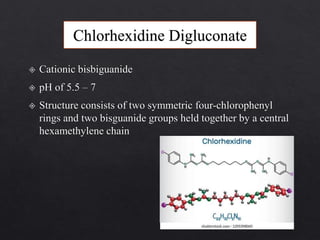
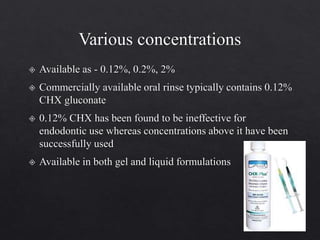
Chlorhexidine Digluconate
Limitations:
• Inability to dissolve organic matter
• No action on smear layer
Hydroxyethylidene bisphosphonate (HEBP)
Iodine Potassium Iodide (IKI)
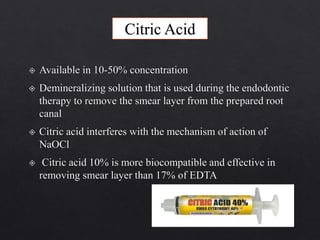
Citric Acid
Maleic Acid
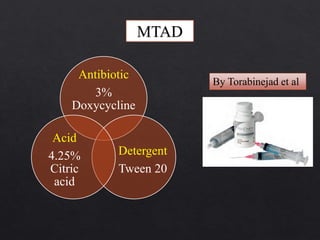
MTAD
Antibiotic
3%
Doxycycline
Detergent
Tween 20
Acid
4.25%
Citric
acid
By Torabinejad et al
Tetraclean
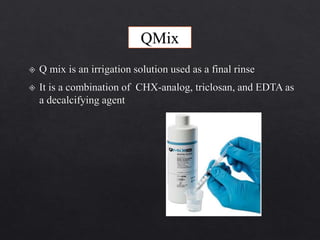
QMix
Triclosan and Gantrez
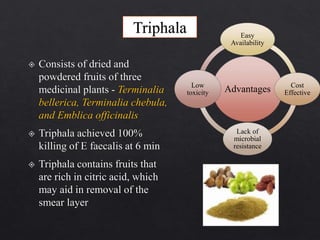
Triphala
Advantages
Easy
Availability
Cost
Effective
Lack of
microbial
resistance
Low
toxicity
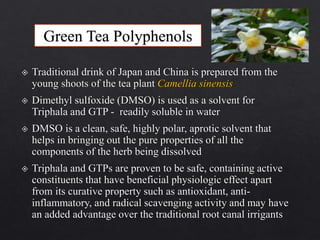
Green Tea Polyphenols
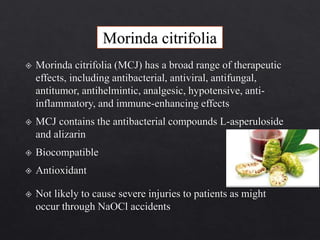
Morinda citrifolia
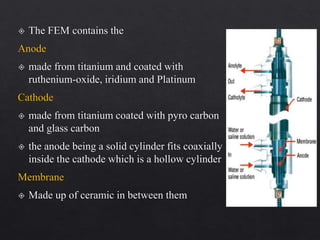
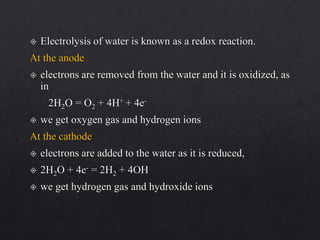
Electrochemically Activated Water
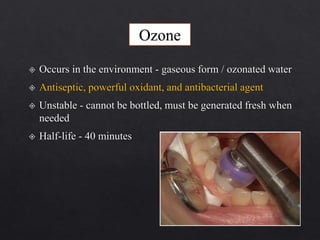
Ozone
Ozone therapy in endodontics:
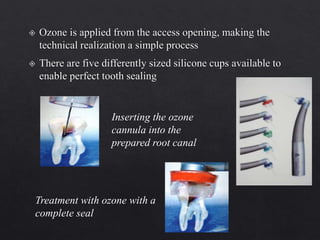
• The application of ozone makes the complete sterilization
of the root canal a real possibility in the near future
• Tooth that is to be treated ozonically needs to be built up so
that the clinical crown is restored
Inserting the ozone
cannula into the
prepared root canal
Treatment with ozone with a
complete seal
Lasers
Hollow tube
• CO2
• Er:YAG
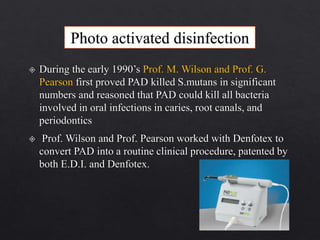
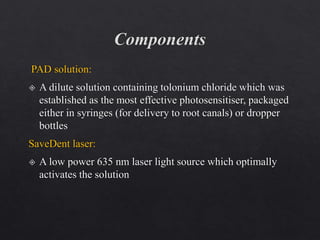
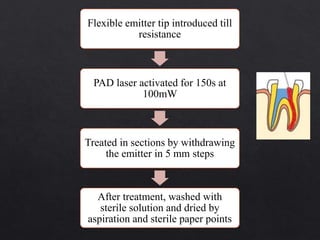
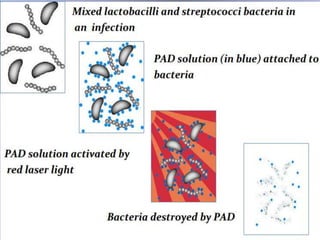
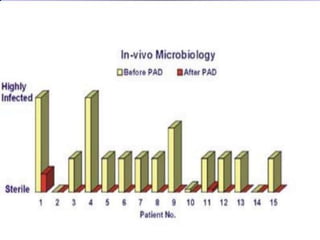
Photo activated disinfection
Canal irrigated with
sterile saline and dried
PAD soln. introduced
into canal
Agitated for 60s using
endodontic file
Flexible emitter tip introduced till
resistance
PAD laser activated for 150s at
100mW
Treated in sections by withdrawing
the emitter in 5 mm steps
After treatment, washed with
sterile solution and dried by
aspiration and sterile paper points
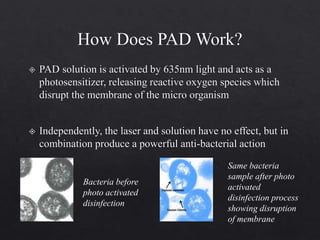
Bacteria before
photo activated
disinfection
Same bacteria
sample after photo
activated
disinfection process
showing disruption
of membrane
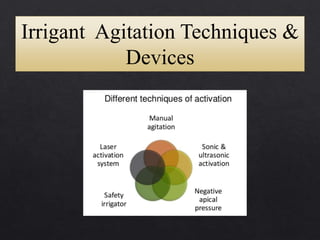
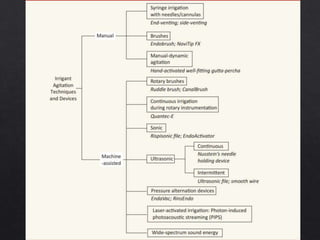
Irrigant Agitation Techniques &
Devices
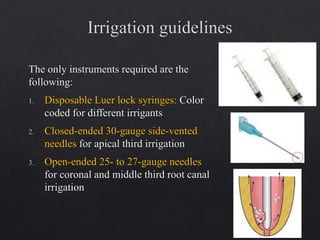
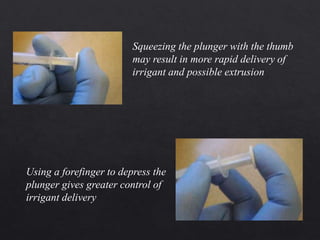
Squeezing the plunger with the thumb
may result in more rapid delivery of
irrigant and possible extrusion
Using a forefinger to depress the
plunger gives greater control of
irrigant delivery
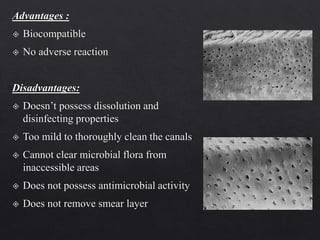
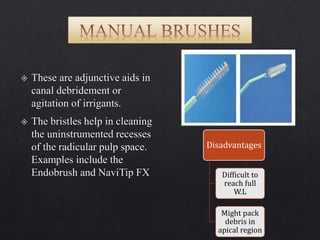
Disadvantages
Difficult to
reach full
W.L
Might pack
debris in
apical region
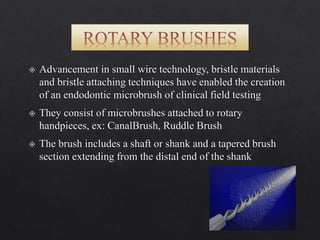
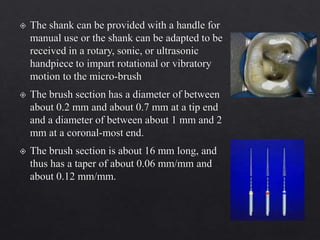
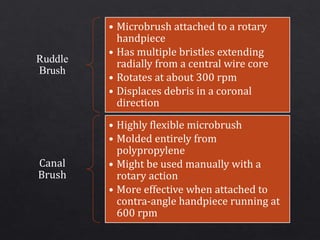
Ruddle
Brush
• Microbrush attached to a rotary
handpiece
• Has multiple bristles extending
radially from a central wire core
• Rotates at about 300 rpm
• Displaces debris in a coronal
direction
Canal
Brush
• Highly flexible microbrush
• Molded entirely from
polypropylene
• Might be used manually with a
rotary action
• More effective when attached to
contra-angle handpiece running at
600 rpm
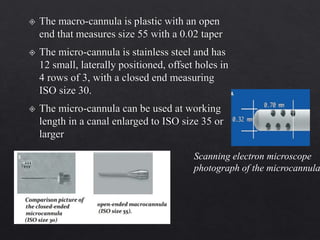
Scanning electron microscope
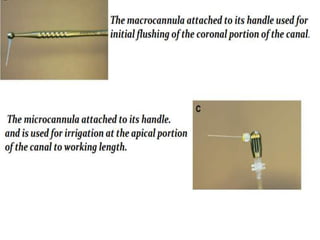
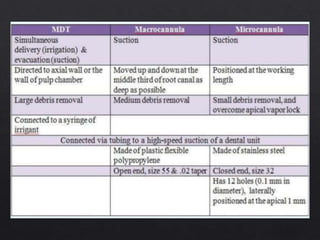
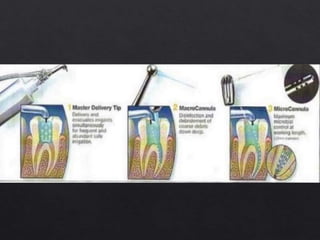
photograph of the microcannula
Irrigants and Irrigation Devices

Irrigants and Irrigation Devices

Editor's Notes

  • #28 Based on MOA Photo-activated disinfection (PAD) BDA - Bis-dequalinium acetate 
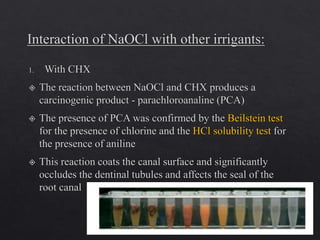
  • #61 Microtubes containing different concentrations of sodium hypochlorite (NaOCl) mixed with 2% and chlorhexidine (CHX). The concentration of NaOCl decreases from 6.0% (the first tube on left) to 0.023% (ninth tube from left). The tenth and eleventh microtubes contain controls of 6% NaOCl and 2% CHX alone, respectively. Note the color change in the mixed liquids, ranging from dark brown at left to light orange in microtube nine, as well as formation of precipitate in varying amounts