IRREGULAR WIDE
COMPLEX
TACHYCARDIAS
DEFINITION
1. Varying R-R Interval
2. QRS complex duration >.12 secs
Causes of wide QRS
Irregular Tachycardia:
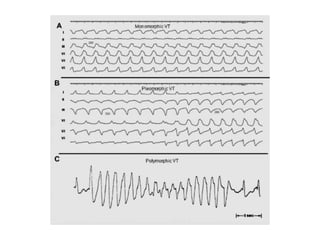
• Polymorphic ventricular tachycardia
• Pre-excited Atrial Fibrillation and Atrial
fibrillation with aberrant conduction
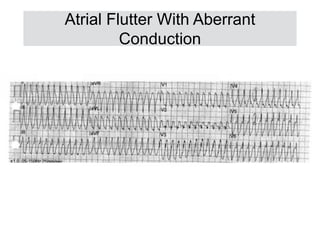
• Atrial Flutter With Aberrant Conduction
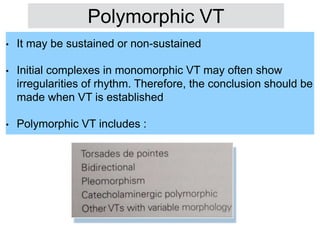
Polymorphic VT
• It may be sustained or non-sustained
• Initial complexes in monomorphic VT may often show
irregularities of rhythm. Therefore, the conclusion should be
made when VT is established
• Polymorphic VT includes :
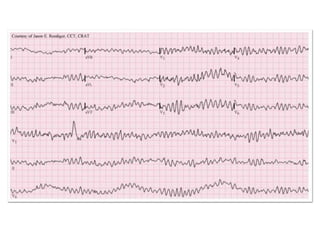
TORSADES DE POINTES
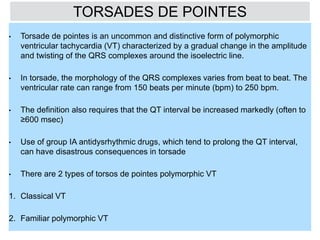
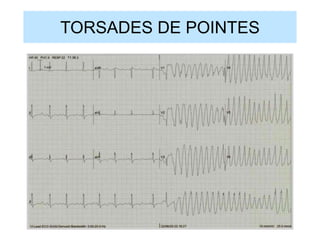
• Torsade de pointes is an uncommon and distinctive form of polymorphic
ventricular tachycardia (VT) characterized by a gradual change in the amplitude
and twisting of the QRS complexes around the isoelectric line.
• In torsade, the morphology of the QRS complexes varies from beat to beat. The
ventricular rate can range from 150 beats per minute (bpm) to 250 bpm.
• The definition also requires that the QT interval be increased markedly (often to
≥600 msec)
• Use of group IA antidysrhythmic drugs, which tend to prolong the QT interval,
can have disastrous consequences in torsade
• There are 2 types of torsos de pointes polymorphic VT
1. Classical VT
2. Familiar polymorphic VT
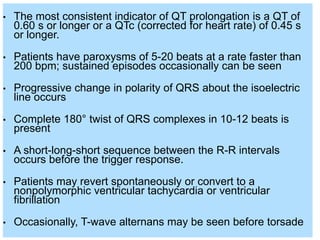
• The most consistent indicator of QT prolongation is a QT of
0.60 s or longer or a QTc (corrected for heart rate) of 0.45 s
or longer.
• Patients have paroxysms of 5-20 beats at a rate faster than
200 bpm; sustained episodes occasionally can be seen
• Progressive change in polarity of QRS about the isoelectric
line occurs
• Complete 180° twist of QRS complexes in 10-12 beats is
present
• A short-long-short sequence between the R-R intervals
occurs before the trigger response.
• Patients may revert spontaneously or convert to a
nonpolymorphic ventricular tachycardia or ventricular
fibrillation
• Occasionally, T-wave alternans may be seen before torsade
TORSADES DE POINTES
Pleomorphic VT
• Occasionally sustained VT in alternate
morphologies[pleomorphism] such as RBBB and
LBBB. These may be gradual or abrupt.
• These changes may be gradual or abrupt, and occur
over long or short periods of time.
• Morphologies are considered to be different when
they have different patterns [RBBB or LBBB], or when
QRS deviation changes to more or equal to
45degress, even if the bundle branch block pattern is
unchanged
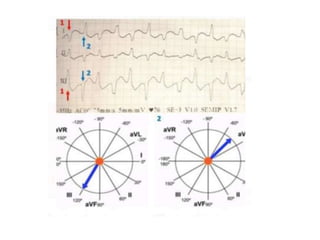
Bi-Directional VT
• Bi- Directional tachycardias are infrequent or may be
supra ventricular [BSVT] or ventricular[DVT] origin.
• The frontal plane axis [AQRS] shows alternative
changes of approximately 180 degrees
• RR intervals are usually equal but sometimes show
bi geminal pattern.
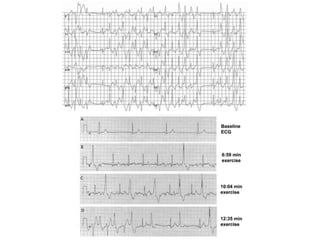
Catecholeminergic
polymorphic VT
• This type of VT is a infrequent form of polymorphic
VT particularly occurring in young patients with a
structurally normal heart.
• It is usually triggered by exercise and associated
with genetic origin.
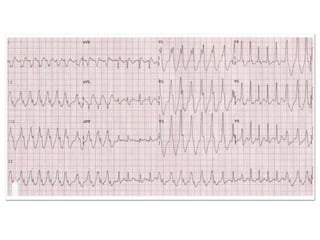
Pre-excited Atrial Fibrillation and
Atrial fibrillation with aberrant
conduction
• During atrial fibrillation (AF), the chaotic atrial
activation results in multiple impulses bombarding
the atrioventricular conduction system. Normally, the
atrioventricular node forms part of this conduction
system and its electrophysiological properties
ensure that the ventricular rate remains controlled.
In patients with an accessory pathway that conducts
in the antegrade direction, this safeguard is lost and,
especially when the pathway has a short refractory
period, rapid conduction to the ventricle can result.
Atrial Flutter With Aberrant
Conduction
Ventricular Fibrillation
• It is a very fast and irregular rhythm which does not
generate effective mechanical activity [>300bpm]
• It is usually triggered by a PVC and maintained as
result of repetitive micro re-entries[Similar to AF]
• ECG shows very high heart rate 300-500 beats per
min
• QRS complexes can be variable morphology and
height where QRS and ST-T are indistinguishable
THANK YOU

Irregular wide qrs tachycardia

  • 1.
  • 2.
    DEFINITION 1. Varying R-RInterval 2. QRS complex duration >.12 secs
  • 3.
    Causes of wideQRS Irregular Tachycardia: • Polymorphic ventricular tachycardia • Pre-excited Atrial Fibrillation and Atrial fibrillation with aberrant conduction • Atrial Flutter With Aberrant Conduction
  • 4.
    Polymorphic VT • Itmay be sustained or non-sustained • Initial complexes in monomorphic VT may often show irregularities of rhythm. Therefore, the conclusion should be made when VT is established • Polymorphic VT includes :
  • 5.
    TORSADES DE POINTES •Torsade de pointes is an uncommon and distinctive form of polymorphic ventricular tachycardia (VT) characterized by a gradual change in the amplitude and twisting of the QRS complexes around the isoelectric line. • In torsade, the morphology of the QRS complexes varies from beat to beat. The ventricular rate can range from 150 beats per minute (bpm) to 250 bpm. • The definition also requires that the QT interval be increased markedly (often to ≥600 msec) • Use of group IA antidysrhythmic drugs, which tend to prolong the QT interval, can have disastrous consequences in torsade • There are 2 types of torsos de pointes polymorphic VT 1. Classical VT 2. Familiar polymorphic VT
  • 6.
    • The mostconsistent indicator of QT prolongation is a QT of 0.60 s or longer or a QTc (corrected for heart rate) of 0.45 s or longer. • Patients have paroxysms of 5-20 beats at a rate faster than 200 bpm; sustained episodes occasionally can be seen • Progressive change in polarity of QRS about the isoelectric line occurs • Complete 180° twist of QRS complexes in 10-12 beats is present • A short-long-short sequence between the R-R intervals occurs before the trigger response. • Patients may revert spontaneously or convert to a nonpolymorphic ventricular tachycardia or ventricular fibrillation • Occasionally, T-wave alternans may be seen before torsade
  • 7.
  • 8.
    Pleomorphic VT • Occasionallysustained VT in alternate morphologies[pleomorphism] such as RBBB and LBBB. These may be gradual or abrupt. • These changes may be gradual or abrupt, and occur over long or short periods of time. • Morphologies are considered to be different when they have different patterns [RBBB or LBBB], or when QRS deviation changes to more or equal to 45degress, even if the bundle branch block pattern is unchanged
  • 10.
    Bi-Directional VT • Bi-Directional tachycardias are infrequent or may be supra ventricular [BSVT] or ventricular[DVT] origin. • The frontal plane axis [AQRS] shows alternative changes of approximately 180 degrees • RR intervals are usually equal but sometimes show bi geminal pattern.
  • 12.
    Catecholeminergic polymorphic VT • Thistype of VT is a infrequent form of polymorphic VT particularly occurring in young patients with a structurally normal heart. • It is usually triggered by exercise and associated with genetic origin.
  • 14.
    Pre-excited Atrial Fibrillationand Atrial fibrillation with aberrant conduction • During atrial fibrillation (AF), the chaotic atrial activation results in multiple impulses bombarding the atrioventricular conduction system. Normally, the atrioventricular node forms part of this conduction system and its electrophysiological properties ensure that the ventricular rate remains controlled. In patients with an accessory pathway that conducts in the antegrade direction, this safeguard is lost and, especially when the pathway has a short refractory period, rapid conduction to the ventricle can result.
  • 16.
    Atrial Flutter WithAberrant Conduction
  • 17.
    Ventricular Fibrillation • Itis a very fast and irregular rhythm which does not generate effective mechanical activity [>300bpm] • It is usually triggered by a PVC and maintained as result of repetitive micro re-entries[Similar to AF] • ECG shows very high heart rate 300-500 beats per min • QRS complexes can be variable morphology and height where QRS and ST-T are indistinguishable
  • 19.