ARRHYTHMIAS
SINUS ARRYTHMIA
• Variation in the P-P interval of more than 120 ms (3 small boxes).
• The P-P interval gradually lengthens and shortens in a cyclical fashion,
usually corresponding to the phases of the respiratory cycle.
• Normal sinus P waves with a constant morphology (i.e. no evidence of
premature atrial contractions).
• Constant P-R interval (i.e. no evidence of Mobitz I AV block).
• Normal sinus P waves (upright in leads I and II) with a constant
morphology — albeit with an appearance suggestive of left atrial
enlargement.
• P-R interval is constant (no evidence of AV block).
• The P-P interval varies widely from 1.04 seconds (heart rate ~57 bpm)
down to 0.60 seconds (heart rate ~100 bpm); a variability of over
400ms.
• Mechanism
• Sinus arrhythmia is a normal physiological phenomenon, most
commonly seen in young, healthy people.
• The heart rate varies due to reflex changes in vagal tone during the
different stages of the respiratory cycle.
• Inspiration increases the heart rate by decreasing vagal tone.
• With the onset of expiration, vagal tone is restored, leading to a
subsequent decrease in heart rate.
ECTOPIC ATRIAL TACHYCARDIA
• Atrial rate > 100 bpm.
• P wave morphology is abnormal when compared with sinus P wave
due to ectopic origin.
• There is usually an abnormal P-wave axis (e.g. inverted in the inferior
leads II, III and aVF)
• At least three consecutive identical ectopic p waves.
• QRS complexes usually normal morphology
• AV block may be present — this is generally a physiological response
to the rapid atrial rate,
MULTIFOCAL ATRIAL TACHYCARDIA
• Heart rate > 100 bpm (usually 100-150 bpm; may be as high as 250
bpm).
• Irregularly irregular rhythm with varying PP, PR and RR intervals.
• At least 3 distinct P-wave morphologies in the same lead.
• Isoelectric baseline between P-waves (i.e. no flutter waves).
• Absence of a single dominant atrial pacemaker (i.e. not just sinus
rhythm with frequent PACs).
• Some P waves may be nonconducted; others may be aberrantly
conducted to the ventricles.
PREMATURE ATRIAL COMPLEXES
• An abnormal (non-sinus) P wave is followed by a QRS complex.
• The P wave typically has a different morphology and axis to the sinus P waves.
• The abnormal P wave may be hidden in the preceding T wave, producing a
“peaked” or “camel hump” appearance — if this is not appreciated the PAC may
be mistaken for a PJC.
• PACS arising close to the AV node (“low atrial” ectopics) activate the atria
retrogradely, producing an inverted P wave with a relatively short PR interval ≥
120 ms (PR interval < 120 ms is classified as a PJC).
• PACs that reach the SA node may depolarise it, causing the SA node to “reset” —
this results in a longer-than-normal interval before the next sinus beat arrives
(“post-extrasystolic pause”). Unlike with PVCs, this pause is not equal to double
the preceding RR interval (i.e. not a “full compensatory pause”).
ATRIAL FIBRILLATION
• Irregularly irregular rhythm.
• No P waves.
• Absence of an isoelectric baseline.
• Variable ventricular rate.
• QRS complexes usually < 120 ms unless pre-existing bundle branch
block, accessory pathway, or rate related aberrant conduction.
ATRIAL FLUTTER
• There are inverted flutter waves in II, III + aVF at a rate of 260 bpm.
• There are upright flutter waves in V1-2
• There is 4:1 block, resulting in a ventricular rate of 65 bpm.
• Typical Atrial Flutter (Common, or Type I Atrial Flutter)
• Involves the IVC & tricuspid isthmus in the reentry circuit. Can be further
classified based on the direction of the reentry circuit (anticlockwise or
clockwise):
• Anticlockwise Reentry: Commonest form of atrial flutter (90% of cases).
Retrograde atrial conduction produces:
• Inverted flutter waves in leads II,III, aVF
• Positive flutter waves in V1 – may resemble upright P waves
Clockwise Reentry. This uncommon variant produces the opposite pattern:
• Positive flutter waves in leads II, III, aVF
• Broad, inverted flutter waves in V1
AVNRT
• Narrow complex tachycardia at ~ 150 bpm.
• No visible P waves.
• There are pseudo R’ waves in V1-2.
VENTRICULAR BIGEMINI
• PVC-A premature beat arising from an ectopic focus within the
ventricles.
• PVCs have the following features:
• Broad QRS complex (≥ 120 ms) with abnormal morphology.
• Premature — i.e. occurs earlier than would be expected for the next
sinus impulse.
• Discordant ST segment and T wave changes.
• Usually followed by a full compensatory pause.
DISCORDANCE
Appropriate discordance describes a pattern in which the ST segment and T wave are
directed opposite to the main vector of the QRS complex:
ST depression and T wave inversion in leads with a dominant R wave.
ST elevation with upright T waves in leads with a dominant S wave.
COMPENSATORY PAUSE
• With a full compensatory pause, the next normal beat arrives after an
interval that is equal to double the preceding R-R interval
• Classification
• PVCs may be either:
• Unifocal — Arising from a single ectopic focus; each PVC is identical.
• Multifocal — Arising from two or more ectopic foci; multiple QRS
morphologies.
• The origin of each PVC can be discerned from the QRS morphology:
• PVCs arising from the right ventricle have a left bundle branch block
morphology (dominant S wave in V1).
• PVCs arising from the left ventricle have a right bundle branch block
morphology (dominant R wave in V1).
• PVCs are said to be “frequent” if there are more than 5 PVCs per minute on
the routine ECG, or more than 10-30 per hour during ambulatory monitoring.
• Ventricular Tachycardia = 3 or more VEB at a rate of > 130 beats/min
• If > 30 seconds = sustained
• can be monophoric or polymorphic
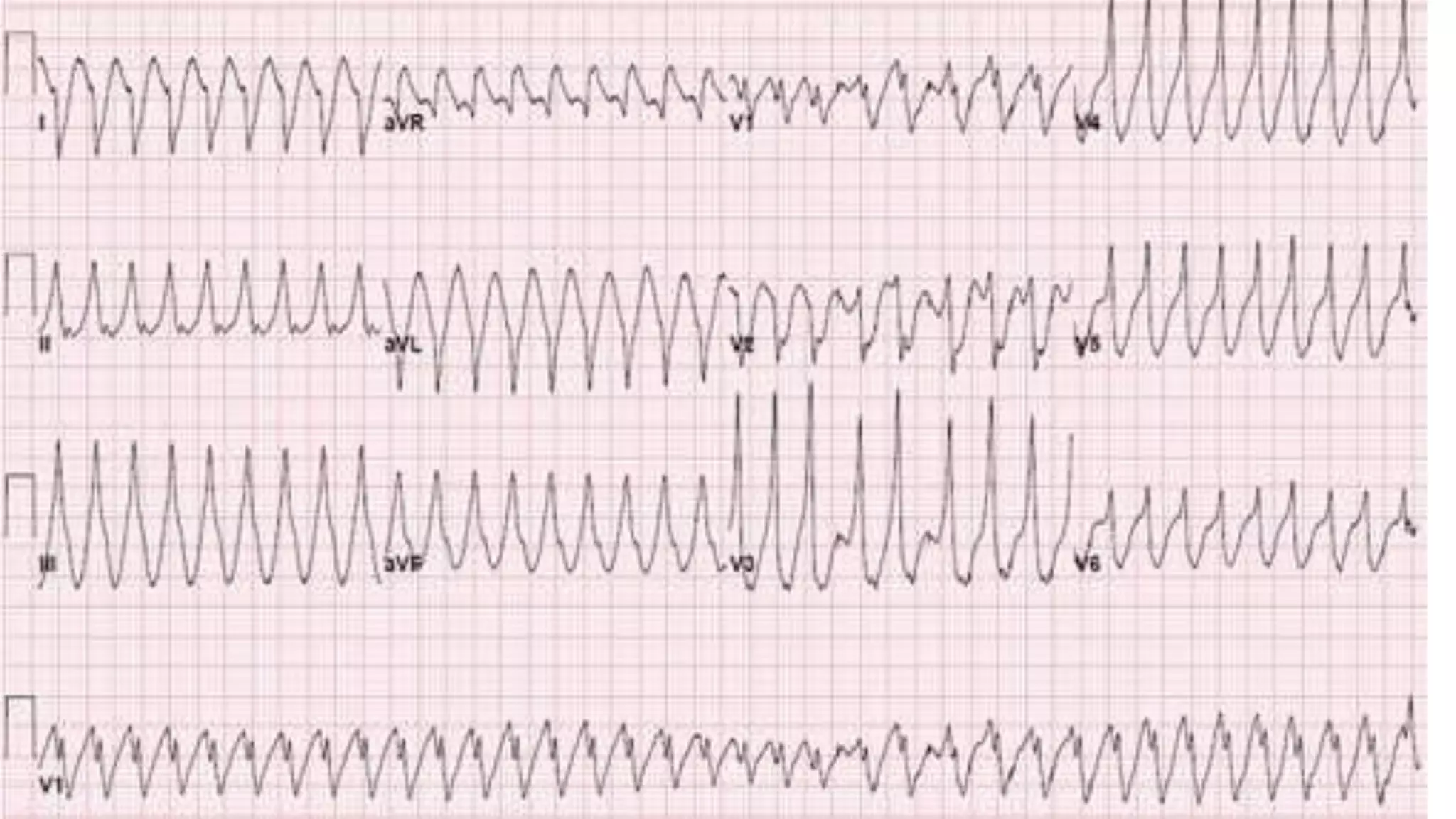
• Classic monomorphic VT with uniform QRS complexes.
• Indeterminate axis.
• Very broad QRS (~200 ms).
DIFFERENTIATING VT FROM WIDE COMPLEX
SVT
• (i) Is RS complex present in any lead? -> if NO the rhythm is VT
• (ii) Is the RS duration >100ms in any lead? -> if YES then the rhythm is
VT
• (iii) Is there AV dissociation? (fusion or capture beats) -> if YES then
the rhythm is VT
• (iv) Is the rhythm morphologically consistent with SVT (looks like
RBBB or LBBB)? -> if NO the rhythm is VT
SVT WITH ABERRANCY
• Chaotic irregular deflections of varying amplitude
• No identifiable P waves, QRS complexes, or T waves
• Rate 150 to 500 per minute
• Amplitude decreases with duration (coarse VF -> fine VF)
• Normal sinus rhythm with 1st degree AV block
• PR interval 260 ms
• Causes of First Degree Heart Block
• Increased vagal tone
• Athletic training
• Inferior MI
• Mitral valve surgery
• Myocarditis (e.g. Lyme disease)
• Electrolyte disturbances (e.g. Hyperkalaemia)
• AV nodal blocking drugs (beta-blockers, calcium channel blockers, digoxin,
amiodarone)
• May be a normal variant
MOBITZ TYPE-1
• The PR interval progressively increases from one complex to the next.
• The Wenckebach pattern here is repeating in cycles of 5 P waves to 4
QRS complexes (5:4 conduction ratio).
• The increase in PR interval from one complex to the next is subtle.
However, the difference is more obvious if you compare the first PR
interval in the cycle to the last.
“Progressive prolongation of the PR interval culminating in a non-
conducted P wave”
• Clinical Significance of AV Block: 2nd degree, Mobitz I
• Mobitz I is usually a benign rhythm, causing minimal haemodynamic
disturbance and with low risk of progression to third degree heart
block.
• Asymptomatic patients do not require treatment.
• Symptomatic patients usually respond to atropine.
• Permanent pacing is rarely required.
MOBITZ TYPE 2
COMPLETE HEART BLOCK
• Atrial rate is ~ 60 bpm.
• Ventricular rate is ~ 27 bpm.
• None of the atrial impulses appear to be conducted to the ventricles.
• There is a slow ventricular escape rhythm.
ARRYTHMIAS- narrow complex tachycardia’s .pptx

ARRYTHMIAS- narrow complex tachycardia’s .pptx

  • 1.
  • 4.
    SINUS ARRYTHMIA • Variationin the P-P interval of more than 120 ms (3 small boxes). • The P-P interval gradually lengthens and shortens in a cyclical fashion, usually corresponding to the phases of the respiratory cycle. • Normal sinus P waves with a constant morphology (i.e. no evidence of premature atrial contractions). • Constant P-R interval (i.e. no evidence of Mobitz I AV block).
  • 5.
    • Normal sinusP waves (upright in leads I and II) with a constant morphology — albeit with an appearance suggestive of left atrial enlargement. • P-R interval is constant (no evidence of AV block). • The P-P interval varies widely from 1.04 seconds (heart rate ~57 bpm) down to 0.60 seconds (heart rate ~100 bpm); a variability of over 400ms.
  • 6.
    • Mechanism • Sinusarrhythmia is a normal physiological phenomenon, most commonly seen in young, healthy people. • The heart rate varies due to reflex changes in vagal tone during the different stages of the respiratory cycle. • Inspiration increases the heart rate by decreasing vagal tone. • With the onset of expiration, vagal tone is restored, leading to a subsequent decrease in heart rate.
  • 8.
    ECTOPIC ATRIAL TACHYCARDIA •Atrial rate > 100 bpm. • P wave morphology is abnormal when compared with sinus P wave due to ectopic origin. • There is usually an abnormal P-wave axis (e.g. inverted in the inferior leads II, III and aVF) • At least three consecutive identical ectopic p waves. • QRS complexes usually normal morphology • AV block may be present — this is generally a physiological response to the rapid atrial rate,
  • 10.
    MULTIFOCAL ATRIAL TACHYCARDIA •Heart rate > 100 bpm (usually 100-150 bpm; may be as high as 250 bpm). • Irregularly irregular rhythm with varying PP, PR and RR intervals. • At least 3 distinct P-wave morphologies in the same lead. • Isoelectric baseline between P-waves (i.e. no flutter waves). • Absence of a single dominant atrial pacemaker (i.e. not just sinus rhythm with frequent PACs). • Some P waves may be nonconducted; others may be aberrantly conducted to the ventricles.
  • 13.
    PREMATURE ATRIAL COMPLEXES •An abnormal (non-sinus) P wave is followed by a QRS complex. • The P wave typically has a different morphology and axis to the sinus P waves. • The abnormal P wave may be hidden in the preceding T wave, producing a “peaked” or “camel hump” appearance — if this is not appreciated the PAC may be mistaken for a PJC. • PACS arising close to the AV node (“low atrial” ectopics) activate the atria retrogradely, producing an inverted P wave with a relatively short PR interval ≥ 120 ms (PR interval < 120 ms is classified as a PJC). • PACs that reach the SA node may depolarise it, causing the SA node to “reset” — this results in a longer-than-normal interval before the next sinus beat arrives (“post-extrasystolic pause”). Unlike with PVCs, this pause is not equal to double the preceding RR interval (i.e. not a “full compensatory pause”).
  • 15.
    ATRIAL FIBRILLATION • Irregularlyirregular rhythm. • No P waves. • Absence of an isoelectric baseline. • Variable ventricular rate. • QRS complexes usually < 120 ms unless pre-existing bundle branch block, accessory pathway, or rate related aberrant conduction.
  • 17.
    ATRIAL FLUTTER • Thereare inverted flutter waves in II, III + aVF at a rate of 260 bpm. • There are upright flutter waves in V1-2 • There is 4:1 block, resulting in a ventricular rate of 65 bpm.
  • 18.
    • Typical AtrialFlutter (Common, or Type I Atrial Flutter) • Involves the IVC & tricuspid isthmus in the reentry circuit. Can be further classified based on the direction of the reentry circuit (anticlockwise or clockwise): • Anticlockwise Reentry: Commonest form of atrial flutter (90% of cases). Retrograde atrial conduction produces: • Inverted flutter waves in leads II,III, aVF • Positive flutter waves in V1 – may resemble upright P waves Clockwise Reentry. This uncommon variant produces the opposite pattern: • Positive flutter waves in leads II, III, aVF • Broad, inverted flutter waves in V1
  • 22.
    AVNRT • Narrow complextachycardia at ~ 150 bpm. • No visible P waves. • There are pseudo R’ waves in V1-2.
  • 27.
    VENTRICULAR BIGEMINI • PVC-Apremature beat arising from an ectopic focus within the ventricles. • PVCs have the following features: • Broad QRS complex (≥ 120 ms) with abnormal morphology. • Premature — i.e. occurs earlier than would be expected for the next sinus impulse. • Discordant ST segment and T wave changes. • Usually followed by a full compensatory pause.
  • 28.
    DISCORDANCE Appropriate discordance describesa pattern in which the ST segment and T wave are directed opposite to the main vector of the QRS complex: ST depression and T wave inversion in leads with a dominant R wave. ST elevation with upright T waves in leads with a dominant S wave.
  • 29.
    COMPENSATORY PAUSE • Witha full compensatory pause, the next normal beat arrives after an interval that is equal to double the preceding R-R interval
  • 30.
    • Classification • PVCsmay be either: • Unifocal — Arising from a single ectopic focus; each PVC is identical. • Multifocal — Arising from two or more ectopic foci; multiple QRS morphologies. • The origin of each PVC can be discerned from the QRS morphology: • PVCs arising from the right ventricle have a left bundle branch block morphology (dominant S wave in V1). • PVCs arising from the left ventricle have a right bundle branch block morphology (dominant R wave in V1). • PVCs are said to be “frequent” if there are more than 5 PVCs per minute on the routine ECG, or more than 10-30 per hour during ambulatory monitoring.
  • 32.
    • Ventricular Tachycardia= 3 or more VEB at a rate of > 130 beats/min • If > 30 seconds = sustained • can be monophoric or polymorphic
  • 34.
    • Classic monomorphicVT with uniform QRS complexes. • Indeterminate axis. • Very broad QRS (~200 ms).
  • 36.
    DIFFERENTIATING VT FROMWIDE COMPLEX SVT • (i) Is RS complex present in any lead? -> if NO the rhythm is VT • (ii) Is the RS duration >100ms in any lead? -> if YES then the rhythm is VT • (iii) Is there AV dissociation? (fusion or capture beats) -> if YES then the rhythm is VT • (iv) Is the rhythm morphologically consistent with SVT (looks like RBBB or LBBB)? -> if NO the rhythm is VT
  • 38.
  • 40.
    • Chaotic irregulardeflections of varying amplitude • No identifiable P waves, QRS complexes, or T waves • Rate 150 to 500 per minute • Amplitude decreases with duration (coarse VF -> fine VF)
  • 42.
    • Normal sinusrhythm with 1st degree AV block • PR interval 260 ms
  • 43.
    • Causes ofFirst Degree Heart Block • Increased vagal tone • Athletic training • Inferior MI • Mitral valve surgery • Myocarditis (e.g. Lyme disease) • Electrolyte disturbances (e.g. Hyperkalaemia) • AV nodal blocking drugs (beta-blockers, calcium channel blockers, digoxin, amiodarone) • May be a normal variant
  • 45.
    MOBITZ TYPE-1 • ThePR interval progressively increases from one complex to the next. • The Wenckebach pattern here is repeating in cycles of 5 P waves to 4 QRS complexes (5:4 conduction ratio). • The increase in PR interval from one complex to the next is subtle. However, the difference is more obvious if you compare the first PR interval in the cycle to the last. “Progressive prolongation of the PR interval culminating in a non- conducted P wave”
  • 46.
    • Clinical Significanceof AV Block: 2nd degree, Mobitz I • Mobitz I is usually a benign rhythm, causing minimal haemodynamic disturbance and with low risk of progression to third degree heart block. • Asymptomatic patients do not require treatment. • Symptomatic patients usually respond to atropine. • Permanent pacing is rarely required.
  • 47.
  • 49.
    COMPLETE HEART BLOCK •Atrial rate is ~ 60 bpm. • Ventricular rate is ~ 27 bpm. • None of the atrial impulses appear to be conducted to the ventricles. • There is a slow ventricular escape rhythm.