International Research Journal of Engineering and Technology (IRJET) e-ISSN: 2395-0056
Volume: 05 Issue: 06 | June-2018 www.irjet.net p-ISSN: 2395-0072
© 2018, IRJET | Impact Factor value: 6.171 | ISO 9001:2008 Certified Journal | Page 187
MULTI FUNCTIONAL COMPRESSOR
Khemraj Beragi1, Prof. Jitendra Jayant2
1M. Tech. Scholar, Mechanical Engineering, LNCT, Indore
2Assistant Professor, Mechanical Engineering, LNCT, Indore, M.P., India,
---------------------------------------------------------------------***---------------------------------------------------------------------
Abstract Renewable energy is generally defined as energy
that comes from resources which are naturally replenishedon
a human timescale such as sunlight, wind, rain, tides, waves
and geothermalheat. Renewableenergyreplacesconventional
fuels in four distinct areas i.e. electricity generation, hot
water/ space heating, motor fuels and rural (off-grid) energy
services.
While many renewable energy projects are large scale,
renewable technologies are also suited to rural areas and
developing countries, where energy is often crucial in human
development. To hardness the energy from renewable energy
resources is a big issue, because for the purpose a large set up
is required and the initial cost is higher than that of a single
unit which works with electricity.
This paper will focus on the design of a multi-functional
compressor which is the combination of Air conditioning,
Water cooling and Refrigeration system.
Key Words: Multifunctional compressor, refrigeration, air
conditioning, heat transfer
1. INTRODUCTION
Demand of electricity is increasing day by day. Its
consumption is more than its production. It is due to
the factthatthepopulationisuncontrollablyincreasing
but the resources for fulfilling their requirements are
limited and diminishing at fasterrate.Toovercomethe
problem of limited resources either we should move
towards the renewable energy resources or design
such an appliance which can save electricity.
While many renewable energy projects are large scale,
renewable technologies are also suited to rural and
remote areas and developing countries, where energy
is often crucial in human development. To harness the
energy from the renewable energy resources is a big
issue because for the purpose a large set up is required
and the initial cost is higher than that of a single unit
which works with electricity.
To fulfill the energy demand, it is the easier way to
make improvementintheexistingsystem.Itsolvestwo
problems one is electricityconsumptionanotheroneis
the improved efficiency at low cost availability.
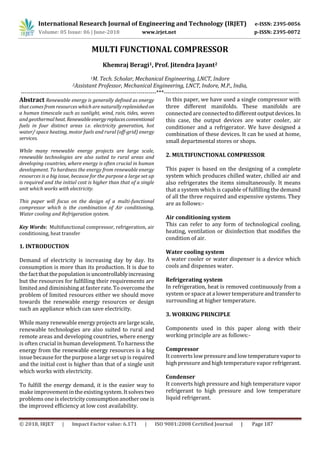
In this paper, we have used a single compressor with
three different manifolds. These manifolds are
connected are connected todifferentoutputdevices.In
this case, the output devices are water cooler, air
conditioner and a refrigerator. We have designed a
combination of these devices. It can be used at home,
small departmental stores or shops.
2. MULTIFUNCTIONAL COMPRESSOR
This paper is based on the designing of a complete
system which produces chilled water, chilled air and
also refrigerates the items simultaneously. It means
that a system which is capable of fulfilling the demand
of all the three required and expensive systems. They
are as follows:-
Air conditioning system
This can refer to any form of technological cooling,
heating, ventilation or disinfection that modifies the
condition of air.
Water cooling system
A water cooler or water dispenser is a device which
cools and dispenses water.
Refrigerating system
In refrigeration, heat is removed continuously from a
system or space at a lower temperature andtransferto
surrounding at higher temperature.
3. WORKING PRINCIPLE
Components used in this paper along with their
working principle are as follows:-
Compressor
It converts low pressure and low temperaturevaporto
high pressure andhigh temperature vapor refrigerant.
Condenser
It converts high pressure and high temperature vapor
refrigerant to high pressure and low temperature
liquid refrigerant.
International Research Journal of Engineering and Technology (IRJET) e-ISSN: 2395-0056
Volume: 05 Issue: 06 | June-2018 www.irjet.net p-ISSN: 2395-0072
© 2018, IRJET | Impact Factor value: 6.171 | ISO 9001:2008 Certified Journal | Page 188
Diffusion tube
It maintains the flow of the refrigerant in respective
compartments.
Expansion valve
It converts high pressure and low temperature liquid
refrigerant into low pressure and low temperature
liquid refrigerant.
Evaporation
It converts low pressure and low temperature liquid
refrigerant into low pressure and low temperature
vapor refrigerant.
Back pressure valve
It maintains the equal proportion of the refrigerant to
avoid load on the compressor.
4. APPLICATIONS-
1. It is very useful system that can be used in
home, kitchen, departmental stores, small
kiosk, shops, etc.
2. The system is capable of saving powerbecause
one system is applied for differentusefulwork.
3. It doesn’t cost more. It is much cheaper than
the available separate system.
4. It is suitable for small scale industries.
5. It is quite useful for future applications.
6. It is smaller than the separate system, so
occupies less space.
5. Advantages and disadvantages of the system
5.1 Advantages-
1. It consumes less power because it works for
three separate systems alone.
2. Its design is quite simple.
3. It is less spacious.
4. Maintenance is easy.
5. It can be installed anywhere.
6. Its installation cost is very low.
7. It’s an efficient system.
5.2 Limitations-
1. It does not contain stabilizers in it.
2. It is not suitable for large scale or big
industries.
3. It is a low capacity device.
6.DESIGNINGOFMULTIFUNCTIONALCOMPRESSOR
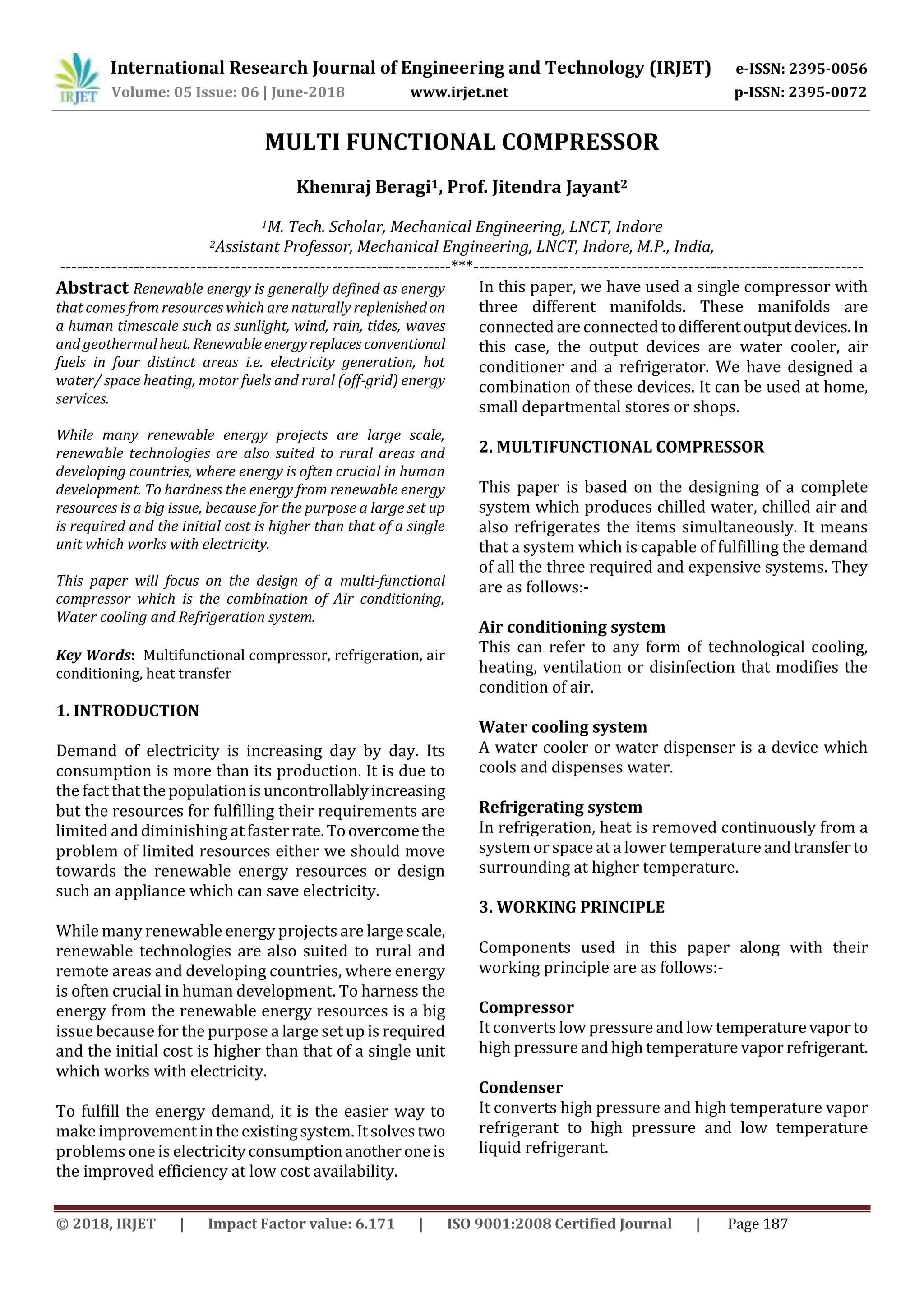
6.1Design of evaporator-
An evaporator should transfer enough heat from as
small size as possible. It should be light, compact, safe
and durable. The pressure loss should be as low as
possible.
Heat absorbed by refrigerant vapor= 7.014 KJ/min=
116.9W= 1.6679 kcal/min
Temperature of air surrounding evaporator, Thi= 20 C
Temperature of air after 1 min, Tco= 30 C
Temperature of refrigerant liquidenteringevaporator,
Tci= -180˚C
Temperature of refrigerant liquid leaving evaporator,
Tco= -180˚C
Assuming counter flow type heat exchanger,
= Tco-Tci
To find U:
Let outer diameter=12mm
Inner diameter= 10mm
Inside the tube is refrigerant liquid.
Therefore, hi=220*
Where
Therefore hi= 220*20= 4400kcal/m2hrk
To find h0:
Outside fluid is air,
Let v=2m/sec
Properties of air at film temperature 2.5 C
ρ= 1.284 Kg/m3
6.2 Design of condenser
Temperature of hot solution at inlet, Thi= 34˚C
Temperature of hot solution at outlet, Th2= 30˚C
Temperature of cold solution at inlet, Tc1= 5 ˚C
Temperature of cold solution at outlet, Tc2= 15˚C
Assuming counter flow type heat exchanger,
International Research Journal of Engineering and Technology (IRJET) e-ISSN: 2395-0056
Volume: 05 Issue: 06 | June-2018 www.irjet.net p-ISSN: 2395-0072
© 2018, IRJET | Impact Factor value: 6.171 | ISO 9001:2008 Certified Journal | Page 189
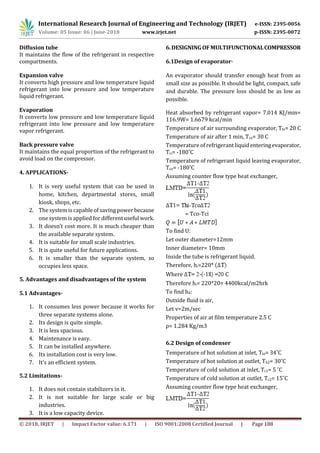
= Th1-Tc1
LMTD= [34-15]-[30-5]/ln[(34-15)/(30-5)]
Overall heat transfer coefficient:
I/U= {1/h0+ (d0/k)*[(d0-di)/(d0-di)+(1/h1)*d0/di}
To find h0:
Average temperature of cold solution= 15+5/2=10˚C
Properties of water at 100˚C
ρ= 0.625 Kg/m3
T= 21.05*10-3 w/m2.k
U= 13.1*(10-6)
Pr= 0.898
To find h1:
Average temperature of hot solution= 34+34/2 = 32˚C
Properties at 32˚C:
ρ= 592 Kg/m3
T= 507.1*10-3 w/m2.k
U= 0.355*(10-6)
Pr= 2.16
Equating mass flow rate
1/5.92*0.04853/60= N/4* (0.012)2*V
V=0.012m/sec
Re= v*do/W= 0.012*0.012/0.3558 (10-6) = 432.734
For external flow of constant wall temperature
Nu= 0.193*Re*0.618*Pr*0.333
Nu= 0.193*7710.91*0.618*0.898*0.333
Nu=47.014
Therefore, h0= Nu*k/d0= 70.68 w/m2.k
Nu= 0.023*re*0.8*Pr*0.333
Nu= 0.432.73*0.8*2.16*0.333
Nu=3.72
Therefore, h1=Nu*k/di= 3.72*505.1*10-3/0.012=
157.34w/m2.k
From hi. Ho values, U , overall heat transfer coefficient
is calculated.
I/U={(1/h0+d0/k)*(d0-di/d0+di)+(1/hi)*do/di}
=[1/77.69]+[0.014/53.3]*[(14-
12)/(14+12)]+[1/157.34]*[0.014/0.012]
U=46.33 w/m2.k
Q=m*S*DT
Q=0.04853/60*4.8*103*10=38.848 W
Q=U*A* LMTD
38.838=46.44*A*21.86
A=0.0384
6.3 Design of compressor
The combination of air can beassumedtobereversible
polytropic process,
P.v=constant
Fig -1. Design of Compressor
The net work done by a compression cycle is shownby
Work input=
Also
T2=T1(p2-p1)(n-1)/n
Where,
n=constant or polytrophic index
m- mass flow rate of air
R= specific gas constant
T2=Air delivery temperature
T1=Air suction temperature
P2=Air delivery pressure
P1=Air suction pressure
CONCLUSION-
This paper is based on solving the live problems of
more power consumption. It contains the three
different units which are more expensive and low
International Research Journal of Engineering and Technology (IRJET) e-ISSN: 2395-0056
Volume: 05 Issue: 06 | June-2018 www.irjet.net p-ISSN: 2395-0072
© 2018, IRJET | Impact Factor value: 6.171 | ISO 9001:2008 Certified Journal | Page 190
efficient. The efficiency of the designed system can be
enhanced when it is converted into the actual product.
Many accessories can be attached to it for making it
more sophisticated. As the demand of electricity is
increasing day by day and the consumption is higher
than its production, so we should move towards
renewable sources of energy which are available in
abundance.
REFERENCES-
[1] Sunil A More at. Al.; Combined Air Refrigeration,
Air Conditioning And Water Dispenser Systems,
Jan 2018, IRJET
[2] S.M. Shaikh, “Performance Investigation of
Window Air Conditioner” IOSR Journal of Civil and
Mechanical Engineering (IOSR-JMCE) sISSN: 2278-
1684, PP: 32-37www.iosrjournals.org
[3] P.Dasthagiri and H.Ranganna, “Fabrication and
Analysis of Refrigerator cum Chilled Water
Dispenser” Advanced Engineering and Applied
Sciences: An International Journal, ISSN 2320–3927
[4] Himanshu, “Feasibility Study and Development of
Refrigerator cum Air Conditioner” International
Journal of Scientific and Research Publications,
Volume 4, Issue 12, December 2014 1 ISSN
22503153 .
[5] Dr. U. V.Kongre and A. R. Chiddarwar, “Testing
and Performance Analysis on Air Conditioner cum
Water Dispenser” International Journal of
Engineering Trends and Technology (IJETT) -
Volume4Issue4- April 2013
[6] B. Naveen, “waste heat recovery in r & ac systems”
internationaljournalofscienceandresearch(ijsr)ISSN
(online): 2319-7064
BIOGRAPHIES
Khemraj Beragi
M. Tech. Scholar,
Mechanical Engineering,
LNCT, Indore,(M.P)
Prof. Jitendra Jayant
Asst.Professor,
Mechanical Engineering,
LNCT,Indore, (M.P)
Photo

IRJET-Multi Functional Compressor

  • 1.
    International Research Journalof Engineering and Technology (IRJET) e-ISSN: 2395-0056 Volume: 05 Issue: 06 | June-2018 www.irjet.net p-ISSN: 2395-0072 © 2018, IRJET | Impact Factor value: 6.171 | ISO 9001:2008 Certified Journal | Page 187 MULTI FUNCTIONAL COMPRESSOR Khemraj Beragi1, Prof. Jitendra Jayant2 1M. Tech. Scholar, Mechanical Engineering, LNCT, Indore 2Assistant Professor, Mechanical Engineering, LNCT, Indore, M.P., India, ---------------------------------------------------------------------***--------------------------------------------------------------------- Abstract Renewable energy is generally defined as energy that comes from resources which are naturally replenishedon a human timescale such as sunlight, wind, rain, tides, waves and geothermalheat. Renewableenergyreplacesconventional fuels in four distinct areas i.e. electricity generation, hot water/ space heating, motor fuels and rural (off-grid) energy services. While many renewable energy projects are large scale, renewable technologies are also suited to rural areas and developing countries, where energy is often crucial in human development. To hardness the energy from renewable energy resources is a big issue, because for the purpose a large set up is required and the initial cost is higher than that of a single unit which works with electricity. This paper will focus on the design of a multi-functional compressor which is the combination of Air conditioning, Water cooling and Refrigeration system. Key Words: Multifunctional compressor, refrigeration, air conditioning, heat transfer 1. INTRODUCTION Demand of electricity is increasing day by day. Its consumption is more than its production. It is due to the factthatthepopulationisuncontrollablyincreasing but the resources for fulfilling their requirements are limited and diminishing at fasterrate.Toovercomethe problem of limited resources either we should move towards the renewable energy resources or design such an appliance which can save electricity. While many renewable energy projects are large scale, renewable technologies are also suited to rural and remote areas and developing countries, where energy is often crucial in human development. To harness the energy from the renewable energy resources is a big issue because for the purpose a large set up is required and the initial cost is higher than that of a single unit which works with electricity. To fulfill the energy demand, it is the easier way to make improvementintheexistingsystem.Itsolvestwo problems one is electricityconsumptionanotheroneis the improved efficiency at low cost availability. In this paper, we have used a single compressor with three different manifolds. These manifolds are connected are connected todifferentoutputdevices.In this case, the output devices are water cooler, air conditioner and a refrigerator. We have designed a combination of these devices. It can be used at home, small departmental stores or shops. 2. MULTIFUNCTIONAL COMPRESSOR This paper is based on the designing of a complete system which produces chilled water, chilled air and also refrigerates the items simultaneously. It means that a system which is capable of fulfilling the demand of all the three required and expensive systems. They are as follows:- Air conditioning system This can refer to any form of technological cooling, heating, ventilation or disinfection that modifies the condition of air. Water cooling system A water cooler or water dispenser is a device which cools and dispenses water. Refrigerating system In refrigeration, heat is removed continuously from a system or space at a lower temperature andtransferto surrounding at higher temperature. 3. WORKING PRINCIPLE Components used in this paper along with their working principle are as follows:- Compressor It converts low pressure and low temperaturevaporto high pressure andhigh temperature vapor refrigerant. Condenser It converts high pressure and high temperature vapor refrigerant to high pressure and low temperature liquid refrigerant.
  • 2.
    International Research Journalof Engineering and Technology (IRJET) e-ISSN: 2395-0056 Volume: 05 Issue: 06 | June-2018 www.irjet.net p-ISSN: 2395-0072 © 2018, IRJET | Impact Factor value: 6.171 | ISO 9001:2008 Certified Journal | Page 188 Diffusion tube It maintains the flow of the refrigerant in respective compartments. Expansion valve It converts high pressure and low temperature liquid refrigerant into low pressure and low temperature liquid refrigerant. Evaporation It converts low pressure and low temperature liquid refrigerant into low pressure and low temperature vapor refrigerant. Back pressure valve It maintains the equal proportion of the refrigerant to avoid load on the compressor. 4. APPLICATIONS- 1. It is very useful system that can be used in home, kitchen, departmental stores, small kiosk, shops, etc. 2. The system is capable of saving powerbecause one system is applied for differentusefulwork. 3. It doesn’t cost more. It is much cheaper than the available separate system. 4. It is suitable for small scale industries. 5. It is quite useful for future applications. 6. It is smaller than the separate system, so occupies less space. 5. Advantages and disadvantages of the system 5.1 Advantages- 1. It consumes less power because it works for three separate systems alone. 2. Its design is quite simple. 3. It is less spacious. 4. Maintenance is easy. 5. It can be installed anywhere. 6. Its installation cost is very low. 7. It’s an efficient system. 5.2 Limitations- 1. It does not contain stabilizers in it. 2. It is not suitable for large scale or big industries. 3. It is a low capacity device. 6.DESIGNINGOFMULTIFUNCTIONALCOMPRESSOR 6.1Design of evaporator- An evaporator should transfer enough heat from as small size as possible. It should be light, compact, safe and durable. The pressure loss should be as low as possible. Heat absorbed by refrigerant vapor= 7.014 KJ/min= 116.9W= 1.6679 kcal/min Temperature of air surrounding evaporator, Thi= 20 C Temperature of air after 1 min, Tco= 30 C Temperature of refrigerant liquidenteringevaporator, Tci= -180˚C Temperature of refrigerant liquid leaving evaporator, Tco= -180˚C Assuming counter flow type heat exchanger, = Tco-Tci To find U: Let outer diameter=12mm Inner diameter= 10mm Inside the tube is refrigerant liquid. Therefore, hi=220* Where Therefore hi= 220*20= 4400kcal/m2hrk To find h0: Outside fluid is air, Let v=2m/sec Properties of air at film temperature 2.5 C ρ= 1.284 Kg/m3 6.2 Design of condenser Temperature of hot solution at inlet, Thi= 34˚C Temperature of hot solution at outlet, Th2= 30˚C Temperature of cold solution at inlet, Tc1= 5 ˚C Temperature of cold solution at outlet, Tc2= 15˚C Assuming counter flow type heat exchanger,
  • 3.
    International Research Journalof Engineering and Technology (IRJET) e-ISSN: 2395-0056 Volume: 05 Issue: 06 | June-2018 www.irjet.net p-ISSN: 2395-0072 © 2018, IRJET | Impact Factor value: 6.171 | ISO 9001:2008 Certified Journal | Page 189 = Th1-Tc1 LMTD= [34-15]-[30-5]/ln[(34-15)/(30-5)] Overall heat transfer coefficient: I/U= {1/h0+ (d0/k)*[(d0-di)/(d0-di)+(1/h1)*d0/di} To find h0: Average temperature of cold solution= 15+5/2=10˚C Properties of water at 100˚C ρ= 0.625 Kg/m3 T= 21.05*10-3 w/m2.k U= 13.1*(10-6) Pr= 0.898 To find h1: Average temperature of hot solution= 34+34/2 = 32˚C Properties at 32˚C: ρ= 592 Kg/m3 T= 507.1*10-3 w/m2.k U= 0.355*(10-6) Pr= 2.16 Equating mass flow rate 1/5.92*0.04853/60= N/4* (0.012)2*V V=0.012m/sec Re= v*do/W= 0.012*0.012/0.3558 (10-6) = 432.734 For external flow of constant wall temperature Nu= 0.193*Re*0.618*Pr*0.333 Nu= 0.193*7710.91*0.618*0.898*0.333 Nu=47.014 Therefore, h0= Nu*k/d0= 70.68 w/m2.k Nu= 0.023*re*0.8*Pr*0.333 Nu= 0.432.73*0.8*2.16*0.333 Nu=3.72 Therefore, h1=Nu*k/di= 3.72*505.1*10-3/0.012= 157.34w/m2.k From hi. Ho values, U , overall heat transfer coefficient is calculated. I/U={(1/h0+d0/k)*(d0-di/d0+di)+(1/hi)*do/di} =[1/77.69]+[0.014/53.3]*[(14- 12)/(14+12)]+[1/157.34]*[0.014/0.012] U=46.33 w/m2.k Q=m*S*DT Q=0.04853/60*4.8*103*10=38.848 W Q=U*A* LMTD 38.838=46.44*A*21.86 A=0.0384 6.3 Design of compressor The combination of air can beassumedtobereversible polytropic process, P.v=constant Fig -1. Design of Compressor The net work done by a compression cycle is shownby Work input= Also T2=T1(p2-p1)(n-1)/n Where, n=constant or polytrophic index m- mass flow rate of air R= specific gas constant T2=Air delivery temperature T1=Air suction temperature P2=Air delivery pressure P1=Air suction pressure CONCLUSION- This paper is based on solving the live problems of more power consumption. It contains the three different units which are more expensive and low
  • 4.
    International Research Journalof Engineering and Technology (IRJET) e-ISSN: 2395-0056 Volume: 05 Issue: 06 | June-2018 www.irjet.net p-ISSN: 2395-0072 © 2018, IRJET | Impact Factor value: 6.171 | ISO 9001:2008 Certified Journal | Page 190 efficient. The efficiency of the designed system can be enhanced when it is converted into the actual product. Many accessories can be attached to it for making it more sophisticated. As the demand of electricity is increasing day by day and the consumption is higher than its production, so we should move towards renewable sources of energy which are available in abundance. REFERENCES- [1] Sunil A More at. Al.; Combined Air Refrigeration, Air Conditioning And Water Dispenser Systems, Jan 2018, IRJET [2] S.M. Shaikh, “Performance Investigation of Window Air Conditioner” IOSR Journal of Civil and Mechanical Engineering (IOSR-JMCE) sISSN: 2278- 1684, PP: 32-37www.iosrjournals.org [3] P.Dasthagiri and H.Ranganna, “Fabrication and Analysis of Refrigerator cum Chilled Water Dispenser” Advanced Engineering and Applied Sciences: An International Journal, ISSN 2320–3927 [4] Himanshu, “Feasibility Study and Development of Refrigerator cum Air Conditioner” International Journal of Scientific and Research Publications, Volume 4, Issue 12, December 2014 1 ISSN 22503153 . [5] Dr. U. V.Kongre and A. R. Chiddarwar, “Testing and Performance Analysis on Air Conditioner cum Water Dispenser” International Journal of Engineering Trends and Technology (IJETT) - Volume4Issue4- April 2013 [6] B. Naveen, “waste heat recovery in r & ac systems” internationaljournalofscienceandresearch(ijsr)ISSN (online): 2319-7064 BIOGRAPHIES Khemraj Beragi M. Tech. Scholar, Mechanical Engineering, LNCT, Indore,(M.P) Prof. Jitendra Jayant Asst.Professor, Mechanical Engineering, LNCT,Indore, (M.P) Photo