International Research Journal of Engineering and Technology (IRJET) e-ISSN: 2395-0056
Volume: 06 Issue: 06 | June 2019 www.irjet.net p-ISSN: 2395-0072
© 2019, IRJET | Impact Factor value: 7.211 | ISO 9001:2008 Certified Journal | Page 3108
Wearable Sensor Based Fall Detection System
Aneena George1, Ashitha Haridas2, Athira K P3, Sreepriya E V4, Prof. Sarin Abraham5
1,2,3,4Student, Dept. of Electronics and Communication Engineering, MACE, Kerala, India
5Assisstant Professor, Dept. of Electronics and Communication Engineering, MACE, Kerala, India
---------------------------------------------------------------------***---------------------------------------------------------------------
Abstract -Fall detection is a major challenge in the public
healthcare domain, especially forthe elderlyasthedeclineof
their physical fitness, and timely and reliable surveillance is
necessary to mitigate the negative effects of falls. This
project develops a novel fall detection system based on a
wearable device. The system monitors the movements of
human body, recognizes a fall from normal dailyactivitiesby
an effective quaternion algorithm, and automatically sends
request for help to the caregivers with the patients location.
1. INTRODUCTION
Falls of the elderly always lead to serioushealthissuesasthe
decline of their physical fitness. Fracture is the most
common injury in fall of an elderly situations,thefall process
is the main source of injury because of the high impact. But
sometimes the late medical salvage may worsen the
situation. That means the faster the salvage comes, the less
risk the elderly will face.
Progress of technology brings more possibilities to help us
protect the elderly. Low power consumption components
make it possible to realize wearable monitoring device.
MEMS (micro electro-mechanical systems) sensors have
simplified the design and implementation of sensor system.
Location based service (LBS) makes it more convenient to
locate the elderly in health monitoring. Beside these, mobile
computing makesremotehealthmonitoring easiertorealize.
Several kinds of fall detection methods havebeendeveloped
or applied in our life. One of them is computer vision based
method. Cameras are distributed at limited space to offer
pictures or videos of human activities to implement fall
detection algorithm. External supports such as motion
sensors could be used to enhance computer vision basedfall
detection method, and a data fusion algorithm can operate
the validation and correlation among the two subsystems to
raise robust performance of fall detection. These computer
based methods work effectively in indoor environment, but
they are hard to realize in outdoor environment as the
deployment of cameras is always limited.
But, in fact, using more sensors means more power
consumption, and it is a challenge to design a proper
algorithm to fuse different kinds of sensors. A single triaxial
accelerometer is quite enough for human fall detection as
suffcient information could be extracted from its
measurements. Besides this, the accelerometer coordinate
does not have to be fixed if only the magnitude of sumvector
is needed, and that is quite convenient for wearable
application. In this paper, a fall detection system based on a
wearable device is developed. The hardware and software
realization of the device is mainly based on a single triaxial
accelerometer and GPS/GSM module. The device uses an
efficient fall detection algorithm with less resource and
power consumption, which means that it is a proper design
for outdoor application.
2. LITERATURE SURVEY
The rapid aging of the world's population, along with an
increase in the prevalence of chronic illnesses and obesity,
requires adaption and modification of current healthcare
models. One such approach involves telehealthapplications,
many of which are based on sensor technologies for
unobtrusive monitoring. Recent technological advances, in
particular, involving micro electro-mechanical systems,have
resulted in miniaturized wearable devices that can be used
for a range of applications. One of the leading areas for
utilization of body-fixed sensors is the monitoring of human
movement. An overview of common ambulatory sensors is
presented, followed by a summary of the developments in
this field, with an emphasis on the clinical applications of
falls detection, fallsrisk assessment,andenergyexpenditure.
The importance of these applications is considerable inlight
of the global demographic trends and the resultant rise in
the occurrence of injurious falls and the decrease of physical
activity. The potential of using such monitors in an
unsupervised mannerforcommunity-dwellingindividualsis
immense, but entails an array of challenges with regards to
design considerations, implementationprotocols, andsignal
analysis processes.
3. DESIGN
In this a microcontroller is employedtohandledata transfer
operations. We are using PICmicrocontroller(PIC16F877A),
which are a family specialised microcon-troller chips
produced by microchip technology. The acronym PICstands
for peripheral interface controller. A microcontroller is
compact microcomputer designedtogoverntheoperationof
three axis accelerometer and GSM/GPS module etc.
The system is used for the detection of fall. A triaxial
accelerometer is used to detect the fall. The accelerometer,
GSM and GPS module are interfaced with the PIC
microcontroller. The GPS module is used to locate the place
International Research Journal of Engineering and Technology (IRJET) e-ISSN: 2395-0056
Volume: 06 Issue: 06 | June 2019 www.irjet.net p-ISSN: 2395-0072
© 2019, IRJET | Impact Factor value: 7.211 | ISO 9001:2008 Certified Journal | Page 3109
where a person falls. The GSM moduleisusedtotransmit the
message when a person falls. The decision making for
sending message and location is based on the data received
from the tri-axial accelerometer. The power unit supplies
+5V to the microcontroller, GSM and GPS module for its
working.
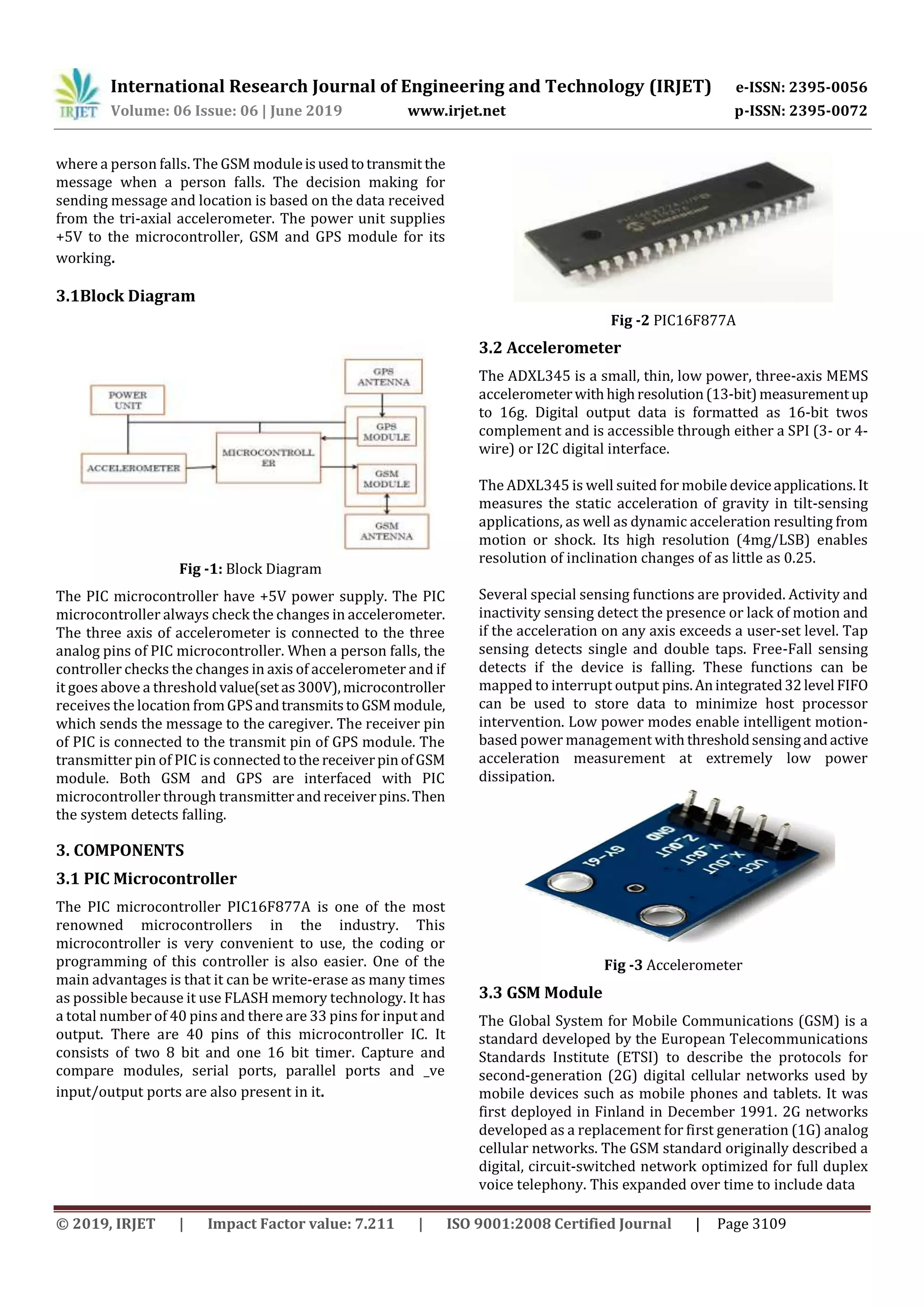
3.1Block Diagram
Fig -1: Block Diagram
The PIC microcontroller have +5V power supply. The PIC
microcontroller always check the changes in accelerometer.
The three axis of accelerometer is connected to the three
analog pins of PIC microcontroller. When a person falls, the
controller checks the changes in axis of accelerometer and if
it goes above a thresholdvalue(setas300V),microcontroller
receives the location fromGPSandtransmitstoGSMmodule,
which sends the message to the caregiver. The receiver pin
of PIC is connected to the transmit pin of GPS module. The
transmitter pin of PIC is connectedtothe receiverpinofGSM
module. Both GSM and GPS are interfaced with PIC
microcontroller through transmitterandreceiverpins.Then
the system detects falling.
3. COMPONENTS
3.1 PIC Microcontroller
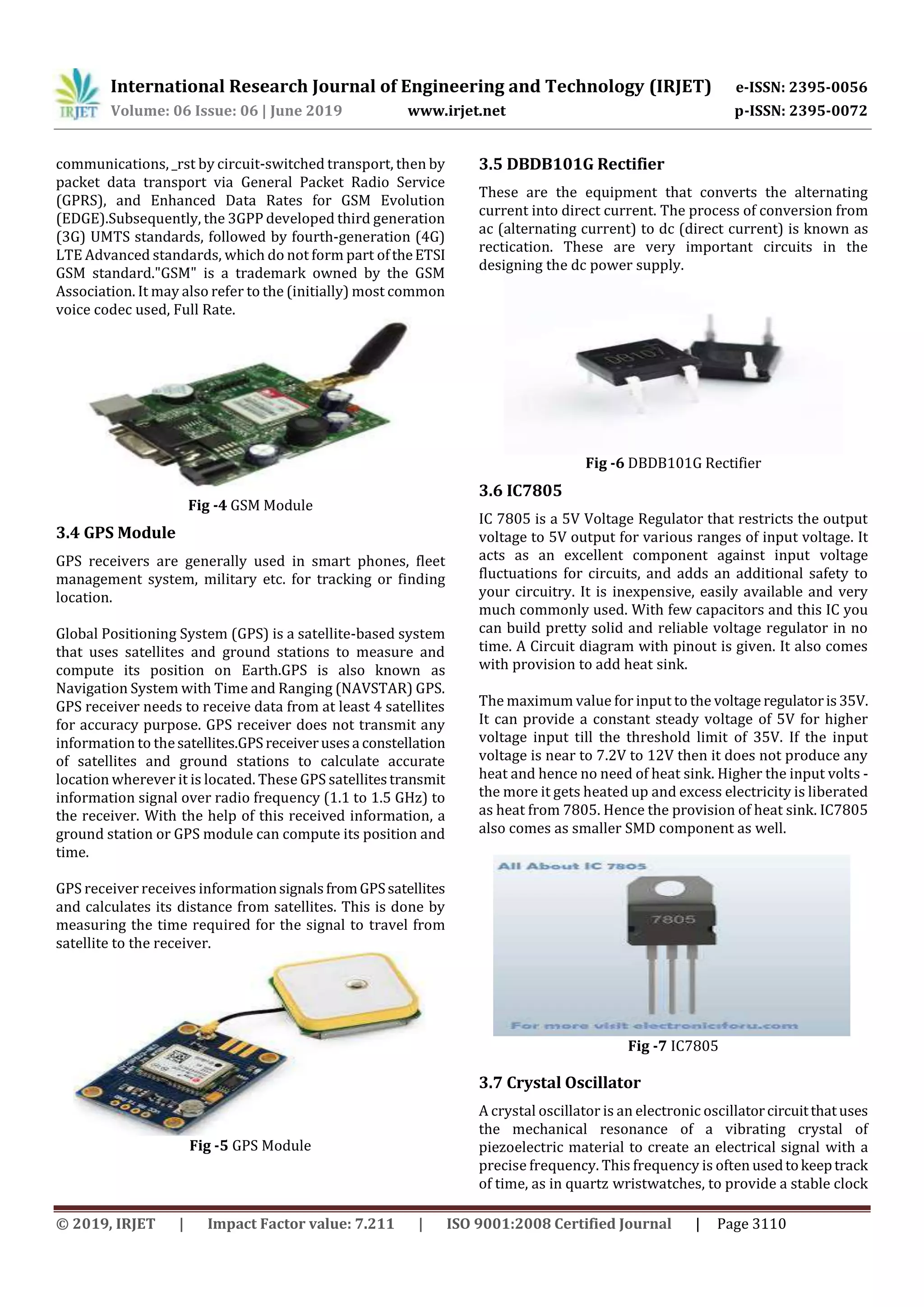
The PIC microcontroller PIC16F877A is one of the most
renowned microcontrollers in the industry. This
microcontroller is very convenient to use, the coding or
programming of this controller is also easier. One of the
main advantages is that it can be write-erase as many times
as possible because it use FLASH memory technology. It has
a total number of 40 pins and there are 33 pins for input and
output. There are 40 pins of this microcontroller IC. It
consists of two 8 bit and one 16 bit timer. Capture and
compare modules, serial ports, parallel ports and _ve
input/output ports are also present in it.
Fig -2 PIC16F877A
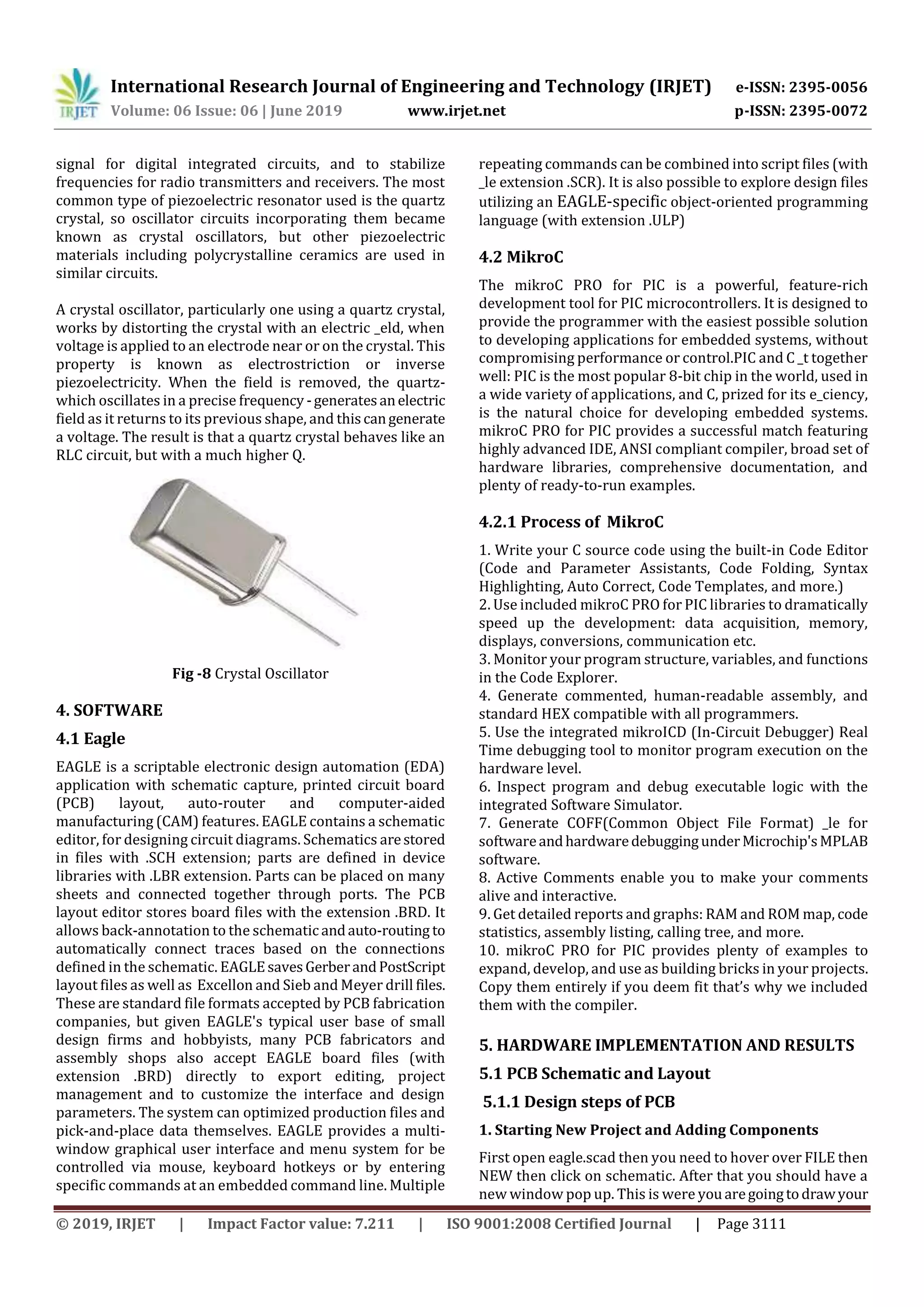
3.2 Accelerometer
The ADXL345 is a small, thin, low power, three-axis MEMS
accelerometerwith highresolution(13-bit)measurementup
to 16g. Digital output data is formatted as 16-bit twos
complement and is accessible through either a SPI (3- or 4-
wire) or I2C digital interface.
The ADXL345 is well suited for mobile deviceapplications.It
measures the static acceleration of gravity in tilt-sensing
applications, as well as dynamic acceleration resulting from
motion or shock. Its high resolution (4mg/LSB) enables
resolution of inclination changes of as little as 0.25.
Several special sensing functions are provided. Activity and
inactivity sensing detect the presence or lack of motion and
if the acceleration on any axis exceeds a user-set level. Tap
sensing detects single and double taps. Free-Fall sensing
detects if the device is falling. These functions can be
mapped to interrupt output pins.Anintegrated32level FIFO
can be used to store data to minimize host processor
intervention. Low power modes enable intelligent motion-
based power management with thresholdsensingandactive
acceleration measurement at extremely low power
dissipation.
Fig -3 Accelerometer
3.3 GSM Module
The Global System for Mobile Communications (GSM) is a
standard developed by the European Telecommunications
Standards Institute (ETSI) to describe the protocols for
second-generation (2G) digital cellular networks used by
mobile devices such as mobile phones and tablets. It was
first deployed in Finland in December 1991. 2G networks
developed as a replacement for first generation (1G) analog
cellular networks. The GSM standard originally described a
digital, circuit-switched network optimized for full duplex
voice telephony. This expanded over time to include data
International Research Journal of Engineering and Technology (IRJET) e-ISSN: 2395-0056
Volume: 06 Issue: 06 | June 2019 www.irjet.net p-ISSN: 2395-0072
© 2019, IRJET | Impact Factor value: 7.211 | ISO 9001:2008 Certified Journal | Page 3110
communications, _rst by circuit-switched transport, then by
packet data transport via General Packet Radio Service
(GPRS), and Enhanced Data Rates for GSM Evolution
(EDGE).Subsequently, the 3GPP developed third generation
(3G) UMTS standards, followed by fourth-generation (4G)
LTE Advanced standards, which do not form part oftheETSI
GSM standard."GSM" is a trademark owned by the GSM
Association. It may also refer to the (initially) most common
voice codec used, Full Rate.
Fig -4 GSM Module
3.4 GPS Module
GPS receivers are generally used in smart phones, fleet
management system, military etc. for tracking or finding
location.
Global Positioning System (GPS) is a satellite-based system
that uses satellites and ground stations to measure and
compute its position on Earth.GPS is also known as
Navigation System with Time and Ranging (NAVSTAR) GPS.
GPS receiver needs to receive data from at least 4 satellites
for accuracy purpose. GPS receiver does not transmit any
information to thesatellites.GPSreceiverusesa constellation
of satellites and ground stations to calculate accurate
location wherever it is located. These GPS satellitestransmit
information signal over radio frequency (1.1 to 1.5 GHz) to
the receiver. With the help of this received information, a
ground station or GPS module can compute its position and
time.
GPS receiver receives informationsignalsfromGPSsatellites
and calculates its distance from satellites. This is done by
measuring the time required for the signal to travel from
satellite to the receiver.
Fig -5 GPS Module
3.5 DBDB101G Rectifier
These are the equipment that converts the alternating
current into direct current. The process of conversion from
ac (alternating current) to dc (direct current) is known as
rectication. These are very important circuits in the
designing the dc power supply.
Fig -6 DBDB101G Rectifier
3.6 IC7805
IC 7805 is a 5V Voltage Regulator that restricts the output
voltage to 5V output for various ranges of input voltage. It
acts as an excellent component against input voltage
fluctuations for circuits, and adds an additional safety to
your circuitry. It is inexpensive, easily available and very
much commonly used. With few capacitors and this IC you
can build pretty solid and reliable voltage regulator in no
time. A Circuit diagram with pinout is given. It also comes
with provision to add heat sink.
The maximum value for input to the voltage regulatoris35V.
It can provide a constant steady voltage of 5V for higher
voltage input till the threshold limit of 35V. If the input
voltage is near to 7.2V to 12V then it does not produce any
heat and hence no need of heat sink. Higher the input volts -
the more it gets heated up and excess electricity is liberated
as heat from 7805. Hence the provision of heat sink. IC7805
also comes as smaller SMD component as well.
Fig -7 IC7805
3.7 Crystal Oscillator
A crystal oscillator is an electronic oscillatorcircuitthatuses
the mechanical resonance of a vibrating crystal of
piezoelectric material to create an electrical signal with a
precise frequency. This frequency is often usedtokeeptrack
of time, as in quartz wristwatches, to provide a stable clock
International Research Journal of Engineering and Technology (IRJET) e-ISSN: 2395-0056
Volume: 06 Issue: 06 | June 2019 www.irjet.net p-ISSN: 2395-0072
© 2019, IRJET | Impact Factor value: 7.211 | ISO 9001:2008 Certified Journal | Page 3111
signal for digital integrated circuits, and to stabilize
frequencies for radio transmitters and receivers. The most
common type of piezoelectric resonator used is the quartz
crystal, so oscillator circuits incorporating them became
known as crystal oscillators, but other piezoelectric
materials including polycrystalline ceramics are used in
similar circuits.
A crystal oscillator, particularly one using a quartz crystal,
works by distorting the crystal with an electric _eld, when
voltage is applied to an electrode near or on the crystal. This
property is known as electrostriction or inverse
piezoelectricity. When the field is removed, the quartz-
which oscillates in a precise frequency -generatesanelectric
field as it returns to its previous shape, and thiscangenerate
a voltage. The result is that a quartz crystal behaves like an
RLC circuit, but with a much higher Q.
Fig -8 Crystal Oscillator
4. SOFTWARE
4.1 Eagle
EAGLE is a scriptable electronic design automation (EDA)
application with schematic capture, printed circuit board
(PCB) layout, auto-router and computer-aided
manufacturing (CAM) features. EAGLE contains a schematic
editor, for designing circuit diagrams. Schematics arestored
in files with .SCH extension; parts are defined in device
libraries with .LBR extension. Parts can be placed on many
sheets and connected together through ports. The PCB
layout editor stores board files with the extension .BRD. It
allows back-annotation to the schematicandauto-routing to
automatically connect traces based on the connections
defined in the schematic. EAGLE savesGerberandPostScript
layout files as well as Excellon and Sieb and Meyer drill files.
These are standard file formats accepted by PCB fabrication
companies, but given EAGLE's typical user base of small
design firms and hobbyists, many PCB fabricators and
assembly shops also accept EAGLE board files (with
extension .BRD) directly to export editing, project
management and to customize the interface and design
parameters. The system can optimized production files and
pick-and-place data themselves. EAGLE provides a multi-
window graphical user interface and menu system for be
controlled via mouse, keyboard hotkeys or by entering
specific commands at an embedded command line. Multiple
repeating commands can be combined into script files (with
_le extension .SCR). It is also possible to explore design files
utilizing an EAGLE-specific object-oriented programming
language (with extension .ULP)
4.2 MikroC
The mikroC PRO for PIC is a powerful, feature-rich
development tool for PIC microcontrollers. It is designed to
provide the programmer with the easiest possible solution
to developing applications for embedded systems, without
compromising performance or control.PIC and C _t together
well: PIC is the most popular 8-bit chip in the world, used in
a wide variety of applications, and C, prized for its e_ciency,
is the natural choice for developing embedded systems.
mikroC PRO for PIC provides a successful match featuring
highly advanced IDE, ANSI compliant compiler, broad set of
hardware libraries, comprehensive documentation, and
plenty of ready-to-run examples.
4.2.1 Process of MikroC
1. Write your C source code using the built-in Code Editor
(Code and Parameter Assistants, Code Folding, Syntax
Highlighting, Auto Correct, Code Templates, and more.)
2. Use included mikroC PRO for PIC libraries to dramatically
speed up the development: data acquisition, memory,
displays, conversions, communication etc.
3. Monitor your program structure, variables, and functions
in the Code Explorer.
4. Generate commented, human-readable assembly, and
standard HEX compatible with all programmers.
5. Use the integrated mikroICD (In-Circuit Debugger) Real
Time debugging tool to monitor program execution on the
hardware level.
6. Inspect program and debug executable logic with the
integrated Software Simulator.
7. Generate COFF(Common Object File Format) _le for
softwareandhardwaredebuggingunderMicrochip'sMPLAB
software.
8. Active Comments enable you to make your comments
alive and interactive.
9. Get detailed reports and graphs: RAM and ROM map, code
statistics, assembly listing, calling tree, and more.
10. mikroC PRO for PIC provides plenty of examples to
expand, develop, and use as building bricks in your projects.
Copy them entirely if you deem fit that’s why we included
them with the compiler.
5. HARDWARE IMPLEMENTATION AND RESULTS
5.1 PCB Schematic and Layout
5.1.1 Design steps of PCB
1. Starting New Project and Adding Components
First open eagle.scad then you need to hover over FILE then
NEW then click on schematic. After that you should have a
new window pop up. This is were youaregoingtodrawyour
International Research Journal of Engineering and Technology (IRJET) e-ISSN: 2395-0056
Volume: 06 Issue: 06 | June 2019 www.irjet.net p-ISSN: 2395-0072
© 2019, IRJET | Impact Factor value: 7.211 | ISO 9001:2008 Certified Journal | Page 3112
schematic. To add a component you need to click the add
button. Then _nd your component. Click OK and you should
have the schematic sign of your component, just click and it
will be added. That I show you add a part. Keep doing that
Intel you have all the parts you need. To turn a component
all you have to do is right click.
2. Connecting Components.
To connect your components you have to click the wire
button. Then click on one part you wanttoconnectthenclick
the other. If you right click then the angle that the lin tirns at
and direction will change.
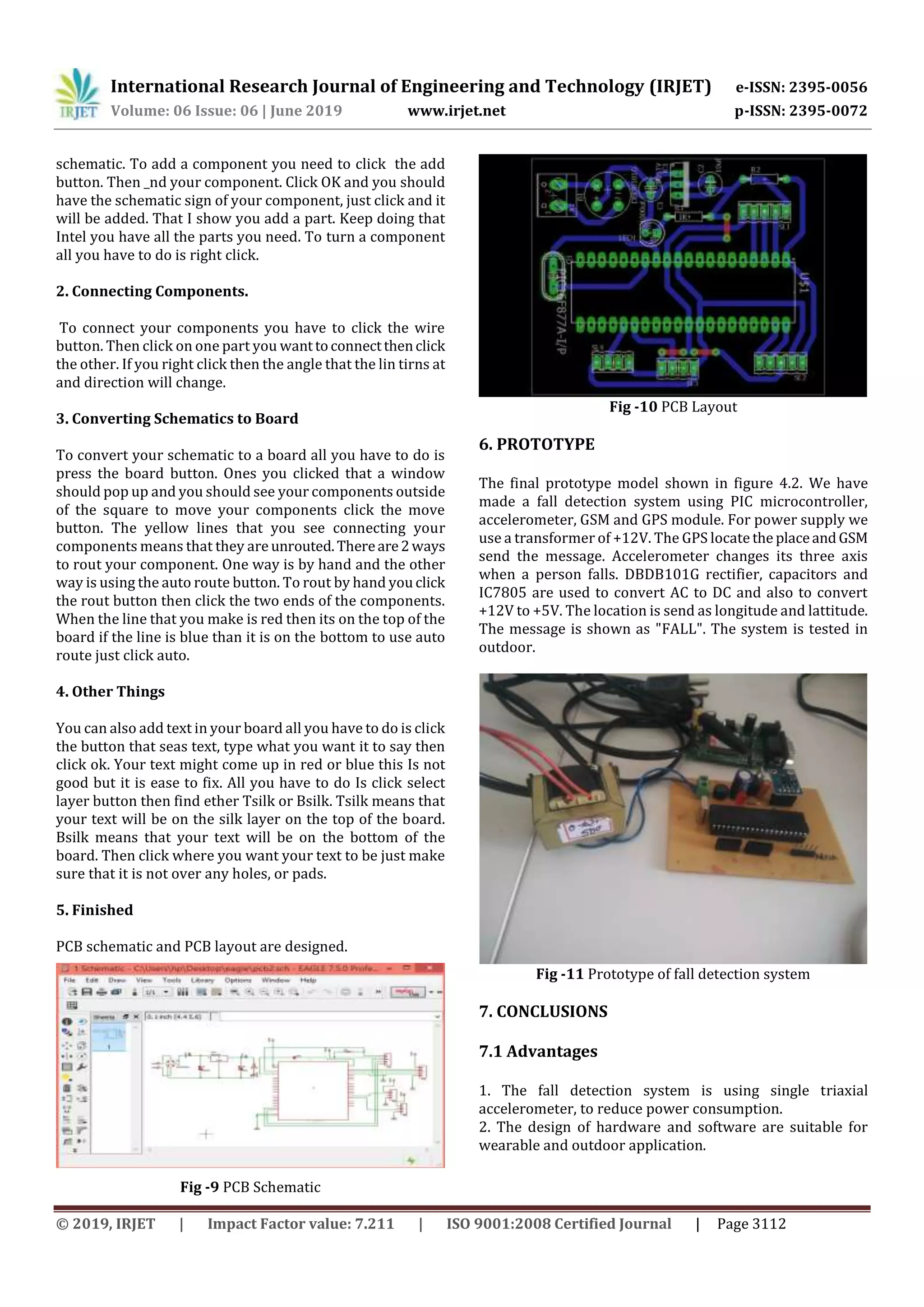
3. Converting Schematics to Board
To convert your schematic to a board all you have to do is
press the board button. Ones you clicked that a window
should pop up and you should see your components outside
of the square to move your components click the move
button. The yellow lines that you see connecting your
components means that they are unrouted.Thereare2ways
to rout your component. One way is by hand and the other
way is using the auto route button. To rout by hand youclick
the rout button then click the two ends of the components.
When the line that you make is red then its on the top of the
board if the line is blue than it is on the bottom to use auto
route just click auto.
4. Other Things
You can also add text in your board all you have to do is click
the button that seas text, type what you want it to say then
click ok. Your text might come up in red or blue this Is not
good but it is ease to fix. All you have to do Is click select
layer button then find ether Tsilk or Bsilk. Tsilk means that
your text will be on the silk layer on the top of the board.
Bsilk means that your text will be on the bottom of the
board. Then click where you want your text to be just make
sure that it is not over any holes, or pads.
5. Finished
PCB schematic and PCB layout are designed.
Fig -9 PCB Schematic
Fig -10 PCB Layout
6. PROTOTYPE
The final prototype model shown in figure 4.2. We have
made a fall detection system using PIC microcontroller,
accelerometer, GSM and GPS module. For power supply we
use a transformer of +12V. The GPS locatethe placeandGSM
send the message. Accelerometer changes its three axis
when a person falls. DBDB101G rectifier, capacitors and
IC7805 are used to convert AC to DC and also to convert
+12V to +5V. The location is send as longitude and lattitude.
The message is shown as "FALL". The system is tested in
outdoor.
Fig -11 Prototype of fall detection system
7. CONCLUSIONS
7.1 Advantages
1. The fall detection system is using single triaxial
accelerometer, to reduce power consumption.
2. The design of hardware and software are suitable for
wearable and outdoor application.
International Research Journal of Engineering and Technology (IRJET) e-ISSN: 2395-0056
Volume: 06 Issue: 06 | June 2019 www.irjet.net p-ISSN: 2395-0072
© 2019, IRJET | Impact Factor value: 7.211 | ISO 9001:2008 Certified Journal | Page 3113
7.2 Disadvantages
1. The system detects fall, but cannot distinguish different
activities.
2. The size of the wearable system is large which made
difficult to the person to carry it.
8. FUTURE SCOPE
Since this fall detection system is built as a prototype it has
various limitations. More research should do to improve the
current proposed system. Sufficient sample number
collected from subjects with different age and gender will
improve the reliability and robustness of the threshold.
REFERENCES
[1] M. K. Karlsson, H. Magnusson, T. vonSchewelov,and B.E.
Rosengren, Prevention of falls in the elderlya review,
Osteoporosis International, vol. 24, no. 3, pp. 747762, 2013.
[2] T. Shany, S. J. Redmond, M. R. Narayanan,andN.H.Lovell,
Sensors-based wearable systems for monitoring of human
movement and falls, IEEE Sensors Journal, vol. 12, no. 3, pp.
658670, 2012.
[3] M. Grassi, A. Lombardi, G. Rescio et al., An integrated
system for people fall-detection with data fusioncapabilities
based on 3D ToF camera and wireless accelerometer, in
Proceedings of the 9th IEEE Sensors Conference (SENSORS
'10), pp. 10161019, Kona, Hawaii, USA, November 2010.
[4] . Abbate, M. Avvenuti, G. Cola et al., Recognition of false
alarms in fall detection systems, in Consumer
Communications and Networking Conference (CCNC '11),
pp. 2328, Las Vegas, Nev, USA, 2011.
[5] . V. C. Bouten, K. T. M. Koekkoek, M. Verduin, R. Kodde,
and J. D. Janssen, A triaxial accelerometer and portable data
processing unit for theassessmentof +dailyphysical activity,
IEEE Transactions on Biomedical Engineering, vol. 44, no.
3, pp. 136147, 1997.

IRJET- Wearable Sensor based Fall Detection System

  • 1.
    International Research Journalof Engineering and Technology (IRJET) e-ISSN: 2395-0056 Volume: 06 Issue: 06 | June 2019 www.irjet.net p-ISSN: 2395-0072 © 2019, IRJET | Impact Factor value: 7.211 | ISO 9001:2008 Certified Journal | Page 3108 Wearable Sensor Based Fall Detection System Aneena George1, Ashitha Haridas2, Athira K P3, Sreepriya E V4, Prof. Sarin Abraham5 1,2,3,4Student, Dept. of Electronics and Communication Engineering, MACE, Kerala, India 5Assisstant Professor, Dept. of Electronics and Communication Engineering, MACE, Kerala, India ---------------------------------------------------------------------***--------------------------------------------------------------------- Abstract -Fall detection is a major challenge in the public healthcare domain, especially forthe elderlyasthedeclineof their physical fitness, and timely and reliable surveillance is necessary to mitigate the negative effects of falls. This project develops a novel fall detection system based on a wearable device. The system monitors the movements of human body, recognizes a fall from normal dailyactivitiesby an effective quaternion algorithm, and automatically sends request for help to the caregivers with the patients location. 1. INTRODUCTION Falls of the elderly always lead to serioushealthissuesasthe decline of their physical fitness. Fracture is the most common injury in fall of an elderly situations,thefall process is the main source of injury because of the high impact. But sometimes the late medical salvage may worsen the situation. That means the faster the salvage comes, the less risk the elderly will face. Progress of technology brings more possibilities to help us protect the elderly. Low power consumption components make it possible to realize wearable monitoring device. MEMS (micro electro-mechanical systems) sensors have simplified the design and implementation of sensor system. Location based service (LBS) makes it more convenient to locate the elderly in health monitoring. Beside these, mobile computing makesremotehealthmonitoring easiertorealize. Several kinds of fall detection methods havebeendeveloped or applied in our life. One of them is computer vision based method. Cameras are distributed at limited space to offer pictures or videos of human activities to implement fall detection algorithm. External supports such as motion sensors could be used to enhance computer vision basedfall detection method, and a data fusion algorithm can operate the validation and correlation among the two subsystems to raise robust performance of fall detection. These computer based methods work effectively in indoor environment, but they are hard to realize in outdoor environment as the deployment of cameras is always limited. But, in fact, using more sensors means more power consumption, and it is a challenge to design a proper algorithm to fuse different kinds of sensors. A single triaxial accelerometer is quite enough for human fall detection as suffcient information could be extracted from its measurements. Besides this, the accelerometer coordinate does not have to be fixed if only the magnitude of sumvector is needed, and that is quite convenient for wearable application. In this paper, a fall detection system based on a wearable device is developed. The hardware and software realization of the device is mainly based on a single triaxial accelerometer and GPS/GSM module. The device uses an efficient fall detection algorithm with less resource and power consumption, which means that it is a proper design for outdoor application. 2. LITERATURE SURVEY The rapid aging of the world's population, along with an increase in the prevalence of chronic illnesses and obesity, requires adaption and modification of current healthcare models. One such approach involves telehealthapplications, many of which are based on sensor technologies for unobtrusive monitoring. Recent technological advances, in particular, involving micro electro-mechanical systems,have resulted in miniaturized wearable devices that can be used for a range of applications. One of the leading areas for utilization of body-fixed sensors is the monitoring of human movement. An overview of common ambulatory sensors is presented, followed by a summary of the developments in this field, with an emphasis on the clinical applications of falls detection, fallsrisk assessment,andenergyexpenditure. The importance of these applications is considerable inlight of the global demographic trends and the resultant rise in the occurrence of injurious falls and the decrease of physical activity. The potential of using such monitors in an unsupervised mannerforcommunity-dwellingindividualsis immense, but entails an array of challenges with regards to design considerations, implementationprotocols, andsignal analysis processes. 3. DESIGN In this a microcontroller is employedtohandledata transfer operations. We are using PICmicrocontroller(PIC16F877A), which are a family specialised microcon-troller chips produced by microchip technology. The acronym PICstands for peripheral interface controller. A microcontroller is compact microcomputer designedtogoverntheoperationof three axis accelerometer and GSM/GPS module etc. The system is used for the detection of fall. A triaxial accelerometer is used to detect the fall. The accelerometer, GSM and GPS module are interfaced with the PIC microcontroller. The GPS module is used to locate the place
  • 2.
    International Research Journalof Engineering and Technology (IRJET) e-ISSN: 2395-0056 Volume: 06 Issue: 06 | June 2019 www.irjet.net p-ISSN: 2395-0072 © 2019, IRJET | Impact Factor value: 7.211 | ISO 9001:2008 Certified Journal | Page 3109 where a person falls. The GSM moduleisusedtotransmit the message when a person falls. The decision making for sending message and location is based on the data received from the tri-axial accelerometer. The power unit supplies +5V to the microcontroller, GSM and GPS module for its working. 3.1Block Diagram Fig -1: Block Diagram The PIC microcontroller have +5V power supply. The PIC microcontroller always check the changes in accelerometer. The three axis of accelerometer is connected to the three analog pins of PIC microcontroller. When a person falls, the controller checks the changes in axis of accelerometer and if it goes above a thresholdvalue(setas300V),microcontroller receives the location fromGPSandtransmitstoGSMmodule, which sends the message to the caregiver. The receiver pin of PIC is connected to the transmit pin of GPS module. The transmitter pin of PIC is connectedtothe receiverpinofGSM module. Both GSM and GPS are interfaced with PIC microcontroller through transmitterandreceiverpins.Then the system detects falling. 3. COMPONENTS 3.1 PIC Microcontroller The PIC microcontroller PIC16F877A is one of the most renowned microcontrollers in the industry. This microcontroller is very convenient to use, the coding or programming of this controller is also easier. One of the main advantages is that it can be write-erase as many times as possible because it use FLASH memory technology. It has a total number of 40 pins and there are 33 pins for input and output. There are 40 pins of this microcontroller IC. It consists of two 8 bit and one 16 bit timer. Capture and compare modules, serial ports, parallel ports and _ve input/output ports are also present in it. Fig -2 PIC16F877A 3.2 Accelerometer The ADXL345 is a small, thin, low power, three-axis MEMS accelerometerwith highresolution(13-bit)measurementup to 16g. Digital output data is formatted as 16-bit twos complement and is accessible through either a SPI (3- or 4- wire) or I2C digital interface. The ADXL345 is well suited for mobile deviceapplications.It measures the static acceleration of gravity in tilt-sensing applications, as well as dynamic acceleration resulting from motion or shock. Its high resolution (4mg/LSB) enables resolution of inclination changes of as little as 0.25. Several special sensing functions are provided. Activity and inactivity sensing detect the presence or lack of motion and if the acceleration on any axis exceeds a user-set level. Tap sensing detects single and double taps. Free-Fall sensing detects if the device is falling. These functions can be mapped to interrupt output pins.Anintegrated32level FIFO can be used to store data to minimize host processor intervention. Low power modes enable intelligent motion- based power management with thresholdsensingandactive acceleration measurement at extremely low power dissipation. Fig -3 Accelerometer 3.3 GSM Module The Global System for Mobile Communications (GSM) is a standard developed by the European Telecommunications Standards Institute (ETSI) to describe the protocols for second-generation (2G) digital cellular networks used by mobile devices such as mobile phones and tablets. It was first deployed in Finland in December 1991. 2G networks developed as a replacement for first generation (1G) analog cellular networks. The GSM standard originally described a digital, circuit-switched network optimized for full duplex voice telephony. This expanded over time to include data
  • 3.
    International Research Journalof Engineering and Technology (IRJET) e-ISSN: 2395-0056 Volume: 06 Issue: 06 | June 2019 www.irjet.net p-ISSN: 2395-0072 © 2019, IRJET | Impact Factor value: 7.211 | ISO 9001:2008 Certified Journal | Page 3110 communications, _rst by circuit-switched transport, then by packet data transport via General Packet Radio Service (GPRS), and Enhanced Data Rates for GSM Evolution (EDGE).Subsequently, the 3GPP developed third generation (3G) UMTS standards, followed by fourth-generation (4G) LTE Advanced standards, which do not form part oftheETSI GSM standard."GSM" is a trademark owned by the GSM Association. It may also refer to the (initially) most common voice codec used, Full Rate. Fig -4 GSM Module 3.4 GPS Module GPS receivers are generally used in smart phones, fleet management system, military etc. for tracking or finding location. Global Positioning System (GPS) is a satellite-based system that uses satellites and ground stations to measure and compute its position on Earth.GPS is also known as Navigation System with Time and Ranging (NAVSTAR) GPS. GPS receiver needs to receive data from at least 4 satellites for accuracy purpose. GPS receiver does not transmit any information to thesatellites.GPSreceiverusesa constellation of satellites and ground stations to calculate accurate location wherever it is located. These GPS satellitestransmit information signal over radio frequency (1.1 to 1.5 GHz) to the receiver. With the help of this received information, a ground station or GPS module can compute its position and time. GPS receiver receives informationsignalsfromGPSsatellites and calculates its distance from satellites. This is done by measuring the time required for the signal to travel from satellite to the receiver. Fig -5 GPS Module 3.5 DBDB101G Rectifier These are the equipment that converts the alternating current into direct current. The process of conversion from ac (alternating current) to dc (direct current) is known as rectication. These are very important circuits in the designing the dc power supply. Fig -6 DBDB101G Rectifier 3.6 IC7805 IC 7805 is a 5V Voltage Regulator that restricts the output voltage to 5V output for various ranges of input voltage. It acts as an excellent component against input voltage fluctuations for circuits, and adds an additional safety to your circuitry. It is inexpensive, easily available and very much commonly used. With few capacitors and this IC you can build pretty solid and reliable voltage regulator in no time. A Circuit diagram with pinout is given. It also comes with provision to add heat sink. The maximum value for input to the voltage regulatoris35V. It can provide a constant steady voltage of 5V for higher voltage input till the threshold limit of 35V. If the input voltage is near to 7.2V to 12V then it does not produce any heat and hence no need of heat sink. Higher the input volts - the more it gets heated up and excess electricity is liberated as heat from 7805. Hence the provision of heat sink. IC7805 also comes as smaller SMD component as well. Fig -7 IC7805 3.7 Crystal Oscillator A crystal oscillator is an electronic oscillatorcircuitthatuses the mechanical resonance of a vibrating crystal of piezoelectric material to create an electrical signal with a precise frequency. This frequency is often usedtokeeptrack of time, as in quartz wristwatches, to provide a stable clock
  • 4.
    International Research Journalof Engineering and Technology (IRJET) e-ISSN: 2395-0056 Volume: 06 Issue: 06 | June 2019 www.irjet.net p-ISSN: 2395-0072 © 2019, IRJET | Impact Factor value: 7.211 | ISO 9001:2008 Certified Journal | Page 3111 signal for digital integrated circuits, and to stabilize frequencies for radio transmitters and receivers. The most common type of piezoelectric resonator used is the quartz crystal, so oscillator circuits incorporating them became known as crystal oscillators, but other piezoelectric materials including polycrystalline ceramics are used in similar circuits. A crystal oscillator, particularly one using a quartz crystal, works by distorting the crystal with an electric _eld, when voltage is applied to an electrode near or on the crystal. This property is known as electrostriction or inverse piezoelectricity. When the field is removed, the quartz- which oscillates in a precise frequency -generatesanelectric field as it returns to its previous shape, and thiscangenerate a voltage. The result is that a quartz crystal behaves like an RLC circuit, but with a much higher Q. Fig -8 Crystal Oscillator 4. SOFTWARE 4.1 Eagle EAGLE is a scriptable electronic design automation (EDA) application with schematic capture, printed circuit board (PCB) layout, auto-router and computer-aided manufacturing (CAM) features. EAGLE contains a schematic editor, for designing circuit diagrams. Schematics arestored in files with .SCH extension; parts are defined in device libraries with .LBR extension. Parts can be placed on many sheets and connected together through ports. The PCB layout editor stores board files with the extension .BRD. It allows back-annotation to the schematicandauto-routing to automatically connect traces based on the connections defined in the schematic. EAGLE savesGerberandPostScript layout files as well as Excellon and Sieb and Meyer drill files. These are standard file formats accepted by PCB fabrication companies, but given EAGLE's typical user base of small design firms and hobbyists, many PCB fabricators and assembly shops also accept EAGLE board files (with extension .BRD) directly to export editing, project management and to customize the interface and design parameters. The system can optimized production files and pick-and-place data themselves. EAGLE provides a multi- window graphical user interface and menu system for be controlled via mouse, keyboard hotkeys or by entering specific commands at an embedded command line. Multiple repeating commands can be combined into script files (with _le extension .SCR). It is also possible to explore design files utilizing an EAGLE-specific object-oriented programming language (with extension .ULP) 4.2 MikroC The mikroC PRO for PIC is a powerful, feature-rich development tool for PIC microcontrollers. It is designed to provide the programmer with the easiest possible solution to developing applications for embedded systems, without compromising performance or control.PIC and C _t together well: PIC is the most popular 8-bit chip in the world, used in a wide variety of applications, and C, prized for its e_ciency, is the natural choice for developing embedded systems. mikroC PRO for PIC provides a successful match featuring highly advanced IDE, ANSI compliant compiler, broad set of hardware libraries, comprehensive documentation, and plenty of ready-to-run examples. 4.2.1 Process of MikroC 1. Write your C source code using the built-in Code Editor (Code and Parameter Assistants, Code Folding, Syntax Highlighting, Auto Correct, Code Templates, and more.) 2. Use included mikroC PRO for PIC libraries to dramatically speed up the development: data acquisition, memory, displays, conversions, communication etc. 3. Monitor your program structure, variables, and functions in the Code Explorer. 4. Generate commented, human-readable assembly, and standard HEX compatible with all programmers. 5. Use the integrated mikroICD (In-Circuit Debugger) Real Time debugging tool to monitor program execution on the hardware level. 6. Inspect program and debug executable logic with the integrated Software Simulator. 7. Generate COFF(Common Object File Format) _le for softwareandhardwaredebuggingunderMicrochip'sMPLAB software. 8. Active Comments enable you to make your comments alive and interactive. 9. Get detailed reports and graphs: RAM and ROM map, code statistics, assembly listing, calling tree, and more. 10. mikroC PRO for PIC provides plenty of examples to expand, develop, and use as building bricks in your projects. Copy them entirely if you deem fit that’s why we included them with the compiler. 5. HARDWARE IMPLEMENTATION AND RESULTS 5.1 PCB Schematic and Layout 5.1.1 Design steps of PCB 1. Starting New Project and Adding Components First open eagle.scad then you need to hover over FILE then NEW then click on schematic. After that you should have a new window pop up. This is were youaregoingtodrawyour
  • 5.
    International Research Journalof Engineering and Technology (IRJET) e-ISSN: 2395-0056 Volume: 06 Issue: 06 | June 2019 www.irjet.net p-ISSN: 2395-0072 © 2019, IRJET | Impact Factor value: 7.211 | ISO 9001:2008 Certified Journal | Page 3112 schematic. To add a component you need to click the add button. Then _nd your component. Click OK and you should have the schematic sign of your component, just click and it will be added. That I show you add a part. Keep doing that Intel you have all the parts you need. To turn a component all you have to do is right click. 2. Connecting Components. To connect your components you have to click the wire button. Then click on one part you wanttoconnectthenclick the other. If you right click then the angle that the lin tirns at and direction will change. 3. Converting Schematics to Board To convert your schematic to a board all you have to do is press the board button. Ones you clicked that a window should pop up and you should see your components outside of the square to move your components click the move button. The yellow lines that you see connecting your components means that they are unrouted.Thereare2ways to rout your component. One way is by hand and the other way is using the auto route button. To rout by hand youclick the rout button then click the two ends of the components. When the line that you make is red then its on the top of the board if the line is blue than it is on the bottom to use auto route just click auto. 4. Other Things You can also add text in your board all you have to do is click the button that seas text, type what you want it to say then click ok. Your text might come up in red or blue this Is not good but it is ease to fix. All you have to do Is click select layer button then find ether Tsilk or Bsilk. Tsilk means that your text will be on the silk layer on the top of the board. Bsilk means that your text will be on the bottom of the board. Then click where you want your text to be just make sure that it is not over any holes, or pads. 5. Finished PCB schematic and PCB layout are designed. Fig -9 PCB Schematic Fig -10 PCB Layout 6. PROTOTYPE The final prototype model shown in figure 4.2. We have made a fall detection system using PIC microcontroller, accelerometer, GSM and GPS module. For power supply we use a transformer of +12V. The GPS locatethe placeandGSM send the message. Accelerometer changes its three axis when a person falls. DBDB101G rectifier, capacitors and IC7805 are used to convert AC to DC and also to convert +12V to +5V. The location is send as longitude and lattitude. The message is shown as "FALL". The system is tested in outdoor. Fig -11 Prototype of fall detection system 7. CONCLUSIONS 7.1 Advantages 1. The fall detection system is using single triaxial accelerometer, to reduce power consumption. 2. The design of hardware and software are suitable for wearable and outdoor application.
  • 6.
    International Research Journalof Engineering and Technology (IRJET) e-ISSN: 2395-0056 Volume: 06 Issue: 06 | June 2019 www.irjet.net p-ISSN: 2395-0072 © 2019, IRJET | Impact Factor value: 7.211 | ISO 9001:2008 Certified Journal | Page 3113 7.2 Disadvantages 1. The system detects fall, but cannot distinguish different activities. 2. The size of the wearable system is large which made difficult to the person to carry it. 8. FUTURE SCOPE Since this fall detection system is built as a prototype it has various limitations. More research should do to improve the current proposed system. Sufficient sample number collected from subjects with different age and gender will improve the reliability and robustness of the threshold. REFERENCES [1] M. K. Karlsson, H. Magnusson, T. vonSchewelov,and B.E. Rosengren, Prevention of falls in the elderlya review, Osteoporosis International, vol. 24, no. 3, pp. 747762, 2013. [2] T. Shany, S. J. Redmond, M. R. Narayanan,andN.H.Lovell, Sensors-based wearable systems for monitoring of human movement and falls, IEEE Sensors Journal, vol. 12, no. 3, pp. 658670, 2012. [3] M. Grassi, A. Lombardi, G. Rescio et al., An integrated system for people fall-detection with data fusioncapabilities based on 3D ToF camera and wireless accelerometer, in Proceedings of the 9th IEEE Sensors Conference (SENSORS '10), pp. 10161019, Kona, Hawaii, USA, November 2010. [4] . Abbate, M. Avvenuti, G. Cola et al., Recognition of false alarms in fall detection systems, in Consumer Communications and Networking Conference (CCNC '11), pp. 2328, Las Vegas, Nev, USA, 2011. [5] . V. C. Bouten, K. T. M. Koekkoek, M. Verduin, R. Kodde, and J. D. Janssen, A triaxial accelerometer and portable data processing unit for theassessmentof +dailyphysical activity, IEEE Transactions on Biomedical Engineering, vol. 44, no. 3, pp. 136147, 1997.