International Research Journal of Engineering and Technology (IRJET) e-ISSN: 2395-0056
Volume: 06 Issue: 12 | Dec 2019 www.irjet.net p-ISSN: 2395-0072
© 2019, IRJET | Impact Factor value: 7.34 | ISO 9001:2008 Certified Journal | Page 1198
Development and Monitoring of a Fall Detection System through
Wearable Sensor Belt
Swathi S Kendri1, Dr. Sheela. Kiran. Kore2, Mr. Prabhakar Manage3
1,2,3Dept. of Electronics and Communication, K.L.E. Dr. M. S. Sheshagiri College of Engineering and Technology,
Belagavi, Karnataka, India.
-----------------------------------------------------------------------***------------------------------------------------------------------------
ABSTRACT - The elderly people’s population increases
health care demand with a greater desire for independence.
And, also avoiding the risks of falling incidents has become
particularly noticeable which can cause disability leading to
a significant decrease in movability and sometimes even life
quality. Resulting in this, respective technologies had been
developed to preventing and simultaneously monitoring
falls. Some systems depend on cameras being mounted in all
rooms of a patient’s house while others are wearable type all
time. This paper explores a wearable belt system using an
inventive IoT-based technology for detection of falls in
elderly patients along with sending an alert to the caretaker.
This system even senses the location when the monitored
parameters exceed the preset limits and monitoring it
visually using Vpython. The motion is detected using a three-
dimensional accelerometer BMA222 embedded within a
launchpad attached to a wearable belt. The accelerometer,
which in turn extracts the movement data and sends it to the
data cloud for an alert message by using Wi-Fi and Neo 6M
GPS location module. To maintain efficiency, we can monitor
the system for a continuous-time span.
Key words: IoT-based system, Vpython, three-
dimensional accelerometer BMA222, launchpad, Wi-Fi and
Neo 6M GPS
1. INTRODUCTION
The definition of fall is an event of a person losing
balance and collapse. Falls of the elderly might lead to
some serious health issues like loss of independence, cause
of fear, disability, movables and also leads to some health
care utilization, thus as the decline of their physical fitness.
A fracture would be the most common injury in the fall of
the elderly, and also there is a certain possibility of brain
trauma, coma, and paralysis. In most fall situations, the fall
process is the main source of injury because of the high
impact. Sometimes the late process of treatment may
worsen the situation. Thus, the faster the treatment there
will be lesser risk factors in the elderly [1]. For the
majority, external support is imperative for avoiding major
consequences in most of the fall events [3].
To realize a fall detection, a wearable monitoring
with visualizing and sending alert devices the low power
consumption components makes it possible. With the
design of a sensor system, the Micro Electron Mechanical
Systems (MEMS) sensors had simplified the
implementation with the installation steps. To find the
location of the elderly in health monitoring the Location
Based Service (LBS) is more convenient [1].
The computer vision-based method is one of the
several kinds of fall detection techniques being developed
or applied in our life. A visual-based fall detection method
could be enhanced through the external supports such as
motion sensors, and to raise robust performance in a fall
detection and to operate for the validation and correlation
of the two subsystems, a data fusion algorithm technique
can be used. These visual-based methods work effectively
in an indoor environment, but yet still becomes hard to
realize in the outdoor environment as the deployment of
cameras is always limited [1].
Also, the commonly used method is the Motion
sensor-based method. Gyroscope and accelerometer could
provide angular and linear motion of the object
information directly. Sensor measurements with a proper
fusion could be used to distinguish the real fall of an object.
The constitution of motion sensors with the detection
algorithms is considered from the several kinds of
detection methods. One type of detection method is using
an accelerometer. The accelerations of an object are in
three directions through the influence of gravity is
measured through a single triaxial accelerometer. As soon
as the accelerometer is fixed on the patient’s body, a
coordinate will be built. By using a low pass filter or high
pass filters the influence of gravity or dynamic acceleration
is made available. The vector sum with the relationship to
that of acceleration components some type of angular
movement information can also be calculated. Another
type of detection method is based on both accelerometer
and gyroscope or also involves a magnetometer. The
angular velocity can be measured through a gyroscope and
the linear motion information can be measured through
the accelerometer. A magnetic strength, in three directions
can be detected through the triaxial magnetometer, and
also the angular motion information in the horizontal
plane can be provided. The geomagnetic field gets
disturbed by the environment magnetic field and thus
International Research Journal of Engineering and Technology (IRJET) e-ISSN: 2395-0056
Volume: 06 Issue: 12 | Dec 2019 www.irjet.net p-ISSN: 2395-0072
© 2019, IRJET | Impact Factor value: 7.34 | ISO 9001:2008 Certified Journal | Page 1199
reduces the reliability of the magnetometer outputs, for an
instance in some of the steel structure architecture or with
strong electromagnetism near some of the objects.
Through the accelerometer measurements, the angular
information can also be extracted, the Kalman filter which
is a state-space filter is a commonly used technique to
combine angular motion information [1].
More power consumption can occur using more
sensors and also designing a low power dissipation with a
proper algorithm is a challenging task with the fusion of
the different kinds of sensors. For a human fall detection, a
single triaxial accelerometer is quite enough from its
measurements with all the sufficient information that
could be extracted. Besides this, if only the magnitude of
the sum vector is needed, the accelerometer coordinate
does not have to be fixed and which is quite convenient in
the wearable applications. In this paper, a fall detection
system based on a wearable device is developed and even
monitored visually. The hardware and software realization
of the device is mainly based on a single triaxial
accelerometer, a wi-fi transmission capabilities for SMS
(Short Message Service) alert or notifications. For a proper
design of the outdoor application, this type of device uses
an efficient fall detection algorithm with less resource and
power consumption [1].
2. METHODOLOGY
There are three types of fall detection namely:
1. wearable device based
2. Ambiance sensor-based, and
3. Vision (camera) based.
All three types have their limitations. Vision-based
type uses a camera and neural network to find the changes
of shape occurred from the human, but the camera is
limited with the area and at most can only be used indoor.
Ambiance sensor-based type consists of an array of
capacitive sensors or proximity sensors and many other
sensors, but again the area is limited.
Fig. 1. A simple block diagram of a wearable belt with a
visual monitoring and to send message alert based on the
fall detection.
Fig 2. Part 1 flowchart to trigger an alert message based on
the motion detected.
The wearable device type includes an
accelerometer, gyroscope and a barometer sensor
attached to the belt, which will be tied to the person’s
wrist or trunk. But again, through this type of sensor, the
only fall can be detected but the force of falling and even
the height of falling cannot be analyzed through the
International Research Journal of Engineering and Technology (IRJET) e-ISSN: 2395-0056
Volume: 06 Issue: 12 | Dec 2019 www.irjet.net p-ISSN: 2395-0072
© 2019, IRJET | Impact Factor value: 7.34 | ISO 9001:2008 Certified Journal | Page 1200
caretaker and hence VPython is used to serially visualize
the fall detected and take necessary actions.
Fig 2. Part 2 flowchart to trigger an alert message based on
the motion detected.
The development of a wearable belt includes a
single motion type sensor called tri-axial accelerometer to
sense the motion or movement of an elderly person, which
is in build type of sensor in CC3200 LaunchXL LaunchPad.
Also, a Neo 6M GPS location module type of sensor for GPS
location is used to detect the location of the fall of an
elderly person. And, the launchpad with a 32-bit Arm
Cortex-M4 microcontroller that supports and also has in-
built wi-fi receiver and transmission capabilities which
helps to send a message alert through the cloud using
IFTTT to the caretaker and even to store the data in the
cloud if necessary.
VPython, is also known as a visual python. It is a
real-time 3D graphics module for the high-level
programming language, provides a simple but powerful
programming environment for visualization, physics
educators and students [6].
A VPython visually displays a fall detection in a 3D
graphics manner and based on the type of fall, a care-taker
can take some necessary measures.
3. ALGORITHM OF FALL -DETECTION WITH ALERT:
Initially, we need to set variables Trigger and Calls
to ‘0’, and variable Maxcalls to ‘1’. Even, the variables X_val,
Y_val and Z_val to ‘0’. Similarly, the variables X_init, Y_init
and Z_init to ‘0’. And also, the variable Firstrun to ‘1’. Now
when the motion is detected for the first time the X_init
stores the value of X_val, the Y_init stores the value of Y_val
and Z_init stores the value of Z_val with the Firstrun set to
‘0’. Then later, whenever the motion has detected the
values stored in variables X_val, Y_val, and Z_val to the
variables X_init, Y_init and Z_init respectively. When the
value of Y_val subtracted with the value of Y_init gives the
value less than or equal to ‘10’, and the value Z_val
subtracted with the value of Z_init gives the value greater
than or equal to ‘20’ and Calls will be incrementing
simultaneously. Now when calls value is less than the
Maxcalls value an alert will be sent to the caretaker and
also can be displayed visually using Vpython.
The algorithm of fall detection with alert and
visual 3D display is also shown in the above flowchart.
4. IMPLEMENTATION
4.1 BMA222 ACCELEROMETER WITH CC3200
LAUNCHXL LAUNCHPAD:
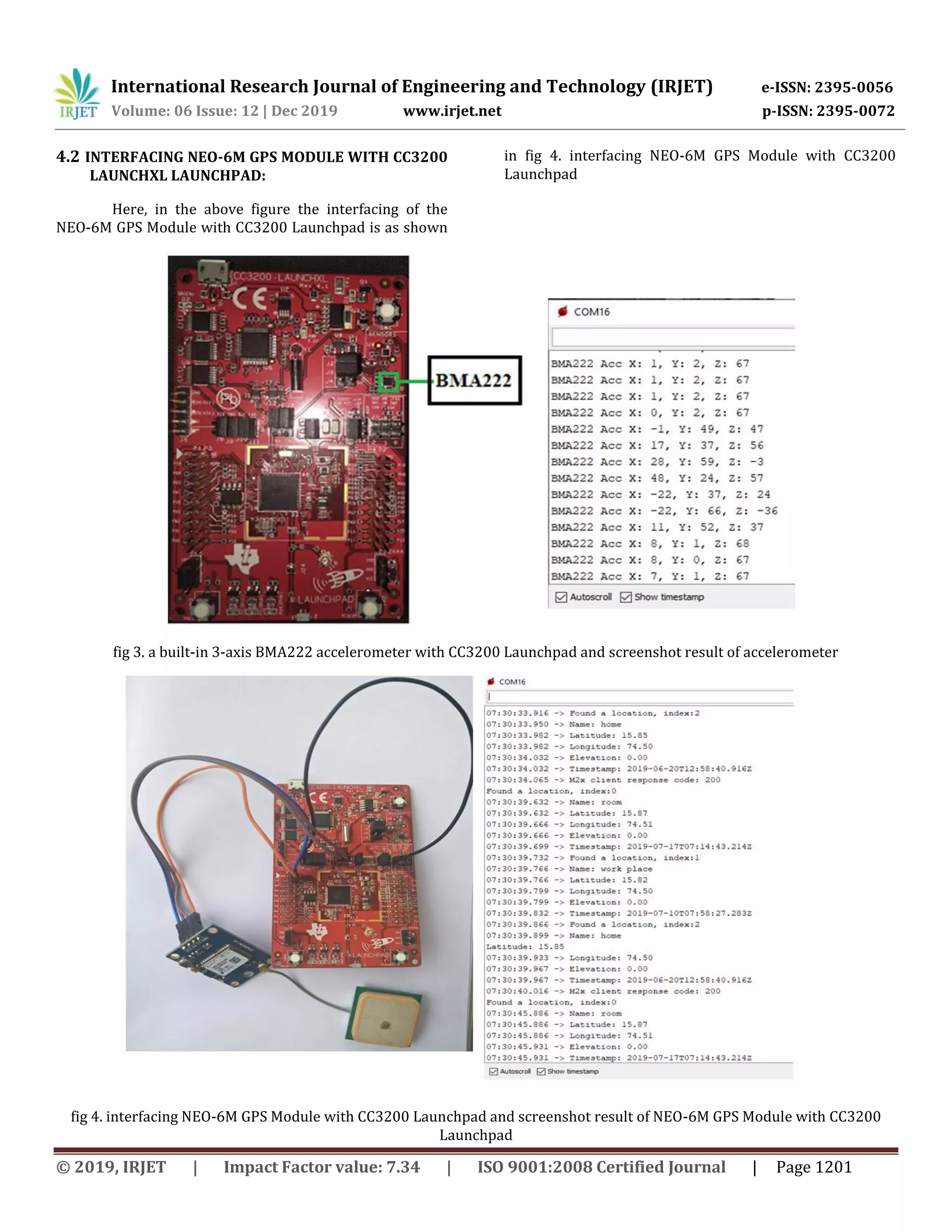
Here, in the below figure the 3-axis BMA222
accelerometer built within CC3200 Launchpad is as shown
in fig 3. A built-in 3- axis BMA222 accelerometer with
CC3200 Launchpad and screenshot result of
accelerometer.
And, the results after debugging the program and
dumping the program to the launchpad in the serial
monitor the values of X, Y and Z axes respectively are also
shown.
International Research Journal of Engineering and Technology (IRJET) e-ISSN: 2395-0056
Volume: 06 Issue: 12 | Dec 2019 www.irjet.net p-ISSN: 2395-0072
© 2019, IRJET | Impact Factor value: 7.34 | ISO 9001:2008 Certified Journal | Page 1201
4.2 INTERFACING NEO-6M GPS MODULE WITH CC3200
LAUNCHXL LAUNCHPAD:
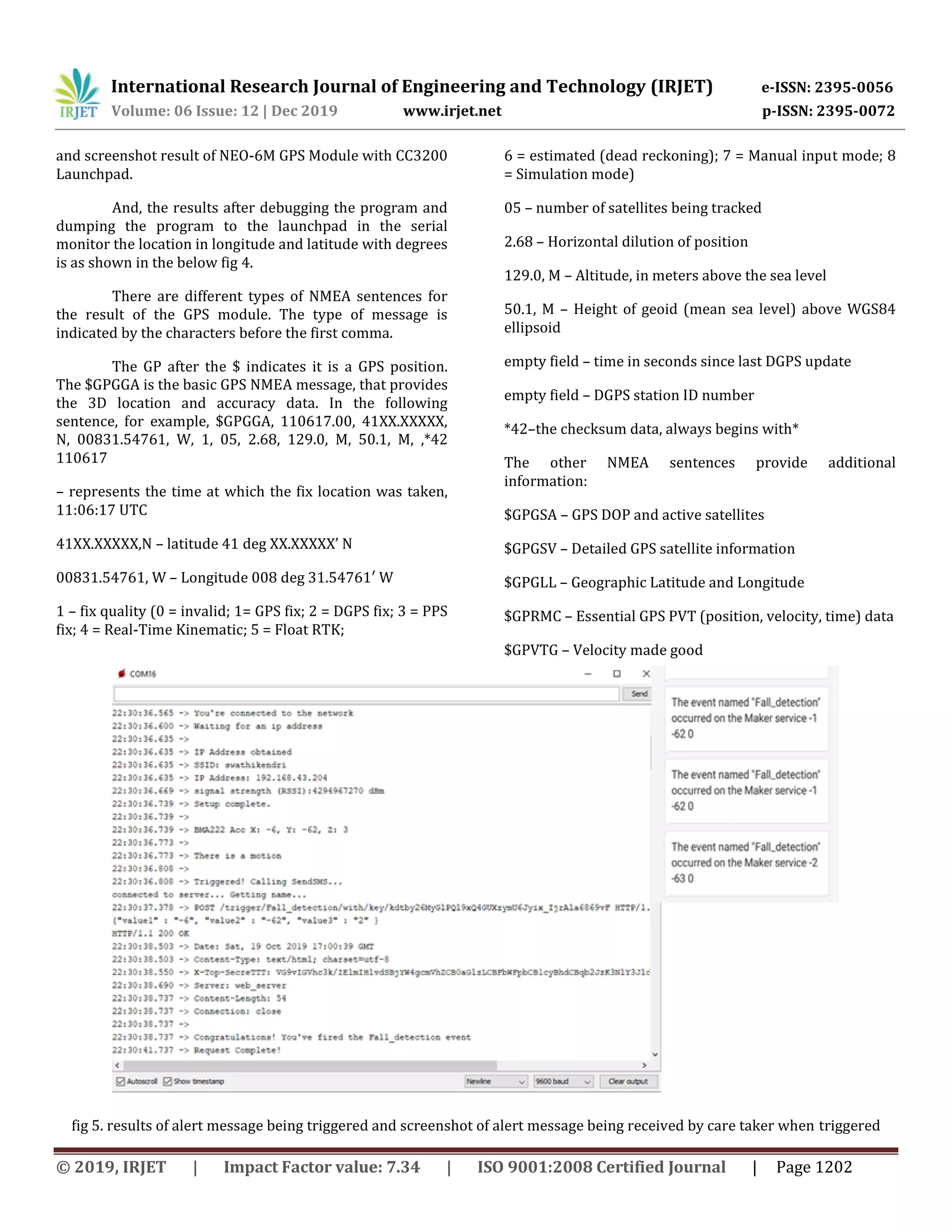
Here, in the above figure the interfacing of the
NEO-6M GPS Module with CC3200 Launchpad is as shown
in fig 4. interfacing NEO-6M GPS Module with CC3200
Launchpad
fig 3. a built-in 3-axis BMA222 accelerometer with CC3200 Launchpad and screenshot result of accelerometer
fig 4. interfacing NEO-6M GPS Module with CC3200 Launchpad and screenshot result of NEO-6M GPS Module with CC3200
Launchpad
International Research Journal of Engineering and Technology (IRJET) e-ISSN: 2395-0056
Volume: 06 Issue: 12 | Dec 2019 www.irjet.net p-ISSN: 2395-0072
© 2019, IRJET | Impact Factor value: 7.34 | ISO 9001:2008 Certified Journal | Page 1202
and screenshot result of NEO-6M GPS Module with CC3200
Launchpad.
And, the results after debugging the program and
dumping the program to the launchpad in the serial
monitor the location in longitude and latitude with degrees
is as shown in the below fig 4.
There are different types of NMEA sentences for
the result of the GPS module. The type of message is
indicated by the characters before the first comma.
The GP after the $ indicates it is a GPS position.
The $GPGGA is the basic GPS NMEA message, that provides
the 3D location and accuracy data. In the following
sentence, for example, $GPGGA, 110617.00, 41XX.XXXXX,
N, 00831.54761, W, 1, 05, 2.68, 129.0, M, 50.1, M, ,*42
110617
– represents the time at which the fix location was taken,
11:06:17 UTC
41XX.XXXXX,N – latitude 41 deg XX.XXXXX’ N
00831.54761, W – Longitude 008 deg 31.54761′ W
1 – fix quality (0 = invalid; 1= GPS fix; 2 = DGPS fix; 3 = PPS
fix; 4 = Real-Time Kinematic; 5 = Float RTK;
6 = estimated (dead reckoning); 7 = Manual input mode; 8
= Simulation mode)
05 – number of satellites being tracked
2.68 – Horizontal dilution of position
129.0, M – Altitude, in meters above the sea level
50.1, M – Height of geoid (mean sea level) above WGS84
ellipsoid
empty field – time in seconds since last DGPS update
empty field – DGPS station ID number
*42–the checksum data, always begins with*
The other NMEA sentences provide additional
information:
$GPGSA – GPS DOP and active satellites
$GPGSV – Detailed GPS satellite information
$GPGLL – Geographic Latitude and Longitude
$GPRMC – Essential GPS PVT (position, velocity, time) data
$GPVTG – Velocity made good
fig 5. results of alert message being triggered and screenshot of alert message being received by care taker when triggered
International Research Journal of Engineering and Technology (IRJET) e-ISSN: 2395-0056
Volume: 06 Issue: 12 | Dec 2019 www.irjet.net p-ISSN: 2395-0072
© 2019, IRJET | Impact Factor value: 7.34 | ISO 9001:2008 Certified Journal | Page 1203
4.3 ALERT MESSAGE FOR MOTION DETECTION:
The alert message for motion detection is shown
in the above figure fig 5. result of Message triggered using
CC3200 Launchpad in the serial monitor.
4.4 3D VISUAL DISPLAY USING VPYTHON:
The 3D Visual display of the person in Vpython is
shown in the below figure fig 6. 3D display of the person in
Vpython.
fig 6. 3D display of the person in Vpython
5. CONCLUSIONS
This paper developed and helped to monitor the fall
detection system based on a single triaxial accelerometer
and also a GPS module interfaced with LaunchPad
mounted on a wearable device. The algorithm applied does
not claim to be fixed strictly through the axes of
accelerometer thus there is no special requirement for the
device’s mounting orientation. The system is designed
with the consumption of low power for the hardware
design and the wearable device with a highly efficient
algorithm that could extend the service of time. Both the
hardware and software designs are suitable for the
wearable belt in indoor and outdoor applications [1].
Similarly, as the normal activity of the resting body also
the activity of the falling, but it may trigger a fall alarm
when the body does hit gravity with the force. To
distinguish falling from the body lying activity from the
larger or smaller height, the choice is quite important.
With the different age and gender, a sufficient number of
sample data is collected from subjects, thus will improve
the reliability and robustness of the threshold. Besides
these, technologies such as SVM and visually analyzing
using VPython are considerable to seek out a proper
classification method based on the features used in this
system [1].
ACKNOWLEDGEMENT
I thank my management, Principle, Head of the
department, coordinator of VLSI and ES subject and staff of
the Electronics and Communication Department, K.L.E. Dr.
M. S. Sheshagiri college of engineering and technology,
Belagavi, Karnataka, India and my special thanks to my
guides Dr Sheela Kore, Professor and, Mr. Prabhakar
Manage, Asst. Professor, Dept of Electronics and
Communication for encouraging me in this work.
References
[1.] Falin Wu, Hengyang Zhao, Yan Zhao, and Haibo
Zhong, “Development of a Wearable-Sensor-
Based Fall Detection System”, International
Journal of Telemedicine and Applications Volume
2015, Article ID 576364, 11 pages
http://dx.doi.org/10.1155/2015/576364
Research Article.
[2.] https://energia.nu/guide/
[3.] Subhash Chand Agrawal, Rajesh Kumar Tripathi
and Anand Singh Jalal, “Human-fall Detection
from an Indoor Video Surveillance”, IEEE –
40222, 8th ICCCNT 2017 July 3-5, 2017, IIT Delhi,
Delhi, India.
[4.] G. Vijaya Kumar, Dr. Y. Padma Sai, V. Naveen
Kumar, A. Prathibha, “Hand Gesture Recognition
Using Accelerometer for Disabled”, International
Journal of Science, Engineering and Technology
Research (IJSETR), Volume 3, Issue 12, December
2014, ISSN: 2278 – 7798.
[5.] George Loo, Ching Jianhong, “VPython Application
to The Computer-aided Drug Design Problem”,
The Python Papers Monograph 2: 18 Proceedings
of PyCon Asia-Pacific 2010.
[6.] Rhett Allain, “Numerical physics - vpython vs.
Easy java simulations”, AIN DOT-PHYSICS,
11.12.0806:41 PM.

IRJET- Development and Monitoring of a Fall Detection System through Wearable Sensor Belt

  • 1.
    International Research Journalof Engineering and Technology (IRJET) e-ISSN: 2395-0056 Volume: 06 Issue: 12 | Dec 2019 www.irjet.net p-ISSN: 2395-0072 © 2019, IRJET | Impact Factor value: 7.34 | ISO 9001:2008 Certified Journal | Page 1198 Development and Monitoring of a Fall Detection System through Wearable Sensor Belt Swathi S Kendri1, Dr. Sheela. Kiran. Kore2, Mr. Prabhakar Manage3 1,2,3Dept. of Electronics and Communication, K.L.E. Dr. M. S. Sheshagiri College of Engineering and Technology, Belagavi, Karnataka, India. -----------------------------------------------------------------------***------------------------------------------------------------------------ ABSTRACT - The elderly people’s population increases health care demand with a greater desire for independence. And, also avoiding the risks of falling incidents has become particularly noticeable which can cause disability leading to a significant decrease in movability and sometimes even life quality. Resulting in this, respective technologies had been developed to preventing and simultaneously monitoring falls. Some systems depend on cameras being mounted in all rooms of a patient’s house while others are wearable type all time. This paper explores a wearable belt system using an inventive IoT-based technology for detection of falls in elderly patients along with sending an alert to the caretaker. This system even senses the location when the monitored parameters exceed the preset limits and monitoring it visually using Vpython. The motion is detected using a three- dimensional accelerometer BMA222 embedded within a launchpad attached to a wearable belt. The accelerometer, which in turn extracts the movement data and sends it to the data cloud for an alert message by using Wi-Fi and Neo 6M GPS location module. To maintain efficiency, we can monitor the system for a continuous-time span. Key words: IoT-based system, Vpython, three- dimensional accelerometer BMA222, launchpad, Wi-Fi and Neo 6M GPS 1. INTRODUCTION The definition of fall is an event of a person losing balance and collapse. Falls of the elderly might lead to some serious health issues like loss of independence, cause of fear, disability, movables and also leads to some health care utilization, thus as the decline of their physical fitness. A fracture would be the most common injury in the fall of the elderly, and also there is a certain possibility of brain trauma, coma, and paralysis. In most fall situations, the fall process is the main source of injury because of the high impact. Sometimes the late process of treatment may worsen the situation. Thus, the faster the treatment there will be lesser risk factors in the elderly [1]. For the majority, external support is imperative for avoiding major consequences in most of the fall events [3]. To realize a fall detection, a wearable monitoring with visualizing and sending alert devices the low power consumption components makes it possible. With the design of a sensor system, the Micro Electron Mechanical Systems (MEMS) sensors had simplified the implementation with the installation steps. To find the location of the elderly in health monitoring the Location Based Service (LBS) is more convenient [1]. The computer vision-based method is one of the several kinds of fall detection techniques being developed or applied in our life. A visual-based fall detection method could be enhanced through the external supports such as motion sensors, and to raise robust performance in a fall detection and to operate for the validation and correlation of the two subsystems, a data fusion algorithm technique can be used. These visual-based methods work effectively in an indoor environment, but yet still becomes hard to realize in the outdoor environment as the deployment of cameras is always limited [1]. Also, the commonly used method is the Motion sensor-based method. Gyroscope and accelerometer could provide angular and linear motion of the object information directly. Sensor measurements with a proper fusion could be used to distinguish the real fall of an object. The constitution of motion sensors with the detection algorithms is considered from the several kinds of detection methods. One type of detection method is using an accelerometer. The accelerations of an object are in three directions through the influence of gravity is measured through a single triaxial accelerometer. As soon as the accelerometer is fixed on the patient’s body, a coordinate will be built. By using a low pass filter or high pass filters the influence of gravity or dynamic acceleration is made available. The vector sum with the relationship to that of acceleration components some type of angular movement information can also be calculated. Another type of detection method is based on both accelerometer and gyroscope or also involves a magnetometer. The angular velocity can be measured through a gyroscope and the linear motion information can be measured through the accelerometer. A magnetic strength, in three directions can be detected through the triaxial magnetometer, and also the angular motion information in the horizontal plane can be provided. The geomagnetic field gets disturbed by the environment magnetic field and thus
  • 2.
    International Research Journalof Engineering and Technology (IRJET) e-ISSN: 2395-0056 Volume: 06 Issue: 12 | Dec 2019 www.irjet.net p-ISSN: 2395-0072 © 2019, IRJET | Impact Factor value: 7.34 | ISO 9001:2008 Certified Journal | Page 1199 reduces the reliability of the magnetometer outputs, for an instance in some of the steel structure architecture or with strong electromagnetism near some of the objects. Through the accelerometer measurements, the angular information can also be extracted, the Kalman filter which is a state-space filter is a commonly used technique to combine angular motion information [1]. More power consumption can occur using more sensors and also designing a low power dissipation with a proper algorithm is a challenging task with the fusion of the different kinds of sensors. For a human fall detection, a single triaxial accelerometer is quite enough from its measurements with all the sufficient information that could be extracted. Besides this, if only the magnitude of the sum vector is needed, the accelerometer coordinate does not have to be fixed and which is quite convenient in the wearable applications. In this paper, a fall detection system based on a wearable device is developed and even monitored visually. The hardware and software realization of the device is mainly based on a single triaxial accelerometer, a wi-fi transmission capabilities for SMS (Short Message Service) alert or notifications. For a proper design of the outdoor application, this type of device uses an efficient fall detection algorithm with less resource and power consumption [1]. 2. METHODOLOGY There are three types of fall detection namely: 1. wearable device based 2. Ambiance sensor-based, and 3. Vision (camera) based. All three types have their limitations. Vision-based type uses a camera and neural network to find the changes of shape occurred from the human, but the camera is limited with the area and at most can only be used indoor. Ambiance sensor-based type consists of an array of capacitive sensors or proximity sensors and many other sensors, but again the area is limited. Fig. 1. A simple block diagram of a wearable belt with a visual monitoring and to send message alert based on the fall detection. Fig 2. Part 1 flowchart to trigger an alert message based on the motion detected. The wearable device type includes an accelerometer, gyroscope and a barometer sensor attached to the belt, which will be tied to the person’s wrist or trunk. But again, through this type of sensor, the only fall can be detected but the force of falling and even the height of falling cannot be analyzed through the
  • 3.
    International Research Journalof Engineering and Technology (IRJET) e-ISSN: 2395-0056 Volume: 06 Issue: 12 | Dec 2019 www.irjet.net p-ISSN: 2395-0072 © 2019, IRJET | Impact Factor value: 7.34 | ISO 9001:2008 Certified Journal | Page 1200 caretaker and hence VPython is used to serially visualize the fall detected and take necessary actions. Fig 2. Part 2 flowchart to trigger an alert message based on the motion detected. The development of a wearable belt includes a single motion type sensor called tri-axial accelerometer to sense the motion or movement of an elderly person, which is in build type of sensor in CC3200 LaunchXL LaunchPad. Also, a Neo 6M GPS location module type of sensor for GPS location is used to detect the location of the fall of an elderly person. And, the launchpad with a 32-bit Arm Cortex-M4 microcontroller that supports and also has in- built wi-fi receiver and transmission capabilities which helps to send a message alert through the cloud using IFTTT to the caretaker and even to store the data in the cloud if necessary. VPython, is also known as a visual python. It is a real-time 3D graphics module for the high-level programming language, provides a simple but powerful programming environment for visualization, physics educators and students [6]. A VPython visually displays a fall detection in a 3D graphics manner and based on the type of fall, a care-taker can take some necessary measures. 3. ALGORITHM OF FALL -DETECTION WITH ALERT: Initially, we need to set variables Trigger and Calls to ‘0’, and variable Maxcalls to ‘1’. Even, the variables X_val, Y_val and Z_val to ‘0’. Similarly, the variables X_init, Y_init and Z_init to ‘0’. And also, the variable Firstrun to ‘1’. Now when the motion is detected for the first time the X_init stores the value of X_val, the Y_init stores the value of Y_val and Z_init stores the value of Z_val with the Firstrun set to ‘0’. Then later, whenever the motion has detected the values stored in variables X_val, Y_val, and Z_val to the variables X_init, Y_init and Z_init respectively. When the value of Y_val subtracted with the value of Y_init gives the value less than or equal to ‘10’, and the value Z_val subtracted with the value of Z_init gives the value greater than or equal to ‘20’ and Calls will be incrementing simultaneously. Now when calls value is less than the Maxcalls value an alert will be sent to the caretaker and also can be displayed visually using Vpython. The algorithm of fall detection with alert and visual 3D display is also shown in the above flowchart. 4. IMPLEMENTATION 4.1 BMA222 ACCELEROMETER WITH CC3200 LAUNCHXL LAUNCHPAD: Here, in the below figure the 3-axis BMA222 accelerometer built within CC3200 Launchpad is as shown in fig 3. A built-in 3- axis BMA222 accelerometer with CC3200 Launchpad and screenshot result of accelerometer. And, the results after debugging the program and dumping the program to the launchpad in the serial monitor the values of X, Y and Z axes respectively are also shown.
  • 4.
    International Research Journalof Engineering and Technology (IRJET) e-ISSN: 2395-0056 Volume: 06 Issue: 12 | Dec 2019 www.irjet.net p-ISSN: 2395-0072 © 2019, IRJET | Impact Factor value: 7.34 | ISO 9001:2008 Certified Journal | Page 1201 4.2 INTERFACING NEO-6M GPS MODULE WITH CC3200 LAUNCHXL LAUNCHPAD: Here, in the above figure the interfacing of the NEO-6M GPS Module with CC3200 Launchpad is as shown in fig 4. interfacing NEO-6M GPS Module with CC3200 Launchpad fig 3. a built-in 3-axis BMA222 accelerometer with CC3200 Launchpad and screenshot result of accelerometer fig 4. interfacing NEO-6M GPS Module with CC3200 Launchpad and screenshot result of NEO-6M GPS Module with CC3200 Launchpad
  • 5.
    International Research Journalof Engineering and Technology (IRJET) e-ISSN: 2395-0056 Volume: 06 Issue: 12 | Dec 2019 www.irjet.net p-ISSN: 2395-0072 © 2019, IRJET | Impact Factor value: 7.34 | ISO 9001:2008 Certified Journal | Page 1202 and screenshot result of NEO-6M GPS Module with CC3200 Launchpad. And, the results after debugging the program and dumping the program to the launchpad in the serial monitor the location in longitude and latitude with degrees is as shown in the below fig 4. There are different types of NMEA sentences for the result of the GPS module. The type of message is indicated by the characters before the first comma. The GP after the $ indicates it is a GPS position. The $GPGGA is the basic GPS NMEA message, that provides the 3D location and accuracy data. In the following sentence, for example, $GPGGA, 110617.00, 41XX.XXXXX, N, 00831.54761, W, 1, 05, 2.68, 129.0, M, 50.1, M, ,*42 110617 – represents the time at which the fix location was taken, 11:06:17 UTC 41XX.XXXXX,N – latitude 41 deg XX.XXXXX’ N 00831.54761, W – Longitude 008 deg 31.54761′ W 1 – fix quality (0 = invalid; 1= GPS fix; 2 = DGPS fix; 3 = PPS fix; 4 = Real-Time Kinematic; 5 = Float RTK; 6 = estimated (dead reckoning); 7 = Manual input mode; 8 = Simulation mode) 05 – number of satellites being tracked 2.68 – Horizontal dilution of position 129.0, M – Altitude, in meters above the sea level 50.1, M – Height of geoid (mean sea level) above WGS84 ellipsoid empty field – time in seconds since last DGPS update empty field – DGPS station ID number *42–the checksum data, always begins with* The other NMEA sentences provide additional information: $GPGSA – GPS DOP and active satellites $GPGSV – Detailed GPS satellite information $GPGLL – Geographic Latitude and Longitude $GPRMC – Essential GPS PVT (position, velocity, time) data $GPVTG – Velocity made good fig 5. results of alert message being triggered and screenshot of alert message being received by care taker when triggered
  • 6.
    International Research Journalof Engineering and Technology (IRJET) e-ISSN: 2395-0056 Volume: 06 Issue: 12 | Dec 2019 www.irjet.net p-ISSN: 2395-0072 © 2019, IRJET | Impact Factor value: 7.34 | ISO 9001:2008 Certified Journal | Page 1203 4.3 ALERT MESSAGE FOR MOTION DETECTION: The alert message for motion detection is shown in the above figure fig 5. result of Message triggered using CC3200 Launchpad in the serial monitor. 4.4 3D VISUAL DISPLAY USING VPYTHON: The 3D Visual display of the person in Vpython is shown in the below figure fig 6. 3D display of the person in Vpython. fig 6. 3D display of the person in Vpython 5. CONCLUSIONS This paper developed and helped to monitor the fall detection system based on a single triaxial accelerometer and also a GPS module interfaced with LaunchPad mounted on a wearable device. The algorithm applied does not claim to be fixed strictly through the axes of accelerometer thus there is no special requirement for the device’s mounting orientation. The system is designed with the consumption of low power for the hardware design and the wearable device with a highly efficient algorithm that could extend the service of time. Both the hardware and software designs are suitable for the wearable belt in indoor and outdoor applications [1]. Similarly, as the normal activity of the resting body also the activity of the falling, but it may trigger a fall alarm when the body does hit gravity with the force. To distinguish falling from the body lying activity from the larger or smaller height, the choice is quite important. With the different age and gender, a sufficient number of sample data is collected from subjects, thus will improve the reliability and robustness of the threshold. Besides these, technologies such as SVM and visually analyzing using VPython are considerable to seek out a proper classification method based on the features used in this system [1]. ACKNOWLEDGEMENT I thank my management, Principle, Head of the department, coordinator of VLSI and ES subject and staff of the Electronics and Communication Department, K.L.E. Dr. M. S. Sheshagiri college of engineering and technology, Belagavi, Karnataka, India and my special thanks to my guides Dr Sheela Kore, Professor and, Mr. Prabhakar Manage, Asst. Professor, Dept of Electronics and Communication for encouraging me in this work. References [1.] Falin Wu, Hengyang Zhao, Yan Zhao, and Haibo Zhong, “Development of a Wearable-Sensor- Based Fall Detection System”, International Journal of Telemedicine and Applications Volume 2015, Article ID 576364, 11 pages http://dx.doi.org/10.1155/2015/576364 Research Article. [2.] https://energia.nu/guide/ [3.] Subhash Chand Agrawal, Rajesh Kumar Tripathi and Anand Singh Jalal, “Human-fall Detection from an Indoor Video Surveillance”, IEEE – 40222, 8th ICCCNT 2017 July 3-5, 2017, IIT Delhi, Delhi, India. [4.] G. Vijaya Kumar, Dr. Y. Padma Sai, V. Naveen Kumar, A. Prathibha, “Hand Gesture Recognition Using Accelerometer for Disabled”, International Journal of Science, Engineering and Technology Research (IJSETR), Volume 3, Issue 12, December 2014, ISSN: 2278 – 7798. [5.] George Loo, Ching Jianhong, “VPython Application to The Computer-aided Drug Design Problem”, The Python Papers Monograph 2: 18 Proceedings of PyCon Asia-Pacific 2010. [6.] Rhett Allain, “Numerical physics - vpython vs. Easy java simulations”, AIN DOT-PHYSICS, 11.12.0806:41 PM.