NATURAL LANGUAGE
PROCESSING
ADVANCEMENTS BY DEEP
LEARNING: A SURVEY
INTRODUCTION • The process of transferring the knowledge of human-level
understanding of human interactions into a machine is the
concept of Natural Language Processing.
• Human interactions hold huge information, involving
various topics, tones, words, emotions.
• The set of unstructured/unlabelled data are difficult to be
processed by machines, requiring extensive efforts, and
varied models. It also requires higher computation power,
more time, and handcrafting the features through careful
analysis.
• The state-of-the-art deep learning models attempt to
overcome the above-mentioned complications. It gets
an in-depth representation of the language,
identifies meaningful information in a text for further
processing, and constructs features at different levels.
CORE
CONCEPTS IN
NLP
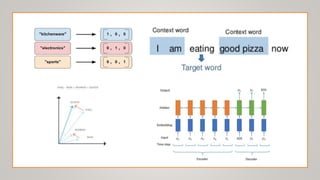
• Feature Representation
• Converting textual inputs into a machine-
understandable format.
• One-Hot Representation: Representing unique elements
in text/categorical variables as binary vectors.
• Continuous Bag of Words: To predict the missing/target
word or word sequence based on the neighbouring
words in a context.
• Word-Level Embedding: Collections of words are
converted to vectors of real numbers in representation
space.
• Character-Level Embedding: Each character in a word is
one hot encoded.
• Seq2Seq Framework
• The encoder gets the sequence of text inputs, creates a
mid-level/hidden output to be ingested to the decoder
to produce a sequence of output
STATE-OF-THE-ART DEEP
LEARNING MODELS FOR
NLP TASKS
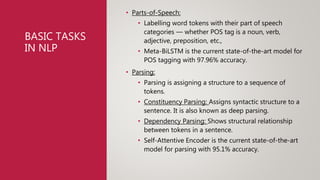
BASIC TASKS
IN NLP
• Parts-of-Speech:
• Labelling word tokens with their part of speech
categories — whether POS tag is a noun, verb,
adjective, preposition, etc.,
• Meta-BiLSTM is the current state-of-the-art model for
POS tagging with 97.96% accuracy.
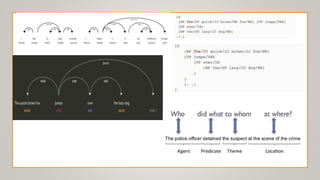
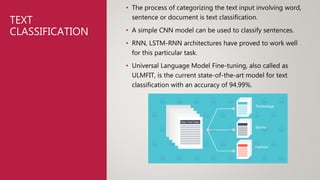
• Parsing:
• Parsing is assigning a structure to a sequence of
tokens.
• Constituency Parsing: Assigns syntactic structure to a
sentence. It is also known as deep parsing.
• Dependency Parsing: Shows structural relationship
between tokens in a sentence.
• Self-Attentive Encoder is the current state-of-the-art
model for parsing with 95.1% accuracy.
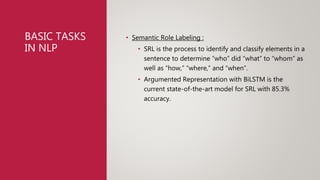
BASIC TASKS
IN NLP
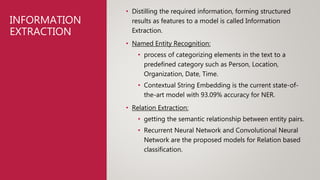
• Semantic Role Labeling :
• SRL is the process to identify and classify elements in a
sentence to determine “who” did “what” to “whom” as
well as “how,” “where,” and “when”.
• Argumented Representation with BiLSTM is the
current state-of-the-art model for SRL with 85.3%
accuracy.
TEXT
CLASSIFICATION
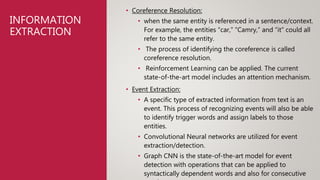
• The process of categorizing the text input involving word,
sentence or document is text classification.
• A simple CNN model can be used to classify sentences.
• RNN, LSTM-RNN architectures have proved to work well
for this particular task.
• Universal Language Model Fine-tuning, also called as
ULMFIT, is the current state-of-the-art model for text
classification with an accuracy of 94.99%.
INFORMATION
EXTRACTION
• Distilling the required information, forming structured
results as features to a model is called Information
Extraction.
• Named Entity Recognition:
• process of categorizing elements in the text to a
predefined category such as Person, Location,
Organization, Date, Time.
• Contextual String Embedding is the current state-of-
the-art model with 93.09% accuracy for NER.
• Relation Extraction:
• getting the semantic relationship between entity pairs.
• Recurrent Neural Network and Convolutional Neural
Network are the proposed models for Relation based
classification.
INFORMATION
EXTRACTION
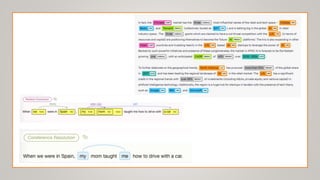
• Coreference Resolution:
• when the same entity is referenced in a sentence/context.
For example, the entities “car,” “Camry,” and “it” could all
refer to the same entity.
• The process of identifying the coreference is called
coreference resolution.
• Reinforcement Learning can be applied. The current
state-of-the-art model includes an attention mechanism.
• Event Extraction:
• A specific type of extracted information from text is an
event. This process of recognizing events will also be able
to identify trigger words and assign labels to those
entities.
• Convolutional Neural networks are utilized for event
extraction/detection.
• Graph CNN is the state-of-the-art model for event
detection with operations that can be applied to
syntactically dependent words and also for consecutive
SENTIMENT
ANALYSIS
• Sentiment Analysis is identifying the tone in which the information
is presented. It is also called opinion mining
• The main aim is to analyse the human opinion, sentiments,
emotions on a product, problem, or any other subject.
• Document-level Sentiment Analysis:
• Identifying if the document exhibit positive or negative tone
on any entity is document-level sentiment analysis.
• The Gated Recurrent Neural Network can be employed to
encode the relations in the semantic structure of a document.
• Sentence-level Sentiment Analysis:
• Determining if a sentence is expressing positivity, neutrality, or
negativity is a Sentence-level Sentiment Analysis.
• The Sentiment Treebank and Recursive Neural Tensor
Networks are the current state-of-the-art model for fine-
grained sentiment labelling.
SENTIMENT
ANALYSIS
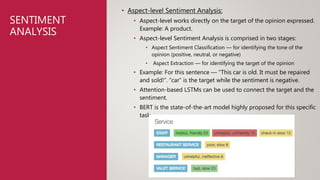
• Aspect-level Sentiment Analysis:
• Aspect-level works directly on the target of the opinion expressed.
Example: A product.
• Aspect-level Sentiment Analysis is comprised in two stages:
• Aspect Sentiment Classification — for identifying the tone of the
opinion (positive, neutral, or negative)
• Aspect Extraction — for identifying the target of the opinion
• Example: For this sentence — “This car is old. It must be repaired
and sold!”. “car” is the target while the sentiment is negative.
• Attention-based LSTMs can be used to connect the target and the
sentiment.
• BERT is the state-of-the-art model highly proposed for this specific
task.
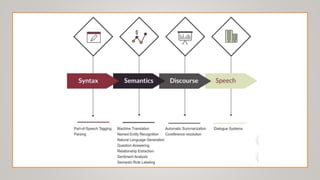
MACHINE
TRANSLATION
• The process of translating text/speech from one language to other
(Speech and Language Processing) by a model is Machine
Translation.
• Neural Machine Translation:
• Traditional Machine Translation was first introduced in 1954, with very
limited vocabulary. Human labour was used for evaluation
• Neural Machine Translation did not require extensive pre-processing
and word alignments. The importance was mainly given to network
structure.
• Convolutional Seq-to-Seq, Attention Is All You Need, Weighted
Transformer, Self Attention, DeepL Translation Machine are some
of the models used for machine translation on English-German
Dataset.
• Back-translation is the current state-of-the-art model with 35%
accuracy for Machine Translation.
QUESTION
ANSWERING
• The detailed form of Information Retrieval is the Question
Answering System.
• The expected output from the Question Answering System can be
in the form of document, text, image, etc, retrieved from a set of
documents.
• Rule-based Question Answering:
• IBM’s QA Systems: 4 components
• Question/Answer Type Classification
• Query Expansion/Information Retrieval
• Name Entity Making,
• Answer Selection
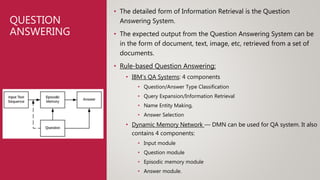
• Dynamic Memory Network — DMN can be used for QA system. It also
contains 4 components:
• Input module
• Question module
• Episodic memory module
• Answer module.
DOCUMENT
SUMMARIZATION
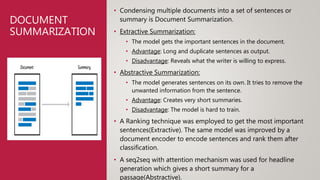
• Condensing multiple documents into a set of sentences or
summary is Document Summarization.
• Extractive Summarization:
• The model gets the important sentences in the document.
• Advantage: Long and duplicate sentences as output.
• Disadvantage: Reveals what the writer is willing to express.
• Abstractive Summarization:
• The model generates sentences on its own. It tries to remove the
unwanted information from the sentence.
• Advantage: Creates very short summaries.
• Disadvantage: The model is hard to train.
• A Ranking technique was employed to get the most important
sentences(Extractive). The same model was improved by a
document encoder to encode sentences and rank them after
classification.
• A seq2seq with attention mechanism was used for headline
generation which gives a short summary for a
passage(Abstractive).
DIALOGUE
SYSTEMS
• The well-known application of a Dialogue system is the Automated
Customer Service.
• It is also called conversational machines or dialogue machines.
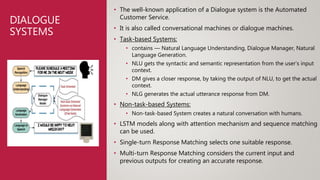
• Task-based Systems:
• contains — Natural Language Understanding, Dialogue Manager, Natural
Language Generation.
• NLU gets the syntactic and semantic representation from the user’s input
context.
• DM gives a closer response, by taking the output of NLU, to get the actual
context.
• NLG generates the actual utterance response from DM.
• Non-task-based Systems:
• Non-task-based System creates a natural conversation with humans.
• LSTM models along with attention mechanism and sequence matching
can be used.
• Single-turn Response Matching selects one suitable response.
• Multi-turn Response Matching considers the current input and
previous outputs for creating an accurate response.
THANK YOU.

Natural Language Processing Advancements By Deep Learning - A Survey

  • 1.
  • 2.
    INTRODUCTION • Theprocess of transferring the knowledge of human-level understanding of human interactions into a machine is the concept of Natural Language Processing. • Human interactions hold huge information, involving various topics, tones, words, emotions. • The set of unstructured/unlabelled data are difficult to be processed by machines, requiring extensive efforts, and varied models. It also requires higher computation power, more time, and handcrafting the features through careful analysis. • The state-of-the-art deep learning models attempt to overcome the above-mentioned complications. It gets an in-depth representation of the language, identifies meaningful information in a text for further processing, and constructs features at different levels.
  • 3.
    CORE CONCEPTS IN NLP • FeatureRepresentation • Converting textual inputs into a machine- understandable format. • One-Hot Representation: Representing unique elements in text/categorical variables as binary vectors. • Continuous Bag of Words: To predict the missing/target word or word sequence based on the neighbouring words in a context. • Word-Level Embedding: Collections of words are converted to vectors of real numbers in representation space. • Character-Level Embedding: Each character in a word is one hot encoded. • Seq2Seq Framework • The encoder gets the sequence of text inputs, creates a mid-level/hidden output to be ingested to the decoder to produce a sequence of output
  • 5.
  • 7.
    BASIC TASKS IN NLP •Parts-of-Speech: • Labelling word tokens with their part of speech categories — whether POS tag is a noun, verb, adjective, preposition, etc., • Meta-BiLSTM is the current state-of-the-art model for POS tagging with 97.96% accuracy. • Parsing: • Parsing is assigning a structure to a sequence of tokens. • Constituency Parsing: Assigns syntactic structure to a sentence. It is also known as deep parsing. • Dependency Parsing: Shows structural relationship between tokens in a sentence. • Self-Attentive Encoder is the current state-of-the-art model for parsing with 95.1% accuracy.
  • 8.
    BASIC TASKS IN NLP •Semantic Role Labeling : • SRL is the process to identify and classify elements in a sentence to determine “who” did “what” to “whom” as well as “how,” “where,” and “when”. • Argumented Representation with BiLSTM is the current state-of-the-art model for SRL with 85.3% accuracy.
  • 10.
    TEXT CLASSIFICATION • The processof categorizing the text input involving word, sentence or document is text classification. • A simple CNN model can be used to classify sentences. • RNN, LSTM-RNN architectures have proved to work well for this particular task. • Universal Language Model Fine-tuning, also called as ULMFIT, is the current state-of-the-art model for text classification with an accuracy of 94.99%.
  • 11.
    INFORMATION EXTRACTION • Distilling therequired information, forming structured results as features to a model is called Information Extraction. • Named Entity Recognition: • process of categorizing elements in the text to a predefined category such as Person, Location, Organization, Date, Time. • Contextual String Embedding is the current state-of- the-art model with 93.09% accuracy for NER. • Relation Extraction: • getting the semantic relationship between entity pairs. • Recurrent Neural Network and Convolutional Neural Network are the proposed models for Relation based classification.
  • 12.
    INFORMATION EXTRACTION • Coreference Resolution: •when the same entity is referenced in a sentence/context. For example, the entities “car,” “Camry,” and “it” could all refer to the same entity. • The process of identifying the coreference is called coreference resolution. • Reinforcement Learning can be applied. The current state-of-the-art model includes an attention mechanism. • Event Extraction: • A specific type of extracted information from text is an event. This process of recognizing events will also be able to identify trigger words and assign labels to those entities. • Convolutional Neural networks are utilized for event extraction/detection. • Graph CNN is the state-of-the-art model for event detection with operations that can be applied to syntactically dependent words and also for consecutive
  • 14.
    SENTIMENT ANALYSIS • Sentiment Analysisis identifying the tone in which the information is presented. It is also called opinion mining • The main aim is to analyse the human opinion, sentiments, emotions on a product, problem, or any other subject. • Document-level Sentiment Analysis: • Identifying if the document exhibit positive or negative tone on any entity is document-level sentiment analysis. • The Gated Recurrent Neural Network can be employed to encode the relations in the semantic structure of a document. • Sentence-level Sentiment Analysis: • Determining if a sentence is expressing positivity, neutrality, or negativity is a Sentence-level Sentiment Analysis. • The Sentiment Treebank and Recursive Neural Tensor Networks are the current state-of-the-art model for fine- grained sentiment labelling.
  • 15.
    SENTIMENT ANALYSIS • Aspect-level SentimentAnalysis: • Aspect-level works directly on the target of the opinion expressed. Example: A product. • Aspect-level Sentiment Analysis is comprised in two stages: • Aspect Sentiment Classification — for identifying the tone of the opinion (positive, neutral, or negative) • Aspect Extraction — for identifying the target of the opinion • Example: For this sentence — “This car is old. It must be repaired and sold!”. “car” is the target while the sentiment is negative. • Attention-based LSTMs can be used to connect the target and the sentiment. • BERT is the state-of-the-art model highly proposed for this specific task.
  • 16.
    MACHINE TRANSLATION • The processof translating text/speech from one language to other (Speech and Language Processing) by a model is Machine Translation. • Neural Machine Translation: • Traditional Machine Translation was first introduced in 1954, with very limited vocabulary. Human labour was used for evaluation • Neural Machine Translation did not require extensive pre-processing and word alignments. The importance was mainly given to network structure. • Convolutional Seq-to-Seq, Attention Is All You Need, Weighted Transformer, Self Attention, DeepL Translation Machine are some of the models used for machine translation on English-German Dataset. • Back-translation is the current state-of-the-art model with 35% accuracy for Machine Translation.
  • 17.
    QUESTION ANSWERING • The detailedform of Information Retrieval is the Question Answering System. • The expected output from the Question Answering System can be in the form of document, text, image, etc, retrieved from a set of documents. • Rule-based Question Answering: • IBM’s QA Systems: 4 components • Question/Answer Type Classification • Query Expansion/Information Retrieval • Name Entity Making, • Answer Selection • Dynamic Memory Network — DMN can be used for QA system. It also contains 4 components: • Input module • Question module • Episodic memory module • Answer module.
  • 18.
    DOCUMENT SUMMARIZATION • Condensing multipledocuments into a set of sentences or summary is Document Summarization. • Extractive Summarization: • The model gets the important sentences in the document. • Advantage: Long and duplicate sentences as output. • Disadvantage: Reveals what the writer is willing to express. • Abstractive Summarization: • The model generates sentences on its own. It tries to remove the unwanted information from the sentence. • Advantage: Creates very short summaries. • Disadvantage: The model is hard to train. • A Ranking technique was employed to get the most important sentences(Extractive). The same model was improved by a document encoder to encode sentences and rank them after classification. • A seq2seq with attention mechanism was used for headline generation which gives a short summary for a passage(Abstractive).
  • 19.
    DIALOGUE SYSTEMS • The well-knownapplication of a Dialogue system is the Automated Customer Service. • It is also called conversational machines or dialogue machines. • Task-based Systems: • contains — Natural Language Understanding, Dialogue Manager, Natural Language Generation. • NLU gets the syntactic and semantic representation from the user’s input context. • DM gives a closer response, by taking the output of NLU, to get the actual context. • NLG generates the actual utterance response from DM. • Non-task-based Systems: • Non-task-based System creates a natural conversation with humans. • LSTM models along with attention mechanism and sequence matching can be used. • Single-turn Response Matching selects one suitable response. • Multi-turn Response Matching considers the current input and previous outputs for creating an accurate response.
  • 20.