International Research Journal of Engineering and Technology (IRJET) e-ISSN: 2395-0056
Volume: 05 Issue: 04 | Apr-2018 www.irjet.net p-ISSN: 2395-0072
© 2018, IRJET | Impact Factor value: 6.171 | ISO 9001:2008 Certified Journal | Page 86
PREVENTING OF KEY-RECOVERY ATTACKS ON KEYED INTRUSION
DETECTION SYSTEM
MANDALAPALLI YAGNASREE1, M.VENKATESH NAIK2
1 M.Tech Scholar, ST.MARK Educational Institution Society Group Institutions, Anantapur.
2Assistant Professor, ST.MARK Educational Institution Society Group Institutions, Anantapur.
--------------------------------------------------------------------***-----------------------------------------------------------------------
confidence machine learning algorithms to derive a model
of normality that's later accustomed detect suspicious
events. Some works conducted over the last years have
observed that such algorithms are typically prone to
deception, notably within the sort of attacks rigorously
made to evade detection. varied learning schemes are
projected to beat this weakness. One such system is Keyed
IDS (KIDS), introduced at DIMVA “10. KIDS” core plan is
adore the functioning of some cryptanalytic primitives,
particularly to introduce a secret component (the key) into
the theme in order that some operations are unworkable
while not knowing it. In youngsters the learned model and
also the computation of the anomaly score are each key-
dependent, a reality that presumptively prevents associate
offender from making evasion attacks.
During this work have a tendency to show that
convalescent the secret's very simple on condition that the
offender will move with youngsters and find feedback
concerning inquisitory requests. we have a tendency to
gift realistic attacks for 2 completely different adversarial
settings and show that convalescent the key needs solely a
little quantity of queries, that indicates that children
doesn't meet the claimed security properties. we have a
tendency to finally come back KIDS’ central plan and
supply heuristic arguments concerning its suitableness
and limitations.
With the anomaly detection systems, many approaches
and techniques have been developed to track novel attacks
on the systems. Abnormality identification frameworks in
light of predefine standards and calculations; it's hard to
characterize all guidelines. To conquer this issue different
machine learning plans have been presented. The keyed
oddity location framework must protect one central
property. This is unimaginable for an assailant to recoup
the key under any sensible ill-disposed model. Here
purposely pick not to investigate how troublesome is for
an assailant to avoid identification if the classifier is keyed.
The key-recuperation issue as one of antagonistic learning.
Exhibiting two instantiations of such assaults for KIDS, one
for each model. Our assaults appear as question systems
that influence the classifier to release some data about the
key. In this circumstance, the message framework is
utilized to tell the particular client about the spilled data
before that the framework is obstructed the aggressor.
recouping the key through effective systems, showing that
the grouping procedure spills data about it that can be
utilized by an assailant. Be that as it may, a definitive
objective is to avoid the framework, and recently accepted
that knowing the key is fundamental to make an assault
that sidesteps discovery or possibly, that altogether
encourages the procedure. It stays to be seen whether a
keyed classifier, for example, KIDS can be simply avoided
without unequivocally recouping the key. In the event that
the appropriate response is in the agreed, at that point the
key does not guarantee protection against avoidance.
2. INTRODUCTION
In this chapter brief introduction about the secure
computing and the entities in the secure computing like
working conditions and basic needs in the secure
computing and also benefits, applications where secure
computing is needed.
2.1 Secure Computing
Computer security (Also referred to as cyber security
or IT Security) is data security as applied to computers
and networks. the sphere covers all the processes and
mechanisms by that computer-based instrumentality, data
and services are protected against uncaused or
unauthorized access, modification or destruction. pc
security conjointly includes protection from unplanned
events and natural disasters. Otherwise, within the
industry, the term security -- or the phrase pc security --
refers to techniques for making certain that information
keep during a pc cannot be scan or compromised by any
people while not authorization. Most pc security measures
involve encryption and passwords. encryption is that the
translation of knowledge into a kind that's unintelligible
while not a deciphering mechanism. A Arcanum could be a
secret word or phrase that provides a user access to a
specific program or system.
Fig: 1 Secure Computing
1. ABSTRACT - Most anomaly detection systems have The fundamental concentration in this work has been on
International Research Journal of Engineering and Technology (IRJET) e-ISSN: 2395-0056
Volume: 05 Issue: 04 | Apr-2018 www.irjet.net p-ISSN: 2395-0072
© 2018, IRJET | Impact Factor value: 6.171 | ISO 9001:2008 Certified Journal | Page 87
2.2 Working Conditions and Basic Needs inthe Secure
Computing
If you do not take basic steps to shield your work pc, you
place it and every one the data thereon in danger. You’ll be
able to doubtless compromise the operation of alternative
computers on your organization's network, or perhaps the
functioning of the network as an entire.
1. Physical security
Technical measures like login passwords, anti-virus ar
essential. (More concerning those below) but, a secure
physical area is that the initial and a lot of necessary line of
defense. Is the place you retain your geographical point pc
secure enough to forestall larceny or access thereto
whereas you're away? Whereas the safety Department
provides coverage across the center, it solely takes
seconds to steal a pc, significantly a conveyable device sort
of a portable computer or a personal digital assistant. A pc
ought to be secured like every alternative valuable
possession after you don't seem to be gift.
Human threats don't seem to be the sole concern.
Computers are often compromised by environmental
mishaps (e.g., water, coffee) or physical trauma. make
certain the physical location of your pc takes account of
these risks additionally.
2. Access passwords
The University's networks and shared data systems ar
protected partly by login credentials (user-IDs and
passwords). Access passwords also are a vital protection
for private computers in most circumstances. Offices are
typically open and shared areas, therefore physical access
to computers cannot be utterly controlled.
To protect your pc, you must take into account setting
passwords for significantly sensitive applications resident
on the pc (e.g., information analysis software), if the
package provides that capability.
3. Prying eye protection
Because we have a tendency to subsume all aspects of
clinical, research, instructional and body information here
on the medical field, it's necessary to try and do everything
attainable to attenuate exposure of knowledge to
unauthorized people.
4. Anti-virus software
Up-to-date, properly organized anti-virus package is
crucial. whereas we've got server-side anti-virus package
on our network computers, you continue to would like it
on the consumer facet (your computer).
5. Firewalls
Anti-virus product examines files on your pc and in
email. Firewall package and hardware monitor
communications between your pc and also the outside
world. that's essential for any networked pc.
6. Software updates
It is essential to stay package up so far, particularly
the software, anti-virus and anti-spyware, email and
browser package. the latest versions can contain fixes for
discovered vulnerabilities.
Almost all anti-virus have automatic update options
(including SAV). Keeping the "signatures" (digital
patterns) of malicious package detectors up-to-date is
crucial for these products to be effective.
7. Keep secure backups
Even if you're taking of these security steps, unhealthy
things will still happen. Be ready for the worst by creating
backup copies of essential information, and keeping those
backup copies during a separate, secure location. for
instance, use supplemental arduous drives, CDs/DVDs, or
flash drives to store essential, hard-to-replace information.
8. Report problems
If you think that your pc or any information thereon
has been compromised, your ought to build a data security
incident report. that's needed by University policy for all
information on our systems, and lawfully needed for
health, education, monetary and the other reasonably
record containing distinctive personal data.
2.3 Benefits of Secure Computing
 Protect yourself - Civil liability
You may be command lawfully at risk of
compensate a 3rd party ought to the expertise
monetary harm or distress as a results of their
personal information being taken from you or leaked
by you.
 Protect your credibleness - Compliance
You may need compliance with the info
Protection Act, the FSA, SOX or alternative restrictive
standards. every of those bodies stipulates that bound
measures be taken to shield the info on your network.
 Protect your name – Spam
A common use for infected systems is to hitch
them to a botnet and use them to transport spam. This
spam is often copied back to you, your server may be
blacklisted and you'll be unable to send email.
 Protect your financial gain - Competitive
advantage
There ar variety of “hackers-for-hire”
advertising their services on the net marketing their
International Research Journal of Engineering and Technology (IRJET) e-ISSN: 2395-0056
Volume: 05 Issue: 04 | Apr-2018 www.irjet.net p-ISSN: 2395-0072
© 2018, IRJET | Impact Factor value: 6.171 | ISO 9001:2008 Certified Journal | Page 88
skills in breaking into company’s servers to steal
consumer databases, proprietary package, merger and
acquisition data, personnel detail set.
Your server's hard drive zone is utilized to oblige the
programmer's video cuts, music accumulations, pilfered
bundle or more regrettable. Your server or pc at that point
turns out to be persistently moderate and your net
affiliation speeds disintegrate inferable from the amount
of people interfacing with your server in order to
exchange the offered products.
2.4 Area of Research
The key-recovery problem as one of adversarial
learning. Presenting two instantiations of such attacks for
KIDS, one for each model. Our attacks take the form of
query strategies that make the classifier leak some
information about the key. In this situation, the message
system is used to notify the respective user about the
leaked information before that the system is blocked the
attacker.
The main focus in this work has been on
recovering the key through efficient procedures,
demonstrating that the classification process leaks
information about it that can be leveraged by an attacker.
However, the ultimate goal is to evade the system, and just
assumed that knowing the key is essential to craft an
attack that evades detection or at least, that significantly
facilitates the process. It remains to be seen whether a
keyed classifier such as KIDS can be just evaded without
explicitly recovering the key. If the answer is in the
affirmative, then the key does not ensure resistance
against evasion.
2.5 Motivation
There are a number of “hackers-for-hire”
advertising their services on the internet selling their
skills in breaking into company’s servers to steal client
databases, proprietary software, and merger and
acquisition information, personnel details.
With the anomaly detection systems, many
approaches and techniques have been developed to track
novel attacks on the systems. Anomaly detection systems
based on predefine rules and algorithms; it’s difficult to
define all rules. To overcome this problem various
machine learning schemes have been introduced. The
keyed anomaly detection system must preserve one
fundamental property. This is impossible for an attacker to
recover the key under any reasonable adversarial model.
Here deliberately choose not to analyze how difficult is for
an attacker to evade detection if the classifier is keyed.
3. PROPOSED WORK AND ANALYSIS
With the anomaly detection systems, many
approaches and techniques have been developed to track
novel attacks on the systems. Anomaly detection systems
based on predefine rules and algorithms; it’s difficult to
define all rules. To overcome this problem various
machine learning schemes have been introduced. The
keyed anomaly detection system must preserve one
fundamental property. This is impossible for an attacker to
recover the key under any reasonable adversarial model.
Here deliberately choose not to analyze how difficult is for
an attacker to evade detection if the classifier is keyed.
3.1 Existing System
Recent work has accurately observed that security
issues disagree from alternative application domains of
machine learning in, at least, one elementary feature:
the presence of associate individual United Nations
agency will strategically play against the algorithmic
program to accomplish his goals.
A few detection schemes projected over the previous
few years have tried to include defenses against evasion
attacks. One such system is keyed intrusion detection
system (KIDS), introduced by Mrdovic and Drazenovic
at DIMVA’10. youngsters is associate application-layer
network anomaly detection system that extracts variety
of options (“words”) from every payload.
Dalvi et al. explored the matter of computing best ways
to change associate attack in order that it evades
detection by a Na€ıve Thomas Bayes classifier.
Disadvantages of Existing System
The main downside of this strategy is that it will
influence negatively the general detection performance,
significantly increasing the false positive rate. When
assessing the safety of systems like youngsters, one
major downside mes from the absence of wide accepted
adversarial models giving a certain description of the
attacker’s goals and his capabilities.
3.2 Proposed System
We argue that any keyed anomaly detection system (or,
a lot of typically, associatey keyed classifier) should
preserve one elementary property: The impossibility for
an offender to recover the key underneath any
affordable adversarial model. we have a tendency to
deliberately opt for to not associatealyze however
troublesome is for an offender to evade detection if the
classifier is keyed. we have a tendency to believe that
this can be a connected, however completely different
downside.
4. RESULTS
In this chapter the practical interface is discussed.
In this chapter the software requirements and the
hardware requirements that are necessary to execute the
extraction pattern are specified.
International Research Journal of Engineering and Technology (IRJET) e-ISSN: 2395-0056
Volume: 05 Issue: 04 | Apr-2018 www.irjet.net p-ISSN: 2395-0072
© 2018, IRJET | Impact Factor value: 6.171 | ISO 9001:2008 Certified Journal | Page 89
4.1 System Requirements
Software Requirements
• Operating system : - Windows XP.
• Coding Language : C#.NET
• Data Base :MSSQL SERVER 2005
Hardware Requirements
• System : Pentium IV 2.4 GHz.
• Hard Disk : 40 GB.
• Monitor : 15 VGA Colour.
• Ram : 512 Mb.
4.2 Execution Results
In this section it describes the entity
disambiguity.In this section each and every screen shot
has been presented and the guidance about the usage of
the logic and how it can be achieved. This section
describes how the project will work.
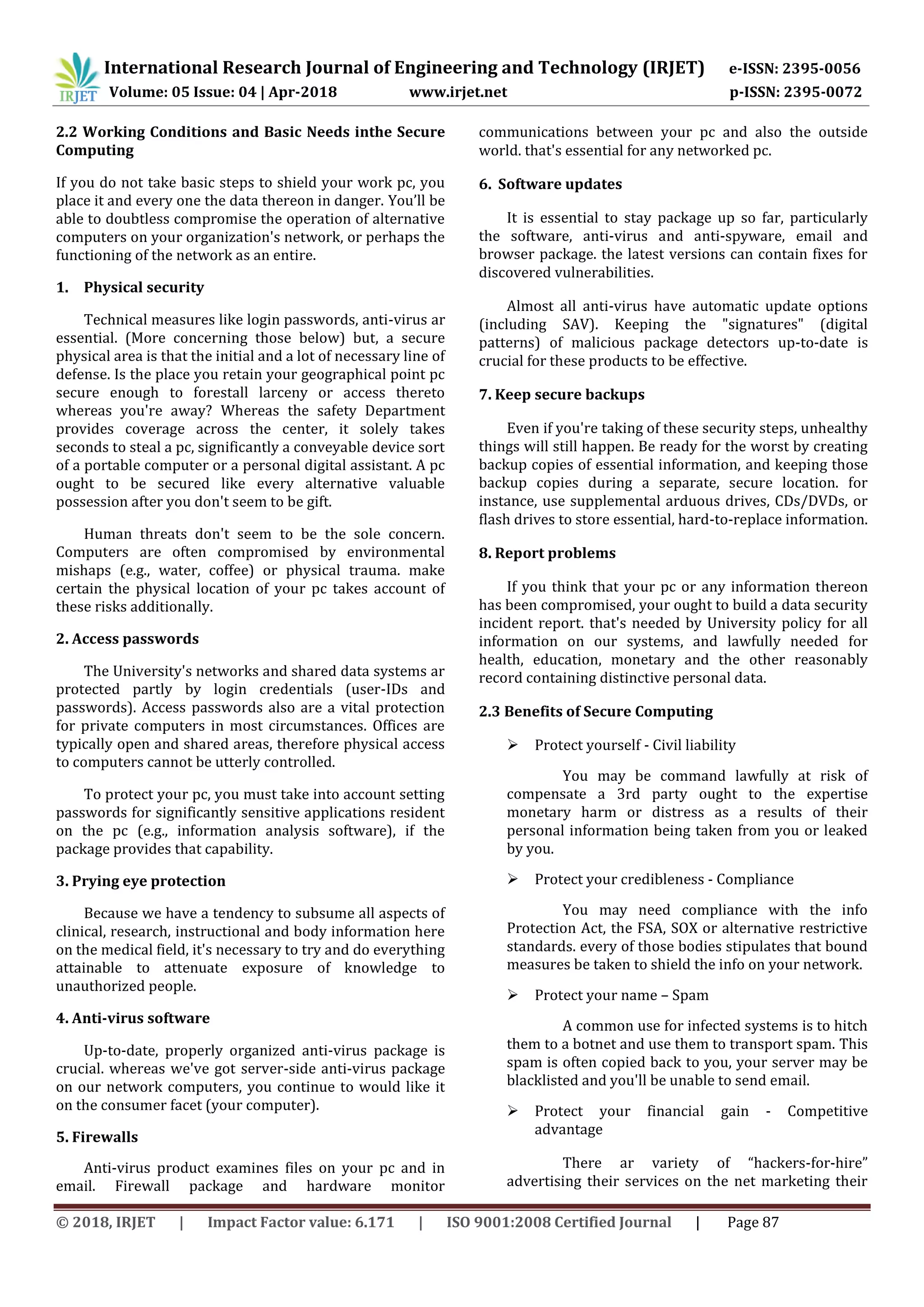
User Registration form
3 User Registration form
This screen describes about the user registration
process with the required fields (Name, Email, Password,
Date of birth etc. Once the registration has done the user
has to wait for approval from the admin. Once the admin
conformed then user can login into the site and he can
access the file.
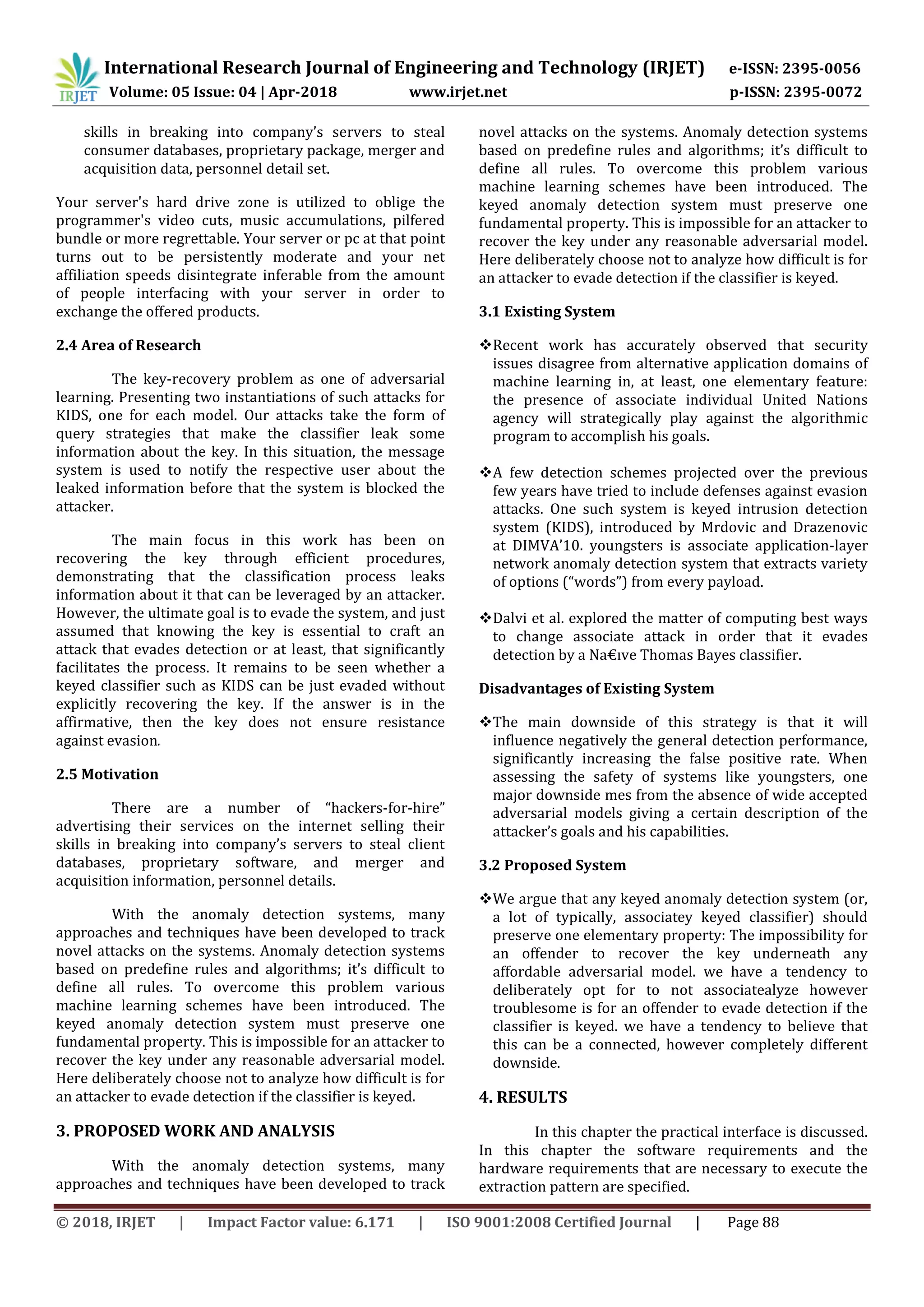
User login form
4 User login form
This screen describes about the user login for
accessing the details. Here user can modify his/her details
and also he can view the files what he uploaded and also
he can download the files .
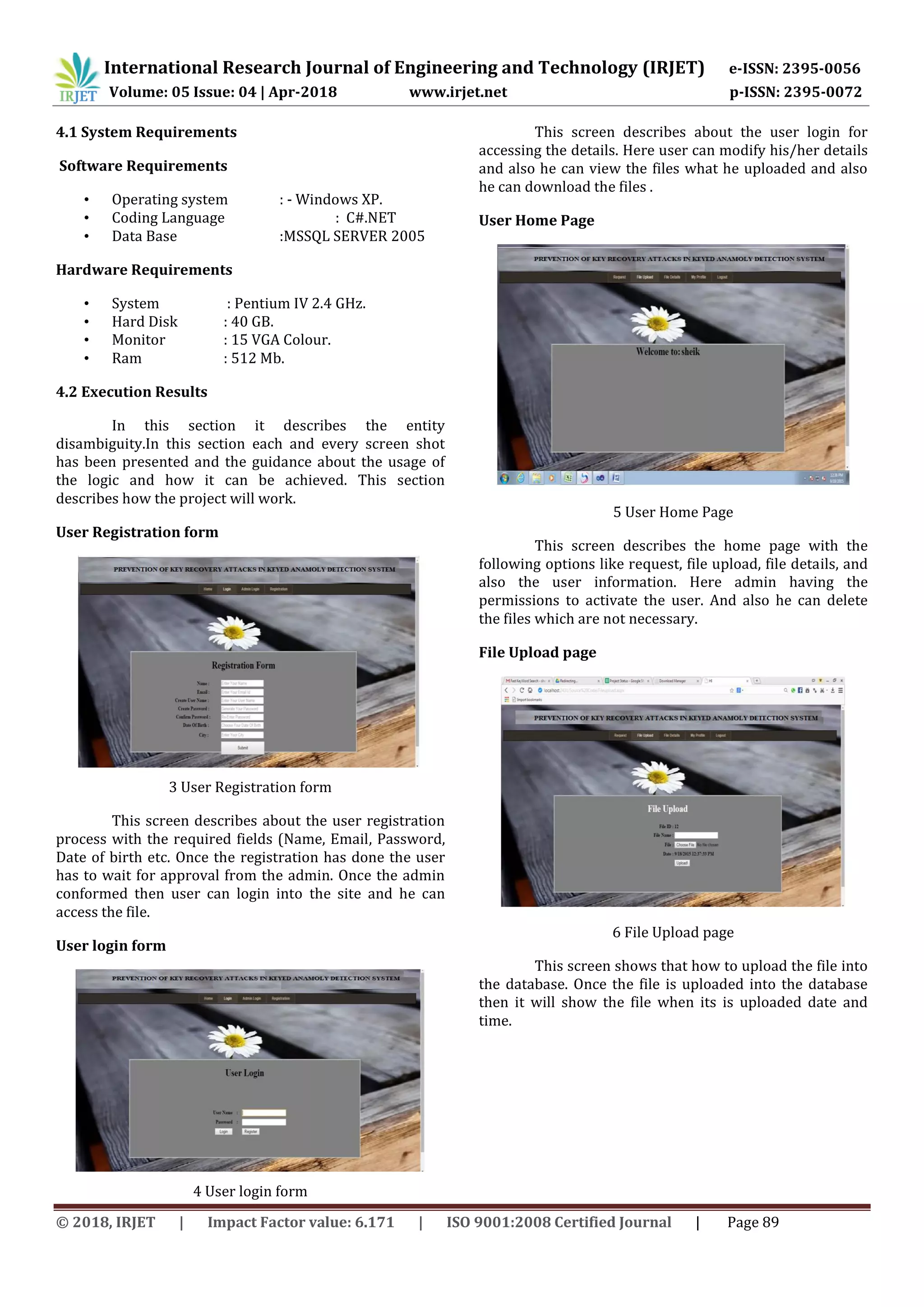
User Home Page
5 User Home Page
This screen describes the home page with the
following options like request, file upload, file details, and
also the user information. Here admin having the
permissions to activate the user. And also he can delete
the files which are not necessary.
File Upload page
6 File Upload page
This screen shows that how to upload the file into
the database. Once the file is uploaded into the database
then it will show the file when its is uploaded date and
time.
International Research Journal of Engineering and Technology (IRJET) e-ISSN: 2395-0056
Volume: 05 Issue: 04 | Apr-2018 www.irjet.net p-ISSN: 2395-0072
© 2018, IRJET | Impact Factor value: 6.171 | ISO 9001:2008 Certified Journal | Page 90
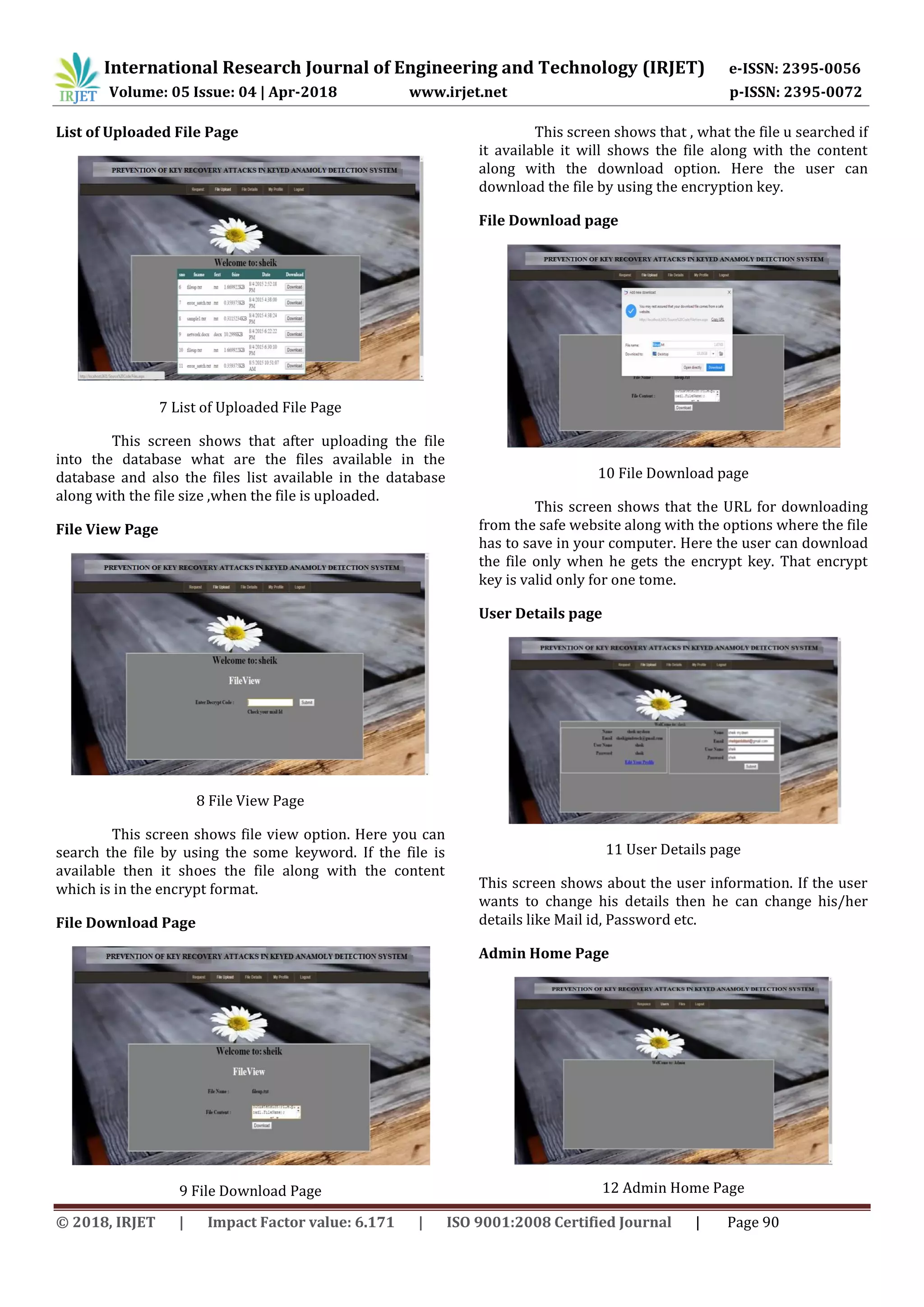
List of Uploaded File Page
7 List of Uploaded File Page
This screen shows that after uploading the file
into the database what are the files available in the
database and also the files list available in the database
along with the file size ,when the file is uploaded.
File View Page
8 File View Page
This screen shows file view option. Here you can
search the file by using the some keyword. If the file is
available then it shoes the file along with the content
which is in the encrypt format.
File Download Page
9 File Download Page
This screen shows that , what the file u searched if
it available it will shows the file along with the content
along with the download option. Here the user can
download the file by using the encryption key.
File Download page
10 File Download page
This screen shows that the URL for downloading
from the safe website along with the options where the file
has to save in your computer. Here the user can download
the file only when he gets the encrypt key. That encrypt
key is valid only for one tome.
User Details page
11 User Details page
This screen shows about the user information. If the user
wants to change his details then he can change his/her
details like Mail id, Password etc.
Admin Home Page
12 Admin Home Page
International Research Journal of Engineering and Technology (IRJET) e-ISSN: 2395-0056
Volume: 05 Issue: 04 | Apr-2018 www.irjet.net p-ISSN: 2395-0072
© 2018, IRJET | Impact Factor value: 6.171 | ISO 9001:2008 Certified Journal | Page 91
This screen shows the welcome page of the Admin
user. Here the admin can see the list of users registered
and also what are the files are available along with the
details of the files like when the files are uploaded etc.
Here the admin having the permissions to activate or
deactivate the user.
Registered Users Page
13 Registered Users Page
This screen shows that the users list along with
Email, password etc. Here the Admin is having the
permissions to enable or disable the user and also having
the permissions to modify the password. Here admin can
see from which place the user is registered.
Encrypt Key View Page
14 Encrypt Key View Page
This Screen shows that the encryption key which
is needed to view or download the file. Here the
encryption key is valid for only for one time. If the user
tried to access the file for view or download then the
encryption key is not valid. Here the encryption key is
produced by the KIDS server with the combination of
alphabets, special characters and numbers.
Encrypt Text View page
15 Encrypt Text View page
This Screen shows the files which are uploaded by
the user is in encrypted format. So, if any of the
unauthorized user wants to access the files of the other
users then the KIDS server finds the user and it blocks that
user as well as it will send the message to the particular
user.
CONCLUSION
Here analyzed the strength of KIDS against key-
recovery attacks. In doing so, we have adapted to the
anomaly detection context an adversarial model borrowed
from the related field of adversarial learning. We've got
conferred key-recovery attacks in keeping with 2
adversarial settings, reckoning on the feedback given by
youngsters to inquisitory queries. To the simplest of our
information, our work is that the initial to demonstrate
key-recovery attacks on a keyed classifier. Surprisingly,
our attacks are very economical, showing that it's
moderately straightforward for associate offender to
recover the key in any of the 2 settings mentioned.
Thus, our recommendation for future styles is to
base choices on strong principles instead of explicit fixes.
Going on the far side youngsters, it remains to be seen
whether or not similar schemes are secure against key
recovery attacks. As discussed in Section 1, our attacks (or
variants of them) are focused on keyed classifiers, and we
believe that they will not carry over randomized
classifiers. We note that, in its present form, KIDS cannot
be easily randomized, as choosing a new key implies
training the classifier again, which is clearly impractical in
real-world scenarios. In the case of Anagram, the authors
discuss one mode of operation where the key is used to
split the packet in various portions so that each of them is
checked against a different Bloom filter.
REFERENCES
[1] M. Barreno, B. Nelson, R. Sears, A.D. Joseph, and J.D.
Tygar, “Can Machine Learning be Secure?” Proc. ACM
Symp. Information, Computer and Comm. Security
(ASIACCS ’06 ), pp. 16-25, 2006.
International Research Journal of Engineering and Technology (IRJET) e-ISSN: 2395-0056
Volume: 05 Issue: 04 | Apr-2018 www.irjet.net p-ISSN: 2395-0072
© 2018, IRJET | Impact Factor value: 6.171 | ISO 9001:2008 Certified Journal | Page 92
[2] M. Barreno, B. Nelson, A.D. Joseph, and J.D. Tygar, “The
Security of Machine Learning,” Machine Learning, vol. 81,
no. 2, pp. 121-148, 2010.
[3] B. Biggio, G. Fumera, and F. Roli, “Adversarial Pattern
Classification Using Multiple Classifiers and
Randomisation,” Proc. IAPR Int’l Workshop Structural,
Syntactic, and Statistical Pattern Recognition, pp. 500-509,
2008.
[4] B. Biggio, B. Nelson, and P. Laskov, “Support Vector
Machines Under Adversarial Label Noise,” J. Machine
Learning Research, vol. 20, pp. 97-112, 2011.
[5] N. Dalvi, P. Domingos, Mausam, S. Sanghai, and D.
Verma, “Adversarial Classification,” Proc. 10th ACM
SIGKDD Int’l Conf. Knowledge Discovery and Data Mining
(KDD ’04), pp. 99-108, 2004.
[6] P. Fogla, M. Sharif, R. Perdisci, O. Kolesnikov, and W.
Lee, “Polymorphic Blending Attacks,” Proc. 15th Conf.
USENIX Security Symp., 2006.
[7] C. Gates and C. Taylo, “Challenging the Anomaly
Detection Paradigm: A Provocative Discussion,” Proc. New
Security Paradigms Workshop (NSPW), pp. 21-29, 2006.
[8] A. Kolcz and C.H. Teo, “Feature Weighting for
Improved Classifier Robustness,” Proc. Sixth Conf. Email
and Anti-Spam (CEAS ’09), 2009.
[9] O. Kolesnikov, D. Dagon, and W. Lee, “Advanced
Polymorphic Worms: Evading IDS by Blending in with
Normal Traffic,” Proc. USENIX Security Symp., 2005.
[10] D. Lowd and C. Meek, “Adversarial Learning,” Proc.
11th ACM SIGKDD Int’l Conf. Knowledge Discovery in Data
Mining (KDD ’05), pp. 641-647, 2005.

IRJET- Preventing of Key-Recovery Attacks on Keyed Intrusion Detection System

  • 1.
    International Research Journalof Engineering and Technology (IRJET) e-ISSN: 2395-0056 Volume: 05 Issue: 04 | Apr-2018 www.irjet.net p-ISSN: 2395-0072 © 2018, IRJET | Impact Factor value: 6.171 | ISO 9001:2008 Certified Journal | Page 86 PREVENTING OF KEY-RECOVERY ATTACKS ON KEYED INTRUSION DETECTION SYSTEM MANDALAPALLI YAGNASREE1, M.VENKATESH NAIK2 1 M.Tech Scholar, ST.MARK Educational Institution Society Group Institutions, Anantapur. 2Assistant Professor, ST.MARK Educational Institution Society Group Institutions, Anantapur. --------------------------------------------------------------------***----------------------------------------------------------------------- confidence machine learning algorithms to derive a model of normality that's later accustomed detect suspicious events. Some works conducted over the last years have observed that such algorithms are typically prone to deception, notably within the sort of attacks rigorously made to evade detection. varied learning schemes are projected to beat this weakness. One such system is Keyed IDS (KIDS), introduced at DIMVA “10. KIDS” core plan is adore the functioning of some cryptanalytic primitives, particularly to introduce a secret component (the key) into the theme in order that some operations are unworkable while not knowing it. In youngsters the learned model and also the computation of the anomaly score are each key- dependent, a reality that presumptively prevents associate offender from making evasion attacks. During this work have a tendency to show that convalescent the secret's very simple on condition that the offender will move with youngsters and find feedback concerning inquisitory requests. we have a tendency to gift realistic attacks for 2 completely different adversarial settings and show that convalescent the key needs solely a little quantity of queries, that indicates that children doesn't meet the claimed security properties. we have a tendency to finally come back KIDS’ central plan and supply heuristic arguments concerning its suitableness and limitations. With the anomaly detection systems, many approaches and techniques have been developed to track novel attacks on the systems. Abnormality identification frameworks in light of predefine standards and calculations; it's hard to characterize all guidelines. To conquer this issue different machine learning plans have been presented. The keyed oddity location framework must protect one central property. This is unimaginable for an assailant to recoup the key under any sensible ill-disposed model. Here purposely pick not to investigate how troublesome is for an assailant to avoid identification if the classifier is keyed. The key-recuperation issue as one of antagonistic learning. Exhibiting two instantiations of such assaults for KIDS, one for each model. Our assaults appear as question systems that influence the classifier to release some data about the key. In this circumstance, the message framework is utilized to tell the particular client about the spilled data before that the framework is obstructed the aggressor. recouping the key through effective systems, showing that the grouping procedure spills data about it that can be utilized by an assailant. Be that as it may, a definitive objective is to avoid the framework, and recently accepted that knowing the key is fundamental to make an assault that sidesteps discovery or possibly, that altogether encourages the procedure. It stays to be seen whether a keyed classifier, for example, KIDS can be simply avoided without unequivocally recouping the key. In the event that the appropriate response is in the agreed, at that point the key does not guarantee protection against avoidance. 2. INTRODUCTION In this chapter brief introduction about the secure computing and the entities in the secure computing like working conditions and basic needs in the secure computing and also benefits, applications where secure computing is needed. 2.1 Secure Computing Computer security (Also referred to as cyber security or IT Security) is data security as applied to computers and networks. the sphere covers all the processes and mechanisms by that computer-based instrumentality, data and services are protected against uncaused or unauthorized access, modification or destruction. pc security conjointly includes protection from unplanned events and natural disasters. Otherwise, within the industry, the term security -- or the phrase pc security -- refers to techniques for making certain that information keep during a pc cannot be scan or compromised by any people while not authorization. Most pc security measures involve encryption and passwords. encryption is that the translation of knowledge into a kind that's unintelligible while not a deciphering mechanism. A Arcanum could be a secret word or phrase that provides a user access to a specific program or system. Fig: 1 Secure Computing 1. ABSTRACT - Most anomaly detection systems have The fundamental concentration in this work has been on
  • 2.
    International Research Journalof Engineering and Technology (IRJET) e-ISSN: 2395-0056 Volume: 05 Issue: 04 | Apr-2018 www.irjet.net p-ISSN: 2395-0072 © 2018, IRJET | Impact Factor value: 6.171 | ISO 9001:2008 Certified Journal | Page 87 2.2 Working Conditions and Basic Needs inthe Secure Computing If you do not take basic steps to shield your work pc, you place it and every one the data thereon in danger. You’ll be able to doubtless compromise the operation of alternative computers on your organization's network, or perhaps the functioning of the network as an entire. 1. Physical security Technical measures like login passwords, anti-virus ar essential. (More concerning those below) but, a secure physical area is that the initial and a lot of necessary line of defense. Is the place you retain your geographical point pc secure enough to forestall larceny or access thereto whereas you're away? Whereas the safety Department provides coverage across the center, it solely takes seconds to steal a pc, significantly a conveyable device sort of a portable computer or a personal digital assistant. A pc ought to be secured like every alternative valuable possession after you don't seem to be gift. Human threats don't seem to be the sole concern. Computers are often compromised by environmental mishaps (e.g., water, coffee) or physical trauma. make certain the physical location of your pc takes account of these risks additionally. 2. Access passwords The University's networks and shared data systems ar protected partly by login credentials (user-IDs and passwords). Access passwords also are a vital protection for private computers in most circumstances. Offices are typically open and shared areas, therefore physical access to computers cannot be utterly controlled. To protect your pc, you must take into account setting passwords for significantly sensitive applications resident on the pc (e.g., information analysis software), if the package provides that capability. 3. Prying eye protection Because we have a tendency to subsume all aspects of clinical, research, instructional and body information here on the medical field, it's necessary to try and do everything attainable to attenuate exposure of knowledge to unauthorized people. 4. Anti-virus software Up-to-date, properly organized anti-virus package is crucial. whereas we've got server-side anti-virus package on our network computers, you continue to would like it on the consumer facet (your computer). 5. Firewalls Anti-virus product examines files on your pc and in email. Firewall package and hardware monitor communications between your pc and also the outside world. that's essential for any networked pc. 6. Software updates It is essential to stay package up so far, particularly the software, anti-virus and anti-spyware, email and browser package. the latest versions can contain fixes for discovered vulnerabilities. Almost all anti-virus have automatic update options (including SAV). Keeping the "signatures" (digital patterns) of malicious package detectors up-to-date is crucial for these products to be effective. 7. Keep secure backups Even if you're taking of these security steps, unhealthy things will still happen. Be ready for the worst by creating backup copies of essential information, and keeping those backup copies during a separate, secure location. for instance, use supplemental arduous drives, CDs/DVDs, or flash drives to store essential, hard-to-replace information. 8. Report problems If you think that your pc or any information thereon has been compromised, your ought to build a data security incident report. that's needed by University policy for all information on our systems, and lawfully needed for health, education, monetary and the other reasonably record containing distinctive personal data. 2.3 Benefits of Secure Computing  Protect yourself - Civil liability You may be command lawfully at risk of compensate a 3rd party ought to the expertise monetary harm or distress as a results of their personal information being taken from you or leaked by you.  Protect your credibleness - Compliance You may need compliance with the info Protection Act, the FSA, SOX or alternative restrictive standards. every of those bodies stipulates that bound measures be taken to shield the info on your network.  Protect your name – Spam A common use for infected systems is to hitch them to a botnet and use them to transport spam. This spam is often copied back to you, your server may be blacklisted and you'll be unable to send email.  Protect your financial gain - Competitive advantage There ar variety of “hackers-for-hire” advertising their services on the net marketing their
  • 3.
    International Research Journalof Engineering and Technology (IRJET) e-ISSN: 2395-0056 Volume: 05 Issue: 04 | Apr-2018 www.irjet.net p-ISSN: 2395-0072 © 2018, IRJET | Impact Factor value: 6.171 | ISO 9001:2008 Certified Journal | Page 88 skills in breaking into company’s servers to steal consumer databases, proprietary package, merger and acquisition data, personnel detail set. Your server's hard drive zone is utilized to oblige the programmer's video cuts, music accumulations, pilfered bundle or more regrettable. Your server or pc at that point turns out to be persistently moderate and your net affiliation speeds disintegrate inferable from the amount of people interfacing with your server in order to exchange the offered products. 2.4 Area of Research The key-recovery problem as one of adversarial learning. Presenting two instantiations of such attacks for KIDS, one for each model. Our attacks take the form of query strategies that make the classifier leak some information about the key. In this situation, the message system is used to notify the respective user about the leaked information before that the system is blocked the attacker. The main focus in this work has been on recovering the key through efficient procedures, demonstrating that the classification process leaks information about it that can be leveraged by an attacker. However, the ultimate goal is to evade the system, and just assumed that knowing the key is essential to craft an attack that evades detection or at least, that significantly facilitates the process. It remains to be seen whether a keyed classifier such as KIDS can be just evaded without explicitly recovering the key. If the answer is in the affirmative, then the key does not ensure resistance against evasion. 2.5 Motivation There are a number of “hackers-for-hire” advertising their services on the internet selling their skills in breaking into company’s servers to steal client databases, proprietary software, and merger and acquisition information, personnel details. With the anomaly detection systems, many approaches and techniques have been developed to track novel attacks on the systems. Anomaly detection systems based on predefine rules and algorithms; it’s difficult to define all rules. To overcome this problem various machine learning schemes have been introduced. The keyed anomaly detection system must preserve one fundamental property. This is impossible for an attacker to recover the key under any reasonable adversarial model. Here deliberately choose not to analyze how difficult is for an attacker to evade detection if the classifier is keyed. 3. PROPOSED WORK AND ANALYSIS With the anomaly detection systems, many approaches and techniques have been developed to track novel attacks on the systems. Anomaly detection systems based on predefine rules and algorithms; it’s difficult to define all rules. To overcome this problem various machine learning schemes have been introduced. The keyed anomaly detection system must preserve one fundamental property. This is impossible for an attacker to recover the key under any reasonable adversarial model. Here deliberately choose not to analyze how difficult is for an attacker to evade detection if the classifier is keyed. 3.1 Existing System Recent work has accurately observed that security issues disagree from alternative application domains of machine learning in, at least, one elementary feature: the presence of associate individual United Nations agency will strategically play against the algorithmic program to accomplish his goals. A few detection schemes projected over the previous few years have tried to include defenses against evasion attacks. One such system is keyed intrusion detection system (KIDS), introduced by Mrdovic and Drazenovic at DIMVA’10. youngsters is associate application-layer network anomaly detection system that extracts variety of options (“words”) from every payload. Dalvi et al. explored the matter of computing best ways to change associate attack in order that it evades detection by a Na€ıve Thomas Bayes classifier. Disadvantages of Existing System The main downside of this strategy is that it will influence negatively the general detection performance, significantly increasing the false positive rate. When assessing the safety of systems like youngsters, one major downside mes from the absence of wide accepted adversarial models giving a certain description of the attacker’s goals and his capabilities. 3.2 Proposed System We argue that any keyed anomaly detection system (or, a lot of typically, associatey keyed classifier) should preserve one elementary property: The impossibility for an offender to recover the key underneath any affordable adversarial model. we have a tendency to deliberately opt for to not associatealyze however troublesome is for an offender to evade detection if the classifier is keyed. we have a tendency to believe that this can be a connected, however completely different downside. 4. RESULTS In this chapter the practical interface is discussed. In this chapter the software requirements and the hardware requirements that are necessary to execute the extraction pattern are specified.
  • 4.
    International Research Journalof Engineering and Technology (IRJET) e-ISSN: 2395-0056 Volume: 05 Issue: 04 | Apr-2018 www.irjet.net p-ISSN: 2395-0072 © 2018, IRJET | Impact Factor value: 6.171 | ISO 9001:2008 Certified Journal | Page 89 4.1 System Requirements Software Requirements • Operating system : - Windows XP. • Coding Language : C#.NET • Data Base :MSSQL SERVER 2005 Hardware Requirements • System : Pentium IV 2.4 GHz. • Hard Disk : 40 GB. • Monitor : 15 VGA Colour. • Ram : 512 Mb. 4.2 Execution Results In this section it describes the entity disambiguity.In this section each and every screen shot has been presented and the guidance about the usage of the logic and how it can be achieved. This section describes how the project will work. User Registration form 3 User Registration form This screen describes about the user registration process with the required fields (Name, Email, Password, Date of birth etc. Once the registration has done the user has to wait for approval from the admin. Once the admin conformed then user can login into the site and he can access the file. User login form 4 User login form This screen describes about the user login for accessing the details. Here user can modify his/her details and also he can view the files what he uploaded and also he can download the files . User Home Page 5 User Home Page This screen describes the home page with the following options like request, file upload, file details, and also the user information. Here admin having the permissions to activate the user. And also he can delete the files which are not necessary. File Upload page 6 File Upload page This screen shows that how to upload the file into the database. Once the file is uploaded into the database then it will show the file when its is uploaded date and time.
  • 5.
    International Research Journalof Engineering and Technology (IRJET) e-ISSN: 2395-0056 Volume: 05 Issue: 04 | Apr-2018 www.irjet.net p-ISSN: 2395-0072 © 2018, IRJET | Impact Factor value: 6.171 | ISO 9001:2008 Certified Journal | Page 90 List of Uploaded File Page 7 List of Uploaded File Page This screen shows that after uploading the file into the database what are the files available in the database and also the files list available in the database along with the file size ,when the file is uploaded. File View Page 8 File View Page This screen shows file view option. Here you can search the file by using the some keyword. If the file is available then it shoes the file along with the content which is in the encrypt format. File Download Page 9 File Download Page This screen shows that , what the file u searched if it available it will shows the file along with the content along with the download option. Here the user can download the file by using the encryption key. File Download page 10 File Download page This screen shows that the URL for downloading from the safe website along with the options where the file has to save in your computer. Here the user can download the file only when he gets the encrypt key. That encrypt key is valid only for one tome. User Details page 11 User Details page This screen shows about the user information. If the user wants to change his details then he can change his/her details like Mail id, Password etc. Admin Home Page 12 Admin Home Page
  • 6.
    International Research Journalof Engineering and Technology (IRJET) e-ISSN: 2395-0056 Volume: 05 Issue: 04 | Apr-2018 www.irjet.net p-ISSN: 2395-0072 © 2018, IRJET | Impact Factor value: 6.171 | ISO 9001:2008 Certified Journal | Page 91 This screen shows the welcome page of the Admin user. Here the admin can see the list of users registered and also what are the files are available along with the details of the files like when the files are uploaded etc. Here the admin having the permissions to activate or deactivate the user. Registered Users Page 13 Registered Users Page This screen shows that the users list along with Email, password etc. Here the Admin is having the permissions to enable or disable the user and also having the permissions to modify the password. Here admin can see from which place the user is registered. Encrypt Key View Page 14 Encrypt Key View Page This Screen shows that the encryption key which is needed to view or download the file. Here the encryption key is valid for only for one time. If the user tried to access the file for view or download then the encryption key is not valid. Here the encryption key is produced by the KIDS server with the combination of alphabets, special characters and numbers. Encrypt Text View page 15 Encrypt Text View page This Screen shows the files which are uploaded by the user is in encrypted format. So, if any of the unauthorized user wants to access the files of the other users then the KIDS server finds the user and it blocks that user as well as it will send the message to the particular user. CONCLUSION Here analyzed the strength of KIDS against key- recovery attacks. In doing so, we have adapted to the anomaly detection context an adversarial model borrowed from the related field of adversarial learning. We've got conferred key-recovery attacks in keeping with 2 adversarial settings, reckoning on the feedback given by youngsters to inquisitory queries. To the simplest of our information, our work is that the initial to demonstrate key-recovery attacks on a keyed classifier. Surprisingly, our attacks are very economical, showing that it's moderately straightforward for associate offender to recover the key in any of the 2 settings mentioned. Thus, our recommendation for future styles is to base choices on strong principles instead of explicit fixes. Going on the far side youngsters, it remains to be seen whether or not similar schemes are secure against key recovery attacks. As discussed in Section 1, our attacks (or variants of them) are focused on keyed classifiers, and we believe that they will not carry over randomized classifiers. We note that, in its present form, KIDS cannot be easily randomized, as choosing a new key implies training the classifier again, which is clearly impractical in real-world scenarios. In the case of Anagram, the authors discuss one mode of operation where the key is used to split the packet in various portions so that each of them is checked against a different Bloom filter. REFERENCES [1] M. Barreno, B. Nelson, R. Sears, A.D. Joseph, and J.D. Tygar, “Can Machine Learning be Secure?” Proc. ACM Symp. Information, Computer and Comm. Security (ASIACCS ’06 ), pp. 16-25, 2006.
  • 7.
    International Research Journalof Engineering and Technology (IRJET) e-ISSN: 2395-0056 Volume: 05 Issue: 04 | Apr-2018 www.irjet.net p-ISSN: 2395-0072 © 2018, IRJET | Impact Factor value: 6.171 | ISO 9001:2008 Certified Journal | Page 92 [2] M. Barreno, B. Nelson, A.D. Joseph, and J.D. Tygar, “The Security of Machine Learning,” Machine Learning, vol. 81, no. 2, pp. 121-148, 2010. [3] B. Biggio, G. Fumera, and F. Roli, “Adversarial Pattern Classification Using Multiple Classifiers and Randomisation,” Proc. IAPR Int’l Workshop Structural, Syntactic, and Statistical Pattern Recognition, pp. 500-509, 2008. [4] B. Biggio, B. Nelson, and P. Laskov, “Support Vector Machines Under Adversarial Label Noise,” J. Machine Learning Research, vol. 20, pp. 97-112, 2011. [5] N. Dalvi, P. Domingos, Mausam, S. Sanghai, and D. Verma, “Adversarial Classification,” Proc. 10th ACM SIGKDD Int’l Conf. Knowledge Discovery and Data Mining (KDD ’04), pp. 99-108, 2004. [6] P. Fogla, M. Sharif, R. Perdisci, O. Kolesnikov, and W. Lee, “Polymorphic Blending Attacks,” Proc. 15th Conf. USENIX Security Symp., 2006. [7] C. Gates and C. Taylo, “Challenging the Anomaly Detection Paradigm: A Provocative Discussion,” Proc. New Security Paradigms Workshop (NSPW), pp. 21-29, 2006. [8] A. Kolcz and C.H. Teo, “Feature Weighting for Improved Classifier Robustness,” Proc. Sixth Conf. Email and Anti-Spam (CEAS ’09), 2009. [9] O. Kolesnikov, D. Dagon, and W. Lee, “Advanced Polymorphic Worms: Evading IDS by Blending in with Normal Traffic,” Proc. USENIX Security Symp., 2005. [10] D. Lowd and C. Meek, “Adversarial Learning,” Proc. 11th ACM SIGKDD Int’l Conf. Knowledge Discovery in Data Mining (KDD ’05), pp. 641-647, 2005.