DESIGN AND CONTRUCTION OF A WIRELSS POWER THEFT
DETECTION SYSTEM
KUMASI TECHNICAL UNIVERSITY
B-TECH ELECTRICAL AND ELETRONICS ENGINEERING
PROJECT PROPOSAL:
on
SUPERVISEDBY
MR. ADJEI-SAFORO KWAFO EDMUND
NAMES INDEXNo
George K.K. Owusu 05170037
Immanuel Asamoah Maclean 05170019
26TH
MAY, 2018
OUTLINE
 Background
 Significance.
 Problem statement.
 Objectives.
 Methodology & Technological scheme.
 Research time plan.
“The electricity theft can be classified in the form of meter tampering, illegal connections,
billing indiscretions, and unpaid bills” [ T.B. Smith, 2008]
 What is Powertheft……?
• The use of electrical power without a contract with the Supplier, or
• Interfering this system in a way to adulterate its measurement.
BACKGROUND
 Electricity theft is a very communal problem in countries like Ghana.
 Every year in Ghana, there is a very increasing number of electricity theft across
domestic and as well as industrial supply, this results in:
• loss of energy.
• power outages.
• load shedding.
PROBLEMSTATEMENT
 Over the years Power theft has been an issue that the country is battling with.
 “About 30% of the power supplied was lost through theft and other
illegal activities” [W. Hutton-Mensah, 2014]
 However, these bulk losses caused by the theft and other illegal
connections must be solved by electronic wireless means.
 Our proposed system will detect power theft on the distribution
lines and send a signal to the supplier for swift response.
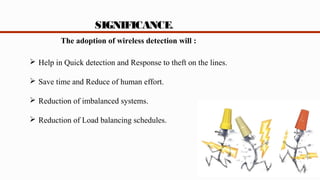
SIGNIFICANCE.
 Help in Quick detection and Response to theft on the lines.
 Save time and Reduce of human effort.
 Reduction of imbalanced systems.
 Reduction of Load balancing schedules.
The adoption of wireless detection will :
•
Indicate exact zone and distribution line where the theft occurred.
•
To detect power theft without any human control.
•
To maximize the profit margin of energy provider company.
OBJECTIVE
Specific Objectives
 Design and construct a wireless theft detection system on
distribution lines using radio frequency to eliminate power theft.
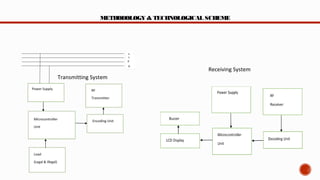
METHODOLOGY & TECHNOLOGICAL SCHEME
Transmitting System
Receiving System
RESEARCH TIME PLAN.
PROJECT SCHEDULE-2018 MAY JUNE JULY AUG SEPT OCT
Proposal defense
Chapter 1- Introduction
Chapter 2- Literature Review
Chapter 3- Methodology
Design and construction
Chapter 4- Testing, Results and Analysis
Chapter 5- conclusion and
Recommendation
Corrections and finalization
[2] Rev. W. Hutton-Mensah, The Ghanaian Times, 11/05/ 2014
[1] T.B. Smith, ”Electricity Theft: a Comparative Analysis, Energy Policy”. 32(18), pp. 2067 – 2076,
2008

WIRELESS Power theft DETECTION

  • 1.
    DESIGN AND CONTRUCTIONOF A WIRELSS POWER THEFT DETECTION SYSTEM KUMASI TECHNICAL UNIVERSITY B-TECH ELECTRICAL AND ELETRONICS ENGINEERING PROJECT PROPOSAL: on SUPERVISEDBY MR. ADJEI-SAFORO KWAFO EDMUND NAMES INDEXNo George K.K. Owusu 05170037 Immanuel Asamoah Maclean 05170019 26TH MAY, 2018
  • 2.
    OUTLINE  Background  Significance. Problem statement.  Objectives.  Methodology & Technological scheme.  Research time plan.
  • 3.
    “The electricity theftcan be classified in the form of meter tampering, illegal connections, billing indiscretions, and unpaid bills” [ T.B. Smith, 2008]  What is Powertheft……? • The use of electrical power without a contract with the Supplier, or • Interfering this system in a way to adulterate its measurement. BACKGROUND  Electricity theft is a very communal problem in countries like Ghana.  Every year in Ghana, there is a very increasing number of electricity theft across domestic and as well as industrial supply, this results in: • loss of energy. • power outages. • load shedding.
  • 4.
    PROBLEMSTATEMENT  Over theyears Power theft has been an issue that the country is battling with.  “About 30% of the power supplied was lost through theft and other illegal activities” [W. Hutton-Mensah, 2014]  However, these bulk losses caused by the theft and other illegal connections must be solved by electronic wireless means.  Our proposed system will detect power theft on the distribution lines and send a signal to the supplier for swift response.
  • 5.
    SIGNIFICANCE.  Help inQuick detection and Response to theft on the lines.  Save time and Reduce of human effort.  Reduction of imbalanced systems.  Reduction of Load balancing schedules. The adoption of wireless detection will :
  • 6.
    • Indicate exact zoneand distribution line where the theft occurred. • To detect power theft without any human control. • To maximize the profit margin of energy provider company. OBJECTIVE Specific Objectives  Design and construct a wireless theft detection system on distribution lines using radio frequency to eliminate power theft.
  • 7.
    METHODOLOGY & TECHNOLOGICALSCHEME Transmitting System Receiving System
  • 8.
    RESEARCH TIME PLAN. PROJECTSCHEDULE-2018 MAY JUNE JULY AUG SEPT OCT Proposal defense Chapter 1- Introduction Chapter 2- Literature Review Chapter 3- Methodology Design and construction Chapter 4- Testing, Results and Analysis Chapter 5- conclusion and Recommendation Corrections and finalization
  • 10.
    [2] Rev. W.Hutton-Mensah, The Ghanaian Times, 11/05/ 2014 [1] T.B. Smith, ”Electricity Theft: a Comparative Analysis, Energy Policy”. 32(18), pp. 2067 – 2076, 2008