International Research Journal of Engineering and Technology (IRJET) e-ISSN: 2395-0056
Volume: 07 Issue: 01 | Jan 2020 www.irjet.net p-ISSN: 2395-0072
© 2020, IRJET | Impact Factor value: 7.34 | ISO 9001:2008 Certified Journal | Page 1018
MODELING AND ANALYSIS OF FIELD OF EXHAUST MANIFOLD DESIGN
Usha Mandloi1, Purushottam Kumar Sahu2, Jagdish Saini3
1BM College of Technology RGPV Bhopal
2HOD Mechanical Engineering Department
3Professor, Dept. of Mechanical Engineering, BM College of Technology, Madhya Pradesh, India
---------------------------------------------------------------------***----------------------------------------------------------------------
Abstract - In the current century, spark ignition engines
have become an isolated part of society, and are used in
many fields of energy. They act as the backbone for
transport systems, but, as a bitter truth they behave like a
major source of air pollution. There are basically three types
of emissions, one emerged from an SI engine; Exhaust
emissions, evaporative emissions and crankcase emissions,
and the major pollutants emitted from these engines are CO,
CO2, SOX, NOx. The current work aims to reduce emissions.
It is a well-established fact that smooth combustion reduces
emissions, and the exhaust process greatly contributes to
completing the smooth combustion process. In the present
work, multiple designs of exhaust for a multi-cylinder spark
ignition engine are optimized to reduce emissions, by
evaluating back pressure. For this purpose, four different
designs, such as, short bend center exit, short bend side exit,
long bend center exit with reducer, and long bend side exit
with reducer are considered, and their performance is
evaluated separately. Loading conditions are performed.
The resulting performance scores of various models are
evaluated based on back pressure, and based on these
scores; the overall performance score is examined. In the
next step, different models are ranked based on the overall
performance score.
Key Words: Exhaust manifold, back pressure, exhaust
velocity, CATIA v5, ANSYS workbench
1. INTRODUCTION
Air pollution can be defined as an addition of any material
which will deleterious effect on the life on the earth. The
main pollutants contributed by IC engines are carbon
monoxide, nitrogen oxides, unburned hydrocarbons, and
other particulate emissions. In addition to this, different
fuels used in engines also emit carbon dioxide in large
quantities, which is more concerned to greenhouse effect.
A renounced meteorologist recently predicted that
polluted air can put an end to life on the earth within a
century. This, in turn, will reduce the emissions of carbon
dioxide. A viable alternative to IC engines or alternative
fuels is not likely to be available within the next few
decades. Therefore, all efforts should be made to develop
better engines, and methods to reduce the pollution from
IC engines.
1.1 THEORETICAL CONSIDERATIONS
In an internal combustion (IC) engine, combustion of fuel
takes place inside the engine cylinder in the presence of
oxygen (present in air), and a large amount of mechanical
energy is obtained. For the purpose of combustion, either
petrol is used along with air in case of spark ignition
engines, or compressed air is used and diesel is sprayed in
diesel engines. This process generates tremendous
mechanical energy. Inside the engine cylinder, the piston
power is transmitted to a shaft known as crank shaft,
which converts reciprocating motion of the piston into
rotary motion. Today's IC engines can be classified in
many ways. Internal combustion (IC) engine rankings in
some of the following methods:
1. Based on request
a) Automobile engine;
b) Aircraft engines;
c) Locomotive Engine;
d) Marine engines; and
e) Stationary engines.
2. Based on the basic engine design
a) Single cylinder engine,
b) Multi-cylinder line engine,
c) V-engine,
d) Radial engine,
e) Opposed piston opposed cylinder engine, and
f) Rotatory engine.
3. Based on Operating Cycle
a) Atkinson (full extension SI engine);
b) Diesel (e.g. diesel engine);
c) Dual (original diesel engine);
d) Miller (early / late inlet valve closing type SI engine);
and
International Research Journal of Engineering and Technology (IRJET) e-ISSN: 2395-0056
Volume: 07 Issue: 01 | Jan 2020 www.irjet.net p-ISSN: 2395-0072
© 2020, IRJET | Impact Factor value: 7.34 | ISO 9001:2008 Certified Journal | Page 1019
e) Otto (Convectional for SI engine).
4. On the basis of the working cycle
a) Four stroke cycle;
b) Two-stroke cycle;
c) Clean, straight / crankcase / cross-flow, back flow /
loop, uniform flow; and
d) Naturally Aspirated or Turbocharged.
5. Based on the valve / port design
a) Poppet valve; and
b) Rotatory Valve.
6. Based on location Valve / port
c) Head T- type;
d) Head L- type;
e) France head
7. Based on fuels used
a) Convectional
b) Oil derivatives, petrol, diesel
c) Other sources, coal, standing biomass, tar, rock
d) Substitute
e) Petroleum derivatives CNG, LPG
f) Biomass derived: alcohol, vegetable oil, producer gas,
biogas and hydrogen
g)Blending
h)Two fuel and dual-fuel
8. Based on Composition Preparation
a) Carburetion; and
b) Fuel Injection.
9. Based on ignition type
a) Spark ignition (SI); and
b) Compression ignition (CI).
2. LITERATURE REVIEW
Present chapter tells about the opinions of different
researchers on pollutants form SI engines, and exhaust
manifold designs, and finds the gaps found during the
survey of literature, which constitute the objectives of the
research, and concludes with the summary.
2.1 REVIEWS OF RELATED LITERATURE
A summary of literature based on different approaches
adopted by researchers in the field of exhaust manifold
design is present as follows:
1. Arcoumanis C (1994)
The researcher adopted a modelling approach for
investigating flow distribution in exhaust manifold by
modifying inlet and exhaust manifolds. Research also
conducted experimentations for investigating the emission
conditions for the engine.
2. Ahmed and Gowreesh (2015)
This research work consists of application of different CFD
techniques to identify the optimum exhaust manifold for a
4-cylinder, 4-stroke petrol engine. In the research work,
five variants of header based on manifold pipe geometry,
namely, convergent inlet pipe, reduced convergent length,
divergent-straight-convergent, reduced, divergent length,
and enhanced convergent length, ideal divergent and
convergent, and reduced straight length, are considered.
The simulations were carried out with the help of
simulation and analysis software ANSYS FLUENT using
unstructured meshes. In the research work, boundary
condition used was mass flow inlet. On the basis of results
obtained, researchers reported that the minimum back-
pressure at the exhaust manifold outlet can be achieved
with the help of reducers.
3. Amruthraj, et al. (2012)
In the present work, researchers have studied the exhaust
when a additive (brown gas) is mixed with air and petrol
in 4 stroke SI engine. Results of the analysis show that
with this combination, percentage of hydrocarbon
emissions has reduced by 99.92%, and CO emissions are
reduced by 98.668%.
4. Bafghi (2013)
In his research work, researcher analyzed the effect of
exhaust gas to air manifold on NOX on different loads, the
smoke temperature at exhaust, bsfc, vol. efficiency, and
changes in thermal efficiency. Results of this research
show that on increasing the exhaust temperature to the
manifold, volumetric and thermal efficiency of the engine
decreases.
5. Chi et al.(2012)
In this research work, performance of a single cylinder SI
engine was estimated using 1-dimensional, GT-Power
software. The virtually obtained power output, was then,
International Research Journal of Engineering and Technology (IRJET) e-ISSN: 2395-0056
Volume: 07 Issue: 01 | Jan 2020 www.irjet.net p-ISSN: 2395-0072
© 2020, IRJET | Impact Factor value: 7.34 | ISO 9001:2008 Certified Journal | Page 1020
compared against the experimental data. During the
research work the considered parameters were the intake
runner diameter, the position of restrictor, the exhaust
runner lengths, and the sphere plenum diameter. For
designing the plenum for both the manifolds Helmholtz
theory was applied, and the optimization experimental
study was conducted with the help of Orthogonal Array
Testing Strategy (OATS). The results obtained from the
experimental analysis show satisfactory level of similarity
with results of GT-Power software predictions.
6. Chiavolaet al. (2001)
The researchers carried out the study of flow behaviour on
intake and exhaust systems of an IC engine, and found that
the phenomena of flow in ducts closely affects the
volumetric efficiency of the engine.
7. Cho et al. (2013)
The researcher designs the exhaust manifold for a 4s- SI
engine, to run at 700 – 1500 RPM, and with power output
up to 600 kilowatts. In the research work, thermal
expansion analysis, and vibration analysis of the exhaust
manifold was carried out.
8. Choongsik and Junemo (2001)
The researchers performed the research to analyze the
effect of exhaust gas re-circulation on combustion
characteristics of a petrol engine.
9. Dattatrayet al. (2013)
The researchers focused on thermal analysis of exhaust
system for a motor bike silencer for the purpose of
reducing hot spot through design improvement, and
suggest for improving life of the device. During the
research, they used a customized power coating for
making mufflers used in automotive applications. As a
result they analyzed that modified design offers reduced
hot spots.
10. Dattuet al. (2014)
In this research work, researchers carried out thermal
analysis for the exhaust manifold of tubular type, for
various operating conditions. In the research work,
researchers considered four different types, namely,
radius 48 mm exhaust valve at extremely left, radius 48 m
exhaust valve at center, radius 100 mm exhaust valve at
the extremely left, and radius 100 mm exhaust valve at the
center. The materials used for this purpose were cast iron,
and aluminium. On the basis of results obtained,
researchers suggested that as a material aluminium shows
better thermal performance as compared to cast iron, and
the exhaust manifold with 48 mm radius with exhaust
valve at the center, shows superior thermal properties as
compared to the other options.
11. Duratet al. (2014)
The researchers carried out both computational fluid
dynamics and experimental analysis for investigating
thermal performance of exhaust system for a SI engine.
For this purpose, an experimental study was conducted to
analyze the behaviour of gas flowing in exhaust pipe. The
result shows satisfactory values.
12. Ghazikhaniet al. (2014)
The researchers focused on exergy recovery for a diesel
engine of direct injection type. In the research work
investigations were performed for turbocharged diesel
engines for different RPM and torque values. For this
purpose, a double pipe heat exchanger with reversed flow
conditions was used. The research shows that by
increasing load and engine speed the recovered exergy of
the system increases, while the bsfc reduces by
approximately 10%.
2.2 GAPS IS THE LITERATURE
On the basis of above mentioned literature survey,
following gaps are being identified:
There is a limited research available considering different
geometries of exhaust manifold; there is a limited research
conducted for analyzing pressure and velocity changes
happening in the header and their effect on exhaust
emission; and Comparative study of different geometries
of exhaust manifold for reducing exhaust emission
problem.
Based on the gaps noticed in literature, objectives for the
present research work are targeted.
3. DESIGNING, MODELING AND ANALYSIS OF EXHAUST
MANIFOLD
MODEL FORMULATION
In present research work CFD analysis of exhaust manifold
of multi-cylinder SI engine is accomplished for
determining optimal geometry for the purpose of reducing
the emissions. For this purpose four manifolds chosen
from the research work of Umeshet al. (2013) are
compared at comparatively higher load values as
compared with the research work of the previous
researchers. Following are the physical details of models
adopted for research.
International Research Journal of Engineering and Technology (IRJET) e-ISSN: 2395-0056
Volume: 07 Issue: 01 | Jan 2020 www.irjet.net p-ISSN: 2395-0072
© 2020, IRJET | Impact Factor value: 7.34 | ISO 9001:2008 Certified Journal | Page 1021
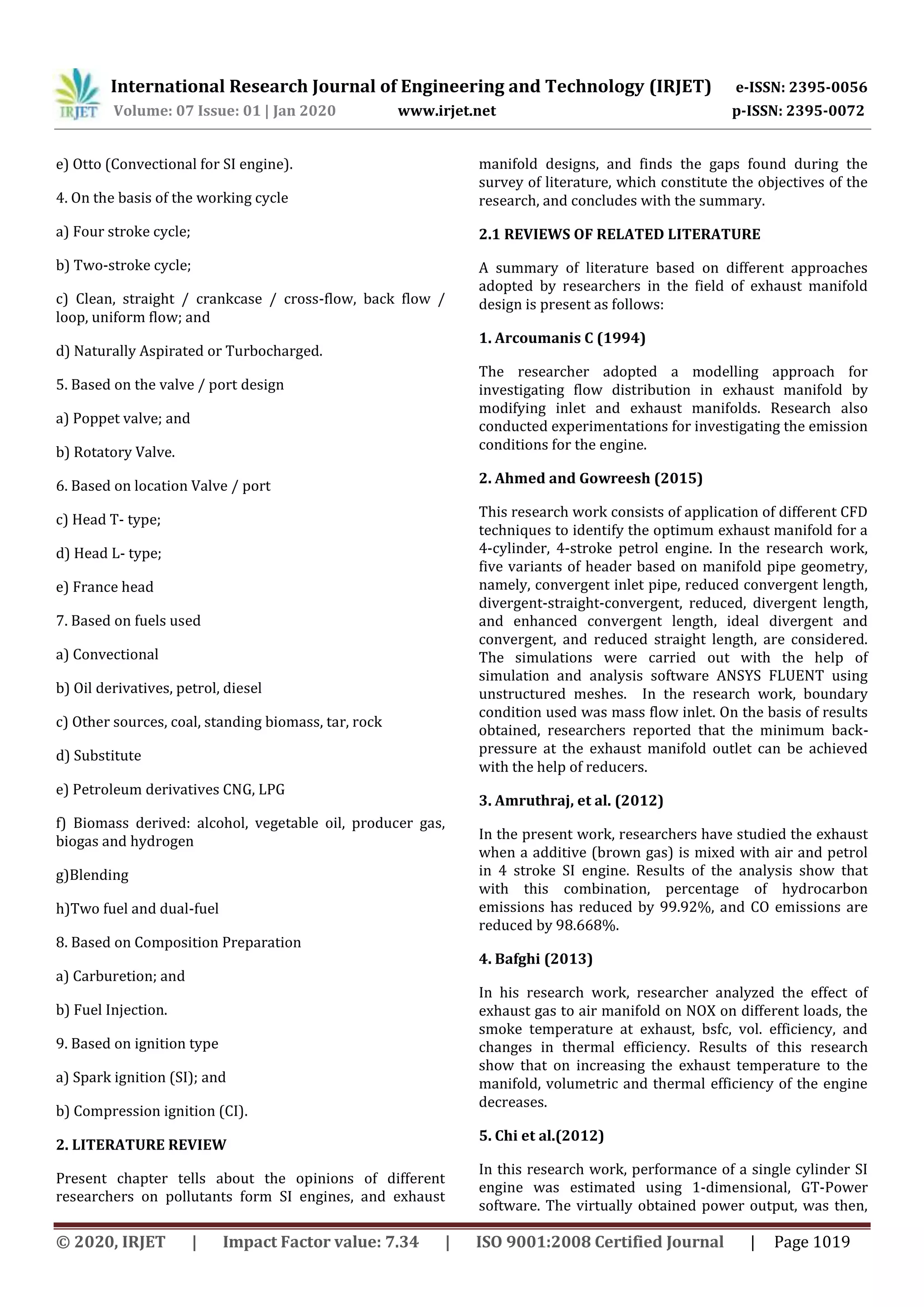
Table 3.1: Values of back pressures for different models
S.
N
o
Type
Load applied
5kg 10 kg 15 kg 20 kg 25 kg
1
Short Bend
Center Exit
993 1079 1184 1204 1219
2
Short Bend
Side Exit
1089 1132 1242 1262 1277
3
Long bend
center exit
with reducer
1099 1187 1302 1322 1337
4
Long bend
side exit with
reducer
1194 1276 1386 1411 1441
Graphical representation of above analysis is as follows.
Figure3.1: Values of back pressures for different models
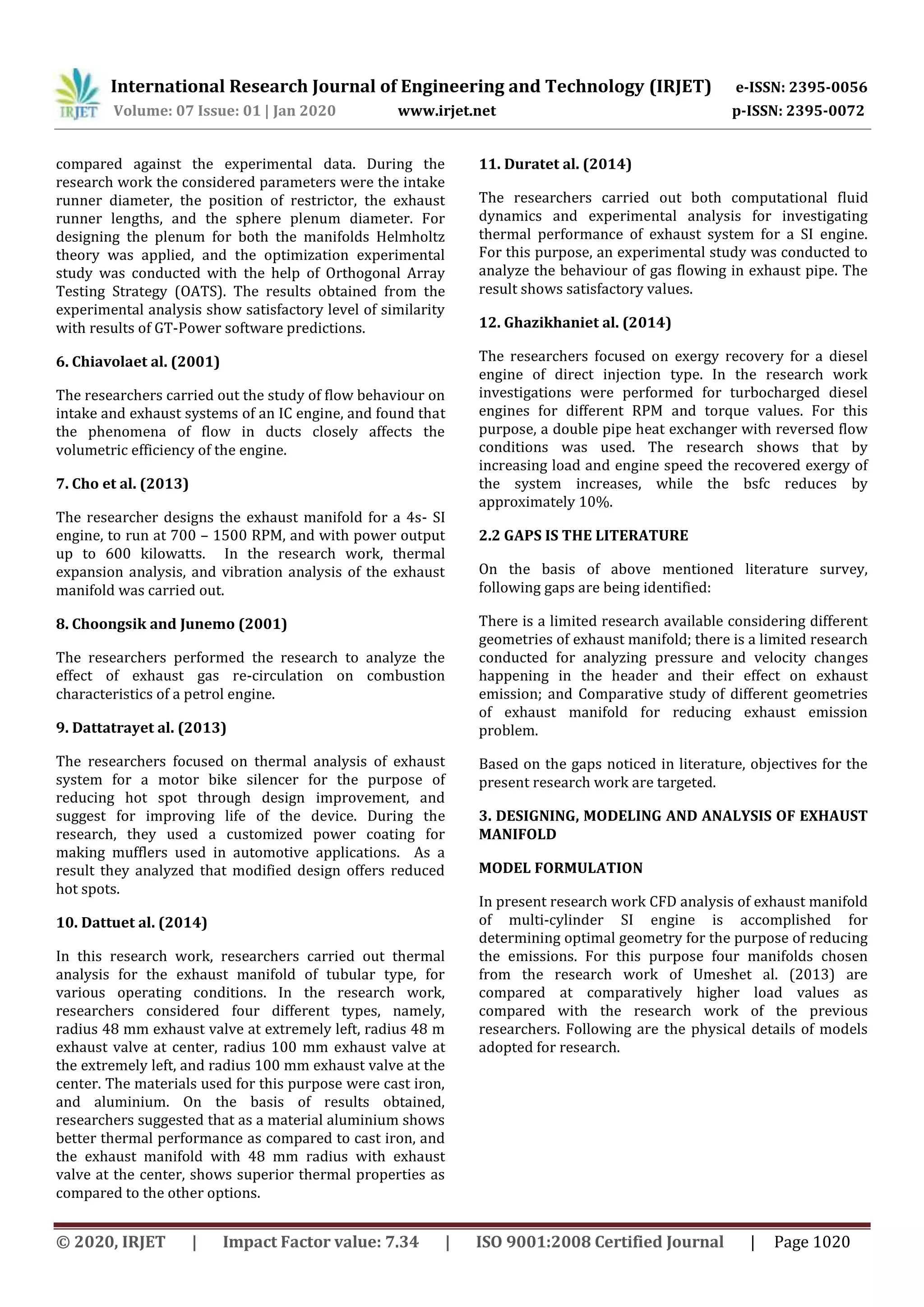
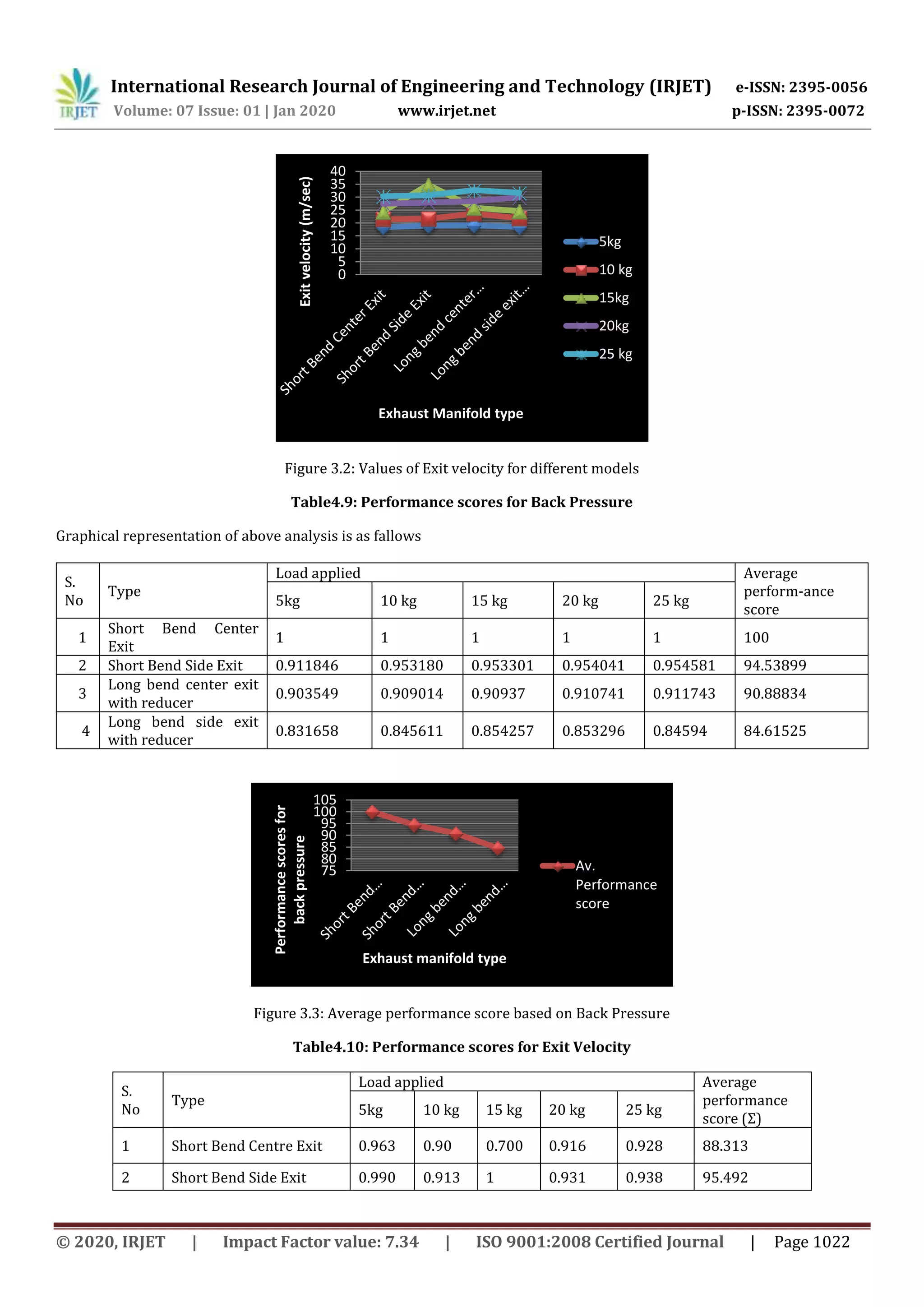
a) In next stage, exit velocities for different models in different loading conditions were calculated (please refer figure
5.3 to figure 5.6). Following are the results.
Table4.8: Values of exit velocities for different models
Graphical representation of above analysis is as follows.
0
200
400
600
800
1000
1200
1400
1600
Short
Bend
Center
Exit
Short
Bend
Side Exit
Long
Bend
Center
Exit
Long
Bend
Side Exit
Backpressure(Pa)
Exhaust manifold type
5kg
10 kg
15 kg
20 kg
25 kg
S.No Type
Load applied
5kg 10 kg 15kg 20kg 25 kg
1 Short Bend Center Exit 18.41 21.45 24.39 27.43 30.37
2 Short Bend Side Exit 18.92 21.60 34.82 27.90 30.72
3 Long bend center exit
with reducer
19.10 23.65 25.90 28.46 32.72
4 Long bend side exit with
reducer
18.48 21.86 24.56 29.94 31.64
International Research Journal of Engineering and Technology (IRJET) e-ISSN: 2395-0056
Volume: 07 Issue: 01 | Jan 2020 www.irjet.net p-ISSN: 2395-0072
© 2020, IRJET | Impact Factor value: 7.34 | ISO 9001:2008 Certified Journal | Page 1022
Figure 3.2: Values of Exit velocity for different models
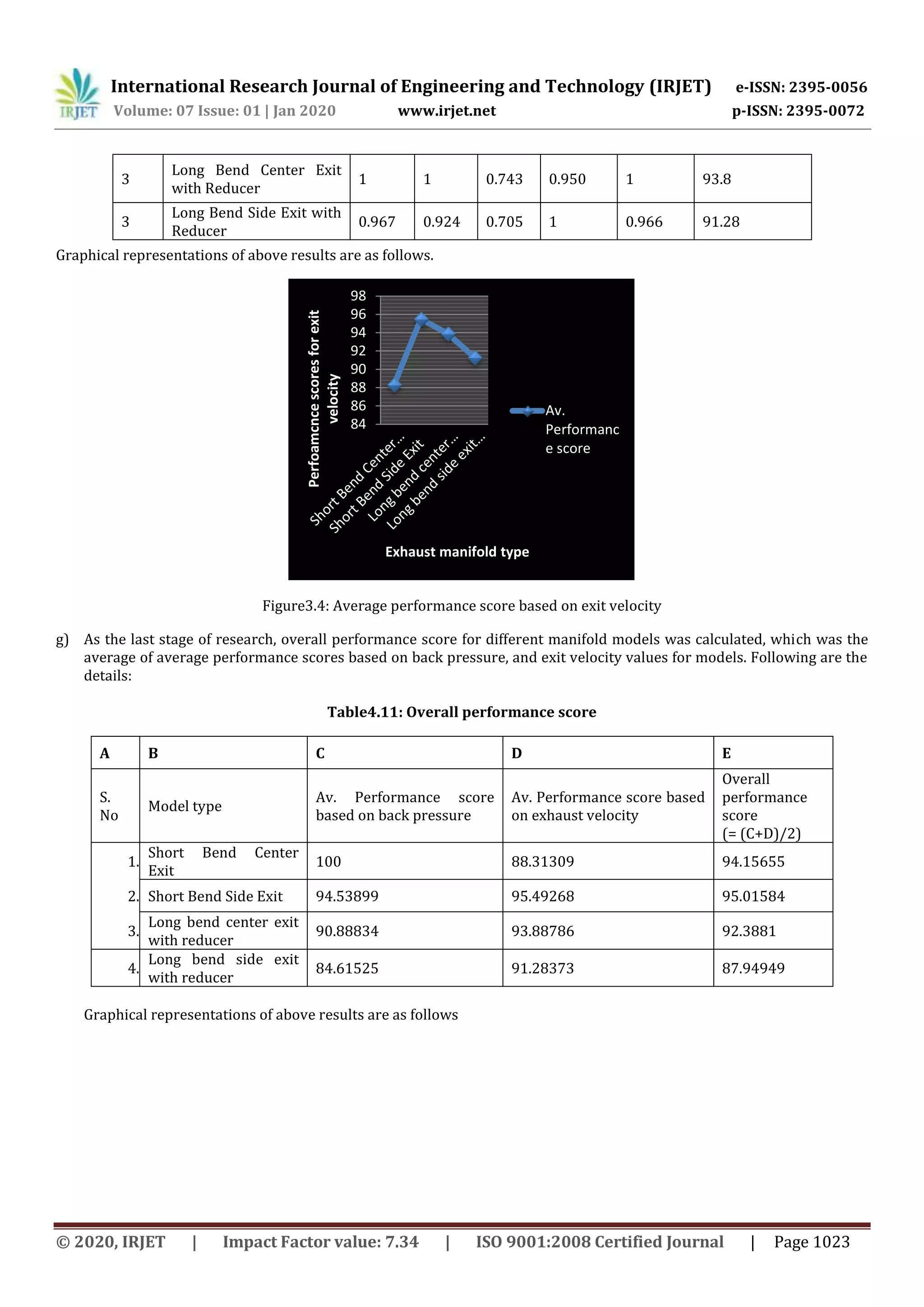
Table4.9: Performance scores for Back Pressure
Graphical representation of above analysis is as fallows
Figure 3.3: Average performance score based on Back Pressure
Table4.10: Performance scores for Exit Velocity
0
5
10
15
20
25
30
35
40
Exitvelocity(m/sec)
Exhaust Manifold type
5kg
10 kg
15kg
20kg
25 kg
75
80
85
90
95
100
105
Performancescoresfor
backpressure
Exhaust manifold type
Av.
Performance
score
S.
No
Type
Load applied Average
perform-ance
score
5kg 10 kg 15 kg 20 kg 25 kg
1
Short Bend Center
Exit
1 1 1 1 1 100
2 Short Bend Side Exit 0.911846 0.953180 0.953301 0.954041 0.954581 94.53899
3
Long bend center exit
with reducer
0.903549 0.909014 0.90937 0.910741 0.911743 90.88834
4
Long bend side exit
with reducer
0.831658 0.845611 0.854257 0.853296 0.84594 84.61525
S.
No
Type
Load applied Average
performance
score (Σ)
5kg 10 kg 15 kg 20 kg 25 kg
1 Short Bend Centre Exit 0.963 0.90 0.700 0.916 0.928 88.313
2 Short Bend Side Exit 0.990 0.913 1 0.931 0.938 95.492
International Research Journal of Engineering and Technology (IRJET) e-ISSN: 2395-0056
Volume: 07 Issue: 01 | Jan 2020 www.irjet.net p-ISSN: 2395-0072
© 2020, IRJET | Impact Factor value: 7.34 | ISO 9001:2008 Certified Journal | Page 1023
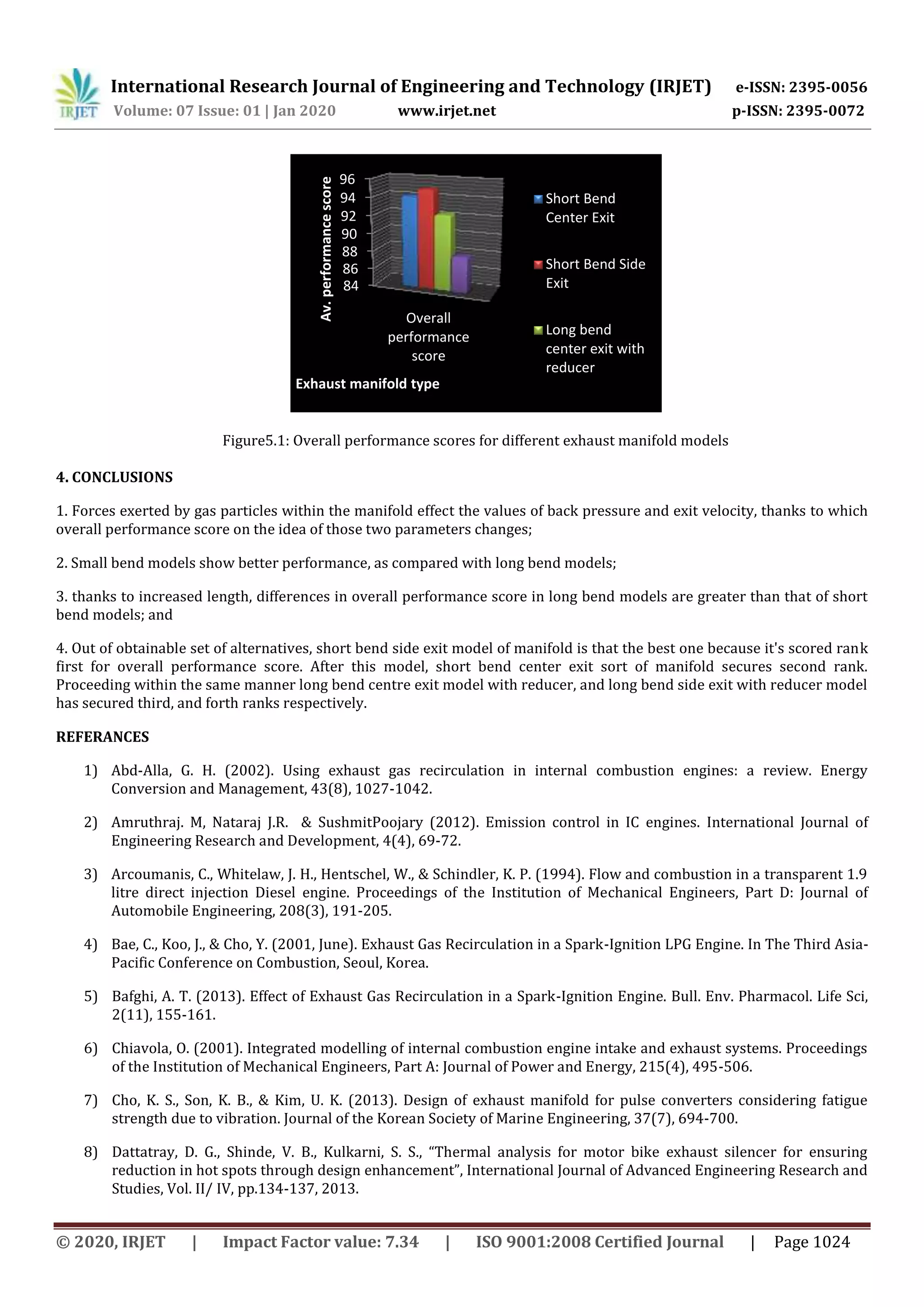
Graphical representations of above results are as follows.
Figure3.4: Average performance score based on exit velocity
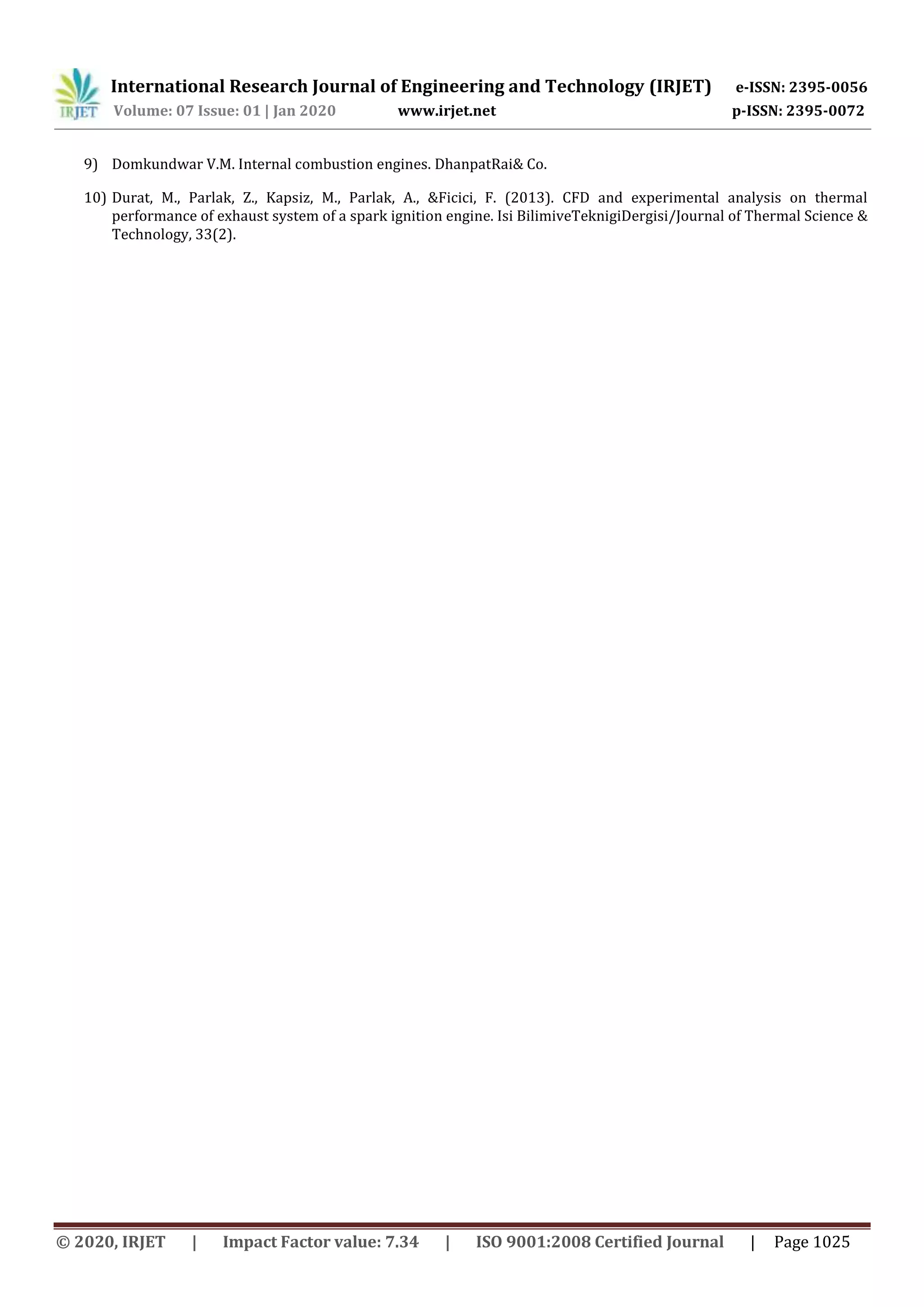
g) As the last stage of research, overall performance score for different manifold models was calculated, which was the
average of average performance scores based on back pressure, and exit velocity values for models. Following are the
details:
Table4.11: Overall performance score
A B C D E
S.
No
Model type
Av. Performance score
based on back pressure
Av. Performance score based
on exhaust velocity
Overall
performance
score
(= (C+D)/2)
1.
Short Bend Center
Exit
100 88.31309 94.15655
2. Short Bend Side Exit 94.53899 95.49268 95.01584
3.
Long bend center exit
with reducer
90.88834 93.88786 92.3881
4.
Long bend side exit
with reducer
84.61525 91.28373 87.94949
Graphical representations of above results are as follows
84
86
88
90
92
94
96
98
Perfoamcncescoresforexit
velocity
Exhaust manifold type
Av.
Performanc
e score
3
Long Bend Center Exit
with Reducer
1 1 0.743 0.950 1 93.8
3
Long Bend Side Exit with
Reducer
0.967 0.924 0.705 1 0.966 91.28
International Research Journal of Engineering and Technology (IRJET) e-ISSN: 2395-0056
Volume: 07 Issue: 01 | Jan 2020 www.irjet.net p-ISSN: 2395-0072
© 2020, IRJET | Impact Factor value: 7.34 | ISO 9001:2008 Certified Journal | Page 1024
Figure5.1: Overall performance scores for different exhaust manifold models
4. CONCLUSIONS
1. Forces exerted by gas particles within the manifold effect the values of back pressure and exit velocity, thanks to which
overall performance score on the idea of those two parameters changes;
2. Small bend models show better performance, as compared with long bend models;
3. thanks to increased length, differences in overall performance score in long bend models are greater than that of short
bend models; and
4. Out of obtainable set of alternatives, short bend side exit model of manifold is that the best one because it's scored rank
first for overall performance score. After this model, short bend center exit sort of manifold secures second rank.
Proceeding within the same manner long bend centre exit model with reducer, and long bend side exit with reducer model
has secured third, and forth ranks respectively.
REFERANCES
1) Abd-Alla, G. H. (2002). Using exhaust gas recirculation in internal combustion engines: a review. Energy
Conversion and Management, 43(8), 1027-1042.
2) Amruthraj. M, Nataraj J.R. & SushmitPoojary (2012). Emission control in IC engines. International Journal of
Engineering Research and Development, 4(4), 69-72.
3) Arcoumanis, C., Whitelaw, J. H., Hentschel, W., & Schindler, K. P. (1994). Flow and combustion in a transparent 1.9
litre direct injection Diesel engine. Proceedings of the Institution of Mechanical Engineers, Part D: Journal of
Automobile Engineering, 208(3), 191-205.
4) Bae, C., Koo, J., & Cho, Y. (2001, June). Exhaust Gas Recirculation in a Spark-Ignition LPG Engine. In The Third Asia-
Pacific Conference on Combustion, Seoul, Korea.
5) Bafghi, A. T. (2013). Effect of Exhaust Gas Recirculation in a Spark-Ignition Engine. Bull. Env. Pharmacol. Life Sci,
2(11), 155-161.
6) Chiavola, O. (2001). Integrated modelling of internal combustion engine intake and exhaust systems. Proceedings
of the Institution of Mechanical Engineers, Part A: Journal of Power and Energy, 215(4), 495-506.
7) Cho, K. S., Son, K. B., & Kim, U. K. (2013). Design of exhaust manifold for pulse converters considering fatigue
strength due to vibration. Journal of the Korean Society of Marine Engineering, 37(7), 694-700.
8) Dattatray, D. G., Shinde, V. B., Kulkarni, S. S., “Thermal analysis for motor bike exhaust silencer for ensuring
reduction in hot spots through design enhancement”, International Journal of Advanced Engineering Research and
Studies, Vol. II/ IV, pp.134-137, 2013.
84
86
88
90
92
94
96
Overall
performance
score
Av.performancescore
Exhaust manifold type
Short Bend
Center Exit
Short Bend Side
Exit
Long bend
center exit with
reducer
International Research Journal of Engineering and Technology (IRJET) e-ISSN: 2395-0056
Volume: 07 Issue: 01 | Jan 2020 www.irjet.net p-ISSN: 2395-0072
© 2020, IRJET | Impact Factor value: 7.34 | ISO 9001:2008 Certified Journal | Page 1025
9) Domkundwar V.M. Internal combustion engines. DhanpatRai& Co.
10) Durat, M., Parlak, Z., Kapsiz, M., Parlak, A., &Ficici, F. (2013). CFD and experimental analysis on thermal
performance of exhaust system of a spark ignition engine. Isi BilimiveTeknigiDergisi/Journal of Thermal Science &
Technology, 33(2).

IRJET- Modeling and Analysis of Field of Exhaust Manifold Design

  • 1.
    International Research Journalof Engineering and Technology (IRJET) e-ISSN: 2395-0056 Volume: 07 Issue: 01 | Jan 2020 www.irjet.net p-ISSN: 2395-0072 © 2020, IRJET | Impact Factor value: 7.34 | ISO 9001:2008 Certified Journal | Page 1018 MODELING AND ANALYSIS OF FIELD OF EXHAUST MANIFOLD DESIGN Usha Mandloi1, Purushottam Kumar Sahu2, Jagdish Saini3 1BM College of Technology RGPV Bhopal 2HOD Mechanical Engineering Department 3Professor, Dept. of Mechanical Engineering, BM College of Technology, Madhya Pradesh, India ---------------------------------------------------------------------***---------------------------------------------------------------------- Abstract - In the current century, spark ignition engines have become an isolated part of society, and are used in many fields of energy. They act as the backbone for transport systems, but, as a bitter truth they behave like a major source of air pollution. There are basically three types of emissions, one emerged from an SI engine; Exhaust emissions, evaporative emissions and crankcase emissions, and the major pollutants emitted from these engines are CO, CO2, SOX, NOx. The current work aims to reduce emissions. It is a well-established fact that smooth combustion reduces emissions, and the exhaust process greatly contributes to completing the smooth combustion process. In the present work, multiple designs of exhaust for a multi-cylinder spark ignition engine are optimized to reduce emissions, by evaluating back pressure. For this purpose, four different designs, such as, short bend center exit, short bend side exit, long bend center exit with reducer, and long bend side exit with reducer are considered, and their performance is evaluated separately. Loading conditions are performed. The resulting performance scores of various models are evaluated based on back pressure, and based on these scores; the overall performance score is examined. In the next step, different models are ranked based on the overall performance score. Key Words: Exhaust manifold, back pressure, exhaust velocity, CATIA v5, ANSYS workbench 1. INTRODUCTION Air pollution can be defined as an addition of any material which will deleterious effect on the life on the earth. The main pollutants contributed by IC engines are carbon monoxide, nitrogen oxides, unburned hydrocarbons, and other particulate emissions. In addition to this, different fuels used in engines also emit carbon dioxide in large quantities, which is more concerned to greenhouse effect. A renounced meteorologist recently predicted that polluted air can put an end to life on the earth within a century. This, in turn, will reduce the emissions of carbon dioxide. A viable alternative to IC engines or alternative fuels is not likely to be available within the next few decades. Therefore, all efforts should be made to develop better engines, and methods to reduce the pollution from IC engines. 1.1 THEORETICAL CONSIDERATIONS In an internal combustion (IC) engine, combustion of fuel takes place inside the engine cylinder in the presence of oxygen (present in air), and a large amount of mechanical energy is obtained. For the purpose of combustion, either petrol is used along with air in case of spark ignition engines, or compressed air is used and diesel is sprayed in diesel engines. This process generates tremendous mechanical energy. Inside the engine cylinder, the piston power is transmitted to a shaft known as crank shaft, which converts reciprocating motion of the piston into rotary motion. Today's IC engines can be classified in many ways. Internal combustion (IC) engine rankings in some of the following methods: 1. Based on request a) Automobile engine; b) Aircraft engines; c) Locomotive Engine; d) Marine engines; and e) Stationary engines. 2. Based on the basic engine design a) Single cylinder engine, b) Multi-cylinder line engine, c) V-engine, d) Radial engine, e) Opposed piston opposed cylinder engine, and f) Rotatory engine. 3. Based on Operating Cycle a) Atkinson (full extension SI engine); b) Diesel (e.g. diesel engine); c) Dual (original diesel engine); d) Miller (early / late inlet valve closing type SI engine); and
  • 2.
    International Research Journalof Engineering and Technology (IRJET) e-ISSN: 2395-0056 Volume: 07 Issue: 01 | Jan 2020 www.irjet.net p-ISSN: 2395-0072 © 2020, IRJET | Impact Factor value: 7.34 | ISO 9001:2008 Certified Journal | Page 1019 e) Otto (Convectional for SI engine). 4. On the basis of the working cycle a) Four stroke cycle; b) Two-stroke cycle; c) Clean, straight / crankcase / cross-flow, back flow / loop, uniform flow; and d) Naturally Aspirated or Turbocharged. 5. Based on the valve / port design a) Poppet valve; and b) Rotatory Valve. 6. Based on location Valve / port c) Head T- type; d) Head L- type; e) France head 7. Based on fuels used a) Convectional b) Oil derivatives, petrol, diesel c) Other sources, coal, standing biomass, tar, rock d) Substitute e) Petroleum derivatives CNG, LPG f) Biomass derived: alcohol, vegetable oil, producer gas, biogas and hydrogen g)Blending h)Two fuel and dual-fuel 8. Based on Composition Preparation a) Carburetion; and b) Fuel Injection. 9. Based on ignition type a) Spark ignition (SI); and b) Compression ignition (CI). 2. LITERATURE REVIEW Present chapter tells about the opinions of different researchers on pollutants form SI engines, and exhaust manifold designs, and finds the gaps found during the survey of literature, which constitute the objectives of the research, and concludes with the summary. 2.1 REVIEWS OF RELATED LITERATURE A summary of literature based on different approaches adopted by researchers in the field of exhaust manifold design is present as follows: 1. Arcoumanis C (1994) The researcher adopted a modelling approach for investigating flow distribution in exhaust manifold by modifying inlet and exhaust manifolds. Research also conducted experimentations for investigating the emission conditions for the engine. 2. Ahmed and Gowreesh (2015) This research work consists of application of different CFD techniques to identify the optimum exhaust manifold for a 4-cylinder, 4-stroke petrol engine. In the research work, five variants of header based on manifold pipe geometry, namely, convergent inlet pipe, reduced convergent length, divergent-straight-convergent, reduced, divergent length, and enhanced convergent length, ideal divergent and convergent, and reduced straight length, are considered. The simulations were carried out with the help of simulation and analysis software ANSYS FLUENT using unstructured meshes. In the research work, boundary condition used was mass flow inlet. On the basis of results obtained, researchers reported that the minimum back- pressure at the exhaust manifold outlet can be achieved with the help of reducers. 3. Amruthraj, et al. (2012) In the present work, researchers have studied the exhaust when a additive (brown gas) is mixed with air and petrol in 4 stroke SI engine. Results of the analysis show that with this combination, percentage of hydrocarbon emissions has reduced by 99.92%, and CO emissions are reduced by 98.668%. 4. Bafghi (2013) In his research work, researcher analyzed the effect of exhaust gas to air manifold on NOX on different loads, the smoke temperature at exhaust, bsfc, vol. efficiency, and changes in thermal efficiency. Results of this research show that on increasing the exhaust temperature to the manifold, volumetric and thermal efficiency of the engine decreases. 5. Chi et al.(2012) In this research work, performance of a single cylinder SI engine was estimated using 1-dimensional, GT-Power software. The virtually obtained power output, was then,
  • 3.
    International Research Journalof Engineering and Technology (IRJET) e-ISSN: 2395-0056 Volume: 07 Issue: 01 | Jan 2020 www.irjet.net p-ISSN: 2395-0072 © 2020, IRJET | Impact Factor value: 7.34 | ISO 9001:2008 Certified Journal | Page 1020 compared against the experimental data. During the research work the considered parameters were the intake runner diameter, the position of restrictor, the exhaust runner lengths, and the sphere plenum diameter. For designing the plenum for both the manifolds Helmholtz theory was applied, and the optimization experimental study was conducted with the help of Orthogonal Array Testing Strategy (OATS). The results obtained from the experimental analysis show satisfactory level of similarity with results of GT-Power software predictions. 6. Chiavolaet al. (2001) The researchers carried out the study of flow behaviour on intake and exhaust systems of an IC engine, and found that the phenomena of flow in ducts closely affects the volumetric efficiency of the engine. 7. Cho et al. (2013) The researcher designs the exhaust manifold for a 4s- SI engine, to run at 700 – 1500 RPM, and with power output up to 600 kilowatts. In the research work, thermal expansion analysis, and vibration analysis of the exhaust manifold was carried out. 8. Choongsik and Junemo (2001) The researchers performed the research to analyze the effect of exhaust gas re-circulation on combustion characteristics of a petrol engine. 9. Dattatrayet al. (2013) The researchers focused on thermal analysis of exhaust system for a motor bike silencer for the purpose of reducing hot spot through design improvement, and suggest for improving life of the device. During the research, they used a customized power coating for making mufflers used in automotive applications. As a result they analyzed that modified design offers reduced hot spots. 10. Dattuet al. (2014) In this research work, researchers carried out thermal analysis for the exhaust manifold of tubular type, for various operating conditions. In the research work, researchers considered four different types, namely, radius 48 mm exhaust valve at extremely left, radius 48 m exhaust valve at center, radius 100 mm exhaust valve at the extremely left, and radius 100 mm exhaust valve at the center. The materials used for this purpose were cast iron, and aluminium. On the basis of results obtained, researchers suggested that as a material aluminium shows better thermal performance as compared to cast iron, and the exhaust manifold with 48 mm radius with exhaust valve at the center, shows superior thermal properties as compared to the other options. 11. Duratet al. (2014) The researchers carried out both computational fluid dynamics and experimental analysis for investigating thermal performance of exhaust system for a SI engine. For this purpose, an experimental study was conducted to analyze the behaviour of gas flowing in exhaust pipe. The result shows satisfactory values. 12. Ghazikhaniet al. (2014) The researchers focused on exergy recovery for a diesel engine of direct injection type. In the research work investigations were performed for turbocharged diesel engines for different RPM and torque values. For this purpose, a double pipe heat exchanger with reversed flow conditions was used. The research shows that by increasing load and engine speed the recovered exergy of the system increases, while the bsfc reduces by approximately 10%. 2.2 GAPS IS THE LITERATURE On the basis of above mentioned literature survey, following gaps are being identified: There is a limited research available considering different geometries of exhaust manifold; there is a limited research conducted for analyzing pressure and velocity changes happening in the header and their effect on exhaust emission; and Comparative study of different geometries of exhaust manifold for reducing exhaust emission problem. Based on the gaps noticed in literature, objectives for the present research work are targeted. 3. DESIGNING, MODELING AND ANALYSIS OF EXHAUST MANIFOLD MODEL FORMULATION In present research work CFD analysis of exhaust manifold of multi-cylinder SI engine is accomplished for determining optimal geometry for the purpose of reducing the emissions. For this purpose four manifolds chosen from the research work of Umeshet al. (2013) are compared at comparatively higher load values as compared with the research work of the previous researchers. Following are the physical details of models adopted for research.
  • 4.
    International Research Journalof Engineering and Technology (IRJET) e-ISSN: 2395-0056 Volume: 07 Issue: 01 | Jan 2020 www.irjet.net p-ISSN: 2395-0072 © 2020, IRJET | Impact Factor value: 7.34 | ISO 9001:2008 Certified Journal | Page 1021 Table 3.1: Values of back pressures for different models S. N o Type Load applied 5kg 10 kg 15 kg 20 kg 25 kg 1 Short Bend Center Exit 993 1079 1184 1204 1219 2 Short Bend Side Exit 1089 1132 1242 1262 1277 3 Long bend center exit with reducer 1099 1187 1302 1322 1337 4 Long bend side exit with reducer 1194 1276 1386 1411 1441 Graphical representation of above analysis is as follows. Figure3.1: Values of back pressures for different models a) In next stage, exit velocities for different models in different loading conditions were calculated (please refer figure 5.3 to figure 5.6). Following are the results. Table4.8: Values of exit velocities for different models Graphical representation of above analysis is as follows. 0 200 400 600 800 1000 1200 1400 1600 Short Bend Center Exit Short Bend Side Exit Long Bend Center Exit Long Bend Side Exit Backpressure(Pa) Exhaust manifold type 5kg 10 kg 15 kg 20 kg 25 kg S.No Type Load applied 5kg 10 kg 15kg 20kg 25 kg 1 Short Bend Center Exit 18.41 21.45 24.39 27.43 30.37 2 Short Bend Side Exit 18.92 21.60 34.82 27.90 30.72 3 Long bend center exit with reducer 19.10 23.65 25.90 28.46 32.72 4 Long bend side exit with reducer 18.48 21.86 24.56 29.94 31.64
  • 5.
    International Research Journalof Engineering and Technology (IRJET) e-ISSN: 2395-0056 Volume: 07 Issue: 01 | Jan 2020 www.irjet.net p-ISSN: 2395-0072 © 2020, IRJET | Impact Factor value: 7.34 | ISO 9001:2008 Certified Journal | Page 1022 Figure 3.2: Values of Exit velocity for different models Table4.9: Performance scores for Back Pressure Graphical representation of above analysis is as fallows Figure 3.3: Average performance score based on Back Pressure Table4.10: Performance scores for Exit Velocity 0 5 10 15 20 25 30 35 40 Exitvelocity(m/sec) Exhaust Manifold type 5kg 10 kg 15kg 20kg 25 kg 75 80 85 90 95 100 105 Performancescoresfor backpressure Exhaust manifold type Av. Performance score S. No Type Load applied Average perform-ance score 5kg 10 kg 15 kg 20 kg 25 kg 1 Short Bend Center Exit 1 1 1 1 1 100 2 Short Bend Side Exit 0.911846 0.953180 0.953301 0.954041 0.954581 94.53899 3 Long bend center exit with reducer 0.903549 0.909014 0.90937 0.910741 0.911743 90.88834 4 Long bend side exit with reducer 0.831658 0.845611 0.854257 0.853296 0.84594 84.61525 S. No Type Load applied Average performance score (Σ) 5kg 10 kg 15 kg 20 kg 25 kg 1 Short Bend Centre Exit 0.963 0.90 0.700 0.916 0.928 88.313 2 Short Bend Side Exit 0.990 0.913 1 0.931 0.938 95.492
  • 6.
    International Research Journalof Engineering and Technology (IRJET) e-ISSN: 2395-0056 Volume: 07 Issue: 01 | Jan 2020 www.irjet.net p-ISSN: 2395-0072 © 2020, IRJET | Impact Factor value: 7.34 | ISO 9001:2008 Certified Journal | Page 1023 Graphical representations of above results are as follows. Figure3.4: Average performance score based on exit velocity g) As the last stage of research, overall performance score for different manifold models was calculated, which was the average of average performance scores based on back pressure, and exit velocity values for models. Following are the details: Table4.11: Overall performance score A B C D E S. No Model type Av. Performance score based on back pressure Av. Performance score based on exhaust velocity Overall performance score (= (C+D)/2) 1. Short Bend Center Exit 100 88.31309 94.15655 2. Short Bend Side Exit 94.53899 95.49268 95.01584 3. Long bend center exit with reducer 90.88834 93.88786 92.3881 4. Long bend side exit with reducer 84.61525 91.28373 87.94949 Graphical representations of above results are as follows 84 86 88 90 92 94 96 98 Perfoamcncescoresforexit velocity Exhaust manifold type Av. Performanc e score 3 Long Bend Center Exit with Reducer 1 1 0.743 0.950 1 93.8 3 Long Bend Side Exit with Reducer 0.967 0.924 0.705 1 0.966 91.28
  • 7.
    International Research Journalof Engineering and Technology (IRJET) e-ISSN: 2395-0056 Volume: 07 Issue: 01 | Jan 2020 www.irjet.net p-ISSN: 2395-0072 © 2020, IRJET | Impact Factor value: 7.34 | ISO 9001:2008 Certified Journal | Page 1024 Figure5.1: Overall performance scores for different exhaust manifold models 4. CONCLUSIONS 1. Forces exerted by gas particles within the manifold effect the values of back pressure and exit velocity, thanks to which overall performance score on the idea of those two parameters changes; 2. Small bend models show better performance, as compared with long bend models; 3. thanks to increased length, differences in overall performance score in long bend models are greater than that of short bend models; and 4. Out of obtainable set of alternatives, short bend side exit model of manifold is that the best one because it's scored rank first for overall performance score. After this model, short bend center exit sort of manifold secures second rank. Proceeding within the same manner long bend centre exit model with reducer, and long bend side exit with reducer model has secured third, and forth ranks respectively. REFERANCES 1) Abd-Alla, G. H. (2002). Using exhaust gas recirculation in internal combustion engines: a review. Energy Conversion and Management, 43(8), 1027-1042. 2) Amruthraj. M, Nataraj J.R. & SushmitPoojary (2012). Emission control in IC engines. International Journal of Engineering Research and Development, 4(4), 69-72. 3) Arcoumanis, C., Whitelaw, J. H., Hentschel, W., & Schindler, K. P. (1994). Flow and combustion in a transparent 1.9 litre direct injection Diesel engine. Proceedings of the Institution of Mechanical Engineers, Part D: Journal of Automobile Engineering, 208(3), 191-205. 4) Bae, C., Koo, J., & Cho, Y. (2001, June). Exhaust Gas Recirculation in a Spark-Ignition LPG Engine. In The Third Asia- Pacific Conference on Combustion, Seoul, Korea. 5) Bafghi, A. T. (2013). Effect of Exhaust Gas Recirculation in a Spark-Ignition Engine. Bull. Env. Pharmacol. Life Sci, 2(11), 155-161. 6) Chiavola, O. (2001). Integrated modelling of internal combustion engine intake and exhaust systems. Proceedings of the Institution of Mechanical Engineers, Part A: Journal of Power and Energy, 215(4), 495-506. 7) Cho, K. S., Son, K. B., & Kim, U. K. (2013). Design of exhaust manifold for pulse converters considering fatigue strength due to vibration. Journal of the Korean Society of Marine Engineering, 37(7), 694-700. 8) Dattatray, D. G., Shinde, V. B., Kulkarni, S. S., “Thermal analysis for motor bike exhaust silencer for ensuring reduction in hot spots through design enhancement”, International Journal of Advanced Engineering Research and Studies, Vol. II/ IV, pp.134-137, 2013. 84 86 88 90 92 94 96 Overall performance score Av.performancescore Exhaust manifold type Short Bend Center Exit Short Bend Side Exit Long bend center exit with reducer
  • 8.
    International Research Journalof Engineering and Technology (IRJET) e-ISSN: 2395-0056 Volume: 07 Issue: 01 | Jan 2020 www.irjet.net p-ISSN: 2395-0072 © 2020, IRJET | Impact Factor value: 7.34 | ISO 9001:2008 Certified Journal | Page 1025 9) Domkundwar V.M. Internal combustion engines. DhanpatRai& Co. 10) Durat, M., Parlak, Z., Kapsiz, M., Parlak, A., &Ficici, F. (2013). CFD and experimental analysis on thermal performance of exhaust system of a spark ignition engine. Isi BilimiveTeknigiDergisi/Journal of Thermal Science & Technology, 33(2).