International Research Journal of Engineering and Technology (IRJET) e-ISSN: 2395-0056
Volume: 06 Issue: 04 | Apr 2019 www.irjet.net p-ISSN: 2395-0072
© 2019, IRJET | Impact Factor value: 7.211 | ISO 9001:2008 Certified Journal | Page 2716
Landmines detection using UAV
Aashish Raj1, Ibraze Rafiq2, Abhishek Gowda J3, Lakshmisha S Krishna4
1,2,3Student, Department of ECE, Alpha College of Engineering, Karnataka, India
4HOD, Department of ECE, Alpha College of Engineering, Karnataka, India
----------------------------------------------------------------------***---------------------------------------------------------------------
Abstract - The purpose of this project is to apply the
concept of swarm robotics in defence field. Swarm robotics
is the technique where multiple robots are operating
parallel in a synchronous manner to attain a common
objective. The idea here is to divide the overall operations
into landmine detection, mapping and defusing. In this
project we are using pure concept of swarm robotics with
help of autobots. Which are able to carry out the given task,
with the help of other bots. As per the concept of auto-bot
here we are using a UAV (drones), which is able to sense the
landmines in the warzones. Due to the concept of swarm
robotics in the defence, it not only reduces the cost of the
labor work, but also saves the lives of the militants by
eliminating the trial and error methods.
Key Words: Swarm Robotics, Landmine Detection,
Autobot, UAV, Defence.
1. INTRODUCTION
An Unmanned Aerial Vehicle (UAV), commonly known as
a drone, as an unmanned aircraft system (UAS), and also
referred by several other names, is an aircraft without a
human pilot aboard. The flight of UAVs may be controlled
with various kinds of autonomy: either by a given degree
of remote control from an operator, located on the ground
or in another vehicle, or fully autonomously, by onboard
computers. UAVs are often preferred for missions that are
too dangerous for manned aircraft. They have been and
are mostly found in military and special operation
applications, though UAVs are increasingly finding uses in
civil and recreational applications, such as policing and
surveillance, aerial filming, and drone racing.
All these processes will be taken care by dedicated robots
which will work synchronously but sequentially towards
the common task of detecting and defusing. This idea finds
a very demanding application in the field of defence. The
robots can also be made to work independently for
various levels in defence field. The work here is divided
into three categories landmines detection, mapping and
defusing which will be implemented using the principle of
electromagnetic induction for the detection of landmines,
high resolution 360º camera for mapping out the positions
of the detected landmines. The idea of this project is to
reduce the cost, human interference, power requirement
but increases the efficiency and also provides safety of the
militants.
2. LITERATURE SURVEY
There are many countries affected by landmines which
present a major threat to lives and cause economic
problems. Landmines are harmful because of their
unknown positions and often difficult to detect. Detection
of buried antipersonnel landmines (APL) is a demanding
task in which one tries to obtain information about
characteristics of the soil and of objects buried in it. The
development of new demining technologies is difficult
because of the tremendous diversity of terrains and
environmental conditions in which mines are laid and also
because of the wide variety of landmines. Currently,
detecting and clearing mines demand specific expertise
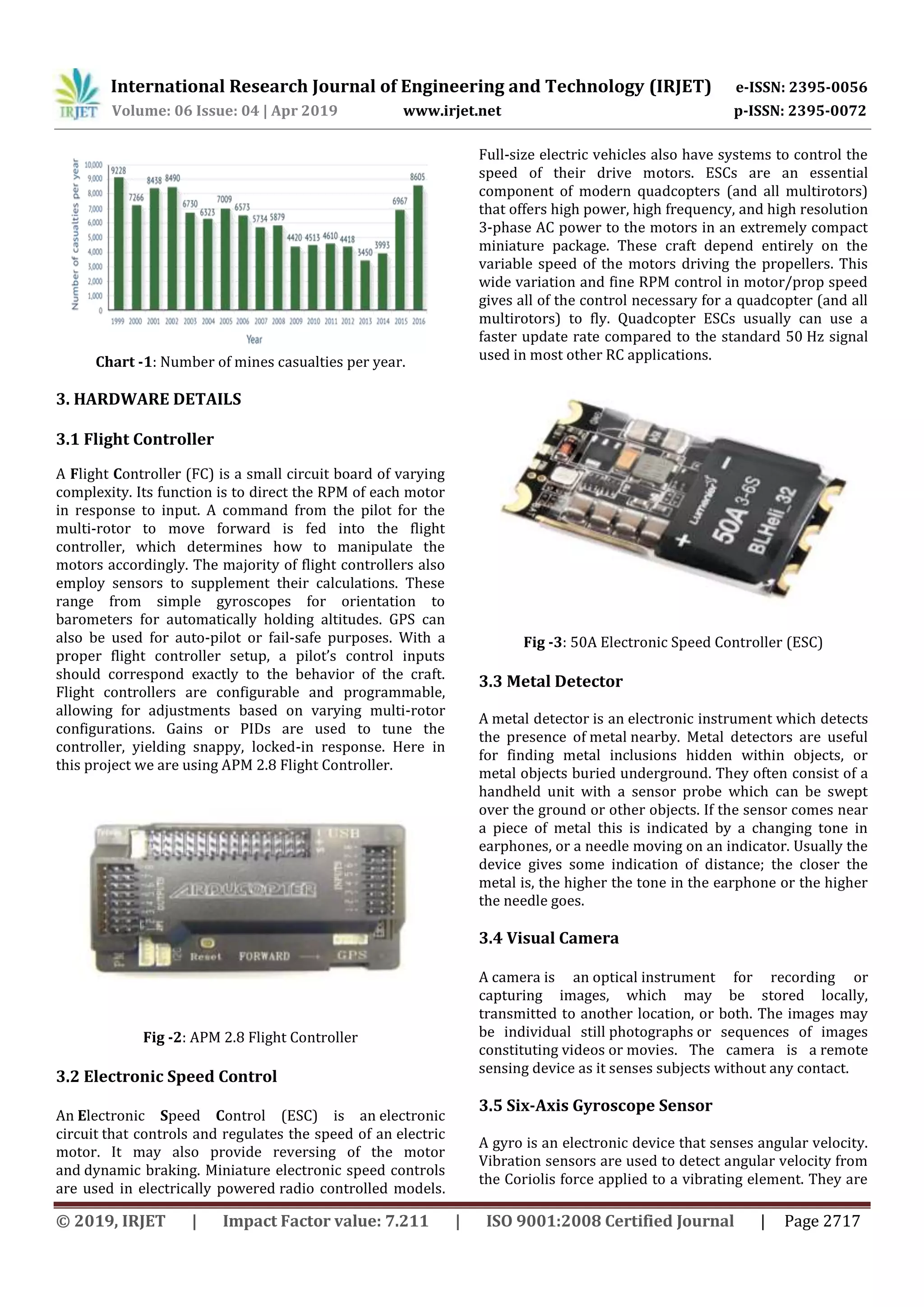
with special equipments. According to a survey report of
2016 there were at least 1,554 child casualties recorded
which was 42% of the total civilian casualties [5].
Therefore there is an urgent need for new and improved
methods to be developed, particularly in view of the threat
that abandoned landmines pose to civilian populations.
Fig -1: Block Diagram of UAV
International Research Journal of Engineering and Technology (IRJET) e-ISSN: 2395-0056
Volume: 06 Issue: 04 | Apr 2019 www.irjet.net p-ISSN: 2395-0072
© 2019, IRJET | Impact Factor value: 7.211 | ISO 9001:2008 Certified Journal | Page 2717
Chart -1: Number of mines casualties per year.
3. HARDWARE DETAILS
3.1 Flight Controller
A Flight Controller (FC) is a small circuit board of varying
complexity. Its function is to direct the RPM of each motor
in response to input. A command from the pilot for the
multi-rotor to move forward is fed into the flight
controller, which determines how to manipulate the
motors accordingly. The majority of flight controllers also
employ sensors to supplement their calculations. These
range from simple gyroscopes for orientation to
barometers for automatically holding altitudes. GPS can
also be used for auto-pilot or fail-safe purposes. With a
proper flight controller setup, a pilot’s control inputs
should correspond exactly to the behavior of the craft.
Flight controllers are configurable and programmable,
allowing for adjustments based on varying multi-rotor
configurations. Gains or PIDs are used to tune the
controller, yielding snappy, locked-in response. Here in
this project we are using APM 2.8 Flight Controller.
Fig -2: APM 2.8 Flight Controller
3.2 Electronic Speed Control
An Electronic Speed Control (ESC) is an electronic
circuit that controls and regulates the speed of an electric
motor. It may also provide reversing of the motor
and dynamic braking. Miniature electronic speed controls
are used in electrically powered radio controlled models.
Full-size electric vehicles also have systems to control the
speed of their drive motors. ESCs are an essential
component of modern quadcopters (and all multirotors)
that offers high power, high frequency, and high resolution
3-phase AC power to the motors in an extremely compact
miniature package. These craft depend entirely on the
variable speed of the motors driving the propellers. This
wide variation and fine RPM control in motor/prop speed
gives all of the control necessary for a quadcopter (and all
multirotors) to fly. Quadcopter ESCs usually can use a
faster update rate compared to the standard 50 Hz signal
used in most other RC applications.
Fig -3: 50A Electronic Speed Controller (ESC)
3.3 Metal Detector
A metal detector is an electronic instrument which detects
the presence of metal nearby. Metal detectors are useful
for finding metal inclusions hidden within objects, or
metal objects buried underground. They often consist of a
handheld unit with a sensor probe which can be swept
over the ground or other objects. If the sensor comes near
a piece of metal this is indicated by a changing tone in
earphones, or a needle moving on an indicator. Usually the
device gives some indication of distance; the closer the
metal is, the higher the tone in the earphone or the higher
the needle goes.
3.4 Visual Camera
A camera is an optical instrument for recording or
capturing images, which may be stored locally,
transmitted to another location, or both. The images may
be individual still photographs or sequences of images
constituting videos or movies. The camera is a remote
sensing device as it senses subjects without any contact.
3.5 Six-Axis Gyroscope Sensor
A gyro is an electronic device that senses angular velocity.
Vibration sensors are used to detect angular velocity from
the Coriolis force applied to a vibrating element. They are
International Research Journal of Engineering and Technology (IRJET) e-ISSN: 2395-0056
Volume: 06 Issue: 04 | Apr 2019 www.irjet.net p-ISSN: 2395-0072
© 2019, IRJET | Impact Factor value: 7.211 | ISO 9001:2008 Certified Journal | Page 2718
also known as angular velocity sensors or rate
sensors. These sensors provide stability and direction by
sensing motion caused by vibrations. There are many
applications of gyro sensors. In navigation systems, it can
be used to sense angular velocity produced by the sensor’s
movements. These angles are detected through an
integration operation by a CPU. An example of 6-axis
gyroscope is GY 521 MPU 6050.
Fig -4: GY-521 MPU 6050
3.6 Microcontroller
A microcontroller is a compact integrated circuit designed
to govern a specific operation in an embedded system. A
typical microcontroller includes a processor, memory and
input/output (I/O) peripherals on a single chip.
Sometimes referred to as an embedded controller or
microcontroller unit (MCU), microcontrollers are found in
vehicles, robots, office machines, medical devices, mobile
radio transceivers, vending machines and home
appliances among other devices. A microcontroller's
processor will vary by application. Options range from the
simple 4-bit, 8-bit or 16-bit processors to more complex
32-bit or 64-bit processors. In terms of memory,
microcontrollers can use random access memory
(RAM), flash memory, EPROM or EEPROM. Generally,
microcontrollers are designed to be readily usable without
additional computing components because they are
designed with sufficient onboard memory as well as
offering pins for general I/O operations, so they can
directly interface with sensors and other components.
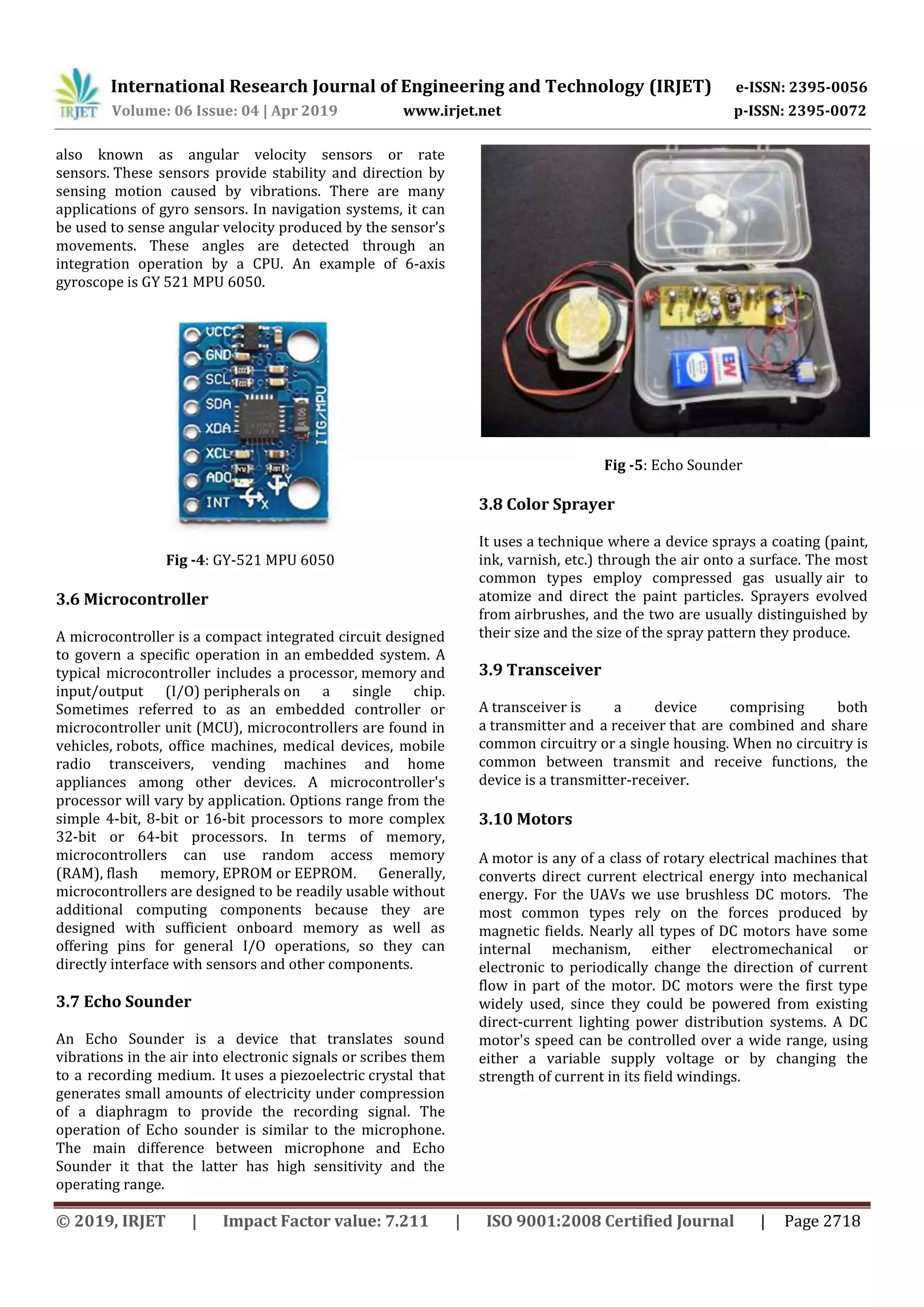
3.7 Echo Sounder
An Echo Sounder is a device that translates sound
vibrations in the air into electronic signals or scribes them
to a recording medium. It uses a piezoelectric crystal that
generates small amounts of electricity under compression
of a diaphragm to provide the recording signal. The
operation of Echo sounder is similar to the microphone.
The main difference between microphone and Echo
Sounder it that the latter has high sensitivity and the
operating range.
Fig -5: Echo Sounder
3.8 Color Sprayer
It uses a technique where a device sprays a coating (paint,
ink, varnish, etc.) through the air onto a surface. The most
common types employ compressed gas usually air to
atomize and direct the paint particles. Sprayers evolved
from airbrushes, and the two are usually distinguished by
their size and the size of the spray pattern they produce.
3.9 Transceiver
A transceiver is a device comprising both
a transmitter and a receiver that are combined and share
common circuitry or a single housing. When no circuitry is
common between transmit and receive functions, the
device is a transmitter-receiver.
3.10 Motors
A motor is any of a class of rotary electrical machines that
converts direct current electrical energy into mechanical
energy. For the UAVs we use brushless DC motors. The
most common types rely on the forces produced by
magnetic fields. Nearly all types of DC motors have some
internal mechanism, either electromechanical or
electronic to periodically change the direction of current
flow in part of the motor. DC motors were the first type
widely used, since they could be powered from existing
direct-current lighting power distribution systems. A DC
motor's speed can be controlled over a wide range, using
either a variable supply voltage or by changing the
strength of current in its field windings.
International Research Journal of Engineering and Technology (IRJET) e-ISSN: 2395-0056
Volume: 06 Issue: 04 | Apr 2019 www.irjet.net p-ISSN: 2395-0072
© 2019, IRJET | Impact Factor value: 7.211 | ISO 9001:2008 Certified Journal | Page 2719
Fig -6: Brushless DC Motor
4. MERITS AND DEMERITS
Merits of the system are: Automatic detection of
landmines are possible, Mapping of landmines, It avoids
manual operation, It is safe and less risky, It eliminates
trial and error method, Can also be used for defusing
landmines.
Demerits of the system are: Require specialize pilot for the
operation, Fly time is less (varies on the capacity of the
battery), comparatively costlier than present devices used
for detecting landmines/metals.
5. RESULT
The developed system eliminates the risk of life threats to
militants and reduces the traditional trial and error
method of detection of the landmines. It also provides
greater range and increases the efficiency of defusing
landmines. With the help of swarm robotics the task of
detection, mapping and diffusing becomes easier.
5. CONCLUSION AND FUTURE ENHANCEMENT
It can be concluded that, by using this system the detection
and mapping of landmines can be implemented and
carried out efficiently and in a much safer way.
The range and the detection can be more specific and
accurate by using high performance/military grade
sensors. With the help of swarm robotics the diffusion of
landmines can be done. The operating range of this device
can further be improved.
6. REFERENCES
[1] R. K. Megalingam, V. Gontu, R. Chanda, P. K. Yadav and
A. P. Kumar, "Landmine detection and reporting using
light weight zumo bot," 2017 International Conference
on Inventive Computing and Informatics (ICICI),
Coimbatore, 2017,pp.618-622.
doi: 10.1109/ICICI.2017.8365207
[2] R. K. Megalingam, D. Nagalla, P. R. Kiran, R. T. Geesala
and K. Nigam, "Swarm based autonomous landmine
detecting robots," 2017 International Conference on
Inventive Computing and Informatics (ICICI),
Coimbatore, 2017,pp.608-612.
doi: 10.1109/ICICI.2017.8365205
[3] V. Abilash and J. P. C. Kumar, "Ardunio controlled
landmine detection robot," 2017 Third International
Conference on Science Technology Engineering &
Management (ICONSTEM), Chennai, 2017, pp. 1077-
1082.
doi: 10.1109/ICONSTEM.2017.8261366
[4] Land mines (From Wikipedia)
[5] www.the-monitor.org – Landmine Monitor 2017
[6] DETECTION OF LAND MINES By Shri Prabhakar,
Defence Science Organisation, Ministry of Defence,
New Delhi. Defence Science Journal, Vol. 4, No. 1,
January 1954, pp.36-37 © 1954. DESIDOC.

IRJET- Landmines Detection using UAV

  • 1.
    International Research Journalof Engineering and Technology (IRJET) e-ISSN: 2395-0056 Volume: 06 Issue: 04 | Apr 2019 www.irjet.net p-ISSN: 2395-0072 © 2019, IRJET | Impact Factor value: 7.211 | ISO 9001:2008 Certified Journal | Page 2716 Landmines detection using UAV Aashish Raj1, Ibraze Rafiq2, Abhishek Gowda J3, Lakshmisha S Krishna4 1,2,3Student, Department of ECE, Alpha College of Engineering, Karnataka, India 4HOD, Department of ECE, Alpha College of Engineering, Karnataka, India ----------------------------------------------------------------------***--------------------------------------------------------------------- Abstract - The purpose of this project is to apply the concept of swarm robotics in defence field. Swarm robotics is the technique where multiple robots are operating parallel in a synchronous manner to attain a common objective. The idea here is to divide the overall operations into landmine detection, mapping and defusing. In this project we are using pure concept of swarm robotics with help of autobots. Which are able to carry out the given task, with the help of other bots. As per the concept of auto-bot here we are using a UAV (drones), which is able to sense the landmines in the warzones. Due to the concept of swarm robotics in the defence, it not only reduces the cost of the labor work, but also saves the lives of the militants by eliminating the trial and error methods. Key Words: Swarm Robotics, Landmine Detection, Autobot, UAV, Defence. 1. INTRODUCTION An Unmanned Aerial Vehicle (UAV), commonly known as a drone, as an unmanned aircraft system (UAS), and also referred by several other names, is an aircraft without a human pilot aboard. The flight of UAVs may be controlled with various kinds of autonomy: either by a given degree of remote control from an operator, located on the ground or in another vehicle, or fully autonomously, by onboard computers. UAVs are often preferred for missions that are too dangerous for manned aircraft. They have been and are mostly found in military and special operation applications, though UAVs are increasingly finding uses in civil and recreational applications, such as policing and surveillance, aerial filming, and drone racing. All these processes will be taken care by dedicated robots which will work synchronously but sequentially towards the common task of detecting and defusing. This idea finds a very demanding application in the field of defence. The robots can also be made to work independently for various levels in defence field. The work here is divided into three categories landmines detection, mapping and defusing which will be implemented using the principle of electromagnetic induction for the detection of landmines, high resolution 360º camera for mapping out the positions of the detected landmines. The idea of this project is to reduce the cost, human interference, power requirement but increases the efficiency and also provides safety of the militants. 2. LITERATURE SURVEY There are many countries affected by landmines which present a major threat to lives and cause economic problems. Landmines are harmful because of their unknown positions and often difficult to detect. Detection of buried antipersonnel landmines (APL) is a demanding task in which one tries to obtain information about characteristics of the soil and of objects buried in it. The development of new demining technologies is difficult because of the tremendous diversity of terrains and environmental conditions in which mines are laid and also because of the wide variety of landmines. Currently, detecting and clearing mines demand specific expertise with special equipments. According to a survey report of 2016 there were at least 1,554 child casualties recorded which was 42% of the total civilian casualties [5]. Therefore there is an urgent need for new and improved methods to be developed, particularly in view of the threat that abandoned landmines pose to civilian populations. Fig -1: Block Diagram of UAV
  • 2.
    International Research Journalof Engineering and Technology (IRJET) e-ISSN: 2395-0056 Volume: 06 Issue: 04 | Apr 2019 www.irjet.net p-ISSN: 2395-0072 © 2019, IRJET | Impact Factor value: 7.211 | ISO 9001:2008 Certified Journal | Page 2717 Chart -1: Number of mines casualties per year. 3. HARDWARE DETAILS 3.1 Flight Controller A Flight Controller (FC) is a small circuit board of varying complexity. Its function is to direct the RPM of each motor in response to input. A command from the pilot for the multi-rotor to move forward is fed into the flight controller, which determines how to manipulate the motors accordingly. The majority of flight controllers also employ sensors to supplement their calculations. These range from simple gyroscopes for orientation to barometers for automatically holding altitudes. GPS can also be used for auto-pilot or fail-safe purposes. With a proper flight controller setup, a pilot’s control inputs should correspond exactly to the behavior of the craft. Flight controllers are configurable and programmable, allowing for adjustments based on varying multi-rotor configurations. Gains or PIDs are used to tune the controller, yielding snappy, locked-in response. Here in this project we are using APM 2.8 Flight Controller. Fig -2: APM 2.8 Flight Controller 3.2 Electronic Speed Control An Electronic Speed Control (ESC) is an electronic circuit that controls and regulates the speed of an electric motor. It may also provide reversing of the motor and dynamic braking. Miniature electronic speed controls are used in electrically powered radio controlled models. Full-size electric vehicles also have systems to control the speed of their drive motors. ESCs are an essential component of modern quadcopters (and all multirotors) that offers high power, high frequency, and high resolution 3-phase AC power to the motors in an extremely compact miniature package. These craft depend entirely on the variable speed of the motors driving the propellers. This wide variation and fine RPM control in motor/prop speed gives all of the control necessary for a quadcopter (and all multirotors) to fly. Quadcopter ESCs usually can use a faster update rate compared to the standard 50 Hz signal used in most other RC applications. Fig -3: 50A Electronic Speed Controller (ESC) 3.3 Metal Detector A metal detector is an electronic instrument which detects the presence of metal nearby. Metal detectors are useful for finding metal inclusions hidden within objects, or metal objects buried underground. They often consist of a handheld unit with a sensor probe which can be swept over the ground or other objects. If the sensor comes near a piece of metal this is indicated by a changing tone in earphones, or a needle moving on an indicator. Usually the device gives some indication of distance; the closer the metal is, the higher the tone in the earphone or the higher the needle goes. 3.4 Visual Camera A camera is an optical instrument for recording or capturing images, which may be stored locally, transmitted to another location, or both. The images may be individual still photographs or sequences of images constituting videos or movies. The camera is a remote sensing device as it senses subjects without any contact. 3.5 Six-Axis Gyroscope Sensor A gyro is an electronic device that senses angular velocity. Vibration sensors are used to detect angular velocity from the Coriolis force applied to a vibrating element. They are
  • 3.
    International Research Journalof Engineering and Technology (IRJET) e-ISSN: 2395-0056 Volume: 06 Issue: 04 | Apr 2019 www.irjet.net p-ISSN: 2395-0072 © 2019, IRJET | Impact Factor value: 7.211 | ISO 9001:2008 Certified Journal | Page 2718 also known as angular velocity sensors or rate sensors. These sensors provide stability and direction by sensing motion caused by vibrations. There are many applications of gyro sensors. In navigation systems, it can be used to sense angular velocity produced by the sensor’s movements. These angles are detected through an integration operation by a CPU. An example of 6-axis gyroscope is GY 521 MPU 6050. Fig -4: GY-521 MPU 6050 3.6 Microcontroller A microcontroller is a compact integrated circuit designed to govern a specific operation in an embedded system. A typical microcontroller includes a processor, memory and input/output (I/O) peripherals on a single chip. Sometimes referred to as an embedded controller or microcontroller unit (MCU), microcontrollers are found in vehicles, robots, office machines, medical devices, mobile radio transceivers, vending machines and home appliances among other devices. A microcontroller's processor will vary by application. Options range from the simple 4-bit, 8-bit or 16-bit processors to more complex 32-bit or 64-bit processors. In terms of memory, microcontrollers can use random access memory (RAM), flash memory, EPROM or EEPROM. Generally, microcontrollers are designed to be readily usable without additional computing components because they are designed with sufficient onboard memory as well as offering pins for general I/O operations, so they can directly interface with sensors and other components. 3.7 Echo Sounder An Echo Sounder is a device that translates sound vibrations in the air into electronic signals or scribes them to a recording medium. It uses a piezoelectric crystal that generates small amounts of electricity under compression of a diaphragm to provide the recording signal. The operation of Echo sounder is similar to the microphone. The main difference between microphone and Echo Sounder it that the latter has high sensitivity and the operating range. Fig -5: Echo Sounder 3.8 Color Sprayer It uses a technique where a device sprays a coating (paint, ink, varnish, etc.) through the air onto a surface. The most common types employ compressed gas usually air to atomize and direct the paint particles. Sprayers evolved from airbrushes, and the two are usually distinguished by their size and the size of the spray pattern they produce. 3.9 Transceiver A transceiver is a device comprising both a transmitter and a receiver that are combined and share common circuitry or a single housing. When no circuitry is common between transmit and receive functions, the device is a transmitter-receiver. 3.10 Motors A motor is any of a class of rotary electrical machines that converts direct current electrical energy into mechanical energy. For the UAVs we use brushless DC motors. The most common types rely on the forces produced by magnetic fields. Nearly all types of DC motors have some internal mechanism, either electromechanical or electronic to periodically change the direction of current flow in part of the motor. DC motors were the first type widely used, since they could be powered from existing direct-current lighting power distribution systems. A DC motor's speed can be controlled over a wide range, using either a variable supply voltage or by changing the strength of current in its field windings.
  • 4.
    International Research Journalof Engineering and Technology (IRJET) e-ISSN: 2395-0056 Volume: 06 Issue: 04 | Apr 2019 www.irjet.net p-ISSN: 2395-0072 © 2019, IRJET | Impact Factor value: 7.211 | ISO 9001:2008 Certified Journal | Page 2719 Fig -6: Brushless DC Motor 4. MERITS AND DEMERITS Merits of the system are: Automatic detection of landmines are possible, Mapping of landmines, It avoids manual operation, It is safe and less risky, It eliminates trial and error method, Can also be used for defusing landmines. Demerits of the system are: Require specialize pilot for the operation, Fly time is less (varies on the capacity of the battery), comparatively costlier than present devices used for detecting landmines/metals. 5. RESULT The developed system eliminates the risk of life threats to militants and reduces the traditional trial and error method of detection of the landmines. It also provides greater range and increases the efficiency of defusing landmines. With the help of swarm robotics the task of detection, mapping and diffusing becomes easier. 5. CONCLUSION AND FUTURE ENHANCEMENT It can be concluded that, by using this system the detection and mapping of landmines can be implemented and carried out efficiently and in a much safer way. The range and the detection can be more specific and accurate by using high performance/military grade sensors. With the help of swarm robotics the diffusion of landmines can be done. The operating range of this device can further be improved. 6. REFERENCES [1] R. K. Megalingam, V. Gontu, R. Chanda, P. K. Yadav and A. P. Kumar, "Landmine detection and reporting using light weight zumo bot," 2017 International Conference on Inventive Computing and Informatics (ICICI), Coimbatore, 2017,pp.618-622. doi: 10.1109/ICICI.2017.8365207 [2] R. K. Megalingam, D. Nagalla, P. R. Kiran, R. T. Geesala and K. Nigam, "Swarm based autonomous landmine detecting robots," 2017 International Conference on Inventive Computing and Informatics (ICICI), Coimbatore, 2017,pp.608-612. doi: 10.1109/ICICI.2017.8365205 [3] V. Abilash and J. P. C. Kumar, "Ardunio controlled landmine detection robot," 2017 Third International Conference on Science Technology Engineering & Management (ICONSTEM), Chennai, 2017, pp. 1077- 1082. doi: 10.1109/ICONSTEM.2017.8261366 [4] Land mines (From Wikipedia) [5] www.the-monitor.org – Landmine Monitor 2017 [6] DETECTION OF LAND MINES By Shri Prabhakar, Defence Science Organisation, Ministry of Defence, New Delhi. Defence Science Journal, Vol. 4, No. 1, January 1954, pp.36-37 © 1954. DESIDOC.