International Research Journal of Engineering and Technology (IRJET) e-ISSN: 2395-0056
Volume: 07 Issue: 02 | Feb 2020 www.irjet.net p-ISSN: 2395-0072
© 2020, IRJET | Impact Factor value: 7.34 | ISO 9001:2008 Certified Journal | Page 1285
Knowledge-based Forging Die Design of Crankshaft
Abdelnaser O. Shiba1,Sabreen A. Abdelwahab2, H. M. A.Hussein3, Ibrahim Ahmed4
1Researcher, Department of Production Technology, Helwan University, Cairo, Egypt
2Assistant Professor, Department of Production Technology, Helwan University, Cairo, Egypt
3Assistant Professor, Department of Mechanical Engineering, Helwan University, Cairo, Egypt
4Professor, Department of Automotive Technology, Helwan University, Cairo, Egypt
----------------------------------------------------------------------***---------------------------------------------------------------------
Abstract - Design of forging dies is tedious and complex
process, which is a skill-based activity, anditneedsmoreeffort
and time. The purpose of this work is to analyze the elements
of design and knowledge experience for Designing the forging
die of Crankshaft by Computer Aided design, establishing
knowledge bases such as hammer load, hammer dimensions
and flash dimensions by using Visualbasic to link knowledge
bases and Solidworks. This system is experimental. Theresults
indicate that the benefits of using this system to save time and
effort and reduce errors caused by designers and improving
the design quality.
Key Words: Computer Aided Design, Forging Die,
Crankshaft, CAD, Solid Work, Visual Basic
1. INTRODUCTION
Process of forging design is the crucial task in process
planning of forging industry. It depends on the skills and
accumulative expertise of the forging experts. Such
knowledge of the experts is not easy to elicit directly.
However, this knowledge should be managed and used to
improve the efficiency, reduce timeandcostoftheprocessof
forging design. Although, now forging process has new
technology such modern machine with high capacity, high
quality tool materials and engineering software like
CAD/CAM/CAE, however, the process of forging design is
still need to the experience and knowledge of theexperts[1].
When designing of forging dies, design process Parameters
such as metal flow, consideration of thetypeofmetal dieand
product, product weight, friction, hammer condition
temperature, inclinationangleswithinthedie,skill offorging
workers, ---etc.
Computer-aideddesign(CAD)andmanufacturing(CAM)are
increasingly implemented at all phases of design and
fabrication of forging dies. Techniques include analysis of
elements used during design [2-4].Thedesignofforgingdies
depends on the following:
1. Design of dies depends on the expertiseandknowledge
of the specialists.
2. Design of dies is tedious and complex process.
3. The dies design is an innovative process, Taking into
account the Parameters of the design process, such as
the determination of the materials of die, the type of
metal product , the steps of the forging and the forging
machine --- etc. [5].
From 1970 until now, researchers have made a lot of efforts
to develop computer-aided design templates to design
different types of dies which used to produce forging dies
parts. Very few researchers have attempted to develop a
computer-aided design of forging dies scheme, and less
research has covered the design of the die. Therefore, there
is a need to develop a system for the rapid design of forging
dies. Many researchers have done their efforts to develop
CADD systems for drilling and cutting of forging [6-10].
2. THE FRAMEWORK AND MAINFUNCTIONMODULES OF
CRANKSHAFT FORGING DESIGN SYSTEM
The disadvantages of traditional CAD systems for the design
of forging dies are:
1. The process of designing forging dies is based on the
expertise and skill of designers, which affects the result
of the design of forging dies [11].
2. There is no mechanism for knowledge management.
The system cannot give the designer the right
knowledge in decision making. In order to getting
benefit from accumulated engineering knowledge and
increased design efficiency, a knowledge-basedsystem
has been developed for the design of Crankshaft
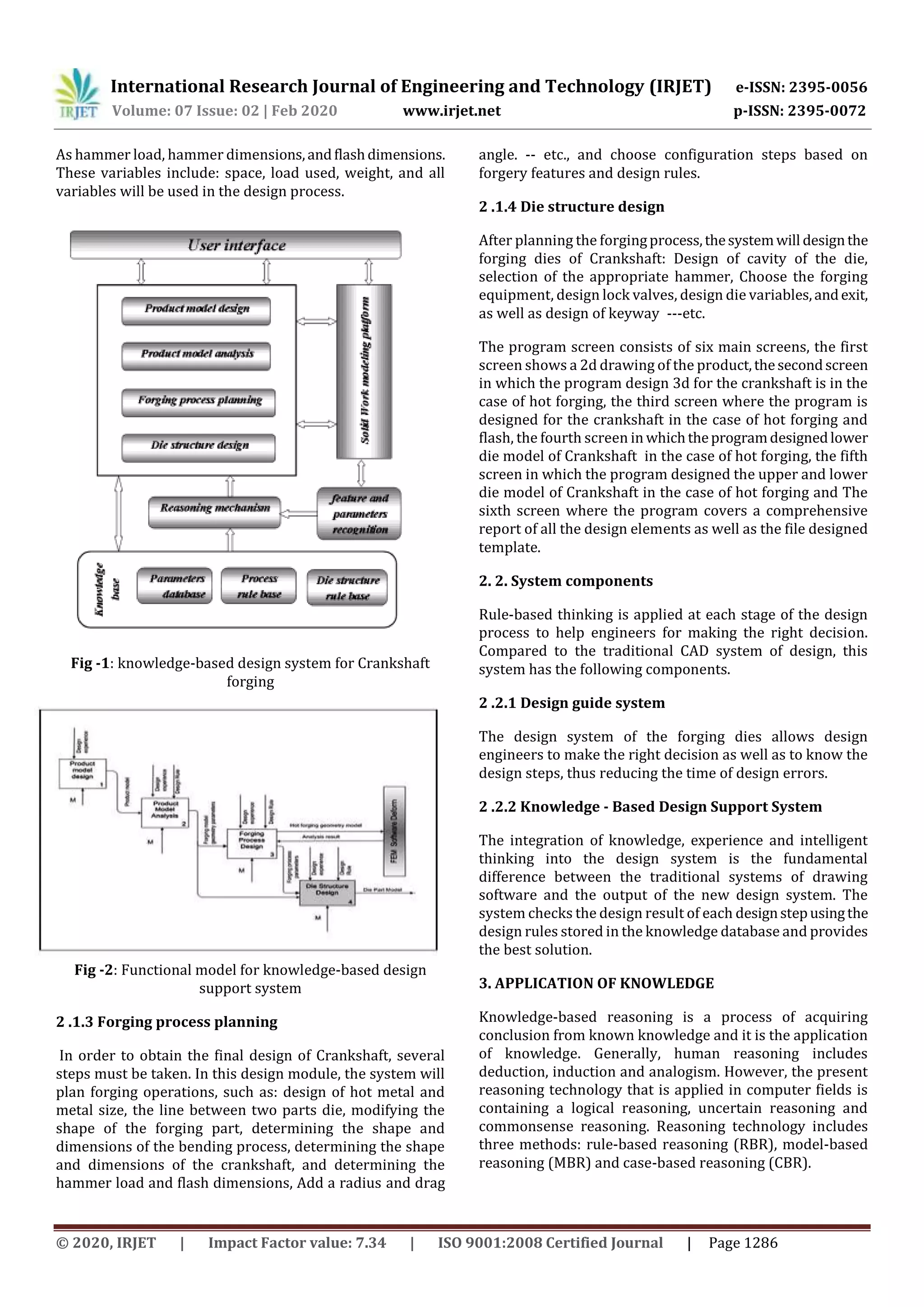
diagram, this is illustrated in Fig.1.
2.1 System structure and main functional modules
The system is composed of four subsystems: product model
design, product model analysis, forging process planning,
and die structure design. These subsystems are interrelated
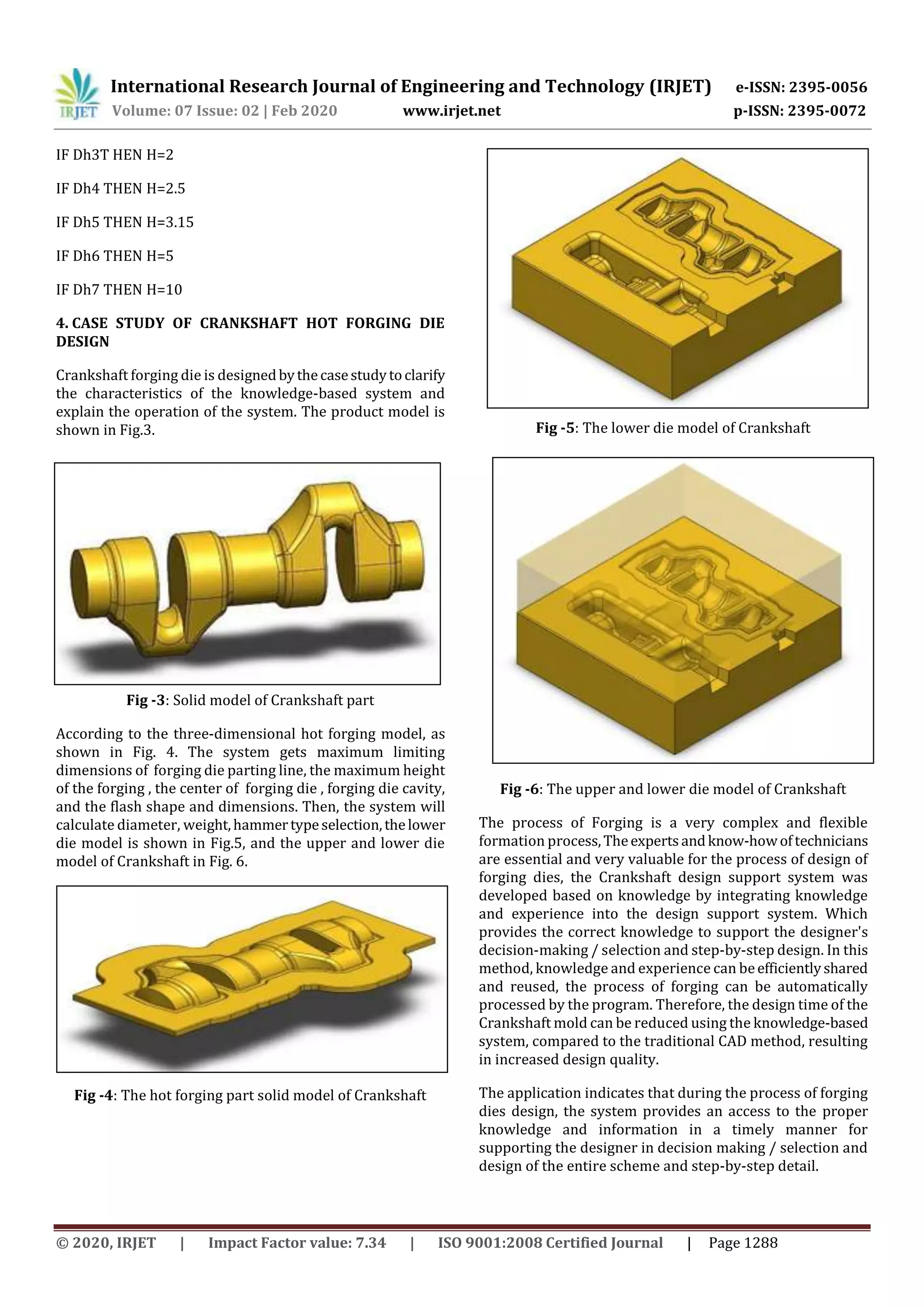
based on the integrated product model. This is illustrated in
Fig.2.
2.1.1 Product model design
The three-dimensional shape of Crankshaft is designed by
using the Solid Works software.
2 .1.2 Product model analysis
Based on Crankshaft design that was created, analyze
drawing elements from Solid Works,establishingknowledge
bases such
International Research Journal of Engineering and Technology (IRJET) e-ISSN: 2395-0056
Volume: 07 Issue: 02 | Feb 2020 www.irjet.net p-ISSN: 2395-0072
© 2020, IRJET | Impact Factor value: 7.34 | ISO 9001:2008 Certified Journal | Page 1286
As hammer load, hammer dimensions,andflashdimensions.
These variables include: space, load used, weight, and all
variables will be used in the design process.
Fig -1: knowledge-based design system for Crankshaft
forging
Fig -2: Functional model for knowledge-based design
support system
2 .1.3 Forging process planning
In order to obtain the final design of Crankshaft, several
steps must be taken. In this design module, the system will
plan forging operations, such as: design of hot metal and
metal size, the line between two parts die, modifying the
shape of the forging part, determining the shape and
dimensions of the bending process, determining the shape
and dimensions of the crankshaft, and determining the
hammer load and flash dimensions, Add a radius and drag
angle. -- etc., and choose configuration steps based on
forgery features and design rules.
2 .1.4 Die structure design
After planning the forgingprocess,thesystemwill designthe
forging dies of Crankshaft: Design of cavity of the die,
selection of the appropriate hammer, Choose the forging
equipment, design lock valves, design die variables,andexit,
as well as design of keyway ---etc.
The program screen consists of six main screens, the first
screen shows a 2d drawing of the product,thesecondscreen
in which the program design 3d for the crankshaft is in the
case of hot forging, the third screen where the program is
designed for the crankshaft in the case of hot forging and
flash, the fourth screen in whichtheprogramdesignedlower
die model of Crankshaft in the case of hot forging, the fifth
screen in which the program designed the upper and lower
die model of Crankshaft in the case of hot forging and The
sixth screen where the program covers a comprehensive
report of all the design elements as well as the file designed
template.
2. 2. System components
Rule-based thinking is applied at each stage of the design
process to help engineers for making the right decision.
Compared to the traditional CAD system of design, this
system has the following components.
2 .2.1 Design guide system
The design system of the forging dies allows design
engineers to make the right decision as well as to know the
design steps, thus reducing the time of design errors.
2 .2.2 Knowledge - Based Design Support System
The integration of knowledge, experience and intelligent
thinking into the design system is the fundamental
difference between the traditional systems of drawing
software and the output of the new design system. The
system checks the design result of each designstepusingthe
design rules stored in the knowledge database and provides
the best solution.
3. APPLICATION OF KNOWLEDGE
Knowledge-based reasoning is a process of acquiring
conclusion from known knowledge and it is the application
of knowledge. Generally, human reasoning includes
deduction, induction and analogism. However, the present
reasoning technology that is applied in computer fields is
containing a logical reasoning, uncertain reasoning and
commonsense reasoning. Reasoning technology includes
three methods: rule-based reasoning (RBR), model-based
reasoning (MBR) and case-based reasoning (CBR).
International Research Journal of Engineering and Technology (IRJET) e-ISSN: 2395-0056
Volume: 07 Issue: 02 | Feb 2020 www.irjet.net p-ISSN: 2395-0072
© 2020, IRJET | Impact Factor value: 7.34 | ISO 9001:2008 Certified Journal | Page 1287
In the process of forging die design, RBR is the primary
reasoning technology to provide proper knowledge. In the
forging die design, there are several designrules.Theserules
are saved in the rule database of the system by way of the
production rule. While designing, rule-based reasoning is
applied according to specific conditions. Producingrulesare
put forward by US mathematician Post, and developed by
Newell and Simon. Producing representation is also called
rules representation. Each rule is a producing expression.
Every rule contains two parts, one is situation of recognition
(premise/antecedent part), and the other is the activitypart
(conclusion/consequent part). Producing rules werelooked
at the situation-activity pairs or premise-conclusion pairs.
Base Production Production rule is similar to logic in form:
P→ Q, CF. In this formula: P is antecedent, Q is consequent,
and CF is the certainty factor of the rule. The following is the
BNF description of producing rules using the logical
knowledge representation method:
< Predication >::=< Name of predication>[< Parameter >,...]
< Action >::=< Name of action >[< Parameter >,...]
<Premise>::=empty| < Predication >1, < Predication >|
<Conclusion>::=< Predication >| < Action >{ Conclusion...}
< Production rule >::=< Premise >< Conclusion >,<CF>
<CF>::=<(0,1)real number>
< Production knowledge>::=< Production rule >1,
< Production rule >2,...
For example, during system design the capacity of hammer
(H) can be selected according to average diameter of
workpiece (D) of the metal used and can be determined
according to Table 1 .
H =10 (1- 0.005*D) (1.1+2/D)² (0.75+0.001D²)*D*ƿ (1)
Table -1: The relationship between the capacity of
hammer (H) and average diameter of workpiece (D) [12].
The design rules:
IF D <=4.5 THEN H= 0.63
IF D >4.5 AND D <=8.5 THEN H=1
IF D >8, 5 AND D <=17 THEN H=2
IF D >17 AND D <=20 THEN H=2.5
IF D >20 AND D <=24 THEN H=3.15
IF D >24 AND D <=31 THEN H=5
IF D>31 AND D<=44 THEN H=10
For example, during system design of Dimensions of the
flash (F) can be selected accordingto thecapacityofhammer
(H) of the metal used and can be determined according to
Table 2
The design rules:
IF F1 THEN H=0.63
IF F2 THEN H=1
IF F3 THEN H=2
IF F4 THEN H=2.5
IF F5 THEN H=3.15
IF F6 THEN H=5
IF F7THEN H=10
Table -2: The relationship between the capacity of
hammer (H) and the flash (F) [12].
For example, during system design of Dimensions of the
hammer (Dh) can be selected according to the capacity of
hammer (H) of the metal used and can be determined
according to Table 3.
Table -3: The relationship between the capacity of
hammer (H) and Dimensions of the hammer(Dh) [12].
The design rules:
IF Dh1 THEN H=0.63
IF Dh2 THEN H=1
D (cm)
> 4.5 4.5 ≤
8.5
8.5 ≤
17
17 ≤
20
20 ≤
24
24 ≤
31
31 ≤
44
H( ton) 0.63 1 2 2.5 3.15 5 10
H
( ton)
F
(mm)
A R2 h R R1 L L1
0.63 F1 0.5 0.5 4 4 1 8 25
1 F2 0.8 0.8 4 4 1.5 8 30
2 F3 1.5 1.5 4 4 1.5 10 35
2.5 F4 1.5 1.5 5 5 1.5 10 35
3.15 F5 1.5 1.5 5 5 1.5 10 35
5 F6 2 2 6 6 3 12 40
10 F7 2.5 2.5 8 8 3 12 50
H ( ton) Dh)mm) H min H max B L
0.63 Dh1 280 380 400 380
1 Dh2 320 500 500 450
2 Dh3 360 550 600 700
2.5 Dh4 430 650 700 710
3.15 Dh5 480 650 700 800
5 Dh6 530 800 700 1000
10 Dh7 610 810 1000 1200
International Research Journal of Engineering and Technology (IRJET) e-ISSN: 2395-0056
Volume: 07 Issue: 02 | Feb 2020 www.irjet.net p-ISSN: 2395-0072
© 2020, IRJET | Impact Factor value: 7.34 | ISO 9001:2008 Certified Journal | Page 1288
IF Dh3T HEN H=2
IF Dh4 THEN H=2.5
IF Dh5 THEN H=3.15
IF Dh6 THEN H=5
IF Dh7 THEN H=10
4. CASE STUDY OF CRANKSHAFT HOT FORGING DIE
DESIGN
Crankshaft forging die is designedbythecasestudytoclarify
the characteristics of the knowledge-based system and
explain the operation of the system. The product model is
shown in Fig.3.
Fig -3: Solid model of Crankshaft part
According to the three-dimensional hot forging model, as
shown in Fig. 4. The system gets maximum limiting
dimensions of forging die parting line, the maximum height
of the forging , the center of forging die , forging die cavity,
and the flash shape and dimensions. Then, the system will
calculate diameter, weight,hammertypeselection,thelower
die model is shown in Fig.5, and the upper and lower die
model of Crankshaft in Fig. 6.
Fig -4: The hot forging part solid model of Crankshaft
Fig -5: The lower die model of Crankshaft
Fig -6: The upper and lower die model of Crankshaft
The process of Forging is a very complex and flexible
formation process,Theexpertsandknow-howoftechnicians
are essential and very valuable for the process of design of
forging dies, the Crankshaft design support system was
developed based on knowledge by integrating knowledge
and experience into the design support system. Which
provides the correct knowledge to support the designer's
decision-making / selection and step-by-step design. In this
method, knowledge and experience can beefficientlyshared
and reused, the process of forging can be automatically
processed by the program. Therefore, the design time of the
Crankshaft mold can be reduced using the knowledge-based
system, compared to the traditional CAD method, resulting
in increased design quality.
The application indicates that during the process of forging
dies design, the system provides an access to the proper
knowledge and information in a timely manner for
supporting the designer in decision making / selection and
design of the entire scheme and step-by-step detail.
International Research Journal of Engineering and Technology (IRJET) e-ISSN: 2395-0056
Volume: 07 Issue: 02 | Feb 2020 www.irjet.net p-ISSN: 2395-0072
© 2020, IRJET | Impact Factor value: 7.34 | ISO 9001:2008 Certified Journal | Page 1289
5. CONCLUSIONS
During forging dies design process, the accumulated
experience and knowledge of designers is very important.
For the design of die. In order to optimize the accumulated
engineering knowledge, it is necessary to integrate
knowledge and experience in designingforgingdiessystems
into a CAD system and developinga knowledge-baseddesign
support system. In this work, a knowledge-basedCrankshaft
design support system has been developed on the basis of
methodology. Through the representation of engineering
knowledge, knowledge acquisition and knowledge-based
design support techniques. A case study shows in this work
by adopting this system the following:
1. Using the automatic design instead of manual
design
2. The product development cost reduced
3. To save time and effort greatly
4. To reduce errors caused by designers
5. Improvement the quality of the design
NOMENCLATURE
SUBSCRIPTS
CAD Computer Aided Design
CAM Computer-Aided Manufacturing
CAE Computer-Aided Engineering
CADD Computer Aided Design And Drafting
RBR Rule-Based Reasoning
MBR Model-Based Reasoning
CBR Case-Based Reasoning
REFERENCES
[1] Numthong C.Butdee S. "The Knowledge Based System
for Forging Process Design based on Case-Based
Reasoning and Finite Element Method" AIJSTPME,
2012, 5(2): 45-54
[2] F. Diko, M.S.J. Hashmi," A finite element simulation of
non steady state metal forming processes" J. Mater.
Process. Technol. 38 (1993) 115–122.
[3] M.S. Joun, S.M. Hwang "Optimal process design in
steady-state metal forming by finiteelementmethod"
II. Application to die profile design in extrusion, Int. J.
Mech. Tools Manuf. 33 (1) (1993) 63–70
[4] M. Knoerr, L. Joon, A. Taylan, Application of the 2D
finite element methodtosimulationofvariousforming
processes, Journal of materials processing technology
33(1-2),31-55,1992.
[5] Mantyla M, Nau D, Shah J. "Challenges in feature-based
manufacturing research" Communications of theACM
1996;39(2):77–85
[6] Y.K.D.V. Prasad and S. Somasundaram, "CADDS An
Automated Die Design System for Sheet Metal
Blanking.", Computing and Control Engineering
Journal, V.3, n.4, pp.185-191, , July 1992.
[7] Choi S. H. And Wong K.W.,"A CAD/CAM package for
sheet metal blanking dies.", In the proceedings of the
International Conference of Manufacturing
Automation"Hong Kong(10-12August1992),pp.674-
679,1992.
[8] H.S. Ismail, K. Huang and K.k.B .Hon, "CAPTD: a low-
cost integrated computer aided design system for
press-tool design," I-Mech-E, Part B, Journal of
Engineering Manufacture vol. 207 n B2, pp. 117-127,
1993.
[9] R. Singh and G. S. Sekhon," Design and Application of
Hybrid SoftwareforModelingDieComponentsandDie
Assembly", I-Mech-E, Part B: Journal of Engineering
Manufacture, vol. 217, pp. 235-250, 2003.
[10] Hussein H.M.A., Abdeltif, L.A.,Etman,M.I.,andBarakat
A. F., "An Approach to Construct an Intelligent System
in Sheet Metal Cutting Die Design"., 9th Cairo
university international conference on mechanical
design & production (MDP-9) Cairo, Egypt, January 8-
10, 2008.
[11] Xiong N, Litz L, Ressom H "Learning premises of fuzzy
rulesfor knowledge acquisition in classification
problems." Knowl Inf Syst4(1):96–111, 2002
[12] Abdelnaser Omran "ComputerAidedProcessPlanning
and Design of Forging Dies" PhD under progress,
Faculty of Industrial Education, Helwan University,
Cairo, Egypt, 2020.
Symbol Description Unit
H The capacity of hammer ton
ƿ Density Kg / cm3
D Diameter cm
F Dimensions of the flash mm
Dh Dimensions of the hammer mm
H min Maximum Height mm
H max Minimum Height mm
B Die Width mm
L Dei Length mm
International Research Journal of Engineering and Technology (IRJET) e-ISSN: 2395-0056
Volume: 07 Issue: 02 | Feb 2020 www.irjet.net p-ISSN: 2395-0072
© 2020, IRJET | Impact Factor value: 7.34 | ISO 9001:2008 Certified Journal | Page 1290
BIOGRAPHIES
Abdelnaser O. Shiba is a Ph.D.
Student, Production Technology
Department. Faculty of Industrial
Education, Helwan University. He
obtained his B.Sc. (1992) and M.Sc.
(2016) in Production Technology
Sabreen A. Abdelwahab is as
assistant Professor at Production
Technology Department, Helwan
University. She received her B.Sc.
(2000) and M.Sc. (2008) major
field Automatic control and PhD
(2015) in Mechanical Engineering,
Faculty of Engineering at Ain
Shams University,Cairo-Egypt.Her
research interest include
mechanical engineering,
mechatronics, robotics and
automatic control
H. M. A. Hussein is an Assistant
Professor, Mechanical Engineering
Department, Faculty of
Engineering, Helwan University,
Cairo, Egypt He obtained his PhD
in Mechanical Engineering (2008).
His research interests include
Computer-Aided sheet metal die
design, AI application to sheet
metal forming, CAD/CAM,
AutoCAD applications and
customizations.
Ibrahim Ahmed, is a Professor of
Vehicle Dynamic and Control at
Helwan University in Egypt. He is
currently the Head of Production
Technology Department. He
obtained his B.Sc. (1990) and M.Sc.
(1995) of Automotive Engineering
from Helwan University in Cairo,
Egypt followed by another M.Sc.
from Eindhoven University 1997.
He obtained also the PhD (2002)
from Newcastle Upon Tyne, UK.He
has about 50 papers in the field of
Vehicle Dynamics and Tribology.
He has many contributions in the
field of Noise, Vibration and
Harshness (NVH).

IRJET - Knowledge-based Forging Die Design of Crankshaft

  • 1.
    International Research Journalof Engineering and Technology (IRJET) e-ISSN: 2395-0056 Volume: 07 Issue: 02 | Feb 2020 www.irjet.net p-ISSN: 2395-0072 © 2020, IRJET | Impact Factor value: 7.34 | ISO 9001:2008 Certified Journal | Page 1285 Knowledge-based Forging Die Design of Crankshaft Abdelnaser O. Shiba1,Sabreen A. Abdelwahab2, H. M. A.Hussein3, Ibrahim Ahmed4 1Researcher, Department of Production Technology, Helwan University, Cairo, Egypt 2Assistant Professor, Department of Production Technology, Helwan University, Cairo, Egypt 3Assistant Professor, Department of Mechanical Engineering, Helwan University, Cairo, Egypt 4Professor, Department of Automotive Technology, Helwan University, Cairo, Egypt ----------------------------------------------------------------------***--------------------------------------------------------------------- Abstract - Design of forging dies is tedious and complex process, which is a skill-based activity, anditneedsmoreeffort and time. The purpose of this work is to analyze the elements of design and knowledge experience for Designing the forging die of Crankshaft by Computer Aided design, establishing knowledge bases such as hammer load, hammer dimensions and flash dimensions by using Visualbasic to link knowledge bases and Solidworks. This system is experimental. Theresults indicate that the benefits of using this system to save time and effort and reduce errors caused by designers and improving the design quality. Key Words: Computer Aided Design, Forging Die, Crankshaft, CAD, Solid Work, Visual Basic 1. INTRODUCTION Process of forging design is the crucial task in process planning of forging industry. It depends on the skills and accumulative expertise of the forging experts. Such knowledge of the experts is not easy to elicit directly. However, this knowledge should be managed and used to improve the efficiency, reduce timeandcostoftheprocessof forging design. Although, now forging process has new technology such modern machine with high capacity, high quality tool materials and engineering software like CAD/CAM/CAE, however, the process of forging design is still need to the experience and knowledge of theexperts[1]. When designing of forging dies, design process Parameters such as metal flow, consideration of thetypeofmetal dieand product, product weight, friction, hammer condition temperature, inclinationangleswithinthedie,skill offorging workers, ---etc. Computer-aideddesign(CAD)andmanufacturing(CAM)are increasingly implemented at all phases of design and fabrication of forging dies. Techniques include analysis of elements used during design [2-4].Thedesignofforgingdies depends on the following: 1. Design of dies depends on the expertiseandknowledge of the specialists. 2. Design of dies is tedious and complex process. 3. The dies design is an innovative process, Taking into account the Parameters of the design process, such as the determination of the materials of die, the type of metal product , the steps of the forging and the forging machine --- etc. [5]. From 1970 until now, researchers have made a lot of efforts to develop computer-aided design templates to design different types of dies which used to produce forging dies parts. Very few researchers have attempted to develop a computer-aided design of forging dies scheme, and less research has covered the design of the die. Therefore, there is a need to develop a system for the rapid design of forging dies. Many researchers have done their efforts to develop CADD systems for drilling and cutting of forging [6-10]. 2. THE FRAMEWORK AND MAINFUNCTIONMODULES OF CRANKSHAFT FORGING DESIGN SYSTEM The disadvantages of traditional CAD systems for the design of forging dies are: 1. The process of designing forging dies is based on the expertise and skill of designers, which affects the result of the design of forging dies [11]. 2. There is no mechanism for knowledge management. The system cannot give the designer the right knowledge in decision making. In order to getting benefit from accumulated engineering knowledge and increased design efficiency, a knowledge-basedsystem has been developed for the design of Crankshaft diagram, this is illustrated in Fig.1. 2.1 System structure and main functional modules The system is composed of four subsystems: product model design, product model analysis, forging process planning, and die structure design. These subsystems are interrelated based on the integrated product model. This is illustrated in Fig.2. 2.1.1 Product model design The three-dimensional shape of Crankshaft is designed by using the Solid Works software. 2 .1.2 Product model analysis Based on Crankshaft design that was created, analyze drawing elements from Solid Works,establishingknowledge bases such
  • 2.
    International Research Journalof Engineering and Technology (IRJET) e-ISSN: 2395-0056 Volume: 07 Issue: 02 | Feb 2020 www.irjet.net p-ISSN: 2395-0072 © 2020, IRJET | Impact Factor value: 7.34 | ISO 9001:2008 Certified Journal | Page 1286 As hammer load, hammer dimensions,andflashdimensions. These variables include: space, load used, weight, and all variables will be used in the design process. Fig -1: knowledge-based design system for Crankshaft forging Fig -2: Functional model for knowledge-based design support system 2 .1.3 Forging process planning In order to obtain the final design of Crankshaft, several steps must be taken. In this design module, the system will plan forging operations, such as: design of hot metal and metal size, the line between two parts die, modifying the shape of the forging part, determining the shape and dimensions of the bending process, determining the shape and dimensions of the crankshaft, and determining the hammer load and flash dimensions, Add a radius and drag angle. -- etc., and choose configuration steps based on forgery features and design rules. 2 .1.4 Die structure design After planning the forgingprocess,thesystemwill designthe forging dies of Crankshaft: Design of cavity of the die, selection of the appropriate hammer, Choose the forging equipment, design lock valves, design die variables,andexit, as well as design of keyway ---etc. The program screen consists of six main screens, the first screen shows a 2d drawing of the product,thesecondscreen in which the program design 3d for the crankshaft is in the case of hot forging, the third screen where the program is designed for the crankshaft in the case of hot forging and flash, the fourth screen in whichtheprogramdesignedlower die model of Crankshaft in the case of hot forging, the fifth screen in which the program designed the upper and lower die model of Crankshaft in the case of hot forging and The sixth screen where the program covers a comprehensive report of all the design elements as well as the file designed template. 2. 2. System components Rule-based thinking is applied at each stage of the design process to help engineers for making the right decision. Compared to the traditional CAD system of design, this system has the following components. 2 .2.1 Design guide system The design system of the forging dies allows design engineers to make the right decision as well as to know the design steps, thus reducing the time of design errors. 2 .2.2 Knowledge - Based Design Support System The integration of knowledge, experience and intelligent thinking into the design system is the fundamental difference between the traditional systems of drawing software and the output of the new design system. The system checks the design result of each designstepusingthe design rules stored in the knowledge database and provides the best solution. 3. APPLICATION OF KNOWLEDGE Knowledge-based reasoning is a process of acquiring conclusion from known knowledge and it is the application of knowledge. Generally, human reasoning includes deduction, induction and analogism. However, the present reasoning technology that is applied in computer fields is containing a logical reasoning, uncertain reasoning and commonsense reasoning. Reasoning technology includes three methods: rule-based reasoning (RBR), model-based reasoning (MBR) and case-based reasoning (CBR).
  • 3.
    International Research Journalof Engineering and Technology (IRJET) e-ISSN: 2395-0056 Volume: 07 Issue: 02 | Feb 2020 www.irjet.net p-ISSN: 2395-0072 © 2020, IRJET | Impact Factor value: 7.34 | ISO 9001:2008 Certified Journal | Page 1287 In the process of forging die design, RBR is the primary reasoning technology to provide proper knowledge. In the forging die design, there are several designrules.Theserules are saved in the rule database of the system by way of the production rule. While designing, rule-based reasoning is applied according to specific conditions. Producingrulesare put forward by US mathematician Post, and developed by Newell and Simon. Producing representation is also called rules representation. Each rule is a producing expression. Every rule contains two parts, one is situation of recognition (premise/antecedent part), and the other is the activitypart (conclusion/consequent part). Producing rules werelooked at the situation-activity pairs or premise-conclusion pairs. Base Production Production rule is similar to logic in form: P→ Q, CF. In this formula: P is antecedent, Q is consequent, and CF is the certainty factor of the rule. The following is the BNF description of producing rules using the logical knowledge representation method: < Predication >::=< Name of predication>[< Parameter >,...] < Action >::=< Name of action >[< Parameter >,...] <Premise>::=empty| < Predication >1, < Predication >| <Conclusion>::=< Predication >| < Action >{ Conclusion...} < Production rule >::=< Premise >< Conclusion >,<CF> <CF>::=<(0,1)real number> < Production knowledge>::=< Production rule >1, < Production rule >2,... For example, during system design the capacity of hammer (H) can be selected according to average diameter of workpiece (D) of the metal used and can be determined according to Table 1 . H =10 (1- 0.005*D) (1.1+2/D)² (0.75+0.001D²)*D*ƿ (1) Table -1: The relationship between the capacity of hammer (H) and average diameter of workpiece (D) [12]. The design rules: IF D <=4.5 THEN H= 0.63 IF D >4.5 AND D <=8.5 THEN H=1 IF D >8, 5 AND D <=17 THEN H=2 IF D >17 AND D <=20 THEN H=2.5 IF D >20 AND D <=24 THEN H=3.15 IF D >24 AND D <=31 THEN H=5 IF D>31 AND D<=44 THEN H=10 For example, during system design of Dimensions of the flash (F) can be selected accordingto thecapacityofhammer (H) of the metal used and can be determined according to Table 2 The design rules: IF F1 THEN H=0.63 IF F2 THEN H=1 IF F3 THEN H=2 IF F4 THEN H=2.5 IF F5 THEN H=3.15 IF F6 THEN H=5 IF F7THEN H=10 Table -2: The relationship between the capacity of hammer (H) and the flash (F) [12]. For example, during system design of Dimensions of the hammer (Dh) can be selected according to the capacity of hammer (H) of the metal used and can be determined according to Table 3. Table -3: The relationship between the capacity of hammer (H) and Dimensions of the hammer(Dh) [12]. The design rules: IF Dh1 THEN H=0.63 IF Dh2 THEN H=1 D (cm) > 4.5 4.5 ≤ 8.5 8.5 ≤ 17 17 ≤ 20 20 ≤ 24 24 ≤ 31 31 ≤ 44 H( ton) 0.63 1 2 2.5 3.15 5 10 H ( ton) F (mm) A R2 h R R1 L L1 0.63 F1 0.5 0.5 4 4 1 8 25 1 F2 0.8 0.8 4 4 1.5 8 30 2 F3 1.5 1.5 4 4 1.5 10 35 2.5 F4 1.5 1.5 5 5 1.5 10 35 3.15 F5 1.5 1.5 5 5 1.5 10 35 5 F6 2 2 6 6 3 12 40 10 F7 2.5 2.5 8 8 3 12 50 H ( ton) Dh)mm) H min H max B L 0.63 Dh1 280 380 400 380 1 Dh2 320 500 500 450 2 Dh3 360 550 600 700 2.5 Dh4 430 650 700 710 3.15 Dh5 480 650 700 800 5 Dh6 530 800 700 1000 10 Dh7 610 810 1000 1200
  • 4.
    International Research Journalof Engineering and Technology (IRJET) e-ISSN: 2395-0056 Volume: 07 Issue: 02 | Feb 2020 www.irjet.net p-ISSN: 2395-0072 © 2020, IRJET | Impact Factor value: 7.34 | ISO 9001:2008 Certified Journal | Page 1288 IF Dh3T HEN H=2 IF Dh4 THEN H=2.5 IF Dh5 THEN H=3.15 IF Dh6 THEN H=5 IF Dh7 THEN H=10 4. CASE STUDY OF CRANKSHAFT HOT FORGING DIE DESIGN Crankshaft forging die is designedbythecasestudytoclarify the characteristics of the knowledge-based system and explain the operation of the system. The product model is shown in Fig.3. Fig -3: Solid model of Crankshaft part According to the three-dimensional hot forging model, as shown in Fig. 4. The system gets maximum limiting dimensions of forging die parting line, the maximum height of the forging , the center of forging die , forging die cavity, and the flash shape and dimensions. Then, the system will calculate diameter, weight,hammertypeselection,thelower die model is shown in Fig.5, and the upper and lower die model of Crankshaft in Fig. 6. Fig -4: The hot forging part solid model of Crankshaft Fig -5: The lower die model of Crankshaft Fig -6: The upper and lower die model of Crankshaft The process of Forging is a very complex and flexible formation process,Theexpertsandknow-howoftechnicians are essential and very valuable for the process of design of forging dies, the Crankshaft design support system was developed based on knowledge by integrating knowledge and experience into the design support system. Which provides the correct knowledge to support the designer's decision-making / selection and step-by-step design. In this method, knowledge and experience can beefficientlyshared and reused, the process of forging can be automatically processed by the program. Therefore, the design time of the Crankshaft mold can be reduced using the knowledge-based system, compared to the traditional CAD method, resulting in increased design quality. The application indicates that during the process of forging dies design, the system provides an access to the proper knowledge and information in a timely manner for supporting the designer in decision making / selection and design of the entire scheme and step-by-step detail.
  • 5.
    International Research Journalof Engineering and Technology (IRJET) e-ISSN: 2395-0056 Volume: 07 Issue: 02 | Feb 2020 www.irjet.net p-ISSN: 2395-0072 © 2020, IRJET | Impact Factor value: 7.34 | ISO 9001:2008 Certified Journal | Page 1289 5. CONCLUSIONS During forging dies design process, the accumulated experience and knowledge of designers is very important. For the design of die. In order to optimize the accumulated engineering knowledge, it is necessary to integrate knowledge and experience in designingforgingdiessystems into a CAD system and developinga knowledge-baseddesign support system. In this work, a knowledge-basedCrankshaft design support system has been developed on the basis of methodology. Through the representation of engineering knowledge, knowledge acquisition and knowledge-based design support techniques. A case study shows in this work by adopting this system the following: 1. Using the automatic design instead of manual design 2. The product development cost reduced 3. To save time and effort greatly 4. To reduce errors caused by designers 5. Improvement the quality of the design NOMENCLATURE SUBSCRIPTS CAD Computer Aided Design CAM Computer-Aided Manufacturing CAE Computer-Aided Engineering CADD Computer Aided Design And Drafting RBR Rule-Based Reasoning MBR Model-Based Reasoning CBR Case-Based Reasoning REFERENCES [1] Numthong C.Butdee S. "The Knowledge Based System for Forging Process Design based on Case-Based Reasoning and Finite Element Method" AIJSTPME, 2012, 5(2): 45-54 [2] F. Diko, M.S.J. Hashmi," A finite element simulation of non steady state metal forming processes" J. Mater. Process. Technol. 38 (1993) 115–122. [3] M.S. Joun, S.M. Hwang "Optimal process design in steady-state metal forming by finiteelementmethod" II. Application to die profile design in extrusion, Int. J. Mech. Tools Manuf. 33 (1) (1993) 63–70 [4] M. Knoerr, L. Joon, A. Taylan, Application of the 2D finite element methodtosimulationofvariousforming processes, Journal of materials processing technology 33(1-2),31-55,1992. [5] Mantyla M, Nau D, Shah J. "Challenges in feature-based manufacturing research" Communications of theACM 1996;39(2):77–85 [6] Y.K.D.V. Prasad and S. Somasundaram, "CADDS An Automated Die Design System for Sheet Metal Blanking.", Computing and Control Engineering Journal, V.3, n.4, pp.185-191, , July 1992. [7] Choi S. H. And Wong K.W.,"A CAD/CAM package for sheet metal blanking dies.", In the proceedings of the International Conference of Manufacturing Automation"Hong Kong(10-12August1992),pp.674- 679,1992. [8] H.S. Ismail, K. Huang and K.k.B .Hon, "CAPTD: a low- cost integrated computer aided design system for press-tool design," I-Mech-E, Part B, Journal of Engineering Manufacture vol. 207 n B2, pp. 117-127, 1993. [9] R. Singh and G. S. Sekhon," Design and Application of Hybrid SoftwareforModelingDieComponentsandDie Assembly", I-Mech-E, Part B: Journal of Engineering Manufacture, vol. 217, pp. 235-250, 2003. [10] Hussein H.M.A., Abdeltif, L.A.,Etman,M.I.,andBarakat A. F., "An Approach to Construct an Intelligent System in Sheet Metal Cutting Die Design"., 9th Cairo university international conference on mechanical design & production (MDP-9) Cairo, Egypt, January 8- 10, 2008. [11] Xiong N, Litz L, Ressom H "Learning premises of fuzzy rulesfor knowledge acquisition in classification problems." Knowl Inf Syst4(1):96–111, 2002 [12] Abdelnaser Omran "ComputerAidedProcessPlanning and Design of Forging Dies" PhD under progress, Faculty of Industrial Education, Helwan University, Cairo, Egypt, 2020. Symbol Description Unit H The capacity of hammer ton ƿ Density Kg / cm3 D Diameter cm F Dimensions of the flash mm Dh Dimensions of the hammer mm H min Maximum Height mm H max Minimum Height mm B Die Width mm L Dei Length mm
  • 6.
    International Research Journalof Engineering and Technology (IRJET) e-ISSN: 2395-0056 Volume: 07 Issue: 02 | Feb 2020 www.irjet.net p-ISSN: 2395-0072 © 2020, IRJET | Impact Factor value: 7.34 | ISO 9001:2008 Certified Journal | Page 1290 BIOGRAPHIES Abdelnaser O. Shiba is a Ph.D. Student, Production Technology Department. Faculty of Industrial Education, Helwan University. He obtained his B.Sc. (1992) and M.Sc. (2016) in Production Technology Sabreen A. Abdelwahab is as assistant Professor at Production Technology Department, Helwan University. She received her B.Sc. (2000) and M.Sc. (2008) major field Automatic control and PhD (2015) in Mechanical Engineering, Faculty of Engineering at Ain Shams University,Cairo-Egypt.Her research interest include mechanical engineering, mechatronics, robotics and automatic control H. M. A. Hussein is an Assistant Professor, Mechanical Engineering Department, Faculty of Engineering, Helwan University, Cairo, Egypt He obtained his PhD in Mechanical Engineering (2008). His research interests include Computer-Aided sheet metal die design, AI application to sheet metal forming, CAD/CAM, AutoCAD applications and customizations. Ibrahim Ahmed, is a Professor of Vehicle Dynamic and Control at Helwan University in Egypt. He is currently the Head of Production Technology Department. He obtained his B.Sc. (1990) and M.Sc. (1995) of Automotive Engineering from Helwan University in Cairo, Egypt followed by another M.Sc. from Eindhoven University 1997. He obtained also the PhD (2002) from Newcastle Upon Tyne, UK.He has about 50 papers in the field of Vehicle Dynamics and Tribology. He has many contributions in the field of Noise, Vibration and Harshness (NVH).