INTERNATIONAL RESEARCH JOURNAL OF ENGINEERING AND TECHNOLOGY (IRJET) E-ISSN: 2395-0056
VOLUME: 06 ISSUE: 05 | MAY 2019 WWW.IRJET.NET P-ISSN: 2395-0072
© 2019, IRJET | Impact Factor value: 7.211 | ISO 9001:2008 Certified Journal | Page 5450
Intelligent Manhole Cover System
IoT based Intelligent Manhole Cover Management System for
Smart Cities
Ms. Ambika H N1, Ms. Amulya P S2, Ms. K Chandanashree3, Ms. Kusum B S4, Dr. Nandakumar A N5
1,2,3,4,5Department of Computer Science and Engineering for women, GSSS Institute of Engineering and Technology,
Mysuru, Karnataka, India
----------------------------------------------------------------------***---------------------------------------------------------------------
Abstract — World is heading over to urbanization, smart cities
are emerging very fast all over the world. Many parameters are
considered for the smart cities such as water, transportation,
electricity, communication, underground system, etc. Most of the
cables in power and communication departments are buried into
the ground. The waste water is disposed underground. Water
pipelines are placed below the ground. This underground
systems needs to be maintained in order to maintain the dignity
of the smart cities. Municipal Corporation is the official
authorities to maintain the manhole cover functions. Manual
maintenance will be difficult in real-time execution, thus we are
proposing a management system. The main idea behind
developing this system is to maintain the manhole covers from
damaging. It is the IoT based manhole cover system. This system
consists of three sensors and an interface where notification gets
to the municipal office. Implementation of this system will help in
the betterment of the smart cities.
Keywords—intelligent manhole cover; manhole; drainage
monitoring system
1. INTRODUCTION
The smart world is the new trend where everything is
controlled by the things, not by human beings. The world
which is getting urbanized requires well maintained
surrounding. Smart cities are forming in order to make
people comfortable. That comfortness includes in
maintaining our environment clean. Maintaining
cleanliness in your living place is the great lifeline for the
smart city. The drainage system which is laid underground
is the base of well-maintained smart city. In order to
manage these systems, many holes in the pavement are
made, they are called as manholes. Open manholes are not
included in good management of the smart city. Manhole
covers are made in the pavement. Implementation of new
system should undergo well management so that it works
properly. Manholes should be properly closed in order to
decrease the accidents. Road accidents, hazardous gas
emission, people or animals falling inside the manholes
and environmental pollution are frequently occur as a
result of manhole cover displacement, loss, and damage by
threatening lives and safety. The rate of accidents due to
insecure manhole coverage is high. If the drainage
maintenance is not proper the pure water gets
contaminated with drainage water and infectious diseases
may get spread. Obviously, this is an objection over the
concept of the smart cities. The person of corporation
office has to go directly and check the manholes or the
people of that area have to inform to the corporation office.
Managing the drainage system is manual therefore it
would not be efficient to have clean and working
underground system in the smart cities, it is difficult for
the government authorities to find the exact manhole
which is causing the problem to the whole drainage
system. It is difficult to go directly and check the manholes
manually. There might be the chances of emission of
hazardous gases from the manhole due to the damaged
cover which cannot be detected in the initial stages by the
corporation office. The crack or tilt on the cover of the
manhole may cause accidents which are harmful for
society. There are many technologies which are introduced
to manage every single systems implemented. To decrease
the manhole cover accidents we need a management
system which involves the technology. Here we are
proposing a system; an intelligent manhole cover
management system is one of the most important basic
platforms in a smart city to prevent frequent manhole
cover accidents. This project proposes an IoT based
Intelligent Manhole Cover System (IMCS) for smart cities.
Many sensors are used for sensing the problem which has
occurred inside the manhole and an Arduino is used for the
communication purpose. It takes input and gives the
output. That output is the one which notifies the
authorities in the municipal office. It helps the authorities
to take action corresponding management through mobile
devices based on the collected information.
The main objectives of this proposed system are:
1. Detection of water level and blockages in the drainage
system.
2. Detection of damage or the displacement of the
manhole cover.
3. The main intension is to maintain cleanliness in the
smart cities.
4. By implementing the intelligent manhole cover
system is obtain an effective low-cost and flexible
solution for condition monitoring and infrastructure
management in the city.
In order to maintain the quality of a smart city efficiently
we are proposing this system. The intelligent manhole
cover management system will decrease the delay in
INTERNATIONAL RESEARCH JOURNAL OF ENGINEERING AND TECHNOLOGY (IRJET) E-ISSN: 2395-0056
VOLUME: 06 ISSUE: 05 | MAY 2019 WWW.IRJET.NET P-ISSN: 2395-0072
© 2019, IRJET | Impact Factor value: 7.211 | ISO 9001:2008 Certified Journal | Page 5451
noticing the damage of the manhole covers. It notifies as
soon as the data gets collected. This helps the municipal
authorities to take the action and resolve the problem. The
involvement of technology for implemented system does
work in a better way.
2. RELATED WORK
Radio frequency identification (RFID) technology being
used in the communication between a reader and the tags
based on radio waves. The radio signals are used to track or
locate the objects easier. An RFID reader has two modes,
fixed and static. RFID tags are intelligent barcodes, which
allows them to be easily tracked. RFID tags communicate
wirelessly with the reader. An RFID system can easily meet
the self-perception requirement and provide a user with
information about an object’s type, location, and condition.
There are three components RFID consists: 1) the RFID
tags; 2) RFID readers; and 3) antenna. RFID tags are
microprocessor chips; each chip consists of an integrated
circuit with a memory.
Cloud computing is taking all over the technical world.
Cloud computing has been the most dominant computing
paradigm in the last decade. It involves computing, storage,
and network management in the cloud environment. One of
the greatest advantages of cloud computing is the ability to
deliver elastic computing power and storage, because of the
vast resources of the clouds, which can satisfy the needs of
resource-constrained end-user devices. However, edge
computing is becoming a new computing paradigm. It
combines the IoT and cloud computing. It processes data at
the edge of the network, which has the potential to provide
a better response time, battery life, bandwidth cost, data
safety, and privacy.
Based on the above two parts, the manhole cover with the
attached RFID tag and the network that combines the NB-
IoT and Internet, the server can obtain the data from
manhole covers. However, it is important to respond the
abnormal condition immediately when receiving alarm
information from a manhole cover. If a manhole cover is
stolen by someone, the RFID tag with the sensors in the
manhole cover makes it possible for the server to obtain
dynamic information about its location, even if it is moving.
Moreover, the management system must respond in real
time to the dynamic location information to make things
easier.
3. Proposed System
The proposed architecture of IMCS consists of the
following:
1. Three sensors and an arduino are attached to the
manhole covers all over the city. They will sense
the changes happening according to their
functionality, through the arduino data will be
communicated to the municipal office.
2. There are two modes of notification we are getting
to the municipal office. They are online mode and
offline mode.
3. Online mode: We have a web interface for the
online notification. The sensed data pops up in the
web page as the warning. The municipal officer can
take action after receiving the warning.
4. Offline mode: We have used the SIM800A GSM
module in the board attached inside the manhole.
The messages will be sent to the phone number
which we have already given in the backend code.
Transmitting data from manhole to the municipal
corporation through GSM module. The data or the warning
will be shown in the mobile device and the web interface.
This easily helps the officials to locate which manhole is
having the problem and could take appropriate steps.
The main architecture of the proposed system is shown in
the figure 1. It includes the main goal where monitoring the
manholes are done efficiently. The three steps are as
follows:
1. Technology used for the recognition purpose.
Sensors are used to sense the change and inform
the same.
2. Data transmission through network using wifi for
the warning which pops up in the web interface.
3. Information processing will be done by the
municipal officials. They will search the data and
take actions against the problem.
Figure 1. Architecture
A. Manhole attached to the sensors
Manhole cover lid and wall of the manhole are attached
with the required sensors, an arduino board which we have
used for the writing and uploading the backend code for the
proper functionality of the sensors.
INTERNATIONAL RESEARCH JOURNAL OF ENGINEERING AND TECHNOLOGY (IRJET) E-ISSN: 2395-0056
VOLUME: 06 ISSUE: 05 | MAY 2019 WWW.IRJET.NET P-ISSN: 2395-0072
© 2019, IRJET | Impact Factor value: 7.211 | ISO 9001:2008 Certified Journal | Page 5452
Figure 2. Top view of manhole attached to the sensors
1. Arduino: Arduino is an open-source electronics
platform based on the hardware and software
which can be used easily. Arduino boards are able
to read inputs and turn it into an output. The
arduino board functions are done by sending a set
of instructions to the microcontroller on the board.
To do so we should use the Arduino programming
language, the Arduino Software (IDE), based on
processing.
Figure 3. Arduino board
2. Gas Sensors: A gas sensor is a device that detects
the presence of gases in an area, often as a part of
safety system. This type of equipment is used to
detect a gas leak or other emissions and can
interface with a control system so a process can be
automatically shut down.
Figure 4. Gas Sensor
3. Water Level Sensors: Level sensors are used to
detect the level of the substances that can flow. Such
substances include liquids, slurries, granular
material and powders. Level measurements can be
done inside containers or it can be the level of a
river or lake. Such measurements can be used to
determine the amount of materials within a closed
container or the flow of water in the open channels.
Figure 5. Water overflow Sensor
4. Tilt Sensors: A tilt sensor is an instrument that is
used for measuring the tilt in multiple axes of a
reference plane. Tilt se3nsors measure the tilting
position with references to gravity and are used in
numerous applications. They enable the easy
detection of the orientation and inclination. Here we
are using tilt sensor for the displacement of
manhole cover.
Figure 6. Tilt Sensor
B. Modes of notification
1. Web Interface
 Online notification in the web interface. Web
interface is the interaction between the user and
software running on the web server. The user
interface is the web browser and the web page it
downloaded and rendered. It is the programming
connection between the Application interface and
the web servers. Using wi-fi connection the warning
pops up in the web interface.
 In the web interface usage the user or the municipal
officer should be login to the interface using their
email account. Then they can monitor online by
getting the warnings. They will take the action
INTERNATIONAL RESEARCH JOURNAL OF ENGINEERING AND TECHNOLOGY (IRJET) E-ISSN: 2395-0056
VOLUME: 06 ISSUE: 05 | MAY 2019 WWW.IRJET.NET P-ISSN: 2395-0072
© 2019, IRJET | Impact Factor value: 7.211 | ISO 9001:2008 Certified Journal | Page 5453
against the problem according to the warning they
have got.
 The web interface is shown in the figure 7. It is
having a home page, dashboard and a logout button.
When they are not monitoring online they can logout
the web page.
 This interface is only used when they can monitor
online. If they are not watching the pop ups then
they cannot solve the problem immediately. So the
web interface should monitor continuously so that
the problem can be solved without delay.
Figure 7. Web interface
2. Text message to the Mobile phone
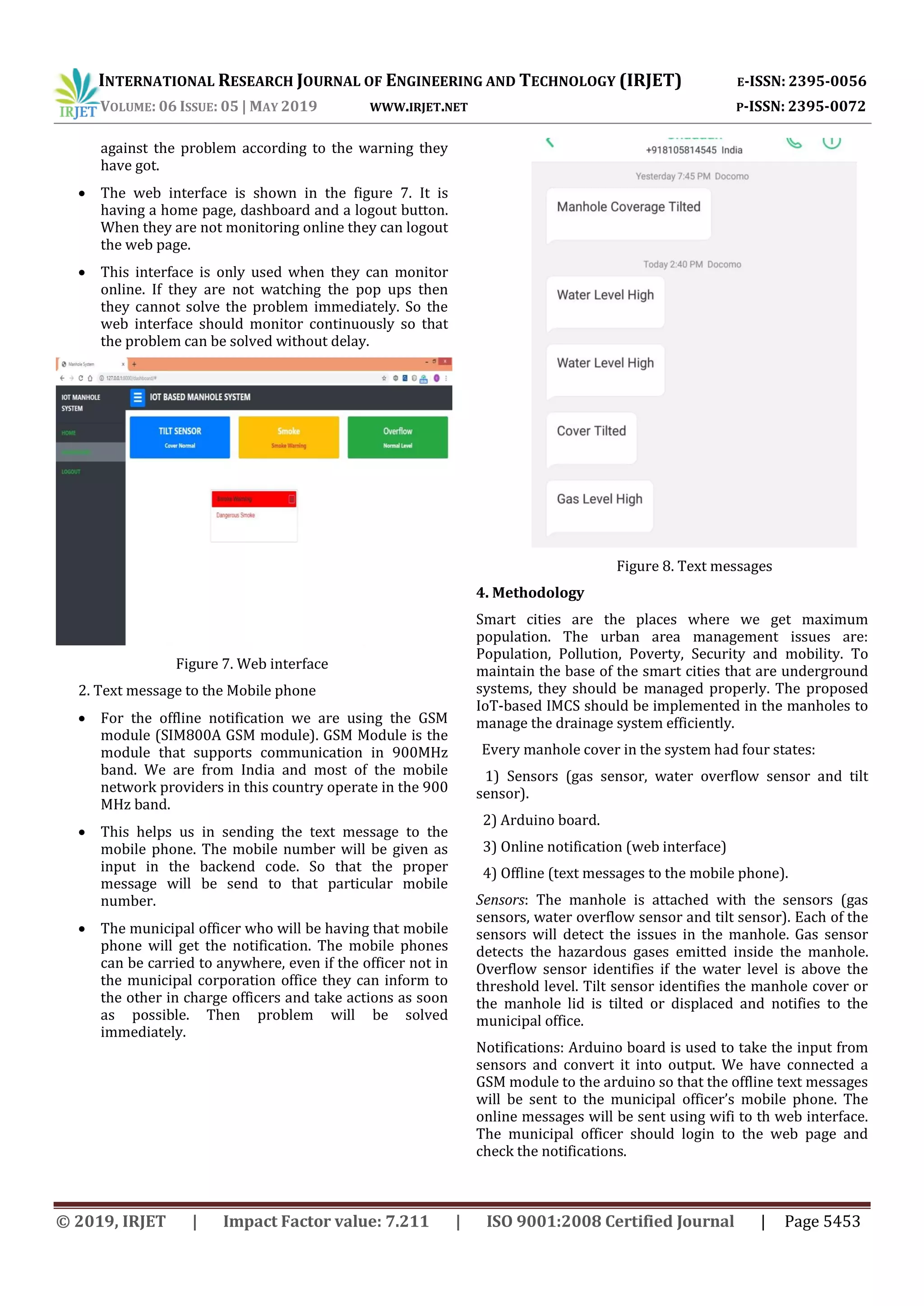
 For the offline notification we are using the GSM
module (SIM800A GSM module). GSM Module is the
module that supports communication in 900MHz
band. We are from India and most of the mobile
network providers in this country operate in the 900
MHz band.
 This helps us in sending the text message to the
mobile phone. The mobile number will be given as
input in the backend code. So that the proper
message will be send to that particular mobile
number.
 The municipal officer who will be having that mobile
phone will get the notification. The mobile phones
can be carried to anywhere, even if the officer not in
the municipal corporation office they can inform to
the other in charge officers and take actions as soon
as possible. Then problem will be solved
immediately.
Figure 8. Text messages
4. Methodology
Smart cities are the places where we get maximum
population. The urban area management issues are:
Population, Pollution, Poverty, Security and mobility. To
maintain the base of the smart cities that are underground
systems, they should be managed properly. The proposed
IoT-based IMCS should be implemented in the manholes to
manage the drainage system efficiently.
Every manhole cover in the system had four states:
1) Sensors (gas sensor, water overflow sensor and tilt
sensor).
2) Arduino board.
3) Online notification (web interface)
4) Offline (text messages to the mobile phone).
Sensors: The manhole is attached with the sensors (gas
sensors, water overflow sensor and tilt sensor). Each of the
sensors will detect the issues in the manhole. Gas sensor
detects the hazardous gases emitted inside the manhole.
Overflow sensor identifies if the water level is above the
threshold level. Tilt sensor identifies the manhole cover or
the manhole lid is tilted or displaced and notifies to the
municipal office.
Notifications: Arduino board is used to take the input from
sensors and convert it into output. We have connected a
GSM module to the arduino so that the offline text messages
will be sent to the municipal officer’s mobile phone. The
online messages will be sent using wifi to th web interface.
The municipal officer should login to the web page and
check the notifications.
INTERNATIONAL RESEARCH JOURNAL OF ENGINEERING AND TECHNOLOGY (IRJET) E-ISSN: 2395-0056
VOLUME: 06 ISSUE: 05 | MAY 2019 WWW.IRJET.NET P-ISSN: 2395-0072
© 2019, IRJET | Impact Factor value: 7.211 | ISO 9001:2008 Certified Journal | Page 5454
The proposed system will be dealing with the safety
protection of manhole covers in major cities. The important
features are:
 A real-time monitoring system.
 The warnings can be viewed anywhere at any time
using mobile phone and internet.
 Sensors are used so the size will be less.
 The damage in the manhole cover can be found
very easily and accidents can be avoided without
delay.
Advantages of the Project
The proposed system will be a good managing system for
the smart cities to monitor the manholes. It automates the
function of the people to come directly to the place and
observe it. This monitoring will be 24x7 which makes it
more efficient. Most of the accidents can be reduced
without delay if the manhole cover is monitored properly.
Thus the proposed system will be a advancement in safety
protection.
5. CONCLUSION
The proposed system deals with the sensors and the
Internet of Things technology. IoT technique will provide
greater resolution for the monitoring system. Underground
system management is a challenging problem. Further we
can update the system implementing two or more sensors.
They will help in solving few more problems faced by the
society because of the improper management of drainage
system. This project proposes two methods for monitoring
and managing underground drainage system. It explains
various applications like underground drainage and
manhole identification in real time. This helps the
municipal authorities to take the necessary actions against
the problems. In this way the accidents occurred due to
manhole cover damage are decreased. The real time
update on the internet and offline text message helps in
maintaining the regularity in drainage check thus avoiding
the aftereffects.
References
[1] Gangyong Jia, Member, IEEE, Guangjie Han , Member,
IEEE, Huanle Rao, and Lei Shu, Senior Member, IEEE, “Edge
Computing-Based Intelligent Manhole Cover Management
System for Smart Cities,” IEEE INTERNET OF THINGS
JOURNAL, VOL. 5, NO. 3, JUNE 2018
[2] Sowndharya Vadivelu, Prakashraja, Guangjie Han ,
Sahana Raga Saini, Malavika Ramaiyan, “Smart Manhole
Coverage System Using IOT,” International Journal of
Advancements in Engineering and Technology
ISSN: 2581-3374.
[3] Yash Narale, Apurva Jogal, Himani Choudhary, S. P
Bhosale, “Underground Drainage Monitoring System Using
IoT,” International Journal of Advance Research, Ideas and
Innovations In Technology ISSN: 2454-132X
Impact factor: 4.295 (Volume 4, Issue 1) Available.

IRJET- Intelligent Manhole Cover System

  • 1.
    INTERNATIONAL RESEARCH JOURNALOF ENGINEERING AND TECHNOLOGY (IRJET) E-ISSN: 2395-0056 VOLUME: 06 ISSUE: 05 | MAY 2019 WWW.IRJET.NET P-ISSN: 2395-0072 © 2019, IRJET | Impact Factor value: 7.211 | ISO 9001:2008 Certified Journal | Page 5450 Intelligent Manhole Cover System IoT based Intelligent Manhole Cover Management System for Smart Cities Ms. Ambika H N1, Ms. Amulya P S2, Ms. K Chandanashree3, Ms. Kusum B S4, Dr. Nandakumar A N5 1,2,3,4,5Department of Computer Science and Engineering for women, GSSS Institute of Engineering and Technology, Mysuru, Karnataka, India ----------------------------------------------------------------------***--------------------------------------------------------------------- Abstract — World is heading over to urbanization, smart cities are emerging very fast all over the world. Many parameters are considered for the smart cities such as water, transportation, electricity, communication, underground system, etc. Most of the cables in power and communication departments are buried into the ground. The waste water is disposed underground. Water pipelines are placed below the ground. This underground systems needs to be maintained in order to maintain the dignity of the smart cities. Municipal Corporation is the official authorities to maintain the manhole cover functions. Manual maintenance will be difficult in real-time execution, thus we are proposing a management system. The main idea behind developing this system is to maintain the manhole covers from damaging. It is the IoT based manhole cover system. This system consists of three sensors and an interface where notification gets to the municipal office. Implementation of this system will help in the betterment of the smart cities. Keywords—intelligent manhole cover; manhole; drainage monitoring system 1. INTRODUCTION The smart world is the new trend where everything is controlled by the things, not by human beings. The world which is getting urbanized requires well maintained surrounding. Smart cities are forming in order to make people comfortable. That comfortness includes in maintaining our environment clean. Maintaining cleanliness in your living place is the great lifeline for the smart city. The drainage system which is laid underground is the base of well-maintained smart city. In order to manage these systems, many holes in the pavement are made, they are called as manholes. Open manholes are not included in good management of the smart city. Manhole covers are made in the pavement. Implementation of new system should undergo well management so that it works properly. Manholes should be properly closed in order to decrease the accidents. Road accidents, hazardous gas emission, people or animals falling inside the manholes and environmental pollution are frequently occur as a result of manhole cover displacement, loss, and damage by threatening lives and safety. The rate of accidents due to insecure manhole coverage is high. If the drainage maintenance is not proper the pure water gets contaminated with drainage water and infectious diseases may get spread. Obviously, this is an objection over the concept of the smart cities. The person of corporation office has to go directly and check the manholes or the people of that area have to inform to the corporation office. Managing the drainage system is manual therefore it would not be efficient to have clean and working underground system in the smart cities, it is difficult for the government authorities to find the exact manhole which is causing the problem to the whole drainage system. It is difficult to go directly and check the manholes manually. There might be the chances of emission of hazardous gases from the manhole due to the damaged cover which cannot be detected in the initial stages by the corporation office. The crack or tilt on the cover of the manhole may cause accidents which are harmful for society. There are many technologies which are introduced to manage every single systems implemented. To decrease the manhole cover accidents we need a management system which involves the technology. Here we are proposing a system; an intelligent manhole cover management system is one of the most important basic platforms in a smart city to prevent frequent manhole cover accidents. This project proposes an IoT based Intelligent Manhole Cover System (IMCS) for smart cities. Many sensors are used for sensing the problem which has occurred inside the manhole and an Arduino is used for the communication purpose. It takes input and gives the output. That output is the one which notifies the authorities in the municipal office. It helps the authorities to take action corresponding management through mobile devices based on the collected information. The main objectives of this proposed system are: 1. Detection of water level and blockages in the drainage system. 2. Detection of damage or the displacement of the manhole cover. 3. The main intension is to maintain cleanliness in the smart cities. 4. By implementing the intelligent manhole cover system is obtain an effective low-cost and flexible solution for condition monitoring and infrastructure management in the city. In order to maintain the quality of a smart city efficiently we are proposing this system. The intelligent manhole cover management system will decrease the delay in
  • 2.
    INTERNATIONAL RESEARCH JOURNALOF ENGINEERING AND TECHNOLOGY (IRJET) E-ISSN: 2395-0056 VOLUME: 06 ISSUE: 05 | MAY 2019 WWW.IRJET.NET P-ISSN: 2395-0072 © 2019, IRJET | Impact Factor value: 7.211 | ISO 9001:2008 Certified Journal | Page 5451 noticing the damage of the manhole covers. It notifies as soon as the data gets collected. This helps the municipal authorities to take the action and resolve the problem. The involvement of technology for implemented system does work in a better way. 2. RELATED WORK Radio frequency identification (RFID) technology being used in the communication between a reader and the tags based on radio waves. The radio signals are used to track or locate the objects easier. An RFID reader has two modes, fixed and static. RFID tags are intelligent barcodes, which allows them to be easily tracked. RFID tags communicate wirelessly with the reader. An RFID system can easily meet the self-perception requirement and provide a user with information about an object’s type, location, and condition. There are three components RFID consists: 1) the RFID tags; 2) RFID readers; and 3) antenna. RFID tags are microprocessor chips; each chip consists of an integrated circuit with a memory. Cloud computing is taking all over the technical world. Cloud computing has been the most dominant computing paradigm in the last decade. It involves computing, storage, and network management in the cloud environment. One of the greatest advantages of cloud computing is the ability to deliver elastic computing power and storage, because of the vast resources of the clouds, which can satisfy the needs of resource-constrained end-user devices. However, edge computing is becoming a new computing paradigm. It combines the IoT and cloud computing. It processes data at the edge of the network, which has the potential to provide a better response time, battery life, bandwidth cost, data safety, and privacy. Based on the above two parts, the manhole cover with the attached RFID tag and the network that combines the NB- IoT and Internet, the server can obtain the data from manhole covers. However, it is important to respond the abnormal condition immediately when receiving alarm information from a manhole cover. If a manhole cover is stolen by someone, the RFID tag with the sensors in the manhole cover makes it possible for the server to obtain dynamic information about its location, even if it is moving. Moreover, the management system must respond in real time to the dynamic location information to make things easier. 3. Proposed System The proposed architecture of IMCS consists of the following: 1. Three sensors and an arduino are attached to the manhole covers all over the city. They will sense the changes happening according to their functionality, through the arduino data will be communicated to the municipal office. 2. There are two modes of notification we are getting to the municipal office. They are online mode and offline mode. 3. Online mode: We have a web interface for the online notification. The sensed data pops up in the web page as the warning. The municipal officer can take action after receiving the warning. 4. Offline mode: We have used the SIM800A GSM module in the board attached inside the manhole. The messages will be sent to the phone number which we have already given in the backend code. Transmitting data from manhole to the municipal corporation through GSM module. The data or the warning will be shown in the mobile device and the web interface. This easily helps the officials to locate which manhole is having the problem and could take appropriate steps. The main architecture of the proposed system is shown in the figure 1. It includes the main goal where monitoring the manholes are done efficiently. The three steps are as follows: 1. Technology used for the recognition purpose. Sensors are used to sense the change and inform the same. 2. Data transmission through network using wifi for the warning which pops up in the web interface. 3. Information processing will be done by the municipal officials. They will search the data and take actions against the problem. Figure 1. Architecture A. Manhole attached to the sensors Manhole cover lid and wall of the manhole are attached with the required sensors, an arduino board which we have used for the writing and uploading the backend code for the proper functionality of the sensors.
  • 3.
    INTERNATIONAL RESEARCH JOURNALOF ENGINEERING AND TECHNOLOGY (IRJET) E-ISSN: 2395-0056 VOLUME: 06 ISSUE: 05 | MAY 2019 WWW.IRJET.NET P-ISSN: 2395-0072 © 2019, IRJET | Impact Factor value: 7.211 | ISO 9001:2008 Certified Journal | Page 5452 Figure 2. Top view of manhole attached to the sensors 1. Arduino: Arduino is an open-source electronics platform based on the hardware and software which can be used easily. Arduino boards are able to read inputs and turn it into an output. The arduino board functions are done by sending a set of instructions to the microcontroller on the board. To do so we should use the Arduino programming language, the Arduino Software (IDE), based on processing. Figure 3. Arduino board 2. Gas Sensors: A gas sensor is a device that detects the presence of gases in an area, often as a part of safety system. This type of equipment is used to detect a gas leak or other emissions and can interface with a control system so a process can be automatically shut down. Figure 4. Gas Sensor 3. Water Level Sensors: Level sensors are used to detect the level of the substances that can flow. Such substances include liquids, slurries, granular material and powders. Level measurements can be done inside containers or it can be the level of a river or lake. Such measurements can be used to determine the amount of materials within a closed container or the flow of water in the open channels. Figure 5. Water overflow Sensor 4. Tilt Sensors: A tilt sensor is an instrument that is used for measuring the tilt in multiple axes of a reference plane. Tilt se3nsors measure the tilting position with references to gravity and are used in numerous applications. They enable the easy detection of the orientation and inclination. Here we are using tilt sensor for the displacement of manhole cover. Figure 6. Tilt Sensor B. Modes of notification 1. Web Interface  Online notification in the web interface. Web interface is the interaction between the user and software running on the web server. The user interface is the web browser and the web page it downloaded and rendered. It is the programming connection between the Application interface and the web servers. Using wi-fi connection the warning pops up in the web interface.  In the web interface usage the user or the municipal officer should be login to the interface using their email account. Then they can monitor online by getting the warnings. They will take the action
  • 4.
    INTERNATIONAL RESEARCH JOURNALOF ENGINEERING AND TECHNOLOGY (IRJET) E-ISSN: 2395-0056 VOLUME: 06 ISSUE: 05 | MAY 2019 WWW.IRJET.NET P-ISSN: 2395-0072 © 2019, IRJET | Impact Factor value: 7.211 | ISO 9001:2008 Certified Journal | Page 5453 against the problem according to the warning they have got.  The web interface is shown in the figure 7. It is having a home page, dashboard and a logout button. When they are not monitoring online they can logout the web page.  This interface is only used when they can monitor online. If they are not watching the pop ups then they cannot solve the problem immediately. So the web interface should monitor continuously so that the problem can be solved without delay. Figure 7. Web interface 2. Text message to the Mobile phone  For the offline notification we are using the GSM module (SIM800A GSM module). GSM Module is the module that supports communication in 900MHz band. We are from India and most of the mobile network providers in this country operate in the 900 MHz band.  This helps us in sending the text message to the mobile phone. The mobile number will be given as input in the backend code. So that the proper message will be send to that particular mobile number.  The municipal officer who will be having that mobile phone will get the notification. The mobile phones can be carried to anywhere, even if the officer not in the municipal corporation office they can inform to the other in charge officers and take actions as soon as possible. Then problem will be solved immediately. Figure 8. Text messages 4. Methodology Smart cities are the places where we get maximum population. The urban area management issues are: Population, Pollution, Poverty, Security and mobility. To maintain the base of the smart cities that are underground systems, they should be managed properly. The proposed IoT-based IMCS should be implemented in the manholes to manage the drainage system efficiently. Every manhole cover in the system had four states: 1) Sensors (gas sensor, water overflow sensor and tilt sensor). 2) Arduino board. 3) Online notification (web interface) 4) Offline (text messages to the mobile phone). Sensors: The manhole is attached with the sensors (gas sensors, water overflow sensor and tilt sensor). Each of the sensors will detect the issues in the manhole. Gas sensor detects the hazardous gases emitted inside the manhole. Overflow sensor identifies if the water level is above the threshold level. Tilt sensor identifies the manhole cover or the manhole lid is tilted or displaced and notifies to the municipal office. Notifications: Arduino board is used to take the input from sensors and convert it into output. We have connected a GSM module to the arduino so that the offline text messages will be sent to the municipal officer’s mobile phone. The online messages will be sent using wifi to th web interface. The municipal officer should login to the web page and check the notifications.
  • 5.
    INTERNATIONAL RESEARCH JOURNALOF ENGINEERING AND TECHNOLOGY (IRJET) E-ISSN: 2395-0056 VOLUME: 06 ISSUE: 05 | MAY 2019 WWW.IRJET.NET P-ISSN: 2395-0072 © 2019, IRJET | Impact Factor value: 7.211 | ISO 9001:2008 Certified Journal | Page 5454 The proposed system will be dealing with the safety protection of manhole covers in major cities. The important features are:  A real-time monitoring system.  The warnings can be viewed anywhere at any time using mobile phone and internet.  Sensors are used so the size will be less.  The damage in the manhole cover can be found very easily and accidents can be avoided without delay. Advantages of the Project The proposed system will be a good managing system for the smart cities to monitor the manholes. It automates the function of the people to come directly to the place and observe it. This monitoring will be 24x7 which makes it more efficient. Most of the accidents can be reduced without delay if the manhole cover is monitored properly. Thus the proposed system will be a advancement in safety protection. 5. CONCLUSION The proposed system deals with the sensors and the Internet of Things technology. IoT technique will provide greater resolution for the monitoring system. Underground system management is a challenging problem. Further we can update the system implementing two or more sensors. They will help in solving few more problems faced by the society because of the improper management of drainage system. This project proposes two methods for monitoring and managing underground drainage system. It explains various applications like underground drainage and manhole identification in real time. This helps the municipal authorities to take the necessary actions against the problems. In this way the accidents occurred due to manhole cover damage are decreased. The real time update on the internet and offline text message helps in maintaining the regularity in drainage check thus avoiding the aftereffects. References [1] Gangyong Jia, Member, IEEE, Guangjie Han , Member, IEEE, Huanle Rao, and Lei Shu, Senior Member, IEEE, “Edge Computing-Based Intelligent Manhole Cover Management System for Smart Cities,” IEEE INTERNET OF THINGS JOURNAL, VOL. 5, NO. 3, JUNE 2018 [2] Sowndharya Vadivelu, Prakashraja, Guangjie Han , Sahana Raga Saini, Malavika Ramaiyan, “Smart Manhole Coverage System Using IOT,” International Journal of Advancements in Engineering and Technology ISSN: 2581-3374. [3] Yash Narale, Apurva Jogal, Himani Choudhary, S. P Bhosale, “Underground Drainage Monitoring System Using IoT,” International Journal of Advance Research, Ideas and Innovations In Technology ISSN: 2454-132X Impact factor: 4.295 (Volume 4, Issue 1) Available.