International Research Journal of Engineering and Technology (IRJET) e-ISSN: 2395-0056
Volume: 07 Issue: 03 | Mar 2020 www.irjet.net p-ISSN: 2395-0072
© 2020, IRJET | Impact Factor value: 7.34 | ISO 9001:2008 Certified Journal | Page 3098
SMART DRAINAGE MANAGEMENT SYSTEM
G. Durvasi1, G. Keerthi2, V. Phani Sonika3,T. Hepsiba Susan4
1Assistant Professor, Department of Information Technology and Engineering, Andhra Loyola Institute of
Engineering and Technology, Vijayawada-08, Andhra Pradesh, India
2,3,4Under Graduate Student, Department of Information Technology and Engineering, Andhra Loyola Institute of
Engineering and Technology, Vijayawada-08, Andhra Pradesh, India
---------------------------------------------------------------------***----------------------------------------------------------------------
Abstract - As we are forming urban communities into
brilliant urban communities subsequently there is a need for
designing proper underground infrastructure which includes
underground water pipelines, drainage monitoring for the
purpose of keeping the city clean. If the system isn't monitored
properly it's going to cause blockage and sewage overflow
which successively results in contamination of pure water
leading to spreading of infectious diseases. So different quite
work has been done to detect, maintain and manage these
underground systems. In like manner, leaks and bursts which
are unavoidable aspects of water distribution system
management and may account for significant water loss
within a distribution network ifleft undetected forlongperiod.
This project representstheimplementationformonitoring and
managing underground system with different approaches. It
gives a description of water flow system by giving water flow
rate and detecting overflow and also it uses detection method
to detect blockage defects in sewer pipeline based on Water
flow.
Key Words: IOT, WSN, Drainage System, Sensors.
1. INTRODUCTION
Sewage framework assumes a significant job in huge urban
communities where a huge number of individuals live.
Sewage framework is known as the base for land dryness
from the overabundance and unused water. Downpour
water and wastewater. Sewage conditions ought to be
observed so as to keep up its appropriate capacity. Actually,
not all zones have a sewage observing group. It prompts
inconstant observing of the waste condition. The inconstant
checking has added to the obstructing of the waste that
suggests the welcome which triggers flooding in the area.
Manual checking is additionally hard. It needs a ton of
committed people who are just ready to record constrained
reports with low exactness. The issue emergesinsuchwaste
lines can make difficult issues in the everyday schedule of
the city. Issues, for example, blockage because of waste
material, abrupt increment in the water level if the best
possible cleaning moves are not made every once in a while.
The present sewage framework isn't electronic because of
which it is difficult to know whether blockage is happening
specifically area. Likewise, we don't get early alarms of the
blockage or the expansion in water level. Henceforth
identification and fixingoftheblockagebecomestedious and
furious. NodeMCU combines features of WIFI access point
and station + microcontroller. These are the features which
makes the NodeMCU extremely powerful tool for Wi-Fi
networking. It tends to be used as access point and/or
station, host a webserver or connect to internet to fetch or
upload data. By using this type of wireless sensor network,
we can be notified the sensor data through internet.
1.1 PROBLEM STATEMENT
Overflow of sewage on roads is been a major
problem in many developed and under developed cities as
well. Existing drainage system is manual monitoring and all
areas doesn’t have proper monitoring teams. Manual
monitoring is difficult and ineffective.
One of the major problems on the rainy days are
overflow of manholes and drainage on a road. which is
caused due to no information on manhole level of filling.
Another problem in drainage system is difficulty of finding
blockage in underground drainage pipes. Most of time
drainage management team of municipality detects the
problem in the drainage system when it is causes the
trouble.
1.2 OBJECTIVE
This project is to keep the city clean, safety and healthy.
And to replace the manual work of drainage monitoring for
the safety of sewage workers.
The intelligence of sensors and predictive system
identifies the drain is clogged and also give usinformationof
level of manhole filled so, action can be taken by the
authorities.
The sensors are communicated through Wi-Fi
communication modules to share information.
This information canbeviewedbyauthorizedusersatany
time and any place in the internet.
2. LITERATURE SURVEY
1. Towards the implementation of IoT for
environmental condition monitoring in homes
International Research Journal of Engineering and Technology (IRJET) e-ISSN: 2395-0056
Volume: 07 Issue: 03 | Mar 2020 www.irjet.net p-ISSN: 2395-0072
© 2020, IRJET | Impact Factor value: 7.34 | ISO 9001:2008 Certified Journal | Page 3099
Authors: Sean Dieter Tebje Kelly, Nagender Kumar
Suryadevara, and Subhas Chandra Mukhopadhyay,
Fellow, IEEE.
 In paper discusses an effective implementation for
Internet of Things used for monitoring regular
domestic conditions by means of low-cost global
sensing system.
 The systems basic operations include remote
management and control of domestic devices such
as electric lamp; water heater etc.
 The framework of themonitoringsystemisbasedon
a combination of widespread distributed sensing
units, informationsystemforthedatacollection,and
reasoning and situation awareness.
2. On real-time performance evaluation of volcano-
monitoring systems with wireless sensor networks
Authors: Roman Lara, Member, Diego Benitez,
Senior Member, IEEE, Antonio Caamano, Marco
Zennaro and Jose Luis Rojo- Alvarez
• This journal paper discusses about early warning of
a volcanic eruption using real-time (RT) systems.
• In this wireless sensor networks (WSNs) may play a
key role.
• To test the system in a real scenario, 10 sensors
were deployed in a strategic area at Cotopaxi
Volcano, and information wascollectedduringthree
days of continuous monitoring.
• This information was sent to a remote surveillance
laboratory located 45 km away from the station.
3. METHODOLOGY
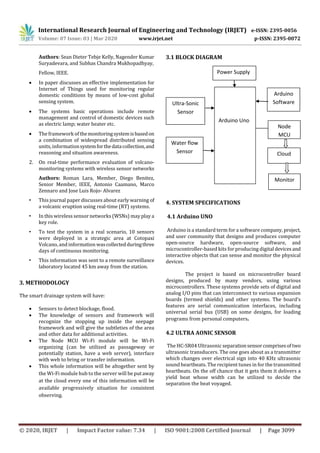
The smart drainage system will have:
 Sensors to detect blockage, flood.
 The knowledge of sensors and framework will
recognize the stopping up inside the seepage
framework and will give the subtleties of the area
and other data for additional activities.
 The Node MCU Wi-Fi module will be Wi-Fi
organizing (can be utilized as passageway or
potentially station, have a web server), interface
with web to bring or transfer information.
 This whole information will be altogether sent by
the Wi-Fi module hub to the server will be putaway
at the cloud every one of this information will be
available progressively situation for consistent
observing.
3.1 BLOCK DIAGRAM
4. SYSTEM SPECIFICATIONS
4.1 Arduino UNO
Arduino is a standard term for a software company, project,
and user community that designs and produces computer
open-source hardware, open-source software, and
microcontroller-based kits for producing digital devices and
interactive objects that can sense and monitor the physical
devices.
The project is based on microcontroller board
designs, produced by many vendors, using various
microcontrollers. These systems provide sets of digital and
analog I/O pins that can interconnect to various expansion
boards (termed shields) and other systems. The board’s
features are serial communication interfaces, including
universal serial bus (USB) on some designs, for loading
programs from personal computers.
4.2 ULTRA AONIC SENSOR
The HC-SR04 Ultrasonic separationsensorcomprisesoftwo
ultrasonic transducers. The one goes about as a transmitter
which changes over electrical sign into 40 KHz ultrasonic
sound heartbeats. The recipient tunes in for the transmitted
heartbeats. On the off chance that it gets them it delivers a
yield beat whose width can be utilized to decide the
separation the beat voyaged.
Ultra-Sonic
Sensor
Arduino Uno
Arduino
Software
Water flow
Sensor
Node
MCU
Cloud
Monitor
Power Supply
International Research Journal of Engineering and Technology (IRJET) e-ISSN: 2395-0056
Volume: 07 Issue: 03 | Mar 2020 www.irjet.net p-ISSN: 2395-0072
© 2020, IRJET | Impact Factor value: 7.34 | ISO 9001:2008 Certified Journal | Page 3100
4.3 WATER FLOW SENSOR
Water stream sensor comprises of a plastic valve from
which water can pass. A water rotor along with a hall effect
sensor is available to sense and measures the water stream.
At the point when water moves through the valve it
pivots the rotor. By this, the change can be seen in the speed
of the engine. This change is determined as yield as a
heartbeat signal by the corridor impact sensor.
Consequently, the pace of stream of water can be estimated.
4.4 Node MCU
The All new NodeMCU ESP8266 V3 Lau CH340 Wi-Fi Dev.
Board is a fast-leading edge low-cost Wife technology.
Modern high-level mature LUA based technology. It is an
integrated unit with all available resources on board. It is
super simple to complement your existing Arduino projects
or any development board that has I/O pins available.
Modern Internet development tools suchasNode.js
can take advantage the NodeMCU with thebuilt-inAPIto put
your idea on the fast track immediately. NodeMCU is built
based on the mature ESP8266 technology to take advantage
of the abundant resources available on the web.
5. Experiment Setup
Experimental Result
CONCLUSION
Sensor networks are considered as the key enablers for the
IOT paradigm. This paper tends to about savvy and ongoing
Drainage observing framework through IOTapplications for
metropolitan urban areas. By utilizing different sensors, for
example, gas identification, water level just as blockage
recognition we can screen the constant situation of waste
framework by for recognizing the issues in sewage
framework. By doing this we can able to take particular
action on the problems as we will receive the early alerts of
blockage as well as increase. This paper can be utilized to
plan the savvy and constant sewage framework forchecking
just as investigating reason.
REFERENCES
[1] Brown, Eric (13 September 2016).” Who need the
Internet of things”? Linux.com? Retrieved 23 October 2016.
[2] Wemer-Allen, G., Johnson, J., Ruize, M., Less,J.,and Welsh,
Matt “Monitoring Volcanic Eruptions with a Wireless sensor
Network. (ISSN: 2321 – 5658) Volume 01– Issue 04,
December 2013 Asian Online Journals
[3] Basha, D. and Rus, D. “Design of Early Warning Flood
Detection System fordevelopingcountries.Proceedingof the
conference on ICTD, Bonsalove, India. Pp 1- 10, 2007.
[4] Yuwat, C. and Kilaso, S. “A Wireless Sensor Network for
Weather and Disaster Alarm System”, IPCSIT Vol. 6,
Singapore. Pp 1 – 5, 2011
[5] Morias, R., Valente, A., Serodo, C. “A Wireless Sensor
Network forSmartIrrigation andEnvironmental Monitoring.
EFTA/WCCA Joint Congress onITinAgriculture,Portugal,pp
845 – 850. 2005
[6] Windarto, J.” Flood Early Warning System develop at
Garang River Semarang using Information Technology base
on SMS and Web”. International Journal of Geomatics and
Geosciences Vol. 1 No. 1, 2010

IRJET - Smart Drainage Management System

  • 1.
    International Research Journalof Engineering and Technology (IRJET) e-ISSN: 2395-0056 Volume: 07 Issue: 03 | Mar 2020 www.irjet.net p-ISSN: 2395-0072 © 2020, IRJET | Impact Factor value: 7.34 | ISO 9001:2008 Certified Journal | Page 3098 SMART DRAINAGE MANAGEMENT SYSTEM G. Durvasi1, G. Keerthi2, V. Phani Sonika3,T. Hepsiba Susan4 1Assistant Professor, Department of Information Technology and Engineering, Andhra Loyola Institute of Engineering and Technology, Vijayawada-08, Andhra Pradesh, India 2,3,4Under Graduate Student, Department of Information Technology and Engineering, Andhra Loyola Institute of Engineering and Technology, Vijayawada-08, Andhra Pradesh, India ---------------------------------------------------------------------***---------------------------------------------------------------------- Abstract - As we are forming urban communities into brilliant urban communities subsequently there is a need for designing proper underground infrastructure which includes underground water pipelines, drainage monitoring for the purpose of keeping the city clean. If the system isn't monitored properly it's going to cause blockage and sewage overflow which successively results in contamination of pure water leading to spreading of infectious diseases. So different quite work has been done to detect, maintain and manage these underground systems. In like manner, leaks and bursts which are unavoidable aspects of water distribution system management and may account for significant water loss within a distribution network ifleft undetected forlongperiod. This project representstheimplementationformonitoring and managing underground system with different approaches. It gives a description of water flow system by giving water flow rate and detecting overflow and also it uses detection method to detect blockage defects in sewer pipeline based on Water flow. Key Words: IOT, WSN, Drainage System, Sensors. 1. INTRODUCTION Sewage framework assumes a significant job in huge urban communities where a huge number of individuals live. Sewage framework is known as the base for land dryness from the overabundance and unused water. Downpour water and wastewater. Sewage conditions ought to be observed so as to keep up its appropriate capacity. Actually, not all zones have a sewage observing group. It prompts inconstant observing of the waste condition. The inconstant checking has added to the obstructing of the waste that suggests the welcome which triggers flooding in the area. Manual checking is additionally hard. It needs a ton of committed people who are just ready to record constrained reports with low exactness. The issue emergesinsuchwaste lines can make difficult issues in the everyday schedule of the city. Issues, for example, blockage because of waste material, abrupt increment in the water level if the best possible cleaning moves are not made every once in a while. The present sewage framework isn't electronic because of which it is difficult to know whether blockage is happening specifically area. Likewise, we don't get early alarms of the blockage or the expansion in water level. Henceforth identification and fixingoftheblockagebecomestedious and furious. NodeMCU combines features of WIFI access point and station + microcontroller. These are the features which makes the NodeMCU extremely powerful tool for Wi-Fi networking. It tends to be used as access point and/or station, host a webserver or connect to internet to fetch or upload data. By using this type of wireless sensor network, we can be notified the sensor data through internet. 1.1 PROBLEM STATEMENT Overflow of sewage on roads is been a major problem in many developed and under developed cities as well. Existing drainage system is manual monitoring and all areas doesn’t have proper monitoring teams. Manual monitoring is difficult and ineffective. One of the major problems on the rainy days are overflow of manholes and drainage on a road. which is caused due to no information on manhole level of filling. Another problem in drainage system is difficulty of finding blockage in underground drainage pipes. Most of time drainage management team of municipality detects the problem in the drainage system when it is causes the trouble. 1.2 OBJECTIVE This project is to keep the city clean, safety and healthy. And to replace the manual work of drainage monitoring for the safety of sewage workers. The intelligence of sensors and predictive system identifies the drain is clogged and also give usinformationof level of manhole filled so, action can be taken by the authorities. The sensors are communicated through Wi-Fi communication modules to share information. This information canbeviewedbyauthorizedusersatany time and any place in the internet. 2. LITERATURE SURVEY 1. Towards the implementation of IoT for environmental condition monitoring in homes
  • 2.
    International Research Journalof Engineering and Technology (IRJET) e-ISSN: 2395-0056 Volume: 07 Issue: 03 | Mar 2020 www.irjet.net p-ISSN: 2395-0072 © 2020, IRJET | Impact Factor value: 7.34 | ISO 9001:2008 Certified Journal | Page 3099 Authors: Sean Dieter Tebje Kelly, Nagender Kumar Suryadevara, and Subhas Chandra Mukhopadhyay, Fellow, IEEE.  In paper discusses an effective implementation for Internet of Things used for monitoring regular domestic conditions by means of low-cost global sensing system.  The systems basic operations include remote management and control of domestic devices such as electric lamp; water heater etc.  The framework of themonitoringsystemisbasedon a combination of widespread distributed sensing units, informationsystemforthedatacollection,and reasoning and situation awareness. 2. On real-time performance evaluation of volcano- monitoring systems with wireless sensor networks Authors: Roman Lara, Member, Diego Benitez, Senior Member, IEEE, Antonio Caamano, Marco Zennaro and Jose Luis Rojo- Alvarez • This journal paper discusses about early warning of a volcanic eruption using real-time (RT) systems. • In this wireless sensor networks (WSNs) may play a key role. • To test the system in a real scenario, 10 sensors were deployed in a strategic area at Cotopaxi Volcano, and information wascollectedduringthree days of continuous monitoring. • This information was sent to a remote surveillance laboratory located 45 km away from the station. 3. METHODOLOGY The smart drainage system will have:  Sensors to detect blockage, flood.  The knowledge of sensors and framework will recognize the stopping up inside the seepage framework and will give the subtleties of the area and other data for additional activities.  The Node MCU Wi-Fi module will be Wi-Fi organizing (can be utilized as passageway or potentially station, have a web server), interface with web to bring or transfer information.  This whole information will be altogether sent by the Wi-Fi module hub to the server will be putaway at the cloud every one of this information will be available progressively situation for consistent observing. 3.1 BLOCK DIAGRAM 4. SYSTEM SPECIFICATIONS 4.1 Arduino UNO Arduino is a standard term for a software company, project, and user community that designs and produces computer open-source hardware, open-source software, and microcontroller-based kits for producing digital devices and interactive objects that can sense and monitor the physical devices. The project is based on microcontroller board designs, produced by many vendors, using various microcontrollers. These systems provide sets of digital and analog I/O pins that can interconnect to various expansion boards (termed shields) and other systems. The board’s features are serial communication interfaces, including universal serial bus (USB) on some designs, for loading programs from personal computers. 4.2 ULTRA AONIC SENSOR The HC-SR04 Ultrasonic separationsensorcomprisesoftwo ultrasonic transducers. The one goes about as a transmitter which changes over electrical sign into 40 KHz ultrasonic sound heartbeats. The recipient tunes in for the transmitted heartbeats. On the off chance that it gets them it delivers a yield beat whose width can be utilized to decide the separation the beat voyaged. Ultra-Sonic Sensor Arduino Uno Arduino Software Water flow Sensor Node MCU Cloud Monitor Power Supply
  • 3.
    International Research Journalof Engineering and Technology (IRJET) e-ISSN: 2395-0056 Volume: 07 Issue: 03 | Mar 2020 www.irjet.net p-ISSN: 2395-0072 © 2020, IRJET | Impact Factor value: 7.34 | ISO 9001:2008 Certified Journal | Page 3100 4.3 WATER FLOW SENSOR Water stream sensor comprises of a plastic valve from which water can pass. A water rotor along with a hall effect sensor is available to sense and measures the water stream. At the point when water moves through the valve it pivots the rotor. By this, the change can be seen in the speed of the engine. This change is determined as yield as a heartbeat signal by the corridor impact sensor. Consequently, the pace of stream of water can be estimated. 4.4 Node MCU The All new NodeMCU ESP8266 V3 Lau CH340 Wi-Fi Dev. Board is a fast-leading edge low-cost Wife technology. Modern high-level mature LUA based technology. It is an integrated unit with all available resources on board. It is super simple to complement your existing Arduino projects or any development board that has I/O pins available. Modern Internet development tools suchasNode.js can take advantage the NodeMCU with thebuilt-inAPIto put your idea on the fast track immediately. NodeMCU is built based on the mature ESP8266 technology to take advantage of the abundant resources available on the web. 5. Experiment Setup Experimental Result CONCLUSION Sensor networks are considered as the key enablers for the IOT paradigm. This paper tends to about savvy and ongoing Drainage observing framework through IOTapplications for metropolitan urban areas. By utilizing different sensors, for example, gas identification, water level just as blockage recognition we can screen the constant situation of waste framework by for recognizing the issues in sewage framework. By doing this we can able to take particular action on the problems as we will receive the early alerts of blockage as well as increase. This paper can be utilized to plan the savvy and constant sewage framework forchecking just as investigating reason. REFERENCES [1] Brown, Eric (13 September 2016).” Who need the Internet of things”? Linux.com? Retrieved 23 October 2016. [2] Wemer-Allen, G., Johnson, J., Ruize, M., Less,J.,and Welsh, Matt “Monitoring Volcanic Eruptions with a Wireless sensor Network. (ISSN: 2321 – 5658) Volume 01– Issue 04, December 2013 Asian Online Journals [3] Basha, D. and Rus, D. “Design of Early Warning Flood Detection System fordevelopingcountries.Proceedingof the conference on ICTD, Bonsalove, India. Pp 1- 10, 2007. [4] Yuwat, C. and Kilaso, S. “A Wireless Sensor Network for Weather and Disaster Alarm System”, IPCSIT Vol. 6, Singapore. Pp 1 – 5, 2011 [5] Morias, R., Valente, A., Serodo, C. “A Wireless Sensor Network forSmartIrrigation andEnvironmental Monitoring. EFTA/WCCA Joint Congress onITinAgriculture,Portugal,pp 845 – 850. 2005 [6] Windarto, J.” Flood Early Warning System develop at Garang River Semarang using Information Technology base on SMS and Web”. International Journal of Geomatics and Geosciences Vol. 1 No. 1, 2010