International Research Journal of Engineering and Technology (IRJET) e-ISSN: 2395-0056
Volume: 06 Issue: 09 | Sep 2019 www.irjet.net p-ISSN: 2395-0072
© 2019, IRJET | Impact Factor value: 7.34 | ISO 9001:2008 Certified Journal | Page 231
Cloud based Intelligent Plant Monitoring Device
Gunjan Chauhan1, Yash Sharma2
1
Department of Biochemistry, Katkiya P.G. College, Jagdalpur, Chhattisgarh, India
2
Department of Electronics and Telecommunication, Bhilai Institute of Technology ,Raipur, Chhattisgarh, India
-----------------------------------------------------------------------***--------------------------------------------------------------------
Abstract - Issues concerning agriculture, countryside and farmers have been always hindering India’s development. The only
solution to these three problems is agricultural modernization. The Introduction of cloud computing and Internet of things
into agricultural modernization will probabaly solve the problem. Cloud computing is closely related to Internet of things. A
perfect combination of them can promote fast development of agricultural modernization, realize smart agriculture and
effectively solve the issues concerning agriculture, countryside and farmers. This project is designed as a smart plant
monitoring system based on IoT through this one can easily monitor the light intensity, humidity and temperature like
quantities of a plant from anywhere in the world. The data visualization can be achieved by using a android/ios application.
Key Words: Nodemcu ESP8266 boards, Adafruit IoT cloud platform, Environmental factors, Sensor, IoT, Wi-Fi.
1. INTRODUCTION
International Telecommunication Union defines IoT as “A global infrastructure for the Information Society, enabling
advanced services by interconnecting (physical and virtual) things based on, existing and evolving, interoperable information
and communication technologies.”
IoT is also defined as “The network of physical objects – devices, vehicles, buildings and other items – embedded with
electronics, software, sensors, and network connectivity that enables these objects to collect andexchange data.TheIoTallows
objects to be sensed and controlled remotely across existing network infrastructure."
Atits very basic level,IoT refers to theconnection of everyday objects to the Internet and to oneanother,with thegoal being to
provide users with smarter, more efficient experiences. Some recent examples of IoT products include the Nest Protect
smoke detector, August door locks and Nest thermostat. One of the known examples is the Nest thermostat. This Wi-Fi
connected thermostat allows you to remotely adjust the temperature via mobile device. The potential value is that we can
save money on utility bill by being ableto remotely turn off aircondition, which we forget to dobefore leaving the house.
We live in a world where everything can be controlled and operated automatically, but thereare still a few importantsectors in
our country where automation has not been adopted or not been put to a full-fledged use, perhaps because of several
reasons one such reason is cost. One such field is that of agriculture. Agriculture been one of the primary occupations of man
since early civilizations and even today manual interventions in farming are inevitable.
Plant monitoring form an important part of the agriculture and horticulture sectors in our country as they can be used to
grow plants under controlled climatic conditions for optimum produce. Automating a plant monitoring andcontrolling of the
climatic parameters which directly or indirectly govern the plant growth and hence their produce. Automation is process
control of industrial machinery and processes, thereby replacing human operators.
In this paper the presented plant monitoring system technology to provide feedback to the user through smart phone. The
automated system will reduce the need of manpower hencereducing the error for a large scale area, itisquite impossible for
a farmer to monitor the efficiency of the system by implementing this technology, the farmers can easily monitor the system
using there smart phone.
Certain important factors such as temperature, humidity, light and the level of carbon dioxide has an impact on the
productivity of plant growth. Therefore, continuous monitoring of these environmental factors gives information to the user,
how each factor affects growthand how tomaximize the growth of plants. In recent year’s precisionagriculture hasbecome the
trend in agriculture. Here the focus is mainly on understanding the environment through the interpretation of wide variety
of data. The main idea of the system is to monitor the plants whether they get required amount of water and light. If there is
enough moisture in the soil, the samewill bereported to the user.
This will help the user to give the resources to the plants every day without much manual effort and constantly monitor the
health of a plant from a remote location. Improvement of agricultural field has become biggest challenge for countries like
India, so new technologies are to be adopted. We have implemented a novel methodology of physical parameter monitoring,
International Research Journal of Engineering and Technology (IRJET) e-ISSN: 2395-0056
Volume: 06 Issue: 09 | Sep 2019 www.irjet.net p-ISSN: 2395-0072
© 2019, IRJET | Impact Factor value: 7.34 | ISO 9001:2008 Certified Journal | Page 232
data integration to the cloud, alert generation andpredicting the future values.
We have used Temperature humidity sensor, Soil moisture sensor and Light intensity sensor. These sensors have been
installed in the agriculture field to collect the data, and thus data is stored into the cloud using Adafruit IO IoT cloud
platform.
2. LITERATURE SURVEY
Teemu Ahonen, Reino Virrankoski and Mohammed Elmusrati [1], have done a research in Martens Greenhouse Research
Center in the Narpio townin Western Finland, they had integrated three commercial sensors with Sensinode’ssensorplatform
to measure four environmental key variables in greenhouse control. The system feasibility was verified in a simple star
topology setup in a tomato greenhouse. The sensors used were SHT75 humidity/temperature sensor and TSL262R light
irradiance sensor, and Figaro’s TGS4161 CO2 sensor used. Application of the concept in the greenhouse: temperature,
luminosity and humidity sensors measured climate variables and communicated directly with the gateway node.Thegateway
node acted as a coordinator and received the measured data from the sensor nodes. The maximal communication range, 15
meters was figured out in individual test where the distance between the coordinator and the sensor node inside the
greenhouse dense flora was increased, the reliable communication range fell to one third in the greenhouse’s dense flora.
Mancuso and Franco [2], have done a similar researchwork in a tomato greenhouse in the South ofItaly.TheSensicastdeviceis
used for air temperature, humidity and soil temperature with wireless sensor network and a web based plant monitoring
system is developed. User can read the measurements over the Internet, and an alert message is sent to his mobile phone
through SMS if there are any deviations from normal measurements. Sensor node will transmit the data of temperature and
relative humidity in one minute interval to the Bridgenode.
3. SYSTEM ARCHITECTURE
Fig -1: Block diagram of IoT based plant health monitoring system.
3.1 Temperature Sensor
Fig -2: DHT11 humidity and temperature sensor.
DHT11 is a Temperature and Humidity monitoring sensor using digital signal acquisition technique and temperature &
humidity sensing technology. This sensor consists of a resistive type humidity measurement component and an NTC
International Research Journal of Engineering and Technology (IRJET) e-ISSN: 2395-0056
Volume: 06 Issue: 09 | Sep 2019 www.irjet.net p-ISSN: 2395-0072
© 2019, IRJET | Impact Factor value: 7.34 | ISO 9001:2008 Certified Journal | Page 233
temperature measurement component, connects to a high performance 8-bit microcontroller, offering excellent quality, fast
response, anti-interference ability, low power consumption, cost effective cheap sensor and suitable for Arduino. It has
following specifications humidity measuring range 20% to 90% RH with an accuracy of 5.0% RH and temperature
measuring range of 0 to 50 C with an accuracy of 2.0C.
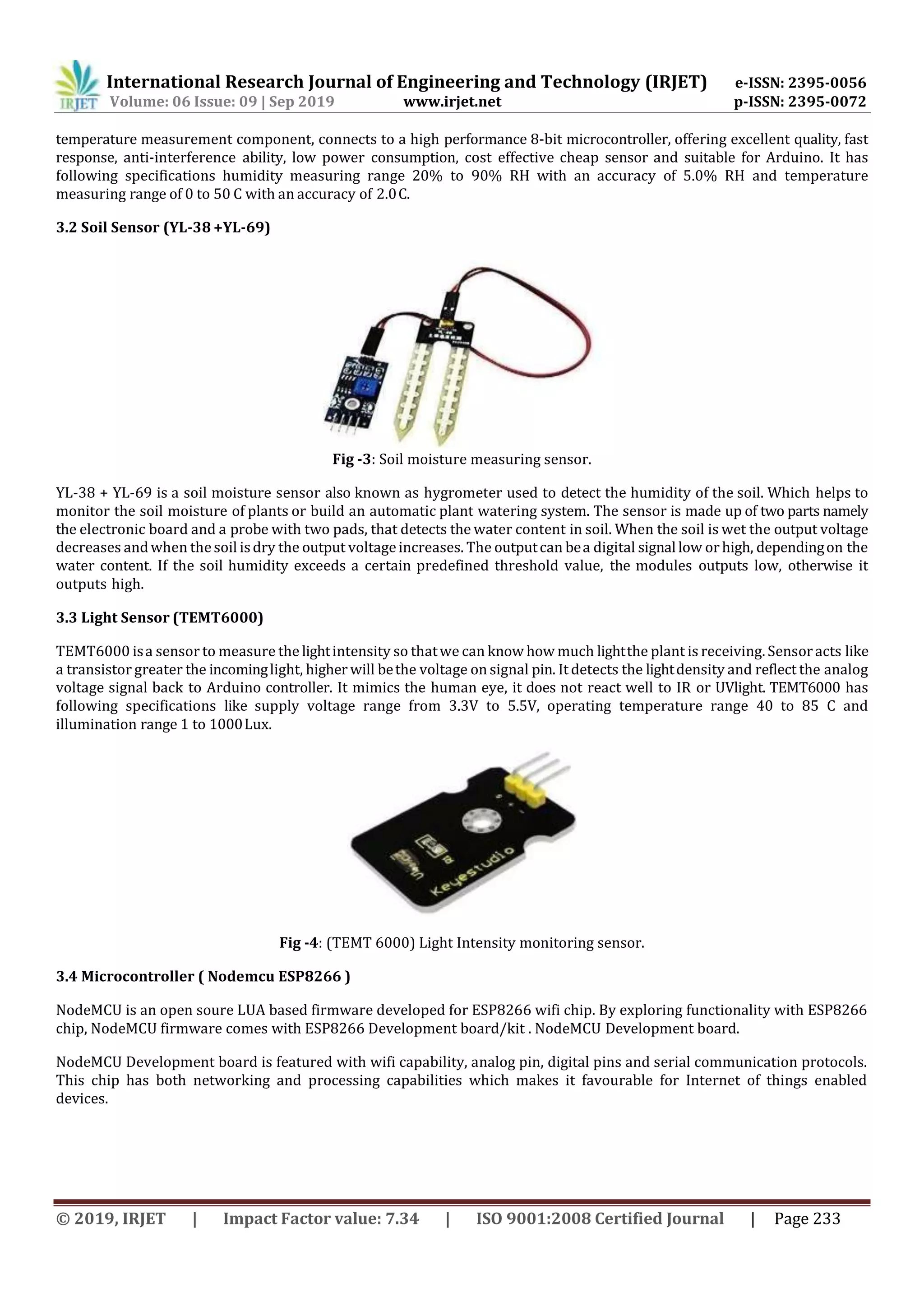
3.2 Soil Sensor (YL-38 +YL-69)
Fig -3: Soil moisture measuring sensor.
YL-38 + YL-69 is a soil moisture sensor also known as hygrometer used to detect the humidity of the soil. Which helps to
monitor the soil moisture of plants or build an automatic plant watering system. The sensor is made up of two parts namely
the electronic board and a probe with two pads, that detects the water content in soil. When the soil is wet the output voltage
decreases andwhen thesoil isdry the output voltageincreases. The outputcan bea digital signal low or high, dependingon the
water content. If the soil humidity exceeds a certain predefined threshold value, the modules outputs low, otherwise it
outputs high.
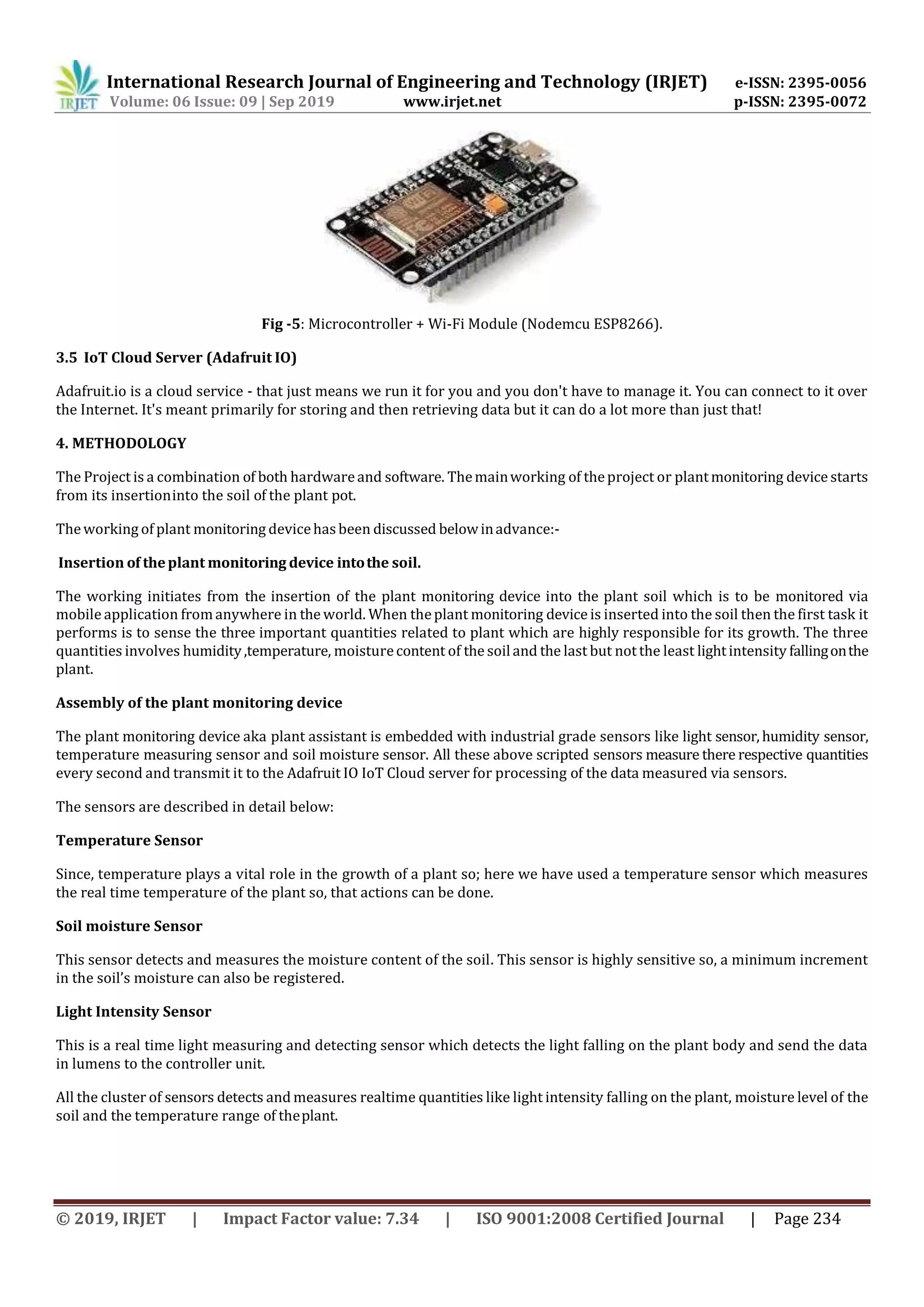
3.3 Light Sensor (TEMT6000)
TEMT6000 isa sensor to measure the lightintensity so thatwe can know how much lightthe plant is receiving. Sensoracts like
a transistor greater the incominglight, higher will bethe voltage on signal pin. It detects the lightdensity and reflect the analog
voltage signal back to Arduino controller. It mimics the human eye, it does not react well to IR or UVlight. TEMT6000 has
following specifications like supply voltage range from 3.3V to 5.5V, operating temperature range 40 to 85 C and
illumination range 1 to 1000Lux.
Fig -4: (TEMT 6000) Light Intensity monitoring sensor.
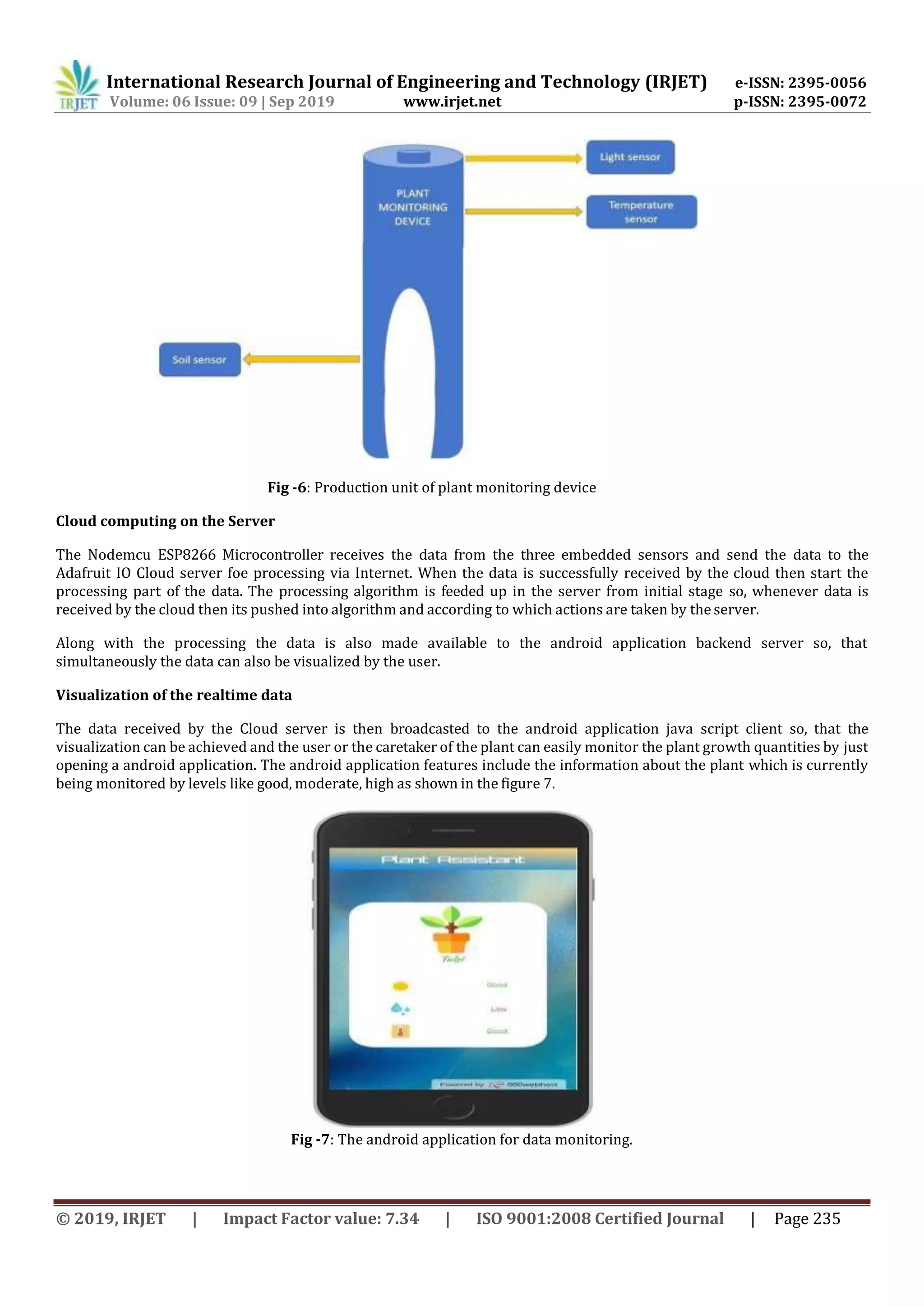
3.4 Microcontroller ( Nodemcu ESP8266 )
NodeMCU is an open soure LUA based firmware developed for ESP8266 wifi chip. By exploring functionality with ESP8266
chip, NodeMCU firmware comes with ESP8266 Development board/kit . NodeMCU Development board.
NodeMCU Development board is featured with wifi capability, analog pin, digital pins and serial communication protocols.
This chip has both networking and processing capabilities which makes it favourable for Internet of things enabled
devices.
International Research Journal of Engineering and Technology (IRJET) e-ISSN: 2395-0056
Volume: 06 Issue: 09 | Sep 2019 www.irjet.net p-ISSN: 2395-0072
© 2019, IRJET | Impact Factor value: 7.34 | ISO 9001:2008 Certified Journal | Page 234
Fig -5: Microcontroller + Wi-Fi Module (Nodemcu ESP8266).
3.5 IoT Cloud Server (Adafruit IO)
Adafruit.io is a cloud service - that just means we run it for you and you don't have to manage it. You can connect to it over
the Internet. It's meant primarily for storing and then retrieving data but it can do a lot more than just that!
4. METHODOLOGY
The Project is a combination of both hardwareand software. Themainworking of theproject or plantmonitoring device starts
from its insertioninto the soil of the plant pot.
Theworking of plant monitoring devicehasbeen discussed belowinadvance:-
Insertion of theplant monitoring device intothe soil.
The working initiates from the insertion of the plant monitoring device into the plant soil which is to be monitored via
mobile application fromanywhere in the world. When theplant monitoring device is inserted into the soil then the first task it
performs is to sense the three important quantities related to plant which are highly responsible for its growth. The three
quantities involves humidity,temperature, moisturecontent of the soiland the last but not the least lightintensity fallingonthe
plant.
Assembly of the plant monitoring device
The plant monitoring device aka plant assistant is embedded with industrial grade sensors like light sensor, humidity sensor,
temperature measuring sensor and soil moisture sensor. All these above scripted sensors measure there respective quantities
every second and transmit it to the Adafruit IO IoT Cloud server for processing of the data measured via sensors.
The sensors are described in detail below:
Temperature Sensor
Since, temperature plays a vital role in the growth of a plant so; here we have used a temperature sensor which measures
the real time temperature of the plant so, that actions can be done.
Soil moisture Sensor
This sensor detects and measures the moisture content of the soil. This sensor is highly sensitive so, a minimum increment
in the soil’s moisture can also be registered.
Light Intensity Sensor
This is a real time light measuring and detecting sensor which detects the light falling on the plant body and send the data
in lumens to the controller unit.
All the cluster of sensors detects and measures realtime quantities like light intensity falling on the plant, moisture level of the
soil and the temperature range of theplant.
International Research Journal of Engineering and Technology (IRJET) e-ISSN: 2395-0056
Volume: 06 Issue: 09 | Sep 2019 www.irjet.net p-ISSN: 2395-0072
© 2019, IRJET | Impact Factor value: 7.34 | ISO 9001:2008 Certified Journal | Page 235
Fig -6: Production unit of plant monitoring device
Cloud computing on the Server
The Nodemcu ESP8266 Microcontroller receives the data from the three embedded sensors and send the data to the
Adafruit IO Cloud server foe processing via Internet. When the data is successfully received by the cloud then start the
processing part of the data. The processing algorithm is feeded up in the server from initial stage so, whenever data is
received by the cloud then its pushed into algorithm and according to which actions are taken by the server.
Along with the processing the data is also made available to the android application backend server so, that
simultaneously the data can also be visualized by the user.
Visualization of the realtime data
The data received by the Cloud server is then broadcasted to the android application java script client so, that the
visualization can be achieved and the user or the caretaker of the plant can easily monitor the plant growth quantities by just
opening a android application. The android application features include the information about the plant which is currently
being monitored by levels like good, moderate, high as shown in the figure 7.
Fig -7: The android application for data monitoring.
International Research Journal of Engineering and Technology (IRJET) e-ISSN: 2395-0056
Volume: 06 Issue: 09 | Sep 2019 www.irjet.net p-ISSN: 2395-0072
© 2019, IRJET | Impact Factor value: 7.34 | ISO 9001:2008 Certified Journal | Page 236
5. EXPERIMENT AND ANALYSIS
By this work, the wastage of water and the consumption of power by motor can be reduced so that they are conserved for the
future use. This system provides complete monitoring action of sensors in fields that is very easy to control the field. It also
provides huge security to the plants and by using machine learning we can easily detect the plant behavior according to the
environmental conditions. The sensors and microcontroller are successfully interfaced with the cloud. The data is stored
successfully and can beaccessed remotely. All observations and experimental set up proves that this isa complete solution to
monitor the health of a plant. User can have access to the data and can know if there are any deviations with respect to
temperature, humidity, soil moistureand lightintensity. Implementing this system will allow users likefarmersto monitorand
improve the yield of crops and overall production.
6. FUTURE SCOPE
• The performance of the system can be further improved in terms of the operating speed, memory capacity, and
instruction cycle period of the microcontroller by using other high end controllers. Thenumberofchannelscanbe
increased to interface more number of sensors which is possible by using advanced versions of controllers.
• The system can be modified with the use of a data logger and a graphical LCD panel showing the measured
sensor data over a period of time.
• A speaking voice alarm could beused or a mobile notification can be broadcasted to the android application.
• The device can be made to perform better by providing the power supply with the help of renewable source.
• Time bound administration of fertilizers, insecticides and pesticides can beintroduced.
• The machine learning algorithms can also be used to study the behavior oof plant according to different
environmental factors.
• The device can also be powered with small solar panels as a power source in order to ignite the electronics
inside the smart plant monitoring device.
7. CONCLUSION
By this work, the wastage of water and the consumption of power by motor can be reduced so that they are conserved for the
future use. This system provides complete monitoring action of sensors in fields that is very easy to control the field. It also
provides huge security to the plants and by using machine learning we can easily detect the plant behavior according to the
environmental conditions. The sensors and microcontroller are successfully interfaced with the cloud. The data is stored
successfully and can beaccessed remotely. All observations and experimental set up proves that this isa complete solution to
monitor the health of a plant. User can have access to the data and can know if there are any deviations with respect to
temperature, humidity, soil moistureand lightintensity. Implementing this system will allow users likefarmersto monitorand
improve the yield of crops and overall production.
REFERENCES
[1] Teemu Ahonen, Reino Virrankoski and Mohammed Elmusrati, “Greenhouse Monitoring with Wireless Sensor
Network” University of Vaasa.
[2] Marco Mancuso and Franco Bustaffa, “A Wireless Sensor Network for Monitoring Environmental Variables in a
Tomato Greenhouse”.
International Research Journal of Engineering and Technology (IRJET) e-ISSN: 2395-0056
Volume: 06 Issue: 09 | Sep 2019 www.irjet.net p-ISSN: 2395-0072
© 2019, IRJET | Impact Factor value: 7.34 | ISO 9001:2008 Certified Journal | Page 237
BIOGRAPHIES
Miss. Gunjan Chauhan is pursuing her final year in BSC (BioChemistry) from Katkiya P.G. College,
Bastar University, Chhattisgarh, India. She is currently working on effect of environmental factors
on plants growth.Her area of interest are mainly focused on concepts regarding Chemistry.
Er. Yash Sharma is pursuing his final year in BE (Electronics and Telecommunication) from Bhilai
Institute of Technology, Raipur ,Chhattisgarh, India. He is an IoT Enthusiast and Embedded developer .
He is currently working on Smart home automation products and smart voice assistants . His area
of interest are Internet of Things and Machine Learning .

IRJET- Cloud based Intelligent Plant Monitoring Device

  • 1.
    International Research Journalof Engineering and Technology (IRJET) e-ISSN: 2395-0056 Volume: 06 Issue: 09 | Sep 2019 www.irjet.net p-ISSN: 2395-0072 © 2019, IRJET | Impact Factor value: 7.34 | ISO 9001:2008 Certified Journal | Page 231 Cloud based Intelligent Plant Monitoring Device Gunjan Chauhan1, Yash Sharma2 1 Department of Biochemistry, Katkiya P.G. College, Jagdalpur, Chhattisgarh, India 2 Department of Electronics and Telecommunication, Bhilai Institute of Technology ,Raipur, Chhattisgarh, India -----------------------------------------------------------------------***-------------------------------------------------------------------- Abstract - Issues concerning agriculture, countryside and farmers have been always hindering India’s development. The only solution to these three problems is agricultural modernization. The Introduction of cloud computing and Internet of things into agricultural modernization will probabaly solve the problem. Cloud computing is closely related to Internet of things. A perfect combination of them can promote fast development of agricultural modernization, realize smart agriculture and effectively solve the issues concerning agriculture, countryside and farmers. This project is designed as a smart plant monitoring system based on IoT through this one can easily monitor the light intensity, humidity and temperature like quantities of a plant from anywhere in the world. The data visualization can be achieved by using a android/ios application. Key Words: Nodemcu ESP8266 boards, Adafruit IoT cloud platform, Environmental factors, Sensor, IoT, Wi-Fi. 1. INTRODUCTION International Telecommunication Union defines IoT as “A global infrastructure for the Information Society, enabling advanced services by interconnecting (physical and virtual) things based on, existing and evolving, interoperable information and communication technologies.” IoT is also defined as “The network of physical objects – devices, vehicles, buildings and other items – embedded with electronics, software, sensors, and network connectivity that enables these objects to collect andexchange data.TheIoTallows objects to be sensed and controlled remotely across existing network infrastructure." Atits very basic level,IoT refers to theconnection of everyday objects to the Internet and to oneanother,with thegoal being to provide users with smarter, more efficient experiences. Some recent examples of IoT products include the Nest Protect smoke detector, August door locks and Nest thermostat. One of the known examples is the Nest thermostat. This Wi-Fi connected thermostat allows you to remotely adjust the temperature via mobile device. The potential value is that we can save money on utility bill by being ableto remotely turn off aircondition, which we forget to dobefore leaving the house. We live in a world where everything can be controlled and operated automatically, but thereare still a few importantsectors in our country where automation has not been adopted or not been put to a full-fledged use, perhaps because of several reasons one such reason is cost. One such field is that of agriculture. Agriculture been one of the primary occupations of man since early civilizations and even today manual interventions in farming are inevitable. Plant monitoring form an important part of the agriculture and horticulture sectors in our country as they can be used to grow plants under controlled climatic conditions for optimum produce. Automating a plant monitoring andcontrolling of the climatic parameters which directly or indirectly govern the plant growth and hence their produce. Automation is process control of industrial machinery and processes, thereby replacing human operators. In this paper the presented plant monitoring system technology to provide feedback to the user through smart phone. The automated system will reduce the need of manpower hencereducing the error for a large scale area, itisquite impossible for a farmer to monitor the efficiency of the system by implementing this technology, the farmers can easily monitor the system using there smart phone. Certain important factors such as temperature, humidity, light and the level of carbon dioxide has an impact on the productivity of plant growth. Therefore, continuous monitoring of these environmental factors gives information to the user, how each factor affects growthand how tomaximize the growth of plants. In recent year’s precisionagriculture hasbecome the trend in agriculture. Here the focus is mainly on understanding the environment through the interpretation of wide variety of data. The main idea of the system is to monitor the plants whether they get required amount of water and light. If there is enough moisture in the soil, the samewill bereported to the user. This will help the user to give the resources to the plants every day without much manual effort and constantly monitor the health of a plant from a remote location. Improvement of agricultural field has become biggest challenge for countries like India, so new technologies are to be adopted. We have implemented a novel methodology of physical parameter monitoring,
  • 2.
    International Research Journalof Engineering and Technology (IRJET) e-ISSN: 2395-0056 Volume: 06 Issue: 09 | Sep 2019 www.irjet.net p-ISSN: 2395-0072 © 2019, IRJET | Impact Factor value: 7.34 | ISO 9001:2008 Certified Journal | Page 232 data integration to the cloud, alert generation andpredicting the future values. We have used Temperature humidity sensor, Soil moisture sensor and Light intensity sensor. These sensors have been installed in the agriculture field to collect the data, and thus data is stored into the cloud using Adafruit IO IoT cloud platform. 2. LITERATURE SURVEY Teemu Ahonen, Reino Virrankoski and Mohammed Elmusrati [1], have done a research in Martens Greenhouse Research Center in the Narpio townin Western Finland, they had integrated three commercial sensors with Sensinode’ssensorplatform to measure four environmental key variables in greenhouse control. The system feasibility was verified in a simple star topology setup in a tomato greenhouse. The sensors used were SHT75 humidity/temperature sensor and TSL262R light irradiance sensor, and Figaro’s TGS4161 CO2 sensor used. Application of the concept in the greenhouse: temperature, luminosity and humidity sensors measured climate variables and communicated directly with the gateway node.Thegateway node acted as a coordinator and received the measured data from the sensor nodes. The maximal communication range, 15 meters was figured out in individual test where the distance between the coordinator and the sensor node inside the greenhouse dense flora was increased, the reliable communication range fell to one third in the greenhouse’s dense flora. Mancuso and Franco [2], have done a similar researchwork in a tomato greenhouse in the South ofItaly.TheSensicastdeviceis used for air temperature, humidity and soil temperature with wireless sensor network and a web based plant monitoring system is developed. User can read the measurements over the Internet, and an alert message is sent to his mobile phone through SMS if there are any deviations from normal measurements. Sensor node will transmit the data of temperature and relative humidity in one minute interval to the Bridgenode. 3. SYSTEM ARCHITECTURE Fig -1: Block diagram of IoT based plant health monitoring system. 3.1 Temperature Sensor Fig -2: DHT11 humidity and temperature sensor. DHT11 is a Temperature and Humidity monitoring sensor using digital signal acquisition technique and temperature & humidity sensing technology. This sensor consists of a resistive type humidity measurement component and an NTC
  • 3.
    International Research Journalof Engineering and Technology (IRJET) e-ISSN: 2395-0056 Volume: 06 Issue: 09 | Sep 2019 www.irjet.net p-ISSN: 2395-0072 © 2019, IRJET | Impact Factor value: 7.34 | ISO 9001:2008 Certified Journal | Page 233 temperature measurement component, connects to a high performance 8-bit microcontroller, offering excellent quality, fast response, anti-interference ability, low power consumption, cost effective cheap sensor and suitable for Arduino. It has following specifications humidity measuring range 20% to 90% RH with an accuracy of 5.0% RH and temperature measuring range of 0 to 50 C with an accuracy of 2.0C. 3.2 Soil Sensor (YL-38 +YL-69) Fig -3: Soil moisture measuring sensor. YL-38 + YL-69 is a soil moisture sensor also known as hygrometer used to detect the humidity of the soil. Which helps to monitor the soil moisture of plants or build an automatic plant watering system. The sensor is made up of two parts namely the electronic board and a probe with two pads, that detects the water content in soil. When the soil is wet the output voltage decreases andwhen thesoil isdry the output voltageincreases. The outputcan bea digital signal low or high, dependingon the water content. If the soil humidity exceeds a certain predefined threshold value, the modules outputs low, otherwise it outputs high. 3.3 Light Sensor (TEMT6000) TEMT6000 isa sensor to measure the lightintensity so thatwe can know how much lightthe plant is receiving. Sensoracts like a transistor greater the incominglight, higher will bethe voltage on signal pin. It detects the lightdensity and reflect the analog voltage signal back to Arduino controller. It mimics the human eye, it does not react well to IR or UVlight. TEMT6000 has following specifications like supply voltage range from 3.3V to 5.5V, operating temperature range 40 to 85 C and illumination range 1 to 1000Lux. Fig -4: (TEMT 6000) Light Intensity monitoring sensor. 3.4 Microcontroller ( Nodemcu ESP8266 ) NodeMCU is an open soure LUA based firmware developed for ESP8266 wifi chip. By exploring functionality with ESP8266 chip, NodeMCU firmware comes with ESP8266 Development board/kit . NodeMCU Development board. NodeMCU Development board is featured with wifi capability, analog pin, digital pins and serial communication protocols. This chip has both networking and processing capabilities which makes it favourable for Internet of things enabled devices.
  • 4.
    International Research Journalof Engineering and Technology (IRJET) e-ISSN: 2395-0056 Volume: 06 Issue: 09 | Sep 2019 www.irjet.net p-ISSN: 2395-0072 © 2019, IRJET | Impact Factor value: 7.34 | ISO 9001:2008 Certified Journal | Page 234 Fig -5: Microcontroller + Wi-Fi Module (Nodemcu ESP8266). 3.5 IoT Cloud Server (Adafruit IO) Adafruit.io is a cloud service - that just means we run it for you and you don't have to manage it. You can connect to it over the Internet. It's meant primarily for storing and then retrieving data but it can do a lot more than just that! 4. METHODOLOGY The Project is a combination of both hardwareand software. Themainworking of theproject or plantmonitoring device starts from its insertioninto the soil of the plant pot. Theworking of plant monitoring devicehasbeen discussed belowinadvance:- Insertion of theplant monitoring device intothe soil. The working initiates from the insertion of the plant monitoring device into the plant soil which is to be monitored via mobile application fromanywhere in the world. When theplant monitoring device is inserted into the soil then the first task it performs is to sense the three important quantities related to plant which are highly responsible for its growth. The three quantities involves humidity,temperature, moisturecontent of the soiland the last but not the least lightintensity fallingonthe plant. Assembly of the plant monitoring device The plant monitoring device aka plant assistant is embedded with industrial grade sensors like light sensor, humidity sensor, temperature measuring sensor and soil moisture sensor. All these above scripted sensors measure there respective quantities every second and transmit it to the Adafruit IO IoT Cloud server for processing of the data measured via sensors. The sensors are described in detail below: Temperature Sensor Since, temperature plays a vital role in the growth of a plant so; here we have used a temperature sensor which measures the real time temperature of the plant so, that actions can be done. Soil moisture Sensor This sensor detects and measures the moisture content of the soil. This sensor is highly sensitive so, a minimum increment in the soil’s moisture can also be registered. Light Intensity Sensor This is a real time light measuring and detecting sensor which detects the light falling on the plant body and send the data in lumens to the controller unit. All the cluster of sensors detects and measures realtime quantities like light intensity falling on the plant, moisture level of the soil and the temperature range of theplant.
  • 5.
    International Research Journalof Engineering and Technology (IRJET) e-ISSN: 2395-0056 Volume: 06 Issue: 09 | Sep 2019 www.irjet.net p-ISSN: 2395-0072 © 2019, IRJET | Impact Factor value: 7.34 | ISO 9001:2008 Certified Journal | Page 235 Fig -6: Production unit of plant monitoring device Cloud computing on the Server The Nodemcu ESP8266 Microcontroller receives the data from the three embedded sensors and send the data to the Adafruit IO Cloud server foe processing via Internet. When the data is successfully received by the cloud then start the processing part of the data. The processing algorithm is feeded up in the server from initial stage so, whenever data is received by the cloud then its pushed into algorithm and according to which actions are taken by the server. Along with the processing the data is also made available to the android application backend server so, that simultaneously the data can also be visualized by the user. Visualization of the realtime data The data received by the Cloud server is then broadcasted to the android application java script client so, that the visualization can be achieved and the user or the caretaker of the plant can easily monitor the plant growth quantities by just opening a android application. The android application features include the information about the plant which is currently being monitored by levels like good, moderate, high as shown in the figure 7. Fig -7: The android application for data monitoring.
  • 6.
    International Research Journalof Engineering and Technology (IRJET) e-ISSN: 2395-0056 Volume: 06 Issue: 09 | Sep 2019 www.irjet.net p-ISSN: 2395-0072 © 2019, IRJET | Impact Factor value: 7.34 | ISO 9001:2008 Certified Journal | Page 236 5. EXPERIMENT AND ANALYSIS By this work, the wastage of water and the consumption of power by motor can be reduced so that they are conserved for the future use. This system provides complete monitoring action of sensors in fields that is very easy to control the field. It also provides huge security to the plants and by using machine learning we can easily detect the plant behavior according to the environmental conditions. The sensors and microcontroller are successfully interfaced with the cloud. The data is stored successfully and can beaccessed remotely. All observations and experimental set up proves that this isa complete solution to monitor the health of a plant. User can have access to the data and can know if there are any deviations with respect to temperature, humidity, soil moistureand lightintensity. Implementing this system will allow users likefarmersto monitorand improve the yield of crops and overall production. 6. FUTURE SCOPE • The performance of the system can be further improved in terms of the operating speed, memory capacity, and instruction cycle period of the microcontroller by using other high end controllers. Thenumberofchannelscanbe increased to interface more number of sensors which is possible by using advanced versions of controllers. • The system can be modified with the use of a data logger and a graphical LCD panel showing the measured sensor data over a period of time. • A speaking voice alarm could beused or a mobile notification can be broadcasted to the android application. • The device can be made to perform better by providing the power supply with the help of renewable source. • Time bound administration of fertilizers, insecticides and pesticides can beintroduced. • The machine learning algorithms can also be used to study the behavior oof plant according to different environmental factors. • The device can also be powered with small solar panels as a power source in order to ignite the electronics inside the smart plant monitoring device. 7. CONCLUSION By this work, the wastage of water and the consumption of power by motor can be reduced so that they are conserved for the future use. This system provides complete monitoring action of sensors in fields that is very easy to control the field. It also provides huge security to the plants and by using machine learning we can easily detect the plant behavior according to the environmental conditions. The sensors and microcontroller are successfully interfaced with the cloud. The data is stored successfully and can beaccessed remotely. All observations and experimental set up proves that this isa complete solution to monitor the health of a plant. User can have access to the data and can know if there are any deviations with respect to temperature, humidity, soil moistureand lightintensity. Implementing this system will allow users likefarmersto monitorand improve the yield of crops and overall production. REFERENCES [1] Teemu Ahonen, Reino Virrankoski and Mohammed Elmusrati, “Greenhouse Monitoring with Wireless Sensor Network” University of Vaasa. [2] Marco Mancuso and Franco Bustaffa, “A Wireless Sensor Network for Monitoring Environmental Variables in a Tomato Greenhouse”.
  • 7.
    International Research Journalof Engineering and Technology (IRJET) e-ISSN: 2395-0056 Volume: 06 Issue: 09 | Sep 2019 www.irjet.net p-ISSN: 2395-0072 © 2019, IRJET | Impact Factor value: 7.34 | ISO 9001:2008 Certified Journal | Page 237 BIOGRAPHIES Miss. Gunjan Chauhan is pursuing her final year in BSC (BioChemistry) from Katkiya P.G. College, Bastar University, Chhattisgarh, India. She is currently working on effect of environmental factors on plants growth.Her area of interest are mainly focused on concepts regarding Chemistry. Er. Yash Sharma is pursuing his final year in BE (Electronics and Telecommunication) from Bhilai Institute of Technology, Raipur ,Chhattisgarh, India. He is an IoT Enthusiast and Embedded developer . He is currently working on Smart home automation products and smart voice assistants . His area of interest are Internet of Things and Machine Learning .