International Research Journal of Engineering and Technology (IRJET) e-ISSN: 2395-0056
Volume: 06 Issue: 08 | Aug 2019 www.irjet.net p-ISSN: 2395-0072
© 2019, IRJET | Impact Factor value: 7.34 | ISO 9001:2008 Certified Journal | Page 428
AN EXPERIMENTAL INVESTIGATION ON REINFORCED CONCRETE
CONTAINING GGBFS
Vikas Kumar1, Ramanuj Jaldhari2
1M.Tech Scholar Vikas Kumar, Dept. of Civil Engineering, Kautilya institute of Technology & Engineering, Jaipur
(Raj.), India
2 Er. Ramanuj Jaldhari, Dept. of Civil Engineering, Kautilya institute of Technology & Engineering, Jaipur (Raj.),
India
-----------------------------------------------------------------------***--------------------------------------------------------------------
Abstract – Use of steel is known to increase flexural strength
in concrete beams. However, the literature mainly consists of
studies on beams with reinforced concrete along with the
cement replacing materials. The present investigationaims to
study the behavior of concrete beams with steelreinforcement
and also to evaluate the performance of plain concreteflexure
member and reinforced concrete flexure members with
Ground Granulated Blast Furnace Slag. GGBFScontentusedin
present work are 30% and 40% as cement replacing material.
The study was conducted with two water cement ratios: 0.35
and 0.40 for M 40 grade of concrete. The study was performed
with three different reinforcement contents, with doubly
reinforced sections containing two bars of 6mm, 8mm
and10mm as the main reinforcement and two bars of 6mm,
6mm and 8mm as compression reinforcement respectively.
The specimens were testedfor strengthincompression;flexure
and splitting tensile strength at the age of 28 and 56 days.
Durability and deflection test also conducted on beam
specimen
Key Words: (Size 10 & Bold) Key word1, Key word2, Key
word3, etc (Minimum 5 to 8 key words)…
1. INTRODUCTION
Concrete is a combination of cement, sand, coarse aggregate
and water. Its realization lies in a reality that can be
designed to resist hostile environments while taking the
most inspiring forms. Engineers and scientists are trying to
increase their limits with the help of innovative chemical
additives and several additional SCM.
1.1 SUPPLEMENTARY CEMENTATIONS MATERIALS
There are many researchers who have worked in the design
of concrete (standard concrete and high strength) for better
performance and strength. Inorganic materials have
pozzolanic properties. These very fine grain materials are
added to the concrete mix to improve concrete properties
(mineral additives). Theyare testing and using productsthat
incorporate limestone, fly ash, blast furnace slag and other
useful materials with pozzolanic properties in the mixture.
This development is oneofthelargestproducers(ofaround5
to 10%) of global emissions of greenhouse gases, as well as
cost reduction, improvement of concrete properties and
waste recycling. The present study aimed to evaluate the
performance of plain concrete flexure member and
reinforced concrete flexure members with GGBFS for M 40
grade. Beam specimens with GGBFS content equal to 30%
and 40% were made. The study was conducted with two
water cement ratios:0.35 and0.40. The studywasperformed
with three different reinforcement contents, with doubly
reinforced sections containing two bars of 6mm, 8mm
and10mm as the main reinforcement and two bars of 6mm,
6mm and8mm as compression reinforcement respectively.
2. LITERATURE REVIEW
Salient points from the previous studies on concrete
containing Ground granulated blast furnace slag and
Reinforced concrete are presented below:
Johnpaul et. al. 2019, Discussed that in readily developing
countries like our Republic of India, we have a tendency to
consume a lot of cement for infrastructure development.
During this context, we have a tendency to now not use
natural resources, questioning our futureclimate conditions
for our country. This additionally ends up in warming.
Sanni et. al. 2018, Study the Statics serves to assess the
behavior of engineering structures beneath totally different
masses. The foremost common strategies of structural
analysisembraceanalyticalmethods,experimentalstrategies
and numerical methods.
Rao et. al. 2018, Discussed the main objective is to cut back
the prices of the materials used for construction, especially
steel. Steel is that the material used for all kinds of
reinforcements in columns, beams and slabs. The most
disadvantage of this materialis thatitcorrodessimplyonceit
interacts with wetness and, thanks to this impact, its
resistance is additionally considerably reduced and ends up
in a retardant of sturdiness in buildings.
Kaviya.R et. al. 2017, Discussed that the Concrete has
becomean important a partofourlives,withconcretegetting
used at a awfully high rate. one among the most parts of
hydraulic cement. Cement producing produces important
CO2 emissions. Thus, researchers began to seek out
alternatives to the partial replacement of cement.
International Research Journal of Engineering and Technology (IRJET) e-ISSN: 2395-0056
Volume: 06 Issue: 08 | Aug 2019 www.irjet.net p-ISSN: 2395-0072
© 2019, IRJET | Impact Factor value: 7.34 | ISO 9001:2008 Certified Journal | Page 429
3. EXPERIMENTAL PROGRAM
Concrete is a composite material which is prepared with mix
of cement, fine aggregate, coarse aggregate and water. It can
be widely used for any type of structure as per choice and
demand and percentage constituents of concrete can be
changed as per load and strength requirement by
infrastructure. Concrete is economical as compared to steel
structure and it has also low cost of maintenance, easy
mechanism for work. Evaluate the performance of concrete
containing supplementary cementations materials such as
GGBS. The necessity of high-performance concrete is
increasing because of demands in the construction industry.
Efforts for improving the performance of concrete over the
past few years suggest that cement replacement materials
along with Mineral & chemical admixtures can improve the
strength and durability characteristics of concrete. The
challenge for civil engineering community in the near future
is to realize projects in harmony with the concept of
sustainable development and involves the use of high
performing wastematerial manufacturedatreasonablecost.
3.1 RAW MATERIALS
Aggregateis the compositematerial that resistscompressive
stress and provides bulk to the composite material. For
efficient filling, aggregate should be much smaller than the
finished item, but have a wide variety of sizes. There are
mainly two type of aggregate which are used for this study
are given as follows:
1. Coarse Aggregate
2. Fine Aggregate
3.1.1 CEMENT
The Ordinary Portland Cement of 43 Grade conforming to IS:
8112 - 1989 was used for the present experimental study.
Specific gravity of cement was 3.15.
Table -1: Properties of Cement (OPC 43 grade)
Chemical Composition Value
CaO 62%-67%
SiO2 17% - 25%
Al2O3 3% - 8%
Fe2O3 3%-4%
MgO 0.1%-3%
SO3 1%-3%
Na2O 0%-0.5%
Gypsum (CaSO4.2H2O) 2.5%
3.1.2GROUND-GRANULATED BLAST-FURNACE SLAG
Ground-granulatedblast-furnaceslagisaspeciallyprocessed
product based on slag of high glass content with high
reactivity obtained through the process of controlled
granulation. Ground-granulated blast-furnace slag, although
finer than OPC and it does not typically have higher water
demand as compared to OPC in concrete Owing to its unique
chemistry and ultra-fine particle size, It has low absorption
and denser packing features (smaller particles of Ground-
granulated blast-furnace slag nestling between the OPC
grains).
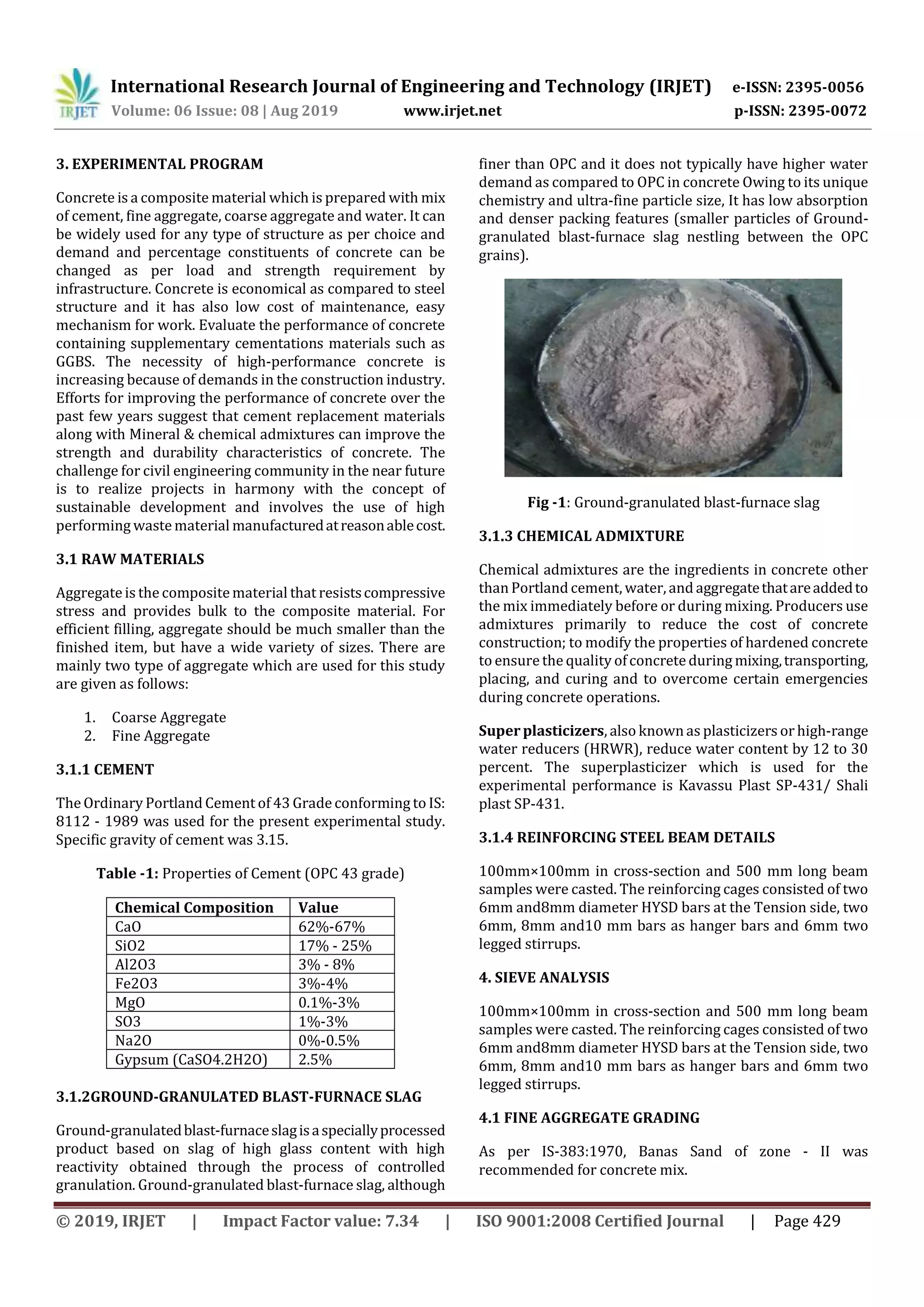
Fig -1: Ground-granulated blast-furnace slag
3.1.3 CHEMICAL ADMIXTURE
Chemical admixtures are the ingredients in concrete other
than Portland cement, water, and aggregatethatareaddedto
the mix immediately before or during mixing. Producers use
admixtures primarily to reduce the cost of concrete
construction; to modify the properties of hardened concrete
to ensurethe quality ofconcreteduring mixing,transporting,
placing, and curing and to overcome certain emergencies
during concrete operations.
Super plasticizers, also knownas plasticizers or high-range
water reducers (HRWR), reduce water content by 12 to 30
percent. The superplasticizer which is used for the
experimental performance is Kavassu Plast SP-431/ Shali
plast SP-431.
3.1.4 REINFORCING STEEL BEAM DETAILS
100mm×100mm in cross-section and 500 mm long beam
samples were casted. The reinforcing cages consisted of two
6mm and8mm diameter HYSD bars at the Tension side, two
6mm, 8mm and10 mm bars as hanger bars and 6mm two
legged stirrups.
4. SIEVE ANALYSIS
100mm×100mm in cross-section and 500 mm long beam
samples were casted. The reinforcing cages consisted of two
6mm and8mm diameter HYSD bars at the Tension side, two
6mm, 8mm and10 mm bars as hanger bars and 6mm two
legged stirrups.
4.1 FINE AGGREGATE GRADING
As per IS-383:1970, Banas Sand of zone - II was
recommended for concrete mix.
International Research Journal of Engineering and Technology (IRJET) e-ISSN: 2395-0056
Volume: 06 Issue: 08 | Aug 2019 www.irjet.net p-ISSN: 2395-0072
© 2019, IRJET | Impact Factor value: 7.34 | ISO 9001:2008 Certified Journal | Page 430
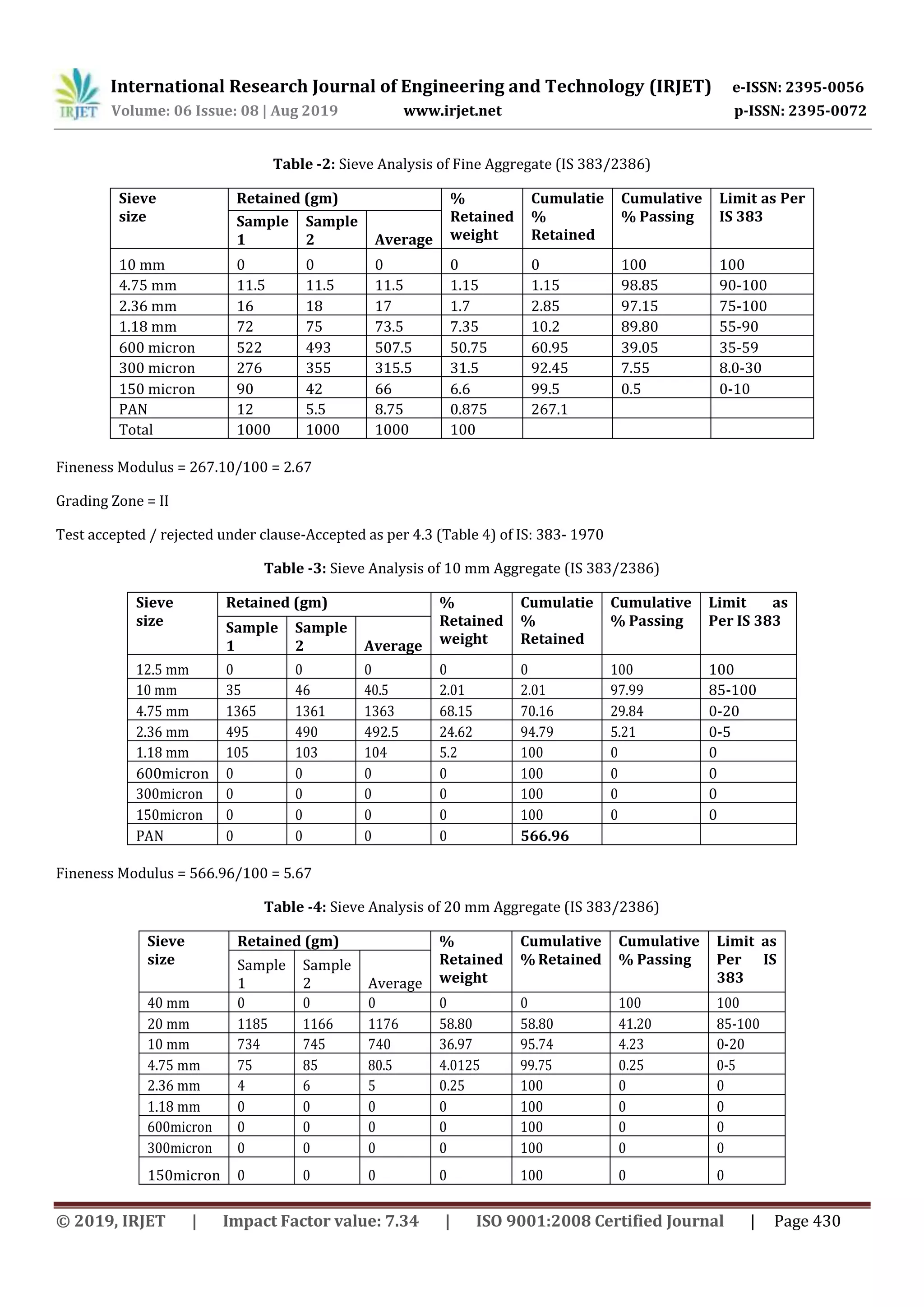
Table -2: Sieve Analysis of Fine Aggregate (IS 383/2386)
Sieve
size
Retained (gm) %
Retained
weight
Cumulatie
%
Retained
Cumulative
% Passing
Limit as Per
IS 383Sample
1
Sample
2 Average
10 mm 0 0 0 0 0 100 100
4.75 mm 11.5 11.5 11.5 1.15 1.15 98.85 90-100
2.36 mm 16 18 17 1.7 2.85 97.15 75-100
1.18 mm 72 75 73.5 7.35 10.2 89.80 55-90
600 micron 522 493 507.5 50.75 60.95 39.05 35-59
300 micron 276 355 315.5 31.5 92.45 7.55 8.0-30
150 micron 90 42 66 6.6 99.5 0.5 0-10
PAN 12 5.5 8.75 0.875 267.1
Total 1000 1000 1000 100
Fineness Modulus = 267.10/100 = 2.67
Grading Zone = II
Test accepted / rejected under clause-Accepted as per 4.3 (Table 4) of IS: 383- 1970
Table -3: Sieve Analysis of 10 mm Aggregate (IS 383/2386)
Sieve
size
Retained (gm) %
Retained
weight
Cumulatie
%
Retained
Cumulative
% Passing
Limit as
Per IS 383Sample
1
Sample
2 Average
12.5 mm 0 0 0 0 0 100 100
10 mm 35 46 40.5 2.01 2.01 97.99 85-100
4.75 mm 1365 1361 1363 68.15 70.16 29.84 0-20
2.36 mm 495 490 492.5 24.62 94.79 5.21 0-5
1.18 mm 105 103 104 5.2 100 0 0
600micron 0 0 0 0 100 0 0
300micron 0 0 0 0 100 0 0
150micron 0 0 0 0 100 0 0
PAN 0 0 0 0 566.96
Fineness Modulus = 566.96/100 = 5.67
Table -4: Sieve Analysis of 20 mm Aggregate (IS 383/2386)
Sieve
size
Retained (gm) %
Retained
weight
Cumulative
% Retained
Cumulative
% Passing
Limit as
Per IS
383
Sample
1
Sample
2 Average
40 mm 0 0 0 0 0 100 100
20 mm 1185 1166 1176 58.80 58.80 41.20 85-100
10 mm 734 745 740 36.97 95.74 4.23 0-20
4.75 mm 75 85 80.5 4.0125 99.75 0.25 0-5
2.36 mm 4 6 5 0.25 100 0 0
1.18 mm 0 0 0 0 100 0 0
600micron 0 0 0 0 100 0 0
300micron 0 0 0 0 100 0 0
150micron 0 0 0 0 100 0 0
International Research Journal of Engineering and Technology (IRJET) e-ISSN: 2395-0056
Volume: 06 Issue: 08 | Aug 2019 www.irjet.net p-ISSN: 2395-0072
© 2019, IRJET | Impact Factor value: 7.34 | ISO 9001:2008 Certified Journal | Page 431
5. CONTROL MIX
Control mix was designed as per IS 10262:2009specification
and recommendation which are given below:
Table 5: Control Mix Proportion for M40 (For 1 Cum. of
Concrete)
S.No Materials Quantities in Kg/m3
1. Cement (OPC-43)377 330
2. Coarse aggregate1136 1159
3. Fine aggregate 886.4 904.5
4. Water 132 litre 132 litre
5. Super-plasticizer 2.64 2.31
6. W/C Ratio 0.35 0.40
Following Test is Adopted for testing of concrete
1. Slump
2. Compressive Strength
3. Flexural Strength
4. Splitting Tensile Strength
5. Durability
5.1 COMPRESSIVE STRENGTH
IS Code 516:1959 use for method of tests for compressive
strength of concrete. The sizeof specimens150mmx150mm
x 150mm. The specimens were tested after deep curing for 7
days and 28 days.
Compressive strength = P/A (Unit = N/mm2 or MPa)
Where,
P = Load
A = Area of Specimen
5.2 FLEXURAL STRENGTH
IS Code516:1959 use for methodoftestsforflexuralstrength
of concrete the size of beam 500mm x 100mm x 100mm.The
specimens were tested after deep curing for 28 and 56 days.
The central point loading method was used for this testing.
Flexural Strength = 3PL/2bd2 = 3PL/2d3 (b=d, due to size of
b and d are equal)
Where, P = Load,
L = Distance from Centre of Two Support,
b = Depth of Specimen,
d = Width of Specimen
5.3 SPLITTING TENSILE STRENGTH
IS Code 5816:1999 use for method of test splitting tensile
strength of concrete. The size of 200mm(length) x
100mm(diameter). The specimens were tested after deep
curing for 28 days.
Splitting Tensile Strength = 2P/ ld (Unit = N/mm2 or MPa)
Where
P= Load
l= Length of Cylinder
d = Diameter of Cylinder
5.4 DURABILITY
The samples immersed in 5% concentrationofH2SO4 inplace
of water curing then analysis the loss in strength or strength
reduction. In present work reinforced beam sample is
immersed in acid solution.
6. TEST RESULTS
6.1 SLUMP
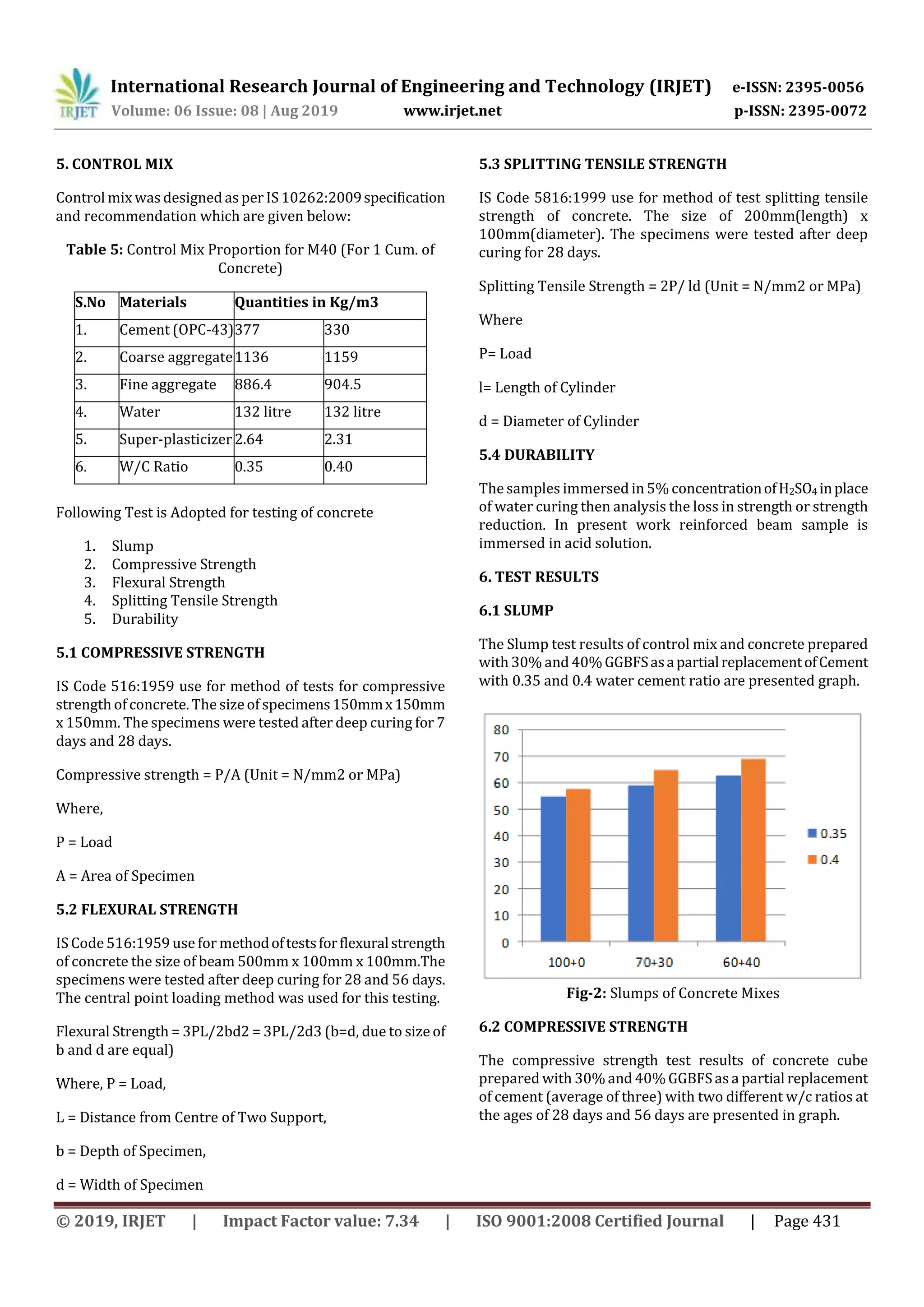
The Slump test results of control mix and concrete prepared
with 30% and 40%GGBFSasapartialreplacementofCement
with 0.35 and 0.4 water cement ratio are presented graph.
Fig-2: Slumps of Concrete Mixes
6.2 COMPRESSIVE STRENGTH
The compressive strength test results of concrete cube
prepared with 30% and 40% GGBFSas a partial replacement
of cement (average of three) with two different w/c ratios at
the ages of 28 days and 56 days are presented in graph.
International Research Journal of Engineering and Technology (IRJET) e-ISSN: 2395-0056
Volume: 06 Issue: 08 | Aug 2019 www.irjet.net p-ISSN: 2395-0072
© 2019, IRJET | Impact Factor value: 7.34 | ISO 9001:2008 Certified Journal | Page 432
49.21
51.7
52.4252.81
55.7
57.55
44
46
48
50
52
54
56
58
60
100+0 70+30 60+40
28 DAYS
56 DAYS
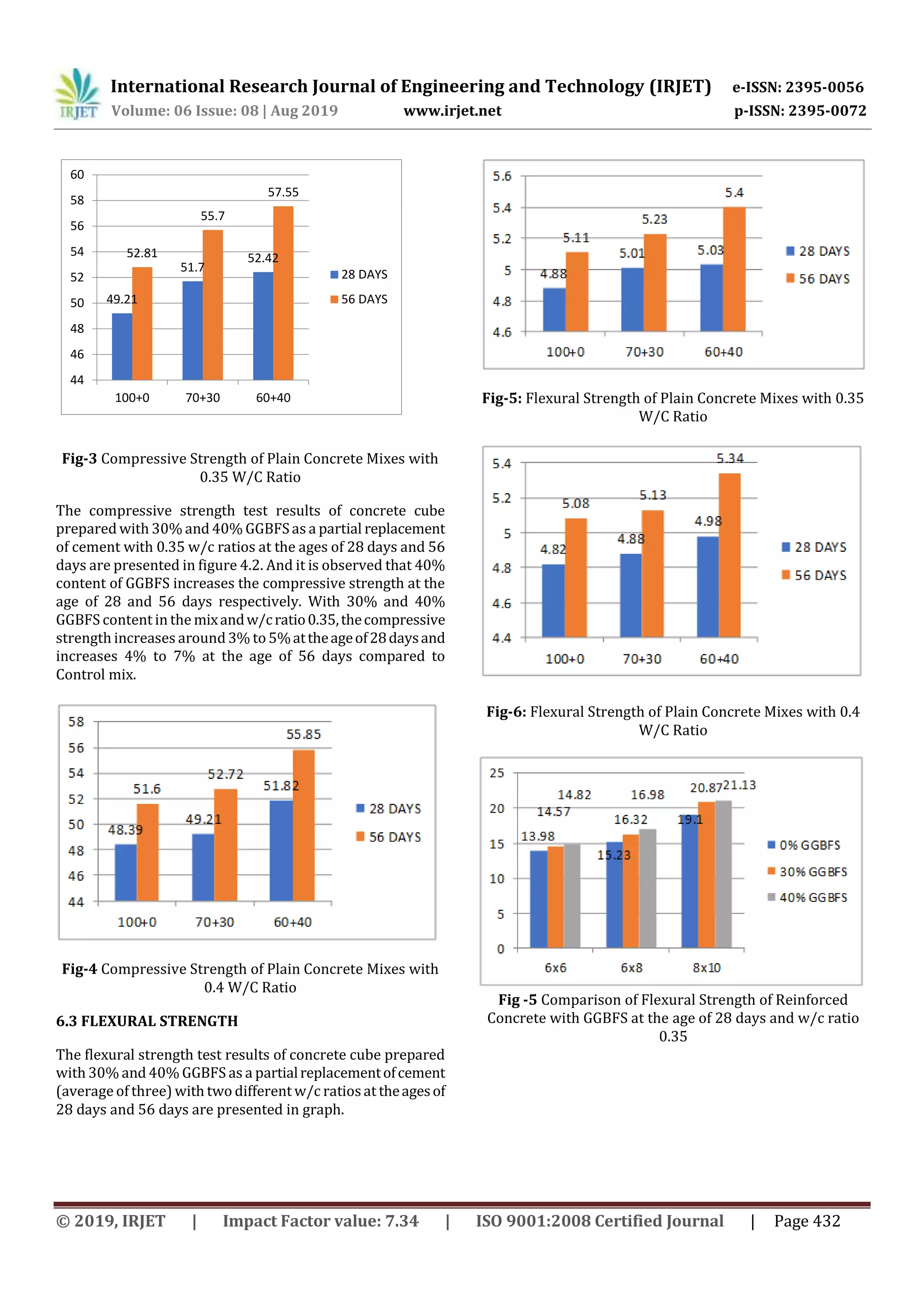
Fig-3 Compressive Strength of Plain Concrete Mixes with
0.35 W/C Ratio
The compressive strength test results of concrete cube
prepared with 30% and 40% GGBFSas a partial replacement
of cement with 0.35 w/c ratios at the ages of 28 days and 56
days are presented in figure 4.2. And it is observed that 40%
content of GGBFS increases the compressive strength at the
age of 28 and 56 days respectively. With 30% and 40%
GGBFS content in the mixandw/cratio0.35,thecompressive
strength increases around 3% to 5%attheageof28daysand
increases 4% to 7% at the age of 56 days compared to
Control mix.
Fig-4 Compressive Strength of Plain Concrete Mixes with
0.4 W/C Ratio
6.3 FLEXURAL STRENGTH
The flexural strength test results of concrete cube prepared
with 30% and 40% GGBFS as a partialreplacementofcement
(average of three) with two different w/c ratiosat theagesof
28 days and 56 days are presented in graph.
Fig-5: Flexural Strength of Plain Concrete Mixes with 0.35
W/C Ratio
Fig-6: Flexural Strength of Plain Concrete Mixes with 0.4
W/C Ratio
Fig -5 Comparison of Flexural Strength of Reinforced
Concrete with GGBFS at the age of 28 days and w/c ratio
0.35
International Research Journal of Engineering and Technology (IRJET) e-ISSN: 2395-0056
Volume: 06 Issue: 08 | Aug 2019 www.irjet.net p-ISSN: 2395-0072
© 2019, IRJET | Impact Factor value: 7.34 | ISO 9001:2008 Certified Journal | Page 433
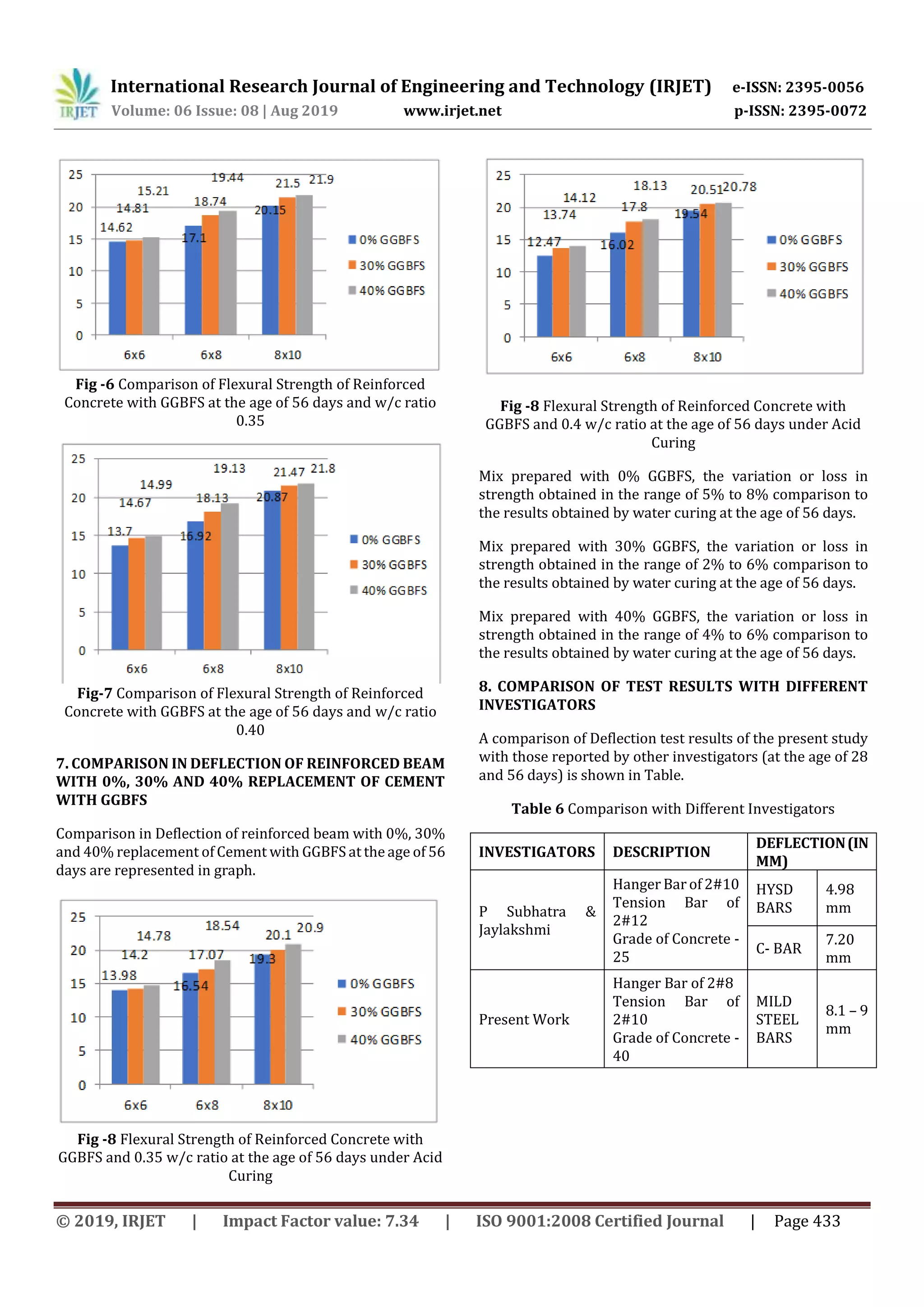
Fig -6 Comparison of Flexural Strength of Reinforced
Concrete with GGBFS at the age of 56 days and w/c ratio
0.35
Fig-7 Comparison of Flexural Strength of Reinforced
Concrete with GGBFS at the age of 56 days and w/c ratio
0.40
7. COMPARISON IN DEFLECTION OF REINFORCED BEAM
WITH 0%, 30% AND 40% REPLACEMENT OF CEMENT
WITH GGBFS
Comparison in Deflection of reinforced beam with 0%, 30%
and 40% replacement of Cement with GGBFS at the age of 56
days are represented in graph.
Fig -8 Flexural Strength of Reinforced Concrete with
GGBFS and 0.35 w/c ratio at the age of 56 days under Acid
Curing
Fig -8 Flexural Strength of Reinforced Concrete with
GGBFS and 0.4 w/c ratio at the age of 56 days under Acid
Curing
Mix prepared with 0% GGBFS, the variation or loss in
strength obtained in the range of 5% to 8% comparison to
the results obtained by water curing at the age of 56 days.
Mix prepared with 30% GGBFS, the variation or loss in
strength obtained in the range of 2% to 6% comparison to
the results obtained by water curing at the age of 56 days.
Mix prepared with 40% GGBFS, the variation or loss in
strength obtained in the range of 4% to 6% comparison to
the results obtained by water curing at the age of 56 days.
8. COMPARISON OF TEST RESULTS WITH DIFFERENT
INVESTIGATORS
A comparison of Deflection test results of the present study
with those reported by other investigators (at the age of 28
and 56 days) is shown in Table.
Table 6 Comparison with Different Investigators
INVESTIGATORS DESCRIPTION
DEFLECTION(IN
MM)
P Subhatra &
Jaylakshmi
Hanger Bar of 2#10
Tension Bar of
2#12
Grade of Concrete -
25
HYSD
BARS
4.98
mm
C- BAR
7.20
mm
Present Work
Hanger Bar of 2#8
Tension Bar of
2#10
Grade of Concrete -
40
MILD
STEEL
BARS
8.1 – 9
mm
International Research Journal of Engineering and Technology (IRJET) e-ISSN: 2395-0056
Volume: 06 Issue: 08 | Aug 2019 www.irjet.net p-ISSN: 2395-0072
© 2019, IRJET | Impact Factor value: 7.34 | ISO 9001:2008 Certified Journal | Page 434
Table 7 Comparison with Different Investigators
Investigators Description
GGBFS
CONTENT
Deflection (in
mm)
(%) 28
DAYS
56
DAYS
Dr. S.P
Sangeetha
Hanger Bar
of 2#10
Tension Bar
of 3#12
Grade of
Concrete M-
35
0%
8.5-9
mm
7.5-8
mm
40%
8.1-9
mm
7.5-
8.1mm
Present Work
Hanger Bar
of 2#8
Tension Bar
of 2#10
Grade of
Concrete-40
0%
7.8-
8.2
mm
8.1-8.5
mm
40%
8.1-
8.5
8.9-9
mm
9. CONCLUSIONS
1. Partially replacing Cement with GGBFS 30% to 40% the
slump increases significantly.
2. Partially replacingCementwithGGBFS,theconsumptionof
Cement from cement production reduces significantly also
enhanced the strength (Compression, flexure and Splitting
tensile) comparison to control mix at the ages of 28 and 56
days respectively.
3. Flexural strength of plain concrete at the age of 56 days
It was observed that the flexural strength of plain concrete
beams increased in the range of 2% to 6% compared to
Control mix, with partially replacement of Cement by GGBFS
in the range of 30% to 40% respectively with 0.35 water
cement ratio.
4. Flexural strength of Reinforced concrete at the age of 28
days
It was observed that the valuesofflexuralstrengthforabeam
which is prepared with partially replacement of Cement by
GGBFS in the range of 30% to 40% and Hanger Bar and
Tension Bar taken 2#6 and 2#6 respectively and w/c ratio
0.35. The Flexural strength of reinforced beam increased in
the range of 1% to 6%
5. It was observed that the values of flexural strength for a
beam which is prepared with partially replacement of
Cement by GGBFS in the range of 30% to 40% and Hanger
Bar and Tension Bar taken 2#8 and 2#10 respectively and
w/c ratio 0.35. The Flexural strength of reinforced beam
increased in the range of 4% to 10.6%
6. Flexural strength of Reinforced concrete beam with Acid
curing (56 Days)
It was observed that the valuesofflexuralstrengthforabeam
which is prepared with partially replacement of Cement by
GGBFS in the range of 30% to 40% and Hanger Bar and
Tension Bar taken with different sets of diameter bars and
acid curing for 56 days, w/c ratio 0.35 and 0.4. The Flexural
strength of reinforced beam decreased in the range of 3% to
6% and 4% to 8% respectively compared to reinforcedbeam
of control mix.
7. Deflection in Reinforced concrete beam
A comparison of Deflection test results of the present study
with those reported by other investigators at the age of 28
and 56 days, lie in the almost same range of the results given
by other investigators.
REFERENCES
[1] V. Johnpaul, N. Balasundharam, S. Sanothini.
Pragadheesh , Kameshwaran J, Satheesh kumar M, M.
Balajimanikandan, " An Experimental Study on Flexural
Behaviour of Nano Ggbfs Concrete", International
Journal of Recent Technology and Engineering (IJRTE),
Volume-7, Issue-6S5,PP-1744-1747, April 2019.
[2] Dr. Shankar H. Sanni and Keshavraj. Girinivas,
"Analytical Investigations on Reinforced Concrete
Beams", International Research Journal of Engineering
and Technology (IRJET), Volume-05,Issue-12,PP-1509-
1513, Dec 2018.
[3] P. Rama Mohan Rao and S. Karthik," Investigation on
Flexural Behaviour of Beam with Bamboo as Main
Rebars",International Journal of RecentTechnologyand
Engineering (IJRTE), ISSN: 2277-3878, Volume-7 Issue-
4S2, PP- 173-177, December 2018.
[4] Rathan Raj R, Ganesh Prabhu G and Perumal Pillai E B, "
Flexural Behavior of Concrete Beam with GGBS and Fly
Ash as Supplementary Cementitious Material",
International Journal of Applied Engineering Research,
Vol-10, No-47, PP-32310-32315, 2015.
[5] B.Kaviya.R, Arjun, Rajkumar. P, Ramakrishnan. S and
Subash. S, "Study on Partial Replacement Of Cement By
Ground Granulated Blast Furnace Slag (GGBS)",
International Journal of Pure and Applied Mathematics,
Vol-116, No-13, PP-411-416, 2017.
[6] Divyadevi Sundaravadivel and Dr. R. Mohana, "Recent
Studies of Sugarcane Bagasse Ash in Concrete and
Mortar- A Review", International Journal ofEngineering
Research & Technology (IJERT),Vol.7,Issue04,PP-306-
312, April 2018.
International Research Journal of Engineering and Technology (IRJET) e-ISSN: 2395-0056
Volume: 06 Issue: 08 | Aug 2019 www.irjet.net p-ISSN: 2395-0072
© 2019, IRJET | Impact Factor value: 7.34 | ISO 9001:2008 Certified Journal | Page 435
[7] J.Vengadesh Marshall Raman and V.Murali Krishnan,
“Partial Replacement of Cement with GGBS in Self
Compacting Concrete for Sustainable Construction",
SSRG International Journal of Civil Engineering ( SSRG –
IJCE ), Volume 4, Issue 3, PP-22-25, March 2017.
[8] Sonali K. Gadpalliwar, R. S. Deotale and Abhijeet R.
Narde, "To Study the Partial Replacement of Cement by
GGBS & RHA and Natural Sand by Quarry Sand In
Concrete", IOSR Journal of Mechanical and Civil
Engineering (IOSR-JMCE), Volume 11, Issue 2, Ver. II,
PP-69-77, Mar- Apr. 2014.
[9] Mr. P. Brightson, Mr. M. Prem Anand and Dr. M. S.
Ravikumar, "Flexural Behavior of Beams Incorporating
GGBS as Partial Replacement of Fine Aggregate in
Concrete", Advanced Materials Research Vols-984-985,
PP-698-706, 2014.
[10] Mrs. S. P. Sangeetha and Dr. P. S. Joanna, "Flexural
Behaviour of Reinforced Concrete Beams With GGBS",
International Journal of Civil Engineering and
Technology (IJCIET),Volume-5, Issue-3, PP-124-131,
March 2014.
[11] Dattatreya J K, Rajamane NP, Sabitha D, Ambily P S and
Nataraja MC, "Flexural behavior of reinforced Geo
polymer concrete beams", International Journal Of Civil
And Structural Engineering, Volume-2, No-1, PP-138-
159, 2011.
[12] Chithra P, Naveen Kumar A B, Vivekananthan V,
"Experimental Study on Structural behaviour of
reinforced concrete beams containing Sisal fiber and
GGBS", International Journal of Multidisciplinary
Research Transactions", Volume-1, Issue-3, PP-22-30,
May 2019.
[13] Dr. S. P. Sangeetha, "Strength and Flexural Behaviour Of
Reinforced Concrete With Ground Granulated Blast
Furnace Slag", International Journal ofPureandApplied
Mathematics, Volume-118, No-5, PP-867-879, 2018.
[14] Dr. B. Vidivelli, M. Gopinath andT.Subbulakshmi,"Study
on flexural behaviour of reinforce concrete beam with
GGBS and steel fibre", International Journal of Scientific
& EngineeringResearch,Volume-7,Issue-6,PP-719-730,
June-2016.

IRJET- An Experimental Investigation on Reinforced Concrete Containing GGBFS

  • 1.
    International Research Journalof Engineering and Technology (IRJET) e-ISSN: 2395-0056 Volume: 06 Issue: 08 | Aug 2019 www.irjet.net p-ISSN: 2395-0072 © 2019, IRJET | Impact Factor value: 7.34 | ISO 9001:2008 Certified Journal | Page 428 AN EXPERIMENTAL INVESTIGATION ON REINFORCED CONCRETE CONTAINING GGBFS Vikas Kumar1, Ramanuj Jaldhari2 1M.Tech Scholar Vikas Kumar, Dept. of Civil Engineering, Kautilya institute of Technology & Engineering, Jaipur (Raj.), India 2 Er. Ramanuj Jaldhari, Dept. of Civil Engineering, Kautilya institute of Technology & Engineering, Jaipur (Raj.), India -----------------------------------------------------------------------***-------------------------------------------------------------------- Abstract – Use of steel is known to increase flexural strength in concrete beams. However, the literature mainly consists of studies on beams with reinforced concrete along with the cement replacing materials. The present investigationaims to study the behavior of concrete beams with steelreinforcement and also to evaluate the performance of plain concreteflexure member and reinforced concrete flexure members with Ground Granulated Blast Furnace Slag. GGBFScontentusedin present work are 30% and 40% as cement replacing material. The study was conducted with two water cement ratios: 0.35 and 0.40 for M 40 grade of concrete. The study was performed with three different reinforcement contents, with doubly reinforced sections containing two bars of 6mm, 8mm and10mm as the main reinforcement and two bars of 6mm, 6mm and 8mm as compression reinforcement respectively. The specimens were testedfor strengthincompression;flexure and splitting tensile strength at the age of 28 and 56 days. Durability and deflection test also conducted on beam specimen Key Words: (Size 10 & Bold) Key word1, Key word2, Key word3, etc (Minimum 5 to 8 key words)… 1. INTRODUCTION Concrete is a combination of cement, sand, coarse aggregate and water. Its realization lies in a reality that can be designed to resist hostile environments while taking the most inspiring forms. Engineers and scientists are trying to increase their limits with the help of innovative chemical additives and several additional SCM. 1.1 SUPPLEMENTARY CEMENTATIONS MATERIALS There are many researchers who have worked in the design of concrete (standard concrete and high strength) for better performance and strength. Inorganic materials have pozzolanic properties. These very fine grain materials are added to the concrete mix to improve concrete properties (mineral additives). Theyare testing and using productsthat incorporate limestone, fly ash, blast furnace slag and other useful materials with pozzolanic properties in the mixture. This development is oneofthelargestproducers(ofaround5 to 10%) of global emissions of greenhouse gases, as well as cost reduction, improvement of concrete properties and waste recycling. The present study aimed to evaluate the performance of plain concrete flexure member and reinforced concrete flexure members with GGBFS for M 40 grade. Beam specimens with GGBFS content equal to 30% and 40% were made. The study was conducted with two water cement ratios:0.35 and0.40. The studywasperformed with three different reinforcement contents, with doubly reinforced sections containing two bars of 6mm, 8mm and10mm as the main reinforcement and two bars of 6mm, 6mm and8mm as compression reinforcement respectively. 2. LITERATURE REVIEW Salient points from the previous studies on concrete containing Ground granulated blast furnace slag and Reinforced concrete are presented below: Johnpaul et. al. 2019, Discussed that in readily developing countries like our Republic of India, we have a tendency to consume a lot of cement for infrastructure development. During this context, we have a tendency to now not use natural resources, questioning our futureclimate conditions for our country. This additionally ends up in warming. Sanni et. al. 2018, Study the Statics serves to assess the behavior of engineering structures beneath totally different masses. The foremost common strategies of structural analysisembraceanalyticalmethods,experimentalstrategies and numerical methods. Rao et. al. 2018, Discussed the main objective is to cut back the prices of the materials used for construction, especially steel. Steel is that the material used for all kinds of reinforcements in columns, beams and slabs. The most disadvantage of this materialis thatitcorrodessimplyonceit interacts with wetness and, thanks to this impact, its resistance is additionally considerably reduced and ends up in a retardant of sturdiness in buildings. Kaviya.R et. al. 2017, Discussed that the Concrete has becomean important a partofourlives,withconcretegetting used at a awfully high rate. one among the most parts of hydraulic cement. Cement producing produces important CO2 emissions. Thus, researchers began to seek out alternatives to the partial replacement of cement.
  • 2.
    International Research Journalof Engineering and Technology (IRJET) e-ISSN: 2395-0056 Volume: 06 Issue: 08 | Aug 2019 www.irjet.net p-ISSN: 2395-0072 © 2019, IRJET | Impact Factor value: 7.34 | ISO 9001:2008 Certified Journal | Page 429 3. EXPERIMENTAL PROGRAM Concrete is a composite material which is prepared with mix of cement, fine aggregate, coarse aggregate and water. It can be widely used for any type of structure as per choice and demand and percentage constituents of concrete can be changed as per load and strength requirement by infrastructure. Concrete is economical as compared to steel structure and it has also low cost of maintenance, easy mechanism for work. Evaluate the performance of concrete containing supplementary cementations materials such as GGBS. The necessity of high-performance concrete is increasing because of demands in the construction industry. Efforts for improving the performance of concrete over the past few years suggest that cement replacement materials along with Mineral & chemical admixtures can improve the strength and durability characteristics of concrete. The challenge for civil engineering community in the near future is to realize projects in harmony with the concept of sustainable development and involves the use of high performing wastematerial manufacturedatreasonablecost. 3.1 RAW MATERIALS Aggregateis the compositematerial that resistscompressive stress and provides bulk to the composite material. For efficient filling, aggregate should be much smaller than the finished item, but have a wide variety of sizes. There are mainly two type of aggregate which are used for this study are given as follows: 1. Coarse Aggregate 2. Fine Aggregate 3.1.1 CEMENT The Ordinary Portland Cement of 43 Grade conforming to IS: 8112 - 1989 was used for the present experimental study. Specific gravity of cement was 3.15. Table -1: Properties of Cement (OPC 43 grade) Chemical Composition Value CaO 62%-67% SiO2 17% - 25% Al2O3 3% - 8% Fe2O3 3%-4% MgO 0.1%-3% SO3 1%-3% Na2O 0%-0.5% Gypsum (CaSO4.2H2O) 2.5% 3.1.2GROUND-GRANULATED BLAST-FURNACE SLAG Ground-granulatedblast-furnaceslagisaspeciallyprocessed product based on slag of high glass content with high reactivity obtained through the process of controlled granulation. Ground-granulated blast-furnace slag, although finer than OPC and it does not typically have higher water demand as compared to OPC in concrete Owing to its unique chemistry and ultra-fine particle size, It has low absorption and denser packing features (smaller particles of Ground- granulated blast-furnace slag nestling between the OPC grains). Fig -1: Ground-granulated blast-furnace slag 3.1.3 CHEMICAL ADMIXTURE Chemical admixtures are the ingredients in concrete other than Portland cement, water, and aggregatethatareaddedto the mix immediately before or during mixing. Producers use admixtures primarily to reduce the cost of concrete construction; to modify the properties of hardened concrete to ensurethe quality ofconcreteduring mixing,transporting, placing, and curing and to overcome certain emergencies during concrete operations. Super plasticizers, also knownas plasticizers or high-range water reducers (HRWR), reduce water content by 12 to 30 percent. The superplasticizer which is used for the experimental performance is Kavassu Plast SP-431/ Shali plast SP-431. 3.1.4 REINFORCING STEEL BEAM DETAILS 100mm×100mm in cross-section and 500 mm long beam samples were casted. The reinforcing cages consisted of two 6mm and8mm diameter HYSD bars at the Tension side, two 6mm, 8mm and10 mm bars as hanger bars and 6mm two legged stirrups. 4. SIEVE ANALYSIS 100mm×100mm in cross-section and 500 mm long beam samples were casted. The reinforcing cages consisted of two 6mm and8mm diameter HYSD bars at the Tension side, two 6mm, 8mm and10 mm bars as hanger bars and 6mm two legged stirrups. 4.1 FINE AGGREGATE GRADING As per IS-383:1970, Banas Sand of zone - II was recommended for concrete mix.
  • 3.
    International Research Journalof Engineering and Technology (IRJET) e-ISSN: 2395-0056 Volume: 06 Issue: 08 | Aug 2019 www.irjet.net p-ISSN: 2395-0072 © 2019, IRJET | Impact Factor value: 7.34 | ISO 9001:2008 Certified Journal | Page 430 Table -2: Sieve Analysis of Fine Aggregate (IS 383/2386) Sieve size Retained (gm) % Retained weight Cumulatie % Retained Cumulative % Passing Limit as Per IS 383Sample 1 Sample 2 Average 10 mm 0 0 0 0 0 100 100 4.75 mm 11.5 11.5 11.5 1.15 1.15 98.85 90-100 2.36 mm 16 18 17 1.7 2.85 97.15 75-100 1.18 mm 72 75 73.5 7.35 10.2 89.80 55-90 600 micron 522 493 507.5 50.75 60.95 39.05 35-59 300 micron 276 355 315.5 31.5 92.45 7.55 8.0-30 150 micron 90 42 66 6.6 99.5 0.5 0-10 PAN 12 5.5 8.75 0.875 267.1 Total 1000 1000 1000 100 Fineness Modulus = 267.10/100 = 2.67 Grading Zone = II Test accepted / rejected under clause-Accepted as per 4.3 (Table 4) of IS: 383- 1970 Table -3: Sieve Analysis of 10 mm Aggregate (IS 383/2386) Sieve size Retained (gm) % Retained weight Cumulatie % Retained Cumulative % Passing Limit as Per IS 383Sample 1 Sample 2 Average 12.5 mm 0 0 0 0 0 100 100 10 mm 35 46 40.5 2.01 2.01 97.99 85-100 4.75 mm 1365 1361 1363 68.15 70.16 29.84 0-20 2.36 mm 495 490 492.5 24.62 94.79 5.21 0-5 1.18 mm 105 103 104 5.2 100 0 0 600micron 0 0 0 0 100 0 0 300micron 0 0 0 0 100 0 0 150micron 0 0 0 0 100 0 0 PAN 0 0 0 0 566.96 Fineness Modulus = 566.96/100 = 5.67 Table -4: Sieve Analysis of 20 mm Aggregate (IS 383/2386) Sieve size Retained (gm) % Retained weight Cumulative % Retained Cumulative % Passing Limit as Per IS 383 Sample 1 Sample 2 Average 40 mm 0 0 0 0 0 100 100 20 mm 1185 1166 1176 58.80 58.80 41.20 85-100 10 mm 734 745 740 36.97 95.74 4.23 0-20 4.75 mm 75 85 80.5 4.0125 99.75 0.25 0-5 2.36 mm 4 6 5 0.25 100 0 0 1.18 mm 0 0 0 0 100 0 0 600micron 0 0 0 0 100 0 0 300micron 0 0 0 0 100 0 0 150micron 0 0 0 0 100 0 0
  • 4.
    International Research Journalof Engineering and Technology (IRJET) e-ISSN: 2395-0056 Volume: 06 Issue: 08 | Aug 2019 www.irjet.net p-ISSN: 2395-0072 © 2019, IRJET | Impact Factor value: 7.34 | ISO 9001:2008 Certified Journal | Page 431 5. CONTROL MIX Control mix was designed as per IS 10262:2009specification and recommendation which are given below: Table 5: Control Mix Proportion for M40 (For 1 Cum. of Concrete) S.No Materials Quantities in Kg/m3 1. Cement (OPC-43)377 330 2. Coarse aggregate1136 1159 3. Fine aggregate 886.4 904.5 4. Water 132 litre 132 litre 5. Super-plasticizer 2.64 2.31 6. W/C Ratio 0.35 0.40 Following Test is Adopted for testing of concrete 1. Slump 2. Compressive Strength 3. Flexural Strength 4. Splitting Tensile Strength 5. Durability 5.1 COMPRESSIVE STRENGTH IS Code 516:1959 use for method of tests for compressive strength of concrete. The sizeof specimens150mmx150mm x 150mm. The specimens were tested after deep curing for 7 days and 28 days. Compressive strength = P/A (Unit = N/mm2 or MPa) Where, P = Load A = Area of Specimen 5.2 FLEXURAL STRENGTH IS Code516:1959 use for methodoftestsforflexuralstrength of concrete the size of beam 500mm x 100mm x 100mm.The specimens were tested after deep curing for 28 and 56 days. The central point loading method was used for this testing. Flexural Strength = 3PL/2bd2 = 3PL/2d3 (b=d, due to size of b and d are equal) Where, P = Load, L = Distance from Centre of Two Support, b = Depth of Specimen, d = Width of Specimen 5.3 SPLITTING TENSILE STRENGTH IS Code 5816:1999 use for method of test splitting tensile strength of concrete. The size of 200mm(length) x 100mm(diameter). The specimens were tested after deep curing for 28 days. Splitting Tensile Strength = 2P/ ld (Unit = N/mm2 or MPa) Where P= Load l= Length of Cylinder d = Diameter of Cylinder 5.4 DURABILITY The samples immersed in 5% concentrationofH2SO4 inplace of water curing then analysis the loss in strength or strength reduction. In present work reinforced beam sample is immersed in acid solution. 6. TEST RESULTS 6.1 SLUMP The Slump test results of control mix and concrete prepared with 30% and 40%GGBFSasapartialreplacementofCement with 0.35 and 0.4 water cement ratio are presented graph. Fig-2: Slumps of Concrete Mixes 6.2 COMPRESSIVE STRENGTH The compressive strength test results of concrete cube prepared with 30% and 40% GGBFSas a partial replacement of cement (average of three) with two different w/c ratios at the ages of 28 days and 56 days are presented in graph.
  • 5.
    International Research Journalof Engineering and Technology (IRJET) e-ISSN: 2395-0056 Volume: 06 Issue: 08 | Aug 2019 www.irjet.net p-ISSN: 2395-0072 © 2019, IRJET | Impact Factor value: 7.34 | ISO 9001:2008 Certified Journal | Page 432 49.21 51.7 52.4252.81 55.7 57.55 44 46 48 50 52 54 56 58 60 100+0 70+30 60+40 28 DAYS 56 DAYS Fig-3 Compressive Strength of Plain Concrete Mixes with 0.35 W/C Ratio The compressive strength test results of concrete cube prepared with 30% and 40% GGBFSas a partial replacement of cement with 0.35 w/c ratios at the ages of 28 days and 56 days are presented in figure 4.2. And it is observed that 40% content of GGBFS increases the compressive strength at the age of 28 and 56 days respectively. With 30% and 40% GGBFS content in the mixandw/cratio0.35,thecompressive strength increases around 3% to 5%attheageof28daysand increases 4% to 7% at the age of 56 days compared to Control mix. Fig-4 Compressive Strength of Plain Concrete Mixes with 0.4 W/C Ratio 6.3 FLEXURAL STRENGTH The flexural strength test results of concrete cube prepared with 30% and 40% GGBFS as a partialreplacementofcement (average of three) with two different w/c ratiosat theagesof 28 days and 56 days are presented in graph. Fig-5: Flexural Strength of Plain Concrete Mixes with 0.35 W/C Ratio Fig-6: Flexural Strength of Plain Concrete Mixes with 0.4 W/C Ratio Fig -5 Comparison of Flexural Strength of Reinforced Concrete with GGBFS at the age of 28 days and w/c ratio 0.35
  • 6.
    International Research Journalof Engineering and Technology (IRJET) e-ISSN: 2395-0056 Volume: 06 Issue: 08 | Aug 2019 www.irjet.net p-ISSN: 2395-0072 © 2019, IRJET | Impact Factor value: 7.34 | ISO 9001:2008 Certified Journal | Page 433 Fig -6 Comparison of Flexural Strength of Reinforced Concrete with GGBFS at the age of 56 days and w/c ratio 0.35 Fig-7 Comparison of Flexural Strength of Reinforced Concrete with GGBFS at the age of 56 days and w/c ratio 0.40 7. COMPARISON IN DEFLECTION OF REINFORCED BEAM WITH 0%, 30% AND 40% REPLACEMENT OF CEMENT WITH GGBFS Comparison in Deflection of reinforced beam with 0%, 30% and 40% replacement of Cement with GGBFS at the age of 56 days are represented in graph. Fig -8 Flexural Strength of Reinforced Concrete with GGBFS and 0.35 w/c ratio at the age of 56 days under Acid Curing Fig -8 Flexural Strength of Reinforced Concrete with GGBFS and 0.4 w/c ratio at the age of 56 days under Acid Curing Mix prepared with 0% GGBFS, the variation or loss in strength obtained in the range of 5% to 8% comparison to the results obtained by water curing at the age of 56 days. Mix prepared with 30% GGBFS, the variation or loss in strength obtained in the range of 2% to 6% comparison to the results obtained by water curing at the age of 56 days. Mix prepared with 40% GGBFS, the variation or loss in strength obtained in the range of 4% to 6% comparison to the results obtained by water curing at the age of 56 days. 8. COMPARISON OF TEST RESULTS WITH DIFFERENT INVESTIGATORS A comparison of Deflection test results of the present study with those reported by other investigators (at the age of 28 and 56 days) is shown in Table. Table 6 Comparison with Different Investigators INVESTIGATORS DESCRIPTION DEFLECTION(IN MM) P Subhatra & Jaylakshmi Hanger Bar of 2#10 Tension Bar of 2#12 Grade of Concrete - 25 HYSD BARS 4.98 mm C- BAR 7.20 mm Present Work Hanger Bar of 2#8 Tension Bar of 2#10 Grade of Concrete - 40 MILD STEEL BARS 8.1 – 9 mm
  • 7.
    International Research Journalof Engineering and Technology (IRJET) e-ISSN: 2395-0056 Volume: 06 Issue: 08 | Aug 2019 www.irjet.net p-ISSN: 2395-0072 © 2019, IRJET | Impact Factor value: 7.34 | ISO 9001:2008 Certified Journal | Page 434 Table 7 Comparison with Different Investigators Investigators Description GGBFS CONTENT Deflection (in mm) (%) 28 DAYS 56 DAYS Dr. S.P Sangeetha Hanger Bar of 2#10 Tension Bar of 3#12 Grade of Concrete M- 35 0% 8.5-9 mm 7.5-8 mm 40% 8.1-9 mm 7.5- 8.1mm Present Work Hanger Bar of 2#8 Tension Bar of 2#10 Grade of Concrete-40 0% 7.8- 8.2 mm 8.1-8.5 mm 40% 8.1- 8.5 8.9-9 mm 9. CONCLUSIONS 1. Partially replacing Cement with GGBFS 30% to 40% the slump increases significantly. 2. Partially replacingCementwithGGBFS,theconsumptionof Cement from cement production reduces significantly also enhanced the strength (Compression, flexure and Splitting tensile) comparison to control mix at the ages of 28 and 56 days respectively. 3. Flexural strength of plain concrete at the age of 56 days It was observed that the flexural strength of plain concrete beams increased in the range of 2% to 6% compared to Control mix, with partially replacement of Cement by GGBFS in the range of 30% to 40% respectively with 0.35 water cement ratio. 4. Flexural strength of Reinforced concrete at the age of 28 days It was observed that the valuesofflexuralstrengthforabeam which is prepared with partially replacement of Cement by GGBFS in the range of 30% to 40% and Hanger Bar and Tension Bar taken 2#6 and 2#6 respectively and w/c ratio 0.35. The Flexural strength of reinforced beam increased in the range of 1% to 6% 5. It was observed that the values of flexural strength for a beam which is prepared with partially replacement of Cement by GGBFS in the range of 30% to 40% and Hanger Bar and Tension Bar taken 2#8 and 2#10 respectively and w/c ratio 0.35. The Flexural strength of reinforced beam increased in the range of 4% to 10.6% 6. Flexural strength of Reinforced concrete beam with Acid curing (56 Days) It was observed that the valuesofflexuralstrengthforabeam which is prepared with partially replacement of Cement by GGBFS in the range of 30% to 40% and Hanger Bar and Tension Bar taken with different sets of diameter bars and acid curing for 56 days, w/c ratio 0.35 and 0.4. The Flexural strength of reinforced beam decreased in the range of 3% to 6% and 4% to 8% respectively compared to reinforcedbeam of control mix. 7. Deflection in Reinforced concrete beam A comparison of Deflection test results of the present study with those reported by other investigators at the age of 28 and 56 days, lie in the almost same range of the results given by other investigators. REFERENCES [1] V. Johnpaul, N. Balasundharam, S. Sanothini. Pragadheesh , Kameshwaran J, Satheesh kumar M, M. Balajimanikandan, " An Experimental Study on Flexural Behaviour of Nano Ggbfs Concrete", International Journal of Recent Technology and Engineering (IJRTE), Volume-7, Issue-6S5,PP-1744-1747, April 2019. [2] Dr. Shankar H. Sanni and Keshavraj. Girinivas, "Analytical Investigations on Reinforced Concrete Beams", International Research Journal of Engineering and Technology (IRJET), Volume-05,Issue-12,PP-1509- 1513, Dec 2018. [3] P. Rama Mohan Rao and S. Karthik," Investigation on Flexural Behaviour of Beam with Bamboo as Main Rebars",International Journal of RecentTechnologyand Engineering (IJRTE), ISSN: 2277-3878, Volume-7 Issue- 4S2, PP- 173-177, December 2018. [4] Rathan Raj R, Ganesh Prabhu G and Perumal Pillai E B, " Flexural Behavior of Concrete Beam with GGBS and Fly Ash as Supplementary Cementitious Material", International Journal of Applied Engineering Research, Vol-10, No-47, PP-32310-32315, 2015. [5] B.Kaviya.R, Arjun, Rajkumar. P, Ramakrishnan. S and Subash. S, "Study on Partial Replacement Of Cement By Ground Granulated Blast Furnace Slag (GGBS)", International Journal of Pure and Applied Mathematics, Vol-116, No-13, PP-411-416, 2017. [6] Divyadevi Sundaravadivel and Dr. R. Mohana, "Recent Studies of Sugarcane Bagasse Ash in Concrete and Mortar- A Review", International Journal ofEngineering Research & Technology (IJERT),Vol.7,Issue04,PP-306- 312, April 2018.
  • 8.
    International Research Journalof Engineering and Technology (IRJET) e-ISSN: 2395-0056 Volume: 06 Issue: 08 | Aug 2019 www.irjet.net p-ISSN: 2395-0072 © 2019, IRJET | Impact Factor value: 7.34 | ISO 9001:2008 Certified Journal | Page 435 [7] J.Vengadesh Marshall Raman and V.Murali Krishnan, “Partial Replacement of Cement with GGBS in Self Compacting Concrete for Sustainable Construction", SSRG International Journal of Civil Engineering ( SSRG – IJCE ), Volume 4, Issue 3, PP-22-25, March 2017. [8] Sonali K. Gadpalliwar, R. S. Deotale and Abhijeet R. Narde, "To Study the Partial Replacement of Cement by GGBS & RHA and Natural Sand by Quarry Sand In Concrete", IOSR Journal of Mechanical and Civil Engineering (IOSR-JMCE), Volume 11, Issue 2, Ver. II, PP-69-77, Mar- Apr. 2014. [9] Mr. P. Brightson, Mr. M. Prem Anand and Dr. M. S. Ravikumar, "Flexural Behavior of Beams Incorporating GGBS as Partial Replacement of Fine Aggregate in Concrete", Advanced Materials Research Vols-984-985, PP-698-706, 2014. [10] Mrs. S. P. Sangeetha and Dr. P. S. Joanna, "Flexural Behaviour of Reinforced Concrete Beams With GGBS", International Journal of Civil Engineering and Technology (IJCIET),Volume-5, Issue-3, PP-124-131, March 2014. [11] Dattatreya J K, Rajamane NP, Sabitha D, Ambily P S and Nataraja MC, "Flexural behavior of reinforced Geo polymer concrete beams", International Journal Of Civil And Structural Engineering, Volume-2, No-1, PP-138- 159, 2011. [12] Chithra P, Naveen Kumar A B, Vivekananthan V, "Experimental Study on Structural behaviour of reinforced concrete beams containing Sisal fiber and GGBS", International Journal of Multidisciplinary Research Transactions", Volume-1, Issue-3, PP-22-30, May 2019. [13] Dr. S. P. Sangeetha, "Strength and Flexural Behaviour Of Reinforced Concrete With Ground Granulated Blast Furnace Slag", International Journal ofPureandApplied Mathematics, Volume-118, No-5, PP-867-879, 2018. [14] Dr. B. Vidivelli, M. Gopinath andT.Subbulakshmi,"Study on flexural behaviour of reinforce concrete beam with GGBS and steel fibre", International Journal of Scientific & EngineeringResearch,Volume-7,Issue-6,PP-719-730, June-2016.