International Research Journal of Engineering and Technology (IRJET) e-ISSN: 2395-0056
Volume: 06 Issue: 12 | Dec 2019 www.irjet.net p-ISSN: 2395-0072
© 2019, IRJET | Impact Factor value: 7.34 | ISO 9001:2008 Certified Journal | Page 1476
A STUDY ON RECLAIMED ASPHALT PAVEMENT (RAP)MATERIAL USING
SUB-GRADE LAYER OF FLEXIBAL PAVEMENT IN VIDISHA CITY
Raju Kumar Pandit1, Dr. S.S. Goliya2, Dr. Rakesh Mehar3
1PG Student, Transportation Engineering, Dept. of Civil Engineering, SATI, Vidisha, M.P, India
2Associate Professor, Dept. of Civil Engineering, SATI, Vidisha, M.P, India
3Assistant Professor, Dept. of Civil Engineering, SATI, Vidisha, M.P, India
--------------------------------------------------------------------------***----------------------------------------------------------------------------
ABSTRACT -Flexible pavement reclaimed bituminous
pavement (FPRBP) is describe as removing pavement
material containing bitumen and aggregates. These
material are generated, when bitumen pavement is
reconstruction, resurfacing, obtain access to coursed
utilities. All though much of the composed rap is recycled
pavement material, a big part of its wasted or down-graded
whenever using in land filling, embankment or base layers.
In huge amount Reclaimed asphalt pavement is evolved that
cannot be used in the same year, so it will be according to
the requirement. It has been predicted that as most as
approximately 36 million metric tons (39 million tons), or 85
to 87 percent of the excess bitumen concrete immediately
generated.
In this thesis we study the effect on soil with different
percentage of reclaimed asphalt pavement material and
check the CBR value and comparing with a normal soil. After
that find the maximum replacement of reclaimed asphalt
pavement material at which gives the higher bearing
capacity of soil.
For sub-grade, the CBR value is minimum 8% and the
thickness of sub-grade should be 150mm. Thickness of the
sub-grade is vary according to the bearing capacity of soil in
different area and the properties of soil for sub-grade is also
changes. CBR is reducing below the applicable value for
conventional granular base layer whenever the amount of
RAP road exceeding 15 and 20%. CBR test method is used for
evaluation of strength of soil in mixing of a reclaimed
bitumen pavement (RBP) material in different percentage.
After 25% mix of reclaimed asphalt pavement material in
soil, the CBR value of a sample is found 10.29%.
Key words: -flexible pavement reclaimed bituminous
pavement (FPRBP), CBR value, sub grade layer, sub base
layer, reclaimed bitumen pavement (RBP), recycling
pavement, land filling, and embankment.
1. INTRODUCTION –
Reclaimed bituminous pavement (RBP) is explained
because the retired pavement material is said to contain
bitumen and aggregates. This material arising due to the
stabilization of bitumen pavement is a reconstruction,
resurfacing, and gaining access to a burial utility.
Whenever fine rock and screened rock is crushed, the
wrap consists of high-quality, well-graded aggregates
coated with pavements of bitumen that have long-term US
recycled materials. The financial and environmental
benefits from the use of wrap materials have been well
recognized. While all is too much rake recycling, in a large
part, whenever landfills, embankments or base layers are
used, it is ruined or down. The bulk of the wrap is
manufactured in recycling and use, although it is not
always in a year that it is produced. Recycled wrap is
routinely used as sometime around returning tails to the
pavement structure, usually included in bitumen paving
for hot or cold recycling means, this can be added to the
base layer or sub-base layer construction at any time is
using.
1.1 NEEDS OF STUDY –
When the CC road is to be built, the flexible payment is
broken due to which a lot of waste comes out. These
materials are totally waste, so it can be reused in sub grade
layer of road. It will decrease the landfill by using the
waste material. By using these waste materials, the cost of
construction of road will decease up to 25 to 30% of total
construction of road. Before using these materials, the
material should be tested in the laboratory and find that it
is suitable for construction or not. The water adsorption
on these material is to less as compression to the natural
aggregate used for construction due to coating of bitumen
into the aggregate, which is very helpful in sub grade layer
for reducing the capillary action and easing water removal
from these layer and prefaced the top layer.
1.2 OBJECTIVE:-
 To evaluate the use of Reclaimed asphalt
pavement material is sub-grade layer in
pavement.
International Research Journal of Engineering and Technology (IRJET) e-ISSN: 2395-0056
Volume: 06 Issue: 12 | Dec 2019 www.irjet.net p-ISSN: 2395-0072
© 2019, IRJET | Impact Factor value: 7.34 | ISO 9001:2008 Certified Journal | Page 1477
0
20
40
60
80
100
120
25 20 16 12.5 10 8 6.3 4.75 pan
Sample 1
Sample 2
Sampal 3
0
50
100
150
25 20 16 12.5 10 8 6.3 4.75 pan
Average Value of Aggregate Sample
Sample
 To enhance the bearing capacity of soil (CBR) to
mix with reclaimed asphalt pavement.
2. EXPERIMENTALINVESTIGATION
2.1 Aggregate Testing
Aggregate is combination of sand, gravel and crushed
stone for bind all the ingredient into a single unit used
binding material like Portland cement, lime, asphalt, etc
with some percentage of water ( For proper mixing all the
ingredient ). Aggregate is used upto 90 to 98% of the total
ingredient used in asphalt concrete and upto 65 to 85% of
total in ingredient used in Portland cement concrete.
Aggregate can be used in base layer and sub-base layer in
both type of construction work weather it is flexible or
rigid pavement. Aggregate formed by crushing of the rock
as per desired shape and size. At the time of crushing may
be material are formed many test following are:-
1. Sieve size analysis test
2. Impact test
3. Los Angeles abrasion test
4. Aggregate crushing value test
5. Specific gravity test
6. Water absorption test
2.2 Soil testing
Soil testing for any construction depends on the properties
of a soil and design of a construction. Some test can be
performed on soil for better construction that includes
liquid limit, plastic limit, moisture content, specific gravity
and particle size distribution. These tests can be
performed at site or in laboratory for determine the
bearing capacity of soil, California bearing ratio test is
conducted & for moisture content, proctor test is
conducted. At the time may be material are testing of
different test following are:-
1. Sieve size analysis test
2. Liquid limit test
3. Plastic limit test
4. Plastic index test
5. Proctor test
6. Free Swell index test
7. California bearing ratio (CBR) test
8. Specific gravity test
3. RESULT AND DISCUSSION
3.1 Aggregate –
Aggregate is a construction material which is used
obediently. It is made up of different material depending
on the parent rock and the Impact value, Abrasion value,
Crushing value, Specific gravity is also different for
different aggregate. Aggregate will be available in different
shape and size like 6mm, 8mm, 10mm, 12.5mm, 16mm
and 20mm is used top layer and 25mm to 40mm is used
for DLC layer. Sand is used as a filler material in voids of an
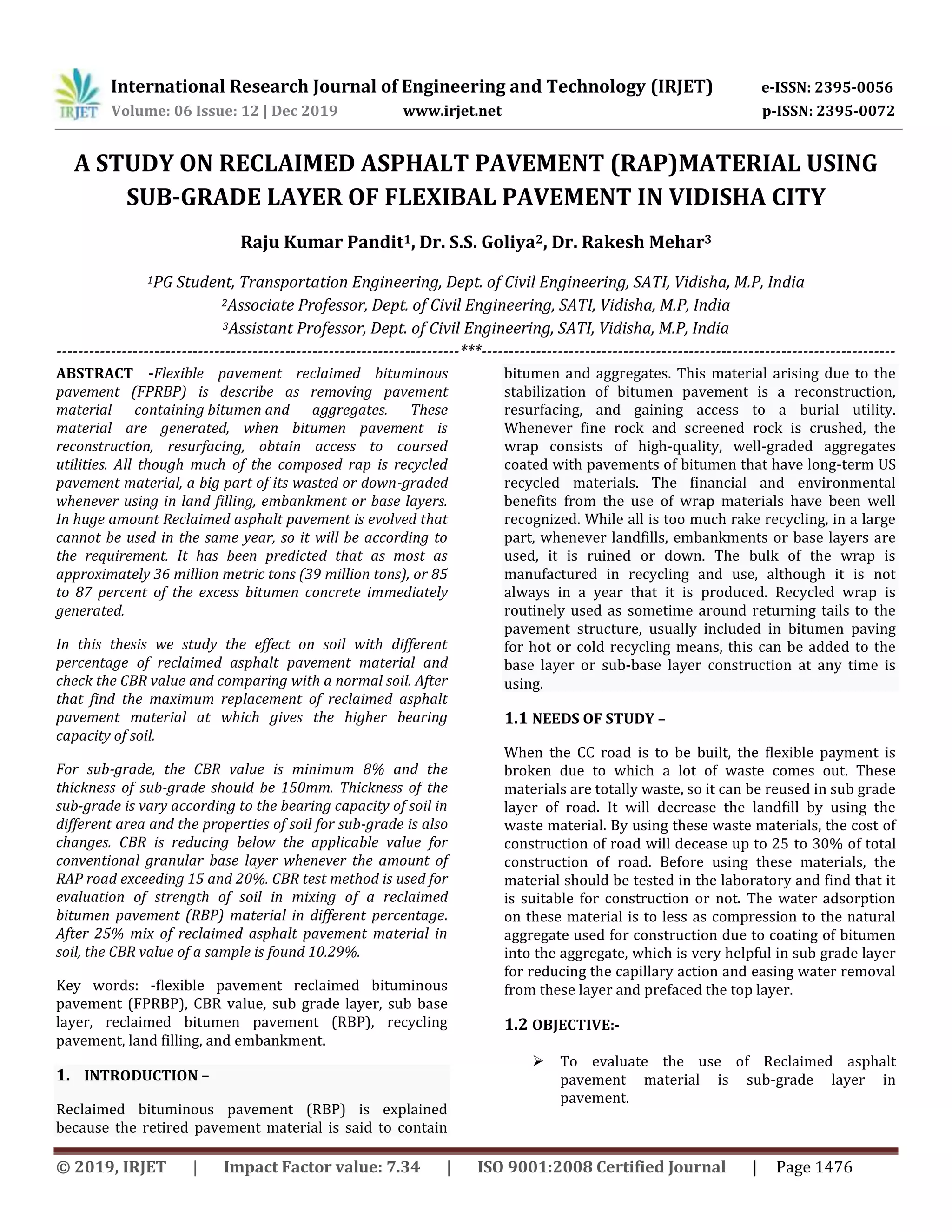
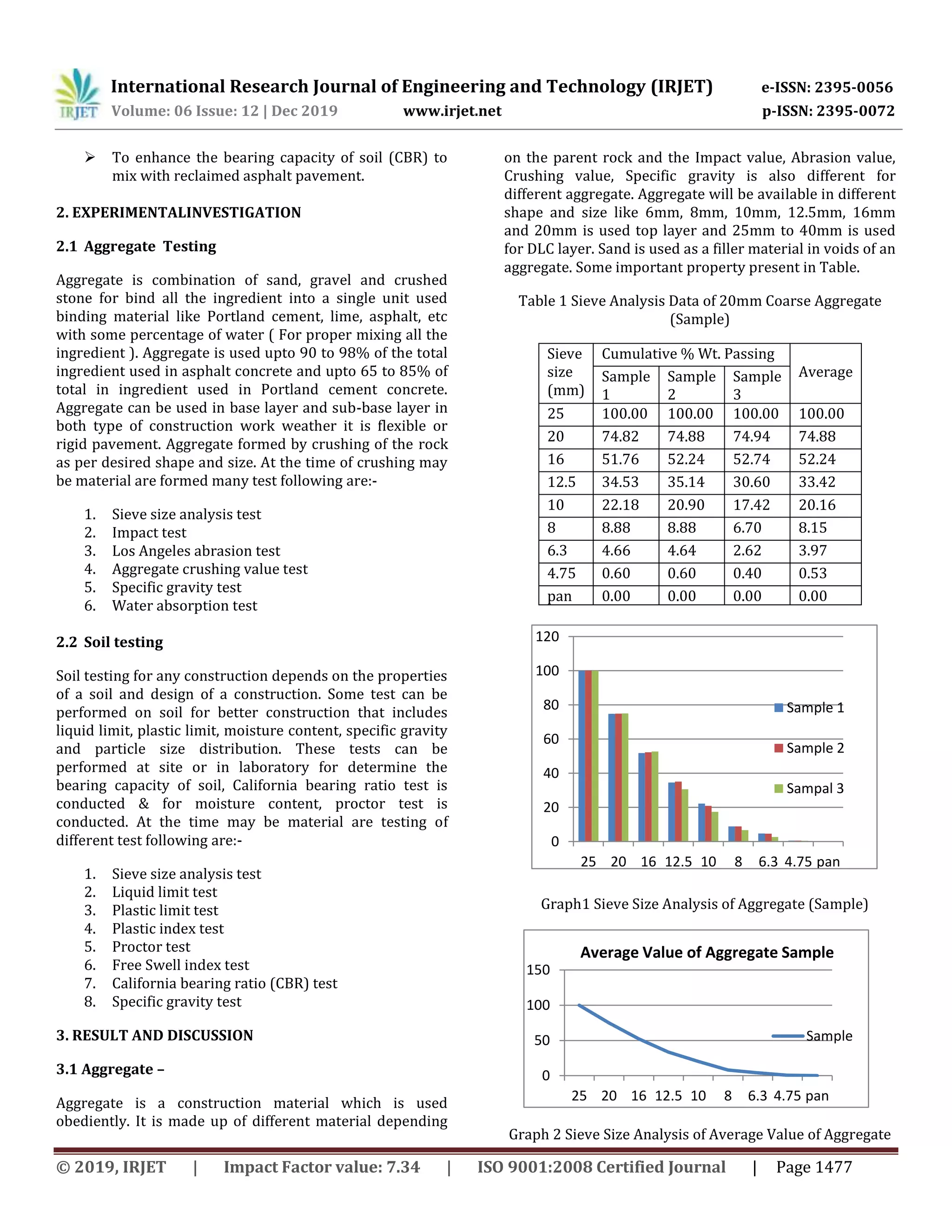
aggregate. Some important property present in Table.
Table 1 Sieve Analysis Data of 20mm Coarse Aggregate
(Sample)
Sieve
size
(mm)
Cumulative % Wt. Passing
AverageSample
1
Sample
2
Sample
3
25 100.00 100.00 100.00 100.00
20 74.82 74.88 74.94 74.88
16 51.76 52.24 52.74 52.24
12.5 34.53 35.14 30.60 33.42
10 22.18 20.90 17.42 20.16
8 8.88 8.88 6.70 8.15
6.3 4.66 4.64 2.62 3.97
4.75 0.60 0.60 0.40 0.53
pan 0.00 0.00 0.00 0.00
Graph1 Sieve Size Analysis of Aggregate (Sample)
Graph 2 Sieve Size Analysis of Average Value of Aggregate
International Research Journal of Engineering and Technology (IRJET) e-ISSN: 2395-0056
Volume: 06 Issue: 12 | Dec 2019 www.irjet.net p-ISSN: 2395-0072
© 2019, IRJET | Impact Factor value: 7.34 | ISO 9001:2008 Certified Journal | Page 1478
Since the concrete pavement are subjected to dynamic
load due to the vehicular movement, therefore some
special properties in aggregate as such impact value,
abrasion value & crushing value, in addition to its normal
properties, evaluated generally for the common use of
aggregate for making concrete, were also determined. The
results and permissible limits for are presented in Table.
Table 2 Important Physical Properties of 20mm Aggregate
(Sample)
3.2 Soil: -
Soil is a mixture of broken rocks and mineral and load of
whole structure whether it is road, building or bridge is
bear by the soil. So the soil bearing capacity is high to
resist the structure for long time. For increasing the
bearing capacity of soil, soil stabilization is necessary. Soil
stabilization alters the property of soil and in erasing the
shear strength of soil & control the swelling shrinkage of a
soil. .
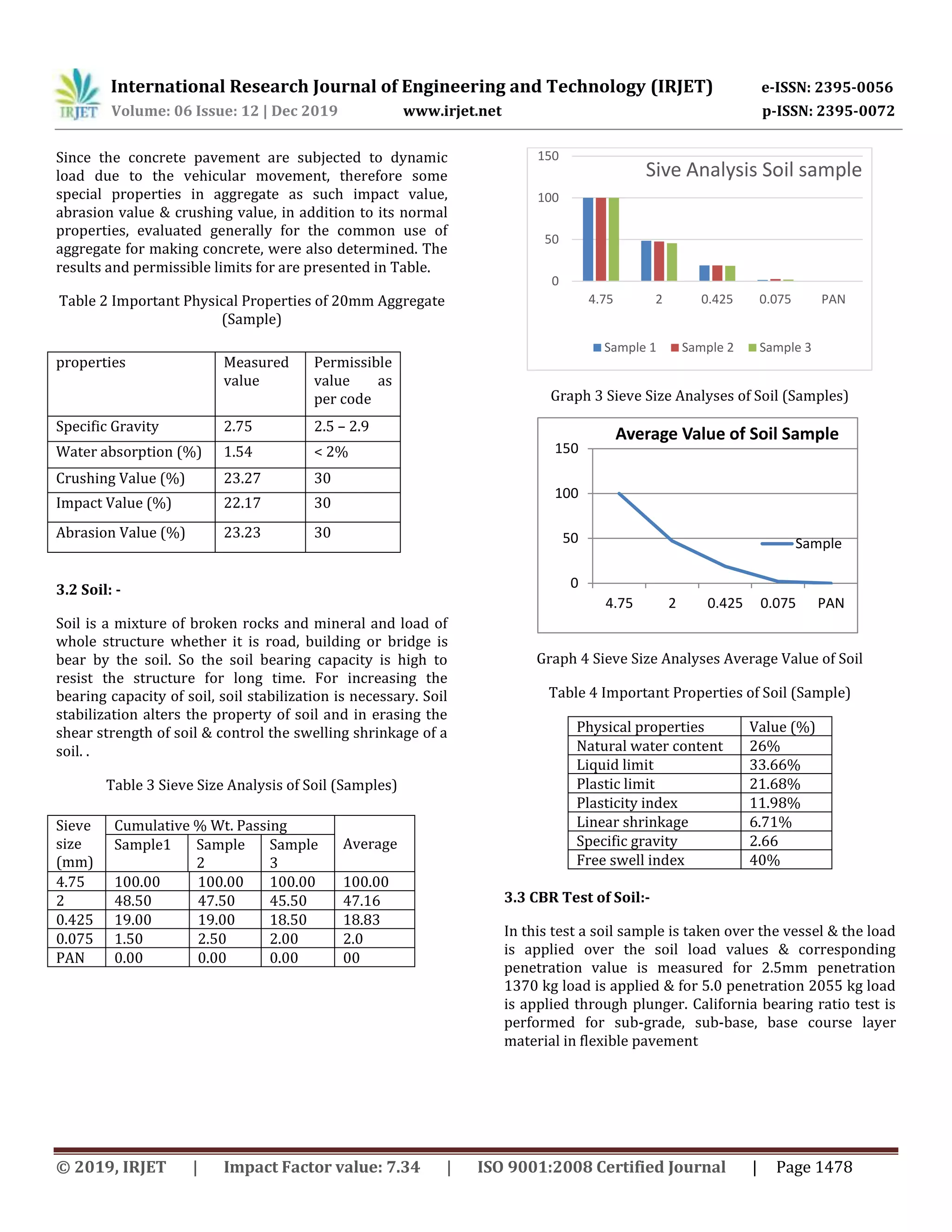
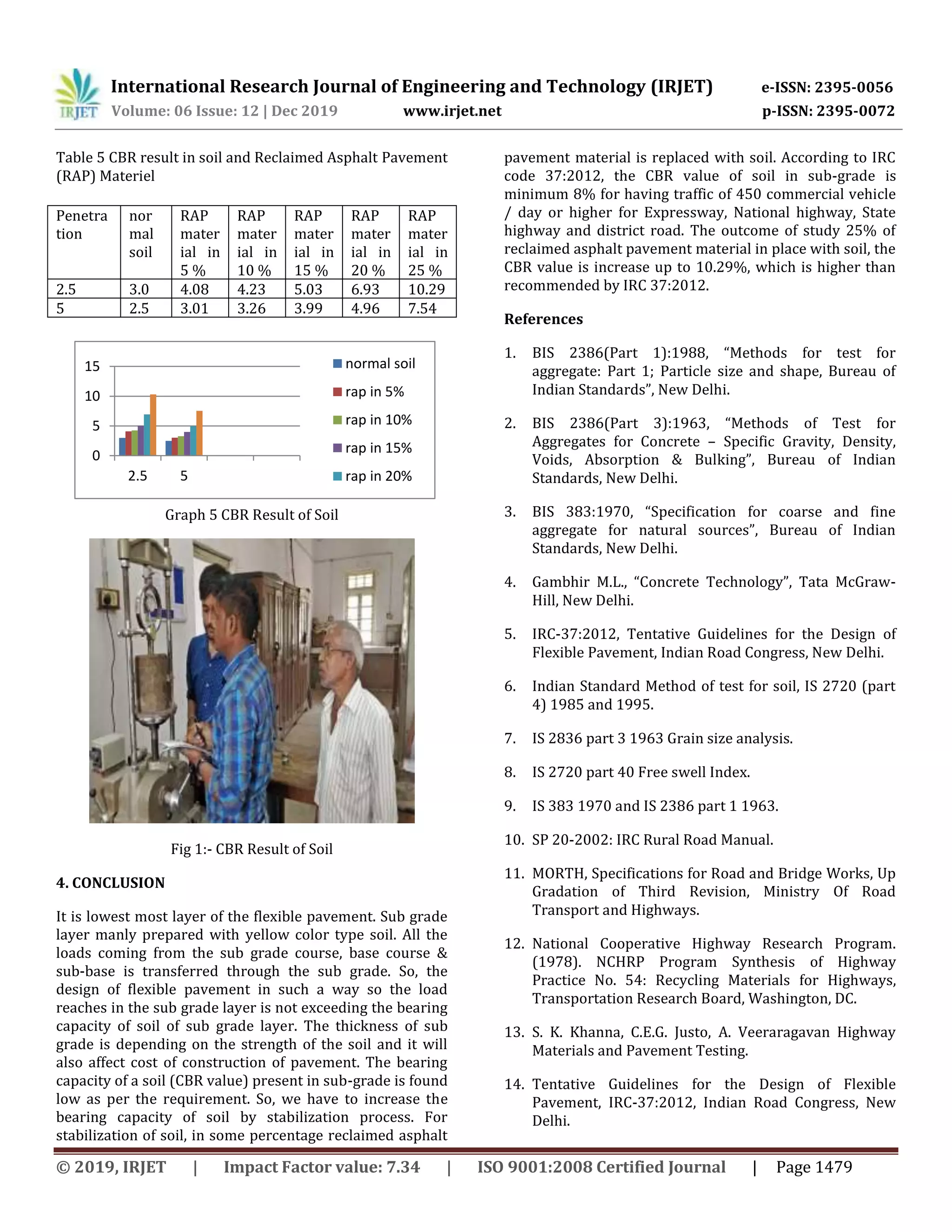
Table 3 Sieve Size Analysis of Soil (Samples)
Graph 3 Sieve Size Analyses of Soil (Samples)
Graph 4 Sieve Size Analyses Average Value of Soil
Table 4 Important Properties of Soil (Sample)
Physical properties Value (%)
Natural water content 26%
Liquid limit 33.66%
Plastic limit 21.68%
Plasticity index 11.98%
Linear shrinkage 6.71%
Specific gravity 2.66
Free swell index 40%
3.3 CBR Test of Soil:-
In this test a soil sample is taken over the vessel & the load
is applied over the soil load values & corresponding
penetration value is measured for 2.5mm penetration
1370 kg load is applied & for 5.0 penetration 2055 kg load
is applied through plunger. California bearing ratio test is
performed for sub-grade, sub-base, base course layer
material in flexible pavement
0
50
100
150
4.75 2 0.425 0.075 PAN
Sive Analysis Soil sample
Sample 1 Sample 2 Sample 3
properties Measured
value
Permissible
value as
per code
Specific Gravity 2.75 2.5 – 2.9
Water absorption (%) 1.54 < 2%
Crushing Value (%) 23.27 30
Impact Value (%) 22.17 30
Abrasion Value (%) 23.23 30
Sieve
size
(mm)
Cumulative % Wt. Passing
AverageSample1 Sample
2
Sample
3
4.75 100.00 100.00 100.00 100.00
2 48.50 47.50 45.50 47.16
0.425 19.00 19.00 18.50 18.83
0.075 1.50 2.50 2.00 2.0
PAN 0.00 0.00 0.00 00
0
50
100
150
4.75 2 0.425 0.075 PAN
Average Value of Soil Sample
Sample
International Research Journal of Engineering and Technology (IRJET) e-ISSN: 2395-0056
Volume: 06 Issue: 12 | Dec 2019 www.irjet.net p-ISSN: 2395-0072
© 2019, IRJET | Impact Factor value: 7.34 | ISO 9001:2008 Certified Journal | Page 1479
0
5
10
15
2.5 5
normal soil
rap in 5%
rap in 10%
rap in 15%
rap in 20%
Table 5 CBR result in soil and Reclaimed Asphalt Pavement
(RAP) Materiel
Graph 5 CBR Result of Soil
Fig 1:- CBR Result of Soil
4. CONCLUSION
It is lowest most layer of the flexible pavement. Sub grade
layer manly prepared with yellow color type soil. All the
loads coming from the sub grade course, base course &
sub-base is transferred through the sub grade. So, the
design of flexible pavement in such a way so the load
reaches in the sub grade layer is not exceeding the bearing
capacity of soil of sub grade layer. The thickness of sub
grade is depending on the strength of the soil and it will
also affect cost of construction of pavement. The bearing
capacity of a soil (CBR value) present in sub-grade is found
low as per the requirement. So, we have to increase the
bearing capacity of soil by stabilization process. For
stabilization of soil, in some percentage reclaimed asphalt
pavement material is replaced with soil. According to IRC
code 37:2012, the CBR value of soil in sub-grade is
minimum 8% for having traffic of 450 commercial vehicle
/ day or higher for Expressway, National highway, State
highway and district road. The outcome of study 25% of
reclaimed asphalt pavement material in place with soil, the
CBR value is increase up to 10.29%, which is higher than
recommended by IRC 37:2012.
References
1. BIS 2386(Part 1):1988, “Methods for test for
aggregate: Part 1; Particle size and shape, Bureau of
Indian Standards”, New Delhi.
2. BIS 2386(Part 3):1963, “Methods of Test for
Aggregates for Concrete – Specific Gravity, Density,
Voids, Absorption & Bulking”, Bureau of Indian
Standards, New Delhi.
3. BIS 383:1970, “Specification for coarse and fine
aggregate for natural sources”, Bureau of Indian
Standards, New Delhi.
4. Gambhir M.L., “Concrete Technology”, Tata McGraw-
Hill, New Delhi.
5. IRC-37:2012, Tentative Guidelines for the Design of
Flexible Pavement, Indian Road Congress, New Delhi.
6. Indian Standard Method of test for soil, IS 2720 (part
4) 1985 and 1995.
7. IS 2836 part 3 1963 Grain size analysis.
8. IS 2720 part 40 Free swell Index.
9. IS 383 1970 and IS 2386 part 1 1963.
10. SP 20-2002: IRC Rural Road Manual.
11. MORTH, Specifications for Road and Bridge Works, Up
Gradation of Third Revision, Ministry Of Road
Transport and Highways.
12. National Cooperative Highway Research Program.
(1978). NCHRP Program Synthesis of Highway
Practice No. 54: Recycling Materials for Highways,
Transportation Research Board, Washington, DC.
13. S. K. Khanna, C.E.G. Justo, A. Veeraragavan Highway
Materials and Pavement Testing.
14. Tentative Guidelines for the Design of Flexible
Pavement, IRC-37:2012, Indian Road Congress, New
Delhi.
Penetra
tion
nor
mal
soil
RAP
mater
ial in
5 %
RAP
mater
ial in
10 %
RAP
mater
ial in
15 %
RAP
mater
ial in
20 %
RAP
mater
ial in
25 %
2.5 3.0 4.08 4.23 5.03 6.93 10.29
5 2.5 3.01 3.26 3.99 4.96 7.54

IRJET- A Study on Reclaimed Asphalt Pavement (RAP)Material using Sub-Grade Layer of Flexibal Pavement in Vidisha City

  • 1.
    International Research Journalof Engineering and Technology (IRJET) e-ISSN: 2395-0056 Volume: 06 Issue: 12 | Dec 2019 www.irjet.net p-ISSN: 2395-0072 © 2019, IRJET | Impact Factor value: 7.34 | ISO 9001:2008 Certified Journal | Page 1476 A STUDY ON RECLAIMED ASPHALT PAVEMENT (RAP)MATERIAL USING SUB-GRADE LAYER OF FLEXIBAL PAVEMENT IN VIDISHA CITY Raju Kumar Pandit1, Dr. S.S. Goliya2, Dr. Rakesh Mehar3 1PG Student, Transportation Engineering, Dept. of Civil Engineering, SATI, Vidisha, M.P, India 2Associate Professor, Dept. of Civil Engineering, SATI, Vidisha, M.P, India 3Assistant Professor, Dept. of Civil Engineering, SATI, Vidisha, M.P, India --------------------------------------------------------------------------***---------------------------------------------------------------------------- ABSTRACT -Flexible pavement reclaimed bituminous pavement (FPRBP) is describe as removing pavement material containing bitumen and aggregates. These material are generated, when bitumen pavement is reconstruction, resurfacing, obtain access to coursed utilities. All though much of the composed rap is recycled pavement material, a big part of its wasted or down-graded whenever using in land filling, embankment or base layers. In huge amount Reclaimed asphalt pavement is evolved that cannot be used in the same year, so it will be according to the requirement. It has been predicted that as most as approximately 36 million metric tons (39 million tons), or 85 to 87 percent of the excess bitumen concrete immediately generated. In this thesis we study the effect on soil with different percentage of reclaimed asphalt pavement material and check the CBR value and comparing with a normal soil. After that find the maximum replacement of reclaimed asphalt pavement material at which gives the higher bearing capacity of soil. For sub-grade, the CBR value is minimum 8% and the thickness of sub-grade should be 150mm. Thickness of the sub-grade is vary according to the bearing capacity of soil in different area and the properties of soil for sub-grade is also changes. CBR is reducing below the applicable value for conventional granular base layer whenever the amount of RAP road exceeding 15 and 20%. CBR test method is used for evaluation of strength of soil in mixing of a reclaimed bitumen pavement (RBP) material in different percentage. After 25% mix of reclaimed asphalt pavement material in soil, the CBR value of a sample is found 10.29%. Key words: -flexible pavement reclaimed bituminous pavement (FPRBP), CBR value, sub grade layer, sub base layer, reclaimed bitumen pavement (RBP), recycling pavement, land filling, and embankment. 1. INTRODUCTION – Reclaimed bituminous pavement (RBP) is explained because the retired pavement material is said to contain bitumen and aggregates. This material arising due to the stabilization of bitumen pavement is a reconstruction, resurfacing, and gaining access to a burial utility. Whenever fine rock and screened rock is crushed, the wrap consists of high-quality, well-graded aggregates coated with pavements of bitumen that have long-term US recycled materials. The financial and environmental benefits from the use of wrap materials have been well recognized. While all is too much rake recycling, in a large part, whenever landfills, embankments or base layers are used, it is ruined or down. The bulk of the wrap is manufactured in recycling and use, although it is not always in a year that it is produced. Recycled wrap is routinely used as sometime around returning tails to the pavement structure, usually included in bitumen paving for hot or cold recycling means, this can be added to the base layer or sub-base layer construction at any time is using. 1.1 NEEDS OF STUDY – When the CC road is to be built, the flexible payment is broken due to which a lot of waste comes out. These materials are totally waste, so it can be reused in sub grade layer of road. It will decrease the landfill by using the waste material. By using these waste materials, the cost of construction of road will decease up to 25 to 30% of total construction of road. Before using these materials, the material should be tested in the laboratory and find that it is suitable for construction or not. The water adsorption on these material is to less as compression to the natural aggregate used for construction due to coating of bitumen into the aggregate, which is very helpful in sub grade layer for reducing the capillary action and easing water removal from these layer and prefaced the top layer. 1.2 OBJECTIVE:-  To evaluate the use of Reclaimed asphalt pavement material is sub-grade layer in pavement.
  • 2.
    International Research Journalof Engineering and Technology (IRJET) e-ISSN: 2395-0056 Volume: 06 Issue: 12 | Dec 2019 www.irjet.net p-ISSN: 2395-0072 © 2019, IRJET | Impact Factor value: 7.34 | ISO 9001:2008 Certified Journal | Page 1477 0 20 40 60 80 100 120 25 20 16 12.5 10 8 6.3 4.75 pan Sample 1 Sample 2 Sampal 3 0 50 100 150 25 20 16 12.5 10 8 6.3 4.75 pan Average Value of Aggregate Sample Sample  To enhance the bearing capacity of soil (CBR) to mix with reclaimed asphalt pavement. 2. EXPERIMENTALINVESTIGATION 2.1 Aggregate Testing Aggregate is combination of sand, gravel and crushed stone for bind all the ingredient into a single unit used binding material like Portland cement, lime, asphalt, etc with some percentage of water ( For proper mixing all the ingredient ). Aggregate is used upto 90 to 98% of the total ingredient used in asphalt concrete and upto 65 to 85% of total in ingredient used in Portland cement concrete. Aggregate can be used in base layer and sub-base layer in both type of construction work weather it is flexible or rigid pavement. Aggregate formed by crushing of the rock as per desired shape and size. At the time of crushing may be material are formed many test following are:- 1. Sieve size analysis test 2. Impact test 3. Los Angeles abrasion test 4. Aggregate crushing value test 5. Specific gravity test 6. Water absorption test 2.2 Soil testing Soil testing for any construction depends on the properties of a soil and design of a construction. Some test can be performed on soil for better construction that includes liquid limit, plastic limit, moisture content, specific gravity and particle size distribution. These tests can be performed at site or in laboratory for determine the bearing capacity of soil, California bearing ratio test is conducted & for moisture content, proctor test is conducted. At the time may be material are testing of different test following are:- 1. Sieve size analysis test 2. Liquid limit test 3. Plastic limit test 4. Plastic index test 5. Proctor test 6. Free Swell index test 7. California bearing ratio (CBR) test 8. Specific gravity test 3. RESULT AND DISCUSSION 3.1 Aggregate – Aggregate is a construction material which is used obediently. It is made up of different material depending on the parent rock and the Impact value, Abrasion value, Crushing value, Specific gravity is also different for different aggregate. Aggregate will be available in different shape and size like 6mm, 8mm, 10mm, 12.5mm, 16mm and 20mm is used top layer and 25mm to 40mm is used for DLC layer. Sand is used as a filler material in voids of an aggregate. Some important property present in Table. Table 1 Sieve Analysis Data of 20mm Coarse Aggregate (Sample) Sieve size (mm) Cumulative % Wt. Passing AverageSample 1 Sample 2 Sample 3 25 100.00 100.00 100.00 100.00 20 74.82 74.88 74.94 74.88 16 51.76 52.24 52.74 52.24 12.5 34.53 35.14 30.60 33.42 10 22.18 20.90 17.42 20.16 8 8.88 8.88 6.70 8.15 6.3 4.66 4.64 2.62 3.97 4.75 0.60 0.60 0.40 0.53 pan 0.00 0.00 0.00 0.00 Graph1 Sieve Size Analysis of Aggregate (Sample) Graph 2 Sieve Size Analysis of Average Value of Aggregate
  • 3.
    International Research Journalof Engineering and Technology (IRJET) e-ISSN: 2395-0056 Volume: 06 Issue: 12 | Dec 2019 www.irjet.net p-ISSN: 2395-0072 © 2019, IRJET | Impact Factor value: 7.34 | ISO 9001:2008 Certified Journal | Page 1478 Since the concrete pavement are subjected to dynamic load due to the vehicular movement, therefore some special properties in aggregate as such impact value, abrasion value & crushing value, in addition to its normal properties, evaluated generally for the common use of aggregate for making concrete, were also determined. The results and permissible limits for are presented in Table. Table 2 Important Physical Properties of 20mm Aggregate (Sample) 3.2 Soil: - Soil is a mixture of broken rocks and mineral and load of whole structure whether it is road, building or bridge is bear by the soil. So the soil bearing capacity is high to resist the structure for long time. For increasing the bearing capacity of soil, soil stabilization is necessary. Soil stabilization alters the property of soil and in erasing the shear strength of soil & control the swelling shrinkage of a soil. . Table 3 Sieve Size Analysis of Soil (Samples) Graph 3 Sieve Size Analyses of Soil (Samples) Graph 4 Sieve Size Analyses Average Value of Soil Table 4 Important Properties of Soil (Sample) Physical properties Value (%) Natural water content 26% Liquid limit 33.66% Plastic limit 21.68% Plasticity index 11.98% Linear shrinkage 6.71% Specific gravity 2.66 Free swell index 40% 3.3 CBR Test of Soil:- In this test a soil sample is taken over the vessel & the load is applied over the soil load values & corresponding penetration value is measured for 2.5mm penetration 1370 kg load is applied & for 5.0 penetration 2055 kg load is applied through plunger. California bearing ratio test is performed for sub-grade, sub-base, base course layer material in flexible pavement 0 50 100 150 4.75 2 0.425 0.075 PAN Sive Analysis Soil sample Sample 1 Sample 2 Sample 3 properties Measured value Permissible value as per code Specific Gravity 2.75 2.5 – 2.9 Water absorption (%) 1.54 < 2% Crushing Value (%) 23.27 30 Impact Value (%) 22.17 30 Abrasion Value (%) 23.23 30 Sieve size (mm) Cumulative % Wt. Passing AverageSample1 Sample 2 Sample 3 4.75 100.00 100.00 100.00 100.00 2 48.50 47.50 45.50 47.16 0.425 19.00 19.00 18.50 18.83 0.075 1.50 2.50 2.00 2.0 PAN 0.00 0.00 0.00 00 0 50 100 150 4.75 2 0.425 0.075 PAN Average Value of Soil Sample Sample
  • 4.
    International Research Journalof Engineering and Technology (IRJET) e-ISSN: 2395-0056 Volume: 06 Issue: 12 | Dec 2019 www.irjet.net p-ISSN: 2395-0072 © 2019, IRJET | Impact Factor value: 7.34 | ISO 9001:2008 Certified Journal | Page 1479 0 5 10 15 2.5 5 normal soil rap in 5% rap in 10% rap in 15% rap in 20% Table 5 CBR result in soil and Reclaimed Asphalt Pavement (RAP) Materiel Graph 5 CBR Result of Soil Fig 1:- CBR Result of Soil 4. CONCLUSION It is lowest most layer of the flexible pavement. Sub grade layer manly prepared with yellow color type soil. All the loads coming from the sub grade course, base course & sub-base is transferred through the sub grade. So, the design of flexible pavement in such a way so the load reaches in the sub grade layer is not exceeding the bearing capacity of soil of sub grade layer. The thickness of sub grade is depending on the strength of the soil and it will also affect cost of construction of pavement. The bearing capacity of a soil (CBR value) present in sub-grade is found low as per the requirement. So, we have to increase the bearing capacity of soil by stabilization process. For stabilization of soil, in some percentage reclaimed asphalt pavement material is replaced with soil. According to IRC code 37:2012, the CBR value of soil in sub-grade is minimum 8% for having traffic of 450 commercial vehicle / day or higher for Expressway, National highway, State highway and district road. The outcome of study 25% of reclaimed asphalt pavement material in place with soil, the CBR value is increase up to 10.29%, which is higher than recommended by IRC 37:2012. References 1. BIS 2386(Part 1):1988, “Methods for test for aggregate: Part 1; Particle size and shape, Bureau of Indian Standards”, New Delhi. 2. BIS 2386(Part 3):1963, “Methods of Test for Aggregates for Concrete – Specific Gravity, Density, Voids, Absorption & Bulking”, Bureau of Indian Standards, New Delhi. 3. BIS 383:1970, “Specification for coarse and fine aggregate for natural sources”, Bureau of Indian Standards, New Delhi. 4. Gambhir M.L., “Concrete Technology”, Tata McGraw- Hill, New Delhi. 5. IRC-37:2012, Tentative Guidelines for the Design of Flexible Pavement, Indian Road Congress, New Delhi. 6. Indian Standard Method of test for soil, IS 2720 (part 4) 1985 and 1995. 7. IS 2836 part 3 1963 Grain size analysis. 8. IS 2720 part 40 Free swell Index. 9. IS 383 1970 and IS 2386 part 1 1963. 10. SP 20-2002: IRC Rural Road Manual. 11. MORTH, Specifications for Road and Bridge Works, Up Gradation of Third Revision, Ministry Of Road Transport and Highways. 12. National Cooperative Highway Research Program. (1978). NCHRP Program Synthesis of Highway Practice No. 54: Recycling Materials for Highways, Transportation Research Board, Washington, DC. 13. S. K. Khanna, C.E.G. Justo, A. Veeraragavan Highway Materials and Pavement Testing. 14. Tentative Guidelines for the Design of Flexible Pavement, IRC-37:2012, Indian Road Congress, New Delhi. Penetra tion nor mal soil RAP mater ial in 5 % RAP mater ial in 10 % RAP mater ial in 15 % RAP mater ial in 20 % RAP mater ial in 25 % 2.5 3.0 4.08 4.23 5.03 6.93 10.29 5 2.5 3.01 3.26 3.99 4.96 7.54