International Research Journal of Engineering and Technology (IRJET) e-ISSN: 2395-0056
Volume: 06 Issue: 08 | Aug 2019 www.irjet.net p-ISSN: 2395-0072
© 2019, IRJET | Impact Factor value: 7.34 | ISO 9001:2008 Certified Journal | Page 1526
A STUDY ON BEHAVIOUR OF DIAGRID STRUCTURE USING PUSHOVER
ANALYSIS
Jeevitha H¹, Guruprasad T N², Dr. Mallesh T V3, Ramesh S R4
¹P.G Student, Civil Engineering Department, Sri Siddhartha Institute of Technology, Tumakuru, Karnataka, India.
²Asst.Professor, Civil Engineering Department, Sri Siddhartha Institute of Technology, Tumakuru,
Karnataka, India.
3Professor and Head, Civil Engineering Department, Sri Siddhartha Institute of Technology, Tumakuru,
Karnataka, India.
4Professor, Civil Engineering Department, Sri Siddhartha Institute of Technology, Tumakuru, Karnataka, India.
-------------------------------------------------------------------------***------------------------------------------------------------------------
Abstract: The growth of population has influenced the
development of cities. The costly lands, decisions to avoid
urban expansion and to preserve the agricultural lands,
the residential development drive upwards. As buildings
height increases the lateral load resisting system of the
building is important than the gravity load resisting
system. The latest trend in high rise building is diagrid
structures because of structural and architectural
effectiveness. In the present study diagrids are provided
for Circular steel Building and detailed analysis were
carried out to check the behavior of circular steel building
with and without diagrid. ETABS software is used for
modeling, analysis and design of models. G+11 and G+23
storey buildings of circular plan of 30m diameter with
storey height 4m located at zone v on a hard rock are
modeled, analyzed and designed. Push over analysis is
carried to obtain the base shear v/s roof displacement
curves. These are Push over curves or capacity curves.
Push over curves of circular steel building without diagrid
and circular steel building with diagrid are compared. It is
observed from the results of 4 module building that
stiffness will be high which makes base-shear and
overturning moment to increase and decrease in the story
displacement and story drift compared with 3 and 4
module building.
Key words: Diagrid, Braced tube structures, Push
over analysis, Optimal grid, Neliastic deformation etc
1. Introduction:
The Diagrids are perimeter structural configurations
characterized by a narrow grid of diagonal members
which are involved both in gravity and in lateral load
resistance. Diagonalized applications of structural steel
members for providing efficient solutions both in terms
of strength and stiffness are not new, however nowadays
a renewed interest in it and a widespread application of
diagrid is registered with reference to large span and
high rise buildings, particularly when they are
characterized by complex geometries and curved shapes.
The Swiss Re tower in London, Hearst tower in New
York, CCTV headquarters building in Beijing, Mode
Gakuen Spiral Tower in Aichi, West tower in Guangzhou,
Lotte super tower in Seoul, Capital Gate in Abu Dhabi etc.
are some of the popular diagrid buildings.
The diagrid systems are the evolution of braced tube
structures, since the perimeter configuration still holds
for preserving the maximum bending resistance and
rigidity, while, with respect to the braced tube, the mega-
diagonal members are diffusely spread over the façade,
giving rise to closely spaced diagonal elements and
allowing for the complete elimination of the
conventional vertical columns. The major difference
between a braced tube building and a diagrid building is
that, there are no vertical columns present in the
perimeter of diagrid building, whereas in braced tube
building there are vertical column present in the
perimeter of the building. Therefore the diagonal
members in diagrid structures act both as inclined
columns and as bracing elements, and carry gravity
loads as well as lateral forces; due to their triangulated
configuration, mainly internal axial forces arise in the
members, thus minimizing shear racking effects. The
term “diagrid” is a combination of the words “diagonal”
and “grid” and refers to a structural system that is single‐
thickness in nature and gains its structural integrity
through the use of triangulation. Diagrid systems can be
planar, crystalline or take on multiple curvatures. They
often use crystalline forms or curvature to increase their
stiffness. Perimeter diagrids normally carry the lateral
and gravity loads of the building and are used to support
the floor edges.
2. Literature review:
Ravi Sorathiya and Pradeep Pandey [1] (Study on
Diagrid structure of multi-storey Building (IJARED-2017)).
The diagrid structures are buildings with diagonal grids
in the periphery at a particular angle and in modules
across the height of the building. Diagrid structures use
triangulated grids which are in place of vertical columns
in the periphery. Thus, systems that are more efficient in
achieving stiffness against lateral loads are considered
better options in designing tall buildings.
Nishith B. panchal and Vinubhai R. Patel [2] (Diagrid
structural system: strategies to reduce lateral forces on
International Research Journal of Engineering and Technology (IRJET) e-ISSN: 2395-0056
Volume: 06 Issue: 08 | Aug 2019 www.irjet.net p-ISSN: 2395-0072
© 2019, IRJET | Impact Factor value: 7.34 | ISO 9001:2008 Certified Journal | Page 1527
high-rise buildings (IJRET-2014)). New structural
concepts with newly adopted high strength materials
and construction methods have been towards “stiffness”
and “lightness”. It is common knowledge that rather than
directly standing the forces, it is better to reduce them
and dissipate the magnitude of vibrations. The modelled
structural system should be such that it should be
effectively utilized for structural requirements. Recently
diagrid structural is adopted in tall buildings due to its
structural efficiency and architectural planning.
Kyoung Sun Moona [3] (Diagrid structures for complex
shaped tall buildings (ASCE-2011)). The diagrid
structures are prevalently used for today’s tall building
due to their structural efficiency and architectural
aesthetic potentials. For each complex form category, tall
buildings are designed with diagrid systems, and their
structural efficiency is studied in conjunction with
building forms. Here the complex shaped tall buildings
such as twisted, tilted and free form towers are analysed.
Saket Yadav and Vivek Garg [4] (Advantage of diagrid
building over conventional building (ASCE-2011)). The
use of diagonal members for carrying the gravity and
lateral load has increased and these members are known
as ‘diagrid’. In this study the structural response of
conventional and diagrid building is investigated to
evaluate the structural benefits of diagrid system.
Saket Yadav and Vivek Garg [5] (An analytical study on
performance of a diagrid structure using non-linear static
pushover Analysis (ASCE-2011)). In this present study the
performance characteristics of diagrid structures using
non-linear pushover analysis. In pushover analysis, the
structure is subjected to monotonically increasing lateral
loads till the target displacement is reached. In
displacement control method, the displacement of the
top storey of the structure is incremented step by step,
such that required horizontal forces push the structure
laterally
3. Objectives
1) To find the brace angle or storey module with less
base shear at performance
2) To find the lateral stiffness of the circular steel
building with diagrid.
3) The primary objective in designing an earthquake
resistant structure is to ensure that the building has
enough ductility to withstand the lateral loads.
4. Methodology
Design of Structural members:
Here, 2, 3, 4 and 6 modules of 12 and 24 storied
structural models are considered for the diagrid
structures are considered for the analysis. All the models
consist of 12 storeys. Conventional beam-slab design is
considered for the analysis. For bracings and Beams of I-
section is used and the specifications are mentioned
below. The plan considered is circular and it is of
diameter 30m. The Storey height is 4.0m. The angle of
inclination of diagrids considered are 37.94˚, 49.34˚ and
57.32˚. 10.26m spacing is maintained in diagrids along
the perimeter of the building. The live load and the
flooring load considered are 2.0kN/m2 and 3.0kN/m2
respectively. The structural models are modelled in
ETABS 16.2.0 Software. The various input parameters
which are considered while modeling are described in
detail in the following sections.
Table 4.1 Structural elements and their materials
Structural
Element
Material
Concrete Rebar Steel
Beam Fe250
Slab M30 HYSD500
Diagrid Fe250
Table 4.2 Section Properties of Structural Elements used
in models
Table 4.2.1 : 12- storey building
Type of
building
Structural
Elements
Sectional Properties
(mm)
12
Storey
building
Beams depth 550
Bottom
flange
thickness 25
Bottom
flange width 225
Top flange
width 225
Top flange
thickness 25
Web
thickness 25
Columns depth 1000
Bottom
flange
38
International Research Journal of Engineering and Technology (IRJET) e-ISSN: 2395-0056
Volume: 06 Issue: 08 | Aug 2019 www.irjet.net p-ISSN: 2395-0072
© 2019, IRJET | Impact Factor value: 7.34 | ISO 9001:2008 Certified Journal | Page 1528
thickness
Bottom
flange width 500
Top flange
width 500
Top flange
thickness 38
Web
thickness 38
Slab thickness 200
Table 4.2.2 : 24-storey building
Type of
building
Structural
Elements
Sectional Properties
(mm)
24 Storey
Building
Beams depth 550
Bottom
flange
thickness 25
Bottom
flange width 225
Top flange
width 225
Top flange
thickness 25
Web
thickness 25
Columns
depth
1400
Bottom
flange
thickness 50
Bottom
flange width 700
Top flange
width 700
Top flange
thickness 50
Web
thickness 50
Slab thickness 200
Table 4.3 Parameters considered for earthquake
Analysis:
Parameters Consideration
Zone factor 0.36
Response reduction factor 3
Importance factor 1
Soil type Medium soil
Damping 5%
Table 4.4: Load combinations considered for design and
analysis.
Models considered for study
Model 1: 12 storey Steel frame building with 2 modules
Model 2: 12 storey Steel frame building with 3 modules
Model 3: 12 storey Steel frame building with 4 modules
Model 4: 24 storey Steel frame building with 2 modules
Model 5: 24 storey Steel frame building with 3 modules
Model 6 : 24 storey Steel frame building with 4 modules
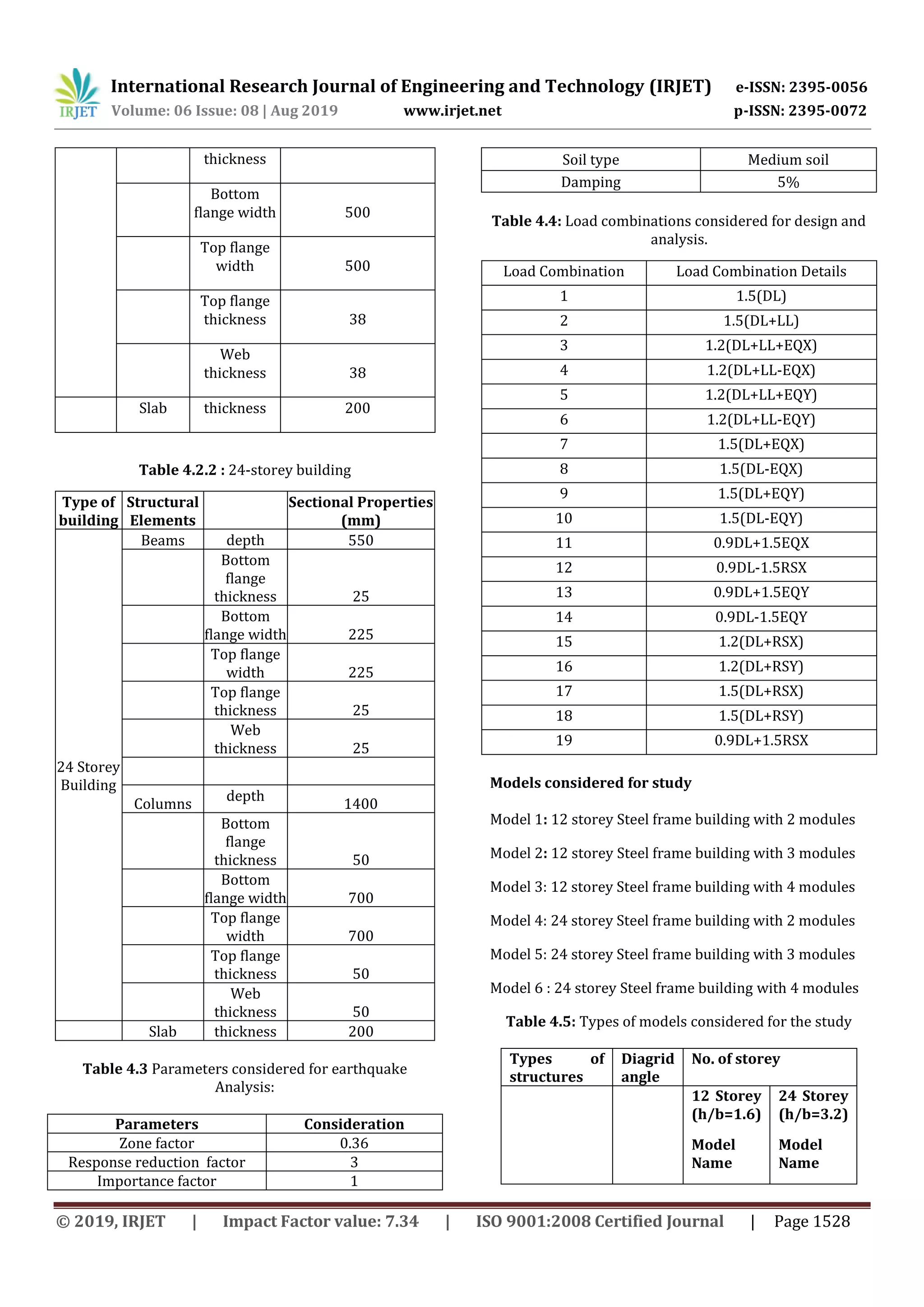
Table 4.5: Types of models considered for the study
Types of
structures
Diagrid
angle
No. of storey
12 Storey
(h/b=1.6)
Model
Name
24 Storey
(h/b=3.2)
Model
Name
Load Combination Load Combination Details
1 1.5(DL)
2 1.5(DL+LL)
3 1.2(DL+LL+EQX)
4 1.2(DL+LL-EQX)
5 1.2(DL+LL+EQY)
6 1.2(DL+LL-EQY)
7 1.5(DL+EQX)
8 1.5(DL-EQX)
9 1.5(DL+EQY)
10 1.5(DL-EQY)
11 0.9DL+1.5EQX
12 0.9DL-1.5RSX
13 0.9DL+1.5EQY
14 0.9DL-1.5EQY
15 1.2(DL+RSX)
16 1.2(DL+RSY)
17 1.5(DL+RSX)
18 1.5(DL+RSY)
19 0.9DL+1.5RSX
International Research Journal of Engineering and Technology (IRJET) e-ISSN: 2395-0056
Volume: 06 Issue: 08 | Aug 2019 www.irjet.net p-ISSN: 2395-0072
© 2019, IRJET | Impact Factor value: 7.34 | ISO 9001:2008 Certified Journal | Page 1529
Type 1 Type 2
Conventional
frame
building
2 Storey
Module
37.94˚ M1 M4
3 Storey
Module
49.46˚ M2 M5
4 Storey
Module
57.32˚ M3 M6
5. RESULTS AND DISCUSSIONS
1) This study is to compare the behavior of 2, 3 and 4
modules building of conventional diagrid building to find
the resistance of conventional diagrid building for lateral
loads.
2) The models are designed for the gravity loads, lateral
loads and the combination of loads considered.
3) Pushover analysis are carried out and the results are
tabulated.
Plotting graphs of
• Storey v/s displacement
• Storey v/s drift
International Research Journal of Engineering and Technology (IRJET) e-ISSN: 2395-0056
Volume: 06 Issue: 08 | Aug 2019 www.irjet.net p-ISSN: 2395-0072
© 2019, IRJET | Impact Factor value: 7.34 | ISO 9001:2008 Certified Journal | Page 1530
• Storey v/s overturning moment
• Displacement v/s base shear
• Storey v/s stiffness
Table 5.1: Comparision of maximum storey
displacement of different brace angle for both 12 and 24
storied building
Building Angle
Max story
displacement-
12 story (mm)
Maximum
story
displacement -
24 story (mm)
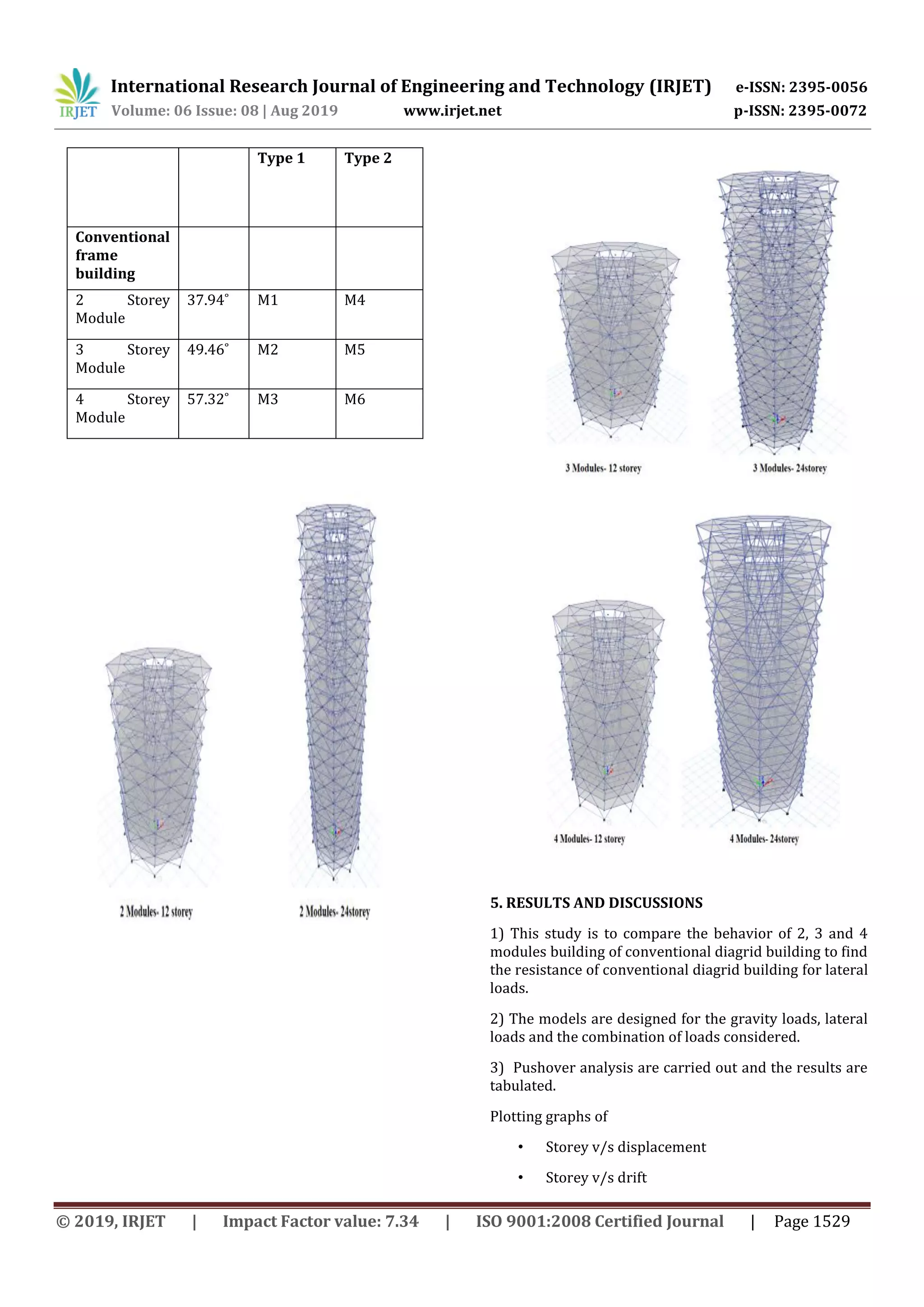
2-module 37.94° 28.7 86.59
3-module 49.346° 22.125 68.0035
4-module 57.32° 16.52 60.998
Fig 5.1: Comparision of maximum storey displacement
of different brace angle for both 12 and 24 storied
building
Table 5.2: comparision of Maximum Storey drifts of
different brace angle of 12 and 24 story building
Building Angle
Max story
drift-12
story
Maximum
story drift -
24 story
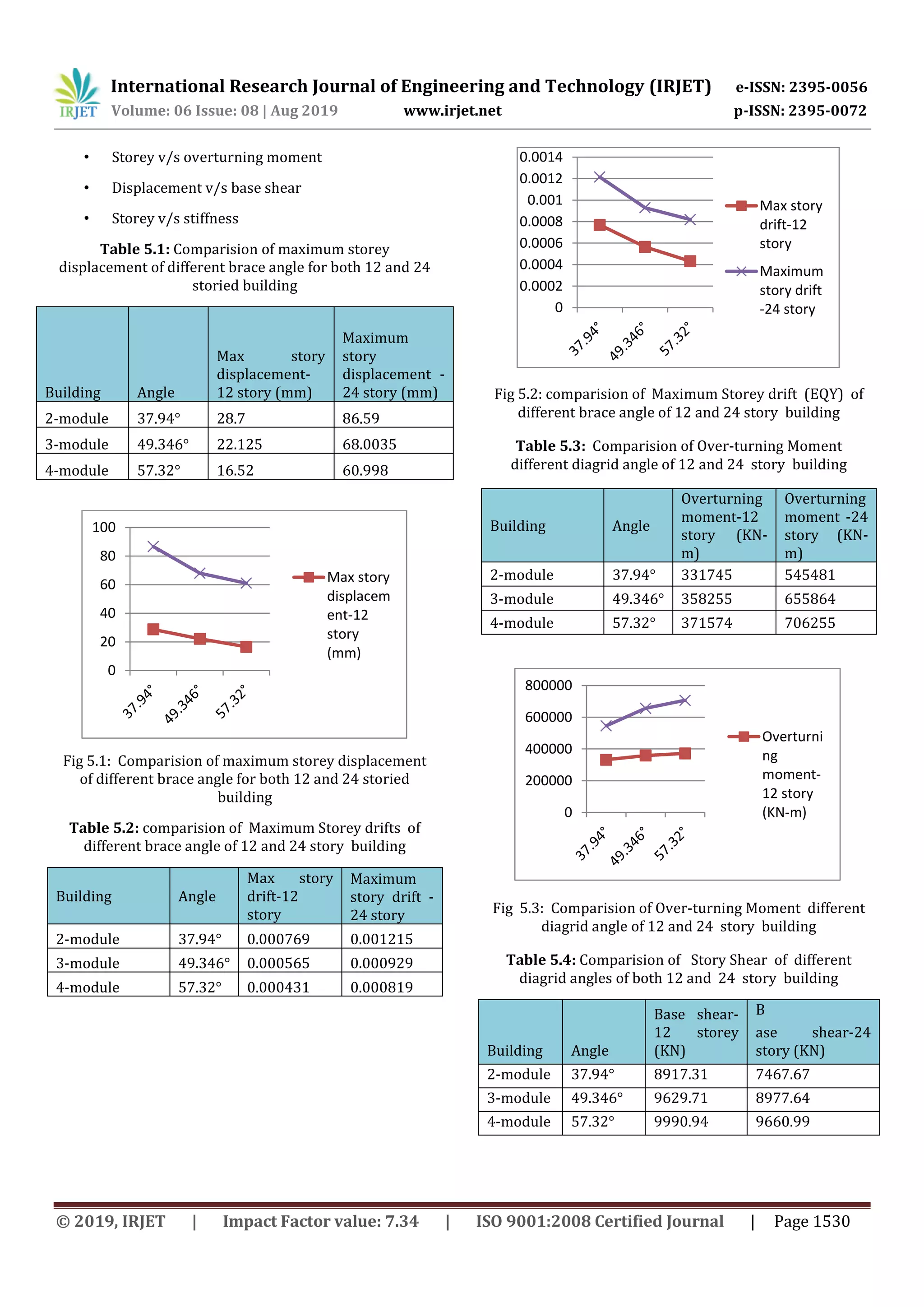
2-module 37.94° 0.000769 0.001215
3-module 49.346° 0.000565 0.000929
4-module 57.32° 0.000431 0.000819
Fig 5.2: comparision of Maximum Storey drift (EQY) of
different brace angle of 12 and 24 story building
Table 5.3: Comparision of Over-turning Moment
different diagrid angle of 12 and 24 story building
Building Angle
Overturning
moment-12
story (KN-
m)
Overturning
moment -24
story (KN-
m)
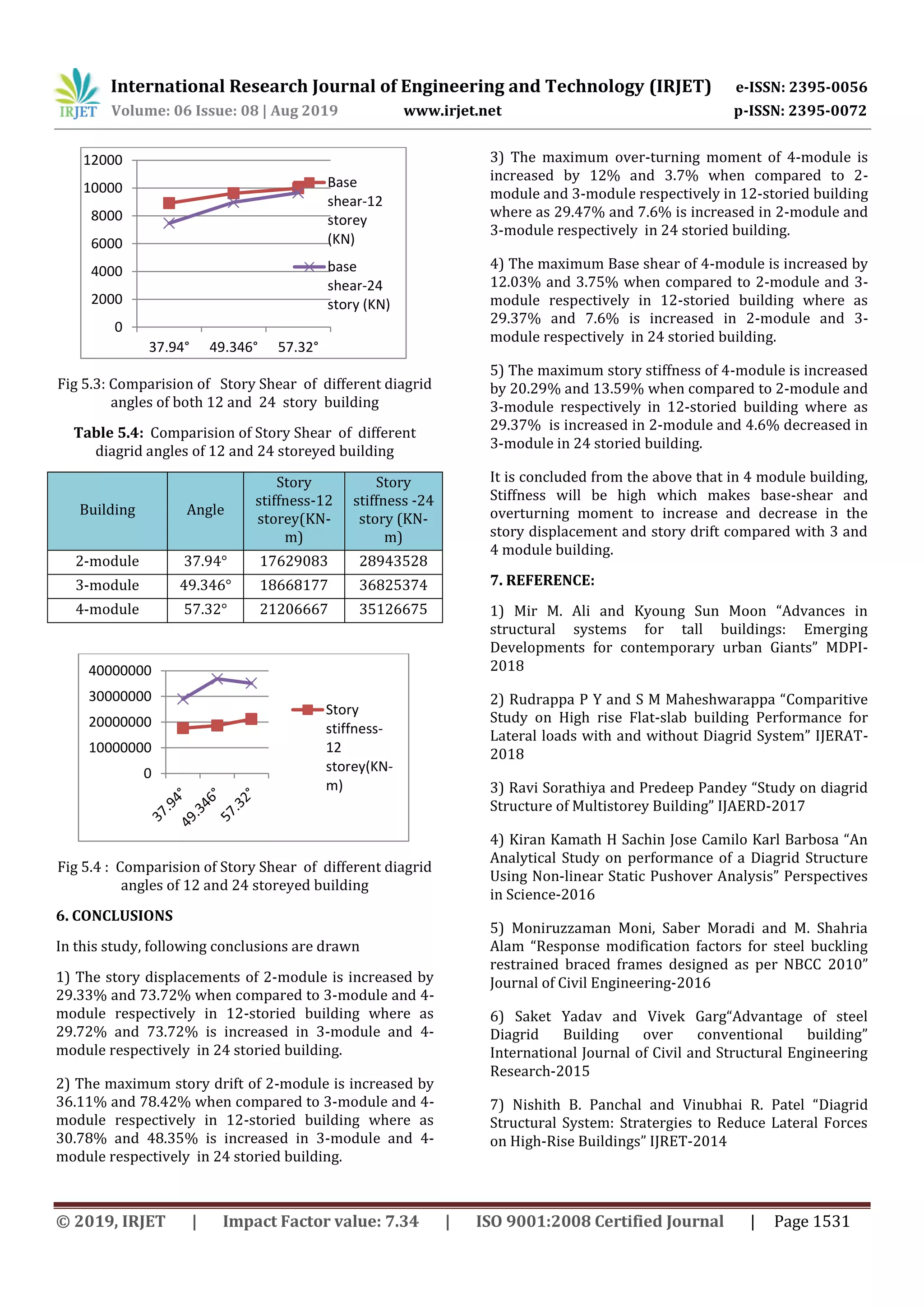
2-module 37.94° 331745 545481
3-module 49.346° 358255 655864
4-module 57.32° 371574 706255
Fig 5.3: Comparision of Over-turning Moment different
diagrid angle of 12 and 24 story building
Table 5.4: Comparision of Story Shear of different
diagrid angles of both 12 and 24 story building
Building Angle
Base shear-
12 storey
(KN)
B
ase shear-24
story (KN)
2-module 37.94° 8917.31 7467.67
3-module 49.346° 9629.71 8977.64
4-module 57.32° 9990.94 9660.99
0
20
40
60
80
100
Max story
displacem
ent-12
story
(mm)
0
0.0002
0.0004
0.0006
0.0008
0.001
0.0012
0.0014
Max story
drift-12
story
Maximum
story drift
-24 story
0
200000
400000
600000
800000
Overturni
ng
moment-
12 story
(KN-m)
International Research Journal of Engineering and Technology (IRJET) e-ISSN: 2395-0056
Volume: 06 Issue: 08 | Aug 2019 www.irjet.net p-ISSN: 2395-0072
© 2019, IRJET | Impact Factor value: 7.34 | ISO 9001:2008 Certified Journal | Page 1531
Fig 5.3: Comparision of Story Shear of different diagrid
angles of both 12 and 24 story building
Table 5.4: Comparision of Story Shear of different
diagrid angles of 12 and 24 storeyed building
Building Angle
Story
stiffness-12
storey(KN-
m)
Story
stiffness -24
story (KN-
m)
2-module 37.94° 17629083 28943528
3-module 49.346° 18668177 36825374
4-module 57.32° 21206667 35126675
Fig 5.4 : Comparision of Story Shear of different diagrid
angles of 12 and 24 storeyed building
6. CONCLUSIONS
In this study, following conclusions are drawn
1) The story displacements of 2-module is increased by
29.33% and 73.72% when compared to 3-module and 4-
module respectively in 12-storied building where as
29.72% and 73.72% is increased in 3-module and 4-
module respectively in 24 storied building.
2) The maximum story drift of 2-module is increased by
36.11% and 78.42% when compared to 3-module and 4-
module respectively in 12-storied building where as
30.78% and 48.35% is increased in 3-module and 4-
module respectively in 24 storied building.
3) The maximum over-turning moment of 4-module is
increased by 12% and 3.7% when compared to 2-
module and 3-module respectively in 12-storied building
where as 29.47% and 7.6% is increased in 2-module and
3-module respectively in 24 storied building.
4) The maximum Base shear of 4-module is increased by
12.03% and 3.75% when compared to 2-module and 3-
module respectively in 12-storied building where as
29.37% and 7.6% is increased in 2-module and 3-
module respectively in 24 storied building.
5) The maximum story stiffness of 4-module is increased
by 20.29% and 13.59% when compared to 2-module and
3-module respectively in 12-storied building where as
29.37% is increased in 2-module and 4.6% decreased in
3-module in 24 storied building.
It is concluded from the above that in 4 module building,
Stiffness will be high which makes base-shear and
overturning moment to increase and decrease in the
story displacement and story drift compared with 3 and
4 module building.
7. REFERENCE:
1) Mir M. Ali and Kyoung Sun Moon “Advances in
structural systems for tall buildings: Emerging
Developments for contemporary urban Giants” MDPI-
2018
2) Rudrappa P Y and S M Maheshwarappa “Comparitive
Study on High rise Flat-slab building Performance for
Lateral loads with and without Diagrid System” IJERAT-
2018
3) Ravi Sorathiya and Predeep Pandey “Study on diagrid
Structure of Multistorey Building” IJAERD-2017
4) Kiran Kamath H Sachin Jose Camilo Karl Barbosa “An
Analytical Study on performance of a Diagrid Structure
Using Non-linear Static Pushover Analysis” Perspectives
in Science-2016
5) Moniruzzaman Moni, Saber Moradi and M. Shahria
Alam “Response modification factors for steel buckling
restrained braced frames designed as per NBCC 2010”
Journal of Civil Engineering-2016
6) Saket Yadav and Vivek Garg“Advantage of steel
Diagrid Building over conventional building”
International Journal of Civil and Structural Engineering
Research-2015
7) Nishith B. Panchal and Vinubhai R. Patel “Diagrid
Structural System: Stratergies to Reduce Lateral Forces
on High-Rise Buildings” IJRET-2014
0
2000
4000
6000
8000
10000
12000
37.94° 49.346° 57.32°
Base
shear-12
storey
(KN)
base
shear-24
story (KN)
0
10000000
20000000
30000000
40000000
Story
stiffness-
12
storey(KN-
m)
International Research Journal of Engineering and Technology (IRJET) e-ISSN: 2395-0056
Volume: 06 Issue: 08 | Aug 2019 www.irjet.net p-ISSN: 2395-0072
© 2019, IRJET | Impact Factor value: 7.34 | ISO 9001:2008 Certified Journal | Page 1532
Textbooks:
1) Varghese.P.C, “Advanced reinforced concrete design”,
2nd Edition, The-Prentice-hall of India, New Delhi.
2) Agarwal.P,“Earthquake Resistant Design of Structures”,
Prentice Hall of India Pvt. Ltd., India, (2014).
3) Duggal.S.K,“Earthquake Resistant Design of
Structures”, Prentice Hall of India Pvt. Ltd., India.
Code books:
1) IS 456: 2000, “Indian Standard Code for Plain and
Reinforced Concrete”, Bureau of Indian Standards, New
Delhi.
2) IS 875(part 1): 1987, “Indian Standard Code of
practice for design loads (other than earthquake for
building and structures): Dead loads, Bureau of Indian
Standards, New Delhi.
3) IS 875(part 2): 1987, “Indian Standard Code of
practice for design loads (other than earthquake for
building and structures): Imposed loads, Bureau of
Indian Standards, New Delhi.
4) IS 1893 (Part 1); 2002, “Indian Standard: Criteria for
Earthquake Resistance Design of Structures”, New Delhi,
India.
5) SP 16: 1980, “Design Aids for Reinforced Concrete to
IS: 456- 1978”, Bureau of Indian Standards, New Delhi.

IRJET- A Study on Behaviour of Diagrid Structure using Pushover Analysis

  • 1.
    International Research Journalof Engineering and Technology (IRJET) e-ISSN: 2395-0056 Volume: 06 Issue: 08 | Aug 2019 www.irjet.net p-ISSN: 2395-0072 © 2019, IRJET | Impact Factor value: 7.34 | ISO 9001:2008 Certified Journal | Page 1526 A STUDY ON BEHAVIOUR OF DIAGRID STRUCTURE USING PUSHOVER ANALYSIS Jeevitha H¹, Guruprasad T N², Dr. Mallesh T V3, Ramesh S R4 ¹P.G Student, Civil Engineering Department, Sri Siddhartha Institute of Technology, Tumakuru, Karnataka, India. ²Asst.Professor, Civil Engineering Department, Sri Siddhartha Institute of Technology, Tumakuru, Karnataka, India. 3Professor and Head, Civil Engineering Department, Sri Siddhartha Institute of Technology, Tumakuru, Karnataka, India. 4Professor, Civil Engineering Department, Sri Siddhartha Institute of Technology, Tumakuru, Karnataka, India. -------------------------------------------------------------------------***------------------------------------------------------------------------ Abstract: The growth of population has influenced the development of cities. The costly lands, decisions to avoid urban expansion and to preserve the agricultural lands, the residential development drive upwards. As buildings height increases the lateral load resisting system of the building is important than the gravity load resisting system. The latest trend in high rise building is diagrid structures because of structural and architectural effectiveness. In the present study diagrids are provided for Circular steel Building and detailed analysis were carried out to check the behavior of circular steel building with and without diagrid. ETABS software is used for modeling, analysis and design of models. G+11 and G+23 storey buildings of circular plan of 30m diameter with storey height 4m located at zone v on a hard rock are modeled, analyzed and designed. Push over analysis is carried to obtain the base shear v/s roof displacement curves. These are Push over curves or capacity curves. Push over curves of circular steel building without diagrid and circular steel building with diagrid are compared. It is observed from the results of 4 module building that stiffness will be high which makes base-shear and overturning moment to increase and decrease in the story displacement and story drift compared with 3 and 4 module building. Key words: Diagrid, Braced tube structures, Push over analysis, Optimal grid, Neliastic deformation etc 1. Introduction: The Diagrids are perimeter structural configurations characterized by a narrow grid of diagonal members which are involved both in gravity and in lateral load resistance. Diagonalized applications of structural steel members for providing efficient solutions both in terms of strength and stiffness are not new, however nowadays a renewed interest in it and a widespread application of diagrid is registered with reference to large span and high rise buildings, particularly when they are characterized by complex geometries and curved shapes. The Swiss Re tower in London, Hearst tower in New York, CCTV headquarters building in Beijing, Mode Gakuen Spiral Tower in Aichi, West tower in Guangzhou, Lotte super tower in Seoul, Capital Gate in Abu Dhabi etc. are some of the popular diagrid buildings. The diagrid systems are the evolution of braced tube structures, since the perimeter configuration still holds for preserving the maximum bending resistance and rigidity, while, with respect to the braced tube, the mega- diagonal members are diffusely spread over the façade, giving rise to closely spaced diagonal elements and allowing for the complete elimination of the conventional vertical columns. The major difference between a braced tube building and a diagrid building is that, there are no vertical columns present in the perimeter of diagrid building, whereas in braced tube building there are vertical column present in the perimeter of the building. Therefore the diagonal members in diagrid structures act both as inclined columns and as bracing elements, and carry gravity loads as well as lateral forces; due to their triangulated configuration, mainly internal axial forces arise in the members, thus minimizing shear racking effects. The term “diagrid” is a combination of the words “diagonal” and “grid” and refers to a structural system that is single‐ thickness in nature and gains its structural integrity through the use of triangulation. Diagrid systems can be planar, crystalline or take on multiple curvatures. They often use crystalline forms or curvature to increase their stiffness. Perimeter diagrids normally carry the lateral and gravity loads of the building and are used to support the floor edges. 2. Literature review: Ravi Sorathiya and Pradeep Pandey [1] (Study on Diagrid structure of multi-storey Building (IJARED-2017)). The diagrid structures are buildings with diagonal grids in the periphery at a particular angle and in modules across the height of the building. Diagrid structures use triangulated grids which are in place of vertical columns in the periphery. Thus, systems that are more efficient in achieving stiffness against lateral loads are considered better options in designing tall buildings. Nishith B. panchal and Vinubhai R. Patel [2] (Diagrid structural system: strategies to reduce lateral forces on
  • 2.
    International Research Journalof Engineering and Technology (IRJET) e-ISSN: 2395-0056 Volume: 06 Issue: 08 | Aug 2019 www.irjet.net p-ISSN: 2395-0072 © 2019, IRJET | Impact Factor value: 7.34 | ISO 9001:2008 Certified Journal | Page 1527 high-rise buildings (IJRET-2014)). New structural concepts with newly adopted high strength materials and construction methods have been towards “stiffness” and “lightness”. It is common knowledge that rather than directly standing the forces, it is better to reduce them and dissipate the magnitude of vibrations. The modelled structural system should be such that it should be effectively utilized for structural requirements. Recently diagrid structural is adopted in tall buildings due to its structural efficiency and architectural planning. Kyoung Sun Moona [3] (Diagrid structures for complex shaped tall buildings (ASCE-2011)). The diagrid structures are prevalently used for today’s tall building due to their structural efficiency and architectural aesthetic potentials. For each complex form category, tall buildings are designed with diagrid systems, and their structural efficiency is studied in conjunction with building forms. Here the complex shaped tall buildings such as twisted, tilted and free form towers are analysed. Saket Yadav and Vivek Garg [4] (Advantage of diagrid building over conventional building (ASCE-2011)). The use of diagonal members for carrying the gravity and lateral load has increased and these members are known as ‘diagrid’. In this study the structural response of conventional and diagrid building is investigated to evaluate the structural benefits of diagrid system. Saket Yadav and Vivek Garg [5] (An analytical study on performance of a diagrid structure using non-linear static pushover Analysis (ASCE-2011)). In this present study the performance characteristics of diagrid structures using non-linear pushover analysis. In pushover analysis, the structure is subjected to monotonically increasing lateral loads till the target displacement is reached. In displacement control method, the displacement of the top storey of the structure is incremented step by step, such that required horizontal forces push the structure laterally 3. Objectives 1) To find the brace angle or storey module with less base shear at performance 2) To find the lateral stiffness of the circular steel building with diagrid. 3) The primary objective in designing an earthquake resistant structure is to ensure that the building has enough ductility to withstand the lateral loads. 4. Methodology Design of Structural members: Here, 2, 3, 4 and 6 modules of 12 and 24 storied structural models are considered for the diagrid structures are considered for the analysis. All the models consist of 12 storeys. Conventional beam-slab design is considered for the analysis. For bracings and Beams of I- section is used and the specifications are mentioned below. The plan considered is circular and it is of diameter 30m. The Storey height is 4.0m. The angle of inclination of diagrids considered are 37.94˚, 49.34˚ and 57.32˚. 10.26m spacing is maintained in diagrids along the perimeter of the building. The live load and the flooring load considered are 2.0kN/m2 and 3.0kN/m2 respectively. The structural models are modelled in ETABS 16.2.0 Software. The various input parameters which are considered while modeling are described in detail in the following sections. Table 4.1 Structural elements and their materials Structural Element Material Concrete Rebar Steel Beam Fe250 Slab M30 HYSD500 Diagrid Fe250 Table 4.2 Section Properties of Structural Elements used in models Table 4.2.1 : 12- storey building Type of building Structural Elements Sectional Properties (mm) 12 Storey building Beams depth 550 Bottom flange thickness 25 Bottom flange width 225 Top flange width 225 Top flange thickness 25 Web thickness 25 Columns depth 1000 Bottom flange 38
  • 3.
    International Research Journalof Engineering and Technology (IRJET) e-ISSN: 2395-0056 Volume: 06 Issue: 08 | Aug 2019 www.irjet.net p-ISSN: 2395-0072 © 2019, IRJET | Impact Factor value: 7.34 | ISO 9001:2008 Certified Journal | Page 1528 thickness Bottom flange width 500 Top flange width 500 Top flange thickness 38 Web thickness 38 Slab thickness 200 Table 4.2.2 : 24-storey building Type of building Structural Elements Sectional Properties (mm) 24 Storey Building Beams depth 550 Bottom flange thickness 25 Bottom flange width 225 Top flange width 225 Top flange thickness 25 Web thickness 25 Columns depth 1400 Bottom flange thickness 50 Bottom flange width 700 Top flange width 700 Top flange thickness 50 Web thickness 50 Slab thickness 200 Table 4.3 Parameters considered for earthquake Analysis: Parameters Consideration Zone factor 0.36 Response reduction factor 3 Importance factor 1 Soil type Medium soil Damping 5% Table 4.4: Load combinations considered for design and analysis. Models considered for study Model 1: 12 storey Steel frame building with 2 modules Model 2: 12 storey Steel frame building with 3 modules Model 3: 12 storey Steel frame building with 4 modules Model 4: 24 storey Steel frame building with 2 modules Model 5: 24 storey Steel frame building with 3 modules Model 6 : 24 storey Steel frame building with 4 modules Table 4.5: Types of models considered for the study Types of structures Diagrid angle No. of storey 12 Storey (h/b=1.6) Model Name 24 Storey (h/b=3.2) Model Name Load Combination Load Combination Details 1 1.5(DL) 2 1.5(DL+LL) 3 1.2(DL+LL+EQX) 4 1.2(DL+LL-EQX) 5 1.2(DL+LL+EQY) 6 1.2(DL+LL-EQY) 7 1.5(DL+EQX) 8 1.5(DL-EQX) 9 1.5(DL+EQY) 10 1.5(DL-EQY) 11 0.9DL+1.5EQX 12 0.9DL-1.5RSX 13 0.9DL+1.5EQY 14 0.9DL-1.5EQY 15 1.2(DL+RSX) 16 1.2(DL+RSY) 17 1.5(DL+RSX) 18 1.5(DL+RSY) 19 0.9DL+1.5RSX
  • 4.
    International Research Journalof Engineering and Technology (IRJET) e-ISSN: 2395-0056 Volume: 06 Issue: 08 | Aug 2019 www.irjet.net p-ISSN: 2395-0072 © 2019, IRJET | Impact Factor value: 7.34 | ISO 9001:2008 Certified Journal | Page 1529 Type 1 Type 2 Conventional frame building 2 Storey Module 37.94˚ M1 M4 3 Storey Module 49.46˚ M2 M5 4 Storey Module 57.32˚ M3 M6 5. RESULTS AND DISCUSSIONS 1) This study is to compare the behavior of 2, 3 and 4 modules building of conventional diagrid building to find the resistance of conventional diagrid building for lateral loads. 2) The models are designed for the gravity loads, lateral loads and the combination of loads considered. 3) Pushover analysis are carried out and the results are tabulated. Plotting graphs of • Storey v/s displacement • Storey v/s drift
  • 5.
    International Research Journalof Engineering and Technology (IRJET) e-ISSN: 2395-0056 Volume: 06 Issue: 08 | Aug 2019 www.irjet.net p-ISSN: 2395-0072 © 2019, IRJET | Impact Factor value: 7.34 | ISO 9001:2008 Certified Journal | Page 1530 • Storey v/s overturning moment • Displacement v/s base shear • Storey v/s stiffness Table 5.1: Comparision of maximum storey displacement of different brace angle for both 12 and 24 storied building Building Angle Max story displacement- 12 story (mm) Maximum story displacement - 24 story (mm) 2-module 37.94° 28.7 86.59 3-module 49.346° 22.125 68.0035 4-module 57.32° 16.52 60.998 Fig 5.1: Comparision of maximum storey displacement of different brace angle for both 12 and 24 storied building Table 5.2: comparision of Maximum Storey drifts of different brace angle of 12 and 24 story building Building Angle Max story drift-12 story Maximum story drift - 24 story 2-module 37.94° 0.000769 0.001215 3-module 49.346° 0.000565 0.000929 4-module 57.32° 0.000431 0.000819 Fig 5.2: comparision of Maximum Storey drift (EQY) of different brace angle of 12 and 24 story building Table 5.3: Comparision of Over-turning Moment different diagrid angle of 12 and 24 story building Building Angle Overturning moment-12 story (KN- m) Overturning moment -24 story (KN- m) 2-module 37.94° 331745 545481 3-module 49.346° 358255 655864 4-module 57.32° 371574 706255 Fig 5.3: Comparision of Over-turning Moment different diagrid angle of 12 and 24 story building Table 5.4: Comparision of Story Shear of different diagrid angles of both 12 and 24 story building Building Angle Base shear- 12 storey (KN) B ase shear-24 story (KN) 2-module 37.94° 8917.31 7467.67 3-module 49.346° 9629.71 8977.64 4-module 57.32° 9990.94 9660.99 0 20 40 60 80 100 Max story displacem ent-12 story (mm) 0 0.0002 0.0004 0.0006 0.0008 0.001 0.0012 0.0014 Max story drift-12 story Maximum story drift -24 story 0 200000 400000 600000 800000 Overturni ng moment- 12 story (KN-m)
  • 6.
    International Research Journalof Engineering and Technology (IRJET) e-ISSN: 2395-0056 Volume: 06 Issue: 08 | Aug 2019 www.irjet.net p-ISSN: 2395-0072 © 2019, IRJET | Impact Factor value: 7.34 | ISO 9001:2008 Certified Journal | Page 1531 Fig 5.3: Comparision of Story Shear of different diagrid angles of both 12 and 24 story building Table 5.4: Comparision of Story Shear of different diagrid angles of 12 and 24 storeyed building Building Angle Story stiffness-12 storey(KN- m) Story stiffness -24 story (KN- m) 2-module 37.94° 17629083 28943528 3-module 49.346° 18668177 36825374 4-module 57.32° 21206667 35126675 Fig 5.4 : Comparision of Story Shear of different diagrid angles of 12 and 24 storeyed building 6. CONCLUSIONS In this study, following conclusions are drawn 1) The story displacements of 2-module is increased by 29.33% and 73.72% when compared to 3-module and 4- module respectively in 12-storied building where as 29.72% and 73.72% is increased in 3-module and 4- module respectively in 24 storied building. 2) The maximum story drift of 2-module is increased by 36.11% and 78.42% when compared to 3-module and 4- module respectively in 12-storied building where as 30.78% and 48.35% is increased in 3-module and 4- module respectively in 24 storied building. 3) The maximum over-turning moment of 4-module is increased by 12% and 3.7% when compared to 2- module and 3-module respectively in 12-storied building where as 29.47% and 7.6% is increased in 2-module and 3-module respectively in 24 storied building. 4) The maximum Base shear of 4-module is increased by 12.03% and 3.75% when compared to 2-module and 3- module respectively in 12-storied building where as 29.37% and 7.6% is increased in 2-module and 3- module respectively in 24 storied building. 5) The maximum story stiffness of 4-module is increased by 20.29% and 13.59% when compared to 2-module and 3-module respectively in 12-storied building where as 29.37% is increased in 2-module and 4.6% decreased in 3-module in 24 storied building. It is concluded from the above that in 4 module building, Stiffness will be high which makes base-shear and overturning moment to increase and decrease in the story displacement and story drift compared with 3 and 4 module building. 7. REFERENCE: 1) Mir M. Ali and Kyoung Sun Moon “Advances in structural systems for tall buildings: Emerging Developments for contemporary urban Giants” MDPI- 2018 2) Rudrappa P Y and S M Maheshwarappa “Comparitive Study on High rise Flat-slab building Performance for Lateral loads with and without Diagrid System” IJERAT- 2018 3) Ravi Sorathiya and Predeep Pandey “Study on diagrid Structure of Multistorey Building” IJAERD-2017 4) Kiran Kamath H Sachin Jose Camilo Karl Barbosa “An Analytical Study on performance of a Diagrid Structure Using Non-linear Static Pushover Analysis” Perspectives in Science-2016 5) Moniruzzaman Moni, Saber Moradi and M. Shahria Alam “Response modification factors for steel buckling restrained braced frames designed as per NBCC 2010” Journal of Civil Engineering-2016 6) Saket Yadav and Vivek Garg“Advantage of steel Diagrid Building over conventional building” International Journal of Civil and Structural Engineering Research-2015 7) Nishith B. Panchal and Vinubhai R. Patel “Diagrid Structural System: Stratergies to Reduce Lateral Forces on High-Rise Buildings” IJRET-2014 0 2000 4000 6000 8000 10000 12000 37.94° 49.346° 57.32° Base shear-12 storey (KN) base shear-24 story (KN) 0 10000000 20000000 30000000 40000000 Story stiffness- 12 storey(KN- m)
  • 7.
    International Research Journalof Engineering and Technology (IRJET) e-ISSN: 2395-0056 Volume: 06 Issue: 08 | Aug 2019 www.irjet.net p-ISSN: 2395-0072 © 2019, IRJET | Impact Factor value: 7.34 | ISO 9001:2008 Certified Journal | Page 1532 Textbooks: 1) Varghese.P.C, “Advanced reinforced concrete design”, 2nd Edition, The-Prentice-hall of India, New Delhi. 2) Agarwal.P,“Earthquake Resistant Design of Structures”, Prentice Hall of India Pvt. Ltd., India, (2014). 3) Duggal.S.K,“Earthquake Resistant Design of Structures”, Prentice Hall of India Pvt. Ltd., India. Code books: 1) IS 456: 2000, “Indian Standard Code for Plain and Reinforced Concrete”, Bureau of Indian Standards, New Delhi. 2) IS 875(part 1): 1987, “Indian Standard Code of practice for design loads (other than earthquake for building and structures): Dead loads, Bureau of Indian Standards, New Delhi. 3) IS 875(part 2): 1987, “Indian Standard Code of practice for design loads (other than earthquake for building and structures): Imposed loads, Bureau of Indian Standards, New Delhi. 4) IS 1893 (Part 1); 2002, “Indian Standard: Criteria for Earthquake Resistance Design of Structures”, New Delhi, India. 5) SP 16: 1980, “Design Aids for Reinforced Concrete to IS: 456- 1978”, Bureau of Indian Standards, New Delhi.