State-Corporate Crime:
Ireland, a Case Study
NUIM 3 MAY 2019
Mediated Corruption
‘The individual who abuses public office for private gain does not
necessarily always directly benefit.
Instead [it] may indirectly benefit the public officials’ family, friends,
political associates, political party, constituency or other affiliation
associated with the public official.
The gain is political, often indirect, and valuable within its own
context.
Corruption therefore is the use of public office for private gain
without any direct link to a precise favour but in anticipation of future
benefits.
It may encompass undue influence in the formulation of policy and
legislation by vested interests at the expense of the public interest
but which benefit political actors through popular and political
support.’ (p.13)
Mediated Corruption
‘The mediated approach recognises that
the preservation of public trust is not just a
question of discerning legal rights from
wrongs, but upholding the very spirit of the
law….
…An awareness of mediated corruption
reintroduces notions of moral
responsibility which have been lost on an
over dependence on legal definitions of
corruption.’ (p.13)
Ch.2 – Why So Little Corruption? 1900s-1920s
‘[An] unconditional respect for the rule of law, and the
pride in the 1922 Free State Constitution, generated a
collective moral bond….
…Although Ireland was not partitioned, this revolutionary
generation not only restored legislative independence lost
through the Act of Union, 1801, but secured wider
sovereignty for post-independence Ireland.
They achieved this because they sacrificed their self-
interest for the public good and assumed that the lessons
of Irish history were enough for this principle to endure
after them’ (p.33)
Mediated Corruption
‘The individual who abuses public office for private gain does not
necessarily always directly benefit.
Instead [it] may indirectly benefit the public officials’ family, friends,
political associates, political party, constituency or other affiliation
associated with the public official.
The gain is political, often indirect, and valuable within its own
context.
Corruption therefore is the use of public office for private gain
without any direct link to a precise favour but in anticipation of future
benefits.
It may encompass undue influence in the formulation of policy and
legislation by vested interests at the expense of the public interest
but which benefit political actors through popular and political
support.’ (p.13)
‘In general, white-collar crime is considered to be crime
committed by the natural persons, those capable of wearing
white-collars, while corporate crime is committed by artificial
legal persons, corporate entities….
… The core contribution of [Edwin] Sutherland’s work… was to
show that white-collar wrongdoing was a serious form of crime
which was not defined as such by the legal system…
… Though corporate and white-collar crime is a broad area of
inquiry, this monograph is restricted to an analysis of the
enforcement of criminal offences in the Companies Act and
matters which have had an impact on their enforcement.’ (pp.6-7)
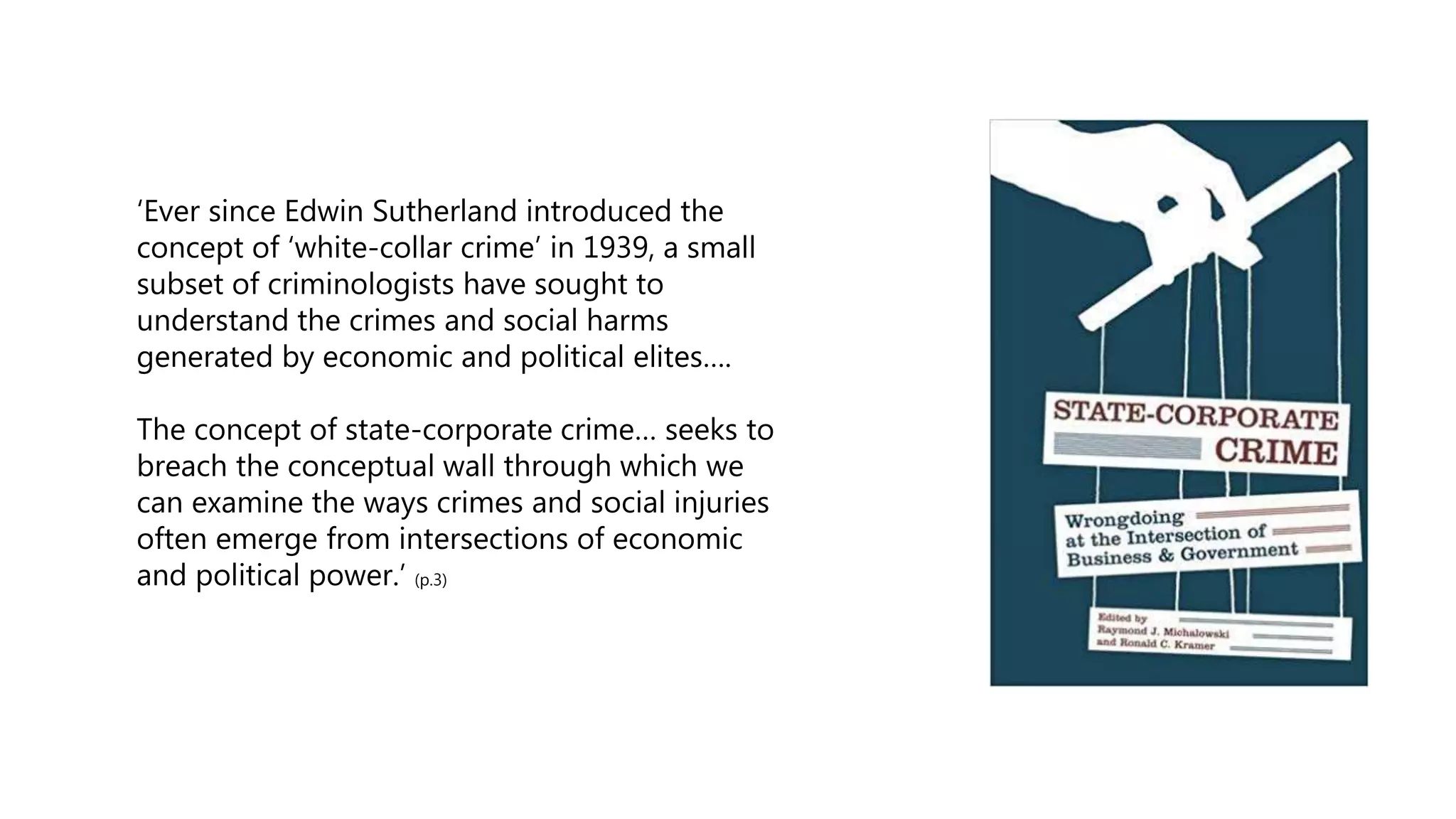
‘Ever since Edwin Sutherland introduced the
concept of ‘white-collar crime’ in 1939, a small
subset of criminologists have sought to
understand the crimes and social harms
generated by economic and political elites….
The concept of state-corporate crime… seeks to
breach the conceptual wall through which we
can examine the ways crimes and social injuries
often emerge from intersections of economic
and political power.’ (p.3)
‘… criminology is typically defined as the study of
acts designated as crime by law, rather than
more broadly as a study of the ways humans can
harm one another.
This means that the subject matter of
criminology… will always be shaped by what
governments choose to criminalize, rather than
by analytic criteria independent of these political
processes.
Insofar as the process of criminalization… is a
politicized one, political-economic arrangements
and hegemonic consciousness, rather than any
calculus of demonstrable social harm, dominates
the definition of crime.’ (p.6)
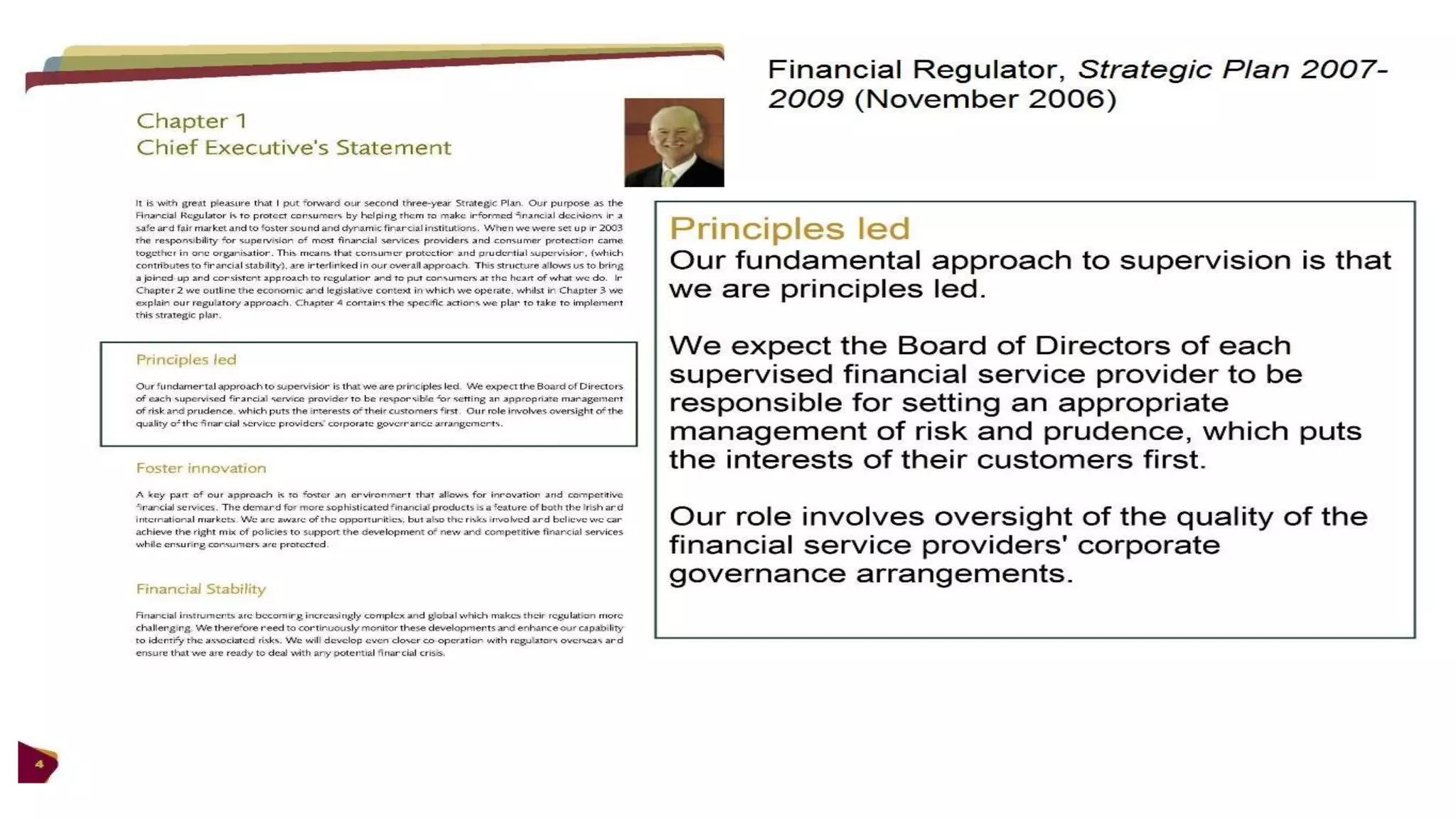
“As understood by the Financial Regulator, ‘principles-based’
regulation relied very heavily on making sure that appropriate
governance structures and systems were in place in banks and
building societies.
Honohan Report on the Irish banking crisis, May 2010, p.44.
“As understood by the Financial Regulator, ‘principles-based’
regulation relied very heavily on making sure that appropriate
governance structures and systems were in place in banks and
building societies.
To this extent, the underlying philosophy was oriented towards
trusting a properly governed firm; it was potentially only a short
step from that trust to the emergence of a somewhat diffident
attitude on the part of the regulators so far as challenging the
decisions of firms was concerned.
Honohan Report on the Irish banking crisis, May 2010, p.44.
“As understood by the Financial Regulator, ‘principles-based’
regulation relied very heavily on making sure that appropriate
governance structures and systems were in place in banks and
building societies.
To this extent, the underlying philosophy was oriented towards
trusting a properly governed firm; it was potentially only a short
step from that trust to the emergence of a somewhat diffident
attitude on the part of the regulators so far as challenging the
decisions of firms was concerned.
[Also], legislation set as a statutory objective of the [central
bank and financial regulator] the promotion of the financial
services industry in Ireland, the situation was ripe for the
emergence of a rather accommodating stance vis-à-vis credit
institutions.”
Honohan Report on the Irish banking crisis, May 2010, p.44.
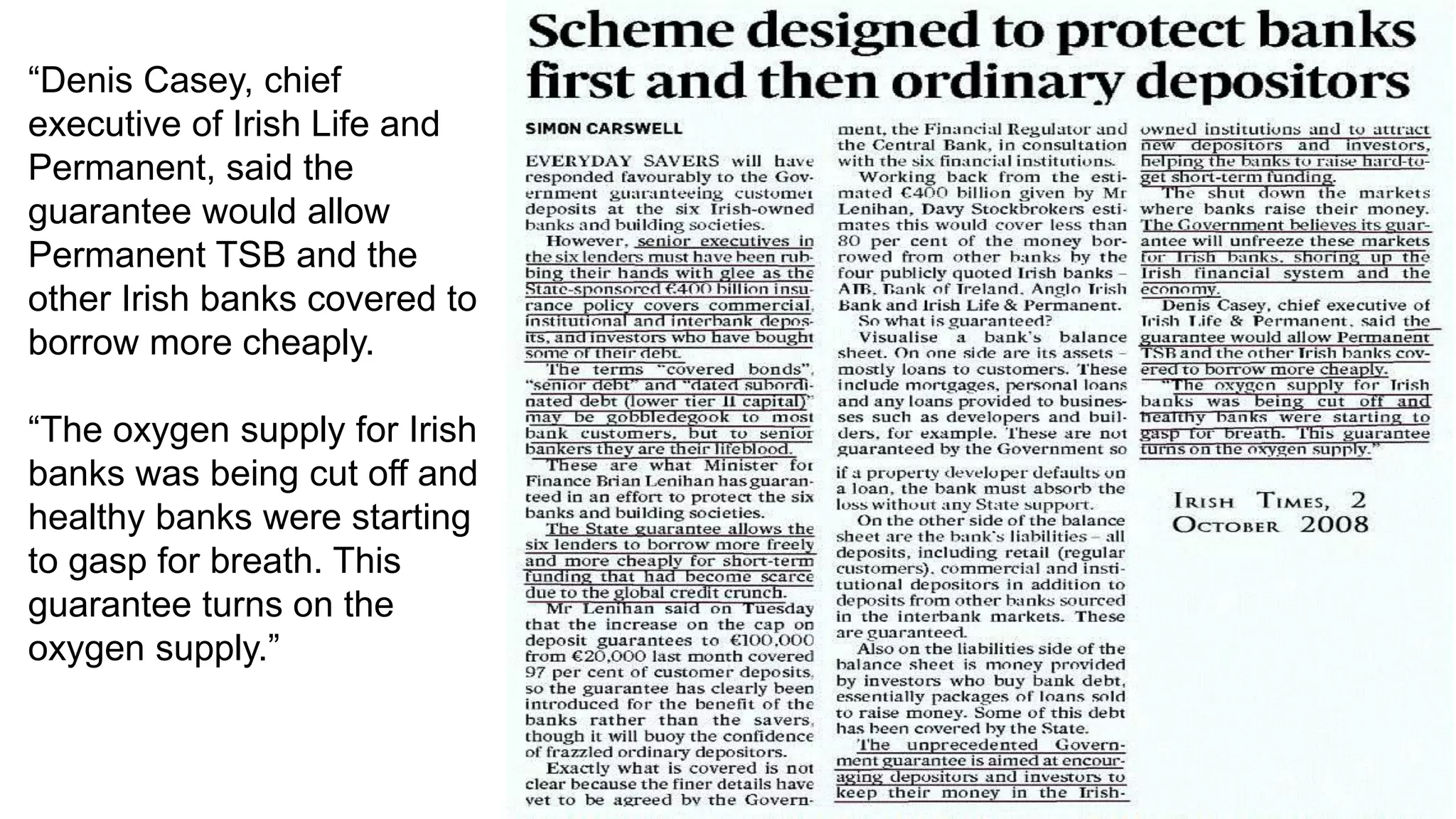
Irish Executives in the six lenders
must have been rubbing their
hands with glee as the State-
sponsored €400 billion insurance
policy covers commercial,
institutional and interbank
deposits, and investors who have
bought some of their debt.
The State guarantee allows the six
lenders to borrow more freely and
more cheaply for short-term
funding that had become scarce
due to the global credit crunch.
Mr. Lenihan said on Tuesday
that the increase on the cap
on deposit guarantees up to
€100,000 from €20,000 last
month covered 97 per cent
of customer deposits so the
guarantee has clearly been
included for the benefit of
the banks rather than the
savers…
“Denis Casey, chief
executive of Irish Life and
Permanent, said the
guarantee would allow
Permanent TSB and the
other Irish banks covered to
borrow more cheaply.
“The oxygen supply for Irish
banks was being cut off and
healthy banks were starting
to gasp for breath. This
guarantee turns on the
oxygen supply.”
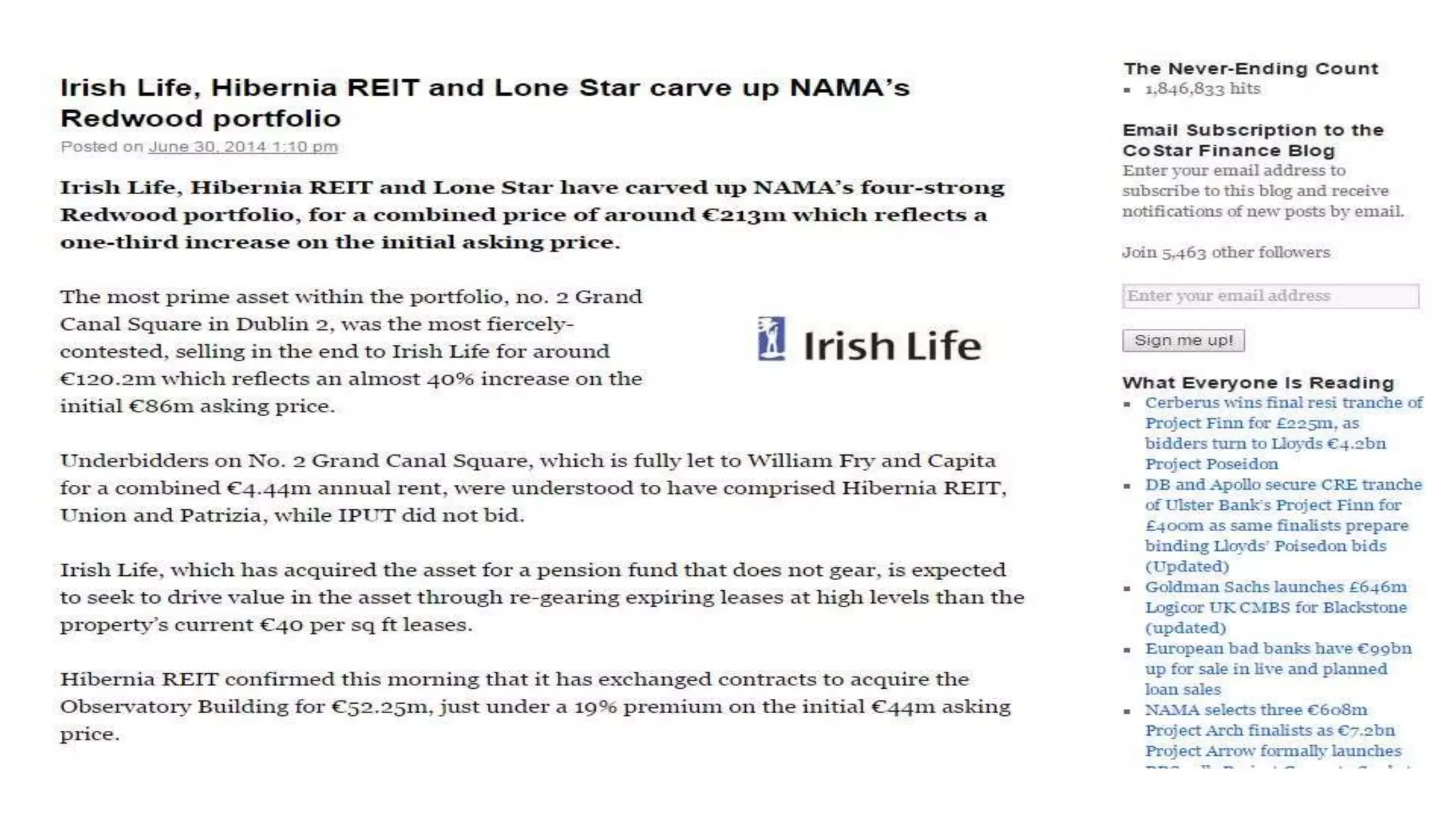
NAMA PROPERTIES = c.16,000
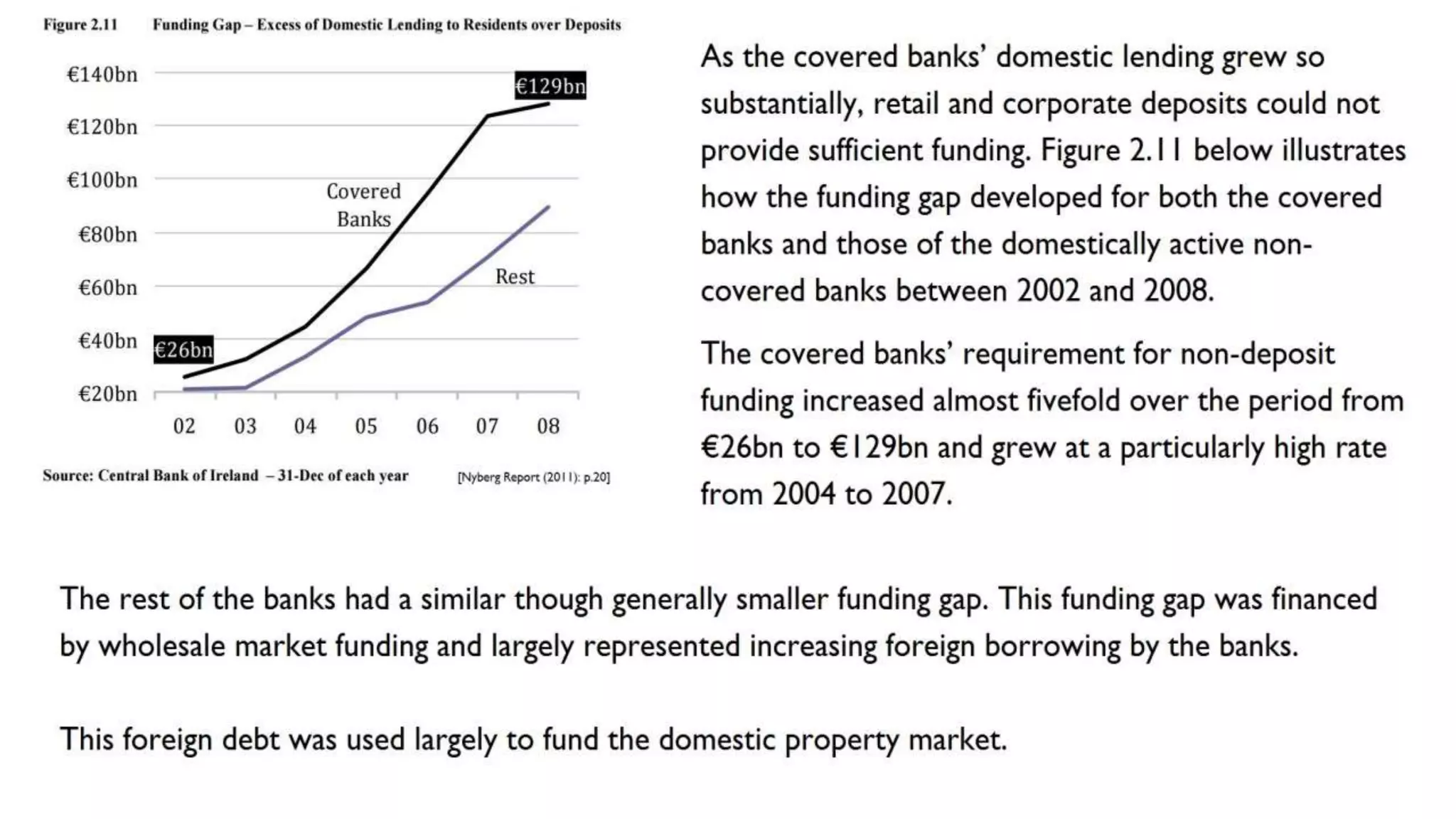
“The problem here is that, when one looks at the top 190 debtors
in the NAMA universe with debts of €62 billion, a relatively small
number of people were chasing the same assets and it was like a
Ponzi scheme. They overborrowed and were overlent to by
banks. There was huge inflation of asset values and this was not
sustainable in the context of the economy. There was a
disconnect between the economy growing at 8% or 9% per
annum and lending by banks growing at 35% or 40% per year.
The problem was caused by overpaying for assets.”
Brendan McDonagh, Chief Executive, NAMA, in evidence to the Public Accounts Committee, 26
October 2011
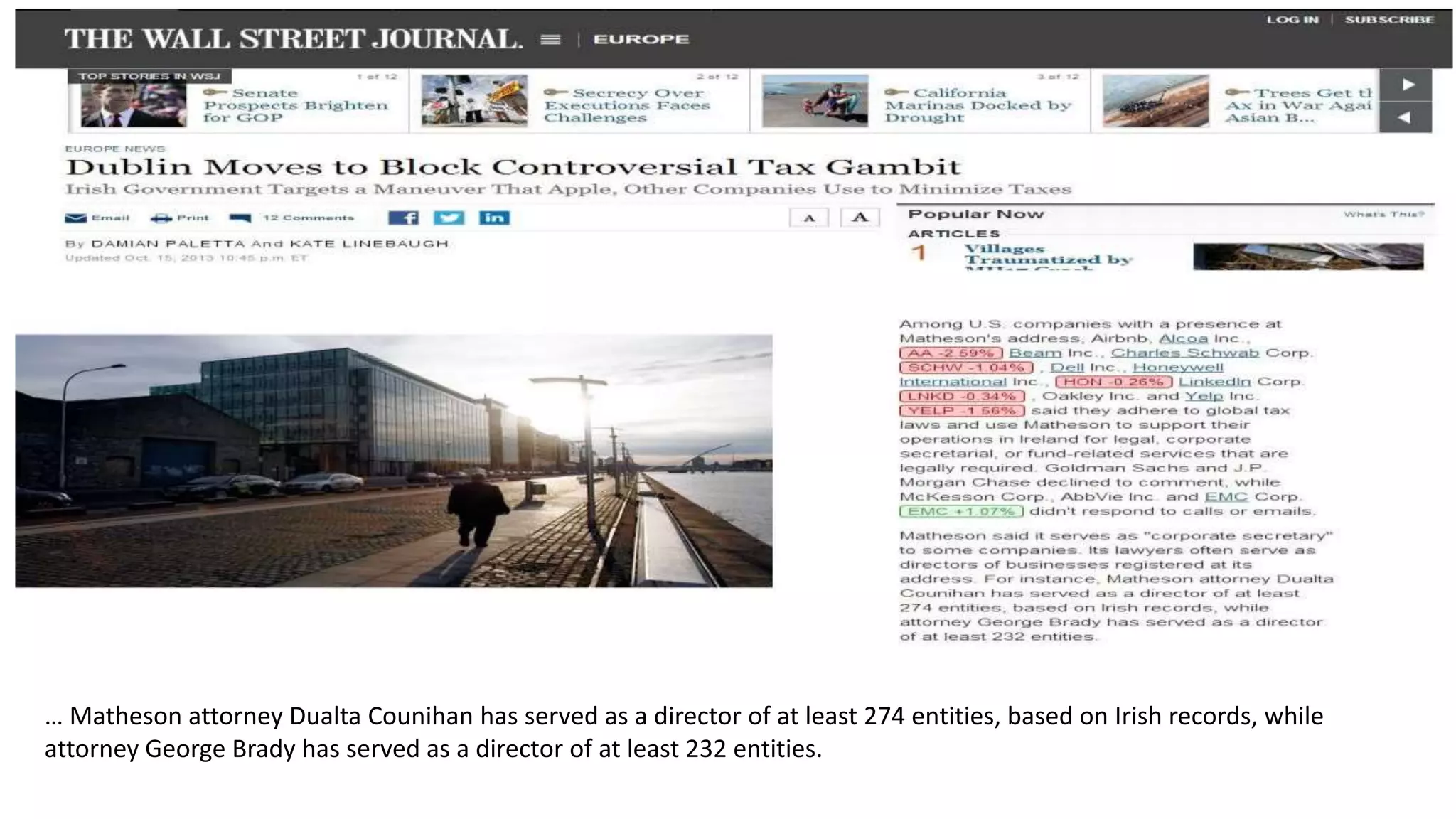
… Matheson attorney Dualta Counihan has served as a director of at least 274 entities, based on Irish records, while
attorney George Brady has served as a director of at least 232 entities.
State-Corporate Crime:
Ireland, a Case Study
NUIM 3 MAY 2019

Ireland and Corruption

  • 1.
    State-Corporate Crime: Ireland, aCase Study NUIM 3 MAY 2019
  • 5.
    Mediated Corruption ‘The individualwho abuses public office for private gain does not necessarily always directly benefit. Instead [it] may indirectly benefit the public officials’ family, friends, political associates, political party, constituency or other affiliation associated with the public official. The gain is political, often indirect, and valuable within its own context. Corruption therefore is the use of public office for private gain without any direct link to a precise favour but in anticipation of future benefits. It may encompass undue influence in the formulation of policy and legislation by vested interests at the expense of the public interest but which benefit political actors through popular and political support.’ (p.13)
  • 6.
    Mediated Corruption ‘The mediatedapproach recognises that the preservation of public trust is not just a question of discerning legal rights from wrongs, but upholding the very spirit of the law…. …An awareness of mediated corruption reintroduces notions of moral responsibility which have been lost on an over dependence on legal definitions of corruption.’ (p.13)
  • 7.
    Ch.2 – WhySo Little Corruption? 1900s-1920s ‘[An] unconditional respect for the rule of law, and the pride in the 1922 Free State Constitution, generated a collective moral bond…. …Although Ireland was not partitioned, this revolutionary generation not only restored legislative independence lost through the Act of Union, 1801, but secured wider sovereignty for post-independence Ireland. They achieved this because they sacrificed their self- interest for the public good and assumed that the lessons of Irish history were enough for this principle to endure after them’ (p.33)
  • 11.
    Mediated Corruption ‘The individualwho abuses public office for private gain does not necessarily always directly benefit. Instead [it] may indirectly benefit the public officials’ family, friends, political associates, political party, constituency or other affiliation associated with the public official. The gain is political, often indirect, and valuable within its own context. Corruption therefore is the use of public office for private gain without any direct link to a precise favour but in anticipation of future benefits. It may encompass undue influence in the formulation of policy and legislation by vested interests at the expense of the public interest but which benefit political actors through popular and political support.’ (p.13)
  • 21.
    ‘In general, white-collarcrime is considered to be crime committed by the natural persons, those capable of wearing white-collars, while corporate crime is committed by artificial legal persons, corporate entities…. … The core contribution of [Edwin] Sutherland’s work… was to show that white-collar wrongdoing was a serious form of crime which was not defined as such by the legal system… … Though corporate and white-collar crime is a broad area of inquiry, this monograph is restricted to an analysis of the enforcement of criminal offences in the Companies Act and matters which have had an impact on their enforcement.’ (pp.6-7)
  • 37.
    ‘Ever since EdwinSutherland introduced the concept of ‘white-collar crime’ in 1939, a small subset of criminologists have sought to understand the crimes and social harms generated by economic and political elites…. The concept of state-corporate crime… seeks to breach the conceptual wall through which we can examine the ways crimes and social injuries often emerge from intersections of economic and political power.’ (p.3)
  • 38.
    ‘… criminology istypically defined as the study of acts designated as crime by law, rather than more broadly as a study of the ways humans can harm one another. This means that the subject matter of criminology… will always be shaped by what governments choose to criminalize, rather than by analytic criteria independent of these political processes. Insofar as the process of criminalization… is a politicized one, political-economic arrangements and hegemonic consciousness, rather than any calculus of demonstrable social harm, dominates the definition of crime.’ (p.6)
  • 71.
    “As understood bythe Financial Regulator, ‘principles-based’ regulation relied very heavily on making sure that appropriate governance structures and systems were in place in banks and building societies. Honohan Report on the Irish banking crisis, May 2010, p.44.
  • 72.
    “As understood bythe Financial Regulator, ‘principles-based’ regulation relied very heavily on making sure that appropriate governance structures and systems were in place in banks and building societies. To this extent, the underlying philosophy was oriented towards trusting a properly governed firm; it was potentially only a short step from that trust to the emergence of a somewhat diffident attitude on the part of the regulators so far as challenging the decisions of firms was concerned. Honohan Report on the Irish banking crisis, May 2010, p.44.
  • 73.
    “As understood bythe Financial Regulator, ‘principles-based’ regulation relied very heavily on making sure that appropriate governance structures and systems were in place in banks and building societies. To this extent, the underlying philosophy was oriented towards trusting a properly governed firm; it was potentially only a short step from that trust to the emergence of a somewhat diffident attitude on the part of the regulators so far as challenging the decisions of firms was concerned. [Also], legislation set as a statutory objective of the [central bank and financial regulator] the promotion of the financial services industry in Ireland, the situation was ripe for the emergence of a rather accommodating stance vis-à-vis credit institutions.” Honohan Report on the Irish banking crisis, May 2010, p.44.
  • 76.
    Irish Executives inthe six lenders must have been rubbing their hands with glee as the State- sponsored €400 billion insurance policy covers commercial, institutional and interbank deposits, and investors who have bought some of their debt. The State guarantee allows the six lenders to borrow more freely and more cheaply for short-term funding that had become scarce due to the global credit crunch.
  • 77.
    Mr. Lenihan saidon Tuesday that the increase on the cap on deposit guarantees up to €100,000 from €20,000 last month covered 97 per cent of customer deposits so the guarantee has clearly been included for the benefit of the banks rather than the savers…
  • 78.
    “Denis Casey, chief executiveof Irish Life and Permanent, said the guarantee would allow Permanent TSB and the other Irish banks covered to borrow more cheaply. “The oxygen supply for Irish banks was being cut off and healthy banks were starting to gasp for breath. This guarantee turns on the oxygen supply.”
  • 85.
  • 91.
    “The problem hereis that, when one looks at the top 190 debtors in the NAMA universe with debts of €62 billion, a relatively small number of people were chasing the same assets and it was like a Ponzi scheme. They overborrowed and were overlent to by banks. There was huge inflation of asset values and this was not sustainable in the context of the economy. There was a disconnect between the economy growing at 8% or 9% per annum and lending by banks growing at 35% or 40% per year. The problem was caused by overpaying for assets.” Brendan McDonagh, Chief Executive, NAMA, in evidence to the Public Accounts Committee, 26 October 2011
  • 118.
    … Matheson attorneyDualta Counihan has served as a director of at least 274 entities, based on Irish records, while attorney George Brady has served as a director of at least 232 entities.
  • 135.
    State-Corporate Crime: Ireland, aCase Study NUIM 3 MAY 2019