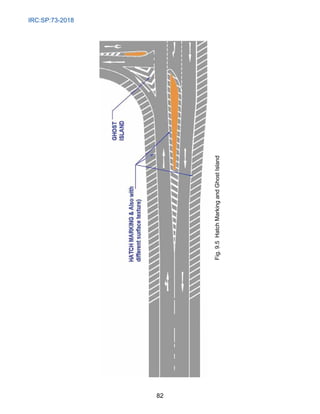
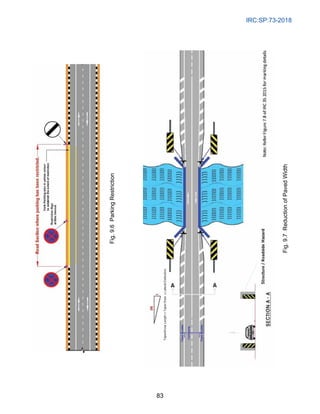
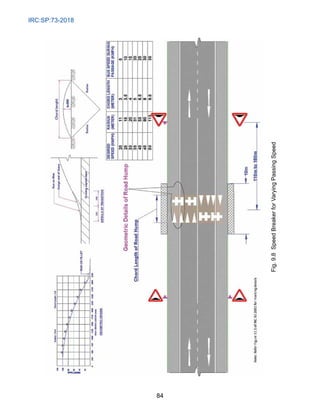
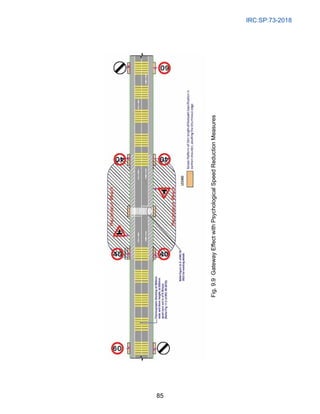
IRC:SP:73-2018
MANUAL OF SPECIFICATIONS and
STANDARDS FOR TWO LANING OF
HIGHWAYS WITH PAVED SHOULDER
(Second Revision)
Published by:
INDIAN ROADS CONGRESS
Kama Koti Marg,
Sector-6, R.K. Puram,
New Delhi-110 022
November, 2018
Price : `1500/-
(Plus Packing  Postage)
IRC:SP:73-2018
First Published : August 2007
First Revision : June, 2015
Reprinted : February, 2016
Second Revision : November, 2018
Reprinted : August, 2019 
(Incorporates Amendment No.1 published in
Indian Highways September, 2019)
(All Rights Reserved. No part of this publication shall be reproduced,
translated or transmitted in any form or by any means without the
permission of the Secretary General, Indian Roads Congress)
Printed by India Offset Press, Delhi - 110 064
1100 Copies
IRC:SP:73-2018
Contents
S. No.		Description Page No.
	
Personnel of the General Specifications
and Standards Committee (GSS) (i)
Introduction 1
Preamble	 2
SECTION 1 : GENERAL 6
SECTION 2 : GEOMETRIC DESIGN AND GENERAL FEATURES
2.1 General 13
2.2 Design Speed 13
2.3 Right of Way 14
2.4 Lane Width of Carriage Way 14
2.5 Median 14
2.6 Shoulders 14
2.7 Roadway Width 15
2.8 Camber or Cross Fall 16
2.9 Geometric Design and Alignment 16
2.10 Lateral and Vertical Clearance at Underpasses 18
2.11 Lateral and Vertical Clearance at Overpasses 18
2.12 Service Roads 19
2.13 Grade Separated Structures 19
2.14 Footpath, Drain and Pedestrian Railing in Built-up Areas 20
2.15 Utility Corridor 20
2.16 Typical Cross-Sections 21
2.17 Capacity of Two-Lane Highway 21
SECTION 3 : INTERSECTIONS AND GRADE SEPARATORS
3.1 Introduction 29
3.2 At-Grade Intersections 29
3.3 Grade Separated Intersections without Ramp 32
3.4 Interchanges 36
SECTION 4 : ROAD EMBANKMENT
4.1 General 42
4.2 Embankment 42
4.3 Roadway in Cutting 43
4.4 Soil Investigations and Design Report 43
SECTION 5 : PAVEMENT DESIGN
5.1 General 46
5.2 Type of Pavement 46
5.3 Method of Design - New Pavements 46
5.4 Design Requirements for New Pavement Sections 47
5.5 Design Traffic 48
5.6 Sub-Grade 48
IRC:SP:73-2018
5.7 Pavement Components and Materials 48
5.8 Performance Evaluation 48
5.9 Widening and Strengthening of Existing Pavement to 48
		 Two Lane
5.10 Paved Shoulders 50
5.11 Earthen Shoulders 51
5.12 Construction, Workmanship and Quality of Works 51
5.13 Premature Distress 51
SECTION 6 : ROADSIDE DRAINAGE
6.1 General 52
6.2 Surface Drainage 52
6.3 Drainage where Embankment Height is more than 3 m 53
6.4 Catch Water Drains 53
6.5 Sub-Surface Drains 53
6.6 Internal Drainage of Pavement Structure 55
6.7 Drainage for Structures 55
6.8 Existing Drains, Canals and Minor Waterways 57
SECTION 7 :	DESIGN OF STRUCTURES
7.1 General 58
7.2 Design Loading and Stresses 58
7.3 Width of Structures 58
7.4 Structure Types 61
7.5 Hydrology 62
7.6 Sub-Soil Investigations 62
7.7 Culverts and Bridges using Pipes 62
7.8 Temporary Works 63
7.9 Foundations and Sub-Structures 64
7.10 Approach Slabs 64
7.11 Superstructures 64
7.12 Bearings 65
7.13 Expansion Joints 65
7.14 Wearing Coat 66
7.15 Reinforced Earth Retaining Structures 66
7.16 River Training and Protective Works 67
7.17 Safety Barriers 67
7.18 Rail-Road Bridges 67
7.19 Grade Separated Road Structures 68
7.20 Drainage 68
7.21 Structures in Marine Environment 69
7.22 Repairs and Strengthening 69
7.23 Design Report 70
7.24 Responsibility for Design and Structural Adequacy 70
IRC:SP:73-2018
SECTION 8 : MATERIALS
8.1 General 72
SECTION 9 : TRAFFIC CONTROL DEVICES AND ROAD SAFETY WORKS
9.1 General 73
9.2 Road Signs 73
9.3 Road Markings 76
9.4 Road Delineators 77
9.5 Reflective Pavement Markers (Road Studs) 86
9.6 … Deleted 87
9.7 Roadside and Median Safety Barriers 87
9.8 Pedestrian Facilities 92
9.9 Work Zone Traffic Management Plans (WTMPs) 103
SECTION 10 : TOLL PLAZAS
10.1 General 113
10.2 Location of Toll Plaza 113
10.3 Land for Toll Plaza 113
10.4 Layout and Design of Toll Plaza 113
10.5 Electronic Toll Collection 114
10.6 Prevention of Overloading 118
10.7 Toll Collection System 118
10.8 Pavement 118
10.9 Traffic Signs 119
10.10 Road Markings 119
10.11 Lighting 119
10.12 Water Supply 120
10.13 Fire Fighting System 120
10.14 Toll Plaza Complex 120
10.15 Toll Audit 121
10.16 Report to be Submitted 121
Annexure-A 127
Annexure-B 129
SECTION 11 : LANDSCAPING AND TREE PLANTATION
11.1 General 159
11.2 Design Considerations in Various Locations 159
11.3 Landscape Treatment 160
11.4 Report to be Submitted 161
SECTION 12 : PROJECT FACILITIES
12.1 General 162
12.2 Road Boundary Walls (RBW) 162
12.3 Kilometre and 200 m Stones 162
12.4 Street Lighting 162
12.5 Truck Lay-by 163
IRC:SP:73-2018
12.6 Bus Bays and Bus Shelters 164
12.7 … Deleted 166
12.8 … Deleted 166
12.9 … Deleted 166
12.10 Rest Areas 166
12.11 Highway Patrol Unit(s) 168
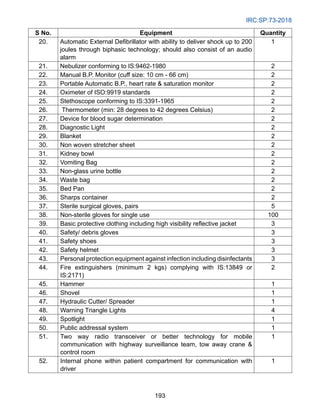
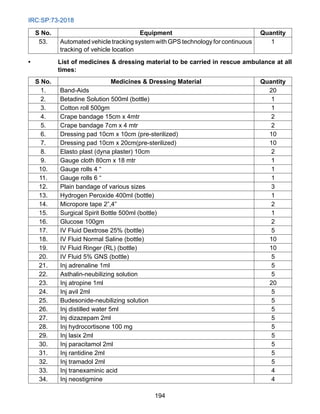
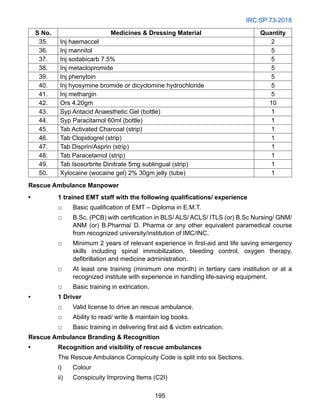
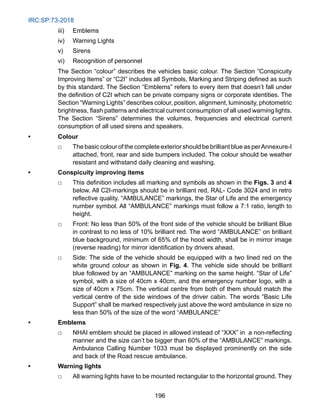
12.12 Emergency Medical Services 168
12.13 Crane Services 168
12.14 Communication System 168
12.15 Advanced Traffic Management Systems (ATMS) 168
12.16 Operation and Maintenance Center 169
Annexure-C 170
Annexure-D 177
SECTION 13 : SPECIAL REQUIREMENTS FOR HILL ROADS
13.1 General 199
13.2 Set Back Distance at Horizontal Curves 199
13.3 Grade Compensation at Curves 199
13.4 Hairpin Bends 200
13.5 Climbing Lane 200
13.6 Rock Blasting 200
13.7 Cut Slopes 200
13.8 Tunnels 200
13.9 Drainage 200
13.10 Retaining Walls 200
13.11 Breast Wall 201
13.12 Aprons etc. 201
13.13 Disposal of Debris 201
13.14 Report to be Submitted 201
SECTION 14 : TUNNELS
14.1 General 202
14.2 Geometrics 202
14.3 Geotechnical Investigations 204
14.4 Structural Design 204
14.5 Design of Drainage System 205
14.6 Waterproofing 205
14.7 Ventilation 205
14.8 Tunnel Illumination 206
14.9 Tunnel Furnishing 206
14.10 Signages and Carriageway Markings 206
14.11 Emergency Facilities 206
		 14.12 Safety During Construction 209
Appendix-1			 213
Appendix-2			 214
IRC:SP:73-2018
i
Personnel of the General Specifications
and Standards Committee (GSS)
(As on 24th
June, 2017)
1 Kumar, Manoj
(Convenor)
Director General (RD)  Special Secretary to the Govt of India,
Ministry of Road Transport  Highways, New Delhi
2 Singh, B.N.
(Co-Convenor)
Additional Director General, Ministry of Road Transport  Highways,
New Delhi
3 Verma, Dr. S.K.
(Member Secretary)
Chief Engineer SRT(R), Ministry of Road Transport  Highways,
New Delhi
Members
4 Basu, Kaushik Chief Engineer, Ministry of Road Transport  Highways
5 Bhardwaj, R.S. Senior Principal Scientist, Central Road Research Institute,
New Delhi
6 Chacko, Dr. K.M. Director, Shriram Institute of Industral Research, Delhi
7 Eligar, J.H. Superintending Engineer, Ministry of Road Transport  Highways
8 Gupta, D.P. DG(RD)  AS (Retd), Ministry of Road Transport  Highways, New
Delhi
9 Jain, Prof (Dr) S.S. Professor, IIT Roorkee
10 Jhamb, S.B. Addl. Director General(Retd.), Central Public Works Department,
New Delhi
11 Joshi, L.K. Secretary(Retd.), Ministry of Road Transport  Highways,
New Delhi
12 Lal, Bhure Chairman, Environment Pollution (Prevention  Control) Authority,
Delhi
13 Mathur, Dr. Ajay Director General, The Energy  Resource Institute, New Delhi
14 Narain, Sunita Director General, Centre for Science  Environment, New Delhi
15 Goel, O.P. Director General(Retd), Central Public Works Department,
New Delhi
16 Pandey, I.K. Chief Engineer, Ministry of Road Transport  Highways,
New Delhi
17 Parrikar,G.M. Naik Superintending Engineer, PWD Goa
18 Pateriya, Dr. I.K. Director (Technical), National Rural Road Development Agency,
New Delhi
19 Puri, S.K. DG(RD)  SS (Retd), Ministry of Road Transport  Highways, New
Delhi
20 Rajoria, K.B. Engineer-in-Chief(Retd.), Delhi PWD, New Delhi
21 Raju, Dr.G.V.S. Engineer-in-Chief(Retd.), R B Deptt., Hyderabad
22 Rajvanshi, Ms. Asha Head, EIA Wild Life Institute, Dehradun
23 The Director
(Reddy, D.N.)
Engineering Staff College of Engineering, Hyderabad
IRC:SP:73-2018
ii
24 The CEO  PD
(Sahay,Vishvajit)
National Automotive Testing and RD Infrastructure Project,
New Delhi
25 Sarangi, D Chief General Manager, National Highways Authority of India
26 Sharma, D. C. Principal Scientist, Central Road Research Institute, New Delhi
27 Sharma, M. P. Chief Engineer, Ministry of Road Transport  Highways,
New Delhi
28 Sharma, R. S. Managing Director, M/s STP Ltd New Delhi
29 Sharma, V. K. Chief General Manager (LA), National Highways Authority of India,
New Delhi
30 Sinha, A.V. DG (RD)  SS (Retd.), Ministry of Road Transport  Highways, New
Delhi
31 Sinha, B.N. Chief Engineer (Retd.), Central Public Works Department,
New Delhi
32 Tawade, D.O. Member(Technical), National Highways Authority of India,
New Delhi
33 The Director General,
(Mathur, Vishnu)
Society of Indian Automobile Manufacturers, New Delhi
34 The Director
(Urdhwareshe, Mrs. Rashmi)
Automotive Research Association of India, Pune
35 Vasantha, Dr. C. Superintending Engineer, PWD Hyderabad
36 Verma, S.K. Advisor, Engineering Staff College of India, Hyderabad
37 Verma, Maj V.C. Director, M/s Oriental Structures Engineers Pvt. Ltd., New Delhi
38 Vyas, Neha Senior Environment Specialist, World Bank, New Delhi
Corresponding Members
1 Momin, C.W. Chief Engineer, PWD Meghalaya
2 Parsekar, U P Principal Chief Engineer, PWD Goa
3 Sachdev,V.K. Chief Engineer (Retd), Ministry of Road Transport  Highways, New
Delhi
4 Temjen, R. Temsu Addl. Chief Engineer, PWD Nagaland
5 Vanlaltluanga, R. Engineer-in-Chief, PWD Mizoram
Ex-Officio Members
1. President, IRC (Pradhan, N.K.) Engineer-in-Chief cum Secretary to the Govt. of
Odisha, Bhubneshwar
2. Director General (RD) 
Spl. Secretary to the Govt.
of India
(Kumar, Manoj) Ministry of Road Transport and Highways, New Delhi
3. Secretary General (Nirmal, S.K.) Indian Roads Congress, New Delhi
IRC:SP:73-2018
1
Manual of Specifications  Standards for Two Laning
of Highways with Paved Shoulder
INTRODUCTION
The Manual of Standard  Specifications for two laning of State Highways on BOT Basis” was
first published in August, 2007. The first revision of this document was approved by Council in its
204th
Meeting held in Bhubaneswar on 19th
January, 2015 and it was made applicable for 2 lane
with or without paved shoulder on BOT/EPC Basis. However, since then based on the experience
of EPC Projects and site specific problems, the Project Preparation, Contract Management,
Quality Assurance and Public Private Partnership Committee (G-1) under the Convenorship of
Shri B.N. Singh in its 1st
meeting held on 06.06.2015 decided that IRC:SP:73-2015 should
be reviewed on priority.Asub-group under ShriA.V. Sinha with other members as ShriAshok Kumar,
Shri A.K. Bhasin, Shri I.K. Pandey and Shri S.K. Nirmal was constituted. The sub group prepared
different sections of the special publication in the Transport Bhawan, which were further discussed
in different meetings of G-1 Committee between 25.07.2015 and 19.11.2016. On 19.11.2016, the
Committee after detailed discussion authorized the Convenor to finalize the document as per
suggestions/comments of the members. The sub-group discussed in detail the various comments/
suggestions during their meetings on 20.1.2017, 21.3.2017, 29.4.2017 and 06.06.2017 under
the chairmanship of Convenor again at Transport Bhavan and finalized the document. The draft
revision was approved by the GSS on 24.06.2017 and by Council in its 212th
meeting at Udaipur
on 14th
to 15th
July, 2017 authroizing EC to take a view about safety aspects. Finally, EC in its
meeting on 07.08.17 approved the document for publication. The Sub-Group received inputs from
Shri Jacob George in drafting sections on Road Safety and Cross-section drawings which is duly
acknowledged. The Sub-group gratefully acknowledges peer review of the draft by Shri D.P. Gupta.
Singh, B.N. — Convenor
Sarangi, D. — Co-Convenor
Nirmal, S.K. — Member-Secretary
Members
Banerjee, A.K. Kumar, Ashok
Bhasin, Col. A.K. Kumar, M. Kishore
Bongirwar, P.L. Pandey, I.K.
Chand, Faqir Pandey, R.K.
Dash, Bimal Chandra Patwardhan, S.V.
Deepankar, Alok Puri, S.K.
De, D.C. Raju, Dr. G.V.S.
Gajria, Maj Gen. K.T. Sharma, M.P.
Gupta, D.P. Sharma, R.S.
Indoria, R.P. Sinha, A.V.
Jain, N.S. Sinha, N.K.
Jindal, S.C.
Corresponding Members
Venkateshan, T. Verma, Maj. V.C.
Ex-Officio Members
President, IRC
(Pradhan, N.K.)
DG (RD)  SS, MoRTH
(Kumar, Manoj)
Secretary General, IRC
(Nirmal, S.K.)
IRC:SP:73-2018
2
Preamble
This Manual is divided into various sections each dealing with a particular aspect of the
project such as General, Geometric Design, Pavement design, Structures, Drainage, Safety,
Environment, Materials, etc. Each chapter contains various sections, paragraphs, tables,
sketches and drawings describing those aspects in detail. These provisions collectively intend
to ensure delivery of value through this procurement by completing the work within the stipulated
time and with quality, safety and environmental safeguards. Therefore, subject to the provisions
of this Manual, the Concessionaire shall plan and execute the work in a manner that eventually
delivers value (i.e., timely completion with quality, safety and environmental safeguards).
The Concessionaire shall plan and design the work, deploy the required resources, establish
systems and procedures for execution of the work and execute the work in accordance with
these procedures. At every stage, the focus shall be on value delivery by timely completion
of the Work with quality, safety and environmental safeguards. This focus shall be ensured by
devising, as a part of procedures, a system of pre-audit of all activities including the procedures
relating to execution of the Work. As long as the focus remains on delivery of value, the Authority
shall accept such plan, design, deployment, and procedures without questioning their adequacy.
However, in case the execution is not in accordance with the Concessionaire’s own plan and
procedures, it shall be considered a violation of this Manual.
The system and procedure to be established by the Concessionaire shall include but not limited
to (a) delegation of responsibility to its personnel, Consultant and Subcontractors, (b) the
mechanism for initiating, completing, checking and acceptance of the assigned responsibility,
(c) the mechanism for controlling the inputs, processes and outputs or outcomes relating to any
part of the work or activity. In the event of persistent non-compliance with the provisions of this
Manual by any of the Concessionaire’s personnel, Consultant and Subcontractors within their
respective delegation, the Authority shall have the right not to accept their continued presence
on the site of the Work and the Concessionaire shall make suitable replacements.
Planning
Theoverallplanningoftheworkshall(a)recognizetheconstraintsatsitesuchaslimitationofterrain
and space; existence of habitation and its needs such as safety of shops and dwelling units, safe
access, movement and circulation during construction; likely adverse impact of construction on
the communities such as loss of business, increase in air, dust and noise pollution, severance of
communities, visual intrusion; safe movement and operation of construction traffic and equipment
with minimal interference with smooth and safe traffic operation during construction;(b) adopt
measures to overcome the constraints by adopting suitable design, construction technologies
and methods; by adopting suitable attenuation and mitigation measures such as barricading
construction sites, disposal of debris, muffling noise, dust palliation, alternative accesses,
protecting third party properties from collateral damages; by planning the logistics of construction
vehicles and equipment; by engaging with stakeholders(c)assess the requirement of resources
and the schedule of their deployment by estimating the quantities of work, materials, equipment,
IRC:SP:73-2018
3
manpower and finances; by identifying the sources of supply, deciding the supply schedule and
finalising the terms of supply; by identifying the specialist suppliers including design consultants
and specialist subcontractors and finalising the terms of engagement with them and (d) establish
the systems and procedures for execution of the work by assigning responsibilities to the
personnel, consultants and subcontractors; by specifying the manner in which the work-related
activities shall be initiated, carried out and accepted; by specifying the manner in which the inputs,
processes and the outputs or outcomes shall be controlled; by specifying the accountability of
the personnel for various actions.(Emphasis added)
Design
The Work and its components shall be designed in a manner that they are (a) safe, both locally
as well as globally; (b)serviceable under the operating conditions;(c) durable within the design
life, (d) constructible under the given site conditions and with the technological option chosen by
the Concessionaire, (e) maintainable in future by repairs, replacement or rehabilitation; and (f)
fit for the intended purpose. Wherever necessary, design shall be accompanied with detailing.
Design shall be done in three steps, viz., the initial design, proof check and acceptance, each of
the steps being taken independently by different sets of personnel.(Emphasis added)
Execution
The execution of Work in accordance with these Manuals shall ensure timely completion with
quality, safety and environmental safeguards.
Timely completion: At any stage of the work, if the Concessionaire is notified that the work
is not likely to be completed within the stipulated period as per the plan furnished by the
Concessionaire, the latter shall revise the plan and deploy additional resources to complete the
work within the stipulated period.
Quality: Quality shall mean to include the quality of inputs and outputs, the capability of the
processes and the actual controls in running these processes to deliver uniform and reproducible
outputs and outcomes; durability of the materials and the work; serviceability of the work and
its components; and the overall fitness of the Work to serve its intended purpose. The Quality
procedures of the Concessionaire shall address each of these issues.
Explanations
(1) Inputs: Conforming quality of aggregates and their grading within the specified
band but some deficiency or excess of a particular size fraction making the mix
harsh and incompactible.
(2) Outputs: Conforming quality and quantity of inputs, correct process of mixing but
the mix delivered at site is segregated.
(3) Serviceability: A work executed with conforming inputs and by following the
correct processes but the surface delivered has more undulations than permitted
in the Manual.
IRC:SP:73-2018
4
(4) Durability:Apavement designed for certain years loses serviceability prematurely
because of faulty mix design or compaction at inappropriate temperature or
absence of certain essential ingredients like anti stripping agents.
(5) Processes: An overheated bituminous mix because of malfunctioning of the
temperature control in the hot mix plant.
(6) Fitness of purpose: A drain constructed in correct slope and cross section unable
to discharge for lack of connection with outfall.
The Concessionaire shall devise the quality procedures, have these procedures pre-audited and
ensure their compliance by their personnel, the Consultants and subcontractors.
Safety: Safety shall include safety of works, workers, traffic, other road users and safety of third
party properties. Safety procedures devised by the Concessionaire shall address each of the
stakeholders and provide for appropriate measures to ensure safety.
Safety of works shall include both temporary and permanent works. All the works including
temporary works shall be designed safe, both globally and locally, and constructed as per
design. The design of temporary works, lifting and launching systems shall have sufficient built-
in redundancies to safeguards against accidental failure of any component or member. Transfer
of loads from temporary to permanent structures shall be only after the permanent structure is
capable of taking that load.
Safety of workers shall be ensured by providing them with safety gears, briefing them with
safety procedures, insulating all workers from the site of a risky operation except those who are
trained and responsible for carrying out such operation, not exposing any worker to traffic except
those responsible for traffic management and equipping the latter with high visibility gears and
equipment, setting up an emergency protocol and intervention, debriefing the workers in case of
a mishap and taking remedial measures.
Safety of traffic shall be ensured by segregating road space for normal traffic operation from
a construction site within a construction zone and regulating the traffic within that zone; by not
permitting construction traffic and equipment to interfere with normal traffic; by not permitting
any overhead operation in the vertical space over the road carrying traffic and protecting the
road surface against accidental falls of materials, tools, equipment or construction members; by
illuminating the construction zone, marking the travelled way and providing road signs including
vehicle mounted signs.
Safety of other road users such as access traffic, non-motorised vehicles and pedestrians shall
be ensured by making available protected road space segregated from normal traffic within the
construction zone and providing them safe crossing.
Safety of third party properties shall be ensured against collateral damage to the properties
and exposure of their owners and occupants to the risks of construction traffic and equipment
operation.
Environmental safeguards: Safeguards against damage to physical environment like land, air,
water and noise as well as disruption to social environment like severance of communities, visual
IRC:SP:73-2018
5
intrusion, and blocked accesses shall be ensured during execution. Environmental safeguard
procedures devised by the Concessionaire shall address each of these issues and provide
appropriate mitigating measures.
Landshallnotbeallowedtobedegradedbydrawingofconstructionmaterialswithoutrehabilitating
the land, dumping of construction wastes in non-designated dump sites, spillage on ground of
unacceptable materials like oils, chemicals, construction mixes.
Water bodies like community ponds shall not be encroached upon without providing alternatives,
water courses shall not be allowed to silt by dumping of wastes and contaminants like chemicals
and untreated wastes, drawl of ground water shall not be indiscriminate to cause lowering of
water table at unacceptably high rate.
Air pollution level shall not increase unacceptably due to release of fumes and particulate matters.
Appropriate dust palliation measures shall be taken.
Noise levels shall not increase to unacceptable level to cause inconvenience to the nearby
habitation and appropriate attenuation measures shall be taken.
Where communities are severed or access is blocked or the construction is visually intrusive to
the communities, appropriate alternatives shall be provided.
Consultation with stakeholders
The Concessionaire shall make every effort to bring all stakeholders on board by having interaction
with them during which it will explain its position, understand the stakeholders’ views, make its
proposals, receive their response and accommodate their requests to the extent possible. Such
consultations shall be limited to the local issues resulting from the construction of the project and
not extend to global policy issues like greening the environment, ecological imbalance or climate
change, etc., if these are cited to question the construction itself.
Procedures and pre-audit of procedures
The Concessionaire shall devise its internal procedures to take care of the issues described
above and have the procedures internally pre-audited to satisfy itself that these adequately cover
each aspect of planning, design and execution with focus on delivery of value by adherence to
time, quality, safety and environmental safeguards. In case any changes and modifications are
required these shall be carried out in the procedures.
IRC:SP:73-2018
6
SECTION - 1
GENERAL
1.1 This Manual describes the planning, standards, design, construction, maintenance,
operation, safety and environmental requirements to be fulfilled in execution of the works of [ …]
under a concession or contract Agreement and shall be read harmoniously and in conjunction
with the contract. This Manual is applicable for Two Laning of Highways (with or without paved
shoulders) through Public Private Partnership (PPP), EPC or any other mode. The general
planning aspects laid out in this Manual shall be applicable for widening from single/intermediate
lane to two lane or new construction of two lane highways. The scope of the work shall be as
defined in the Concession Agreement. As far as National Highways are concerned, two laning
in this Manual shall mean two lane with paved shoulders as per Ministry’s Guidelines unless
otherwise specified.
1.2 The Project Highway and the project facilities shall conform to the requirements of design
and specifications set out in this Manual, which are the minimum prescribed. The project report
and other information provided by the Authority shall be used by the Concessionaire only for its
own reference and for carrying out further investigations. The Concessionaire shall be solely
responsible for undertaking all the necessary surveys, investigations and detailed designs in
accordance with Authority for any loss, damage, risk, costs, liabilities or obligations arising out of
or in relation to the project report and other information provided by the Authority.
1.3 At least 2 weeks prior to commencement of the work, the Concessionaire shall draw up
a Quality Assurance Manual (QAM) covering the Quality System (QS), Quality Assurance Plan
(QAP) and documentation for all aspects of the bridge and road works, which shall include the
standard operative procedures which the Concessionaire, his personnel, his contractors and their
sub-contractors shall follow during execution and send three copies of each to the Independent
Engineer (IE) for review. The class of quality assurance shall be as per IRC:SP:112-2017 Manual
for Quality Control in Road and Bridge Works.
1.4 The Codes, Standards, Technical Specifications and Guidelines applicable for the design
and construction of project components are:
i) Indian Roads Congress (IRC) Codes, Standards and Guidelines;
ii) Specifications for Road and Bridge Works issued by the Ministry of Road
Transport  Highways (MORTH) hereinafter referred to as MORTH or Ministry’s
specifications.
iii) Any other standards referred to in the Manual and any supplement issued
with the bid document.
1.5 The version of the Codes, Standards, Specifications, etc. notified/published at least 60
days prior to the last date of bid submission shall be considered applicable.
IRC:SP:73-2018
7
1.6 The terms ‘Ministry of Surface Transport’, ‘Ministry of Shipping, Road Transport Highways’
and ‘Ministry of Road Transport and Highways’ or any successor or substitute thereof shall be
considered as synonymous.
1.7 a) The terms ‘Inspector’ and ‘Engineer’ used in MORTH Specifications shall be
deemed to be substituted by the term “Independent Engineer” for PPP projects
to the extent it is consistent with the provisions of the Concession Agreement
and this Manual. The role of the Independent Engineer shall be as defined in the
Concession Agreement.
b) In case of EPC contracts the term ‘Independent Engineer’ shall be replaced by
‘Authority Engineer’ and the terms ‘Concessionaire’ and ‘ConcessionAgreement’
shall be replaced by ‘Contractor’ and ‘Contract Agreement’ respectively.
1.8 Notwithstanding conflict or inconsistency in the provisions of the applicable IRC Codes,
Standards or MORTH Specifications, the provisions contained in this Manual shall prevail.
1.9 This Manual generally provides for design and construction as per Codes, Standards,
Specifications, Guidelines, etc. as published by IRC, MORTH and BIS for road and bridge works.
Where the Concessionaire intends to use an alternative to these Standards and Guidelines for
delivering an equal or better product, he shall be permitted to use such alternative subject to the
following conditions:
i) He shall demonstrate that the proposed alternative conforms to any of the
following International Standards, Codes of Practice, Specifications, Guidelines,
etc.
a) American Association of State Highway and Transportation Officials
(AASHTO).
b) American Society for Testing of Materials (ASTM).
c) Euro and British Codes.
ii) In case the Concessionaire intends to use any alternative material, technology/
method, whether patented or otherwise, that is not specifically covered in the
Indian or International Standards as listed above, but the use of which has been
permitted on similar projects (similar in category of road, traffic and climatic
conditions) as the Project Highway, he would be permitted its use on certification
by the owners of such similar projects regarding the continued successful
performance of such materials, technologies, methods, procedures or processes
for the design life of the project.
Such a certification shall be supported with details of critical performance
parameters.
1.10 All items of building works shall conform to Central Public Works Department (CPWD)
Specifications for Class 1 building works and standards given in the National Building Code (NBC).
To the extent specific provisions for building works are made in IRC/MORTH Specifications, the
IRC:SP:73-2018
8
same shall prevail over the CPWD/ NBC provisions. For this purpose, building works shall be
deemed to include toll plaza complex, road furniture, road side facilities, landscape elements
and/or any other works incidental to the building works.
1.11 Alternative Standards and Specifications
a) Where alternative standards and specifications are intended to be used
in accordance with para 1.9, all such proposals shall be submitted by the
Concessionaire to the Independent Engineer together with certification and
details mentioned in para 1.9. In case, the Independent Engineer is of the opinion
that the proposal submitted by the Concessionaire is not in conformity with any
of the International Standards or Codes or evidence by successful performance,
then he will record his reasons and convey the same to the Concessionaire
for compliance. A record shall be kept by the Independent Engineer, of non-
compliance, if any, by the Concessionaire. Adverse consequences, if any
arising from adoption of any such alternative proposals shall be treated as
“Concessionaire Default” and shall be dealt in accordance with the provisions of
the Concession Agreement.
b) Provisions under Para 1.9 and 1.11 (a) above shall also be applicable for EPC
projects, unless specified otherwise in the contract.
1.12 Guidelines for Preparing Schedules of the Concession Agreement
Certain paras (fully or part) in Sections 1 to 14 of this Manual refer to the Schedules of the
Concession Agreement. While finalizing the feasibility/project report for the Project Highway, and
the scope of the project, each of these paras should be carefully examined and addressed by
the Authority with a view to making appropriate provisions in the Schedules of the Concession
Agreement. A list of such paras is enclosed at Appendix 2.
1.13 General considerations for Planning, Design and Construction
The Concessionaire shall undertake measures to overcome the physical and operational
constraints and plan, design and construct the Project Highway using appropriate methods,
management techniques and technologies in line with intention specified in the preamble
prefacing this Manual. The objective, therefore is to construct a 2 lane highway for all road users
as an active infrastructure facility for people for their safety and services and as a catalyst in
development of economy based on an inclusive approach.
General considerations shall, without being limited to, be as follows:-
a) The constraints
		 The physical constraints in the existing highway are in the form of limitation of
right of way, un-regulated access, inadequate service roads and underpasses,
numerous at-grade junctions, lack of physical separation between local and
through traffic etc. The operation constraints arise out of the necessity or
possibility of closing a portion of the road for construction and/or diverting the
IRC:SP:73-2018
9
traffic to temporary diversions, thereby reducing the capacity and safety of the
existing highway. The solutions evolved by the Concessionaire shall be such
that these operational constraints are overcome through appropriate planning,
design and construction method, techniques and technologies and by adopting
suitable traffic management measures.
b) Safety of design
		 All designs shall be safe to ensure that the Project Highway or any part thereof
(for example embankment, pavement, retaining structures, bridges, culverts,
etc.) does not collapse (global stability) nor its serviceability/performance (for
example settlement, roughness, undulations, deflections, etc.) deteriorates
below acceptable level as prescribed in Schedule ‘K’ of the Concession
Agreement.
c)	Durability
		 The Project Highway shall not only be safe but also durable. This would mean
that the deteriorating effects of climate and environment (for example wetting and
drying, freezing and thawing, if applicable, temperature differences, aggressive
environment leading to corrosion, etc.) in addition to the traffic shall be duly
considered in design and construction to make the Project Highway durable.
d) Mitigating disruptive effects of construction
		 The planning, design and construction of the highway shall be such that
the construction of Project Highway does not have adverse impact on the
environment and does not disrupt the lives and business activities of the people
living close to the Project Highway.
1.14 Safety during Construction and Operation  Maintenance
1.14.1 The Concessionaire shall develop, implement and administer a surveillance and
safety programme for providing a safe environment on or about the Project Highway, and shall
comply with the safety requirements set forth in the Concession Agreement.
1.14.2 Before taking up any construction or maintenance operation/work, the Concessionaire
shall prepare a Traffic Management Plan for each work zone and furnish it to the Independent
Engineer for comments duly incorporating the following:
i) Designate a Site Safety Team headed by a qualified Safety Officer.
ii) Traffic safety devices as per IRC:SP:55 with the following specifications:
a) Signages of retro-reflective sheet of high intensity grade.
b) Delineators in the form of cones/drums as per IRC:SP:55 made of plastic/
rubber having retro reflective red and white band, along with a reflective
tape (red and white band) to be tied in between the gaps of cones/drums. A
bulb/flasher using solar energy is to be placed on the top of the cone/ drum
for night delineation.
c) Barricades as prescribed in IRC:SP:55 shall be used.
IRC:SP:73-2018
10
iii) The arrangement of traffic during construction and maintenance shall conform
to the requirements of IRC:SP:55, Clause 112 of MORTH Specifications and
provisions of the Concession Agreement. During the construction period, the
Concessionaire shall maintain, at its cost, the existing lane(s) of the Project
Highway or divert the traffic on to an alternative route-diversion road so that
the operating width and safety standards shall be equal to those of existing
lanes (excluding paved shoulders, if any) for each direction. The crust of such
alternative route/diversion road shall be provided for minimum 10 msa. The
drainage of existing road and construction zone during construction shall be given
special attention by the Concessionaire. Prior to commencement of construction
works, the Concessionaire shall submit to the Independent Engineer, the
detailed construction methodology to meet the aforesaid requirement including
temporary drainage plan of existing road and construction zone.
iv) Sprinkling of water for dust control at work zones, haul roads and plant camp
sites.
v) Noise/Pollution suppression measures at work zones, haul roads and plant/
camp sites.
vi) Mechanical, electrical and fire safety practices.
vii) Safety measures like PPE (Personal Protection Equipment) for workers engaged.
viii) First Aid and Emergency Response Arrangements i.e. First Aid Box, Ambulance,
paramedical staff, alarms, etc.
ix) Safety training/awareness programmes.
x) Formats to maintain the accident records/emergency response provided during
accidents.
1.14.3 The Concessionaire shall also be responsible for ensuring compliance of all labour
laws and regulations including those relating to the welfare of workers engaged both directly and
indirectly on the Project Highway, besides their occupational safety and health.
1.15 The Concessionaire shall set up field laboratory for testing of materials and finished
products as stipulated in Clause 120 of MORTH Specifications. It shall make necessary
arrangements for additional/confirmatory testing of any materials/products at the government
accredited laboratory, for which facilities at site laboratory are not available.
1.16 Environment Mitigation Measures
The Concessionaire shall carry out tests/monitor various parameters impacting the environment
of the Project Highway keeping in view the guidelines of the Ministry of Environment and Forests
and submit proposals for mitigation of adverse environment impact including provision of noise
barriers, etc. for review and comments of the IE, if any and undertake implementation of the
proposals in consultation with the IE. The type and locations of the Noise Barriers required to be
provided shall be specified in Schedule ‘B’.
IRC:SP:73-2018
11
1.17 Utilities
The details of the new-utilities which are to be constructed or provided for along or across
the Project Highway shall be as specified in Schedule ‘B’ of the Concession Agreement. The
Concessionaire shall be responsible for protection of the existing utilities on the Project Highway
that are not required to be shifted.
1.18 Review and Comments by Independent Engineer
a) For PPP projects, in cases where the Concessionaire is required to submit any
drawings or documents to the Independent Engineer for review and comments,
and in the event such comments are received by the Concessionaire, it shall
duly consider such comments in accordance with the Concession Agreement
for taking appropriate action thereon. The correspondence between the
Concessionaire and the Independent Engineer shall be deemed valid only if a
copy thereof is endorsed to and received by the Authority.
b) For EPC projects, the design and drawings shall be got reviewed and approved
from the Authority Engineer as per the agreement.
1.19 Definitions and Interpretation
1.19.1 The definitions contained in the Concession Agreement shall apply. In case it is not
specified in the Concession Agreement, the definition given in this Manual shall apply.
1.19.2 Built-up area shall mean sections of the Project Highway that are situated within the
municipal limits. Sections of 200 m or more in non-municipal areas where permanent structures
are built on one or both sides of the Project Highway on at least 50 per cent of the total length
comprising such section shall also be treated as built up area. The location and chainages of
Built up areas shall be as specified in Schedule ‘B’ of the Concession Agreement.
Rural areas are synonymous to non-built up areas and urban areas are synonymous to builtup
areas for the purpose of deciding various provisions given in this Manual.
1.19.3 The definition of PCU used in this Manual shall be as per IRC:64.
1.20 Grade Separated Structures
i) The structures through which the traffic flows at different levels are called grade
separated structures.
ii) A grade separated structure which is provided for crossing of vehicles under the
Project Highway is called as Vehicular Underpass (VUP).
iii) A grade separated structure which is provided for crossing of vehicles over the
Project Highway is called as Vehicular Overpass (VOP).
iv) A pedestrian/cattle underpass through which light vehicles of height up to
3 m can also pass is called Light Vehicular Underpass (LVUP).
IRC:SP:73-2018
12
v) A grade separated structure which is provided for crossing of small vehicles
under the Project Highway is called as Small Vehicular Underpass (SVUP).
vi) Flyover is synonymous to VUP/VOP/LVUP/SVUP.
vii) A structure provided above the Project Highway to cross pedestrians is called
Foot Over bridge.
viii) A structure provided over the railway lines to carry the Project Highway is called
Road Over Bridge (ROB).
ix) A structure provided below the railway lines to carry the Project Highway is
called Road Under Bridge (RUB).
x) A Trumpet interchange is a grade separator structure provided at major
T-junction facilitating uninterrupted flow of traffic in each direction.
xi) A Cloverleaf is a grade separator structure provided at a major cross road
junction facilitating uninterrupted flow of traffic in each direction.
IRC:SP:73-2018
13
SECTION - 2
GEOMETRIC DESIGN AND GENERAL FEATURES
2.1 General
i) This Section lays down the standards for geometric design and general features
for upgrading the existing highways to two-lane. Emphasis, focus objective shall
be on improvement and development of highway to NH standards and to ensure
that no stretch remains with deficient geometrics so that eventually hierarchical
function of the highway is facilitated.
ii) Stretches where 4/6-laning is to be provided, shall be indicated in Schedule ‘B’
of the Concession Agreement and respective Manual of 4/6 laning shall be
applicable.
iii) Where there are constraints of existing ROW width or difficulty in acquiring
land along the existing alignment in built up areas, the Authority may decide
for construction of a bypass. The alignment of the bypass shall be given in
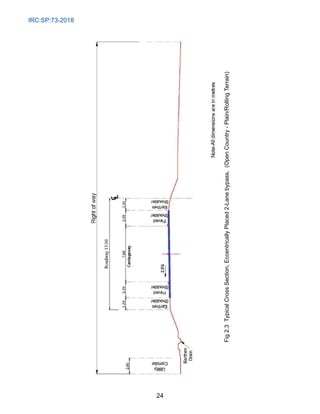
Schedule ‘B’ and placed eccentrically with respect to the ROW to facilitate
proper widening to four lanes in future (Fig. 2.3).
iv) The geometric design of the Project Highway shall conform to the standards
set out in this Section as a minimum. The Concessionaire shall ensure with the
consent of Engineer that liberal geometric standards are followed to the extent
feasible within the given Right of Way and consistent with safety.
v) As far as possible, uniformity of design standards shall be maintained throughout
the length. In case of any change, it shall be effected in a gradual manner.
vi) Where the existing road geometrics are deficient with respect to minimum
requirements and its improvement to the prescribed standards is not feasible
due to any constraint in acquisition of additional land, such stretches shall be as
specified in Schedule ‘B’ of the Concession Agreement.
vii) Existing horizontal curves, which are found deficient in radius, layout, transition
lengths or super elevation shall be corrected to the standards specified in this
section.
viii) Any deficiencies in the vertical profile in respect of grades, layout of vertical
curves and sight distance shall be corrected to meet the minimum requirements
in this section.
2.2	Design Speed
2.2.1 The design speeds given in Table 2.1 shall be adopted for various terrain classifications
(Terrain is classified by the general slope of the ground across the highway alignment).
IRC:SP:73-2018
14
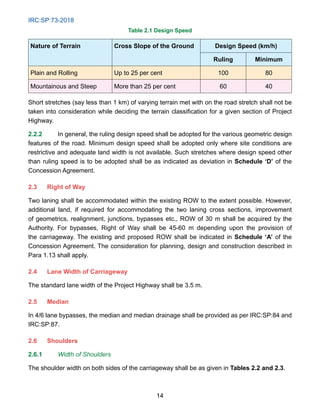
Table 2.1 Design Speed
Nature of Terrain Cross Slope of the Ground Design Speed (km/h)
Ruling Minimum
Plain and Rolling Up to 25 per cent 100 80
Mountainous and Steep More than 25 per cent 60 40
Short stretches (say less than 1 km) of varying terrain met with on the road stretch shall not be
taken into consideration while deciding the terrain classification for a given section of Project
Highway.
2.2.2 In general, the ruling design speed shall be adopted for the various geometric design
features of the road. Minimum design speed shall be adopted only where site conditions are
restrictive and adequate land width is not available. Such stretches where design speed other
than ruling speed is to be adopted shall be as indicated as deviation in Schedule ‘D’ of the
Concession Agreement.
2.3 Right of Way
Two laning shall be accommodated within the existing ROW to the extent possible. However,
additional land, if required for accommodating the two laning cross sections, improvement
of geometrics, realignment, junctions, bypasses etc., ROW of 30 m shall be acquired by the
Authority. For bypasses, Right of Way shall be 45-60 m depending upon the provision of
the carriageway. The existing and proposed ROW shall be indicated in Schedule ‘A’ of the
Concession Agreement. The consideration for planning, design and construction described in
Para 1.13 shall apply.
2.4 Lane Width of Carriageway
The standard lane width of the Project Highway shall be 3.5 m.
2.5 Median
In 4/6 lane bypasses, the median and median drainage shall be provided as per IRC:SP:84 and
IRC:SP:87.
2.6 Shoulders
2.6.1 Width of Shoulders
The shoulder width on both sides of the carriageway shall be as given in Tables 2.2 and 2.3.
IRC:SP:73-2018
15
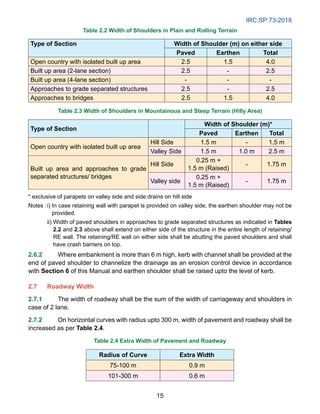
Table 2.2 Width of Shoulders in Plain and Rolling Terrain
Type of Section Width of Shoulder (m) on either side
Paved Earthen Total
Open country with isolated built up area 2.5 1.5 4.0
Built up area (2-lane section) 2.5 - 2.5
Built up area (4-lane section) - - -
Approaches to grade separated structures 2.5 - 2.5
Approaches to bridges 2.5 1.5 4.0
Table 2.3 Width of Shoulders in Mountainous and Steep Terrain (Hilly Area)
Type of Section
Width of Shoulder (m)*
Paved Earthen Total
Open country with isolated built up area
Hill Side 1.5 m - 1.5 m
Valley Side 1.5 m 1.0 m 2.5 m
Built up area and approaches to grade
separated structures/ bridges
Hill Side
0.25 m +
1.5 m (Raised)
- 1.75 m
Valley side
0.25 m +
1.5 m (Raised)
- 1.75 m
* exclusive of parapets on valley side and side drains on hill side
Notes :i) 
In case retaining wall with parapet is provided on valley side, the earthen shoulder may not be
provided.
ii) 
Width of paved shoulders in approaches to grade separated structures as indicated in Tables
2.2 and 2.3 above shall extend on either side of the structure in the entire length of retaining/
RE wall. The retaining/RE wall on either side shall be abutting the paved shoulders and shall
have crash barriers on top.
2.6.2 Where embankment is more than 6 m high, kerb with channel shall be provided at the
end of paved shoulder to channelize the drainage as an erosion control device in accordance
with Section 6 of this Manual and earthen shoulder shall be raised upto the level of kerb.
2.7 Roadway Width
2.7.1 The width of roadway shall be the sum of the width of carriageway and shoulders in
case of 2 lane.
2.7.2 On horizontal curves with radius upto 300 m, width of pavement and roadway shall be
increased as per Table 2.4.
Table 2.4 Extra Width of Pavement and Roadway
Radius of Curve Extra Width
75-100 m 0.9 m
101-300 m 0.6 m
IRC:SP:73-2018
16
2.8 Camber or Cross Fall
2.8.1 The crossfall on straight sections of road carriageway, paved shoulders and paved
portion of median shall be 2.5 per cent for bituminous surface and 2.0 per cent for cement
concrete surface.
2.8.2 The cross fall for earthen shoulders on straight portions shall be at least 0.5 per cent
steeper than the slope of the pavement and paved shoulder subject to a minimum of 3.0 per
cent. On super elevated sections, the earthen portion of the shoulder on the outer side of the
curve shall be provided with reverse crossfall of 0.5 per cent so that the earth does not drain on
the carriageway and the storm water drains out with minimum travel path.
2.8.3 The two-lane roads shall be provided with a crown in the middle. On horizontal curves,
the carriageway shall be super elevated.
2.9 Geometric Design and Alignment
2.9.1 Geometric design shall conform to IRC:73 except as otherwise indicated in this
Manual.
2.9.2 All horizontal curves shall consist of circular portion flanked by spiral transitions at
both ends.
2.9.3 Super Elevation
Super elevation shall be limited to 7 per cent, if radius of curve is less than the desirable minimum.
It shall be limited to 5 per cent, if the radius is more than desirable minimum and also at section
where Project Highway passes through an urban section or falls on a major junction.
2.9.4 Radii of Horizontal Curves
The desirable minimum and absolute minimum radii of horizontal curves for various classes of
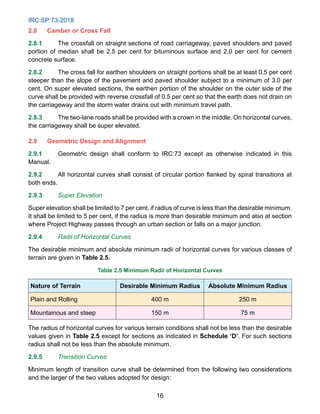
terrain are given in Table 2.5.
Table 2.5 Minimum Radii of Horizontal Curves
Nature of Terrain Desirable Minimum Radius Absolute Minimum Radius
Plain and Rolling 400 m 250 m
Mountainous and steep 150 m 75 m
The radius of horizontal curves for various terrain conditions shall not be less than the desirable
values given in Table 2.5 except for sections as indicated in Schedule ‘D’. For such sections
radius shall not be less than the absolute minimum.
2.9.5 Transition Curves
Minimum length of transition curve shall be determined from the following two considerations
and the larger of the two values adopted for design:
IRC:SP:73-2018
17
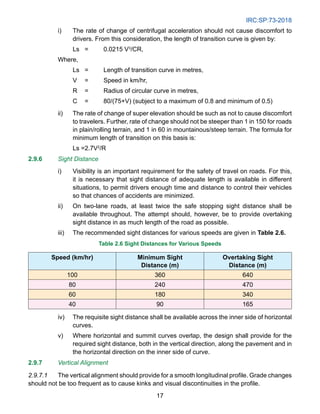
i) The rate of change of centrifugal acceleration should not cause discomfort to
drivers. From this consideration, the length of transition curve is given by:
		 Ls = 0.0215 V3
/CR,
Where,
		 Ls = Length of transition curve in metres,
		 V = Speed in km/hr,
		 R = Radius of circular curve in metres,
		 C = 80/(75+V) (subject to a maximum of 0.8 and minimum of 0.5)
ii) The rate of change of super elevation should be such as not to cause discomfort
to travelers. Further, rate of change should not be steeper than 1 in 150 for roads
in plain/rolling terrain, and 1 in 60 in mountainous/steep terrain. The formula for
minimum length of transition on this basis is:
		 Ls =2.7V2
/R
2.9.6 Sight Distance
i) Visibility is an important requirement for the safety of travel on roads. For this,
it is necessary that sight distance of adequate length is available in different
situations, to permit drivers enough time and distance to control their vehicles
so that chances of accidents are minimized.
ii) On two-lane roads, at least twice the safe stopping sight distance shall be
available throughout. The attempt should, however, be to provide overtaking
sight distance in as much length of the road as possible.
iii) The recommended sight distances for various speeds are given in Table 2.6.
Table 2.6 Sight Distances for Various Speeds
Speed (km/hr) Minimum Sight
Distance (m)
Overtaking Sight
Distance (m)
100 360 640
80 240 470
60 180 340
40 90 165
iv) The requisite sight distance shall be available across the inner side of horizontal
curves.
v) Where horizontal and summit curves overlap, the design shall provide for the
required sight distance, both in the vertical direction, along the pavement and in
the horizontal direction on the inner side of curve.
2.9.7 Vertical Alignment
2.9.7.1 The vertical alignment should provide for a smooth longitudinal profile. Grade changes
should not be too frequent as to cause kinks and visual discontinuities in the profile.
IRC:SP:73-2018
18
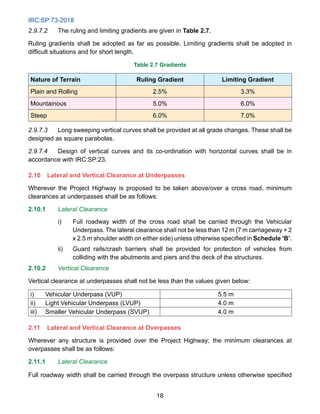
2.9.7.2 The ruling and limiting gradients are given in Table 2.7.
Ruling gradients shall be adopted as far as possible. Limiting gradients shall be adopted in
difficult situations and for short length.
Table 2.7 Gradients
Nature of Terrain Ruling Gradient Limiting Gradient
Plain and Rolling 2.5% 3.3%
Mountainous 5.0% 6.0%
Steep 6.0% 7.0%
2.9.7.3 Long sweeping vertical curves shall be provided at all grade changes. These shall be
designed as square parabolas.
2.9.7.4 Design of vertical curves and its co-ordination with horizontal curves shall be in
accordance with IRC:SP:23.
2.10 Lateral and Vertical Clearance at Underpasses
Wherever the Project Highway is proposed to be taken above/over a cross road, minimum
clearances at underpasses shall be as follows:
2.10.1 Lateral Clearance
i) Full roadway width of the cross road shall be carried through the Vehicular
Underpass. The lateral clearance shall not be less than 12 m (7 m carriageway + 2
x 2.5 m shoulder width on either side) unless otherwise specified in Schedule ‘B’.
ii) Guard rails/crash barriers shall be provided for protection of vehicles from
colliding with the abutments and piers and the deck of the structures.
2.10.2 Vertical Clearance
Vertical clearance at underpasses shall not be less than the values given below:
i) Vehicular Underpass (VUP) 5.5 m
ii) Light Vehicular Underpass (LVUP) 4.0 m
iii) Smaller Vehicular Underpass (SVUP) 4.0 m
2.11 Lateral and Vertical Clearance at Overpasses
Wherever any structure is provided over the Project Highway; the minimum clearances at
overpasses shall be as follows:
2.11.1 Lateral Clearance
Full roadway width shall be carried through the overpass structure unless otherwise specified
IRC:SP:73-2018
19
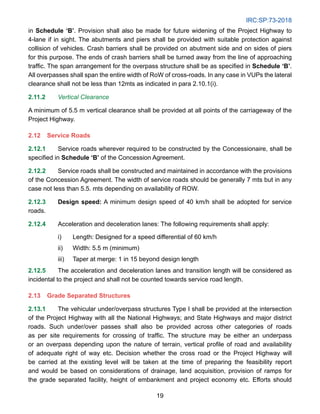
in Schedule ‘B’. Provision shall also be made for future widening of the Project Highway to
4-lane if in sight. The abutments and piers shall be provided with suitable protection against
collision of vehicles. Crash barriers shall be provided on abutment side and on sides of piers
for this purpose. The ends of crash barriers shall be turned away from the line of approaching
traffic. The span arrangement for the overpass structure shall be as specified in Schedule ‘B’.
All overpasses shall span the entire width of RoW of cross-roads. In any case in VUPs the lateral
clearance shall not be less than 12mts as indicated in para 2.10.1(i).
2.11.2 Vertical Clearance
A minimum of 5.5 m vertical clearance shall be provided at all points of the carriageway of the
Project Highway.
2.12 Service Roads
2.12.1 Service roads wherever required to be constructed by the Concessionaire, shall be
specified in Schedule ‘B’ of the Concession Agreement.
2.12.2 Service roads shall be constructed and maintained in accordance with the provisions
of the Concession Agreement. The width of service roads should be generally 7 mts but in any
case not less than 5.5. mts depending on availability of ROW.
2.12.3 Design speed: A minimum design speed of 40 km/h shall be adopted for service
roads.
2.12.4 Acceleration and deceleration lanes: The following requirements shall apply:
i) Length: Designed for a speed differential of 60 km/h
ii) Width: 5.5 m (minimum)
iii) Taper at merge: 1 in 15 beyond design length
2.12.5 The acceleration and deceleration lanes and transition length will be considered as
incidental to the project and shall not be counted towards service road length.
2.13 Grade Separated Structures
2.13.1 The vehicular under/overpass structures Type I shall be provided at the intersection
of the Project Highway with all the National Highways; and State Highways and major district
roads. Such under/over passes shall also be provided across other categories of roads
as per site requirements for crossing of traffic. The structure may be either an underpass
or an overpass depending upon the nature of terrain, vertical profile of road and availability
of adequate right of way etc. Decision whether the cross road or the Project Highway will
be carried at the existing level will be taken at the time of preparing the feasibility report
and would be based on considerations of drainage, land acquisition, provision of ramps for
the grade separated facility, height of embankment and project economy etc. Efforts should
IRC:SP:73-2018
20
be made to have cross road/lower category road above provided land is available as it may
economise cost of grade separation and future expansion of main highway. SVUP may be
provided at other location where PUP/CUP and lower VUP etc. were being provided earlier.
2.13. 2 SVUP and Foot Over Bridge
i) A SVUP/ Foot Over Bridge/LVUP may not be necessary within a distance of
2 km from other Vehicular underpasses/overpasses except in exceptional
circumstances.
ii) The pedestrian crossings (SVUP/FOB) shall have provision for movement of
physically disabled persons.
iii) Underpasses shall be preferred to Foot Over Bridges.
iv) SVUP/Foot Over Bridge shall also be provided within a distance of
200 m from a school or hospital or factory/industrial area.
v) The Bus Bays along with the Bus Shelters shall be provided at the identified
SVUP/Foot Over Bridge/locations where buses normally stop to drop and pick
up commuters as specified in Para 12.6 of this Manual. Such locations shall be
specified in Schedule ‘B’.
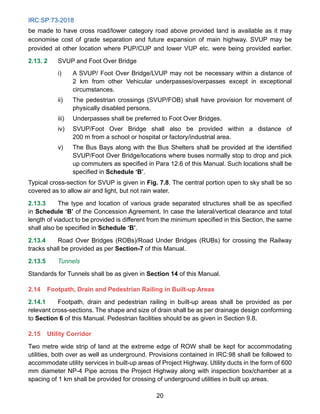
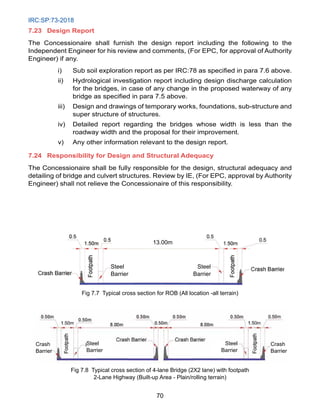
Typical cross-section for SVUP is given in Fig. 7.8. The central portion open to sky shall be so
covered as to allow air and light, but not rain water.
2.13.3 The type and location of various grade separated structures shall be as specified
in Schedule ‘B’ of the Concession Agreement. In case the lateral/vertical clearance and total
length of viaduct to be provided is different from the minimum specified in this Section, the same
shall also be specified in Schedule ‘B’.
2.13.4 Road Over Bridges (ROBs)/Road Under Bridges (RUBs) for crossing the Railway
tracks shall be provided as per Section-7 of this Manual.
2.13.5 Tunnels
Standards for Tunnels shall be as given in Section 14 of this Manual.
2.14 Footpath, Drain and Pedestrian Railing in Built-up Areas
2.14.1 Footpath, drain and pedestrian railing in built-up areas shall be provided as per
relevant cross-sections. The shape and size of drain shall be as per drainage design conforming
to Section 6 of this Manual. Pedestrian facilities should be as given in Section 9.8.
2.15 Utility Corridor
Two metre wide strip of land at the extreme edge of ROW shall be kept for accommodating
utilities, both over as well as underground. Provisions contained in IRC:98 shall be followed to
accommodate utility services in built-up areas of Project Highway. Utility ducts in the form of 600
mm diameter NP-4 Pipe across the Project Highway along with inspection box/chamber at a
spacing of 1 km shall be provided for crossing of underground utilities in built up areas.
IRC:SP:73-2018
21
2.16 Typical Cross-Sections
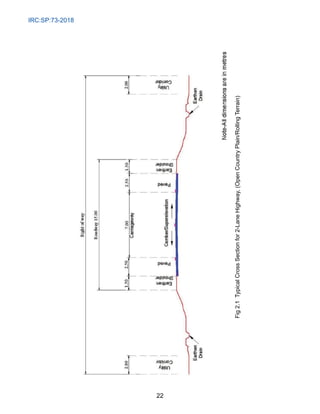
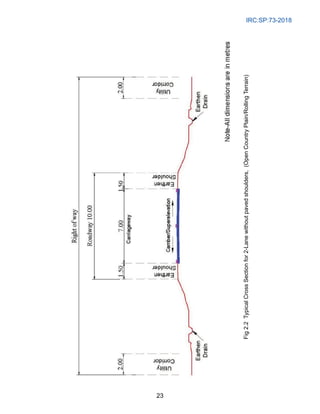
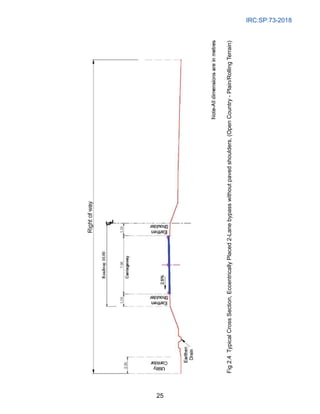
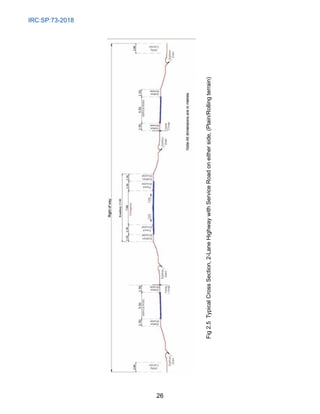
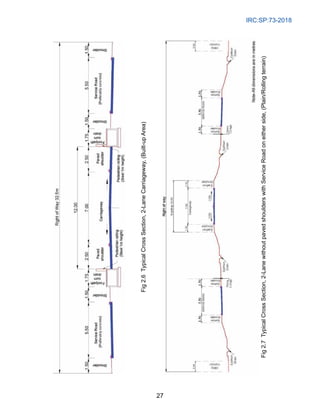
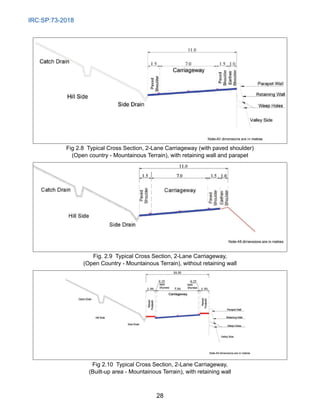
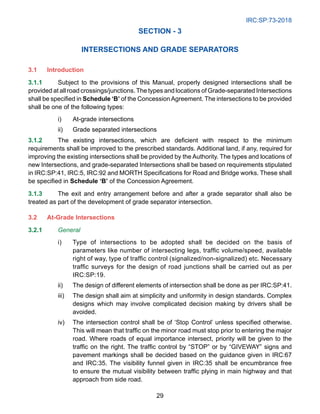
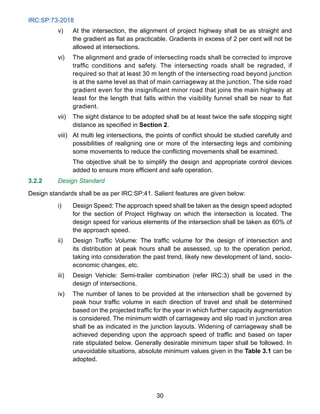
2.16.1 Typical cross-sections of Project Highway are given in Figs. 2.1 to 2.10. These shall
be adopted for various locations, as applicable. Fig. 2.2 and 2.4 and Fig 2.6 are applicable
for two lane highway without paved shoulders. These shall be used if deviation is made and
specified in Schedule ‘D’.
2.16.2 Where cross-section changes from two lane to four lane a transition of 1 in 20 to 1 in
30 shall be provided as per IRC:73 and IRC:86.
2.17 Capacity of Two-Lane Highway
The design service volume of two-lane highway for different type of terrain shall be as per the latest
guidelines of the MORTH which is at present specified in circular no. RW/NH-33044/37/2015/
SR (R) dated 26th
May, 2016 as given below:
Table 2.8 Design Service Volume of Two-Lane Highway in PCUs per day
Nature of Terrain Design Service Volume in PCUs per day
Plain 10,000
Rolling 8500
Mountainous and Sleep 6000
IRC:SP:73-2018
22
Fig
2.1
Typical
Cross
Section
for
2-Lane
Highway,
(Open
Country
Plain/Rolling
Terrain)
IRC:SP:73-2018
23
Fig
2.2
Typical
Cross
Section
for
2-Lane
without
paved
shoulders,
(Open
Country
Plain/Rolling
Terrain)
IRC:SP:73-2018
24
Fig
2.3
Typical
Cross
Section,
Eccentrically
Placed
2-Lane
bypass,
(Open
Country
-
Plain/Rolling
Terrain)
IRC:SP:73-2018
25
Fig
2.4
Typical
Cross
Section,
Eccentrically
Placed
2-Lane
bypass
without
paved
shoulders,
(Open
Country
-
Plain/Rolling
Terrain)
IRC:SP:73-2018
26
Fig
2.5
Typical
Cross
Section,
2-Lane
Highway
with
Service
Road
on
either
side,
(Plain/Rolling
terrain)
IRC:SP:73-2018
27
Fig
2.6
Typical
Cross
Section,
2-Lane
Carriageway,
(Built-up
Area)
Fig
2.7
Typical
Cross
Section,
2-Lane
without
paved
shoulders
with
Service
Road
on
either
side,
(Plain/Rolling
terrain)
IRC:SP:73-2018
28
Fig 2.8 Typical Cross Section, 2-Lane Carriageway (with paved shoulder)
(Open country - Mountainous Terrain), with retaining wall and parapet
Fig. 2.9 Typical Cross Section, 2-Lane Carriageway,
(Open Country - Mountainous Terrain), without retaining wall
Fig 2.10 Typical Cross Section, 2-Lane Carriageway,
(Built-up area - Mountainous Terrain), with retaining wall
IRC:SP:73-2018
29
SECTION - 3
INTERSECTIONS AND GRADE SEPARATORS
3.1 Introduction
3.1.1 Subject to the provisions of this Manual, properly designed intersections shall be
provided at all road crossings/junctions.The types and locations of Grade-separated Intersections
shall be specified in Schedule ‘B’ of the ConcessionAgreement. The intersections to be provided
shall be one of the following types:
i) At-grade intersections
ii) Grade separated intersections
3.1.2 The existing intersections, which are deficient with respect to the minimum
requirements shall be improved to the prescribed standards. Additional land, if any, required for
improving the existing intersections shall be provided by the Authority. The types and locations of
new Intersections, and grade-separated Intersections shall be based on requirements stipulated
in IRC:SP:41, IRC:5, IRC:92 and MORTH Specifications for Road and Bridge works. These shall
be specified in Schedule ‘B’ of the Concession Agreement.
3.1.3 The exit and entry arrangement before and after a grade separator shall also be
treated as part of the development of grade separator intersection.
3.2 At-Grade Intersections
3.2.1 General
i) Type of intersections to be adopted shall be decided on the basis of
parameters like number of intersecting legs, traffic volume/speed, available
right of way, type of traffic control (signalized/non-signalized) etc. Necessary
traffic surveys for the design of road junctions shall be carried out as per
IRC:SP:19.
ii) The design of different elements of intersection shall be done as per IRC:SP:41.
iii) The design shall aim at simplicity and uniformity in design standards. Complex
designs which may involve complicated decision making by drivers shall be
avoided.
iv) The intersection control shall be of ‘Stop Control’ unless specified otherwise.
This will mean that traffic on the minor road must stop prior to entering the major
road. Where roads of equal importance intersect, priority will be given to the
traffic on the right. The traffic control by “STOP” or by “GIVEWAY” signs and
pavement markings shall be decided based on the guidance given in IRC:67
and IRC:35. The visibility funnel given in IRC:35 shall be encumbrance free
to ensure the mutual visibility between traffic plying in main highway and that
approach from side road.
IRC:SP:73-2018
30
v) At the intersection, the alignment of project highway shall be as straight and
the gradient as flat as practicable. Gradients in excess of 2 per cent will not be
allowed at intersections.
vi) The alignment and grade of intersecting roads shall be corrected to improve
traffic conditions and safety. The intersecting roads shall be regraded, if
required so that at least 30 m length of the intersecting road beyond junction
is at the same level as that of main carriageway at the junction. The side road
gradient even for the insignificant minor road that joins the main highway at
least for the length that falls within the visibility funnel shall be near to flat
gradient.
vii) The sight distance to be adopted shall be at least twice the safe stopping sight
distance as specified in Section 2.
viii) At multi leg intersections, the points of conflict should be studied carefully and
possibilities of realigning one or more of the intersecting legs and combining
some movements to reduce the conflicting movements shall be examined.
		 The objective shall be to simplify the design and appropriate control devices
added to ensure more efficient and safe operation.
3.2.2 Design Standard
Design standards shall be as per IRC:SP:41. Salient features are given below:
i) Design Speed: The approach speed shall be taken as the design speed adopted
for the section of Project Highway on which the intersection is located. The
design speed for various elements of the intersection shall be taken as 60% of
the approach speed.
ii) Design Traffic Volume: The traffic volume for the design of intersection and
its distribution at peak hours shall be assessed, up to the operation period,
taking into consideration the past trend, likely new development of land, socio-
economic changes, etc.
iii) Design Vehicle: Semi-trailer combination (refer IRC:3) shall be used in the
design of intersections.
iv) The number of lanes to be provided at the intersection shall be governed by
peak hour traffic volume in each direction of travel and shall be determined
based on the projected traffic for the year in which further capacity augmentation
is considered. The minimum width of carriageway and slip road in junction area
shall be as indicated in the junction layouts. Widening of carriageway shall be
achieved depending upon the approach speed of traffic and based on taper
rate stipulated below. Generally desirable minimum taper shall be followed. In
unavoidable situations, absolute minimum values given in the Table 3.1 can be
adopted.
IRC:SP:73-2018
31
Table 3.1: Taper Rate
Speed (kmph) Desirable Minimum Taper Absolute Minimum Taper
 50 kmph 1:35 1:20
50 to 65 kmph 1:40 1:25
66 to 80 kmph 1:45 1:30
80 kmph 1:50 1:40
v) Type and radius of curve of intersection: The type and radii of curves would
depend upon the types of vehicles turning at the intersection and shall be
decided based on the traffic data.
vi) Visibility at intersection: A minimum safe stopping sight distance, appropriate for
the approach speeds, shall be available for the traffic on the Project Highway.
3.2.3 Traffic Control Devices
i) Road markings:Typical road markings for road intersection as given in IRC:SP:41
and IRC:SP:35 shall be followed. The specifications of road markings shall be
as given in Section 9 of this Manual.
ii) Signs: Traffic signs at the junctions shall be provided as per IRC:67 and
Section 9 of this Manual.
iii) Reflectors: To guide the traffic, reflectors in the form of Reflective Pavement
Markers (Road Studs), delineators, etc shall be provided, in addition to the road
markings, especially at the channelizing islands.
3.2.4 Typical at-Grade Junction Layouts
Based on the general principles and design standards laid out, the typical design provided below
may be adopted
i) Major Junctions: For major at grade junctions, the layouts described below
shall be adopted.
ii) Minor Junctions: Depending upon the situations, following layouts shall be
applied for minor junctions.
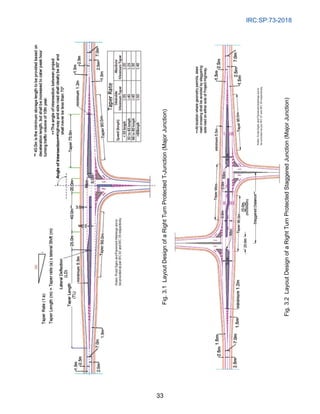
Fig. 3.1 : Layout for T Junction with storage lane with physical island and is applicable for all
junctions unless otherwise it falls in the minor junction category.
Fig. 3.2 : Layout for staggered Junction with storage lane with physical island and is applicable
where there is enough space to convert a cross junction into a staggered junction.
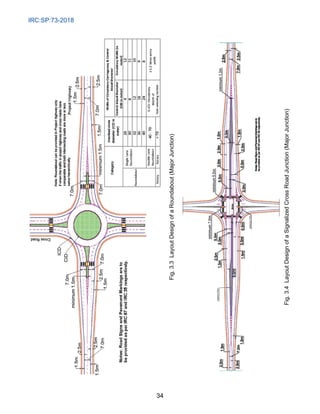
Fig. 3.3 : Layout for roundabout/rotary where project highway joins or intersect with another
road of more or less same both hierarchically as well as traffic volume wise and witnessing
considerable right turning traffic. Roundabout/rotary can be adopted for rural and semi-urban
location to have round-the-clock traffic control. The IRC:65 shall be followed for layout design of
roundabout and rotary.
IRC:SP:73-2018
32
Fig. 3.4 : Layout for cross road with signalization and is applicable where approach traffic volume
warrants traffic signal and can be adopted in junctions where there is predominate presence of
pedestrians and cyclists. In order to ensure round the clock traffic control, signal shall be vehicle
actuated.
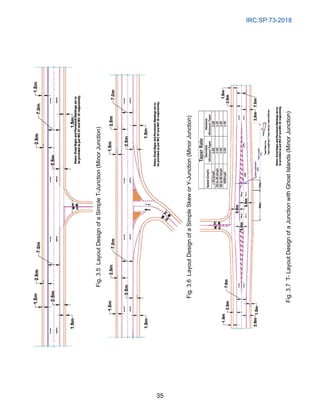
Fig. 3.5 : Layout for Simple T junction for an insignificant side road like a property access in the
project highway.
Fig. 3.6 : Layout for Simple Y or skew junction for an insignificant side road joining project
highway, wherein the side road traffic has been made to join the project highway at nearly
perpendicular in order to achieve mutual visibility between traffic approaching in project highway
and that in side road. A direct taper of 50 m shall be given for merging and diverging and also to
avoid rear end collision.
Fig. 3.7 : Layout for T Junction with storage lane with Ghost islands i.e. with markings. The
layout is applicable for a minor junction, even if there is few right turning movement to side road,
as at some locations, the land availability does not permit to provide a junction with shelter lane
protected with physical island. Unlike the simple junctions, the small vehicles can still find a
shelter, avoiding waiting in the fast lane of through traffic, as they are intended to ply on priority.
3.3 Grade Separated Intersections without Ramp
3.3.1 General
I. If specifically provided in Schedule ‘B’, Grade Separated intersection without
ramp may be provided.
II. All features pertaining to structures for this type of grade separator will be same
as provided in Section 2 of this Manual.
3.3.2 Deleted
3.3.3 Design of Structures
For design of structures of grade-separated structures, the details given in Sections 7 and 8
of this Manual shall be followed. Minimum length of viaduct required to be provided at various
grade separated structures shall be specified by the Authority in Schedule ‘B’ of the Concession
Agreement.
3.3.4 Traffic Control Devices
Details given in paras 3.2.3 and 3.4.6 shall apply.
3.3.5 Detailed Design and Data for Review by IE
The Concessionaire shall submit the details of the ground surveys, traffic data, traffic forecast,
design and drawings of the grade separated intersections and the structures, showing all safety
features, to the Independent Engineer for approval.
IRC:SP:73-2018
33
Fig.
3.1
Layout
Design
of
a
Right
Turn
Protected
T-Junction
(Major
Junction)
Fig.
3.2
Layout
Design
of
a
Right
Turn
Protected
Staggered
Junction
(Major
Junction)
IRC:SP:73-2018
34
Fig.
3.3
Layout
Design
of
a
Roundabout
(Major
Junction)
Fig.
3.4
Layout
Design
of
a
Signalized
Cross
Road
Junction
(Major
Junction)
IRC:SP:73-2018
35
Fig.
3.5
Layout
Design
of
a
Simple
T-Junction
(Minor
Junction)
Fig.
3.6  Layout
Design
of
a
Simple
Skew
or
Y-Junction
(Minor
Junction)
Fig.
3.7
T-
Layout
Design
of
a
Junction
with
Ghost
Islands
(Minor
Junction)
IRC:SP:73-2018
36
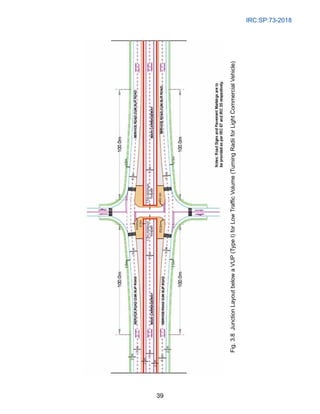
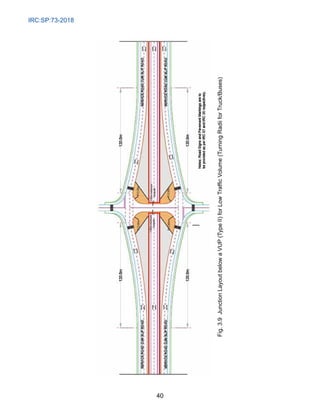
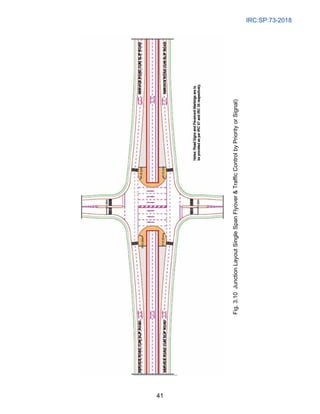
3.3.6 Typical Layouts for Grade Separated Junction
The grade separator junction is justified at locations where traffic on cross roads is moderate
to heavy and for safe and efficient traffic flow, ramps are necessary for cross road traffic.
The type and location of interchanges to be provided shall be specified in Schedule ‘B’.
The grade separator junctions shall be done with appropriate exit and entry before and after
grade separator.
Fig. 3.8 : Junction Layout below a VUP for Low Traffic Volume (Turning Radii for Light Commercial
Vehicle).
Fig. 3.9 : Junction Layout below a VUP for Low Traffic Volume (Turning Radii for Trucks/Buses).
Fig. 3.10 : Junction Layout for Medium Traffic Volume (Single Span Flyover  Control by Priority
or Traffic Signal.
3.4 Interchanges
3.4.1 General
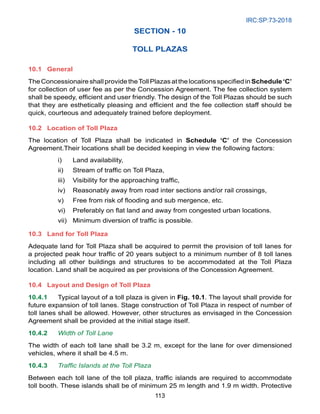
i) An Interchange is a grade-separated intersection with connecting roadways
(ramps) for turning traffic between highway approaches. Such an Interchange
will be necessary at all crossings of a highway, which is to be developed to
completely access controlled standards. An Interchange may also be justified at
locations where traffic on cross roads is heavy and when anAt-grade intersection
fails to handle the heavy volume of turning, merging and diverging traffic leading
to excessive delays and fatal and major accidents.
		 Cost effectiveness will decide whether to provide full Interchange or grade
separated intersection without ramps.
ii) An Interchange may be justified at the crossing of the Project Highway with
another highway, and where the total traffic on all the arms of the intersection is
in excess of 10,000 PCUs in peak hour.
iii) The decision to provide Interchange at such locations shall be taken by the
Authority and the requirement shall be clearly spelt out in Schedule ‘B’ of the
Concession Agreement, which shall also indicate specifications and traffic
streams to be grade separated.
iv) The detailed design and layout of the Interchange shall conform to broad
parameters and requirements specified by the Authority in Schedule ‘B’ of
the Concession Agreement. Based on detailed survey and investigations, the
Concessionaire shall develop appropriate detailed drawings and designs and
submit to the Independent Engineer for review and comments, if any.
IRC:SP:73-2018
37
3.4.2 Types of Interchanges
i) Interchanges are generally described by the pattern of the various turning
roadways or ramps, which determine their geometric configuration. The common
geometric configurations of Interchanges are the trumpet, diamond, cloverleaf,
rotary and directional. Within each type of Interchange, there can be several
variations such as split diamond, partial cloverleaf, etc. depending on the ramp
arrangements.
ii) The type of Interchanges, the shape and pattern of the Interchange ramps
and loops and their designs shall be governed by factors such as the
importance of the intersecting highway, the number of intersecting legs, the
design volumes of through and turning traffic movements including their
composition, the design speeds, available right of way and topography. The
Interchange site shall be studied in detail and alternative designs made, to
determine the most suitable arrangement of structures and ramps satisfying
the specified requirements.
3.4.3 Geometric Design Standards for Interchange Elements
The geometric design standards shall be as per IRC:92 appropriate for the design speed adopted
for the Project Highway. The design speed for ramps shall not be less than 40 km per hour.
The desirable values of various parameters given in IRC:92 shall be adopted, unless there are
severe site constraints.
3.4.4 Design Traffic
The traffic volume for the design of various elements of Interchange including ramps shall be
assessed up to the end of the Concession Period or twenty years, whichever is more, taking into
consideration the past trends, likely new development of land, socio-economic changes, etc.
3.4.5 Design of Structure
For design of structure of grade-separated structure comprising of main structure and ramps,
the details given in Sections 7 and 8 of this Manual shall be followed. Minimum length of viaduct
required to be provided at various grade-separated structure shall be specified by the Authority
in Schedule ‘B’ of the Concession Agreement.
3.4.6 Traffic Control Devices
Traffic signs (refer IRC:67) shall be provided at suitable locations to:
i) Serve as advance notice of the approaches to the Interchanges;
ii) Direct drivers into appropriate lanes for diverging/merging movements;
iii) Identify routes and directions;
iv) Provide other information of importance to the drivers; and
v) Show distances to destinations.
IRC:SP:73-2018
38
The specifications of road markings shall be as given in IRC:35 and as prescribed in Section 9
of this Manual.
3.4.7 Detailed Design and Data for EPC projects:
In respect of EPC projects, the contractor shall submit the details in respect of intersections at
grade and grade separated as also the interchanges for review and approval of the Authority
Engineer.
IRC:SP:73-2018
39
Fig.
3.8  Junction
Layout
below
a
VUP
(Type
I)
for
Low
Traffic
Volume
(Turning
Radii
for
Light
Commercial
Vehicle)
IRC:SP:73-2018
40
Fig.
3.9  Junction
Layout
below
a
VUP
(Type
II)
for
Low
Traffic
Volume
(Turning
Radii
for
Truck/Buses)
IRC:SP:73-2018
41
Fig.
3.10  Junction
Layout
Single
Span
Flyover

Traffic
Control
by
Priority
or
Signal)
IRC:SP:73-2018
42
SECTION - 4
ROAD EMBANKMENT
4.1 General
4.1.1 The design and construction of the road in embankment and in cuttings shall be
carried out in accordance with Section 300 of MORTH Specifications, relevant IRC codes and
the requirements, and standards and specifications given in this Section. This Section also
covers specifications for sub-grade and earthen shoulders.
4.1.2 Efforts should be made to remove the inherent deficiencies in plan and profile of the
existing road. The final centre line of the road and the road levels shall be fixed duly considering
all the relevant factors covering structural soundness, safety and functional requirements as per
relevant IRC Codes and provisions of this Manual.
4.1.3 The existing road embankment shall be widened/modified to the specified cross-
sectional details.
4.2 Embankment
4.2.1 The height of the embankment shall be measured with respect to the finished road
levels. The following principles shall be kept in view while fixing the road level :
i) No section of the road is overtopped. Top of sub-grade shall be at least
0.60 m above the general ground level in case of existing road, if the road has
no history of being overtopped.
ii) The bottom of sub-grade shall be 1.0 m above the High Flood Level (HFL)/
level of water table if the road has been over topped in the past. The HFL
should be decided by intelligent inspections, local observations, enquiries
and studying the past records. This shall be relevant to situations where
road alignment is sited within the flood plain or in the vicinity of water bodies
or where ponding of water is encountered . If raising of any section(s) of
the existing road is required, the same shall be specified in Schedule ‘B’
of the Concession Agreement along with its FRL. In case of no mention in
Schedule ‘B’ of FRL, the road shall be designed by following above principle
as stipulated in IRC:37.
4.2.2 Materials and Physical Requirements
4.2.2.1 Sourcing of materials for embankment and sub-grade construction, as well as
compliance with environmental requirements in respect of excavation and borrow areas under
the applicable laws shall be the sole responsibility of the Concessionaire.
4.2.2.2 The material to be used in sub-grade shall satisfy the design California Bearing Ratio
(CBR) at the specified density and moisture content.
IRC:SP:73-2018
43
4.2.2.3 The embankment and sub-grade shall be compacted to satisfy the minimum
compaction requirements given in Clause 305 of MORTH Specifications.
4.2.3 Structural Features and Design of Embankment
4.2.3.1 Embankment with height 6.0 more above shall be designed in accordance with
IRC:75 taking into account slope stability, bearing capacity, consolidation, settlement and safety
considerations based on geotechnical and investigation data. Where the embankment is to be
supported on a weak stratum, appropriate remedial/ground improvement measures shall be
taken.
4.2.3.2 Side slopes shall not be steeper than 2H: 1V unless soil is retained by suitable soil
retaining structures.
4.2.3.3 The side slopes and the earthen shoulders shall be protected against erosion by
providing a suitable vegetative cover, kerb channel, chute, stone/cement concrete block pitching
or any other suitable protection measures depending on the height of the embankment and
susceptibility of soil to erosion. Drainage arrangement shall be provided as per Section 6 of this
Manual. In high rainfall areas and where soil is susceptible to erosion, before providing turfing
on slopes and shoulders, a coir or jute blanket shall be placed on such slopes and shoulders
immediately after completion of work and in any event before onset of first monsoon after
completion of work in that reach.
4.2.4 Use of Pond Ash for Embankment Construction
Where pond ash is used for embankment construction in pursuance of the instructions of the
Ministry of Environment and Forests or otherwise, the embankment shall be designed and
constructed in accordance with IRC:SP:58.
4.3 Roadway in Cutting
4.3.1 The road level shall be fixed, keeping in view the provisions of relevant IRC Codes.
4.4 Soil Investigations and Design Report
4.4.1 General
The Concessionaire shall carry out necessary soil surveys, and field and laboratory investigations
for selecting appropriate borrow pits, identifying and treating problematic ground locations, if
any, and for finalizing structural features and design of the embankment and cut sections and
establishing improved ground properties. A report on the soil investigation shall be furnished
along with the design.
4.4.2 Soil Investigations for Embankment
Soil investigations shall cover the following:
a) Soil investigations and tests in accordance with the requirements specified in
IRC:SP:19 and shall be reported in the Proforma given in Table 1 of IRC:SP:19.
IRC:SP:73-2018
44
In addition to this, all tests as per the requirements of MORTH Specifications
shall be reported.
b) In respect of embankments with height more than 6 m, additional
investigations and soil tests as per IRC:75 and Appendix 10 of IRC:SP:19.
c) Information regarding the topography, high flood level, natural drainage
conditions, highest sub-soil water level, and the nature and extent of inundation,
if any.
d) The characteristics of embankment foundation including the presence of any
unsuitable/weak strata, marshy areas, waterlogged areas, etc.
e) Along the alignment of the road, where unstable strata, soft material or poor
subsoil conditions have been met with at the foundation level, the soil profile
shall be drawn after determining through borings, the type of soil at different
levels. The borings shall be at maximum interval of 100 m to a depth of 2 m or
more below the existing ground as necessary. In the case of high embankments,
the borings shall be taken down to a depth equal to twice the height of the
embankment.
f) Any particular construction problems of the area or other important features.
g) Geotechnical properties of pond ash, covering parameters specified in Table 1of
IRC:SP:58 and Optimum Moisture Content (OMC) - dry density relationship for
heavy compaction. This information shall be furnished, in case pond ash is used
in embankment construction.
4.4.3 Soil Investigations for Cut Sections
Soil investigations and tests shall be carried out in accordance with the requirements specified in
IRC:SP:19 and information regarding depth of water table, seepage flow, presence of any weak,
unstable or problematic strata.
4.4.4 Design Report
The Concessionaire shall prepare the design report with all relevant details including the following:
i) Road Embankment
a) The detailed design of the embankment, remedial/ground improvement
treatment where required. For embankments with height more than 6 m,
construction methodology should also be included.
b) Design of retaining walls/reinforced earth structures.
c) Design of protection measures for embankment slope and drainage
arrangement.
IRC:SP:73-2018
45
d) Design of pond ash embankment in case use of pond ash is proposed.
e) Any additional information relevant to the design of embankment.
ii) Cut Section
a) Type of cutting involved and proposed cut slopes shall be provided in
accordance with the nature of the soil encountered. Where required,
benching including use of slope stability measures like pitching, breast
walls, etc. shall be adopted to make the slopes stable and safe.
b) Design and details of erosion control, slope protection measures, etc.
c) In cut sections in hilly terrain, the problem of seepage flow is common.
Where such conditions exist, necessary measures shall be taken including
provision of deep side drains to intercept the seepage flow and discharge
the drained water into suitable outlets to avoid any damage to road and
cut slopes. Design and details of drainage arrangement for sub-soil and
surface water shall be furnished. It should be ensured that rain water and
seepage water is quickly drained out. The gradient of drain shall not be
flatter than 1 in 200.
d) Any other additional information relevant to the design of cut slopes.
IRC:SP:73-2018
46
SECTION - 5
PAVEMENT DESIGN
5.1 General
5.1.1 The design and construction of new pavement sections, and of strengthening
measures (overlay) for the existing pavement shall be carried out in accordance with the criteria,
standards and specifications given in this section. Where alternative specifications or materials
are proposed to bring in innovation in design etc., provisions of paras 1.9 and 1.11 of this Manual
shall apply.
5.1.2 Design of new pavement sections or widening and strengthening of existing pavements
shall take into account all relevant factors for assuring reliable performance that satisfies the
specified minimum performance requirements.
5.1.3 The Concessionaire shall undertake the necessary soil, material and pavement
investigations and traffic volume and axle load studies in accordance with the good industry
practice for preparing detailed designs.
5.1.4 The materials, mixes and construction practice shall meet the requirements prescribed
herein and MORTH Specifications/IRC Specifications.
5.1.5 Where problematic conditions such as expansive soils, swamps or marshes, flooding,
poor drainage, frost susceptible areas etc. are found to exist, adequate measures shall be
adopted to deal with such site conditions.
5.2 Type of Pavement
5.2.1 The type of pavement to be provided shall be specified in Schedule ‘B’. If nothing is
specified, the Concessionaire may adopt any type (flexible/rigid) of pavement structure for new
construction and/or widening of existing carriageway.
5.2.2 Strengthening of the existing flexible pavement will be carried out by providing
appropriate bituminous overlay, unless specified otherwise in Schedule ‘B’ of the Concession
Agreement.
5.3 Method of Design - New Pavements
5.3.1 Method of Design of Flexible Pavement
The new pavement shall be designed in accordance with the IRC:37. “Guidelines for the Design
of Flexible Pavements”.
5.3.2 Method of Design of Rigid Pavement
RigidpavementshallbedesignedinaccordancewiththemethodprescribedinIRC:58.“Guidelines
for the Design of Plain Jointed Rigid Pavements for Highways” or IRC:101 “Guidelines for Design
IRC:SP:73-2018
47
of Continuously Reinforced Concrete Pavement”.
5.4	Design Requirements for New Pavement Sections
5.4.1 Flexible Pavement - Design Period and Strategy
i) Flexible pavement shall be designed for a minimum design period of 15 years,
subject to the condition that design traffic shall not be less than 20 msa.
ii) Stage construction shall not be permitted.
5.4.2 Rigid Pavement-Design Period and Strategy
Rigid pavement shall be designed for a minimum design period of 30 years.The stage construction
shall not be permitted.
5.4.3 Pavement performance requirements for main carriageway, service roads, entry/ exit
ramps and acceleration/deceleration lanes shall be follows :
i) The pavement structure shall be capable of giving the specified performance
over the entire operation period.
ii) The new pavement surface shall satisfy the following standards;
a) Surface finish : As per requirements of Clauses 902 and 903 of MoRTH
Specifications
b) Roughness in each lane :
i) Rigid Pavement : 2000 mm/km for each lane in a km length
ii) Flexible Pavement : 1800 mm/km for each lane in a km length
c) Rutting in wheel path measured by 3 m Straight Edge : Nil
d) Cracking or any other distress : Nil
iii) During the operation period, the pavement surface roughness or any
structural or functional distress shall not exceed the values specified in
Schedule 'K' of the ConcessionAgreement. Generally the pavement condition in
terms of roughness, cracking and rutting should not deteriorate to the maximum
values specified in Schedule 'K' for rectification, earlier than 5 years from the
original level from the year of rectification. Any treatment in the form of renewal/
overlay carried out or required to restore/correct/ improve the riding quality or
any distress shall be of such thickness and specification that will restore the
riding quality to roughness not exceeding 2000 mm/km.
iv) During the operation and maintenance period, the pavement strength shall be
evaluated periodically through deflection measurements (Refer to Para 5.8 (ii)
of this Section) and the stretches exhibiting any structural deficiency shall be
rectified. If the deflection measurements are more than 1.2 mm, the pavement
shall be strengthened in those reaches.
IRC:SP:73-2018
48
5.4.4 The performance of the rigid pavement shall meet the requirements as specified in
IRC:SP:16 and IRC:SP:83.
5.5 Design Traffic
5.5.3 The design traffic shall be estimated in terms of cumulative number of standard axles
(8160 kg) to be carried by the pavement during the design period.
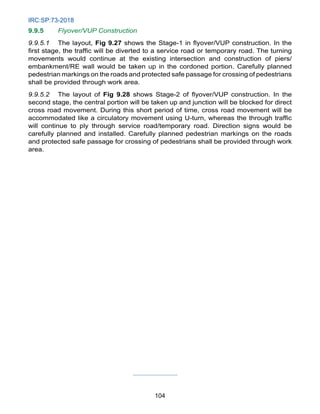
5.5.4 Initial Daily Average Traffic Flow shall be Assessed based on IRC:9.
5.5.5 Any likely change in traffic due to proposed improvement of the facility and/or future
development plans, land use, shall be duly considered in estimating the design traffic.
5.5.6 The design traffic in case of service road shall not be less than ten million standard
axles. The crust composition shall be provided accordingly.
5.6 Sub-grade
The Sub-grade, whether in cut or fill, shall meet the requirements stipulated in Clause 305 of
MORTH Specifications.
5.7 Pavement Components and Materials
i) The pavement construction materials for sub-base, base and bituminous
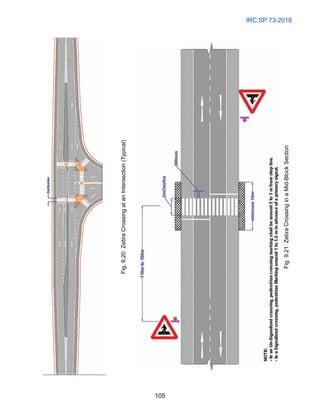
surfacing shall conform to the requirements prescribed in MORTH Specifications
and IRC Standards.
ii) Where several materials will adequately serve as component within the pavement
structure, such as a sub-base or a base course, the Concessionaire shall have
the option of using any of the materials specifications, subject to specified norms
and product quality requirements.
5.8 Performance Evaluation
i) Roughness in each lane for full length shall be measured twice a year using
appropriate approved method and equipment.
ii) The structural evaluation of the pavement shall be made by taking deflection
measurements every 5 years, in accordance with the procedure given in relevant
IRC Code, unless needed earlier for stretches exhibiting severe distress during
the operation and maintenance period.
5.9 Widening and Strengthening of Existing Pavement to Two Lane
5.9.1 The thickness of the pavement layers for widening portion shall be as per IRC:37,
independent of pavement composition of existing carriageway. However, the total pavement
thickness of the widening portion shall not be less than the thickness of existing carriageway
plus overlay. It shall also be ensured that drainage layer of existing carriageway matches with
the drainage layer of widening portion.
IRC:SP:73-2018
49
5.9.2 The pavement shall be widened on one side or on both sides depending on the
placement of the existing road within the right of way. This aspect may be decided in consultation
with the Independent Engineer in view of availability of land at site; in case not specified in the
relevant schedule of the Concession Agreement.
5.9.3 Before strengthening treatment is prescribed, a detailed pavement condition survey
and evaluation shall be carried out in accordance with relevant IRC codes to determine:
(i) The extent of distress and nature of deficiency in the existing pavement structure,
and
(ii) Whether any special treatments e.g. provision for remedying reflection cracking,
pavement internal drainage, sub-grade improvement/reconstruction, or
rectification of any other deficiencies are warranted.
5.9.4 Before implementing the strengthening treatment, the existing pavement surface
profile shall be checked and if found deficient, shall be corrected by providing a suitable profile
corrective course or by milling and recycling. The profile corrective course shall meet the following
requirements:
i) The profile corrective course shall not form part of the overlay thickness.
ii) Where the maximum thickness of profile corrective course is not more than
40 mm, it shall be constructed as an integral part of the overlay course. In other
cases, the profile corrective course shall be constructed as a separate layer.
iii) Where it is to be laid as integral part of the overlay/strengthening course, the
profile corrective course material shall be of the same specifications as that of
the overlay/strengthening course.
5.9.5 Necessary corrective measures to treat the identified deficiency vide paras 5.9.3 and
5.9.4 above, shall be taken along with strengthening of the pavement.
5.9.6 In stretches where the pavement is damaged/deteriorated to such an extent that
the use of Falling Weight Deflectometer (FWD) may not result in a realistic assessment of the
strengthening treatment, pavement shall be designed as new pavement.
5.9.7 Where an existing pavement is built over an untreated expansive/black cotton soil
sub-grade, Its Improvement strengthening shall be treated separately. Such stretches shall
require reconstruction with provision of necessary measures such as replacement treatment of
expansive sub-grade, drainage, etc. as per the prescribed specifications and IRC:37 and shall
be designed as new pavement. Stretches to be reconstructed, whether due to expansive sub-
grade or having grossly deteriorated, etc. shall be specified in Schedule ‘B’ of the Concession
Agreement.
5.9.8 No granular layer shall be provided over an existing bituminous surfacing. Situations
may arise where it is envisaged to strengthen grossly deficient existing road with a granular layer
in addition to the bituminous overlay, or where for camber and/or grade correction substantial
thickness of profile corrective course is needed. In such cases, the existing bituminous surfacing
shall be completely removed by scarifying/milling and then the pavement built up with the granular
IRC:SP:73-2018
50
layer(s) and bituminous overlay. The thickness and composition of bituminous surfacing (Binder
course and Wearing course) over the granular layer shall conform to IRC:37.
5.9.9 Design of Overlay
i) The thickness of the bituminous overlay shall be determined on the basis of
FWD method and the design traffic as per the  relevant code of IRC.
ii) The design period will be the same as specified for the new pavement sections
vide Para 5.4.1 of this Section.
iii) The design traffic will be estimated as per the procedure described for new
pavement.
iv) The thickness of bituminous overlay for pavement strengthening shall not be
less than 40 mm bituminous concrete, after attending to the requirements of
profile corrective course.
v) Renewal where during the maintenance shall be however carried out by any type
of bituminous mix as per MORTH Specifications in case of flexible pavements.
5.9.10 Bituminous Mix for Overlay
i) The specifications for the bituminous mixes for the overlay shall be as specified
for bituminous surfacing for new pavement sections.
ii) Design of recycled mix where provided shall conform to the requirements of
Clause 517 of MORTH Specifications and IRC:120 “Recommended Practice for
Recycling of Bituminous Pavements”.
5.9.11 Pavement Performance Requirements and Evaluation
i) The strengthened pavement shall satisfy the minimum standard and
maintenance requirements specified for new pavement sections in this Manual
and Schedule ‘K’ of the Concession Agreement.
ii) The performance measurement and evaluation will be done as given in this
Manual.
5.10 Paved Shoulders
i) The paved shoulders shall be constructed in layers, each matching the thickness
of the adjoining pavement layer. The work shall be carried out in accordance
with Clause 408 of MORTH Specifications.
ii) Where the existing pavement is to be widened to two lanes with paved shoulders,
the pavement layers in the main carriageway and in the paved shoulders width
shall be laid and compacted together.
iii) If the thickness of the existing paved shoulders, if any, is less than the thickness
of the adjacent pavement, the paved shoulders shall be re-constructed to the
new pavement thickness.
iv) The overlay on the main carriageway pavement and on the paved shoulders
shall be uniform in thickness and composition.
IRC:SP:73-2018
51
5.11 Earthen Shoulders
Top 150 mm of earthen shoulder shall be well graded naturals and, moorum, gravel, crushed
stone or combination there of, conforming to Clause 401 of MORTH Specifications and having
soaked CBR value of not less than 30%. The granular layer shall be compacted to atleast 98% of
the maximum dry density for the material determined as per IS:2720 (Part 8). Remaining portion
shall conform to Section 300 of MORTH Specifications.
5.12 Construction, Workmanship and Quality of works.
All materials, construction operations, workmanship, surface finish and quality of completed
construction for all pavement works including sub-grade, sub-base, base course, bituminous
surface courses for both new pavement and strengthening of existing pavements, shoulders,
service roads, etc. shall conform to the specified requirements and comply with the provisions of
Section 900 of the MORTH Specifications.
5.13 Premature Distress
Notwithstanding the minimum design, specifications and standards specified in the preceding
paras for new pavements and strengthening of existing pavements, if the pavement shows
premature distress in the form of cracking, rutting, patching, loss of camber or any other structural
or functional distress, necessary remedial measures by strengthening/resurfacing/recycling shall
be undertaken for conforming to the minimum requirements prescribed in Schedule ‘K’ of the
Concession Agreement. In case of repetition of distress, reconstruction shall be resorted to after
proper investigations.
IRC:SP:73-2018
52
SECTION - 6
ROADSIDE DRAINAGE
6.1 General
6.1.1 The design and construction of surface and subsurface drains for highway
drainage and drainage for structures shall be carried out in accordance with the
requirement of this Section.
6.1.2 For efficient drainage system for the entire Project Highway including
structures, directions contained in Clause 309 of MORTH Specifications, IRC:SP:42,
IRC:SP:50, IRC:SP:90 and this Manual as relevant shall be followed.
6.1.3 In road sections in cuttings, underpasses, and situation where it may not be
possible to drain out the water using gravity flow, vertical drains may be planned in
combination with horizontal drains / culverts and if necessary, arrangement for pumping
shall also be made.
6.2 Surface Drainage
6.2.1(a) The minimum length of drain (lined/unlined) shall be provided in Schedule 'B'.
6.2.1(b) The selection of type of roadside drains shall be based on the magnitude and
duration of flow. The roadside drains shall be designed on the principles of flow in open
channel.
6.2.2 The road side drains shall not pose any danger to traffic, slopes of cuttings,
embankment, pavement or structures.
6.2.3 As far as possible, longitudinal slope shall not be less than 0.2 per cent for
lined drains and 0.3 per cent for unlined drains. Permissible non-erodible flow velocity
for corresponding earth surface as mentioned in Clause 9.4 of IRC:SP:42 shall be kept
in view.
6.2.4 The side slopes of the unlined drains shall be as flat as possible and shall not
be steeper than 2H: 1V.
6.2.5 RCC/Cement Concrete drains shall be provided in the following situations:
i) When due to space constraint, the drains are located near the toe of the
embankment or near structures.
ii) Drains located in built-up areas.
iii) Flow velocity is more than 1 m/s in silt and sand; and more than 1.5 m/s
in stiff clay.
IRC:SP:73-2018
53
6.2.6 In built-up areas, covered RCC/Cement Concrete or piped drains, with
manholes at suitable intervals to de-silt the drains shall be provided.
6.2.7 The drainage of cross roads shall be maintained. RCC Box of sufficient
size shall be provided across the cross road to maintain the longitudinal drainage
along the Project Highway.
6.3	Drainage where Embankment Height is more than 3 m
6.3.1 In case of embankment height between 3 m to 6 m, proper protection
of slope by turfing/vegetation or by providing side channel or any other suitable
measure shall be adopted.
6.3.2 In embankments with height more than 6 m and approaches to bridges, special
arrangement for protection of embankment slopes shall be essential in order to ensure
that embankment slopes maintain their shape during the monsoon season. In this
respect, directions contained in Clause 7 of IRC:SP:42 may be followed as appropriate
for the climatic conditions of the area of the Project Highway.
6.3.3 Drainage arrangement shall include provision of kerb with channel at the
edges of the roadway to channelise the water and Cement Concrete (CC) lined chutes
along the slopes at designed intervals with energy dissipation basin, side channels at
the bottom, protection of the slope by turfing, vegetation and/or any other suitable type.
The drainage system and slope protection shall be kept well maintained at all times.
6.3.4 The chute drains and drains at toe of the embankment shall be of Plain Cement
Concrete (M 15 grade), over bedding in Cement Concrete M10.
6.4 Catch Water Drains
6.4.1 Suitable catch water drains shall be provided on the hill slope above cutting to
collect and remove surface water run-off from upper reaches. These drains shall be of
trapezoidal shape with stone lining pointed with cement and sand mortar.
6.4.2 The catch water drains shall be designed to carry the intercepted water to the
nearest culvert or natural drainage channel.
6.4.3 It shall be ensured that the catch water drains are provided in stable hill slopes
outside the periphery of slide/unstable areas.
6.4.4 Where required lined chutes shall be provided to lead the discharge to the
catch pit of culvert or to a natural drainage channel.
6.5 Sub-surface Drains
6.5.1 The Sub-Surface Drainage shall be Provided
i) for lowering the water table required for drainage of sub-grade;
IRC:SP:73-2018
54
ii) to intercept or drain out free water in cut slopes; and
iii) For drainage of pervious sub-base in situations where it may not be
practicable to extend the sub-base across the shoulder.
6.5.2 The Sub-surface Drains shall be:
i) Close jointed perforated pipes or open jointed unperforated pipes in
trenches with backfill material around pipes.
ii) Aggregate drains consisting of free draining material in the trench without
any pipe.
6.5.3 Perforated pipes and unperforated pipes shall meet the requirements of
Clause 309.3 of the MORTH Specifications.
6.5.4 The internal diameter of the pipe shall not be less than 150 mm.
6.5.5 The sub-surface drains shall be located not less than 0.5 m below the sub-
grade.
6.5.6 Backfill Material
i) Backfill material shall be free draining sand, gravel or crushed stone
designed on inverted filter criteria for filtration and permeability, or of
an appropriate grading conforming to the requirements of Table 300.3
of the MORTH Specifications.
ii) Thickness of backfill material around the pipe shall not be less than 150
mm. The minimum thickness of material above the top of the pipe shall
be 300 mm.
6.5.7 Sub-surface drains outside the road pavement shall be sealed at the top to
avoid percolation of surface water into these drains.
6.5.8 Use of Geo-textile
i) The sub-surface drains may be designed using appropriate geo-textile to
serve the functions of filtration and separation
ii) The sub-surface drains can be provided with geo-textile either along the
trench or around the pipe or both.
iii) The geo-textile shall satisfy the requirements of Clause 702 of the
MORTH Specifications.
6.5.9 Trench excavation, laying of pipe, backfilling, and use of geo-synthetics shall
conform to the requirements of Clause 309.3 of the MORTH Specifications.
6.5.10 The drain outlet shall be a free outlet and shall be provided as per Clause
309.3 of the MORTH Specifications.
IRC:SP:73-2018
55
6.5.11 Aggregate Drains
i) The trench for aggregate drain shall be of minimum 300 mm width and
cut to a depth to expose the granular pavement courses to be drained.
ii) Aggregate for the drain shall be gravel, stone aggregate or slag of grading
as per Table 8 of IRC:SP:42.
iii) The aggregate drain shall be provided with a geo-textile wrap to act as
filtration and separation layer.
6.5.12 Design of Sub-surface drainage shall be based on a rational basis. Reference
may be made to IRC:SP:42.
6.6 Internal Drainage of Pavement Structure
i) Boxed type construction in which pavement is housed in earthen
shoulders shall not be provided.
ii) The sub-base shall be extended across the shoulders for efficient
drainage of pavement.
iii) The granular sub-base shall be of proper design and grading to perform
satisfactorily as a drainage layer. The drainage layer shall not have
material finer than 75 micron size.
iv) A suitable filter of granular material or geo-textile to act as filtration and
separation layer shall be incorporated, where necessary, between the
sub-grade and sub-base to prevent clogging.
6.7	Drainage for Structures
6.7.1 Culverts and Bridges
6. 7.1.1 For culverts and bridges provision of suitable cross slope/camber and
downtake pipes/spouts near the kerb, covered with gratings at the inlet points shall be
provided at regular interval to facilitate rapid draining of water from the deck without
any ponding. The length and location of these drainage spouts should be such that the
water is not discharged on any bridge element.
6.7.1.2 The bridges particularly those in high rainfall area shall preferably be built
in longitudinal gradient with suitably designed cross-drains at abutment locations to
facilitate proper drainage.
6.7.2 Grade Separators/Flyovers/Road Over Bridges
6.7.2.1 Effective drainage shall be provided both longitudinally and transversely.
The transverse drainage shall be secured by means of suitable camber in the
roadway surface. Longitudinal drainage shall be secured by means of scuppers,
inlets, or other suitable means of sufficient size and numbers to drain the run-off
efficiently.
IRC:SP:73-2018
56
6.7.2.2 Efficient drainage of the deck structure shall be ensured by providing a suitably
designed drainage arrangement consisting of drainage spouts connected to horizontal
and vertical pipe system such that the water from the structure does not fall on the road,
does not stagnate over the road or at entry and exit points of grade separated structure
and is discharged into the draining system of the area. Care must be taken that the
pipes are taken down in such a way that they are aesthetically pleasing.
6.7.2.3 Typically, water spouts are provided at the kerbs at the rate of 1 No. per
12 sqm of the surface in level portions and 1 No. per 15 sqm of the surface area on
gradients. Water spouts are connected to runner pipe of suitable diameter (minimum
100 mm) on either side of roadway and taken down by downtake pipes at pier and
abutment locations.
6.7.2.4 Drainage fixtures and downspouts shall be of rigid, corrosion resistant material
not less than 100 mm as the least dimension and shall be provided with suitable clean
out fixtures.
6.7.2.5 The arrangement of floor drains shall be such as to prevent the splashing
discharge of drainage water against any portion of the structure. Overhanging portions
of concrete floors shall be provided with drip moulds.
6.7.2.6 Catch water drains are necessary at the ends of viaduct portion so that water
coming from grade separated structure does not over saturate and affect the earthen
embankment. Similar catch water drains should be provided at the end of gradient so
that water coming from the structure is properly let out to nearest drain.
6.7.2.7 An integrated drainage plan for the water coming from the deck of structures,
local catchment area of the project and all other sources should be prepared so that
no water falls on any surface of the structures, or remain standing or flowing over the
level roads. All the water is collected through sumps and finally discharged into the local
drainage system i.e. storm water drain/pipes etc. either by gravity through connecting
drains or by pumping into the existing outgoing drains.
6.7.2.8 The rainwater from the deck of the structures usually does not flow transversely
but flows on the high gradient slopes of the road or approaches and is collected in the
valley curve portion. As such attention is to be paid to get this large quantity of water
drained out fast without accumulating there causing problems for traffic flow resulting in
traffic jams. The draining out systems should be designed with greater margins so as to
avoid this problem, at least for grade separators, inside the cities or inhabited areas.
6.7.3 Underpasses and Subways
6.7.3.1 Where rain water cannot flow into the drainage system by gravity due to the
requirement of depressed road to get minimum head room, necessary provision for
drainage by vertical drains and/or pumping shall be made so that there is no disruption
of traffic through such location on account of waterlogging/flooding of underpass or
subway.
IRC:SP:73-2018
57
6.8 Existing Drains, Canals and Minor Waterways
6.8.1 For the existing drains, canals and waterways, to be over passed by the
highway, draining provisions shall be maintained and the effects of prolonged heavy
rainfall must be catered for.
6.8.2 Special attention shall be paid to the drainage channels carrying industrial
waste and effluent in particular to those draining chloride contaminated effluents which
are detrimental to the RCC structures.
6.8.3 Adequate care shall be taken while crossing irrigation canals to prevent
contamination of the flow in the canal by spillage from the highway.
6.8.4 When highway runs parallel to existing channels, adequate measures shall
be taken in the form of bank protection and channel alignment to avoid water build
up or stagnation against the highway slope endangering the pavement drainage. The
drainage channels at the toe of the highway may have to be adequately protected or
reshaped for discharge into these channels. Where the discharge from road drainage
is not permitted, separate cross drainage structures are to be provided on both sides of
such channel.
IRC:SP:73-2018
58
SECTION - 7
DESIGN OF STRUCTURES
7.1 General
i) All structures shall be designed in accordance with the relevant Codes,
Standards and Specifications, Special Publications and Guidelines of the
IRC. Construction of all culverts, bridges and grade separated structures
shall conform to MORTH Specifications for Road and Bridge Works.
ii) Four lane bridges and grade separated structures wherever provided shall
have independent superstructure for each direction of travel unless specified
otherwise in Schedule ‘B’. Culverts may have single or independent
superstructure.
iii) All bridges shall be high level bridges.
iv) In built up sections, vidaduct spans shall be provided in the approaches
of the structure. However, embankment/RE wall/Retaining wall may be
provided upto 5 m height. For this purpose, the height shall be measured
from existing road level.
v) Provision for any utility service such as OFC  telephone cable to be carried
by the structures shall be made in the design as per relevant circular of
MORTH Provision of water pipeline and, Gas line shall not be allowed.
7.2	Design Loading and Stresses
i) The design loads and stresses shall be as per IRC:6 appropriate for the
width of carriageway, velocity of stream, location, altitude, environment, etc.
ii) All new structures shall be designed for the condition when footpath is used
as carriageway. The footpath portion may be provided at the same level
as the bridge carriageway and separated by crash barrier in non-built-up
areas.
iii) All the components of structures shall be designed for a service life of
100 years except appurtenances like crash barriers, wearing surface and
rubberized components in expansion joints and elastomeric bearings.All the
requirements to achieve durability and serviceability shall be implemented.
7.3 Width of Structures
Width of the culverts and bridges shall be adopted as below:
i) New culverts
		 Overall width of all new culverts shall be equal to roadway width of the
approaches. The outer most face of railing/parapet shall be in line with the
outer most edge of shoulder. Typical cross section of the new culverts for a
2-lane project highway is given in Fig. 7.1 to 7.5 for various locations.
IRC:SP:73-2018
59
ii) New bridges
		 All new two lane bridges in urban area shall have footpaths on either side.
The clear carriageway width shall be exactly as per the road formation
width (excluding railing).In case of footpath, the carriageway width shall
be 13 m including Kerb shyness. At the inner edge of footpaths pedestrian
railings and at the outer edge crash barrier shall be provided, which would
ensure the continuity of Metal Beam crash barrier installed on the bridge
approaches. The width of footpath clear of crash barrier and railings shall be
1.5 m minimum. Typical cross sections of new two lane bridge with footpath
for a 2-lane Project Highway is given in Fig. 7.6.
iii) Existing culverts
a) All culverts which are structurally distressed or not having sufficient vent
size or unsafe for design loads due to surcharge like in approaches to
structures shall be reconstructed as new structures of width as per sub
para 7.3 (i) of this Section.
b) All existing culverts which are not to be reconstructed shall be widened
equal to the roadway width of the approaches.
c) The culverts and Hume pipe structures shall be widened so as to make
the deck width same as specified in Sub Para 7.3 (i) of this Section. If
the width of additional widening is less than 0.5 m on either side, the
widening of the structure may be dispensed with and traffic shall be
guided with the help of crash barriers in a transition of 1 in 30 on either
side approaches.
d) List of culverts to be reconstructed and/or widened shall be specified
in Schedule ‘B’ of the Concession Agreement. However, culverts
widened shall not be specified in Schedule ‘B’ and would be considered
as a part of Road work.
iv) Existing bridges
a) All bridges which are structurally distressed shall be reconstructed as
new bridges of width as per Sub para 7.3 (ii).
b) Components like bearings, expansion joints, railings, crash barriers,
wearing surface, etc., which are not in sound condition, shall be
replaced. Minor non-structural works shall be suitably repaired as per
para 7.22.
c) If the width of additional widening is less than 0.5 m on either side, the
widening of the structure may be dispensed with and traffic shall be
guided with the help of crash barriers in a transition of 1 in 30 on either
side approaches.
d) List of bridge structures to be reconstructed and/or widened shall be
specified in Schedule ‘B’ of the Concession Agreement. However,
rehabilitation of bridges including repair/replacement of bearing,
expansion joints, railing, wearing coat etc. shall be done on the existing
IRC:SP:73-2018
60
bridge irrespective of its mention in Schedule ‘B’. Concessionaire
must ensure its rehabilitation before COD.
Fig 7.1 Typical cross section of Culvert at deck level for 2-Lane Highway
(Open country - Plain/rolling terrain)
Fig 7.2 Typical cross section of Culvert at deck level for 2-Lane Highway without earthen shoulders
(Open country - Plain/rolling terrain)
Fig 7.3 Typical cross section of Culvert at deck level for 2-Lane Highway
(Built-up Area - Plain/rolling terrain)
Fig 7.4 Typical cross section of Culvert at deck level for 2-Lane Highway with paved shoulder
(Open country - Mountainous terrain)
Parapet
Wall
IRC:SP:73-2018
61
7.4 Structure Types
The Concessionaire may adopt any type of structure and structure system commensurate
with safety, serviceability and durability requirements. General guidelines as below shall
be followed:
i) The structure should aesthetically blend with the environment.
ii) The type and span arrangement may be such as to provide maximum
riding comfort and involve minimum inspection and maintenance during
the service life of structure.
iii) Continuous superstructure with fewer number of bearings and expansion
joints if not unsuitable otherwise should be preferred over simply
supported spans.
iv) For small bridges and culverts integral concept (in which sub-structures
and superstructure are made joint less i.e. monolithic) is preferred.
v) Wherever box girders are proposed for superstructure, the minimum
clear depth inside the box shall be 1.50 m with suitable openings in the
diaphragms and box to facilitate inspection. Haunches of minimum size
of 300 mm (horizontal) and 150 mm (vertical) shall be provided at the
extreme corners of the box section. Suitable arrangements for lighting
shall be made to enable inspection of the box.
Steel
Barrier
Steel
Barrier
Fig 7.5 Typical cross section of Culvert at deck level for 2-Lane highway with footpath and
without paved shoulder (Built-up Area - Mountainous terrain)
Fig 7.6 Typical cross section of bridge for 2-Lane Highway with paved shoulder and
protected footpath (Open country - Plain/rolling terrain)
IRC:SP:73-2018
62
vi) The following types of structures shall not be accepted.
a) Drop in spans with halved joints (articulations)
b) Trestle type frames for substructures
vii) If constructions of structures like cable stayed suspension bridge or with
special techniques is envisaged, it shall be specified in Schedule ‘B’
of the Concession Agreement. Similarly, in case minimum span length,
spacing between joints, obligatory spans etc. are desired, the same shall
be specified in Schedule ‘B’.
viii) Concepts that involve precast elements are preferable for improved
quality, better finish and reduction of environmental impact.
ix) When the alignment crosses urban environment, the construction
methodology should be such as to avoid prolonged disturbance to
existing traffic.
7.5 Hydrology
All the structures shall have adequate waterway, which shall in any case be not less
than that of existing bridge (except when such waterways can be reduced in cases like
clogging or silting of spans, etc.). The design discharge shall be evaluated for flood
of 100-year return period. Navigational clearance (horizontal and vertical) wherever
required shall be ensured in consultation with the river authority.
7.6 Sub-Soil Investigations
7.6.1 The Concessionaire shall carry out independent sub-soil investigations
to establish the soil parameters required for detailed design of each foundation
separately, in accordance with relevant provisions of IRC:78 and MORTH
Specifications.
7.6.2 For single span structures (bridges, over passes, ROBs etc.), bores shall be
taken at each of the abutment locations. For structures having more than one span,
at least one bore shall be taken at each of the foundation locations. However, for
structures having smaller spans, the spacing between two bore holes may be kept as
10-12 m.
7.7 Culverts and Bridges using Pipes
i) Reinforced concrete pipes for culverts and bridge structures shall be of
Non Pressure (NP) - 4 type conforming to the requirements of IS:458.
ii) Minimum diameter of pipes for new pipe culverts shall be 1200 mm.
iii) Existing culverts of diameter 900 mm and above, which are in sound
condition and functioning satisfactorily, may be extended, using pipes of
same diameter. All culverts having pipe of diameter less than 900 mm
shall be replaced with pipes of minimum 1200 mm diameter. Minimum
depth of earth cushion over pipe excluding road crust shall not be less
than 600 mm for new/reconstructed/retained culverts.
IRC:SP:73-2018
63
In case the cushion is insufficient, encasing of pipe in concrete of minimum 200 mm
shall be ensured. Floor protection shall be as specified in the relevant IRC Codes and
Specifications.
7.8 Temporary Works
7.8.1 Form Work
The Concessionaire shall be responsible for the safe, workable design and methodology
for all temporary or permanent forms, staging and centering required for supporting and
forming the concrete of shape, dimensions and surface finish as shown on the drawings
(refer IRC:87). Adequate foundation for the staging shall be ensured. Redundancy in
support system shall also be ensured by providing diagonals and additional members.
The following guidelines shall be adopted:
i) Form work shall be of steel, marine ply or laminated plywood.
ii) Only such shuttering oil (release agent) shall be used, which permits
easy removal of shutters without leaving stains or other marks on the
surface of the concrete. Requirements given under Clause 3.5 of IRC:87
shall also be complied with.
iii) In case of tubular staging of heights more than 10 m, special attention
shall be paid to the structural adequacy of the system, efficacy of the
connections (clamps etc), and foundations. Foundation blocks of
adequate thickness in M15 cement concrete shall be provided under
the base plates to prevent differential settlements. All bent tubular props
shall be straightened before re-use and the member with deviation from
straightness more than 1 in 600 of its length shall not be re-used. For
re-used props, suitable reduction in the permissible loads shall be made
depending upon their condition in accordance with recommendations of
the manufacturer and as reviewed by the IE.
iv) In case of pre-stressed concrete members, the side forms shall be
removed as early as possible and the soffit forms shall permit movement of
member without restraint; when pre-stress is applied. Form supports and
forms for cast-in-situ members shall not be removed until sufficient pre-
stress has been applied to carry all anticipated loads during construction
stage.
v) Adequate foundations for form work shall be ensured.
7.8.2 Special Temporary and Enabling Works
Designs, drawings and methodology proposed by the Concessionaire in the use of
special temporary and enabling works like Launching Girders, Cantilever Construction
Equipment, Tall Form work, Shoring for Earth Retention, Lifting and Handling Equipment
and the like shall be submitted to the Independent Engineer (IE) for his review and
comments if any. The Concessionaire shall be fully responsible for the design and
structural adequacy of all temporary and enabling works. Review by IE shall not relieve
the Concessionaire of this responsibility.
IRC:SP:73-2018
64
7.8.3 The construction methodology adopted by the Concessionaire should ensure
speedy and safe construction including safety of workers.
7.9 Foundations and Sub-structures
7.9.1 The Design of Foundations and Sub-Structures shall Conform to IRC:78.
7.9.2 Open Foundations
The design of open foundations shall conform to IRC:78. Floor protection shall be
provided as per Section 2500 of MORTH Specifications.
7.9.3 Pile Foundations
The design of pile foundations shall be done as per IRC:78. Initial load test shall invariably
be done on at least two piles for each structure before starting piling work. However for
structures of length less than 60 m length, the initial load test may be done on at least
one pile.
7.9.4 Well Foundations
The design of well foundations shall be done as per IRC:78.
7.10 Approach Slabs
Approach slabs shall be provided for all bridges and grade separated structures as per
Clause 217 of IRC:6 and Section 2700 of MORTH Specifications.
7.11 Superstructures
7.11.1 The design of reinforced and pre-stressed concrete super structures shall be
as per IRC:112. The design of steel and steel-concrete composite super structures shall
conform to IRC:24 and IRC:22 respectively.
7.11.2 The Concessionaire shall submit the Method Statement to Independent
Engineer for review and comments,(For EPC, for approval of Authority Engineer) if any,
indicating inter-alia the following:
i) Sources of materials,
ii) Design, erection and removal of form work,
iii) Layout of casting yard together with necessary details,
iv) Production, transportation, laying, compacting and curing of concrete,
v) Sequence of concreting in cast-in-situ construction, side shifting of
girders, if applicable and placing of girders on the bearings,
vi) Details of construction joints,
vii) Pre-stressing system, if required,
viii) Methodology and equipment for side shifting and launching of pre-cast
girders,
IRC:SP:73-2018
65
ix) Key personnel for execution and supervision,
x) Testing and sampling procedure,
xi) Equipment details.
7.12	Bearings
7.12.1 All bearings shall be easily accessible for inspection, maintenance and
replacement. Suitable permanent arrangements shall be made for inspection of bearings
from bridge deck. Design and specifications of bearings shall be as per IRC:83 (Part I, II,
III and IV). The drawing of bearings shall include the layout plan showing exact location
on top of pier and abutment cap and the type of bearings i.e. fixed/free/rotational at each
location along with notes for proper installation. The bearing should cater for movement
in both longitudinal and lateral direction.
7.12.2 Deleted
7.12.3 The Concessionaire shall submit detailed specifications, designs and drawings
including installation drawings and maintenance manual incorporating the replacement
procedure to the Independent Engineer for review and comments, if any.
7.12.4 The Concessionaire shall obtain a complete Quality Assurance Programme
(QAP) from the manufacturer for the review and comments, if any, by Independent
Engineer. The QAP shall give full details of the process of quality control, raw material
testing, various stages of manufacture, testing on bearing components as well as
testing on complete bearing in conformity with relevant part of IRC:83 prior to the
commencement of manufacture of the bearings.
7.12.5 In addition to the rout interesting of the materials and bearings at the
manufacturer’s premises, the Concessionaire shall arrange testing of random samples
of one per cent (minimum one number of each type) of bearings from independent
agency approved by Independent Engineer.
7.12.6 The Concessionaire shall submit a certificate of confirmation regarding quality
control measures taken during manufacture of the bearings and the material conforming
to the prescribed standards and specifications. Full lot of bearings of the sample found
to have inferior specifications to those certified by the manufacturer or to have a major
discrepancy in material specifications or fail to meet the acceptance criteria, shall be
rejected.
7.13 Expansion Joints
i) Structures shall have minimum number of expansion joints. This may be
achieved by adopting longer spans, making the superstructure continuous
or by adopting integrated structures. Expansion joints shall conform
to IRC:SP:69. The Concessionaire shall furnish guarantee/proprietary
indemnity bonds from the manufacturers/suppliers of expansion joints
for a period of 10 years.
IRC:SP:73-2018
66
ii) For existing bridges all expansion joints, which are older than 15 years
shall be replaced even though it is not specified in Schedule ’B’.
iii) Deleted
7.14 Wearing Coat
i) The wearing coat may be either bituminous or cement concrete type.
The wearing coat shall be in conformity with Section 2700 of MORTH
Specifications.
ii) Wearing coat older than 15 years or in damaged/distressed condition
shall be replaced even though it is not specified in Schedule ’B’.
7.15 Reinforced Earth Retaining Structures
7.15.1 The design of reinforced earth retaining structures shall be as per IRC:SP:102.
Reinforced earth retaining structures should be given special attention in design,
construction, ground improvement where necessary, maintenance and selection of
System/System design. Local and global stability of the structure shall be ensured.
However, such structures shall not be provided near water bodies. The specifications of
RE structures shall conform to section 3100 of MORTH specifications.
7.15.2 Design Accreditation and warranty for life of the structure from the approved
supplier/manufacturer shall be obtained and furnished. A qualified and experienced
technical representative of the approved supplier/manufacturer shall be present on site
throughout during the casting and erection phases to ensure that the quality of the
works executed by the Concessionaire is in accordance with good industry practice.
7.15.3 The Concessionaire shall submit relevant information on the system covering
inter-alia the following:
i) General features of the system along with specifications and standards;
ii) Authenticated copies of license/agreement, if any;
iii) Details of plant and equipment to be used along with the names of
manufacturers and name of process/system;
iv) Details of projects where the process/system has been successfully
used;
v) Limitations, if any;
vi) Acceptance tests and criteria;
vii) Installation and maintenance procedure and schedule; and
viii) Performance warranty.
7.15.4 The Concessionaire shall submit a method statement including the following:
i) Design assumptions calculations and drawings;
ii) Construction Procedure;
iii) Tests to be conducted including frequency and the formats for reporting
the test results.
IRC:SP:73-2018
67
7.15.5 The packaging of reinforcing elements shall clearly indicate the name of the
manufacturer/supplier and brand name, date of production, expiry, if any and batch
identification number along with the manufacturers test certificates.
7.16 River Training and Protective Works
River training and protective works shall be provided wherever required for ensuring the
safety of bridges and their approaches on either side. Design of various types of river
training and protective works shall be in accordance with IRC:89. The construction of
river training works shall conform to MORTH Specifications.
7.17 Safety Barriers
i) For bridges without foot paths, concrete crash barriers shall be provided
at the edge of the carriageway on all new bridges.
ii) The type design for the crash barriers may be adopted as per IRC:5. The
design loading for the crash barriers shall be as per IRC:6.
iii) For bridges with foot paths, pedestrian railing shall be provided on the
outer side of foot path.
iv) On the existing bridges which are to be retained with or without widening
crash barriers on the inside and pedestrian railings on the outer sides of
the footpaths shall be provided unless otherwise specified in Schedule 'D'
of the Concession Agreement.
v) Parapets/Railings of the existing bridges/culverts to be repaired/replaced
shall be specified in Schedule 'B' of the Concession Agreement.
7.18 Rail-Road Bridges
7.18.1 ROB/RUB to be provided shall be as specified in this Manual. Any deviation
to these provisions shall be specified in Schedule ‘D’.
7.18.2 Road Over Bridge (Road Over Railway Line)
i) In case a 2-lane bridge having minimum carriageway of 7.5 m exists over the
railway tracks, the same may be retained if it is in sound condition, otherwise
it shall be reconstructed/widened as per typical cross section at Fig. 7.7.
ii) In case the bridge is to be provided over an existing level crossing in
built up area, twin 2-lane bridges shall be constructed with overall width
as per typical cross section at Fig.7.8, unless specified otherwise in
Schedule ‘D’. For a similar situation in open country, typical cross section
as given in Fig 7.9 can be applied. If the alignment of road at the existing
railway crossing has skew angle more than 45 degrees, the alignment of
road or of pier/abutment shall be suitably designed to reduce skew angle
up to 45 degrees.
iii) The horizontal and vertical clearances to be provided shall be as per
requirement of the Railway authorities.
IRC:SP:73-2018
68
iv) The Concessionaire shall be required to obtain approvals of all designs
and drawings from the concerned Railway authorities.
v) The construction of ROB within the railway boundary shall be under the
supervision of Railway authorities.
vi) The approach gradient shall not be steeper than 1 in 40.
7.18.3 Road under Bridges (Road under Railway Line)
i) Full roadway width as in the approaches shall pass below the bridge
structure. The service roads shall be continued in the bridge portion
also.
ii) The vertical and lateral clearances shall be as per guidelines given in
Section 2 of this Manual.
iii) These structures shall be designed to carry railway loads. The
Concessionaire shall be required to obtain approvals of all designs and
drawings from the concerned railway authorities. The design of structure
shall be in accordance with relevant Railway codes.
iv) The construction of RUB and its approaches shall be undertaken in
conformity with the terms specified in the approval granted by the Railway
authorities.
7.18.4 In cases of ROB, the service road on both the sides shall be provided and
joined through one of the viaducts of ROB. This arrangement shall be on either side of
the railway crossing.
7.19 Grade Separated Road Structures
7.19.1 The location and type of grade separated road structures to be provided
on the Project Highway shall be as specified in Schedule ‘B’ of the Concession
Agreement.
7.19.2 The vertical and lateral clearances shall be as per requirements given
in Section 2 of this Manual. Design of structures shall conform to the requirements
specified in this Manual. Typical cross sections of grade separated structures/elevated
sections shall be as given below:-
i) Typical cross section of grade separated structure for open country, all
terrain where Project Highway is of 2-lane width - Fig. 7.10.
ii) Typical cross section of grade separated structure for built up area,
all terrain where Project Highway is of 2-lane dual carriageway -
Fig. 7.11.
iii) Typical cross section of grade separated structure for all locations, all
terrain where 4-lane bypass is provided - Fig. 7.12.
7.20	Drainage
An effective drainage system for the bridge deck structure shall be planned, designed
and installed so as to ensure that water from the deck is taken down to ground level/
IRC:SP:73-2018
69
drainage courses by adequate size of drainage spouts and pipes.
7.21 Structures in Marine Environment
Necessary measures/treatments for protecting structures in marine environment shall
be as specified in Schedule ‘B’ of the Concession Agreement.
7.22 Repairs and Strengthening
i) Structures requiring repairs and strengthening of shall be specified in
Schedule 'B' of the Concession Agreement. This shall be based on
detailed condition survey of existing structures and shall bring out the
nature and extent of repairs to be carried out, covering the following in
addition to other specific requirements:-
a) Repair/replacement of damage drailings, parapets and crash
barriers,
b) Replacement of wearing coat and approach slab (old wearing coat
shall be replaced by bituminous wearing coat),
c) Replacement of expansion joints,
d) Replacement of bearings,
e) Structural repairs to substructure/super structure, including
strengthening of substructure/superstructure, if required,
f) Repair to flooring and protection works.
ii) The Concessionaire shall submit repairs and strengthening plan for
structures in para (i) above to Independent Engineer for review and
comments, if any. For all other structures with minor deficiencies, not
affecting structural inadequacies, integrity appropriate repair measures
may be proposed and submitted to Independent Engineer for review and
comments, if any.
iii) Strengthening/rehabilitation work shall be carried out in accordance with
relevant IRC Codes and Guidelines.
iv) The Concessionaire shall take up repair and widening of existing bridge at
a particular site only after making all arrangements for diversion of traffic
to ensure that a smooth flow of traffic is maintained. Before taking up the
works of repair and widening of the existing bridge, the Concessionaire
shall make all arrangements to ensure that both way traffic can use the
diversion and smooth flow of traffic is maintained. The Concessionaire
shall take all precautions to guard against any traffic accident due to such
diversion and shall use all necessary road signs, traffic management
measures etc. for the purpose. After completion of repair and widening of
the existing bridge, temporary works carried out for such diversion shall
be made good by the Concessionaire.
IRC:SP:73-2018
70
7.23	Design Report
The Concessionaire shall furnish the design report including the following to the
Independent Engineer for his review and comments, (For EPC, for approval of Authority
Engineer) if any.
i) Sub soil exploration report as per IRC:78 as specified in para 7.6 above.
ii) Hydrological investigation report including design discharge calculation
for the bridges, in case of any change in the proposed waterway of any
bridge as specified in para 7.5 above.
iii) Design and drawings of temporary works, foundations, sub-structure and
super structure of structures.
iv) Detailed report regarding the bridges whose width is less than the
roadway width and the proposal for their improvement.
v) Any other information relevant to the design report.
7.24 Responsibility for Design and Structural Adequacy
The Concessionaire shall be fully responsible for the design, structural adequacy and
detailing of bridge and culvert structures. Review by IE, (For EPC, approval by Authority
Engineer) shall not relieve the Concessionaire of this responsibility.
Steel
Barrier
Steel
Barrier
13.00m
Fig 7.7 Typical cross section for ROB (All location -all terrain)
Crash
Barrier
Crash
Barrier
Steel
Barrier
Steel
Barrier
Fig 7.8 Typical cross section of 4-lane Bridge (2X2 lane) with footpath
2-Lane Highway (Built-up Area - Plain/rolling terrain)
IRC:SP:73-2018
71
Crash Barrier
Steel
Barrier
Steel
Barrier
Roadway 10.50
Roadway 10.50
2.50
2.50
Fig 7.9 Typical cross section of 4-lane bridge (ROB), 2-Lane Highway
(Open country - all terrain)
Fig 7.10 Typical cross section of grade separated structure, 2-Lane Highway
(Open country - all terrain)
10.50
2.50 2.50
10.50
Fig 7.11 Typical cross section of 4-lane grade separated structure,
2-Lane Highway (Built up - all terrain)
2.50
11.00 11.00
2.50
Fig 7.12 Typical cross section of 4-lane grade separated structure,
2-Lane Highway (Open country - all terrain)
Crash Barrier Crash Barrier
IRC:SP:73-2018
72
SECTION - 8
MATERIALS
8.1 General
All materials to be used in works shall be in conformity with the requirements laid down
for relevant item in MORTH Specifications. If the Concessionaire proposes to use any
material, which is not covered in MORTH Specifications, it shall conform to IRC or
relevant Indian Standards, if there are any, or to the International Standards. Proprietary
products proposed to be used shall be proven by use in comparable international road
and bridge projects, and shall be supported with authenticated licensing arrangement
with the manufacturer.
IRC:SP:73-2018
73
SECTION - 9
TRAFFIC CONTROL DEVICES AND ROAD SAFETY WORKS
9.1 General
The highways being built under various road development programmes are adopting the
geometric standards specifications, signage, road markings etc. as per the provisions
contained in the codes of practice and the standards of the Indian Roads Congress
supported by the Ministry’s specifications. However, accident data demonstrates that
motorists leave the roadway for numerous reasons including errors of judgment. To ensure
long term road safety on these highways, the following suitable engineering measure are
considered essential for adoption so as to help in reducing risk of road crashes.
Traffic Control Devices, Road Safety Devices and Road Side Furniture shall comprise
of road signs, road markings, object markers, hazard markers, studs, delineators,
attenuators, safety barriers, pedestrian guard rails, boundary stones, km stones, etc.
Guidelines given in IRC:8, IRC:25, IRC:26, IRC:35, IRC:67, IRC:79, IRC:103, IRC:119
and Section 800 of MORTH Specifications shall be used for providing these items unless
otherwise specified in this Section. Site specific details of traffic signs and pavement
markings shall be planned and shown on a drawing. Same shall be got approved
from AE.
9.2 Road Signs
The three types of road signs viz., mandatory/regulatory signs, cautionary/warning signs
and informatory signs shall be provided as given in IRC:67 and Section 800 of MORTH
Specifications. Proper signs shall be provided for main carriageways, service and slip
roads, toll plaza and other project highway facilities. Clustering and proliferation of road
signs shall be avoided for enhancing their effectiveness.
9.2.1 There shall be corresponding road markings with stop signs, give way signs,
merging or diverging traffic signs, lane closed signs, road narrowing signs, slip roads/
diversion signs, compulsory keep left/right signs, or any other signs as per IRC:67.
9.2.2 The Specifications and Standards of road signs, which are not covered by
IRC:67 would be as per International Standards.
9.2.3 All road signs shall be of Prismatic Grade Sheeting corresponding to Class C
Sheeting described in IRC:67 and any of the sheeting types VIII, IX or XI as per ASTM
D 4956-09 fixed over Aluminium or Aluminium Composite Material. The sheeting for
different types of signs can be chosen based on the selection guidance provided in
IRC:67 depending upon the situation encountered by road users in viewing the signs.
Sheeting with high coefficient of retro-reflection at small observation angle are for a
road sign to be viewed by a driver from a long distance, whereas the sheeting with wide
observation angle for better performance at short distance viewing. The Type XI sheeting
will have better performance at short and medium distances. Micro prismatic sheeting is
IRC:SP:73-2018
74
preferred for gantry mounted overhead signs. Type IV micro prismatic sheeting can be
used for delineator posts.
9.2.4 Shoulder mounted signs shall be supported on GI pipes. Overhead signs
shall be placed on a structurally sound gantry or cantilever structure made of GI pipes.
Its height, lateral and vertical clearance for installation shall be as per the guidance
provided in IRC:67 and also as per MORTH Specifications.
9.2.5 Locations of overhead traffic signs shall be specified in Schedule ‘C’ of the
Concession Agreement. The following conditions may be considered while deciding
about the locations of overhead signs:
i) Present and future traffic volume,
ii) Restricted sight distance,
iii) Built up stretches,
iv) Insufficient space for placing ground mounted signs and also where road
features and roadside activities obscure the ground mounted signs,
v) Distances of important places and routes at suitable intervals.
vi) Before major intersections of considerable traffic bifurcation and on
approaches to interchanges/flyovers/VUPs.
The overall size of gantry mounted signs shall be evolved based on design of sign
boards given in IRC:67.
9.2.6 The road sign, traffic signal or any other device erected for traffic control,
traffic guidance and or traffic information shall not obscure other traffic sign. Further, the
signs and signals shall not carry any advertisement.
9.2.7 Wherever the Project Highway alignment is on a curve, there shall be advance
cautionary signs for sharp curves (depending on whether it is on left or right) and
chevron signs (rectangular in shape with yellow background and black arrow) at the
outer edge of the curve. The sign for the curve ahead particularly in mountainous and
steep terrain shall always be accompanied with chevron signs at the outer edge of the
curve and appropriate delineation. Following guidance shall be adopted while installing
curve signs:
i) The curves with radii upto 450 m shall be provided with curves warning
sign in advance of hazard and single Chevrons on outer edge of curve.
Chevron signs shall be always placed on outer edge of the curve and
spaced uniformly for the length including the transition length and the
straight portion as given in IRC:67. Due to any reason, if there is any
curve with radius less than 450 m, the safe negotiating speed for the
particular curve shall be placed along with curve warning sign at both
approaches. Generally if the difference between the approach speed
and permissible negotiating speed of any curve is more than 15 kmph,
the curve warning and speed limit sign shall be placed on both sides. All
signs shall be installed on both approaches.
IRC:SP:73-2018
75
ii) The curves with radii 451 m to 750 m shall be installed with single
Chevrons on outer edge of curve at 75 m spacing.
iii) The curves with radii 751 m to 1200 m with deflection angle greater than
20 degree shall be provided with single Chevron signs
iv) For curves with radii 751 m to 1200 m with deflection angle less than 20
degree and also curves with radii from 1201 to 2000 m shall be provided
with forgiving type delineator posts at 40 m spacing on outer edge of
curves. Fig. 9.1 presents the positioning of Chevron signs and also the
Object Hazard Markers with respect to traffic movement.
9.2.8 Each exit ramp/slip road shall have ground mounted flag type direction sign
indicating the name of the place and the important roads it would lead to.
9.2.9 Direction Information Sign
Gantry and shoulder mounted Advance Direction Sign shall be provided in advance of
an interchange/ Flyover/VUP or any urban reach. Flag type direction information sign
shall be installed at the start of deceleration length or gorge indicating the destinations
of the side roads. Fig 9.2 gives the typical placement of direction information signs.
9.2.10 At-Grade Junctions
Stack type advance direction sign and flag type direction signs shall be provided for
at-grade junctions. The junction control shall be established either with “STOP” sign or
“GIVE WAY” sign based on visibility funnel given in IRC:67 and IRC:35. The “STOP” and
“GIVE WAY” sign shall not be installed on Project Highway, but shall be always on side
road only. For junction with substantial turning traffic, the roundabout or traffic signal
shall be the traffic control, for which the signs mentioned in IRC:67 shall be adopted.
The tip of all splitter and triangular islands shall be installed with the direction regulatory
sign of appropriate size along with Object Hazard Markers. Though both signs can be
installed in one post, but while installing them the minimum clearance between vertical
faces of signs and kerb specified in IRC:67 shall be ensured. Fig. 9.2 gives the typical
placement of direction information signs for three armed major junction.
9.2.11 The approach arm to roundabout shall be provided with GIVEWAY sign and
central island with turn left sign and double chevron signs as given in IRC:67. Relatively
insignificant minor road approaches shall be provided with STOP sign and also a speed
breaker at 8 m to 12 m away from edge line, whereas a side road warning sign shall be
placed on Project Highway.
9.2.12 Incaseofajunctionwithphysicalmedian,theplantationsandotherunwarranted
objects obscuring visibility shall be removed for a length equal to stopping distance from
the median tip to enhance the visibility in the junction influence area. Central median
for stopping distances on both approaches can be covered by cement concrete or any
treatment that would prevent growth of vegetation on central median.
9.2.13 Facility Information
Roadside facility information sign shall be provided wherever necessary like for Eating
place, Filling station, Police station and Hospitals.
IRC:SP:73-2018
76
9.2.14 Prohibitory Signs
Required prohibitory sign shall be placed prohibiting the entry of certain movements
like Bullocks carts into Project Highway and also parking prohibitory sign in junction
influence area of Project Highway.
9.2.15 Pedestrian Signs
Pedestrians guide rails shall be provided to streamline movements and guide pedestrians
towards safe zebra crossing locations. Pedestrian guard rail shall be forgiving type
and as per IRC:103 provided to protect and guide pedestrians to designated crossing
points. The zebra crossing shall be provided with warning sign and also informatory
sign. On approach to school, warning sign shall be provided and zone shall be provided
with footways and speed limit sign. If required, grade separated pedestrians crossing
facility shall be provided.
9.3 Road Markings
Road markings shall be of hot applied thermoplastic materials with glass reflectorizing
beads and design and specifications shall be as per IRC:35. The quality of thermoplastic
application shall be ensured by testing actual samples by random selection during
application time to avoid any possible deception in the quality of materials used. Since
the readability of Project Highway hinges on road markings, the minimum performance
level indicated in relevant code and specification for road marking shall be ensured and
any shortage shall invite reapplication of road marking.
9.3.1 Longitudinal Markings
The centre line upto 450 m radii shall be no overtaking either with single or double and
where space permitted with hatch marking as given in IRC:35. The no-overtaking centre
line shall always followed by warning line as given in Fig. 9.3. The Longitudinal marking
at extremely vulnerable reaches can be zig-zag marking as shown in Fig. 9.4, along
with various measures to create gateway effect.
9.3.2 Diagonal and Chevron Markings
Chevron marking shall be provided for all entry/exit and shall be in continuation of shoulder
edge line. Diagonal marking shall be provided in case of opposite stream of traffic.
9.3.3 Bus and Truck Lane Marking
Bus and truck lane marking shall be provided with adequate chevron marking at
diverging/ merging locations with main carriageway. The continuity of shoulder edge
line shall be maintained while making chevron markings.
9.3.4 Stop Line and Give Way Marking
Stop line and Give way marking shall be provided for side road, which shall also be in
the continuity of shoulder side edge line.
IRC:SP:73-2018
77
9.3.5 Pedestrian Crossing Marking
The pedestrian crossing in junction area is shown in Fig 9.21. Pedestrian crossing
in mid-block section shall be provided with a platform with kerb as given in Fig. 9.22
so that pedestrians can wait comfortably without being directly exposed to motorised
vehicular movement.
9.3.6 Hatch Marking and Ghost Islands
To avoid the accidents by hitting raised islands, hatch marking shall be provided to
confine the drivers within the required space. In a junction, where physical island cannot
be installed, wide open area effect can be avoided by providing Ghost Island so as to
streamline the traffic movement. The typical hatch marking and ghost island marking is
given in Fig. 9.5.
9.3.7 Longitudinal Marking to Toll Booths
The traffic lane marking running through the four lane shall be continued till the toll
booth, in such a way that traffic from each lane of project highway is guided to discharge
uniformly to different toll booths. Toll booth shall be provided with chevron marking and
hazard markers. There shall be transverse bar marking to alert the traffic about the
approaching toll booth.
9.3.8 Parking Restriction Markings
In order to establish extent marking the edge line and kerb can be painted yellow colour
as shown in Fig 9.6.
9.3.9 Object Markings
To streamline the traffic through the defined pathway and also to discourage zigzag
vehicular movements, the paved surfaced between edge line and the adjacent raised
islands/separators/ barriers shall be provided with diagonal markings. Typical application
on approaches to bridge where bituminous surface is narrowing is shown in Fig. 9.7.
Similar diagonal markings along with carriageway edge line can be applied in junctions
and in truck/bus lay-byes.
9.3.10 Speed Reduction Measures
At locations where vulnerable road users are exposed to high speed traffic movement,
the speed can be physically curtailed by speed breakers. The speed breakers of varying
passing speed can be installed by providing breakers of different chord length as given
in Fig. 9.8. If at all only psychological effect has to be created, it can be gained by bar
marking as shown in Fig. 9.9. Gateway effect by speed breaker can be considered for
highly vulnerable road section and that with bar marking can be provided when project
highway passes through relatively hazardous reaches.
9.4 Road Delineators
These are roadway Indicators, hazard markers and object markers as given in IRC:79.
IRC:SP:73-2018
78
9.4.1 Roadway Indicators
Circular Iron Posts of 1.0 m height or concrete or any manufacturers product with retro-
reflective reflector of at least Type IV sheeting as per criteria, placement and spacing
given in IRC:79 shall be provided. This will include embankments of 2-3 m height and
curves having radii up to 750 m where crash barriers are not provided.
9.4.2 Hazard Markers shall be provided as given in IRC:67. In addition, the objects
close to the traffic movement shall be provided with diagonal or chevron marking or
hatch marking as appropriate as given in IRC:35.
9.4.3 Object Markers shall be provided as given in IRC:79 and IRC:67. All physical
objects projects above the Finished Road Level (FRL) that are falling within 3 m from
the carriageway edge line shall be illuminated with Object Hazard Markers (OHM).
The objects shall include foot path or utility poles or parapet or concrete barrier of
Major bridge, Minor bridge, Culverts, RE wall start of Underpass or flyovers. The Object
Hazard Marker shall be either left OHM or right OHM or Two way Hazard Marker with
respect to position of object to the traffic as shown in Fig. 9.1.
9.4.4 Object Painting
The medians/traffic islands shall be painted with black and white stripes using the
paint conforming to IS:164. Invariably all object running parallel to traffic movement like
concrete barrier and railing shall also be painted with alternate black and while paints
similar to normal kerb painting. The front elevation of an object that falls within traffic
way or protruding into bituminous surface either in carriageway or paved shoulder or in
edge strip shall be painted with alternate yellow and black painting whereas the front
elevation of an object that are not in the traffic way yet adjacent to traffic way shall be
painted alternate black and white as depicted in IRC:35.
IRC:SP:73-2018
79
Fig. 9.1 Curve Delineation for Two Lane Road
IRC:SP:73-2018
80
Fig.
9.2
Directional
Information
Sign
for
a
Junction
Fig.
9.3
Longitudinal
Marking

Roads
Studs
for
a
Two
Lane
Road
IRC:SP:73-2018
81
Fig.
9.4
Gateway
Effect
with
Physical
Speed
Reduction
Measures
IRC:SP:73-2018
82
Fig.
9.5
Hatch
Marking
and
Ghost
Island
IRC:SP:73-2018
83
Fig.
9.6
Parking
Restriction
Fig.
9.7
Reduction
of
Paved
Width
IRC:SP:73-2018
84
Fig.
9.8
Speed
Breaker
for
Varying
Passing
Speed
IRC:SP:73-2018
85
Fig.
9.9
Gateway
Effect
with
Psychological
Speed
Reduction
Measures
IRC:SP:73-2018
86
9.5 Reflective Pavement Markers (Road Studs)
The Reflective Pavement Markers (RRPM) i.e. road studs shall be provided to improve
the visibility in night time and wet weather conditions. These shall be prismatic retro-
reflective type conforming toASTM D 4280. Table 9.1 presents the warrants for providing
Road studs in two lane highway and the priorities to be followed along with placement
details shall be as per IRC:35. The colour pattern of road studs for edge line and centre
line with respect traffic movement is depicted in Fig. 9.3.
Table 9.1 Warrants for Road Studs
S. No. Description of section Length Spacing Location  Colour
1. All sections of
Project Highway
having horizontal
curves
Curve radii upto
450m
Curve length
including transition
with 20 m on either
side.
6 m Red-White Bi-
directional on
shoulder side 
Yellow-Yellow
Bi-directional on
Centreline of No
overtaking portions
and White-White
Bidirectional for
center line of other
reaches
2. Curve radii 451 to
750m
9 m
3. Curve radii 751
to 2000 m and
critical section
18 m
4. All sections of
Project Highway
having horizontal
curves
Length of highway
where vertical
gradient is 2.5%
and above and its
vertical curves
Length including
vertical grade and
curves and adjoining
180 m portion on
either side
9 m
5. All sections of
Project Highway
where overtaking
prohibited
Sections where
over-taking
prohibited
Length of no
overtaking zone.
6 m
6. All Major/Minor
Bridge, ROB and
all structures
(Inter-change/
Flyover/VUP)
Structure Structure portion and
adjoining 180 m on
either side
9 m Red-White Bi-
directional on
shoulder side 
Yellow-Yellow
Bi-directional on
Centre line of No
overtaking portions
and White-White
Bi-directional for
center line of other
reaches
7. Approaches Approach length
including the length
of acceleration/
deceleration length
if any and 180 m
adjoining on either
side.
18 m
8. Built-up areas Built-up area/
settlement/villages
Length of built up
from the start to end
9 m
9. All entry/exit slip
roads/ramps and
its acceleration/
deceleration lanes
Entry/exit slip
roads and ramps
Length of both side
edge lines of slip
roads/ramp+edge
line of acceleration/
deceleration lane
9 m Red colour on edge
lines
10. Chevron/diagonal
markings on gorge
6 m Red Colour for
Chevrons/diagonal
markings
IRC:SP:73-2018
87
S. No. Description of section Length Spacing Location  Colour
11. Continuity line
for acceleration/
deceleration lane
for entry/exit of
slip
Length of crossable
continuity line for
lane changing of
entry/exit slip roads
8 m Green Colour for
crossable continuity
line
12. All junctions and
median openings
Storage lane
and acceleration/
deceleration lanes
including 180 m
on either side
Length of Shoulder
and median edge
lines
9 m Red colour on
Shoulder side and
Yellow Colour for
median sides
13. Chevron/diagonal
markings
6 m Red Colour for
Chevrons/diagonal
markings
14. Across the
carriageway
At the start of
acceleration lane
3 rows at
1 m apart
Green Color
15. Pedestrian
Crossing
For zebra
crossing marking
At four corners of
all block of Zebra
crossing markings
2 rows 
at 0.5 m
spacing
Yellow Color
Solar Powered Road Markers are more effective and draw attention of drivers and shall be
provided at locations like at Sl. 6  8 and also other locations where performance of normal
road studs is not that effective due to street lightings and other roadside activities.
9.6	Deleted
9.7 Roadside and Median Safety Barriers
There are two types of safety barriers viz., roadside safety barriers and median safety barriers.
9.7.1 Road Side Safety Barriers
i) Warrants: The longitudinal roadside barriers are basically meant to
shield two types of roadside hazards i.e. embankments and roadside
obstacles and also for preventing the vehicles veering off the sharp
curves. Therefore, all embankments with height 3 m or more shall have
safety barriers at the edge of formation, with delineating reflectors fitted
on them. W-beam barrier shall be provided along all curves having radii
upto 450 m for complete length of curves including transitions and 20 m
further before and after the curve.
		 Normally, on shoulder side, the lateral distance of at least 0.75 to 1.0 m
width from edge of paved portion (i.e. carriageway + paved shoulder)
should be available without any obstacles. Wherever a permanent object
cannot be removed for some reasons, provision of tandems viz. W-beam
metal crash barriers and hazard markers with reflectors must be made.
Further, frangible lighting columns and sign posts need to be used for
minimizing the severity in case of collision.
		 Irrespective of type of barrier being used, the slope in front of W-beam
or wire rope or rigid barrier shall be near to flat gradient so that safety
IRC:SP:73-2018
88
barrier perform best when impacted by a vehicle and the slope of ground
in front of barrier shall not be steeper than 10:1.
		 Some of the commonly encountered roadside obstacles are bridge piers,
abutments and railing ends, roadside rock mass, culverts, pipes and
head walls, cut slopes, retaining walls, lighting supports, traffic signs and
signal supports, trees and utility poles.
9.7.1.1 Types of roadside safety barriers
There are three types of longitudinal roadside safety barriers viz:
a) Semi-rigid type like
● “W” beam type steel barrier
● Thrie beam type steel barrier
b) Rigid type (like concrete crash barriers)
c ) Flexible type (like wire rope fencing)
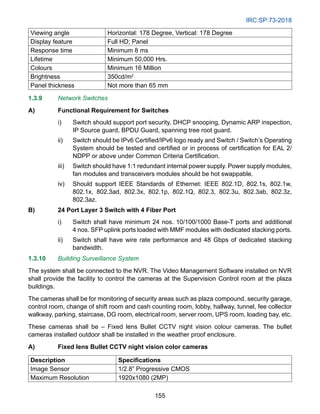
The steel barriers with strong post type usually remain functional after moderate
collisions, thereby eliminating the need for immediate repair. If damaged by a vehicle
collision, both posts and rails of W-beam are to be repaired. Lack in maintenance can
cause the W-beam rails to protrude into traffic way creating highly unsafe situation. The
wire rope though technically complicated, can be repaired with minimum costs. Though
initial installation cost is relatively high for concrete rigid barrier compared to W-beam
and wire rope safety barriers, the repair and maintenance issues can be minimized
greatly in concrete rigid barrier. The psychological shyness of drivers to keep away from
the safety barrier will be the least in rigid concrete barrier compared to other types. Since
rigid barriers will not yield under any vehicle impact, it shall be provided for bridges and
ROBs and also to shield roadside objects/hazards where the required set back distance
cannot be retained with wire rope and W-Beam (due to any site condition), as they are
deflective in nature.
Invariably W-beam and wire rope barrier shall not be installed upon a structure. For
a median upon a structure, it shall be concrete rigid barrier. Wire Rope Safety Barrier
shall not be used over major or minor bridges.
9.7.2 Road Side Steel Barriers
a) Design aspects: The “W” beam type safety barrier consists of steel
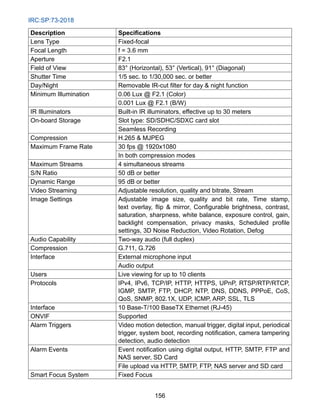
posts and a 3 mm thick “W” beam rail. There shall be a steel spacer block
between the post and the beam to prevent the vehicle from snagging on
the post, as the snagging can cause the vehicle to spin round. The steel
posts and the blocking out spacer shall both be channel section of 75
mm x 150 mm size and 5 mm thick. The posts shall be spaced 2 m center
to center. Fig. 9.10 gives the typical details of ‘W’ beam rail and splices
and shall be procured and installed from a reputed manufacturer.
		 The Thrie beam safety barrier shall have posts and spacers similar to the
ones mentioned above for “W” beam type. The rail and splices design
IRC:SP:73-2018
89
details for typical Thrie beam are shown in Fig. 9.11 and shall be from
a reputed manufacturer. This barrier has higher initial cost than the “W”
beam type but is less prone to damages to vehicle collisions especially
for shallow angle impacts.
The “W” beam, the Thrie beam and the posts spacers and fasteners for steel
barriers shall be galvanized by hot dip process and design elements and
installations shall be as per the details shown for crash barrier in this Manual
so as to achieve the performance characteristics intended for ‘W’ beam. For
any structural elements and details missing in this Manual for ‘W’ beam and
its various end treatments, the details from international guidelines/manuals on
‘W’-beam which would conform to EN 1317 Part-2 can be adopted.
b) End treatment for steel barrier: If hit, an untreated end of the roadside
barrier can be hazardous, because the barrier beam can penetrate the
passenger compartment and cause the impact vehicle to stop abruptly.
End treatments should, therefore, form an integral part of safety barriers
and the end treatment should not spear vault or roll a vehicle for head
on or angled impacts. The end treatment on approach shall be Modified
Eccentric Loader Terminal (MELT) arrangement as shown in Fig. 9.12
and departure sides it shall be Trailing Terminal (TT) arrangement as
shown in Fig. 9.13. The international practices shall be adopted for
those details which are not available in this Manual for MELT and TT
arrangements for the end treatment of ‘W’ beam.
		 The ‘W’ Beam to concrete transition shall be carried out by decreasing
the post spacing, nesting one rail behind another and using steel section
behind the ‘W’ Beam. The transition between ‘W’ beam and concrete
barrier is detailed in Fig. 9.14 or tested transition should be allowed.
c) Placement: Placement recommendations determine the exact layout of
the barrier and shall be made by the design engineer keeping in view
the lateral offset of the barrier and flare rate. The final layout shall be
as site-specific combination of these factors. The barriers shall be as
far away from the traffic as possible and shall preferably have uniform
clearance between the traffic and the hazard. As far as possible, the
safety barrier shall be placed beyond 2.5 m of the travelled way. For long
and continuous stretches, this offset is not critical. The distance between
the barrier and the hazard shall not be less than the deflection of the
barrier by an impact of a full sized vehicle. In case of embankments, a
minimum distance of 600 mm shall be maintained between the barrier
and the start of embankment slope of a hazard to prevent the wheels
from dropping over the edge.
		 The ‘W’ beam and thrie beam perform well on the outside of curves and
even those of relatively small radius. When a kerb exists on the edge
of road and on to close proximity traffic way whether on shoulder or
median edge lines, a distance not more than 100 mm shall be maintained
between vertical face of kerb and ‘W’ beam or thrie beam face to ensure
IRC:SP:73-2018
90
that impacting vehicle do not vault over safety barrier and at the same
time reduces the nuisance hit. The steel barrier shall be placed in such a
way so as to be collided by vehicle directly.
9.7.3 Road Side Concrete Barriers
a) Design aspects: Roadside concrete safety barriers are rigid barriers
having a sloped front face and a vertical back face. For uniformity New
Jersey type concrete barriers should be used where necessary. Rigid
crash barriers may however be required only in constrained urban location
between main carriageway and service road. The concrete barrier may
be pre-cast in lengths of up to 6 m depending upon the feasibility of
transport and lifting arrangements. Concrete grade for the barriers shall
not be leaner than M 30. The minimum thickness of foundations shall
be 25 mm thick cement concrete or hot mix asphalt placed at the base
of barrier to provide lateral restraint. Where more than 75 mm thick over
lay on the road pavement is anticipated, the foundation step may be
increased to 125 mm. However, longitudinal roadside concrete barrier
should have elaborate footing design which is structurally safe unless
sufficient earth support is available. Suggested flare rates depending
upon the design speed are given in Table 9.2.
Design Speed in km Per Hour Flare Rates
100 17:1
80 14:1
60 11:1
40 8:1
b) End treatment: Safety barrier shall be provided with an end treatment,
which shall be obtained by tapering the height of terminating end of the
median barrier within a length of 8 m to 9 m.
c) Placement: Placement recommendations for roadside steel barriers, mentioned
in Para 9.7.2 (c) are applicable to roadside concrete barriers as well.
9.7.4 Wire Rope Safety Barrier
a) Design aspects: The wire rope barriers/systems are suitable for either
shoulder and/or median side application, provided there is adequate
clearance to account for their deflection, as per manufactures system
design specification and standards. The slope of surface between traffic
way and wire rope safety barrier shall always be flatter than 10:1 and there
shall not any object or raised kerb in between so to enable the cables
to readily disengage from posts during impact and thereby minimizing
snagging and ensuring that the vehicle is smoothly redirected.
		 Wire rope barrier can be repaired quickly and only damaged posts are
to be replaced. High tension 3 rope or 4 rope wire system confirming
IRC:SP:73-2018
91
the requirements of EN 1317-2 for higher containment Level of H2 shall
be used. Typical details of wire rope barrier are given in Fig. 9.15 and
wire rope barrier with ropes interwoven are also presented in Fig. 9.16.
The wire rope barrier shall be the proprietary product of an approved
manufacture. The material and design of wire rope shall be as per the
MORTH Specification.
b) End treatment: The end treatment shall be as per the manufactures
details conforming to EN 1317 Part 2. The wire rope to ‘W’ beam transition
shall be done Modified Eccentric Loader Terminal (MELT) arrangement
as shown in Fig. 9.17 or as per Manufacturer’s approved design. The
termination of wire rope to a rigid or concrete barrier or a parapet shall be
avoided and there shall be a transition from wire rope to W-beam in-turn
to concrete barrier as shown in Fig. 9.18.
c) Placement: The placement of the Wire Rope Safety Barrier shall be
determined by the design engineer and shall be a combination of the
deflection ratios of the barrier and the site-specific conditions. The
barrier shall be placed as far away from the traffic as possible and shall
preferably have uniform clearance. The lateral slope of surface between
traffic way and wire rope safety shall always be flatter than 10:1 so that
vehicle bumper trajectory will not change before an errant vehicle hit the
wire rope.
When Wire Rope Safety Barrier is provided in front of a hazard, it shall be so located caters
to the deflection specified by the manufacture. The barrier shall be extended at full height
not less than 30 m in advance of the hazard on the approach side, and shall continue at
full height for 7.5 m beyond the hazard on the departure side. The minimum length of fence
shall be no less than 50 m. If there is a hazard present in the deflection area of the barrier,
then the distance between fence and the hazard shall not be less than that deflection values
described by the manufacture and will depend upon the post spacing.
There shall be at least 1 m setback distance between wire rope safety barrier and the start
of drop or embankment slope. While installing wire rope on a highway carrying two/three-
wheelers and other small vehicles, the deflection as specified by the manufacturer shall
be maintained as set back distance from the start of drop or embankment. The deflection
can be reduced by closer post spacing, however the minimum setback distance shall be
ensured. Wire rope can be installed for curves radii more than 450 m only.
The Wire Rope Safety Barrier shall not be permitted in following situations:
● Where a hazard is present within the deflection area of the fence.
● Where total fence length is less than 50 m
● On a horizontal curves of radius 450 m or less but not less than 200 m.
● On vertical sag curves of radius less than 3 km.
● Where rate of change in setback is steeper than 1 in 10.
IRC:SP:73-2018
92
9.7.5 Barriers on Median/Raised Footpath
9.7.5.1 At locations where project is passing through 4-lane or 6 lane configurations
having a narrow median and at locations where barriers have to be install on footpath
or raised platform, the provisions and warrants given in IRC:84 shall govern.
9.7.5.2 The lateral placement of ‘W’ beam or wire rope barrier on raised platform
of footpath having raised kerb and on embankment sides are pictorially presented in
Fig. 9.19.
9.7.6 General
Raised kerbs or drains shall not be provided between the traveled way and the barriers.
These destabilize the vehicle balance and disturb its equilibrium before it strikes the
barrier, thus defeating the essential purpose of safety and redirection of the impacting
vehicle. Steel barriers shall be provided in non-built-up sections whereas concrete
barriers shall be provided in built-up sections. In addition to the warrants given in
paras 9.7.1 (i) and 9.7.5 (ii), the safety barriers shall also be provided at the following
locations:
a) Where embankment is retained by a retaining structure (concrete).
b) On valley side of highway in mountainous and steep terrain (concrete).
c) Between main carriageway and footpath in bridges (concrete).
d) At hazardous locations identified in Schedule ‘C’ or through safety audit
(concrete/steel as specified in Schedule ‘B’ or Safety Audit Report).
The requirements of Safety Barriers for structures are given in para 7.17 of this Manual.
9.8 Pedestrian Facilities
9.8.1 General
Pedestrians are vulnerable to being involved in accidents. Therefore, adequate
consideration shall be given to their safety through provision of facilities. The facilities
for pedestrians given in this Section shall be provided on the Project Highway.
9.8.2 Footpath (Sidewalk)
i) The foot paths shall be provided in the built-up sections on both sides.
Pedestrian facilities for their safe and convenient movement along the
highway and for crossing the highway shall be integral part of facility and
therefore carefully planned and provided.
ii) The width of side walks depends upon the expected pedestrian flow, but
shall not be less than1.5 m land to be acquired, if need be.
9.8.3 Pedestrian Guardrails
i) Pedestrian guardrails are an important design element to prevent
indiscriminate crossing and spilling over of pedestrians on to the
carriageway. Their judicious use can help to ensure that pedestrians cross
IRC:SP:73-2018
93
the highway at predetermined and safe locations. As the guardrails would
confine the movement of pedestrians to the footpath, it is obligatory that
sufficient width of footpath be made available for the use of pedestrians.
ii) Design: The design shall be such that the guardrails are neat and simple
in appearance. The height of guardrail shall be 1.2 m from foot path
level. The visibility of the approaching vehicles by the pedestrians as
well as the visibility of the pedestrians by the drivers of the approaching
vehicles shall be adequate. The railings shall not have any thick horizontal
member, other than the baluster to achieve the desired objective. It shall
be provided as per IRC:103.
iii) Application: Pedestrian guardrails shall be provided at the following
locations/ situations:
a) Hazardous locations on straight stretches: In particularly busy
reaches, where the road is congested and vehicles move at a fast
pace, guardrails shall be provided on both sides of the carriage
way so as to channelize the pedestrians on to the planned crossing
locations.
b) At Junctions/Intersections: Railing barriers shall be provided to
prevent people from crossing the junctions diagonally at signalized
inter sections. The barrier shall open only at planned crossing facility
(at the Zebra Crossing). At unsignalized junctions they shall be
provided for sufficient length to guide the pedestrians to the nearest
planned pedestrian crossing.
c) Schools: Provision of guardrails near schools, where children
would otherwise run straight in to the road, is essential. If there is a
pedestrian crossing or a school crossing patrol nearby, the guardrails
shall be extended up to it.
d) Bus Stops, Railway Stations, etc.: Guardrails shall be provided
along side walks with suitable access at bus stops, railway stations
and other areas of heavy pedestrian activity such as cinema houses,
stadia, etc. for guiding pedestrians safely in such areas.
e) Overpass, Subway, etc.: Guardrails shall be provided at these
locations in order to compel the pedestrians to use the facilities
provided for them.
f) Central Reserves: Where there is a central reserve or a median,
guardrails shall be erected within it to deter the pedestrians from
attempting a crossing.
iv) Gaps/Set back Distance: The guardrails shall be setback from edge of
the carriageway by at least 150 mm
9.8.4 Pedestrian Crossing
i) Where complete segregation of pedestrians from vehicular traffic is not
provided, some form of planned road sharing principle shall be applied.
IRC:SP:73-2018
94
Fig. 9.10 Typical Details of W Beam Structural Elements
IRC:SP:73-2018
95
Fig. 9.11 Typical Details of Thrie Beam Structural Elements
IRC:SP:73-2018
96
Fig.
9.12  Modified
Eccentric
Loader
Terminal
(MELT)
Arrangement
W
Beam
Treatment
on
Approach
Side
IRC:SP:73-2018
97
Fig. 9.13 Trailing Terminal (TT) Arrangement - W Beam Treatment on Departure Side
IRC:SP:73-2018
98
Fig.
9.14
W
Beam
to
Concrete
Connection
Details
IRC:SP:73-2018
99
Fig.
9.15
Typical
Details
of
Wire
Rope
Safety
Barrier
IRC:SP:73-2018
100
Fig.
9.16
Typical
Details
of
Interwoven
Wire
Rope
Safety
Barrier
Fig.
9.17
Typical
Details
on
Wire
Rope
to
W
Beam
Barrier
IRC:SP:73-2018
101
Fig.
9.18
Typical
Details
on
Wire
Rope
to
Rigid
Barrier
Fig.
9.19
Lateral
Clearance
IRC:SP:73-2018
102
Pedestrian crossings shall be provided where they will be well used.
Pedestrian crossings shall be suitably integrated with the overall design
of the inter section.
ii) The following criteria shall be followed regarding selection of pedestrian
crossing:
a) At-grade Pedestrian Crossing (pedestrian cross walk):
Pedestrian cross walks shall be provided at all important inter
sections and such other locations where substantial conflict
exists between vehicular and pedestrian movements. Wherever
possible,thecrosswalksshallbeatrightanglestothecarriageway
and properly marked so that the pedestrians are subjected to
minimum inconvenience. Cross walks shall not substantially
increase the walk distance of pedestrians. Adequate visibility,
freedom from obstructions and sufficient space for waiting are
the other important requirements for location of cross walks.
		 At-grade pedestrian crossings can be uncontrolled or controlled.
Uncontrolled pedestrian crossings shall be provided only where the
inter section itself is left uncontrolled because of low volumes of both
vehicular and pedestrian traffic even during peak hours and where
accident records do not indicate any need to segregate vehicular
traffic from cross pedestrian traffic. Uncontrolled pedestrian cross
walk shall be marked by studs or paint line.
		 Controlled form of crossing shall be achieved through provision
of Zebra Crossings, whether at a non-signalized or signalized
intersection. Fig. 9.20 gives a typically out of pedestrian cross walk
in an intersection.
b) Zebra Crossing: A zebra crossing shall not be sited within 150 m
of another such crossing. The zebra crossing shall be somewhat
set back from the carriageway line. However, the set back distance
shall not be so much as to cause an appreciable increase in
walking distance for the pedestrians. Pedestrian guard rails may be
necessary where the set back distance is appreciable or at the skew
crossings.
		 The width of the zebra crossing shall be adequate and shall generally
lie within a range of 2.0 m to 4.0 m. The crossing shall, as far as
possible, proceed uninterrupted through the median strip. In the
event of the median strip being used as pedestrian refuge, adequate
width of median shall be provided. Incase of raised medians, such
portion could be suitably depressed with kerb height not exceeding
150 mm.
In the vicinity of zebra crossing, guard rails of sufficient length shall
be provided to deter pedestrians from crossing the road at any
arbitrary point along the road. Fig 9.21 gives a typical layout zebra
crossing in a mid-block section.
IRC:SP:73-2018
103
		 Dropped kerbs (ramps) shall be provided at all the at grade pedestrian
crossings as per Clause 6.2.3 and 6.7 of IRC:103-2012.
9.9 Work Zone Traffic Management Plans (WTMPs)
The traffic diversion plan during construction shall be prepared as per IRC:SP:55 for the
entire project highway. Separate traffic diversion plan shall be prepared for structures
and CD works. Following suggested layouts presented in IRC:SP:55 are recommended
for various construction scenarios. Suiting the specific site requirements, the application
steps described therein shall be followed.
9.9.1 Lateral Widening
The layout Fig 9.22 shown is applicable when a two lane highway is upgraded to 2-lane
with paved shoulder with eccentric widening. In the first stage, the traffic will continue to
ply through the existing road.
9.9.2 Single/Intermediate Lane Road to 2-lane
9.9.2.1 The layout Fig 9.23 for Stage-1 shown is applicable when a single lane or
intermediate or two lane carriageway is upgraded to standard two lanes with paved
or earthen shoulder. In this stage, the work will be taken up adjacent to existing traffic
movement with traffic control measures. Layout of signs and barriers would be as
shown. In Fig 9.23, there is layout for preparing surface to facilitate temporary traffic
movement is also shown: The layout shown is applicable (if at all required) to prepare
additional width to achieve 5.5 m width to facilitate two directional traffic movement with
the pavement composition and thickness which can withstand the temporarily diverted
traffic for a length from transition zone to termination zone.
9.9.2.2 In the subsequent stage, the traffic will be diverted to the portion of carriageway
and shoulder developed during the first stage. Layout of signs and barriers would be as
shown in Fig 9.24 for Stage-2.
9.9.3 Temporary Diversion for CD Structures
The layout, Fig 9.25 shown is applicable when a Cross Drainage structure has
to be constructed and where a temporary diversion will need to be constructed for
maintaining the traffic flow. The diversion in most cases would be on embankment;
therefore, delineation is essential for both day and night time. Temporary diversion shall
be developed and maintained to accommodate all types of vehicles likely to ply through
the road.
9.9.4 Work at the center of Carriageway
The layout, Fig 9.26 shown is applicable for short term maintenance activities at the
center of a carriageway. Generally, traffic cones are used so that it can be placed and
removed easily.
IRC:SP:73-2018
104
9.9.5 Flyover/VUP Construction
9.9.5.1 The layout, Fig 9.27 shows the Stage-1 in flyover/VUP construction. In the
first stage, the traffic will be diverted to a service road or temporary road. The turning
movements would continue at the existing intersection and construction of piers/
embankment/RE wall would be taken up in the cordoned portion. Carefully planned
pedestrian markings on the roads and protected safe passage for crossing of pedestrians
shall be provided through work area.
9.9.5.2 The layout of Fig 9.28 shows Stage-2 of flyover/VUP construction. In the
second stage, the central portion will be taken up and junction will be blocked for direct
cross road movement. During this short period of time, cross road movement will be
accommodated like a circulatory movement using U-turn, whereas the through traffic
will continue to ply through service road/temporary road. Direction signs would be
carefully planned and installed. Carefully planned pedestrian markings on the roads
and protected safe passage for crossing of pedestrians shall be provided through work
area.
IRC:SP:73-2018
105
Fig.
9.20
Zebra
Crossing
at
an
Intersection
(Typical)
Fig.
9.21
Zebra
Crossing
in
a
Mid-Block
Section
IRC:SP:73-2018
106
Fig.
9.22
Lateral
Widening
IRC:SP:73-2018
107
Fig.
9.23
Stage-1
Single/Intermediate
Lane
Road
into
2-Lane
with
Shoulders
IRC:SP:73-2018
108
Fig.
9.24
Stage-2
of
Single/Intermediate
Lane
Road
into
2-Lane
with
Shoulders
IRC:SP:73-2018
109
Fig.
9.25
Temporary
Diversion
for
Reconstruction
of
CD
Structures
IRC:SP:73-2018
110
Fig
9.26
Work
at
Center
of
Carriageway
IRC:SP:73-2018
111
Fig.
9.27
Stage
-1
of
Flyover/VUP
Construction
Speed
(Kmph)
Distance
in
Meter
a
b
c
z
Up
to
50
60
60
60
45
51
to
65
90
90
90
60
66
to
80
110
120
120
75
81
to
100
160
160
180
105
IRC:SP:73-2018
112
Fig
9.28
Stage
-2
of
Flyover/VUP
Construction
Speed
(Kmph)
Distance
in
Meter
a
b
c
z
Up
to
50
60
60
60
45
51
to
65
90
90
90
60
66
to
80
110
120
120
75
81
to
100
160
160
180
105
IRC:SP:73-2018
113
SECTION - 10
TOLL PLAZAS
10.1 General
TheConcessionaireshallprovidetheTollPlazasatthelocationsspecifiedinSchedule‘C’
for collection of user fee as per the Concession Agreement. The fee collection system
shall be speedy, efficient and user friendly. The design of the Toll Plazas should be such
that they are esthetically pleasing and efficient and the fee collection staff should be
quick, courteous and adequately trained before deployment.
10.2 Location of Toll Plaza
The location of Toll Plaza shall be indicated in Schedule ‘C’ of the Concession
Agreement.Their locations shall be decided keeping in view the following factors:
i) Land availability,
ii) Stream of traffic on Toll Plaza,
iii) Visibility for the approaching traffic,
iv) Reasonably away from road inter sections and/or rail crossings,
v) Free from risk of flooding and sub mergence, etc.
vi) Preferably on flat land and away from congested urban locations.
vii) Minimum diversion of traffic is possible.
10.3 Land for Toll Plaza
Adequate land for Toll Plaza shall be acquired to permit the provision of toll lanes for
a projected peak hour traffic of 20 years subject to a minimum number of 8 toll lanes
including all other buildings and structures to be accommodated at the Toll Plaza
location. Land shall be acquired as per provisions of the Concession Agreement.
10.4 Layout and Design of Toll Plaza
10.4.1 Typical layout of a toll plaza is given in Fig. 10.1. The layout shall provide for
future expansion of toll lanes. Stage construction of Toll Plaza in respect of number of
toll lanes shall be allowed. However, other structures as envisaged in the Concession
Agreement shall be provided at the initial stage itself.
10.4.2 Width of Toll Lane
The width of each toll lane shall be 3.2 m, except for the lane for over dimensioned
vehicles, where it shall be 4.5 m.
10.4.3 Traffic Islands at the Toll Plaza
Between each toll lane of the toll plaza, traffic islands are required to accommodate
toll booth. These islands shall be of minimum 25 m length and 1.9 m width. Protective
IRC:SP:73-2018
114
barriers of reinforced concrete and traffic impact attenuators shall be placed at the front
of each island to prevent out of control approaching vehicles crashing into the toll booth.
They would be painted with reflective chevron markings. For toll lane to be installed with
weigh in motion system, the minimum length of islands shall be 35 m where 22.5 m on
approach side.
10.4.4 Toll Booths
Toll booths may be provided of prefabricated materials or of masonry. The toll booths
shall have adequate space for seating of toll collector, computer, printer, cash box, etc.
It should have provision for light, fan and air conditioning. The typical details of traffic
island with toll booth are given in Fig. 10.2. Toll booth shall be placed at The centre
of each traffic island. The toll booth shall have large glass window to provide the toll
collector with good visibility of approaching vehicles. The bottom of the toll window should
be placed at such a height (0.9 m) above ground level so as to provide convenience
of operation. The toll booths shall be ergonomically designed and vandal proof. There
shall be CCTV camera installed at each booth.
10.4.5 Tunnels
For the movement between toll office and toll booth of each toll lane, an underground
tunnel across all toll lanes shall be provided. Its dimension would be sufficient to
accommodate the required wiring/cable system and for convenient movement of
personnel. It should also be provided with lighting and ventilation system so that the
movement is convenient. The tunnel shall be of minimum 3 m width and 2.5 m height or
alternately suitable safe overhead system of cash transfer may be planned, if required,
and same shall be specified in Schedule ‘B’.
10.4.6 Transition
A transition of 1 in 20 to 1 in 10 may be provided from two-lane section to the widened
width at Toll Plaza on either side.
10.4.7 Canopy
All the toll lanes and toll booths shall be covered with a canopy. The canopy shall
be wide enough to provide weather protection to toll operators, drivers and facilities.
The canopy shall be of aesthetically pleasing design with cylindrical support columns
located at traffic island so that there is no restriction on visibility and traffic movement.
The vertical clearance shall be as prescribed in this Manual.
10.4.8 Drainage
The toll plaza shall be provided with surface and sub-surface drainage system so that
all the storm water is drained off efficiently and no ponding or stagnation of water takes
place at any area of the toll plaza.
10.5 Electronic Toll Collection
10.5.1 Hybrid ETC system of tolling shall be adopted.
The Concessionaire shall carry out, as per defined technical specifications, installation, testing,
commissioning, operations and maintenance of Hybrid ETC System in all the lanes of Toll Plazas
IRC:SP:73-2018
115
including but not limited to:
i) Installation, integration, testing, commissioning, operations and maintenance of
ETC RFID transceiver in all the lanes of Toll Plazas.
ii) Installation, integration, testing, commissioning, operations and maintenance of
Medium Speed Weigh in Motion in all the lanes of Toll Plazas and one Static
Weigh Bridge in each direction of traffic at the Toll Plazas.
iii) Integration, testing, operations and maintenance of ETC RFID transceiver,
Medium Speed Weigh in Motion, Static Weigh Bridge and other associated
peripheral hardware into a single Hybrid Toll Management System/Software.
10.5.2 The Concessionaire shall ensure requisite civil work at Toll Plazas is completed prior to
installation, integration, testing and commissioning of Hybrid ETC System. The Concessionaire
shall ensure smooth flow of traffic during installation, integration, testing, commissioning of
Hybrid ETC System and acknowledges that it will have no claims for against the Authority on
account of any lane closure, if any and on account of any third party claims.
10.5.3 Scope of Work
A) The Concessionaire shall install, integrate, test, commission, operate and
maintain Hybrid ETC System in all the lanes of the Toll Plazas. The list of
equipment to be installed and commissioned for Hybrid ETC System and their
minimum technical specifications have been provided in the Annexure A. A
design layout of the Hybrid ETC system is provided in Annexure B. In case of
EPC projects, this will be provided by the Authority.
B) The Hybrid ETC infrastructure shall be installed, commissioned, operated and
maintained for a period of 5 years beyond which it shall be replaced or renewed
as the case may be by the Concessionaire at cost of the Authority. The same
cycle shall be maintained till the end of Concession Period as per the Concession
Agreement.
C) The Concessionaire shall set up a system within the Hybrid ETC System to
provide real time data for user fee collection to the Authority as per mutually
agreed templates. However, in case of any dispute, the template provided by
the Authority shall prevail without recourse to the Dispute Resolution Procedure.
D) The Concessionaire shall set up a system within the Hybrid ETC System to
provide uptime availability data of all Hybrid ETC lanes in the Toll Plazas to
the Authority. The Concessionaire shall design, procure/manufacture, install,
test, commission operate and maintain a monitoring system that meets the
concept and functions stated herein and detailed in Annexure B. However, in
case the Concessionaire shows inability to set up a monitoring system, then
Authority shall facilitate the set-up of such monitoring system that meets the
concept and functions stated herein and detailed in Annexure B. The Authority,
if it chooses, can setup a real time monitoring system or software on its own
or through its representative. The Concessionaire will have to abide with data
sharing of Hybrid ETC System uptime through this system as well. The Slow
Speed Weigh in Motions (SSWIMs), if already installed and functional on a lane
IRC:SP:73-2018
116
of the Toll Plazas shall not be removed. The installation of Medium Speed Weigh
in Motions (MSWIMs) shall be carried out only on those lanes where there is no
existing Weigh in Motion (WIM) equipment / hardware.
10.5.4 Service Level
i) The uptime availability of all critical components of Hybrid ETC lanes shall be
99% per lane per month for 90% of total lanes in a toll plaza (rounded off to
nearest integer). For the balance 10% lanes, uptime availability of all critical
components shall be 98% per lane per month.
ii) The downtime for a toll lane shall be calculated at a cumulative level when any
of the below mentioned critical component is non-operational for that specific
lane:
		 a) ETC RFID transceiver
		 b) Automatic Lane Barrier
		 c) Lane Incident Camera
d) Automatic Vehicle Classifier
		 e) Hybrid Lane Controller
		 f) Any other plaza level or lane level equipment leading to disruption in ETC
transactions
iii) For all other components of Hybrid ETC System, the uptime availability shall be
98% per lane per month.
iv) Scheduled downtime is defined as a period of time when system will remain
unavailable for conducting necessary preventive maintenance, urgent repairs
etc. The maximum scheduled downtime for any Site shall be 4 hours per lane
per month.
v) The formula for calculation of Hybrid ETC System availability shall be as follows:
System Uptime = [1-{A/(B-C)}*100]
Where A = Time for which system is down per month basis scenarios identified
in clause 4B
		 B = Total time in a month
		 C = Scheduled downtime basis Clause 4D
vi) The Concessionaire shall maintain adequate inventory to ensure the service
levels prescribed in Clause 4A are adhered. Spares of critical components
of Hybrid ETC System as identified in Clause 4B for at most 2 lanes shall be
included in the cost of change in Scope of Work Order. There shall be no other
provision or payment for additional Hybrid ETC equipment/hardware from the
Authority.
vii) The Concessionaire shall ensure that the Hybrid ETC Systems are operational
as per the service levels defined in Clause A to facilitate payment of user fee
through ETC. In case, a vehicle user with a valid, functional ETC RFID tag with
sufficient balance in the linked account is not able to pay user fee through ETC
IRC:SP:73-2018
117
through any lane owing to malfunctioning of Hybrid ETC equipment/hardware,
the vehicle user shall be permitted to pass without payment of any user fee.
viii) In case of non-adherence to service levels as defined in Clause 4A, suitable
damages shall be levied on each lane by the Authority over and above the free
passage of user as described in Clause 4G.
ix) The Concessionaire shall ensure that all transaction files are uploaded as per
defined service levels provided by the Authority or CCH. The service levels are
prescribed in the table below:
S. No. Description Service Level Damages
1. Sending clean
transaction files in a
specified format to
CCH
• 
Within 10
minutes of [ETC
transaction]
• 
Up to 3 days of
[ETC transaction.]
• 
Transaction post 10 minutes shall
be processed only if the tag account
has sufficient balance. In case of
negative balance, the transaction
shall be rejected.
• 
Liability of such transactions (after
10 minutes and before 3 days) shall
lie with the Concessionaire.
Transaction shall be rejected by CCH
after 3 days.
2. Sending violation
transactions post audit
at plaza level along
with clear supporting
images to CCH.
The images should be
clear enough to identify
the vehicle class.
• 
Within 10 minutes
of ETC transaction
• 
Up to 3 days of
ETC transaction
Transaction post 10 minutes shall be
processed only if the tag account has
sufficient balance. In case of negative
balance, the transaction shall be
rejected.
Liability of such transactions (after 10
minutes and before 3 days) shall lie
with the Concessionaire.
Transaction shall be rejected by CCH
after 3 days.
3. Populating blacklist
file in the Hybrid ETC
system of all the lanes.
• 
Within 10 minutes
of receipt from
CCH
Post 10 minutes, any clean/violation
transaction file received by CCH for
the same tag account with inadequate
balance shall be rejected.
10.5.5 A) The Concessionaire shall be provided a list of Acquiring parties by the Authority
or a representative of the Authority amongst which the Concessionaire shall
select one for the processing of ETC transactions. The list of Acquiring parties
may be updated or modified from time to time by the Authority or a representative
of Authority and the Concessionaire shall abide by all the terms and conditions
of such directives.
B) The Concessionaire shall effect and maintain at its own cost, adequate
insurance cover for any case of accidental damage to Hybrid ETC Systems. The
Concessionaire shall indemnify the Authority against any claims whatsoever on
this account.
IRC:SP:73-2018
118
10.6 Prevention of Overloading
10.6.1 Toll plaza location shall also be provided with system for checking and preventing
overloading of vehicles at toll plaza. For this purpose, weigh in motion systems at approaches
to each toll lane are to be installed. Separate space for static weigh bridge and area to hold off-
loaded goods from overloaded vehicles shall be provided after the toll barriers for each direction
of travel.
10.6.2 The total number of toll booths and lanes shall be such as to ensure the servicetime
of not more than 10 second per vehicle at peak flow regardless of methodology adopted for
fee collection. For purpose of guidance following parameters are suggested as a capacity of
individual toll lane for design purpose:
Electronic Toll Collection (ETC lanes)
(Toll collection through RFID tags and no
stoppage of vehicles
1200 veh/hour
Not less than 2 middle toll lanes shall be capable of being used as reversible lane to meet the
demand of tidal flow.
Toll plazas shall be designed for projected peak hour traffic of 20 years. As mentioned in Para
10.4.1, the stage construction of toll plaza in respect of number of toll lanes shall be allowed. If
at any time, the queue of vehicles becomes so large that the waiting time of the user exceeds
three minutes, the number of toll lanes shall be increased so that the maximum waiting time is
brought down to less than three minutes.
10.7 Toll Collection System
For smooth and efficient functioning of toll collection, the following arrangements/facilities shall
be provided:
i) The staff posted at the counters in the semi-automatic system of toll collection
shall be provided with sufficient electronic equipment for the collection of toll and
recording data, and small denomination, notes/coins at the start of each shift.
ii) Intercom facility shall be provided between booths and the office of the
supervisors.
iii) If the booth is closed for any reason, incoming traffic shall be guided into the
adjoining working booth with the help of appropriate signs.
iv) The entire fee collection complex shall be adequately guarded.
10.8 Pavement
Concrete pavement shall be provided in the toll plaza area including tapering zone, from durability
and longtime serviceability consideration and to permit the provision of toll lanes initially for a
projected peak hour traffic of 10 years. The concrete pavement may be widened to provide for
future toll lanes required as per stage construction. The rigid pavement shall be designed as per
IRC:58. For this work, use of paver shall not be insisted.
IRC:SP:73-2018
119
10.9 Traffic Signs
A well thought out strategy should be evolved for providing traffic signs and road markings in and
around the toll plaza in accordance with IRC:67 and IRC:35. The concessionaire would design
the configuration/placement of signs for toll plaza which are not given in IRC:67 and furnish to IE
for review so as to ensure uniformity of signs in use on all the highways across the country. Signs
should be placed along the project highway, roadway of toll plaza to guide and render assistance
to the drivers approaching the toll plaza. It is necessary to alert the driver about the existence
of toll plaza one km ahead with a repeater sign 500 m ahead. Stop sign shall always be used
in combination with certain road markings such as stop line and the word ‘STOP’ marked on
the pavement. The toll plaza sign should be supplemented by the sign advising the users of
the notified toll rates (fees) for various types of vehicles and exempted categories of vehicles.
Fig. 10.3 to 10.5 give details of various Information signs in toll plaza. Overhead Lane Signs
(OHLS) shall be mounted on the leading edge of the canopy covering the toll lanes above the
center of the lane to indicate to the user. Lane applicable to specific category of vehicle, lane with
ETC System, reversible lane, etc. It shall also indicate whether the toll lane is open or closed
for the processing of vehicles. A red cross signal would indicate that the lane is closed, whilst a
green arrow would indicate that the lane is open to traffic.
10.10 Road Markings
The road markings shall be used in accordance with Section 9 of this Manual. The road markings
for the toll plaza area shall consist of lane markings, diagonals, chevron markings. Single center
line is provided at the center of carriageway at toll gate to demarcate each service lane. Diagonal
markings for central traffic island and chevron markings at side traffic island shall be provided
to guide the approaching and separating traffic.In order to check over speeding of the vehicle
approaching toll booth, transverse bar markings can be provided. The typical lay out of plaza
building, associate facilities and uploading platforms along with transverse and longitudinal
markings are shown in Fig. 10.6.
10.11 Lighting
The toll plaza shall have lighting system to provide visibility to drivers for the use of facility
especially to access the correct service lane and also to the toll collector. Indian Standard Code
of Practice for Lighting of Public thorough Fare IS:1944 shall be followed . This would be done
by interior and exterior lighting as indicated below. Power supply shall be from public power
supply system, but standby generating set of the capacity to supply the required power shall be
provided at toll plaza.
Interior Lighting:
The toll booths and facility building office shall be illuminated adequately.Indoor lighting shall be
with fluorescent lamps. Lighting should be provided in such a manner that glare is avoided or
minimized. The level of illumination shall be average 200 to 300 lux as per IS:3646- Part II.
Exterior Lighting:
Lighting of the toll plaza is important for enhancing the night visibility. The lighting system shall
consist of the following major components:
IRC:SP:73-2018
120
i) High mast lighting
ii) Lighting on both side approaches to the toll plaza
iii) Canopy lighting of complex
High mast lighting: Normal low light poles are not able to give the required lighting
conditions. It is, therefore, necessary to install high mast. A height of 30 m for the mast is
considered suitable to have uniform spread of desired level of illumination in the toll plaza area
for safe movement of vehicles. A minimum requirement of illumination on the road surface of
average 40 lux shall be ensured.
Highway lighting:
A minimum requirement of illumination on the road surface of average 40 lux shall be ensured.
Lighting in minimum 500 m length on both side approaches of toll plaza (toll booth) shall be
provided to enhance the safety at night on the Project Highway and to make the drivers conscious
of their approaching the toll gate. These shall be provided on the mild steel welded tubular pole
of 10 m height from road surface and with 2 m overhang. Sodium Vapour/LED lamp of 200-250
watts should be provided for these poles on both sides at 50 m staggered spacing. There should
be provision for flashing signals for foggy weather conditions.
Canopy lighting: A higher level of illumination up to average 100 lux by providing 150 watt
metal halide lamps shall be provided at the toll gate and at toll booth locations. 1000-watt halogen
lamps shall be provided at the selected nodes of space frame of the canopy to ensure uniform
illumination of the area.
10.12 Water Supply
Adequate water supply shall be provided. For working out water requirement and internal
drainage system, reference may be made to IS:1172, IS:5339 and IS:1742.
10.13 Fire Fighting System
Toll plaza shall have fire fighting equipment, including smoke detectors and auto visual alarm
system as per Section 4.17.1 of National Building Code, so that the personnel working in the
complex and the office and the road users are protected against fire hazards.
10.14 Toll Plaza Complex
Toll plaza shall have a separate office building so as to provide comfortable office space for
manager, cashier and other staff. There shall be separate rooms for TV monitors, meetings,
toilets, and for the sale of passes, smart cards, on board units and public interaction. The building
shall have a strong room for keeping the cash and a garage to accommodate the security van
(during operation of loading the collected revenue). There shall be parking space in the same
campus for vehicles for the staff and workers and other vehicles engaged in the operation of the
project highway.The size of the office complex depends on the minimum requirement of above
facilities.
Provision for future expansion: The office building shall be located taking into consideration
of future expansion.
IRC:SP:73-2018
121
10.15 Toll Audit
The toll plaza shall have toll audit system and fraud protection measures. The operations for toll
collection, supervision, auditing and cash handling shall be done through the qualified personnel
with adequate number so that each operation is efficiently handled.
10.16 Report to be Submitted
The design and layout of toll Plaza complex including all facilities shall be submitted to the
Independent Engineer for review and comments, if any.
IRC:SP:73-2018
122
Fig.
10.1
Typical
Layout
of
a
Toll
Plaza
Information
Signs
IRC:SP:73-2018
123
Fig.
10.1(a)
Design
Layout
of
Hybrid
ETC
IRC:SP:73-2018
124
Fig.
10.2
Typical
Details
of
Toll
Lanes
IRC:SP:73-2018
125
Fig. 10.3a Toll Rate
(High Speed, Font Size - 100 mm)
Fig. 10.3b Toll Rate
(Low Speed, Font Size 60 mm)
Fig. 10.4a Cash Lane-Car/LMV Fig. 10.4b Tag Lane-Car/LMV
Fig. 10.4c Cash Lane-Bus/Truck Fig. 10.4d Tag Lane-Bus/Truck
Fig. 10.5a Information Sign Fig. 10.5b Information Sign
IRC:SP:73-2018
126
Fig.
10.6
Typical
Layout
Building
and
Associated
Facilities
and
Pavement
Markings
IRC:SP:73-2018
127
Annexure–A
(Para 10.5.3)
Sr. No. Item/Description Unit Quantity
I - Lane Level Equipment - Hybrid ETC Lanes
1 ETC RFID transceiver near Pay-axis - mounted on canopy No 1 per lane
2 Electronics Enclosure No 1 per lane
3 Lane Controller with Industrial PC No 1 per lane
4 AVC including sensors, loop and detector Set 1 per lane
5 User Fare Display with mounting pole Set 1 per lane
6 Automatic Barrier Gate No 1 per lane
7 Overhead Lane Status light (OHLS) No 1 per lane
8 Traffic light with mounting pole Set 1 per lane
9 Loops with detector Set 2 per lane
10 Incident Capture Camera with mounting pole Set 1 per lane
11 License Plate Image Capture Camera with mounting poles Set 1 per lane
12 TFT Monitor No 1 per lane
13 Customized industrial grade keyboard No 1 per lane
14 Thermal Receipt Printer No 1 per lane
15 Barcode Reader with stand No 1 per lane
16 Violation light  Alarm (on existing pole) and Foot switch in
booth No
1 per lane
17 Booth CCTV camera with voice recording No 1 per lane
18 Cabling/Networking/Installation/Commissioning (Lump sum) LS 1 per lane
19 Software – Lane Level No 1 per lane
20 Intercom Slave unit in booth No 1 per lane
21 Medium Speed Weigh In Motion No 1 per lane
II - Plaza Level Equipment
1 Plaza Servers in hot-standby configuration No 1 per plaza
2 Static Weigh Bridge No 2 per plaza
3 Workstations for MIS, Cashup, Audit  LSDU (Lane status
display unit in control room) No 4 per plaza
4 Network Printer No 1 per plaza
5 8 Port Network switch (Layer 3) Job 2 per plaza
6 24 Port Network switch (Layer 3) Job 2 per plaza
IRC:SP:73-2018
128
Sr. No. Item/Description Unit Quantity
7 Internet router for connection to the CCH No 1 per plaza
8 Software – Plaza level No 1 per plaza
9 Broadband Internet connection with minimum 2 Mbps link Facility 1 per plaza
10 UPS system as required for complete Hybrid ETC Toll Plaza
system No 2 per plaza
11 55” LED Display for CCTV Monitoring No 1 per plaza
12 Network Video Recorder (NVR) for CCTV recording No 1 per plaza
13 CCTV cameras for Plaza building surveillance (server room,
control room, cash up room, admin) No 4 per plaza
14 Intercom Master Unit in Control Room - 10 Channel (For =8
lanes) No 1 per plaza
15 Intercom Master Unit in Control Room - 20 Channel (For 8
lanes) No per plaza
IRC:SP:73-2018
129
Annexure–B
(Para 10.5.3)
The minimum functional and technical specifications for hardware to be used in Hybrid ETC
system at the plaza are specified in this section. The Concessionaire shall ensure that the
equipment provided meets the basic functional criteria as prescribed in this section.
1.1 Queuing Area
1.1.1 Magnetic Loops
A) Functions
The magnetic loops shall be used for two purposes:
i) Presence Loop – This is a single loop installed in the transaction area. This
shall be triggered on the basis of vehicle detection leading to a certain set of
activities as required.
ii) Exit Loop – This is a single loop installed at the end of transaction used to
trigger the exit barrier once the transaction has been completed.
B) Specifications
The loop detector units/cards shall conform to the following minimum requirements.
i) The unit shall be easily removable and shall be fitted with at least two (2) loops
per card.
ii) The unit shall have a minimum of 4 separate adjustable sensitivity and frequency
levels.
iii) The unit shall have indicators for vehicle presence, loop on/off and failure.
1.1.2 Overhead Lane Status Sign (OHLS)
A) Function
The Over Head Lane Sign (OHLS) is located above the centre of the lane at the lane entrance.
The purpose of the OHLS is to indicate to the User whether the toll lane is open for the processing
of vehicle or closed. A red cross is used to signal that the lane is closed, whilst a green arrow is
used to indicate that the lane is open to traffic.
Signs must be sufficiently bright and directed to indicate to a motorist, approaching the toll plaza,
at a distance of 300 m on a bright cloud free day that the lane is available for use. The OHLS
status shall also be visible up to a peripheral view of 45 degrees from the travel axis.
At any situation, both RED and GREEN part shall not glow simultaneously. Under failure
conditions, only Red Cross shall be displayed until rectification.
IRC:SP:73-2018
130
B) Specifications
The following minimum specifications shall be met:
Description Specification
Size 300mm X 300 mm
Display (Cross) Red LED
Display (Arrow) Green LED
LED 5mm in diameter, 8000 mcd
Visibility Range 300 m
Enclosure IP 65
1.2 Transaction Area
1.2.1 ETC RFID Transceiver
Concessionaire is free to choose any brand of ETC RFID transceiver as long as it satisfies the
functional requirements prescribed by the Authority as below:
A) Functions
Each Hybrid ETC lane shall have one ETC RFID Transceiver. The ETC RFID Transceiver shall
be mounted at least 5.5 meters above the finished road level. The Concessionaire shall provide
cantilever pole (if required), brackets, fixtures and other accessories necessary for the installation
of the RFID Transceivers.
The operator shall design the installation method of ETC RFID Transceiver and decide the
height of the RFID Transceiver within the applicable laws and regulations. But in no case, the
clearance from the ground level shall be less than 5.5 meter.
B) Specifications
Description Specification
RF/Radio:
Frequency UHF 865 to 867 MHz
Communications Ethernet/Serial communication (EIA standard RS 232 C/ RS 485)
RF Power maximum 1 W – transmitted  4 W – EIRP (Equivalent Isotropically Radiated
Power)
Reading distance With the Transceiver mounted typically at a height of 6m above
the road surface, the coverage of the antenna shall not exceed a
diameter of 3.6m
Antenna Circularly/Linear Polarized
Protocol EPC Gen 2, ISO 18000-6C and shall comply with the general
conformance requirements of the standard.
IRC:SP:73-2018
131
Description Specification
Visual diagnostics The Transceiver shall have LED indicators for sense; transmit Fault
and Power which shall be visible clearly to the operator on ground
while the system is operational.
Environmental:
Enclosure Light weight enclosure for the RFID Transceiver and circularly/
linearly polarized antenna
Environmental IP 65 or better for outdoor units
Relative Humidity 95% Condensing
Operating Temperature -20°C to 55°C
Storage Temperature -40°C to 85°C
Operational Characteristics:
Air Interface  Adaptive
Noise Features
The Transceiver technology employed should have the capability
to optimize read rates for the vehicle identification application and
adapt to instantaneous noise and interference level.
Application capability 1) 
Should have read reliability exceeding 99.5% in the distance
range specified.
2) Diagnostic and Reporting Tools.
Upgradeability The firmware should be upgradable to support future protocols.
Transaction Capability Reading of Tag  EPC memory for at least 2 Tags per second for a
moving vehicle with a speed limit of 40 kilometres/ hour.
Driver Software The transceiver driver software shall be provided along with the
transceiver that will interface to the ETC client through socket
interface and handle the communication with ETC client. The packet
structure shall be as notified in the ETC client-transceiver interface.
The driver software shall implement filtering using a range of EPC-
codes /Tag-TID code provided by set of bit pattern masks.
1.2.2 Traffic Light with mounting pole
A) Functions
The Traffic Light (TL) shall be located in the toll lanes in a position where it is readily visible to
users of the toll road, usually on the side of the lane beyond the toll booth. The traffic light shall
consist of two traffic light heads mounted on a suitable pole. An amber signal with arrow is used
to indicate that the user should take suggested path, whilst the green signal is used to indicate
that the user should proceed.
At any situation, both AMBER and GREEN part shall not glow simultaneously. Under failure
conditions, only Amber arrow shall be displayed until rectification.
IRC:SP:73-2018
132
B) Specifications
The following minimum specifications shall be met:
Description Specification
Size 200 mm
Display (Stop) Amber LED
Display (Start) Green LED
Visibility Range 20 m (under normal visibility conditions)
Enclosure SS
Protection IP 65 rated
1.2.3 Electronic Enclosure
A) All electronic interface and related peripheral/controllers shall be enclosed in an
IP 65 compliant cabinet.
B) The enclosure shall have a locking mechanism with a unique key providing
access to the equipment inside.
C) Door monitoring: The cabinet door shall be monitored utilizing proximity switch.
Door open/close events shall be recorded as incidents identified by time and
lane. The incidents shall be displayed on the plaza software subsystem.
D) Cabling Layout: All external cables shall be protected against the effects of
lightning and shall comply with all requirements for the control of interference
from EMI. All data cables shall be screened and shall be properly separated and
shielded from all power cables.
E) Ventilation and Internal Temperature: All equipment endorsed by the cabinet
shall be kept at a temperature consistent with manufacturers recommendations.
F) Finishing: The cabinet surfaces shall be protected from the environment in
which it is to be used and adequate surface treatments shall be applied. Each
cabinet shall be painted and numbered in a manner consistent with the toll lanes
and consistent with all equipment related functions (e.g. reporting to the plaza
software subsystem).
G) Cable dressing: All cables (power  signal) shall be properly routed and dressed
with suitable railings inside the enclosure and ties.
H) Cable numbering: The signal  power cable terminations shall be identified
by proper numbering. In addition to the termination at the controller end, this
numbering shall also be maintained at locations where the cables are exposed
(like manholes, junctions) and at the peripheral end. Further, all the individual
component boards shall be properly identified by labeling.
I) Cable terminations: The signal  power cable (from the peripherals) terminations
shall be kept separated inside the cabinet.The cable routing inside the enclosures
shall be done in a proper manner, so that, the cable faults can be traced and
faulty cables can be replaced easily and quickly.
IRC:SP:73-2018
133
1.2.4 Hybrid Lane Controller (HLC)
A) Functions
The Hybrid Lane Controller is used to control and monitor all the sub systems and peripheral
equipment and communication of the lane for user fee collection process and vehicle passage.
The HLC is located in the booth or the tunnel. It is an electronic enclosure that houses the
lane computer, AVC computer, peripheral coordination circuitry, redundant power supply, lane
network switch and power protection blocks. It acquires the lane data and transmits to the Toll
Management System (TMS) in real time.
The HLC shall be connected to the plaza, via fibre optic cable, and shall be required to transmit
all transactions, incidents as well as other control information to the TMS in real time. All lanes
shall be connected to the TMS server for this test. The LSDU shall be able to monitor activities
of each lane in real time. The HLC shall be capable of interfacing with at least the following
peripheral equipment –
i) Fee Collector Display
ii) User Fare Display
iii) Overhead Lane Status Sign
iv) Automatic Exit Barrier
v) AVC System including loop
vi) ETC Equipment
vii) Incident Capture Camera
viii) License Plate Image Capture Camera
The HLC shall be able to track and store in an accurate and fully auditable manner all lane and
AVC transactions in a manner as to ensure the system and data integrity is not compromised in
any way. A comprehensive test methodology shall be provided for this activity.
The HLC shall be capable of communicating with the local ETC server. Communication shall
consist of data necessary to build a complete database in the local ETC server, from which
the required financial and operating reports and statistics can be generated. The local ETC
server shall also receive and log any reportable incidents occurring in the lane, which shall
be transmitted real-time to the Incidents Computer (IC) for action by the toll supervision staff.
In terms of incidents, real-time shall mean the time from the occurrence of the incident to the
storage of the incident and the subsequent display of the incident on the IC; shall not be greater
than 2 seconds.
Each Hybrid Lane Controller electrical component should be built on a single rack with its own
electrical protections and automatic fuses. Each lane cabinet/enclosure shall have individual
independent power sources, one from the UPS and another directly from the plaza power
source. All the cabinet power inputs in the plaza are connected to an electrical switch to shut
down the power of all plaza lanes for emergency purposes. Separate power supply (SMPS) shall
be provided for AVC system and lane computer. The AVC computer shall have additional power
back up (UPS) inside the electronic enclosure to provide power backup in case of complete
shutdown of the plaza power supply. The UPS shall provide the backup of at least 4 hours to the
independent AVC computer and AVC lane components.
IRC:SP:73-2018
134
B) System Configuration
The system located at the toll booth shall consist of at least the following:
i) Lane computer
ii) Independent AVC computer
iii) Separate power supplies for lane and AVC computer
iv) Power distribution panel with surge and lightening protection circuit
v) Terminal blocks
vi) Relays
vii) Thermostat
viii) IP 55 Electronic enclosure with high security locking mechanism
C) Lane Computer
Lane Computer shall be mounted inside the electronic enclosure. It shall acquire all the data
from the lane peripherals and transmit them to the TMS in real time. The specification of lane
computer shall be upgraded as per the latest specifications/technologies available. A basic
specification is provided in the table below.
Description Specification
Type Industrial Grade Cabinet Computer
Motherboard Industrial Grade
HDD Based on estimated storage requirement for 6 months data
RAM 2 GB or latest as per requirement
Processor Intel i3 or equivalent/higher
Processor Speed 2 Ghz or latest as per market
NIC 1 Gbps X 2 Numbers On-board
PCI Slot 2 Nos. spare
USB Port (for authorized) 4
Frame grabber card
(if used for capturing images)
1 with 2 channels capable of capturing frames at the same
time on both channel
D) Independent AVC Computer
Same as Lane Computer.
E) 8-Port PoE Industrial grade rugged Switch with 2 Fibre Port
This device shall have the capability to provide adequate continuous power to each of the CCTV
cameras and associated equipment (e.g. video analytics module, PTZ mechanism) to meet the
required performance, quality and reliability requirements.
a) Switch shall have minimum 8 nos. 10/100Base-T (with minimum 6 PoE ports
with power budget of 60W) ports and additional 2 numbers of SFP uplink ports
loaded with MMF Modules.
IRC:SP:73-2018
135
b) Shall have be IP 30 rated and shall work on up to 60°C temp in a sealed enclosure
and should be DIN Rail mountable.
c) Switch shall be IEC 60068-2-6, IEC 60068-2-27, IEC 60068-2-47, IEC 60068-2-
64, IEC 61000-4-5 and NEMA TS-2 compliant.
F) 24 Port Switch with 4 Fibre Port
a) Switch shall have minimum 24 nos. 10/100/1000 Base-T ports and additional
4 nos. SFP uplink ports loaded with MMF modules with dedicated stacking ports
b) Switch shall have wire rate performance and 48 Gbps of dedicated stacking
bandwidth.
1.2.5 Automatic Vehicle Classification (AVC) System
A) Functions
The AVC system shall be able to distinguish between pre-defined classes of vehicle. This
information shall be transmitted to the lane computer, and simultaneously to the LSDU (Lane
Status Display Unit) database system, on completion of AVC classification. The lane computer
will match this information with the classification entered by the Fee Collector (FC). If there is a
discrepancy between the two classifications, the incident capture camera shall be triggered to
capture a digital image of the vehicle.
The classification sensors is a combination of the following:
i) Height sensors, axle counters and profilers
ii) Inductive loops
The choice of classification sensor rests with the Concessionaire. The Concessionaire can
propose a better proven combination of above mentioned classification sensors. The treadles
shall not be installed in the road directly without the frame for the same.
B) Specifications
The AVC shall have the following accuracy for the standard vehicles:
i) For vehicle counting : 99 %
ii) For vehicle classification: 98 %
The minimum specifications for Height Sensors shall be as follows:
Description Specification
Sensor type Through beam
Sensor Range Between 5m
Light source wavelength Infrared LED
Full clad housing Outdoor mild steel
Power supply requirement Vendor Specific
Access for maintenance,
modularity of construction
All cables termination are well identified and have signal
received indicator.
Modular design with low cost maintenance.
IRC:SP:73-2018
136
Description Specification
Environmental Conditions Operating Temperature of 10°C - 55°C
Sensor Type of Protection IP 65
Reliability and maintainability
MTBF 30,000 hrs
MTTR 1 Hour.
The minimum functional specifications for AVC shall be as follows:
In case of network failure, the AVC system shall function independently and store all data locally
on a storage device. The data shall be sent to the independent database system via a separate
data communication link which is different from the Hybrid Lane Controller.
The system shall be able to detect a vehicle moving in wrong direction.
The AVC computer
i) Shall be a real-time processing unit
ii) Shall be the trigger source for Incident Capture Lane Camera system
iii) Shall have a local storage device capable of storing data for a period of at least
30 days.
iv) Shall have a standby power supply capable of operations for a period of at least
24 hours
1.2.6 Medium Speed Weigh-in-Motion
A) Functions
i) The MSWIM system shall be able to capture number of axles, axle spacing,
number of wheels, gross weight of vehicle and height of each passing vehicle
and provide data of each vehicle to the lane controller for further auditing and
analysis.
ii) The Gross Vehicle Weight of vehicles approaching the toll booth shall be
automatically detected for speed range prescribed in the specifications.
iii) This detected weight shall not be displayed on the computer terminal of toll
collector until the toll collector classifies the vehicle.
iv) If the vehicle is found to be overloaded based on Toll Collector Classification, the
Weight information shall be displayed as “Overweight Warning” and appropriate
toll receipts with 10 times the fare/fee, shall be generated automatically.
v) The excess fee charged against such overloaded vehicles shall also be
separately printed on user fee receipts of such vehicles.
vi) MIS reports shall be available for the Authority, on numbers of overloaded
vehicles crossing any toll plaza as per mutually decided format.
IRC:SP:73-2018
137
B) Specifications
Description Specification
Capacity of the Platform 30 Ton/Axle
Stationary Accuracy ±0.1% FSR
In Motion Accuracy ±7% FSR up to speed 50 Km/h; and
Overload capacity of the platform 150% of rated capacity
Vehicle separator IR Based curtain housed in Weather Proof, IP 65 Rated
pillars with proper sealing
Controller Housing Water/ weather proof with anti-rust coating; IP 65 rated
Approval/ Certification Weights  Measures Approved Model, Duly stamped 
sealed by WM Department on Installation
Re-calibration/ Stamping 
Verification
Every 12 (Twelve) months
Downtime allowed for Periodic
Maintenance
Maximum 24 (Twenty Four) hour/ Quarter
1.2.7 Fee Collector Terminal
The Fee Collector Terminal (FCT) shall consist of following equipment:
A) Fee Collector touchscreen Display (FCD)
B) Fee Collector Keyboard (FCK)
C) Barcode Reader (BCR)
D) Receipt Printer (RPR)
The FCT shall be the interface between the system and the Fee Collector. With the FCT, the
collector shall be able to input the data in the system and the fee collector display and receipt
printer shall provide the output data from the lane controller to the collector.
A) Fee Collector Display
The Fee Collector Display (FCD) shall be located on the Fee Collector’s desktop and shall
be screwed or bolted through the counter top. Suitable mounting brackets manufactured from
stainless steel shall be provided to fix the screen to the desktop. All nuts and bolts are used to
secure the FCT to the booth counter top shall be stainless steel. It shall be the system’s interface
to the fee collector, to display the status of transactions and status of the lane peripherals.
The minimum technical specifications are as follows:
Descriptions Remarks
Display Type Touchscreen TFT with Diagonal Size of 18.5” Minimum
Cables Power Cable
1 x VGA Cable (15- pin HD D – Sub)
IRC:SP:73-2018
138
Descriptions Remarks
Cable routes Power cable is terminated to the Hybrid Lane Controller power
distribution block via booth ducting
VGA Cable is terminated to the SVGA Port at the LC via booth
ducting
Colour Manufacturer’s Original Colour
Voltage AC 230 V ( 50 / 60 Hz )
Power Consumption 80 W
Operating Temperature 0°C to 50°C
Relative Humidity 20 % to 80 %
Design Criteria - Min. Resolution: 1024 X 768 / 60 Hz
- Aspect Ratio : 4:3
- Number of Colours : 16.2 M, (6bit+FRC)
- Video bandwidth: 70 MHz
- Viewable size: 18.5” Minimum
- MTBF: 30,000 hrs
- MTTR: 0.25 hrs
B) Fee Collector Keyboard
The keyboard on the Fee Collector Terminal for registration of toll operations shall be a
programmable Industrial Grade keyboard. The keyboard shall be used to enter data such as:
i) Staff ID number
ii) Classification of vehicle
iii) Type of transaction
iv) Accept/Cancel transaction
v) Selecting method of payment
vi) Operating OHLS
vii) Bleed-off button
viii) Violation Cancel/Accept Button
ix) Simulation Button (Only to be used during Maintenance Mode)
x) Alpha Numeric Keys in QWERTY format
The minimum specifications shall be as follows:
i) Shall have good programming capability.
ii) Programming under DOS and Windows, multiple page, multiple level, whole
range key content, time delay, position sense answer back code, etc.
iii) True spill-resistant design.
iv) Optional blank key, double key for alternative key group layout.
IRC:SP:73-2018
139
v) Optional Magnetic Stripe Reader
vi) 70 programming keys + 6 position control key
vii) Key top size: 18 mm x 22 mm for single key
viii) Interface : PS/2 or USB
ix) Dimension : 340 mm (W) x 150 mm (D) x 58 mm (H); Weight: upto 1.2 kg
x) Color : OEM Specific
C)	Barcode reader
Desktop mounted fixed barcode reader shall be installed in the toll booth on the fee collector
desktop. The road user upon reaching the pay-axis of the lane will produce the return/ daily
pass ticket. The fee collector will place the ticket on the barcode reader which will read the 2D
barcode printed on the ticket. The lane controller shall get the transit details from the barcode
which validates the ticket and authenticates the vehicle class (as entered by the fee collector) for
processing of the transaction.
The minimum BCR features and specification shall be as follows:
i) BCR shall be a high performance 2D omnidirectional laser scanner.
ii) Shall have programmable sleep mode which can be reactivated by simple push
of a button.
iii) BCR shall perform Full automatic scanning operation.
iv) Depth of Field: 300 mm (EAN 0.33 mm / 13 mil, PCS = 90%).
v) Scan Patten: 7 directions of scan field, 24 scan lines.
vi) Scan Rate: 2400 scans/sec for omnidirectional scanning.
vii) Dimension: 152 mm (H) x 152 mm (W) x 91 mm (D); Weight: not more than 500 g.
viii) Interface: USB or Serial.
D) Receipt Printer
The thermal RPR shall be used to print receipts in the lanes. The printer shall be provided with
the automatic advance function of the paper after printing so that the space for the first line of
printing is aligned under the print head thus reducing the time taken to produce a receipt.
For design purpose it shall be assumed that receipts will be approximately 70mm in length.
The Authority and Project/plaza information will occupy space on the top. The area under this
shall be used for particular printed data. The Concessionaire shall take the approval from the
Authority for the format of the receipt.
The minimum technical specifications for the RPR shall be as follows:
Descriptions Specification
Dimension Maximum up to 145mm (W) x 195mm (D) x 148 (H)
Weight Shall be less than 2 kg
Installation and Fixing Details Installed and fixed on the Fee Collector desk
IRC:SP:73-2018
140
Descriptions Specification
Cables
- Power cable
- Serial RS232C/ Parallel /USB
Cable routes
Power cable is terminated to the HLC Termination Block via
booth ducting.
Data cable is connected to the HLC
Colour Cool White/Dark Grey
Power Supply Requirement 24 VDC + 7%
Access for maintenance,
modularity of construction
The cover can be opened for maintenance. It also has paper
sensors. Off-the-shelf product
Operating Temperature 5°C to 50°C
Relative Humidity 5 % to 90 %
Design Criteria
Print Speed: 47 LPS
Print font: 9x17/12x24
Print column capacity: 56/42 columns
Character size (mm): 0.99(W) x 2.4 (H) / 1.41 (W) x 3.4 (H)
Paper dimension (mm): 79.5 + 0.5 (W) x 83 (diameter)
Paper thickness: 0.06-0.07 mm
Auto cutter life: 1.5 million cuts
Real-time printer status: Auto status back (ASB) messages
MCBF: 52 million lines
MTBF: 360,000 hours, Overall MTTR: 0.25 hrs
1.2.8 User Fare Display
A) Functions
The User Fare Display (UFD) shall be a LED display panel controlled automatically by the lane
computer. It shall indicate to the road user the category of the vehicle and the amount payable/
balance in prepaid account. The STOP/GO light shall be integrated in the UFD at the top corner.
B) Specifications
Description Specifications
Size 750 mm x 400 mm
Display Red LED
Visibility Range 10 m
Enclosure MS
MTBF 50,000 hours
MTTR Less than 30 minutes
Protection IP 65
IRC:SP:73-2018
141
1.2.9 Incident Capture Camera
A) Functions
The Incident Capture Camera is installed at a convenient location on the island to capture images
and video clips of the vehicles for the following incidents:
i) Class discrepancy between the classes detected by the AVC and that entered
by the fee collector.
ii) Exempt users
iii) All transaction of vehicle with special events
iv) Offending vehicles
v) When the panic alarm footswitch is activated by the fee collector.
The camera shall be installed inside the housing at the suitable height above the surface of the
lane to be decided by the Concessionaire on a pole to record the vehicle images and video clip
for every transaction in the lane. The vehicle images captured shall be of the front and right side
portion of the vehicle.
General Requirements:
i) The housing will be equipped with a hood to protect the camera under direct
sunlight.
ii) Protection: IP 65.
iii) The stand of the lane camera shall be made of steel that shall not swing or twist
under gutter speed of strong wind. The stand will be protected from corrosive
environmental conditions.
B) Specifications
Description Specification
Image Sensor 1/3” Progressive Scan CMOS
Min. Illumination 0.01 Lux @(F1.2,AGC ON), 0 Lux with IR
Shutter time 1/25s ~ 1/100,000s
Lens 2.8 - 12 mm @ F1.4, Angle of view: 80°-28.7°
Lens Mount φ14
Day Night IR cut filter with auto switch
Wide Dynamic Range Digital WDR
Digital noise reduction 3D DNR
Video Compression H.264/M-JPEG
Bit Rate 32 Kbps ~ 16 Mbps
Audio Compression -S: G.711/G.726/MP2L2
Dual Stream Yes
IRC:SP:73-2018
142
Description Specification
Max. Image Resolution 1280x960
Frame Rate 50 Hz: 25 fps (1280 × 960), 25 fps (1280 x 720), 25 fps (704
x 576), 25 fps (640 x 480), 60 Hz: 30 fps (1280 × 960), 30 fps
(1280 x 720), 30 fps (704 x 576), 30 fps (640 x 480)
Image Setting Saturation, brightness, contrast adjustable through client
software or web browser
BLC Yes, zone configurable
ROI Yes, up to 4 configurable areas
Network Storage Shall store data on NVR
Alarm Trigger Motion detection, Dynamic Analysis, Tampering alarm, Network
disconnect, IP address conflict, Storage exception
Protocols TCP/IP, ICMP, HTTP, HTTPS, FTP, DHCP, DNS, DDNS, RTP,
RTCP, PPPoE, NTP, UPnP, SMTP, SNMP, IGMP, 802.1X,QoS
Security UserAuthentication,Watermark,IPaddressfiltering,anonymous
access
System Compatibility ONVIF, PSIA, CGI, ISAPI
Communication Interface 1 RJ45 10M / 100M ethernet interface
On-board storage Built-in Micro SD/SDHC/SDXC card slot, up to 64 GB
Reset Button Yes
Operating Conditions -30 °C ~ 60 °C (-22 °F ~ 140 °F)
Power Supply 12 VDC ± 10%, PoE (802.3af)
Weather Proof IP 66
Power Consumption Max. 5.5 W (Max. 7.5 W with IR cut filter on)
IR Range Up to 30 m
1.2.10 License Plate Image Capture Camera
The camera shall be installed inside the housing at the suitable height above the surface of
the lane to be decided by the Concessionaire on a pole to allow the automatic number plate
capturing of the vehicle in the lane.
A) General Requirement:
The system should automatically detect a vehicle in the camera view using video detection and
activate license plate recognition. The system shall automatically detect the license plate in the
captured video feed in real-time.
The system shall perform OCR (optical character recognition) of the license plate characters
(English alpha-numeric characters in standard fonts). It is expected that the software should
provide at least 80% detection accuracy in day time and 70% during night time with proper IR
IRC:SP:73-2018
143
illuminator and with standard license plates. The system shall be self-learning and shall improve
the reading accuracy with time.
The system shall store JPEG image of vehicle and license plate and enter the license plate
number into DBMS database along with date time stamp and site location details.
System should be able to detect and recognize the English alphanumeric license plate in standard
fonts and format for all four wheelers including cars, HCV, and LCV.
The system shall be robust to variation in license plates in terms of font, size, contrast and colour
and should work with good accuracy.
B) Vehicle Status Alerts
The system should have option to input certain license plates according to the hot listed categories
like “Wanted”, “Suspicious”, “Stolen”, etc. by authorized personnel such as administrator or
supervisor.
The system should be able to generate automatic alarms to alert the control room personnel for
further action, in the event of detection of any vehicle falling in the hot listed categories.
C) Vehicle Status Alarm Module
On successful recognition of the vehicle number plate, system should be able generate automatic
alarm to alert the control room for vehicles which have been marked as “Wanted”, “Suspicious”,
“Stolen”, “Expired”. (System should have provision/expansion option to add more categories for
future need).
D) Vehicle Log Module
The system shall enable easy and quick retrieval of snapshots, video and other data for post
incident analysis and investigations. The system should be able to generate suitable MIS reports
that will provide meaningful data to concerned authorities and facilitate optimum utilization of
resources. These reports shall include:
i) Report of vehicle flow at each of the installed locations for Last Day, Last Week
and Last Month.
ii) Report of vehicles in the detected categories at each of the installed locations
for Last Day, Last Week and Last Month.
iii) Report of vehicle status change in different vehicle categories
The system shall have search option to tune the reports based on license plate number, date
and time, site location as per the need of the authorities. The system shall have option to save
custom reports for subsequent use. The system shall have option to export report being viewed
to common format for use outside of the system.
The system should provide advanced and smart searching facility of license plates from the
database. There should be an option of searching number plates almost matching with the
specific number entered (up to 1 and 2-character distance).
IRC:SP:73-2018
144
E) Central Management Module
The Central Management Module shall run on the video server in every TMS. It should be
possible to view records and edit hotlists from the CCTV Workstation. The extracted data shall
be provided to other sub system through seamless integration. The system shall be integrated
with Weight in Motion system which will detect overweight vehicles and will pass on the trigger
to the licence plate image capture system to capture vehicle image with license plate.
The License Plate Image Capture system shall also achieve:
i) Continuous monitoring of the operational status and event-triggered alarms from
servers, cameras and other devices. This shall provide a real-time overview of
alarm status or technical problems while allowing for immediate visual verification
and troubleshooting.
ii) Recording schedules can be continuous, event based, schedule based, trigger
based etc.
iii) Virtual Matrix – To allow viewing of live video in different layouts on operator
screen.
iv) Seamless working of fully integrated software platform.
v) Archive search using dates, time, event etc.
F) Specifications
Description Specification
Image Sensor 1/2.8” Progressive Scan CMOS
Signal System PAL / NTSC
Min. Illumination 0.05Lux @(F1.2,AGC ON) ,0 Lux with IR
Shutter time 1/25(1/30) s to 1/100,000s
Lens E13: 6mm@ F2.0 Angle of view:45.3°(4mm optional)
EI5: 12mm@ F2.0 Angle of view:22°
Lens Mount M12
Day  Night Function Day Night visibility with color images / videos
Video Compression H.264 / MPEG4 / MJPEG
Bit Rate 32 Kbps ~ 16 Mbps
Dual Stream Yes
Maximum Image Resolution 1920 x 1080
Frame Rate 50Hz:25fps (1920×1080), 60Hz:30fps (1920 × 1080)
Image Settings Saturation, brightness, contrast adjustable through client
software or web browser
Alarm Trigger Motion detection, Dynamic Analysis, Tampering alarm
Security User Authentication, Watermark, IP address filtering,
anonymous access
System Compatibility ONVIF, PSIA, CGI
IRC:SP:73-2018
145
Description Specification
Operating Conditions -10°C ~ 60°C (14°F ~ 140°F), Humidity 90% or less (non-
condensing)
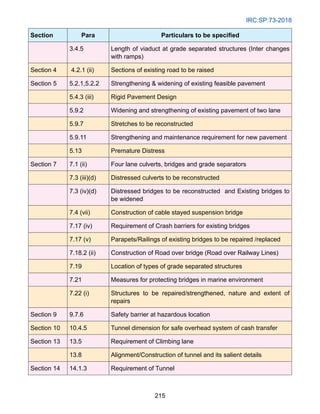
Power Supply DC, PoE (802.3af)

Weather Proof IP 66
IP Range E13: Approx. 20-30 metres; E15: Approx. 50 metres
OCR Yes
Note This Camera needs external high power IR panel to
illuminate license plate with a stronger IR light.
1.2.11 Emergency Footswitch Alarm System
A) Functions
The emergency footswitch is located in each booth under the fee collector’s desk. The footswitch
is provided for use in case of emergency or an accident. Pressing the footswitch shall raise an
alarm to the auditor via the LSDU  activate a siren. The siren is fitted on the top of the booth.
The siren also is triggered by the incidents like violation and the HP  MC convoy as mentioned
in the design specification documents earlier.
B) Specifications
The minimum specifications for the emergency footswitch are as follows:
Description Specifications
Installation and Fixing Details Mounted on the floor inside the tollbooth under the desktop.
Cables - Power cable
- Signal cable
Cable routes - 
The power cable is laid inside the booth manhole before
terminating to the HLC Termination Block.
- 
Data cable is connected to the HLC DI board from the
termination block
Material and finishes Steel
Colour Manufacturer’s Original Colour
Power Supply Requirement 220~240 V AC 50-60Hz with 10 A
Access for maintenance,
modularity of construction
Modular Design, only plug and replace when fails.
Environmental Considerations Operating Temperature 0°C - 50°C
Reliability and maintainability MCBF: 100,000 operations
MTTR: 0.5 hrs
IRC:SP:73-2018
146
The minimum specifications for the siren are as follows:
Description Specifications
Technology Motor Driven or better
Audible rating 112 dB at 1 meter
Environmental Designed to meet IP 54
1.2.12 Booth CCTV Cameras
A) Functions
The booth CCTV camera shall be a fixed dome type IP (Internet Protocol) colour camera installed
inside the booth to capture the activities of the fee collector while performing his operations. The
camera shall also capture the view of the paying vehicle.
These cameras shall have inbuilt voice recording and SD memory card of minimum 32GB for
local storage of videos and voice recordings. These cameras shall be connected to the plaza
video server installed at the TMS server room at each plaza building.
The camera shall be capable of triggering alarms in case of camera tampering detection and
audio detection. The triggering alerts can be controlled by the control room operator.
B) Specifications
The technical specifications of the booth cameras shall be as follows:
Description Specifications
Image Sensor 1/2.8” Progressive CMOS
Maximum Resolution 1920x1080 (2MP)
Lens Type Fixed Focal
Focal Length f = 2.8
Aperture F1.8
Field of View
110° (Horizontal)
64° (Vertical)
135° (Diagonal)
Shutter Time 1/5 sec. to 1/30,000 sec.
Day/Night Removable IR-cut filter for day  night function
Minimum Illumination
0.08 Lux @ F1.8 (Color)
0.001 Lux @ F1.8 (B/W)
IR Illuminators
Built-in IR illuminators, effective up to 25 meters or better
IR LED*8
On-board Storage SD/SDHC/SDXC card slot
Compression H.264  MJPEG
IRC:SP:73-2018
147
Description Specifications
Maximum Frame Rate
30 fps @ 1920x1080
In both compression modes
Maximum Streams 4 simultaneous streams
S/N Ratio Above 55dB
Dynamic Range 97dB or better
Video Streaming Adjustable resolution, quality and bitrate
Image Settings
Adjustable image size, quality and bit rate, time stamp,
text overlay, flip  mirror, configurable brightness, contrast,
saturation, sharpness, white balance, exposure control,
gain, backlight compensation, privacy masks, scheduled
profile settings, seamless recording, smart stream, 3D Noise
Reduction, Video Rotation
Audio Capability Audio input /output (full duplex)
Compression G.711, G.726
Interface
External microphone input
Audio output
Protocols
IPv4, IPv6, TCP/IP, HTTP, HTTPS, UPnP, RTSP/RTP/RTCP,
IGMP, SMTP, FTP, DHCP, NTP, DNS, DDNS, PPPoE, CoS,
QoS, SNMP, 802.1X, UDP, ICMP
Interface 10 Base-T/100 BaseTX Ethernet (RJ-45)
ONVIF Supported
Alarm Triggers
Video motion detection, manual trigger, digital input,
periodical trigger, system boot, recording notification, camera
tampering detection, audio detection
Alarm Events
Event notification using digital output, HTTP, SMTP, FTP and
NAS server, SD Card
File upload via HTTP, SMTP, FTP, NAS server and SD card
Connectors
RJ-45 cable connector for Network/PoE connection
Audio output
DC 12V power input
Digital input*1
Digital output*1
LED Indicator System power and status indicator
Power Input Max. 9 W (PoE)
Safety Certifications CE, LVD, FCC Class B, VCCI, C-Tick
Operating Temperature Starting Temperature: -10°C to 50°C (14°F~ 122°F)
IRC:SP:73-2018
148
1.2.13 Intercom Slave Communication Unit (ISCU)
A) Function
Intercom Slave Communication Unit (ISCU) shall be used for communication between the fee
collector at the lane and the auditor/supervisor at the plaza building. It shall have the following
functions:
i) It shall provide hands free two-way verbal communication between the
supervision staff in the control room and the Fee Collector. The Fee Collector
shall be able to attract the attention of the auditor in the control room by pressing
a single button on the intercom slave unit.
ii) The equipment shall also have the facility to allow the supervision staff to monitor
communication in the booth between the Fee Collector and the user or between
any two booths without alerting the Fee Collector.
iii) The voice communication system shall operate independent of the HLC system.
iv) Voice communication shall also be implemented in various rooms of the plaza
building and at building access points.
v) Two-way communications shall be possible as soon as the auditor responds by
selecting the appropriate lane button on the master communication unit.
vi) One-way communication shall be possible from the Control Room intercom to
all lanes simultaneously (broadcast).
B) Specifications
ISCU shall meet the following minimum specifications:
Descriptions Remarks
Installation and Fixing
Details
Fixed in the booth. (wall/desktop mount)
Speech Method Hands-free
Wiring distance 120 meters with 0.202 mm diameter (33 AWG) cable, 300
meters with 1.024 mm diameter (18AWG) cable
Speaker 20 ohms
Power Consumption 6 W (max.)
Power Supply Requirement Power supply from Master System
Wiring 2 wires, non-twisted
Environmental
Considerations
Operating Temperature of 10°C to 50°C
Reliability 30,000 hrs
The operator may also propose/provide an IP based intercom system.
IRC:SP:73-2018
149
1.2.14 Automatic Lane Exit Barrier (ALB)
A) Functions
The function of the ALB is to control the passage of vehicles through the lane. Each lane shall
be fitted with an ALB, the exact location of the ALB shall be provided by the Concessionaire in
the lane layout drawing at the time of tender.
The operation of barrier is linked to the lane controller. It allows the vehicle to pass through after
a successful transaction has happened at the lane.
The system consists of a fixed housing and a movable arm with a high impact breakaway device
or provision. The housing shall contain the motor and control units along with the integrated
metal detectors for vehicle detection purpose. The housing shall be installed on the right side of
the traffic direction, after the booth on a concrete base.
The boom arms shall be fitted with a swing-away flange to prevent damages to the barrier/
vehicle in case of an unpermitted or forced drive-through. Boom contact shall be available which
gives continuous alert to the TMS when the boom is missing or swung away.
B) Specifications
The ALB shall meet the following technical specifications:
i) The lane exit barrier shall be suitable for high-speed ETC transactions. One full
open-close cycle shall not take more than 1.2 seconds. The barriers used shall
be capable of full lane open from a close state in less than 0.6 seconds.
ii) The housing and any mounting frame shall be fabricated from corrosion-resistant
materials. They shall be IP 55 rated. The barrier shall be driven electrically.
The motor shall not be damaged when the barrier is blocked in any position.
Exit barriers shall have presence detectors independent to the AVC system to
prevent barrier arms coming down on vehicles while passing. This shall be in
the form of infrared units and dedicated embedded loops. Apart from the barrier
arm, the mechanism may not have any moving protrusions that pose a risk to
persons standing in close proximity to the barrier.
iii) The barrier arm shall be fabricated from a light, corrosion resistant material
readily and inexpensively available in India. The barrier arm shall further have
a protective mechanism whereby controlled fracture of the barrier arm occurs
without damage to the housing or motor in the event of frontal collision. Preference
will be given to non-destructive break-away mechanisms. Further, there shall be
a protection mechanism to detect the presence of vehicles to avoid accidental
hitting on the vehicles, whenever the boom is triggered for closing.
iv) Suitable power supply scheme shall be implemented by the Contractor to feed
the Exit barrier to protect the source from being damaged due to electrical surges/
spikes injected by the dynamic (inductive) load. Further, the drive shall be so
designed as to the damping factor is just sufficient for the drive to operate the
booms without any jerks during open/close to avoid freak hitting by the exiting
vehicles.
IRC:SP:73-2018
150
v) Barrier arms shall have retro-reflective red stripes in accordance with the local
traffic sign standards.
vi) The Automatic Barrier Gate shall be IP 55 rated.
vii) The Automatic Barrier Gate shall receive power directly from dedicated online
UPS. Suitable protection shall be provided by the Contractor at the load end
to protect the Boom Barrier. The Contractor shall fulfill any specific earthing
requirement.
viii) The following minimum specifications shall be met:
		 Boom Length: 3.5 m
		 Boom Material: Aluminium
1.2.15 Network Video Recorder (NVR)
H.265 Linux-based embedded standalone NVR shall be provided. Shall support 16-Channel
/24-Channel/32-Channel network cameras. The NVR shall be ONVIF compliant and scalable
configuration with features to help users to set up and manage advanced IP surveillance systems
with ease. The NVR shall also support remote and mobile access, via web based application,
and app for both iOS and Android devices.
The NVR shall have minimum following technical features:
a) H.265 Compression Technology
b) Plug  Play One Button Auto Setup
c) Intuitive, Intelligent and Interactive UI
d) Live viewing, recording and Playback features
e) Embedded Linux OS or OEM Specific
f) Support RAID 0/1/5 Storage
g) Up to 12MP Camera Liveview  Playback
h) Dual Lan Network Ports with Failover Function
i) ONVIF Open Platform
1.3 Administrative Area
1.3.1 Master Communication Unit
A) Functions
The master communication unit MCU is a master communication system to control communication
between the fee collector at the lane and the auditor at the plaza building. The unit will be located
in the control room and controlled by auditor/supervisor.
B) Specifications
Description Specifications
Power Source 24V DC
Current Consumption Max. 1A, 80mA in standby
IRC:SP:73-2018
151
Communication Push-to-talk at master station hands free at sub station
Calling LED and intermittent ringing tone at master until answered
Frequency Response 770 – 6800Hz
Total Harmonic Distortion 3% @ 1000Hz at 20 ohms
Mounting Wall or desk mount
Wiring 2 conductor per sub station
MTBF 30,000 hrs
1.3.2 Static Weigh Bridge
The handling of overloaded vehicles shall be governed by terms of directives issued by the
Authority.
A) Functional Requirements
i) A Static Weigh Bridge (SWB) shall be installed in each direction of traffic, after
the toll plaza, in a separate area having facility of parking of overloaded vehicles.
This is to ensure that an overloaded vehicle does not ply on National Highways.
ii) The SWB system shall be able to capture Toll Transaction Number with Date and
Time, Vehicle Registration Number, Category of Vehicle, Permissible Weight,
and Gross Vehicle Weight along with date/time of weighing, and the receipt
printed by the SWB system shall contain these information. This system shall
also be integrated with the toll system and generate a closure report.
iii) The SWB station shall have a CCTV camera for capturing image of vehicle while
weighing.
iv) Monthly MIS reports shall be available for the Authority, such as Actual Over
loaded vehicles, Total Overweight Vehicles (WIM) vs Actual Overweight vehicles
(SWB) etc.
B) Technical Specifications
Type Site specific ( Pit/Pit less/Mobile)
Body/Platform Steel
Size 18 meter x 3 meter
Capacity 120 Tonnes
Structure I-Beam complying BIS 2062. Top Plate - 10 mm or more – Steel
as per BIS 2062
Structure Duly certified for Structural Analysis And Design(STAAD)-III
Number of Load cells 8
Type of Load Cells Compression Type/Double Ended Shear Beam – Stainless Steel
17-4 Ph
IRC:SP:73-2018
152
Type Site specific ( Pit/Pit less/Mobile)
Protection Class for the
Load Cells
IP 68 or better, Operational Temp: -10 to 65 Degrees
Protection Class for the
Weighing Indicator
IP 65 or better, Operational Temp: -10 to 65 Degrees
Overload capacity 150% of rated capacity
Accuracy Class OIML - C-IV
Accuracy Tolerance Up to 0.02%
Painting Anti-rust  anti-corrosion painting
BIS Specification   IS-9281(Part-III)
Compliant Legal Metrology Act 2009 (1 of 2010)  Rules framed there under
from time to time - Duly sealed by the Weights  Measures Dept.
Approval/ Certification Weights  Measures Approved Model
1.3.3 UPS System
A) Specifications
Online UPS with 4 hours of backup and sizing based on power requirement calculation, shall be
provided. The UPS design shall take the following into account:
i) The system shall be capable of maintaining an uninterrupted power supply to the
UPS loads for a sustained period of at least 4 hours under full load conditions
from a fully charged battery.
ii) It shall also be capable of continuously supplying power to the system under an
intermittent interruption cycle.
iii) The UPS shall be capable of operating at input voltages of 210/380Volts ±10%
and 50 Hz ±2.5 Hz.
1.3.4 Network Laser Printer (Black and White)
A) Specifications
At least 2 Network Printer shall be required in the Plaza office/Control Room with following
minimum specifications:
• 25 PPM
• Duplex;
• Fast Ethernet; and should support Paper size(s): Letter/Legal/Executive/
Statement/8.50” x 13”/Envelope No. 10/Monarch Envelope/Custom Size.
1.3.5 Cabling
A) Specifications
All cables and wires shall be of good quality, conforming to normally accepted industry standards,
and shall be of the proper type and have sufficient ratings for the particular application.
IRC:SP:73-2018
153
All exposed ends of unconnected cables and wires shall be coated with water tight sealing
compound or sealing tape to avoid damage to conductors. All communication cables used shall
have a clearly marked label securely fixed near each end in accordance with the cable network
diagram.
All cables and wires shall be adequately protected from the edges of equipment housing or other
surrounding objects. All the cables and wires shall be neatly arranged and securely placed in
such a way that all terminals are relieved of the weight of the cables. Terminals shall be coded
and identified as per the wiring diagrams. Live metal shall be recessed or protected to avoid
accidental contact.
1.3.6 Workstation
A) Functions
The workstation will be used by the System Administrator and / or Toll Supervisor to access the
system for Admin/Audit purpose. At least 4 work stations / laptops should be provided in the
Plaza office/Control Room with following minimum specification.
B) Specifications
The TMS workstation shall comply with the minimum specifications prescribed in the below table.
Description Specifications
Processor Intel Core i5, Processor 2.4 GHz; 8 MB Cache, 1600 MHz, 4
Cores, Hyper threading, Intel HD Graphics
Memory(RAM) 4 GB or better
Storage 300 GB or better
Network Integrated NIC
Ports RJ-45, 1 USB 3.0, 3 USB 2.0
Monitor 18.5”LED
Input interface Keyboard and Mouse
Antivirus Yes
1.3.7 Server
A) Functions
The Plaza Server should have 1+1 redundancy and should be provided with Server Rack 24U,
with fan and adequate power points and cable management adjustable for caster / wall mount.
IRC:SP:73-2018
154
B) Specifications
Description Specifications
Form factor/height 2U Rack
Processor 4 - core Intel Xeon E5-2600 v2 series processors – 2 Nos. or better
Cache 15 MB per processor or Better
Memory 32 GB RAM, DDR 4, Shall be expendable to 64 GB
Internal Storage Minimum 8 TB SAS/SATA or Better
Media bays ODD and tape drive bay
RAID support
Integrated 6 Gbps or new optional 12 Gbps* hardware RAID-0, -1,
-10 with optional RAID-5, -50, -6, -60
Power supply (std/max) 2 - Redundant Hot swappable
Hot-swap components Power supplies, fan modules and hard disk drives
Network Interface
Controller (NIC) Trusted
Platform Module (TPM)
4 × 1 GbE (std.), 2 × 10 GbE Embedded Adapter (slot less
opt.)/TPM
PCIe 3.0 Expansion slots
(x16/x8)
4 - 6 PCIe ports or 4 PCI-X (CTO) or 2 double-width PCIe (for
GPU)
USB ports 2 front/4 back/2 internal
Internal storage Minimum 8 TB SAS/SATA or Better
Energy-efficiency
compliance
80 PLUS® Platinum and ENERGY STAR® Compliance
Monitor 18.5” LED
Input interface Keyboard and Mouse
Operating System
Windows Server 2012 Std. or Open source OS such as Linux, Unix
flavours, as per requirement of Toll Management System.
1.3.8 Display for CCTV Monitoring
The Display shall be a 55” inch professional grade display with wide viewing angle, full HD
resolution and shall be suitable for 24x7 indoor application. The monitor shall have high contrast
ratio, lightweight design, full high definition 1920x1080 resolution, and anti-glare panel. It shall
have inbuilt VGA, DVI, S-Video and HDMI ports for multiple video inputs.
Description Specifications
Panel Size 55 inch
Light source LED Backlight
Resolution 1920 X 1080 pixels
Dynamic Contrast Ratio 1400:1
IRC:SP:73-2018
155
Viewing angle Horizontal: 178 Degree, Vertical: 178 Degree
Display feature Full HD; Panel
Response time Minimum 8 ms
Lifetime Minimum 50,000 Hrs.
Colours Minimum 16 Million
Brightness 350cd/m2
Panel thickness Not more than 65 mm
1.3.9 Network Switches
A) Functional Requirement for Switches
i) Switch should support port security, DHCP snooping, Dynamic ARP inspection,
IP Source guard, BPDU Guard, spanning tree root guard.
ii) Switch should be IPv6 Certified/IPv6 logo ready and Switch / Switch’s Operating
System should be tested and certified or in process of certification for EAL 2/
NDPP or above under Common Criteria Certification.
iii) Switch should have 1:1 redundant internal power supply. Power supply modules,
fan modules and transceivers modules should be hot swappable.
iv) Should support IEEE Standards of Ethernet: IEEE 802.1D, 802.1s, 802.1w,
802.1x, 802.3ad, 802.3x, 802.1p, 802.1Q, 802.3, 802.3u, 802.3ab, 802.3z,
802.3az.
B) 24 Port Layer 3 Switch with 4 Fiber Port
i) Switch shall have minimum 24 nos. 10/100/1000 Base-T ports and additional
4 nos. SFP uplink ports loaded with MMF modules with dedicated stacking ports.
ii) Switch shall have wire rate performance and 48 Gbps of dedicated stacking
bandwidth.
1.3.10 Building Surveillance System
The system shall be connected to the NVR. The Video Management Software installed on NVR
shall provide the facility to control the cameras at the Supervision Control room at the plaza
buildings.
The cameras shall be for monitoring of security areas such as plaza compound, security garage,
control room, change of shift room and cash counting room, lobby, hallway, tunnel, fee collector
walkway, parking, staircase, DG room, electrical room, server room, UPS room, loading bay, etc.
These cameras shall be – Fixed lens Bullet CCTV night vision colour cameras. The bullet
cameras installed outdoor shall be installed in the weather proof enclosure.
A) Fixed lens Bullet CCTV night vision color cameras
Description Specifications
Image Sensor 1/2.8” Progressive CMOS
Maximum Resolution 1920x1080 (2MP)
IRC:SP:73-2018
156
Description Specifications
Lens Type Fixed-focal
Focal Length f = 3.6 mm
Aperture F2.1
Field of View 83° (Horizontal), 53° (Vertical), 91° (Diagonal)
Shutter Time 1/5 sec. to 1/30,000 sec. or better
Day/Night Removable IR-cut filter for day  night function
Minimum Illumination 0.06 Lux @ F2.1 (Color)
0.001 Lux @ F2.1 (B/W)
IR Illuminators Built-in IR illuminators, effective up to 30 meters
On-board Storage Slot type: SD/SDHC/SDXC card slot
Seamless Recording
Compression H.265  MJPEG
Maximum Frame Rate 30 fps @ 1920x1080
In both compression modes
Maximum Streams 4 simultaneous streams
S/N Ratio 50 dB or better
Dynamic Range 95 dB or better
Video Streaming Adjustable resolution, quality and bitrate, Stream
Image Settings Adjustable image size, quality and bit rate, Time stamp,
text overlay, flip  mirror, Configurable brightness, contrast,
saturation, sharpness, white balance, exposure control, gain,
backlight compensation, privacy masks, Scheduled profile
settings, 3D Noise Reduction, Video Rotation, Defog
Audio Capability Two-way audio (full duplex)
Compression G.711, G.726
Interface External microphone input
Audio output
Users Live viewing for up to 10 clients
Protocols IPv4, IPv6, TCP/IP, HTTP, HTTPS, UPnP, RTSP/RTP/RTCP,
IGMP, SMTP, FTP, DHCP, NTP, DNS, DDNS, PPPoE, CoS,
QoS, SNMP, 802.1X, UDP, ICMP, ARP, SSL, TLS
Interface 10 Base-T/100 BaseTX Ethernet (RJ-45)
ONVIF Supported
Alarm Triggers Video motion detection, manual trigger, digital input, periodical
trigger, system boot, recording notification, camera tampering
detection, audio detection
Alarm Events Event notification using digital output, HTTP, SMTP, FTP and
NAS server, SD Card
File upload via HTTP, SMTP, FTP, NAS server and SD card
Smart Focus System Fixed Focus
IRC:SP:73-2018
157
Description Specifications
Connectors RJ-45 cable connector for Network/PoE connection
Audio input
Audio output
DC 12V power input
Digital input: 1, Digital output:1
LED Indicator System power and status indicator
Casing Weather-proof IP 66-rated housing
Vandal-proof IK10-rated metal housing (Casing Only)
Safety Certifications CE, LVD, FCC Class A, VCCI, C-Tick
Operating Temperature 10°C to 50°C
1.3.11 Hybrid Toll Management System/Software – Lane and Plaza level
i) The Toll Management System (TMS) shall be responsible for capturing 
processing toll transactions into information, that will be used to verify toll
collections, provide toll collector control, cash-up and shall include a host of
management tools and reports for the effective administration of the toll operation.
ii) The TMS shall also assist in auditing the toll collection operation. It shall be a
modular system with the capability for various modules and functions to perform
independently at different levels of the toll collection operations.
iii) The TMS shall have various customizable reports.
iv) The TMS shall have financial management and traffic analysis tools to assist the
Concessionaire in planning operations.
v) The Service Provider shall ensure that security updates and latest service packs,
“patches” are loaded on the Lane / AVC Controllers as well as Toll Plaza Servers.
Industry standard operating systems shall be utilized and all user licenses shall
be provided.
vi) The database shall be an industry standard relational database management
system and shall be supplied with all the latest service packs and patches,
including required user licenses.
vii) Toll Management System should be able to support all kind of Fare structures
 Payment methods including, but not limited to, Daily Pass, Return Pass,
Monthly Pass, Discounted tariffs, Exemptions, Open / Closed fare schemes etc.
and shall meet the Tolling System requirements of the respective Concession
Agreement.
viii) Fully integrated with all other peripherals and systems such as WIM, SWB etc.
ix) Shall be able to send data to Central data center designated by the Authority, in
real time.
IRC:SP:73-2018
158
1.3.12 Monitoring system
System of the Hybrid ETC hardware in real time through a system logger shall be available.
The monitoring system shall keep record of its operation and status of the various Hybrid ETC
Systems and devices in a unified manner in the database. All incident and events shall be
recorded. Data retrieval software shall be provided to retrieve and display the operating history
of the specified systems and devices.
The system shall be used for monitoring the up-time of entire system (including each peripheral
and network connectivity) including generation of system alerts/reports on system downtime for
SLA monitoring/compliance. This shall also include monitoring of downtime of any lane/plaza
level equipment, poor/low video quality, no video signal, communication network or bandwidth
related issues etc. Entire process of capturing downtime, reporting, escalating till resolution
should be enabled within the system itself like standard CRM practices.
ETC shall mean electronic payment of user fee using RFID tags or any such device.
“Hybrid ETC System” shall mean new Electronic Toll Collection (ETC) system which will also
facilitate other modes of payment of user fee apart from ETC mode of collection of user fee and
includes all the hardware items as listed in Annexure A.
“ETC RFID transceiver, Medium Speed Weigh in Motion (MSWIMs), Static Weigh Bridge, Hybrid
Toll Management System/Software” shall be defined as per the Annexure B.
“CCH” shall mean a company or body engaged by the Authority to undertake and act as the
Central Clearing House for clearing and settlement of ETC transactions and other related
services.
“Acquiring Party” shall mean an institution certified by theAuthority or a representative ofAuthority
to process ETC transactions at toll plazas.
IRC:SP:73-2018
159
SECTION - 11
LANDSCAPING AND TREE PLANTATION
11.1 General
The Concessionaire shall plant trees and shrubs of required number and type at
the appropriate locations with in the Right of Way and in the land ear marked by the
authority for afforestation keeping in view the IRC Guidelines on Landscaping and
Tree Plantation. The authority shall specify the number of trees which are required
to be planted by the concessionaire as compensatory afforestation or otherwise in
Schedule ‘C’ of Concession Agreement. In case the number of trees to be provided is
not specified in Schedule ‘C’, the Concessionaire shall not be required to plant trees.
The Concessionaire shall also maintain the trees and shrubs in good condition during
the concession period as part of the maintenance schedule. The guidelines given in this
Section shall be followed in plantation of trees and shrubs.
11.2	Design Considerations in various locations
11.2.1 Set-Back Distance of Trees and other Plantation
Trees on the roadside shall be sufficiently away from the roadway so that they are
not a hazard to road traffic or restrict the visibility. Most vulnerable locations in this
regard are the inside of curves, junction corners and cut slopes. Trees shall be placed
at a minimum distance of 10-11 m from the centre line of the extreme traffic lane to
provide recovery area for the vehicle that runs off the road. A second row of trees 6 m
further away will also be planted, wherever possible. Preferably, the first row of trees
shall consist of species with thick shade and other rows of vertical type providing thin
shade. Expansion of the project highway to 4-lanes shall be taken into consideration
while locating the trees so that land is free of trees when further widening takes
place. In case future widening is not to be considered the same shall be specified in
Schedule ‘D’ of Concession Agreement. The distances for alternative rows of trees shall
be reckoned from the nearest edge of the pavement. No plantation shall be allowed on
the embankment slopes.
11.2.2 Set-Back of Trees on Curves
In plain terrain, as topping sight distance of 180 m corresponding to the design speed
of 100 km per hour shall be ensured on all curved sections of project highways along
the inner most lane. However, where there are site restrictions, their requirement may
be reduced to 130 m corresponding to the design speed of 80 km per hour as a special
case. The existing trees and vegetation on the sides have to be suitably thinned/trimmed
or even removed, if necessary, and a regular programme of pruning of the offending
trees shall be undertaken as part of the maintenance operations. In all cases, location
of trees shall be checked to ensure that clear vision of all highway signs/signals is
IRC:SP:73-2018
160
available at all times to the motorists. Also, the foliage or trees shall not come in the way
of roadway lighting.
In urban/built-up sections of the Project Highway, trees can be planted on the raised
footpaths, provided the distance between the edge of the kerbs and the nearest edge
of tree is not less than 2 m.
11.2.3 Vertical Clearance of Trees and other Plantations
For safe traffic operation, the vertical clearance available across the roadway shall be
minimum 5 m. From this angle, the probable size of all plants shall be anticipated in
advance, at the time of initial planting. To allow for the effects of growth, wind and rain,
trees shall be trimmed to 6 m and 6.5 m above the pavement in rural and urban areas
respectively.
11.2.4 Deleted
11.2.5 Spacing of Avenue Trees
The spacing of avenue trees will depend on the type and growth characteristics of
trees, requirement of maintenance, penetration of distant views, etc. A range of 10-15
m would meet the requirement for most varieties.
11.2.6 Choice of Trees
The following guidelines shall be kept in view while selecting the species of trees to be
planted:
i) Trees shall be selected with due regard to soil, rainfall, temperature and
water level.
ii) Trees which become very wide shall be avoided as their maintenance
would cause interference with traffic flow.
iii) The species must be capable of developing a straight and clean bole
upto a height of 2.5 to 3.5 m from the ground level.
iv) The selected trees shall, preferably, be fast growing and wind-firm. These
shall not be thorny or drop too many leaves.
v) The trees shall be deep rooted as shallow roots injure pavements.
vi) In urban areas, the species selected shall be of less spreading type, so
that these do not interfere with overhead services, clear view of signs/
signals and efficiency of roadway lighting.
11.3 Landscape Treatment
A suitable landscape treatment with provision of foundations and coloured lighting so
as to enhance the overall aesthetics duly designed by a qualified and experienced
landscaping architect, shall be provided at grade separators, elevated sections,
IRC:SP:73-2018
161
viaducts, traffic islands, toll plazas, bus bays, truck lay byes, rest areas, OM centre,
etc. The locations where landscape treatment is to be given shall be specified in
Schedule ‘C’. The landscape treatment shall also be provided for special areas as
given in IRC:SP:21(para 8).
11.4 Report to be submitted
The concessionaire shall submit scheme for plantation and maintenance of plants and
trees to the Independent Engineer for review and comments, if any.
IRC:SP:73-2018
162
SECTION - 12
PROJECT FACILITIES
12.1 General
The requirement of the project facilities to be provided shall be indicated in Schedule ‘C’
of the Concession Agreement. This shall include information regarding location and size
of the facilities. Land required for provision of facilities shall be acquired by the Authority
and the date of handing over of the land to the Concessionaire shall be indicated in the
Concession Agreement.
12.2 Road Boundary Walls (RBW)
Road Boundary walls shall be provided at the boundary on both sides of the Right of
Way available under the control of the Authority, except at ingress and egress points.
The boundary walls shall be of reinforced cement concrete as per Type Design given
in IRC:25.
12.3 Kilometre and 200 m Stones
a) The km and 200 m stones shall be provided on one side of the project
highway. The side of the road on which such stones will be provided,
shall be decided by the Authority.
b) The design and specifications of kilometre stones shall conform to IRC:8.
The matter to be written on various kilometre stones and the pattern
thereof, shall be as specified in IRC:8.
c) 200 m stones shall be provided at every 200 m distance. The design and
specification of 200 m stone shall conform to IRC:26.The matter to be
written on various 200 m stones shall be as specified in IRC:26.
12.4 Street Lighting
12.4.1 General
The concessionaire shall provide lighting at specified locations of the project highway,
using appropriate system and source of electric power as per the requirements of this
Section. Such locations shall be specified in Schedule ‘C’.
The Concessionaire shall make suitable arrangements for procuring power supply to
ensure uninterrupted lighting during night and when visibility is low, including provision
of DG sets as stand by arrangements.
The Concessionaire shall bear all costs of procurement, installation, running and
operation cost of all lighting, including cost of energy consumption specified in this
Section.
IRC:SP:73-2018
163
12.4.2 Specifications
i) Unless stated otherwise in this Manual, the minimum level of illumination
on the locations of the project highway where lighting is to be provided
as per this section shall be 40 Lux.
ii) The layout of the lighting system together with type of luminaries for
different locations shall be prepared by the Concessionaire in such a
manner that the minimum illumination level prescribed in para 12.4.2(i)
can be achieved and shall be submitted to the Independent Engineer for
review and comments, if any, for compliance by the Concessionaire.
iii) Overhead electrical power and telecommunication lines erected within the
ROW by the Concessionaire shall be provided with adequate clearance
so that safe use of the highway is not affected.
iv) Vertical and horizontal clearances for electrical installations shall conform
to IRC:32.
v) All the fixtures, wires/cables, lights shall conform to relevant BIS
specifications as a minimum. The Concessionaire with the prior review
and comments of the Independent Engineer can use fixtures with better
specifications.
12.4.3 Locations where Lighting is to be provided
Unless specified otherwise in Schedule ‘C’ of the ConcessionAgreement and elsewhere
in this Manual, the Concessionaire shall provide lighting at the following locations of the
Project Highway:
i) Toll Plaza Area: The lighting in and around toll plaza, toll booths, office
building, on the approach road, etc. shall be as per Section-10 of this Manual.
ii) Rest Areas as given in para 12.10.
iii) Truck lay-bye: Lighting at the truck lay-bye shall be as per para 12.5.
iv) Bus Bay  Bus Shelter Locations: Lighting shall be provided as per para 12.6.
v) Grade Separated Structures, Interchanges, Flyovers, Underpasses
(vehicular/pedestrian) and Overpasses: The top and underside of the
grade separated structures and interchange area at the ground level
upto 50 m beyond and point from where flaring of the main carriageway
takes place shall be provided with lighting.
vi) Built-up sections on the project highway both in the median of main
carriageway and on the service roads on either side.
12.5 Truck Lay-by
12.5.2 General
The Concessionaire shall construct and maintain adequate number and size of truck lay-
bye for parking of trucks by the side of the project highway as indicated in Schedule ‘C’
IRC:SP:73-2018
164
of the Concession Agreement. The guidelines, as given here, shall be followed in regard
to location, size and facilities to be provided at the truck lay-byes. A typical lay out is
given in Fig. 12.1.
12.5.3 Location and Size
Location and size: Truck lay-byes shall, in general, be located near check barriers,
interstate borders, places of conventional stops of the truck operators, etc. The places
be identified on the basis of field survey and shall have adequate space for facilities as
specified in this section and future growth.
12.5.4 Facilities
The truck lay-byes shall have the following facilities:
i) Paved parking,
ii) Toilets and drinking water,
iii) Telephone.
12.5.5 Lighting
The truck lay-byes and 50 m length of the project highway on its either side shall be
illuminated at night to provide an minimum illumination of 40 Lux. Suitably designed
electric poles having aesthetic appeal and energy saving bulbs may be used to provide
required illumination. Alternatively, photo voltaic lamps may be used.
12.6	Bus Bays and Bus Shelters
12.6.1 General
The buses shall be allowed to stop for dropping and picking up passengers only at the
bus bays. The Authority will indicate in Schedule ‘C’ of the Concession Agreement,
the number and broad location of bus bays to be provided by the concessionaire. The
bus bays shall conform to the specifications and standards given in this Section. In
case where bus stands are provided by the concerned State Government Transport
Authority, the Concessionaire shall provide only access road within the Right of Way.
12.6.2 Location
The location of the bus bays shall be fixed on the basis of following principles:
i) The bus stops shall be sited away from bridges and other important
structures and embankment sections more than 3 m high.
ii) As far as possible, bus bays shall not be located on horizontal curves or
at the summit of vertical curves.
iii) The location shall have good visibility, not less than the safe stopping
sight distance.
iv) The bus bays shall not be located too close to the road intersections. A
gap of 30 m from the tangent point of intersections to start/end of the bus
bay shall be desirable. At minor intersections (e.g. junctions with village
IRC:SP:73-2018
165
roads), distance of 60 m may be adopted. However, if a substantial
volume of buses is to turn right at the intersection, it is necessary that the
bus bay shall be located sufficiently ahead of the intersection so that the
buses can maneuvere easily from the pick-up stop on the left hand side
to the extreme right lane for turning. The location of the bus bays may be
fixed after due consultation with the local communities expected to use
such facilities.
v) At major four-way intersections involving transfer of a substantial number
of passengers from one pick-up stop to the other, it might be desirable to
construct a single, composite bus stop of suitable design to cater to all
the bus routes collectively.
vi) In hilly areas, the bus bays shall be located, preferably, where the road
is straight on both sides, gradients are flat and the visibility is reasonably
good (usually not less than 50 m). Subject to these requirements, it will be
advisable to choose locations where it is possible to widen the roadway
economically for accommodating bus bays.
12.6.3 Layout and Design
i) For plain area, typical/layouts of bus bays given in Fig. 12.2 shall be
adopted. The length “L” shown in Fig. 12.2 shall be 15 m which shall be
increased in multiples of 15 m if more than one bus is likely to halt at the
bus bay at one time.
ii) For hilly areas, where there is a general constraint on space, the layout
indicated in Fig. 12.3 may be adopted.
iii) The chanellizing island between the paved shoulder and bus-bay shall
not be raised but it shall be paved with CC blocks. At certain situations,
due to space constraints, it can be provided with Ghost island also as
given in Fig. 12.2.
iv) Bus bays shall be provided on both sides of the project highway for each
direction of travel independently, so that the buses do not have to cut
across the road. Bus bays on opposite sides shall be staggered to a
certain extent to avoid undue congestion on the highway. At intersections,
the bus bays for up and down direction shall be located on farther sides
of the intersection.
v) Covered steps with rise not exceeding 150 mm (minimum 5 m wide)
along with a ramp for use of disabled persons (1 m wide minimum) with
railing on either side shall be provided for climbing up/down from bus
shelter to underpass/overpass to carriageway and vice versa. The cover
of the steps shall be aesthetically pleasing and protect the users from
sun, wind and rain. The entire area used by the pedestrians shall be
provided with granite stone cladding and flooring.
vi) The bus bay shall be provided with a shelter for passengers. The shelter
shall be structurally safe and aesthetic in appearance, while also being
functional so as to protect the waiting passengers adequately from sun,
IRC:SP:73-2018
166
wind and rain. If the shelter is constructed on the hill side, slopes shall be
properly dressed and suitably protected to avoid slips.
vii) The bus bay and passenger shelter shall be designed to provide for safe
and convenient use by persons with disabilities as well.
12.6.4 Pavement
The pavement in the bus bays shall have adequate crust with respect to the wheel
loads expected. Also, the surfacing shall be strong enough to withstand forces due to
frequent braking and acceleration by the buses.
12.6.5 Drainage
i) The bus bays shall have proper cross slope to drain off the excess water.
No water, which is likely to splash on the waiting passengers, shall be
allowed to collect near the bus shelters.
ii) Suitable kerb gutter section with requisite longitudinal slope and outlets
at intervals to ensure quick disposal of water shall be provided.
iii) Adequate drainage for the steps and pedestrian movement area shall be
provided.
12.6.6 Road Markings
Pavement markings as specified in Section 9 of this Manual shall be provided at the bus
stops as shown in Figs. 12.2 and 12.3 with the word ‘BUS’ written prominently on the
pavement. Pedestrian crossings shall be marked slightly behind the standing position
of the buses in order to reduce pedestrian conflicts. The kerbs shall be marked with
continuous yellow line to indicate “No Parking”.
12.6.7 Landscaping and Plantation
The total area of ROW near the bus bay location shall be landscaped and planted with
shady trees for giving pleasing appearance of the area.
12.6.8 Lighting
The entire bus bay area shall be provided with lighting (minimum illumination of 40 Lux).
12.7	Deleted
12.8	Deleted
12.9	Deleted
12.10 Rest Areas
12.10.1 The rest areas shall be provided at the locations given in Schedule ‘C’.
Rest areas shall be provided by the concessionaire on the lands included in the site
IRC:SP:73-2018
167
Fig.
12.3
Typical
Layout
of
Pick
up
Bus
Stop
on
Hilly
Area
Fig.
12.2
Typical
Layout
of
Bus
Bay
Fig.
12.1
Typical
Layout
of
Truck
Lay
Bye
IRC:SP:73-2018
168
and procured by the Authority. Within the areas so provided, the Concessionaire shall
construct and operate, or cause to be constructed and operated, facilities such as toilets,
telephones, cafeteria, restaurant, parking for cars, buses and trucks, dormitory, rest
rooms, shops for travel needs, fuel stations and garage, first aid, etc. In approximately
2 Hectares of land, the following minimum facilities shall be provided.
Cafeteria/Restaurant for seating 50 persons; Toilets (separate for ladies and gents)
(WC - 5 nos.; Urinals - 10 Nos.); Dormitory with 20 beds; drinking water facility; parking
for 100 trucks and 50 cars in addition to STD/ISD Telephone Facility, Shops and First
Aid Facilities.
The facilities shall be provided keeping in view the expected peak hour traffic.
The whole area shall be elaborately landscaped to provide a pleasing environment.
12.10.2 Lighting shall be Provided as given in Para 12.4 .
12.11 Highway Patrol Unit(s)
The concessionaire shall establish and operate Highway Patrol Unit(s) at the Toll Plaza
Locations, which shall continuously patrol the highway in a stretch not exceeding 50 km
and shall remain in contact with the control room on a real time basis. The Specifications
of Patrol Vehicles including equipments and manpower are given in Annexure-C.
12.12 Emergency Medical Services
These services shall include setting up medical aid posts by the Concessionaire. The
Concessionaire shall provide '2 Patient Capacity' rescue ambulance(s) at the toll plaza
location(s). Specification of '2 Patient Capacity' rescue ambulance alongwith medical
devices on board equipments, medicines and manpower are given in Annexure-D.
12.13 Crane Services
The Concessionaire shall provide a crane of adequate capacity (minimum 20 MT) at
each toll plaza location(s) with all necessary equipment so that it can reach the site of
the incident within 30 minutes of call and clear the disabled/accident vehicles. It shall
also be fitted with a GPS based vehicle tracking system to monitor its movement on 24
hours x 7 days of a week basis.
12.14 Communication System
The Concessionaire shall provide a suitable Communication System with all necessary
equipment for meeting his OM obligations.
12.15 Advanced Traffic Management Systems (ATMS)
ATMS shall be provided as per Clause 816.1 to 816.17 of Specifications for Road and
Bridge Works of MORTH.
IRC:SP:73-2018
169
12.16 Operation and Maintenance Center
12.16.1 There shall be operation and maintenance center(s) either at the toll plaza (s)
or at any other location along the Project Highway as identified by the Concessionaire.
The land for the same shall be acquired by the Concessionaire at his cost. The operation
and maintenance center would have following minimum facilities:
i) Main control center and administrative block.
ii) Equipment for operation and maintenance and storage space for them.
iii) Storage space for equipment and material for traffic signs and markings.
iv) Workshop.
v) General garage and repair shop.
vi) Testing laboratory.
vii) Parking space for minimum 4 numbers of large vehicles and for other
expected vehicles during peak hours including those for working staff
and visitors.
12.16.2 All building works shall be designed to meet the functional requirements
and shall be compatible with regional architecture and micro climate. Locally available
materials shall be given preference but not at the cost of construction quality.
12.16.3 The circulation roads and parking spaces in the OM center shall be paved to
withstand vehicle loads and forces due to frequent acceleration and braking of vehicles.
Parking bays/lots shall have proper cross slope and drainage. The marking of the parking
bays shall be as per IRC:35 to demarcate parking and circulation space. Parking lots
shall have illumination as provided in IS: 1944 (Parts I and II).
12.16.4 The whole campus of operation and maintenance center shall have system
for security with safe entry and exit.
IRC:SP:73-2018
170
Annexure–C
(Para 12.11)
Specifications of Patrol Vehicle
Every Patrol Vehicle (PV) should adhere to the minimum specifications as described below:
General Vehicle
Type Description
1. Vehicle type •	
PV should be a large size Sport Utility Vehicle(SUV) or Multi Utility
Vehicle(MUV) with a seating capacity of minimum 4 people.
•	
PV should have trunk with open ceiling at the rear end of the vehicle
with minimum trunk dimensions of 1400mm x 1400mm x 900mm
where 1400mm is the length of trunk measured from inside, 1400mm
is the breadth of trunk measured from inside and 900 mm is the height
measured from the surface of trunk to the top ceiling of the seating area
of the vehicle.
•	
The PV should be a new vehicle and should not have covered more
than 2000 km at the time of procurement (from date of first registration).
•	
PV should be able to accelerate from 0km/ h to 80 km/ h within 20s with
a top speed of 80 km/h when tested in accordance with IS: 11851-1986.
2. Two-External
equipments
•	
PV should have high intensity red and blue blinkers along with light bar
mounted on top of a vehicle.
•	
PV should have 1 Portable Variable Message Sign(VMS) for large
display of warning. The portable VMS Should have a single line display
with the minimum height of 200 mm for each character. The overall
length of signboard should be atleast 1500mm and display color should
be red. VMS should be clearly readable from 50 m distance.
• PV should have provision for fog lights.
•	
PV should have beacon lighting - white color flashing light mounted at
the top of the vehicle.
IRC:SP:73-2018
171
Type Description
3. Branding and
recognition
The PV conspicuity code is split into three Sections
• Color
• Conspicuity Improving Items
• Recognition of personnel
The Section “Color” describes the vehicle basic color. The Section
“Conspicuity Improving Items” includes all Symbols, Marking and Striping
defined as such by this standard. The Section “Recognition of personnel”
describes the dress code and safety garments of Patrol Vehicle personnel.
• Color
	
The basic color of the complete exterior of PV should be brilliant blue,
front, rear and side bumpers included. The color should be weather
resistant and withstand daily cleaning and washing.
• Conspicuity Improving Items
•	
This definition includes all marking and symbols as shown in the
sketch below. The vehicle should be painted with brilliant blue on the
entire body.
•	
PV should have “NHAI Highway Surveillance Unit” written on all four
sides of the vehicle in brilliant red color of retro reflective quality as
shown in Fig. PV.
•	
PV should have a text at the centre of all four sides of the vehicle with
“Emergency Number” written on top and “1033” written right below
“Emergency Number” in brilliant red color of retro reflective quality.
The “Emergency Number” marking should be atleast 10 cm high and
the ratio of height of “1033” and “Emergency Number” should be 2:1.
• Recognition of personnel
•	
All PV Personnel should wear brilliant blue color uniform including
brilliant blue color jackets required in winters.
•	
Safety garments for PV personnel should conform to at least ISO
14116:2008.
The branding and recognition pattern of PV described above should resemble with the one
shown in the sketche below:
IRC:SP:73-2018
172
Fig. PV – Side View
Equipments
Following are the list of equipments and specification of each to be kept in working condition in
every PV.
Type Description
1. Tracking
equipments
• 
Automatic vehicle tracking system with GPS technology for tracking
vehicle’s current location; Information to be viewable on GIS software.
2.
Communication
Equipments
• 
1 Two- way radio device with antennae or better technology for mobile
communication, for communication with Regional Command Center
and with on-road units. Should have a sufficient range to communicate
in the entire region(or state)  sufficient battery life (12 hours+);
• 
1 Public address system consisting of microphone, amplifier and
loudspeaker to address the traffic in case of accident, should have
minimum 100 W amplifier with loud sound;
• 
1 Cellular phone for communication.
3. General
Surveillance
Equipments
• 
1 Digital Camera with minimum 5 megapixel camera quality;
• 
2 white color high intensity torch lights with two set of spare batteries;
• 
3 Orange color reflective safety jacket along with gum boots and helmet
(1 for every attendant);
• 
3 Rain suit (1 for every attendant of Surveillance Unit);
• 
2 units of liquid containers with minimum 5 L capacity for carrying
petrol/diesel along with a funnel;
• 
1 water container;
• 
1 rope of minimum 20 m length;
• 
10 orange/red color reflective flags of atleast 300 mm height;
• 
1 whistle;
• 
2 hand signals.
IRC:SP:73-2018
173
Type Description
4. Vehicle
Repairing
Equipments
• 
3 pairs of leather gloves;
• 
2 ton hydraulic jack capable of lifting car, bus and light trucks, should
be able to attain a maximum height of atleast 300 mm;
• 
1 Heavy duty steel towing chain of minimum 1.5 m length;
• 
1 Animal hook;
• 
1 Tyre gauge with minimum 0-50 psi range and tyre sealant;
• 
1 Portable tyre inflator pump capable of filling tyres upto a pressure of
50 psi; should be able to inflate tyres of cars, buses and light trucks;
• 
1 pair of Starter leads with multimeter: For making connections with
external power source;
• 
1 Tow bar for towing purposes;
• 
1 Mechanical toolkit with equipment like hammer, fencing pliers, mallet,
ratchet wrench set, screwdriver set, battery brush, etc.
5. Extrication
 First Aid
Equipments
• 
1 Portable electric windshield cutter operated by battery or external
power source, should be able to cut all type of windshields causing
minimum glass dust;
• 
1 Hydraulic/electric portable hand cutter and spreader combined tool,
should be able to cut off vehicle parts, metal structure, steel plate.
Should have maximum cutting force  250 KN, spreading force ≥ 25KN
with opening distance of Blades  150 mm;
• 4 wooden wedges, 4 rectangular wooden blocks of minimum
dimensions 150 * 120 * 60 mm for stabilizing light and heavy vehicles;
• 
Two struts capable of stabilizing a vehicle of minimum 1500 kg weight;
• 
1 Long spinal board (with head immobilizer  securing straps and
plastic material at high strength, should be waterproof  conforming to
EN 1865 standard;
• 
1 Cervical collar for both kids  adults (should have pre-molded chin
support, locking dips and rear ventilation panel and an enlarged
trachea opening, should have high density polyethylene and foam
padding, should be X-ray lucent and easy to clean and dis-infect);
• 
1 KED extrication device for both kids and adults should be made of
polymer/wooden bars in a nylon jacket;
• 
1 Pick-up stretcher conforming to EN 1865 standard (minimum
usable length of 1650 mm and extendable to a minimum of 2010 mm,
minimum width of 400 mm, mass not more than 11 kilograms  should
have minimum loading capacity of 150 kilograms:
• 
1 First aid kit;
• 
2 woolen blankets;
• 
1 Map locating nearest hospital, police station, fire station.
IRC:SP:73-2018
174
Type Description
6. Scene
Management
Equipments
• 
Minimum 10 Reflective cones of 750 mm each, should be orange in
color with retro-reflectorised white band and a heavy rubber base with
minimum possibility of being displaced by wind/vehicular traffic;
• 
4 kg dry Powder Fire Extinguisher;
• 
3 pairs of Rubber gloves;
• 
1 Hard bristle broom;
• 
1 Shovel;
• 
Sign boards with messages:
• 
3 - “Accident ahead”;
• 
3 - “Lane merging”- 3 units;
• 
3 - “Direction arrows” – 3 units;
• 
2 - “Speed Limit” (80, 60, 40);
• 
2 -  “Keep left/right”;
• 
2 – “Lane closure”;
• 
2 - “Men at work”.
• 
All signs should be of retro reflective sheeting of High intensity grade or
Prismatic grade;
• 
9 units of Sign stand (for triangular and circular sign) for height between
1.5 m to 2 m;
• 
2 Reflective type barricade, tape;
• 
3 pairs of safety glasses and masks for protection of safety officers
from glass debris/ airborne dust;
• 
10 kg sealed bucket with lime or cement inside.
IRC:SP:73-2018
175
Manpower and Trainings
Type Description
1. Highway
surveillance
in-charge
• 
1 Highway surveillance in-charge should be appointed per shift per
vehicle;
• 
Employee appointed should have minimum 2 years of relevant
experience in route patrolling and traffic management;
• 
Employee appointed should be able to read/write and maintain log
books;
• 
Employee appointed should undergo trainings including fields such as:
• 
Vehicle use and maintenance;
• 
Safety policies;
• 
Radio and communication procedures;
• 
Public relations/ customer service;
• 
Defensive driving;
• 
Public relations/customer service;
• 
Maintenance of traffic;
• 
Vehicle recovery procedures;
• 
Victim extrication procedures;
• 
Extinguishing vehicles fires;
• 
Basic first aid training;
• 
Work side protection;
• 
Minor vehicle repairs.
2. EMT • 
1 EMT should be appointed per shift per vehicle.
• 
Basic qualification of EMT – Diploma in E.M.T.
• 
B.Sc. (PCB) with certification in BLS/ ALS/ ACLS/ ITLS (or) B.Sc
Nursing/ GNM/ ANM (or) B.Pharma/ D. Pharma or any other equivalent
paramedical course from recognized university/institution of IMC/INC.
• 
Employee appointed should have minimum 2 years of relevant
experience in first-aid and life saving emergency skills including spinal
immobilization, bleeding control, oxygen therapy, defibrillation and
medicine administration.
• 
Employee appointed should undergo atleast one training (with duration
of minimum one month) in tertiary care institution or at a recognized
institute with experience in handling life-saving equipment.
• 
Basic training of employee should include fields such as:
• 
Vehicle and equipment use and maintenance;
• 
Victim extrication from a crashed/damaged vehicle;
• 
Safety policies;
• 
Radio and communication procedures;
• 
Public relations/customer service.
IRC:SP:73-2018
176
3. Driver/helper • 1 driver/ helper should be appointed per shift per vehicle.
• 
Employee appointed should have a valid license to drive a SUV
vehicle.
• 
Employee appointed should be able to read/ write  maintain log
books.
• Basic training of employee should include fields such as:
• Vehicle driving along multiple shifts;
• Minor repairing of vehicle;
• Vehicle and equipment use and maintenance;
• Radio and communication;
• Work site protection.
IRC:SP:73-2018
177
Annexure–D
(Para 12.12)
'2 patient capacity’ Rescue Ambulance Specifications
Every ‘2 patient capacity’ rescue ambulance should adhere to the minimum specifications as
described below:
Vehicle Characteristics
General Construction
• The road rescue ambulance shall comply with homologation requirements given
in standards notified under CMVR 1989 and the AIS-125 Code. Wherever, there
is difference in the homologation requirements given in other standards notified
under CMVR 1989 and AIS-125 code, the requirements of AIS-125 code will be
applicable.
• The rescue ambulance vehicle shall be a Swaraj Mazda/ Tempo traveler or
equivalent which should be a new vehicle and should not have covered more
than 2000 km at the time of procurement (from date of first registration).
Performance Requirements
• The road rescue ambulance loaded to the permissible gross vehicle weight
shall be able to accelerate from 0 km/h to 70 km/h within 40s, when tested in
accordance with IS: 11851-1986.
Electrical Requirements
• General
		
□ Electrical installations shall comply with those Clauses of IEC 60364-7-708
which are applicable to rescue ambulances.
• Battery and alternator
		
□ Batteries shall be positioned to allow maintenance without removing the battery
from its securing device. The construction of the battery and all connections
to it shall be such as to prevent any possibility of an inadvertent short circuit.
Additional batteries may be required to power the medical devices carried
on board and the intended use of the rescue ambulance. In such cases, the
manufacturer shall ensure optimal charging of the additional batteries without
any impact on the primary vehicle battery. The additional circuit shall not draw
current more than as specified by the manufacturer.
		
□ Indicative Capacity/Power (These values are given as a broad guideline
only. The manufacturers may alter them based on vehicle characteristics and
operational requirements) should be as per the below mentioned table:
Indicative Capacity/ Power Requirements
Additional Battery(ies)
(if deployed)
Nominal Voltage 12V 80Ah
Nominal Voltage 24V 63Ah (2x12V)
Alternator Power 700W
IRC:SP:73-2018
178
□ When the engine is idling, electrical stability should be maintained between
electrical load and alternator output. In order to achieve, this it may be necessary
to fit an electrical load prioritization device to the vehicle.
□ Manufacturer shall give declaration regarding the certified capacity of the electric
system of the vehicle model in the following format:
Sr. No Rescue Ambulance Type Additional Electric Load of Medical
Equipment’s permissible (Watts)
1 C/ Basic Life Support XXX
□ This shall be prominently displayed in the patient compartment at an appropriate
location. Further each electrical socket provided in the patient compartment
should be permanently labelled as regards its voltage and amperage.
• Electrical installation
		
□ Recessed externally mounted power connector to enable external power to
be provided for operations such as the following:
			 a) Charging battery (ies).
			 b) Operating medical devices, when installed.
			 c) Operating a stand-alone patient compartment heater, when installed.
			 d) Operating an engine pre-heater, when installed.
		
□ The connector for 220/240 V, shall be a male connector and not interfere with
the electrical and mechanical safety.
		
□ It shall be not possible to start the engine whilst it is connected to an external
220/240 V power supply unless an automatic mechanical disconnection is
fitted. If no automatic mechanical disconnection is fitted, the connector shall
be on the driver’s side. The 220/240 V circuit shall be protected either by an
“earth leakage device” with a maximum setting of 30 mA or by a separated
transformer. If the protection is given only by an “earth leakage device” there
shall be a label near the plug that reads as follows: “CAUTION! CONNECT
ONLY TO AN AUTHORISED SOCKET.”
		
□ The patient’s compartment shall be fitted with a minimum 4 number of
connections. For these connections a permanent power supply shall exist.
		
□ Any additional electrical systems fitted to the base vehicle shall be separated
from the base vehicle electrical system and the body or chassis shall not be
used as an earth return for additional circuits. All circuits in the additional
system(s) shall have separate overload protection. Overload protection may
consist of either fuses or so called Electronic Management Control systems.
All circuits shall be well defined and cables clearly marked at the connection
points and at a maximum of 1m intervals along its length.
		
□ The system shall have enough circuits and be so constructed that when/if a
circuit fails all illumination and medical technical equipment can be switched
to an alternative power source.
IRC:SP:73-2018
179
		
□ The wiring and, where applicable conduits, shall withstand vibrations. No
wiring shall be located in or pass through conduit intended for medical gas
installation. The wiring shall not be loaded higher than that stated by the wire
manufacture.
		
□ Where there are different voltage systems, the connections shall be non-
interchangeable.
Vehicle Body
• Fire safety
		
□ All interior materials shall comply with the flammability requirements specified
in IS: 15061, as notified under CMV (A) R, 1989 though the standard does not
cover rescue ambulance in the scope.
• Fitment of fire extinguisher
		
□ The rescue ambulance shall be equipped with Two fire extinguishers of 2 Kg
each.
• Minimum loading capacity
		
□ The minimum loading capacity of at least 2 stretcher facilities in the patient
compartment. Serious casualties/ patients must not be transported on patient
compartment seat without use of stretcher  proper restraining support
provided to the patient.
• Partition wall
		
□ Full partition wall or a partition wall with a door or a window shall separate the
driver’s compartment from the patient’s compartment. Where a door is fitted,
it shall be secured against opening if the road rescue ambulance is in motion.
		
□ One or two windows with a minimum separation of 100 mm shall be provided
in the partition wall made of material complying with the requirements of
CMVR. The windows shall allow direct visual contact with the driver. The
opening area of the window shall have a maximum area of 0,12 m². It shall
be secured against self-opening and shall have an adjustable blind or other
means of preventing the driver being disturbed by the light of the patient’s
compartment.
• Openings (Doors, Windows, Emergency Exits)
		
□ General
a) The driver seat shall comply with the requirements of AIS:023-2005 or
IS:15546-2005 as applicable and notified under CMVR. There shall be a
minimum of two openings – one at the rear (door/tailgate) and one at the
side (door/window) of the patient’s compartment. All openings shall have
seals to protect against the ingress of water and dust.
b) All openings shall comply with the minimum dimensions set out in the
following table:
IRC:SP:73-2018
180
Dimensions in mm
Side Opening (optional) Height 1300
Width 660
Rear Opening Height 1300
Width 1050
		
□ Doors
a) Each external door of the patient’s compartment shall be fitted with a
security system which enables the following:
		
□ lock and unlock from inside without use of a key;
		
□ lock and unlock from outside with use of a key;
		
□	
Unlock from the outside using a key when the door is locked from the
inside.
b) Note: This security system may be integrated with an optional central
locking system. The patient’s compartment doors shall be capable of being
positively restrained in the open position. An audible or visual signal shall
warn the driver when any door is not completely closed when the vehicle
is in motion. The key can be a mechanical or non-mechanical device.
		
□ Windows
a) In the patient’s compartment, there shall be a minimum of two external
windows. There shall be one on each side or one on the side and other at
the rear. The windows shall be positioned or screened to ensure patient’s
privacy when required. Windows shall be fitted with safety glasses
complying with the requirements of IS:2553 specified under Rule 100 of
CMV(A)R, 1989.
□ Stretcher loading
a) Loading area requirements shall be in accordance with the following table.
Loading Angle
(Strecher)
Maximum 160 a
Loading Height
Stretcher
When the patient is manually loaded or unloaded on the stretcher, the
centre of the stretcher handles shall be no more than 975 mm above
ground level. The maximum height of either the floor or the loading
holding assembly above ground level shall not exceed 900 mm at net
vehicle mass plus loose equipment.
The loading angle should be kept as low as possible.
b) Where a ramp or lift is installed between ground level and vehicle floor level, it
shall be covered with a anti-slip surface and capable of taking a constant load
of 350 kg. In the event of a power failure the loading device shall be capable
of being operated manually.
IRC:SP:73-2018
181
Fig.1 Loading angle for the stretcher
Patient’s Compartment
• General
□ The patient compartment should have minimum internal dimensions of at
least 2500 mm (length) x 1800 mm (width) x 1800 mm (height).
□ The patient’s compartment shall be designed and constructed to accommodate
the medical devices listed in the equipment table. The width of the patient
compartment after installation of cabinets, etc. shall provide 40 ± 15 cm clear
aisle walkway between the main stretcher/undercarriage and the base of
squad bench/attendant seats, with the main stretcher located in the street
side (non-centered) position.
□ The length of the Patient Compartment shall provide at least 64 cm and not
more than 76 cm of unobstructed space at the head of the primary patient,
when measured from the face of the backrest of the Doctor’s/Paramedic’s
Seat to the forward edge of the stretcher.
□ The ceiling, the interior side walls and the doors of the patient’s compartment
shall be lined with a material that is non-permeable and resistant to disinfectant.
The edges of surfaces shall be designed and/or sealed in such a way that no
fluid can infiltrate. If the floor arrangement does not allow fluids to flow away,
one or more drain with plugs shall be provided. Exposed edges that could
come into contact with the occupant’s hands, legs, head etc., during normal
use shall have a radius of curvature of not less than 2.5 mm except in the
case of projections of less than 3.2 mm, measured from the panel. In this
case, the minimum radius of curvature shall not apply provided the height
of the projection is not more than half its width and its edges are blunted.
All installations in the patient compartment above 700 mm from floor level
shall not have sharp exposed edges and shall terminate in rounded edges.
Sharp edges shall meet the requirements of IS:15223 for M1 and AIS:047
for M2 as amended from time to time. Medical equipment and their holding
devices (for example stretchers, platforms, suction units etc.) are excluded.
Drawers should be secured against self-opening and where lockers are fitted
with doors that open upwards they should be fitted with a positive hold open
mechanism.
IRC:SP:73-2018
182
□ The rescue ambulance should be equipped with a lockable drugs compartment
with security lock. Floor coverings shall be chosen that will provide adequate
grip for the attendant including when wet and should be durable and easy to
clean.
□ The rescue ambulance should also be fitted with a hand-holding device
positioned above the stretcher. The hand-holding device shall be positioned
along the longitudinal axis. If the patient’s compartment is to be equipped with
a non-foldable chair, space shall be provided with a width of at least 600 mm
measured at elbow height and a ceiling height above the seat squab of at
least 920 mm. Vehicle maintenance equipment (e.g. Spare wheel and Tools)
shall be placed such that accessing them does not cause inconvenience to
the patient
• Patient and attendant seating
□ The minimum number of patient and attendant seats should be as per the
following table:
Minimum Number 2
Position (s) On one side of the stretcher 1
On one side of the stretcher 2/3 end 1
Positions (s) at head of stretcher -
• Patient and attendant seat dimensions
□ Patient and attendant seat dimensions shall be minimum of 381 mm X
381 mm per seat. Seats fitted in the patient compartment shall be installed
in either forward / sideward / rear-facing positions and shall be fitted with
Two Point (Lap Belt) or Three Point Retractable Safety Belts (preferred for
forward / rearward facing seats) in conformance with IS:15140-2003. Head
restraints shall be fitted as applicable and in accordance with AIS-023:2005
or IS: 15546-2005. Backrests shall be constructed to a minimum dimension
of 300 mm × 100 mm.
• Patient compartment environmental equipment
□ The patient compartment shall be heated, ventilated, and air conditioned as
required in accordance with the criteria specified hereto.
• Air conditioning criteria
□ The cooling system should be such that, given an outside and inside
temperature of 32°C, the cooling down to at most 27°C in the patient’s
compartment should not take longer than 15 min. After 30 min a temperature
of at most 25 °C should be reached.
□ The inside temperature should be measured in the centre of the patient
compartment and at the mid-point from the cooling outlets (if several outlets
are available). The installation of the system shall not encourage exhaust
gases entering the patient’s compartment.
IRC:SP:73-2018
183
• Heating
□ If the heating system is provided, the system shall be such that given an
outside and inside temperature of -10°C, the heating up to at least +15°C
shall not take longer than 45 min. The inside temperature shall be measured
in the centre of the patient compartment and at the midpoint from the heater
outlets (if several outlets are available). The installation of the system shall
not encourage exhaust gases entering the patient’s compartment.
• Interior lighting
□ Natural colour balance lighting shall be provided as set out in the table below.
□ Note: The colour temperature of the light will change the appearance of skin
and organs. Therefore, it is important that the interior lighting is suitable for
patient care during transport. Although it may not be necessary in rescue
ambulance use to define “daylight” or “natural colour balance” in a more exact
way other than the colour temperature. The colour temperature of the interior
lights should be minimum 4000 Degrees Kelvin.
Patient’s compartment illumination –Maximum intensity Lux
Patient Area (Stretcher) 150
Surrounding Area 50
□ Light levels shall be measured along the central longitudinal axis of the
stretcher at the head, mid-point and foot position with the stretcher in its
normal position for transportation in the rescue ambulance.
• Interior noise level
□ The interior noise level in the patient compartment shall comply with
requirements of AIS:020. During the test, the Siren of the rescue ambulance
shall be kept in the Off position.
• Ingress of dust and rain water
□ All doors, windows and hatches shall not allow ingress of dust and rain water
when in the fully closed position, when tested in accordance to IS:11739-
1986 as amended from time to time, for recording dust ingress in automotive
vehicles, and when tested in accordance to IS:11865-2006 as amended from
time to time, for water proofing test for automobiles.
• Mounting systems
□ Permanent seats and their anchorages in the patients’ compartment,
designed for use by patients and attendants when the rescue ambulance
is in motion, shall comply with the requirements of IS:15546-2005 (for M1
category vehicles) and AIS:023-2005 (for other than M1 category vehicles).
□ All items e.g. medical devices, equipment and objects normally carried on
the road rescue ambulance shall be restrained, installed or stowed to prevent
them becoming a projectile when subjected to accelerations/decelerations of
10 g in the forward and rearward directions.
IRC:SP:73-2018
184
□ When subjected to these accelerations/decelerations, the distance travelled
by an equipment or an item shall not endanger the safety of persons on the
road rescue ambulance.
□ After being subjected to these accelerations/decelerations:
a) no items shall have sharp edges or endanger the safety of persons in the
road rescue ambulance;
b) the maximum distance the stretcher and any item attached to either the
holding assembly or stretcher may travel shall be no more than 150 mm.
The displacement of the patient during the test may exceed 150 mm;
c) it shall be possible to release all persons in the road rescue ambulance
without the use of equipment not carried on the road rescue ambulance.
□ All tested lockers, rails and non-dedicated storage locations or storage devices
shall be labelled to show the total maximum permissible weight allowed.
Testing of Maintain Systems and Fixations of the equipment in the Patient’s Compartment:
• Verification of conformity to fixation and maintain systems shall be made when
the stretcher(s)/medical device(s) and holding assembly is placed in the mean
position of all possible positions available.
• Thesamplesubmittedfortest,shallbeidenticaltoorhavethesamecharacteristics
and behaviour during test as would the production item or vehicle.
		
Note: Care should be taken that no internal/external additional reinforcement through
the rig will modify the behaviour during test.
• The stretchers and chairs shall be loaded with a dummy (as specified in IS:15140-
2003) which is then secured with the restraint system.
• The head end of the stretcher shall be fixed in a position of 15° measured from
the horizontal. The lying area of the stretcher tray assembly (holding assembly)
shall be in a horizontal position.
• The stretcher shall be fixed on the stretcher’s holding assembly. The sedan
chair when provided shall also be fixed in its holder.
• The dynamic tests can be carried out with the appropriate stretcher(s) or medical
device(s) installed or stowed in the holding system(s) or with weights having the
mass distribution and dimensions corresponding to the mass and dimensions
of the stretcher(s) and device(s) intended to be installed on or stowed in the
holding system.
• In case of dynamic testing, the dynamic test shall be carried out using a patient’s
compartment assembly or a relevant part of the construction approved by the
notified body and the following test method:
□ The test assembly shall be accelerated/decelerated in the longitudinal and
transverse and vertical directions in accordance with the figure below.
□ The impact speed shall be between 30 km/h and 32 km/h.
□ Test weights for use in lockers should be sand bags with masses in kg
increments, with a tolerance of +10% - 0%.
IRC:SP:73-2018
185
Fig.2 Acceleration impulse
Medical Devices  On-board equipment
• Medical Devices Storage
□ All equipment required for a set procedure shall be stored in a specified
location. Essential equipment required for use outside the vehicle shall be easily
accessible via normally used doors. All equipment shall be securely and safely
stowed to prevent damage or injury whilst the vehicle is in motion.
• Requirements for Medical Devices
□ General
♦ The device shall be designed for use in mobile situations and in field
applications. If a medical device is designated as “portable”, which is
mandatory for use inside a rescue ambulance (except main stretcher, pickup
stretcher, vacuum mattress  long spinal board). It shall be in accordance
with IEC:60601-1 and shall
		 a) be possible to be carried by one person
		 b) have its own built in power supply (where relevant)
		 c) be capable of use outside the vehicle
		 d) be placed preferably along the street side wall of the patient
compartment or along the ceiling ensuring the minimum possible distance
to be connected to the patient without hindering the movement of personnel
around the main stretcher.
□ Temperature
♦ Unless otherwise marked on the device, the device shall function as described
in the following two points, when brought back to room temperature (20°C)
after storage in temperatures ranging from -30°C to 70°C.
♦ Unless otherwise marked on the device, the device shall function throughout
the temperature range from 0°C to 40°C.
IRC:SP:73-2018
186
♦ Unless otherwise marked on the device, the device shall function for at least
20 min when placed in an environment at -5°C after storage at room
temperature (20°C).
□ Humidity and ingress of liquids
♦ Devices shall comply with ISO:60601-1 and with particular device standards
of the series ISO:60601-2 where applicable.
□ Mechanical strength
♦ General: Where there are not more stringent requirements for mechanical
strength in particular devices standards exists, then the following mechanical
strength requirements shall apply to medical devices for use in road rescue
ambulances.
♦ Vibration and bump: After vibration tests and bump test in accordance
Vibration  Bump test, the maintain system and device shall function within
the tolerances specified by the manufacturer.
♦ Free fall: If the medical device is fixed, as defined in ISO:60601-1, it is
exempted from the free fall test. Devices which are taken out of holders and/
or carried by hand shall be submitted to the Free Fall Test according to the
Free Fall Test (mentioned subsequently) and shall then function within the
tolerances specified by the manufacturer.
			
Note: A medical device may consist of fixed and loose components, the Free Fall
Test applies to the loose components only.
□ Fixation of devices
♦ The device shall be restrained by means of a fixation system.
♦ The fixation system(s), maintain system(s) or storage system(s) shall hold
the device to withstand accelerations or decelerations of 10 g longitudinal
(forward, backward), 10 g transverse (left, right) and 10 g vertical.
♦ Terminal units and electrical socket outlets shall not be used as part of the
fixation system.
♦ If rails systems are used, they shall comply with ISO:19054.
			
Note: Rail systems consist of e.g. rail supports, rails, rail clamps, equipment mount
holders, equipment mounts, equipment pin holders and equipment pins.
□ Electrical safety
♦ All devices shall be selected and mounted so that no harmful influence to the
electrical supplies results.
□ User interface
♦ Buttons,switches,indicatorsandcontrolsshallbeeasilyaccessibleandvisible.
SI units (except for blood pressure and airway pressure) and standardized
graphical symbols where applicable shall be used.
□ Gas installation
♦ All the components should be certified as per ISO/TC 121/SC6 and
ISO:15001-2003 as “Compatibility of Medical Equipment with Oxygen”
IRC:SP:73-2018
187
♦ Source of supply
a) The source of supply shall consist of one or more of the following, as per
the requirement of the source supplies in the different types of road rescue
ambulances.
i) Gas in cylinders, e.g. Oxygen
ii) Any other compressed medical gas as required for treatment and
therapy of patients.
iii) Vacuum system.
b) Note: All the components of the source of supply should be certified as per
ISO:7396.
c) All compressed gas cylinders except for sizes up to 2.2 L Water Capacity,
must be stored and used in an upright position with the valve end up.
Only special compressed gas cylinders designed and certified for use in a
horizontal position can be placed in that position.
d) The valve of the compressed gas cylinder when is at a height of more
than 1500 mm. from the ground level, the cylinder compartment should
be provided with an retractable / foldable / flushed / enclosed foot step to
permit the user to stand comfortably to access the cylinder valve at the
time of changing the cylinders
e) The cylinder compartment should have facility to place the regulators safely
at the time of replacing empty cylinders and fitting filled ones.
f) Rescue ambulances should never be operated with lesser number of
cylinders as specified in equipment table.
□ System design
a) The rescue ambulance whenever fitted with a stationary oxygen system, shall
have all the essential components and accessories required for two sets of
piped oxygen system which shall include as a minimum:
i) One no. Pressure Regulator for each of the supply sources (stationary
as well as portable).
ii) Low pressure, electrically conductive, hose approved for medical
oxygen.
iii) Oxygen piping concealed and not exposed to the elements, securely
supported to prevent damage, and be readily accessible for inspection
and replacement.
iv) Oxygen piped to a self-sealing duplex oxygen outlet station for the
primary patient with a minimum flow rate of 100 LPM at the outlet.
			 In addition to the above, the ambulance shall have hospital type piped
medical oxygen system (manifold) capable of storing and supplying medical
grade oxygen. The system should comprise of an oxygen cylinder manifold
as specified, a cylinder changing wrench, chained and clipped with/within the
oxygen cylinder compartment; a pressure regulator; oxygen piping approved
IRC:SP:73-2018
188
for medical oxygen; a duplex oxygen outlet station with quick-disconnect
interface for the primary patient and a second duplex oxygen outlet station
with quick-disconnect interface for the secondary patient. A medical grade
oxygen pressure regulator with inlet filter  static outlet pressure of 4.12 bars
/60 psi shall be provided at the cylinder manifold. It shall include a pressure
gauge, an inlet filter, a safety relief valve; a locking mechanism to prevent
settings from being inadvertently changed; shall maintain accurate readings
and calibrations during ambulance operation and not be affected by the
temperature conditions. The manifold should have oxygen cylinders of B or
D size only (minimum one D  one B type cylinder/equivalent). An adapter to
refill the cylinders from a bulk cylinder should be provided.
		 b) The patient cabin shall have a digital display panel for oxygen supply status.
The display panel should be certified for use with Medical Oxygen and should
have three individual values displayed to constantly indicate the pressure
level of both the cylinders as well as the distribution pressure level. The digital
displays should show the actual pressure measured by three individual digital
pressure sensors as per the pressure level under monitoring (one each for
both the cylinders and one for the line pressure).
		 c) The changing from one cylinder to the other should not affect the distribution
pressure in any way and this change over should occur as fully automatic
operation.
		 d) The rescue ambulance shall be supplied with an emergency oxygen outlet
for each of the stationary oxygen system available on any of the walls of the
patient compartment easily accessible to the patient head end and connected
directly at the output of the pressure regulator of the stationary oxygen
system ensuring that any fault in the oxygen distribution system would ensure
uninterrupted oxygen supply to the patient. The terminal outlets shall be of the
same design and operational criteria as the self sealing duplex outlets of the
distribution system.
e) Outlets shall be adequately marked and identified and not interfere with the
suction outlet, whenever provided.
		 f) Stationary oxygen system shall be accessible from outside of the vehicle and
shall be physically isolated from the patient as well as the driver compartment.
□ Gas piping
		 a) Gas piping shall not pass through cupboards and compartments, all ducts for
gas installations or gas piping shall be vented.
		 b) The use of remote high pressure lines and gauges are not allowed.
□ Stationary oxygen supply
		 a) The stationary oxygen supply shall comprise a source in accordance with
equipment table (under normal temperature and pressure) pressure regulators
and terminal units or pressure regulators with flow metering devices. Rescue
ambulances should never be operated with lesser number of cylinders as that
designated.
IRC:SP:73-2018
189
□ Portable oxygen supply
		 a) The portable oxygen supply shall comprise a source in accordance with the
equipment table (under normal temperature and pressure) and a pressure
regulator with flow metering device.
□ Pressure regulators and flow metering devices
		 a) The pressure regulators shall be directly connected to the source of supply
and shall comply with the following as applicable:
		 b) ISO:10524-1-2006, Pressure regulators for use with medical gases - Part 1:
Pressure regulators and pressure regulators with flow-metering devices.
		 c) ISO:10524-3-2005, Pressure regulators for use with medical gases - Part 3:
Pressure regulators integrated with cylinder valves.
		 d) Flow metering devices for connection to terminal units and for connection to
flow-rate control units shall be of dial type without any floats and shall conform
to ISO:15002.
□ Terminal units
		 a) Terminal units shall comply with the requirements of ISO:7396.
b) The components of terminal unit should be cleaned as defined in “Compatibility
of Medical Equipment with Oxygen” as per ISO/TC121/SC6 and ISO:15001-
2003.
c) The terminal outlet should have an hexagonal geometrical profile to permit
only geometrically matching adapters.
		 d) The process of inserting the probe into the terminal unit of the distribution
system as well as pressure regulators shall be:
i) an axial force not exceeding 100N and/or
ii) a torque not exceeding 1 N-m
		 e) The process of releasing the probe from the terminal outlet should be by
i) applying an axial force having torque not more than 1 N-m and not
less than 0.1 N-m.
ii) applying a push or pull force of not more than 110 N and not less than
20 N.
		 f) When all locking provisions have been released, disconnection of the probe
from the terminal unit shall require a force of not more than 100 N.
		 g) Danger to personnel can occur as a result of the rapid expulsion of probes
from terminal units. The design should prevent this from occurring.
		 h) The terminal outlets should be colour coded as per ISO:32-1977 colour
coding.
□ Pneumatic power supply
		 a) If the road rescue ambulance is equipped with terminal units, the range of
operating pressure shall be
IRC:SP:73-2018
190
i) for compressed medical gases 3.5 ± 0.5 Bar
ii) for vacuum ≤ 0.4 Bar absolute pressure and the maximum allowable
pressure change between the source of supply and the terminal units shall
be
• for compressed medical gases 10 % at a flow of 40 l/min;
• for vacuum 20 % at a flow of 25 l/min.
□ Additional outlet connectors
		 a) For road rescue ambulances complying with Pneumatic power supply, one
additional outlet connector (i.e. a terminal unit or a gas specific connection
point) complying with the primary outlet shall be fitted in addition to the outlet
connectors necessary for the devices intended to be normally used.
□ Test Pressure
		 a) The gas piping shall withstand a pressure of 8 Bar i.e. twice the maximum
operating pressure of 4 Bar.
		 b) Note: This pressure is also the maximum pressure supplied by pressure
regulators in single fault condition.
□ Pin-Index Cylinder Valves
		 a) Pin-index outlet connections of cylinder values shall comply with IS:3224.
□ Flexible Hoses
		 a) Flexiblehosesforconnectingmedicaldevicestooutletconnectors(i.e.terminal
units or a gas-specific connection points) shall comply with ISO:5359-2008.
If flexible hoses are used between the pressure regulators and the terminal
units, the requirements of ISO:11197 apply.
□ Alarms
		 a) The alarm level would be as per IEC:60601-1-8-2006.
□ Marking and Instructions
		 a) Marking and instructions for use shall comply with Annexure 1 of AIS:125.
Operating and maintenance instructions, service records and any other
appropriate regulations shall accompany the product.
		 b) Standardized symbols should be used or it should be written in English or any
other local language of the area where the equipment is to be used. Usage of
any other local languages are not mandatory but is only advised.
□ Maintenance
		 a) The manufacturer shall supply instructions for carrying out preventive
maintenance.
• Mechanical Strength - Test Methods for Medical Devices for use in Road
Rescue Ambulances
□ Vibration and bump test – The medical devices shall be submitted to the
following tests:
IRC:SP:73-2018
191
♦ Vibration (sinusoidal) according to IEC:60068-2-6, Test Fc
♦ Frequency range: 10 Hz to 150 Hz
♦ Amplitude/acceleration: ±0,15 mm/2 g
♦ Sweep rate: 1 octave/minute
♦ Number of sweep cycles: 4 in each axis
♦ Random vibration broadband – reproducibility medium according to
IEC:60068-2-64, Test Fh
♦ Acceleration Spectral Density 10 Hz to 20 Hz: 0,05 g²/Hz
♦ Acceleration Spectral Density 20 Hz to 150 Hz: 0,05 g²/Hz,
□ -3 dB/Octave
♦ Total RMS acceleration 1,6 grms
♦ Duration/axis/mounting: 30 min
♦ Bump according to IEC:60068-2-27, Test Ea
♦ Peak acceleration: 15 g
♦ Acceleration Spectral Density
♦ Pulse duration: 6 ms
♦ Number of bumps: 1000
♦ Direction: vertical, with the medical device in its normal operating position(s)
□ Free Fall – The medical device shall, while functioning, be submitted to the
following test:
♦ Free fall according to IEC:60068-2-31, Test Ec
♦ Height of fall: 0,75 m
♦ Number of falls: One on each of the six sides/surfaces of the device
• List of Equipment
□ Supplementary devices may be introduced depending on local requirements.
Where applicable the equipment shall be available across the full age range of
patients.
□ The minimum mass including a mass reserve required for the listed sanitary,
medical and technical devices should be 225 kg.
□ The equipment shall comply with the standards mentioned against them if any.
Tests conducted by notified international bodies as per the relevant standards
shall be acceptable if verifiable certified copies of the test reports and certificates
are available.
□ All rescue ambulances must be fitted/ carry the following list of equipment with
them at all times.
IRC:SP:73-2018
192
S No. Equipment Quantity
1. Main automatic loading stretcher (length 1900 mm - 1970mm, width
530 mm to 570 mm with loading capacity of 150 kg) conforming to EN
1865 standard
2
2. Scoop stretcher (lightweight aluminum stretcher, length 1600 mm -
2000 mm, width - minimum 42 cms, loading capacity - minimum 150
kgs) conforming to EN 1865 standard
2
3. Vacuum mattress (length 1900 mm - 1970 mm, width 530 mm to 570
mm with loading capacity of minimum 150 kg) conforming to EN 1865
standard
2
4. Long spinal board (with head immobilizer  securing straps and plastic
material at high strength, should be waterproof  conforming to EN
1865 standard
2
5. Set of fractures/ splints made of mouldable metal or alloy (aluminum)
- sizes for both children  adults and for hand  wrist, half arm, full
arm, foot and ankle, half leg, full leg (all splints should be washable
and reusable)
2 each
6. Cervical collar for both kids  adults (should have pre-molded chin
support, locking dips and rear ventilation panel and an enlarged
trachea opening, should have high density polyethylene and foam
padding, should be X-ray lucent and easy to clean and dis-infect)
4 each
7. KED extrication device 1
8. Stationary oxygen - Minimum 2 Nos. of 10 L water capacity cylinders
at maximum 150 kgf/ cm2
filling pressure manufactured as per IS:7285
 certified by chief controller of explosives, Nagpur along with 3/8 bull
nose valve as per IS:3224
2
9. Portable oxygen - Minimum 1 Nos. of 10 L water capacity cylinders at
maximum 150 kgf/ cm2
filling pressure manufactured as per IS:7285
 certified by chief controller of explosives, Nagpur along with 3/8 bull
nose valve as per IS:3224
2
10. Manual resuscitator with oxygen inlet and mask 2
11. Airways (nasopharyngeal airways of size 6.5 mm, 7.5 mm, 7 mm, 8.5
mm  8 mm  oropharyngeal of size 0, 1, 2, 3  4)
2 each
12. Electric portable suction aspirator with air flow of at least 30 L/ min and
vacuum level of at least 600 mm Hg (ISO:10079-1-1999)
2
13. Manual portable suction aspirator conforming to IS:4533-1995 3
14. Suction Catheter (12  16) 2 each
15. Laryngeal mask airway (for both kids  adults) 2 each
16. Infusion solutions, Litre 4
17. Equipment for injections and infusions set (IV Sets) 2
18. Infusion mounting 2
19. Tourniquet (multiple sizes) conforming to IS:7971-1987 2
IRC:SP:73-2018
193
S No. Equipment Quantity
20. Automatic External Defibrillator with ability to deliver shock up to 200
joules through biphasic technology; should also consist of an audio
alarm
1
21. Nebulizer conforming to IS:9462-1980 2
22. Manual B.P. Monitor (cuff size: 10 cm - 66 cm) 2
23. Portable Automatic B.P., heart rate  saturation monitor 2
24. Oximeter of ISO:9919 standards 2
25. Stethoscope conforming to IS:3391-1965 2
26. Thermometer (min: 28 degrees to 42 degrees Celsius) 2
27. Device for blood sugar determination 2
28. Diagnostic Light 2
29. Blanket 2
30. Non woven stretcher sheet 2
31. Kidney bowl 2
32. Vomiting Bag 2
33. Non-glass urine bottle 2
34. Waste bag 2
35. Bed Pan 2
36. Sharps container 2
37. Sterile surgical gloves, pairs 5
38. Non-sterile gloves for single use 100
39. Basic protective clothing including high visibility reflective jacket 3
40. Safety/ debris gloves 3
41. Safety shoes 3
42. Safety helmet 3
43. Personal protection equipment against infection including disinfectants 3
44. Fire extinguishers (minimum 2 kgs) complying with IS:13849 or
IS:2171)
2
45. Hammer 1
46. Shovel 1
47. Hydraulic Cutter/ Spreader 1
48. Warning Triangle Lights 4
49. Spotlight 1
50. Public addressal system 1
51. Two way radio transceiver or better technology for mobile
communication with highway surveillance team, tow away crane 
control room
1
52. Internal phone within patient compartment for communication with
driver
1
IRC:SP:73-2018
194
S No. Equipment Quantity
53. Automated vehicle tracking system with GPS technology for continuous
tracking of vehicle location
1
• List of medicines  dressing material to be carried in rescue ambulance at all
times:
S No. Medicines  Dressing Material Quantity
1. Band-Aids 20
2. Betadine Solution 500ml (bottle) 1
3. Cotton roll 500gm 1
4. Crape bandage 15cm x 4mtr 2
5. Crape bandage 7cm x 4 mtr 2
6. Dressing pad 10cm x 10cm (pre-sterilized) 10
7. Dressing pad 10cm x 20cm(pre-sterilized) 10
8. Elasto plast (dyna plaster) 10cm 2
9. Gauge cloth 80cm x 18 mtr 1
10. Gauge rolls 4 “ 1
11. Gauge rolls 6 “ 1
12. Plain bandage of various sizes 3
13. Hydrogen Peroxide 400ml (bottle) 1
14. Micropore tape 2”,4” 2
15. Surgical Spirit Bottle 500ml (bottle) 1
16. Glucose 100gm 2
17. iv Fluid Dextrose 25% (bottle) 5
18. iv Fluid Normal Saline (bottle) 10
19. iv Fluid Ringer (RL) (bottle) 10
20. iv Fluid 5% gns (bottle) 5
21. Inj adrenaline 1ml 5
22. Asthalin-neubilizing solution 5
23. Inj atropine 1ml 20
24. Inj avil 2ml 5
25. Budesonide-neubilizing solution 5
26. Inj distilled water 5ml 5
27. Inj dizazepam 2ml 5
28. Inj hydrocortisone 100 mg 5
29. Inj lasix 2ml 5
30. Inj paracitamol 2ml 5
31. Inj rantidine 2ml 5
32. Inj tramadol 2ml 5
33. Inj tranexaminic acid 4
34. Inj neostigmine 4
IRC:SP:73-2018
195
S No. Medicines  Dressing Material Quantity
35. Inj haemaccel 2
36. Inj mannitol 5
37. Inj sodabicarb 7.5% 5
38. Inj metaclopromide 5
39. Inj phenytoin 5
40. Inj hyosymine bromide or dicyclomine hydrochloride 5
41. Inj methargin 5
42. Ors 4.20gm 10
43. Syp Antacid Anaesthetic Gel (bottle) 1
44. Syp Paracitamol 60ml (bottle) 1
45. Tab Activated Charcoal (strip) 1
46. Tab Clopidogrel (strip) 1
47. Tab Disprin/Asprin (strip) 1
48. Tab Paracetamol (strip) 1
49. Tab Isosorbrite Dinitrate 5mg sublingual (strip) 1
50. Xylocaine (wocaine gel) 2% 30gm jelly (tube) 1
Rescue Ambulance Manpower
• 1 trained EMT staff with the following qualifications/ experience
□ Basic qualification of EMT – Diploma in E.M.T.
□ B.Sc. (PCB) with certification in BLS/ ALS/ ACLS/ ITLS (or) B.Sc Nursing/ GNM/
ANM (or) B.Pharma/ D. Pharma or any other equivalent paramedical course
from recognized university/institution of IMC/INC.
□ Minimum 2 years of relevant experience in first-aid and life saving emergency
skills including spinal immobilization, bleeding control, oxygen therapy,
defibrillation and medicine administration.
□ At least one training (minimum one month) in tertiary care institution or at a
recognized institute with experience in handling life-saving equipment.
□ Basic training in extrication.
• 1 Driver
□ Valid license to drive an rescue ambulance.
□ Ability to read/ write  maintain log books.
□ Basic training in delivering first aid  victim extrication.
Rescue Ambulance Branding  Recognition
• Recognition and visibility of rescue ambulances
The Rescue Ambulance Conspicuity Code is split into six Sections.
i) Colour
ii) Conspicuity Improving Items (C2I)
IRC:SP:73-2018
196
iii) Emblems
iv) Warning Lights
v) Sirens
vi) Recognition of personnel
The Section “colour” describes the vehicles basic colour. The Section “Conspicuity
Improving Items” or “C2I” includes all Symbols, Marking and Striping defined as such
by this standard. The Section “Emblems” refers to every item that doesn’t fall under
the definition of C2I which can be private company signs or corporate identities. The
Section “Warning Lights” describes colour, position, alignment, luminosity, photometric
brightness, flash patterns and electrical current consumption of all used warning lights.
The Section “Sirens” determines the volumes, frequencies and electrical current
consumption of all used sirens and speakers.
• Colour
□ The basic colour of the complete exterior should be brilliant blue as perAnnexure-I
attached, front, rear and side bumpers included. The colour should be weather
resistant and withstand daily cleaning and washing.
• Conspicuity improving items
□ This definition includes all marking and symbols as shown in the Figs. 3 and 4
below. All C2I-markings should be in brilliant red, RAL- Code 3024 and in retro
reflective quality. “AMBULANCE” markings, the Star of Life and the emergency
number symbol. All “AMBULANCE” markings must follow a 7:1 ratio, length to
height.
□ Front: No less than 50% of the front side of the vehicle should be brilliant Blue
in contrast to no less of 10% brilliant red. The word “AMBULANCE” on brilliant
blue background, minimum of 65% of the hood width, shall be in mirror image
(reverse reading) for mirror identification by drivers ahead.
□ Side: The side of the vehicle should be equipped with a two lined red on the
white ground colour as shown in Fig. 4. The vehicle side should be brilliant
blue followed by an “AMBULANCE” marking on the same height. “Star of Life”
symbol, with a size of 40cm x 40cm, and the emergency number logo, with a
size of 40cm x 75cm. The vertical centre from both of them should match the
vertical centre of the side windows of the driver cabin. The words “Basic Life
Support” shall be marked respectively just above the word ambulance in size no
less than 50% of the size of the word “AMBULANCE”
• Emblems
□ NHAI emblem should be placed in allowed instead of “XXX” in  a non-reflecting
manner and the size can’t be bigger than 60% of the “AMBULANCE” markings.
Ambulance Calling Number 1033 must be displayed prominently on the side
and back of the Road rescue ambulance.
• Warning lights
□ All warning lights have to be mounted rectangular to the horizontal ground. They
IRC:SP:73-2018
197
must provide 100% of their intensity in a vertical angle of ±4 degrees and 50% in
a vertical angle of ±8 degrees. The minimum intensity is for blue and red lights at
100cd at daylight and 200cd in the night. The horizontal minimum angle should
be at least 45 degrees. All lights must flash between 2Hz and 4Hz and should
be mounted as on the graphic below:
blue 2x
red 1x
amber 2z
amber 1z
red 1x
red 1x
red 1x
red 2x
red blue 2y
red blue 2y
red blue 2y
red blue 1y
red blue 1y
red blue 1y
blue 2x
blue 2x
blue 1x
blue 2x
Flash Pattern
1. Indicates light flashing the same time
2. Indicates light flashing
3. 180 degree out of phase with 1
4. ‘x’ indicates ‘ON’ lights in primary and secondary mode
5. ‘y’ indicates ‘ON’ light only in primary mode
6. 5 ‘z’ indicates ‘ON’ light only in secondary mode
□ Lights marked with “red blue” must show red and blue in one piece one at a
time. In daytime they must flash red in nighttime they must flash blue. Two
lights have to be mounted in the lower middle windshield only flashing to the
outside of the car. All lights should be flashing as shown in the graphic above.
To switch from Primary into Secondary Mode there has to be one switch that
allows only one mode.
• Sirens
□ All siren loudspeakers have to be mounted on the front of the vehicle. Hidden
installation is allowed. The main sound direction must be in driving direction.
Permitted are wail and yelp signals that cycle between 10-18 respectively
150-250 per minute at an sound pressure level of 110dB(A) to 120dB(A). The
sirens should be tested in accordance with IS:1884 (though not covered in the
standard). The frequency range must be at least one octave and should be
between 500Hz and 2.000Hz. An additional electronic air horn can be used.
Further there should be a public address system that can be worked at all
times ergonomically from the driver’s seat. The siren switch can only be used
if the warning lights are on.
• Recognition of personnel
□ Safety garments for rescue ambulance personnel should conform to at least
IRC:SP:73-2018
198
ISO:14116-2008.
Fig. 3 Rescue Ambulance – Front View
Fig. 4 Rescue Ambulance Side View
Brilliant Blue Colour Code  : C: 87%, M: 74%, Y: 0%, K: 0%
IRC:SP:73-2018
199
SECTION - 13
SPECIAL REQUIREMENTS FOR HILL ROADS
13.1 General
13.1.1 The Concessionaire shall pay due attention to geo-technical, environmental and social
aspects of hill roads and take appropriate measures to ensure the following: (The guidelines
given in IRC:SP:48 may be referred to, for details).
i) Stability against geological disturbances.
ii) Prevention of soil erosion.
iii) Provision of efficient drainage and preservation of natural drainage system.
13.1.2 If there are any landslide prone areas along the road alignment, adequate investigation
shall be undertaken and appropriate remedial measures shall be provided as per guidelines
given in IRC:SP:48.
13.1.3 Where any new construction/realignment is involved, the alignment shall avoid large
scale cuttings and fillings and follow the profile of land, as far as possible.
Areas having potential landslide or settlement problems shall be avoided. Adverse impact on
the environment shall be reduced by adopting proper mitigation measures. Refer to guidelines
given in IRC:SP:48.
13.1.4 Unstable hill slopes shall be adequately addressed by providing appropriate bio-
engineering and stabilization measures.
13.1.5 Necessary safeguards shall be taken to protect ecology sensitive areas like wildlife
and bird sanctuaries, reserve forests, national parks, etc.
13.1.6 Provision of protective structures for traffic such as parapets, railings, roadside safety
barriers, boulder nets, gabions etc. shall be provided, where necessary.
13.2 Setback Distance at Horizontal Curves
Requisite sight distance should be available across the inside of horizontal curves. Lack of
visibility in the lateral direction may arise due to obstructions like walls, cut- slopes, wooded
areas, etc. Setback distance from the central line of the carriage way, within which the offending
obstructions should be cleared to ensure the needed visibility, can be determined using the
equation given in IRC:52.
13.3 Grade Compensation at Curves
At horizontal curves, the gradient shall be eased by applying the grade compensation correction
for gradients steeper than 4% in accordance with IRC:52.
IRC:SP:73-2018
200
13.4 Hairpin Bends
Hairpin bends, where unavoidable, may be designed either as a circular curve with transition
curves at each end or as a compound circular curve.
Design criteria given in IRC:52 shall be adopted for the design of hair pin bends. At hairpin bends
the full roadway width should be surfaced.
13.5 Climbing Lane
Climbing lane shall be provided, where specified in Schedule ‘B’ of the Concession Agreement,
in order to address the necessity of making available separate lane for safe overtaking for vehicle
travelling uphill. Proper signing and road markings shall be provided to ensure that the absolute
right of way for climbing vehicles is available.
13.6 Rock Blasting
Heavy rock blasting should be avoided. Controlled blasting shall be resorted to. Blasting shall
be supervised by experienced personnel. Blasting and related operations shall be carried out in
accordance with Clause 302 of MORTH Specifications.
13.7 Cut Slopes
Cut slopes shall be rendered stable in the construction stage itself, by cutting at the correct angle
and benching etc. including slope stabilizing structures liked rains, breast walls, pitching, etc.
13.8 Tunnels
Where it is necessary to cross hills or high ridges, the various alternatives including construction
of tunnel to avoid deep cuts shall be considered and the most preferred alternative shall be
chosen. The alternative to be followed shall be indicated in Schedule ‘B’ of the Concession
Agreement. Where road is to be taken through tunnel, its salient details shall be indicated in
Schedule ‘B’ of the Concession Agreement. The design and specification of tunnels shall be as
per Section 14 of this Manual.
13.9	Drainage
For drainage of water from roadside, an effective system of drainage shall be constructed to
lead the run-off to natural watercourses. In particular, catch water drains (Refer to para 6.5 of
this Manual) shall be provided above the cut slopes. It shall be ensured that water is not drained
into villages and cultivated land. Location of cross drains and culverts should be so chosen as
to avoid erosion of the outlet. Erosion control works like drop walls, apron at out-fall points along
with pitching/paving of the channel shall be provided where required.
13.10 Retaining Walls
13.10.1 Retaining Walls shall be Provided:
i) To support the downhill side unstable strata or fills,
ii) To achieve width of roadway, where cutting into hill is restricted,
iii) To arrest damage caused to the valley side and the road, by undercutting by a
stream or other watercourse,
IRC:SP:73-2018
201
iv) At valley points, where water flows over the road,
v) At places where the valley side gets saturated in the monsoons sand is likely to
result in slips and damage to the road,
vi) At any other locations warranting provision of retaining walls.
13.10.2 The retaining walls on the existing roads shall be inspected by the Concessionaire
to check and assess the requirements of repairs and/or strengthening or reconstruction. If so
required, the repair and/or strengthening or reconstruction work shall be carried out as per the
assessment.
13.10.3 For general features, arrangement and design, guidelines given in IRC:SP:48 may be
referred to.
13.11	Breast Wall
13.11.1 Breast walls shall be provided
(i) To support uphill sides unstable strata or fills.
(ii) To achieve width of roadway where cutting of hill slopes is essential.
(iii) To arrest damages caused to the hill side toe due to pore water pressure/
undercutting by side drains water flow.
(iv) At hill side locations where the hill slopes get saturated in the monsoons and is
likely to result in slips and damages to the road.
(v) To assets in drainage from hill-slope through weep- holes in breast wall on to the
side drains in front of the wall.
(vi) At any other locations warranting provisions of Breast Walls.
13.11.2 The Breast walls on the existing roads shall be inspected by the Concessionaire
to check and assess the requirements of repairs and/ or strengthening or reconstruction. If so
required, the repair and/or strengthening or reconstruction work shall be carried out as per the
assessment.
13.11.3 For general features, arrangement and design, guidelines given in IRC:SP:48 may be
referred to.
13.12 Aprons etc.
Constructionofapron,pitching,flooringshallconformtorelevantClausesofMORTHSpecifications.
13.13	Disposal of Debris
Disposal sites shall be identified for disposal of waste, debris, etc. Tipping of waste in to valley
sides, stream channels, water bodies, and forest areas shall not be resorted to.
13.14 Report to be submitted
The Concessionaire shall submit report containing proposal for special requirements in hill areas
to the IE for review and comments, if any.
IRC:SP:73-2018
202
SECTION - 14
TUNNELS
14.1 General
14.1.1 Project highway shall be constructed in tunnel either to carry the alignment
under or through a natural obstacle or to minimize the impact on the community under
conditions such as:
(i) Long, narrow mountainous terrain where a cut section is economically
unviable or leads to adverse environmental consequences.
(ii) Narrow right-of-way where all the surface area must be retained for road
purpose.
(iii) Railway yard, airport or similar facilities.
(iv) Parks or other land uses, existing or planned.
(v) Prohibitive costs of land acquisition exceeding the costs of tunnel
construction and operation.
14.1.2 Planning and design of tunnel shall be based on various conditions along the
project highway alignment including the topography, geology, meteorology, environment,
locations and traffic volumes and shall generally conform to provisions of IRC:SP:91
and this Manual.
14.1.3 Wherever tunnel is required to be provided its location, length and number of
lanes shall be indicated in Schedule ‘B’ of the Concession Agreement.
14.2 Geometrics
14.2.1 A tunnel shall have the same geometric standards as on the main carriageway
outside the tunnel except as specified in this Section.
14.2.2 Cross Section
Shape of tunnel cross section shall be commensurate with the methodology of
construction, e.g., mining or cut-and-cover method, geotechnical conditions and
structural consideration.
14.2.3 Horizontal Clearance
The tunnel shall cater for carriageway, paved shoulder, edge strip as on the adjoining
carriageways outside the tunnel, and space to be provided for ventilation ducts, escape
footway, emergency lay-bye where necessary, lighting, drainage, fire and other services.
14.2.4 Vertical Clearance
The tunnel shall have a minimum vertical clearance of 5.5 m over the full width of
carriageway and paved shoulders. Vertical clearance over footway shall be 3.0 m
IRC:SP:73-2018
203
minimum. Additional vertical clearance shall be provided for accommodating tunnel
ventilation and lighting fixtures.
14.2.5 Number of Traffic Lanes
Design service volume for tunnel shall be same as for the portion of highway outside
the tunnel. Number of lanes to be provided shall be based on the traffic projections for
25 years. Tunnels shall have minimum 3 lanes carriageway and paved shoulders of 2.5
m on either side. Provision shall be made for providing additional tubes as and when
traffic demands.
14.2.6 Carriageway and Paved Shoulder
The carriageways of the tunnels shall be of cement concrete. Tunnels shall have paved
shoulder of 2.5 m on either side. In case of tunnels having more than 500 m length
provision shall be made for 100 m long and 3.0 m wide emergency lay bye beyond the
left most lane at 750 m intervals to facilitate refuge by break down/damaged vehicles
and also for maintenance of vehicles. Proper transitions, line of sight and informatory
signs shall be ensured for such lay-bye.
Typical tunnel cross sections for unidirectional traffic conditions for two-lane configuration
with cut and cover construction and mining type construction are shown in Figs. 14.1
and 14.2. A typical layout of lay-bye is shown in Fig. 14.3.
14.2.7 Tunnel Spacing
The clear distance between the twin tubes shall be kept depending upon the type of
strata and structural stability of the tunnel subject.
14.2.8 Tunnel Passage
The twin tunnels of more than 500 m length if provided shall be connected by a cross
passage at an inclination to facilitate diversion of the traffic from one tube to other tube
in the event of an incident/accident in one of the tubes at a spacing of 300 m. The cross
passage shall be at an angle of 30 degrees with the direction of flow as shown in Fig.
14.4. The cross passage shall have provision for one traffic lane, edge strip of 0.60 m,
crash barriers and walkways on either side. In normal conditions, the cross passage
shall be barricaded.
14.2.9 Vertical Alignment
The vertical gradient shall not be more than 2.5 per cent for tunnels of length more
than 500 m. In short tunnels the gradient may be limited to 6 per cent however, in such
cases the ventilation system should be designed to take effect of gradient and possible
incidence of fire.
14.2.10 Horizontal Alignment
The horizontal alignment shall be straight as far as practicable. However the straight
stretch shall not be more than 1500 m to avoid the effect of monotony and induction of
an unconscious increase in speed. Similarly, last few metres of the tunnel shall have
IRC:SP:73-2018
204
gentle curve. The curves, if provided shall be gentle and meet the minimum radius
requirements for design speed of the tunnel. Tunnel alignment at the ends and open/
approach cuts shall merge smoothly with adjoining road in the open air. The crossing of
central median, wherever applicable shall be provided at suitable locations at approaches
of both tunnel tubes so as to allow emergency services gain immediate access to either
tube and also to send back diverted traffic to proper traffic lanes.
14.2.11 Tunnel Approach
Tunnel approach shall have smoothly aligned tunnel walls without any sudden narrowing
to avoid a shift from the tunnel wall and a good day/night visibility of the edge lines.
Tunnel wall lining shall be of white colour with high luminous reflectance.
14.2.12 Tunnel Portals
Tunnel portals should, apart from providing protection at entry and exit, convey drivers
about the presence of the tunnel, reduce the luminance of facing walls and be in harmony
with the surrounding environment from aesthetics considerations.
14.3 Geotechnical Investigations
In order to make a realistic geotechnical and geophysical assessment of the ground
through which the tunnel is to pass and detailed mapping of surface geology of the
tunnel area necessary for the planning and design of alignment and portal locations,
shape of tunnel, tunnel supporting systems, minimum distance to be kept between two
tunnels, independent geotechnical investigations should be carried in accordance with
the provisions of Section 3 of IRC:SP:91.
14.4 Structural Design
14.4.1 Assessment of applicable loads shall be based on structural properties of
the ground likely to be met during tunneling as arrived from detailed geo-technical
investigations.
14.4.2 The design shall cater to the most adverse combination of load conditions
including only those loads which have reasonable probability of simultaneous occurring
with due consideration for the methodology of construction particularly in case of soft
strata and soils. The design shall be checked for loading conditions during the stages of
construction, operation and maintenance.
14.4.3 Tunnels in Rock
Provisions of Section 4 of IRC:SP:91 shall be followed for the structural design of tunnels
passing through rock.
14.4.4 Tunnels through Soft Strata and Soils
Structural design of tunnel system passing through soft strata and soils may be carried
out by suitable National or International Standards, specialist literature and best
engineering practices.
IRC:SP:73-2018
205
14.5	Design of Drainage System
Efficient and effective drainage system shall be provided in the tunnel for the removal of
water from rainfall, seepage, tunnel washing operations, vehicle drippings/spillage on
fire fighting operations.
14.5.1 In order to trap rainwater from hill slopes and prevent it from flowing into the
approach cuts and the tunnel, suitable catch water drains shall be provided above the
top of sides of the open/approach cuts and above excavated portals.
14.5.2 In the open/approach cuts discontinuous kerbs shall be provided to demarcate
the edge of the carriageway. Beyond the kerbs, side drains with adequate waterway
shall be provided in the open/approach cuts.
14.5.3 Inside the tunnel, suitable side drains shall be provided behind the kerbs/
crash barriers. Suitable drain pipes going through the kerbs/crash barriers shall be
provided to lead seepage and wash water to the drains. The drains shall be located
below the walkways meant for the pedestrians and maintenance personnel, as shown
in the sketches below. The carriageway shall have suitable camber to facilitate drainage
into the side drains. In case of bi-directional tunnel, the camber shall be from the centre
outwards and in case of uni-directional tunnel from high speed lane towards low speed
lane. The vertical profile shall facilitate self-draining of tunnel by providing high point
somewhere in the tunnel. However, for long tunnels this may not be possible and detailed
draining system shall be designed by providing sumps and combination of self-draining
and pumping arrangements.
14.5.4 The black topped road surface inside tunnel, generally constructed on rocky
subgrade, gets damaged due to seepage water and creates severe problem for surface
drainage. Hence the pavement inside the tunnel and in approach cuts shall be of high
performance pavement concrete.
14.6 Waterproofing
Waterproofing in the form of tunnel lining such as cast in situ plains on reinforced
concrete shall be provided for structural protection from surrounding weathering effects
as well as operational considerations. To prevent water leaks inside the tunnel, water
proof sheet at least 0.8 mm thick with synthetic textile buffer between shotcrete and
lining shall be provided.
14.7 Ventilation
14.7.1 Natural ventilation may be sufficient for tunnels of length up to 500 m. However
for tunnels of length more than 250 m natural ventilation system should be used only
after thorough evaluation of reliance on natural ventilation especially with reference to
effects of meteorological and operating conditions.
14.7.2 Mechanical system of ventilation shall be provided in case of tunnels of length
more than 500 m.
IRC:SP:73-2018
206
14.7.3 Detailed design of ventilation shall be carried out as per Section 7 of IRC:SP:91
keeping in view the length, shape, size, tunnel environs and complexion of the likely
traffic for which tunnel has been designed.
14.8 Tunnel Illumination
Tunnel illumination/lighting shall be designed and provided as per MORTH guidelines
for Expressway.
14.9 Tunnel Furnishing
Provisions shall be made for installation of tunnel furnishing such as sign boards, fire
fighting arrangements, cable trays for telephone and power lines etc. in consultation
with relevant local authorities.
14.10 Signages and Carriageway Markings
14.10.1 Variable messages signs inside the tunnel shall be provided for the information
of traffic of lane blockage/closure due to incidents related to vehicles/non-vehicles,
weather and human hazards etc. or maintenance operations as also to warn of possible
hazard ahead due to any abnormal situation. Signage system shall be complemented
by providing traffic lights above each lane at the entry portal end and inside. Signages
indicating distance travelled, distance/direction to an exit on evacuation route shall be
provided inside the tunnel.
14.10.2 Tunnel carriageway markings consisting of a discontinuous line separating
the traffic lanes and continuous line separating the lateral traffic lane from the paved
shoulder and emergency lay-bye shall have good day/night visibility and conform to
IRC:35. The markings shall be done by means of self-propelled machine which has a
satisfactory cut-off capable of applying broken line automatically.
14.10.2.1Material
i) Hot applied thermoplastic paint with glass beads shall be used as
carriageway marking material.
ii) Carriageway marking may also be in the form of pre-fabricated sheet
material, e.g. plastic sheets, which may be set into the pavement with
upper surface flush with the pavement surface.
14.11 Emergency Facilities
14.11.1 Tunnel emergency facilities categorized mitigate damage in the event of
incidence of fire or any other accident in the tunnel shall be provided in conformity
with the standards for installation of emergency facilities according to the classification
based on traffic volume and length of tunnel as shown in Fig. 14.5 and guidelines of
emergency facilities for each classification of tunnel vide Table 14.1 as per details in
following Para 14.11.2.
IRC:SP:73-2018
207
14.11.2 Types of details of emergency facilities to be provided are categorized as
Information and Alarm Equipment, Fire Extinguishing Equipment, Escape and Guidance
Facilities and other equipment. Requirements are as under:
i) Information and Alarm Equipment
a) Emergency Telephone to be used exclusively for dispatching
information regarding the occurrence of an accident to the highway
authorities by persons involved in or discovering the accident
(installed at intervals of 200 m).
b) Push button type information equipment to be pressed by persons
involved in or discovering an accident in order to inform the highway
authorities etc. of the occurrence of the accident (installed at intervals
of 50 m).
c) Fire Detectors: detect fires and automatically notify their location to
the highway authorities etc. (installed at interval of 25 m).
d) Emergency Alarm Equipment: when something goes out of order in
the tunnel, drivers running in the access zone as well as in tunnel
promptly notified through this alarm equipment. The system includes
entrance information boards at tunnel entrances and the in-tunnel
information boards in emergency parking areas in the tunnels.
ii) Fire Extinguishing Equipment
a) Fire Extinguishers: installed for initial control of small-scale fires.
Portable powder-type fire extinguisher, two per set, are equipped
(installed at intervals of 50 m).
b) Fire Plug: hose-reel water plugs are installed for initial control of
ordinary fires. Designed for road users to be able to handle them
(installed at intervals of 50 m).
c) Smoke Discharge Equipment: when a fire arises, this device keeps
the spread of smoke to a minimum level and also functions to force
smoke to be discharged. Usually, ventilation equipment (working in
reverse mode) is used as a smoke remover.
iii) Escape and Guidance Facilities
a) Guide board in an emergency, these direct road users in the tunnel
the distance/direction to an exit or evacuation route, the current
position, and other information.
b) Escape Passage: These are evacuation tunnels and evacuation
exits for the road users in the tunnel to a safe place. The former is
built for escape, separately from the main tunnel, while the latter
connects the main tunnel to an evacuation which runs in parallel with
it, or two main tunnels. The evacuation tunnel may have a vertical
clearance of 4.5 m. The exit for evacuation shall be shutter type
of light weight and non- inflammable materials. Adequate signage
IRC:SP:73-2018
208
Table 14.1 Installation Standards of Emergency Facilities
IRC:SP:73-2018
209
for direction of movement and easy opening mechanism shall be
provided. Evacuation tunnel shall be used only by the evacuating
persons and emergency vehicles.
iv) Other Equipment
a) Hydrant supply water for fire fighting activities by fire service crew.The
storage capacity of tank is designed to supply water to the following
fire fighting measures for at least 40 minutes simultaneously. Design
allowance shall be 20 per cent extra.
● three fire hydrants (with fire hose)
● two sections of sprinkler
● two hydrants.
b) Radio Communication Auxiliary Equipment: used for communication
with the fire squads engaged in rescue or fire-fighting activities in
the tunnel.
c) Mobile Connectivity: Arrangements for mobile connectivity shall be
provided.
d) Radio Rebroadcasting Equipment: This is installed in the tunnel so
that radio broadcasting can be made by the authorities to transmit
information in an emergency.
e) Loudspeaker Equipment: reliable information is supplied to those
who have alighted from their vehicles.
f) Water Sprinkler System: Sprinkle fire particles of water from water
spray heads in order to prevent fire from spreading, support fire-
fighting activities.
g) Observation Equipment: CCTV with zoom function are installed at
intervals of 200 m.
h Lighting Equipment for Power Failure: maintains minimum lighting
required during power failure or a fire.
i) Emergency Power Supply Equipment: used to keep emergency
facilities functioning during power failure. There are two kinds,
storage cell type and an independent power plant.
14.12 Safety During Construction
14.12.1 It shall be ensured that all applicable rules and regulations relating to the
construction of tunnels are duly complied with in strict conformity with the spirit and
body of such regulations.
14.12.2 A Project Safety Plan (PSP) relevant to particular site shall be prepared by the
Concessionaire and got approved from the competent authority. The PSP shall address
all site-specific issues and take all the identified risk elements. During all operations
IRC:SP:73-2018
210
connected with the construction of tunnels appropriate safety precautions shall be taken
through the implementation of the PSP.
14.12.3 An emergency management plan shall be part of the approved Project Safety
Plan which shall be well communicated to all working personnel and prominently
displayed at site. Emergency Research Measures should be drawn up to take care of
various possible contingencies.
14.12.4 Provisions of Section 6 of IRC:SP:91 shall be followed for safety during
construction of tunnels.
Fig. 14.1 Typical Cross-section of Two Lane Tunnel Cut and Cover Construction
Note - All Dimensions are in metre
3.00 7.00
12.50
IRC:SP:73-2018
211
3.00 7.00
12.50
Fig. 14.2 Typical Cross-section of Two Lane Tunnel Mining Type Construction
NOTE - All Dimesion are in metres
Fig. 14.3 Typical Layby Inside Tunnel For Tunnels Length More Than 500 M
(At 750 m Interval)
NOTE - All Dimesion are in metres
IRC:SP:73-2018
212
Fig. 14.4
Fig. 14.5
IRC:SP:73-2018
213
Appendix - 1
(Para 10.5.3)
ETC PRE-SCREENING ARRANGEMENT AND OPERATION
A) VEHICLE WITH VALID TAG
When the vehicle approaches the dedicated ETC lane, the first transceiver reads the Tag and
allow the vehicle to proceed.
B) VEHICLE WITHOUT TAG OR INVALID TAG
When the vehicle approaches the dedicated ETC Jane, the first transceiver detects vehicle as
non-Tag I invalid Tag and bring down the barrier blocking the entry to ETC lane. This will force
the vehicle to eject from the ETC lane and go to adjacent Cash Lanes.
IRC:SP:73-2018
214
Appendix-2
(Reference Para 1.12)
List of paras for preparing Schedule ‘B’  ‘C’ of the Concession Agreement
Section Para Particulars to be specified
Schedule B
Section 1 1.16 Type and locations of Noise Barriers
1.17 Details of new utilities which are to be constructed or provided for
along or across the Project Highway
Section 2 2.1 (ii) Stretches requiring 4/6 laning
2.1 (iii) Construction of bypass, realignment and land for the bypass
2.1 (vi), (vii),
(viii)
Deficient road geometrics, deficient horizontal curves and
deficiencies in vertical profile respectively  
2.2.2 Land for geometric improvements and such stretches for ruling
design speed
2.3 Right of way
2.6.1 Width of Shoulder if different from that given in Para 2.6.1
2.10 Type of Structures for Vehicular under/over passes
2.10.2 Location of Cattle and Pedestrian Underpasses/overpasses
2.11.1 Full roadway width and span arrangement for overpass structure
2.12.1 Provision of Service Roads and Stretches
2.13.2 (v) Location of bus bays
2.13.3 Location and other features of grade separated structures
Section 3 3.1.1, 3.1.2 Type of Intersection and land for intersection
3.3.1 (ii) Location and other features of grade separated intersections
without ramps
3.3.3 Length of viaduct at grade separated structures
3.4.1 (iii) Location and other features of interchanges
IRC:SP:73-2018
215
Section Para Particulars to be specified
3.4.5 Length of viaduct at grade separated structures (Inter changes
with ramps)
Section 4 4.2.1 (ii) Sections of existing road to be raised
Section 5 5.2.1,5.2.2 Strengthening  widening of existing feasible pavement
5.4.3 (iii) Rigid Pavement Design
5.9.2 Widening and strengthening of existing pavement of two lane
5.9.7 Stretches to be reconstructed
5.9.11 Strengthening and maintenance requirement for new pavement
5.13 Premature Distress
Section 7 7.1 (ii) Four lane culverts, bridges and grade separators
7.3 (iii)(d) Distressed culverts to be reconstructed
7.3 (iv)(d) Distressed bridges to be reconstructed and Existing bridges to
be widened
7.4 (vii) Construction of cable stayed suspension bridge
7.17 (iv) Requirement of Crash barriers for existing bridges
7.17 (v) Parapets/Railings of existing bridges to be repaired /replaced
7.18.2 (ii) Construction of Road over bridge (Road over Railway Lines)
7.19 Location of types of grade separated structures
7.21 Measures for protecting bridges in marine environment
7.22 (i) Structures to be repaired/strengthened, nature and extent of
repairs
Section 9 9.7.6 Safety barrier at hazardous location
Section 10 10.4.5 Tunnel dimension for safe overhead system of cash transfer
Section 13 13.5 Requirement of Climbing lane
13.8 Alignment/Construction of tunnel and its salient details
Section 14 14.1.3 Requirement of Tunnel
irc 073,2018 document uploaded by Priyanshu Kumar,9608684800

irc 073,2018 document uploaded by Priyanshu Kumar,9608684800

  • 3.
    IRC:SP:73-2018 MANUAL OF SPECIFICATIONSand STANDARDS FOR TWO LANING OF HIGHWAYS WITH PAVED SHOULDER (Second Revision) Published by: INDIAN ROADS CONGRESS Kama Koti Marg, Sector-6, R.K. Puram, New Delhi-110 022 November, 2018 Price : `1500/- (Plus Packing Postage)
  • 4.
    IRC:SP:73-2018 First Published :August 2007 First Revision : June, 2015 Reprinted : February, 2016 Second Revision : November, 2018 Reprinted : August, 2019 (Incorporates Amendment No.1 published in Indian Highways September, 2019) (All Rights Reserved. No part of this publication shall be reproduced, translated or transmitted in any form or by any means without the permission of the Secretary General, Indian Roads Congress) Printed by India Offset Press, Delhi - 110 064 1100 Copies
  • 5.
    IRC:SP:73-2018 Contents S. No. Description PageNo. Personnel of the General Specifications and Standards Committee (GSS) (i) Introduction 1 Preamble 2 SECTION 1 : GENERAL 6 SECTION 2 : GEOMETRIC DESIGN AND GENERAL FEATURES 2.1 General 13 2.2 Design Speed 13 2.3 Right of Way 14 2.4 Lane Width of Carriage Way 14 2.5 Median 14 2.6 Shoulders 14 2.7 Roadway Width 15 2.8 Camber or Cross Fall 16 2.9 Geometric Design and Alignment 16 2.10 Lateral and Vertical Clearance at Underpasses 18 2.11 Lateral and Vertical Clearance at Overpasses 18 2.12 Service Roads 19 2.13 Grade Separated Structures 19 2.14 Footpath, Drain and Pedestrian Railing in Built-up Areas 20 2.15 Utility Corridor 20 2.16 Typical Cross-Sections 21 2.17 Capacity of Two-Lane Highway 21 SECTION 3 : INTERSECTIONS AND GRADE SEPARATORS 3.1 Introduction 29 3.2 At-Grade Intersections 29 3.3 Grade Separated Intersections without Ramp 32 3.4 Interchanges 36 SECTION 4 : ROAD EMBANKMENT 4.1 General 42 4.2 Embankment 42 4.3 Roadway in Cutting 43 4.4 Soil Investigations and Design Report 43 SECTION 5 : PAVEMENT DESIGN 5.1 General 46 5.2 Type of Pavement 46 5.3 Method of Design - New Pavements 46 5.4 Design Requirements for New Pavement Sections 47 5.5 Design Traffic 48 5.6 Sub-Grade 48
  • 6.
    IRC:SP:73-2018 5.7 Pavement Componentsand Materials 48 5.8 Performance Evaluation 48 5.9 Widening and Strengthening of Existing Pavement to 48 Two Lane 5.10 Paved Shoulders 50 5.11 Earthen Shoulders 51 5.12 Construction, Workmanship and Quality of Works 51 5.13 Premature Distress 51 SECTION 6 : ROADSIDE DRAINAGE 6.1 General 52 6.2 Surface Drainage 52 6.3 Drainage where Embankment Height is more than 3 m 53 6.4 Catch Water Drains 53 6.5 Sub-Surface Drains 53 6.6 Internal Drainage of Pavement Structure 55 6.7 Drainage for Structures 55 6.8 Existing Drains, Canals and Minor Waterways 57 SECTION 7 : DESIGN OF STRUCTURES 7.1 General 58 7.2 Design Loading and Stresses 58 7.3 Width of Structures 58 7.4 Structure Types 61 7.5 Hydrology 62 7.6 Sub-Soil Investigations 62 7.7 Culverts and Bridges using Pipes 62 7.8 Temporary Works 63 7.9 Foundations and Sub-Structures 64 7.10 Approach Slabs 64 7.11 Superstructures 64 7.12 Bearings 65 7.13 Expansion Joints 65 7.14 Wearing Coat 66 7.15 Reinforced Earth Retaining Structures 66 7.16 River Training and Protective Works 67 7.17 Safety Barriers 67 7.18 Rail-Road Bridges 67 7.19 Grade Separated Road Structures 68 7.20 Drainage 68 7.21 Structures in Marine Environment 69 7.22 Repairs and Strengthening 69 7.23 Design Report 70 7.24 Responsibility for Design and Structural Adequacy 70
  • 7.
    IRC:SP:73-2018 SECTION 8 :MATERIALS 8.1 General 72 SECTION 9 : TRAFFIC CONTROL DEVICES AND ROAD SAFETY WORKS 9.1 General 73 9.2 Road Signs 73 9.3 Road Markings 76 9.4 Road Delineators 77 9.5 Reflective Pavement Markers (Road Studs) 86 9.6 … Deleted 87 9.7 Roadside and Median Safety Barriers 87 9.8 Pedestrian Facilities 92 9.9 Work Zone Traffic Management Plans (WTMPs) 103 SECTION 10 : TOLL PLAZAS 10.1 General 113 10.2 Location of Toll Plaza 113 10.3 Land for Toll Plaza 113 10.4 Layout and Design of Toll Plaza 113 10.5 Electronic Toll Collection 114 10.6 Prevention of Overloading 118 10.7 Toll Collection System 118 10.8 Pavement 118 10.9 Traffic Signs 119 10.10 Road Markings 119 10.11 Lighting 119 10.12 Water Supply 120 10.13 Fire Fighting System 120 10.14 Toll Plaza Complex 120 10.15 Toll Audit 121 10.16 Report to be Submitted 121 Annexure-A 127 Annexure-B 129 SECTION 11 : LANDSCAPING AND TREE PLANTATION 11.1 General 159 11.2 Design Considerations in Various Locations 159 11.3 Landscape Treatment 160 11.4 Report to be Submitted 161 SECTION 12 : PROJECT FACILITIES 12.1 General 162 12.2 Road Boundary Walls (RBW) 162 12.3 Kilometre and 200 m Stones 162 12.4 Street Lighting 162 12.5 Truck Lay-by 163
  • 8.
    IRC:SP:73-2018 12.6 Bus Baysand Bus Shelters 164 12.7 … Deleted 166 12.8 … Deleted 166 12.9 … Deleted 166 12.10 Rest Areas 166 12.11 Highway Patrol Unit(s) 168 12.12 Emergency Medical Services 168 12.13 Crane Services 168 12.14 Communication System 168 12.15 Advanced Traffic Management Systems (ATMS) 168 12.16 Operation and Maintenance Center 169 Annexure-C 170 Annexure-D 177 SECTION 13 : SPECIAL REQUIREMENTS FOR HILL ROADS 13.1 General 199 13.2 Set Back Distance at Horizontal Curves 199 13.3 Grade Compensation at Curves 199 13.4 Hairpin Bends 200 13.5 Climbing Lane 200 13.6 Rock Blasting 200 13.7 Cut Slopes 200 13.8 Tunnels 200 13.9 Drainage 200 13.10 Retaining Walls 200 13.11 Breast Wall 201 13.12 Aprons etc. 201 13.13 Disposal of Debris 201 13.14 Report to be Submitted 201 SECTION 14 : TUNNELS 14.1 General 202 14.2 Geometrics 202 14.3 Geotechnical Investigations 204 14.4 Structural Design 204 14.5 Design of Drainage System 205 14.6 Waterproofing 205 14.7 Ventilation 205 14.8 Tunnel Illumination 206 14.9 Tunnel Furnishing 206 14.10 Signages and Carriageway Markings 206 14.11 Emergency Facilities 206 14.12 Safety During Construction 209 Appendix-1 213 Appendix-2 214
  • 9.
    IRC:SP:73-2018 i Personnel of theGeneral Specifications and Standards Committee (GSS) (As on 24th June, 2017) 1 Kumar, Manoj (Convenor) Director General (RD) Special Secretary to the Govt of India, Ministry of Road Transport Highways, New Delhi 2 Singh, B.N. (Co-Convenor) Additional Director General, Ministry of Road Transport Highways, New Delhi 3 Verma, Dr. S.K. (Member Secretary) Chief Engineer SRT(R), Ministry of Road Transport Highways, New Delhi Members 4 Basu, Kaushik Chief Engineer, Ministry of Road Transport Highways 5 Bhardwaj, R.S. Senior Principal Scientist, Central Road Research Institute, New Delhi 6 Chacko, Dr. K.M. Director, Shriram Institute of Industral Research, Delhi 7 Eligar, J.H. Superintending Engineer, Ministry of Road Transport Highways 8 Gupta, D.P. DG(RD) AS (Retd), Ministry of Road Transport Highways, New Delhi 9 Jain, Prof (Dr) S.S. Professor, IIT Roorkee 10 Jhamb, S.B. Addl. Director General(Retd.), Central Public Works Department, New Delhi 11 Joshi, L.K. Secretary(Retd.), Ministry of Road Transport Highways, New Delhi 12 Lal, Bhure Chairman, Environment Pollution (Prevention Control) Authority, Delhi 13 Mathur, Dr. Ajay Director General, The Energy Resource Institute, New Delhi 14 Narain, Sunita Director General, Centre for Science Environment, New Delhi 15 Goel, O.P. Director General(Retd), Central Public Works Department, New Delhi 16 Pandey, I.K. Chief Engineer, Ministry of Road Transport Highways, New Delhi 17 Parrikar,G.M. Naik Superintending Engineer, PWD Goa 18 Pateriya, Dr. I.K. Director (Technical), National Rural Road Development Agency, New Delhi 19 Puri, S.K. DG(RD) SS (Retd), Ministry of Road Transport Highways, New Delhi 20 Rajoria, K.B. Engineer-in-Chief(Retd.), Delhi PWD, New Delhi 21 Raju, Dr.G.V.S. Engineer-in-Chief(Retd.), R B Deptt., Hyderabad 22 Rajvanshi, Ms. Asha Head, EIA Wild Life Institute, Dehradun 23 The Director (Reddy, D.N.) Engineering Staff College of Engineering, Hyderabad
  • 10.
    IRC:SP:73-2018 ii 24 The CEO PD (Sahay,Vishvajit) National Automotive Testing and RD Infrastructure Project, New Delhi 25 Sarangi, D Chief General Manager, National Highways Authority of India 26 Sharma, D. C. Principal Scientist, Central Road Research Institute, New Delhi 27 Sharma, M. P. Chief Engineer, Ministry of Road Transport Highways, New Delhi 28 Sharma, R. S. Managing Director, M/s STP Ltd New Delhi 29 Sharma, V. K. Chief General Manager (LA), National Highways Authority of India, New Delhi 30 Sinha, A.V. DG (RD) SS (Retd.), Ministry of Road Transport Highways, New Delhi 31 Sinha, B.N. Chief Engineer (Retd.), Central Public Works Department, New Delhi 32 Tawade, D.O. Member(Technical), National Highways Authority of India, New Delhi 33 The Director General, (Mathur, Vishnu) Society of Indian Automobile Manufacturers, New Delhi 34 The Director (Urdhwareshe, Mrs. Rashmi) Automotive Research Association of India, Pune 35 Vasantha, Dr. C. Superintending Engineer, PWD Hyderabad 36 Verma, S.K. Advisor, Engineering Staff College of India, Hyderabad 37 Verma, Maj V.C. Director, M/s Oriental Structures Engineers Pvt. Ltd., New Delhi 38 Vyas, Neha Senior Environment Specialist, World Bank, New Delhi Corresponding Members 1 Momin, C.W. Chief Engineer, PWD Meghalaya 2 Parsekar, U P Principal Chief Engineer, PWD Goa 3 Sachdev,V.K. Chief Engineer (Retd), Ministry of Road Transport Highways, New Delhi 4 Temjen, R. Temsu Addl. Chief Engineer, PWD Nagaland 5 Vanlaltluanga, R. Engineer-in-Chief, PWD Mizoram Ex-Officio Members 1. President, IRC (Pradhan, N.K.) Engineer-in-Chief cum Secretary to the Govt. of Odisha, Bhubneshwar 2. Director General (RD) Spl. Secretary to the Govt. of India (Kumar, Manoj) Ministry of Road Transport and Highways, New Delhi 3. Secretary General (Nirmal, S.K.) Indian Roads Congress, New Delhi
  • 11.
    IRC:SP:73-2018 1 Manual of Specifications Standards for Two Laning of Highways with Paved Shoulder INTRODUCTION The Manual of Standard Specifications for two laning of State Highways on BOT Basis” was first published in August, 2007. The first revision of this document was approved by Council in its 204th Meeting held in Bhubaneswar on 19th January, 2015 and it was made applicable for 2 lane with or without paved shoulder on BOT/EPC Basis. However, since then based on the experience of EPC Projects and site specific problems, the Project Preparation, Contract Management, Quality Assurance and Public Private Partnership Committee (G-1) under the Convenorship of Shri B.N. Singh in its 1st meeting held on 06.06.2015 decided that IRC:SP:73-2015 should be reviewed on priority.Asub-group under ShriA.V. Sinha with other members as ShriAshok Kumar, Shri A.K. Bhasin, Shri I.K. Pandey and Shri S.K. Nirmal was constituted. The sub group prepared different sections of the special publication in the Transport Bhawan, which were further discussed in different meetings of G-1 Committee between 25.07.2015 and 19.11.2016. On 19.11.2016, the Committee after detailed discussion authorized the Convenor to finalize the document as per suggestions/comments of the members. The sub-group discussed in detail the various comments/ suggestions during their meetings on 20.1.2017, 21.3.2017, 29.4.2017 and 06.06.2017 under the chairmanship of Convenor again at Transport Bhavan and finalized the document. The draft revision was approved by the GSS on 24.06.2017 and by Council in its 212th meeting at Udaipur on 14th to 15th July, 2017 authroizing EC to take a view about safety aspects. Finally, EC in its meeting on 07.08.17 approved the document for publication. The Sub-Group received inputs from Shri Jacob George in drafting sections on Road Safety and Cross-section drawings which is duly acknowledged. The Sub-group gratefully acknowledges peer review of the draft by Shri D.P. Gupta. Singh, B.N. — Convenor Sarangi, D. — Co-Convenor Nirmal, S.K. — Member-Secretary Members Banerjee, A.K. Kumar, Ashok Bhasin, Col. A.K. Kumar, M. Kishore Bongirwar, P.L. Pandey, I.K. Chand, Faqir Pandey, R.K. Dash, Bimal Chandra Patwardhan, S.V. Deepankar, Alok Puri, S.K. De, D.C. Raju, Dr. G.V.S. Gajria, Maj Gen. K.T. Sharma, M.P. Gupta, D.P. Sharma, R.S. Indoria, R.P. Sinha, A.V. Jain, N.S. Sinha, N.K. Jindal, S.C. Corresponding Members Venkateshan, T. Verma, Maj. V.C. Ex-Officio Members President, IRC (Pradhan, N.K.) DG (RD) SS, MoRTH (Kumar, Manoj) Secretary General, IRC (Nirmal, S.K.)
  • 12.
    IRC:SP:73-2018 2 Preamble This Manual isdivided into various sections each dealing with a particular aspect of the project such as General, Geometric Design, Pavement design, Structures, Drainage, Safety, Environment, Materials, etc. Each chapter contains various sections, paragraphs, tables, sketches and drawings describing those aspects in detail. These provisions collectively intend to ensure delivery of value through this procurement by completing the work within the stipulated time and with quality, safety and environmental safeguards. Therefore, subject to the provisions of this Manual, the Concessionaire shall plan and execute the work in a manner that eventually delivers value (i.e., timely completion with quality, safety and environmental safeguards). The Concessionaire shall plan and design the work, deploy the required resources, establish systems and procedures for execution of the work and execute the work in accordance with these procedures. At every stage, the focus shall be on value delivery by timely completion of the Work with quality, safety and environmental safeguards. This focus shall be ensured by devising, as a part of procedures, a system of pre-audit of all activities including the procedures relating to execution of the Work. As long as the focus remains on delivery of value, the Authority shall accept such plan, design, deployment, and procedures without questioning their adequacy. However, in case the execution is not in accordance with the Concessionaire’s own plan and procedures, it shall be considered a violation of this Manual. The system and procedure to be established by the Concessionaire shall include but not limited to (a) delegation of responsibility to its personnel, Consultant and Subcontractors, (b) the mechanism for initiating, completing, checking and acceptance of the assigned responsibility, (c) the mechanism for controlling the inputs, processes and outputs or outcomes relating to any part of the work or activity. In the event of persistent non-compliance with the provisions of this Manual by any of the Concessionaire’s personnel, Consultant and Subcontractors within their respective delegation, the Authority shall have the right not to accept their continued presence on the site of the Work and the Concessionaire shall make suitable replacements. Planning Theoverallplanningoftheworkshall(a)recognizetheconstraintsatsitesuchaslimitationofterrain and space; existence of habitation and its needs such as safety of shops and dwelling units, safe access, movement and circulation during construction; likely adverse impact of construction on the communities such as loss of business, increase in air, dust and noise pollution, severance of communities, visual intrusion; safe movement and operation of construction traffic and equipment with minimal interference with smooth and safe traffic operation during construction;(b) adopt measures to overcome the constraints by adopting suitable design, construction technologies and methods; by adopting suitable attenuation and mitigation measures such as barricading construction sites, disposal of debris, muffling noise, dust palliation, alternative accesses, protecting third party properties from collateral damages; by planning the logistics of construction vehicles and equipment; by engaging with stakeholders(c)assess the requirement of resources and the schedule of their deployment by estimating the quantities of work, materials, equipment,
  • 13.
    IRC:SP:73-2018 3 manpower and finances;by identifying the sources of supply, deciding the supply schedule and finalising the terms of supply; by identifying the specialist suppliers including design consultants and specialist subcontractors and finalising the terms of engagement with them and (d) establish the systems and procedures for execution of the work by assigning responsibilities to the personnel, consultants and subcontractors; by specifying the manner in which the work-related activities shall be initiated, carried out and accepted; by specifying the manner in which the inputs, processes and the outputs or outcomes shall be controlled; by specifying the accountability of the personnel for various actions.(Emphasis added) Design The Work and its components shall be designed in a manner that they are (a) safe, both locally as well as globally; (b)serviceable under the operating conditions;(c) durable within the design life, (d) constructible under the given site conditions and with the technological option chosen by the Concessionaire, (e) maintainable in future by repairs, replacement or rehabilitation; and (f) fit for the intended purpose. Wherever necessary, design shall be accompanied with detailing. Design shall be done in three steps, viz., the initial design, proof check and acceptance, each of the steps being taken independently by different sets of personnel.(Emphasis added) Execution The execution of Work in accordance with these Manuals shall ensure timely completion with quality, safety and environmental safeguards. Timely completion: At any stage of the work, if the Concessionaire is notified that the work is not likely to be completed within the stipulated period as per the plan furnished by the Concessionaire, the latter shall revise the plan and deploy additional resources to complete the work within the stipulated period. Quality: Quality shall mean to include the quality of inputs and outputs, the capability of the processes and the actual controls in running these processes to deliver uniform and reproducible outputs and outcomes; durability of the materials and the work; serviceability of the work and its components; and the overall fitness of the Work to serve its intended purpose. The Quality procedures of the Concessionaire shall address each of these issues. Explanations (1) Inputs: Conforming quality of aggregates and their grading within the specified band but some deficiency or excess of a particular size fraction making the mix harsh and incompactible. (2) Outputs: Conforming quality and quantity of inputs, correct process of mixing but the mix delivered at site is segregated. (3) Serviceability: A work executed with conforming inputs and by following the correct processes but the surface delivered has more undulations than permitted in the Manual.
  • 14.
    IRC:SP:73-2018 4 (4) Durability:Apavement designedfor certain years loses serviceability prematurely because of faulty mix design or compaction at inappropriate temperature or absence of certain essential ingredients like anti stripping agents. (5) Processes: An overheated bituminous mix because of malfunctioning of the temperature control in the hot mix plant. (6) Fitness of purpose: A drain constructed in correct slope and cross section unable to discharge for lack of connection with outfall. The Concessionaire shall devise the quality procedures, have these procedures pre-audited and ensure their compliance by their personnel, the Consultants and subcontractors. Safety: Safety shall include safety of works, workers, traffic, other road users and safety of third party properties. Safety procedures devised by the Concessionaire shall address each of the stakeholders and provide for appropriate measures to ensure safety. Safety of works shall include both temporary and permanent works. All the works including temporary works shall be designed safe, both globally and locally, and constructed as per design. The design of temporary works, lifting and launching systems shall have sufficient built- in redundancies to safeguards against accidental failure of any component or member. Transfer of loads from temporary to permanent structures shall be only after the permanent structure is capable of taking that load. Safety of workers shall be ensured by providing them with safety gears, briefing them with safety procedures, insulating all workers from the site of a risky operation except those who are trained and responsible for carrying out such operation, not exposing any worker to traffic except those responsible for traffic management and equipping the latter with high visibility gears and equipment, setting up an emergency protocol and intervention, debriefing the workers in case of a mishap and taking remedial measures. Safety of traffic shall be ensured by segregating road space for normal traffic operation from a construction site within a construction zone and regulating the traffic within that zone; by not permitting construction traffic and equipment to interfere with normal traffic; by not permitting any overhead operation in the vertical space over the road carrying traffic and protecting the road surface against accidental falls of materials, tools, equipment or construction members; by illuminating the construction zone, marking the travelled way and providing road signs including vehicle mounted signs. Safety of other road users such as access traffic, non-motorised vehicles and pedestrians shall be ensured by making available protected road space segregated from normal traffic within the construction zone and providing them safe crossing. Safety of third party properties shall be ensured against collateral damage to the properties and exposure of their owners and occupants to the risks of construction traffic and equipment operation. Environmental safeguards: Safeguards against damage to physical environment like land, air, water and noise as well as disruption to social environment like severance of communities, visual
  • 15.
    IRC:SP:73-2018 5 intrusion, and blockedaccesses shall be ensured during execution. Environmental safeguard procedures devised by the Concessionaire shall address each of these issues and provide appropriate mitigating measures. Landshallnotbeallowedtobedegradedbydrawingofconstructionmaterialswithoutrehabilitating the land, dumping of construction wastes in non-designated dump sites, spillage on ground of unacceptable materials like oils, chemicals, construction mixes. Water bodies like community ponds shall not be encroached upon without providing alternatives, water courses shall not be allowed to silt by dumping of wastes and contaminants like chemicals and untreated wastes, drawl of ground water shall not be indiscriminate to cause lowering of water table at unacceptably high rate. Air pollution level shall not increase unacceptably due to release of fumes and particulate matters. Appropriate dust palliation measures shall be taken. Noise levels shall not increase to unacceptable level to cause inconvenience to the nearby habitation and appropriate attenuation measures shall be taken. Where communities are severed or access is blocked or the construction is visually intrusive to the communities, appropriate alternatives shall be provided. Consultation with stakeholders The Concessionaire shall make every effort to bring all stakeholders on board by having interaction with them during which it will explain its position, understand the stakeholders’ views, make its proposals, receive their response and accommodate their requests to the extent possible. Such consultations shall be limited to the local issues resulting from the construction of the project and not extend to global policy issues like greening the environment, ecological imbalance or climate change, etc., if these are cited to question the construction itself. Procedures and pre-audit of procedures The Concessionaire shall devise its internal procedures to take care of the issues described above and have the procedures internally pre-audited to satisfy itself that these adequately cover each aspect of planning, design and execution with focus on delivery of value by adherence to time, quality, safety and environmental safeguards. In case any changes and modifications are required these shall be carried out in the procedures.
  • 16.
    IRC:SP:73-2018 6 SECTION - 1 GENERAL 1.1This Manual describes the planning, standards, design, construction, maintenance, operation, safety and environmental requirements to be fulfilled in execution of the works of [ …] under a concession or contract Agreement and shall be read harmoniously and in conjunction with the contract. This Manual is applicable for Two Laning of Highways (with or without paved shoulders) through Public Private Partnership (PPP), EPC or any other mode. The general planning aspects laid out in this Manual shall be applicable for widening from single/intermediate lane to two lane or new construction of two lane highways. The scope of the work shall be as defined in the Concession Agreement. As far as National Highways are concerned, two laning in this Manual shall mean two lane with paved shoulders as per Ministry’s Guidelines unless otherwise specified. 1.2 The Project Highway and the project facilities shall conform to the requirements of design and specifications set out in this Manual, which are the minimum prescribed. The project report and other information provided by the Authority shall be used by the Concessionaire only for its own reference and for carrying out further investigations. The Concessionaire shall be solely responsible for undertaking all the necessary surveys, investigations and detailed designs in accordance with Authority for any loss, damage, risk, costs, liabilities or obligations arising out of or in relation to the project report and other information provided by the Authority. 1.3 At least 2 weeks prior to commencement of the work, the Concessionaire shall draw up a Quality Assurance Manual (QAM) covering the Quality System (QS), Quality Assurance Plan (QAP) and documentation for all aspects of the bridge and road works, which shall include the standard operative procedures which the Concessionaire, his personnel, his contractors and their sub-contractors shall follow during execution and send three copies of each to the Independent Engineer (IE) for review. The class of quality assurance shall be as per IRC:SP:112-2017 Manual for Quality Control in Road and Bridge Works. 1.4 The Codes, Standards, Technical Specifications and Guidelines applicable for the design and construction of project components are: i) Indian Roads Congress (IRC) Codes, Standards and Guidelines; ii) Specifications for Road and Bridge Works issued by the Ministry of Road Transport Highways (MORTH) hereinafter referred to as MORTH or Ministry’s specifications. iii) Any other standards referred to in the Manual and any supplement issued with the bid document. 1.5 The version of the Codes, Standards, Specifications, etc. notified/published at least 60 days prior to the last date of bid submission shall be considered applicable.
  • 17.
    IRC:SP:73-2018 7 1.6 The terms‘Ministry of Surface Transport’, ‘Ministry of Shipping, Road Transport Highways’ and ‘Ministry of Road Transport and Highways’ or any successor or substitute thereof shall be considered as synonymous. 1.7 a) The terms ‘Inspector’ and ‘Engineer’ used in MORTH Specifications shall be deemed to be substituted by the term “Independent Engineer” for PPP projects to the extent it is consistent with the provisions of the Concession Agreement and this Manual. The role of the Independent Engineer shall be as defined in the Concession Agreement. b) In case of EPC contracts the term ‘Independent Engineer’ shall be replaced by ‘Authority Engineer’ and the terms ‘Concessionaire’ and ‘ConcessionAgreement’ shall be replaced by ‘Contractor’ and ‘Contract Agreement’ respectively. 1.8 Notwithstanding conflict or inconsistency in the provisions of the applicable IRC Codes, Standards or MORTH Specifications, the provisions contained in this Manual shall prevail. 1.9 This Manual generally provides for design and construction as per Codes, Standards, Specifications, Guidelines, etc. as published by IRC, MORTH and BIS for road and bridge works. Where the Concessionaire intends to use an alternative to these Standards and Guidelines for delivering an equal or better product, he shall be permitted to use such alternative subject to the following conditions: i) He shall demonstrate that the proposed alternative conforms to any of the following International Standards, Codes of Practice, Specifications, Guidelines, etc. a) American Association of State Highway and Transportation Officials (AASHTO). b) American Society for Testing of Materials (ASTM). c) Euro and British Codes. ii) In case the Concessionaire intends to use any alternative material, technology/ method, whether patented or otherwise, that is not specifically covered in the Indian or International Standards as listed above, but the use of which has been permitted on similar projects (similar in category of road, traffic and climatic conditions) as the Project Highway, he would be permitted its use on certification by the owners of such similar projects regarding the continued successful performance of such materials, technologies, methods, procedures or processes for the design life of the project. Such a certification shall be supported with details of critical performance parameters. 1.10 All items of building works shall conform to Central Public Works Department (CPWD) Specifications for Class 1 building works and standards given in the National Building Code (NBC). To the extent specific provisions for building works are made in IRC/MORTH Specifications, the
  • 18.
    IRC:SP:73-2018 8 same shall prevailover the CPWD/ NBC provisions. For this purpose, building works shall be deemed to include toll plaza complex, road furniture, road side facilities, landscape elements and/or any other works incidental to the building works. 1.11 Alternative Standards and Specifications a) Where alternative standards and specifications are intended to be used in accordance with para 1.9, all such proposals shall be submitted by the Concessionaire to the Independent Engineer together with certification and details mentioned in para 1.9. In case, the Independent Engineer is of the opinion that the proposal submitted by the Concessionaire is not in conformity with any of the International Standards or Codes or evidence by successful performance, then he will record his reasons and convey the same to the Concessionaire for compliance. A record shall be kept by the Independent Engineer, of non- compliance, if any, by the Concessionaire. Adverse consequences, if any arising from adoption of any such alternative proposals shall be treated as “Concessionaire Default” and shall be dealt in accordance with the provisions of the Concession Agreement. b) Provisions under Para 1.9 and 1.11 (a) above shall also be applicable for EPC projects, unless specified otherwise in the contract. 1.12 Guidelines for Preparing Schedules of the Concession Agreement Certain paras (fully or part) in Sections 1 to 14 of this Manual refer to the Schedules of the Concession Agreement. While finalizing the feasibility/project report for the Project Highway, and the scope of the project, each of these paras should be carefully examined and addressed by the Authority with a view to making appropriate provisions in the Schedules of the Concession Agreement. A list of such paras is enclosed at Appendix 2. 1.13 General considerations for Planning, Design and Construction The Concessionaire shall undertake measures to overcome the physical and operational constraints and plan, design and construct the Project Highway using appropriate methods, management techniques and technologies in line with intention specified in the preamble prefacing this Manual. The objective, therefore is to construct a 2 lane highway for all road users as an active infrastructure facility for people for their safety and services and as a catalyst in development of economy based on an inclusive approach. General considerations shall, without being limited to, be as follows:- a) The constraints The physical constraints in the existing highway are in the form of limitation of right of way, un-regulated access, inadequate service roads and underpasses, numerous at-grade junctions, lack of physical separation between local and through traffic etc. The operation constraints arise out of the necessity or possibility of closing a portion of the road for construction and/or diverting the
  • 19.
    IRC:SP:73-2018 9 traffic to temporarydiversions, thereby reducing the capacity and safety of the existing highway. The solutions evolved by the Concessionaire shall be such that these operational constraints are overcome through appropriate planning, design and construction method, techniques and technologies and by adopting suitable traffic management measures. b) Safety of design All designs shall be safe to ensure that the Project Highway or any part thereof (for example embankment, pavement, retaining structures, bridges, culverts, etc.) does not collapse (global stability) nor its serviceability/performance (for example settlement, roughness, undulations, deflections, etc.) deteriorates below acceptable level as prescribed in Schedule ‘K’ of the Concession Agreement. c) Durability The Project Highway shall not only be safe but also durable. This would mean that the deteriorating effects of climate and environment (for example wetting and drying, freezing and thawing, if applicable, temperature differences, aggressive environment leading to corrosion, etc.) in addition to the traffic shall be duly considered in design and construction to make the Project Highway durable. d) Mitigating disruptive effects of construction The planning, design and construction of the highway shall be such that the construction of Project Highway does not have adverse impact on the environment and does not disrupt the lives and business activities of the people living close to the Project Highway. 1.14 Safety during Construction and Operation Maintenance 1.14.1 The Concessionaire shall develop, implement and administer a surveillance and safety programme for providing a safe environment on or about the Project Highway, and shall comply with the safety requirements set forth in the Concession Agreement. 1.14.2 Before taking up any construction or maintenance operation/work, the Concessionaire shall prepare a Traffic Management Plan for each work zone and furnish it to the Independent Engineer for comments duly incorporating the following: i) Designate a Site Safety Team headed by a qualified Safety Officer. ii) Traffic safety devices as per IRC:SP:55 with the following specifications: a) Signages of retro-reflective sheet of high intensity grade. b) Delineators in the form of cones/drums as per IRC:SP:55 made of plastic/ rubber having retro reflective red and white band, along with a reflective tape (red and white band) to be tied in between the gaps of cones/drums. A bulb/flasher using solar energy is to be placed on the top of the cone/ drum for night delineation. c) Barricades as prescribed in IRC:SP:55 shall be used.
  • 20.
    IRC:SP:73-2018 10 iii) The arrangementof traffic during construction and maintenance shall conform to the requirements of IRC:SP:55, Clause 112 of MORTH Specifications and provisions of the Concession Agreement. During the construction period, the Concessionaire shall maintain, at its cost, the existing lane(s) of the Project Highway or divert the traffic on to an alternative route-diversion road so that the operating width and safety standards shall be equal to those of existing lanes (excluding paved shoulders, if any) for each direction. The crust of such alternative route/diversion road shall be provided for minimum 10 msa. The drainage of existing road and construction zone during construction shall be given special attention by the Concessionaire. Prior to commencement of construction works, the Concessionaire shall submit to the Independent Engineer, the detailed construction methodology to meet the aforesaid requirement including temporary drainage plan of existing road and construction zone. iv) Sprinkling of water for dust control at work zones, haul roads and plant camp sites. v) Noise/Pollution suppression measures at work zones, haul roads and plant/ camp sites. vi) Mechanical, electrical and fire safety practices. vii) Safety measures like PPE (Personal Protection Equipment) for workers engaged. viii) First Aid and Emergency Response Arrangements i.e. First Aid Box, Ambulance, paramedical staff, alarms, etc. ix) Safety training/awareness programmes. x) Formats to maintain the accident records/emergency response provided during accidents. 1.14.3 The Concessionaire shall also be responsible for ensuring compliance of all labour laws and regulations including those relating to the welfare of workers engaged both directly and indirectly on the Project Highway, besides their occupational safety and health. 1.15 The Concessionaire shall set up field laboratory for testing of materials and finished products as stipulated in Clause 120 of MORTH Specifications. It shall make necessary arrangements for additional/confirmatory testing of any materials/products at the government accredited laboratory, for which facilities at site laboratory are not available. 1.16 Environment Mitigation Measures The Concessionaire shall carry out tests/monitor various parameters impacting the environment of the Project Highway keeping in view the guidelines of the Ministry of Environment and Forests and submit proposals for mitigation of adverse environment impact including provision of noise barriers, etc. for review and comments of the IE, if any and undertake implementation of the proposals in consultation with the IE. The type and locations of the Noise Barriers required to be provided shall be specified in Schedule ‘B’.
  • 21.
    IRC:SP:73-2018 11 1.17 Utilities The detailsof the new-utilities which are to be constructed or provided for along or across the Project Highway shall be as specified in Schedule ‘B’ of the Concession Agreement. The Concessionaire shall be responsible for protection of the existing utilities on the Project Highway that are not required to be shifted. 1.18 Review and Comments by Independent Engineer a) For PPP projects, in cases where the Concessionaire is required to submit any drawings or documents to the Independent Engineer for review and comments, and in the event such comments are received by the Concessionaire, it shall duly consider such comments in accordance with the Concession Agreement for taking appropriate action thereon. The correspondence between the Concessionaire and the Independent Engineer shall be deemed valid only if a copy thereof is endorsed to and received by the Authority. b) For EPC projects, the design and drawings shall be got reviewed and approved from the Authority Engineer as per the agreement. 1.19 Definitions and Interpretation 1.19.1 The definitions contained in the Concession Agreement shall apply. In case it is not specified in the Concession Agreement, the definition given in this Manual shall apply. 1.19.2 Built-up area shall mean sections of the Project Highway that are situated within the municipal limits. Sections of 200 m or more in non-municipal areas where permanent structures are built on one or both sides of the Project Highway on at least 50 per cent of the total length comprising such section shall also be treated as built up area. The location and chainages of Built up areas shall be as specified in Schedule ‘B’ of the Concession Agreement. Rural areas are synonymous to non-built up areas and urban areas are synonymous to builtup areas for the purpose of deciding various provisions given in this Manual. 1.19.3 The definition of PCU used in this Manual shall be as per IRC:64. 1.20 Grade Separated Structures i) The structures through which the traffic flows at different levels are called grade separated structures. ii) A grade separated structure which is provided for crossing of vehicles under the Project Highway is called as Vehicular Underpass (VUP). iii) A grade separated structure which is provided for crossing of vehicles over the Project Highway is called as Vehicular Overpass (VOP). iv) A pedestrian/cattle underpass through which light vehicles of height up to 3 m can also pass is called Light Vehicular Underpass (LVUP).
  • 22.
    IRC:SP:73-2018 12 v) A gradeseparated structure which is provided for crossing of small vehicles under the Project Highway is called as Small Vehicular Underpass (SVUP). vi) Flyover is synonymous to VUP/VOP/LVUP/SVUP. vii) A structure provided above the Project Highway to cross pedestrians is called Foot Over bridge. viii) A structure provided over the railway lines to carry the Project Highway is called Road Over Bridge (ROB). ix) A structure provided below the railway lines to carry the Project Highway is called Road Under Bridge (RUB). x) A Trumpet interchange is a grade separator structure provided at major T-junction facilitating uninterrupted flow of traffic in each direction. xi) A Cloverleaf is a grade separator structure provided at a major cross road junction facilitating uninterrupted flow of traffic in each direction.
  • 23.
    IRC:SP:73-2018 13 SECTION - 2 GEOMETRICDESIGN AND GENERAL FEATURES 2.1 General i) This Section lays down the standards for geometric design and general features for upgrading the existing highways to two-lane. Emphasis, focus objective shall be on improvement and development of highway to NH standards and to ensure that no stretch remains with deficient geometrics so that eventually hierarchical function of the highway is facilitated. ii) Stretches where 4/6-laning is to be provided, shall be indicated in Schedule ‘B’ of the Concession Agreement and respective Manual of 4/6 laning shall be applicable. iii) Where there are constraints of existing ROW width or difficulty in acquiring land along the existing alignment in built up areas, the Authority may decide for construction of a bypass. The alignment of the bypass shall be given in Schedule ‘B’ and placed eccentrically with respect to the ROW to facilitate proper widening to four lanes in future (Fig. 2.3). iv) The geometric design of the Project Highway shall conform to the standards set out in this Section as a minimum. The Concessionaire shall ensure with the consent of Engineer that liberal geometric standards are followed to the extent feasible within the given Right of Way and consistent with safety. v) As far as possible, uniformity of design standards shall be maintained throughout the length. In case of any change, it shall be effected in a gradual manner. vi) Where the existing road geometrics are deficient with respect to minimum requirements and its improvement to the prescribed standards is not feasible due to any constraint in acquisition of additional land, such stretches shall be as specified in Schedule ‘B’ of the Concession Agreement. vii) Existing horizontal curves, which are found deficient in radius, layout, transition lengths or super elevation shall be corrected to the standards specified in this section. viii) Any deficiencies in the vertical profile in respect of grades, layout of vertical curves and sight distance shall be corrected to meet the minimum requirements in this section. 2.2 Design Speed 2.2.1 The design speeds given in Table 2.1 shall be adopted for various terrain classifications (Terrain is classified by the general slope of the ground across the highway alignment).
  • 24.
    IRC:SP:73-2018 14 Table 2.1 DesignSpeed Nature of Terrain Cross Slope of the Ground Design Speed (km/h) Ruling Minimum Plain and Rolling Up to 25 per cent 100 80 Mountainous and Steep More than 25 per cent 60 40 Short stretches (say less than 1 km) of varying terrain met with on the road stretch shall not be taken into consideration while deciding the terrain classification for a given section of Project Highway. 2.2.2 In general, the ruling design speed shall be adopted for the various geometric design features of the road. Minimum design speed shall be adopted only where site conditions are restrictive and adequate land width is not available. Such stretches where design speed other than ruling speed is to be adopted shall be as indicated as deviation in Schedule ‘D’ of the Concession Agreement. 2.3 Right of Way Two laning shall be accommodated within the existing ROW to the extent possible. However, additional land, if required for accommodating the two laning cross sections, improvement of geometrics, realignment, junctions, bypasses etc., ROW of 30 m shall be acquired by the Authority. For bypasses, Right of Way shall be 45-60 m depending upon the provision of the carriageway. The existing and proposed ROW shall be indicated in Schedule ‘A’ of the Concession Agreement. The consideration for planning, design and construction described in Para 1.13 shall apply. 2.4 Lane Width of Carriageway The standard lane width of the Project Highway shall be 3.5 m. 2.5 Median In 4/6 lane bypasses, the median and median drainage shall be provided as per IRC:SP:84 and IRC:SP:87. 2.6 Shoulders 2.6.1 Width of Shoulders The shoulder width on both sides of the carriageway shall be as given in Tables 2.2 and 2.3.
  • 25.
    IRC:SP:73-2018 15 Table 2.2 Widthof Shoulders in Plain and Rolling Terrain Type of Section Width of Shoulder (m) on either side Paved Earthen Total Open country with isolated built up area 2.5 1.5 4.0 Built up area (2-lane section) 2.5 - 2.5 Built up area (4-lane section) - - - Approaches to grade separated structures 2.5 - 2.5 Approaches to bridges 2.5 1.5 4.0 Table 2.3 Width of Shoulders in Mountainous and Steep Terrain (Hilly Area) Type of Section Width of Shoulder (m)* Paved Earthen Total Open country with isolated built up area Hill Side 1.5 m - 1.5 m Valley Side 1.5 m 1.0 m 2.5 m Built up area and approaches to grade separated structures/ bridges Hill Side 0.25 m + 1.5 m (Raised) - 1.75 m Valley side 0.25 m + 1.5 m (Raised) - 1.75 m * exclusive of parapets on valley side and side drains on hill side Notes :i) In case retaining wall with parapet is provided on valley side, the earthen shoulder may not be provided. ii) Width of paved shoulders in approaches to grade separated structures as indicated in Tables 2.2 and 2.3 above shall extend on either side of the structure in the entire length of retaining/ RE wall. The retaining/RE wall on either side shall be abutting the paved shoulders and shall have crash barriers on top. 2.6.2 Where embankment is more than 6 m high, kerb with channel shall be provided at the end of paved shoulder to channelize the drainage as an erosion control device in accordance with Section 6 of this Manual and earthen shoulder shall be raised upto the level of kerb. 2.7 Roadway Width 2.7.1 The width of roadway shall be the sum of the width of carriageway and shoulders in case of 2 lane. 2.7.2 On horizontal curves with radius upto 300 m, width of pavement and roadway shall be increased as per Table 2.4. Table 2.4 Extra Width of Pavement and Roadway Radius of Curve Extra Width 75-100 m 0.9 m 101-300 m 0.6 m
  • 26.
    IRC:SP:73-2018 16 2.8 Camber orCross Fall 2.8.1 The crossfall on straight sections of road carriageway, paved shoulders and paved portion of median shall be 2.5 per cent for bituminous surface and 2.0 per cent for cement concrete surface. 2.8.2 The cross fall for earthen shoulders on straight portions shall be at least 0.5 per cent steeper than the slope of the pavement and paved shoulder subject to a minimum of 3.0 per cent. On super elevated sections, the earthen portion of the shoulder on the outer side of the curve shall be provided with reverse crossfall of 0.5 per cent so that the earth does not drain on the carriageway and the storm water drains out with minimum travel path. 2.8.3 The two-lane roads shall be provided with a crown in the middle. On horizontal curves, the carriageway shall be super elevated. 2.9 Geometric Design and Alignment 2.9.1 Geometric design shall conform to IRC:73 except as otherwise indicated in this Manual. 2.9.2 All horizontal curves shall consist of circular portion flanked by spiral transitions at both ends. 2.9.3 Super Elevation Super elevation shall be limited to 7 per cent, if radius of curve is less than the desirable minimum. It shall be limited to 5 per cent, if the radius is more than desirable minimum and also at section where Project Highway passes through an urban section or falls on a major junction. 2.9.4 Radii of Horizontal Curves The desirable minimum and absolute minimum radii of horizontal curves for various classes of terrain are given in Table 2.5. Table 2.5 Minimum Radii of Horizontal Curves Nature of Terrain Desirable Minimum Radius Absolute Minimum Radius Plain and Rolling 400 m 250 m Mountainous and steep 150 m 75 m The radius of horizontal curves for various terrain conditions shall not be less than the desirable values given in Table 2.5 except for sections as indicated in Schedule ‘D’. For such sections radius shall not be less than the absolute minimum. 2.9.5 Transition Curves Minimum length of transition curve shall be determined from the following two considerations and the larger of the two values adopted for design:
  • 27.
    IRC:SP:73-2018 17 i) The rateof change of centrifugal acceleration should not cause discomfort to drivers. From this consideration, the length of transition curve is given by: Ls = 0.0215 V3 /CR, Where, Ls = Length of transition curve in metres, V = Speed in km/hr, R = Radius of circular curve in metres, C = 80/(75+V) (subject to a maximum of 0.8 and minimum of 0.5) ii) The rate of change of super elevation should be such as not to cause discomfort to travelers. Further, rate of change should not be steeper than 1 in 150 for roads in plain/rolling terrain, and 1 in 60 in mountainous/steep terrain. The formula for minimum length of transition on this basis is: Ls =2.7V2 /R 2.9.6 Sight Distance i) Visibility is an important requirement for the safety of travel on roads. For this, it is necessary that sight distance of adequate length is available in different situations, to permit drivers enough time and distance to control their vehicles so that chances of accidents are minimized. ii) On two-lane roads, at least twice the safe stopping sight distance shall be available throughout. The attempt should, however, be to provide overtaking sight distance in as much length of the road as possible. iii) The recommended sight distances for various speeds are given in Table 2.6. Table 2.6 Sight Distances for Various Speeds Speed (km/hr) Minimum Sight Distance (m) Overtaking Sight Distance (m) 100 360 640 80 240 470 60 180 340 40 90 165 iv) The requisite sight distance shall be available across the inner side of horizontal curves. v) Where horizontal and summit curves overlap, the design shall provide for the required sight distance, both in the vertical direction, along the pavement and in the horizontal direction on the inner side of curve. 2.9.7 Vertical Alignment 2.9.7.1 The vertical alignment should provide for a smooth longitudinal profile. Grade changes should not be too frequent as to cause kinks and visual discontinuities in the profile.
  • 28.
    IRC:SP:73-2018 18 2.9.7.2 The rulingand limiting gradients are given in Table 2.7. Ruling gradients shall be adopted as far as possible. Limiting gradients shall be adopted in difficult situations and for short length. Table 2.7 Gradients Nature of Terrain Ruling Gradient Limiting Gradient Plain and Rolling 2.5% 3.3% Mountainous 5.0% 6.0% Steep 6.0% 7.0% 2.9.7.3 Long sweeping vertical curves shall be provided at all grade changes. These shall be designed as square parabolas. 2.9.7.4 Design of vertical curves and its co-ordination with horizontal curves shall be in accordance with IRC:SP:23. 2.10 Lateral and Vertical Clearance at Underpasses Wherever the Project Highway is proposed to be taken above/over a cross road, minimum clearances at underpasses shall be as follows: 2.10.1 Lateral Clearance i) Full roadway width of the cross road shall be carried through the Vehicular Underpass. The lateral clearance shall not be less than 12 m (7 m carriageway + 2 x 2.5 m shoulder width on either side) unless otherwise specified in Schedule ‘B’. ii) Guard rails/crash barriers shall be provided for protection of vehicles from colliding with the abutments and piers and the deck of the structures. 2.10.2 Vertical Clearance Vertical clearance at underpasses shall not be less than the values given below: i) Vehicular Underpass (VUP) 5.5 m ii) Light Vehicular Underpass (LVUP) 4.0 m iii) Smaller Vehicular Underpass (SVUP) 4.0 m 2.11 Lateral and Vertical Clearance at Overpasses Wherever any structure is provided over the Project Highway; the minimum clearances at overpasses shall be as follows: 2.11.1 Lateral Clearance Full roadway width shall be carried through the overpass structure unless otherwise specified
  • 29.
    IRC:SP:73-2018 19 in Schedule ‘B’.Provision shall also be made for future widening of the Project Highway to 4-lane if in sight. The abutments and piers shall be provided with suitable protection against collision of vehicles. Crash barriers shall be provided on abutment side and on sides of piers for this purpose. The ends of crash barriers shall be turned away from the line of approaching traffic. The span arrangement for the overpass structure shall be as specified in Schedule ‘B’. All overpasses shall span the entire width of RoW of cross-roads. In any case in VUPs the lateral clearance shall not be less than 12mts as indicated in para 2.10.1(i). 2.11.2 Vertical Clearance A minimum of 5.5 m vertical clearance shall be provided at all points of the carriageway of the Project Highway. 2.12 Service Roads 2.12.1 Service roads wherever required to be constructed by the Concessionaire, shall be specified in Schedule ‘B’ of the Concession Agreement. 2.12.2 Service roads shall be constructed and maintained in accordance with the provisions of the Concession Agreement. The width of service roads should be generally 7 mts but in any case not less than 5.5. mts depending on availability of ROW. 2.12.3 Design speed: A minimum design speed of 40 km/h shall be adopted for service roads. 2.12.4 Acceleration and deceleration lanes: The following requirements shall apply: i) Length: Designed for a speed differential of 60 km/h ii) Width: 5.5 m (minimum) iii) Taper at merge: 1 in 15 beyond design length 2.12.5 The acceleration and deceleration lanes and transition length will be considered as incidental to the project and shall not be counted towards service road length. 2.13 Grade Separated Structures 2.13.1 The vehicular under/overpass structures Type I shall be provided at the intersection of the Project Highway with all the National Highways; and State Highways and major district roads. Such under/over passes shall also be provided across other categories of roads as per site requirements for crossing of traffic. The structure may be either an underpass or an overpass depending upon the nature of terrain, vertical profile of road and availability of adequate right of way etc. Decision whether the cross road or the Project Highway will be carried at the existing level will be taken at the time of preparing the feasibility report and would be based on considerations of drainage, land acquisition, provision of ramps for the grade separated facility, height of embankment and project economy etc. Efforts should
  • 30.
    IRC:SP:73-2018 20 be made tohave cross road/lower category road above provided land is available as it may economise cost of grade separation and future expansion of main highway. SVUP may be provided at other location where PUP/CUP and lower VUP etc. were being provided earlier. 2.13. 2 SVUP and Foot Over Bridge i) A SVUP/ Foot Over Bridge/LVUP may not be necessary within a distance of 2 km from other Vehicular underpasses/overpasses except in exceptional circumstances. ii) The pedestrian crossings (SVUP/FOB) shall have provision for movement of physically disabled persons. iii) Underpasses shall be preferred to Foot Over Bridges. iv) SVUP/Foot Over Bridge shall also be provided within a distance of 200 m from a school or hospital or factory/industrial area. v) The Bus Bays along with the Bus Shelters shall be provided at the identified SVUP/Foot Over Bridge/locations where buses normally stop to drop and pick up commuters as specified in Para 12.6 of this Manual. Such locations shall be specified in Schedule ‘B’. Typical cross-section for SVUP is given in Fig. 7.8. The central portion open to sky shall be so covered as to allow air and light, but not rain water. 2.13.3 The type and location of various grade separated structures shall be as specified in Schedule ‘B’ of the Concession Agreement. In case the lateral/vertical clearance and total length of viaduct to be provided is different from the minimum specified in this Section, the same shall also be specified in Schedule ‘B’. 2.13.4 Road Over Bridges (ROBs)/Road Under Bridges (RUBs) for crossing the Railway tracks shall be provided as per Section-7 of this Manual. 2.13.5 Tunnels Standards for Tunnels shall be as given in Section 14 of this Manual. 2.14 Footpath, Drain and Pedestrian Railing in Built-up Areas 2.14.1 Footpath, drain and pedestrian railing in built-up areas shall be provided as per relevant cross-sections. The shape and size of drain shall be as per drainage design conforming to Section 6 of this Manual. Pedestrian facilities should be as given in Section 9.8. 2.15 Utility Corridor Two metre wide strip of land at the extreme edge of ROW shall be kept for accommodating utilities, both over as well as underground. Provisions contained in IRC:98 shall be followed to accommodate utility services in built-up areas of Project Highway. Utility ducts in the form of 600 mm diameter NP-4 Pipe across the Project Highway along with inspection box/chamber at a spacing of 1 km shall be provided for crossing of underground utilities in built up areas.
  • 31.
    IRC:SP:73-2018 21 2.16 Typical Cross-Sections 2.16.1Typical cross-sections of Project Highway are given in Figs. 2.1 to 2.10. These shall be adopted for various locations, as applicable. Fig. 2.2 and 2.4 and Fig 2.6 are applicable for two lane highway without paved shoulders. These shall be used if deviation is made and specified in Schedule ‘D’. 2.16.2 Where cross-section changes from two lane to four lane a transition of 1 in 20 to 1 in 30 shall be provided as per IRC:73 and IRC:86. 2.17 Capacity of Two-Lane Highway The design service volume of two-lane highway for different type of terrain shall be as per the latest guidelines of the MORTH which is at present specified in circular no. RW/NH-33044/37/2015/ SR (R) dated 26th May, 2016 as given below: Table 2.8 Design Service Volume of Two-Lane Highway in PCUs per day Nature of Terrain Design Service Volume in PCUs per day Plain 10,000 Rolling 8500 Mountainous and Sleep 6000
  • 32.
  • 33.
  • 34.
  • 35.
  • 36.
  • 37.
  • 38.
    IRC:SP:73-2018 28 Fig 2.8 TypicalCross Section, 2-Lane Carriageway (with paved shoulder) (Open country - Mountainous Terrain), with retaining wall and parapet Fig. 2.9 Typical Cross Section, 2-Lane Carriageway, (Open Country - Mountainous Terrain), without retaining wall Fig 2.10 Typical Cross Section, 2-Lane Carriageway, (Built-up area - Mountainous Terrain), with retaining wall
  • 39.
    IRC:SP:73-2018 29 SECTION - 3 INTERSECTIONSAND GRADE SEPARATORS 3.1 Introduction 3.1.1 Subject to the provisions of this Manual, properly designed intersections shall be provided at all road crossings/junctions.The types and locations of Grade-separated Intersections shall be specified in Schedule ‘B’ of the ConcessionAgreement. The intersections to be provided shall be one of the following types: i) At-grade intersections ii) Grade separated intersections 3.1.2 The existing intersections, which are deficient with respect to the minimum requirements shall be improved to the prescribed standards. Additional land, if any, required for improving the existing intersections shall be provided by the Authority. The types and locations of new Intersections, and grade-separated Intersections shall be based on requirements stipulated in IRC:SP:41, IRC:5, IRC:92 and MORTH Specifications for Road and Bridge works. These shall be specified in Schedule ‘B’ of the Concession Agreement. 3.1.3 The exit and entry arrangement before and after a grade separator shall also be treated as part of the development of grade separator intersection. 3.2 At-Grade Intersections 3.2.1 General i) Type of intersections to be adopted shall be decided on the basis of parameters like number of intersecting legs, traffic volume/speed, available right of way, type of traffic control (signalized/non-signalized) etc. Necessary traffic surveys for the design of road junctions shall be carried out as per IRC:SP:19. ii) The design of different elements of intersection shall be done as per IRC:SP:41. iii) The design shall aim at simplicity and uniformity in design standards. Complex designs which may involve complicated decision making by drivers shall be avoided. iv) The intersection control shall be of ‘Stop Control’ unless specified otherwise. This will mean that traffic on the minor road must stop prior to entering the major road. Where roads of equal importance intersect, priority will be given to the traffic on the right. The traffic control by “STOP” or by “GIVEWAY” signs and pavement markings shall be decided based on the guidance given in IRC:67 and IRC:35. The visibility funnel given in IRC:35 shall be encumbrance free to ensure the mutual visibility between traffic plying in main highway and that approach from side road.
  • 40.
    IRC:SP:73-2018 30 v) At theintersection, the alignment of project highway shall be as straight and the gradient as flat as practicable. Gradients in excess of 2 per cent will not be allowed at intersections. vi) The alignment and grade of intersecting roads shall be corrected to improve traffic conditions and safety. The intersecting roads shall be regraded, if required so that at least 30 m length of the intersecting road beyond junction is at the same level as that of main carriageway at the junction. The side road gradient even for the insignificant minor road that joins the main highway at least for the length that falls within the visibility funnel shall be near to flat gradient. vii) The sight distance to be adopted shall be at least twice the safe stopping sight distance as specified in Section 2. viii) At multi leg intersections, the points of conflict should be studied carefully and possibilities of realigning one or more of the intersecting legs and combining some movements to reduce the conflicting movements shall be examined. The objective shall be to simplify the design and appropriate control devices added to ensure more efficient and safe operation. 3.2.2 Design Standard Design standards shall be as per IRC:SP:41. Salient features are given below: i) Design Speed: The approach speed shall be taken as the design speed adopted for the section of Project Highway on which the intersection is located. The design speed for various elements of the intersection shall be taken as 60% of the approach speed. ii) Design Traffic Volume: The traffic volume for the design of intersection and its distribution at peak hours shall be assessed, up to the operation period, taking into consideration the past trend, likely new development of land, socio- economic changes, etc. iii) Design Vehicle: Semi-trailer combination (refer IRC:3) shall be used in the design of intersections. iv) The number of lanes to be provided at the intersection shall be governed by peak hour traffic volume in each direction of travel and shall be determined based on the projected traffic for the year in which further capacity augmentation is considered. The minimum width of carriageway and slip road in junction area shall be as indicated in the junction layouts. Widening of carriageway shall be achieved depending upon the approach speed of traffic and based on taper rate stipulated below. Generally desirable minimum taper shall be followed. In unavoidable situations, absolute minimum values given in the Table 3.1 can be adopted.
  • 41.
    IRC:SP:73-2018 31 Table 3.1: TaperRate Speed (kmph) Desirable Minimum Taper Absolute Minimum Taper 50 kmph 1:35 1:20 50 to 65 kmph 1:40 1:25 66 to 80 kmph 1:45 1:30 80 kmph 1:50 1:40 v) Type and radius of curve of intersection: The type and radii of curves would depend upon the types of vehicles turning at the intersection and shall be decided based on the traffic data. vi) Visibility at intersection: A minimum safe stopping sight distance, appropriate for the approach speeds, shall be available for the traffic on the Project Highway. 3.2.3 Traffic Control Devices i) Road markings:Typical road markings for road intersection as given in IRC:SP:41 and IRC:SP:35 shall be followed. The specifications of road markings shall be as given in Section 9 of this Manual. ii) Signs: Traffic signs at the junctions shall be provided as per IRC:67 and Section 9 of this Manual. iii) Reflectors: To guide the traffic, reflectors in the form of Reflective Pavement Markers (Road Studs), delineators, etc shall be provided, in addition to the road markings, especially at the channelizing islands. 3.2.4 Typical at-Grade Junction Layouts Based on the general principles and design standards laid out, the typical design provided below may be adopted i) Major Junctions: For major at grade junctions, the layouts described below shall be adopted. ii) Minor Junctions: Depending upon the situations, following layouts shall be applied for minor junctions. Fig. 3.1 : Layout for T Junction with storage lane with physical island and is applicable for all junctions unless otherwise it falls in the minor junction category. Fig. 3.2 : Layout for staggered Junction with storage lane with physical island and is applicable where there is enough space to convert a cross junction into a staggered junction. Fig. 3.3 : Layout for roundabout/rotary where project highway joins or intersect with another road of more or less same both hierarchically as well as traffic volume wise and witnessing considerable right turning traffic. Roundabout/rotary can be adopted for rural and semi-urban location to have round-the-clock traffic control. The IRC:65 shall be followed for layout design of roundabout and rotary.
  • 42.
    IRC:SP:73-2018 32 Fig. 3.4 :Layout for cross road with signalization and is applicable where approach traffic volume warrants traffic signal and can be adopted in junctions where there is predominate presence of pedestrians and cyclists. In order to ensure round the clock traffic control, signal shall be vehicle actuated. Fig. 3.5 : Layout for Simple T junction for an insignificant side road like a property access in the project highway. Fig. 3.6 : Layout for Simple Y or skew junction for an insignificant side road joining project highway, wherein the side road traffic has been made to join the project highway at nearly perpendicular in order to achieve mutual visibility between traffic approaching in project highway and that in side road. A direct taper of 50 m shall be given for merging and diverging and also to avoid rear end collision. Fig. 3.7 : Layout for T Junction with storage lane with Ghost islands i.e. with markings. The layout is applicable for a minor junction, even if there is few right turning movement to side road, as at some locations, the land availability does not permit to provide a junction with shelter lane protected with physical island. Unlike the simple junctions, the small vehicles can still find a shelter, avoiding waiting in the fast lane of through traffic, as they are intended to ply on priority. 3.3 Grade Separated Intersections without Ramp 3.3.1 General I. If specifically provided in Schedule ‘B’, Grade Separated intersection without ramp may be provided. II. All features pertaining to structures for this type of grade separator will be same as provided in Section 2 of this Manual. 3.3.2 Deleted 3.3.3 Design of Structures For design of structures of grade-separated structures, the details given in Sections 7 and 8 of this Manual shall be followed. Minimum length of viaduct required to be provided at various grade separated structures shall be specified by the Authority in Schedule ‘B’ of the Concession Agreement. 3.3.4 Traffic Control Devices Details given in paras 3.2.3 and 3.4.6 shall apply. 3.3.5 Detailed Design and Data for Review by IE The Concessionaire shall submit the details of the ground surveys, traffic data, traffic forecast, design and drawings of the grade separated intersections and the structures, showing all safety features, to the Independent Engineer for approval.
  • 43.
  • 44.
  • 45.
  • 46.
    IRC:SP:73-2018 36 3.3.6 Typical Layoutsfor Grade Separated Junction The grade separator junction is justified at locations where traffic on cross roads is moderate to heavy and for safe and efficient traffic flow, ramps are necessary for cross road traffic. The type and location of interchanges to be provided shall be specified in Schedule ‘B’. The grade separator junctions shall be done with appropriate exit and entry before and after grade separator. Fig. 3.8 : Junction Layout below a VUP for Low Traffic Volume (Turning Radii for Light Commercial Vehicle). Fig. 3.9 : Junction Layout below a VUP for Low Traffic Volume (Turning Radii for Trucks/Buses). Fig. 3.10 : Junction Layout for Medium Traffic Volume (Single Span Flyover Control by Priority or Traffic Signal. 3.4 Interchanges 3.4.1 General i) An Interchange is a grade-separated intersection with connecting roadways (ramps) for turning traffic between highway approaches. Such an Interchange will be necessary at all crossings of a highway, which is to be developed to completely access controlled standards. An Interchange may also be justified at locations where traffic on cross roads is heavy and when anAt-grade intersection fails to handle the heavy volume of turning, merging and diverging traffic leading to excessive delays and fatal and major accidents. Cost effectiveness will decide whether to provide full Interchange or grade separated intersection without ramps. ii) An Interchange may be justified at the crossing of the Project Highway with another highway, and where the total traffic on all the arms of the intersection is in excess of 10,000 PCUs in peak hour. iii) The decision to provide Interchange at such locations shall be taken by the Authority and the requirement shall be clearly spelt out in Schedule ‘B’ of the Concession Agreement, which shall also indicate specifications and traffic streams to be grade separated. iv) The detailed design and layout of the Interchange shall conform to broad parameters and requirements specified by the Authority in Schedule ‘B’ of the Concession Agreement. Based on detailed survey and investigations, the Concessionaire shall develop appropriate detailed drawings and designs and submit to the Independent Engineer for review and comments, if any.
  • 47.
    IRC:SP:73-2018 37 3.4.2 Types ofInterchanges i) Interchanges are generally described by the pattern of the various turning roadways or ramps, which determine their geometric configuration. The common geometric configurations of Interchanges are the trumpet, diamond, cloverleaf, rotary and directional. Within each type of Interchange, there can be several variations such as split diamond, partial cloverleaf, etc. depending on the ramp arrangements. ii) The type of Interchanges, the shape and pattern of the Interchange ramps and loops and their designs shall be governed by factors such as the importance of the intersecting highway, the number of intersecting legs, the design volumes of through and turning traffic movements including their composition, the design speeds, available right of way and topography. The Interchange site shall be studied in detail and alternative designs made, to determine the most suitable arrangement of structures and ramps satisfying the specified requirements. 3.4.3 Geometric Design Standards for Interchange Elements The geometric design standards shall be as per IRC:92 appropriate for the design speed adopted for the Project Highway. The design speed for ramps shall not be less than 40 km per hour. The desirable values of various parameters given in IRC:92 shall be adopted, unless there are severe site constraints. 3.4.4 Design Traffic The traffic volume for the design of various elements of Interchange including ramps shall be assessed up to the end of the Concession Period or twenty years, whichever is more, taking into consideration the past trends, likely new development of land, socio-economic changes, etc. 3.4.5 Design of Structure For design of structure of grade-separated structure comprising of main structure and ramps, the details given in Sections 7 and 8 of this Manual shall be followed. Minimum length of viaduct required to be provided at various grade-separated structure shall be specified by the Authority in Schedule ‘B’ of the Concession Agreement. 3.4.6 Traffic Control Devices Traffic signs (refer IRC:67) shall be provided at suitable locations to: i) Serve as advance notice of the approaches to the Interchanges; ii) Direct drivers into appropriate lanes for diverging/merging movements; iii) Identify routes and directions; iv) Provide other information of importance to the drivers; and v) Show distances to destinations.
  • 48.
    IRC:SP:73-2018 38 The specifications ofroad markings shall be as given in IRC:35 and as prescribed in Section 9 of this Manual. 3.4.7 Detailed Design and Data for EPC projects: In respect of EPC projects, the contractor shall submit the details in respect of intersections at grade and grade separated as also the interchanges for review and approval of the Authority Engineer.
  • 49.
  • 50.
  • 51.
  • 52.
    IRC:SP:73-2018 42 SECTION - 4 ROADEMBANKMENT 4.1 General 4.1.1 The design and construction of the road in embankment and in cuttings shall be carried out in accordance with Section 300 of MORTH Specifications, relevant IRC codes and the requirements, and standards and specifications given in this Section. This Section also covers specifications for sub-grade and earthen shoulders. 4.1.2 Efforts should be made to remove the inherent deficiencies in plan and profile of the existing road. The final centre line of the road and the road levels shall be fixed duly considering all the relevant factors covering structural soundness, safety and functional requirements as per relevant IRC Codes and provisions of this Manual. 4.1.3 The existing road embankment shall be widened/modified to the specified cross- sectional details. 4.2 Embankment 4.2.1 The height of the embankment shall be measured with respect to the finished road levels. The following principles shall be kept in view while fixing the road level : i) No section of the road is overtopped. Top of sub-grade shall be at least 0.60 m above the general ground level in case of existing road, if the road has no history of being overtopped. ii) The bottom of sub-grade shall be 1.0 m above the High Flood Level (HFL)/ level of water table if the road has been over topped in the past. The HFL should be decided by intelligent inspections, local observations, enquiries and studying the past records. This shall be relevant to situations where road alignment is sited within the flood plain or in the vicinity of water bodies or where ponding of water is encountered . If raising of any section(s) of the existing road is required, the same shall be specified in Schedule ‘B’ of the Concession Agreement along with its FRL. In case of no mention in Schedule ‘B’ of FRL, the road shall be designed by following above principle as stipulated in IRC:37. 4.2.2 Materials and Physical Requirements 4.2.2.1 Sourcing of materials for embankment and sub-grade construction, as well as compliance with environmental requirements in respect of excavation and borrow areas under the applicable laws shall be the sole responsibility of the Concessionaire. 4.2.2.2 The material to be used in sub-grade shall satisfy the design California Bearing Ratio (CBR) at the specified density and moisture content.
  • 53.
    IRC:SP:73-2018 43 4.2.2.3 The embankmentand sub-grade shall be compacted to satisfy the minimum compaction requirements given in Clause 305 of MORTH Specifications. 4.2.3 Structural Features and Design of Embankment 4.2.3.1 Embankment with height 6.0 more above shall be designed in accordance with IRC:75 taking into account slope stability, bearing capacity, consolidation, settlement and safety considerations based on geotechnical and investigation data. Where the embankment is to be supported on a weak stratum, appropriate remedial/ground improvement measures shall be taken. 4.2.3.2 Side slopes shall not be steeper than 2H: 1V unless soil is retained by suitable soil retaining structures. 4.2.3.3 The side slopes and the earthen shoulders shall be protected against erosion by providing a suitable vegetative cover, kerb channel, chute, stone/cement concrete block pitching or any other suitable protection measures depending on the height of the embankment and susceptibility of soil to erosion. Drainage arrangement shall be provided as per Section 6 of this Manual. In high rainfall areas and where soil is susceptible to erosion, before providing turfing on slopes and shoulders, a coir or jute blanket shall be placed on such slopes and shoulders immediately after completion of work and in any event before onset of first monsoon after completion of work in that reach. 4.2.4 Use of Pond Ash for Embankment Construction Where pond ash is used for embankment construction in pursuance of the instructions of the Ministry of Environment and Forests or otherwise, the embankment shall be designed and constructed in accordance with IRC:SP:58. 4.3 Roadway in Cutting 4.3.1 The road level shall be fixed, keeping in view the provisions of relevant IRC Codes. 4.4 Soil Investigations and Design Report 4.4.1 General The Concessionaire shall carry out necessary soil surveys, and field and laboratory investigations for selecting appropriate borrow pits, identifying and treating problematic ground locations, if any, and for finalizing structural features and design of the embankment and cut sections and establishing improved ground properties. A report on the soil investigation shall be furnished along with the design. 4.4.2 Soil Investigations for Embankment Soil investigations shall cover the following: a) Soil investigations and tests in accordance with the requirements specified in IRC:SP:19 and shall be reported in the Proforma given in Table 1 of IRC:SP:19.
  • 54.
    IRC:SP:73-2018 44 In addition tothis, all tests as per the requirements of MORTH Specifications shall be reported. b) In respect of embankments with height more than 6 m, additional investigations and soil tests as per IRC:75 and Appendix 10 of IRC:SP:19. c) Information regarding the topography, high flood level, natural drainage conditions, highest sub-soil water level, and the nature and extent of inundation, if any. d) The characteristics of embankment foundation including the presence of any unsuitable/weak strata, marshy areas, waterlogged areas, etc. e) Along the alignment of the road, where unstable strata, soft material or poor subsoil conditions have been met with at the foundation level, the soil profile shall be drawn after determining through borings, the type of soil at different levels. The borings shall be at maximum interval of 100 m to a depth of 2 m or more below the existing ground as necessary. In the case of high embankments, the borings shall be taken down to a depth equal to twice the height of the embankment. f) Any particular construction problems of the area or other important features. g) Geotechnical properties of pond ash, covering parameters specified in Table 1of IRC:SP:58 and Optimum Moisture Content (OMC) - dry density relationship for heavy compaction. This information shall be furnished, in case pond ash is used in embankment construction. 4.4.3 Soil Investigations for Cut Sections Soil investigations and tests shall be carried out in accordance with the requirements specified in IRC:SP:19 and information regarding depth of water table, seepage flow, presence of any weak, unstable or problematic strata. 4.4.4 Design Report The Concessionaire shall prepare the design report with all relevant details including the following: i) Road Embankment a) The detailed design of the embankment, remedial/ground improvement treatment where required. For embankments with height more than 6 m, construction methodology should also be included. b) Design of retaining walls/reinforced earth structures. c) Design of protection measures for embankment slope and drainage arrangement.
  • 55.
    IRC:SP:73-2018 45 d) Design ofpond ash embankment in case use of pond ash is proposed. e) Any additional information relevant to the design of embankment. ii) Cut Section a) Type of cutting involved and proposed cut slopes shall be provided in accordance with the nature of the soil encountered. Where required, benching including use of slope stability measures like pitching, breast walls, etc. shall be adopted to make the slopes stable and safe. b) Design and details of erosion control, slope protection measures, etc. c) In cut sections in hilly terrain, the problem of seepage flow is common. Where such conditions exist, necessary measures shall be taken including provision of deep side drains to intercept the seepage flow and discharge the drained water into suitable outlets to avoid any damage to road and cut slopes. Design and details of drainage arrangement for sub-soil and surface water shall be furnished. It should be ensured that rain water and seepage water is quickly drained out. The gradient of drain shall not be flatter than 1 in 200. d) Any other additional information relevant to the design of cut slopes.
  • 56.
    IRC:SP:73-2018 46 SECTION - 5 PAVEMENTDESIGN 5.1 General 5.1.1 The design and construction of new pavement sections, and of strengthening measures (overlay) for the existing pavement shall be carried out in accordance with the criteria, standards and specifications given in this section. Where alternative specifications or materials are proposed to bring in innovation in design etc., provisions of paras 1.9 and 1.11 of this Manual shall apply. 5.1.2 Design of new pavement sections or widening and strengthening of existing pavements shall take into account all relevant factors for assuring reliable performance that satisfies the specified minimum performance requirements. 5.1.3 The Concessionaire shall undertake the necessary soil, material and pavement investigations and traffic volume and axle load studies in accordance with the good industry practice for preparing detailed designs. 5.1.4 The materials, mixes and construction practice shall meet the requirements prescribed herein and MORTH Specifications/IRC Specifications. 5.1.5 Where problematic conditions such as expansive soils, swamps or marshes, flooding, poor drainage, frost susceptible areas etc. are found to exist, adequate measures shall be adopted to deal with such site conditions. 5.2 Type of Pavement 5.2.1 The type of pavement to be provided shall be specified in Schedule ‘B’. If nothing is specified, the Concessionaire may adopt any type (flexible/rigid) of pavement structure for new construction and/or widening of existing carriageway. 5.2.2 Strengthening of the existing flexible pavement will be carried out by providing appropriate bituminous overlay, unless specified otherwise in Schedule ‘B’ of the Concession Agreement. 5.3 Method of Design - New Pavements 5.3.1 Method of Design of Flexible Pavement The new pavement shall be designed in accordance with the IRC:37. “Guidelines for the Design of Flexible Pavements”. 5.3.2 Method of Design of Rigid Pavement RigidpavementshallbedesignedinaccordancewiththemethodprescribedinIRC:58.“Guidelines for the Design of Plain Jointed Rigid Pavements for Highways” or IRC:101 “Guidelines for Design
  • 57.
    IRC:SP:73-2018 47 of Continuously ReinforcedConcrete Pavement”. 5.4 Design Requirements for New Pavement Sections 5.4.1 Flexible Pavement - Design Period and Strategy i) Flexible pavement shall be designed for a minimum design period of 15 years, subject to the condition that design traffic shall not be less than 20 msa. ii) Stage construction shall not be permitted. 5.4.2 Rigid Pavement-Design Period and Strategy Rigid pavement shall be designed for a minimum design period of 30 years.The stage construction shall not be permitted. 5.4.3 Pavement performance requirements for main carriageway, service roads, entry/ exit ramps and acceleration/deceleration lanes shall be follows : i) The pavement structure shall be capable of giving the specified performance over the entire operation period. ii) The new pavement surface shall satisfy the following standards; a) Surface finish : As per requirements of Clauses 902 and 903 of MoRTH Specifications b) Roughness in each lane : i) Rigid Pavement : 2000 mm/km for each lane in a km length ii) Flexible Pavement : 1800 mm/km for each lane in a km length c) Rutting in wheel path measured by 3 m Straight Edge : Nil d) Cracking or any other distress : Nil iii) During the operation period, the pavement surface roughness or any structural or functional distress shall not exceed the values specified in Schedule 'K' of the ConcessionAgreement. Generally the pavement condition in terms of roughness, cracking and rutting should not deteriorate to the maximum values specified in Schedule 'K' for rectification, earlier than 5 years from the original level from the year of rectification. Any treatment in the form of renewal/ overlay carried out or required to restore/correct/ improve the riding quality or any distress shall be of such thickness and specification that will restore the riding quality to roughness not exceeding 2000 mm/km. iv) During the operation and maintenance period, the pavement strength shall be evaluated periodically through deflection measurements (Refer to Para 5.8 (ii) of this Section) and the stretches exhibiting any structural deficiency shall be rectified. If the deflection measurements are more than 1.2 mm, the pavement shall be strengthened in those reaches.
  • 58.
    IRC:SP:73-2018 48 5.4.4 The performanceof the rigid pavement shall meet the requirements as specified in IRC:SP:16 and IRC:SP:83. 5.5 Design Traffic 5.5.3 The design traffic shall be estimated in terms of cumulative number of standard axles (8160 kg) to be carried by the pavement during the design period. 5.5.4 Initial Daily Average Traffic Flow shall be Assessed based on IRC:9. 5.5.5 Any likely change in traffic due to proposed improvement of the facility and/or future development plans, land use, shall be duly considered in estimating the design traffic. 5.5.6 The design traffic in case of service road shall not be less than ten million standard axles. The crust composition shall be provided accordingly. 5.6 Sub-grade The Sub-grade, whether in cut or fill, shall meet the requirements stipulated in Clause 305 of MORTH Specifications. 5.7 Pavement Components and Materials i) The pavement construction materials for sub-base, base and bituminous surfacing shall conform to the requirements prescribed in MORTH Specifications and IRC Standards. ii) Where several materials will adequately serve as component within the pavement structure, such as a sub-base or a base course, the Concessionaire shall have the option of using any of the materials specifications, subject to specified norms and product quality requirements. 5.8 Performance Evaluation i) Roughness in each lane for full length shall be measured twice a year using appropriate approved method and equipment. ii) The structural evaluation of the pavement shall be made by taking deflection measurements every 5 years, in accordance with the procedure given in relevant IRC Code, unless needed earlier for stretches exhibiting severe distress during the operation and maintenance period. 5.9 Widening and Strengthening of Existing Pavement to Two Lane 5.9.1 The thickness of the pavement layers for widening portion shall be as per IRC:37, independent of pavement composition of existing carriageway. However, the total pavement thickness of the widening portion shall not be less than the thickness of existing carriageway plus overlay. It shall also be ensured that drainage layer of existing carriageway matches with the drainage layer of widening portion.
  • 59.
    IRC:SP:73-2018 49 5.9.2 The pavementshall be widened on one side or on both sides depending on the placement of the existing road within the right of way. This aspect may be decided in consultation with the Independent Engineer in view of availability of land at site; in case not specified in the relevant schedule of the Concession Agreement. 5.9.3 Before strengthening treatment is prescribed, a detailed pavement condition survey and evaluation shall be carried out in accordance with relevant IRC codes to determine: (i) The extent of distress and nature of deficiency in the existing pavement structure, and (ii) Whether any special treatments e.g. provision for remedying reflection cracking, pavement internal drainage, sub-grade improvement/reconstruction, or rectification of any other deficiencies are warranted. 5.9.4 Before implementing the strengthening treatment, the existing pavement surface profile shall be checked and if found deficient, shall be corrected by providing a suitable profile corrective course or by milling and recycling. The profile corrective course shall meet the following requirements: i) The profile corrective course shall not form part of the overlay thickness. ii) Where the maximum thickness of profile corrective course is not more than 40 mm, it shall be constructed as an integral part of the overlay course. In other cases, the profile corrective course shall be constructed as a separate layer. iii) Where it is to be laid as integral part of the overlay/strengthening course, the profile corrective course material shall be of the same specifications as that of the overlay/strengthening course. 5.9.5 Necessary corrective measures to treat the identified deficiency vide paras 5.9.3 and 5.9.4 above, shall be taken along with strengthening of the pavement. 5.9.6 In stretches where the pavement is damaged/deteriorated to such an extent that the use of Falling Weight Deflectometer (FWD) may not result in a realistic assessment of the strengthening treatment, pavement shall be designed as new pavement. 5.9.7 Where an existing pavement is built over an untreated expansive/black cotton soil sub-grade, Its Improvement strengthening shall be treated separately. Such stretches shall require reconstruction with provision of necessary measures such as replacement treatment of expansive sub-grade, drainage, etc. as per the prescribed specifications and IRC:37 and shall be designed as new pavement. Stretches to be reconstructed, whether due to expansive sub- grade or having grossly deteriorated, etc. shall be specified in Schedule ‘B’ of the Concession Agreement. 5.9.8 No granular layer shall be provided over an existing bituminous surfacing. Situations may arise where it is envisaged to strengthen grossly deficient existing road with a granular layer in addition to the bituminous overlay, or where for camber and/or grade correction substantial thickness of profile corrective course is needed. In such cases, the existing bituminous surfacing shall be completely removed by scarifying/milling and then the pavement built up with the granular
  • 60.
    IRC:SP:73-2018 50 layer(s) and bituminousoverlay. The thickness and composition of bituminous surfacing (Binder course and Wearing course) over the granular layer shall conform to IRC:37. 5.9.9 Design of Overlay i) The thickness of the bituminous overlay shall be determined on the basis of FWD method and the design traffic as per the relevant code of IRC. ii) The design period will be the same as specified for the new pavement sections vide Para 5.4.1 of this Section. iii) The design traffic will be estimated as per the procedure described for new pavement. iv) The thickness of bituminous overlay for pavement strengthening shall not be less than 40 mm bituminous concrete, after attending to the requirements of profile corrective course. v) Renewal where during the maintenance shall be however carried out by any type of bituminous mix as per MORTH Specifications in case of flexible pavements. 5.9.10 Bituminous Mix for Overlay i) The specifications for the bituminous mixes for the overlay shall be as specified for bituminous surfacing for new pavement sections. ii) Design of recycled mix where provided shall conform to the requirements of Clause 517 of MORTH Specifications and IRC:120 “Recommended Practice for Recycling of Bituminous Pavements”. 5.9.11 Pavement Performance Requirements and Evaluation i) The strengthened pavement shall satisfy the minimum standard and maintenance requirements specified for new pavement sections in this Manual and Schedule ‘K’ of the Concession Agreement. ii) The performance measurement and evaluation will be done as given in this Manual. 5.10 Paved Shoulders i) The paved shoulders shall be constructed in layers, each matching the thickness of the adjoining pavement layer. The work shall be carried out in accordance with Clause 408 of MORTH Specifications. ii) Where the existing pavement is to be widened to two lanes with paved shoulders, the pavement layers in the main carriageway and in the paved shoulders width shall be laid and compacted together. iii) If the thickness of the existing paved shoulders, if any, is less than the thickness of the adjacent pavement, the paved shoulders shall be re-constructed to the new pavement thickness. iv) The overlay on the main carriageway pavement and on the paved shoulders shall be uniform in thickness and composition.
  • 61.
    IRC:SP:73-2018 51 5.11 Earthen Shoulders Top150 mm of earthen shoulder shall be well graded naturals and, moorum, gravel, crushed stone or combination there of, conforming to Clause 401 of MORTH Specifications and having soaked CBR value of not less than 30%. The granular layer shall be compacted to atleast 98% of the maximum dry density for the material determined as per IS:2720 (Part 8). Remaining portion shall conform to Section 300 of MORTH Specifications. 5.12 Construction, Workmanship and Quality of works. All materials, construction operations, workmanship, surface finish and quality of completed construction for all pavement works including sub-grade, sub-base, base course, bituminous surface courses for both new pavement and strengthening of existing pavements, shoulders, service roads, etc. shall conform to the specified requirements and comply with the provisions of Section 900 of the MORTH Specifications. 5.13 Premature Distress Notwithstanding the minimum design, specifications and standards specified in the preceding paras for new pavements and strengthening of existing pavements, if the pavement shows premature distress in the form of cracking, rutting, patching, loss of camber or any other structural or functional distress, necessary remedial measures by strengthening/resurfacing/recycling shall be undertaken for conforming to the minimum requirements prescribed in Schedule ‘K’ of the Concession Agreement. In case of repetition of distress, reconstruction shall be resorted to after proper investigations.
  • 62.
    IRC:SP:73-2018 52 SECTION - 6 ROADSIDEDRAINAGE 6.1 General 6.1.1 The design and construction of surface and subsurface drains for highway drainage and drainage for structures shall be carried out in accordance with the requirement of this Section. 6.1.2 For efficient drainage system for the entire Project Highway including structures, directions contained in Clause 309 of MORTH Specifications, IRC:SP:42, IRC:SP:50, IRC:SP:90 and this Manual as relevant shall be followed. 6.1.3 In road sections in cuttings, underpasses, and situation where it may not be possible to drain out the water using gravity flow, vertical drains may be planned in combination with horizontal drains / culverts and if necessary, arrangement for pumping shall also be made. 6.2 Surface Drainage 6.2.1(a) The minimum length of drain (lined/unlined) shall be provided in Schedule 'B'. 6.2.1(b) The selection of type of roadside drains shall be based on the magnitude and duration of flow. The roadside drains shall be designed on the principles of flow in open channel. 6.2.2 The road side drains shall not pose any danger to traffic, slopes of cuttings, embankment, pavement or structures. 6.2.3 As far as possible, longitudinal slope shall not be less than 0.2 per cent for lined drains and 0.3 per cent for unlined drains. Permissible non-erodible flow velocity for corresponding earth surface as mentioned in Clause 9.4 of IRC:SP:42 shall be kept in view. 6.2.4 The side slopes of the unlined drains shall be as flat as possible and shall not be steeper than 2H: 1V. 6.2.5 RCC/Cement Concrete drains shall be provided in the following situations: i) When due to space constraint, the drains are located near the toe of the embankment or near structures. ii) Drains located in built-up areas. iii) Flow velocity is more than 1 m/s in silt and sand; and more than 1.5 m/s in stiff clay.
  • 63.
    IRC:SP:73-2018 53 6.2.6 In built-upareas, covered RCC/Cement Concrete or piped drains, with manholes at suitable intervals to de-silt the drains shall be provided. 6.2.7 The drainage of cross roads shall be maintained. RCC Box of sufficient size shall be provided across the cross road to maintain the longitudinal drainage along the Project Highway. 6.3 Drainage where Embankment Height is more than 3 m 6.3.1 In case of embankment height between 3 m to 6 m, proper protection of slope by turfing/vegetation or by providing side channel or any other suitable measure shall be adopted. 6.3.2 In embankments with height more than 6 m and approaches to bridges, special arrangement for protection of embankment slopes shall be essential in order to ensure that embankment slopes maintain their shape during the monsoon season. In this respect, directions contained in Clause 7 of IRC:SP:42 may be followed as appropriate for the climatic conditions of the area of the Project Highway. 6.3.3 Drainage arrangement shall include provision of kerb with channel at the edges of the roadway to channelise the water and Cement Concrete (CC) lined chutes along the slopes at designed intervals with energy dissipation basin, side channels at the bottom, protection of the slope by turfing, vegetation and/or any other suitable type. The drainage system and slope protection shall be kept well maintained at all times. 6.3.4 The chute drains and drains at toe of the embankment shall be of Plain Cement Concrete (M 15 grade), over bedding in Cement Concrete M10. 6.4 Catch Water Drains 6.4.1 Suitable catch water drains shall be provided on the hill slope above cutting to collect and remove surface water run-off from upper reaches. These drains shall be of trapezoidal shape with stone lining pointed with cement and sand mortar. 6.4.2 The catch water drains shall be designed to carry the intercepted water to the nearest culvert or natural drainage channel. 6.4.3 It shall be ensured that the catch water drains are provided in stable hill slopes outside the periphery of slide/unstable areas. 6.4.4 Where required lined chutes shall be provided to lead the discharge to the catch pit of culvert or to a natural drainage channel. 6.5 Sub-surface Drains 6.5.1 The Sub-Surface Drainage shall be Provided i) for lowering the water table required for drainage of sub-grade;
  • 64.
    IRC:SP:73-2018 54 ii) to interceptor drain out free water in cut slopes; and iii) For drainage of pervious sub-base in situations where it may not be practicable to extend the sub-base across the shoulder. 6.5.2 The Sub-surface Drains shall be: i) Close jointed perforated pipes or open jointed unperforated pipes in trenches with backfill material around pipes. ii) Aggregate drains consisting of free draining material in the trench without any pipe. 6.5.3 Perforated pipes and unperforated pipes shall meet the requirements of Clause 309.3 of the MORTH Specifications. 6.5.4 The internal diameter of the pipe shall not be less than 150 mm. 6.5.5 The sub-surface drains shall be located not less than 0.5 m below the sub- grade. 6.5.6 Backfill Material i) Backfill material shall be free draining sand, gravel or crushed stone designed on inverted filter criteria for filtration and permeability, or of an appropriate grading conforming to the requirements of Table 300.3 of the MORTH Specifications. ii) Thickness of backfill material around the pipe shall not be less than 150 mm. The minimum thickness of material above the top of the pipe shall be 300 mm. 6.5.7 Sub-surface drains outside the road pavement shall be sealed at the top to avoid percolation of surface water into these drains. 6.5.8 Use of Geo-textile i) The sub-surface drains may be designed using appropriate geo-textile to serve the functions of filtration and separation ii) The sub-surface drains can be provided with geo-textile either along the trench or around the pipe or both. iii) The geo-textile shall satisfy the requirements of Clause 702 of the MORTH Specifications. 6.5.9 Trench excavation, laying of pipe, backfilling, and use of geo-synthetics shall conform to the requirements of Clause 309.3 of the MORTH Specifications. 6.5.10 The drain outlet shall be a free outlet and shall be provided as per Clause 309.3 of the MORTH Specifications.
  • 65.
    IRC:SP:73-2018 55 6.5.11 Aggregate Drains i)The trench for aggregate drain shall be of minimum 300 mm width and cut to a depth to expose the granular pavement courses to be drained. ii) Aggregate for the drain shall be gravel, stone aggregate or slag of grading as per Table 8 of IRC:SP:42. iii) The aggregate drain shall be provided with a geo-textile wrap to act as filtration and separation layer. 6.5.12 Design of Sub-surface drainage shall be based on a rational basis. Reference may be made to IRC:SP:42. 6.6 Internal Drainage of Pavement Structure i) Boxed type construction in which pavement is housed in earthen shoulders shall not be provided. ii) The sub-base shall be extended across the shoulders for efficient drainage of pavement. iii) The granular sub-base shall be of proper design and grading to perform satisfactorily as a drainage layer. The drainage layer shall not have material finer than 75 micron size. iv) A suitable filter of granular material or geo-textile to act as filtration and separation layer shall be incorporated, where necessary, between the sub-grade and sub-base to prevent clogging. 6.7 Drainage for Structures 6.7.1 Culverts and Bridges 6. 7.1.1 For culverts and bridges provision of suitable cross slope/camber and downtake pipes/spouts near the kerb, covered with gratings at the inlet points shall be provided at regular interval to facilitate rapid draining of water from the deck without any ponding. The length and location of these drainage spouts should be such that the water is not discharged on any bridge element. 6.7.1.2 The bridges particularly those in high rainfall area shall preferably be built in longitudinal gradient with suitably designed cross-drains at abutment locations to facilitate proper drainage. 6.7.2 Grade Separators/Flyovers/Road Over Bridges 6.7.2.1 Effective drainage shall be provided both longitudinally and transversely. The transverse drainage shall be secured by means of suitable camber in the roadway surface. Longitudinal drainage shall be secured by means of scuppers, inlets, or other suitable means of sufficient size and numbers to drain the run-off efficiently.
  • 66.
    IRC:SP:73-2018 56 6.7.2.2 Efficient drainageof the deck structure shall be ensured by providing a suitably designed drainage arrangement consisting of drainage spouts connected to horizontal and vertical pipe system such that the water from the structure does not fall on the road, does not stagnate over the road or at entry and exit points of grade separated structure and is discharged into the draining system of the area. Care must be taken that the pipes are taken down in such a way that they are aesthetically pleasing. 6.7.2.3 Typically, water spouts are provided at the kerbs at the rate of 1 No. per 12 sqm of the surface in level portions and 1 No. per 15 sqm of the surface area on gradients. Water spouts are connected to runner pipe of suitable diameter (minimum 100 mm) on either side of roadway and taken down by downtake pipes at pier and abutment locations. 6.7.2.4 Drainage fixtures and downspouts shall be of rigid, corrosion resistant material not less than 100 mm as the least dimension and shall be provided with suitable clean out fixtures. 6.7.2.5 The arrangement of floor drains shall be such as to prevent the splashing discharge of drainage water against any portion of the structure. Overhanging portions of concrete floors shall be provided with drip moulds. 6.7.2.6 Catch water drains are necessary at the ends of viaduct portion so that water coming from grade separated structure does not over saturate and affect the earthen embankment. Similar catch water drains should be provided at the end of gradient so that water coming from the structure is properly let out to nearest drain. 6.7.2.7 An integrated drainage plan for the water coming from the deck of structures, local catchment area of the project and all other sources should be prepared so that no water falls on any surface of the structures, or remain standing or flowing over the level roads. All the water is collected through sumps and finally discharged into the local drainage system i.e. storm water drain/pipes etc. either by gravity through connecting drains or by pumping into the existing outgoing drains. 6.7.2.8 The rainwater from the deck of the structures usually does not flow transversely but flows on the high gradient slopes of the road or approaches and is collected in the valley curve portion. As such attention is to be paid to get this large quantity of water drained out fast without accumulating there causing problems for traffic flow resulting in traffic jams. The draining out systems should be designed with greater margins so as to avoid this problem, at least for grade separators, inside the cities or inhabited areas. 6.7.3 Underpasses and Subways 6.7.3.1 Where rain water cannot flow into the drainage system by gravity due to the requirement of depressed road to get minimum head room, necessary provision for drainage by vertical drains and/or pumping shall be made so that there is no disruption of traffic through such location on account of waterlogging/flooding of underpass or subway.
  • 67.
    IRC:SP:73-2018 57 6.8 Existing Drains,Canals and Minor Waterways 6.8.1 For the existing drains, canals and waterways, to be over passed by the highway, draining provisions shall be maintained and the effects of prolonged heavy rainfall must be catered for. 6.8.2 Special attention shall be paid to the drainage channels carrying industrial waste and effluent in particular to those draining chloride contaminated effluents which are detrimental to the RCC structures. 6.8.3 Adequate care shall be taken while crossing irrigation canals to prevent contamination of the flow in the canal by spillage from the highway. 6.8.4 When highway runs parallel to existing channels, adequate measures shall be taken in the form of bank protection and channel alignment to avoid water build up or stagnation against the highway slope endangering the pavement drainage. The drainage channels at the toe of the highway may have to be adequately protected or reshaped for discharge into these channels. Where the discharge from road drainage is not permitted, separate cross drainage structures are to be provided on both sides of such channel.
  • 68.
    IRC:SP:73-2018 58 SECTION - 7 DESIGNOF STRUCTURES 7.1 General i) All structures shall be designed in accordance with the relevant Codes, Standards and Specifications, Special Publications and Guidelines of the IRC. Construction of all culverts, bridges and grade separated structures shall conform to MORTH Specifications for Road and Bridge Works. ii) Four lane bridges and grade separated structures wherever provided shall have independent superstructure for each direction of travel unless specified otherwise in Schedule ‘B’. Culverts may have single or independent superstructure. iii) All bridges shall be high level bridges. iv) In built up sections, vidaduct spans shall be provided in the approaches of the structure. However, embankment/RE wall/Retaining wall may be provided upto 5 m height. For this purpose, the height shall be measured from existing road level. v) Provision for any utility service such as OFC telephone cable to be carried by the structures shall be made in the design as per relevant circular of MORTH Provision of water pipeline and, Gas line shall not be allowed. 7.2 Design Loading and Stresses i) The design loads and stresses shall be as per IRC:6 appropriate for the width of carriageway, velocity of stream, location, altitude, environment, etc. ii) All new structures shall be designed for the condition when footpath is used as carriageway. The footpath portion may be provided at the same level as the bridge carriageway and separated by crash barrier in non-built-up areas. iii) All the components of structures shall be designed for a service life of 100 years except appurtenances like crash barriers, wearing surface and rubberized components in expansion joints and elastomeric bearings.All the requirements to achieve durability and serviceability shall be implemented. 7.3 Width of Structures Width of the culverts and bridges shall be adopted as below: i) New culverts Overall width of all new culverts shall be equal to roadway width of the approaches. The outer most face of railing/parapet shall be in line with the outer most edge of shoulder. Typical cross section of the new culverts for a 2-lane project highway is given in Fig. 7.1 to 7.5 for various locations.
  • 69.
    IRC:SP:73-2018 59 ii) New bridges All new two lane bridges in urban area shall have footpaths on either side. The clear carriageway width shall be exactly as per the road formation width (excluding railing).In case of footpath, the carriageway width shall be 13 m including Kerb shyness. At the inner edge of footpaths pedestrian railings and at the outer edge crash barrier shall be provided, which would ensure the continuity of Metal Beam crash barrier installed on the bridge approaches. The width of footpath clear of crash barrier and railings shall be 1.5 m minimum. Typical cross sections of new two lane bridge with footpath for a 2-lane Project Highway is given in Fig. 7.6. iii) Existing culverts a) All culverts which are structurally distressed or not having sufficient vent size or unsafe for design loads due to surcharge like in approaches to structures shall be reconstructed as new structures of width as per sub para 7.3 (i) of this Section. b) All existing culverts which are not to be reconstructed shall be widened equal to the roadway width of the approaches. c) The culverts and Hume pipe structures shall be widened so as to make the deck width same as specified in Sub Para 7.3 (i) of this Section. If the width of additional widening is less than 0.5 m on either side, the widening of the structure may be dispensed with and traffic shall be guided with the help of crash barriers in a transition of 1 in 30 on either side approaches. d) List of culverts to be reconstructed and/or widened shall be specified in Schedule ‘B’ of the Concession Agreement. However, culverts widened shall not be specified in Schedule ‘B’ and would be considered as a part of Road work. iv) Existing bridges a) All bridges which are structurally distressed shall be reconstructed as new bridges of width as per Sub para 7.3 (ii). b) Components like bearings, expansion joints, railings, crash barriers, wearing surface, etc., which are not in sound condition, shall be replaced. Minor non-structural works shall be suitably repaired as per para 7.22. c) If the width of additional widening is less than 0.5 m on either side, the widening of the structure may be dispensed with and traffic shall be guided with the help of crash barriers in a transition of 1 in 30 on either side approaches. d) List of bridge structures to be reconstructed and/or widened shall be specified in Schedule ‘B’ of the Concession Agreement. However, rehabilitation of bridges including repair/replacement of bearing, expansion joints, railing, wearing coat etc. shall be done on the existing
  • 70.
    IRC:SP:73-2018 60 bridge irrespective ofits mention in Schedule ‘B’. Concessionaire must ensure its rehabilitation before COD. Fig 7.1 Typical cross section of Culvert at deck level for 2-Lane Highway (Open country - Plain/rolling terrain) Fig 7.2 Typical cross section of Culvert at deck level for 2-Lane Highway without earthen shoulders (Open country - Plain/rolling terrain) Fig 7.3 Typical cross section of Culvert at deck level for 2-Lane Highway (Built-up Area - Plain/rolling terrain) Fig 7.4 Typical cross section of Culvert at deck level for 2-Lane Highway with paved shoulder (Open country - Mountainous terrain) Parapet Wall
  • 71.
    IRC:SP:73-2018 61 7.4 Structure Types TheConcessionaire may adopt any type of structure and structure system commensurate with safety, serviceability and durability requirements. General guidelines as below shall be followed: i) The structure should aesthetically blend with the environment. ii) The type and span arrangement may be such as to provide maximum riding comfort and involve minimum inspection and maintenance during the service life of structure. iii) Continuous superstructure with fewer number of bearings and expansion joints if not unsuitable otherwise should be preferred over simply supported spans. iv) For small bridges and culverts integral concept (in which sub-structures and superstructure are made joint less i.e. monolithic) is preferred. v) Wherever box girders are proposed for superstructure, the minimum clear depth inside the box shall be 1.50 m with suitable openings in the diaphragms and box to facilitate inspection. Haunches of minimum size of 300 mm (horizontal) and 150 mm (vertical) shall be provided at the extreme corners of the box section. Suitable arrangements for lighting shall be made to enable inspection of the box. Steel Barrier Steel Barrier Fig 7.5 Typical cross section of Culvert at deck level for 2-Lane highway with footpath and without paved shoulder (Built-up Area - Mountainous terrain) Fig 7.6 Typical cross section of bridge for 2-Lane Highway with paved shoulder and protected footpath (Open country - Plain/rolling terrain)
  • 72.
    IRC:SP:73-2018 62 vi) The followingtypes of structures shall not be accepted. a) Drop in spans with halved joints (articulations) b) Trestle type frames for substructures vii) If constructions of structures like cable stayed suspension bridge or with special techniques is envisaged, it shall be specified in Schedule ‘B’ of the Concession Agreement. Similarly, in case minimum span length, spacing between joints, obligatory spans etc. are desired, the same shall be specified in Schedule ‘B’. viii) Concepts that involve precast elements are preferable for improved quality, better finish and reduction of environmental impact. ix) When the alignment crosses urban environment, the construction methodology should be such as to avoid prolonged disturbance to existing traffic. 7.5 Hydrology All the structures shall have adequate waterway, which shall in any case be not less than that of existing bridge (except when such waterways can be reduced in cases like clogging or silting of spans, etc.). The design discharge shall be evaluated for flood of 100-year return period. Navigational clearance (horizontal and vertical) wherever required shall be ensured in consultation with the river authority. 7.6 Sub-Soil Investigations 7.6.1 The Concessionaire shall carry out independent sub-soil investigations to establish the soil parameters required for detailed design of each foundation separately, in accordance with relevant provisions of IRC:78 and MORTH Specifications. 7.6.2 For single span structures (bridges, over passes, ROBs etc.), bores shall be taken at each of the abutment locations. For structures having more than one span, at least one bore shall be taken at each of the foundation locations. However, for structures having smaller spans, the spacing between two bore holes may be kept as 10-12 m. 7.7 Culverts and Bridges using Pipes i) Reinforced concrete pipes for culverts and bridge structures shall be of Non Pressure (NP) - 4 type conforming to the requirements of IS:458. ii) Minimum diameter of pipes for new pipe culverts shall be 1200 mm. iii) Existing culverts of diameter 900 mm and above, which are in sound condition and functioning satisfactorily, may be extended, using pipes of same diameter. All culverts having pipe of diameter less than 900 mm shall be replaced with pipes of minimum 1200 mm diameter. Minimum depth of earth cushion over pipe excluding road crust shall not be less than 600 mm for new/reconstructed/retained culverts.
  • 73.
    IRC:SP:73-2018 63 In case thecushion is insufficient, encasing of pipe in concrete of minimum 200 mm shall be ensured. Floor protection shall be as specified in the relevant IRC Codes and Specifications. 7.8 Temporary Works 7.8.1 Form Work The Concessionaire shall be responsible for the safe, workable design and methodology for all temporary or permanent forms, staging and centering required for supporting and forming the concrete of shape, dimensions and surface finish as shown on the drawings (refer IRC:87). Adequate foundation for the staging shall be ensured. Redundancy in support system shall also be ensured by providing diagonals and additional members. The following guidelines shall be adopted: i) Form work shall be of steel, marine ply or laminated plywood. ii) Only such shuttering oil (release agent) shall be used, which permits easy removal of shutters without leaving stains or other marks on the surface of the concrete. Requirements given under Clause 3.5 of IRC:87 shall also be complied with. iii) In case of tubular staging of heights more than 10 m, special attention shall be paid to the structural adequacy of the system, efficacy of the connections (clamps etc), and foundations. Foundation blocks of adequate thickness in M15 cement concrete shall be provided under the base plates to prevent differential settlements. All bent tubular props shall be straightened before re-use and the member with deviation from straightness more than 1 in 600 of its length shall not be re-used. For re-used props, suitable reduction in the permissible loads shall be made depending upon their condition in accordance with recommendations of the manufacturer and as reviewed by the IE. iv) In case of pre-stressed concrete members, the side forms shall be removed as early as possible and the soffit forms shall permit movement of member without restraint; when pre-stress is applied. Form supports and forms for cast-in-situ members shall not be removed until sufficient pre- stress has been applied to carry all anticipated loads during construction stage. v) Adequate foundations for form work shall be ensured. 7.8.2 Special Temporary and Enabling Works Designs, drawings and methodology proposed by the Concessionaire in the use of special temporary and enabling works like Launching Girders, Cantilever Construction Equipment, Tall Form work, Shoring for Earth Retention, Lifting and Handling Equipment and the like shall be submitted to the Independent Engineer (IE) for his review and comments if any. The Concessionaire shall be fully responsible for the design and structural adequacy of all temporary and enabling works. Review by IE shall not relieve the Concessionaire of this responsibility.
  • 74.
    IRC:SP:73-2018 64 7.8.3 The constructionmethodology adopted by the Concessionaire should ensure speedy and safe construction including safety of workers. 7.9 Foundations and Sub-structures 7.9.1 The Design of Foundations and Sub-Structures shall Conform to IRC:78. 7.9.2 Open Foundations The design of open foundations shall conform to IRC:78. Floor protection shall be provided as per Section 2500 of MORTH Specifications. 7.9.3 Pile Foundations The design of pile foundations shall be done as per IRC:78. Initial load test shall invariably be done on at least two piles for each structure before starting piling work. However for structures of length less than 60 m length, the initial load test may be done on at least one pile. 7.9.4 Well Foundations The design of well foundations shall be done as per IRC:78. 7.10 Approach Slabs Approach slabs shall be provided for all bridges and grade separated structures as per Clause 217 of IRC:6 and Section 2700 of MORTH Specifications. 7.11 Superstructures 7.11.1 The design of reinforced and pre-stressed concrete super structures shall be as per IRC:112. The design of steel and steel-concrete composite super structures shall conform to IRC:24 and IRC:22 respectively. 7.11.2 The Concessionaire shall submit the Method Statement to Independent Engineer for review and comments,(For EPC, for approval of Authority Engineer) if any, indicating inter-alia the following: i) Sources of materials, ii) Design, erection and removal of form work, iii) Layout of casting yard together with necessary details, iv) Production, transportation, laying, compacting and curing of concrete, v) Sequence of concreting in cast-in-situ construction, side shifting of girders, if applicable and placing of girders on the bearings, vi) Details of construction joints, vii) Pre-stressing system, if required, viii) Methodology and equipment for side shifting and launching of pre-cast girders,
  • 75.
    IRC:SP:73-2018 65 ix) Key personnelfor execution and supervision, x) Testing and sampling procedure, xi) Equipment details. 7.12 Bearings 7.12.1 All bearings shall be easily accessible for inspection, maintenance and replacement. Suitable permanent arrangements shall be made for inspection of bearings from bridge deck. Design and specifications of bearings shall be as per IRC:83 (Part I, II, III and IV). The drawing of bearings shall include the layout plan showing exact location on top of pier and abutment cap and the type of bearings i.e. fixed/free/rotational at each location along with notes for proper installation. The bearing should cater for movement in both longitudinal and lateral direction. 7.12.2 Deleted 7.12.3 The Concessionaire shall submit detailed specifications, designs and drawings including installation drawings and maintenance manual incorporating the replacement procedure to the Independent Engineer for review and comments, if any. 7.12.4 The Concessionaire shall obtain a complete Quality Assurance Programme (QAP) from the manufacturer for the review and comments, if any, by Independent Engineer. The QAP shall give full details of the process of quality control, raw material testing, various stages of manufacture, testing on bearing components as well as testing on complete bearing in conformity with relevant part of IRC:83 prior to the commencement of manufacture of the bearings. 7.12.5 In addition to the rout interesting of the materials and bearings at the manufacturer’s premises, the Concessionaire shall arrange testing of random samples of one per cent (minimum one number of each type) of bearings from independent agency approved by Independent Engineer. 7.12.6 The Concessionaire shall submit a certificate of confirmation regarding quality control measures taken during manufacture of the bearings and the material conforming to the prescribed standards and specifications. Full lot of bearings of the sample found to have inferior specifications to those certified by the manufacturer or to have a major discrepancy in material specifications or fail to meet the acceptance criteria, shall be rejected. 7.13 Expansion Joints i) Structures shall have minimum number of expansion joints. This may be achieved by adopting longer spans, making the superstructure continuous or by adopting integrated structures. Expansion joints shall conform to IRC:SP:69. The Concessionaire shall furnish guarantee/proprietary indemnity bonds from the manufacturers/suppliers of expansion joints for a period of 10 years.
  • 76.
    IRC:SP:73-2018 66 ii) For existingbridges all expansion joints, which are older than 15 years shall be replaced even though it is not specified in Schedule ’B’. iii) Deleted 7.14 Wearing Coat i) The wearing coat may be either bituminous or cement concrete type. The wearing coat shall be in conformity with Section 2700 of MORTH Specifications. ii) Wearing coat older than 15 years or in damaged/distressed condition shall be replaced even though it is not specified in Schedule ’B’. 7.15 Reinforced Earth Retaining Structures 7.15.1 The design of reinforced earth retaining structures shall be as per IRC:SP:102. Reinforced earth retaining structures should be given special attention in design, construction, ground improvement where necessary, maintenance and selection of System/System design. Local and global stability of the structure shall be ensured. However, such structures shall not be provided near water bodies. The specifications of RE structures shall conform to section 3100 of MORTH specifications. 7.15.2 Design Accreditation and warranty for life of the structure from the approved supplier/manufacturer shall be obtained and furnished. A qualified and experienced technical representative of the approved supplier/manufacturer shall be present on site throughout during the casting and erection phases to ensure that the quality of the works executed by the Concessionaire is in accordance with good industry practice. 7.15.3 The Concessionaire shall submit relevant information on the system covering inter-alia the following: i) General features of the system along with specifications and standards; ii) Authenticated copies of license/agreement, if any; iii) Details of plant and equipment to be used along with the names of manufacturers and name of process/system; iv) Details of projects where the process/system has been successfully used; v) Limitations, if any; vi) Acceptance tests and criteria; vii) Installation and maintenance procedure and schedule; and viii) Performance warranty. 7.15.4 The Concessionaire shall submit a method statement including the following: i) Design assumptions calculations and drawings; ii) Construction Procedure; iii) Tests to be conducted including frequency and the formats for reporting the test results.
  • 77.
    IRC:SP:73-2018 67 7.15.5 The packagingof reinforcing elements shall clearly indicate the name of the manufacturer/supplier and brand name, date of production, expiry, if any and batch identification number along with the manufacturers test certificates. 7.16 River Training and Protective Works River training and protective works shall be provided wherever required for ensuring the safety of bridges and their approaches on either side. Design of various types of river training and protective works shall be in accordance with IRC:89. The construction of river training works shall conform to MORTH Specifications. 7.17 Safety Barriers i) For bridges without foot paths, concrete crash barriers shall be provided at the edge of the carriageway on all new bridges. ii) The type design for the crash barriers may be adopted as per IRC:5. The design loading for the crash barriers shall be as per IRC:6. iii) For bridges with foot paths, pedestrian railing shall be provided on the outer side of foot path. iv) On the existing bridges which are to be retained with or without widening crash barriers on the inside and pedestrian railings on the outer sides of the footpaths shall be provided unless otherwise specified in Schedule 'D' of the Concession Agreement. v) Parapets/Railings of the existing bridges/culverts to be repaired/replaced shall be specified in Schedule 'B' of the Concession Agreement. 7.18 Rail-Road Bridges 7.18.1 ROB/RUB to be provided shall be as specified in this Manual. Any deviation to these provisions shall be specified in Schedule ‘D’. 7.18.2 Road Over Bridge (Road Over Railway Line) i) In case a 2-lane bridge having minimum carriageway of 7.5 m exists over the railway tracks, the same may be retained if it is in sound condition, otherwise it shall be reconstructed/widened as per typical cross section at Fig. 7.7. ii) In case the bridge is to be provided over an existing level crossing in built up area, twin 2-lane bridges shall be constructed with overall width as per typical cross section at Fig.7.8, unless specified otherwise in Schedule ‘D’. For a similar situation in open country, typical cross section as given in Fig 7.9 can be applied. If the alignment of road at the existing railway crossing has skew angle more than 45 degrees, the alignment of road or of pier/abutment shall be suitably designed to reduce skew angle up to 45 degrees. iii) The horizontal and vertical clearances to be provided shall be as per requirement of the Railway authorities.
  • 78.
    IRC:SP:73-2018 68 iv) The Concessionaireshall be required to obtain approvals of all designs and drawings from the concerned Railway authorities. v) The construction of ROB within the railway boundary shall be under the supervision of Railway authorities. vi) The approach gradient shall not be steeper than 1 in 40. 7.18.3 Road under Bridges (Road under Railway Line) i) Full roadway width as in the approaches shall pass below the bridge structure. The service roads shall be continued in the bridge portion also. ii) The vertical and lateral clearances shall be as per guidelines given in Section 2 of this Manual. iii) These structures shall be designed to carry railway loads. The Concessionaire shall be required to obtain approvals of all designs and drawings from the concerned railway authorities. The design of structure shall be in accordance with relevant Railway codes. iv) The construction of RUB and its approaches shall be undertaken in conformity with the terms specified in the approval granted by the Railway authorities. 7.18.4 In cases of ROB, the service road on both the sides shall be provided and joined through one of the viaducts of ROB. This arrangement shall be on either side of the railway crossing. 7.19 Grade Separated Road Structures 7.19.1 The location and type of grade separated road structures to be provided on the Project Highway shall be as specified in Schedule ‘B’ of the Concession Agreement. 7.19.2 The vertical and lateral clearances shall be as per requirements given in Section 2 of this Manual. Design of structures shall conform to the requirements specified in this Manual. Typical cross sections of grade separated structures/elevated sections shall be as given below:- i) Typical cross section of grade separated structure for open country, all terrain where Project Highway is of 2-lane width - Fig. 7.10. ii) Typical cross section of grade separated structure for built up area, all terrain where Project Highway is of 2-lane dual carriageway - Fig. 7.11. iii) Typical cross section of grade separated structure for all locations, all terrain where 4-lane bypass is provided - Fig. 7.12. 7.20 Drainage An effective drainage system for the bridge deck structure shall be planned, designed and installed so as to ensure that water from the deck is taken down to ground level/
  • 79.
    IRC:SP:73-2018 69 drainage courses byadequate size of drainage spouts and pipes. 7.21 Structures in Marine Environment Necessary measures/treatments for protecting structures in marine environment shall be as specified in Schedule ‘B’ of the Concession Agreement. 7.22 Repairs and Strengthening i) Structures requiring repairs and strengthening of shall be specified in Schedule 'B' of the Concession Agreement. This shall be based on detailed condition survey of existing structures and shall bring out the nature and extent of repairs to be carried out, covering the following in addition to other specific requirements:- a) Repair/replacement of damage drailings, parapets and crash barriers, b) Replacement of wearing coat and approach slab (old wearing coat shall be replaced by bituminous wearing coat), c) Replacement of expansion joints, d) Replacement of bearings, e) Structural repairs to substructure/super structure, including strengthening of substructure/superstructure, if required, f) Repair to flooring and protection works. ii) The Concessionaire shall submit repairs and strengthening plan for structures in para (i) above to Independent Engineer for review and comments, if any. For all other structures with minor deficiencies, not affecting structural inadequacies, integrity appropriate repair measures may be proposed and submitted to Independent Engineer for review and comments, if any. iii) Strengthening/rehabilitation work shall be carried out in accordance with relevant IRC Codes and Guidelines. iv) The Concessionaire shall take up repair and widening of existing bridge at a particular site only after making all arrangements for diversion of traffic to ensure that a smooth flow of traffic is maintained. Before taking up the works of repair and widening of the existing bridge, the Concessionaire shall make all arrangements to ensure that both way traffic can use the diversion and smooth flow of traffic is maintained. The Concessionaire shall take all precautions to guard against any traffic accident due to such diversion and shall use all necessary road signs, traffic management measures etc. for the purpose. After completion of repair and widening of the existing bridge, temporary works carried out for such diversion shall be made good by the Concessionaire.
  • 80.
    IRC:SP:73-2018 70 7.23 Design Report The Concessionaireshall furnish the design report including the following to the Independent Engineer for his review and comments, (For EPC, for approval of Authority Engineer) if any. i) Sub soil exploration report as per IRC:78 as specified in para 7.6 above. ii) Hydrological investigation report including design discharge calculation for the bridges, in case of any change in the proposed waterway of any bridge as specified in para 7.5 above. iii) Design and drawings of temporary works, foundations, sub-structure and super structure of structures. iv) Detailed report regarding the bridges whose width is less than the roadway width and the proposal for their improvement. v) Any other information relevant to the design report. 7.24 Responsibility for Design and Structural Adequacy The Concessionaire shall be fully responsible for the design, structural adequacy and detailing of bridge and culvert structures. Review by IE, (For EPC, approval by Authority Engineer) shall not relieve the Concessionaire of this responsibility. Steel Barrier Steel Barrier 13.00m Fig 7.7 Typical cross section for ROB (All location -all terrain) Crash Barrier Crash Barrier Steel Barrier Steel Barrier Fig 7.8 Typical cross section of 4-lane Bridge (2X2 lane) with footpath 2-Lane Highway (Built-up Area - Plain/rolling terrain)
  • 81.
    IRC:SP:73-2018 71 Crash Barrier Steel Barrier Steel Barrier Roadway 10.50 Roadway10.50 2.50 2.50 Fig 7.9 Typical cross section of 4-lane bridge (ROB), 2-Lane Highway (Open country - all terrain) Fig 7.10 Typical cross section of grade separated structure, 2-Lane Highway (Open country - all terrain) 10.50 2.50 2.50 10.50 Fig 7.11 Typical cross section of 4-lane grade separated structure, 2-Lane Highway (Built up - all terrain) 2.50 11.00 11.00 2.50 Fig 7.12 Typical cross section of 4-lane grade separated structure, 2-Lane Highway (Open country - all terrain) Crash Barrier Crash Barrier
  • 82.
    IRC:SP:73-2018 72 SECTION - 8 MATERIALS 8.1General All materials to be used in works shall be in conformity with the requirements laid down for relevant item in MORTH Specifications. If the Concessionaire proposes to use any material, which is not covered in MORTH Specifications, it shall conform to IRC or relevant Indian Standards, if there are any, or to the International Standards. Proprietary products proposed to be used shall be proven by use in comparable international road and bridge projects, and shall be supported with authenticated licensing arrangement with the manufacturer.
  • 83.
    IRC:SP:73-2018 73 SECTION - 9 TRAFFICCONTROL DEVICES AND ROAD SAFETY WORKS 9.1 General The highways being built under various road development programmes are adopting the geometric standards specifications, signage, road markings etc. as per the provisions contained in the codes of practice and the standards of the Indian Roads Congress supported by the Ministry’s specifications. However, accident data demonstrates that motorists leave the roadway for numerous reasons including errors of judgment. To ensure long term road safety on these highways, the following suitable engineering measure are considered essential for adoption so as to help in reducing risk of road crashes. Traffic Control Devices, Road Safety Devices and Road Side Furniture shall comprise of road signs, road markings, object markers, hazard markers, studs, delineators, attenuators, safety barriers, pedestrian guard rails, boundary stones, km stones, etc. Guidelines given in IRC:8, IRC:25, IRC:26, IRC:35, IRC:67, IRC:79, IRC:103, IRC:119 and Section 800 of MORTH Specifications shall be used for providing these items unless otherwise specified in this Section. Site specific details of traffic signs and pavement markings shall be planned and shown on a drawing. Same shall be got approved from AE. 9.2 Road Signs The three types of road signs viz., mandatory/regulatory signs, cautionary/warning signs and informatory signs shall be provided as given in IRC:67 and Section 800 of MORTH Specifications. Proper signs shall be provided for main carriageways, service and slip roads, toll plaza and other project highway facilities. Clustering and proliferation of road signs shall be avoided for enhancing their effectiveness. 9.2.1 There shall be corresponding road markings with stop signs, give way signs, merging or diverging traffic signs, lane closed signs, road narrowing signs, slip roads/ diversion signs, compulsory keep left/right signs, or any other signs as per IRC:67. 9.2.2 The Specifications and Standards of road signs, which are not covered by IRC:67 would be as per International Standards. 9.2.3 All road signs shall be of Prismatic Grade Sheeting corresponding to Class C Sheeting described in IRC:67 and any of the sheeting types VIII, IX or XI as per ASTM D 4956-09 fixed over Aluminium or Aluminium Composite Material. The sheeting for different types of signs can be chosen based on the selection guidance provided in IRC:67 depending upon the situation encountered by road users in viewing the signs. Sheeting with high coefficient of retro-reflection at small observation angle are for a road sign to be viewed by a driver from a long distance, whereas the sheeting with wide observation angle for better performance at short distance viewing. The Type XI sheeting will have better performance at short and medium distances. Micro prismatic sheeting is
  • 84.
    IRC:SP:73-2018 74 preferred for gantrymounted overhead signs. Type IV micro prismatic sheeting can be used for delineator posts. 9.2.4 Shoulder mounted signs shall be supported on GI pipes. Overhead signs shall be placed on a structurally sound gantry or cantilever structure made of GI pipes. Its height, lateral and vertical clearance for installation shall be as per the guidance provided in IRC:67 and also as per MORTH Specifications. 9.2.5 Locations of overhead traffic signs shall be specified in Schedule ‘C’ of the Concession Agreement. The following conditions may be considered while deciding about the locations of overhead signs: i) Present and future traffic volume, ii) Restricted sight distance, iii) Built up stretches, iv) Insufficient space for placing ground mounted signs and also where road features and roadside activities obscure the ground mounted signs, v) Distances of important places and routes at suitable intervals. vi) Before major intersections of considerable traffic bifurcation and on approaches to interchanges/flyovers/VUPs. The overall size of gantry mounted signs shall be evolved based on design of sign boards given in IRC:67. 9.2.6 The road sign, traffic signal or any other device erected for traffic control, traffic guidance and or traffic information shall not obscure other traffic sign. Further, the signs and signals shall not carry any advertisement. 9.2.7 Wherever the Project Highway alignment is on a curve, there shall be advance cautionary signs for sharp curves (depending on whether it is on left or right) and chevron signs (rectangular in shape with yellow background and black arrow) at the outer edge of the curve. The sign for the curve ahead particularly in mountainous and steep terrain shall always be accompanied with chevron signs at the outer edge of the curve and appropriate delineation. Following guidance shall be adopted while installing curve signs: i) The curves with radii upto 450 m shall be provided with curves warning sign in advance of hazard and single Chevrons on outer edge of curve. Chevron signs shall be always placed on outer edge of the curve and spaced uniformly for the length including the transition length and the straight portion as given in IRC:67. Due to any reason, if there is any curve with radius less than 450 m, the safe negotiating speed for the particular curve shall be placed along with curve warning sign at both approaches. Generally if the difference between the approach speed and permissible negotiating speed of any curve is more than 15 kmph, the curve warning and speed limit sign shall be placed on both sides. All signs shall be installed on both approaches.
  • 85.
    IRC:SP:73-2018 75 ii) The curveswith radii 451 m to 750 m shall be installed with single Chevrons on outer edge of curve at 75 m spacing. iii) The curves with radii 751 m to 1200 m with deflection angle greater than 20 degree shall be provided with single Chevron signs iv) For curves with radii 751 m to 1200 m with deflection angle less than 20 degree and also curves with radii from 1201 to 2000 m shall be provided with forgiving type delineator posts at 40 m spacing on outer edge of curves. Fig. 9.1 presents the positioning of Chevron signs and also the Object Hazard Markers with respect to traffic movement. 9.2.8 Each exit ramp/slip road shall have ground mounted flag type direction sign indicating the name of the place and the important roads it would lead to. 9.2.9 Direction Information Sign Gantry and shoulder mounted Advance Direction Sign shall be provided in advance of an interchange/ Flyover/VUP or any urban reach. Flag type direction information sign shall be installed at the start of deceleration length or gorge indicating the destinations of the side roads. Fig 9.2 gives the typical placement of direction information signs. 9.2.10 At-Grade Junctions Stack type advance direction sign and flag type direction signs shall be provided for at-grade junctions. The junction control shall be established either with “STOP” sign or “GIVE WAY” sign based on visibility funnel given in IRC:67 and IRC:35. The “STOP” and “GIVE WAY” sign shall not be installed on Project Highway, but shall be always on side road only. For junction with substantial turning traffic, the roundabout or traffic signal shall be the traffic control, for which the signs mentioned in IRC:67 shall be adopted. The tip of all splitter and triangular islands shall be installed with the direction regulatory sign of appropriate size along with Object Hazard Markers. Though both signs can be installed in one post, but while installing them the minimum clearance between vertical faces of signs and kerb specified in IRC:67 shall be ensured. Fig. 9.2 gives the typical placement of direction information signs for three armed major junction. 9.2.11 The approach arm to roundabout shall be provided with GIVEWAY sign and central island with turn left sign and double chevron signs as given in IRC:67. Relatively insignificant minor road approaches shall be provided with STOP sign and also a speed breaker at 8 m to 12 m away from edge line, whereas a side road warning sign shall be placed on Project Highway. 9.2.12 Incaseofajunctionwithphysicalmedian,theplantationsandotherunwarranted objects obscuring visibility shall be removed for a length equal to stopping distance from the median tip to enhance the visibility in the junction influence area. Central median for stopping distances on both approaches can be covered by cement concrete or any treatment that would prevent growth of vegetation on central median. 9.2.13 Facility Information Roadside facility information sign shall be provided wherever necessary like for Eating place, Filling station, Police station and Hospitals.
  • 86.
    IRC:SP:73-2018 76 9.2.14 Prohibitory Signs Requiredprohibitory sign shall be placed prohibiting the entry of certain movements like Bullocks carts into Project Highway and also parking prohibitory sign in junction influence area of Project Highway. 9.2.15 Pedestrian Signs Pedestrians guide rails shall be provided to streamline movements and guide pedestrians towards safe zebra crossing locations. Pedestrian guard rail shall be forgiving type and as per IRC:103 provided to protect and guide pedestrians to designated crossing points. The zebra crossing shall be provided with warning sign and also informatory sign. On approach to school, warning sign shall be provided and zone shall be provided with footways and speed limit sign. If required, grade separated pedestrians crossing facility shall be provided. 9.3 Road Markings Road markings shall be of hot applied thermoplastic materials with glass reflectorizing beads and design and specifications shall be as per IRC:35. The quality of thermoplastic application shall be ensured by testing actual samples by random selection during application time to avoid any possible deception in the quality of materials used. Since the readability of Project Highway hinges on road markings, the minimum performance level indicated in relevant code and specification for road marking shall be ensured and any shortage shall invite reapplication of road marking. 9.3.1 Longitudinal Markings The centre line upto 450 m radii shall be no overtaking either with single or double and where space permitted with hatch marking as given in IRC:35. The no-overtaking centre line shall always followed by warning line as given in Fig. 9.3. The Longitudinal marking at extremely vulnerable reaches can be zig-zag marking as shown in Fig. 9.4, along with various measures to create gateway effect. 9.3.2 Diagonal and Chevron Markings Chevron marking shall be provided for all entry/exit and shall be in continuation of shoulder edge line. Diagonal marking shall be provided in case of opposite stream of traffic. 9.3.3 Bus and Truck Lane Marking Bus and truck lane marking shall be provided with adequate chevron marking at diverging/ merging locations with main carriageway. The continuity of shoulder edge line shall be maintained while making chevron markings. 9.3.4 Stop Line and Give Way Marking Stop line and Give way marking shall be provided for side road, which shall also be in the continuity of shoulder side edge line.
  • 87.
    IRC:SP:73-2018 77 9.3.5 Pedestrian CrossingMarking The pedestrian crossing in junction area is shown in Fig 9.21. Pedestrian crossing in mid-block section shall be provided with a platform with kerb as given in Fig. 9.22 so that pedestrians can wait comfortably without being directly exposed to motorised vehicular movement. 9.3.6 Hatch Marking and Ghost Islands To avoid the accidents by hitting raised islands, hatch marking shall be provided to confine the drivers within the required space. In a junction, where physical island cannot be installed, wide open area effect can be avoided by providing Ghost Island so as to streamline the traffic movement. The typical hatch marking and ghost island marking is given in Fig. 9.5. 9.3.7 Longitudinal Marking to Toll Booths The traffic lane marking running through the four lane shall be continued till the toll booth, in such a way that traffic from each lane of project highway is guided to discharge uniformly to different toll booths. Toll booth shall be provided with chevron marking and hazard markers. There shall be transverse bar marking to alert the traffic about the approaching toll booth. 9.3.8 Parking Restriction Markings In order to establish extent marking the edge line and kerb can be painted yellow colour as shown in Fig 9.6. 9.3.9 Object Markings To streamline the traffic through the defined pathway and also to discourage zigzag vehicular movements, the paved surfaced between edge line and the adjacent raised islands/separators/ barriers shall be provided with diagonal markings. Typical application on approaches to bridge where bituminous surface is narrowing is shown in Fig. 9.7. Similar diagonal markings along with carriageway edge line can be applied in junctions and in truck/bus lay-byes. 9.3.10 Speed Reduction Measures At locations where vulnerable road users are exposed to high speed traffic movement, the speed can be physically curtailed by speed breakers. The speed breakers of varying passing speed can be installed by providing breakers of different chord length as given in Fig. 9.8. If at all only psychological effect has to be created, it can be gained by bar marking as shown in Fig. 9.9. Gateway effect by speed breaker can be considered for highly vulnerable road section and that with bar marking can be provided when project highway passes through relatively hazardous reaches. 9.4 Road Delineators These are roadway Indicators, hazard markers and object markers as given in IRC:79.
  • 88.
    IRC:SP:73-2018 78 9.4.1 Roadway Indicators CircularIron Posts of 1.0 m height or concrete or any manufacturers product with retro- reflective reflector of at least Type IV sheeting as per criteria, placement and spacing given in IRC:79 shall be provided. This will include embankments of 2-3 m height and curves having radii up to 750 m where crash barriers are not provided. 9.4.2 Hazard Markers shall be provided as given in IRC:67. In addition, the objects close to the traffic movement shall be provided with diagonal or chevron marking or hatch marking as appropriate as given in IRC:35. 9.4.3 Object Markers shall be provided as given in IRC:79 and IRC:67. All physical objects projects above the Finished Road Level (FRL) that are falling within 3 m from the carriageway edge line shall be illuminated with Object Hazard Markers (OHM). The objects shall include foot path or utility poles or parapet or concrete barrier of Major bridge, Minor bridge, Culverts, RE wall start of Underpass or flyovers. The Object Hazard Marker shall be either left OHM or right OHM or Two way Hazard Marker with respect to position of object to the traffic as shown in Fig. 9.1. 9.4.4 Object Painting The medians/traffic islands shall be painted with black and white stripes using the paint conforming to IS:164. Invariably all object running parallel to traffic movement like concrete barrier and railing shall also be painted with alternate black and while paints similar to normal kerb painting. The front elevation of an object that falls within traffic way or protruding into bituminous surface either in carriageway or paved shoulder or in edge strip shall be painted with alternate yellow and black painting whereas the front elevation of an object that are not in the traffic way yet adjacent to traffic way shall be painted alternate black and white as depicted in IRC:35.
  • 89.
    IRC:SP:73-2018 79 Fig. 9.1 CurveDelineation for Two Lane Road
  • 90.
  • 91.
  • 92.
  • 93.
  • 94.
  • 95.
  • 96.
    IRC:SP:73-2018 86 9.5 Reflective PavementMarkers (Road Studs) The Reflective Pavement Markers (RRPM) i.e. road studs shall be provided to improve the visibility in night time and wet weather conditions. These shall be prismatic retro- reflective type conforming toASTM D 4280. Table 9.1 presents the warrants for providing Road studs in two lane highway and the priorities to be followed along with placement details shall be as per IRC:35. The colour pattern of road studs for edge line and centre line with respect traffic movement is depicted in Fig. 9.3. Table 9.1 Warrants for Road Studs S. No. Description of section Length Spacing Location Colour 1. All sections of Project Highway having horizontal curves Curve radii upto 450m Curve length including transition with 20 m on either side. 6 m Red-White Bi- directional on shoulder side Yellow-Yellow Bi-directional on Centreline of No overtaking portions and White-White Bidirectional for center line of other reaches 2. Curve radii 451 to 750m 9 m 3. Curve radii 751 to 2000 m and critical section 18 m 4. All sections of Project Highway having horizontal curves Length of highway where vertical gradient is 2.5% and above and its vertical curves Length including vertical grade and curves and adjoining 180 m portion on either side 9 m 5. All sections of Project Highway where overtaking prohibited Sections where over-taking prohibited Length of no overtaking zone. 6 m 6. All Major/Minor Bridge, ROB and all structures (Inter-change/ Flyover/VUP) Structure Structure portion and adjoining 180 m on either side 9 m Red-White Bi- directional on shoulder side Yellow-Yellow Bi-directional on Centre line of No overtaking portions and White-White Bi-directional for center line of other reaches 7. Approaches Approach length including the length of acceleration/ deceleration length if any and 180 m adjoining on either side. 18 m 8. Built-up areas Built-up area/ settlement/villages Length of built up from the start to end 9 m 9. All entry/exit slip roads/ramps and its acceleration/ deceleration lanes Entry/exit slip roads and ramps Length of both side edge lines of slip roads/ramp+edge line of acceleration/ deceleration lane 9 m Red colour on edge lines 10. Chevron/diagonal markings on gorge 6 m Red Colour for Chevrons/diagonal markings
  • 97.
    IRC:SP:73-2018 87 S. No. Descriptionof section Length Spacing Location Colour 11. Continuity line for acceleration/ deceleration lane for entry/exit of slip Length of crossable continuity line for lane changing of entry/exit slip roads 8 m Green Colour for crossable continuity line 12. All junctions and median openings Storage lane and acceleration/ deceleration lanes including 180 m on either side Length of Shoulder and median edge lines 9 m Red colour on Shoulder side and Yellow Colour for median sides 13. Chevron/diagonal markings 6 m Red Colour for Chevrons/diagonal markings 14. Across the carriageway At the start of acceleration lane 3 rows at 1 m apart Green Color 15. Pedestrian Crossing For zebra crossing marking At four corners of all block of Zebra crossing markings 2 rows at 0.5 m spacing Yellow Color Solar Powered Road Markers are more effective and draw attention of drivers and shall be provided at locations like at Sl. 6 8 and also other locations where performance of normal road studs is not that effective due to street lightings and other roadside activities. 9.6 Deleted 9.7 Roadside and Median Safety Barriers There are two types of safety barriers viz., roadside safety barriers and median safety barriers. 9.7.1 Road Side Safety Barriers i) Warrants: The longitudinal roadside barriers are basically meant to shield two types of roadside hazards i.e. embankments and roadside obstacles and also for preventing the vehicles veering off the sharp curves. Therefore, all embankments with height 3 m or more shall have safety barriers at the edge of formation, with delineating reflectors fitted on them. W-beam barrier shall be provided along all curves having radii upto 450 m for complete length of curves including transitions and 20 m further before and after the curve. Normally, on shoulder side, the lateral distance of at least 0.75 to 1.0 m width from edge of paved portion (i.e. carriageway + paved shoulder) should be available without any obstacles. Wherever a permanent object cannot be removed for some reasons, provision of tandems viz. W-beam metal crash barriers and hazard markers with reflectors must be made. Further, frangible lighting columns and sign posts need to be used for minimizing the severity in case of collision. Irrespective of type of barrier being used, the slope in front of W-beam or wire rope or rigid barrier shall be near to flat gradient so that safety
  • 98.
    IRC:SP:73-2018 88 barrier perform bestwhen impacted by a vehicle and the slope of ground in front of barrier shall not be steeper than 10:1. Some of the commonly encountered roadside obstacles are bridge piers, abutments and railing ends, roadside rock mass, culverts, pipes and head walls, cut slopes, retaining walls, lighting supports, traffic signs and signal supports, trees and utility poles. 9.7.1.1 Types of roadside safety barriers There are three types of longitudinal roadside safety barriers viz: a) Semi-rigid type like ● “W” beam type steel barrier ● Thrie beam type steel barrier b) Rigid type (like concrete crash barriers) c ) Flexible type (like wire rope fencing) The steel barriers with strong post type usually remain functional after moderate collisions, thereby eliminating the need for immediate repair. If damaged by a vehicle collision, both posts and rails of W-beam are to be repaired. Lack in maintenance can cause the W-beam rails to protrude into traffic way creating highly unsafe situation. The wire rope though technically complicated, can be repaired with minimum costs. Though initial installation cost is relatively high for concrete rigid barrier compared to W-beam and wire rope safety barriers, the repair and maintenance issues can be minimized greatly in concrete rigid barrier. The psychological shyness of drivers to keep away from the safety barrier will be the least in rigid concrete barrier compared to other types. Since rigid barriers will not yield under any vehicle impact, it shall be provided for bridges and ROBs and also to shield roadside objects/hazards where the required set back distance cannot be retained with wire rope and W-Beam (due to any site condition), as they are deflective in nature. Invariably W-beam and wire rope barrier shall not be installed upon a structure. For a median upon a structure, it shall be concrete rigid barrier. Wire Rope Safety Barrier shall not be used over major or minor bridges. 9.7.2 Road Side Steel Barriers a) Design aspects: The “W” beam type safety barrier consists of steel posts and a 3 mm thick “W” beam rail. There shall be a steel spacer block between the post and the beam to prevent the vehicle from snagging on the post, as the snagging can cause the vehicle to spin round. The steel posts and the blocking out spacer shall both be channel section of 75 mm x 150 mm size and 5 mm thick. The posts shall be spaced 2 m center to center. Fig. 9.10 gives the typical details of ‘W’ beam rail and splices and shall be procured and installed from a reputed manufacturer. The Thrie beam safety barrier shall have posts and spacers similar to the ones mentioned above for “W” beam type. The rail and splices design
  • 99.
    IRC:SP:73-2018 89 details for typicalThrie beam are shown in Fig. 9.11 and shall be from a reputed manufacturer. This barrier has higher initial cost than the “W” beam type but is less prone to damages to vehicle collisions especially for shallow angle impacts. The “W” beam, the Thrie beam and the posts spacers and fasteners for steel barriers shall be galvanized by hot dip process and design elements and installations shall be as per the details shown for crash barrier in this Manual so as to achieve the performance characteristics intended for ‘W’ beam. For any structural elements and details missing in this Manual for ‘W’ beam and its various end treatments, the details from international guidelines/manuals on ‘W’-beam which would conform to EN 1317 Part-2 can be adopted. b) End treatment for steel barrier: If hit, an untreated end of the roadside barrier can be hazardous, because the barrier beam can penetrate the passenger compartment and cause the impact vehicle to stop abruptly. End treatments should, therefore, form an integral part of safety barriers and the end treatment should not spear vault or roll a vehicle for head on or angled impacts. The end treatment on approach shall be Modified Eccentric Loader Terminal (MELT) arrangement as shown in Fig. 9.12 and departure sides it shall be Trailing Terminal (TT) arrangement as shown in Fig. 9.13. The international practices shall be adopted for those details which are not available in this Manual for MELT and TT arrangements for the end treatment of ‘W’ beam. The ‘W’ Beam to concrete transition shall be carried out by decreasing the post spacing, nesting one rail behind another and using steel section behind the ‘W’ Beam. The transition between ‘W’ beam and concrete barrier is detailed in Fig. 9.14 or tested transition should be allowed. c) Placement: Placement recommendations determine the exact layout of the barrier and shall be made by the design engineer keeping in view the lateral offset of the barrier and flare rate. The final layout shall be as site-specific combination of these factors. The barriers shall be as far away from the traffic as possible and shall preferably have uniform clearance between the traffic and the hazard. As far as possible, the safety barrier shall be placed beyond 2.5 m of the travelled way. For long and continuous stretches, this offset is not critical. The distance between the barrier and the hazard shall not be less than the deflection of the barrier by an impact of a full sized vehicle. In case of embankments, a minimum distance of 600 mm shall be maintained between the barrier and the start of embankment slope of a hazard to prevent the wheels from dropping over the edge. The ‘W’ beam and thrie beam perform well on the outside of curves and even those of relatively small radius. When a kerb exists on the edge of road and on to close proximity traffic way whether on shoulder or median edge lines, a distance not more than 100 mm shall be maintained between vertical face of kerb and ‘W’ beam or thrie beam face to ensure
  • 100.
    IRC:SP:73-2018 90 that impacting vehicledo not vault over safety barrier and at the same time reduces the nuisance hit. The steel barrier shall be placed in such a way so as to be collided by vehicle directly. 9.7.3 Road Side Concrete Barriers a) Design aspects: Roadside concrete safety barriers are rigid barriers having a sloped front face and a vertical back face. For uniformity New Jersey type concrete barriers should be used where necessary. Rigid crash barriers may however be required only in constrained urban location between main carriageway and service road. The concrete barrier may be pre-cast in lengths of up to 6 m depending upon the feasibility of transport and lifting arrangements. Concrete grade for the barriers shall not be leaner than M 30. The minimum thickness of foundations shall be 25 mm thick cement concrete or hot mix asphalt placed at the base of barrier to provide lateral restraint. Where more than 75 mm thick over lay on the road pavement is anticipated, the foundation step may be increased to 125 mm. However, longitudinal roadside concrete barrier should have elaborate footing design which is structurally safe unless sufficient earth support is available. Suggested flare rates depending upon the design speed are given in Table 9.2. Design Speed in km Per Hour Flare Rates 100 17:1 80 14:1 60 11:1 40 8:1 b) End treatment: Safety barrier shall be provided with an end treatment, which shall be obtained by tapering the height of terminating end of the median barrier within a length of 8 m to 9 m. c) Placement: Placement recommendations for roadside steel barriers, mentioned in Para 9.7.2 (c) are applicable to roadside concrete barriers as well. 9.7.4 Wire Rope Safety Barrier a) Design aspects: The wire rope barriers/systems are suitable for either shoulder and/or median side application, provided there is adequate clearance to account for their deflection, as per manufactures system design specification and standards. The slope of surface between traffic way and wire rope safety barrier shall always be flatter than 10:1 and there shall not any object or raised kerb in between so to enable the cables to readily disengage from posts during impact and thereby minimizing snagging and ensuring that the vehicle is smoothly redirected. Wire rope barrier can be repaired quickly and only damaged posts are to be replaced. High tension 3 rope or 4 rope wire system confirming
  • 101.
    IRC:SP:73-2018 91 the requirements ofEN 1317-2 for higher containment Level of H2 shall be used. Typical details of wire rope barrier are given in Fig. 9.15 and wire rope barrier with ropes interwoven are also presented in Fig. 9.16. The wire rope barrier shall be the proprietary product of an approved manufacture. The material and design of wire rope shall be as per the MORTH Specification. b) End treatment: The end treatment shall be as per the manufactures details conforming to EN 1317 Part 2. The wire rope to ‘W’ beam transition shall be done Modified Eccentric Loader Terminal (MELT) arrangement as shown in Fig. 9.17 or as per Manufacturer’s approved design. The termination of wire rope to a rigid or concrete barrier or a parapet shall be avoided and there shall be a transition from wire rope to W-beam in-turn to concrete barrier as shown in Fig. 9.18. c) Placement: The placement of the Wire Rope Safety Barrier shall be determined by the design engineer and shall be a combination of the deflection ratios of the barrier and the site-specific conditions. The barrier shall be placed as far away from the traffic as possible and shall preferably have uniform clearance. The lateral slope of surface between traffic way and wire rope safety shall always be flatter than 10:1 so that vehicle bumper trajectory will not change before an errant vehicle hit the wire rope. When Wire Rope Safety Barrier is provided in front of a hazard, it shall be so located caters to the deflection specified by the manufacture. The barrier shall be extended at full height not less than 30 m in advance of the hazard on the approach side, and shall continue at full height for 7.5 m beyond the hazard on the departure side. The minimum length of fence shall be no less than 50 m. If there is a hazard present in the deflection area of the barrier, then the distance between fence and the hazard shall not be less than that deflection values described by the manufacture and will depend upon the post spacing. There shall be at least 1 m setback distance between wire rope safety barrier and the start of drop or embankment slope. While installing wire rope on a highway carrying two/three- wheelers and other small vehicles, the deflection as specified by the manufacturer shall be maintained as set back distance from the start of drop or embankment. The deflection can be reduced by closer post spacing, however the minimum setback distance shall be ensured. Wire rope can be installed for curves radii more than 450 m only. The Wire Rope Safety Barrier shall not be permitted in following situations: ● Where a hazard is present within the deflection area of the fence. ● Where total fence length is less than 50 m ● On a horizontal curves of radius 450 m or less but not less than 200 m. ● On vertical sag curves of radius less than 3 km. ● Where rate of change in setback is steeper than 1 in 10.
  • 102.
    IRC:SP:73-2018 92 9.7.5 Barriers onMedian/Raised Footpath 9.7.5.1 At locations where project is passing through 4-lane or 6 lane configurations having a narrow median and at locations where barriers have to be install on footpath or raised platform, the provisions and warrants given in IRC:84 shall govern. 9.7.5.2 The lateral placement of ‘W’ beam or wire rope barrier on raised platform of footpath having raised kerb and on embankment sides are pictorially presented in Fig. 9.19. 9.7.6 General Raised kerbs or drains shall not be provided between the traveled way and the barriers. These destabilize the vehicle balance and disturb its equilibrium before it strikes the barrier, thus defeating the essential purpose of safety and redirection of the impacting vehicle. Steel barriers shall be provided in non-built-up sections whereas concrete barriers shall be provided in built-up sections. In addition to the warrants given in paras 9.7.1 (i) and 9.7.5 (ii), the safety barriers shall also be provided at the following locations: a) Where embankment is retained by a retaining structure (concrete). b) On valley side of highway in mountainous and steep terrain (concrete). c) Between main carriageway and footpath in bridges (concrete). d) At hazardous locations identified in Schedule ‘C’ or through safety audit (concrete/steel as specified in Schedule ‘B’ or Safety Audit Report). The requirements of Safety Barriers for structures are given in para 7.17 of this Manual. 9.8 Pedestrian Facilities 9.8.1 General Pedestrians are vulnerable to being involved in accidents. Therefore, adequate consideration shall be given to their safety through provision of facilities. The facilities for pedestrians given in this Section shall be provided on the Project Highway. 9.8.2 Footpath (Sidewalk) i) The foot paths shall be provided in the built-up sections on both sides. Pedestrian facilities for their safe and convenient movement along the highway and for crossing the highway shall be integral part of facility and therefore carefully planned and provided. ii) The width of side walks depends upon the expected pedestrian flow, but shall not be less than1.5 m land to be acquired, if need be. 9.8.3 Pedestrian Guardrails i) Pedestrian guardrails are an important design element to prevent indiscriminate crossing and spilling over of pedestrians on to the carriageway. Their judicious use can help to ensure that pedestrians cross
  • 103.
    IRC:SP:73-2018 93 the highway atpredetermined and safe locations. As the guardrails would confine the movement of pedestrians to the footpath, it is obligatory that sufficient width of footpath be made available for the use of pedestrians. ii) Design: The design shall be such that the guardrails are neat and simple in appearance. The height of guardrail shall be 1.2 m from foot path level. The visibility of the approaching vehicles by the pedestrians as well as the visibility of the pedestrians by the drivers of the approaching vehicles shall be adequate. The railings shall not have any thick horizontal member, other than the baluster to achieve the desired objective. It shall be provided as per IRC:103. iii) Application: Pedestrian guardrails shall be provided at the following locations/ situations: a) Hazardous locations on straight stretches: In particularly busy reaches, where the road is congested and vehicles move at a fast pace, guardrails shall be provided on both sides of the carriage way so as to channelize the pedestrians on to the planned crossing locations. b) At Junctions/Intersections: Railing barriers shall be provided to prevent people from crossing the junctions diagonally at signalized inter sections. The barrier shall open only at planned crossing facility (at the Zebra Crossing). At unsignalized junctions they shall be provided for sufficient length to guide the pedestrians to the nearest planned pedestrian crossing. c) Schools: Provision of guardrails near schools, where children would otherwise run straight in to the road, is essential. If there is a pedestrian crossing or a school crossing patrol nearby, the guardrails shall be extended up to it. d) Bus Stops, Railway Stations, etc.: Guardrails shall be provided along side walks with suitable access at bus stops, railway stations and other areas of heavy pedestrian activity such as cinema houses, stadia, etc. for guiding pedestrians safely in such areas. e) Overpass, Subway, etc.: Guardrails shall be provided at these locations in order to compel the pedestrians to use the facilities provided for them. f) Central Reserves: Where there is a central reserve or a median, guardrails shall be erected within it to deter the pedestrians from attempting a crossing. iv) Gaps/Set back Distance: The guardrails shall be setback from edge of the carriageway by at least 150 mm 9.8.4 Pedestrian Crossing i) Where complete segregation of pedestrians from vehicular traffic is not provided, some form of planned road sharing principle shall be applied.
  • 104.
    IRC:SP:73-2018 94 Fig. 9.10 TypicalDetails of W Beam Structural Elements
  • 105.
    IRC:SP:73-2018 95 Fig. 9.11 TypicalDetails of Thrie Beam Structural Elements
  • 106.
  • 107.
    IRC:SP:73-2018 97 Fig. 9.13 TrailingTerminal (TT) Arrangement - W Beam Treatment on Departure Side
  • 108.
  • 109.
  • 110.
  • 111.
  • 112.
    IRC:SP:73-2018 102 Pedestrian crossings shallbe provided where they will be well used. Pedestrian crossings shall be suitably integrated with the overall design of the inter section. ii) The following criteria shall be followed regarding selection of pedestrian crossing: a) At-grade Pedestrian Crossing (pedestrian cross walk): Pedestrian cross walks shall be provided at all important inter sections and such other locations where substantial conflict exists between vehicular and pedestrian movements. Wherever possible,thecrosswalksshallbeatrightanglestothecarriageway and properly marked so that the pedestrians are subjected to minimum inconvenience. Cross walks shall not substantially increase the walk distance of pedestrians. Adequate visibility, freedom from obstructions and sufficient space for waiting are the other important requirements for location of cross walks. At-grade pedestrian crossings can be uncontrolled or controlled. Uncontrolled pedestrian crossings shall be provided only where the inter section itself is left uncontrolled because of low volumes of both vehicular and pedestrian traffic even during peak hours and where accident records do not indicate any need to segregate vehicular traffic from cross pedestrian traffic. Uncontrolled pedestrian cross walk shall be marked by studs or paint line. Controlled form of crossing shall be achieved through provision of Zebra Crossings, whether at a non-signalized or signalized intersection. Fig. 9.20 gives a typically out of pedestrian cross walk in an intersection. b) Zebra Crossing: A zebra crossing shall not be sited within 150 m of another such crossing. The zebra crossing shall be somewhat set back from the carriageway line. However, the set back distance shall not be so much as to cause an appreciable increase in walking distance for the pedestrians. Pedestrian guard rails may be necessary where the set back distance is appreciable or at the skew crossings. The width of the zebra crossing shall be adequate and shall generally lie within a range of 2.0 m to 4.0 m. The crossing shall, as far as possible, proceed uninterrupted through the median strip. In the event of the median strip being used as pedestrian refuge, adequate width of median shall be provided. Incase of raised medians, such portion could be suitably depressed with kerb height not exceeding 150 mm. In the vicinity of zebra crossing, guard rails of sufficient length shall be provided to deter pedestrians from crossing the road at any arbitrary point along the road. Fig 9.21 gives a typical layout zebra crossing in a mid-block section.
  • 113.
    IRC:SP:73-2018 103 Dropped kerbs(ramps) shall be provided at all the at grade pedestrian crossings as per Clause 6.2.3 and 6.7 of IRC:103-2012. 9.9 Work Zone Traffic Management Plans (WTMPs) The traffic diversion plan during construction shall be prepared as per IRC:SP:55 for the entire project highway. Separate traffic diversion plan shall be prepared for structures and CD works. Following suggested layouts presented in IRC:SP:55 are recommended for various construction scenarios. Suiting the specific site requirements, the application steps described therein shall be followed. 9.9.1 Lateral Widening The layout Fig 9.22 shown is applicable when a two lane highway is upgraded to 2-lane with paved shoulder with eccentric widening. In the first stage, the traffic will continue to ply through the existing road. 9.9.2 Single/Intermediate Lane Road to 2-lane 9.9.2.1 The layout Fig 9.23 for Stage-1 shown is applicable when a single lane or intermediate or two lane carriageway is upgraded to standard two lanes with paved or earthen shoulder. In this stage, the work will be taken up adjacent to existing traffic movement with traffic control measures. Layout of signs and barriers would be as shown. In Fig 9.23, there is layout for preparing surface to facilitate temporary traffic movement is also shown: The layout shown is applicable (if at all required) to prepare additional width to achieve 5.5 m width to facilitate two directional traffic movement with the pavement composition and thickness which can withstand the temporarily diverted traffic for a length from transition zone to termination zone. 9.9.2.2 In the subsequent stage, the traffic will be diverted to the portion of carriageway and shoulder developed during the first stage. Layout of signs and barriers would be as shown in Fig 9.24 for Stage-2. 9.9.3 Temporary Diversion for CD Structures The layout, Fig 9.25 shown is applicable when a Cross Drainage structure has to be constructed and where a temporary diversion will need to be constructed for maintaining the traffic flow. The diversion in most cases would be on embankment; therefore, delineation is essential for both day and night time. Temporary diversion shall be developed and maintained to accommodate all types of vehicles likely to ply through the road. 9.9.4 Work at the center of Carriageway The layout, Fig 9.26 shown is applicable for short term maintenance activities at the center of a carriageway. Generally, traffic cones are used so that it can be placed and removed easily.
  • 114.
    IRC:SP:73-2018 104 9.9.5 Flyover/VUP Construction 9.9.5.1The layout, Fig 9.27 shows the Stage-1 in flyover/VUP construction. In the first stage, the traffic will be diverted to a service road or temporary road. The turning movements would continue at the existing intersection and construction of piers/ embankment/RE wall would be taken up in the cordoned portion. Carefully planned pedestrian markings on the roads and protected safe passage for crossing of pedestrians shall be provided through work area. 9.9.5.2 The layout of Fig 9.28 shows Stage-2 of flyover/VUP construction. In the second stage, the central portion will be taken up and junction will be blocked for direct cross road movement. During this short period of time, cross road movement will be accommodated like a circulatory movement using U-turn, whereas the through traffic will continue to ply through service road/temporary road. Direction signs would be carefully planned and installed. Carefully planned pedestrian markings on the roads and protected safe passage for crossing of pedestrians shall be provided through work area.
  • 115.
  • 116.
  • 117.
  • 118.
  • 119.
  • 120.
  • 121.
  • 122.
  • 123.
    IRC:SP:73-2018 113 SECTION - 10 TOLLPLAZAS 10.1 General TheConcessionaireshallprovidetheTollPlazasatthelocationsspecifiedinSchedule‘C’ for collection of user fee as per the Concession Agreement. The fee collection system shall be speedy, efficient and user friendly. The design of the Toll Plazas should be such that they are esthetically pleasing and efficient and the fee collection staff should be quick, courteous and adequately trained before deployment. 10.2 Location of Toll Plaza The location of Toll Plaza shall be indicated in Schedule ‘C’ of the Concession Agreement.Their locations shall be decided keeping in view the following factors: i) Land availability, ii) Stream of traffic on Toll Plaza, iii) Visibility for the approaching traffic, iv) Reasonably away from road inter sections and/or rail crossings, v) Free from risk of flooding and sub mergence, etc. vi) Preferably on flat land and away from congested urban locations. vii) Minimum diversion of traffic is possible. 10.3 Land for Toll Plaza Adequate land for Toll Plaza shall be acquired to permit the provision of toll lanes for a projected peak hour traffic of 20 years subject to a minimum number of 8 toll lanes including all other buildings and structures to be accommodated at the Toll Plaza location. Land shall be acquired as per provisions of the Concession Agreement. 10.4 Layout and Design of Toll Plaza 10.4.1 Typical layout of a toll plaza is given in Fig. 10.1. The layout shall provide for future expansion of toll lanes. Stage construction of Toll Plaza in respect of number of toll lanes shall be allowed. However, other structures as envisaged in the Concession Agreement shall be provided at the initial stage itself. 10.4.2 Width of Toll Lane The width of each toll lane shall be 3.2 m, except for the lane for over dimensioned vehicles, where it shall be 4.5 m. 10.4.3 Traffic Islands at the Toll Plaza Between each toll lane of the toll plaza, traffic islands are required to accommodate toll booth. These islands shall be of minimum 25 m length and 1.9 m width. Protective
  • 124.
    IRC:SP:73-2018 114 barriers of reinforcedconcrete and traffic impact attenuators shall be placed at the front of each island to prevent out of control approaching vehicles crashing into the toll booth. They would be painted with reflective chevron markings. For toll lane to be installed with weigh in motion system, the minimum length of islands shall be 35 m where 22.5 m on approach side. 10.4.4 Toll Booths Toll booths may be provided of prefabricated materials or of masonry. The toll booths shall have adequate space for seating of toll collector, computer, printer, cash box, etc. It should have provision for light, fan and air conditioning. The typical details of traffic island with toll booth are given in Fig. 10.2. Toll booth shall be placed at The centre of each traffic island. The toll booth shall have large glass window to provide the toll collector with good visibility of approaching vehicles. The bottom of the toll window should be placed at such a height (0.9 m) above ground level so as to provide convenience of operation. The toll booths shall be ergonomically designed and vandal proof. There shall be CCTV camera installed at each booth. 10.4.5 Tunnels For the movement between toll office and toll booth of each toll lane, an underground tunnel across all toll lanes shall be provided. Its dimension would be sufficient to accommodate the required wiring/cable system and for convenient movement of personnel. It should also be provided with lighting and ventilation system so that the movement is convenient. The tunnel shall be of minimum 3 m width and 2.5 m height or alternately suitable safe overhead system of cash transfer may be planned, if required, and same shall be specified in Schedule ‘B’. 10.4.6 Transition A transition of 1 in 20 to 1 in 10 may be provided from two-lane section to the widened width at Toll Plaza on either side. 10.4.7 Canopy All the toll lanes and toll booths shall be covered with a canopy. The canopy shall be wide enough to provide weather protection to toll operators, drivers and facilities. The canopy shall be of aesthetically pleasing design with cylindrical support columns located at traffic island so that there is no restriction on visibility and traffic movement. The vertical clearance shall be as prescribed in this Manual. 10.4.8 Drainage The toll plaza shall be provided with surface and sub-surface drainage system so that all the storm water is drained off efficiently and no ponding or stagnation of water takes place at any area of the toll plaza. 10.5 Electronic Toll Collection 10.5.1 Hybrid ETC system of tolling shall be adopted. The Concessionaire shall carry out, as per defined technical specifications, installation, testing, commissioning, operations and maintenance of Hybrid ETC System in all the lanes of Toll Plazas
  • 125.
    IRC:SP:73-2018 115 including but notlimited to: i) Installation, integration, testing, commissioning, operations and maintenance of ETC RFID transceiver in all the lanes of Toll Plazas. ii) Installation, integration, testing, commissioning, operations and maintenance of Medium Speed Weigh in Motion in all the lanes of Toll Plazas and one Static Weigh Bridge in each direction of traffic at the Toll Plazas. iii) Integration, testing, operations and maintenance of ETC RFID transceiver, Medium Speed Weigh in Motion, Static Weigh Bridge and other associated peripheral hardware into a single Hybrid Toll Management System/Software. 10.5.2 The Concessionaire shall ensure requisite civil work at Toll Plazas is completed prior to installation, integration, testing and commissioning of Hybrid ETC System. The Concessionaire shall ensure smooth flow of traffic during installation, integration, testing, commissioning of Hybrid ETC System and acknowledges that it will have no claims for against the Authority on account of any lane closure, if any and on account of any third party claims. 10.5.3 Scope of Work A) The Concessionaire shall install, integrate, test, commission, operate and maintain Hybrid ETC System in all the lanes of the Toll Plazas. The list of equipment to be installed and commissioned for Hybrid ETC System and their minimum technical specifications have been provided in the Annexure A. A design layout of the Hybrid ETC system is provided in Annexure B. In case of EPC projects, this will be provided by the Authority. B) The Hybrid ETC infrastructure shall be installed, commissioned, operated and maintained for a period of 5 years beyond which it shall be replaced or renewed as the case may be by the Concessionaire at cost of the Authority. The same cycle shall be maintained till the end of Concession Period as per the Concession Agreement. C) The Concessionaire shall set up a system within the Hybrid ETC System to provide real time data for user fee collection to the Authority as per mutually agreed templates. However, in case of any dispute, the template provided by the Authority shall prevail without recourse to the Dispute Resolution Procedure. D) The Concessionaire shall set up a system within the Hybrid ETC System to provide uptime availability data of all Hybrid ETC lanes in the Toll Plazas to the Authority. The Concessionaire shall design, procure/manufacture, install, test, commission operate and maintain a monitoring system that meets the concept and functions stated herein and detailed in Annexure B. However, in case the Concessionaire shows inability to set up a monitoring system, then Authority shall facilitate the set-up of such monitoring system that meets the concept and functions stated herein and detailed in Annexure B. The Authority, if it chooses, can setup a real time monitoring system or software on its own or through its representative. The Concessionaire will have to abide with data sharing of Hybrid ETC System uptime through this system as well. The Slow Speed Weigh in Motions (SSWIMs), if already installed and functional on a lane
  • 126.
    IRC:SP:73-2018 116 of the TollPlazas shall not be removed. The installation of Medium Speed Weigh in Motions (MSWIMs) shall be carried out only on those lanes where there is no existing Weigh in Motion (WIM) equipment / hardware. 10.5.4 Service Level i) The uptime availability of all critical components of Hybrid ETC lanes shall be 99% per lane per month for 90% of total lanes in a toll plaza (rounded off to nearest integer). For the balance 10% lanes, uptime availability of all critical components shall be 98% per lane per month. ii) The downtime for a toll lane shall be calculated at a cumulative level when any of the below mentioned critical component is non-operational for that specific lane: a) ETC RFID transceiver b) Automatic Lane Barrier c) Lane Incident Camera d) Automatic Vehicle Classifier e) Hybrid Lane Controller f) Any other plaza level or lane level equipment leading to disruption in ETC transactions iii) For all other components of Hybrid ETC System, the uptime availability shall be 98% per lane per month. iv) Scheduled downtime is defined as a period of time when system will remain unavailable for conducting necessary preventive maintenance, urgent repairs etc. The maximum scheduled downtime for any Site shall be 4 hours per lane per month. v) The formula for calculation of Hybrid ETC System availability shall be as follows: System Uptime = [1-{A/(B-C)}*100] Where A = Time for which system is down per month basis scenarios identified in clause 4B B = Total time in a month C = Scheduled downtime basis Clause 4D vi) The Concessionaire shall maintain adequate inventory to ensure the service levels prescribed in Clause 4A are adhered. Spares of critical components of Hybrid ETC System as identified in Clause 4B for at most 2 lanes shall be included in the cost of change in Scope of Work Order. There shall be no other provision or payment for additional Hybrid ETC equipment/hardware from the Authority. vii) The Concessionaire shall ensure that the Hybrid ETC Systems are operational as per the service levels defined in Clause A to facilitate payment of user fee through ETC. In case, a vehicle user with a valid, functional ETC RFID tag with sufficient balance in the linked account is not able to pay user fee through ETC
  • 127.
    IRC:SP:73-2018 117 through any laneowing to malfunctioning of Hybrid ETC equipment/hardware, the vehicle user shall be permitted to pass without payment of any user fee. viii) In case of non-adherence to service levels as defined in Clause 4A, suitable damages shall be levied on each lane by the Authority over and above the free passage of user as described in Clause 4G. ix) The Concessionaire shall ensure that all transaction files are uploaded as per defined service levels provided by the Authority or CCH. The service levels are prescribed in the table below: S. No. Description Service Level Damages 1. Sending clean transaction files in a specified format to CCH • Within 10 minutes of [ETC transaction] • Up to 3 days of [ETC transaction.] • Transaction post 10 minutes shall be processed only if the tag account has sufficient balance. In case of negative balance, the transaction shall be rejected. • Liability of such transactions (after 10 minutes and before 3 days) shall lie with the Concessionaire. Transaction shall be rejected by CCH after 3 days. 2. Sending violation transactions post audit at plaza level along with clear supporting images to CCH. The images should be clear enough to identify the vehicle class. • Within 10 minutes of ETC transaction • Up to 3 days of ETC transaction Transaction post 10 minutes shall be processed only if the tag account has sufficient balance. In case of negative balance, the transaction shall be rejected. Liability of such transactions (after 10 minutes and before 3 days) shall lie with the Concessionaire. Transaction shall be rejected by CCH after 3 days. 3. Populating blacklist file in the Hybrid ETC system of all the lanes. • Within 10 minutes of receipt from CCH Post 10 minutes, any clean/violation transaction file received by CCH for the same tag account with inadequate balance shall be rejected. 10.5.5 A) The Concessionaire shall be provided a list of Acquiring parties by the Authority or a representative of the Authority amongst which the Concessionaire shall select one for the processing of ETC transactions. The list of Acquiring parties may be updated or modified from time to time by the Authority or a representative of Authority and the Concessionaire shall abide by all the terms and conditions of such directives. B) The Concessionaire shall effect and maintain at its own cost, adequate insurance cover for any case of accidental damage to Hybrid ETC Systems. The Concessionaire shall indemnify the Authority against any claims whatsoever on this account.
  • 128.
    IRC:SP:73-2018 118 10.6 Prevention ofOverloading 10.6.1 Toll plaza location shall also be provided with system for checking and preventing overloading of vehicles at toll plaza. For this purpose, weigh in motion systems at approaches to each toll lane are to be installed. Separate space for static weigh bridge and area to hold off- loaded goods from overloaded vehicles shall be provided after the toll barriers for each direction of travel. 10.6.2 The total number of toll booths and lanes shall be such as to ensure the servicetime of not more than 10 second per vehicle at peak flow regardless of methodology adopted for fee collection. For purpose of guidance following parameters are suggested as a capacity of individual toll lane for design purpose: Electronic Toll Collection (ETC lanes) (Toll collection through RFID tags and no stoppage of vehicles 1200 veh/hour Not less than 2 middle toll lanes shall be capable of being used as reversible lane to meet the demand of tidal flow. Toll plazas shall be designed for projected peak hour traffic of 20 years. As mentioned in Para 10.4.1, the stage construction of toll plaza in respect of number of toll lanes shall be allowed. If at any time, the queue of vehicles becomes so large that the waiting time of the user exceeds three minutes, the number of toll lanes shall be increased so that the maximum waiting time is brought down to less than three minutes. 10.7 Toll Collection System For smooth and efficient functioning of toll collection, the following arrangements/facilities shall be provided: i) The staff posted at the counters in the semi-automatic system of toll collection shall be provided with sufficient electronic equipment for the collection of toll and recording data, and small denomination, notes/coins at the start of each shift. ii) Intercom facility shall be provided between booths and the office of the supervisors. iii) If the booth is closed for any reason, incoming traffic shall be guided into the adjoining working booth with the help of appropriate signs. iv) The entire fee collection complex shall be adequately guarded. 10.8 Pavement Concrete pavement shall be provided in the toll plaza area including tapering zone, from durability and longtime serviceability consideration and to permit the provision of toll lanes initially for a projected peak hour traffic of 10 years. The concrete pavement may be widened to provide for future toll lanes required as per stage construction. The rigid pavement shall be designed as per IRC:58. For this work, use of paver shall not be insisted.
  • 129.
    IRC:SP:73-2018 119 10.9 Traffic Signs Awell thought out strategy should be evolved for providing traffic signs and road markings in and around the toll plaza in accordance with IRC:67 and IRC:35. The concessionaire would design the configuration/placement of signs for toll plaza which are not given in IRC:67 and furnish to IE for review so as to ensure uniformity of signs in use on all the highways across the country. Signs should be placed along the project highway, roadway of toll plaza to guide and render assistance to the drivers approaching the toll plaza. It is necessary to alert the driver about the existence of toll plaza one km ahead with a repeater sign 500 m ahead. Stop sign shall always be used in combination with certain road markings such as stop line and the word ‘STOP’ marked on the pavement. The toll plaza sign should be supplemented by the sign advising the users of the notified toll rates (fees) for various types of vehicles and exempted categories of vehicles. Fig. 10.3 to 10.5 give details of various Information signs in toll plaza. Overhead Lane Signs (OHLS) shall be mounted on the leading edge of the canopy covering the toll lanes above the center of the lane to indicate to the user. Lane applicable to specific category of vehicle, lane with ETC System, reversible lane, etc. It shall also indicate whether the toll lane is open or closed for the processing of vehicles. A red cross signal would indicate that the lane is closed, whilst a green arrow would indicate that the lane is open to traffic. 10.10 Road Markings The road markings shall be used in accordance with Section 9 of this Manual. The road markings for the toll plaza area shall consist of lane markings, diagonals, chevron markings. Single center line is provided at the center of carriageway at toll gate to demarcate each service lane. Diagonal markings for central traffic island and chevron markings at side traffic island shall be provided to guide the approaching and separating traffic.In order to check over speeding of the vehicle approaching toll booth, transverse bar markings can be provided. The typical lay out of plaza building, associate facilities and uploading platforms along with transverse and longitudinal markings are shown in Fig. 10.6. 10.11 Lighting The toll plaza shall have lighting system to provide visibility to drivers for the use of facility especially to access the correct service lane and also to the toll collector. Indian Standard Code of Practice for Lighting of Public thorough Fare IS:1944 shall be followed . This would be done by interior and exterior lighting as indicated below. Power supply shall be from public power supply system, but standby generating set of the capacity to supply the required power shall be provided at toll plaza. Interior Lighting: The toll booths and facility building office shall be illuminated adequately.Indoor lighting shall be with fluorescent lamps. Lighting should be provided in such a manner that glare is avoided or minimized. The level of illumination shall be average 200 to 300 lux as per IS:3646- Part II. Exterior Lighting: Lighting of the toll plaza is important for enhancing the night visibility. The lighting system shall consist of the following major components:
  • 130.
    IRC:SP:73-2018 120 i) High mastlighting ii) Lighting on both side approaches to the toll plaza iii) Canopy lighting of complex High mast lighting: Normal low light poles are not able to give the required lighting conditions. It is, therefore, necessary to install high mast. A height of 30 m for the mast is considered suitable to have uniform spread of desired level of illumination in the toll plaza area for safe movement of vehicles. A minimum requirement of illumination on the road surface of average 40 lux shall be ensured. Highway lighting: A minimum requirement of illumination on the road surface of average 40 lux shall be ensured. Lighting in minimum 500 m length on both side approaches of toll plaza (toll booth) shall be provided to enhance the safety at night on the Project Highway and to make the drivers conscious of their approaching the toll gate. These shall be provided on the mild steel welded tubular pole of 10 m height from road surface and with 2 m overhang. Sodium Vapour/LED lamp of 200-250 watts should be provided for these poles on both sides at 50 m staggered spacing. There should be provision for flashing signals for foggy weather conditions. Canopy lighting: A higher level of illumination up to average 100 lux by providing 150 watt metal halide lamps shall be provided at the toll gate and at toll booth locations. 1000-watt halogen lamps shall be provided at the selected nodes of space frame of the canopy to ensure uniform illumination of the area. 10.12 Water Supply Adequate water supply shall be provided. For working out water requirement and internal drainage system, reference may be made to IS:1172, IS:5339 and IS:1742. 10.13 Fire Fighting System Toll plaza shall have fire fighting equipment, including smoke detectors and auto visual alarm system as per Section 4.17.1 of National Building Code, so that the personnel working in the complex and the office and the road users are protected against fire hazards. 10.14 Toll Plaza Complex Toll plaza shall have a separate office building so as to provide comfortable office space for manager, cashier and other staff. There shall be separate rooms for TV monitors, meetings, toilets, and for the sale of passes, smart cards, on board units and public interaction. The building shall have a strong room for keeping the cash and a garage to accommodate the security van (during operation of loading the collected revenue). There shall be parking space in the same campus for vehicles for the staff and workers and other vehicles engaged in the operation of the project highway.The size of the office complex depends on the minimum requirement of above facilities. Provision for future expansion: The office building shall be located taking into consideration of future expansion.
  • 131.
    IRC:SP:73-2018 121 10.15 Toll Audit Thetoll plaza shall have toll audit system and fraud protection measures. The operations for toll collection, supervision, auditing and cash handling shall be done through the qualified personnel with adequate number so that each operation is efficiently handled. 10.16 Report to be Submitted The design and layout of toll Plaza complex including all facilities shall be submitted to the Independent Engineer for review and comments, if any.
  • 132.
  • 133.
  • 134.
  • 135.
    IRC:SP:73-2018 125 Fig. 10.3a TollRate (High Speed, Font Size - 100 mm) Fig. 10.3b Toll Rate (Low Speed, Font Size 60 mm) Fig. 10.4a Cash Lane-Car/LMV Fig. 10.4b Tag Lane-Car/LMV Fig. 10.4c Cash Lane-Bus/Truck Fig. 10.4d Tag Lane-Bus/Truck Fig. 10.5a Information Sign Fig. 10.5b Information Sign
  • 136.
  • 137.
    IRC:SP:73-2018 127 Annexure–A (Para 10.5.3) Sr. No.Item/Description Unit Quantity I - Lane Level Equipment - Hybrid ETC Lanes 1 ETC RFID transceiver near Pay-axis - mounted on canopy No 1 per lane 2 Electronics Enclosure No 1 per lane 3 Lane Controller with Industrial PC No 1 per lane 4 AVC including sensors, loop and detector Set 1 per lane 5 User Fare Display with mounting pole Set 1 per lane 6 Automatic Barrier Gate No 1 per lane 7 Overhead Lane Status light (OHLS) No 1 per lane 8 Traffic light with mounting pole Set 1 per lane 9 Loops with detector Set 2 per lane 10 Incident Capture Camera with mounting pole Set 1 per lane 11 License Plate Image Capture Camera with mounting poles Set 1 per lane 12 TFT Monitor No 1 per lane 13 Customized industrial grade keyboard No 1 per lane 14 Thermal Receipt Printer No 1 per lane 15 Barcode Reader with stand No 1 per lane 16 Violation light Alarm (on existing pole) and Foot switch in booth No 1 per lane 17 Booth CCTV camera with voice recording No 1 per lane 18 Cabling/Networking/Installation/Commissioning (Lump sum) LS 1 per lane 19 Software – Lane Level No 1 per lane 20 Intercom Slave unit in booth No 1 per lane 21 Medium Speed Weigh In Motion No 1 per lane II - Plaza Level Equipment 1 Plaza Servers in hot-standby configuration No 1 per plaza 2 Static Weigh Bridge No 2 per plaza 3 Workstations for MIS, Cashup, Audit LSDU (Lane status display unit in control room) No 4 per plaza 4 Network Printer No 1 per plaza 5 8 Port Network switch (Layer 3) Job 2 per plaza 6 24 Port Network switch (Layer 3) Job 2 per plaza
  • 138.
    IRC:SP:73-2018 128 Sr. No. Item/DescriptionUnit Quantity 7 Internet router for connection to the CCH No 1 per plaza 8 Software – Plaza level No 1 per plaza 9 Broadband Internet connection with minimum 2 Mbps link Facility 1 per plaza 10 UPS system as required for complete Hybrid ETC Toll Plaza system No 2 per plaza 11 55” LED Display for CCTV Monitoring No 1 per plaza 12 Network Video Recorder (NVR) for CCTV recording No 1 per plaza 13 CCTV cameras for Plaza building surveillance (server room, control room, cash up room, admin) No 4 per plaza 14 Intercom Master Unit in Control Room - 10 Channel (For =8 lanes) No 1 per plaza 15 Intercom Master Unit in Control Room - 20 Channel (For 8 lanes) No per plaza
  • 139.
    IRC:SP:73-2018 129 Annexure–B (Para 10.5.3) The minimumfunctional and technical specifications for hardware to be used in Hybrid ETC system at the plaza are specified in this section. The Concessionaire shall ensure that the equipment provided meets the basic functional criteria as prescribed in this section. 1.1 Queuing Area 1.1.1 Magnetic Loops A) Functions The magnetic loops shall be used for two purposes: i) Presence Loop – This is a single loop installed in the transaction area. This shall be triggered on the basis of vehicle detection leading to a certain set of activities as required. ii) Exit Loop – This is a single loop installed at the end of transaction used to trigger the exit barrier once the transaction has been completed. B) Specifications The loop detector units/cards shall conform to the following minimum requirements. i) The unit shall be easily removable and shall be fitted with at least two (2) loops per card. ii) The unit shall have a minimum of 4 separate adjustable sensitivity and frequency levels. iii) The unit shall have indicators for vehicle presence, loop on/off and failure. 1.1.2 Overhead Lane Status Sign (OHLS) A) Function The Over Head Lane Sign (OHLS) is located above the centre of the lane at the lane entrance. The purpose of the OHLS is to indicate to the User whether the toll lane is open for the processing of vehicle or closed. A red cross is used to signal that the lane is closed, whilst a green arrow is used to indicate that the lane is open to traffic. Signs must be sufficiently bright and directed to indicate to a motorist, approaching the toll plaza, at a distance of 300 m on a bright cloud free day that the lane is available for use. The OHLS status shall also be visible up to a peripheral view of 45 degrees from the travel axis. At any situation, both RED and GREEN part shall not glow simultaneously. Under failure conditions, only Red Cross shall be displayed until rectification.
  • 140.
    IRC:SP:73-2018 130 B) Specifications The followingminimum specifications shall be met: Description Specification Size 300mm X 300 mm Display (Cross) Red LED Display (Arrow) Green LED LED 5mm in diameter, 8000 mcd Visibility Range 300 m Enclosure IP 65 1.2 Transaction Area 1.2.1 ETC RFID Transceiver Concessionaire is free to choose any brand of ETC RFID transceiver as long as it satisfies the functional requirements prescribed by the Authority as below: A) Functions Each Hybrid ETC lane shall have one ETC RFID Transceiver. The ETC RFID Transceiver shall be mounted at least 5.5 meters above the finished road level. The Concessionaire shall provide cantilever pole (if required), brackets, fixtures and other accessories necessary for the installation of the RFID Transceivers. The operator shall design the installation method of ETC RFID Transceiver and decide the height of the RFID Transceiver within the applicable laws and regulations. But in no case, the clearance from the ground level shall be less than 5.5 meter. B) Specifications Description Specification RF/Radio: Frequency UHF 865 to 867 MHz Communications Ethernet/Serial communication (EIA standard RS 232 C/ RS 485) RF Power maximum 1 W – transmitted 4 W – EIRP (Equivalent Isotropically Radiated Power) Reading distance With the Transceiver mounted typically at a height of 6m above the road surface, the coverage of the antenna shall not exceed a diameter of 3.6m Antenna Circularly/Linear Polarized Protocol EPC Gen 2, ISO 18000-6C and shall comply with the general conformance requirements of the standard.
  • 141.
    IRC:SP:73-2018 131 Description Specification Visual diagnosticsThe Transceiver shall have LED indicators for sense; transmit Fault and Power which shall be visible clearly to the operator on ground while the system is operational. Environmental: Enclosure Light weight enclosure for the RFID Transceiver and circularly/ linearly polarized antenna Environmental IP 65 or better for outdoor units Relative Humidity 95% Condensing Operating Temperature -20°C to 55°C Storage Temperature -40°C to 85°C Operational Characteristics: Air Interface Adaptive Noise Features The Transceiver technology employed should have the capability to optimize read rates for the vehicle identification application and adapt to instantaneous noise and interference level. Application capability 1) Should have read reliability exceeding 99.5% in the distance range specified. 2) Diagnostic and Reporting Tools. Upgradeability The firmware should be upgradable to support future protocols. Transaction Capability Reading of Tag EPC memory for at least 2 Tags per second for a moving vehicle with a speed limit of 40 kilometres/ hour. Driver Software The transceiver driver software shall be provided along with the transceiver that will interface to the ETC client through socket interface and handle the communication with ETC client. The packet structure shall be as notified in the ETC client-transceiver interface. The driver software shall implement filtering using a range of EPC- codes /Tag-TID code provided by set of bit pattern masks. 1.2.2 Traffic Light with mounting pole A) Functions The Traffic Light (TL) shall be located in the toll lanes in a position where it is readily visible to users of the toll road, usually on the side of the lane beyond the toll booth. The traffic light shall consist of two traffic light heads mounted on a suitable pole. An amber signal with arrow is used to indicate that the user should take suggested path, whilst the green signal is used to indicate that the user should proceed. At any situation, both AMBER and GREEN part shall not glow simultaneously. Under failure conditions, only Amber arrow shall be displayed until rectification.
  • 142.
    IRC:SP:73-2018 132 B) Specifications The followingminimum specifications shall be met: Description Specification Size 200 mm Display (Stop) Amber LED Display (Start) Green LED Visibility Range 20 m (under normal visibility conditions) Enclosure SS Protection IP 65 rated 1.2.3 Electronic Enclosure A) All electronic interface and related peripheral/controllers shall be enclosed in an IP 65 compliant cabinet. B) The enclosure shall have a locking mechanism with a unique key providing access to the equipment inside. C) Door monitoring: The cabinet door shall be monitored utilizing proximity switch. Door open/close events shall be recorded as incidents identified by time and lane. The incidents shall be displayed on the plaza software subsystem. D) Cabling Layout: All external cables shall be protected against the effects of lightning and shall comply with all requirements for the control of interference from EMI. All data cables shall be screened and shall be properly separated and shielded from all power cables. E) Ventilation and Internal Temperature: All equipment endorsed by the cabinet shall be kept at a temperature consistent with manufacturers recommendations. F) Finishing: The cabinet surfaces shall be protected from the environment in which it is to be used and adequate surface treatments shall be applied. Each cabinet shall be painted and numbered in a manner consistent with the toll lanes and consistent with all equipment related functions (e.g. reporting to the plaza software subsystem). G) Cable dressing: All cables (power signal) shall be properly routed and dressed with suitable railings inside the enclosure and ties. H) Cable numbering: The signal power cable terminations shall be identified by proper numbering. In addition to the termination at the controller end, this numbering shall also be maintained at locations where the cables are exposed (like manholes, junctions) and at the peripheral end. Further, all the individual component boards shall be properly identified by labeling. I) Cable terminations: The signal power cable (from the peripherals) terminations shall be kept separated inside the cabinet.The cable routing inside the enclosures shall be done in a proper manner, so that, the cable faults can be traced and faulty cables can be replaced easily and quickly.
  • 143.
    IRC:SP:73-2018 133 1.2.4 Hybrid LaneController (HLC) A) Functions The Hybrid Lane Controller is used to control and monitor all the sub systems and peripheral equipment and communication of the lane for user fee collection process and vehicle passage. The HLC is located in the booth or the tunnel. It is an electronic enclosure that houses the lane computer, AVC computer, peripheral coordination circuitry, redundant power supply, lane network switch and power protection blocks. It acquires the lane data and transmits to the Toll Management System (TMS) in real time. The HLC shall be connected to the plaza, via fibre optic cable, and shall be required to transmit all transactions, incidents as well as other control information to the TMS in real time. All lanes shall be connected to the TMS server for this test. The LSDU shall be able to monitor activities of each lane in real time. The HLC shall be capable of interfacing with at least the following peripheral equipment – i) Fee Collector Display ii) User Fare Display iii) Overhead Lane Status Sign iv) Automatic Exit Barrier v) AVC System including loop vi) ETC Equipment vii) Incident Capture Camera viii) License Plate Image Capture Camera The HLC shall be able to track and store in an accurate and fully auditable manner all lane and AVC transactions in a manner as to ensure the system and data integrity is not compromised in any way. A comprehensive test methodology shall be provided for this activity. The HLC shall be capable of communicating with the local ETC server. Communication shall consist of data necessary to build a complete database in the local ETC server, from which the required financial and operating reports and statistics can be generated. The local ETC server shall also receive and log any reportable incidents occurring in the lane, which shall be transmitted real-time to the Incidents Computer (IC) for action by the toll supervision staff. In terms of incidents, real-time shall mean the time from the occurrence of the incident to the storage of the incident and the subsequent display of the incident on the IC; shall not be greater than 2 seconds. Each Hybrid Lane Controller electrical component should be built on a single rack with its own electrical protections and automatic fuses. Each lane cabinet/enclosure shall have individual independent power sources, one from the UPS and another directly from the plaza power source. All the cabinet power inputs in the plaza are connected to an electrical switch to shut down the power of all plaza lanes for emergency purposes. Separate power supply (SMPS) shall be provided for AVC system and lane computer. The AVC computer shall have additional power back up (UPS) inside the electronic enclosure to provide power backup in case of complete shutdown of the plaza power supply. The UPS shall provide the backup of at least 4 hours to the independent AVC computer and AVC lane components.
  • 144.
    IRC:SP:73-2018 134 B) System Configuration Thesystem located at the toll booth shall consist of at least the following: i) Lane computer ii) Independent AVC computer iii) Separate power supplies for lane and AVC computer iv) Power distribution panel with surge and lightening protection circuit v) Terminal blocks vi) Relays vii) Thermostat viii) IP 55 Electronic enclosure with high security locking mechanism C) Lane Computer Lane Computer shall be mounted inside the electronic enclosure. It shall acquire all the data from the lane peripherals and transmit them to the TMS in real time. The specification of lane computer shall be upgraded as per the latest specifications/technologies available. A basic specification is provided in the table below. Description Specification Type Industrial Grade Cabinet Computer Motherboard Industrial Grade HDD Based on estimated storage requirement for 6 months data RAM 2 GB or latest as per requirement Processor Intel i3 or equivalent/higher Processor Speed 2 Ghz or latest as per market NIC 1 Gbps X 2 Numbers On-board PCI Slot 2 Nos. spare USB Port (for authorized) 4 Frame grabber card (if used for capturing images) 1 with 2 channels capable of capturing frames at the same time on both channel D) Independent AVC Computer Same as Lane Computer. E) 8-Port PoE Industrial grade rugged Switch with 2 Fibre Port This device shall have the capability to provide adequate continuous power to each of the CCTV cameras and associated equipment (e.g. video analytics module, PTZ mechanism) to meet the required performance, quality and reliability requirements. a) Switch shall have minimum 8 nos. 10/100Base-T (with minimum 6 PoE ports with power budget of 60W) ports and additional 2 numbers of SFP uplink ports loaded with MMF Modules.
  • 145.
    IRC:SP:73-2018 135 b) Shall havebe IP 30 rated and shall work on up to 60°C temp in a sealed enclosure and should be DIN Rail mountable. c) Switch shall be IEC 60068-2-6, IEC 60068-2-27, IEC 60068-2-47, IEC 60068-2- 64, IEC 61000-4-5 and NEMA TS-2 compliant. F) 24 Port Switch with 4 Fibre Port a) Switch shall have minimum 24 nos. 10/100/1000 Base-T ports and additional 4 nos. SFP uplink ports loaded with MMF modules with dedicated stacking ports b) Switch shall have wire rate performance and 48 Gbps of dedicated stacking bandwidth. 1.2.5 Automatic Vehicle Classification (AVC) System A) Functions The AVC system shall be able to distinguish between pre-defined classes of vehicle. This information shall be transmitted to the lane computer, and simultaneously to the LSDU (Lane Status Display Unit) database system, on completion of AVC classification. The lane computer will match this information with the classification entered by the Fee Collector (FC). If there is a discrepancy between the two classifications, the incident capture camera shall be triggered to capture a digital image of the vehicle. The classification sensors is a combination of the following: i) Height sensors, axle counters and profilers ii) Inductive loops The choice of classification sensor rests with the Concessionaire. The Concessionaire can propose a better proven combination of above mentioned classification sensors. The treadles shall not be installed in the road directly without the frame for the same. B) Specifications The AVC shall have the following accuracy for the standard vehicles: i) For vehicle counting : 99 % ii) For vehicle classification: 98 % The minimum specifications for Height Sensors shall be as follows: Description Specification Sensor type Through beam Sensor Range Between 5m Light source wavelength Infrared LED Full clad housing Outdoor mild steel Power supply requirement Vendor Specific Access for maintenance, modularity of construction All cables termination are well identified and have signal received indicator. Modular design with low cost maintenance.
  • 146.
    IRC:SP:73-2018 136 Description Specification Environmental ConditionsOperating Temperature of 10°C - 55°C Sensor Type of Protection IP 65 Reliability and maintainability MTBF 30,000 hrs MTTR 1 Hour. The minimum functional specifications for AVC shall be as follows: In case of network failure, the AVC system shall function independently and store all data locally on a storage device. The data shall be sent to the independent database system via a separate data communication link which is different from the Hybrid Lane Controller. The system shall be able to detect a vehicle moving in wrong direction. The AVC computer i) Shall be a real-time processing unit ii) Shall be the trigger source for Incident Capture Lane Camera system iii) Shall have a local storage device capable of storing data for a period of at least 30 days. iv) Shall have a standby power supply capable of operations for a period of at least 24 hours 1.2.6 Medium Speed Weigh-in-Motion A) Functions i) The MSWIM system shall be able to capture number of axles, axle spacing, number of wheels, gross weight of vehicle and height of each passing vehicle and provide data of each vehicle to the lane controller for further auditing and analysis. ii) The Gross Vehicle Weight of vehicles approaching the toll booth shall be automatically detected for speed range prescribed in the specifications. iii) This detected weight shall not be displayed on the computer terminal of toll collector until the toll collector classifies the vehicle. iv) If the vehicle is found to be overloaded based on Toll Collector Classification, the Weight information shall be displayed as “Overweight Warning” and appropriate toll receipts with 10 times the fare/fee, shall be generated automatically. v) The excess fee charged against such overloaded vehicles shall also be separately printed on user fee receipts of such vehicles. vi) MIS reports shall be available for the Authority, on numbers of overloaded vehicles crossing any toll plaza as per mutually decided format.
  • 147.
    IRC:SP:73-2018 137 B) Specifications Description Specification Capacityof the Platform 30 Ton/Axle Stationary Accuracy ±0.1% FSR In Motion Accuracy ±7% FSR up to speed 50 Km/h; and Overload capacity of the platform 150% of rated capacity Vehicle separator IR Based curtain housed in Weather Proof, IP 65 Rated pillars with proper sealing Controller Housing Water/ weather proof with anti-rust coating; IP 65 rated Approval/ Certification Weights Measures Approved Model, Duly stamped sealed by WM Department on Installation Re-calibration/ Stamping Verification Every 12 (Twelve) months Downtime allowed for Periodic Maintenance Maximum 24 (Twenty Four) hour/ Quarter 1.2.7 Fee Collector Terminal The Fee Collector Terminal (FCT) shall consist of following equipment: A) Fee Collector touchscreen Display (FCD) B) Fee Collector Keyboard (FCK) C) Barcode Reader (BCR) D) Receipt Printer (RPR) The FCT shall be the interface between the system and the Fee Collector. With the FCT, the collector shall be able to input the data in the system and the fee collector display and receipt printer shall provide the output data from the lane controller to the collector. A) Fee Collector Display The Fee Collector Display (FCD) shall be located on the Fee Collector’s desktop and shall be screwed or bolted through the counter top. Suitable mounting brackets manufactured from stainless steel shall be provided to fix the screen to the desktop. All nuts and bolts are used to secure the FCT to the booth counter top shall be stainless steel. It shall be the system’s interface to the fee collector, to display the status of transactions and status of the lane peripherals. The minimum technical specifications are as follows: Descriptions Remarks Display Type Touchscreen TFT with Diagonal Size of 18.5” Minimum Cables Power Cable 1 x VGA Cable (15- pin HD D – Sub)
  • 148.
    IRC:SP:73-2018 138 Descriptions Remarks Cable routesPower cable is terminated to the Hybrid Lane Controller power distribution block via booth ducting VGA Cable is terminated to the SVGA Port at the LC via booth ducting Colour Manufacturer’s Original Colour Voltage AC 230 V ( 50 / 60 Hz ) Power Consumption 80 W Operating Temperature 0°C to 50°C Relative Humidity 20 % to 80 % Design Criteria - Min. Resolution: 1024 X 768 / 60 Hz - Aspect Ratio : 4:3 - Number of Colours : 16.2 M, (6bit+FRC) - Video bandwidth: 70 MHz - Viewable size: 18.5” Minimum - MTBF: 30,000 hrs - MTTR: 0.25 hrs B) Fee Collector Keyboard The keyboard on the Fee Collector Terminal for registration of toll operations shall be a programmable Industrial Grade keyboard. The keyboard shall be used to enter data such as: i) Staff ID number ii) Classification of vehicle iii) Type of transaction iv) Accept/Cancel transaction v) Selecting method of payment vi) Operating OHLS vii) Bleed-off button viii) Violation Cancel/Accept Button ix) Simulation Button (Only to be used during Maintenance Mode) x) Alpha Numeric Keys in QWERTY format The minimum specifications shall be as follows: i) Shall have good programming capability. ii) Programming under DOS and Windows, multiple page, multiple level, whole range key content, time delay, position sense answer back code, etc. iii) True spill-resistant design. iv) Optional blank key, double key for alternative key group layout.
  • 149.
    IRC:SP:73-2018 139 v) Optional MagneticStripe Reader vi) 70 programming keys + 6 position control key vii) Key top size: 18 mm x 22 mm for single key viii) Interface : PS/2 or USB ix) Dimension : 340 mm (W) x 150 mm (D) x 58 mm (H); Weight: upto 1.2 kg x) Color : OEM Specific C) Barcode reader Desktop mounted fixed barcode reader shall be installed in the toll booth on the fee collector desktop. The road user upon reaching the pay-axis of the lane will produce the return/ daily pass ticket. The fee collector will place the ticket on the barcode reader which will read the 2D barcode printed on the ticket. The lane controller shall get the transit details from the barcode which validates the ticket and authenticates the vehicle class (as entered by the fee collector) for processing of the transaction. The minimum BCR features and specification shall be as follows: i) BCR shall be a high performance 2D omnidirectional laser scanner. ii) Shall have programmable sleep mode which can be reactivated by simple push of a button. iii) BCR shall perform Full automatic scanning operation. iv) Depth of Field: 300 mm (EAN 0.33 mm / 13 mil, PCS = 90%). v) Scan Patten: 7 directions of scan field, 24 scan lines. vi) Scan Rate: 2400 scans/sec for omnidirectional scanning. vii) Dimension: 152 mm (H) x 152 mm (W) x 91 mm (D); Weight: not more than 500 g. viii) Interface: USB or Serial. D) Receipt Printer The thermal RPR shall be used to print receipts in the lanes. The printer shall be provided with the automatic advance function of the paper after printing so that the space for the first line of printing is aligned under the print head thus reducing the time taken to produce a receipt. For design purpose it shall be assumed that receipts will be approximately 70mm in length. The Authority and Project/plaza information will occupy space on the top. The area under this shall be used for particular printed data. The Concessionaire shall take the approval from the Authority for the format of the receipt. The minimum technical specifications for the RPR shall be as follows: Descriptions Specification Dimension Maximum up to 145mm (W) x 195mm (D) x 148 (H) Weight Shall be less than 2 kg Installation and Fixing Details Installed and fixed on the Fee Collector desk
  • 150.
    IRC:SP:73-2018 140 Descriptions Specification Cables - Powercable - Serial RS232C/ Parallel /USB Cable routes Power cable is terminated to the HLC Termination Block via booth ducting. Data cable is connected to the HLC Colour Cool White/Dark Grey Power Supply Requirement 24 VDC + 7% Access for maintenance, modularity of construction The cover can be opened for maintenance. It also has paper sensors. Off-the-shelf product Operating Temperature 5°C to 50°C Relative Humidity 5 % to 90 % Design Criteria Print Speed: 47 LPS Print font: 9x17/12x24 Print column capacity: 56/42 columns Character size (mm): 0.99(W) x 2.4 (H) / 1.41 (W) x 3.4 (H) Paper dimension (mm): 79.5 + 0.5 (W) x 83 (diameter) Paper thickness: 0.06-0.07 mm Auto cutter life: 1.5 million cuts Real-time printer status: Auto status back (ASB) messages MCBF: 52 million lines MTBF: 360,000 hours, Overall MTTR: 0.25 hrs 1.2.8 User Fare Display A) Functions The User Fare Display (UFD) shall be a LED display panel controlled automatically by the lane computer. It shall indicate to the road user the category of the vehicle and the amount payable/ balance in prepaid account. The STOP/GO light shall be integrated in the UFD at the top corner. B) Specifications Description Specifications Size 750 mm x 400 mm Display Red LED Visibility Range 10 m Enclosure MS MTBF 50,000 hours MTTR Less than 30 minutes Protection IP 65
  • 151.
    IRC:SP:73-2018 141 1.2.9 Incident CaptureCamera A) Functions The Incident Capture Camera is installed at a convenient location on the island to capture images and video clips of the vehicles for the following incidents: i) Class discrepancy between the classes detected by the AVC and that entered by the fee collector. ii) Exempt users iii) All transaction of vehicle with special events iv) Offending vehicles v) When the panic alarm footswitch is activated by the fee collector. The camera shall be installed inside the housing at the suitable height above the surface of the lane to be decided by the Concessionaire on a pole to record the vehicle images and video clip for every transaction in the lane. The vehicle images captured shall be of the front and right side portion of the vehicle. General Requirements: i) The housing will be equipped with a hood to protect the camera under direct sunlight. ii) Protection: IP 65. iii) The stand of the lane camera shall be made of steel that shall not swing or twist under gutter speed of strong wind. The stand will be protected from corrosive environmental conditions. B) Specifications Description Specification Image Sensor 1/3” Progressive Scan CMOS Min. Illumination 0.01 Lux @(F1.2,AGC ON), 0 Lux with IR Shutter time 1/25s ~ 1/100,000s Lens 2.8 - 12 mm @ F1.4, Angle of view: 80°-28.7° Lens Mount φ14 Day Night IR cut filter with auto switch Wide Dynamic Range Digital WDR Digital noise reduction 3D DNR Video Compression H.264/M-JPEG Bit Rate 32 Kbps ~ 16 Mbps Audio Compression -S: G.711/G.726/MP2L2 Dual Stream Yes
  • 152.
    IRC:SP:73-2018 142 Description Specification Max. ImageResolution 1280x960 Frame Rate 50 Hz: 25 fps (1280 × 960), 25 fps (1280 x 720), 25 fps (704 x 576), 25 fps (640 x 480), 60 Hz: 30 fps (1280 × 960), 30 fps (1280 x 720), 30 fps (704 x 576), 30 fps (640 x 480) Image Setting Saturation, brightness, contrast adjustable through client software or web browser BLC Yes, zone configurable ROI Yes, up to 4 configurable areas Network Storage Shall store data on NVR Alarm Trigger Motion detection, Dynamic Analysis, Tampering alarm, Network disconnect, IP address conflict, Storage exception Protocols TCP/IP, ICMP, HTTP, HTTPS, FTP, DHCP, DNS, DDNS, RTP, RTCP, PPPoE, NTP, UPnP, SMTP, SNMP, IGMP, 802.1X,QoS Security UserAuthentication,Watermark,IPaddressfiltering,anonymous access System Compatibility ONVIF, PSIA, CGI, ISAPI Communication Interface 1 RJ45 10M / 100M ethernet interface On-board storage Built-in Micro SD/SDHC/SDXC card slot, up to 64 GB Reset Button Yes Operating Conditions -30 °C ~ 60 °C (-22 °F ~ 140 °F) Power Supply 12 VDC ± 10%, PoE (802.3af) Weather Proof IP 66 Power Consumption Max. 5.5 W (Max. 7.5 W with IR cut filter on) IR Range Up to 30 m 1.2.10 License Plate Image Capture Camera The camera shall be installed inside the housing at the suitable height above the surface of the lane to be decided by the Concessionaire on a pole to allow the automatic number plate capturing of the vehicle in the lane. A) General Requirement: The system should automatically detect a vehicle in the camera view using video detection and activate license plate recognition. The system shall automatically detect the license plate in the captured video feed in real-time. The system shall perform OCR (optical character recognition) of the license plate characters (English alpha-numeric characters in standard fonts). It is expected that the software should provide at least 80% detection accuracy in day time and 70% during night time with proper IR
  • 153.
    IRC:SP:73-2018 143 illuminator and withstandard license plates. The system shall be self-learning and shall improve the reading accuracy with time. The system shall store JPEG image of vehicle and license plate and enter the license plate number into DBMS database along with date time stamp and site location details. System should be able to detect and recognize the English alphanumeric license plate in standard fonts and format for all four wheelers including cars, HCV, and LCV. The system shall be robust to variation in license plates in terms of font, size, contrast and colour and should work with good accuracy. B) Vehicle Status Alerts The system should have option to input certain license plates according to the hot listed categories like “Wanted”, “Suspicious”, “Stolen”, etc. by authorized personnel such as administrator or supervisor. The system should be able to generate automatic alarms to alert the control room personnel for further action, in the event of detection of any vehicle falling in the hot listed categories. C) Vehicle Status Alarm Module On successful recognition of the vehicle number plate, system should be able generate automatic alarm to alert the control room for vehicles which have been marked as “Wanted”, “Suspicious”, “Stolen”, “Expired”. (System should have provision/expansion option to add more categories for future need). D) Vehicle Log Module The system shall enable easy and quick retrieval of snapshots, video and other data for post incident analysis and investigations. The system should be able to generate suitable MIS reports that will provide meaningful data to concerned authorities and facilitate optimum utilization of resources. These reports shall include: i) Report of vehicle flow at each of the installed locations for Last Day, Last Week and Last Month. ii) Report of vehicles in the detected categories at each of the installed locations for Last Day, Last Week and Last Month. iii) Report of vehicle status change in different vehicle categories The system shall have search option to tune the reports based on license plate number, date and time, site location as per the need of the authorities. The system shall have option to save custom reports for subsequent use. The system shall have option to export report being viewed to common format for use outside of the system. The system should provide advanced and smart searching facility of license plates from the database. There should be an option of searching number plates almost matching with the specific number entered (up to 1 and 2-character distance).
  • 154.
    IRC:SP:73-2018 144 E) Central ManagementModule The Central Management Module shall run on the video server in every TMS. It should be possible to view records and edit hotlists from the CCTV Workstation. The extracted data shall be provided to other sub system through seamless integration. The system shall be integrated with Weight in Motion system which will detect overweight vehicles and will pass on the trigger to the licence plate image capture system to capture vehicle image with license plate. The License Plate Image Capture system shall also achieve: i) Continuous monitoring of the operational status and event-triggered alarms from servers, cameras and other devices. This shall provide a real-time overview of alarm status or technical problems while allowing for immediate visual verification and troubleshooting. ii) Recording schedules can be continuous, event based, schedule based, trigger based etc. iii) Virtual Matrix – To allow viewing of live video in different layouts on operator screen. iv) Seamless working of fully integrated software platform. v) Archive search using dates, time, event etc. F) Specifications Description Specification Image Sensor 1/2.8” Progressive Scan CMOS Signal System PAL / NTSC Min. Illumination 0.05Lux @(F1.2,AGC ON) ,0 Lux with IR Shutter time 1/25(1/30) s to 1/100,000s Lens E13: 6mm@ F2.0 Angle of view:45.3°(4mm optional) EI5: 12mm@ F2.0 Angle of view:22° Lens Mount M12 Day Night Function Day Night visibility with color images / videos Video Compression H.264 / MPEG4 / MJPEG Bit Rate 32 Kbps ~ 16 Mbps Dual Stream Yes Maximum Image Resolution 1920 x 1080 Frame Rate 50Hz:25fps (1920×1080), 60Hz:30fps (1920 × 1080) Image Settings Saturation, brightness, contrast adjustable through client software or web browser Alarm Trigger Motion detection, Dynamic Analysis, Tampering alarm Security User Authentication, Watermark, IP address filtering, anonymous access System Compatibility ONVIF, PSIA, CGI
  • 155.
    IRC:SP:73-2018 145 Description Specification Operating Conditions-10°C ~ 60°C (14°F ~ 140°F), Humidity 90% or less (non- condensing) Power Supply DC, PoE (802.3af) Weather Proof IP 66 IP Range E13: Approx. 20-30 metres; E15: Approx. 50 metres OCR Yes Note This Camera needs external high power IR panel to illuminate license plate with a stronger IR light. 1.2.11 Emergency Footswitch Alarm System A) Functions The emergency footswitch is located in each booth under the fee collector’s desk. The footswitch is provided for use in case of emergency or an accident. Pressing the footswitch shall raise an alarm to the auditor via the LSDU activate a siren. The siren is fitted on the top of the booth. The siren also is triggered by the incidents like violation and the HP MC convoy as mentioned in the design specification documents earlier. B) Specifications The minimum specifications for the emergency footswitch are as follows: Description Specifications Installation and Fixing Details Mounted on the floor inside the tollbooth under the desktop. Cables - Power cable - Signal cable Cable routes - The power cable is laid inside the booth manhole before terminating to the HLC Termination Block. - Data cable is connected to the HLC DI board from the termination block Material and finishes Steel Colour Manufacturer’s Original Colour Power Supply Requirement 220~240 V AC 50-60Hz with 10 A Access for maintenance, modularity of construction Modular Design, only plug and replace when fails. Environmental Considerations Operating Temperature 0°C - 50°C Reliability and maintainability MCBF: 100,000 operations MTTR: 0.5 hrs
  • 156.
    IRC:SP:73-2018 146 The minimum specificationsfor the siren are as follows: Description Specifications Technology Motor Driven or better Audible rating 112 dB at 1 meter Environmental Designed to meet IP 54 1.2.12 Booth CCTV Cameras A) Functions The booth CCTV camera shall be a fixed dome type IP (Internet Protocol) colour camera installed inside the booth to capture the activities of the fee collector while performing his operations. The camera shall also capture the view of the paying vehicle. These cameras shall have inbuilt voice recording and SD memory card of minimum 32GB for local storage of videos and voice recordings. These cameras shall be connected to the plaza video server installed at the TMS server room at each plaza building. The camera shall be capable of triggering alarms in case of camera tampering detection and audio detection. The triggering alerts can be controlled by the control room operator. B) Specifications The technical specifications of the booth cameras shall be as follows: Description Specifications Image Sensor 1/2.8” Progressive CMOS Maximum Resolution 1920x1080 (2MP) Lens Type Fixed Focal Focal Length f = 2.8 Aperture F1.8 Field of View 110° (Horizontal) 64° (Vertical) 135° (Diagonal) Shutter Time 1/5 sec. to 1/30,000 sec. Day/Night Removable IR-cut filter for day night function Minimum Illumination 0.08 Lux @ F1.8 (Color) 0.001 Lux @ F1.8 (B/W) IR Illuminators Built-in IR illuminators, effective up to 25 meters or better IR LED*8 On-board Storage SD/SDHC/SDXC card slot Compression H.264 MJPEG
  • 157.
    IRC:SP:73-2018 147 Description Specifications Maximum FrameRate 30 fps @ 1920x1080 In both compression modes Maximum Streams 4 simultaneous streams S/N Ratio Above 55dB Dynamic Range 97dB or better Video Streaming Adjustable resolution, quality and bitrate Image Settings Adjustable image size, quality and bit rate, time stamp, text overlay, flip mirror, configurable brightness, contrast, saturation, sharpness, white balance, exposure control, gain, backlight compensation, privacy masks, scheduled profile settings, seamless recording, smart stream, 3D Noise Reduction, Video Rotation Audio Capability Audio input /output (full duplex) Compression G.711, G.726 Interface External microphone input Audio output Protocols IPv4, IPv6, TCP/IP, HTTP, HTTPS, UPnP, RTSP/RTP/RTCP, IGMP, SMTP, FTP, DHCP, NTP, DNS, DDNS, PPPoE, CoS, QoS, SNMP, 802.1X, UDP, ICMP Interface 10 Base-T/100 BaseTX Ethernet (RJ-45) ONVIF Supported Alarm Triggers Video motion detection, manual trigger, digital input, periodical trigger, system boot, recording notification, camera tampering detection, audio detection Alarm Events Event notification using digital output, HTTP, SMTP, FTP and NAS server, SD Card File upload via HTTP, SMTP, FTP, NAS server and SD card Connectors RJ-45 cable connector for Network/PoE connection Audio output DC 12V power input Digital input*1 Digital output*1 LED Indicator System power and status indicator Power Input Max. 9 W (PoE) Safety Certifications CE, LVD, FCC Class B, VCCI, C-Tick Operating Temperature Starting Temperature: -10°C to 50°C (14°F~ 122°F)
  • 158.
    IRC:SP:73-2018 148 1.2.13 Intercom SlaveCommunication Unit (ISCU) A) Function Intercom Slave Communication Unit (ISCU) shall be used for communication between the fee collector at the lane and the auditor/supervisor at the plaza building. It shall have the following functions: i) It shall provide hands free two-way verbal communication between the supervision staff in the control room and the Fee Collector. The Fee Collector shall be able to attract the attention of the auditor in the control room by pressing a single button on the intercom slave unit. ii) The equipment shall also have the facility to allow the supervision staff to monitor communication in the booth between the Fee Collector and the user or between any two booths without alerting the Fee Collector. iii) The voice communication system shall operate independent of the HLC system. iv) Voice communication shall also be implemented in various rooms of the plaza building and at building access points. v) Two-way communications shall be possible as soon as the auditor responds by selecting the appropriate lane button on the master communication unit. vi) One-way communication shall be possible from the Control Room intercom to all lanes simultaneously (broadcast). B) Specifications ISCU shall meet the following minimum specifications: Descriptions Remarks Installation and Fixing Details Fixed in the booth. (wall/desktop mount) Speech Method Hands-free Wiring distance 120 meters with 0.202 mm diameter (33 AWG) cable, 300 meters with 1.024 mm diameter (18AWG) cable Speaker 20 ohms Power Consumption 6 W (max.) Power Supply Requirement Power supply from Master System Wiring 2 wires, non-twisted Environmental Considerations Operating Temperature of 10°C to 50°C Reliability 30,000 hrs The operator may also propose/provide an IP based intercom system.
  • 159.
    IRC:SP:73-2018 149 1.2.14 Automatic LaneExit Barrier (ALB) A) Functions The function of the ALB is to control the passage of vehicles through the lane. Each lane shall be fitted with an ALB, the exact location of the ALB shall be provided by the Concessionaire in the lane layout drawing at the time of tender. The operation of barrier is linked to the lane controller. It allows the vehicle to pass through after a successful transaction has happened at the lane. The system consists of a fixed housing and a movable arm with a high impact breakaway device or provision. The housing shall contain the motor and control units along with the integrated metal detectors for vehicle detection purpose. The housing shall be installed on the right side of the traffic direction, after the booth on a concrete base. The boom arms shall be fitted with a swing-away flange to prevent damages to the barrier/ vehicle in case of an unpermitted or forced drive-through. Boom contact shall be available which gives continuous alert to the TMS when the boom is missing or swung away. B) Specifications The ALB shall meet the following technical specifications: i) The lane exit barrier shall be suitable for high-speed ETC transactions. One full open-close cycle shall not take more than 1.2 seconds. The barriers used shall be capable of full lane open from a close state in less than 0.6 seconds. ii) The housing and any mounting frame shall be fabricated from corrosion-resistant materials. They shall be IP 55 rated. The barrier shall be driven electrically. The motor shall not be damaged when the barrier is blocked in any position. Exit barriers shall have presence detectors independent to the AVC system to prevent barrier arms coming down on vehicles while passing. This shall be in the form of infrared units and dedicated embedded loops. Apart from the barrier arm, the mechanism may not have any moving protrusions that pose a risk to persons standing in close proximity to the barrier. iii) The barrier arm shall be fabricated from a light, corrosion resistant material readily and inexpensively available in India. The barrier arm shall further have a protective mechanism whereby controlled fracture of the barrier arm occurs without damage to the housing or motor in the event of frontal collision. Preference will be given to non-destructive break-away mechanisms. Further, there shall be a protection mechanism to detect the presence of vehicles to avoid accidental hitting on the vehicles, whenever the boom is triggered for closing. iv) Suitable power supply scheme shall be implemented by the Contractor to feed the Exit barrier to protect the source from being damaged due to electrical surges/ spikes injected by the dynamic (inductive) load. Further, the drive shall be so designed as to the damping factor is just sufficient for the drive to operate the booms without any jerks during open/close to avoid freak hitting by the exiting vehicles.
  • 160.
    IRC:SP:73-2018 150 v) Barrier armsshall have retro-reflective red stripes in accordance with the local traffic sign standards. vi) The Automatic Barrier Gate shall be IP 55 rated. vii) The Automatic Barrier Gate shall receive power directly from dedicated online UPS. Suitable protection shall be provided by the Contractor at the load end to protect the Boom Barrier. The Contractor shall fulfill any specific earthing requirement. viii) The following minimum specifications shall be met: Boom Length: 3.5 m Boom Material: Aluminium 1.2.15 Network Video Recorder (NVR) H.265 Linux-based embedded standalone NVR shall be provided. Shall support 16-Channel /24-Channel/32-Channel network cameras. The NVR shall be ONVIF compliant and scalable configuration with features to help users to set up and manage advanced IP surveillance systems with ease. The NVR shall also support remote and mobile access, via web based application, and app for both iOS and Android devices. The NVR shall have minimum following technical features: a) H.265 Compression Technology b) Plug Play One Button Auto Setup c) Intuitive, Intelligent and Interactive UI d) Live viewing, recording and Playback features e) Embedded Linux OS or OEM Specific f) Support RAID 0/1/5 Storage g) Up to 12MP Camera Liveview Playback h) Dual Lan Network Ports with Failover Function i) ONVIF Open Platform 1.3 Administrative Area 1.3.1 Master Communication Unit A) Functions The master communication unit MCU is a master communication system to control communication between the fee collector at the lane and the auditor at the plaza building. The unit will be located in the control room and controlled by auditor/supervisor. B) Specifications Description Specifications Power Source 24V DC Current Consumption Max. 1A, 80mA in standby
  • 161.
    IRC:SP:73-2018 151 Communication Push-to-talk atmaster station hands free at sub station Calling LED and intermittent ringing tone at master until answered Frequency Response 770 – 6800Hz Total Harmonic Distortion 3% @ 1000Hz at 20 ohms Mounting Wall or desk mount Wiring 2 conductor per sub station MTBF 30,000 hrs 1.3.2 Static Weigh Bridge The handling of overloaded vehicles shall be governed by terms of directives issued by the Authority. A) Functional Requirements i) A Static Weigh Bridge (SWB) shall be installed in each direction of traffic, after the toll plaza, in a separate area having facility of parking of overloaded vehicles. This is to ensure that an overloaded vehicle does not ply on National Highways. ii) The SWB system shall be able to capture Toll Transaction Number with Date and Time, Vehicle Registration Number, Category of Vehicle, Permissible Weight, and Gross Vehicle Weight along with date/time of weighing, and the receipt printed by the SWB system shall contain these information. This system shall also be integrated with the toll system and generate a closure report. iii) The SWB station shall have a CCTV camera for capturing image of vehicle while weighing. iv) Monthly MIS reports shall be available for the Authority, such as Actual Over loaded vehicles, Total Overweight Vehicles (WIM) vs Actual Overweight vehicles (SWB) etc. B) Technical Specifications Type Site specific ( Pit/Pit less/Mobile) Body/Platform Steel Size 18 meter x 3 meter Capacity 120 Tonnes Structure I-Beam complying BIS 2062. Top Plate - 10 mm or more – Steel as per BIS 2062 Structure Duly certified for Structural Analysis And Design(STAAD)-III Number of Load cells 8 Type of Load Cells Compression Type/Double Ended Shear Beam – Stainless Steel 17-4 Ph
  • 162.
    IRC:SP:73-2018 152 Type Site specific( Pit/Pit less/Mobile) Protection Class for the Load Cells IP 68 or better, Operational Temp: -10 to 65 Degrees Protection Class for the Weighing Indicator IP 65 or better, Operational Temp: -10 to 65 Degrees Overload capacity 150% of rated capacity Accuracy Class OIML - C-IV Accuracy Tolerance Up to 0.02% Painting Anti-rust anti-corrosion painting BIS Specification IS-9281(Part-III) Compliant Legal Metrology Act 2009 (1 of 2010) Rules framed there under from time to time - Duly sealed by the Weights Measures Dept. Approval/ Certification Weights Measures Approved Model 1.3.3 UPS System A) Specifications Online UPS with 4 hours of backup and sizing based on power requirement calculation, shall be provided. The UPS design shall take the following into account: i) The system shall be capable of maintaining an uninterrupted power supply to the UPS loads for a sustained period of at least 4 hours under full load conditions from a fully charged battery. ii) It shall also be capable of continuously supplying power to the system under an intermittent interruption cycle. iii) The UPS shall be capable of operating at input voltages of 210/380Volts ±10% and 50 Hz ±2.5 Hz. 1.3.4 Network Laser Printer (Black and White) A) Specifications At least 2 Network Printer shall be required in the Plaza office/Control Room with following minimum specifications: • 25 PPM • Duplex; • Fast Ethernet; and should support Paper size(s): Letter/Legal/Executive/ Statement/8.50” x 13”/Envelope No. 10/Monarch Envelope/Custom Size. 1.3.5 Cabling A) Specifications All cables and wires shall be of good quality, conforming to normally accepted industry standards, and shall be of the proper type and have sufficient ratings for the particular application.
  • 163.
    IRC:SP:73-2018 153 All exposed endsof unconnected cables and wires shall be coated with water tight sealing compound or sealing tape to avoid damage to conductors. All communication cables used shall have a clearly marked label securely fixed near each end in accordance with the cable network diagram. All cables and wires shall be adequately protected from the edges of equipment housing or other surrounding objects. All the cables and wires shall be neatly arranged and securely placed in such a way that all terminals are relieved of the weight of the cables. Terminals shall be coded and identified as per the wiring diagrams. Live metal shall be recessed or protected to avoid accidental contact. 1.3.6 Workstation A) Functions The workstation will be used by the System Administrator and / or Toll Supervisor to access the system for Admin/Audit purpose. At least 4 work stations / laptops should be provided in the Plaza office/Control Room with following minimum specification. B) Specifications The TMS workstation shall comply with the minimum specifications prescribed in the below table. Description Specifications Processor Intel Core i5, Processor 2.4 GHz; 8 MB Cache, 1600 MHz, 4 Cores, Hyper threading, Intel HD Graphics Memory(RAM) 4 GB or better Storage 300 GB or better Network Integrated NIC Ports RJ-45, 1 USB 3.0, 3 USB 2.0 Monitor 18.5”LED Input interface Keyboard and Mouse Antivirus Yes 1.3.7 Server A) Functions The Plaza Server should have 1+1 redundancy and should be provided with Server Rack 24U, with fan and adequate power points and cable management adjustable for caster / wall mount.
  • 164.
    IRC:SP:73-2018 154 B) Specifications Description Specifications Formfactor/height 2U Rack Processor 4 - core Intel Xeon E5-2600 v2 series processors – 2 Nos. or better Cache 15 MB per processor or Better Memory 32 GB RAM, DDR 4, Shall be expendable to 64 GB Internal Storage Minimum 8 TB SAS/SATA or Better Media bays ODD and tape drive bay RAID support Integrated 6 Gbps or new optional 12 Gbps* hardware RAID-0, -1, -10 with optional RAID-5, -50, -6, -60 Power supply (std/max) 2 - Redundant Hot swappable Hot-swap components Power supplies, fan modules and hard disk drives Network Interface Controller (NIC) Trusted Platform Module (TPM) 4 × 1 GbE (std.), 2 × 10 GbE Embedded Adapter (slot less opt.)/TPM PCIe 3.0 Expansion slots (x16/x8) 4 - 6 PCIe ports or 4 PCI-X (CTO) or 2 double-width PCIe (for GPU) USB ports 2 front/4 back/2 internal Internal storage Minimum 8 TB SAS/SATA or Better Energy-efficiency compliance 80 PLUS® Platinum and ENERGY STAR® Compliance Monitor 18.5” LED Input interface Keyboard and Mouse Operating System Windows Server 2012 Std. or Open source OS such as Linux, Unix flavours, as per requirement of Toll Management System. 1.3.8 Display for CCTV Monitoring The Display shall be a 55” inch professional grade display with wide viewing angle, full HD resolution and shall be suitable for 24x7 indoor application. The monitor shall have high contrast ratio, lightweight design, full high definition 1920x1080 resolution, and anti-glare panel. It shall have inbuilt VGA, DVI, S-Video and HDMI ports for multiple video inputs. Description Specifications Panel Size 55 inch Light source LED Backlight Resolution 1920 X 1080 pixels Dynamic Contrast Ratio 1400:1
  • 165.
    IRC:SP:73-2018 155 Viewing angle Horizontal:178 Degree, Vertical: 178 Degree Display feature Full HD; Panel Response time Minimum 8 ms Lifetime Minimum 50,000 Hrs. Colours Minimum 16 Million Brightness 350cd/m2 Panel thickness Not more than 65 mm 1.3.9 Network Switches A) Functional Requirement for Switches i) Switch should support port security, DHCP snooping, Dynamic ARP inspection, IP Source guard, BPDU Guard, spanning tree root guard. ii) Switch should be IPv6 Certified/IPv6 logo ready and Switch / Switch’s Operating System should be tested and certified or in process of certification for EAL 2/ NDPP or above under Common Criteria Certification. iii) Switch should have 1:1 redundant internal power supply. Power supply modules, fan modules and transceivers modules should be hot swappable. iv) Should support IEEE Standards of Ethernet: IEEE 802.1D, 802.1s, 802.1w, 802.1x, 802.3ad, 802.3x, 802.1p, 802.1Q, 802.3, 802.3u, 802.3ab, 802.3z, 802.3az. B) 24 Port Layer 3 Switch with 4 Fiber Port i) Switch shall have minimum 24 nos. 10/100/1000 Base-T ports and additional 4 nos. SFP uplink ports loaded with MMF modules with dedicated stacking ports. ii) Switch shall have wire rate performance and 48 Gbps of dedicated stacking bandwidth. 1.3.10 Building Surveillance System The system shall be connected to the NVR. The Video Management Software installed on NVR shall provide the facility to control the cameras at the Supervision Control room at the plaza buildings. The cameras shall be for monitoring of security areas such as plaza compound, security garage, control room, change of shift room and cash counting room, lobby, hallway, tunnel, fee collector walkway, parking, staircase, DG room, electrical room, server room, UPS room, loading bay, etc. These cameras shall be – Fixed lens Bullet CCTV night vision colour cameras. The bullet cameras installed outdoor shall be installed in the weather proof enclosure. A) Fixed lens Bullet CCTV night vision color cameras Description Specifications Image Sensor 1/2.8” Progressive CMOS Maximum Resolution 1920x1080 (2MP)
  • 166.
    IRC:SP:73-2018 156 Description Specifications Lens TypeFixed-focal Focal Length f = 3.6 mm Aperture F2.1 Field of View 83° (Horizontal), 53° (Vertical), 91° (Diagonal) Shutter Time 1/5 sec. to 1/30,000 sec. or better Day/Night Removable IR-cut filter for day night function Minimum Illumination 0.06 Lux @ F2.1 (Color) 0.001 Lux @ F2.1 (B/W) IR Illuminators Built-in IR illuminators, effective up to 30 meters On-board Storage Slot type: SD/SDHC/SDXC card slot Seamless Recording Compression H.265 MJPEG Maximum Frame Rate 30 fps @ 1920x1080 In both compression modes Maximum Streams 4 simultaneous streams S/N Ratio 50 dB or better Dynamic Range 95 dB or better Video Streaming Adjustable resolution, quality and bitrate, Stream Image Settings Adjustable image size, quality and bit rate, Time stamp, text overlay, flip mirror, Configurable brightness, contrast, saturation, sharpness, white balance, exposure control, gain, backlight compensation, privacy masks, Scheduled profile settings, 3D Noise Reduction, Video Rotation, Defog Audio Capability Two-way audio (full duplex) Compression G.711, G.726 Interface External microphone input Audio output Users Live viewing for up to 10 clients Protocols IPv4, IPv6, TCP/IP, HTTP, HTTPS, UPnP, RTSP/RTP/RTCP, IGMP, SMTP, FTP, DHCP, NTP, DNS, DDNS, PPPoE, CoS, QoS, SNMP, 802.1X, UDP, ICMP, ARP, SSL, TLS Interface 10 Base-T/100 BaseTX Ethernet (RJ-45) ONVIF Supported Alarm Triggers Video motion detection, manual trigger, digital input, periodical trigger, system boot, recording notification, camera tampering detection, audio detection Alarm Events Event notification using digital output, HTTP, SMTP, FTP and NAS server, SD Card File upload via HTTP, SMTP, FTP, NAS server and SD card Smart Focus System Fixed Focus
  • 167.
    IRC:SP:73-2018 157 Description Specifications Connectors RJ-45cable connector for Network/PoE connection Audio input Audio output DC 12V power input Digital input: 1, Digital output:1 LED Indicator System power and status indicator Casing Weather-proof IP 66-rated housing Vandal-proof IK10-rated metal housing (Casing Only) Safety Certifications CE, LVD, FCC Class A, VCCI, C-Tick Operating Temperature 10°C to 50°C 1.3.11 Hybrid Toll Management System/Software – Lane and Plaza level i) The Toll Management System (TMS) shall be responsible for capturing processing toll transactions into information, that will be used to verify toll collections, provide toll collector control, cash-up and shall include a host of management tools and reports for the effective administration of the toll operation. ii) The TMS shall also assist in auditing the toll collection operation. It shall be a modular system with the capability for various modules and functions to perform independently at different levels of the toll collection operations. iii) The TMS shall have various customizable reports. iv) The TMS shall have financial management and traffic analysis tools to assist the Concessionaire in planning operations. v) The Service Provider shall ensure that security updates and latest service packs, “patches” are loaded on the Lane / AVC Controllers as well as Toll Plaza Servers. Industry standard operating systems shall be utilized and all user licenses shall be provided. vi) The database shall be an industry standard relational database management system and shall be supplied with all the latest service packs and patches, including required user licenses. vii) Toll Management System should be able to support all kind of Fare structures Payment methods including, but not limited to, Daily Pass, Return Pass, Monthly Pass, Discounted tariffs, Exemptions, Open / Closed fare schemes etc. and shall meet the Tolling System requirements of the respective Concession Agreement. viii) Fully integrated with all other peripherals and systems such as WIM, SWB etc. ix) Shall be able to send data to Central data center designated by the Authority, in real time.
  • 168.
    IRC:SP:73-2018 158 1.3.12 Monitoring system Systemof the Hybrid ETC hardware in real time through a system logger shall be available. The monitoring system shall keep record of its operation and status of the various Hybrid ETC Systems and devices in a unified manner in the database. All incident and events shall be recorded. Data retrieval software shall be provided to retrieve and display the operating history of the specified systems and devices. The system shall be used for monitoring the up-time of entire system (including each peripheral and network connectivity) including generation of system alerts/reports on system downtime for SLA monitoring/compliance. This shall also include monitoring of downtime of any lane/plaza level equipment, poor/low video quality, no video signal, communication network or bandwidth related issues etc. Entire process of capturing downtime, reporting, escalating till resolution should be enabled within the system itself like standard CRM practices. ETC shall mean electronic payment of user fee using RFID tags or any such device. “Hybrid ETC System” shall mean new Electronic Toll Collection (ETC) system which will also facilitate other modes of payment of user fee apart from ETC mode of collection of user fee and includes all the hardware items as listed in Annexure A. “ETC RFID transceiver, Medium Speed Weigh in Motion (MSWIMs), Static Weigh Bridge, Hybrid Toll Management System/Software” shall be defined as per the Annexure B. “CCH” shall mean a company or body engaged by the Authority to undertake and act as the Central Clearing House for clearing and settlement of ETC transactions and other related services. “Acquiring Party” shall mean an institution certified by theAuthority or a representative ofAuthority to process ETC transactions at toll plazas.
  • 169.
    IRC:SP:73-2018 159 SECTION - 11 LANDSCAPINGAND TREE PLANTATION 11.1 General The Concessionaire shall plant trees and shrubs of required number and type at the appropriate locations with in the Right of Way and in the land ear marked by the authority for afforestation keeping in view the IRC Guidelines on Landscaping and Tree Plantation. The authority shall specify the number of trees which are required to be planted by the concessionaire as compensatory afforestation or otherwise in Schedule ‘C’ of Concession Agreement. In case the number of trees to be provided is not specified in Schedule ‘C’, the Concessionaire shall not be required to plant trees. The Concessionaire shall also maintain the trees and shrubs in good condition during the concession period as part of the maintenance schedule. The guidelines given in this Section shall be followed in plantation of trees and shrubs. 11.2 Design Considerations in various locations 11.2.1 Set-Back Distance of Trees and other Plantation Trees on the roadside shall be sufficiently away from the roadway so that they are not a hazard to road traffic or restrict the visibility. Most vulnerable locations in this regard are the inside of curves, junction corners and cut slopes. Trees shall be placed at a minimum distance of 10-11 m from the centre line of the extreme traffic lane to provide recovery area for the vehicle that runs off the road. A second row of trees 6 m further away will also be planted, wherever possible. Preferably, the first row of trees shall consist of species with thick shade and other rows of vertical type providing thin shade. Expansion of the project highway to 4-lanes shall be taken into consideration while locating the trees so that land is free of trees when further widening takes place. In case future widening is not to be considered the same shall be specified in Schedule ‘D’ of Concession Agreement. The distances for alternative rows of trees shall be reckoned from the nearest edge of the pavement. No plantation shall be allowed on the embankment slopes. 11.2.2 Set-Back of Trees on Curves In plain terrain, as topping sight distance of 180 m corresponding to the design speed of 100 km per hour shall be ensured on all curved sections of project highways along the inner most lane. However, where there are site restrictions, their requirement may be reduced to 130 m corresponding to the design speed of 80 km per hour as a special case. The existing trees and vegetation on the sides have to be suitably thinned/trimmed or even removed, if necessary, and a regular programme of pruning of the offending trees shall be undertaken as part of the maintenance operations. In all cases, location of trees shall be checked to ensure that clear vision of all highway signs/signals is
  • 170.
    IRC:SP:73-2018 160 available at alltimes to the motorists. Also, the foliage or trees shall not come in the way of roadway lighting. In urban/built-up sections of the Project Highway, trees can be planted on the raised footpaths, provided the distance between the edge of the kerbs and the nearest edge of tree is not less than 2 m. 11.2.3 Vertical Clearance of Trees and other Plantations For safe traffic operation, the vertical clearance available across the roadway shall be minimum 5 m. From this angle, the probable size of all plants shall be anticipated in advance, at the time of initial planting. To allow for the effects of growth, wind and rain, trees shall be trimmed to 6 m and 6.5 m above the pavement in rural and urban areas respectively. 11.2.4 Deleted 11.2.5 Spacing of Avenue Trees The spacing of avenue trees will depend on the type and growth characteristics of trees, requirement of maintenance, penetration of distant views, etc. A range of 10-15 m would meet the requirement for most varieties. 11.2.6 Choice of Trees The following guidelines shall be kept in view while selecting the species of trees to be planted: i) Trees shall be selected with due regard to soil, rainfall, temperature and water level. ii) Trees which become very wide shall be avoided as their maintenance would cause interference with traffic flow. iii) The species must be capable of developing a straight and clean bole upto a height of 2.5 to 3.5 m from the ground level. iv) The selected trees shall, preferably, be fast growing and wind-firm. These shall not be thorny or drop too many leaves. v) The trees shall be deep rooted as shallow roots injure pavements. vi) In urban areas, the species selected shall be of less spreading type, so that these do not interfere with overhead services, clear view of signs/ signals and efficiency of roadway lighting. 11.3 Landscape Treatment A suitable landscape treatment with provision of foundations and coloured lighting so as to enhance the overall aesthetics duly designed by a qualified and experienced landscaping architect, shall be provided at grade separators, elevated sections,
  • 171.
    IRC:SP:73-2018 161 viaducts, traffic islands,toll plazas, bus bays, truck lay byes, rest areas, OM centre, etc. The locations where landscape treatment is to be given shall be specified in Schedule ‘C’. The landscape treatment shall also be provided for special areas as given in IRC:SP:21(para 8). 11.4 Report to be submitted The concessionaire shall submit scheme for plantation and maintenance of plants and trees to the Independent Engineer for review and comments, if any.
  • 172.
    IRC:SP:73-2018 162 SECTION - 12 PROJECTFACILITIES 12.1 General The requirement of the project facilities to be provided shall be indicated in Schedule ‘C’ of the Concession Agreement. This shall include information regarding location and size of the facilities. Land required for provision of facilities shall be acquired by the Authority and the date of handing over of the land to the Concessionaire shall be indicated in the Concession Agreement. 12.2 Road Boundary Walls (RBW) Road Boundary walls shall be provided at the boundary on both sides of the Right of Way available under the control of the Authority, except at ingress and egress points. The boundary walls shall be of reinforced cement concrete as per Type Design given in IRC:25. 12.3 Kilometre and 200 m Stones a) The km and 200 m stones shall be provided on one side of the project highway. The side of the road on which such stones will be provided, shall be decided by the Authority. b) The design and specifications of kilometre stones shall conform to IRC:8. The matter to be written on various kilometre stones and the pattern thereof, shall be as specified in IRC:8. c) 200 m stones shall be provided at every 200 m distance. The design and specification of 200 m stone shall conform to IRC:26.The matter to be written on various 200 m stones shall be as specified in IRC:26. 12.4 Street Lighting 12.4.1 General The concessionaire shall provide lighting at specified locations of the project highway, using appropriate system and source of electric power as per the requirements of this Section. Such locations shall be specified in Schedule ‘C’. The Concessionaire shall make suitable arrangements for procuring power supply to ensure uninterrupted lighting during night and when visibility is low, including provision of DG sets as stand by arrangements. The Concessionaire shall bear all costs of procurement, installation, running and operation cost of all lighting, including cost of energy consumption specified in this Section.
  • 173.
    IRC:SP:73-2018 163 12.4.2 Specifications i) Unlessstated otherwise in this Manual, the minimum level of illumination on the locations of the project highway where lighting is to be provided as per this section shall be 40 Lux. ii) The layout of the lighting system together with type of luminaries for different locations shall be prepared by the Concessionaire in such a manner that the minimum illumination level prescribed in para 12.4.2(i) can be achieved and shall be submitted to the Independent Engineer for review and comments, if any, for compliance by the Concessionaire. iii) Overhead electrical power and telecommunication lines erected within the ROW by the Concessionaire shall be provided with adequate clearance so that safe use of the highway is not affected. iv) Vertical and horizontal clearances for electrical installations shall conform to IRC:32. v) All the fixtures, wires/cables, lights shall conform to relevant BIS specifications as a minimum. The Concessionaire with the prior review and comments of the Independent Engineer can use fixtures with better specifications. 12.4.3 Locations where Lighting is to be provided Unless specified otherwise in Schedule ‘C’ of the ConcessionAgreement and elsewhere in this Manual, the Concessionaire shall provide lighting at the following locations of the Project Highway: i) Toll Plaza Area: The lighting in and around toll plaza, toll booths, office building, on the approach road, etc. shall be as per Section-10 of this Manual. ii) Rest Areas as given in para 12.10. iii) Truck lay-bye: Lighting at the truck lay-bye shall be as per para 12.5. iv) Bus Bay Bus Shelter Locations: Lighting shall be provided as per para 12.6. v) Grade Separated Structures, Interchanges, Flyovers, Underpasses (vehicular/pedestrian) and Overpasses: The top and underside of the grade separated structures and interchange area at the ground level upto 50 m beyond and point from where flaring of the main carriageway takes place shall be provided with lighting. vi) Built-up sections on the project highway both in the median of main carriageway and on the service roads on either side. 12.5 Truck Lay-by 12.5.2 General The Concessionaire shall construct and maintain adequate number and size of truck lay- bye for parking of trucks by the side of the project highway as indicated in Schedule ‘C’
  • 174.
    IRC:SP:73-2018 164 of the ConcessionAgreement. The guidelines, as given here, shall be followed in regard to location, size and facilities to be provided at the truck lay-byes. A typical lay out is given in Fig. 12.1. 12.5.3 Location and Size Location and size: Truck lay-byes shall, in general, be located near check barriers, interstate borders, places of conventional stops of the truck operators, etc. The places be identified on the basis of field survey and shall have adequate space for facilities as specified in this section and future growth. 12.5.4 Facilities The truck lay-byes shall have the following facilities: i) Paved parking, ii) Toilets and drinking water, iii) Telephone. 12.5.5 Lighting The truck lay-byes and 50 m length of the project highway on its either side shall be illuminated at night to provide an minimum illumination of 40 Lux. Suitably designed electric poles having aesthetic appeal and energy saving bulbs may be used to provide required illumination. Alternatively, photo voltaic lamps may be used. 12.6 Bus Bays and Bus Shelters 12.6.1 General The buses shall be allowed to stop for dropping and picking up passengers only at the bus bays. The Authority will indicate in Schedule ‘C’ of the Concession Agreement, the number and broad location of bus bays to be provided by the concessionaire. The bus bays shall conform to the specifications and standards given in this Section. In case where bus stands are provided by the concerned State Government Transport Authority, the Concessionaire shall provide only access road within the Right of Way. 12.6.2 Location The location of the bus bays shall be fixed on the basis of following principles: i) The bus stops shall be sited away from bridges and other important structures and embankment sections more than 3 m high. ii) As far as possible, bus bays shall not be located on horizontal curves or at the summit of vertical curves. iii) The location shall have good visibility, not less than the safe stopping sight distance. iv) The bus bays shall not be located too close to the road intersections. A gap of 30 m from the tangent point of intersections to start/end of the bus bay shall be desirable. At minor intersections (e.g. junctions with village
  • 175.
    IRC:SP:73-2018 165 roads), distance of60 m may be adopted. However, if a substantial volume of buses is to turn right at the intersection, it is necessary that the bus bay shall be located sufficiently ahead of the intersection so that the buses can maneuvere easily from the pick-up stop on the left hand side to the extreme right lane for turning. The location of the bus bays may be fixed after due consultation with the local communities expected to use such facilities. v) At major four-way intersections involving transfer of a substantial number of passengers from one pick-up stop to the other, it might be desirable to construct a single, composite bus stop of suitable design to cater to all the bus routes collectively. vi) In hilly areas, the bus bays shall be located, preferably, where the road is straight on both sides, gradients are flat and the visibility is reasonably good (usually not less than 50 m). Subject to these requirements, it will be advisable to choose locations where it is possible to widen the roadway economically for accommodating bus bays. 12.6.3 Layout and Design i) For plain area, typical/layouts of bus bays given in Fig. 12.2 shall be adopted. The length “L” shown in Fig. 12.2 shall be 15 m which shall be increased in multiples of 15 m if more than one bus is likely to halt at the bus bay at one time. ii) For hilly areas, where there is a general constraint on space, the layout indicated in Fig. 12.3 may be adopted. iii) The chanellizing island between the paved shoulder and bus-bay shall not be raised but it shall be paved with CC blocks. At certain situations, due to space constraints, it can be provided with Ghost island also as given in Fig. 12.2. iv) Bus bays shall be provided on both sides of the project highway for each direction of travel independently, so that the buses do not have to cut across the road. Bus bays on opposite sides shall be staggered to a certain extent to avoid undue congestion on the highway. At intersections, the bus bays for up and down direction shall be located on farther sides of the intersection. v) Covered steps with rise not exceeding 150 mm (minimum 5 m wide) along with a ramp for use of disabled persons (1 m wide minimum) with railing on either side shall be provided for climbing up/down from bus shelter to underpass/overpass to carriageway and vice versa. The cover of the steps shall be aesthetically pleasing and protect the users from sun, wind and rain. The entire area used by the pedestrians shall be provided with granite stone cladding and flooring. vi) The bus bay shall be provided with a shelter for passengers. The shelter shall be structurally safe and aesthetic in appearance, while also being functional so as to protect the waiting passengers adequately from sun,
  • 176.
    IRC:SP:73-2018 166 wind and rain.If the shelter is constructed on the hill side, slopes shall be properly dressed and suitably protected to avoid slips. vii) The bus bay and passenger shelter shall be designed to provide for safe and convenient use by persons with disabilities as well. 12.6.4 Pavement The pavement in the bus bays shall have adequate crust with respect to the wheel loads expected. Also, the surfacing shall be strong enough to withstand forces due to frequent braking and acceleration by the buses. 12.6.5 Drainage i) The bus bays shall have proper cross slope to drain off the excess water. No water, which is likely to splash on the waiting passengers, shall be allowed to collect near the bus shelters. ii) Suitable kerb gutter section with requisite longitudinal slope and outlets at intervals to ensure quick disposal of water shall be provided. iii) Adequate drainage for the steps and pedestrian movement area shall be provided. 12.6.6 Road Markings Pavement markings as specified in Section 9 of this Manual shall be provided at the bus stops as shown in Figs. 12.2 and 12.3 with the word ‘BUS’ written prominently on the pavement. Pedestrian crossings shall be marked slightly behind the standing position of the buses in order to reduce pedestrian conflicts. The kerbs shall be marked with continuous yellow line to indicate “No Parking”. 12.6.7 Landscaping and Plantation The total area of ROW near the bus bay location shall be landscaped and planted with shady trees for giving pleasing appearance of the area. 12.6.8 Lighting The entire bus bay area shall be provided with lighting (minimum illumination of 40 Lux). 12.7 Deleted 12.8 Deleted 12.9 Deleted 12.10 Rest Areas 12.10.1 The rest areas shall be provided at the locations given in Schedule ‘C’. Rest areas shall be provided by the concessionaire on the lands included in the site
  • 177.
  • 178.
    IRC:SP:73-2018 168 and procured bythe Authority. Within the areas so provided, the Concessionaire shall construct and operate, or cause to be constructed and operated, facilities such as toilets, telephones, cafeteria, restaurant, parking for cars, buses and trucks, dormitory, rest rooms, shops for travel needs, fuel stations and garage, first aid, etc. In approximately 2 Hectares of land, the following minimum facilities shall be provided. Cafeteria/Restaurant for seating 50 persons; Toilets (separate for ladies and gents) (WC - 5 nos.; Urinals - 10 Nos.); Dormitory with 20 beds; drinking water facility; parking for 100 trucks and 50 cars in addition to STD/ISD Telephone Facility, Shops and First Aid Facilities. The facilities shall be provided keeping in view the expected peak hour traffic. The whole area shall be elaborately landscaped to provide a pleasing environment. 12.10.2 Lighting shall be Provided as given in Para 12.4 . 12.11 Highway Patrol Unit(s) The concessionaire shall establish and operate Highway Patrol Unit(s) at the Toll Plaza Locations, which shall continuously patrol the highway in a stretch not exceeding 50 km and shall remain in contact with the control room on a real time basis. The Specifications of Patrol Vehicles including equipments and manpower are given in Annexure-C. 12.12 Emergency Medical Services These services shall include setting up medical aid posts by the Concessionaire. The Concessionaire shall provide '2 Patient Capacity' rescue ambulance(s) at the toll plaza location(s). Specification of '2 Patient Capacity' rescue ambulance alongwith medical devices on board equipments, medicines and manpower are given in Annexure-D. 12.13 Crane Services The Concessionaire shall provide a crane of adequate capacity (minimum 20 MT) at each toll plaza location(s) with all necessary equipment so that it can reach the site of the incident within 30 minutes of call and clear the disabled/accident vehicles. It shall also be fitted with a GPS based vehicle tracking system to monitor its movement on 24 hours x 7 days of a week basis. 12.14 Communication System The Concessionaire shall provide a suitable Communication System with all necessary equipment for meeting his OM obligations. 12.15 Advanced Traffic Management Systems (ATMS) ATMS shall be provided as per Clause 816.1 to 816.17 of Specifications for Road and Bridge Works of MORTH.
  • 179.
    IRC:SP:73-2018 169 12.16 Operation andMaintenance Center 12.16.1 There shall be operation and maintenance center(s) either at the toll plaza (s) or at any other location along the Project Highway as identified by the Concessionaire. The land for the same shall be acquired by the Concessionaire at his cost. The operation and maintenance center would have following minimum facilities: i) Main control center and administrative block. ii) Equipment for operation and maintenance and storage space for them. iii) Storage space for equipment and material for traffic signs and markings. iv) Workshop. v) General garage and repair shop. vi) Testing laboratory. vii) Parking space for minimum 4 numbers of large vehicles and for other expected vehicles during peak hours including those for working staff and visitors. 12.16.2 All building works shall be designed to meet the functional requirements and shall be compatible with regional architecture and micro climate. Locally available materials shall be given preference but not at the cost of construction quality. 12.16.3 The circulation roads and parking spaces in the OM center shall be paved to withstand vehicle loads and forces due to frequent acceleration and braking of vehicles. Parking bays/lots shall have proper cross slope and drainage. The marking of the parking bays shall be as per IRC:35 to demarcate parking and circulation space. Parking lots shall have illumination as provided in IS: 1944 (Parts I and II). 12.16.4 The whole campus of operation and maintenance center shall have system for security with safe entry and exit.
  • 180.
    IRC:SP:73-2018 170 Annexure–C (Para 12.11) Specifications ofPatrol Vehicle Every Patrol Vehicle (PV) should adhere to the minimum specifications as described below: General Vehicle Type Description 1. Vehicle type • PV should be a large size Sport Utility Vehicle(SUV) or Multi Utility Vehicle(MUV) with a seating capacity of minimum 4 people. • PV should have trunk with open ceiling at the rear end of the vehicle with minimum trunk dimensions of 1400mm x 1400mm x 900mm where 1400mm is the length of trunk measured from inside, 1400mm is the breadth of trunk measured from inside and 900 mm is the height measured from the surface of trunk to the top ceiling of the seating area of the vehicle. • The PV should be a new vehicle and should not have covered more than 2000 km at the time of procurement (from date of first registration). • PV should be able to accelerate from 0km/ h to 80 km/ h within 20s with a top speed of 80 km/h when tested in accordance with IS: 11851-1986. 2. Two-External equipments • PV should have high intensity red and blue blinkers along with light bar mounted on top of a vehicle. • PV should have 1 Portable Variable Message Sign(VMS) for large display of warning. The portable VMS Should have a single line display with the minimum height of 200 mm for each character. The overall length of signboard should be atleast 1500mm and display color should be red. VMS should be clearly readable from 50 m distance. • PV should have provision for fog lights. • PV should have beacon lighting - white color flashing light mounted at the top of the vehicle.
  • 181.
    IRC:SP:73-2018 171 Type Description 3. Brandingand recognition The PV conspicuity code is split into three Sections • Color • Conspicuity Improving Items • Recognition of personnel The Section “Color” describes the vehicle basic color. The Section “Conspicuity Improving Items” includes all Symbols, Marking and Striping defined as such by this standard. The Section “Recognition of personnel” describes the dress code and safety garments of Patrol Vehicle personnel. • Color The basic color of the complete exterior of PV should be brilliant blue, front, rear and side bumpers included. The color should be weather resistant and withstand daily cleaning and washing. • Conspicuity Improving Items • This definition includes all marking and symbols as shown in the sketch below. The vehicle should be painted with brilliant blue on the entire body. • PV should have “NHAI Highway Surveillance Unit” written on all four sides of the vehicle in brilliant red color of retro reflective quality as shown in Fig. PV. • PV should have a text at the centre of all four sides of the vehicle with “Emergency Number” written on top and “1033” written right below “Emergency Number” in brilliant red color of retro reflective quality. The “Emergency Number” marking should be atleast 10 cm high and the ratio of height of “1033” and “Emergency Number” should be 2:1. • Recognition of personnel • All PV Personnel should wear brilliant blue color uniform including brilliant blue color jackets required in winters. • Safety garments for PV personnel should conform to at least ISO 14116:2008. The branding and recognition pattern of PV described above should resemble with the one shown in the sketche below:
  • 182.
    IRC:SP:73-2018 172 Fig. PV –Side View Equipments Following are the list of equipments and specification of each to be kept in working condition in every PV. Type Description 1. Tracking equipments • Automatic vehicle tracking system with GPS technology for tracking vehicle’s current location; Information to be viewable on GIS software. 2. Communication Equipments • 1 Two- way radio device with antennae or better technology for mobile communication, for communication with Regional Command Center and with on-road units. Should have a sufficient range to communicate in the entire region(or state) sufficient battery life (12 hours+); • 1 Public address system consisting of microphone, amplifier and loudspeaker to address the traffic in case of accident, should have minimum 100 W amplifier with loud sound; • 1 Cellular phone for communication. 3. General Surveillance Equipments • 1 Digital Camera with minimum 5 megapixel camera quality; • 2 white color high intensity torch lights with two set of spare batteries; • 3 Orange color reflective safety jacket along with gum boots and helmet (1 for every attendant); • 3 Rain suit (1 for every attendant of Surveillance Unit); • 2 units of liquid containers with minimum 5 L capacity for carrying petrol/diesel along with a funnel; • 1 water container; • 1 rope of minimum 20 m length; • 10 orange/red color reflective flags of atleast 300 mm height; • 1 whistle; • 2 hand signals.
  • 183.
    IRC:SP:73-2018 173 Type Description 4. Vehicle Repairing Equipments • 3 pairs of leather gloves; • 2 ton hydraulic jack capable of lifting car, bus and light trucks, should be able to attain a maximum height of atleast 300 mm; • 1 Heavy duty steel towing chain of minimum 1.5 m length; • 1 Animal hook; • 1 Tyre gauge with minimum 0-50 psi range and tyre sealant; • 1 Portable tyre inflator pump capable of filling tyres upto a pressure of 50 psi; should be able to inflate tyres of cars, buses and light trucks; • 1 pair of Starter leads with multimeter: For making connections with external power source; • 1 Tow bar for towing purposes; • 1 Mechanical toolkit with equipment like hammer, fencing pliers, mallet, ratchet wrench set, screwdriver set, battery brush, etc. 5. Extrication First Aid Equipments • 1 Portable electric windshield cutter operated by battery or external power source, should be able to cut all type of windshields causing minimum glass dust; • 1 Hydraulic/electric portable hand cutter and spreader combined tool, should be able to cut off vehicle parts, metal structure, steel plate. Should have maximum cutting force 250 KN, spreading force ≥ 25KN with opening distance of Blades 150 mm; • 4 wooden wedges, 4 rectangular wooden blocks of minimum dimensions 150 * 120 * 60 mm for stabilizing light and heavy vehicles; • Two struts capable of stabilizing a vehicle of minimum 1500 kg weight; • 1 Long spinal board (with head immobilizer securing straps and plastic material at high strength, should be waterproof conforming to EN 1865 standard; • 1 Cervical collar for both kids adults (should have pre-molded chin support, locking dips and rear ventilation panel and an enlarged trachea opening, should have high density polyethylene and foam padding, should be X-ray lucent and easy to clean and dis-infect); • 1 KED extrication device for both kids and adults should be made of polymer/wooden bars in a nylon jacket; • 1 Pick-up stretcher conforming to EN 1865 standard (minimum usable length of 1650 mm and extendable to a minimum of 2010 mm, minimum width of 400 mm, mass not more than 11 kilograms should have minimum loading capacity of 150 kilograms: • 1 First aid kit; • 2 woolen blankets; • 1 Map locating nearest hospital, police station, fire station.
  • 184.
    IRC:SP:73-2018 174 Type Description 6. Scene Management Equipments • Minimum 10 Reflective cones of 750 mm each, should be orange in color with retro-reflectorised white band and a heavy rubber base with minimum possibility of being displaced by wind/vehicular traffic; • 4 kg dry Powder Fire Extinguisher; • 3 pairs of Rubber gloves; • 1 Hard bristle broom; • 1 Shovel; • Sign boards with messages: • 3 - “Accident ahead”; • 3 - “Lane merging”- 3 units; • 3 - “Direction arrows” – 3 units; • 2 - “Speed Limit” (80, 60, 40); • 2 - “Keep left/right”; • 2 – “Lane closure”; • 2 - “Men at work”. • All signs should be of retro reflective sheeting of High intensity grade or Prismatic grade; • 9 units of Sign stand (for triangular and circular sign) for height between 1.5 m to 2 m; • 2 Reflective type barricade, tape; • 3 pairs of safety glasses and masks for protection of safety officers from glass debris/ airborne dust; • 10 kg sealed bucket with lime or cement inside.
  • 185.
    IRC:SP:73-2018 175 Manpower and Trainings TypeDescription 1. Highway surveillance in-charge • 1 Highway surveillance in-charge should be appointed per shift per vehicle; • Employee appointed should have minimum 2 years of relevant experience in route patrolling and traffic management; • Employee appointed should be able to read/write and maintain log books; • Employee appointed should undergo trainings including fields such as: • Vehicle use and maintenance; • Safety policies; • Radio and communication procedures; • Public relations/ customer service; • Defensive driving; • Public relations/customer service; • Maintenance of traffic; • Vehicle recovery procedures; • Victim extrication procedures; • Extinguishing vehicles fires; • Basic first aid training; • Work side protection; • Minor vehicle repairs. 2. EMT • 1 EMT should be appointed per shift per vehicle. • Basic qualification of EMT – Diploma in E.M.T. • B.Sc. (PCB) with certification in BLS/ ALS/ ACLS/ ITLS (or) B.Sc Nursing/ GNM/ ANM (or) B.Pharma/ D. Pharma or any other equivalent paramedical course from recognized university/institution of IMC/INC. • Employee appointed should have minimum 2 years of relevant experience in first-aid and life saving emergency skills including spinal immobilization, bleeding control, oxygen therapy, defibrillation and medicine administration. • Employee appointed should undergo atleast one training (with duration of minimum one month) in tertiary care institution or at a recognized institute with experience in handling life-saving equipment. • Basic training of employee should include fields such as: • Vehicle and equipment use and maintenance; • Victim extrication from a crashed/damaged vehicle; • Safety policies; • Radio and communication procedures; • Public relations/customer service.
  • 186.
    IRC:SP:73-2018 176 3. Driver/helper •1 driver/ helper should be appointed per shift per vehicle. • Employee appointed should have a valid license to drive a SUV vehicle. • Employee appointed should be able to read/ write maintain log books. • Basic training of employee should include fields such as: • Vehicle driving along multiple shifts; • Minor repairing of vehicle; • Vehicle and equipment use and maintenance; • Radio and communication; • Work site protection.
  • 187.
    IRC:SP:73-2018 177 Annexure–D (Para 12.12) '2 patientcapacity’ Rescue Ambulance Specifications Every ‘2 patient capacity’ rescue ambulance should adhere to the minimum specifications as described below: Vehicle Characteristics General Construction • The road rescue ambulance shall comply with homologation requirements given in standards notified under CMVR 1989 and the AIS-125 Code. Wherever, there is difference in the homologation requirements given in other standards notified under CMVR 1989 and AIS-125 code, the requirements of AIS-125 code will be applicable. • The rescue ambulance vehicle shall be a Swaraj Mazda/ Tempo traveler or equivalent which should be a new vehicle and should not have covered more than 2000 km at the time of procurement (from date of first registration). Performance Requirements • The road rescue ambulance loaded to the permissible gross vehicle weight shall be able to accelerate from 0 km/h to 70 km/h within 40s, when tested in accordance with IS: 11851-1986. Electrical Requirements • General □ Electrical installations shall comply with those Clauses of IEC 60364-7-708 which are applicable to rescue ambulances. • Battery and alternator □ Batteries shall be positioned to allow maintenance without removing the battery from its securing device. The construction of the battery and all connections to it shall be such as to prevent any possibility of an inadvertent short circuit. Additional batteries may be required to power the medical devices carried on board and the intended use of the rescue ambulance. In such cases, the manufacturer shall ensure optimal charging of the additional batteries without any impact on the primary vehicle battery. The additional circuit shall not draw current more than as specified by the manufacturer. □ Indicative Capacity/Power (These values are given as a broad guideline only. The manufacturers may alter them based on vehicle characteristics and operational requirements) should be as per the below mentioned table: Indicative Capacity/ Power Requirements Additional Battery(ies) (if deployed) Nominal Voltage 12V 80Ah Nominal Voltage 24V 63Ah (2x12V) Alternator Power 700W
  • 188.
    IRC:SP:73-2018 178 □ When theengine is idling, electrical stability should be maintained between electrical load and alternator output. In order to achieve, this it may be necessary to fit an electrical load prioritization device to the vehicle. □ Manufacturer shall give declaration regarding the certified capacity of the electric system of the vehicle model in the following format: Sr. No Rescue Ambulance Type Additional Electric Load of Medical Equipment’s permissible (Watts) 1 C/ Basic Life Support XXX □ This shall be prominently displayed in the patient compartment at an appropriate location. Further each electrical socket provided in the patient compartment should be permanently labelled as regards its voltage and amperage. • Electrical installation □ Recessed externally mounted power connector to enable external power to be provided for operations such as the following: a) Charging battery (ies). b) Operating medical devices, when installed. c) Operating a stand-alone patient compartment heater, when installed. d) Operating an engine pre-heater, when installed. □ The connector for 220/240 V, shall be a male connector and not interfere with the electrical and mechanical safety. □ It shall be not possible to start the engine whilst it is connected to an external 220/240 V power supply unless an automatic mechanical disconnection is fitted. If no automatic mechanical disconnection is fitted, the connector shall be on the driver’s side. The 220/240 V circuit shall be protected either by an “earth leakage device” with a maximum setting of 30 mA or by a separated transformer. If the protection is given only by an “earth leakage device” there shall be a label near the plug that reads as follows: “CAUTION! CONNECT ONLY TO AN AUTHORISED SOCKET.” □ The patient’s compartment shall be fitted with a minimum 4 number of connections. For these connections a permanent power supply shall exist. □ Any additional electrical systems fitted to the base vehicle shall be separated from the base vehicle electrical system and the body or chassis shall not be used as an earth return for additional circuits. All circuits in the additional system(s) shall have separate overload protection. Overload protection may consist of either fuses or so called Electronic Management Control systems. All circuits shall be well defined and cables clearly marked at the connection points and at a maximum of 1m intervals along its length. □ The system shall have enough circuits and be so constructed that when/if a circuit fails all illumination and medical technical equipment can be switched to an alternative power source.
  • 189.
    IRC:SP:73-2018 179 □ The wiringand, where applicable conduits, shall withstand vibrations. No wiring shall be located in or pass through conduit intended for medical gas installation. The wiring shall not be loaded higher than that stated by the wire manufacture. □ Where there are different voltage systems, the connections shall be non- interchangeable. Vehicle Body • Fire safety □ All interior materials shall comply with the flammability requirements specified in IS: 15061, as notified under CMV (A) R, 1989 though the standard does not cover rescue ambulance in the scope. • Fitment of fire extinguisher □ The rescue ambulance shall be equipped with Two fire extinguishers of 2 Kg each. • Minimum loading capacity □ The minimum loading capacity of at least 2 stretcher facilities in the patient compartment. Serious casualties/ patients must not be transported on patient compartment seat without use of stretcher proper restraining support provided to the patient. • Partition wall □ Full partition wall or a partition wall with a door or a window shall separate the driver’s compartment from the patient’s compartment. Where a door is fitted, it shall be secured against opening if the road rescue ambulance is in motion. □ One or two windows with a minimum separation of 100 mm shall be provided in the partition wall made of material complying with the requirements of CMVR. The windows shall allow direct visual contact with the driver. The opening area of the window shall have a maximum area of 0,12 m². It shall be secured against self-opening and shall have an adjustable blind or other means of preventing the driver being disturbed by the light of the patient’s compartment. • Openings (Doors, Windows, Emergency Exits) □ General a) The driver seat shall comply with the requirements of AIS:023-2005 or IS:15546-2005 as applicable and notified under CMVR. There shall be a minimum of two openings – one at the rear (door/tailgate) and one at the side (door/window) of the patient’s compartment. All openings shall have seals to protect against the ingress of water and dust. b) All openings shall comply with the minimum dimensions set out in the following table:
  • 190.
    IRC:SP:73-2018 180 Dimensions in mm SideOpening (optional) Height 1300 Width 660 Rear Opening Height 1300 Width 1050 □ Doors a) Each external door of the patient’s compartment shall be fitted with a security system which enables the following: □ lock and unlock from inside without use of a key; □ lock and unlock from outside with use of a key; □ Unlock from the outside using a key when the door is locked from the inside. b) Note: This security system may be integrated with an optional central locking system. The patient’s compartment doors shall be capable of being positively restrained in the open position. An audible or visual signal shall warn the driver when any door is not completely closed when the vehicle is in motion. The key can be a mechanical or non-mechanical device. □ Windows a) In the patient’s compartment, there shall be a minimum of two external windows. There shall be one on each side or one on the side and other at the rear. The windows shall be positioned or screened to ensure patient’s privacy when required. Windows shall be fitted with safety glasses complying with the requirements of IS:2553 specified under Rule 100 of CMV(A)R, 1989. □ Stretcher loading a) Loading area requirements shall be in accordance with the following table. Loading Angle (Strecher) Maximum 160 a Loading Height Stretcher When the patient is manually loaded or unloaded on the stretcher, the centre of the stretcher handles shall be no more than 975 mm above ground level. The maximum height of either the floor or the loading holding assembly above ground level shall not exceed 900 mm at net vehicle mass plus loose equipment. The loading angle should be kept as low as possible. b) Where a ramp or lift is installed between ground level and vehicle floor level, it shall be covered with a anti-slip surface and capable of taking a constant load of 350 kg. In the event of a power failure the loading device shall be capable of being operated manually.
  • 191.
    IRC:SP:73-2018 181 Fig.1 Loading anglefor the stretcher Patient’s Compartment • General □ The patient compartment should have minimum internal dimensions of at least 2500 mm (length) x 1800 mm (width) x 1800 mm (height). □ The patient’s compartment shall be designed and constructed to accommodate the medical devices listed in the equipment table. The width of the patient compartment after installation of cabinets, etc. shall provide 40 ± 15 cm clear aisle walkway between the main stretcher/undercarriage and the base of squad bench/attendant seats, with the main stretcher located in the street side (non-centered) position. □ The length of the Patient Compartment shall provide at least 64 cm and not more than 76 cm of unobstructed space at the head of the primary patient, when measured from the face of the backrest of the Doctor’s/Paramedic’s Seat to the forward edge of the stretcher. □ The ceiling, the interior side walls and the doors of the patient’s compartment shall be lined with a material that is non-permeable and resistant to disinfectant. The edges of surfaces shall be designed and/or sealed in such a way that no fluid can infiltrate. If the floor arrangement does not allow fluids to flow away, one or more drain with plugs shall be provided. Exposed edges that could come into contact with the occupant’s hands, legs, head etc., during normal use shall have a radius of curvature of not less than 2.5 mm except in the case of projections of less than 3.2 mm, measured from the panel. In this case, the minimum radius of curvature shall not apply provided the height of the projection is not more than half its width and its edges are blunted. All installations in the patient compartment above 700 mm from floor level shall not have sharp exposed edges and shall terminate in rounded edges. Sharp edges shall meet the requirements of IS:15223 for M1 and AIS:047 for M2 as amended from time to time. Medical equipment and their holding devices (for example stretchers, platforms, suction units etc.) are excluded. Drawers should be secured against self-opening and where lockers are fitted with doors that open upwards they should be fitted with a positive hold open mechanism.
  • 192.
    IRC:SP:73-2018 182 □ The rescueambulance should be equipped with a lockable drugs compartment with security lock. Floor coverings shall be chosen that will provide adequate grip for the attendant including when wet and should be durable and easy to clean. □ The rescue ambulance should also be fitted with a hand-holding device positioned above the stretcher. The hand-holding device shall be positioned along the longitudinal axis. If the patient’s compartment is to be equipped with a non-foldable chair, space shall be provided with a width of at least 600 mm measured at elbow height and a ceiling height above the seat squab of at least 920 mm. Vehicle maintenance equipment (e.g. Spare wheel and Tools) shall be placed such that accessing them does not cause inconvenience to the patient • Patient and attendant seating □ The minimum number of patient and attendant seats should be as per the following table: Minimum Number 2 Position (s) On one side of the stretcher 1 On one side of the stretcher 2/3 end 1 Positions (s) at head of stretcher - • Patient and attendant seat dimensions □ Patient and attendant seat dimensions shall be minimum of 381 mm X 381 mm per seat. Seats fitted in the patient compartment shall be installed in either forward / sideward / rear-facing positions and shall be fitted with Two Point (Lap Belt) or Three Point Retractable Safety Belts (preferred for forward / rearward facing seats) in conformance with IS:15140-2003. Head restraints shall be fitted as applicable and in accordance with AIS-023:2005 or IS: 15546-2005. Backrests shall be constructed to a minimum dimension of 300 mm × 100 mm. • Patient compartment environmental equipment □ The patient compartment shall be heated, ventilated, and air conditioned as required in accordance with the criteria specified hereto. • Air conditioning criteria □ The cooling system should be such that, given an outside and inside temperature of 32°C, the cooling down to at most 27°C in the patient’s compartment should not take longer than 15 min. After 30 min a temperature of at most 25 °C should be reached. □ The inside temperature should be measured in the centre of the patient compartment and at the mid-point from the cooling outlets (if several outlets are available). The installation of the system shall not encourage exhaust gases entering the patient’s compartment.
  • 193.
    IRC:SP:73-2018 183 • Heating □ Ifthe heating system is provided, the system shall be such that given an outside and inside temperature of -10°C, the heating up to at least +15°C shall not take longer than 45 min. The inside temperature shall be measured in the centre of the patient compartment and at the midpoint from the heater outlets (if several outlets are available). The installation of the system shall not encourage exhaust gases entering the patient’s compartment. • Interior lighting □ Natural colour balance lighting shall be provided as set out in the table below. □ Note: The colour temperature of the light will change the appearance of skin and organs. Therefore, it is important that the interior lighting is suitable for patient care during transport. Although it may not be necessary in rescue ambulance use to define “daylight” or “natural colour balance” in a more exact way other than the colour temperature. The colour temperature of the interior lights should be minimum 4000 Degrees Kelvin. Patient’s compartment illumination –Maximum intensity Lux Patient Area (Stretcher) 150 Surrounding Area 50 □ Light levels shall be measured along the central longitudinal axis of the stretcher at the head, mid-point and foot position with the stretcher in its normal position for transportation in the rescue ambulance. • Interior noise level □ The interior noise level in the patient compartment shall comply with requirements of AIS:020. During the test, the Siren of the rescue ambulance shall be kept in the Off position. • Ingress of dust and rain water □ All doors, windows and hatches shall not allow ingress of dust and rain water when in the fully closed position, when tested in accordance to IS:11739- 1986 as amended from time to time, for recording dust ingress in automotive vehicles, and when tested in accordance to IS:11865-2006 as amended from time to time, for water proofing test for automobiles. • Mounting systems □ Permanent seats and their anchorages in the patients’ compartment, designed for use by patients and attendants when the rescue ambulance is in motion, shall comply with the requirements of IS:15546-2005 (for M1 category vehicles) and AIS:023-2005 (for other than M1 category vehicles). □ All items e.g. medical devices, equipment and objects normally carried on the road rescue ambulance shall be restrained, installed or stowed to prevent them becoming a projectile when subjected to accelerations/decelerations of 10 g in the forward and rearward directions.
  • 194.
    IRC:SP:73-2018 184 □ When subjectedto these accelerations/decelerations, the distance travelled by an equipment or an item shall not endanger the safety of persons on the road rescue ambulance. □ After being subjected to these accelerations/decelerations: a) no items shall have sharp edges or endanger the safety of persons in the road rescue ambulance; b) the maximum distance the stretcher and any item attached to either the holding assembly or stretcher may travel shall be no more than 150 mm. The displacement of the patient during the test may exceed 150 mm; c) it shall be possible to release all persons in the road rescue ambulance without the use of equipment not carried on the road rescue ambulance. □ All tested lockers, rails and non-dedicated storage locations or storage devices shall be labelled to show the total maximum permissible weight allowed. Testing of Maintain Systems and Fixations of the equipment in the Patient’s Compartment: • Verification of conformity to fixation and maintain systems shall be made when the stretcher(s)/medical device(s) and holding assembly is placed in the mean position of all possible positions available. • Thesamplesubmittedfortest,shallbeidenticaltoorhavethesamecharacteristics and behaviour during test as would the production item or vehicle. Note: Care should be taken that no internal/external additional reinforcement through the rig will modify the behaviour during test. • The stretchers and chairs shall be loaded with a dummy (as specified in IS:15140- 2003) which is then secured with the restraint system. • The head end of the stretcher shall be fixed in a position of 15° measured from the horizontal. The lying area of the stretcher tray assembly (holding assembly) shall be in a horizontal position. • The stretcher shall be fixed on the stretcher’s holding assembly. The sedan chair when provided shall also be fixed in its holder. • The dynamic tests can be carried out with the appropriate stretcher(s) or medical device(s) installed or stowed in the holding system(s) or with weights having the mass distribution and dimensions corresponding to the mass and dimensions of the stretcher(s) and device(s) intended to be installed on or stowed in the holding system. • In case of dynamic testing, the dynamic test shall be carried out using a patient’s compartment assembly or a relevant part of the construction approved by the notified body and the following test method: □ The test assembly shall be accelerated/decelerated in the longitudinal and transverse and vertical directions in accordance with the figure below. □ The impact speed shall be between 30 km/h and 32 km/h. □ Test weights for use in lockers should be sand bags with masses in kg increments, with a tolerance of +10% - 0%.
  • 195.
    IRC:SP:73-2018 185 Fig.2 Acceleration impulse MedicalDevices On-board equipment • Medical Devices Storage □ All equipment required for a set procedure shall be stored in a specified location. Essential equipment required for use outside the vehicle shall be easily accessible via normally used doors. All equipment shall be securely and safely stowed to prevent damage or injury whilst the vehicle is in motion. • Requirements for Medical Devices □ General ♦ The device shall be designed for use in mobile situations and in field applications. If a medical device is designated as “portable”, which is mandatory for use inside a rescue ambulance (except main stretcher, pickup stretcher, vacuum mattress long spinal board). It shall be in accordance with IEC:60601-1 and shall a) be possible to be carried by one person b) have its own built in power supply (where relevant) c) be capable of use outside the vehicle d) be placed preferably along the street side wall of the patient compartment or along the ceiling ensuring the minimum possible distance to be connected to the patient without hindering the movement of personnel around the main stretcher. □ Temperature ♦ Unless otherwise marked on the device, the device shall function as described in the following two points, when brought back to room temperature (20°C) after storage in temperatures ranging from -30°C to 70°C. ♦ Unless otherwise marked on the device, the device shall function throughout the temperature range from 0°C to 40°C.
  • 196.
    IRC:SP:73-2018 186 ♦ Unless otherwisemarked on the device, the device shall function for at least 20 min when placed in an environment at -5°C after storage at room temperature (20°C). □ Humidity and ingress of liquids ♦ Devices shall comply with ISO:60601-1 and with particular device standards of the series ISO:60601-2 where applicable. □ Mechanical strength ♦ General: Where there are not more stringent requirements for mechanical strength in particular devices standards exists, then the following mechanical strength requirements shall apply to medical devices for use in road rescue ambulances. ♦ Vibration and bump: After vibration tests and bump test in accordance Vibration Bump test, the maintain system and device shall function within the tolerances specified by the manufacturer. ♦ Free fall: If the medical device is fixed, as defined in ISO:60601-1, it is exempted from the free fall test. Devices which are taken out of holders and/ or carried by hand shall be submitted to the Free Fall Test according to the Free Fall Test (mentioned subsequently) and shall then function within the tolerances specified by the manufacturer. Note: A medical device may consist of fixed and loose components, the Free Fall Test applies to the loose components only. □ Fixation of devices ♦ The device shall be restrained by means of a fixation system. ♦ The fixation system(s), maintain system(s) or storage system(s) shall hold the device to withstand accelerations or decelerations of 10 g longitudinal (forward, backward), 10 g transverse (left, right) and 10 g vertical. ♦ Terminal units and electrical socket outlets shall not be used as part of the fixation system. ♦ If rails systems are used, they shall comply with ISO:19054. Note: Rail systems consist of e.g. rail supports, rails, rail clamps, equipment mount holders, equipment mounts, equipment pin holders and equipment pins. □ Electrical safety ♦ All devices shall be selected and mounted so that no harmful influence to the electrical supplies results. □ User interface ♦ Buttons,switches,indicatorsandcontrolsshallbeeasilyaccessibleandvisible. SI units (except for blood pressure and airway pressure) and standardized graphical symbols where applicable shall be used. □ Gas installation ♦ All the components should be certified as per ISO/TC 121/SC6 and ISO:15001-2003 as “Compatibility of Medical Equipment with Oxygen”
  • 197.
    IRC:SP:73-2018 187 ♦ Source ofsupply a) The source of supply shall consist of one or more of the following, as per the requirement of the source supplies in the different types of road rescue ambulances. i) Gas in cylinders, e.g. Oxygen ii) Any other compressed medical gas as required for treatment and therapy of patients. iii) Vacuum system. b) Note: All the components of the source of supply should be certified as per ISO:7396. c) All compressed gas cylinders except for sizes up to 2.2 L Water Capacity, must be stored and used in an upright position with the valve end up. Only special compressed gas cylinders designed and certified for use in a horizontal position can be placed in that position. d) The valve of the compressed gas cylinder when is at a height of more than 1500 mm. from the ground level, the cylinder compartment should be provided with an retractable / foldable / flushed / enclosed foot step to permit the user to stand comfortably to access the cylinder valve at the time of changing the cylinders e) The cylinder compartment should have facility to place the regulators safely at the time of replacing empty cylinders and fitting filled ones. f) Rescue ambulances should never be operated with lesser number of cylinders as specified in equipment table. □ System design a) The rescue ambulance whenever fitted with a stationary oxygen system, shall have all the essential components and accessories required for two sets of piped oxygen system which shall include as a minimum: i) One no. Pressure Regulator for each of the supply sources (stationary as well as portable). ii) Low pressure, electrically conductive, hose approved for medical oxygen. iii) Oxygen piping concealed and not exposed to the elements, securely supported to prevent damage, and be readily accessible for inspection and replacement. iv) Oxygen piped to a self-sealing duplex oxygen outlet station for the primary patient with a minimum flow rate of 100 LPM at the outlet. In addition to the above, the ambulance shall have hospital type piped medical oxygen system (manifold) capable of storing and supplying medical grade oxygen. The system should comprise of an oxygen cylinder manifold as specified, a cylinder changing wrench, chained and clipped with/within the oxygen cylinder compartment; a pressure regulator; oxygen piping approved
  • 198.
    IRC:SP:73-2018 188 for medical oxygen;a duplex oxygen outlet station with quick-disconnect interface for the primary patient and a second duplex oxygen outlet station with quick-disconnect interface for the secondary patient. A medical grade oxygen pressure regulator with inlet filter static outlet pressure of 4.12 bars /60 psi shall be provided at the cylinder manifold. It shall include a pressure gauge, an inlet filter, a safety relief valve; a locking mechanism to prevent settings from being inadvertently changed; shall maintain accurate readings and calibrations during ambulance operation and not be affected by the temperature conditions. The manifold should have oxygen cylinders of B or D size only (minimum one D one B type cylinder/equivalent). An adapter to refill the cylinders from a bulk cylinder should be provided. b) The patient cabin shall have a digital display panel for oxygen supply status. The display panel should be certified for use with Medical Oxygen and should have three individual values displayed to constantly indicate the pressure level of both the cylinders as well as the distribution pressure level. The digital displays should show the actual pressure measured by three individual digital pressure sensors as per the pressure level under monitoring (one each for both the cylinders and one for the line pressure). c) The changing from one cylinder to the other should not affect the distribution pressure in any way and this change over should occur as fully automatic operation. d) The rescue ambulance shall be supplied with an emergency oxygen outlet for each of the stationary oxygen system available on any of the walls of the patient compartment easily accessible to the patient head end and connected directly at the output of the pressure regulator of the stationary oxygen system ensuring that any fault in the oxygen distribution system would ensure uninterrupted oxygen supply to the patient. The terminal outlets shall be of the same design and operational criteria as the self sealing duplex outlets of the distribution system. e) Outlets shall be adequately marked and identified and not interfere with the suction outlet, whenever provided. f) Stationary oxygen system shall be accessible from outside of the vehicle and shall be physically isolated from the patient as well as the driver compartment. □ Gas piping a) Gas piping shall not pass through cupboards and compartments, all ducts for gas installations or gas piping shall be vented. b) The use of remote high pressure lines and gauges are not allowed. □ Stationary oxygen supply a) The stationary oxygen supply shall comprise a source in accordance with equipment table (under normal temperature and pressure) pressure regulators and terminal units or pressure regulators with flow metering devices. Rescue ambulances should never be operated with lesser number of cylinders as that designated.
  • 199.
    IRC:SP:73-2018 189 □ Portable oxygensupply a) The portable oxygen supply shall comprise a source in accordance with the equipment table (under normal temperature and pressure) and a pressure regulator with flow metering device. □ Pressure regulators and flow metering devices a) The pressure regulators shall be directly connected to the source of supply and shall comply with the following as applicable: b) ISO:10524-1-2006, Pressure regulators for use with medical gases - Part 1: Pressure regulators and pressure regulators with flow-metering devices. c) ISO:10524-3-2005, Pressure regulators for use with medical gases - Part 3: Pressure regulators integrated with cylinder valves. d) Flow metering devices for connection to terminal units and for connection to flow-rate control units shall be of dial type without any floats and shall conform to ISO:15002. □ Terminal units a) Terminal units shall comply with the requirements of ISO:7396. b) The components of terminal unit should be cleaned as defined in “Compatibility of Medical Equipment with Oxygen” as per ISO/TC121/SC6 and ISO:15001- 2003. c) The terminal outlet should have an hexagonal geometrical profile to permit only geometrically matching adapters. d) The process of inserting the probe into the terminal unit of the distribution system as well as pressure regulators shall be: i) an axial force not exceeding 100N and/or ii) a torque not exceeding 1 N-m e) The process of releasing the probe from the terminal outlet should be by i) applying an axial force having torque not more than 1 N-m and not less than 0.1 N-m. ii) applying a push or pull force of not more than 110 N and not less than 20 N. f) When all locking provisions have been released, disconnection of the probe from the terminal unit shall require a force of not more than 100 N. g) Danger to personnel can occur as a result of the rapid expulsion of probes from terminal units. The design should prevent this from occurring. h) The terminal outlets should be colour coded as per ISO:32-1977 colour coding. □ Pneumatic power supply a) If the road rescue ambulance is equipped with terminal units, the range of operating pressure shall be
  • 200.
    IRC:SP:73-2018 190 i) for compressedmedical gases 3.5 ± 0.5 Bar ii) for vacuum ≤ 0.4 Bar absolute pressure and the maximum allowable pressure change between the source of supply and the terminal units shall be • for compressed medical gases 10 % at a flow of 40 l/min; • for vacuum 20 % at a flow of 25 l/min. □ Additional outlet connectors a) For road rescue ambulances complying with Pneumatic power supply, one additional outlet connector (i.e. a terminal unit or a gas specific connection point) complying with the primary outlet shall be fitted in addition to the outlet connectors necessary for the devices intended to be normally used. □ Test Pressure a) The gas piping shall withstand a pressure of 8 Bar i.e. twice the maximum operating pressure of 4 Bar. b) Note: This pressure is also the maximum pressure supplied by pressure regulators in single fault condition. □ Pin-Index Cylinder Valves a) Pin-index outlet connections of cylinder values shall comply with IS:3224. □ Flexible Hoses a) Flexiblehosesforconnectingmedicaldevicestooutletconnectors(i.e.terminal units or a gas-specific connection points) shall comply with ISO:5359-2008. If flexible hoses are used between the pressure regulators and the terminal units, the requirements of ISO:11197 apply. □ Alarms a) The alarm level would be as per IEC:60601-1-8-2006. □ Marking and Instructions a) Marking and instructions for use shall comply with Annexure 1 of AIS:125. Operating and maintenance instructions, service records and any other appropriate regulations shall accompany the product. b) Standardized symbols should be used or it should be written in English or any other local language of the area where the equipment is to be used. Usage of any other local languages are not mandatory but is only advised. □ Maintenance a) The manufacturer shall supply instructions for carrying out preventive maintenance. • Mechanical Strength - Test Methods for Medical Devices for use in Road Rescue Ambulances □ Vibration and bump test – The medical devices shall be submitted to the following tests:
  • 201.
    IRC:SP:73-2018 191 ♦ Vibration (sinusoidal)according to IEC:60068-2-6, Test Fc ♦ Frequency range: 10 Hz to 150 Hz ♦ Amplitude/acceleration: ±0,15 mm/2 g ♦ Sweep rate: 1 octave/minute ♦ Number of sweep cycles: 4 in each axis ♦ Random vibration broadband – reproducibility medium according to IEC:60068-2-64, Test Fh ♦ Acceleration Spectral Density 10 Hz to 20 Hz: 0,05 g²/Hz ♦ Acceleration Spectral Density 20 Hz to 150 Hz: 0,05 g²/Hz, □ -3 dB/Octave ♦ Total RMS acceleration 1,6 grms ♦ Duration/axis/mounting: 30 min ♦ Bump according to IEC:60068-2-27, Test Ea ♦ Peak acceleration: 15 g ♦ Acceleration Spectral Density ♦ Pulse duration: 6 ms ♦ Number of bumps: 1000 ♦ Direction: vertical, with the medical device in its normal operating position(s) □ Free Fall – The medical device shall, while functioning, be submitted to the following test: ♦ Free fall according to IEC:60068-2-31, Test Ec ♦ Height of fall: 0,75 m ♦ Number of falls: One on each of the six sides/surfaces of the device • List of Equipment □ Supplementary devices may be introduced depending on local requirements. Where applicable the equipment shall be available across the full age range of patients. □ The minimum mass including a mass reserve required for the listed sanitary, medical and technical devices should be 225 kg. □ The equipment shall comply with the standards mentioned against them if any. Tests conducted by notified international bodies as per the relevant standards shall be acceptable if verifiable certified copies of the test reports and certificates are available. □ All rescue ambulances must be fitted/ carry the following list of equipment with them at all times.
  • 202.
    IRC:SP:73-2018 192 S No. EquipmentQuantity 1. Main automatic loading stretcher (length 1900 mm - 1970mm, width 530 mm to 570 mm with loading capacity of 150 kg) conforming to EN 1865 standard 2 2. Scoop stretcher (lightweight aluminum stretcher, length 1600 mm - 2000 mm, width - minimum 42 cms, loading capacity - minimum 150 kgs) conforming to EN 1865 standard 2 3. Vacuum mattress (length 1900 mm - 1970 mm, width 530 mm to 570 mm with loading capacity of minimum 150 kg) conforming to EN 1865 standard 2 4. Long spinal board (with head immobilizer securing straps and plastic material at high strength, should be waterproof conforming to EN 1865 standard 2 5. Set of fractures/ splints made of mouldable metal or alloy (aluminum) - sizes for both children adults and for hand wrist, half arm, full arm, foot and ankle, half leg, full leg (all splints should be washable and reusable) 2 each 6. Cervical collar for both kids adults (should have pre-molded chin support, locking dips and rear ventilation panel and an enlarged trachea opening, should have high density polyethylene and foam padding, should be X-ray lucent and easy to clean and dis-infect) 4 each 7. KED extrication device 1 8. Stationary oxygen - Minimum 2 Nos. of 10 L water capacity cylinders at maximum 150 kgf/ cm2 filling pressure manufactured as per IS:7285 certified by chief controller of explosives, Nagpur along with 3/8 bull nose valve as per IS:3224 2 9. Portable oxygen - Minimum 1 Nos. of 10 L water capacity cylinders at maximum 150 kgf/ cm2 filling pressure manufactured as per IS:7285 certified by chief controller of explosives, Nagpur along with 3/8 bull nose valve as per IS:3224 2 10. Manual resuscitator with oxygen inlet and mask 2 11. Airways (nasopharyngeal airways of size 6.5 mm, 7.5 mm, 7 mm, 8.5 mm 8 mm oropharyngeal of size 0, 1, 2, 3 4) 2 each 12. Electric portable suction aspirator with air flow of at least 30 L/ min and vacuum level of at least 600 mm Hg (ISO:10079-1-1999) 2 13. Manual portable suction aspirator conforming to IS:4533-1995 3 14. Suction Catheter (12 16) 2 each 15. Laryngeal mask airway (for both kids adults) 2 each 16. Infusion solutions, Litre 4 17. Equipment for injections and infusions set (IV Sets) 2 18. Infusion mounting 2 19. Tourniquet (multiple sizes) conforming to IS:7971-1987 2
  • 203.
    IRC:SP:73-2018 193 S No. EquipmentQuantity 20. Automatic External Defibrillator with ability to deliver shock up to 200 joules through biphasic technology; should also consist of an audio alarm 1 21. Nebulizer conforming to IS:9462-1980 2 22. Manual B.P. Monitor (cuff size: 10 cm - 66 cm) 2 23. Portable Automatic B.P., heart rate saturation monitor 2 24. Oximeter of ISO:9919 standards 2 25. Stethoscope conforming to IS:3391-1965 2 26. Thermometer (min: 28 degrees to 42 degrees Celsius) 2 27. Device for blood sugar determination 2 28. Diagnostic Light 2 29. Blanket 2 30. Non woven stretcher sheet 2 31. Kidney bowl 2 32. Vomiting Bag 2 33. Non-glass urine bottle 2 34. Waste bag 2 35. Bed Pan 2 36. Sharps container 2 37. Sterile surgical gloves, pairs 5 38. Non-sterile gloves for single use 100 39. Basic protective clothing including high visibility reflective jacket 3 40. Safety/ debris gloves 3 41. Safety shoes 3 42. Safety helmet 3 43. Personal protection equipment against infection including disinfectants 3 44. Fire extinguishers (minimum 2 kgs) complying with IS:13849 or IS:2171) 2 45. Hammer 1 46. Shovel 1 47. Hydraulic Cutter/ Spreader 1 48. Warning Triangle Lights 4 49. Spotlight 1 50. Public addressal system 1 51. Two way radio transceiver or better technology for mobile communication with highway surveillance team, tow away crane control room 1 52. Internal phone within patient compartment for communication with driver 1
  • 204.
    IRC:SP:73-2018 194 S No. EquipmentQuantity 53. Automated vehicle tracking system with GPS technology for continuous tracking of vehicle location 1 • List of medicines dressing material to be carried in rescue ambulance at all times: S No. Medicines Dressing Material Quantity 1. Band-Aids 20 2. Betadine Solution 500ml (bottle) 1 3. Cotton roll 500gm 1 4. Crape bandage 15cm x 4mtr 2 5. Crape bandage 7cm x 4 mtr 2 6. Dressing pad 10cm x 10cm (pre-sterilized) 10 7. Dressing pad 10cm x 20cm(pre-sterilized) 10 8. Elasto plast (dyna plaster) 10cm 2 9. Gauge cloth 80cm x 18 mtr 1 10. Gauge rolls 4 “ 1 11. Gauge rolls 6 “ 1 12. Plain bandage of various sizes 3 13. Hydrogen Peroxide 400ml (bottle) 1 14. Micropore tape 2”,4” 2 15. Surgical Spirit Bottle 500ml (bottle) 1 16. Glucose 100gm 2 17. iv Fluid Dextrose 25% (bottle) 5 18. iv Fluid Normal Saline (bottle) 10 19. iv Fluid Ringer (RL) (bottle) 10 20. iv Fluid 5% gns (bottle) 5 21. Inj adrenaline 1ml 5 22. Asthalin-neubilizing solution 5 23. Inj atropine 1ml 20 24. Inj avil 2ml 5 25. Budesonide-neubilizing solution 5 26. Inj distilled water 5ml 5 27. Inj dizazepam 2ml 5 28. Inj hydrocortisone 100 mg 5 29. Inj lasix 2ml 5 30. Inj paracitamol 2ml 5 31. Inj rantidine 2ml 5 32. Inj tramadol 2ml 5 33. Inj tranexaminic acid 4 34. Inj neostigmine 4
  • 205.
    IRC:SP:73-2018 195 S No. Medicines Dressing Material Quantity 35. Inj haemaccel 2 36. Inj mannitol 5 37. Inj sodabicarb 7.5% 5 38. Inj metaclopromide 5 39. Inj phenytoin 5 40. Inj hyosymine bromide or dicyclomine hydrochloride 5 41. Inj methargin 5 42. Ors 4.20gm 10 43. Syp Antacid Anaesthetic Gel (bottle) 1 44. Syp Paracitamol 60ml (bottle) 1 45. Tab Activated Charcoal (strip) 1 46. Tab Clopidogrel (strip) 1 47. Tab Disprin/Asprin (strip) 1 48. Tab Paracetamol (strip) 1 49. Tab Isosorbrite Dinitrate 5mg sublingual (strip) 1 50. Xylocaine (wocaine gel) 2% 30gm jelly (tube) 1 Rescue Ambulance Manpower • 1 trained EMT staff with the following qualifications/ experience □ Basic qualification of EMT – Diploma in E.M.T. □ B.Sc. (PCB) with certification in BLS/ ALS/ ACLS/ ITLS (or) B.Sc Nursing/ GNM/ ANM (or) B.Pharma/ D. Pharma or any other equivalent paramedical course from recognized university/institution of IMC/INC. □ Minimum 2 years of relevant experience in first-aid and life saving emergency skills including spinal immobilization, bleeding control, oxygen therapy, defibrillation and medicine administration. □ At least one training (minimum one month) in tertiary care institution or at a recognized institute with experience in handling life-saving equipment. □ Basic training in extrication. • 1 Driver □ Valid license to drive an rescue ambulance. □ Ability to read/ write maintain log books. □ Basic training in delivering first aid victim extrication. Rescue Ambulance Branding Recognition • Recognition and visibility of rescue ambulances The Rescue Ambulance Conspicuity Code is split into six Sections. i) Colour ii) Conspicuity Improving Items (C2I)
  • 206.
    IRC:SP:73-2018 196 iii) Emblems iv) WarningLights v) Sirens vi) Recognition of personnel The Section “colour” describes the vehicles basic colour. The Section “Conspicuity Improving Items” or “C2I” includes all Symbols, Marking and Striping defined as such by this standard. The Section “Emblems” refers to every item that doesn’t fall under the definition of C2I which can be private company signs or corporate identities. The Section “Warning Lights” describes colour, position, alignment, luminosity, photometric brightness, flash patterns and electrical current consumption of all used warning lights. The Section “Sirens” determines the volumes, frequencies and electrical current consumption of all used sirens and speakers. • Colour □ The basic colour of the complete exterior should be brilliant blue as perAnnexure-I attached, front, rear and side bumpers included. The colour should be weather resistant and withstand daily cleaning and washing. • Conspicuity improving items □ This definition includes all marking and symbols as shown in the Figs. 3 and 4 below. All C2I-markings should be in brilliant red, RAL- Code 3024 and in retro reflective quality. “AMBULANCE” markings, the Star of Life and the emergency number symbol. All “AMBULANCE” markings must follow a 7:1 ratio, length to height. □ Front: No less than 50% of the front side of the vehicle should be brilliant Blue in contrast to no less of 10% brilliant red. The word “AMBULANCE” on brilliant blue background, minimum of 65% of the hood width, shall be in mirror image (reverse reading) for mirror identification by drivers ahead. □ Side: The side of the vehicle should be equipped with a two lined red on the white ground colour as shown in Fig. 4. The vehicle side should be brilliant blue followed by an “AMBULANCE” marking on the same height. “Star of Life” symbol, with a size of 40cm x 40cm, and the emergency number logo, with a size of 40cm x 75cm. The vertical centre from both of them should match the vertical centre of the side windows of the driver cabin. The words “Basic Life Support” shall be marked respectively just above the word ambulance in size no less than 50% of the size of the word “AMBULANCE” • Emblems □ NHAI emblem should be placed in allowed instead of “XXX” in a non-reflecting manner and the size can’t be bigger than 60% of the “AMBULANCE” markings. Ambulance Calling Number 1033 must be displayed prominently on the side and back of the Road rescue ambulance. • Warning lights □ All warning lights have to be mounted rectangular to the horizontal ground. They
  • 207.
    IRC:SP:73-2018 197 must provide 100%of their intensity in a vertical angle of ±4 degrees and 50% in a vertical angle of ±8 degrees. The minimum intensity is for blue and red lights at 100cd at daylight and 200cd in the night. The horizontal minimum angle should be at least 45 degrees. All lights must flash between 2Hz and 4Hz and should be mounted as on the graphic below: blue 2x red 1x amber 2z amber 1z red 1x red 1x red 1x red 2x red blue 2y red blue 2y red blue 2y red blue 1y red blue 1y red blue 1y blue 2x blue 2x blue 1x blue 2x Flash Pattern 1. Indicates light flashing the same time 2. Indicates light flashing 3. 180 degree out of phase with 1 4. ‘x’ indicates ‘ON’ lights in primary and secondary mode 5. ‘y’ indicates ‘ON’ light only in primary mode 6. 5 ‘z’ indicates ‘ON’ light only in secondary mode □ Lights marked with “red blue” must show red and blue in one piece one at a time. In daytime they must flash red in nighttime they must flash blue. Two lights have to be mounted in the lower middle windshield only flashing to the outside of the car. All lights should be flashing as shown in the graphic above. To switch from Primary into Secondary Mode there has to be one switch that allows only one mode. • Sirens □ All siren loudspeakers have to be mounted on the front of the vehicle. Hidden installation is allowed. The main sound direction must be in driving direction. Permitted are wail and yelp signals that cycle between 10-18 respectively 150-250 per minute at an sound pressure level of 110dB(A) to 120dB(A). The sirens should be tested in accordance with IS:1884 (though not covered in the standard). The frequency range must be at least one octave and should be between 500Hz and 2.000Hz. An additional electronic air horn can be used. Further there should be a public address system that can be worked at all times ergonomically from the driver’s seat. The siren switch can only be used if the warning lights are on. • Recognition of personnel □ Safety garments for rescue ambulance personnel should conform to at least
  • 208.
    IRC:SP:73-2018 198 ISO:14116-2008. Fig. 3 RescueAmbulance – Front View Fig. 4 Rescue Ambulance Side View Brilliant Blue Colour Code : C: 87%, M: 74%, Y: 0%, K: 0%
  • 209.
    IRC:SP:73-2018 199 SECTION - 13 SPECIALREQUIREMENTS FOR HILL ROADS 13.1 General 13.1.1 The Concessionaire shall pay due attention to geo-technical, environmental and social aspects of hill roads and take appropriate measures to ensure the following: (The guidelines given in IRC:SP:48 may be referred to, for details). i) Stability against geological disturbances. ii) Prevention of soil erosion. iii) Provision of efficient drainage and preservation of natural drainage system. 13.1.2 If there are any landslide prone areas along the road alignment, adequate investigation shall be undertaken and appropriate remedial measures shall be provided as per guidelines given in IRC:SP:48. 13.1.3 Where any new construction/realignment is involved, the alignment shall avoid large scale cuttings and fillings and follow the profile of land, as far as possible. Areas having potential landslide or settlement problems shall be avoided. Adverse impact on the environment shall be reduced by adopting proper mitigation measures. Refer to guidelines given in IRC:SP:48. 13.1.4 Unstable hill slopes shall be adequately addressed by providing appropriate bio- engineering and stabilization measures. 13.1.5 Necessary safeguards shall be taken to protect ecology sensitive areas like wildlife and bird sanctuaries, reserve forests, national parks, etc. 13.1.6 Provision of protective structures for traffic such as parapets, railings, roadside safety barriers, boulder nets, gabions etc. shall be provided, where necessary. 13.2 Setback Distance at Horizontal Curves Requisite sight distance should be available across the inside of horizontal curves. Lack of visibility in the lateral direction may arise due to obstructions like walls, cut- slopes, wooded areas, etc. Setback distance from the central line of the carriage way, within which the offending obstructions should be cleared to ensure the needed visibility, can be determined using the equation given in IRC:52. 13.3 Grade Compensation at Curves At horizontal curves, the gradient shall be eased by applying the grade compensation correction for gradients steeper than 4% in accordance with IRC:52.
  • 210.
    IRC:SP:73-2018 200 13.4 Hairpin Bends Hairpinbends, where unavoidable, may be designed either as a circular curve with transition curves at each end or as a compound circular curve. Design criteria given in IRC:52 shall be adopted for the design of hair pin bends. At hairpin bends the full roadway width should be surfaced. 13.5 Climbing Lane Climbing lane shall be provided, where specified in Schedule ‘B’ of the Concession Agreement, in order to address the necessity of making available separate lane for safe overtaking for vehicle travelling uphill. Proper signing and road markings shall be provided to ensure that the absolute right of way for climbing vehicles is available. 13.6 Rock Blasting Heavy rock blasting should be avoided. Controlled blasting shall be resorted to. Blasting shall be supervised by experienced personnel. Blasting and related operations shall be carried out in accordance with Clause 302 of MORTH Specifications. 13.7 Cut Slopes Cut slopes shall be rendered stable in the construction stage itself, by cutting at the correct angle and benching etc. including slope stabilizing structures liked rains, breast walls, pitching, etc. 13.8 Tunnels Where it is necessary to cross hills or high ridges, the various alternatives including construction of tunnel to avoid deep cuts shall be considered and the most preferred alternative shall be chosen. The alternative to be followed shall be indicated in Schedule ‘B’ of the Concession Agreement. Where road is to be taken through tunnel, its salient details shall be indicated in Schedule ‘B’ of the Concession Agreement. The design and specification of tunnels shall be as per Section 14 of this Manual. 13.9 Drainage For drainage of water from roadside, an effective system of drainage shall be constructed to lead the run-off to natural watercourses. In particular, catch water drains (Refer to para 6.5 of this Manual) shall be provided above the cut slopes. It shall be ensured that water is not drained into villages and cultivated land. Location of cross drains and culverts should be so chosen as to avoid erosion of the outlet. Erosion control works like drop walls, apron at out-fall points along with pitching/paving of the channel shall be provided where required. 13.10 Retaining Walls 13.10.1 Retaining Walls shall be Provided: i) To support the downhill side unstable strata or fills, ii) To achieve width of roadway, where cutting into hill is restricted, iii) To arrest damage caused to the valley side and the road, by undercutting by a stream or other watercourse,
  • 211.
    IRC:SP:73-2018 201 iv) At valleypoints, where water flows over the road, v) At places where the valley side gets saturated in the monsoons sand is likely to result in slips and damage to the road, vi) At any other locations warranting provision of retaining walls. 13.10.2 The retaining walls on the existing roads shall be inspected by the Concessionaire to check and assess the requirements of repairs and/or strengthening or reconstruction. If so required, the repair and/or strengthening or reconstruction work shall be carried out as per the assessment. 13.10.3 For general features, arrangement and design, guidelines given in IRC:SP:48 may be referred to. 13.11 Breast Wall 13.11.1 Breast walls shall be provided (i) To support uphill sides unstable strata or fills. (ii) To achieve width of roadway where cutting of hill slopes is essential. (iii) To arrest damages caused to the hill side toe due to pore water pressure/ undercutting by side drains water flow. (iv) At hill side locations where the hill slopes get saturated in the monsoons and is likely to result in slips and damages to the road. (v) To assets in drainage from hill-slope through weep- holes in breast wall on to the side drains in front of the wall. (vi) At any other locations warranting provisions of Breast Walls. 13.11.2 The Breast walls on the existing roads shall be inspected by the Concessionaire to check and assess the requirements of repairs and/ or strengthening or reconstruction. If so required, the repair and/or strengthening or reconstruction work shall be carried out as per the assessment. 13.11.3 For general features, arrangement and design, guidelines given in IRC:SP:48 may be referred to. 13.12 Aprons etc. Constructionofapron,pitching,flooringshallconformtorelevantClausesofMORTHSpecifications. 13.13 Disposal of Debris Disposal sites shall be identified for disposal of waste, debris, etc. Tipping of waste in to valley sides, stream channels, water bodies, and forest areas shall not be resorted to. 13.14 Report to be submitted The Concessionaire shall submit report containing proposal for special requirements in hill areas to the IE for review and comments, if any.
  • 212.
    IRC:SP:73-2018 202 SECTION - 14 TUNNELS 14.1General 14.1.1 Project highway shall be constructed in tunnel either to carry the alignment under or through a natural obstacle or to minimize the impact on the community under conditions such as: (i) Long, narrow mountainous terrain where a cut section is economically unviable or leads to adverse environmental consequences. (ii) Narrow right-of-way where all the surface area must be retained for road purpose. (iii) Railway yard, airport or similar facilities. (iv) Parks or other land uses, existing or planned. (v) Prohibitive costs of land acquisition exceeding the costs of tunnel construction and operation. 14.1.2 Planning and design of tunnel shall be based on various conditions along the project highway alignment including the topography, geology, meteorology, environment, locations and traffic volumes and shall generally conform to provisions of IRC:SP:91 and this Manual. 14.1.3 Wherever tunnel is required to be provided its location, length and number of lanes shall be indicated in Schedule ‘B’ of the Concession Agreement. 14.2 Geometrics 14.2.1 A tunnel shall have the same geometric standards as on the main carriageway outside the tunnel except as specified in this Section. 14.2.2 Cross Section Shape of tunnel cross section shall be commensurate with the methodology of construction, e.g., mining or cut-and-cover method, geotechnical conditions and structural consideration. 14.2.3 Horizontal Clearance The tunnel shall cater for carriageway, paved shoulder, edge strip as on the adjoining carriageways outside the tunnel, and space to be provided for ventilation ducts, escape footway, emergency lay-bye where necessary, lighting, drainage, fire and other services. 14.2.4 Vertical Clearance The tunnel shall have a minimum vertical clearance of 5.5 m over the full width of carriageway and paved shoulders. Vertical clearance over footway shall be 3.0 m
  • 213.
    IRC:SP:73-2018 203 minimum. Additional verticalclearance shall be provided for accommodating tunnel ventilation and lighting fixtures. 14.2.5 Number of Traffic Lanes Design service volume for tunnel shall be same as for the portion of highway outside the tunnel. Number of lanes to be provided shall be based on the traffic projections for 25 years. Tunnels shall have minimum 3 lanes carriageway and paved shoulders of 2.5 m on either side. Provision shall be made for providing additional tubes as and when traffic demands. 14.2.6 Carriageway and Paved Shoulder The carriageways of the tunnels shall be of cement concrete. Tunnels shall have paved shoulder of 2.5 m on either side. In case of tunnels having more than 500 m length provision shall be made for 100 m long and 3.0 m wide emergency lay bye beyond the left most lane at 750 m intervals to facilitate refuge by break down/damaged vehicles and also for maintenance of vehicles. Proper transitions, line of sight and informatory signs shall be ensured for such lay-bye. Typical tunnel cross sections for unidirectional traffic conditions for two-lane configuration with cut and cover construction and mining type construction are shown in Figs. 14.1 and 14.2. A typical layout of lay-bye is shown in Fig. 14.3. 14.2.7 Tunnel Spacing The clear distance between the twin tubes shall be kept depending upon the type of strata and structural stability of the tunnel subject. 14.2.8 Tunnel Passage The twin tunnels of more than 500 m length if provided shall be connected by a cross passage at an inclination to facilitate diversion of the traffic from one tube to other tube in the event of an incident/accident in one of the tubes at a spacing of 300 m. The cross passage shall be at an angle of 30 degrees with the direction of flow as shown in Fig. 14.4. The cross passage shall have provision for one traffic lane, edge strip of 0.60 m, crash barriers and walkways on either side. In normal conditions, the cross passage shall be barricaded. 14.2.9 Vertical Alignment The vertical gradient shall not be more than 2.5 per cent for tunnels of length more than 500 m. In short tunnels the gradient may be limited to 6 per cent however, in such cases the ventilation system should be designed to take effect of gradient and possible incidence of fire. 14.2.10 Horizontal Alignment The horizontal alignment shall be straight as far as practicable. However the straight stretch shall not be more than 1500 m to avoid the effect of monotony and induction of an unconscious increase in speed. Similarly, last few metres of the tunnel shall have
  • 214.
    IRC:SP:73-2018 204 gentle curve. Thecurves, if provided shall be gentle and meet the minimum radius requirements for design speed of the tunnel. Tunnel alignment at the ends and open/ approach cuts shall merge smoothly with adjoining road in the open air. The crossing of central median, wherever applicable shall be provided at suitable locations at approaches of both tunnel tubes so as to allow emergency services gain immediate access to either tube and also to send back diverted traffic to proper traffic lanes. 14.2.11 Tunnel Approach Tunnel approach shall have smoothly aligned tunnel walls without any sudden narrowing to avoid a shift from the tunnel wall and a good day/night visibility of the edge lines. Tunnel wall lining shall be of white colour with high luminous reflectance. 14.2.12 Tunnel Portals Tunnel portals should, apart from providing protection at entry and exit, convey drivers about the presence of the tunnel, reduce the luminance of facing walls and be in harmony with the surrounding environment from aesthetics considerations. 14.3 Geotechnical Investigations In order to make a realistic geotechnical and geophysical assessment of the ground through which the tunnel is to pass and detailed mapping of surface geology of the tunnel area necessary for the planning and design of alignment and portal locations, shape of tunnel, tunnel supporting systems, minimum distance to be kept between two tunnels, independent geotechnical investigations should be carried in accordance with the provisions of Section 3 of IRC:SP:91. 14.4 Structural Design 14.4.1 Assessment of applicable loads shall be based on structural properties of the ground likely to be met during tunneling as arrived from detailed geo-technical investigations. 14.4.2 The design shall cater to the most adverse combination of load conditions including only those loads which have reasonable probability of simultaneous occurring with due consideration for the methodology of construction particularly in case of soft strata and soils. The design shall be checked for loading conditions during the stages of construction, operation and maintenance. 14.4.3 Tunnels in Rock Provisions of Section 4 of IRC:SP:91 shall be followed for the structural design of tunnels passing through rock. 14.4.4 Tunnels through Soft Strata and Soils Structural design of tunnel system passing through soft strata and soils may be carried out by suitable National or International Standards, specialist literature and best engineering practices.
  • 215.
    IRC:SP:73-2018 205 14.5 Design of DrainageSystem Efficient and effective drainage system shall be provided in the tunnel for the removal of water from rainfall, seepage, tunnel washing operations, vehicle drippings/spillage on fire fighting operations. 14.5.1 In order to trap rainwater from hill slopes and prevent it from flowing into the approach cuts and the tunnel, suitable catch water drains shall be provided above the top of sides of the open/approach cuts and above excavated portals. 14.5.2 In the open/approach cuts discontinuous kerbs shall be provided to demarcate the edge of the carriageway. Beyond the kerbs, side drains with adequate waterway shall be provided in the open/approach cuts. 14.5.3 Inside the tunnel, suitable side drains shall be provided behind the kerbs/ crash barriers. Suitable drain pipes going through the kerbs/crash barriers shall be provided to lead seepage and wash water to the drains. The drains shall be located below the walkways meant for the pedestrians and maintenance personnel, as shown in the sketches below. The carriageway shall have suitable camber to facilitate drainage into the side drains. In case of bi-directional tunnel, the camber shall be from the centre outwards and in case of uni-directional tunnel from high speed lane towards low speed lane. The vertical profile shall facilitate self-draining of tunnel by providing high point somewhere in the tunnel. However, for long tunnels this may not be possible and detailed draining system shall be designed by providing sumps and combination of self-draining and pumping arrangements. 14.5.4 The black topped road surface inside tunnel, generally constructed on rocky subgrade, gets damaged due to seepage water and creates severe problem for surface drainage. Hence the pavement inside the tunnel and in approach cuts shall be of high performance pavement concrete. 14.6 Waterproofing Waterproofing in the form of tunnel lining such as cast in situ plains on reinforced concrete shall be provided for structural protection from surrounding weathering effects as well as operational considerations. To prevent water leaks inside the tunnel, water proof sheet at least 0.8 mm thick with synthetic textile buffer between shotcrete and lining shall be provided. 14.7 Ventilation 14.7.1 Natural ventilation may be sufficient for tunnels of length up to 500 m. However for tunnels of length more than 250 m natural ventilation system should be used only after thorough evaluation of reliance on natural ventilation especially with reference to effects of meteorological and operating conditions. 14.7.2 Mechanical system of ventilation shall be provided in case of tunnels of length more than 500 m.
  • 216.
    IRC:SP:73-2018 206 14.7.3 Detailed designof ventilation shall be carried out as per Section 7 of IRC:SP:91 keeping in view the length, shape, size, tunnel environs and complexion of the likely traffic for which tunnel has been designed. 14.8 Tunnel Illumination Tunnel illumination/lighting shall be designed and provided as per MORTH guidelines for Expressway. 14.9 Tunnel Furnishing Provisions shall be made for installation of tunnel furnishing such as sign boards, fire fighting arrangements, cable trays for telephone and power lines etc. in consultation with relevant local authorities. 14.10 Signages and Carriageway Markings 14.10.1 Variable messages signs inside the tunnel shall be provided for the information of traffic of lane blockage/closure due to incidents related to vehicles/non-vehicles, weather and human hazards etc. or maintenance operations as also to warn of possible hazard ahead due to any abnormal situation. Signage system shall be complemented by providing traffic lights above each lane at the entry portal end and inside. Signages indicating distance travelled, distance/direction to an exit on evacuation route shall be provided inside the tunnel. 14.10.2 Tunnel carriageway markings consisting of a discontinuous line separating the traffic lanes and continuous line separating the lateral traffic lane from the paved shoulder and emergency lay-bye shall have good day/night visibility and conform to IRC:35. The markings shall be done by means of self-propelled machine which has a satisfactory cut-off capable of applying broken line automatically. 14.10.2.1Material i) Hot applied thermoplastic paint with glass beads shall be used as carriageway marking material. ii) Carriageway marking may also be in the form of pre-fabricated sheet material, e.g. plastic sheets, which may be set into the pavement with upper surface flush with the pavement surface. 14.11 Emergency Facilities 14.11.1 Tunnel emergency facilities categorized mitigate damage in the event of incidence of fire or any other accident in the tunnel shall be provided in conformity with the standards for installation of emergency facilities according to the classification based on traffic volume and length of tunnel as shown in Fig. 14.5 and guidelines of emergency facilities for each classification of tunnel vide Table 14.1 as per details in following Para 14.11.2.
  • 217.
    IRC:SP:73-2018 207 14.11.2 Types ofdetails of emergency facilities to be provided are categorized as Information and Alarm Equipment, Fire Extinguishing Equipment, Escape and Guidance Facilities and other equipment. Requirements are as under: i) Information and Alarm Equipment a) Emergency Telephone to be used exclusively for dispatching information regarding the occurrence of an accident to the highway authorities by persons involved in or discovering the accident (installed at intervals of 200 m). b) Push button type information equipment to be pressed by persons involved in or discovering an accident in order to inform the highway authorities etc. of the occurrence of the accident (installed at intervals of 50 m). c) Fire Detectors: detect fires and automatically notify their location to the highway authorities etc. (installed at interval of 25 m). d) Emergency Alarm Equipment: when something goes out of order in the tunnel, drivers running in the access zone as well as in tunnel promptly notified through this alarm equipment. The system includes entrance information boards at tunnel entrances and the in-tunnel information boards in emergency parking areas in the tunnels. ii) Fire Extinguishing Equipment a) Fire Extinguishers: installed for initial control of small-scale fires. Portable powder-type fire extinguisher, two per set, are equipped (installed at intervals of 50 m). b) Fire Plug: hose-reel water plugs are installed for initial control of ordinary fires. Designed for road users to be able to handle them (installed at intervals of 50 m). c) Smoke Discharge Equipment: when a fire arises, this device keeps the spread of smoke to a minimum level and also functions to force smoke to be discharged. Usually, ventilation equipment (working in reverse mode) is used as a smoke remover. iii) Escape and Guidance Facilities a) Guide board in an emergency, these direct road users in the tunnel the distance/direction to an exit or evacuation route, the current position, and other information. b) Escape Passage: These are evacuation tunnels and evacuation exits for the road users in the tunnel to a safe place. The former is built for escape, separately from the main tunnel, while the latter connects the main tunnel to an evacuation which runs in parallel with it, or two main tunnels. The evacuation tunnel may have a vertical clearance of 4.5 m. The exit for evacuation shall be shutter type of light weight and non- inflammable materials. Adequate signage
  • 218.
    IRC:SP:73-2018 208 Table 14.1 InstallationStandards of Emergency Facilities
  • 219.
    IRC:SP:73-2018 209 for direction ofmovement and easy opening mechanism shall be provided. Evacuation tunnel shall be used only by the evacuating persons and emergency vehicles. iv) Other Equipment a) Hydrant supply water for fire fighting activities by fire service crew.The storage capacity of tank is designed to supply water to the following fire fighting measures for at least 40 minutes simultaneously. Design allowance shall be 20 per cent extra. ● three fire hydrants (with fire hose) ● two sections of sprinkler ● two hydrants. b) Radio Communication Auxiliary Equipment: used for communication with the fire squads engaged in rescue or fire-fighting activities in the tunnel. c) Mobile Connectivity: Arrangements for mobile connectivity shall be provided. d) Radio Rebroadcasting Equipment: This is installed in the tunnel so that radio broadcasting can be made by the authorities to transmit information in an emergency. e) Loudspeaker Equipment: reliable information is supplied to those who have alighted from their vehicles. f) Water Sprinkler System: Sprinkle fire particles of water from water spray heads in order to prevent fire from spreading, support fire- fighting activities. g) Observation Equipment: CCTV with zoom function are installed at intervals of 200 m. h Lighting Equipment for Power Failure: maintains minimum lighting required during power failure or a fire. i) Emergency Power Supply Equipment: used to keep emergency facilities functioning during power failure. There are two kinds, storage cell type and an independent power plant. 14.12 Safety During Construction 14.12.1 It shall be ensured that all applicable rules and regulations relating to the construction of tunnels are duly complied with in strict conformity with the spirit and body of such regulations. 14.12.2 A Project Safety Plan (PSP) relevant to particular site shall be prepared by the Concessionaire and got approved from the competent authority. The PSP shall address all site-specific issues and take all the identified risk elements. During all operations
  • 220.
    IRC:SP:73-2018 210 connected with theconstruction of tunnels appropriate safety precautions shall be taken through the implementation of the PSP. 14.12.3 An emergency management plan shall be part of the approved Project Safety Plan which shall be well communicated to all working personnel and prominently displayed at site. Emergency Research Measures should be drawn up to take care of various possible contingencies. 14.12.4 Provisions of Section 6 of IRC:SP:91 shall be followed for safety during construction of tunnels. Fig. 14.1 Typical Cross-section of Two Lane Tunnel Cut and Cover Construction Note - All Dimensions are in metre 3.00 7.00 12.50
  • 221.
    IRC:SP:73-2018 211 3.00 7.00 12.50 Fig. 14.2Typical Cross-section of Two Lane Tunnel Mining Type Construction NOTE - All Dimesion are in metres Fig. 14.3 Typical Layby Inside Tunnel For Tunnels Length More Than 500 M (At 750 m Interval) NOTE - All Dimesion are in metres
  • 222.
  • 223.
    IRC:SP:73-2018 213 Appendix - 1 (Para10.5.3) ETC PRE-SCREENING ARRANGEMENT AND OPERATION A) VEHICLE WITH VALID TAG When the vehicle approaches the dedicated ETC lane, the first transceiver reads the Tag and allow the vehicle to proceed. B) VEHICLE WITHOUT TAG OR INVALID TAG When the vehicle approaches the dedicated ETC Jane, the first transceiver detects vehicle as non-Tag I invalid Tag and bring down the barrier blocking the entry to ETC lane. This will force the vehicle to eject from the ETC lane and go to adjacent Cash Lanes.
  • 224.
    IRC:SP:73-2018 214 Appendix-2 (Reference Para 1.12) Listof paras for preparing Schedule ‘B’ ‘C’ of the Concession Agreement Section Para Particulars to be specified Schedule B Section 1 1.16 Type and locations of Noise Barriers 1.17 Details of new utilities which are to be constructed or provided for along or across the Project Highway Section 2 2.1 (ii) Stretches requiring 4/6 laning 2.1 (iii) Construction of bypass, realignment and land for the bypass 2.1 (vi), (vii), (viii) Deficient road geometrics, deficient horizontal curves and deficiencies in vertical profile respectively 2.2.2 Land for geometric improvements and such stretches for ruling design speed 2.3 Right of way 2.6.1 Width of Shoulder if different from that given in Para 2.6.1 2.10 Type of Structures for Vehicular under/over passes 2.10.2 Location of Cattle and Pedestrian Underpasses/overpasses 2.11.1 Full roadway width and span arrangement for overpass structure 2.12.1 Provision of Service Roads and Stretches 2.13.2 (v) Location of bus bays 2.13.3 Location and other features of grade separated structures Section 3 3.1.1, 3.1.2 Type of Intersection and land for intersection 3.3.1 (ii) Location and other features of grade separated intersections without ramps 3.3.3 Length of viaduct at grade separated structures 3.4.1 (iii) Location and other features of interchanges
  • 225.
    IRC:SP:73-2018 215 Section Para Particularsto be specified 3.4.5 Length of viaduct at grade separated structures (Inter changes with ramps) Section 4 4.2.1 (ii) Sections of existing road to be raised Section 5 5.2.1,5.2.2 Strengthening widening of existing feasible pavement 5.4.3 (iii) Rigid Pavement Design 5.9.2 Widening and strengthening of existing pavement of two lane 5.9.7 Stretches to be reconstructed 5.9.11 Strengthening and maintenance requirement for new pavement 5.13 Premature Distress Section 7 7.1 (ii) Four lane culverts, bridges and grade separators 7.3 (iii)(d) Distressed culverts to be reconstructed 7.3 (iv)(d) Distressed bridges to be reconstructed and Existing bridges to be widened 7.4 (vii) Construction of cable stayed suspension bridge 7.17 (iv) Requirement of Crash barriers for existing bridges 7.17 (v) Parapets/Railings of existing bridges to be repaired /replaced 7.18.2 (ii) Construction of Road over bridge (Road over Railway Lines) 7.19 Location of types of grade separated structures 7.21 Measures for protecting bridges in marine environment 7.22 (i) Structures to be repaired/strengthened, nature and extent of repairs Section 9 9.7.6 Safety barrier at hazardous location Section 10 10.4.5 Tunnel dimension for safe overhead system of cash transfer Section 13 13.5 Requirement of Climbing lane 13.8 Alignment/Construction of tunnel and its salient details Section 14 14.1.3 Requirement of Tunnel