COOL PAVEMENTS
 INTRODUCTION
 HEAT- ISLANDS
 COOL PAVEMENT
 TYPES OF COOL PAVEMENTS
 BENEFITS OF COOL PAVEMENTS
 CONCLUSION
 REFERENCES
27/08/2014 2Dept. of Civil Engineering, TKMCE
 A means of reducing UHI effect
 Materials chosen to reduce pavement temperature
 Either reflect solar energy or are porous
 Store less heat
 Economical – do not require new materials
27/08/2014 3Dept. of Civil Engineering, TKMCE
 Cities are often warmer than rural areas
 UHI is a microclimatic phenomenon which occurs in the
metropolitan areas.
 Results in temperature differences up to 10°C
 Human activity, combined with dark pavements make cities
hotter than surrounding rural areas.
27/08/2014 4Dept. of Civil Engineering, TKMCE
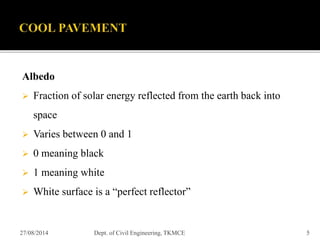
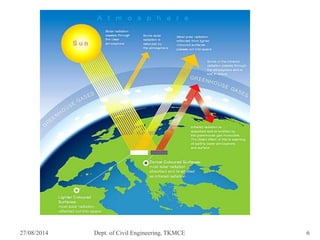
Albedo
 Fraction of solar energy reflected from the earth back into
space
 Varies between 0 and 1
 0 meaning black
 1 meaning white
 White surface is a “perfect reflector”
27/08/2014 5Dept. of Civil Engineering, TKMCE
27/08/2014 6Dept. of Civil Engineering, TKMCE
 Increase Pavement Surface Reflectance
 Increase Pavement Thermal Emission
 Increase Pavement Surface Convection
 Reduce Pavement Thermal Conductivity
 Reduce Pavement Heat Capacity
 Evaporation Cooling
 Shading Pavements
27/08/2014 7Dept. of Civil Engineering, TKMCE
 REFLECTIVE PAVEMENTS
 Increasing the solar reflectivity of a pavement surface
 Using surfacing materials of light colour or applying light
colour coating on dark surfacing materials
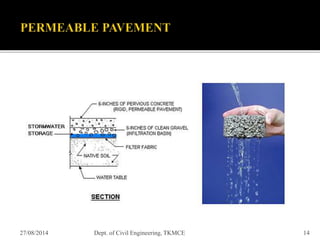
 PERMEABLE PAVEMENT
 Contains more air voids than conventional pavements
 Designed to allow water to drain through the surface into
the sub layers and down into the groundwater
27/08/2014 8Dept. of Civil Engineering, TKMCE
 Portland Cement Concrete Paving
 White-topping
 Asphalt Emulsion Sealcoats
 Asphalt Slurry Seals
 Asphalt Surface Coatings
 Resin Modified Emulsion Pavement
27/08/2014 9Dept. of Civil Engineering, TKMCE
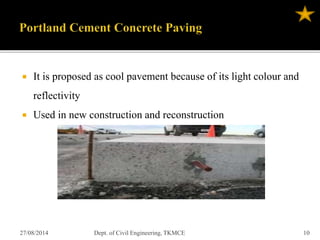
 It is proposed as cool pavement because of its light colour and
reflectivity
 Used in new construction and reconstruction
27/08/2014 Dept. of Civil Engineering, TKMCE 10
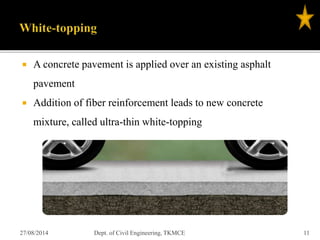
 A concrete pavement is applied over an existing asphalt
pavement
 Addition of fiber reinforcement leads to new concrete
mixture, called ultra-thin white-topping
27/08/2014 Dept. of Civil Engineering, TKMCE 11
 Fine aggregates in emulsion with an asphalt binder
 Brushed on over existing pavements
 Seal small cracks and protect the surfaces
Asphalt slurry seals
 Asphalt emulsion with graded aggregates
27/08/2014 Dept. of Civil Engineering, TKMCE 12
27/08/2014 Dept. of Civil Engineering, TKMCE 13
 binder made primarily from tree resins
 High strength and resistance to fuel spills
27/08/2014 Dept. of Civil Engineering, TKMCE 14
27/08/2014 15Dept. of Civil Engineering, TKMCE
 Pervious concrete pavement
 Porous asphalt
 Permeable interlocking concrete pavement
 Porous, gap-graded or enhanced porosity concrete
 Concrete with reduced sand or fines
 Reduced fines leave stable air pockets in the concrete
 Allows storm water to flow through the concrete
27/08/2014 16Dept. of Civil Engineering, TKMCE
 Pervious, popcorn or open-graded asphalt
 Standard hot-mix asphalt with reduced sand or fines
 Reduced fines leave stable air pockets in the concrete
 Allows storm water to flow through the asphalt
27/08/2014 Dept. of Civil Engineering, TKMCE 17
 Designed with small openings between permeable joints
27/08/2014 Dept. of Civil Engineering, TKMCE 18
 Water quality
 Noise
 Safety
 Nighttime illumination
27/08/2014 19Dept. of Civil Engineering, TKMCE
27/08/2014 Dept. of Civil Engineering, TKMCE 20
 Reflected illumination is proportional to solar reflection
27/08/2014 Dept. of Civil Engineering, TKMCE 21
 About 40% of urban surfaces are paved
 One reason for cities being hot is that have many dark
surfaces
 Cool surfaces are a cost-effective and simple way to achieve
reduced urban temperatures in pavements.
27/08/2014 Dept. of Civil Engineering, TKMCE 22
 Doulos, L., Santamouris, M., and Livada, I. (2004), “Passive cooling of outdoor
urban spaces. The role of materials.” Solar Energy, 77(2), 231–249.
 Santamouris M: Using cool pavements as a mitigation strategy to fight urban heat
island—A review of the actual developments. Renewable and Sustainable Energy
Reviews. In Press, 2013
 Jim Grove, Suneel vanikar and leif wathne, (2011).”Sustainability opportunities for
concrete pavements” Indian concrete journal, march 2011, volume 85, november3,
7-15
 Cambridge systematic.2005.cool pavement draft report prepared for Heat island
reduction initiative, U.S. Environmental Protection Agency.
 Patrica Romero Lankao (2008)”urban areas and climate change: Review of
Current issues and Trends”-issued paper for the 2011 Global report on Human
settlement –Ph D, Institute for the study of society and environment.
 case study_ Natural Stone Solar Reflectance Index and the Urban Heat Island
Effect prepared by the university of Tennessee centre for clean products –July 17
2009M
THANK YOU

Cool pavements

  • 1.
  • 2.
     INTRODUCTION  HEAT-ISLANDS  COOL PAVEMENT  TYPES OF COOL PAVEMENTS  BENEFITS OF COOL PAVEMENTS  CONCLUSION  REFERENCES 27/08/2014 2Dept. of Civil Engineering, TKMCE
  • 3.
     A meansof reducing UHI effect  Materials chosen to reduce pavement temperature  Either reflect solar energy or are porous  Store less heat  Economical – do not require new materials 27/08/2014 3Dept. of Civil Engineering, TKMCE
  • 4.
     Cities areoften warmer than rural areas  UHI is a microclimatic phenomenon which occurs in the metropolitan areas.  Results in temperature differences up to 10°C  Human activity, combined with dark pavements make cities hotter than surrounding rural areas. 27/08/2014 4Dept. of Civil Engineering, TKMCE
  • 5.
    Albedo  Fraction ofsolar energy reflected from the earth back into space  Varies between 0 and 1  0 meaning black  1 meaning white  White surface is a “perfect reflector” 27/08/2014 5Dept. of Civil Engineering, TKMCE
  • 6.
    27/08/2014 6Dept. ofCivil Engineering, TKMCE
  • 7.
     Increase PavementSurface Reflectance  Increase Pavement Thermal Emission  Increase Pavement Surface Convection  Reduce Pavement Thermal Conductivity  Reduce Pavement Heat Capacity  Evaporation Cooling  Shading Pavements 27/08/2014 7Dept. of Civil Engineering, TKMCE
  • 8.
     REFLECTIVE PAVEMENTS Increasing the solar reflectivity of a pavement surface  Using surfacing materials of light colour or applying light colour coating on dark surfacing materials  PERMEABLE PAVEMENT  Contains more air voids than conventional pavements  Designed to allow water to drain through the surface into the sub layers and down into the groundwater 27/08/2014 8Dept. of Civil Engineering, TKMCE
  • 9.
     Portland CementConcrete Paving  White-topping  Asphalt Emulsion Sealcoats  Asphalt Slurry Seals  Asphalt Surface Coatings  Resin Modified Emulsion Pavement 27/08/2014 9Dept. of Civil Engineering, TKMCE
  • 10.
     It isproposed as cool pavement because of its light colour and reflectivity  Used in new construction and reconstruction 27/08/2014 Dept. of Civil Engineering, TKMCE 10
  • 11.
     A concretepavement is applied over an existing asphalt pavement  Addition of fiber reinforcement leads to new concrete mixture, called ultra-thin white-topping 27/08/2014 Dept. of Civil Engineering, TKMCE 11
  • 12.
     Fine aggregatesin emulsion with an asphalt binder  Brushed on over existing pavements  Seal small cracks and protect the surfaces Asphalt slurry seals  Asphalt emulsion with graded aggregates 27/08/2014 Dept. of Civil Engineering, TKMCE 12
  • 13.
    27/08/2014 Dept. ofCivil Engineering, TKMCE 13  binder made primarily from tree resins  High strength and resistance to fuel spills
  • 14.
    27/08/2014 Dept. ofCivil Engineering, TKMCE 14
  • 15.
    27/08/2014 15Dept. ofCivil Engineering, TKMCE  Pervious concrete pavement  Porous asphalt  Permeable interlocking concrete pavement
  • 16.
     Porous, gap-gradedor enhanced porosity concrete  Concrete with reduced sand or fines  Reduced fines leave stable air pockets in the concrete  Allows storm water to flow through the concrete 27/08/2014 16Dept. of Civil Engineering, TKMCE
  • 17.
     Pervious, popcornor open-graded asphalt  Standard hot-mix asphalt with reduced sand or fines  Reduced fines leave stable air pockets in the concrete  Allows storm water to flow through the asphalt 27/08/2014 Dept. of Civil Engineering, TKMCE 17
  • 18.
     Designed withsmall openings between permeable joints 27/08/2014 Dept. of Civil Engineering, TKMCE 18
  • 19.
     Water quality Noise  Safety  Nighttime illumination 27/08/2014 19Dept. of Civil Engineering, TKMCE
  • 20.
    27/08/2014 Dept. ofCivil Engineering, TKMCE 20  Reflected illumination is proportional to solar reflection
  • 21.
    27/08/2014 Dept. ofCivil Engineering, TKMCE 21  About 40% of urban surfaces are paved  One reason for cities being hot is that have many dark surfaces  Cool surfaces are a cost-effective and simple way to achieve reduced urban temperatures in pavements.
  • 22.
    27/08/2014 Dept. ofCivil Engineering, TKMCE 22  Doulos, L., Santamouris, M., and Livada, I. (2004), “Passive cooling of outdoor urban spaces. The role of materials.” Solar Energy, 77(2), 231–249.  Santamouris M: Using cool pavements as a mitigation strategy to fight urban heat island—A review of the actual developments. Renewable and Sustainable Energy Reviews. In Press, 2013  Jim Grove, Suneel vanikar and leif wathne, (2011).”Sustainability opportunities for concrete pavements” Indian concrete journal, march 2011, volume 85, november3, 7-15  Cambridge systematic.2005.cool pavement draft report prepared for Heat island reduction initiative, U.S. Environmental Protection Agency.  Patrica Romero Lankao (2008)”urban areas and climate change: Review of Current issues and Trends”-issued paper for the 2011 Global report on Human settlement –Ph D, Institute for the study of society and environment.  case study_ Natural Stone Solar Reflectance Index and the Urban Heat Island Effect prepared by the university of Tennessee centre for clean products –July 17 2009M
  • 23.