IRC:6-2017
STANDARD SPECIFICATIONS
AND CODE OF PRACTICE
FOR ROAD BRIDGES
SECTION : II
LOADS AND LOAD COMBINATIONS
(SEVENTH REVISION)
INDIAN ROADS CONGRESS
2017
(The Official amendments to this document would be
published by the IRC in its periodical, ‘Indian Highways’
which shall be considered as effective and as part of the
code/guidelines/manual, etc. from the date specified therein)
(incorporating all amendments published upto October, 2019)
IRC: 6-2017
STANDARD SPECIFICATIONS AND
CODE OF PRACTICE FOR
ROAD BRIDGES
SECTION: II
LOADS AND LOAD COMBINATIONS
(SEVENTH REVISION)
(Incorporating all amendments published upto October, 2019)
Published by
Indian Roads Congress
Kama Koti Marg, Sector-6,
R.K. Puram New Delhi-110022
MARCH, 2017
Price ` 1000/-
(Plus Packing and postage charges)
IRC: 6-2017
First Published : December, 1958
Reprinted : May, 1962
Reprinted : September, 1963
Second Revision : October, 1964
Third Revision : Metric Units: October, 1966
Reprinted : October, 1967
Reprinted : November, 1969
Reprinted : March, 1972 (Incorporates Amendment No. 1-Nov. 1971)
Reprinted : February, 1974 (Incorporates Amendment No. 2-Nov. 1972)
Reprinted :	
August, 1974 (Incorporates Amendment No. 3-April. 1974 and No. 4-
August 1974)
Reprinted : July, 1977 (Incorporates Amendment No.5-October, 1976)
Reprinted :	
September, 1981 (Incorporates the changes as given in detail in the
last two sub-paras of introduction at page 3)
Reprinted : November, 1985
Reprinted : September, 1990
Reprinted : January, 1994
Reprinted : January, 1997
Reprinted : March, 1999
Fourth Revision : December, 2000
Reprinted : April, 2002 (Incorporates amended Fig. 5 at page 23)
Reprinted : August, 2004 (Incorporates up-to-date Amendments)
Reprinted : August, 2005
Reprinted : April, 2006
Reprinted : September, 2009 (Incorporates Amendment No. 6)
Fifth Revision : November, 2010
Sixth Revision : January, 2014 (Incorporates all Amendments and
			 Errata Published upto December, 2013)
Seventh Revision :	
March, 2017 (Incorporating all Amendments/Errata Published in
Indian Highways upto March, 2017)
Reprinted :	
September, 2019 (Incorporating all Amendments Published in
Indian Highways upto October, 2019)
(All Rights Reserved. No Part of this Publication shall be
reproduced, translated of transmitted in any form or by any
means without the permission of the Indian Roads Congress)
Printed by I. G. Printers Pvt. Ltd, New Delhi-110020
(600 Copies)
IRC: 6-2017
CONTENTS
Personnel of the Bridges Specifications and Standards Committee
		 Introduction 1
		 Scope 4
201 Classification 4
202 Loads, Forces and Load Effects 5
203 Dead Load 8
204 Live Loads 10
205 Reduction in the Longitudinal Effect on Bridges Accommodating 25
more than Two Traffic Lanes
206 Foot Over Bridges, Footway, Kerb, Railings, Parapet and Crash Barriers 25
207 Tramway Loading 29
208 Impact 31
209 Wind Load 33
210 Horizontal Forces due to Water Currents 40
211 Longitudinal Forces 43
212 Centrifugal Forces 47
213 Buoyancy 48
214 Earth Pressure 48
215 Temperature 56
216 Secondary Effects 59
217 Erection Effects and Construction Loads 59
218 Guidelines for Seismic Design of Road Bridges 60
219 Barge Impact on Bridges 74
220 Snow Load 80
221 Vehicle Collision Loads on Supports of Bridges, Flyover Supports 81
		 and Foot over Bridges
222 Indeterminate Structures and Composite Structures 82

Page
No.
IRC: 6-2017
ANNEXURES
ANNEXURES A: Hypothetical Vehicles for Classification of Vehicles and 84
		 Bridges (Revised)
ANNEXURES B: Combination of Loads for Limit State Design 87
ANNEXURES C: Wind Load Computation on Truss Bridge 98
		 Superstructure
ANNEXURES D: Simplified Formula for Time Period 100
ANNEXURES E: Classification of Inland Waterways in India 101
ANNEXURES F: Sate-wise Higest Maximum and Lowest Minimum Temperature 102
Page
No.
IRC: 6-2017
PERSONNEL OF THE BRIDGES SPECIFICATIONS AND STANDARDS COMMITTEE
(AS on 24th March, 2017)
1 Kumar, Manoj			 Director General (RD)  Spl. Secy. to Govt. of India,
					Ministry of Road Transport and Highways,
					Transport Bhavan, New Delhi
2 (Co-Convenor)		
Addl. Director General, Ministry of Road Transport and
Highways, Transport Bhavan, New Delhi
3 Nahar, Sajjan Singh		 Secretary General, Indian Roads Congress
(Member Secretary)
Members
4 Alam, Pervez			 COO HCC
5 Arora, D.S.			 JMD, UPSBCL
6 Bakshi, S.P.S.		 CMD Engg. Proj. (India)
7 Banerjee, A.K.			 Chief Engineer (Reted.) MoRTH, New Delhi
8 Banerjee, Sushim		 DG, INSDAG
9 Bansal, Shishir		 CPM, DTTDC Ltd.
10 Basa, Ashok			 MD, CEM Engg.  Consultancy (P) Ltd.
11 Bhowmick, Alok		 MD, BSECPL
12 Bordoloi, A.C.			 Commissioner, PWD Assam (MGC)
13 Chand, Faqir			 Advisor, STUP
14 Dheeraj			 Superintending Engineer, MoRTH
15 Dohare, R.D.			 Chief Engineer (Reted.), MoRTH
16 Ghoshal, A.			 Director and Vice President, STUP Consultants (P) Ltd. Kolkata
17 Gupta, Dr. Supratic		 Asst. Prof., IIT Delhi
18 Heggade, V.N.			 Sr. VP Gammon India Ltd.
19 Joshi, Brig. Girish (Rep.) Engineer-in-Chief, MES
20 Khanna, Shobha		 Executive Engineer, PWD Ujjain, M.P.
21 Kondai, Bikshapathi		 Engineer-in-Chief (RB), QC, Telangana
22 Kumar, Ashwani		 Superintending Engineer, MoRTH
23 Kumar, Satander		 Scientist (Retd.), CRRI
24 Pandey, A.K.			 Superintending Engineer, MoRTH
25 Parameswaran, Dr. Lakshmy Chief Scientist (BAS), CRRI, New Delhi
26 Patankar, V.L			 DG(RD)  SS, (Retd.) MoRTH New Delhi
27 Pateriya, Dr. I.K.		 Director, NRRDA
i
IRC: 6-2017
ii
28 Porwal, Dr. S.S.		 (Immediate past President, IRC) ADG, BRO
29 Puri, S.K. 			 DG(RD) SS, (Retd.) MoRTH New Delhi
30 Raina, Dr. V.K.			 Consultant, World Bank
31 Raizada. Pratap S.		 Vice President (Corporate Affairs). Gammon India Ltd. Mumbai
32 Sharan, G.			 DG (RD) Spl. Secy (Retd.) MoRTH, New Delhi
33 Sharma, M.P.			 Member (Tech.), NHAI
34 Sharma, R.S.			 Chief Engineer (Retd.) MoRTH, New Delhi
35 Shekhar, Saurav		 SA Infra Consultants Pvt. Ltd.
36 Sinha, N.K.			 DG(RD) SS, (Retd.) MoRTH New Delhi
37 Srivastava, A.K. 		 Chief Engineer, MoRTH
38 Subbarao, Dr. Harshavardhan	
Chairman  Managing Director, Construma Consultancy
(P) Ltd. Mumbai
39 Tandon, Prof. Mahesh		 Managing Director, Tandon Consultants (P) Ltd., New Delhi
40 Verma, G.L. 			 MD, Engg. Planning Consultant
Corresponding Members
1 Kand, Sunil C.			 Director, C.V Kand Consultant
2 Koshi, Ninan			 DG(RD)SS,(Retd.) MoRTH New Delhi
3 Manjure, P.Y.			 Directoc, FPCC Ltd.
4 Reddi, Dr. S.A.		 Former JMD GIL
5 lyer. Prof. Nagesh R. 		 Director, SERC, TN
Ex-Officio Members
1 (Porwal, S.S.) 			 President, Indian Roads Congress, ADG, BRO
2 (Kumar, Manoj) 		
Director General (Road Development) Special Secretary,
Ministry of Road Transport and Highways  Honorary Treasurer,
Indian Roads Congress, New Delhi
3 Nahar, Sajjan Singh 		 Secretary General, Indian Roads Congress, New Delhi
1
IRC: 6-2017
STANDARD SPECIFICATIONS AND CODE OF
PRACTICE FOR ROAD BRIDGES
INTRODUCTION
The brief history of the Bridge Code given in the Introduction to Section I “General
Features of Design” generally applies to Section II also. The draft of Section II for “Loads
and Stresses”, as discussed at Jaipur Session of the Indian Roads Congress in 1946,
was considered further in a number of meetings of the Bridges Committee for finalisation.
In the years 1957 and 1958, the work of finalisin the draft was pushed on vigorously by
the Bridges Committee.
In the Bridges Committee meeting held at Bombay in August 1958, all the comments
received till then on the different clauses of this Section were disposed off finally and a
drafting Committee consisting of S/Shri S.B. Joshi, K.K. Nambiar, K.F. Antia and S.K.
Ghosh was appointed to work in conjunction with the officers of the Roads Wing of the
Ministry for finalising this Section.
This Committee at its meeting held at New Delhi in September 1958 and later through
correspondences finalized Section II of the Bridge Code, which was printed in 1958 and
reprinted 1962 and 1963.
The Second Revision of Section II of the IRC:6 Code (1954 edition) included all the
amendments, additions and alterations made by the Bridges Specifications and Standards
(BSS) Committee in their meetings held from time to time.
The Executive Committee of the Indian Roads Congress approved the publication of the
third Revision in metric units in 1966.
The Fourth Revision of Section II of the Code (2000 Edition) included all the amendments,
additions and alterations made by the BSS Committee in their meetings held from time to
time and was reprinted in 2002 with Amendment No. 1 reprinted in 2004 with Amendment
No. 2 and again reprinted in 2006 with Amendment Nos. 3,4 and 5.
The Bridges Specifications and Standards Committee and the IRC Council at various
meetings approved certain amendments viz. Amendments No. 6 of November 2006
relating to Sub-Clauses 218.2, 222.5, 207.4 and Appendix-2, Amendment No. 7
of February 2007 relating to Sub-Clauses of 213.7, Note 4 of Appendix-I and 218.3,
Amendment No. 8 of January 2008 relating to Sub-Clauses 214.2(a), 214.5.1.1 and
214.5.2 and new Clause 212 on Wind load.
2
IRC: 6-2017
As approved by the BSS Committee and IRC Council in 2008, the Amendment No.
9 of May 2009 incorporating changes to Clauses 202.3, 208, 209.7 and 218.5 and
Combination of Loads for limit state design of bridges has been introduced in Appendix-3,
apart from the new Clause 222 on Seismic Force for design of bridges.
The Bridges Specifications and Standards Committee in its meeting held on 26th October,
2009 further approved certain modifications to Clause 210.1, 202.3, 205, Note below
Clause 208, 209.1, 209.4, 209.7, 222.5.5, Table 8, Note below Table 8, 222.8, 222.9,
Table 1 and deletion of Clause 213.8, 214.5.1.2 and Note below para 8 of Appendix-3.
The Convenor of B-2 Committee was authorized to incorporate these modifications in
the draft for Fifth Revision of IRC:6, in the light of the comments of some members. The
Executive Committee, in its meeting held on 31st October, 2009, and the IRC Council in
its 189th
meeting held on 14th
November, 2009 at Patna approved publishing of the Fifth
Revision of IRC: 6.
The 6th
Revision of IRC: 6 includes all the amendments and errata published from
time to time upto December, 2013. The revised edition of IRC was approved by the
Bridges Specifications and Standards Committee in its meeting held on 06.01.2014 and
Executive Committee meeting held on 09.01.2014 for publishing.
The 7th
revision of IRC: 6-2017, includes all amendments and errata published in Indian
Highways up to March 2017. The Bridges Specifications and Standards Committee (BSS)
in its meeting held on 20 September, 2016 at IRC HQ New Delhi approved the draft
IRC-6 (7th Revision) with the observations to fine-tune the title as “Loads and Loads
Combination” instead of “Loads  Stresses” in order to bring the functional harmony
of the code. The draft IRC-6 (7th Revision) approved by the BSS was placed to the
Council in its meeting held on 26 September 2016 during the 209th
Mid-term Council
meet at Kumarakom (Kerela) and approved the document subject to the compliance to
the observations of the learned members.
3
IRC: 6-2017
The personnel of the Loads and Stresses Committee (B-2) is given below:
		Banerjee, A.K.		......		Convenor
		Parameswaran,		......		Co-Convenor
		 (Mrs.) Dr. Lakshmy
		Sharma, Aditya		......		Member Secretary
Members
		Bandyopadhyay, N.			Mathur, A.K.
		Bhowmick, Alok				Mukherjee, M.K.
		Dheeraj					Pandey, Alok
		Dhodapkar, A.N.				Puri, S.K.
		Garg, Dr Sanjeev				Rao, M.V.B
		Gupta, Vinay				Saha, Dr G.P.
		Huda, Y.S.					Sharan, G.
		 Jain, Sanjay Kumar			 Thakkar, Dr. S.K.
		Joglekar, S.G.				Venkatram, P.G.
		Kanhere, D.K.				Verma, G.L.
		Kumar, Ashok				Viswanathan, T.
Corresponding Members
		Heggade, V.N.				Murthy, Dr. M.V Ramana
		 Jain, Dr. Sudhir K.				 Subbarao, Dr. H.
Ex-officio Members
		 Porwal, S.S.			
President, Indian Roads Congress ADG, BRO
		 Das. S.N.			
Director General (Road Development)  Special
Secretary, Ministry of Road Transport and
Highways  Honorary Treasurer, Indian Roads
Congress, New Delhi
		 Nahar, Sajjan		 Secretary General, Indian Roads			
		Singh				Congress, New Delhi
4
IRC: 6-2017
SCOPE
The object of the Standard Specifications and Code of Practice is to establish a
common procedure for the design and construction of road bridges in India. This

publication is meant to serve as a guide to both the design engineer and the construction
engineer but compliance with the rules therein does not relieve them in any way of their
responsibility for the stability and soundness of the structure designed and erected by
them. The design and construction of road bridges require an extensive and through
knowledge of the science and technique involved and should be entrusted only to
specially qualified engineers with adequate practical experience in bridge engineering
and capable of ensuring careful execution of work.
201 CLASSIFICATION
201.1 Road bridges and culverts shall be divided into classes according to the
loadings they are designed to carry.
IRC CLASS 70R LOADING: This loading is to be normally adopted on all roads on
which permanent bridges and culverts are constructed. Bridges designed for Class 70R.
Loading should be checked for Class A Loading also as under certain conditions, heavier
stresses may occur under Class A Loading.
IRC CLASS AA LOADING: This loading is to be adopted within certain municipal limits,
in certain existing or contemplated industrial areas, in other specified areas, and along
certain specified highways. Bridges designed for Class AA Loading should be checked
for Class A Loading also, as under certain conditions, heavier stresses may occur under
Class A Loading.
IRC CLASS A LOADING: This loading is to be normally adopted on all roads on which
permanent bridges and culverts are constructed.
IRC CLASS B LOADING: This loading is to be normally adopted for timber bridges.
IRC CLASS SPECIAL VEHICLE (SV) LOADING: This loading is to be adopted for
design of new bridges in select corridors as may be decided by concerned authorities
where passage of trailer vehicles carrying stator units, turbines, heavy equipment and
machinery may occur occasionally. This loading represents a spectrum of special vehicles
in the country and should be considered for inclusion in the design wherever applicable.
For particulars of the above five types of loading, see Clause 204.
5
IRC: 6-2017
201.2 Existing bridges which were not originally constructed or later strengthened
to take one of the above specified I.R.C. Loadings will be classified by giving each a
number equal to that of the highest standard load class whose effects it can safely
withstand.
Annex A gives the essential data regarding the limiting loads in each bridge’s class, and
forms the basis for the classification of bridges.
201.3 Individual bridges and culverts designed to take electric tramways or other
special loadings and not constructed to take any of the loadings described in Clause 201.1
shall be classified in the appropriate load class indicated in Clause 201.2.
202 LOADS, FORCES AND LOAD EFFECTS
202.1 The loads, forces and load effects to be considered in designing road bridges
and culverts are :
1) Dead Load G
2) Live Load Q
3)	Snow Load Gs
		 (See note i)
4) Impact factor on vehicular live load Qim
5) Impact due to floating bodies or Vessels as the Fim
		 cases may be
6) Vehicle collision load VC
7) Wind load W
8) Water current Fwc
9) Longitudinal forces caused by tractive effort of Fa
/Fb
/Ff
		
vehicles or by braking of vehicles and/or those
		 caused by restraint of movement of free
		 bearings by friction or deformation
10) Centrifugal force Fcf
11) Buoyancy Gb
12) Earth Pressure including live load surcharge, if Fep
		any
13) Temperature effects (see note ii) Fte
14) Deformation effects Fd
6
IRC: 6-2017
15) Secondary effects FS
16) Erection effects Fer
17) Seismic force Feq
18) Wave pressure (see note iii) Fwp
19) Grade effect (see note iv) Ge
Notes :
1.	
The snow loads may be based be based on actual observation or past
records in the particular area or local practices, if existing.
2.	
Temperature effects (Fte
) in this context is not the frictional force due to the
movement of bearing but forces that are caused by the restraint effects.
3.	
The wave forces shall be determined by suitable analysis considering
drawing and inertia forces etc. on single structural members based on rational
methods or model studies. In case of group of piles, piers etc., proximity
effects shall also be considered.
4.	
For bridges built in grade or cross-fall, the bearings shall normally be set
level by varying the thickness .of the plate situated between the upper
face of the bearing and lower face of the beam or by any other suitable
arrangement. However, where the bearings are required to be set parallel to
the inclined grade or cross-fall of the superstructure, an allowance shall be
made for the longitudinal and transverse components of the vertical loads on
the bearings.
202.2		 All members shall be designed to sustain safely most critical combination of
various loads, forces and stresses that can co-exist and all calculations shall tabulate
distinctly the various combinations of the above loads and stresses covered by the
design. Besides temperature, effect of environment on durability shall be considered as
per relevant codes.
202.3		 Combination of Loads and Forces and Permissible Increase in Stresses
The load combination shown in Table 1 shall be adopted for masonry and timber bridges
for working out stresses in the members. The permissible increase of stresses in various
members due to these combinations is also indicated therein. These combinations
of forces are not applicable for working out base pressure on foundations for which
provision made in relevant IRC Bridge Code shall be adopted. For calculating stresses in
members using working stress method of design the load combination shown in Table 1
shall be adopted.
The load combination as shown in Annex B shall be adopted for limit state design approach.
7
IRC: 6-2017
e
e
:
8
IRC: 6-2017
Notes:
1)	
*Where Snow Load is applicable, Clause 221 shall be referred for combination of snow load
and live load
2)	
Any load combination involving temperature, wind and/or earthquake acting independently
or in combination, maximum permissible tensile stress in Prestressed Concrete Members
shall be limited to the value as per relevant Code (IRC:112).
3)	
Use of fractional live load shown in Table 1 is applicable only when the design live load
given in Table 6 is considered. The structure must also be checked with no live load.
4)	
The gradient effect due to temperature is considered in the load combinations IIB and IIIB.
The reduced live load (Q) is indicated as 0.5. Its effects (Fa
, Fb
and Fcf
) are also shown as
0.5, as 0.5 stands for the reduced live load to be considered in this case. However for Ff
it is
shown as 1, since it has effects of dead load besides reduced live load. Qim
being a factor of
live load as shown as 1. Whenever a fraction of live load 0.5 shown in the above Table under
column Q is specified, the associated effects due to live load (Qim
Fa
, Fb
, Ff
and Fcf
) shall be
considered corresponding to the associated fraction of live load. When the gradient effect is
considered, the effects, if any due to overall rise of fall of temperature of the structure shall
also be considered.
5)	
Seismic effect during erection stage is reduced to half in load combination IX when
construction phase does not exceed 5 years.
6)	
The load combinations (VIII and IX) relate to the construction stage of a new bridge. For
repair, rehabilitation and retrofitting, the load combination shall be project-specific.
7) Clause 219.5.2 may be referred to, for reduction of live load in Load Combination VI.
203 DEAD LOAD
The dead load carried by a girder or member shall consist of the portion of the weight
of the superstructure (and the fixed loads carried thereon) which is supported wholly
or in part by the girder or member including its own weight. The following unit weights
of materials shall be used in determining loads, unless the unit weights have been
determined by actual weighing of representative samples of the materials in question, in
which case the actual weights as thus determined shall be used.
		
Materials Weight (t/m3
)
1) Ashlar (granite)		 2.7
2) Ashlar (sandstone)		 2.4
3) Stone setts :
		 a) Granite		 2.6
		 b) Basalt 		 2.7
9
IRC: 6-2017
4)	
Ballast (stone screened, broken, 2.5 cm to 7.5 cm
guage, loose):
		 a) Granite		 1.4
		 b) Basalt		 1.6
5) Brickwork (pressed) in cement mortar		 2.2
6) Brickwork (common) in cement mortar		 1.9
7) Brickwork (common) in lime mortar		 1.8
8) Concrete (asphalt)		 2.2
9) Concrete (breeze)		 1.4
10) Concrete (cement-plain)		 2.5
11) Concrete (cement — plain with plums)		 2.5
12) Concrete (cement-reinforced)		 2.5
13) Concrete (cement-prestressed)		 2.5
14) Concrete (lime-brick aggregate)		 1.9
15) Concrete (lime-stone aggregate)		 2.1
16) Earth (compacted)		 2.0
17) Gravel		 1.8
18) Macadam (binder premix)		 2.2
19) Macadam (rolled)		 2.6
20) Sand (loose)		 1.4
21) Sand (wet compressed)		 1.9
22) Coursed rubble stone masonry (cement mortar) 2.6
23) Stone masonry (lime mortar)		 2.4
24) Water		 1.0
25) Wood		 0.8
26) Cast iron		 7.2
27) Wrought iron		 7.7
28) Steel (rolled or cast)		 7.8
10
IRC: 6-2017
204 LIVE LOADS
204.1 Details of I.R.C. Loadings
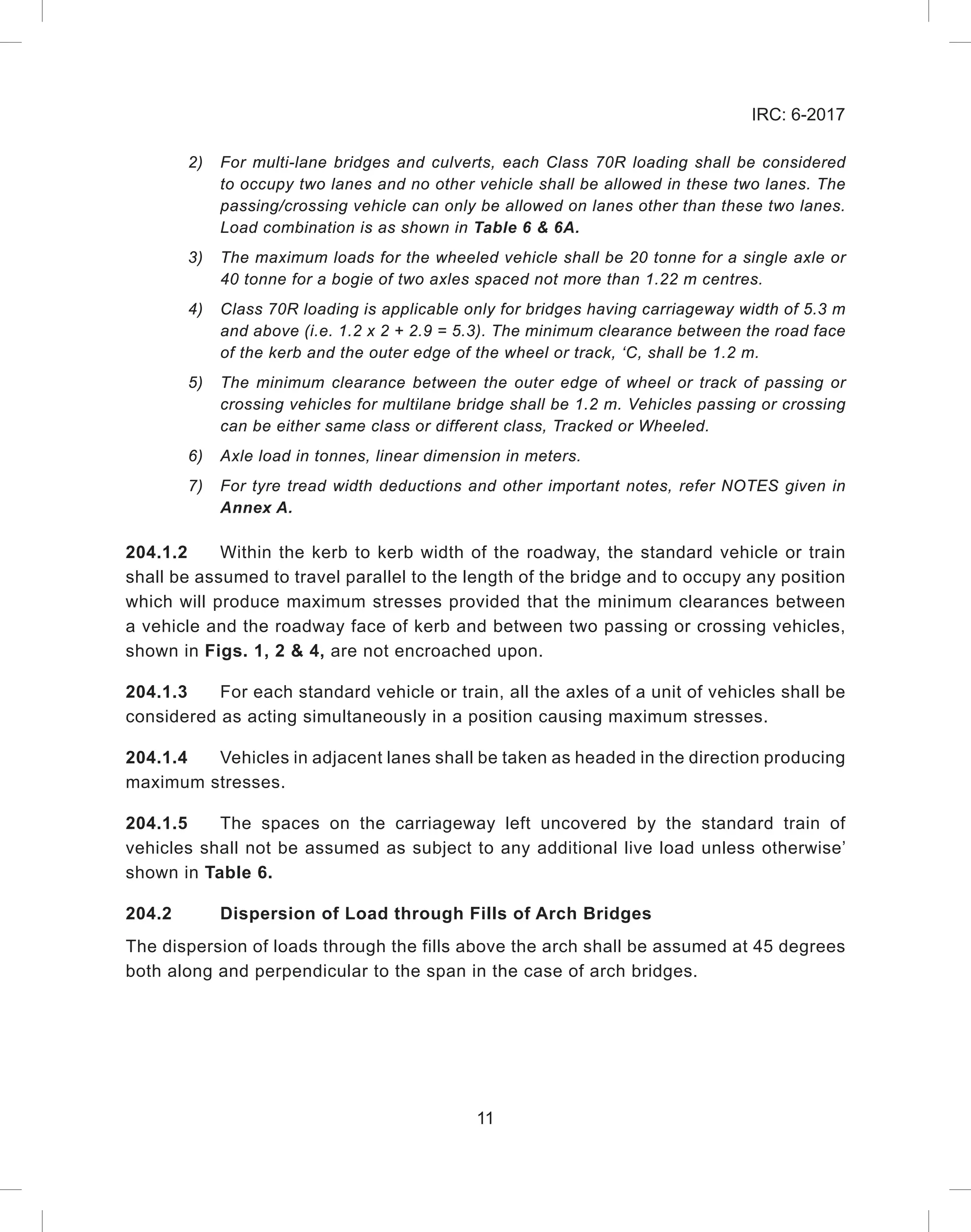
204.1.1 For bridges classified under Clause 201.1, the design live load shall consist of
standard wheeled or tracked vehicles or trains of vehicles as illustrated in Figs. 1, 2  4
and Annex A or Special Vehicle (SV) as per Clause 204.5, if applicable. The trailers
attached to the driving unit are not to be considered as detachable.
WHEEL ARRANGEMENT FOR 70R (WHEELED VEHICLE)
WHEEL ARRANGEMENT FOR 70R (TRACKED) VEHICLE
Fig. 1: Class 70R Wheeled and Tracked Vehicles (Clause 204.1)
Notes:
1)	
The nose to tail spacing between two successive vehicles shall not be less than 90 m for
tracked vehicle. For wheeled vehicle, spacing between successive vehicles shall not be
less than 30 m. It will be measured from the centre of the rear-most axle of the leading
vehicle to the centre of the first axle of the following vehicle.
11
IRC: 6-2017
2)	
For multi-lane bridges and culverts, each Class 70R loading shall be considered
to occupy two lanes and no other vehicle shall be allowed in these two lanes. The
passing/crossing vehicle can only be allowed on lanes other than these two lanes.
Load combination is as shown in Table 6  6A.
3)	
The maximum loads for the wheeled vehicle shall be 20 tonne for a single axle or
40 tonne for a bogie of two axles spaced not more than 1.22 m centres.
4)	
Class 70R loading is applicable only for bridges having carriageway width of 5.3 m
and above (i.e. 1.2 x 2 + 2.9 = 5.3). The minimum clearance between the road face
of the kerb and the outer edge of the wheel or track, ‘C, shall be 1.2 m.
5)	
The minimum clearance between the outer edge of wheel or track of passing or
crossing vehicles for multilane bridge shall be 1.2 m. Vehicles passing or crossing
can be either same class or different class, Tracked or Wheeled.
6)	
Axle load in tonnes, linear dimension in meters.
7)	
For tyre tread width deductions and other important notes, refer NOTES given in
Annex A.
204.1.2 Within the kerb to kerb width of the roadway, the standard vehicle or train
shall be assumed to travel parallel to the length of the bridge and to occupy any position
which will produce maximum stresses provided that the minimum clearances between
a vehicle and the roadway face of kerb and between two passing or crossing vehicles,
shown in Figs. 1, 2  4, are not encroached upon.
204.1.3 For each standard vehicle or train, all the axles of a unit of vehicles shall be
considered as acting simultaneously in a position causing maximum stresses.
204.1.4 Vehicles in adjacent lanes shall be taken as headed in the direction producing
maximum stresses.
204.1.5 The spaces on the carriageway left uncovered by the standard train of
vehicles shall not be assumed as subject to any additional live load unless otherwise’
shown in Table 6.
204.2		 Dispersion of Load through Fills of Arch Bridges
The dispersion of loads through the fills above the arch shall be assumed at 45 degrees
both along and perpendicular to the span in the case of arch bridges.
12
IRC: 6-2017
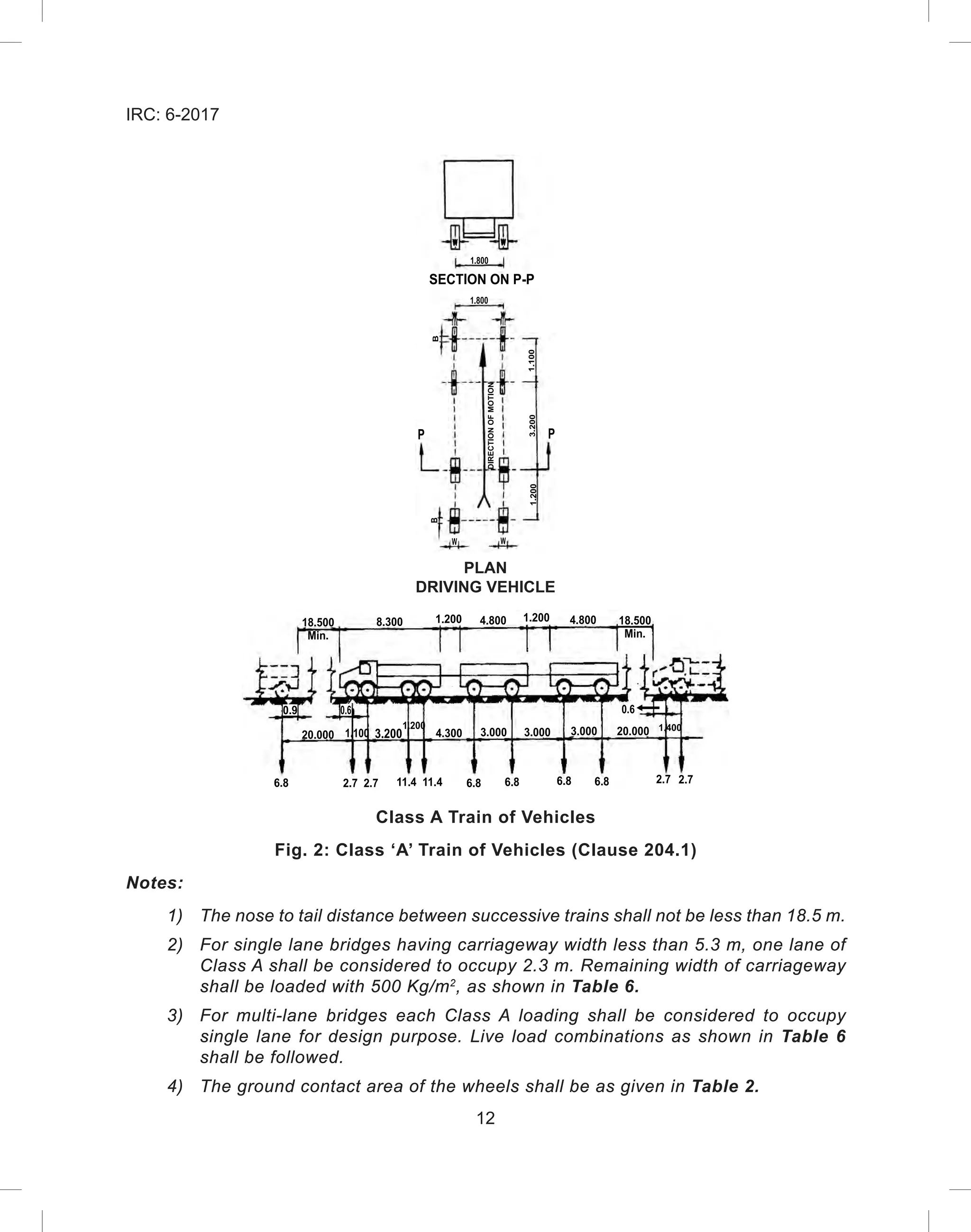
Class A Train of Vehicles
Fig. 2: Class ‘A’ Train of Vehicles (Clause 204.1)
Notes:
1) The nose to tail distance between successive trains shall not be less than 18.5 m.
2) 	
For single lane bridges having carriageway width less than 5.3 m, one lane of
Class A shall be considered to occupy 2.3 m. Remaining width of carriageway
shall be loaded with 500 Kg/m2
, as shown in Table 6.
3) 	
For multi-lane bridges each Class A loading shall be considered to occupy
single lane for design purpose. Live load combinations as shown in Table 6
shall be followed.
4) The ground contact area of the wheels shall be as given in Table 2.
PLAN
DRIVING VEHICLE
13
IRC: 6-2017
Table 2: Ground Contact Dimensions for Class A Loading
Axle load (tonne)
Ground contact area
B (mm) W (mm)
11.4 250 500
6.8 200 380
2.7 150 200
Fig. 3: Minimum Clearance for 2 Class A Train Vehicles
5)	
The minimum clearance, f, between outer edge of the wheel and the roadway
face of the kerb and the minimum clearance, g, between the outer edges of
passing or crossing vehicles on multi-lane bridges shall be as given in Table 3.
Table 3: Minimum Clearance for Class A Train Vehicle
Clear carriageway width g f
5.3 m(*) to 6.1 m(**)
Varying between 0.4 m to
1.2 m 150 mm for all
carriageway widths
Above 6.1 m 1.2 m
(*) = [2x(1.8+0.5)+0.4+2x0.15]
(**)= [2x(1.8+0.5)+1.2+2x0.15]
6) Axle loads in tonne. Linear dimensions in metre.
W W W W
14
IRC: 6-2017
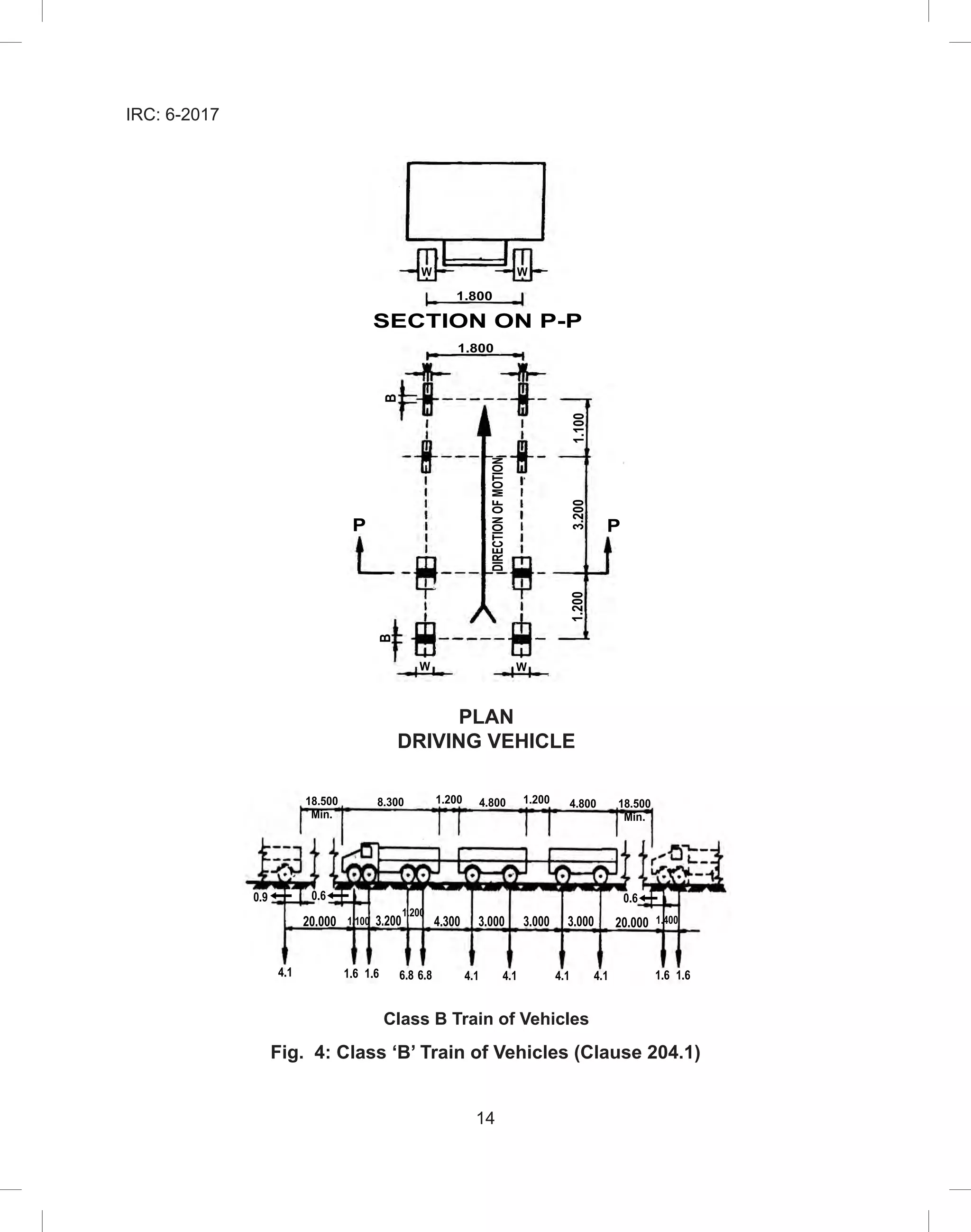
PLAN
DRIVING VEHICLE
Class B Train of Vehicles
Fig. 4: Class ‘B’ Train of Vehicles (Clause 204.1)
15
IRC: 6-2017
Notes:
1)	
The nose to tail distance between successive trains shall not be less than 18.5 m.
2)	
No other live load shall cover any part of the carriageway when a train of vehicles
(or trains of vehicles in multi-lane bridge) is crossing bridge.
3) The ground contact area of the wheels shall be as given in Table 4.
Table 4: Ground Contact Dimensions for Class B Loading
Axle load (tonne)
Ground contact area
B (mm) W (mm)
6.8 200 380
4.1 150 300
1.6 125 175
Fig. 5: Minimum Clearance for 2 Class B Train
4)	For bridges having carriageway width less than 5.06 m, only single lane of Class B
loading shall be considered.
5)	
The minimum clearances, f, between outer edge of the wheel and the roadway
face of the kerb and the minimum clearance, g, between the outer edges of
passing or crossing vehicles on multi-lane bridges shall be as given in Table 5
6) Axle loads in tonne. Linear dimensions in metre
Table 5: Minimum Clearance for Class B Train
Clear carriageway width g f
5.06 m(*) to 5.86 m(**)
Varying between 0.4 m to
1.2 m 150 mm for all
carriageway widths
Above 5.86 m 1.2 m
(*) = [2x(1.8+0.38)+0.4+2x0.15]
(**)= [2x(1.8+0.38)+1.2+2x0.15]
W W W W
16
IRC: 6-2017
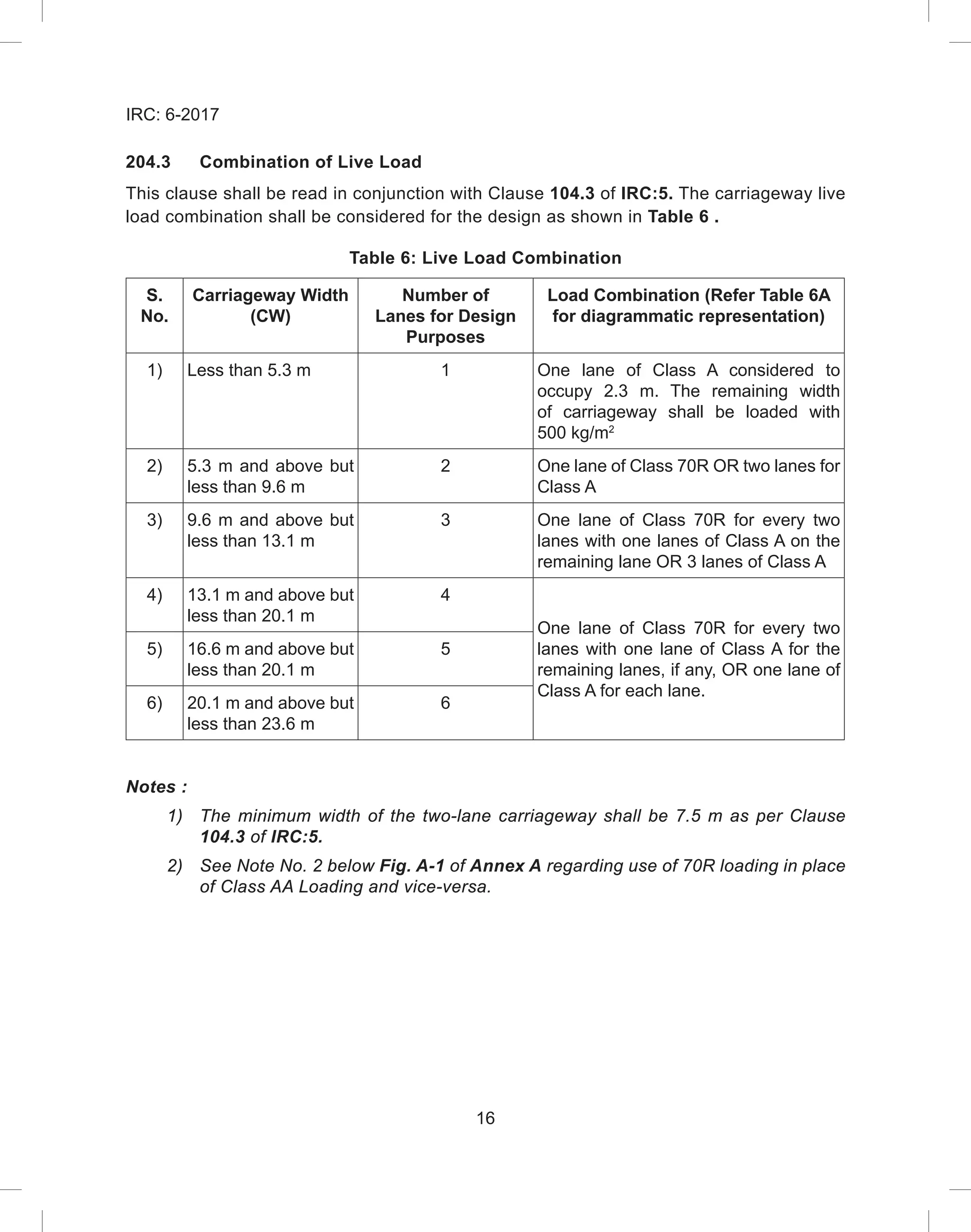
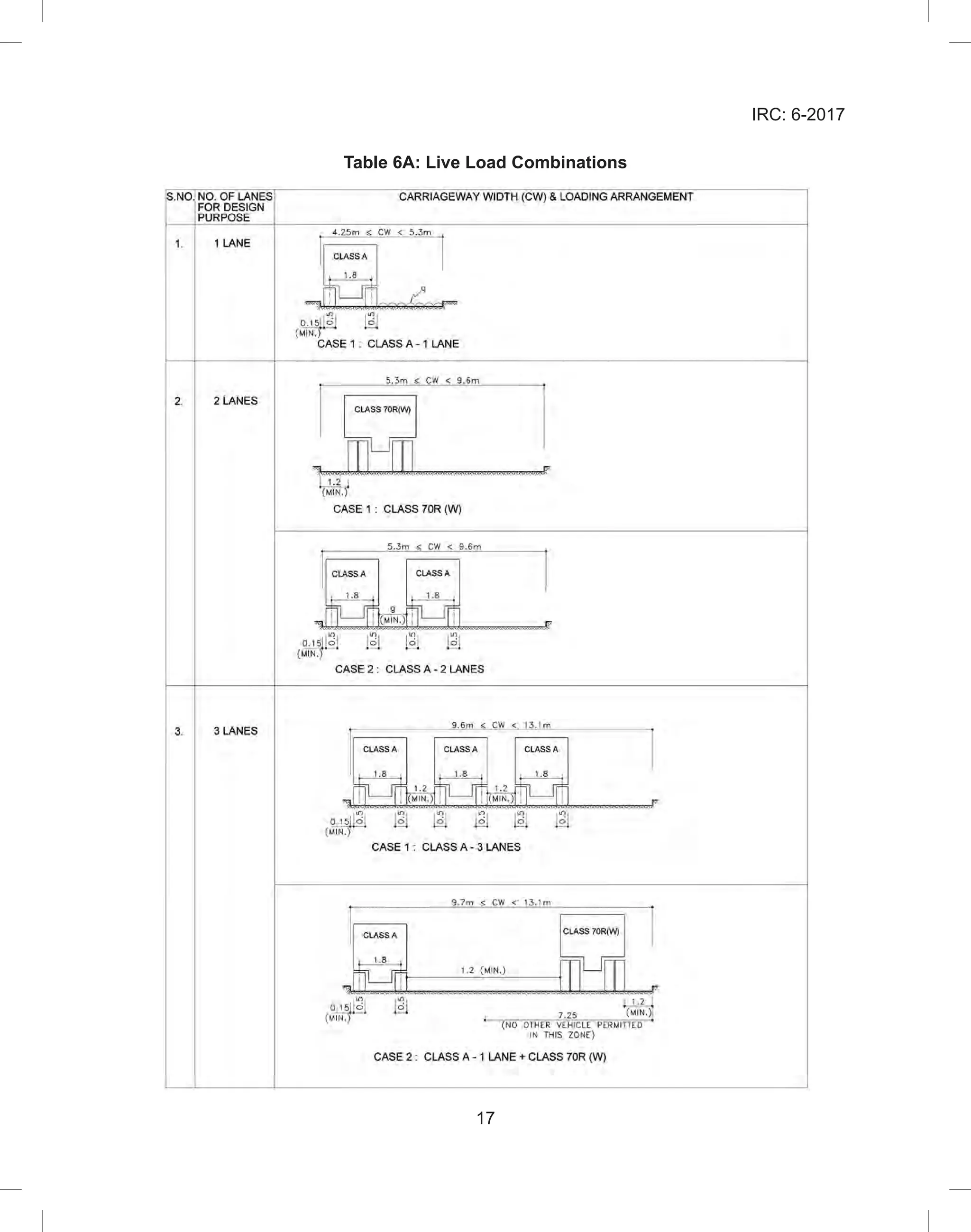
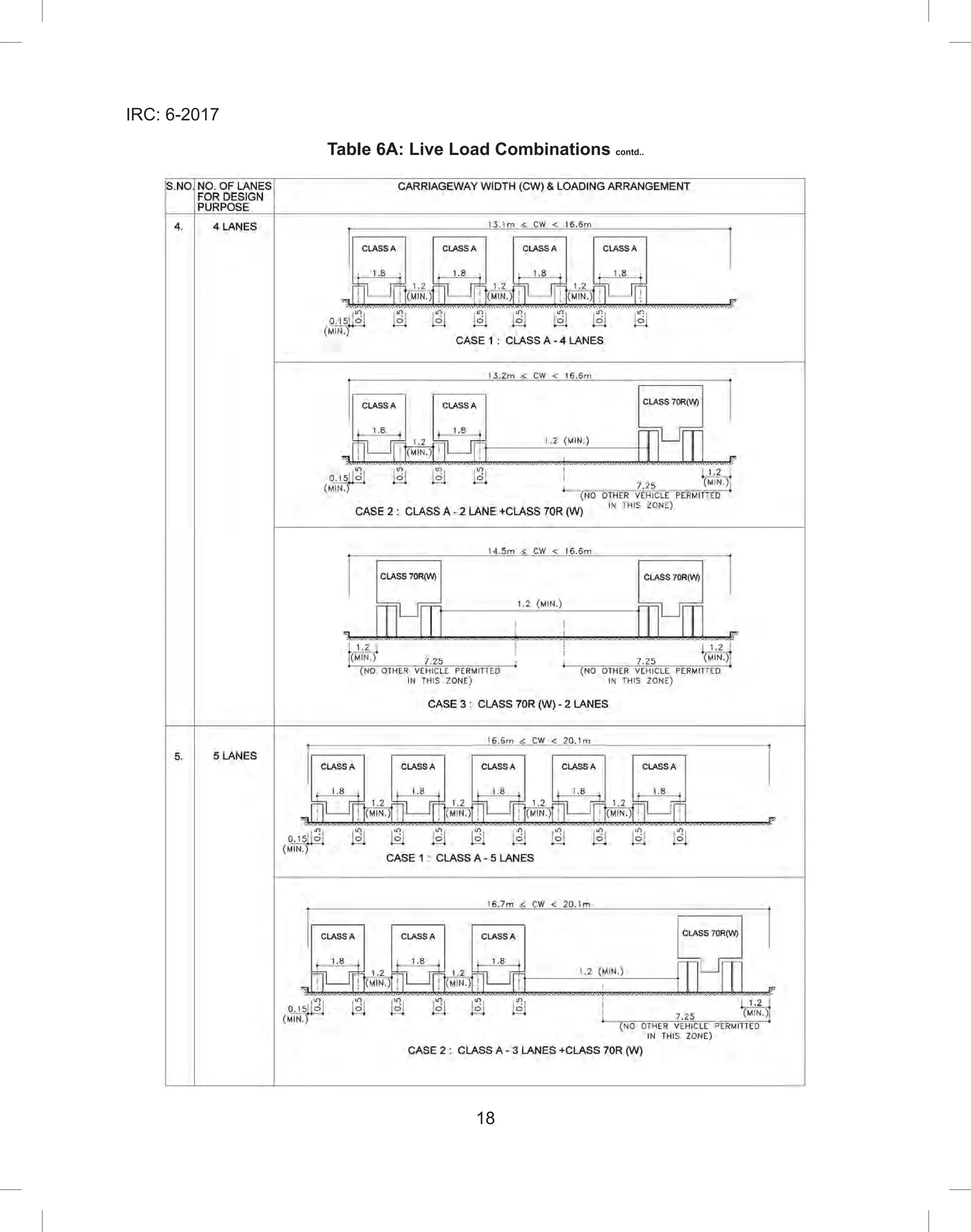
204.3 Combination of Live Load
This clause shall be read in conjunction with Clause 104.3 of IRC:5. The carriageway live
load combination shall be considered for the design as shown in Table 6 .
Table 6: Live Load Combination
S.
No.
Carriageway Width
(CW)
Number of
Lanes for Design
Purposes
Load Combination (Refer Table 6A
for diagrammatic representation)
1) Less than 5.3 m 1 One lane of Class A considered to
occupy 2.3 m. The remaining width
of carriageway shall be loaded with
500 kg/m2
2) 5.3 m and above but
less than 9.6 m
2 One lane of Class 70R OR two lanes for
Class A
3) 9.6 m and above but
less than 13.1 m
3 One lane of Class 70R for every two
lanes with one lanes of Class A on the
remaining lane OR 3 lanes of Class A
4) 13.1 m and above but
less than 20.1 m
4
One lane of Class 70R for every two
lanes with one lane of Class A for the
remaining lanes, if any, OR one lane of
Class A for each lane.
5) 16.6 m and above but
less than 20.1 m
5
6) 20.1 m and above but
less than 23.6 m
6
Notes :
1)	
The minimum width of the two-lane carriageway shall be 7.5 m as per Clause
104.3 of IRC:5.
2)	
See Note No. 2 below Fig. A-1 of Annex A regarding use of 70R loading in place
of Class AA Loading and vice-versa.
17
IRC: 6-2017
Table 6A: Live Load Combinations
18
IRC: 6-2017
Table 6A: Live Load Combinations contd..
19
IRC: 6-2017
Table 6A: Live Load Combinations contd..
20
IRC: 6-2017
Table 6A: Live Load Combinations contd..
Notes:
a)	
Class 70R Wheeled loading in the Table 6  6A can be replaced by Class 70R
tracked, Class AA tracked or Class AA wheeled vehicle.
b)	
Maximum number of vehicles which can be considered, are only shown in the
Table 6A. In case minimum number of vehicles govern the design (e.g. torsion)
the same shall also be considered.
c) All dimensions in Table 6A are in metre.
204.4 Congestion Factor
For bridges, Flyovers/grade separators close to areas such as ports, heavy industries and
mines and any other areas where frequent congestion of heavy vehicles may occur, as
may be decided by the concerned authorities, additional check for congestion of vehicular
live load on the carriageway shall be considered. Congestion factor shall not be applicable
in load combination with SV loading. In the absence of any stipulated value, the congestion
factor, as mentioned in Table 7 shall be considered as multiplying factor on the global
effect of vehicular live load (including impact). Under this condition, horizontal force due
to braking/acceleration, centrifugal action, temperature effect and effect of transverse
eccentricity of live load shall not be included.
21
IRC: 6-2017
Table 7: Congestion Factor
Sl. No. Span Range Congestion Factor
1) Above 10 m and upto 30 m 1.15
2) 30.0 m to 40.0 m 1.15 to 1.30
3) 40.0 m to 50.0 m 1.30 to 1.45
4) 50.0 m to 60.0 m 1.45 to 1.60
5) 60.0 m to 70.0 m 1.60 to 1.70
6) Beyond 70.0 m 1.70
Note : For Intermediate bridge spans, the value of congestion factor may be interpolated.
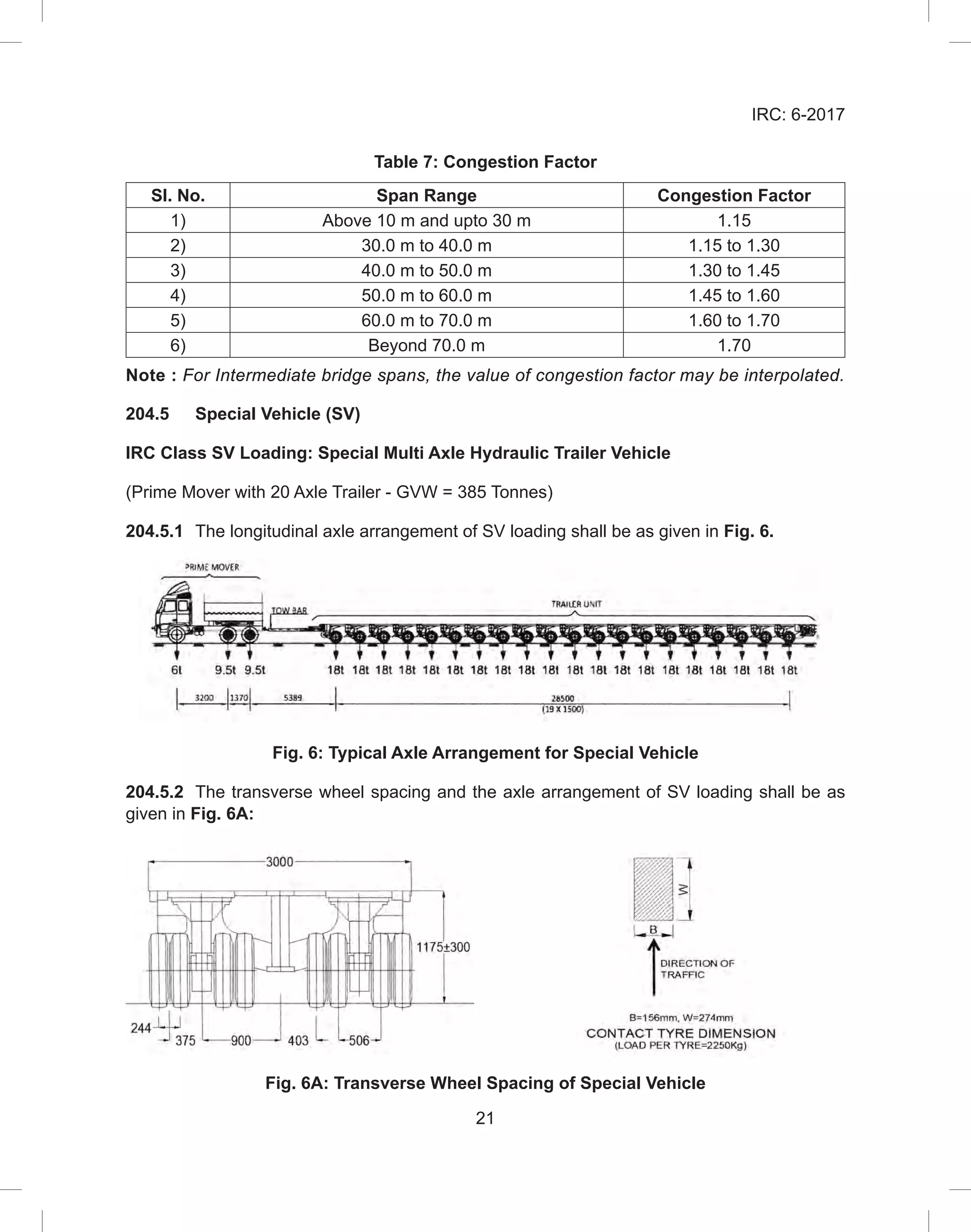
204.5 Special Vehicle (SV)
IRC Class SV Loading: Special Multi Axle Hydraulic Trailer Vehicle
(Prime Mover with 20 Axle Trailer - GVW = 385 Tonnes)
204.5.1 The longitudinal axle arrangement of SV loading shall be as given in Fig. 6.
Fig. 6: Typical Axle Arrangement for Special Vehicle
204.5.2 The transverse wheel spacing and the axle arrangement of SV loading shall be as
given in Fig. 6A:

Fig. 6A: Transverse Wheel Spacing of Special Vehicle
22
IRC: 6-2017
204.5.3 The SV Loading shall be considered to ply close to center of carriageway with a
maximum eccentricity of 300 mm from C/L of carriageway, as shown in Fig. 6B for different
situations.
Fig. 6B: Transverse Placement of Special Vehicle
S.
No.
No. of Lanes  Carriageway
Configuration
Transverse Loading Position (Maximum
Eccentricity)
1 Single Multi-Lane Undivided Carriageway
with Symmetrical Configuration with
Footway on Both Sides or Without
Footpath
2 Single Multi-Lane Undivided Carriageway
having Unsymmetrical Configuration with
Footway on one Side
3 Dual Multi-Lane Carriageway with Central
Median  Structural Gap to Separate
the Two Carriageways (Catering to
Multi-Lanes) with/ without Footpath with
Independent Substructure  Foundation
4 Dual Multi-Lane Carriageway with Central
Median  Structural Gap to Separate the
Two Carriageways. (Catering to
Multi-Lanes) with/without Footpath on
Either Side with Common Sub-Structure
 Foundation for Dual Carriageway.
Load Combinations  Partial safety factors
as given in Clause 204.5.4 shall apply for
superstructure carrying SV loading and for
substructure and foundation
AmeNDmeNtS
FIG. 6B : tRANSVeRSe PLACemeNt OF SPeCIAL VeHICLe
S. No. No. of Lanes  Carriageway Configuration transverseLoadingPosition(maximumeccentricity)
1 Single Multi-Lane Undivided Carriageway
with Symmetrical Confguration with Footway
On Both Sides Or Without Footpath
2 Single Multi-Lane Undivided Carriageway
Having Unsymmetrical Confguration with
Footway on one Side
3 Dual Multi-Lane Carriageway with Central
Median  Structural Gap to Separate the Two
Carriageways (Catering to Multi-Lanes) with/
withoutFootpathwithIndependent Substructure
 Foundation
4 Dual Multi-Lane Carriageway with Central
Median  Structural Gap to Separate the
Two Carriageways (Catering to Multi-Lanes)
with/without Footpath on Either Side with
Common Sub-Structure  Foundation for Dual
Carriageway
5 Dual Multi-Lane Carriageway with Central
Median but without any Structural Gap to
Separate the Two Carriageways (Catering to
Multi-Lanes) with/without Footpath on Either
Side and with Common Sub-Structure 
Foundation for Dual Carriageway
AmeNDmeNtS
36 INDIAN HIGHWAYS│January 2018
FIG. 6B : tRANSVeRSe PLACemeNt OF SPeCIAL VeHICLe
S. No. No. of Lanes  Carriageway Configuration transverseLoadingPosition(maximumeccentricity)
1 Single Multi-Lane Undivided Carriageway
with Symmetrical Confguration with Footway
On Both Sides Or Without Footpath
2 Single Multi-Lane Undivided Carriageway
Having Unsymmetrical Confguration with
Footway on one Side
3 Dual Multi-Lane Carriageway with Central
Median  Structural Gap to Separate the Two
Carriageways (Catering to Multi-Lanes) with/
withoutFootpathwithIndependent Substructure
 Foundation
4 Dual Multi-Lane Carriageway with Central
Median  Structural Gap to Separate the
Two Carriageways (Catering to Multi-Lanes)
with/without Footpath on Either Side with
Common Sub-Structure  Foundation for Dual
Carriageway
5 Dual Multi-Lane Carriageway with Central
Median but without any Structural Gap to
Separate the Two Carriageways (Catering to
Multi-Lanes) with/without Footpath on Either
Side and with Common Sub-Structure 
Foundation for Dual Carriageway
AmeNDmeNtS
36 INDIAN HIGHWAYS│January 2018
FIG. 6B : tRANSVeRSe PLACemeNt OF SPeCIAL VeHICLe
S. No. No. of Lanes  Carriageway Configuration transverseLoadingPosition(maximumeccentricity)
1 Single Multi-Lane Undivided Carriageway
with Symmetrical Confguration with Footway
On Both Sides Or Without Footpath
2 Single Multi-Lane Undivided Carriageway
Having Unsymmetrical Confguration with
Footway on one Side
3 Dual Multi-Lane Carriageway with Central
Median  Structural Gap to Separate the Two
Carriageways (Catering to Multi-Lanes) with/
withoutFootpathwithIndependent Substructure
 Foundation
4 Dual Multi-Lane Carriageway with Central
Median  Structural Gap to Separate the
Two Carriageways (Catering to Multi-Lanes)
with/without Footpath on Either Side with
Common Sub-Structure  Foundation for Dual
Carriageway
5 Dual Multi-Lane Carriageway with Central
Median but without any Structural Gap to
Separate the Two Carriageways (Catering to
Multi-Lanes) with/without Footpath on Either
Side and with Common Sub-Structure 
Foundation for Dual Carriageway
AmeNDmeNtS
36 INDIAN HIGHWAYS│January 2018
FIG. 6B : tRANSVeRSe PLACemeNt OF SPeCIAL VeHICLe
S. No. No. of Lanes  Carriageway Configuration transverseLoadingPosition(maximumeccentricity)
1 Single Multi-Lane Undivided Carriageway
with Symmetrical Confguration with Footway
On Both Sides Or Without Footpath
2 Single Multi-Lane Undivided Carriageway
Having Unsymmetrical Confguration with
Footway on one Side
3 Dual Multi-Lane Carriageway with Central
Median  Structural Gap to Separate the Two
Carriageways (Catering to Multi-Lanes) with/
withoutFootpathwithIndependent Substructure
 Foundation
4 Dual Multi-Lane Carriageway with Central
Median  Structural Gap to Separate the
Two Carriageways (Catering to Multi-Lanes)
with/without Footpath on Either Side with
Common Sub-Structure  Foundation for Dual
Carriageway
5 Dual Multi-Lane Carriageway with Central
Median but without any Structural Gap to
Separate the Two Carriageways (Catering to
Multi-Lanes) with/without Footpath on Either
Side and with Common Sub-Structure 
Foundation for Dual Carriageway
23
IRC: 6-2017
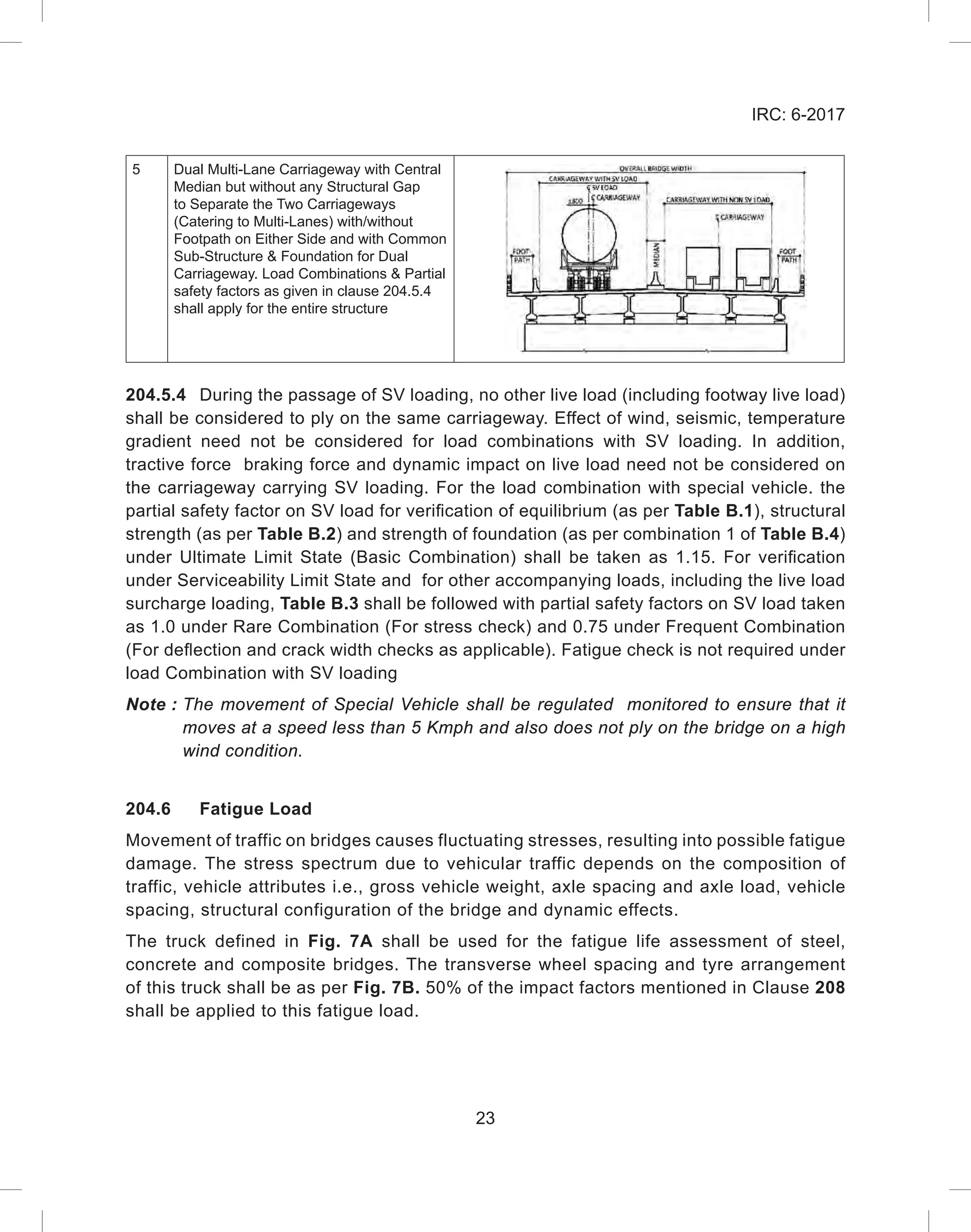
5 Dual Multi-Lane Carriageway with Central
Median but without any Structural Gap
to Separate the Two Carriageways
(Catering to Multi-Lanes) with/without
Footpath on Either Side and with Common
Sub-Structure  Foundation for Dual
Carriageway. Load Combinations  Partial
safety factors as given in clause 204.5.4
shall apply for the entire structure
204.5.4 During the passage of SV loading, no other live load (including footway live load)
shall be considered to ply on the same carriageway. Effect of wind, seismic, temperature
gradient need not be considered for load combinations with SV loading. In addition,
tractive force braking force and dynamic impact on live load need not be considered on
the carriageway carrying SV loading. For the load combination with special vehicle. the
partial safety factor on SV load for verification of equilibrium (as per Table B.1), structural
strength (as per Table B.2) and strength of foundation (as per combination 1 of Table B.4)
under Ultimate Limit State (Basic Combination) shall be taken as 1.15. For verification
under Serviceability Limit State and for other accompanying loads, including the live load
surcharge loading, Table B.3 shall be followed with partial safety factors on SV load taken
as 1.0 under Rare Combination (For stress check) and 0.75 under Frequent Combination
(For deflection and crack width checks as applicable). Fatigue check is not required under
load Combination with SV loading
Note : 
The movement of Special Vehicle shall be regulated monitored to ensure that it
moves at a speed less than 5 Kmph and also does not ply on the bridge on a high
wind condition.
204.6 Fatigue Load
Movement of traffic on bridges causes fluctuating stresses, resulting into possible fatigue
damage. The stress spectrum due to vehicular traffic depends on the composition of
traffic, vehicle attributes i.e., gross vehicle weight, axle spacing and axle load, vehicle
spacing, structural configuration of the bridge and dynamic effects.
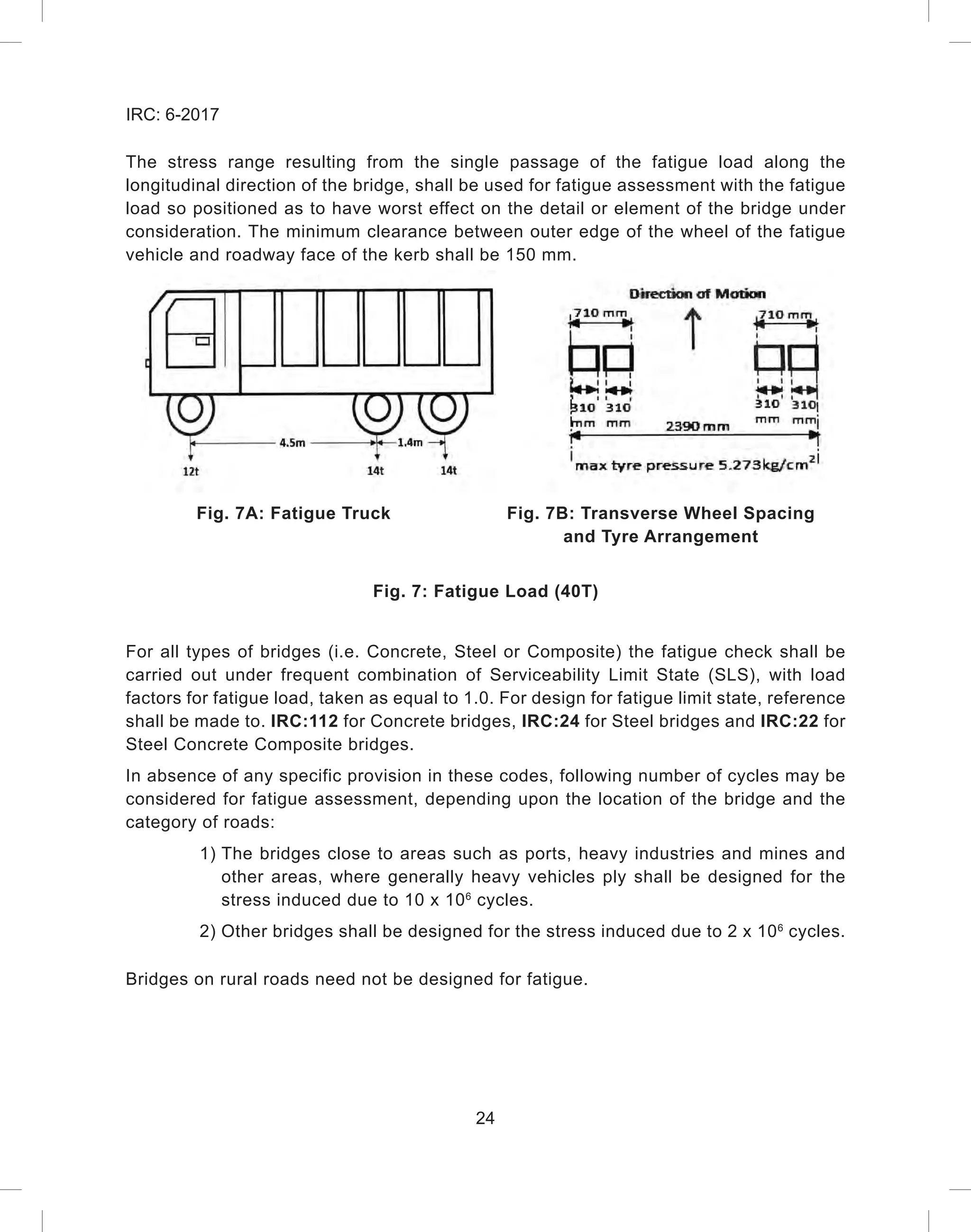
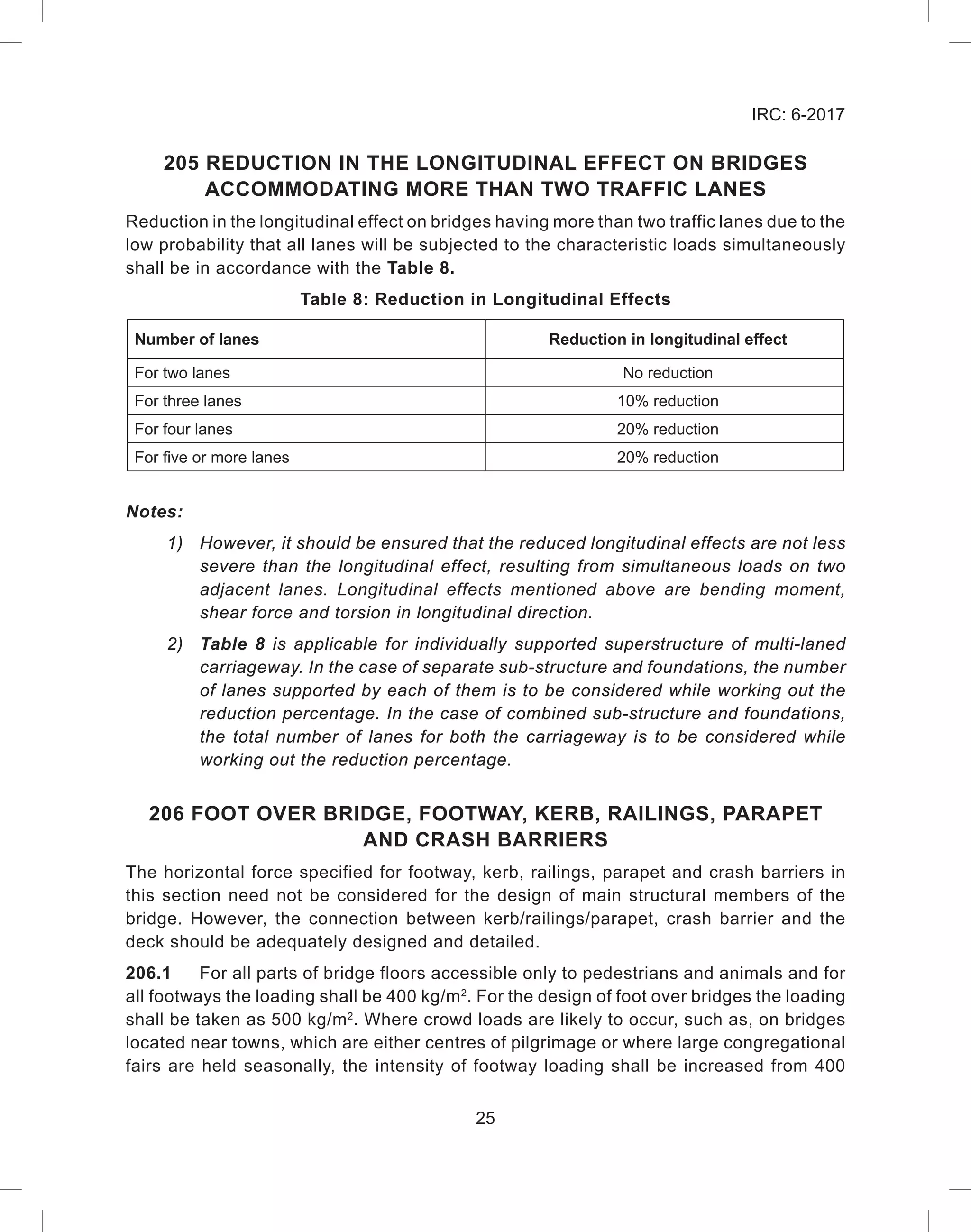
The truck defined in Fig. 7A shall be used for the fatigue life assessment of steel,
concrete and composite bridges. The transverse wheel spacing and tyre arrangement
of this truck shall be as per Fig. 7B. 50% of the impact factors mentioned in Clause 208
shall be applied to this fatigue load.
36 INDIAN HIGHWAYS│January 2018
Two Carriageways (Catering to Multi-Lanes)
with/without Footpath on Either Side with
Common Sub-Structure  Foundation for Dual
Carriageway
5 Dual Multi-Lane Carriageway with Central
Median but without any Structural Gap to
Separate the Two Carriageways (Catering to
Multi-Lanes) with/without Footpath on Either
Side and with Common Sub-Structure 
Foundation for Dual Carriageway
24
IRC: 6-2017
The stress range resulting from the single passage of the fatigue load along the
longitudinal direction of the bridge, shall be used for fatigue assessment with the fatigue
load so positioned as to have worst effect on the detail or element of the bridge under
consideration. The minimum clearance between outer edge of the wheel of the fatigue
vehicle and roadway face of the kerb shall be 150 mm.
For all types of bridges (i.e. Concrete, Steel or Composite) the fatigue check shall be
carried out under frequent combination of Serviceability Limit State (SLS), with load
factors for fatigue load, taken as equal to 1.0. For design for fatigue limit state, reference
shall be made to. IRC:112 for Concrete bridges, IRC:24 for Steel bridges and IRC:22 for
Steel Concrete Composite bridges.
In absence of any specific provision in these codes, following number of cycles may be
considered for fatigue assessment, depending upon the location of the bridge and the
category of roads:
		
1) 
The bridges close to areas such as ports, heavy industries and mines and
other areas, where generally heavy vehicles ply shall be designed for the
stress induced due to 10 x 106
cycles.
		
2) Other bridges shall be designed for the stress induced due to 2 x 10⁶
cycles.
Bridges on rural roads need not be designed for fatigue.
Fig. 7: Fatigue Load (40T)
Fig. 7B: Transverse Wheel Spacing
and Tyre Arrangement
Fig. 7A: Fatigue Truck
25
IRC: 6-2017
205 REDUCTION IN THE LONGITUDINAL EFFECT ON BRIDGES
ACCOMMODATING MORE THAN TWO TRAFFIC LANES
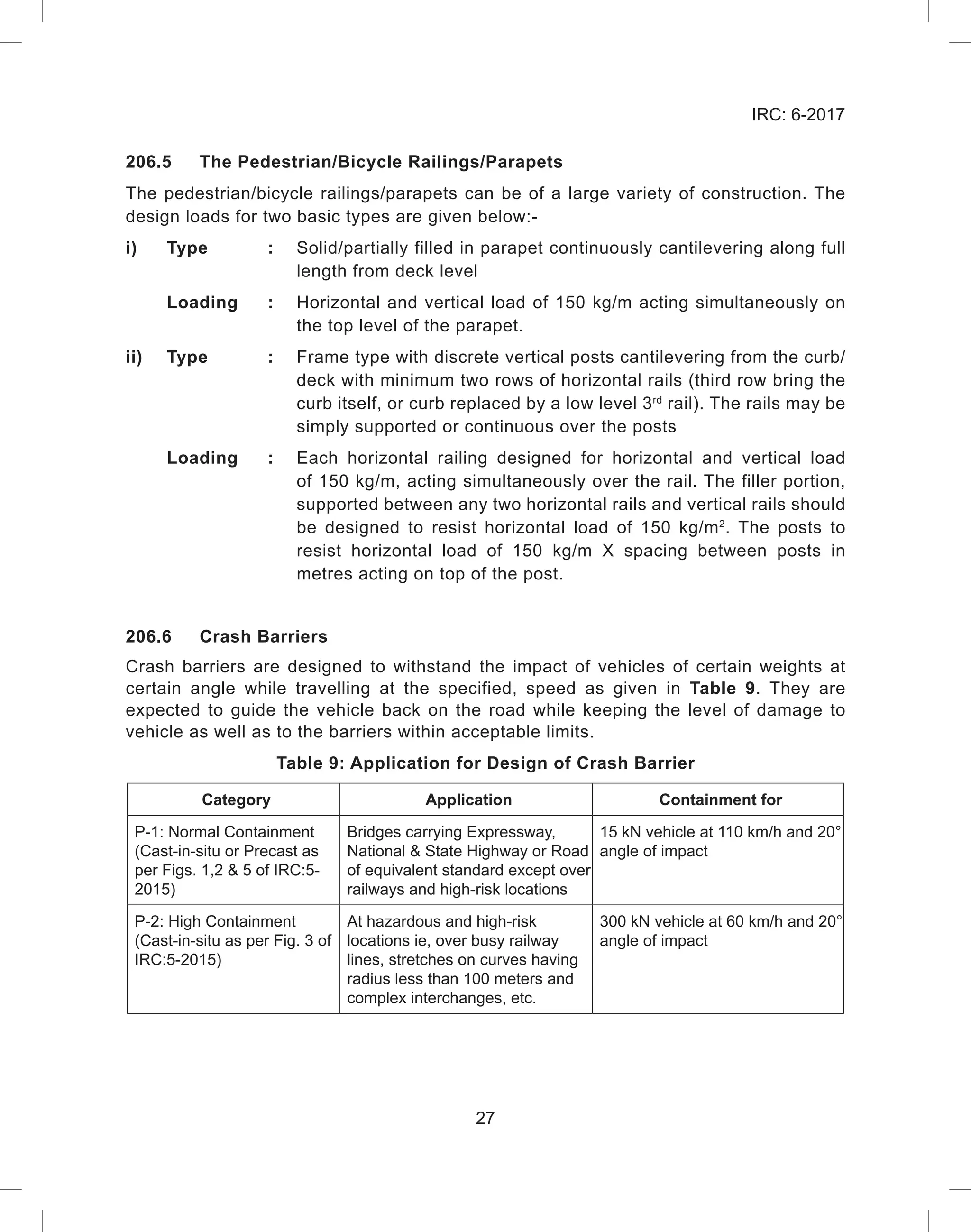
Reduction in the longitudinal effect on bridges having more than two traffic lanes due to the
low probability that all lanes will be subjected to the characteristic loads simultaneously
shall be in accordance with the Table 8.
Table 8: Reduction in Longitudinal Effects
Number of lanes Reduction in longitudinal effect
For two lanes No reduction
For three lanes 10% reduction
For four lanes 20% reduction
For five or more lanes 20% reduction
Notes:
1)	
However, it should be ensured that the reduced longitudinal effects are not less
severe than the longitudinal effect, resulting from simultaneous loads on two
adjacent lanes. Longitudinal effects mentioned above are bending moment,
shear force and torsion in longitudinal direction.
2)	
Table 8 is applicable for individually supported superstructure of multi-laned
carriageway. In the case of separate sub-structure and foundations, the number
of lanes supported by each of them is to be considered while working out the
reduction percentage. In the case of combined sub-structure and foundations,
the total number of lanes for both the carriageway is to be considered while
working out the reduction percentage.
206 FOOT OVER BRIDGE, FOOTWAY, KERB, RAILINGS, PARAPET
AND CRASH BARRIERS
The horizontal force specified for footway, kerb, railings, parapet and crash barriers in
this section need not be considered for the design of main structural members of the
bridge. However, the connection between kerb/railings/parapet, crash barrier and the
deck should be adequately designed and detailed.
206.1 For all parts of bridge floors accessible only to pedestrians and animals and for
all footways the loading shall be 400 kg/m2
. For the design of foot over bridges the loading
shall be taken as 500 kg/m2
. Where crowd loads are likely to occur, such as, on bridges
located near towns, which are either centres of pilgrimage or where large congregational
fairs are held seasonally, the intensity of footway loading shall be increased from 400
26
IRC: 6-2017
kg/m2
to 500 kg/m2
. When crowd load is considered, the bridge should also be designed
for the case of entire carriageway being occupied by crowd load.
206.2 Kerbs, 0.6 m or more in width, shall be designed for the above loads and for a
local lateral force of 750 kg per metre, applied horizontally at top of the kerb. If kerb width
is less than 0.6 m, no live load shall be applied in addition to the lateral load specified
above.
206.3 In bridges designed for any of the loadings described in Clause 204.1, the main
girders, trusses, arches, or other members supporting the footways shall be designed for
the following live loads per square metre for footway area, the loaded length of footway
taken in each case being, such as, to produce the worst effects on the member under
consideration:
a)	
For effective span of 7.5 m or less, 400 kg/m2
or 500 kg/m2
as the case may be,
based on Sub-Clause 206.1.
b)	
For effective spans of over 7.5 m but not exceeding 30 m, the intensity of load
shall be determined according to the equation:
P = P1
–
−
 
 
 
40L 300
9
c)	
For effective spans of over 30 m, the intensity of load shall be determined
according to the equation :
P = 1 4800 16.5 W
P 260
L 15
−
   
− +
   
   
where,
P’ = 
400 kg/m2
or 500 kg/m2
as the case may be, based on Sub-Clause 206.1.
When crowd load is considered for design of the bridge, the reduction
mentioned in this clause will not be applicable.
P = the live load in kg/m2
L = the effective span of the main girder, truss or arch in m, and
W = width of the footway in m
206.4 Each part of the footway shall be capable of resisting an accidental load of 4
tonne, which shall be deemed to include impact, distributed over a contact area of 300
mm in diameter. For limit state design, the accidental combination as per Table B.2 shall
be followed. This provision need not be made where vehicles cannot mount the footway
as in the case of a footway separated from the roadway by means of an insurmountable
obstacle, such as, crash barrier, truss or a main girder
Note : A footway kerb shall be considered mountable by vehicles.
27
IRC: 6-2017
206.5 The Pedestrian/Bicycle Railings/Parapets
The pedestrian/bicycle railings/parapets can be of a large variety of construction. The
design loads for two basic types are given below:-
i) Type :	
Solid/partially filled in parapet continuously cantilevering along full
length from deck level
Loading :	
Horizontal and vertical load of 150 kg/m acting simultaneously on
the top level of the parapet.
ii) Type :	
Frame type with discrete vertical posts cantilevering from the curb/
deck with minimum two rows of horizontal rails (third row bring the
curb itself, or curb replaced by a low level 3rd
rail). The rails may be
simply supported or continuous over the posts
Loading :	
Each horizontal railing designed for horizontal and vertical load
of 150 kg/m, acting simultaneously over the rail. The filler portion,
supported between any two horizontal rails and vertical rails should
be designed to resist horizontal load of 150 kg/m2
. The posts to
resist horizontal load of 150 kg/m X spacing between posts in
metres acting on top of the post.
206.6 Crash Barriers
Crash barriers are designed to withstand the impact of vehicles of certain weights at
certain angle while travelling at the specified, speed as given in Table 9. They are
expected to guide the vehicle back on the road while keeping the level of damage to
vehicle as well as to the barriers within acceptable limits.
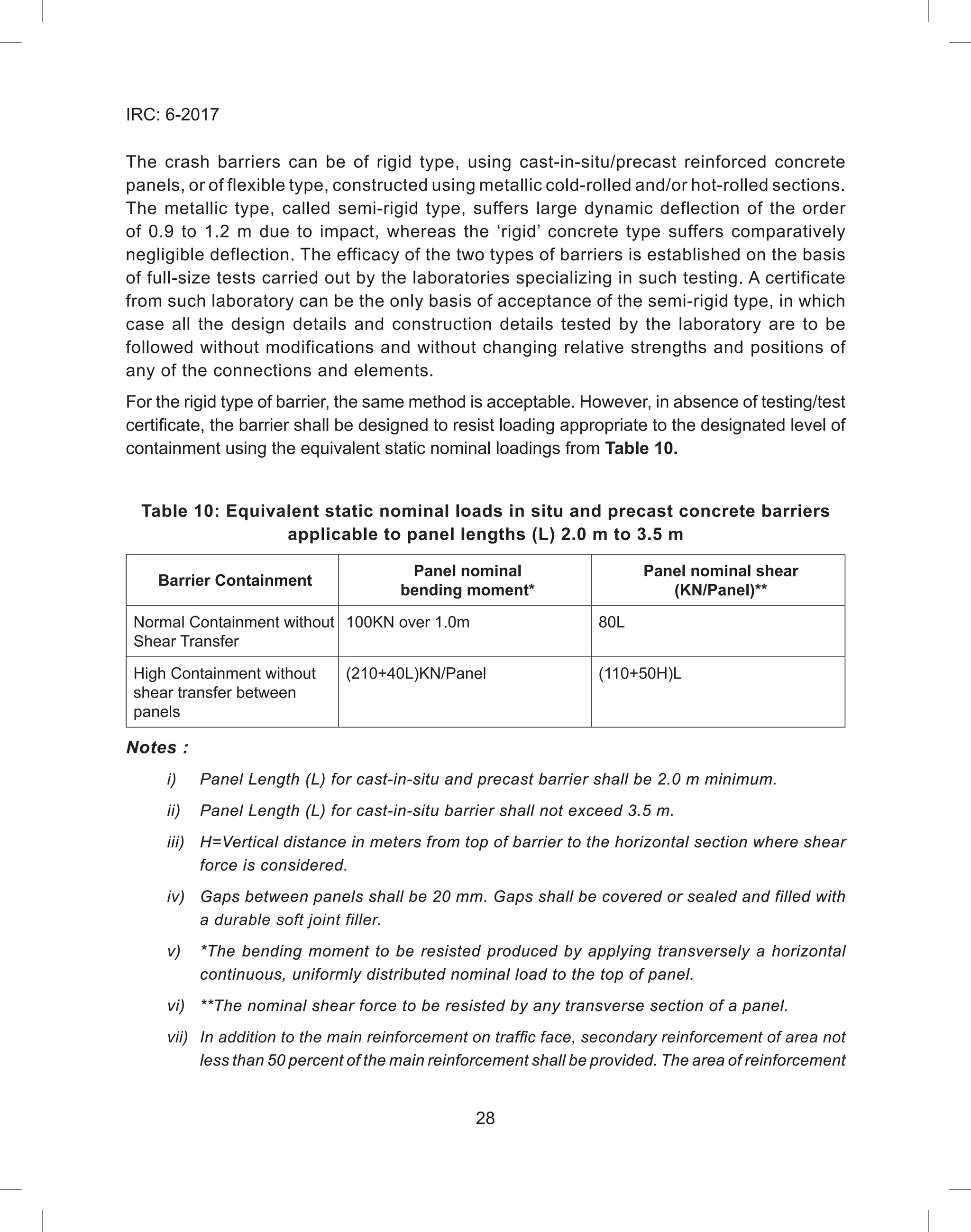
Table 9: Application for Design of Crash Barrier
Category Application Containment for
P-1: Normal Containment
(Cast-in-situ or Precast as
per Figs. 1,2  5 of IRC:5-
2015)
Bridges carrying Expressway,
National  State Highway or Road
of equivalent standard except over
railways and high-risk locations
15 kN vehicle at 110 km/h and 20°
angle of impact
P-2: High Containment
(Cast-in-situ as per Fig. 3 of
IRC:5-2015)
At hazardous and high-risk
locations ie, over busy railway
lines, stretches on curves having
radius less than 100 meters and
complex interchanges, etc.
300 kN vehicle at 60 km/h and 20°
angle of impact
28
IRC: 6-2017
The crash barriers can be of rigid type, using cast-in-situ/precast reinforced concrete
panels, or of flexible type, constructed using metallic cold-rolled and/or hot-rolled sections.
The metallic type, called semi-rigid type, suffers large dynamic deflection of the order
of 0.9 to 1.2 m due to impact, whereas the ‘rigid’ concrete type suffers comparatively
negligible deflection. The efficacy of the two types of barriers is established on the basis
of full-size tests carried out by the laboratories specializing in such testing. A certificate
from such laboratory can be the only basis of acceptance of the semi-rigid type, in which
case all the design details and construction details tested by the laboratory are to be
followed without modifications and without changing relative strengths and positions of
any of the connections and elements.
For the rigid type of barrier, the same method is acceptable. However, in absence of testing/test
certificate, the barrier shall be designed to resist loading appropriate to the designated level of
containment using the equivalent static nominal loadings from Table 10.
Table 10: Equivalent static nominal loads in situ and precast concrete barriers
applicable to panel lengths (L) 2.0 m to 3.5 m
Barrier Containment
Panel nominal
bending moment*
Panel nominal shear
(KN/Panel)**
Normal Containment without
Shear Transfer
100KN over 1.0m 80L
High Containment without
shear transfer between
panels
(210+40L)KN/Panel (110+50H)L
Notes :
i) Panel Length (L) for cast-in-situ and precast barrier shall be 2.0 m minimum.
ii)	
Panel Length (L) for cast-in-situ barrier shall not exceed 3.5 m.
iii)	
H=Vertical distance in meters from top of barrier to the horizontal section where shear
force is considered.
iv)	
Gaps between panels shall be 20 mm. Gaps shall be covered or sealed and filled with
a durable soft joint filler.
v)	
*The bending moment to be resisted produced by applying transversely a horizontal
continuous, uniformly distributed nominal load to the top of panel.
vi) **The nominal shear force to be resisted by any transverse section of a panel.
vii)	
In addition to the main reinforcement on traffic face, secondary reinforcement of area not
less than 50 percent of the main reinforcement shall be provided. The area of reinforcement
29
IRC: 6-2017
A certificate from such laboratory can be the only basis of acceptance of the semi-rigid
type, in which case all the design details and construction details tested by the laboratory
are to be followed into without modifications and without changing relative strengths and
positions of any of the connections and elements.
For the rigid type of barrier, the same method is acceptable. However, in absence of
testing/test certificate, the minimum design resistance shown in Table 10 should be built
into the section.
206.7 Vehicle barriers/pedestrian railing between footpath and carriageway
Where considerable pedestrian traffic is expected, such as, in/near townships, rigid type
of reinforced concrete crash barrier should be provided separating the vehicular traffic
from the same. The design and construction details should be as per Clause 206.6. For
any other type of rigid barrier, the strength should be equivalent to that of rigid RCC type.
For areas of low intensity of pedestrian traffic, semi-rigid type of barrier, which suffers
large deflections, can be adopted.
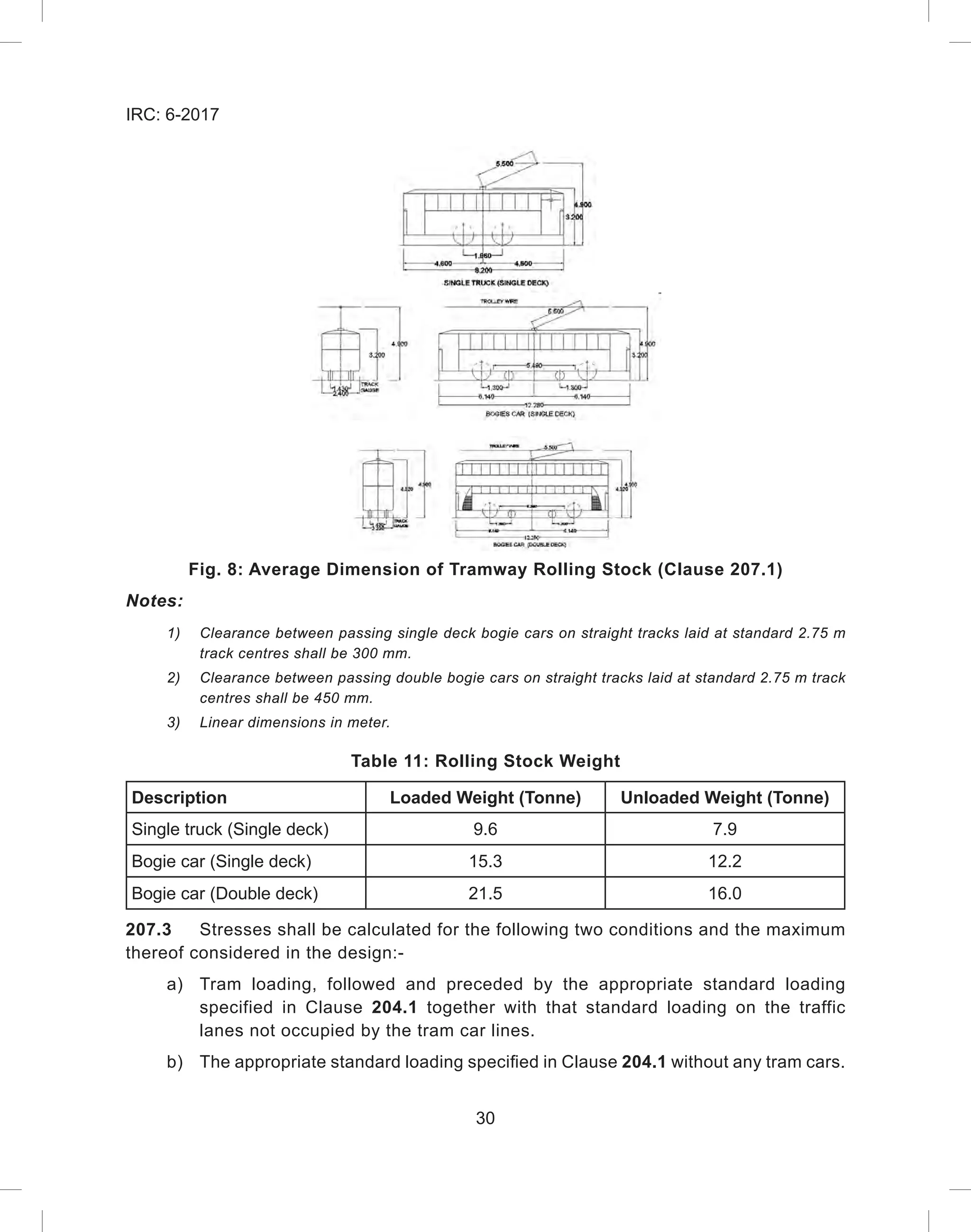
207 Tramway Loading
207.1 When a road bridge carries tram lines, the live load due to the type of tram cars
sketched in Fig. 8 shall be computed and shall be considered to occupy a 3 m width of
roadway
207.2 A nose to tail sequence of the tram cars or any other sequence which produces
the heaviest stresses shall be considered in the design.
on outer face, both vertical and horizontal, shall not be less than 50% of that in the traffic
face. Spacing of reinforcement bars on any face shall not exceed 200 mm.
viii)	
If concrete barrier is used as a median divider, the reinforcement is required to be
placed on both sides.
ix)	
For in-situ panels, the joint between panels shall extend from the top of the panel down
to not more than 25mm above the level of paved surface.
x)	
Specialist literature may be referred for design of attachment systems and anchorages
and their loading for precast concrete parapet panels.
xi)	
Equivalent static loading as given in Table-10 are also applicable to crash barrier
supported on friction slabs and friction slab too can be designed for same static loading.
30
IRC: 6-2017
Fig. 8: Average Dimension of Tramway Rolling Stock (Clause 207.1)
Notes:
1)	
Clearance between passing single deck bogie cars on straight tracks laid at standard 2.75 m
track centres shall be 300 mm.
2)	
Clearance between passing double bogie cars on straight tracks laid at standard 2.75 m track
centres shall be 450 mm.
3) Linear dimensions in meter.
Table 11: Rolling Stock Weight
Description Loaded Weight (Tonne) Unloaded Weight (Tonne)
Single truck (Single deck) 9.6 7.9
Bogie car (Single deck) 15.3 12.2
Bogie car (Double deck) 21.5 16.0
207.3 Stresses shall be calculated for the following two conditions and the maximum
thereof considered in the design:-
a)	
Tram loading, followed and preceded by the appropriate standard loading
specified in Clause 204.1 together with that standard loading on the traffic
lanes not occupied by the tram car lines.
b) 
The appropriate standard loading specified in Clause 204.1 without any tram cars.
31
IRC: 6-2017
208 IMPACT
208.1 Provision for impact or dynamic action shall be made by an increment of the
live load by an impact allowance expressed as a fraction or a percentage of the applied
live load.
208.2 For Class A or Class B Loading
In the members of any bridge designed either for Class A or Class B loading (vide
Clause 204.1), this impact percentage shall be determined from the curves indicated in
Fig.9. The impact fraction shall be determined from the following equations which are
applicable for spans between 3 m and 45 m
		 i) Impact factor fraction for reinforced concrete bridges =
4.5
6 + L
		 ii) Impact factor fraction for steel bridges =
9
13.5 + L
Where L is length in meters of the span as specified in Clause 208.5
208.3 For Class AA Loading and Class 70R Loading
The value of the impact percentage shall be taken as follows:-
a) For spans less than 9 m
		 For tracked vehicles :	
25 percent for spans upto 5 m linearly reducing to
10 percent for spans upto 9 m
		 For wheeled vehicles : 25 Percent
b) For spans of 9 m or more
i) Reinforced Concrete Bridges
1) Tracked Vehicles :	
10 percent upto a span of 40 m and in accordance
with the curve in Fig. 9 for spans in excess of 40 m
2) Wheeled Vehicles :	
25 percent for spans upto 12 m and in accordance
with the curve in Fig. 9 for spans in excess of 12 m.
ii) Steel Bridges
3) Tracked Vehicles : 10 percent for all spans
4) Wheeled vehicles :	
25 percent for spans upto 23 m and in accordance
with the curve indicated in Fig. 9 for spans in excess
of 23 m
32
IRC: 6-2017
Fig.9: Impact Percentage for Highway Bridges for Class A and Class B Loading
(Clause 208.2)
208.4 No impact allowance shall be added to the footway loading specified in Clause 206.
208.5 The span length to be considered for arriving at the impact percentages
specified in Clause 208.2 and 208.3 shall be as follows:
a) For spans simply supported or continuous a) or for arches………….
		 the effective span on which the load is placed.
b)	
For bridges having cantilever arms (with  without) hinges/suspended
spans)….….
		
the effective over hang of the cantilever arms reduced by 25 percent for loads
on the cantilever arms.
Note: 
For individual members of a bridge, such as, a cross girder or deck slab, etc. the
value of L mentioned in Clause 208.2 or the spans mentioned in Clause 208.3
shall be the effective span of the member under consideration.
33
IRC: 6-2017
208.6 In any bridge structure where there is a filling of not less than 0.6 m including
the road crust, the impact percentage to be allowed in the design shall be assumed to
be one-half of what is specified in Clauses 208.2 and 208.3.
208.7 For calculating the pressure on the bearings and abutment cap/pier cap, full
value of the appropriate impact percentage shall be allowed. But, for the design of piers
abutments and structures, generally below the level of the top of the abutment cap/pier
cap, the appropriate impact percentage shall be multiplied by the factor given below:
a) For calculating the pressure on the top 3 m of the
		 structure below the abutment cap/piercap : 0.5
				decreasing
				
uniformly to zero
b) For calculating the pressure on the portion of structure : Zero
		 more than 3 m below the abutment cap/piercap
208.8 In the design of members subjected to among other stresses, direct tension,
such as, hangers in a bowstring girder bridge and in the design of member subjected
to direct compression, such as, spandrel columns or walls in an open spandrel arch,
the impact percentage shall be taken the same as that applicable to the design of the
corresponding member or members of the floor system which transfer loads to the tensile
or compressive members in question.
208.9 These clauses on impact do not apply to the design of suspension bridges
and foot over bridges. In cable suspended bridges and in other bridges where live load
to dead load ratio is high, the dynamic effects such as vibration and fatigue shall be
considered. For long span foot over bridges (with frequency less than 5 Hz and 1.5 Hz in
vertical and horizontal direction) the dynamic effects shall be considered, if necessary,
for which specialist literature may be referred.
209 WIND LOAD
209.1 This clause is applicable to normal span bridges with individual span length up
to 150 m or for bridges with height of pier up to 100 m. For all other bridges including
cable stayed bridges, suspension bridges and ribbon bridges specialist literature shall
be used for computation of design wind load.
209.1.1 The wind pressure acting on a bridge depends on the geographical locations,
the terrain of surrounding area, the fetch of terrain upwind of the site location,
34
IRC: 6-2017
the local topography, the height of bridge above the ground, horizontal dimensions and
cross-section of bridge or its element under consideration. The maximum pressure is
due to gusts that cause local and transient fluctuations about the mean wind pressure.
All structures shall be designed for the wind forces as specified in Clause 209.3 and
209.4. These forces shall be considered to act in such a direction that the resultant
stresses in the member under consideration are maximum.
In addition to applying the prescribed loads in the design of bridge elements, stability
against overturning, uplift and sliding due to wind shall be considered.
209.2 The wind speed at the location of bridge shall be based on basic wind speed
map as shown in Fig. 10. The intensity of wind force shall be based on hourly mean wind
speed and pressure as shown in Table 12. The hourly mean wind speed and pressure
values given in Table 12 corresponds to a basic wind speed of 33 m/s, return period of
100 years, for bridges situated in plain terrain and terrain with obstructions, with a flat
topography. The hourly mean wind pressure shall be appropriately modified depending
on the location of bridge for other basic wind speed as shown in Fig. 10 and used for
design (see notes below Table 12).
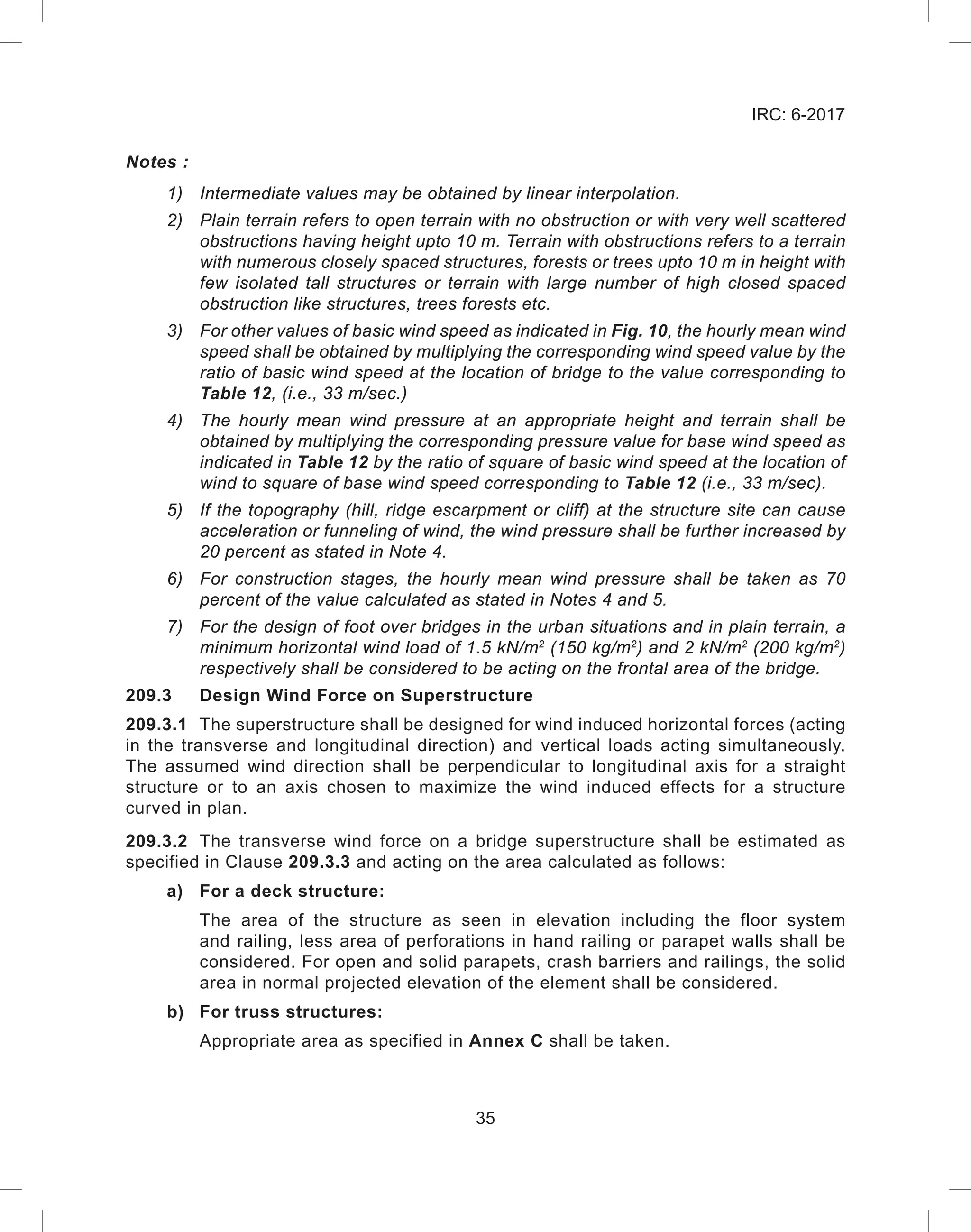
Table 12: Hourly Mean Wind Speed and Wind Pressure
(For a Basic Wind Speed of 33 m/s as shown in Fig. 10)
H (m)
Bridge Situated in
Plain Terrain Terrain with Obstructions
Vz
(m/s) Pz
(N/m2
) Vz
(m/s) Pz
(N/m2
)
Up to 10 m 27.80 463.70 17.80 190.50
15 29.20 512.50 19.60 230.50
20 30.30 550.60 21.00 265.30
30 31.40 590.20 22.80 312.20
50 33.10 659.20 24.90 373.40
60 33.60 676.30 25.60 392.90
70 34.00 693.60 26.20 412.80
80 34.40 711.20 26.90 433.30
90 34.90 729.00 27.50 454.20
100 35.30 747.00 28.20 475.60
where
H =	
the average height in metres of exposed surface above the mean retarding
surface (ground or bed or water level)
Vz
= Hourly mean speed of wind in m/s at height H
Pz
= Horizontal wind pressure in N/m2
at height H
35
IRC: 6-2017
Notes :
1) Intermediate values may be obtained by linear interpolation.
2)	
Plain terrain refers to open terrain with no obstruction or with very well scattered
obstructions having height upto 10 m. Terrain with obstructions refers to a terrain
with numerous closely spaced structures, forests or trees upto 10 m in height with
few isolated tall structures or terrain with large number of high closed spaced
obstruction like structures, trees forests etc.
3)	
For other values of basic wind speed as indicated in Fig. 10, the hourly mean wind
speed shall be obtained by multiplying the corresponding wind speed value by the
ratio of basic wind speed at the location of bridge to the value corresponding to
Table 12, (i.e., 33 m/sec.)
4)	
The hourly mean wind pressure at an appropriate height and terrain shall be
obtained by multiplying the corresponding pressure value for base wind speed as
indicated in Table 12 by the ratio of square of basic wind speed at the location of
wind to square of base wind speed corresponding to Table 12 (i.e., 33 m/sec).
5)	
If the topography (hill, ridge escarpment or cliff) at the structure site can cause
acceleration or funneling of wind, the wind pressure shall be further increased by
20 percent as stated in Note 4.
6)	
For construction stages, the hourly mean wind pressure shall be taken as 70
percent of the value calculated as stated in Notes 4 and 5.
7)	
For the design of foot over bridges in the urban situations and in plain terrain, a
minimum horizontal wind load of 1.5 kN/m2
(150 kg/m2
) and 2 kN/m2
(200 kg/m2
)
respectively shall be considered to be acting on the frontal area of the bridge.
209.3 Design Wind Force on Superstructure
209.3.1 The superstructure shall be designed for wind induced horizontal forces (acting
in the transverse and longitudinal direction) and vertical loads acting simultaneously.
The assumed wind direction shall be perpendicular to longitudinal axis for a straight
structure or to an axis chosen to maximize the wind induced effects for a structure
curved in plan.
209.3.2 The transverse wind force on a bridge superstructure shall be estimated as
specified in Clause 209.3.3 and acting on the area calculated as follows:
a) For a deck structure:
		
The area of the structure as seen in elevation including the floor system
and railing, less area of perforations in hand railing or parapet walls shall be
considered. For open and solid parapets, crash barriers and railings, the solid
area in normal projected elevation of the element shall be considered.
b) For truss structures:
		 Appropriate area as specified in Annex C shall be taken.
36
IRC: 6-2017
c) For construction stages:
		
The area at all stages of construction shall be the appropriate unshielded solid
area of structure.
209.3.3 The transverse wind force FT
(in N) shall be taken as acting at the centroids of
the appropriate areas and horizontally and shall be estimated from:
FT
= Pz
x A1
x G x CD
where, Pz
is the hourly mean wind pressure in N/m2
(see Table 12) , A1
is the solid area
in m2
(see Clause 209.3.2), G is the gust factor and CD
is the drag coefficient depending
on the geometric shape of bridge deck.
For highway bridges upto a span of 150 m, which are generally not sensitive to dynamic
action of wind, gust factor shall be taken as 2.0.
The drag coefficient for slab bridges with width to depth ratio of cross-section, i.e b/d≥10
shall be taken as 1.1.
For bridge decks supported by single beam or box girder, CD
shall be taken as 1.5 for b/d
ratio of 2 and as 1.3 if b/d ≥ 6. For intermediate b/d ratios CD
shall be interpolated. For
deck supported by two or more beams or box girders, where the ratio of clear distance
between the beams of boxes to the depth does not exceed 7, CD
for the combined
structure shall be taken as 1.5 times CD
for the single beam or box.
For deck supported by single plate girder it shall be taken as 2.2. When the deck is
supported by two or more plate girders, for the combined structure CD
shall be taken as
2(1+c/20d), but not more than 4, where c is the centre-to-centre distance of adjacent
girders, and d is the depth of windward girder.
For truss girder superstructure the drag coefficients shall be derived as given in Annex C.
For other type of deck cross-sections CD
shall be ascertained either from wind tunnel
tests or, if available, for similar type of structure, specialist literature shall be referred to.
209.3.4 The longitudinal force on bridge superstructure FL
(in N) shall be taken as 25
percent and 50 percent of the transverse wind load as calculated as per Clause 209.3.3
for beam/box/plate girder bridges and truss girder bridges respectively.
37
IRC: 6-2017
Based upon Survey of India Outline Map printed in 1993
The territorial waters of India extend into the sea to a distance of twelve nautical milesmeasured from the appropriate base line.
The boundary of Meghalaya shown on this map ia as interpreted from the North Eastern Areas (Reorganisation) Act 1971, but has yet to be varified.
Responsibility of correctness of internal details shown on the map rests with the publisher.
The state boundries between Uttaranchal  Uttar Pradesh, Bihar  Jharkhand and Chhatisgarh  Madhya Pradesh have not been varified by Governments concerned.
The Fig. 10 have been reproduced in confirmation of Bureau of Indian Standards
Fig. 10: Basic Wind Speed in m/s (BASED ON 50-YEARS RETURN PERIOD)
Government of India Copyright 2005
38
IRC: 6-2017
209.3.5 An upward or downward vertical wind load Fv (in N) acting at the centroid of the
appropriate area, for all superstructures shall be derived from:
Fv
= Pz
X A3
X G X CL
where,
Pz
= Hourly mean wind speed in N/m2
at height H
A3
= Area in plain in m2
CL
=	
Lift coefficient which shall be taken as 0.75 for normal type of slab, box,
I-girder and plate girder bridges. For other type of deck cross-sections
CL
shall be ascertained either from wind tunnel tests or, if available, for
similar type of structure. Specialist literature shall be referred to.
G = Gust factor as defined in 209.3.3
209.3.6 The transverse wind load per unit exposed frontal area of the live load shall be
computed using the expression FT
given in Clause 209.3.3 except that CD
against shall
be taken as 1.2. The exposed frontal area of live load shall be the entire length of the
superstructure seen in elevation in the direction of wind as defined in clause or any part
of that length producing critical response, multiplied by a height of 3.0 m above the road
way surface. Areas below the top of a solid barrier shall be neglected.
The longitudinal wind load on live load shall be taken as 25 percent of transverse wind
load as calculated above. Both loads shall be applied simultaneously acting at 1.5 m
above the roadway.
209.3.7 The bridges shall not be considered to be carrying any live load when the wind
speed at deck level exceeds 36 m/s.
209.3.8 In case of cantilever construction an upward wind pressure of Pz
x CL
x G N/m2
(see Clause 209.3.5 for notations) on bottom soffit area shall be assumed on stabilizing
cantilever arm in addition to the transverse wind effect calculated as per ,Clause 209.3.3.
In addition to the above, other loads defined in Clause 218.3 shall also be taken into
consideration.
209.4 Design Wind Forces on Substructure
The substructure shall be designed for wind induced loads transmitted to it from the
superstructure and wind loads acting directly on the substructure. Loads for wind
directions both normal and skewed to the longitudinal centerline of the superstructure
shall be considered.
FT
shall be computed using expression in Clause 209.3.3 with A1
taken as the solid area
in normal projected elevation of each pier. No allowance shall be made for shielding.
39
IRC: 6-2017
For piers, CD
shall be taken from Table 13. For piers with cross-section dissimilar to
those given in Table 13, CD
shall be ascertained either from wind tunnel tests or, if
available, for similar type of structure, specialist literature shall be referred to CD
shall
be derived for each pier, without shielding.
Table 13: Drag Coefficients CD
For Piers
PLAN SHAPE
t
b
                 
HEIGHT
         CD
FOR PIER RATIOS OF
                BREADTH
1 2 4 6 10 20 40
WIND
b ≤
1
4
1.3 1.4 1.5 1.6 1.7 1.9 2.1
1
3
1
2
1.3 1.4 1.5 1.6 1.8 2.0 2.2
2
3
1.3 1.4 1.5 1.6 1.8 2.0 2.2
1 1.2 1.3 1.4 1.5 1.6 1.8 2.0
  
1
1
2
1.0 1.1 1.2 1.3 1.4 1.5 1.7
2 0.8 0.9 1.0 1.1 1.2 1.3 1.4
3 0.8 0.8 0.8 0.9 0.9 1.0 1.2
d
b
≥ 4 0.8 0.8 0.8 0.9 0.9 0.9 1.1
1.0 1.1 1.2 1.3 1.4 1.4 1.4
12 SIDE POLYGON 0.7 0.8 0.9 0.9 1.0 1.1 1.3
d
CIRCLE WITH SMOOTH
SURFACE HERE
t Vz
≥ 6 m2
/ S
0.5 0.5 0.5 0.5 0.5 0.6 0.6
d
CIRCLE WITH SMOOTH
SURFACE WHERE
t Vz
 6 m2
/ S
CIRCLE WITH ROUGH
SURFACE OR WITH
PROJECTIONS
0.7 0.7 0.8 0.8 0.9 1.0 1.2
t
SQUAREOR
OCTAGONAL
40
IRC: 6-2017
Notes:
1)	
For rectangular piers with rounded corners with radius r, the value of CD
derived
from Table 13 shall be multiplied by (1-1.5 r/b) or 0.5, whichever is greater.
2)	
For a pier with triangular nosing, CD
shall be derived as for the rectangle
encompassing the outer edges of pier.
3)	
For pier tapering with height, CD
shall be derived for each of the unit heights
into which the support has been subdivided. Mean values of t and b for each
unit height shall be used to evaluate t/b. The overall pier height and mean
breadth of each unit height shall be used to evaluate height/breadth.
4)	
After construction of the superstructure CD
shall be derived for height to breadth
ratio of 40.
209.5 Wind Tunnel Testing
Wind tunnel testing by established procedures shall be conducted for dynamically
sensitive structures such as cable stayed, suspension bridges etc., Including modeling
of appurtenances.
210 HORIZONTAL FORCES DUE TO WATER CURRENTS
210.1 Any part of a road bridge which may be submerged in running water shall be
designed to sustain safely the horizontal pressure due to the force of the current.
210.2 On piers parallel to the direction of the water current, the intensity of pressure
shall be calculated from the following equation:
P = 52KV2
where,
P = intensity of pressure due to water current, in kg/m2
V =	
the velocity of the current at the point where the pressure intensity is being
calculated, in metre per second, and
K =	
a constant having the following values for different shapes of piers illustrated in
Fig.11
		 i) Square ended piers (and for the superstructure) 1.50
		 ii) Circular piers or piers with semi-circular ends 0.66
		 iii) 
Piers with triangular cut and ease waters, the angle 0.50
		 included between the faces being 30° or less
		 iv) 
Piers with triangular cut and ease waters, the angle included 0.50 to
between the faces being more than 30° but less than 60° 0.70
41
IRC: 6-2017
		 v) 
Piers with triangular cut and ease waters, the angle 0.70
		 included between the faces being more than 60° but to 0.90
		 less than 90°
		 vi) Piers with cut and ease waters of equilateral arcs of 0.45
		 circles
		 vii) Piers with arcs of the cut and ease waters intersecting at 90° 0.50
		
Fig. 11: Shapes of Bridge Piers (Clause 210.2)
42
IRC: 6-2017
210.3 The value of V2
(n the equation given in Clause 210.2 shall be assumed to vary
linearly from zero at the point of deepest scour to the square of the maximum velocity at
the free surface of water. The maximum velocity for the purpose of this sub-clause shall
be assumed to be √2 times the mean velocity of the current”
Fig. 12: Velocity Distribution
Square of velocity at a height ‘X’ from the point of deepest Scour =U2
=
where, V is the mean velocity.
210.4 When the current strikes the pier at an angle, the velocity of the current shall
be resolved into two components — one parallel and the other normal to the pier.
		 a) 
The pressure parallel to the pier shall be determined as indicated in Clause
210.2 taking the velocity as the component of the velocity of :the current in
a direction parallel to the pier.
		 b) 
The pressure of the current, normal to the pier and acting on the area of the
side elevation of the pier, shall be calculated similarly taking the velocity as
the component of the velocity of the current in a direction normal to the pier,
and the constant K as 1.5, except in the case of circular piers where the
constant shall be taken as 0.66.
210.5 To provide against possible variation of the direction of the current from the
direction assumed in the design, allowance shall be made in the design of piers for an extra
variation in the current direction of 20 degrees that is to say, piers intended to be parallel
to the direction of current shall be designed for a variation of 20 degrees from the normal
43
IRC: 6-2017
direction of current and piers originally intended to be inclined at 0 degree to the direction
of the current shall be designed for a current direction inclined at (20±0) degrees to the
length of the pier.
210.6 In case of a bridge having a pucca floor or having an inerodible bed, the effect
of cross-currents shall in no case be taken as less than that of a static force due to a
difference of head of 250 mm between the opposite faces of a pier.
210.7 When supports are made with two or more piles or trestle columns, spaced
closer than three times the width of piles/columns across the direction of flow, the group
shall be treated as a solid rectangle of the same overall length and width and the value of
K taken as 1.25 for calculating pressures due to water currents, both parallel and normal
to the pier. If such piles/columns are braced, then the group should be considered as a
solid pier, irrespective of the spacing of the columns.
211 LONGITUDINAL FORCES
211.1 In all road bridges, provision shall be made for longitudinal forces arising from
any one or more of the following causes:
a) Tractive effort caused through acceleration of the driving wheels;
b) Braking effect resulting from the application of the brakes to braked wheels; and
c)	
Frictional resistance offered to the movement of free bearings due to change of
temperature or any other cause.
Note : Braking effect is invariably greater than the tractive effort.
211.2 The braking effect on a simply supported span or a continuous unit of spans or
on any other type of bridge unit shall be assumed to have the following value:
a)	
In the case of a single lane or a two lane bridge : twenty percent of the first
train load plus ten percent of the load of the succeeding trains or part thereof,
the train loads in one lane only being considered for the purpose of this sub-
clause. Where the entire first train is not on the full span, the braking force
shall be taken as equal to twenty percent of the loads actually on the span or
continuous unit of spans.
b)	
In the case of bridges having more than two-lanes: as in (a) above for the
first two lanes plus five percent of the loads on the lanes in excess of two.
Note : The loads in this Clause shall not be increased on account of impact.
44
IRC: 6-2017
211.3 The force due to braking effect shall be assumed to act along a line parallel to the
roadway and 1.2 m above it. While transferring the force to the bearings, the change in the
vertical reaction at the bearings should be taken into account.
211.4 The distribution of longitudinal horizontal forces among bridge supports is
effected by the horizontal deformation of bridges, flexing of the supports and rotation of the
foundations. For spans resting on stiff supports, the distribution may be assumed as given
below in Clause 211.5. For spans resting on flexible supports, distribution of horizontal
forces may be carried out according to procedure given below in Clause 211.6.
211.5 Simply Supported and Continuous Spans on Unyielding Supports
211.5.1 Simply supported spans on unyielding supports
211.5.1.1 For a simply supported span with fixed and free bearings (other than elastomeric
type) on stiff supports, horizontal forces at the bearing level in the longitudinal direction
shall be greater of the two values given below:
Fixed bearing Free bearing
i) Fh
– µ (Rg
+ Rq
) µ (Rq
+Rg
)
or
ii)
h
F
2
+ µ (Rg
+Rq
) µ (Rg
+ Rq
)
where,
Fh
= Applied Horizontal force
Rg
= Reaction at the free end due to dead load
Rq
= Reaction at free end due to live load
µ = Coefficient of friction at the movable bearing which shall be assumed to have the
following values:
i) For steel roller bearings
For concrete roller bearings
For sliding bearings:
0.03
ii) 0.05
iii)
a) Steel on cast iron or steel on steel 0.4
b)	
Gray cast iron
Gray cast iron (Mechanite) 0.3
c)	
Concrete over concrete with bitumen
layer in between 0.5
45
IRC: 6-2017
d) Teflon on stainless steel 0.03 and 0.05
whichever is governing
Notes :
a)	
For design of bearing, the corresponding forces may be taken as per relevant IRC
Codes.
b)	
Unbalanced dead load shall be accounted for properly. The structure under the
fixed bearing shall be designed to withstand the full seismic and design braking/
tractive force.
211.5.1.2 In case of simply supported small spans upto 10 m resting on unyielding supports
and where no bearings are provided, horizontal force in the longitudinal direction at the
bearing level shall be
=
2
h
F
or µRg
whichever is greater
211.5.1.3 For a simply supported span siting on identical elastomeric bearings at each end
resting on unyielding supports. Force at each end
=
2
h
F
+ Vr
ltc
where,
		Vr
= shear rating of the elastomer bearings
		
ltc
= movement of deck above bearing, other than that due to applied forces
211.5.1.4 The substructure and foundation shall also be designed for 10 percent variation
in movement of the span of either side.
211.5.2 For continuous bridges with one fixed bearing or other free bearings on unyielding
support refer Table 14 below.
46
IRC: 6-2017
Table 14: Horizontal Forces at Bearing Level for Continuous Spans on Unyielding Supports
Fixed Bearing Free Bearing
Case-I
(µR – µL) +ve Fh
acting in +ve direction
(a) If, Fh
 2 µR
    Fh
– (µR + µL)
(b) If, Fh
 2µR
1+
h
R
F
n
+ (µR – µL)
µRx
Case-II
(µR – µL) +ve Fh
acting in -ve direction
(a) If, Fh
 2 µL
Fh
– (µR + µL)
(b) If, Fh
 2µL
1+ ∑
h
L
F
n
+ (µR – µL)
µRx
where,
nL
or nR
= number of free bearings to the left or right of fixed bearings, respectively
µL or µR =	
the total horizontal force developed at the free bearings to the left or the
right of the fixed bearing respectively
µRx
= 
the net horizontal force developed at any one of the free bearings
considered to the left or right of the fixed bearings
Note : In seismic areas, the fixed bearing shall also be checked for full seismic force and
braking/tractive force. The structure under the fixed bearing shall be designed to withstand the
full seismic and design braking/tractive force.
211.6 Simply Supported and Continuous Spans on Flexible Supports
211.6.1 Shear rating of a support is the horizontal force required to move the top of the support
through a unit distance taking into account horizontal deformation of the bridges, flexibility of
the support and rotation of the foundation. The distribution of ‘applied’ longitudinal horizontal
forces (e.g., braking, seismic, wind etc.) depends solely on shear ratings of the supports and
may be estimated in proportion to the ratio of individual shear ratings of a support to the sum
of the shear ratings of all the supports.
47
IRC: 6-2017
211.6.2 The distribution of self-induced horizontal force caused by deck movement
(owing to temperature, shrinkage, creep, elastic shortening, etc.) depends not only on
shear ratings of the supports but also on the location of the ‘zero’ movement point in
the deck. The shear rating of the supports, the distribution of applied and self-induced
horizontal force and the determination of the point of zero movement may be made as per
recognized theory for which reference may be made to publications on the subjects.
211.7 The effects of braking force on bridge structures without bearings, such as,
arches, rigid frames, etc., shall be calculated in accordance with approved methods of
analysis of indeterminate structures.
211.8 The effects of the longitudinal forces and all other horizontal forces should be
calculated upto a level where the resultant passive earth resistance of the soil below the
deepest scour level (floor level in case of a bridge having pucca floor) balances these
forces.
212 CENTRIFUGAL FORCES
212.1 Where a road bridge is situated on a curve, all portions of the structure affected
by the centrifugal action of moving vehicles are to be proportioned to carry safely the
stress induced by this action in addition to all other stress to which they may be subjected.
212.2 The centrifugal force shall be determined from the following equation:
C =
2
127
WV
R
where,
C = Centrifugal force acting normally to the traffic (1) at the point of action of the wheel
loads or (2) uniformly distributed over every metre length on which a uniformly
distributed load acts, in tonnes.
W = Live load (1) in case of wheel loads, each wheel load being considered as acting
over the ground contact length specified in Clause 204, in tonnes, and (2) in case
of a uniformly distributed live load, in tonnes per linear metre.
V = The design speed of the vehicles using the bridge in km per hour, and
R = The radius of curvature in metres.
212.3 The centrifugal force shall be considered to act at a height of 1.2 m above the
level of the carriageway.
48
IRC: 6-2017
212.4 No increase for impact effect shall be made on the stress due to centrifugal
action.
212.5 The overturning effect of the centrifugal force on the structure as a whole shall
also be duly considered.
213 BUOYANCY
213.1 In the design of abutments, especially those of submersible bridges, the effects
of buoyancy shall also be considered assuming that the fill behind the abutments has
been removed by scour.
213.2 To allow for full buoyancy, a reduction shall be made in the gross weight of the
member affected by reducing its density by the density of the displaced water.
Note:
1) The density of water may be taken as 1.0 t/m3
2)	
For artesian condition, HFL or actual water head, whichever is higher, shall be
considered for calculating the uplift.
213.3 In the design of submerged masonry or concrete structures, the buoyancy
effect through pore pressure may be limited to 15 percent of full buoyancy.
213.4 In case of submersible bridges, the full buoyancy effect on the superstructure
shall be taken into consideration.
214 EARTH PRESSURE
214.1 Lateral Earth Pressure
Structure designed to retain earth fills shall be proportioned to withstand pressure
calculated in accordance with any rational theory. Coulomb’s theory shall be acceptable
for non-cohesive soils. For cohesive soil Coulomb’s theory is applicable with Bell’s
correction. For calculating the earth pressure at rest Rankine’s theory shall be used.
Earth retaining structures shall, however, be designed to withstand a horizontal pressure
not less than that exerted by a fluid weighing 480 kg/m3
unless special methods are
adopted to eliminate earth pressure.
The provisions made under this clause are not applicable for design of reinforced soil
structures, diaphragm walls and sheet piles etc., for which specialist literature shall be
referred.
49
IRC: 6-2017
214.1.1 Lateral Earth Pressure under Non-Seismic Condition for Non-Cohesive Soil
214.1.1.1 Active pressure
The coefficient of active earth pressure Ka
estimated based on Coulomb earth pressure
theory is as shown in Fig. 13A
where,
φ = Angle of internal friction of soil
α = Angle which earth face of the wall makes with the vertical.
β = Slope of earth fill
δ = 
Angle of friction between the earth and earth fill should be equal to 2/3 of φ
subject to maximum of 22.5º
Point of Application: The centre of pressure exerted by the backfill, when considered
dry, is located at an elevation of 0.42 of the height of the wall above the base and 0.33
of height of wall when considered wet.
214.1.1.2 Passive pressure
The coefficient of active earth pressure Kp
estimated based on Coulomb earth pressure
theory is as shown in Fig. 13B.
50
IRC: 6-2017
where,
φ = Angle of internal friction of soil
α = Angle which earth face of the wall makes with the vertical.
β = Slope of earth fill
δ = Angle of friction between the earth and earth fill should be equal to 2/3 of φ
subject to maximum of 22.5º
Point of Application: The centre of pressure exerted by the backfill is located at an
elevation of 0.33 of the height of the wall above the base, both for wet and dry back fills.
214.1.1.3 Live load surcharge
A live load surcharge shall be applied on abutments and retaining walls. The increase in
horizontal pressure due to live load surcharge shall be estimated as
∆ = k × γ × heq
where,
k = Coefficient of lateral earth pressure
γ = Density of soil
heq
= Equivalent height of soil for vehicular loading which shall be 1.2 m
The live load surcharge need not be considered for any earth retaining structure beyond
3 m from edge of formation width.
214.1.2 Lateral earth pressure under seismic conditions for non—cohesive soil
The pressure from earthfill behind abutments during an earthquake shall be as per the
following expression.
214.1.2.1 Active pressure due to earthfill
The total dynamic force in kg/m length wall due to dynamic active earth pressure shall
be:
1
2
(Paw
) dyn = wh2
Ca
51
IRC: 6-2017
where,
Ca
= Coefficient of dynamic active earth pressure
w = Unit weight of soil in kg/m3
h = Height of wall in m, and
where,
Av
= Vertical seismic coefficient
φ = Angle of internal friction of soil
λ =
α = Angle which earth face of the wall makes with the vertical
β = Slope of earth fill
δ = Angle of friction between the wall and earth fill and
Ah
= 
Horizontal seismic coefficient, shall be taken as (Z/2), for zone factor Z, refer
Table 16
For design purpose, the greater value of Ca shall be taken, out of its two values corresponding
to ± Av
.
Point of Application - From the total pressure computed as above subtract the static active
pressure obtained by putting Ah
= Av
= λ = 0 in the expression given in equation 214.1.2 (a).
The remainder is the dynamic increment. The static component of the total pressure shall be
applied at an elevation h/3 above the base of the wall. The point of application of the dynamic
increment shall be assumed to be at mid-height of the wall.
214.1.2.2 Passive pressure due to earthfill
The total dynamic force in kg/m length wall due to dynamic Passive earth pressure shall be:
where,
Cp
= Coefficient of dynamic Passive Earth Pressure
1
2
(Paw
) dyn = wh2
Cp
52
IRC: 6-2017
w, h, φ , α, β and δ are as defined in (A) above  and
      λ    =
Point of Application — From the static passive pressure obtained by putting Ah
= Av
= λ = 0
in the expression given in equation 214.1.2(b), subtract the total pressure computed as above.
The remainder is the dynamic decrement. The static component of the total pressure shall be
applied at an elevation h/3 above the base of the wall. The point of application of the dynamic
decrement shall be assumed to be at an elevation 0.5h above the base of the wall.
214.1.2.3 Active pressure due to uniform surcharge
The active pressure against the wall due to a uniform surcharge of intensity q per unit area of
the inclined earthfill surface shall be:
Point of Application - The dynamic increment in active pressures due to uniform surcharge
shall be applied at an elevation of 0.66h above the base of the wall, while the static component
shall be applied at mid-height of the wall.
214.1.2.4 Passive pressure due to uniform surcharge
The passive pressure against the wall due to a uniform surcharge of intensity q per unit area of
the inclined earthfill shall be:
Point of Application - The dynamic decrement in passive pressures due to uniform surcharge
shall be applied at an elevation of 0.66 h above the base of the-walls while the static component
shall be applied at mid-height of the wall.
214.1.2.5 Effect of saturation on lateral earth pressure
For submerged earth fill, the dynamic increment (or decrement) in active and passive earth
pressure during earthquakes shall be found from expressions given in 214.1.2 (a) and
214.1.2(b) above with the following modifications:
53
IRC: 6-2017
a) The value of δ shall be taken as 1/2 the value of δ for dry backfill.
b) The value of λs
shall be taken as follows:
		where,
				 Ws
= Saturated unit weight of soil in gm/cc,
				 Ah
= Horizontal seismic coefficient
				 Av
= Vertical seismic coefficient.
c) Buoyant unit weight shall be adopted.
d) From the value of earth pressure found out as above, subtract the value of earth
pressure determined by putting Ah
= Av
= λs
= 0 but using buoyant unit weight. The
remainder shall be dynamic increment.
214.1.3 At-Rest lateral earth pressure coefficient
The coefficient of at-rest earth pressure shall be taken as
					K0
= 1 – sin φ
where,
φ = Coefficient of internal friction of soil
K0
= Coefficient of earth pressure at-rest
Walls that have of no movement should be designed for “at-rest” earth pressure. Typical
examples of such structures are closed box cell structures.
Point of Application: The centre of pressure exerted by the backfill is located at an elevation
of 0.33 of the height of the wall.
214.1.4	
Active and passive lateral earth pressure coefficients for cohesive (C–φ)
soil – non seismic condition
The active and passive pressure coefficients (Ka
and Kp
) for lateral active and passive earth
pressure shall be calculated based on Coulomb’s formula taking into consideration of wall
friction. For cohesive soils, the effect of ‘C’ shall be added as per procedure given by Bell.
For cohesive soils, active pressure shall be estimated by
s
54
IRC: 6-2017
For cohesive soils, passive pressure shall be estimated by
The value of angle of wall friction may be taken as 2/3rd
of φ, the angle of repose, subject to
limit of 22 ½ degree.
where,
Pa
= Active lateral earth pressure
Pp
= Passive lateral earth pressure
ka
= Active Coefficient of lateral earth pressure
kp
= Passive Coefficient of lateral earth pressure
γ = 
Density of soil (For saturated earth fill, saturated unit weight of soil shall be
adopted)
z = Depth below surface of soil
C = Soil cohesive
Point of Application —The centre of earth pressure exerted shall be located at 0.33 of
height for triangular variation of pressure and 0.5 of height for rectangular variation of
pressure.
214.1.5 Earth pressure for partially submerged backfills
The ratio of lateral dynamic increment in active pressure due to backfill to the vertical
pressures at various depths along the height of wall may be taken as shown in Fig. 14a.
The pressure distribution of dynamic increment in active pressures due to, backfill may
be obtained by multiplying the vertical effective pressures by the coefficients in Fig. 14b
at corresponding depths.
Lateral dynamic increment due to surcharge multiplying with q is shown in Fig. 14b.
A similar procedure as in 214.1.5 may be utilized for determining the distribution of
dynamic decrement in passive pressures. Concrete or masonry inertia forces due to
horizontal and vertical earthquake accelerations are the products of the weight of wall
and the horizontal and vertical seismic coefficients respectively.
55
IRC: 6-2017
Note :
Ca
is computed as in 214.1.2 (a) for dry (moist) saturated backfills
C1
a
is computed as in 214.1.2 (a) and 214.1.2 (e) for submerged backfills
K1
a
is the value of Ca
when Ah
= Av
= λ = 0
K1
a
is the value of C1
a
when Ah
= Av
= λ = 0
h1
is the height of submergence above the base of the wall
214.1.6 Earth pressure for integral bridges
For calculation of earth pressure on bridge abutments in integral bridges, the specialist
literature shall be referred.
Fig. 14a
Fig. 14b
56
IRC: 6-2017
214.2 Reinforced concrete approach slab with 12 mm dia 150 mm c/c in each direction
both at top and bottom as reinforcement in M30 grade concrete covering the entire
width of the roadway, with one end resting on the structure designed to retain earth and
extending for a length of not less than 3.5 m into the approach shall be provided.
214.3 Design shall be provided for the thorough drainage of backfilling materials by
means of weep holes and crushed rock or gravel drains; or pipe drains, or perforated
drains. Where such provisions are not provided, the hydrostatic pressures shall also be
considered for the design.
214.4 The pressure of submerged soils (not provided with drainage arrangements)
shall be considered as made up of two components:
		 a) 
Pressure due to the earth calculated in accordance with the method laid
down in Clause 214.1.1, unit weight of earth being reduced for buoyancy,
and
		 b) Full hydrostatic pressure of water
215 TEMPERATURE
215.1 General
Daily and seasonal fluctuations in shade air temperature, solar radiation, etc. cause the
following:
		 a) 
Changes in the overall temperature of the bridge, referred to as the effective
bridge temperature. Over a prescribed period there will be a minimum and a
maximum, together with a range of effective bridge temperature, resulting in
loads and/or load effects within the bridge due to:
		 i)	
Restraint offered to the associated expansion/contraction by the form of
construction (e.g., portal frame, arch, flexible pier, elastomeric bearings)
referred to as temperature restraint; and
		 ii)	
Friction at roller or sliding bearings referred to as frictional bearing
restraint;
		 b) 
Differences in temperature between the top surface and other levels through
the depth of the superstructure, referred to as temperature difference and
resulting in associated loads and/or load effects within the structure.
Provisions shall be made for stresses or movements resulting from variations in the
temperature.
57
IRC: 6-2017
215.2 Range of Effective Bridge Temperature
Effective bridge temperature for the location of bridge shall be estimated from the
maximum and minimum shade air temperature given in Annexure F. For bridge locations
other than the stations listed in Annexure F, the values corresponding to nearest station
shall be used.
The bridge temperature when the structure is effectively restrained shall be estimated
as given in Table 15 below.
Table 15: Range of Bridge Temperature
Bridge location having difference between
maximum and minimum air shade temperature
Bridge temperature to be assumed when the
structure is effectively restrained
 20ºC Mean of maximum and minimum air shade
temperature ± 10ºC whichever is critical
 20ºC Mean of maximum and minimum air shade
temperature ± 5ºC whichever is critical
For metallic structures the extreme range of effective bridge temperature to be considered
in the design shall be as follows:
1) Snowbound areas from — 35°C to + 50°C
2)	For other areas (Maximum air shade temperature + 15°C) to (minimum air shade
temperature — 10°C). Shade air temperature to be obtained from Annexure F
215.3 Temperature Differences
Effect of temperature difference within the superstructure shall be derived from positive
temperature differences which occur when conditions are such that solar radiation
and other effects cause a gain in heat through the top surface of the superstructure.
Conversely, reverse temperature differences are such that heat is lost from the top
surface of the bridge deck as a result of re-radiation and other effects. Positive and
reverse temperature differences for the purpose of design of concrete bridge decks shall
be assumed as shown in Fig. 16a. These design provisions are applicable to concrete
bridge decks with about 50 mm wearing surface. So far as steel and composite decks are
concerned, Fig. 16b may be referred for assessing the effect of temperature gradient.
58
IRC: 6-2017
215.4 Material Properties
For the purposes of calculating temperature effects, the coefficient of thermal expansion
for RCC, PSC and steel structure may be taken as 12.0 x 10⁻⁶
/°C.
Fig. 16a: Design Temperature Differences for Concrete Bridge Decks
Positive Temperature Differences Reverse Temperature Differences
h1
= 0.3h  0.15 m h1
= h4
= 0.2h  0.25 m
h2
= 0.3h  0.10 m h2
= h3
= 0.25h  0.25 m
 0.25 m
h3
= 0.3h  0.15 m
Fig. 16b: Temperature Differences Across Steel and Composite Section
Note : For intermediate slab thickness, T1
may be interpolated.
59
IRC: 6-2017
216 SECONDARY EFFECTS
216.1	
a) Steel Structures: Secondary effects are additional effects brought into play
due to the eccentricity of connections, floor beam loads applied at intermediate
points in a panel, cross girders being connected away from panel points, lateral
wind loads on the end-posts of through girders etc., and effects due to the
movement of supports
		
b) Reinforced Concrete Structures: Secondary effects are additional effects
brought into play due either to the movement of supports or to the deformations
in the geometrical shape of the structure or its member, resulting from causes,
such as, rigidity of end connection or loads applied at intermediate points of
trusses or restrictive shrinkage of concrete floor beams.
216.2 All bridges shall be designated and constructed in a manner such that the
secondary effects are reduced to a minimum and they shall be allowed for in the design.
216.3 For reinforced concrete members, the shrinkage coefficient for purposes of
design may be taken as 2 X 10⁻⁴
.
217 ERECTION EFFECTS AND CONSTRUCTION LOADS
217.1 The effects of erection as per actual loads based on the construction programme
shall be accounted for in the design. This shall also include the condition of one span
being completed in all respects and the adjacent span not in position. However, one
span dislodged condition need not be considered in the case of slab bridge not provided
with bearings.
217.2 Construction loads are those which are incident upon a structure or any of its
constituent components during the construction of the structures.
A detailed construction procedure associated with a method statement shall be drawn
up during design and considered in the design to ensure that all aspects of stability and
strength of the structure are satisfied.
217.3 Examples of Typical Construction Loadings are given below. However, each
individual case shall be investigated in complete detail.
Examples:
		 a)	
Loads of plant and equipment including the weight handled that might be
incident on the structure during construction.
		 b)	
Temporary super-imposed loading caused by storage of construction
material on a partially completed a bridge deck.
60
IRC: 6-2017
		 c)	
Unbalanced effect of a temporary structure, if any, and unbalanced effect
of modules that may be required for cantilever segmental construction of a
bridge.
		 d)	Loading on individual beams and/or completed deck system due to travelling
of a launching truss over such beams/deck system.
		 e) Thermal effects during construction due to temporary restraints.
		 f)	
Secondary effects, if any, emanating from the system and procedure of
construction.
		 g)	
Loading due to any anticipated soil settlement.
		 h)	
Wind load during construction as per Clause 209. For special effects, such
as, unequal gust load and for special type of construction, such as, long
span bridges specialist literature may be referred to.
		 i)	
Seismic effects on partially constructed structure as per Clause 219.
218 GUIDELINES FOR SEISMIC DESIGN OF ROAD BRIDGES
218.1 Applicability
218.1.1 All bridges supported on piers, pier bents and arches, directly or through
bearings, and not exempted below in the category (a) and (b), are to be designed for
horizontal and vertical forces as given in the following clauses.
The following types of bridges need not be checked for seismic effects:
		 a) Culverts and minor bridges up to 10 m span in all seismic zones
		 b)	
Bridges in seismic zones II and III satisfying both limits of total length not
exceeding 60 m and spans not exceeding 15 m
218.1.2 Special investigations should be carried out for the bridges of following
description:
		 a) Bridges more than 150 m span
		 b) Bridges with piers taller than 30 m in Zones IV and V
		 c)	Cable supported bridges, such as extradosed, cable stayed and suspension
bridges
		 d) Arch bridges having more than 50 m span
61
IRC: 6-2017
		 e)	Bridges having any of the special seismic resistant features such as seismic
isolators, dampers etc.
		 f) Bridges using innovative structural arrangements and materials.
		 g) Bridge in near field regions
			
In all seismic zones, areas covered within 10 km from the known active
faults are classified as ‘Near Field Regions’. The information about the
active faults should be sought by bridge authorities for projects situated
within 100 km of known epicenters as a part of preliminary investigations
at the project preparation stage.
			
For all bridges located within ‘Near Field Regions’, except those exempted
in Clause 218.1.1, special investigations should be carried out.
Notes for special investigations:
		
1)	
Special investigations should include aspects such as need for site
specific spectra, independency of component motions, spatial variation of
excitation, need to include soil-structure interaction, suitable methods of
structural analysis in view of geometrical and structural non-linear effects,
characteristics and reliability of seismic isolation and other special seismic
resistant devices, etc.
		 2)	
Site specific spectrum, wherever its need is established in the special
investigation, shall be used, subject to the minimum values specified for
relevant seismic zones, given in Fig. 17.
218.1.3 Masonry and plain concrete arch bridges with span more than 10 m shall be
avoided in Zones IV and V and in ‘Near Field Region’.
218.2 Seismic Zones
For the purpose of determining the seismic forces, the Country is classified into four
zones as shown in Fig. 18. For each Zone a factor ‘Z’ is associated, the value of which
is given in Table 16.
Table 16: Zone Factor (Z)
Zone No. Zone Factor
(Z)
V
IV
III
II
0.36
0.24
0.16
0.10
62
IRC: 6-2017
Fig. 17: Seismic Zones
The Fig. 17 have been reproduced in confirmation of Bureau of Indian Standards
63
IRC: 6-2017
218.3 Components of Seismic Motion
The characteristics of seismic ground motion expected at any location depend upon
the magnitude of earthquake, depth of focus, distance of epicenter and characteristics
of the path through which the seismic wave travels. The random ground motion can be
resolved in three mutually perpendicular directions. The components are considered to
act simultaneously, but independently and their method of combination is described in
Clause 218.4. Two horizontal components are taken as of equal magnitude, and vertical
component is taken as two third of horizontal component.
In zones IV and V the effects of vertical components shall be considered for all elements
of the bridge.
The effect of vertical component may be omitted for all elements in zones II and III,
except for the following cases:
		 a) prestressed concrete decks
		 b) bearings and linkages
		 c) horizontal cantilever structural elements
		 d) for stability checks and
		 e) bridges located in the ‘Near Field Regions’
218.4 Combination of Component Motions
		 1.	
The seismic forces shall be assumed to come from any horizontal direction.
For this purpose two separate analyses shall be performed for design
seismic forces acting along two orthogonal horizontal directions. The design
seismic force resultants (i.e. axial force, bending moments, shear forces,
and torsion) at any cross-section of a bridge component resulting from the
analyses in the two orthogonal horizontal directions shall be combined as
given in Fig.18
			 a) ± r1
± 0.3r2
			 b) ± 0.3r1
± r2
where
			r1
= Force resultant due to full design seismic force along x direction
			r2
= Force resultant due to full design seismic force along z direction
64
IRC: 6-2017
		 2.	When vertical seismic forces are also considered, the design seismic force
resultants at any cross-section of a bridge component shall be combined
as below:
			 a) ± r1
±0.3 r2
±0.3 r3
			 c) ± 0.3 r1
± r2
±0.3 r3
			 d) +0.3 r1
±0.3 r2
± r3
			Where r1
and r2
are as defined above and r3
is the force resultant due to full
design seismic force along the vertical direction.
Fig. 18: Combination of Orthogonal Seismic Forces
65
IRC: 6-2017
Table 17: Design Moment for Ground Motion
Moments for Ground Motion
along X-axis
Moments for Ground Motion
along Z-axis
Design Moments
Where, Mx
and Mz
are absolute moments about local axes.
Note: Analysis of bridge as a whole is carried out for global axes X and Z effects
obtained are combined for design about local axes as shown
218.5 Computation of Seismic Response
Following methods are used for computation of seismic response depending upon the
complexity of the structure and the input ground motion.
		 1)	
For most of the bridges, elastic seismic acceleration method is adequate.
In this method, the first fundamental mode of vibration is calculated and
the corresponding acceleration is read from Fig. 19. This acceleratons is
applied to all parts of the bridge for calculation of forces as per Clause
218.5.1.
		 2)	
Elastic Response Spectrum Method: This is a general method, suitable for
more complex structural systems (e. g. continuous bridges, bridges with
large difference in pier heights, bridges which are curved in plan, etc.), in
which dynamic analysis of the structure is performed to obtain the first as
well as higher modes of vibration and the forces obtained for each mode
by use of response spectrum from Fig. 19 and Clause 218.5.1. These
modal forces are combined by following appropriate combination rules to
arrive at the design forces. Reference is made to specialist literature for
the same.
66
IRC: 6-2017
Fig. 19: Response Spectra
Note:	
For short rigid structural components like short piers and rigid abutments, the
value of Sa/g shall be taken as 1. The component is considered as rigid in case
the time period is less than 0.03 sec. Also , the response reduction factor R
shall be taken as 1.0 for seismic design of such structural component.
218.5.1 Horizontal seismic force
The horizontal seismic forces acting at the centers of mass, which are to be resisted by
the structure as a whole, shall be computed as follows:
Feq
=Ah
(Dead Load + Appropriate Live Load)
where
Feq
= seismic force to be resisted
Ah
= horizontal seismic coefficient = (Z/2) × (I) × (Sa
/g)
Appropriate live load shall be taken as per Clause 218.5.2
Z = Zone factor as given in Table 16
I = Importance Factor (see Clause 218.5.1.1)
T = Fundamental period of the bridge (in sec.) for horizontal vibrations
Fundamental time period of the bridge member is to be calculated by any rational method
ofi analysis adopting the Modulus of Elasticity of Concrete (Ecm
) as per IRC:112, and 5.
considering moment of inertia of cracked section which can be taken as 0.75 times the
moment of inertia of gross uncracked section, in the absence of rigorous calculation. The
fundamental period of vibration can also be calculated by method given in Annex D.
Sa
/g = Average responses acceleration coefficient for 5 percent damping of load resisting
elements depending upon the fundamental period of vibration T as given in Fig.19 which is
67
IRC: 6-2017
based on the following equations:
Notes:-
1.	
Type I - Rock of Hard Soil: Well graded gravel and sand gravel mixtures with or
without clay binder, and clayey sands poorly graded or sand clay mixtures (GB,
CW, SB, SW, and SC) having N above 30, where N is the standard penetration
value.
2.	
Type II Medium Soils : All soils with N between 10 and 30, and poorly graded
sands or gravelly sands with little or no fines SP with N15
3. Type Ill Soft Soils: All soils other than SP with N10
4.	
The value N (Corrected Value) are at founding level and allowable bearing
pressure shall be determined in accordance with IS 6403 or IS 1883.
Note: In absence of calculation of fundamental period for small bridges, (Sa
/g) may be
taken as 2.5
For damping other than 5 percent offered by load resisting elements, the multiplying
factors as given in Table 18.
Table 18: Multiplying Factor for Damping
Damping % 2 5 10
Factor 1.4 1.0 0.8
Application Prestressed concrete,
Steel and composite steel
elements
Reinforced Concrete
elements
Retrofitting of
old bridges with RC piers
218.5.1.1 Seismic importance factor (I)
Bridges are designed to resist design basis earthquake (DBE) level, or other higher or
lower magnitude of forces, depending on the consequences of their partial or complete
non-availability, due to damage or failure from seismic events. The level of design force
is obtained by multiplying (Z/2) by factor ‘I’, which represents seismic importance of the
68
IRC: 6-2017
structure. Combination of factors considered in assessing the consequences of failure
and hence choice of factor ‘I’- include inter alia,
		 a)	
Extent of disturbance to traffic and possibility of providing temporary
diversion,
		 b) Availability of alternative routes,
		 c)	
Cost of repairs and time involved, which depend on the extent of damages,
minor or major,
		 d) Cost of replacement, and time involved in reconstruction in case of failure,
		 e)	
Indirect economic loss due to its partial or full non-availability, Importance
factors are given in Table 19 for different types of bridges.
Table 19: Importance Factor
Seismic Class Illustrative Examples
Importance Factor
‘I’
Normal bridges All bridges except those mentioned in
other classes
1
Important bridges a) River bridges and flyovers inside
cities
b) Bridges on National and State
Highways
c) Bridges serving traffic near ports and
other centers of economic activities
d) Bridges crossing railway lines
1.2
Large critical bridges in all
Seismic Zones
a) Long bridges more than 1km length
across perennial rivers and creeks
b) Bridges for which alternative routes
are not available
1.5
Note: 
While checking for seismic effects during construction, the importance factor of
should be considered for all bridges in all zones.
218.5.2 Live load components
		 i)	
The seismic force due to live load shall not be considered when acting in
the direction of traffic, but shall be considered in the direction perpendicular
to the traffic.
		 ii)	
The horizontal seismic force in the direction perpendicular to the traffic
shall be calculated using 20 percent of live load (excluding impact factor).
69
IRC: 6-2017
		 iii)	
The vertical seismic force shall be calculated using 20 percent of live load
(excluding impact factor).
Note :	
The reduced percentages of live loads are applicable only for calculating the
magnitude of seismic design force and are based on the assumption that only
20 percent of the live load is present over the bridge at the time of earthquake.
218.5.3 Water current and depth of scour
The depth of scour under seismic condition to be considered for design shall be 0.9
times the maximum scour depth. The flood level for calculating hydrodynamic force and
water current force is to be taken as average of yearly maximum design floods. For river
bridges, average may preferably be based on consecutive 7 years’ data, or on local
enquiry in the absence of such data.
218.5.4 Hydrodynamic and earth pressure forces under seismic condition
In addition to inertial forces arising from the dead load and live load, hydrodynamic forces
act on the submerged part of the structure and are transmitted to the foundations. Also,
additional earth pressures due to earthquake act on the retaining portions of abutments.
For values of these loads reference is made to IS 1893. These forces shall be considered
in the design of bridges in zones IV and V.
The modified earth pressure forces described in the preceding paragraph need not be
considered on the portion of the structure below scour level and on other components,
such as wing walls and return walls.
218.5.5 Design forces for elements of structures and use of response reduction factor
The forces on various members obtained from the elastic analyses of bridge structure
are to be divided by Response Reduction Factor given in Table 20 before combining
with other forces as per load combinations given in Table 1. The allowable increase in
permissible stresses should be as per Table 1.
70
IRC: 6-2017
Table 20: Response Reduction Factors
Bridge Component ‘R’ with Ductile
Detailing
‘R’ without Ductile
Detailing
(for Bridges in Zone
II only)
a) 
Superstructure of integral/Semi integral bridge/Framed
bridges
b) 
Other types of Superstructure, including precast
segmental construction
2.0
1.0
1.0
1.0
Substructure
(i) Masonry/PCC Piers, Abutments 1.0 1.0
(ii) 
RCC wall piers and abutments transverse direction
(where plastic hinge can not develop)
1.0 1.0
(iii) 
RCC wall piers and abutments in longitudinal direction
(where hinges can develop)
3.0 2.5
(iv) RCC Single Column 3.0 2.5
(v)R C C / P S C
Frames
a) Column 4.0 3.0
b) RCC beam 3.0 2.0
b) PSC beam 1.0 1.0
(vi) Steel Framed Construction 3.0 2.5
(vii) Steel Cantilever Pier 1.5 1.0
Bearings and Connections (see note v also) 1.0 1.0
Stoppers (Reaction Blocks) Those restraining dislodgement
or drifting away of bridge elements. (See Note (vi) also)
1.0 1.0
Notes :
		
i)	
Those parts of the structural elements of foundations which are not in contact with soil
and transferring load to it, are treated as part of sub-structure element.
		 ii)	
Response reduction factor is not to be applied for calculation of displacements of
elements of bridge and for bridge as a whole.
		 iii)	
When elastomeric bearings are used to transmit horizontal seismic forces, the response
reduction factor (R) shall be taken as 1.0 for RCC, masonry and PCC substructure
		 iv)	
Ductile detailing is mandatory for piers of bridges located in seismic zones Ill, IV and
V and when adopted for bridges in seismic zone II, for which “R value with ductile
detailing” as given in Table 20 shall be used
71
IRC: 6-2017
		 v)	
Bearings and connections shall be designed to resist the lesser of the
following forces, i.e., (a) design seismic forces obtained by using the
response reduction factors given in Table 20 and (b) forces developed due
to over strength moment when hinge is formed in the substructure.
		 vi)	
When connectors and stoppers are designed as additional safety measures
in the event of failure of bearings, R value specified in Table 20 for
appropriate substructure shall be adopted
218.6 Fully Embedded Portions
For embedded portion of foundation at depths exceeding 30 m below scour level, the
seismic force due to foundation mass may be computed using design seismic coefficient
equal to 0.5Ah
.
For portion of foundation between the scour level and upto 30 m depth, the seismic
force due to that portion of foundation mass may be computed using seismic coefficient
obtained by linearly interpolating between Ah
at scour level and 0.5Ah
at a depth 30 m
below scour level
218.7 Liquefaction
In loose sands and poorly graded sands with little or no fines, the vibrations due to
earthquake may cause liquefaction, or excessive total and differential settlements.
Founding bridges on such sands should be avoided unless appropriate methods of
compaction or stabilization are adopted. Alternatively, the foundations should be taken
deeper below liquefiable layers, to firm strata. Reference should be made to the specialist
literature for analysis of liquefaction potential.
218.8 Foundation Design
For design of foundation, the seismic force after taking into account of appropriate R
factor should be taken as 1.35 and 1.25 times the forces transmitted to it by concrete and
steel substructure respectively, so as to provide sufficient margin to cover the possible
higher forces transmitted by substructure arising out of its over strength. However, these
over strength factors are not applicable when R=1. Also, the dynamic increment of earth
pressure due to seismic need not be enhanced.
72
IRC: 6-2017
218.9 Ductile Detailing
Mandatory Provisions
		 i)	
In zones IV and V, to prevent dislodgement of superstructure, “reaction
blocks” (additional safety measures in the event of failure of bearings)
or other types of seismic arresters shall be provided and designed for
the seismic force (Feq
/R). Pier and abutment caps shall be generously
dimensioned, to prevent dislodgement of severe ground—shaking. The
examples of seismic features shown in Figs. 20 to 22 are only indicative
and suitable arrangements will have to be worked out in specific cases.
		 ii)	
To improve the performance of bridges during earthquakes, the bridges
in Seismic Zones Ill, IV and V may be specifically detailed for ductility for
which IRC:112 shall be referred.
Recommended Provisions
		 i)	
In order to mitigate the effects of earthquake forces described above,
special seismic devices such as Shock Transmission Units, Base Isolation,
Seismic Fuse, Lead Plug, etc., may be provided based on specialized
literature, international practices, satisfactory testing etc.
		 ii)	
Continuous superstructure (with fewer number of bearings and expansion
joints) or integral bridges (in which the substructure or superstructure are
made joint less, i.e. monolithic), if not unsuitable otherwise, can possibly
provide high ductility leading to correct behavior during earthquake.
		 iii)	
Where elastomeric bearings are used, a separate system of arrester
control in both directions may be introduced to cater to seismic forces on
the bearing.
Fig. 20: Example of Seismic Reaction Blocks for Continuous Superstructure
73
IRC: 6-2017
Fig. 21: Example of Seismic Reaction Blocks for Simply Supported Bridges
Fig. 22: Minimum Dimension for Support
BEARING
REACTION BLOCK
74
IRC: 6-2017
219 BARGE IMPACT ON BRIDGES
219.1 General
1)	
Bridges crossing navigable channels of rivers, creeks and canals as well as the
shipping channels in port areas and open seas shall be provided with “navigation
spans” which shall be specially identified and marked to direct the waterway traffic
below them. The span arrangement, horizontal clearances between the inner faces
of piers within the width of the navigational channel, vertical clearances above the
air-draft of the ships/barges upto soffit of deck and minimum depth of water in the
channel below the maximum laden draft of the barges shall be decided based on
the classification of waterways as per Inland Waterways Authority of India (IWAI) or
the concerned Ports and Shipping Authorities.
2)	
Bridge components located in a navigable channel of rivers and canals shall be
designed for barge impact force due to the possibility of barge accidentally colliding
with the structure.
3)	
For bridges located in sea, and in waterways under control of ports, the bridge
components may have to be designed for vessel collision force, for which the details
of the ships/barges shall be obtained from the concerned authority. Specialist
literature may be referred for the magnitudes of design forces and appropriate
design solutions.
4)	
The design objective for bridges is to minimize the risk of the structural failure of a
bridge component due to collision with a plying barge in a cost-effective manner and
at the same time reduce the risk of damage to the barge and resulting environmental
pollution, if any. Localized repairable damage of substructure and superstructure
components is permitted provided that:
		 a)	
Damaged structural components can be inspected and repaired in a
relatively cost effective manner not involving detailed investigation, and
		 b)	
Sufficient ductility and redundancy exist in the remaining structure to
prevent consequential progressive collapse, in the event of impact.
5)	
The Indian waterways have been classified in 7 categories by IWAI. The vessel
displacement tonnage for each of the class of waterway is shown in Table 21.
Barges and their configurations which are likely to ply, their dimensions, the Dead
Weight Tonnage (DWT), the minimum dimensions of waterway in lean section, and
minimum clearance requirements are specified by IWAI. The latest requirements
(2009) are shown in Annex E.
75
IRC: 6-2017
Table 21: Vessel Displacement Tonnage
Class of Waterway I II III IV  V VI  VII
DWT (in Tonnes) 200 600 1000 2000 4000
Note: 
The total displacement tonnage of Self Propelled Vehicle (SPV) equals the weight
of the barge when empty plus the weight of the ballast and cargo (DWT) being
carried by the barge. The displacement tonnage for barge tows shall equal the
displacement tonnage of the tug/tow barge plus the combined displacement of
number of barges in the length of the tow as shown in Annex E.
6)	
In determining barge impact loads, consideration shall also be given to the
relationship of the bridge to :
		 a)	Waterway geometry.
		 b)	
Size, type, loading condition of barge using the waterway, taking into
account the available water depth, and width of the navigable channel.
		 c)	
Speed of barge and direction, with respect to water current velocities in the
period of the year when barges are permitted to ply.
		 d)	
Structural response of the bridge to collision.
7)	
In navigable portion of waterways where barge collision is anticipated, structures
shall be :
		 a) Designed to resist barge collision forces, or
		 b)	
Adequately protected by designed fenders, dolphins, berms, artificial
islands, or other sacrificial devices designed to absorb the energy of
colliding vessels or to redirect the course of a vessel, or
		 c)	
A combination of (a) and (b) above, where protective measures absorb
most of the force and substructure is designed for the residual force.
8)	
In non-navigable portion of the waterways, the possibility of smaller barges
using these portions and likely to cause accidental impact shall be examined
from consideration of the available draft and type of barges that ply on the
waterway. In case such possibility exists, the piers shall be designed to resist a
lower force of barge impact caused by the smaller barges as compared to the
navigational span.
9)	
For navigable waterways which have not been classified by IWAI, but where
barges are plying, one of Class from I  VI should be chosen as applicable,
based on the local survey of crafts plying in the waterway. Where reliable data
is not available minimum Class-I shall be assigned.
76
IRC: 6-2017
219.2 Design Barge Dimensions
A design barge shall be selected on the basis of classification of the waterway. The
barge characteristics for any waterway shall be obtained from IWAI (Ref. Annex E).
The dimensions of the barge should be taken from the survey of operating barge. Where
no reliable information is available, the same may be taken from Fig. 23
Fig. 23: Typical Barge Dimensions
219.3	
Checking in Dime Iona! Clearances for Navigation and Location of Barge
Impact Force
Fig. 24 shows e position of bridge foundations and piers as well as the position of the
barge in relation to the actual water level. The minimum and maximum water levels
within which barges are permitted to ply are shown schematically. These levels should
be decided by the river authorities or by authority controlling the navigation.
The minimum navigable level will be controlled by the minimum depth of water needed
for the plying of barges. The maximum level may be determined by the maximum water
velocity in which the barges may safely ply and by the available vertical clearances
below the existing (or planned) structures across the navigable water.
77
IRC: 6-2017
The minimum vertical clearance for the parabolic soffit shall be reckoned above the high
flood level at a distance/section where the minimum horizontal clearance from pier face
is chosen.
L = Length RL
= Row Rake Length
DB
= Depth of Bow B = Breadth/Width of Vessel (Not shown)
DV
= Depth of Vessel D min. = Water draft for empty barge
HL
= Head of Log Height D max. = Water draft for fully loaded barge
HG
= Height of hightest point of cabin on barge
Fig. 24: Factors Deciding Range of Location of Impact Force
Use of Fig. 24:
1) For checking Minimum Clearance below Bridge Deck :
a) (HG
+(DV
-Dmin
) : is maximum projection of the highest barge component above
actual water level (e.g. including projecting equipment over top of cabin like
radar mast).
b) Highest Level of Barge : (HG
+(DV
-Dmin
) + maximum permitted water level for
navigation (This may be decided by water current velocity). Minimum specified
clearance should be checked with reference to this level and lowest soffit level
of bridge.
2) For determining lowest position of barge with respect to bridge pier.
a) Maximum depth of submergence = Dmax
= Maximum Water Draft.
b) Minimum level permitted for navigation = Level at which minimum clearance required
for navigation between bed level and lowest part of barge (at Dmax
) is available.
3) For determining range of pier elevations between which barge impact can take places anywhere :
a) Highest Level = Maximum water level permitted for navigation + (DB
-Dmin
).
78
IRC: 6-2017
b) Lowest Level = Minimum water level permitted for navigation + (DB
-Dmax
).
c) Height over which impact force PB
acts = HL
as defined in Fig. 24.
219.4 Design Barge Speed
The speed at which the barge collides against the components of a bridge depends
upon to the barge transit speed within the navigable channel limits, the distance to the
location of the bridge element from the centre line of the barge transit path and the barge
length overall (LOA). This information shall be collected from the IWAI. In absence of any
data, a design speed of 6 knots (i.e. 3.1 m/sec) for unladen barge and 4 knots (i.e. 2.1
m/sec) for laden barge may be assumed for design for both upstream and downstream
directions of traffic.
219.5 Barge Collision Energy
KE=500 X CH
X W X V2
where,
W = Barge Displacement Tonnage (T)
V = Barge impact speed (m/s)
KE = Barge Collision Energy (N-m)
CH
= Hydrodynamic coefficient
= 1.05 to 1.25 for Barges depending upon the under keel clearance available.
● In case underkeel clearance is more than 0.5 x Draft, CH
=1.05;
● In case underkeel clearance is less than 0.1 x Draft, CH
= 1.25.
● 
For any intermediate values of underkeel clearance, linear interpolation
shall be done.
Note : 
The formula of kinetic energy is a standard kinetic energy, equation KE = 1/2
MV2/1 Ch Mass, M = w/g where W is the weight of barge and CH
is the hydro
dynamic effect representing mass of the water moving together with the barge.
Substitution value in proper units in K.E. formula yields the equation given in the
draft.
79
IRC: 6-2017
219.6 Barge Damage Depth, ‘aB
’
aB
= 3100 x ( [1 + 1.3 x 10(-7)
x KE]0.5
- 1),
where,
aB
= Barge blow damage depth (mm)
219.7 Barge Collision Impact Force, ‘PB
’
The barge collision impact force shall be determined based on the following equations:
For aB
100 mm, PB
= 6.0 x 10⁴
x (aB
), in N
For aB
≥ 100 mm, PB
= 6.0 x 10⁶
+ 1600 x (aB
), in N
219.8 Location  Magnitude of Impact Force in Substructure  Foundation, ‘PB
’
All components of the substructure, exposed to physical contact by any portion of the
design barge’s hull or bow, shall be designed to resist the applied loads. The bow overhang,
rake, or flair distance of barges shall be considered in determining the portions of the
substructure exposed to contact by the barge. Crushing of the barge’s bow, causing
contact with any setback portion of the substructure shall also be considered.
Some of the salient barge dimensions to be checked while checking for the navigational
clearances are as follows.
The design impact force for the above cases is to be applied as a vertical line load
equally distributed along the barge’s bow depth, H2 defined with respect to the reference
water level as shown in Fig.25. The barge’s bow is considered to be raked forward in
determining the potential contact area of the impact force on the substructure.
219.9 Protection of Substructure
Protection may be provided to reduce or to eliminate the exposure of bridge substructures
to barge collision by physical protection systems, including fenders, pile cluster, pile-
supported structures, dolphins, islands, and combinations thereof.
Severe damage and/or collapse of the protection system may be permitted,
provided that the protection system stops the Barge prior to contact with the pier or
redirects the barge away from the pier. In such cases, the bridge piers need not be
80
IRC: 6-2017
designed for Barge Impact. Specialist literature shall be referred for design of protection
structures.
Flexible fenders or other protection system attached to the substructure help to limit the
damage to the barge and the substructure by absorbing part of impact (kinetic energy of
collision). For the design of combined system of pier and protection system, the design
forces as obtained from Clause 219.7 shall be used in absence of rigorous analysis.
219:10 Load Combination
The barge collision load shall be considered as an accidental load and load combination
shall conform to the provisions of Annexure B. Barge impact load shall be considered
only under Ultimate Limit State. For working load/allowable stress condition, allowable
stress may be increased by 50 percent.
The probability of the simultaneous occurrence of a barge collision together with the
maximum flood need not be considered. For the purpose of load combination of barge
collision, the maximum flood level may be taken as the mean annual flood level of previous
20 years, provided that the permissible maximum current velocities for the barges to ply
are not exceeded. In such event maximum level may be calculated backward from the
allowable current velocities. The maximum level of scour below this flood level shall be
calculated by scour formula in Clause 703.3.1 of IRC: 78. However, no credit for scour
shall be taken for verifying required depth for allowing navigation.
220 SNOW LOAD
The snow load of 500 kg/m3
where applicable shall be assumed to act on the bridge
deck while combining with live load as given below. Both the conditions shall be checked
independently:
a)	A snow accumulation upto 0.25 m over the deck shall be taken into consideration,
while designing the structure for wheeled vehicles.
b)	A snow accumulation upto 0.50 m over the deck shall be taken into consideration,
while designing the structure for tracked vehicles.
c)	
In case of snow accumulation exceeding 0.50 m, design shall be based on the
maximum recorded snow accumulation (based on the actual site observation,
including the effect of variation in snow density). No live load shall be considered
to act along with this snow load.
81
IRC: 6-2017
221 VEHICLE COLLISION LOADS ON SUPPORTS OF BRIDGES, FLYOVER
SUPPORTS AND FOOT OVER BRIDGES
221.1 General
221.1.1 Bridge piers of wall type, columns or the frames built in the median or in the
vicinity of the carriageway supporting the superstructure shall be designed to withstand
vehicle collision loads. The effect of collision load shall also be considered on the
supporting elements, such as, foundations and bearings. For multilevel carriageways,
the collision loads shall be considered separately for each level.
221:1.2 The effect of collision load shall not be considered on abutments or on the
structures separated from the edge of the carriageway by a minimum distance of 4.5 m
and shall also not be combined with principal live loads on the carriageway supported by
the structural members subjected to such collision loads, as well as wind or seismic load.
Where pedestrian/cycle track bridge ramps and stairs are structurally independent of the
main highway-spanning structure, their supports need not be designed for the vehicle
collision loads.
Note: The tertiary structures, such as lighting post, signage supports etc. need not be
designed for vehicle collision loads.
221:2 Material factor of safety and Permissible overstressing in foundation
For material factor of safety under collision load reference shall be made to the provision
in IRC: 112 for concrete and IRC: 24 for steel. For permissible overstressing in foundation,
refer provision of IRC: 78.
221:3 Collision Load
221.3.1 The nominal loads given in Table 22 shall be considered to act horizontally as
Vehicle Collision Loads. Supports shall be capable of resisting the main and residual
load components acting simultaneously. Loads normal to the carriageway below and
loads parallel to the carriageway below shall be considered to act separately and shall
not be combined.
82
IRC: 6-2017
Table 22: Nominal Vehicle collision Loads on Supports of bridges
Load Normal to the
Carriageway Below (ton)
Load Parallel to the
Carriageway Below (ton)
Point of Application on
Bridge Support
Main load
component
50 100
At the most severe point
between 0.75 and 1.5 m
above carriageway level
Residual
load
component
25
(10)
50
(10)
At the most severe point
between 1 m and 3 m
above carriageway level
Note : Figures within brackets are for FOBs.
221.3.2 The loads indicated in Clause 222.3.1, are assumed for vehicles plying at
velocity of about 60 km/hour. In case of vehicles travelling at lesser velocity, the loads
may be reduced in proportion to the square of the velocity but not less than 50 percent.
221.3.3 The bridge supports shall be designed for the residual load component only, if
protected with suitably designed fencing system taking into account its flexibility, having
a minimum height of 1.5 m above the carriageway level.
222 INDETERMINATE STRUCTURES AND COMPOSITE STRUCTURES
Effects due to creep, shrinkage and temperature, etc. should be considered for
statically indeterminate structures or composite members consisting of steel or concrete
prefabricated elements and cast-in-situ components for which specialist literature may
be referred to.
_____________
83
IRC: 6-2017
84
IRC: 6-2017
Annex A
(Clause 201.2)
HYPOTHETICAL VEHICLES FOR CLASSIFICATION OF VEHICLES
AND BRIDGES (REVISED)
NOTES FOR LOAD CLASSIFICATION CHART
1)	
The possible variations in the wheel spacings and tyre sizes, for the heaviest single
axles-cols. (f) and (h), the heaviest bogie axles-col. (j) and also for the heaviest
axles of the train vehicle of cols. (e) and (g) are given in cols. (k), (I), (m) and (n).
The same pattern of wheel arrangement may be assumed for all axles of the wheel
train shown in cols. (e) and (g) as for the heaviest axles. The overall width of tyre in
mm may be taken as equal to [150+(p-1) 57], where “p” represents the load on tyre
in tonnes, wherever the tyre sizes are not specified on the chart.
2)	
Contact areas of tyres on the deck may be obtained from the corresponding tyre
loads, max. tyre pressures (p) and width of tyre treads.
3)	
The first dimension of tyre size refers to the overall width of tyre and second
dimension to the rim diameter of the tyre. Tyre tread width may be taken as overall
tyre width minus 25 mm for tyres upto 225 mm width, and minus 50 mm for tyres
over 225 mm width.
4)	
The spacing between successive vehicles shall not be less than 30 m. This spacing
will be measured from the rear-most point of ground contact of the leading vehicles
to the forward-most point of ground contact of the following vehicle in case of tracked
vehicles. For wheeled vehicles, it will be measured from the centre of the rear-most
axle of the leading vehicle to the centre of the first axle of the following vehicle.
5)	
The classification of the bridge shall be determined by the safe load carrying
capacity of the weakest of all the structural members including the main girders,
stringers (or load bearers), the decking, cross bearers (or transome) bearings, piers
and abutments, investigated under the track, wheel axle and bogie loads shown
for the various classes. Any bridge upto and including class 40 will be marked
with a single class number-the highest tracked or wheel standard load class which
the bridge can safely withstand. Any bridge over class 40 will be marked with a
single class number if the wheeled and tracked classes are the same, and with dual
classification sign showing both T and W load classes if the T and W classes are
different.
85
IRC: 6-2017
IRC: 6-2017
6)	
The calculations determining the safe load carrying capacity shall also allow for the
effects due to impact, wind pressure, longitudinal forces, etc., as described in the
relevant Clauses of this Code.
7)	
The distribution of load between the main girders of a bridge is not necessarily
equal and shall be assessed from considerations of the spacing of the main girders,
their torsional stiffness, flexibility of the cross bearers, the width of roadway and the
width of the vehicles, etc., by any rational method of calculations.
8)	
The maximum single axle loads shown in columns (f) and (h) and the bogie axle
loads shown in column (j) correspond to the heaviest axles of the trains, shown in
columns (e) and (g) in load-classes upto and including class 30-R. In the case of
higher load classes, the single axle loads and bogie axle loads shall be assumed to
belong to some other hypothetical vehicles and their effects worked out separately
on the components of bridge deck.
9)	
The minimum clearance between the road face of the kerb and the outer edge of
wheel or track for any of the hypothetical vehicles shall be the same as for Class AA
vehicles, when there is only one-lane of traffic moving on a bridge. If a bridge is to
be designed for two-lanes of traffic for any type of vehicles given in the Chart, the
clearance may be decided in each case depending upon the circumstances.
...................
86
IRC: 6-2017
NOTES FOR LOAD CLASSIFICATION CHART
WHEELED VEHICLE
Fig. A-1: Class AA Tracked and Wheeled Vehicles (Clause 204.1)
Notes :
1) The nose to tail spacing between two successive vehicles shall not be less than 90m.
2) For multi-lane bridges and culverts, each Class AA loading shall be considered to occupy
two lanes and no other vehicle shall be allowed in these two lanes. The passing/crossing
vehicle can only be allowed on lanes other than these two lanes. Load combination is as
shown in Table 6.
3) The maximum loads for the wheeled vehicle shall be 20 tonne for a single axle or 40 tonne
for a bridge of two axles spaced not more than 1.2 m centres.
4) Class AA loading is applicable only for bridges having carriageway width of 5.3 m and above
(i.e. 1.2 x 2 + 2.9 = 5.3). The minimum clearance between the road face of the kerb and the
outer edge of the wheel or track, ‘C’, shall be 1.2 m.
5) Axle loads in tone. Linear dimensions in metre.
87
IRC: 6-2017
Annex B
(Clause 202.3)
COMBINATION OF LOADS FOR LIMIT STATE DESIGN
1.	
Loads to be considered while arriving at the appropriate combination for carrying out
the necessary checks for the design of road bridges and culverts are as follows :
		 1) Dead Load
		 2) Snow load
		 3)	
Superimposed dead load such as hand rail, crash barrier, foot path and
service loads.
		 4) Surfacing or wearing coat
		 5) Back Fill Weight
		 6) Earth Pressure
		 7) Primary and secondary effect of prestress
		 8) Secondary effects such as creep, shrinkage and settlement.
		 9) Temperature effects including restraint and bearing forces.
		 10) Carriageway live load, footpath live load, construction live loads.
		 11)	
Associated carriageway live load such as braking, tractive and centrifugal
forces.
		 12)	Accidental forces such as vehicle collision load, barge impact due to floating
bodies and accidental wheel load on mountable footway
		 13) Wind
		 14) Seismic Effect
		 15)	
Construction dead loads such as weight of launching girder, truss or
cantilever construction equipments
		 16) Water Current Forces
		 17)	Wave Pressure
		 18) Buoyancy
Note : The wave forces shall be determined by suitable analysis considering drawing
and inertia forces etc. on single structural members based on rational methods or model
studies. In case of group of piles, piers etc., proximity effects shall also be considered
88
IRC: 6-2017
2. Combination of Loads for the Verification of Equilibrium and Structural
Strength under Ultimate State
Loads are required to be combined to check the equilibrium and the structural strength
under ultimate limit state. The equilibrium of the structure shall be checked against
overturning, sliding and uplift. It shall be ensured that the disturbing loads (overturning,
sliding and uplifting) shall always be less than the stabilizing or restoring actions. The
structural strength under ultimate limit state shall be estimated in order to avoid internal
failure or excessive deformation. The equilibrium and the structural strength shall be
checked under basic, accidental and seismic combinations of loads.
3. Combination Principles
The following principles shall be followed while using these tables for arriving at the
combinations:
i)	
All loads shown under Column 1 of Table B.1 or Table B.2 or Table B.3 or
Table B.4 shall be combined to carry out the relevant verification.
ii)	
While working out the combinations, only one variable load shall be considered
as the leading load at a time. All other variable loads shall be considered as
accompanying loads. In case if the variable loads produce favourable effect
(relieving effect) the same shall be ignored.
iii)	
For accidental combination, the traffic load on the upper deck of a bridge (when
collision with the pier due to traffic under the bridge occurs) shall be treated
as the leading load. In all other accidental situations the traffic load shall be
treated as the accompanying load.
iv)	
During construction the relevant design situation shall be taken into account.
4. Basic Combination
4.1 For Checking the Equilibrium
For checking the equilibrium of the structure, the partial safety factor for loads shown in
Column No. 2 or 3 under Table B.1 shall be adopted.
4.2 For Checking the Structural Strength
For checking the structural strength, the partial safety factor for loads shown in Column
No. 2 under Table B.2 shall be adopted.
5. Accidental Combination
For checking the equilibrium of the structure, the partial safety factor for loads shown
in Column No. 4 or 5 under Table B.1 and for checking the structural strength, the
89
IRC: 6-2017
partial safety factor for loads shown in Column No. 3 under Table B.2 shall be adopted.
6. Seismic Combination
For checking the equilibrium of the structure, the partial safety factor for loads shown in
Column No. 6 or 7 under Table B.1 and for checking the structural strength, the partial
safety factor for loads shown for seismic combination under Column No. 4 under Table
B.2 and B.4 are applicable only for design basis earthquake (DBE).
7. Combination of Loads for the Verification of Serviceability Limit State
Loads are required to be combined to satisfy the serviceability requirements. The
serviceability limit state check shall be carried out in order to have control on stress,
deflection, ,Vibration, crack width, settlement and to estimate shrinkage and creep
effects. It shall be ensured that the design value obtained by using the appropriate
combination shall be less than the limiting value of serviceability criterion as per the
relevant code. The rare combination of loads shall be used for checking the stress limit.
The frequent combination of loads shall be used for checking the deflection, vibration
and crack width. The quasi-permanent combination of loads shall be used for checking
the settlement, shrinkage creep effects and the permanent stress in concrete.
7.1 Rare Combination
For checking the stress limits, the partial safety factor for loads shown in Column No. 2
under Table B.3 shall be adopted.
7.2 Frequent Combination
For checking the deflection, vibration and crack width in prestressed concrete structures,
partial safety factor for loads shown in Column No. 3 under Table B.3 shall be adopted.
7.3 Quasi-permanent Combinations
For checking the crack width in RCC structures, settlement, creep effects and to estimate
the permanent stress in the structure, partial safety factor for loads shown in Column No. 4
under Table B.3 shall be adopted.
8. Combination for Design of Foundations
For checking the base pressure under foundation and to estimate the structural strength
which includes the geotechnical loads, the partial safety factor for loads for 3 combinations
shown in Table B.4 shall be used.
The material safety factor for the soil parameters, resistance factor and the allowable
bearing pressure for these combinations shall be as per relevant code.
90
IRC: 6-2017
Table B.1 Partial Safety Factor for Verification of Equilibrium
Loads Basic Combination Accidental Combination Seismic Combination
Overturning
or Sliding or
uplift Effect
Restoring
or
Resisting
Effect
Overturning
or sliding or
uplift effect
Restoring
or
Resisting
effect
Overturning
or sliding or
uplift Effect
Restoring
or
Resisting
effect
(1) (2) (3) (4) (5) (6) (7)
1. Permanent Loads:
1.1 Dead Load, Snow load (if
present), SIDL except surfacing,
Backfill weight, settlement, creep
and shrinkage effect
1.1 0.9 1.0 1.0 1.1 0.9
1.2 Surfacing 1.35 1.0 1.0 1.0 1.35 1.0
1.3 Prestress and Secondary effect
of prestress
(Refer Note 5)
1.4 Earth pressure 1.5 1.0 1.0 1.0 1.0 1.0
2. Variable Loads:
2.1 Carriageway Live load,
associated loads (braking, tractive
and centrifugal) and pedestrian load
a) As leading load 1.5 0 0.75 0 - -
b) As accompanying load 1.15 0 0.2 0 0.2 0
c) Construction live load 1.35 0 1.0 0 1.0 0
2.2 Thermal Load
a) As leading load 1.5 0 - - - -
b) As accompanying load 0.9 0 0.5 0 0.5 0
2.3 Wind Load
a) As leading load 1.5 0 - - - -
b) As accompanying load 0.9 0 - - - -
2.4 Live Load Surcharge effects as
accompanying load
1.2 0 - - - -
3. Accidental effects:
3.1 Vehicle collision (or) - - 1.0 - - -
3.2 Barge Impact - - 1.0 - - -
3.3 Impact due to floating bodies - - 1.0 - - -
4. Seismic Effect
(a) During Service - - - - 1.5 -
(b) During Construction - - - - 0.75 -
5. Construction Condition:
5.1 Counter Weights:
a) When density or self weight is
well defined
- 0.9 - 1.0 - 1.0
91
IRC: 6-2017
Loads Basic Combination Accidental Combination Seismic Combination
Overturning
or Sliding or
uplift Effect
Restoring
or
Resisting
Effect
Overturning
or sliding or
uplift effect
Restoring
or
Resisting
effect
Overturning
or sliding or
uplift Effect
Restoring
or
Resisting
effect
(1) (2) (3) (4) (5) (6) (7)
b) When density or self weight is not
well defined
- 0.8 - 1.0 - 1.0
5.2 Construction Dead Loads (such
as weight of launching girder,
truss or Cantilever Construction
Equipment)
1.1 0.90 1.10 0.90 1.1 0.9
5.3 Wind Load
a) As leading load 1.5 0 - - - -
b) As accompanying load 1.2 0 - - - -
6. Hydraulic Loads: (Accompanying Load):
6.1 Water current forces 1.0 0 1.0 0 1.0 -
6.2 Wave Pressure 1.0 0 1.0 0 1.0 -
6.3 Hydrodynamic effect - - - 1.0 -
6.4 Buoyancy 1.0 - 1.0 - 1.0 -
9. Combination for Design of Bearings
a)	
The design of the various bearings shall be based on serviceability or ultimate
limit state depending upon the safety classification of the limit state under
consideration.
b)	
For structures with elastic behavior, all forces and movements should be
based on characteristic values of action. The method of calculation for actions,
rotations and deformations shall follow principles set out in IRC:112 (for concrete
structures), IRC:24 (for Steel Structures) and IRC:22 (for composite structures).
Where the deformation of the foundation or the piers or the bearings has a
significant influence on the forces on bearings or the movements of bearings,
these elements should be included in the analysis model.
c)	
The relevant partial factors and combination rules should be applied at
serviceability, ultimate limit states in conformity with the principles set out in
Table B.1 to Table B.4 of this code, unless otherwise stated below.
d)	
For determining the design values of actions on bearings and their rotations
and movements, the relevant loading combination for the Basic, Accidental and
Seismic load combinations should be taken into account under ULS.
e)	
Design displacements and rotations due to ‘creep’ and ‘shrinkage’ in concrete
shall be considered by multiplying mean values of deformation by a factor of
1.35 under ULS
92
IRC: 6-2017
Notes :
1) During launching the counterweight position shall be allowed a variation
of ± 1 m for steel bridges.
2) For Combination principles refer Para 3.
3) Thermal effects include restraint associated with expansion / contraction due
to type of construction (Portal Frame, arch and elastomeric bearings), frictional
restraint in metallic bearings and thermal gradients.
4) Wind load and thermal load need not be taken simultaneously unless otherwise
required to cater for local climatic condition,
5) Partial safety factor for prestress and secondary effect of prestress shall be as
recommended in the relevant codes.
6) Wherever Snow Load is applicable, Clause 221 shall be referred for combination
of snow load and live load.
7) For repair, rehabilitation and retrofitting, the load combination shall be project
specific.
8) For calculation of time period and seismic force, dead load, SIDL and
appropriate live load as defined in Clause 219.5.2, shall not be enhanced by
corresponding partial safety factor as given in Table B.1 and shall be calculated
using unfactored loads.
7) For dynamic increment and decrements of lateral earth pressure under seismic
condition Clause 214.1.2 shall be referred to.
93
IRC: 6-2017
Table B.2 Partial Safety Factor for Verification of Structural Strength
Loads
Ultimate Limit State
Basic
Combination
Accidental
Combination
Seismic
Combination
(1) (2) (3) (4)
1. Permanent Loads:
1.1 Dead Load, Snow load (if present), SIDL except
surfacing
a) Adding to the effect of variable loads 1.35 1.0 1.35
b) Relieving the effect of variable loads 1.0 1.0 1.0
1.2 Surfacing
a) Adding to the effect of variable loads 1.75 1.0 1.75
b) Relieving the effect of variable loads 1.0 1.0 1.0
1.3 Prestress and Secondary effect of prestress (Refer Note 2)
1.4 Back fill Weight 1.5 1.0 1.0
(a) When causing adverse effect 1.35 1.0 1.0
(b) When causing relieving effect 1.0 1.0 1.0
1.5 Earth Pressure
a) Adding to the effect of variable loads 1.5 1.0 1.0
b) Relieving the effect of variable loads 1.0 1.0 1.0
2. Variable Loads:
2.1 Carriageway Live load and associated loads (braking,
tractive and centrifugal) and Footway live load
a) As leading load 1.5 0.75 -
b) As accompanying load 1.15 0.2 0.2
c) Construction live load 1.35 1.0 1.0
2.2 Wind Load during service and construction
a) As leading load 1.5 - -
b) As accompanying load 0.9 - -
2.3 Live Load Surcharge effects (as accompanying load) 1.2 0.2 0.2
2.4 Construction Dead Loads (such as Wt. of launching
girder, truss or Cantilever Construction Equipments)
1.35 1.0 1.35
2.5 Thermal Loads
a) As leading load 1.5 - -
b) As accompanying load 0.9 0.5 0.5
3. Accidental effects:
3.1 Vehicle collision (or) - 1.0 -
3.2 Barge Impact (or) - 1.0 -
3.3 Impact due to floating bodies - 1.0 -
4. Seismic Effect
(a) During Service - - 1.5
(b) During Construction - - 0.75
94
IRC: 6-2017
Loads
Ultimate Limit State
Basic
Combination
Accidental
Combination
Seismic
Combination
(1) (2) (3) (4)
5. Hydraulic Loads (Accompanying Load):
5.1 Water current forces 1.0 1.0 1.0
5.2 Wave Pressure 1.0 1.0 1.0
5.3 Hydrodynamic effect - - 1.0
5.4 Buoyancy 0.15 0.15 1.0
Notes :
1) For combination principles, refer Para 3.
2)	
Partial safety factor for prestress and secondary effect of prestress shall be as
recommended in the relevant codes.
3) Wherever Snow Load is applicable, Clause 221 shall be referred for combination
of snow load and live load.
4) For calculation of time period and seismic force, dead load, SIDL and
appropriate live load as defined in Clause 219.5.2, shall not be enhanced
by corresponding partial safety factor as given in Table B.2 and shall be
calculated using unfactored loads.
5) Thermal loads indicated, consists of either restraint effect generated by portal
frame or arch or elastomeric bearing or frictional force generated by bearings
as applicable,
6) For dynamic increment and decrements of lateral earth pressure under
seismic condition Clause 214.1.2 shall be referred to.
7) The partial safety factor shown under permanent loads, against adding to the
effect of variable loads in 1.1(a) and 1.2(a) shall be used for loads which are
causing unfavorable effects on bearing and those shown against 1.1(b) and
1.2(b) shall be used for loads which are causing favorable effects (e.g. for
checking the minimum contact pressure of 3 Mpa due to permanent loads
under elastomeric bearings) for checking the relevant design condition
95
IRC: 6-2017
Table B.3 Partial Safety Factor for Verification of Serviceability Limit State
Loads Rare Combination Frequent
Combination
Quasi-permanent
Combination
(1) (2) (3) (4)
1. Permanent Loads:
1.1 Dead Load, Snow load if present, SIDL except surfacing
and back fill weight
1.0 1.0 1.0
1.2 surfacing
a) Adding to the effect of variable loads 1.2 1.2 1.2
b) Relieving the effect of variable loads 1.0 1.0 1.0
1.3 Earth Pressure 1.0 1.0 1.0
1.4 Prestress and Secondary Effect of prestress (Refer Note 4)
1.5 Shrinkage and Creep Effect 1.0 1.0 1.0
2. Settlement Effects
a) Adding to the permanent loads 1.0 1.0 1.0
b) Opposing the permanent loads 0 0 0
3. Variable Loads:
3.1 Carriageway load and associated loads (braking,
tractive and centrifugal forces) and footway live load
a) Leading Load 1.0 0.75 -
b) Accompanying Load 0.75 0.2 0
3.2 Thermal Load
a) Leading Load 1.0 0.60 -
b) Accompanying Load 0.60 0.50 0.5
3.3 Wind Load
a) Leading Load 1.0 0.60 -
b) Accompanying Load 0.60 0.50 0
3.4 Live Load surcharge as accompanying load 0.80 0 0
4. Hydraulic Loads (Accompanying loads) :
4.1 Water Current 1.0 1.0 -
4.2 Wave Pressure 1.0 1.0 -
4.3 Buoyancy 0.15 0.15 0.15
Notes :
1) For Combination principles, refer Para 3.
2) Thermal effects include restraint associated with expansion / contraction due
to type of construction (Portal Frame, arch and elastomeric bearings), frictional
restraint in metallic bearings and thermal gradients.
3) Wind load and thermal load need not be taken simultaneously unless otherwise
required to cater for local climatic condition,
4) Partial safety factor for prestress and secondary effect of prestress shall be as
recommended in the relevant codes.
5) Where Snow Load is applicable, Clause 221 shall be referred for combination
of snow load and live load.
96
IRC: 6-2017
Table B.4 Partial Safety Factor for Checking the Base Pressure and Design of Foundation
Loads Combination
(1)
Combination
(2)
Seismic
Combination
Accidental
Combination
(1) (2) (3) (4) (5)
1. Permanent Loads:
1.1 Dead Load, Snow load (if present), SIDL
except surfacing and Back Fill weight
1.35 1.0 1.35 1.0
a) When causing adverse effects 1.35 1.0 1.35 1.0
b) When causing Relieving effects 1.0 1.0 1.0 1.0
1.2 Surfacing 1.75 1.0 1.75 1.0
a) When causing adverse effect 1.75 1.0 1.75 1.0
b) When causing relieving effect 1.0 1.0 1.0 1.0
1.3 Prestress Effect (Refer Note 4)
1.4 Settlement Effect 1.0 or 0 1.0 or 0 1.0 or 0 1.0 or 0
1.5 Earth Pressure
a) Adding to the effect of variable loads 1.50 1.30 1.0 1.0
b) Relieving the effect of variable loads 1.0 0.85 1.0 1.0
2. Variable Loads:
2.1 All carriageway loads and associated loads
(braking, tractive and centrifugal) and footway live
load
a) Leading Load 1.5 1.3 - 0.75 (if applicable)
or 0
b) Accompanying Load 1.15 1.0 0.2 0.2
2.2 Thermal Load as accompanying load 0.90 0.80 0.5 0.5
2.3 Wind Load
a) Leading Load 1.5 1.3 -
b) Accompanying Load 0.9 0.8 0 0
2.4 Live Load surcharge as Accompanying Load
(if applicable)
1.2 1.0 0.2 0.2
3. Accidental Effect or Seismic Effect
a) During Service - - 1.5 1.0
b) During Construction - - 0.75 0.5
4. Construction Dead Loads 1.35 1.0 1.35 1.0
5. Hydraulic Loads:
5.1 Water Current 1.0 or 0 1.0 or 0 1.0 or 0 1.0 or 0
5.2 Wave Pressure 1.0 or 0 1.0 or 0 1.0 or 0 1.0 or 0
5.3 Hydrodynamic effect - - 1.0 or 0
6. Buoyancy:
a) For Base Pressure 1.0 1.0 1.0 1.0
b) For Structural Design 0.15 0.15 0.15 0.15
97
IRC: 6-2017
Notes :
1) For combination principles, refer para 3.
2) Where two partial factors are indicated for loads, both these factors shall be
considered for arriving at the severe effect.
3) Wind load and thermal load need not be taken simultaneously unless
otherwise required to cater for local climatic condition.
4) Partial safety factor for prestress and secondary effect of prestress shall be as
recommended in the relevant codes.
5) Wherever Snow Load is applicable, Clause 220 shall be referred for combination
of snow load and live load.
6) For repair, rehabilitation and retrofitting the load combination shall be project
specific.
7) For calculation of time period and seismic force, dead load, SIDL and
appropriate live load as defined in Clause 218.5.2. shall not be enhanced by
corresponding partial safety factor as given in Table B.4 and shall be calculated
using unfactored loads.
8) At present the combination of loads shown in Table B.4 shall be used for
structural design of foundation only. For checking the base pressure under
foundation, load combination given in IRC:78 shall be used. Table B.4 shall
be used for checking of base pressure under foundation only when relevant
material safety factor and resistance factor are introduced in IRC:78.
9) For dynamic increment and decrement, Clause 214.1.2 on lateral earth
pressure under seismic condition shall be referred to.
10) Thermal loads indicated, consists of either restraint effect generated by portal
frame or arch or elastomeric bearing or frictional force generated by bearings
as applicable.
..............................
98
IRC: 6-2017
Annex C
(Clause 209.3.3)
Wind Load Computation on Truss bridge Superstructure
C-1.1 Superstructures without live load: The design transverse wind load FT
shall
be derived separately for the areas of the windward and leeward truss girder and deck
elements. Except that FT
need not be derived considering the projected areas of windward
parapet shielded by windward truss, or vice versa, deck shielded by the windward truss,
or vice versa and leeward truss shielded by the deck.
The area A1
for each truss, parapet etc. shall be the solid area in normal projected
elevation, The area A1
for the deck shall be based on the full depth of the deck.
C-1.2 Superstructures with live load: The design transverse wind load shall be
derived separately for elements as specified in C-1 and also for the live load depth. The
area Al
for the deck, parapets, trusses etc. shall be as for the superstructure without live
load. The area A1
for the live load shall be derived using the appropriate live load depth.
C-1.3 Drag Coefficient CD
for all Truss Girder Superstructures
a) Superstructures without live Load :
The drag coefficient CD
for each truss and for the deck shall be derived as follows:
• For a windward truss CD
shall be taken from Table C-1.
• 
For leeward truss of a superstructure with two trusses, drag coefficient shall be
taken as ηCD
, values of shielding factor η are given in Table C-2. The solidity
ratio of the truss is the ratio of the effective area to the overall area of the truss.
• 
Where a superstructure has more than two trusses, the drag coefficient for the
truss adjacent to the windward truss shall be derived as specified above. The
coefficient for all other trusses shall be taken as equal to this value.
• For Deck Construction, the drag coefficient shall be taken as 1.1.
b) Superstructure with live load:
The drag coefficient CD
for each truss and for the deck shall be as for the superstructure
without live load. CD
for the unshielded parts of the live load shall be taken as 1.45.
99
IRC: 6-2017
Table C-1: Force Coefficients for Single Truss
Solidity
Ratio
(Φ)
Drag Coefficient CD
for
Built-up
Sections
Rounded Members of Diameter (d)
Subcritical flow
(dVZ
 6m2
/s)
Supercritical flow
(dVz
≥ 6m2
/s)
0.1 1.9 1.2 0.7
0.2 1.8 1.2 0.8
0.3 1.7 1.2 0.8
0.4 1.7 1.1 0.8
0.5 1.6 1.1 0.8
Notes :
1) Linear interpolation between values is permitted.
2) The solidity ratio of the truss is the ratio of the net area to overall area of the truss
Table C-2: Shielding Factor η for Multiple Trusses
Truss Spacing Ratio Value of η for Solidity Ratio
0.1 0.2 0.3 0.4 0.5
1 1.0 0.90 0.80 0.60 0.45
2 1.0 0.90 0.80 0.65 0.50
3 1.0 0.95 0.80 0.70 0.55
4 1.0 0.95 0.85 0.70 0.60
5 1.0 0.95 0.85 0.75 0.65
6 1.0 0.95 0.90 0.80 0.70
Notes :
1) Linear interpolation between values is permitted.
2) The truss spacing ratio is the distance between centers of trusses divided by
depth of the windward truss.
...................................
100
IRC: 6-2017
Annex D
(Clause 218.5)
SIMPLIFIED FORMULA FOR TIME PERIOD
The fundamental natural period T (in seconds) of pier/abutment of the bridge along a horizontal
direction may be estimated by the following expression:
				 T = 2.0
1000
D
F
where,
D = Appropriate dead load of the superstructure and live load in kN
F = Horizontal force in kN required to be applied at the centre of mass of
superstructure for one mm horizontal deflection at the top of the pier/
abutment for the earthquake in the transverse direction; and the force
to be applied at the top of the bearings for the earthquake in the longitudinal
direction.
_________
101
IRC: 6-2017
Annex E
(Clause 219.1)
CLASSIFICATION OF INLAND WATERWAYS IN INDIA
Table E-1: Class of Waterway, Dimension for Barge  Minimum Navigational Clearances
Class of
Waterway
Tonnage
(DWT)
of SPV
(T)
Barge Units Minimum Dimensions of Navigational Channels in
Lean Seasons
Minimum Clearances for cross
structure
Dimension
of Single
Barge
(LxBxD)
(m)
Demensionof
Barge Units
(LxBxD)
(m)
Tonnage
of Barge
Units
(DWT)
(T)
Rivers Canals
Radius
at Bend
(m)
Horizontal Clearance
Vertical
Clearance**
(m)
Depth*
(m)
Bottom
Width
(m)
Depth*
(m)
Bottom
Width
(m)
Rivers
(m)
Canals
(m)
I 100 32x5x1.0
80x5x1.0
200 1.20 30 1.50 20 300 30 20 4.0
II 300 45x8x1.2
110x8x1.2
600 1.40 40 1.80 30 500 40 30 5.0
III 500 58x9x1.5
141x9x1.5
1000 1.70 50 2.20 40 700 50 40 7.0
IV 1000 70x12x1.6
170x12x1.8
2000 2.00 50 2.50 50 800 50 50 10.0
V 1000 70x12x1.6
170x24x1.8
4000 2.00 80 - - 800 80 - 10.0
VI 2000 86x14x2.5
210x14x2.5
4000 2.75 80 3.50 60 900 80 60 10.0
VII 2000 86x14x2.5
210x26x2.5
8000 2.75 100 - - 900 100 - 10.0
Notes :
1) SPV : Self Propelled Vehicle : L-Overall Length ; B-Beam Width; D-Loaded Draft
2) Minimum Depth of Channel should be available for 95% of the year
3) The vertical clearance shall be available in at least 75% of the portion of each of the
spans in entire width of the waterway during lean season.
4) Reference levels for vertical clearance in different types of channels is given below :
		 A) For rivers, over Navigational High Flood Level (NHFL), which is the highest
Flood level at a frequency of 5% in any year over a period of last twenty
years
		 B) For tidal canals, over the highest high water level
		 C) For other canals, over designed for supply level
_________
102
IRC: 6-2017
Annexure F
(IRC: 6 2017)
Sate-wise Higest Maximum and Lowest Minimum Temperature
(Source: Climatological Normals 1981-2010, IMD,Pune)
State Station Shade air
Temperature
(°C)
Max. Min.
Andaman and
Nicobar Island
Car-Nicobar 38.1 10.9
Hut Bay 39.4 0.2
Kondul 47.2 14
Long Island 43.1 14.6
Mayabandar 39 14
Nancowry 39.2 13.9
Port Blair 36.4 14.6
Andhra Pradesh Anantapur 44.1 9.4
Arogyavaram 40.6 8
Bapatla 47.4 11.1
Cuddapah 46.1 10
Dolphine
Nose/CDR
Visakhapatnam
42.8 14.1
Gannavaram
(A)
48.8 8.5
Kakinada 47.2 12
Kalingapatanam 46.2 10.3
Kavali 47.2 16.4
Kurnool 45.6 6.7
Masulipatnam 47.8 13.2
Nandigama 47.1 9.3
Nandyal 48.2 9.2
Narsapur 46.1 14.6
Nellore 46.7 11.1
Nidadavolu 48.9 11.4
Ongole 47.4 14
Rentachintala 49.9 9.4
103
IRC: 6-2017
Tirmalai 37.6 3.6
Tirupathy 45.2 12.9
Tuni 47.5 13.9
Vishakhapatnam 45.4 10.5
Vishakhapatn
am (RS/RW)
42 15.8
Arunachal
Pradesh
Pasighat 38.8 6
Assam Dhubri (Rupsi) (A) 41.3 2.4
Dibrugarh
(Mohanbari) (A)
39.8 1
Guwahati
(Bhorjar) (A)
40.3 3
North
Lakhimpur
39 2.7
Rangia 39.4 6
Silchar 39.4 5
Tezpur 45.7 5.6
Bihar Bhagalpur 46.6 3.8
Chaibasa 46.7 4.4
Chapra 46.6 2.4
Daltonganj 48.8 0
Darbhanga 44.1 0
Dehri 49.5 -1
Dumka 48.5 1.9
Gaya 49 1.2
Hazaribagh 46.6 0.5
Jamshedpur 47.7 3.9
Jamshedpur (A) 46.6 4.4
Motihari 44.4 0
Muzaffarpur 44.5 2.2
Patna (A) 46.6 1.4
Purnea 43.9 -0.2
Ranchi(A) 43.4 0.6
Sabaur 46.1 0.6
104
IRC: 6-2017
Chattisgarh Ambikapur 44.9 0.9
Bailaldila 39.4 4.6
Jagdalpur 46.1 2.8
Pbo Raipur 47 6.6
Raipur 47.9 3.9
Raipur (Mana) 47.9 5.7
Daman  Diu Diu 44 5
Goa Dabolim (N.A.S.) 38.2 13.6
Marmugao 38.4 12.2
Panjim 39.8 3.4
Gujarat Ahmedabad 47.8 2.2
Amreli 46.2 1.6
Balsar (Valsad) 43.1 5.8
Baroda 46.7 -1.1
Baroda (A) 46.2 2.8
Bhavnagar (A) 47.3 0.6
Bhuj
(Rudramata) (A)
47.8 -0.2
Deesa 49.4 2
Dohad 47 0
Dwarka 42.7 6.1
Idar 48.5 4.8
Keshod (A) 45.5 3.6
Naliya 44.6 0.4
New Kandla 47.1 4.4
Okha 39.5 10
Porbandar (A) 45.5 2
Rajkot (A) 47.9 -0.6
Surat 45.6 4.4
Vallabh Vidyanagar 47.5 2
Veraval 44.2 4.4
Haryana Ambala 47.8 -1.3
Bhiwani 46.8 0.4
Gurgaon 49 -0.4
Hissar 48.8 -3.9
Karnal 49 -0.4
Narnaul 48.4 -0.9
Rohtak 47.2 -0.5
105
IRC: 6-2017
Himachal Pradesh Bhuntar (A) 40 -5.2
Dharamshala 42.7 -1.9
Kalpa (GL) 32.4 -15.5
Manali 35 -11.6
Nahan 43 -7.9
Nauni / Solan 39 -3.9
Shimla 32.4 -12.2
Sundernagar 42.1 -2.7
Una 45.2 -5.8
Jammu
and
Kashmir
Badarwah 39.4 -10.8
Banihal 36.3 -13.6
Batote 36.6 -7.2
Gulmarg 29.4 -19.8
Jammu 47.4 0.6
Kathua 48 -1.8
Katra 46.2 -1
Kukernag 34.9 -15.3
Kupwara 37.6 -15.7
Pehalgam 32.2 -18.6
Quazigund 35.7 -16.7
Srinagar 38..3 -20
Karnataka Agumbe 38 3.2
Bagalkote 42.8 7.8
Balehonnur 39.2 6.7
Bangaluru
[Bangalore]
38.9 7.8
Bangalore (A) 38.3 8.8
Belgaum 41.9 6.7
Belgaum (Sambre)
(A)
40.2 6.4
Bellary 44.7 7
Bidar 44 6.2
Bijapur 44.9 5.6
Chickmagalur 37 10
Chitradurga 41.7 8.3
Gadag 41.7 9.8
Gulbarga 46.1 5.6
106
IRC: 6-2017
Hassan 37.8 5.6
Honavar 38.6 13.5
Karwar 39.6 11.6
Kolar Gold Field 39.7 9.4
Mandya 39.1 8
Mangalore (Bajpe)
(A)
39.8 15.9
Mangalore
(Panambur)
38.1 15.6
Mercara 36.2 4.8
Mysore 39.4 8.6
Raichur 45.6 7.3
Shimoga 44 6
Shirali 38.9 14.3
Tumkur 39 6
Kerala Alleppy (Alappuzha) 39.9 13.8
Calikote/Kozhicode 38.1 13.8
Cannanore (Kannur) 38.3 16.4
Cochin (N.A.S.)/
Kochi
36.5 16.3
Karipur (Airport) 38.6 11.2
Kottayam 38.5 16
Palakkad (Palghat) 41.8 14
Punalur 40.6 12.9
Thiruvananth apuram
(Trivandrum)
38.3 16
Lakshadweep
Islands
Agatti(A) 38 22.1
Amini Divi 38.3 16.6
Minicoy 36.7 16.7
Madhya Pradesh Alirajpur (Jhabua) 46.2 0
Bagratawa 47.2 1.5
Betul 48 -0.2
Bhopal (Bairagarh) 46 0.6
Chhindwara 47.6 1.1
Damoh 49.8 1
Datia 48.5 0
Dhar 47.1 3
Ginabahar 46.1 -6.1
Guna 48 -2.2
107
IRC: 6-2017
Gwalior 48.3 -1.1
Hoshangabad 47.1 1
Indore 46 -2.8
Jabalpur 46.7 0
Jashpurnagar 42.5 -1.3
Kannod 47.6 1.1
Khajuraho 48.4 0.6
Khandwa 47.6 0.2
Khargone 47.9 0.2
Malanjkhand 45.5 0.6
Mandla 46.8 0
Narsinghpur 48.6 -1.4
Nimach 46.7 -1.1
Nowgong 48.8 -1.7
Panna 47 -0.4
Pendra Road 46.7 1.7
Raisen 47.7 0
Rajgarh 48.3 6.4
Rajnandgaon 46.7 1.7
Ratlam 45.5 2.5
Rewa 46.8 0.6
Sagar 46.4 1.1
Satna 47.8 0.4
Seoni 45.2 2.8
Shajapur 47.2 -0.5
Sheopur 48.8 -2.2
Shivpuri 47.2 -4
Sidhi 52.3 1
Thikri 47.5 0.5
Tikamgarh 47.5 -0.6
Ujjain 46 0
Umaria 48.7 0
Vidisha 49.1 0
Maharashtra Ahmednagar 48.2 2.2
Akola 47.8 2.2
Akola (A) 47.7 4.4
Alibagh 40.1 9.4
Amravati 48.3 1.5
108
IRC: 6-2017
Aurangabad
(Chikalthana) (A)
43.6 1.2
Baramati 43.8 5
Bhira 49 5.1
Bir (Beed) 47 4
Brahmapuri 48.3 0.8
Buldhana 44.2 4.4
Chandrapur
(Chanda)
49.2 2.8
Dahanu 40.6 8.3
Devgad (Devgarh) 43.1 14.1
Gondia 47.5 0.8
Harnai 39.8 12.5
Jalgaon 48.4 1.7
Jeur 46.6 2.2
Kolhapur 42.3 8.6
Mahabaleshwar 38.2 3.9
Malegaon 46.7 -0.6
Miraj (Sangali) 43 6.5
Mumbai (Colaba) 40.6 11.7
Mumbai(Bombay)
(Santa Cruz)
42.2 7.4
Nagpur
(Mayo-Hospital)
47.7 7.3
Nagpur (Sonegaon) 47.8 3.9
Nanded 46.7 3.6
Osmanabad 45.1 8
Ozar(A) 43.9 0.4
Parbhani 46.6 4.4
Pune 43.3 1.7
Pusad 47.6 1.1
Ratnagiri (PBO) 40.6 11.5
Satara 42.6 4.8
Sholapur 46 4.4
Sironcha 48.2 4.5
Vengurla 40 6.2
Wardha 48.4 4.3
Yeotmal 46.6 6.2
109
IRC: 6-2017
Manipur Imphal/Tulihal(A) 36.1 -2.7
Meghalaya Barapani 35.2 -3.4
Cherrapunji 31.1 -1
Shillong (C.S.O.) 30.2 -3.3
Mizoram Aizwal 35.5 6.1
New Delhi New Delhi Palam (A) 48.4 -2.2
New Delhi
(Safdarjang)
47.2 -0.6
New Delhi C.H.O. 47.8 -0.4
Orissa Angul 47.2 0
Balasore 46.7 6.7
Baripada 48.3 6.5
Bhawani Patna 48.5 4.5
Bhubaneshwar (A) 46.5 8.6
Bolangir 49 1.6
Chandbali 46.7 5.1
Cuttack 47.7 5.8
Gopalpur 44 9.6
Jharsuguda 49.6 6
Keonjhargarh 47.4 0.6
Paradip Port 42.4 9.6
Pulbani 44.6 -2.3
Puri 44.2 7.5
Sambalpur 49 3.6
Sundergarh 47.6 1.6
Titlagarh 50.1 4
Pondicherry Pondicherry 45.5 15.1
Pondicherry (M.O) 43.1 16.2
Punjab Amritsar (Rajasansi) 47.8 -3.6
Kapurthala 47.7 0
Ludhiana 46.6 -1.7
Ludhiana (P.A.U.) 46.6 -1.6
Patiala 47 -0.9
Patiala (Rs/Rw) 47 -0.1
Rajasthan Abu 40.4 -7.4
Ajmer 47.4 -2.8
Alwar 50.6 -0.8
Banswara 47.5 2.8
110
IRC: 6-2017
Bharatpur 48.5 1.7
Barmer 49.9 -1.7
Bhilwara 47.8 -0.3
Bikaner(P.B.O) 49.4 -4
Chambal/(Rawat
Bhatta Dam)
47.6 -1.1
Chittorgarh 47.5 -0.1
Churu 49.9 -4.6
Dholpur 50 -4.3
Ganganagar 50 -2.8
Jaipur (Sanganer) 49 -2.2
Jaisalmer 49.2 -5.9
Jawai Bandh/
Erinpura
48.1 -3.1
Jhalawar 49.3 -0.6
Kota (A) 48.5 1.8
Kota (PB-Micromet) 47.4 2.1
Phalodi 49.6 -3.3
Pilani 48.6 -4
Sawai Madhopur 48 -1.2
Sikar 49.7 -4.9
Udaipur 44.6 0.4
Udaipur (Dabok) (A) 46.4 -1.3
Sikkim Gangtok 29.9 -2.2
Tadong 32.6 0
Tamil Nadu Adiramapatinam 43 15.6
Ariyalur 49.6 13
Chennai
(Minambakkam) (A)
49.1 15.7
Chennai
(Nungambakkam)
45 13.9
Coimbatore
(Pilamedu)
42.6 12.2
Coonoor 29.6 -0.5
Cuddalore 43.3 8
Dharmapuri 41.4 10.6
Erode 42.8 13
K. Paramathy 45.4 13.4
Kanniyakumari 39.4 18.6
111
IRC: 6-2017
Kodaikanal 29.3 0.6
Karaikal 42 17.8
Karaikudi 42.7 15.5
Koradacherry 42.6 15
Kudumiamalai 43.1 13.5
Madurai 44.5 10.5
Madurai (A) 43.4 14.6
Mettur Dam 42.4 13.1
Nagapattinam 42.8 15.6
Octacamund 28.5 -2.1
Palayamkottai 44.9 16.3
Pamban 38.9 17
Port Novo 43.5 13
Salem 42.8 11.1
Tanjavur 46.2 16.6
Tiruchirapalli (A) 43.9 13.9
Tiruchi 42.4 16
Tiruppattur 46.3 10.2
Tiruttani 48.6 10
Tondi 40.4 15.7
Tuticorin 41.1 15.3
Vedaranniyam 40 14.8
Vellore 45 8.4
Telangana Bhadrachallam 49.4 8.4
Hanamkonda 47.8 8.3
Hyderabad (A) 45.5 6.1
Khammam 47.2 9.4
Mahbubnagar 45.3 9.1
Medak 46.3 2.7
Nalgonda 46.5 10.6
Nizamabad 47.3 4.4
Ramgundam 47.3 7.5
Tripura Agartala (A) 42.2 2
Kailashahar (A) 42.2 2.4
Uttar Pradesh Agra 48.6 -2.2
Aligarh 49.5 0
Allahabad 48.8 -0.7
Bahraich 47.6 0.3
112
IRC: 6-2017
Ballia 48 0
Banda 48.9 -0.8
Barabanki 47 2
Bareilly P.B.O. 47.3 -1.3
Churk 49 -0.6
Etawah 48.6 0.4
Faizabad 47.4 0.8
Fatehgarh 48.8 2.1
Fatehpur 48.1 -1.7
Gazipur 46.4 -0.5
Gonda 49.9 0.1
Gorakhpur (P.B.O) 49.4 1.7
Hamirpur 48.2 -1
Hardoi 48.3 0.7
Jhansi 48.2 0
Kanpur (A) 47.3 0.4
Kheri-Lakhimpur 47.6 0.5
Lucknow (Amausi) 47.7 -1
Mainpuri 49.2 -1.7
Mathura 47.6 0
Meerut 46.1 0
Moradabad 48.2 0
Mukhim 36.3 -9
Muzaffarnagar 45 -2.6
Najibabad 45.2 -2.9
Shahajahanpur 46.2 0.6
Sultanpur (M.O.) 48 0
Varanasi 47.2 1
Varanasi (Babatpur) 48 0.3
Uttarakhand Dehra Dun 43.9 -1.1
Mukteswar (Kumaun) 31.5 -7.8
Pantnagar 45.6 -2.2
Roorkee 47.4 -2.2
West Bengal Bagati 46.2 0.8
Balurghat 43.4 4.1
Bankura 47.4 0.8
Bankura (M.O.) 46.4 6.2
Berhampore 48.3 3.9
113
IRC: 6-2017
Calcutta (Alipur) 43.9 6.7
Calcutta (Dum Dum)
(A)
43.7 5
Canning 42.5 7.6
Contai 43.8 7.7
Cooch Behar (A) 41 3.3
Darjeeling 28.5 -7.2
Digha 42 7.6
Diamond Harbour 43 8.2
Haldia 40.9 9.1
Jalpaiguri 40.9 2.2
Kalimpong 34.1 -0.6
Krishnanagar 46.1 0.9
Malda 45 3.9
Midnapore 47.2 0.6
Purulia 46.3 3.8
Sagar Island 40 7.2
Sandheads 40.4 9.2
Shanti-Niketan 47 5
Ulberia 43.5 6.6
114
IRC: 6-2017
IRC:6-2017
83

irc.gov.in.006.2017.pdf

  • 1.
    IRC:6-2017 STANDARD SPECIFICATIONS AND CODEOF PRACTICE FOR ROAD BRIDGES SECTION : II LOADS AND LOAD COMBINATIONS (SEVENTH REVISION) INDIAN ROADS CONGRESS 2017 (The Official amendments to this document would be published by the IRC in its periodical, ‘Indian Highways’ which shall be considered as effective and as part of the code/guidelines/manual, etc. from the date specified therein) (incorporating all amendments published upto October, 2019)
  • 2.
    IRC: 6-2017 STANDARD SPECIFICATIONSAND CODE OF PRACTICE FOR ROAD BRIDGES SECTION: II LOADS AND LOAD COMBINATIONS (SEVENTH REVISION) (Incorporating all amendments published upto October, 2019) Published by Indian Roads Congress Kama Koti Marg, Sector-6, R.K. Puram New Delhi-110022 MARCH, 2017 Price ` 1000/- (Plus Packing and postage charges)
  • 3.
    IRC: 6-2017 First Published: December, 1958 Reprinted : May, 1962 Reprinted : September, 1963 Second Revision : October, 1964 Third Revision : Metric Units: October, 1966 Reprinted : October, 1967 Reprinted : November, 1969 Reprinted : March, 1972 (Incorporates Amendment No. 1-Nov. 1971) Reprinted : February, 1974 (Incorporates Amendment No. 2-Nov. 1972) Reprinted : August, 1974 (Incorporates Amendment No. 3-April. 1974 and No. 4- August 1974) Reprinted : July, 1977 (Incorporates Amendment No.5-October, 1976) Reprinted : September, 1981 (Incorporates the changes as given in detail in the last two sub-paras of introduction at page 3) Reprinted : November, 1985 Reprinted : September, 1990 Reprinted : January, 1994 Reprinted : January, 1997 Reprinted : March, 1999 Fourth Revision : December, 2000 Reprinted : April, 2002 (Incorporates amended Fig. 5 at page 23) Reprinted : August, 2004 (Incorporates up-to-date Amendments) Reprinted : August, 2005 Reprinted : April, 2006 Reprinted : September, 2009 (Incorporates Amendment No. 6) Fifth Revision : November, 2010 Sixth Revision : January, 2014 (Incorporates all Amendments and Errata Published upto December, 2013) Seventh Revision : March, 2017 (Incorporating all Amendments/Errata Published in Indian Highways upto March, 2017) Reprinted : September, 2019 (Incorporating all Amendments Published in Indian Highways upto October, 2019) (All Rights Reserved. No Part of this Publication shall be reproduced, translated of transmitted in any form or by any means without the permission of the Indian Roads Congress) Printed by I. G. Printers Pvt. Ltd, New Delhi-110020 (600 Copies)
  • 4.
    IRC: 6-2017 CONTENTS Personnel ofthe Bridges Specifications and Standards Committee Introduction 1 Scope 4 201 Classification 4 202 Loads, Forces and Load Effects 5 203 Dead Load 8 204 Live Loads 10 205 Reduction in the Longitudinal Effect on Bridges Accommodating 25 more than Two Traffic Lanes 206 Foot Over Bridges, Footway, Kerb, Railings, Parapet and Crash Barriers 25 207 Tramway Loading 29 208 Impact 31 209 Wind Load 33 210 Horizontal Forces due to Water Currents 40 211 Longitudinal Forces 43 212 Centrifugal Forces 47 213 Buoyancy 48 214 Earth Pressure 48 215 Temperature 56 216 Secondary Effects 59 217 Erection Effects and Construction Loads 59 218 Guidelines for Seismic Design of Road Bridges 60 219 Barge Impact on Bridges 74 220 Snow Load 80 221 Vehicle Collision Loads on Supports of Bridges, Flyover Supports 81 and Foot over Bridges 222 Indeterminate Structures and Composite Structures 82 Page No.
  • 5.
    IRC: 6-2017 ANNEXURES ANNEXURES A:Hypothetical Vehicles for Classification of Vehicles and 84 Bridges (Revised) ANNEXURES B: Combination of Loads for Limit State Design 87 ANNEXURES C: Wind Load Computation on Truss Bridge 98 Superstructure ANNEXURES D: Simplified Formula for Time Period 100 ANNEXURES E: Classification of Inland Waterways in India 101 ANNEXURES F: Sate-wise Higest Maximum and Lowest Minimum Temperature 102 Page No.
  • 6.
    IRC: 6-2017 PERSONNEL OFTHE BRIDGES SPECIFICATIONS AND STANDARDS COMMITTEE (AS on 24th March, 2017) 1 Kumar, Manoj Director General (RD) Spl. Secy. to Govt. of India, Ministry of Road Transport and Highways, Transport Bhavan, New Delhi 2 (Co-Convenor) Addl. Director General, Ministry of Road Transport and Highways, Transport Bhavan, New Delhi 3 Nahar, Sajjan Singh Secretary General, Indian Roads Congress (Member Secretary) Members 4 Alam, Pervez COO HCC 5 Arora, D.S. JMD, UPSBCL 6 Bakshi, S.P.S. CMD Engg. Proj. (India) 7 Banerjee, A.K. Chief Engineer (Reted.) MoRTH, New Delhi 8 Banerjee, Sushim DG, INSDAG 9 Bansal, Shishir CPM, DTTDC Ltd. 10 Basa, Ashok MD, CEM Engg. Consultancy (P) Ltd. 11 Bhowmick, Alok MD, BSECPL 12 Bordoloi, A.C. Commissioner, PWD Assam (MGC) 13 Chand, Faqir Advisor, STUP 14 Dheeraj Superintending Engineer, MoRTH 15 Dohare, R.D. Chief Engineer (Reted.), MoRTH 16 Ghoshal, A. Director and Vice President, STUP Consultants (P) Ltd. Kolkata 17 Gupta, Dr. Supratic Asst. Prof., IIT Delhi 18 Heggade, V.N. Sr. VP Gammon India Ltd. 19 Joshi, Brig. Girish (Rep.) Engineer-in-Chief, MES 20 Khanna, Shobha Executive Engineer, PWD Ujjain, M.P. 21 Kondai, Bikshapathi Engineer-in-Chief (RB), QC, Telangana 22 Kumar, Ashwani Superintending Engineer, MoRTH 23 Kumar, Satander Scientist (Retd.), CRRI 24 Pandey, A.K. Superintending Engineer, MoRTH 25 Parameswaran, Dr. Lakshmy Chief Scientist (BAS), CRRI, New Delhi 26 Patankar, V.L DG(RD) SS, (Retd.) MoRTH New Delhi 27 Pateriya, Dr. I.K. Director, NRRDA i
  • 7.
    IRC: 6-2017 ii 28 Porwal,Dr. S.S. (Immediate past President, IRC) ADG, BRO 29 Puri, S.K. DG(RD) SS, (Retd.) MoRTH New Delhi 30 Raina, Dr. V.K. Consultant, World Bank 31 Raizada. Pratap S. Vice President (Corporate Affairs). Gammon India Ltd. Mumbai 32 Sharan, G. DG (RD) Spl. Secy (Retd.) MoRTH, New Delhi 33 Sharma, M.P. Member (Tech.), NHAI 34 Sharma, R.S. Chief Engineer (Retd.) MoRTH, New Delhi 35 Shekhar, Saurav SA Infra Consultants Pvt. Ltd. 36 Sinha, N.K. DG(RD) SS, (Retd.) MoRTH New Delhi 37 Srivastava, A.K. Chief Engineer, MoRTH 38 Subbarao, Dr. Harshavardhan Chairman Managing Director, Construma Consultancy (P) Ltd. Mumbai 39 Tandon, Prof. Mahesh Managing Director, Tandon Consultants (P) Ltd., New Delhi 40 Verma, G.L. MD, Engg. Planning Consultant Corresponding Members 1 Kand, Sunil C. Director, C.V Kand Consultant 2 Koshi, Ninan DG(RD)SS,(Retd.) MoRTH New Delhi 3 Manjure, P.Y. Directoc, FPCC Ltd. 4 Reddi, Dr. S.A. Former JMD GIL 5 lyer. Prof. Nagesh R. Director, SERC, TN Ex-Officio Members 1 (Porwal, S.S.) President, Indian Roads Congress, ADG, BRO 2 (Kumar, Manoj) Director General (Road Development) Special Secretary, Ministry of Road Transport and Highways Honorary Treasurer, Indian Roads Congress, New Delhi 3 Nahar, Sajjan Singh Secretary General, Indian Roads Congress, New Delhi
  • 8.
    1 IRC: 6-2017 STANDARD SPECIFICATIONSAND CODE OF PRACTICE FOR ROAD BRIDGES INTRODUCTION The brief history of the Bridge Code given in the Introduction to Section I “General Features of Design” generally applies to Section II also. The draft of Section II for “Loads and Stresses”, as discussed at Jaipur Session of the Indian Roads Congress in 1946, was considered further in a number of meetings of the Bridges Committee for finalisation. In the years 1957 and 1958, the work of finalisin the draft was pushed on vigorously by the Bridges Committee. In the Bridges Committee meeting held at Bombay in August 1958, all the comments received till then on the different clauses of this Section were disposed off finally and a drafting Committee consisting of S/Shri S.B. Joshi, K.K. Nambiar, K.F. Antia and S.K. Ghosh was appointed to work in conjunction with the officers of the Roads Wing of the Ministry for finalising this Section. This Committee at its meeting held at New Delhi in September 1958 and later through correspondences finalized Section II of the Bridge Code, which was printed in 1958 and reprinted 1962 and 1963. The Second Revision of Section II of the IRC:6 Code (1954 edition) included all the amendments, additions and alterations made by the Bridges Specifications and Standards (BSS) Committee in their meetings held from time to time. The Executive Committee of the Indian Roads Congress approved the publication of the third Revision in metric units in 1966. The Fourth Revision of Section II of the Code (2000 Edition) included all the amendments, additions and alterations made by the BSS Committee in their meetings held from time to time and was reprinted in 2002 with Amendment No. 1 reprinted in 2004 with Amendment No. 2 and again reprinted in 2006 with Amendment Nos. 3,4 and 5. The Bridges Specifications and Standards Committee and the IRC Council at various meetings approved certain amendments viz. Amendments No. 6 of November 2006 relating to Sub-Clauses 218.2, 222.5, 207.4 and Appendix-2, Amendment No. 7 of February 2007 relating to Sub-Clauses of 213.7, Note 4 of Appendix-I and 218.3, Amendment No. 8 of January 2008 relating to Sub-Clauses 214.2(a), 214.5.1.1 and 214.5.2 and new Clause 212 on Wind load.
  • 9.
    2 IRC: 6-2017 As approvedby the BSS Committee and IRC Council in 2008, the Amendment No. 9 of May 2009 incorporating changes to Clauses 202.3, 208, 209.7 and 218.5 and Combination of Loads for limit state design of bridges has been introduced in Appendix-3, apart from the new Clause 222 on Seismic Force for design of bridges. The Bridges Specifications and Standards Committee in its meeting held on 26th October, 2009 further approved certain modifications to Clause 210.1, 202.3, 205, Note below Clause 208, 209.1, 209.4, 209.7, 222.5.5, Table 8, Note below Table 8, 222.8, 222.9, Table 1 and deletion of Clause 213.8, 214.5.1.2 and Note below para 8 of Appendix-3. The Convenor of B-2 Committee was authorized to incorporate these modifications in the draft for Fifth Revision of IRC:6, in the light of the comments of some members. The Executive Committee, in its meeting held on 31st October, 2009, and the IRC Council in its 189th meeting held on 14th November, 2009 at Patna approved publishing of the Fifth Revision of IRC: 6. The 6th Revision of IRC: 6 includes all the amendments and errata published from time to time upto December, 2013. The revised edition of IRC was approved by the Bridges Specifications and Standards Committee in its meeting held on 06.01.2014 and Executive Committee meeting held on 09.01.2014 for publishing. The 7th revision of IRC: 6-2017, includes all amendments and errata published in Indian Highways up to March 2017. The Bridges Specifications and Standards Committee (BSS) in its meeting held on 20 September, 2016 at IRC HQ New Delhi approved the draft IRC-6 (7th Revision) with the observations to fine-tune the title as “Loads and Loads Combination” instead of “Loads Stresses” in order to bring the functional harmony of the code. The draft IRC-6 (7th Revision) approved by the BSS was placed to the Council in its meeting held on 26 September 2016 during the 209th Mid-term Council meet at Kumarakom (Kerela) and approved the document subject to the compliance to the observations of the learned members.
  • 10.
    3 IRC: 6-2017 The personnelof the Loads and Stresses Committee (B-2) is given below: Banerjee, A.K. ...... Convenor Parameswaran, ...... Co-Convenor (Mrs.) Dr. Lakshmy Sharma, Aditya ...... Member Secretary Members Bandyopadhyay, N. Mathur, A.K. Bhowmick, Alok Mukherjee, M.K. Dheeraj Pandey, Alok Dhodapkar, A.N. Puri, S.K. Garg, Dr Sanjeev Rao, M.V.B Gupta, Vinay Saha, Dr G.P. Huda, Y.S. Sharan, G. Jain, Sanjay Kumar Thakkar, Dr. S.K. Joglekar, S.G. Venkatram, P.G. Kanhere, D.K. Verma, G.L. Kumar, Ashok Viswanathan, T. Corresponding Members Heggade, V.N. Murthy, Dr. M.V Ramana Jain, Dr. Sudhir K. Subbarao, Dr. H. Ex-officio Members Porwal, S.S. President, Indian Roads Congress ADG, BRO Das. S.N. Director General (Road Development) Special Secretary, Ministry of Road Transport and Highways Honorary Treasurer, Indian Roads Congress, New Delhi Nahar, Sajjan Secretary General, Indian Roads Singh Congress, New Delhi
  • 11.
    4 IRC: 6-2017 SCOPE The objectof the Standard Specifications and Code of Practice is to establish a common procedure for the design and construction of road bridges in India. This publication is meant to serve as a guide to both the design engineer and the construction engineer but compliance with the rules therein does not relieve them in any way of their responsibility for the stability and soundness of the structure designed and erected by them. The design and construction of road bridges require an extensive and through knowledge of the science and technique involved and should be entrusted only to specially qualified engineers with adequate practical experience in bridge engineering and capable of ensuring careful execution of work. 201 CLASSIFICATION 201.1 Road bridges and culverts shall be divided into classes according to the loadings they are designed to carry. IRC CLASS 70R LOADING: This loading is to be normally adopted on all roads on which permanent bridges and culverts are constructed. Bridges designed for Class 70R. Loading should be checked for Class A Loading also as under certain conditions, heavier stresses may occur under Class A Loading. IRC CLASS AA LOADING: This loading is to be adopted within certain municipal limits, in certain existing or contemplated industrial areas, in other specified areas, and along certain specified highways. Bridges designed for Class AA Loading should be checked for Class A Loading also, as under certain conditions, heavier stresses may occur under Class A Loading. IRC CLASS A LOADING: This loading is to be normally adopted on all roads on which permanent bridges and culverts are constructed. IRC CLASS B LOADING: This loading is to be normally adopted for timber bridges. IRC CLASS SPECIAL VEHICLE (SV) LOADING: This loading is to be adopted for design of new bridges in select corridors as may be decided by concerned authorities where passage of trailer vehicles carrying stator units, turbines, heavy equipment and machinery may occur occasionally. This loading represents a spectrum of special vehicles in the country and should be considered for inclusion in the design wherever applicable. For particulars of the above five types of loading, see Clause 204.
  • 12.
    5 IRC: 6-2017 201.2 Existingbridges which were not originally constructed or later strengthened to take one of the above specified I.R.C. Loadings will be classified by giving each a number equal to that of the highest standard load class whose effects it can safely withstand. Annex A gives the essential data regarding the limiting loads in each bridge’s class, and forms the basis for the classification of bridges. 201.3 Individual bridges and culverts designed to take electric tramways or other special loadings and not constructed to take any of the loadings described in Clause 201.1 shall be classified in the appropriate load class indicated in Clause 201.2. 202 LOADS, FORCES AND LOAD EFFECTS 202.1 The loads, forces and load effects to be considered in designing road bridges and culverts are : 1) Dead Load G 2) Live Load Q 3) Snow Load Gs (See note i) 4) Impact factor on vehicular live load Qim 5) Impact due to floating bodies or Vessels as the Fim cases may be 6) Vehicle collision load VC 7) Wind load W 8) Water current Fwc 9) Longitudinal forces caused by tractive effort of Fa /Fb /Ff vehicles or by braking of vehicles and/or those caused by restraint of movement of free bearings by friction or deformation 10) Centrifugal force Fcf 11) Buoyancy Gb 12) Earth Pressure including live load surcharge, if Fep any 13) Temperature effects (see note ii) Fte 14) Deformation effects Fd
  • 13.
    6 IRC: 6-2017 15) Secondaryeffects FS 16) Erection effects Fer 17) Seismic force Feq 18) Wave pressure (see note iii) Fwp 19) Grade effect (see note iv) Ge Notes : 1. The snow loads may be based be based on actual observation or past records in the particular area or local practices, if existing. 2. Temperature effects (Fte ) in this context is not the frictional force due to the movement of bearing but forces that are caused by the restraint effects. 3. The wave forces shall be determined by suitable analysis considering drawing and inertia forces etc. on single structural members based on rational methods or model studies. In case of group of piles, piers etc., proximity effects shall also be considered. 4. For bridges built in grade or cross-fall, the bearings shall normally be set level by varying the thickness .of the plate situated between the upper face of the bearing and lower face of the beam or by any other suitable arrangement. However, where the bearings are required to be set parallel to the inclined grade or cross-fall of the superstructure, an allowance shall be made for the longitudinal and transverse components of the vertical loads on the bearings. 202.2 All members shall be designed to sustain safely most critical combination of various loads, forces and stresses that can co-exist and all calculations shall tabulate distinctly the various combinations of the above loads and stresses covered by the design. Besides temperature, effect of environment on durability shall be considered as per relevant codes. 202.3 Combination of Loads and Forces and Permissible Increase in Stresses The load combination shown in Table 1 shall be adopted for masonry and timber bridges for working out stresses in the members. The permissible increase of stresses in various members due to these combinations is also indicated therein. These combinations of forces are not applicable for working out base pressure on foundations for which provision made in relevant IRC Bridge Code shall be adopted. For calculating stresses in members using working stress method of design the load combination shown in Table 1 shall be adopted. The load combination as shown in Annex B shall be adopted for limit state design approach.
  • 14.
  • 15.
    8 IRC: 6-2017 Notes: 1) *Where SnowLoad is applicable, Clause 221 shall be referred for combination of snow load and live load 2) Any load combination involving temperature, wind and/or earthquake acting independently or in combination, maximum permissible tensile stress in Prestressed Concrete Members shall be limited to the value as per relevant Code (IRC:112). 3) Use of fractional live load shown in Table 1 is applicable only when the design live load given in Table 6 is considered. The structure must also be checked with no live load. 4) The gradient effect due to temperature is considered in the load combinations IIB and IIIB. The reduced live load (Q) is indicated as 0.5. Its effects (Fa , Fb and Fcf ) are also shown as 0.5, as 0.5 stands for the reduced live load to be considered in this case. However for Ff it is shown as 1, since it has effects of dead load besides reduced live load. Qim being a factor of live load as shown as 1. Whenever a fraction of live load 0.5 shown in the above Table under column Q is specified, the associated effects due to live load (Qim Fa , Fb , Ff and Fcf ) shall be considered corresponding to the associated fraction of live load. When the gradient effect is considered, the effects, if any due to overall rise of fall of temperature of the structure shall also be considered. 5) Seismic effect during erection stage is reduced to half in load combination IX when construction phase does not exceed 5 years. 6) The load combinations (VIII and IX) relate to the construction stage of a new bridge. For repair, rehabilitation and retrofitting, the load combination shall be project-specific. 7) Clause 219.5.2 may be referred to, for reduction of live load in Load Combination VI. 203 DEAD LOAD The dead load carried by a girder or member shall consist of the portion of the weight of the superstructure (and the fixed loads carried thereon) which is supported wholly or in part by the girder or member including its own weight. The following unit weights of materials shall be used in determining loads, unless the unit weights have been determined by actual weighing of representative samples of the materials in question, in which case the actual weights as thus determined shall be used. Materials Weight (t/m3 ) 1) Ashlar (granite) 2.7 2) Ashlar (sandstone) 2.4 3) Stone setts : a) Granite 2.6 b) Basalt 2.7
  • 16.
    9 IRC: 6-2017 4) Ballast (stonescreened, broken, 2.5 cm to 7.5 cm guage, loose): a) Granite 1.4 b) Basalt 1.6 5) Brickwork (pressed) in cement mortar 2.2 6) Brickwork (common) in cement mortar 1.9 7) Brickwork (common) in lime mortar 1.8 8) Concrete (asphalt) 2.2 9) Concrete (breeze) 1.4 10) Concrete (cement-plain) 2.5 11) Concrete (cement — plain with plums) 2.5 12) Concrete (cement-reinforced) 2.5 13) Concrete (cement-prestressed) 2.5 14) Concrete (lime-brick aggregate) 1.9 15) Concrete (lime-stone aggregate) 2.1 16) Earth (compacted) 2.0 17) Gravel 1.8 18) Macadam (binder premix) 2.2 19) Macadam (rolled) 2.6 20) Sand (loose) 1.4 21) Sand (wet compressed) 1.9 22) Coursed rubble stone masonry (cement mortar) 2.6 23) Stone masonry (lime mortar) 2.4 24) Water 1.0 25) Wood 0.8 26) Cast iron 7.2 27) Wrought iron 7.7 28) Steel (rolled or cast) 7.8
  • 17.
    10 IRC: 6-2017 204 LIVELOADS 204.1 Details of I.R.C. Loadings 204.1.1 For bridges classified under Clause 201.1, the design live load shall consist of standard wheeled or tracked vehicles or trains of vehicles as illustrated in Figs. 1, 2 4 and Annex A or Special Vehicle (SV) as per Clause 204.5, if applicable. The trailers attached to the driving unit are not to be considered as detachable. WHEEL ARRANGEMENT FOR 70R (WHEELED VEHICLE) WHEEL ARRANGEMENT FOR 70R (TRACKED) VEHICLE Fig. 1: Class 70R Wheeled and Tracked Vehicles (Clause 204.1) Notes: 1) The nose to tail spacing between two successive vehicles shall not be less than 90 m for tracked vehicle. For wheeled vehicle, spacing between successive vehicles shall not be less than 30 m. It will be measured from the centre of the rear-most axle of the leading vehicle to the centre of the first axle of the following vehicle.
  • 18.
    11 IRC: 6-2017 2) For multi-lanebridges and culverts, each Class 70R loading shall be considered to occupy two lanes and no other vehicle shall be allowed in these two lanes. The passing/crossing vehicle can only be allowed on lanes other than these two lanes. Load combination is as shown in Table 6 6A. 3) The maximum loads for the wheeled vehicle shall be 20 tonne for a single axle or 40 tonne for a bogie of two axles spaced not more than 1.22 m centres. 4) Class 70R loading is applicable only for bridges having carriageway width of 5.3 m and above (i.e. 1.2 x 2 + 2.9 = 5.3). The minimum clearance between the road face of the kerb and the outer edge of the wheel or track, ‘C, shall be 1.2 m. 5) The minimum clearance between the outer edge of wheel or track of passing or crossing vehicles for multilane bridge shall be 1.2 m. Vehicles passing or crossing can be either same class or different class, Tracked or Wheeled. 6) Axle load in tonnes, linear dimension in meters. 7) For tyre tread width deductions and other important notes, refer NOTES given in Annex A. 204.1.2 Within the kerb to kerb width of the roadway, the standard vehicle or train shall be assumed to travel parallel to the length of the bridge and to occupy any position which will produce maximum stresses provided that the minimum clearances between a vehicle and the roadway face of kerb and between two passing or crossing vehicles, shown in Figs. 1, 2 4, are not encroached upon. 204.1.3 For each standard vehicle or train, all the axles of a unit of vehicles shall be considered as acting simultaneously in a position causing maximum stresses. 204.1.4 Vehicles in adjacent lanes shall be taken as headed in the direction producing maximum stresses. 204.1.5 The spaces on the carriageway left uncovered by the standard train of vehicles shall not be assumed as subject to any additional live load unless otherwise’ shown in Table 6. 204.2 Dispersion of Load through Fills of Arch Bridges The dispersion of loads through the fills above the arch shall be assumed at 45 degrees both along and perpendicular to the span in the case of arch bridges.
  • 19.
    12 IRC: 6-2017 Class ATrain of Vehicles Fig. 2: Class ‘A’ Train of Vehicles (Clause 204.1) Notes: 1) The nose to tail distance between successive trains shall not be less than 18.5 m. 2) For single lane bridges having carriageway width less than 5.3 m, one lane of Class A shall be considered to occupy 2.3 m. Remaining width of carriageway shall be loaded with 500 Kg/m2 , as shown in Table 6. 3) For multi-lane bridges each Class A loading shall be considered to occupy single lane for design purpose. Live load combinations as shown in Table 6 shall be followed. 4) The ground contact area of the wheels shall be as given in Table 2. PLAN DRIVING VEHICLE
  • 20.
    13 IRC: 6-2017 Table 2:Ground Contact Dimensions for Class A Loading Axle load (tonne) Ground contact area B (mm) W (mm) 11.4 250 500 6.8 200 380 2.7 150 200 Fig. 3: Minimum Clearance for 2 Class A Train Vehicles 5) The minimum clearance, f, between outer edge of the wheel and the roadway face of the kerb and the minimum clearance, g, between the outer edges of passing or crossing vehicles on multi-lane bridges shall be as given in Table 3. Table 3: Minimum Clearance for Class A Train Vehicle Clear carriageway width g f 5.3 m(*) to 6.1 m(**) Varying between 0.4 m to 1.2 m 150 mm for all carriageway widths Above 6.1 m 1.2 m (*) = [2x(1.8+0.5)+0.4+2x0.15] (**)= [2x(1.8+0.5)+1.2+2x0.15] 6) Axle loads in tonne. Linear dimensions in metre. W W W W
  • 21.
    14 IRC: 6-2017 PLAN DRIVING VEHICLE ClassB Train of Vehicles Fig. 4: Class ‘B’ Train of Vehicles (Clause 204.1)
  • 22.
    15 IRC: 6-2017 Notes: 1) The noseto tail distance between successive trains shall not be less than 18.5 m. 2) No other live load shall cover any part of the carriageway when a train of vehicles (or trains of vehicles in multi-lane bridge) is crossing bridge. 3) The ground contact area of the wheels shall be as given in Table 4. Table 4: Ground Contact Dimensions for Class B Loading Axle load (tonne) Ground contact area B (mm) W (mm) 6.8 200 380 4.1 150 300 1.6 125 175 Fig. 5: Minimum Clearance for 2 Class B Train 4) For bridges having carriageway width less than 5.06 m, only single lane of Class B loading shall be considered. 5) The minimum clearances, f, between outer edge of the wheel and the roadway face of the kerb and the minimum clearance, g, between the outer edges of passing or crossing vehicles on multi-lane bridges shall be as given in Table 5 6) Axle loads in tonne. Linear dimensions in metre Table 5: Minimum Clearance for Class B Train Clear carriageway width g f 5.06 m(*) to 5.86 m(**) Varying between 0.4 m to 1.2 m 150 mm for all carriageway widths Above 5.86 m 1.2 m (*) = [2x(1.8+0.38)+0.4+2x0.15] (**)= [2x(1.8+0.38)+1.2+2x0.15] W W W W
  • 23.
    16 IRC: 6-2017 204.3 Combinationof Live Load This clause shall be read in conjunction with Clause 104.3 of IRC:5. The carriageway live load combination shall be considered for the design as shown in Table 6 . Table 6: Live Load Combination S. No. Carriageway Width (CW) Number of Lanes for Design Purposes Load Combination (Refer Table 6A for diagrammatic representation) 1) Less than 5.3 m 1 One lane of Class A considered to occupy 2.3 m. The remaining width of carriageway shall be loaded with 500 kg/m2 2) 5.3 m and above but less than 9.6 m 2 One lane of Class 70R OR two lanes for Class A 3) 9.6 m and above but less than 13.1 m 3 One lane of Class 70R for every two lanes with one lanes of Class A on the remaining lane OR 3 lanes of Class A 4) 13.1 m and above but less than 20.1 m 4 One lane of Class 70R for every two lanes with one lane of Class A for the remaining lanes, if any, OR one lane of Class A for each lane. 5) 16.6 m and above but less than 20.1 m 5 6) 20.1 m and above but less than 23.6 m 6 Notes : 1) The minimum width of the two-lane carriageway shall be 7.5 m as per Clause 104.3 of IRC:5. 2) See Note No. 2 below Fig. A-1 of Annex A regarding use of 70R loading in place of Class AA Loading and vice-versa.
  • 24.
    17 IRC: 6-2017 Table 6A:Live Load Combinations
  • 25.
    18 IRC: 6-2017 Table 6A:Live Load Combinations contd..
  • 26.
    19 IRC: 6-2017 Table 6A:Live Load Combinations contd..
  • 27.
    20 IRC: 6-2017 Table 6A:Live Load Combinations contd.. Notes: a) Class 70R Wheeled loading in the Table 6 6A can be replaced by Class 70R tracked, Class AA tracked or Class AA wheeled vehicle. b) Maximum number of vehicles which can be considered, are only shown in the Table 6A. In case minimum number of vehicles govern the design (e.g. torsion) the same shall also be considered. c) All dimensions in Table 6A are in metre. 204.4 Congestion Factor For bridges, Flyovers/grade separators close to areas such as ports, heavy industries and mines and any other areas where frequent congestion of heavy vehicles may occur, as may be decided by the concerned authorities, additional check for congestion of vehicular live load on the carriageway shall be considered. Congestion factor shall not be applicable in load combination with SV loading. In the absence of any stipulated value, the congestion factor, as mentioned in Table 7 shall be considered as multiplying factor on the global effect of vehicular live load (including impact). Under this condition, horizontal force due to braking/acceleration, centrifugal action, temperature effect and effect of transverse eccentricity of live load shall not be included.
  • 28.
    21 IRC: 6-2017 Table 7:Congestion Factor Sl. No. Span Range Congestion Factor 1) Above 10 m and upto 30 m 1.15 2) 30.0 m to 40.0 m 1.15 to 1.30 3) 40.0 m to 50.0 m 1.30 to 1.45 4) 50.0 m to 60.0 m 1.45 to 1.60 5) 60.0 m to 70.0 m 1.60 to 1.70 6) Beyond 70.0 m 1.70 Note : For Intermediate bridge spans, the value of congestion factor may be interpolated. 204.5 Special Vehicle (SV) IRC Class SV Loading: Special Multi Axle Hydraulic Trailer Vehicle (Prime Mover with 20 Axle Trailer - GVW = 385 Tonnes) 204.5.1 The longitudinal axle arrangement of SV loading shall be as given in Fig. 6. Fig. 6: Typical Axle Arrangement for Special Vehicle 204.5.2 The transverse wheel spacing and the axle arrangement of SV loading shall be as given in Fig. 6A: Fig. 6A: Transverse Wheel Spacing of Special Vehicle
  • 29.
    22 IRC: 6-2017 204.5.3 TheSV Loading shall be considered to ply close to center of carriageway with a maximum eccentricity of 300 mm from C/L of carriageway, as shown in Fig. 6B for different situations. Fig. 6B: Transverse Placement of Special Vehicle S. No. No. of Lanes Carriageway Configuration Transverse Loading Position (Maximum Eccentricity) 1 Single Multi-Lane Undivided Carriageway with Symmetrical Configuration with Footway on Both Sides or Without Footpath 2 Single Multi-Lane Undivided Carriageway having Unsymmetrical Configuration with Footway on one Side 3 Dual Multi-Lane Carriageway with Central Median Structural Gap to Separate the Two Carriageways (Catering to Multi-Lanes) with/ without Footpath with Independent Substructure Foundation 4 Dual Multi-Lane Carriageway with Central Median Structural Gap to Separate the Two Carriageways. (Catering to Multi-Lanes) with/without Footpath on Either Side with Common Sub-Structure Foundation for Dual Carriageway. Load Combinations Partial safety factors as given in Clause 204.5.4 shall apply for superstructure carrying SV loading and for substructure and foundation AmeNDmeNtS FIG. 6B : tRANSVeRSe PLACemeNt OF SPeCIAL VeHICLe S. No. No. of Lanes Carriageway Configuration transverseLoadingPosition(maximumeccentricity) 1 Single Multi-Lane Undivided Carriageway with Symmetrical Confguration with Footway On Both Sides Or Without Footpath 2 Single Multi-Lane Undivided Carriageway Having Unsymmetrical Confguration with Footway on one Side 3 Dual Multi-Lane Carriageway with Central Median Structural Gap to Separate the Two Carriageways (Catering to Multi-Lanes) with/ withoutFootpathwithIndependent Substructure Foundation 4 Dual Multi-Lane Carriageway with Central Median Structural Gap to Separate the Two Carriageways (Catering to Multi-Lanes) with/without Footpath on Either Side with Common Sub-Structure Foundation for Dual Carriageway 5 Dual Multi-Lane Carriageway with Central Median but without any Structural Gap to Separate the Two Carriageways (Catering to Multi-Lanes) with/without Footpath on Either Side and with Common Sub-Structure Foundation for Dual Carriageway AmeNDmeNtS 36 INDIAN HIGHWAYS│January 2018 FIG. 6B : tRANSVeRSe PLACemeNt OF SPeCIAL VeHICLe S. No. No. of Lanes Carriageway Configuration transverseLoadingPosition(maximumeccentricity) 1 Single Multi-Lane Undivided Carriageway with Symmetrical Confguration with Footway On Both Sides Or Without Footpath 2 Single Multi-Lane Undivided Carriageway Having Unsymmetrical Confguration with Footway on one Side 3 Dual Multi-Lane Carriageway with Central Median Structural Gap to Separate the Two Carriageways (Catering to Multi-Lanes) with/ withoutFootpathwithIndependent Substructure Foundation 4 Dual Multi-Lane Carriageway with Central Median Structural Gap to Separate the Two Carriageways (Catering to Multi-Lanes) with/without Footpath on Either Side with Common Sub-Structure Foundation for Dual Carriageway 5 Dual Multi-Lane Carriageway with Central Median but without any Structural Gap to Separate the Two Carriageways (Catering to Multi-Lanes) with/without Footpath on Either Side and with Common Sub-Structure Foundation for Dual Carriageway AmeNDmeNtS 36 INDIAN HIGHWAYS│January 2018 FIG. 6B : tRANSVeRSe PLACemeNt OF SPeCIAL VeHICLe S. No. No. of Lanes Carriageway Configuration transverseLoadingPosition(maximumeccentricity) 1 Single Multi-Lane Undivided Carriageway with Symmetrical Confguration with Footway On Both Sides Or Without Footpath 2 Single Multi-Lane Undivided Carriageway Having Unsymmetrical Confguration with Footway on one Side 3 Dual Multi-Lane Carriageway with Central Median Structural Gap to Separate the Two Carriageways (Catering to Multi-Lanes) with/ withoutFootpathwithIndependent Substructure Foundation 4 Dual Multi-Lane Carriageway with Central Median Structural Gap to Separate the Two Carriageways (Catering to Multi-Lanes) with/without Footpath on Either Side with Common Sub-Structure Foundation for Dual Carriageway 5 Dual Multi-Lane Carriageway with Central Median but without any Structural Gap to Separate the Two Carriageways (Catering to Multi-Lanes) with/without Footpath on Either Side and with Common Sub-Structure Foundation for Dual Carriageway AmeNDmeNtS 36 INDIAN HIGHWAYS│January 2018 FIG. 6B : tRANSVeRSe PLACemeNt OF SPeCIAL VeHICLe S. No. No. of Lanes Carriageway Configuration transverseLoadingPosition(maximumeccentricity) 1 Single Multi-Lane Undivided Carriageway with Symmetrical Confguration with Footway On Both Sides Or Without Footpath 2 Single Multi-Lane Undivided Carriageway Having Unsymmetrical Confguration with Footway on one Side 3 Dual Multi-Lane Carriageway with Central Median Structural Gap to Separate the Two Carriageways (Catering to Multi-Lanes) with/ withoutFootpathwithIndependent Substructure Foundation 4 Dual Multi-Lane Carriageway with Central Median Structural Gap to Separate the Two Carriageways (Catering to Multi-Lanes) with/without Footpath on Either Side with Common Sub-Structure Foundation for Dual Carriageway 5 Dual Multi-Lane Carriageway with Central Median but without any Structural Gap to Separate the Two Carriageways (Catering to Multi-Lanes) with/without Footpath on Either Side and with Common Sub-Structure Foundation for Dual Carriageway
  • 30.
    23 IRC: 6-2017 5 DualMulti-Lane Carriageway with Central Median but without any Structural Gap to Separate the Two Carriageways (Catering to Multi-Lanes) with/without Footpath on Either Side and with Common Sub-Structure Foundation for Dual Carriageway. Load Combinations Partial safety factors as given in clause 204.5.4 shall apply for the entire structure 204.5.4 During the passage of SV loading, no other live load (including footway live load) shall be considered to ply on the same carriageway. Effect of wind, seismic, temperature gradient need not be considered for load combinations with SV loading. In addition, tractive force braking force and dynamic impact on live load need not be considered on the carriageway carrying SV loading. For the load combination with special vehicle. the partial safety factor on SV load for verification of equilibrium (as per Table B.1), structural strength (as per Table B.2) and strength of foundation (as per combination 1 of Table B.4) under Ultimate Limit State (Basic Combination) shall be taken as 1.15. For verification under Serviceability Limit State and for other accompanying loads, including the live load surcharge loading, Table B.3 shall be followed with partial safety factors on SV load taken as 1.0 under Rare Combination (For stress check) and 0.75 under Frequent Combination (For deflection and crack width checks as applicable). Fatigue check is not required under load Combination with SV loading Note : The movement of Special Vehicle shall be regulated monitored to ensure that it moves at a speed less than 5 Kmph and also does not ply on the bridge on a high wind condition. 204.6 Fatigue Load Movement of traffic on bridges causes fluctuating stresses, resulting into possible fatigue damage. The stress spectrum due to vehicular traffic depends on the composition of traffic, vehicle attributes i.e., gross vehicle weight, axle spacing and axle load, vehicle spacing, structural configuration of the bridge and dynamic effects. The truck defined in Fig. 7A shall be used for the fatigue life assessment of steel, concrete and composite bridges. The transverse wheel spacing and tyre arrangement of this truck shall be as per Fig. 7B. 50% of the impact factors mentioned in Clause 208 shall be applied to this fatigue load. 36 INDIAN HIGHWAYS│January 2018 Two Carriageways (Catering to Multi-Lanes) with/without Footpath on Either Side with Common Sub-Structure Foundation for Dual Carriageway 5 Dual Multi-Lane Carriageway with Central Median but without any Structural Gap to Separate the Two Carriageways (Catering to Multi-Lanes) with/without Footpath on Either Side and with Common Sub-Structure Foundation for Dual Carriageway
  • 31.
    24 IRC: 6-2017 The stressrange resulting from the single passage of the fatigue load along the longitudinal direction of the bridge, shall be used for fatigue assessment with the fatigue load so positioned as to have worst effect on the detail or element of the bridge under consideration. The minimum clearance between outer edge of the wheel of the fatigue vehicle and roadway face of the kerb shall be 150 mm. For all types of bridges (i.e. Concrete, Steel or Composite) the fatigue check shall be carried out under frequent combination of Serviceability Limit State (SLS), with load factors for fatigue load, taken as equal to 1.0. For design for fatigue limit state, reference shall be made to. IRC:112 for Concrete bridges, IRC:24 for Steel bridges and IRC:22 for Steel Concrete Composite bridges. In absence of any specific provision in these codes, following number of cycles may be considered for fatigue assessment, depending upon the location of the bridge and the category of roads: 1) The bridges close to areas such as ports, heavy industries and mines and other areas, where generally heavy vehicles ply shall be designed for the stress induced due to 10 x 106 cycles. 2) Other bridges shall be designed for the stress induced due to 2 x 10⁶ cycles. Bridges on rural roads need not be designed for fatigue. Fig. 7: Fatigue Load (40T) Fig. 7B: Transverse Wheel Spacing and Tyre Arrangement Fig. 7A: Fatigue Truck
  • 32.
    25 IRC: 6-2017 205 REDUCTIONIN THE LONGITUDINAL EFFECT ON BRIDGES ACCOMMODATING MORE THAN TWO TRAFFIC LANES Reduction in the longitudinal effect on bridges having more than two traffic lanes due to the low probability that all lanes will be subjected to the characteristic loads simultaneously shall be in accordance with the Table 8. Table 8: Reduction in Longitudinal Effects Number of lanes Reduction in longitudinal effect For two lanes No reduction For three lanes 10% reduction For four lanes 20% reduction For five or more lanes 20% reduction Notes: 1) However, it should be ensured that the reduced longitudinal effects are not less severe than the longitudinal effect, resulting from simultaneous loads on two adjacent lanes. Longitudinal effects mentioned above are bending moment, shear force and torsion in longitudinal direction. 2) Table 8 is applicable for individually supported superstructure of multi-laned carriageway. In the case of separate sub-structure and foundations, the number of lanes supported by each of them is to be considered while working out the reduction percentage. In the case of combined sub-structure and foundations, the total number of lanes for both the carriageway is to be considered while working out the reduction percentage. 206 FOOT OVER BRIDGE, FOOTWAY, KERB, RAILINGS, PARAPET AND CRASH BARRIERS The horizontal force specified for footway, kerb, railings, parapet and crash barriers in this section need not be considered for the design of main structural members of the bridge. However, the connection between kerb/railings/parapet, crash barrier and the deck should be adequately designed and detailed. 206.1 For all parts of bridge floors accessible only to pedestrians and animals and for all footways the loading shall be 400 kg/m2 . For the design of foot over bridges the loading shall be taken as 500 kg/m2 . Where crowd loads are likely to occur, such as, on bridges located near towns, which are either centres of pilgrimage or where large congregational fairs are held seasonally, the intensity of footway loading shall be increased from 400
  • 33.
    26 IRC: 6-2017 kg/m2 to 500kg/m2 . When crowd load is considered, the bridge should also be designed for the case of entire carriageway being occupied by crowd load. 206.2 Kerbs, 0.6 m or more in width, shall be designed for the above loads and for a local lateral force of 750 kg per metre, applied horizontally at top of the kerb. If kerb width is less than 0.6 m, no live load shall be applied in addition to the lateral load specified above. 206.3 In bridges designed for any of the loadings described in Clause 204.1, the main girders, trusses, arches, or other members supporting the footways shall be designed for the following live loads per square metre for footway area, the loaded length of footway taken in each case being, such as, to produce the worst effects on the member under consideration: a) For effective span of 7.5 m or less, 400 kg/m2 or 500 kg/m2 as the case may be, based on Sub-Clause 206.1. b) For effective spans of over 7.5 m but not exceeding 30 m, the intensity of load shall be determined according to the equation: P = P1 – −       40L 300 9 c) For effective spans of over 30 m, the intensity of load shall be determined according to the equation : P = 1 4800 16.5 W P 260 L 15 −     − +         where, P’ = 400 kg/m2 or 500 kg/m2 as the case may be, based on Sub-Clause 206.1. When crowd load is considered for design of the bridge, the reduction mentioned in this clause will not be applicable. P = the live load in kg/m2 L = the effective span of the main girder, truss or arch in m, and W = width of the footway in m 206.4 Each part of the footway shall be capable of resisting an accidental load of 4 tonne, which shall be deemed to include impact, distributed over a contact area of 300 mm in diameter. For limit state design, the accidental combination as per Table B.2 shall be followed. This provision need not be made where vehicles cannot mount the footway as in the case of a footway separated from the roadway by means of an insurmountable obstacle, such as, crash barrier, truss or a main girder Note : A footway kerb shall be considered mountable by vehicles.
  • 34.
    27 IRC: 6-2017 206.5 ThePedestrian/Bicycle Railings/Parapets The pedestrian/bicycle railings/parapets can be of a large variety of construction. The design loads for two basic types are given below:- i) Type : Solid/partially filled in parapet continuously cantilevering along full length from deck level Loading : Horizontal and vertical load of 150 kg/m acting simultaneously on the top level of the parapet. ii) Type : Frame type with discrete vertical posts cantilevering from the curb/ deck with minimum two rows of horizontal rails (third row bring the curb itself, or curb replaced by a low level 3rd rail). The rails may be simply supported or continuous over the posts Loading : Each horizontal railing designed for horizontal and vertical load of 150 kg/m, acting simultaneously over the rail. The filler portion, supported between any two horizontal rails and vertical rails should be designed to resist horizontal load of 150 kg/m2 . The posts to resist horizontal load of 150 kg/m X spacing between posts in metres acting on top of the post. 206.6 Crash Barriers Crash barriers are designed to withstand the impact of vehicles of certain weights at certain angle while travelling at the specified, speed as given in Table 9. They are expected to guide the vehicle back on the road while keeping the level of damage to vehicle as well as to the barriers within acceptable limits. Table 9: Application for Design of Crash Barrier Category Application Containment for P-1: Normal Containment (Cast-in-situ or Precast as per Figs. 1,2 5 of IRC:5- 2015) Bridges carrying Expressway, National State Highway or Road of equivalent standard except over railways and high-risk locations 15 kN vehicle at 110 km/h and 20° angle of impact P-2: High Containment (Cast-in-situ as per Fig. 3 of IRC:5-2015) At hazardous and high-risk locations ie, over busy railway lines, stretches on curves having radius less than 100 meters and complex interchanges, etc. 300 kN vehicle at 60 km/h and 20° angle of impact
  • 35.
    28 IRC: 6-2017 The crashbarriers can be of rigid type, using cast-in-situ/precast reinforced concrete panels, or of flexible type, constructed using metallic cold-rolled and/or hot-rolled sections. The metallic type, called semi-rigid type, suffers large dynamic deflection of the order of 0.9 to 1.2 m due to impact, whereas the ‘rigid’ concrete type suffers comparatively negligible deflection. The efficacy of the two types of barriers is established on the basis of full-size tests carried out by the laboratories specializing in such testing. A certificate from such laboratory can be the only basis of acceptance of the semi-rigid type, in which case all the design details and construction details tested by the laboratory are to be followed without modifications and without changing relative strengths and positions of any of the connections and elements. For the rigid type of barrier, the same method is acceptable. However, in absence of testing/test certificate, the barrier shall be designed to resist loading appropriate to the designated level of containment using the equivalent static nominal loadings from Table 10. Table 10: Equivalent static nominal loads in situ and precast concrete barriers applicable to panel lengths (L) 2.0 m to 3.5 m Barrier Containment Panel nominal bending moment* Panel nominal shear (KN/Panel)** Normal Containment without Shear Transfer 100KN over 1.0m 80L High Containment without shear transfer between panels (210+40L)KN/Panel (110+50H)L Notes : i) Panel Length (L) for cast-in-situ and precast barrier shall be 2.0 m minimum. ii) Panel Length (L) for cast-in-situ barrier shall not exceed 3.5 m. iii) H=Vertical distance in meters from top of barrier to the horizontal section where shear force is considered. iv) Gaps between panels shall be 20 mm. Gaps shall be covered or sealed and filled with a durable soft joint filler. v) *The bending moment to be resisted produced by applying transversely a horizontal continuous, uniformly distributed nominal load to the top of panel. vi) **The nominal shear force to be resisted by any transverse section of a panel. vii) In addition to the main reinforcement on traffic face, secondary reinforcement of area not less than 50 percent of the main reinforcement shall be provided. The area of reinforcement
  • 36.
    29 IRC: 6-2017 A certificatefrom such laboratory can be the only basis of acceptance of the semi-rigid type, in which case all the design details and construction details tested by the laboratory are to be followed into without modifications and without changing relative strengths and positions of any of the connections and elements. For the rigid type of barrier, the same method is acceptable. However, in absence of testing/test certificate, the minimum design resistance shown in Table 10 should be built into the section. 206.7 Vehicle barriers/pedestrian railing between footpath and carriageway Where considerable pedestrian traffic is expected, such as, in/near townships, rigid type of reinforced concrete crash barrier should be provided separating the vehicular traffic from the same. The design and construction details should be as per Clause 206.6. For any other type of rigid barrier, the strength should be equivalent to that of rigid RCC type. For areas of low intensity of pedestrian traffic, semi-rigid type of barrier, which suffers large deflections, can be adopted. 207 Tramway Loading 207.1 When a road bridge carries tram lines, the live load due to the type of tram cars sketched in Fig. 8 shall be computed and shall be considered to occupy a 3 m width of roadway 207.2 A nose to tail sequence of the tram cars or any other sequence which produces the heaviest stresses shall be considered in the design. on outer face, both vertical and horizontal, shall not be less than 50% of that in the traffic face. Spacing of reinforcement bars on any face shall not exceed 200 mm. viii) If concrete barrier is used as a median divider, the reinforcement is required to be placed on both sides. ix) For in-situ panels, the joint between panels shall extend from the top of the panel down to not more than 25mm above the level of paved surface. x) Specialist literature may be referred for design of attachment systems and anchorages and their loading for precast concrete parapet panels. xi) Equivalent static loading as given in Table-10 are also applicable to crash barrier supported on friction slabs and friction slab too can be designed for same static loading.
  • 37.
    30 IRC: 6-2017 Fig. 8:Average Dimension of Tramway Rolling Stock (Clause 207.1) Notes: 1) Clearance between passing single deck bogie cars on straight tracks laid at standard 2.75 m track centres shall be 300 mm. 2) Clearance between passing double bogie cars on straight tracks laid at standard 2.75 m track centres shall be 450 mm. 3) Linear dimensions in meter. Table 11: Rolling Stock Weight Description Loaded Weight (Tonne) Unloaded Weight (Tonne) Single truck (Single deck) 9.6 7.9 Bogie car (Single deck) 15.3 12.2 Bogie car (Double deck) 21.5 16.0 207.3 Stresses shall be calculated for the following two conditions and the maximum thereof considered in the design:- a) Tram loading, followed and preceded by the appropriate standard loading specified in Clause 204.1 together with that standard loading on the traffic lanes not occupied by the tram car lines. b) The appropriate standard loading specified in Clause 204.1 without any tram cars.
  • 38.
    31 IRC: 6-2017 208 IMPACT 208.1Provision for impact or dynamic action shall be made by an increment of the live load by an impact allowance expressed as a fraction or a percentage of the applied live load. 208.2 For Class A or Class B Loading In the members of any bridge designed either for Class A or Class B loading (vide Clause 204.1), this impact percentage shall be determined from the curves indicated in Fig.9. The impact fraction shall be determined from the following equations which are applicable for spans between 3 m and 45 m i) Impact factor fraction for reinforced concrete bridges = 4.5 6 + L ii) Impact factor fraction for steel bridges = 9 13.5 + L Where L is length in meters of the span as specified in Clause 208.5 208.3 For Class AA Loading and Class 70R Loading The value of the impact percentage shall be taken as follows:- a) For spans less than 9 m For tracked vehicles : 25 percent for spans upto 5 m linearly reducing to 10 percent for spans upto 9 m For wheeled vehicles : 25 Percent b) For spans of 9 m or more i) Reinforced Concrete Bridges 1) Tracked Vehicles : 10 percent upto a span of 40 m and in accordance with the curve in Fig. 9 for spans in excess of 40 m 2) Wheeled Vehicles : 25 percent for spans upto 12 m and in accordance with the curve in Fig. 9 for spans in excess of 12 m. ii) Steel Bridges 3) Tracked Vehicles : 10 percent for all spans 4) Wheeled vehicles : 25 percent for spans upto 23 m and in accordance with the curve indicated in Fig. 9 for spans in excess of 23 m
  • 39.
    32 IRC: 6-2017 Fig.9: ImpactPercentage for Highway Bridges for Class A and Class B Loading (Clause 208.2) 208.4 No impact allowance shall be added to the footway loading specified in Clause 206. 208.5 The span length to be considered for arriving at the impact percentages specified in Clause 208.2 and 208.3 shall be as follows: a) For spans simply supported or continuous a) or for arches…………. the effective span on which the load is placed. b) For bridges having cantilever arms (with without) hinges/suspended spans)….…. the effective over hang of the cantilever arms reduced by 25 percent for loads on the cantilever arms. Note: For individual members of a bridge, such as, a cross girder or deck slab, etc. the value of L mentioned in Clause 208.2 or the spans mentioned in Clause 208.3 shall be the effective span of the member under consideration.
  • 40.
    33 IRC: 6-2017 208.6 Inany bridge structure where there is a filling of not less than 0.6 m including the road crust, the impact percentage to be allowed in the design shall be assumed to be one-half of what is specified in Clauses 208.2 and 208.3. 208.7 For calculating the pressure on the bearings and abutment cap/pier cap, full value of the appropriate impact percentage shall be allowed. But, for the design of piers abutments and structures, generally below the level of the top of the abutment cap/pier cap, the appropriate impact percentage shall be multiplied by the factor given below: a) For calculating the pressure on the top 3 m of the structure below the abutment cap/piercap : 0.5 decreasing uniformly to zero b) For calculating the pressure on the portion of structure : Zero more than 3 m below the abutment cap/piercap 208.8 In the design of members subjected to among other stresses, direct tension, such as, hangers in a bowstring girder bridge and in the design of member subjected to direct compression, such as, spandrel columns or walls in an open spandrel arch, the impact percentage shall be taken the same as that applicable to the design of the corresponding member or members of the floor system which transfer loads to the tensile or compressive members in question. 208.9 These clauses on impact do not apply to the design of suspension bridges and foot over bridges. In cable suspended bridges and in other bridges where live load to dead load ratio is high, the dynamic effects such as vibration and fatigue shall be considered. For long span foot over bridges (with frequency less than 5 Hz and 1.5 Hz in vertical and horizontal direction) the dynamic effects shall be considered, if necessary, for which specialist literature may be referred. 209 WIND LOAD 209.1 This clause is applicable to normal span bridges with individual span length up to 150 m or for bridges with height of pier up to 100 m. For all other bridges including cable stayed bridges, suspension bridges and ribbon bridges specialist literature shall be used for computation of design wind load. 209.1.1 The wind pressure acting on a bridge depends on the geographical locations, the terrain of surrounding area, the fetch of terrain upwind of the site location,
  • 41.
    34 IRC: 6-2017 the localtopography, the height of bridge above the ground, horizontal dimensions and cross-section of bridge or its element under consideration. The maximum pressure is due to gusts that cause local and transient fluctuations about the mean wind pressure. All structures shall be designed for the wind forces as specified in Clause 209.3 and 209.4. These forces shall be considered to act in such a direction that the resultant stresses in the member under consideration are maximum. In addition to applying the prescribed loads in the design of bridge elements, stability against overturning, uplift and sliding due to wind shall be considered. 209.2 The wind speed at the location of bridge shall be based on basic wind speed map as shown in Fig. 10. The intensity of wind force shall be based on hourly mean wind speed and pressure as shown in Table 12. The hourly mean wind speed and pressure values given in Table 12 corresponds to a basic wind speed of 33 m/s, return period of 100 years, for bridges situated in plain terrain and terrain with obstructions, with a flat topography. The hourly mean wind pressure shall be appropriately modified depending on the location of bridge for other basic wind speed as shown in Fig. 10 and used for design (see notes below Table 12). Table 12: Hourly Mean Wind Speed and Wind Pressure (For a Basic Wind Speed of 33 m/s as shown in Fig. 10) H (m) Bridge Situated in Plain Terrain Terrain with Obstructions Vz (m/s) Pz (N/m2 ) Vz (m/s) Pz (N/m2 ) Up to 10 m 27.80 463.70 17.80 190.50 15 29.20 512.50 19.60 230.50 20 30.30 550.60 21.00 265.30 30 31.40 590.20 22.80 312.20 50 33.10 659.20 24.90 373.40 60 33.60 676.30 25.60 392.90 70 34.00 693.60 26.20 412.80 80 34.40 711.20 26.90 433.30 90 34.90 729.00 27.50 454.20 100 35.30 747.00 28.20 475.60 where H = the average height in metres of exposed surface above the mean retarding surface (ground or bed or water level) Vz = Hourly mean speed of wind in m/s at height H Pz = Horizontal wind pressure in N/m2 at height H
  • 42.
    35 IRC: 6-2017 Notes : 1)Intermediate values may be obtained by linear interpolation. 2) Plain terrain refers to open terrain with no obstruction or with very well scattered obstructions having height upto 10 m. Terrain with obstructions refers to a terrain with numerous closely spaced structures, forests or trees upto 10 m in height with few isolated tall structures or terrain with large number of high closed spaced obstruction like structures, trees forests etc. 3) For other values of basic wind speed as indicated in Fig. 10, the hourly mean wind speed shall be obtained by multiplying the corresponding wind speed value by the ratio of basic wind speed at the location of bridge to the value corresponding to Table 12, (i.e., 33 m/sec.) 4) The hourly mean wind pressure at an appropriate height and terrain shall be obtained by multiplying the corresponding pressure value for base wind speed as indicated in Table 12 by the ratio of square of basic wind speed at the location of wind to square of base wind speed corresponding to Table 12 (i.e., 33 m/sec). 5) If the topography (hill, ridge escarpment or cliff) at the structure site can cause acceleration or funneling of wind, the wind pressure shall be further increased by 20 percent as stated in Note 4. 6) For construction stages, the hourly mean wind pressure shall be taken as 70 percent of the value calculated as stated in Notes 4 and 5. 7) For the design of foot over bridges in the urban situations and in plain terrain, a minimum horizontal wind load of 1.5 kN/m2 (150 kg/m2 ) and 2 kN/m2 (200 kg/m2 ) respectively shall be considered to be acting on the frontal area of the bridge. 209.3 Design Wind Force on Superstructure 209.3.1 The superstructure shall be designed for wind induced horizontal forces (acting in the transverse and longitudinal direction) and vertical loads acting simultaneously. The assumed wind direction shall be perpendicular to longitudinal axis for a straight structure or to an axis chosen to maximize the wind induced effects for a structure curved in plan. 209.3.2 The transverse wind force on a bridge superstructure shall be estimated as specified in Clause 209.3.3 and acting on the area calculated as follows: a) For a deck structure: The area of the structure as seen in elevation including the floor system and railing, less area of perforations in hand railing or parapet walls shall be considered. For open and solid parapets, crash barriers and railings, the solid area in normal projected elevation of the element shall be considered. b) For truss structures: Appropriate area as specified in Annex C shall be taken.
  • 43.
    36 IRC: 6-2017 c) Forconstruction stages: The area at all stages of construction shall be the appropriate unshielded solid area of structure. 209.3.3 The transverse wind force FT (in N) shall be taken as acting at the centroids of the appropriate areas and horizontally and shall be estimated from: FT = Pz x A1 x G x CD where, Pz is the hourly mean wind pressure in N/m2 (see Table 12) , A1 is the solid area in m2 (see Clause 209.3.2), G is the gust factor and CD is the drag coefficient depending on the geometric shape of bridge deck. For highway bridges upto a span of 150 m, which are generally not sensitive to dynamic action of wind, gust factor shall be taken as 2.0. The drag coefficient for slab bridges with width to depth ratio of cross-section, i.e b/d≥10 shall be taken as 1.1. For bridge decks supported by single beam or box girder, CD shall be taken as 1.5 for b/d ratio of 2 and as 1.3 if b/d ≥ 6. For intermediate b/d ratios CD shall be interpolated. For deck supported by two or more beams or box girders, where the ratio of clear distance between the beams of boxes to the depth does not exceed 7, CD for the combined structure shall be taken as 1.5 times CD for the single beam or box. For deck supported by single plate girder it shall be taken as 2.2. When the deck is supported by two or more plate girders, for the combined structure CD shall be taken as 2(1+c/20d), but not more than 4, where c is the centre-to-centre distance of adjacent girders, and d is the depth of windward girder. For truss girder superstructure the drag coefficients shall be derived as given in Annex C. For other type of deck cross-sections CD shall be ascertained either from wind tunnel tests or, if available, for similar type of structure, specialist literature shall be referred to. 209.3.4 The longitudinal force on bridge superstructure FL (in N) shall be taken as 25 percent and 50 percent of the transverse wind load as calculated as per Clause 209.3.3 for beam/box/plate girder bridges and truss girder bridges respectively.
  • 44.
    37 IRC: 6-2017 Based uponSurvey of India Outline Map printed in 1993 The territorial waters of India extend into the sea to a distance of twelve nautical milesmeasured from the appropriate base line. The boundary of Meghalaya shown on this map ia as interpreted from the North Eastern Areas (Reorganisation) Act 1971, but has yet to be varified. Responsibility of correctness of internal details shown on the map rests with the publisher. The state boundries between Uttaranchal Uttar Pradesh, Bihar Jharkhand and Chhatisgarh Madhya Pradesh have not been varified by Governments concerned. The Fig. 10 have been reproduced in confirmation of Bureau of Indian Standards Fig. 10: Basic Wind Speed in m/s (BASED ON 50-YEARS RETURN PERIOD) Government of India Copyright 2005
  • 45.
    38 IRC: 6-2017 209.3.5 Anupward or downward vertical wind load Fv (in N) acting at the centroid of the appropriate area, for all superstructures shall be derived from: Fv = Pz X A3 X G X CL where, Pz = Hourly mean wind speed in N/m2 at height H A3 = Area in plain in m2 CL = Lift coefficient which shall be taken as 0.75 for normal type of slab, box, I-girder and plate girder bridges. For other type of deck cross-sections CL shall be ascertained either from wind tunnel tests or, if available, for similar type of structure. Specialist literature shall be referred to. G = Gust factor as defined in 209.3.3 209.3.6 The transverse wind load per unit exposed frontal area of the live load shall be computed using the expression FT given in Clause 209.3.3 except that CD against shall be taken as 1.2. The exposed frontal area of live load shall be the entire length of the superstructure seen in elevation in the direction of wind as defined in clause or any part of that length producing critical response, multiplied by a height of 3.0 m above the road way surface. Areas below the top of a solid barrier shall be neglected. The longitudinal wind load on live load shall be taken as 25 percent of transverse wind load as calculated above. Both loads shall be applied simultaneously acting at 1.5 m above the roadway. 209.3.7 The bridges shall not be considered to be carrying any live load when the wind speed at deck level exceeds 36 m/s. 209.3.8 In case of cantilever construction an upward wind pressure of Pz x CL x G N/m2 (see Clause 209.3.5 for notations) on bottom soffit area shall be assumed on stabilizing cantilever arm in addition to the transverse wind effect calculated as per ,Clause 209.3.3. In addition to the above, other loads defined in Clause 218.3 shall also be taken into consideration. 209.4 Design Wind Forces on Substructure The substructure shall be designed for wind induced loads transmitted to it from the superstructure and wind loads acting directly on the substructure. Loads for wind directions both normal and skewed to the longitudinal centerline of the superstructure shall be considered. FT shall be computed using expression in Clause 209.3.3 with A1 taken as the solid area in normal projected elevation of each pier. No allowance shall be made for shielding.
  • 46.
    39 IRC: 6-2017 For piers,CD shall be taken from Table 13. For piers with cross-section dissimilar to those given in Table 13, CD shall be ascertained either from wind tunnel tests or, if available, for similar type of structure, specialist literature shall be referred to CD shall be derived for each pier, without shielding. Table 13: Drag Coefficients CD For Piers PLAN SHAPE t b                   HEIGHT          CD FOR PIER RATIOS OF                 BREADTH 1 2 4 6 10 20 40 WIND b ≤ 1 4 1.3 1.4 1.5 1.6 1.7 1.9 2.1 1 3 1 2 1.3 1.4 1.5 1.6 1.8 2.0 2.2 2 3 1.3 1.4 1.5 1.6 1.8 2.0 2.2 1 1.2 1.3 1.4 1.5 1.6 1.8 2.0    1 1 2 1.0 1.1 1.2 1.3 1.4 1.5 1.7 2 0.8 0.9 1.0 1.1 1.2 1.3 1.4 3 0.8 0.8 0.8 0.9 0.9 1.0 1.2 d b ≥ 4 0.8 0.8 0.8 0.9 0.9 0.9 1.1 1.0 1.1 1.2 1.3 1.4 1.4 1.4 12 SIDE POLYGON 0.7 0.8 0.9 0.9 1.0 1.1 1.3 d CIRCLE WITH SMOOTH SURFACE HERE t Vz ≥ 6 m2 / S 0.5 0.5 0.5 0.5 0.5 0.6 0.6 d CIRCLE WITH SMOOTH SURFACE WHERE t Vz 6 m2 / S CIRCLE WITH ROUGH SURFACE OR WITH PROJECTIONS 0.7 0.7 0.8 0.8 0.9 1.0 1.2 t SQUAREOR OCTAGONAL
  • 47.
    40 IRC: 6-2017 Notes: 1) For rectangularpiers with rounded corners with radius r, the value of CD derived from Table 13 shall be multiplied by (1-1.5 r/b) or 0.5, whichever is greater. 2) For a pier with triangular nosing, CD shall be derived as for the rectangle encompassing the outer edges of pier. 3) For pier tapering with height, CD shall be derived for each of the unit heights into which the support has been subdivided. Mean values of t and b for each unit height shall be used to evaluate t/b. The overall pier height and mean breadth of each unit height shall be used to evaluate height/breadth. 4) After construction of the superstructure CD shall be derived for height to breadth ratio of 40. 209.5 Wind Tunnel Testing Wind tunnel testing by established procedures shall be conducted for dynamically sensitive structures such as cable stayed, suspension bridges etc., Including modeling of appurtenances. 210 HORIZONTAL FORCES DUE TO WATER CURRENTS 210.1 Any part of a road bridge which may be submerged in running water shall be designed to sustain safely the horizontal pressure due to the force of the current. 210.2 On piers parallel to the direction of the water current, the intensity of pressure shall be calculated from the following equation: P = 52KV2 where, P = intensity of pressure due to water current, in kg/m2 V = the velocity of the current at the point where the pressure intensity is being calculated, in metre per second, and K = a constant having the following values for different shapes of piers illustrated in Fig.11 i) Square ended piers (and for the superstructure) 1.50 ii) Circular piers or piers with semi-circular ends 0.66 iii) Piers with triangular cut and ease waters, the angle 0.50 included between the faces being 30° or less iv) Piers with triangular cut and ease waters, the angle included 0.50 to between the faces being more than 30° but less than 60° 0.70
  • 48.
    41 IRC: 6-2017 v) Piers with triangular cut and ease waters, the angle 0.70 included between the faces being more than 60° but to 0.90 less than 90° vi) Piers with cut and ease waters of equilateral arcs of 0.45 circles vii) Piers with arcs of the cut and ease waters intersecting at 90° 0.50 Fig. 11: Shapes of Bridge Piers (Clause 210.2)
  • 49.
    42 IRC: 6-2017 210.3 Thevalue of V2 (n the equation given in Clause 210.2 shall be assumed to vary linearly from zero at the point of deepest scour to the square of the maximum velocity at the free surface of water. The maximum velocity for the purpose of this sub-clause shall be assumed to be √2 times the mean velocity of the current” Fig. 12: Velocity Distribution Square of velocity at a height ‘X’ from the point of deepest Scour =U2 = where, V is the mean velocity. 210.4 When the current strikes the pier at an angle, the velocity of the current shall be resolved into two components — one parallel and the other normal to the pier. a) The pressure parallel to the pier shall be determined as indicated in Clause 210.2 taking the velocity as the component of the velocity of :the current in a direction parallel to the pier. b) The pressure of the current, normal to the pier and acting on the area of the side elevation of the pier, shall be calculated similarly taking the velocity as the component of the velocity of the current in a direction normal to the pier, and the constant K as 1.5, except in the case of circular piers where the constant shall be taken as 0.66. 210.5 To provide against possible variation of the direction of the current from the direction assumed in the design, allowance shall be made in the design of piers for an extra variation in the current direction of 20 degrees that is to say, piers intended to be parallel to the direction of current shall be designed for a variation of 20 degrees from the normal
  • 50.
    43 IRC: 6-2017 direction ofcurrent and piers originally intended to be inclined at 0 degree to the direction of the current shall be designed for a current direction inclined at (20±0) degrees to the length of the pier. 210.6 In case of a bridge having a pucca floor or having an inerodible bed, the effect of cross-currents shall in no case be taken as less than that of a static force due to a difference of head of 250 mm between the opposite faces of a pier. 210.7 When supports are made with two or more piles or trestle columns, spaced closer than three times the width of piles/columns across the direction of flow, the group shall be treated as a solid rectangle of the same overall length and width and the value of K taken as 1.25 for calculating pressures due to water currents, both parallel and normal to the pier. If such piles/columns are braced, then the group should be considered as a solid pier, irrespective of the spacing of the columns. 211 LONGITUDINAL FORCES 211.1 In all road bridges, provision shall be made for longitudinal forces arising from any one or more of the following causes: a) Tractive effort caused through acceleration of the driving wheels; b) Braking effect resulting from the application of the brakes to braked wheels; and c) Frictional resistance offered to the movement of free bearings due to change of temperature or any other cause. Note : Braking effect is invariably greater than the tractive effort. 211.2 The braking effect on a simply supported span or a continuous unit of spans or on any other type of bridge unit shall be assumed to have the following value: a) In the case of a single lane or a two lane bridge : twenty percent of the first train load plus ten percent of the load of the succeeding trains or part thereof, the train loads in one lane only being considered for the purpose of this sub- clause. Where the entire first train is not on the full span, the braking force shall be taken as equal to twenty percent of the loads actually on the span or continuous unit of spans. b) In the case of bridges having more than two-lanes: as in (a) above for the first two lanes plus five percent of the loads on the lanes in excess of two. Note : The loads in this Clause shall not be increased on account of impact.
  • 51.
    44 IRC: 6-2017 211.3 Theforce due to braking effect shall be assumed to act along a line parallel to the roadway and 1.2 m above it. While transferring the force to the bearings, the change in the vertical reaction at the bearings should be taken into account. 211.4 The distribution of longitudinal horizontal forces among bridge supports is effected by the horizontal deformation of bridges, flexing of the supports and rotation of the foundations. For spans resting on stiff supports, the distribution may be assumed as given below in Clause 211.5. For spans resting on flexible supports, distribution of horizontal forces may be carried out according to procedure given below in Clause 211.6. 211.5 Simply Supported and Continuous Spans on Unyielding Supports 211.5.1 Simply supported spans on unyielding supports 211.5.1.1 For a simply supported span with fixed and free bearings (other than elastomeric type) on stiff supports, horizontal forces at the bearing level in the longitudinal direction shall be greater of the two values given below: Fixed bearing Free bearing i) Fh – µ (Rg + Rq ) µ (Rq +Rg ) or ii) h F 2 + µ (Rg +Rq ) µ (Rg + Rq ) where, Fh = Applied Horizontal force Rg = Reaction at the free end due to dead load Rq = Reaction at free end due to live load µ = Coefficient of friction at the movable bearing which shall be assumed to have the following values: i) For steel roller bearings For concrete roller bearings For sliding bearings: 0.03 ii) 0.05 iii) a) Steel on cast iron or steel on steel 0.4 b) Gray cast iron Gray cast iron (Mechanite) 0.3 c) Concrete over concrete with bitumen layer in between 0.5
  • 52.
    45 IRC: 6-2017 d) Teflonon stainless steel 0.03 and 0.05 whichever is governing Notes : a) For design of bearing, the corresponding forces may be taken as per relevant IRC Codes. b) Unbalanced dead load shall be accounted for properly. The structure under the fixed bearing shall be designed to withstand the full seismic and design braking/ tractive force. 211.5.1.2 In case of simply supported small spans upto 10 m resting on unyielding supports and where no bearings are provided, horizontal force in the longitudinal direction at the bearing level shall be = 2 h F or µRg whichever is greater 211.5.1.3 For a simply supported span siting on identical elastomeric bearings at each end resting on unyielding supports. Force at each end = 2 h F + Vr ltc where, Vr = shear rating of the elastomer bearings ltc = movement of deck above bearing, other than that due to applied forces 211.5.1.4 The substructure and foundation shall also be designed for 10 percent variation in movement of the span of either side. 211.5.2 For continuous bridges with one fixed bearing or other free bearings on unyielding support refer Table 14 below.
  • 53.
    46 IRC: 6-2017 Table 14:Horizontal Forces at Bearing Level for Continuous Spans on Unyielding Supports Fixed Bearing Free Bearing Case-I (µR – µL) +ve Fh acting in +ve direction (a) If, Fh 2 µR     Fh – (µR + µL) (b) If, Fh 2µR 1+ h R F n + (µR – µL) µRx Case-II (µR – µL) +ve Fh acting in -ve direction (a) If, Fh 2 µL Fh – (µR + µL) (b) If, Fh 2µL 1+ ∑ h L F n + (µR – µL) µRx where, nL or nR = number of free bearings to the left or right of fixed bearings, respectively µL or µR = the total horizontal force developed at the free bearings to the left or the right of the fixed bearing respectively µRx = the net horizontal force developed at any one of the free bearings considered to the left or right of the fixed bearings Note : In seismic areas, the fixed bearing shall also be checked for full seismic force and braking/tractive force. The structure under the fixed bearing shall be designed to withstand the full seismic and design braking/tractive force. 211.6 Simply Supported and Continuous Spans on Flexible Supports 211.6.1 Shear rating of a support is the horizontal force required to move the top of the support through a unit distance taking into account horizontal deformation of the bridges, flexibility of the support and rotation of the foundation. The distribution of ‘applied’ longitudinal horizontal forces (e.g., braking, seismic, wind etc.) depends solely on shear ratings of the supports and may be estimated in proportion to the ratio of individual shear ratings of a support to the sum of the shear ratings of all the supports.
  • 54.
    47 IRC: 6-2017 211.6.2 Thedistribution of self-induced horizontal force caused by deck movement (owing to temperature, shrinkage, creep, elastic shortening, etc.) depends not only on shear ratings of the supports but also on the location of the ‘zero’ movement point in the deck. The shear rating of the supports, the distribution of applied and self-induced horizontal force and the determination of the point of zero movement may be made as per recognized theory for which reference may be made to publications on the subjects. 211.7 The effects of braking force on bridge structures without bearings, such as, arches, rigid frames, etc., shall be calculated in accordance with approved methods of analysis of indeterminate structures. 211.8 The effects of the longitudinal forces and all other horizontal forces should be calculated upto a level where the resultant passive earth resistance of the soil below the deepest scour level (floor level in case of a bridge having pucca floor) balances these forces. 212 CENTRIFUGAL FORCES 212.1 Where a road bridge is situated on a curve, all portions of the structure affected by the centrifugal action of moving vehicles are to be proportioned to carry safely the stress induced by this action in addition to all other stress to which they may be subjected. 212.2 The centrifugal force shall be determined from the following equation: C = 2 127 WV R where, C = Centrifugal force acting normally to the traffic (1) at the point of action of the wheel loads or (2) uniformly distributed over every metre length on which a uniformly distributed load acts, in tonnes. W = Live load (1) in case of wheel loads, each wheel load being considered as acting over the ground contact length specified in Clause 204, in tonnes, and (2) in case of a uniformly distributed live load, in tonnes per linear metre. V = The design speed of the vehicles using the bridge in km per hour, and R = The radius of curvature in metres. 212.3 The centrifugal force shall be considered to act at a height of 1.2 m above the level of the carriageway.
  • 55.
    48 IRC: 6-2017 212.4 Noincrease for impact effect shall be made on the stress due to centrifugal action. 212.5 The overturning effect of the centrifugal force on the structure as a whole shall also be duly considered. 213 BUOYANCY 213.1 In the design of abutments, especially those of submersible bridges, the effects of buoyancy shall also be considered assuming that the fill behind the abutments has been removed by scour. 213.2 To allow for full buoyancy, a reduction shall be made in the gross weight of the member affected by reducing its density by the density of the displaced water. Note: 1) The density of water may be taken as 1.0 t/m3 2) For artesian condition, HFL or actual water head, whichever is higher, shall be considered for calculating the uplift. 213.3 In the design of submerged masonry or concrete structures, the buoyancy effect through pore pressure may be limited to 15 percent of full buoyancy. 213.4 In case of submersible bridges, the full buoyancy effect on the superstructure shall be taken into consideration. 214 EARTH PRESSURE 214.1 Lateral Earth Pressure Structure designed to retain earth fills shall be proportioned to withstand pressure calculated in accordance with any rational theory. Coulomb’s theory shall be acceptable for non-cohesive soils. For cohesive soil Coulomb’s theory is applicable with Bell’s correction. For calculating the earth pressure at rest Rankine’s theory shall be used. Earth retaining structures shall, however, be designed to withstand a horizontal pressure not less than that exerted by a fluid weighing 480 kg/m3 unless special methods are adopted to eliminate earth pressure. The provisions made under this clause are not applicable for design of reinforced soil structures, diaphragm walls and sheet piles etc., for which specialist literature shall be referred.
  • 56.
    49 IRC: 6-2017 214.1.1 LateralEarth Pressure under Non-Seismic Condition for Non-Cohesive Soil 214.1.1.1 Active pressure The coefficient of active earth pressure Ka estimated based on Coulomb earth pressure theory is as shown in Fig. 13A where, φ = Angle of internal friction of soil α = Angle which earth face of the wall makes with the vertical. β = Slope of earth fill δ = Angle of friction between the earth and earth fill should be equal to 2/3 of φ subject to maximum of 22.5º Point of Application: The centre of pressure exerted by the backfill, when considered dry, is located at an elevation of 0.42 of the height of the wall above the base and 0.33 of height of wall when considered wet. 214.1.1.2 Passive pressure The coefficient of active earth pressure Kp estimated based on Coulomb earth pressure theory is as shown in Fig. 13B.
  • 57.
    50 IRC: 6-2017 where, φ =Angle of internal friction of soil α = Angle which earth face of the wall makes with the vertical. β = Slope of earth fill δ = Angle of friction between the earth and earth fill should be equal to 2/3 of φ subject to maximum of 22.5º Point of Application: The centre of pressure exerted by the backfill is located at an elevation of 0.33 of the height of the wall above the base, both for wet and dry back fills. 214.1.1.3 Live load surcharge A live load surcharge shall be applied on abutments and retaining walls. The increase in horizontal pressure due to live load surcharge shall be estimated as ∆ = k × γ × heq where, k = Coefficient of lateral earth pressure γ = Density of soil heq = Equivalent height of soil for vehicular loading which shall be 1.2 m The live load surcharge need not be considered for any earth retaining structure beyond 3 m from edge of formation width. 214.1.2 Lateral earth pressure under seismic conditions for non—cohesive soil The pressure from earthfill behind abutments during an earthquake shall be as per the following expression. 214.1.2.1 Active pressure due to earthfill The total dynamic force in kg/m length wall due to dynamic active earth pressure shall be: 1 2 (Paw ) dyn = wh2 Ca
  • 58.
    51 IRC: 6-2017 where, Ca = Coefficientof dynamic active earth pressure w = Unit weight of soil in kg/m3 h = Height of wall in m, and where, Av = Vertical seismic coefficient φ = Angle of internal friction of soil λ = α = Angle which earth face of the wall makes with the vertical β = Slope of earth fill δ = Angle of friction between the wall and earth fill and Ah = Horizontal seismic coefficient, shall be taken as (Z/2), for zone factor Z, refer Table 16 For design purpose, the greater value of Ca shall be taken, out of its two values corresponding to ± Av . Point of Application - From the total pressure computed as above subtract the static active pressure obtained by putting Ah = Av = λ = 0 in the expression given in equation 214.1.2 (a). The remainder is the dynamic increment. The static component of the total pressure shall be applied at an elevation h/3 above the base of the wall. The point of application of the dynamic increment shall be assumed to be at mid-height of the wall. 214.1.2.2 Passive pressure due to earthfill The total dynamic force in kg/m length wall due to dynamic Passive earth pressure shall be: where, Cp = Coefficient of dynamic Passive Earth Pressure 1 2 (Paw ) dyn = wh2 Cp
  • 59.
    52 IRC: 6-2017 w, h,φ , α, β and δ are as defined in (A) above and λ = Point of Application — From the static passive pressure obtained by putting Ah = Av = λ = 0 in the expression given in equation 214.1.2(b), subtract the total pressure computed as above. The remainder is the dynamic decrement. The static component of the total pressure shall be applied at an elevation h/3 above the base of the wall. The point of application of the dynamic decrement shall be assumed to be at an elevation 0.5h above the base of the wall. 214.1.2.3 Active pressure due to uniform surcharge The active pressure against the wall due to a uniform surcharge of intensity q per unit area of the inclined earthfill surface shall be: Point of Application - The dynamic increment in active pressures due to uniform surcharge shall be applied at an elevation of 0.66h above the base of the wall, while the static component shall be applied at mid-height of the wall. 214.1.2.4 Passive pressure due to uniform surcharge The passive pressure against the wall due to a uniform surcharge of intensity q per unit area of the inclined earthfill shall be: Point of Application - The dynamic decrement in passive pressures due to uniform surcharge shall be applied at an elevation of 0.66 h above the base of the-walls while the static component shall be applied at mid-height of the wall. 214.1.2.5 Effect of saturation on lateral earth pressure For submerged earth fill, the dynamic increment (or decrement) in active and passive earth pressure during earthquakes shall be found from expressions given in 214.1.2 (a) and 214.1.2(b) above with the following modifications:
  • 60.
    53 IRC: 6-2017 a) Thevalue of δ shall be taken as 1/2 the value of δ for dry backfill. b) The value of λs shall be taken as follows: where, Ws = Saturated unit weight of soil in gm/cc, Ah = Horizontal seismic coefficient Av = Vertical seismic coefficient. c) Buoyant unit weight shall be adopted. d) From the value of earth pressure found out as above, subtract the value of earth pressure determined by putting Ah = Av = λs = 0 but using buoyant unit weight. The remainder shall be dynamic increment. 214.1.3 At-Rest lateral earth pressure coefficient The coefficient of at-rest earth pressure shall be taken as K0 = 1 – sin φ where, φ = Coefficient of internal friction of soil K0 = Coefficient of earth pressure at-rest Walls that have of no movement should be designed for “at-rest” earth pressure. Typical examples of such structures are closed box cell structures. Point of Application: The centre of pressure exerted by the backfill is located at an elevation of 0.33 of the height of the wall. 214.1.4 Active and passive lateral earth pressure coefficients for cohesive (C–φ) soil – non seismic condition The active and passive pressure coefficients (Ka and Kp ) for lateral active and passive earth pressure shall be calculated based on Coulomb’s formula taking into consideration of wall friction. For cohesive soils, the effect of ‘C’ shall be added as per procedure given by Bell. For cohesive soils, active pressure shall be estimated by s
  • 61.
    54 IRC: 6-2017 For cohesivesoils, passive pressure shall be estimated by The value of angle of wall friction may be taken as 2/3rd of φ, the angle of repose, subject to limit of 22 ½ degree. where, Pa = Active lateral earth pressure Pp = Passive lateral earth pressure ka = Active Coefficient of lateral earth pressure kp = Passive Coefficient of lateral earth pressure γ = Density of soil (For saturated earth fill, saturated unit weight of soil shall be adopted) z = Depth below surface of soil C = Soil cohesive Point of Application —The centre of earth pressure exerted shall be located at 0.33 of height for triangular variation of pressure and 0.5 of height for rectangular variation of pressure. 214.1.5 Earth pressure for partially submerged backfills The ratio of lateral dynamic increment in active pressure due to backfill to the vertical pressures at various depths along the height of wall may be taken as shown in Fig. 14a. The pressure distribution of dynamic increment in active pressures due to, backfill may be obtained by multiplying the vertical effective pressures by the coefficients in Fig. 14b at corresponding depths. Lateral dynamic increment due to surcharge multiplying with q is shown in Fig. 14b. A similar procedure as in 214.1.5 may be utilized for determining the distribution of dynamic decrement in passive pressures. Concrete or masonry inertia forces due to horizontal and vertical earthquake accelerations are the products of the weight of wall and the horizontal and vertical seismic coefficients respectively.
  • 62.
    55 IRC: 6-2017 Note : Ca iscomputed as in 214.1.2 (a) for dry (moist) saturated backfills C1 a is computed as in 214.1.2 (a) and 214.1.2 (e) for submerged backfills K1 a is the value of Ca when Ah = Av = λ = 0 K1 a is the value of C1 a when Ah = Av = λ = 0 h1 is the height of submergence above the base of the wall 214.1.6 Earth pressure for integral bridges For calculation of earth pressure on bridge abutments in integral bridges, the specialist literature shall be referred. Fig. 14a Fig. 14b
  • 63.
    56 IRC: 6-2017 214.2 Reinforcedconcrete approach slab with 12 mm dia 150 mm c/c in each direction both at top and bottom as reinforcement in M30 grade concrete covering the entire width of the roadway, with one end resting on the structure designed to retain earth and extending for a length of not less than 3.5 m into the approach shall be provided. 214.3 Design shall be provided for the thorough drainage of backfilling materials by means of weep holes and crushed rock or gravel drains; or pipe drains, or perforated drains. Where such provisions are not provided, the hydrostatic pressures shall also be considered for the design. 214.4 The pressure of submerged soils (not provided with drainage arrangements) shall be considered as made up of two components: a) Pressure due to the earth calculated in accordance with the method laid down in Clause 214.1.1, unit weight of earth being reduced for buoyancy, and b) Full hydrostatic pressure of water 215 TEMPERATURE 215.1 General Daily and seasonal fluctuations in shade air temperature, solar radiation, etc. cause the following: a) Changes in the overall temperature of the bridge, referred to as the effective bridge temperature. Over a prescribed period there will be a minimum and a maximum, together with a range of effective bridge temperature, resulting in loads and/or load effects within the bridge due to: i) Restraint offered to the associated expansion/contraction by the form of construction (e.g., portal frame, arch, flexible pier, elastomeric bearings) referred to as temperature restraint; and ii) Friction at roller or sliding bearings referred to as frictional bearing restraint; b) Differences in temperature between the top surface and other levels through the depth of the superstructure, referred to as temperature difference and resulting in associated loads and/or load effects within the structure. Provisions shall be made for stresses or movements resulting from variations in the temperature.
  • 64.
    57 IRC: 6-2017 215.2 Rangeof Effective Bridge Temperature Effective bridge temperature for the location of bridge shall be estimated from the maximum and minimum shade air temperature given in Annexure F. For bridge locations other than the stations listed in Annexure F, the values corresponding to nearest station shall be used. The bridge temperature when the structure is effectively restrained shall be estimated as given in Table 15 below. Table 15: Range of Bridge Temperature Bridge location having difference between maximum and minimum air shade temperature Bridge temperature to be assumed when the structure is effectively restrained 20ºC Mean of maximum and minimum air shade temperature ± 10ºC whichever is critical 20ºC Mean of maximum and minimum air shade temperature ± 5ºC whichever is critical For metallic structures the extreme range of effective bridge temperature to be considered in the design shall be as follows: 1) Snowbound areas from — 35°C to + 50°C 2) For other areas (Maximum air shade temperature + 15°C) to (minimum air shade temperature — 10°C). Shade air temperature to be obtained from Annexure F 215.3 Temperature Differences Effect of temperature difference within the superstructure shall be derived from positive temperature differences which occur when conditions are such that solar radiation and other effects cause a gain in heat through the top surface of the superstructure. Conversely, reverse temperature differences are such that heat is lost from the top surface of the bridge deck as a result of re-radiation and other effects. Positive and reverse temperature differences for the purpose of design of concrete bridge decks shall be assumed as shown in Fig. 16a. These design provisions are applicable to concrete bridge decks with about 50 mm wearing surface. So far as steel and composite decks are concerned, Fig. 16b may be referred for assessing the effect of temperature gradient.
  • 65.
    58 IRC: 6-2017 215.4 MaterialProperties For the purposes of calculating temperature effects, the coefficient of thermal expansion for RCC, PSC and steel structure may be taken as 12.0 x 10⁻⁶ /°C. Fig. 16a: Design Temperature Differences for Concrete Bridge Decks Positive Temperature Differences Reverse Temperature Differences h1 = 0.3h 0.15 m h1 = h4 = 0.2h 0.25 m h2 = 0.3h 0.10 m h2 = h3 = 0.25h 0.25 m 0.25 m h3 = 0.3h 0.15 m Fig. 16b: Temperature Differences Across Steel and Composite Section Note : For intermediate slab thickness, T1 may be interpolated.
  • 66.
    59 IRC: 6-2017 216 SECONDARYEFFECTS 216.1 a) Steel Structures: Secondary effects are additional effects brought into play due to the eccentricity of connections, floor beam loads applied at intermediate points in a panel, cross girders being connected away from panel points, lateral wind loads on the end-posts of through girders etc., and effects due to the movement of supports b) Reinforced Concrete Structures: Secondary effects are additional effects brought into play due either to the movement of supports or to the deformations in the geometrical shape of the structure or its member, resulting from causes, such as, rigidity of end connection or loads applied at intermediate points of trusses or restrictive shrinkage of concrete floor beams. 216.2 All bridges shall be designated and constructed in a manner such that the secondary effects are reduced to a minimum and they shall be allowed for in the design. 216.3 For reinforced concrete members, the shrinkage coefficient for purposes of design may be taken as 2 X 10⁻⁴ . 217 ERECTION EFFECTS AND CONSTRUCTION LOADS 217.1 The effects of erection as per actual loads based on the construction programme shall be accounted for in the design. This shall also include the condition of one span being completed in all respects and the adjacent span not in position. However, one span dislodged condition need not be considered in the case of slab bridge not provided with bearings. 217.2 Construction loads are those which are incident upon a structure or any of its constituent components during the construction of the structures. A detailed construction procedure associated with a method statement shall be drawn up during design and considered in the design to ensure that all aspects of stability and strength of the structure are satisfied. 217.3 Examples of Typical Construction Loadings are given below. However, each individual case shall be investigated in complete detail. Examples: a) Loads of plant and equipment including the weight handled that might be incident on the structure during construction. b) Temporary super-imposed loading caused by storage of construction material on a partially completed a bridge deck.
  • 67.
    60 IRC: 6-2017 c) Unbalancedeffect of a temporary structure, if any, and unbalanced effect of modules that may be required for cantilever segmental construction of a bridge. d) Loading on individual beams and/or completed deck system due to travelling of a launching truss over such beams/deck system. e) Thermal effects during construction due to temporary restraints. f) Secondary effects, if any, emanating from the system and procedure of construction. g) Loading due to any anticipated soil settlement. h) Wind load during construction as per Clause 209. For special effects, such as, unequal gust load and for special type of construction, such as, long span bridges specialist literature may be referred to. i) Seismic effects on partially constructed structure as per Clause 219. 218 GUIDELINES FOR SEISMIC DESIGN OF ROAD BRIDGES 218.1 Applicability 218.1.1 All bridges supported on piers, pier bents and arches, directly or through bearings, and not exempted below in the category (a) and (b), are to be designed for horizontal and vertical forces as given in the following clauses. The following types of bridges need not be checked for seismic effects: a) Culverts and minor bridges up to 10 m span in all seismic zones b) Bridges in seismic zones II and III satisfying both limits of total length not exceeding 60 m and spans not exceeding 15 m 218.1.2 Special investigations should be carried out for the bridges of following description: a) Bridges more than 150 m span b) Bridges with piers taller than 30 m in Zones IV and V c) Cable supported bridges, such as extradosed, cable stayed and suspension bridges d) Arch bridges having more than 50 m span
  • 68.
    61 IRC: 6-2017 e) Bridgeshaving any of the special seismic resistant features such as seismic isolators, dampers etc. f) Bridges using innovative structural arrangements and materials. g) Bridge in near field regions In all seismic zones, areas covered within 10 km from the known active faults are classified as ‘Near Field Regions’. The information about the active faults should be sought by bridge authorities for projects situated within 100 km of known epicenters as a part of preliminary investigations at the project preparation stage. For all bridges located within ‘Near Field Regions’, except those exempted in Clause 218.1.1, special investigations should be carried out. Notes for special investigations: 1) Special investigations should include aspects such as need for site specific spectra, independency of component motions, spatial variation of excitation, need to include soil-structure interaction, suitable methods of structural analysis in view of geometrical and structural non-linear effects, characteristics and reliability of seismic isolation and other special seismic resistant devices, etc. 2) Site specific spectrum, wherever its need is established in the special investigation, shall be used, subject to the minimum values specified for relevant seismic zones, given in Fig. 17. 218.1.3 Masonry and plain concrete arch bridges with span more than 10 m shall be avoided in Zones IV and V and in ‘Near Field Region’. 218.2 Seismic Zones For the purpose of determining the seismic forces, the Country is classified into four zones as shown in Fig. 18. For each Zone a factor ‘Z’ is associated, the value of which is given in Table 16. Table 16: Zone Factor (Z) Zone No. Zone Factor (Z) V IV III II 0.36 0.24 0.16 0.10
  • 69.
    62 IRC: 6-2017 Fig. 17:Seismic Zones The Fig. 17 have been reproduced in confirmation of Bureau of Indian Standards
  • 70.
    63 IRC: 6-2017 218.3 Componentsof Seismic Motion The characteristics of seismic ground motion expected at any location depend upon the magnitude of earthquake, depth of focus, distance of epicenter and characteristics of the path through which the seismic wave travels. The random ground motion can be resolved in three mutually perpendicular directions. The components are considered to act simultaneously, but independently and their method of combination is described in Clause 218.4. Two horizontal components are taken as of equal magnitude, and vertical component is taken as two third of horizontal component. In zones IV and V the effects of vertical components shall be considered for all elements of the bridge. The effect of vertical component may be omitted for all elements in zones II and III, except for the following cases: a) prestressed concrete decks b) bearings and linkages c) horizontal cantilever structural elements d) for stability checks and e) bridges located in the ‘Near Field Regions’ 218.4 Combination of Component Motions 1. The seismic forces shall be assumed to come from any horizontal direction. For this purpose two separate analyses shall be performed for design seismic forces acting along two orthogonal horizontal directions. The design seismic force resultants (i.e. axial force, bending moments, shear forces, and torsion) at any cross-section of a bridge component resulting from the analyses in the two orthogonal horizontal directions shall be combined as given in Fig.18 a) ± r1 ± 0.3r2 b) ± 0.3r1 ± r2 where r1 = Force resultant due to full design seismic force along x direction r2 = Force resultant due to full design seismic force along z direction
  • 71.
    64 IRC: 6-2017 2. Whenvertical seismic forces are also considered, the design seismic force resultants at any cross-section of a bridge component shall be combined as below: a) ± r1 ±0.3 r2 ±0.3 r3 c) ± 0.3 r1 ± r2 ±0.3 r3 d) +0.3 r1 ±0.3 r2 ± r3 Where r1 and r2 are as defined above and r3 is the force resultant due to full design seismic force along the vertical direction. Fig. 18: Combination of Orthogonal Seismic Forces
  • 72.
    65 IRC: 6-2017 Table 17:Design Moment for Ground Motion Moments for Ground Motion along X-axis Moments for Ground Motion along Z-axis Design Moments Where, Mx and Mz are absolute moments about local axes. Note: Analysis of bridge as a whole is carried out for global axes X and Z effects obtained are combined for design about local axes as shown 218.5 Computation of Seismic Response Following methods are used for computation of seismic response depending upon the complexity of the structure and the input ground motion. 1) For most of the bridges, elastic seismic acceleration method is adequate. In this method, the first fundamental mode of vibration is calculated and the corresponding acceleration is read from Fig. 19. This acceleratons is applied to all parts of the bridge for calculation of forces as per Clause 218.5.1. 2) Elastic Response Spectrum Method: This is a general method, suitable for more complex structural systems (e. g. continuous bridges, bridges with large difference in pier heights, bridges which are curved in plan, etc.), in which dynamic analysis of the structure is performed to obtain the first as well as higher modes of vibration and the forces obtained for each mode by use of response spectrum from Fig. 19 and Clause 218.5.1. These modal forces are combined by following appropriate combination rules to arrive at the design forces. Reference is made to specialist literature for the same.
  • 73.
    66 IRC: 6-2017 Fig. 19:Response Spectra Note: For short rigid structural components like short piers and rigid abutments, the value of Sa/g shall be taken as 1. The component is considered as rigid in case the time period is less than 0.03 sec. Also , the response reduction factor R shall be taken as 1.0 for seismic design of such structural component. 218.5.1 Horizontal seismic force The horizontal seismic forces acting at the centers of mass, which are to be resisted by the structure as a whole, shall be computed as follows: Feq =Ah (Dead Load + Appropriate Live Load) where Feq = seismic force to be resisted Ah = horizontal seismic coefficient = (Z/2) × (I) × (Sa /g) Appropriate live load shall be taken as per Clause 218.5.2 Z = Zone factor as given in Table 16 I = Importance Factor (see Clause 218.5.1.1) T = Fundamental period of the bridge (in sec.) for horizontal vibrations Fundamental time period of the bridge member is to be calculated by any rational method ofi analysis adopting the Modulus of Elasticity of Concrete (Ecm ) as per IRC:112, and 5. considering moment of inertia of cracked section which can be taken as 0.75 times the moment of inertia of gross uncracked section, in the absence of rigorous calculation. The fundamental period of vibration can also be calculated by method given in Annex D. Sa /g = Average responses acceleration coefficient for 5 percent damping of load resisting elements depending upon the fundamental period of vibration T as given in Fig.19 which is
  • 74.
    67 IRC: 6-2017 based onthe following equations: Notes:- 1. Type I - Rock of Hard Soil: Well graded gravel and sand gravel mixtures with or without clay binder, and clayey sands poorly graded or sand clay mixtures (GB, CW, SB, SW, and SC) having N above 30, where N is the standard penetration value. 2. Type II Medium Soils : All soils with N between 10 and 30, and poorly graded sands or gravelly sands with little or no fines SP with N15 3. Type Ill Soft Soils: All soils other than SP with N10 4. The value N (Corrected Value) are at founding level and allowable bearing pressure shall be determined in accordance with IS 6403 or IS 1883. Note: In absence of calculation of fundamental period for small bridges, (Sa /g) may be taken as 2.5 For damping other than 5 percent offered by load resisting elements, the multiplying factors as given in Table 18. Table 18: Multiplying Factor for Damping Damping % 2 5 10 Factor 1.4 1.0 0.8 Application Prestressed concrete, Steel and composite steel elements Reinforced Concrete elements Retrofitting of old bridges with RC piers 218.5.1.1 Seismic importance factor (I) Bridges are designed to resist design basis earthquake (DBE) level, or other higher or lower magnitude of forces, depending on the consequences of their partial or complete non-availability, due to damage or failure from seismic events. The level of design force is obtained by multiplying (Z/2) by factor ‘I’, which represents seismic importance of the
  • 75.
    68 IRC: 6-2017 structure. Combinationof factors considered in assessing the consequences of failure and hence choice of factor ‘I’- include inter alia, a) Extent of disturbance to traffic and possibility of providing temporary diversion, b) Availability of alternative routes, c) Cost of repairs and time involved, which depend on the extent of damages, minor or major, d) Cost of replacement, and time involved in reconstruction in case of failure, e) Indirect economic loss due to its partial or full non-availability, Importance factors are given in Table 19 for different types of bridges. Table 19: Importance Factor Seismic Class Illustrative Examples Importance Factor ‘I’ Normal bridges All bridges except those mentioned in other classes 1 Important bridges a) River bridges and flyovers inside cities b) Bridges on National and State Highways c) Bridges serving traffic near ports and other centers of economic activities d) Bridges crossing railway lines 1.2 Large critical bridges in all Seismic Zones a) Long bridges more than 1km length across perennial rivers and creeks b) Bridges for which alternative routes are not available 1.5 Note: While checking for seismic effects during construction, the importance factor of should be considered for all bridges in all zones. 218.5.2 Live load components i) The seismic force due to live load shall not be considered when acting in the direction of traffic, but shall be considered in the direction perpendicular to the traffic. ii) The horizontal seismic force in the direction perpendicular to the traffic shall be calculated using 20 percent of live load (excluding impact factor).
  • 76.
    69 IRC: 6-2017 iii) Thevertical seismic force shall be calculated using 20 percent of live load (excluding impact factor). Note : The reduced percentages of live loads are applicable only for calculating the magnitude of seismic design force and are based on the assumption that only 20 percent of the live load is present over the bridge at the time of earthquake. 218.5.3 Water current and depth of scour The depth of scour under seismic condition to be considered for design shall be 0.9 times the maximum scour depth. The flood level for calculating hydrodynamic force and water current force is to be taken as average of yearly maximum design floods. For river bridges, average may preferably be based on consecutive 7 years’ data, or on local enquiry in the absence of such data. 218.5.4 Hydrodynamic and earth pressure forces under seismic condition In addition to inertial forces arising from the dead load and live load, hydrodynamic forces act on the submerged part of the structure and are transmitted to the foundations. Also, additional earth pressures due to earthquake act on the retaining portions of abutments. For values of these loads reference is made to IS 1893. These forces shall be considered in the design of bridges in zones IV and V. The modified earth pressure forces described in the preceding paragraph need not be considered on the portion of the structure below scour level and on other components, such as wing walls and return walls. 218.5.5 Design forces for elements of structures and use of response reduction factor The forces on various members obtained from the elastic analyses of bridge structure are to be divided by Response Reduction Factor given in Table 20 before combining with other forces as per load combinations given in Table 1. The allowable increase in permissible stresses should be as per Table 1.
  • 77.
    70 IRC: 6-2017 Table 20:Response Reduction Factors Bridge Component ‘R’ with Ductile Detailing ‘R’ without Ductile Detailing (for Bridges in Zone II only) a) Superstructure of integral/Semi integral bridge/Framed bridges b) Other types of Superstructure, including precast segmental construction 2.0 1.0 1.0 1.0 Substructure (i) Masonry/PCC Piers, Abutments 1.0 1.0 (ii) RCC wall piers and abutments transverse direction (where plastic hinge can not develop) 1.0 1.0 (iii) RCC wall piers and abutments in longitudinal direction (where hinges can develop) 3.0 2.5 (iv) RCC Single Column 3.0 2.5 (v)R C C / P S C Frames a) Column 4.0 3.0 b) RCC beam 3.0 2.0 b) PSC beam 1.0 1.0 (vi) Steel Framed Construction 3.0 2.5 (vii) Steel Cantilever Pier 1.5 1.0 Bearings and Connections (see note v also) 1.0 1.0 Stoppers (Reaction Blocks) Those restraining dislodgement or drifting away of bridge elements. (See Note (vi) also) 1.0 1.0 Notes : i) Those parts of the structural elements of foundations which are not in contact with soil and transferring load to it, are treated as part of sub-structure element. ii) Response reduction factor is not to be applied for calculation of displacements of elements of bridge and for bridge as a whole. iii) When elastomeric bearings are used to transmit horizontal seismic forces, the response reduction factor (R) shall be taken as 1.0 for RCC, masonry and PCC substructure iv) Ductile detailing is mandatory for piers of bridges located in seismic zones Ill, IV and V and when adopted for bridges in seismic zone II, for which “R value with ductile detailing” as given in Table 20 shall be used
  • 78.
    71 IRC: 6-2017 v) Bearingsand connections shall be designed to resist the lesser of the following forces, i.e., (a) design seismic forces obtained by using the response reduction factors given in Table 20 and (b) forces developed due to over strength moment when hinge is formed in the substructure. vi) When connectors and stoppers are designed as additional safety measures in the event of failure of bearings, R value specified in Table 20 for appropriate substructure shall be adopted 218.6 Fully Embedded Portions For embedded portion of foundation at depths exceeding 30 m below scour level, the seismic force due to foundation mass may be computed using design seismic coefficient equal to 0.5Ah . For portion of foundation between the scour level and upto 30 m depth, the seismic force due to that portion of foundation mass may be computed using seismic coefficient obtained by linearly interpolating between Ah at scour level and 0.5Ah at a depth 30 m below scour level 218.7 Liquefaction In loose sands and poorly graded sands with little or no fines, the vibrations due to earthquake may cause liquefaction, or excessive total and differential settlements. Founding bridges on such sands should be avoided unless appropriate methods of compaction or stabilization are adopted. Alternatively, the foundations should be taken deeper below liquefiable layers, to firm strata. Reference should be made to the specialist literature for analysis of liquefaction potential. 218.8 Foundation Design For design of foundation, the seismic force after taking into account of appropriate R factor should be taken as 1.35 and 1.25 times the forces transmitted to it by concrete and steel substructure respectively, so as to provide sufficient margin to cover the possible higher forces transmitted by substructure arising out of its over strength. However, these over strength factors are not applicable when R=1. Also, the dynamic increment of earth pressure due to seismic need not be enhanced.
  • 79.
    72 IRC: 6-2017 218.9 DuctileDetailing Mandatory Provisions i) In zones IV and V, to prevent dislodgement of superstructure, “reaction blocks” (additional safety measures in the event of failure of bearings) or other types of seismic arresters shall be provided and designed for the seismic force (Feq /R). Pier and abutment caps shall be generously dimensioned, to prevent dislodgement of severe ground—shaking. The examples of seismic features shown in Figs. 20 to 22 are only indicative and suitable arrangements will have to be worked out in specific cases. ii) To improve the performance of bridges during earthquakes, the bridges in Seismic Zones Ill, IV and V may be specifically detailed for ductility for which IRC:112 shall be referred. Recommended Provisions i) In order to mitigate the effects of earthquake forces described above, special seismic devices such as Shock Transmission Units, Base Isolation, Seismic Fuse, Lead Plug, etc., may be provided based on specialized literature, international practices, satisfactory testing etc. ii) Continuous superstructure (with fewer number of bearings and expansion joints) or integral bridges (in which the substructure or superstructure are made joint less, i.e. monolithic), if not unsuitable otherwise, can possibly provide high ductility leading to correct behavior during earthquake. iii) Where elastomeric bearings are used, a separate system of arrester control in both directions may be introduced to cater to seismic forces on the bearing. Fig. 20: Example of Seismic Reaction Blocks for Continuous Superstructure
  • 80.
    73 IRC: 6-2017 Fig. 21:Example of Seismic Reaction Blocks for Simply Supported Bridges Fig. 22: Minimum Dimension for Support BEARING REACTION BLOCK
  • 81.
    74 IRC: 6-2017 219 BARGEIMPACT ON BRIDGES 219.1 General 1) Bridges crossing navigable channels of rivers, creeks and canals as well as the shipping channels in port areas and open seas shall be provided with “navigation spans” which shall be specially identified and marked to direct the waterway traffic below them. The span arrangement, horizontal clearances between the inner faces of piers within the width of the navigational channel, vertical clearances above the air-draft of the ships/barges upto soffit of deck and minimum depth of water in the channel below the maximum laden draft of the barges shall be decided based on the classification of waterways as per Inland Waterways Authority of India (IWAI) or the concerned Ports and Shipping Authorities. 2) Bridge components located in a navigable channel of rivers and canals shall be designed for barge impact force due to the possibility of barge accidentally colliding with the structure. 3) For bridges located in sea, and in waterways under control of ports, the bridge components may have to be designed for vessel collision force, for which the details of the ships/barges shall be obtained from the concerned authority. Specialist literature may be referred for the magnitudes of design forces and appropriate design solutions. 4) The design objective for bridges is to minimize the risk of the structural failure of a bridge component due to collision with a plying barge in a cost-effective manner and at the same time reduce the risk of damage to the barge and resulting environmental pollution, if any. Localized repairable damage of substructure and superstructure components is permitted provided that: a) Damaged structural components can be inspected and repaired in a relatively cost effective manner not involving detailed investigation, and b) Sufficient ductility and redundancy exist in the remaining structure to prevent consequential progressive collapse, in the event of impact. 5) The Indian waterways have been classified in 7 categories by IWAI. The vessel displacement tonnage for each of the class of waterway is shown in Table 21. Barges and their configurations which are likely to ply, their dimensions, the Dead Weight Tonnage (DWT), the minimum dimensions of waterway in lean section, and minimum clearance requirements are specified by IWAI. The latest requirements (2009) are shown in Annex E.
  • 82.
    75 IRC: 6-2017 Table 21:Vessel Displacement Tonnage Class of Waterway I II III IV V VI VII DWT (in Tonnes) 200 600 1000 2000 4000 Note: The total displacement tonnage of Self Propelled Vehicle (SPV) equals the weight of the barge when empty plus the weight of the ballast and cargo (DWT) being carried by the barge. The displacement tonnage for barge tows shall equal the displacement tonnage of the tug/tow barge plus the combined displacement of number of barges in the length of the tow as shown in Annex E. 6) In determining barge impact loads, consideration shall also be given to the relationship of the bridge to : a) Waterway geometry. b) Size, type, loading condition of barge using the waterway, taking into account the available water depth, and width of the navigable channel. c) Speed of barge and direction, with respect to water current velocities in the period of the year when barges are permitted to ply. d) Structural response of the bridge to collision. 7) In navigable portion of waterways where barge collision is anticipated, structures shall be : a) Designed to resist barge collision forces, or b) Adequately protected by designed fenders, dolphins, berms, artificial islands, or other sacrificial devices designed to absorb the energy of colliding vessels or to redirect the course of a vessel, or c) A combination of (a) and (b) above, where protective measures absorb most of the force and substructure is designed for the residual force. 8) In non-navigable portion of the waterways, the possibility of smaller barges using these portions and likely to cause accidental impact shall be examined from consideration of the available draft and type of barges that ply on the waterway. In case such possibility exists, the piers shall be designed to resist a lower force of barge impact caused by the smaller barges as compared to the navigational span. 9) For navigable waterways which have not been classified by IWAI, but where barges are plying, one of Class from I VI should be chosen as applicable, based on the local survey of crafts plying in the waterway. Where reliable data is not available minimum Class-I shall be assigned.
  • 83.
    76 IRC: 6-2017 219.2 DesignBarge Dimensions A design barge shall be selected on the basis of classification of the waterway. The barge characteristics for any waterway shall be obtained from IWAI (Ref. Annex E). The dimensions of the barge should be taken from the survey of operating barge. Where no reliable information is available, the same may be taken from Fig. 23 Fig. 23: Typical Barge Dimensions 219.3 Checking in Dime Iona! Clearances for Navigation and Location of Barge Impact Force Fig. 24 shows e position of bridge foundations and piers as well as the position of the barge in relation to the actual water level. The minimum and maximum water levels within which barges are permitted to ply are shown schematically. These levels should be decided by the river authorities or by authority controlling the navigation. The minimum navigable level will be controlled by the minimum depth of water needed for the plying of barges. The maximum level may be determined by the maximum water velocity in which the barges may safely ply and by the available vertical clearances below the existing (or planned) structures across the navigable water.
  • 84.
    77 IRC: 6-2017 The minimumvertical clearance for the parabolic soffit shall be reckoned above the high flood level at a distance/section where the minimum horizontal clearance from pier face is chosen. L = Length RL = Row Rake Length DB = Depth of Bow B = Breadth/Width of Vessel (Not shown) DV = Depth of Vessel D min. = Water draft for empty barge HL = Head of Log Height D max. = Water draft for fully loaded barge HG = Height of hightest point of cabin on barge Fig. 24: Factors Deciding Range of Location of Impact Force Use of Fig. 24: 1) For checking Minimum Clearance below Bridge Deck : a) (HG +(DV -Dmin ) : is maximum projection of the highest barge component above actual water level (e.g. including projecting equipment over top of cabin like radar mast). b) Highest Level of Barge : (HG +(DV -Dmin ) + maximum permitted water level for navigation (This may be decided by water current velocity). Minimum specified clearance should be checked with reference to this level and lowest soffit level of bridge. 2) For determining lowest position of barge with respect to bridge pier. a) Maximum depth of submergence = Dmax = Maximum Water Draft. b) Minimum level permitted for navigation = Level at which minimum clearance required for navigation between bed level and lowest part of barge (at Dmax ) is available. 3) For determining range of pier elevations between which barge impact can take places anywhere : a) Highest Level = Maximum water level permitted for navigation + (DB -Dmin ).
  • 85.
    78 IRC: 6-2017 b) LowestLevel = Minimum water level permitted for navigation + (DB -Dmax ). c) Height over which impact force PB acts = HL as defined in Fig. 24. 219.4 Design Barge Speed The speed at which the barge collides against the components of a bridge depends upon to the barge transit speed within the navigable channel limits, the distance to the location of the bridge element from the centre line of the barge transit path and the barge length overall (LOA). This information shall be collected from the IWAI. In absence of any data, a design speed of 6 knots (i.e. 3.1 m/sec) for unladen barge and 4 knots (i.e. 2.1 m/sec) for laden barge may be assumed for design for both upstream and downstream directions of traffic. 219.5 Barge Collision Energy KE=500 X CH X W X V2 where, W = Barge Displacement Tonnage (T) V = Barge impact speed (m/s) KE = Barge Collision Energy (N-m) CH = Hydrodynamic coefficient = 1.05 to 1.25 for Barges depending upon the under keel clearance available. ● In case underkeel clearance is more than 0.5 x Draft, CH =1.05; ● In case underkeel clearance is less than 0.1 x Draft, CH = 1.25. ● For any intermediate values of underkeel clearance, linear interpolation shall be done. Note : The formula of kinetic energy is a standard kinetic energy, equation KE = 1/2 MV2/1 Ch Mass, M = w/g where W is the weight of barge and CH is the hydro dynamic effect representing mass of the water moving together with the barge. Substitution value in proper units in K.E. formula yields the equation given in the draft.
  • 86.
    79 IRC: 6-2017 219.6 BargeDamage Depth, ‘aB ’ aB = 3100 x ( [1 + 1.3 x 10(-7) x KE]0.5 - 1), where, aB = Barge blow damage depth (mm) 219.7 Barge Collision Impact Force, ‘PB ’ The barge collision impact force shall be determined based on the following equations: For aB 100 mm, PB = 6.0 x 10⁴ x (aB ), in N For aB ≥ 100 mm, PB = 6.0 x 10⁶ + 1600 x (aB ), in N 219.8 Location Magnitude of Impact Force in Substructure Foundation, ‘PB ’ All components of the substructure, exposed to physical contact by any portion of the design barge’s hull or bow, shall be designed to resist the applied loads. The bow overhang, rake, or flair distance of barges shall be considered in determining the portions of the substructure exposed to contact by the barge. Crushing of the barge’s bow, causing contact with any setback portion of the substructure shall also be considered. Some of the salient barge dimensions to be checked while checking for the navigational clearances are as follows. The design impact force for the above cases is to be applied as a vertical line load equally distributed along the barge’s bow depth, H2 defined with respect to the reference water level as shown in Fig.25. The barge’s bow is considered to be raked forward in determining the potential contact area of the impact force on the substructure. 219.9 Protection of Substructure Protection may be provided to reduce or to eliminate the exposure of bridge substructures to barge collision by physical protection systems, including fenders, pile cluster, pile- supported structures, dolphins, islands, and combinations thereof. Severe damage and/or collapse of the protection system may be permitted, provided that the protection system stops the Barge prior to contact with the pier or redirects the barge away from the pier. In such cases, the bridge piers need not be
  • 87.
    80 IRC: 6-2017 designed forBarge Impact. Specialist literature shall be referred for design of protection structures. Flexible fenders or other protection system attached to the substructure help to limit the damage to the barge and the substructure by absorbing part of impact (kinetic energy of collision). For the design of combined system of pier and protection system, the design forces as obtained from Clause 219.7 shall be used in absence of rigorous analysis. 219:10 Load Combination The barge collision load shall be considered as an accidental load and load combination shall conform to the provisions of Annexure B. Barge impact load shall be considered only under Ultimate Limit State. For working load/allowable stress condition, allowable stress may be increased by 50 percent. The probability of the simultaneous occurrence of a barge collision together with the maximum flood need not be considered. For the purpose of load combination of barge collision, the maximum flood level may be taken as the mean annual flood level of previous 20 years, provided that the permissible maximum current velocities for the barges to ply are not exceeded. In such event maximum level may be calculated backward from the allowable current velocities. The maximum level of scour below this flood level shall be calculated by scour formula in Clause 703.3.1 of IRC: 78. However, no credit for scour shall be taken for verifying required depth for allowing navigation. 220 SNOW LOAD The snow load of 500 kg/m3 where applicable shall be assumed to act on the bridge deck while combining with live load as given below. Both the conditions shall be checked independently: a) A snow accumulation upto 0.25 m over the deck shall be taken into consideration, while designing the structure for wheeled vehicles. b) A snow accumulation upto 0.50 m over the deck shall be taken into consideration, while designing the structure for tracked vehicles. c) In case of snow accumulation exceeding 0.50 m, design shall be based on the maximum recorded snow accumulation (based on the actual site observation, including the effect of variation in snow density). No live load shall be considered to act along with this snow load.
  • 88.
    81 IRC: 6-2017 221 VEHICLECOLLISION LOADS ON SUPPORTS OF BRIDGES, FLYOVER SUPPORTS AND FOOT OVER BRIDGES 221.1 General 221.1.1 Bridge piers of wall type, columns or the frames built in the median or in the vicinity of the carriageway supporting the superstructure shall be designed to withstand vehicle collision loads. The effect of collision load shall also be considered on the supporting elements, such as, foundations and bearings. For multilevel carriageways, the collision loads shall be considered separately for each level. 221:1.2 The effect of collision load shall not be considered on abutments or on the structures separated from the edge of the carriageway by a minimum distance of 4.5 m and shall also not be combined with principal live loads on the carriageway supported by the structural members subjected to such collision loads, as well as wind or seismic load. Where pedestrian/cycle track bridge ramps and stairs are structurally independent of the main highway-spanning structure, their supports need not be designed for the vehicle collision loads. Note: The tertiary structures, such as lighting post, signage supports etc. need not be designed for vehicle collision loads. 221:2 Material factor of safety and Permissible overstressing in foundation For material factor of safety under collision load reference shall be made to the provision in IRC: 112 for concrete and IRC: 24 for steel. For permissible overstressing in foundation, refer provision of IRC: 78. 221:3 Collision Load 221.3.1 The nominal loads given in Table 22 shall be considered to act horizontally as Vehicle Collision Loads. Supports shall be capable of resisting the main and residual load components acting simultaneously. Loads normal to the carriageway below and loads parallel to the carriageway below shall be considered to act separately and shall not be combined.
  • 89.
    82 IRC: 6-2017 Table 22:Nominal Vehicle collision Loads on Supports of bridges Load Normal to the Carriageway Below (ton) Load Parallel to the Carriageway Below (ton) Point of Application on Bridge Support Main load component 50 100 At the most severe point between 0.75 and 1.5 m above carriageway level Residual load component 25 (10) 50 (10) At the most severe point between 1 m and 3 m above carriageway level Note : Figures within brackets are for FOBs. 221.3.2 The loads indicated in Clause 222.3.1, are assumed for vehicles plying at velocity of about 60 km/hour. In case of vehicles travelling at lesser velocity, the loads may be reduced in proportion to the square of the velocity but not less than 50 percent. 221.3.3 The bridge supports shall be designed for the residual load component only, if protected with suitably designed fencing system taking into account its flexibility, having a minimum height of 1.5 m above the carriageway level. 222 INDETERMINATE STRUCTURES AND COMPOSITE STRUCTURES Effects due to creep, shrinkage and temperature, etc. should be considered for statically indeterminate structures or composite members consisting of steel or concrete prefabricated elements and cast-in-situ components for which specialist literature may be referred to. _____________
  • 90.
  • 91.
    84 IRC: 6-2017 Annex A (Clause201.2) HYPOTHETICAL VEHICLES FOR CLASSIFICATION OF VEHICLES AND BRIDGES (REVISED) NOTES FOR LOAD CLASSIFICATION CHART 1) The possible variations in the wheel spacings and tyre sizes, for the heaviest single axles-cols. (f) and (h), the heaviest bogie axles-col. (j) and also for the heaviest axles of the train vehicle of cols. (e) and (g) are given in cols. (k), (I), (m) and (n). The same pattern of wheel arrangement may be assumed for all axles of the wheel train shown in cols. (e) and (g) as for the heaviest axles. The overall width of tyre in mm may be taken as equal to [150+(p-1) 57], where “p” represents the load on tyre in tonnes, wherever the tyre sizes are not specified on the chart. 2) Contact areas of tyres on the deck may be obtained from the corresponding tyre loads, max. tyre pressures (p) and width of tyre treads. 3) The first dimension of tyre size refers to the overall width of tyre and second dimension to the rim diameter of the tyre. Tyre tread width may be taken as overall tyre width minus 25 mm for tyres upto 225 mm width, and minus 50 mm for tyres over 225 mm width. 4) The spacing between successive vehicles shall not be less than 30 m. This spacing will be measured from the rear-most point of ground contact of the leading vehicles to the forward-most point of ground contact of the following vehicle in case of tracked vehicles. For wheeled vehicles, it will be measured from the centre of the rear-most axle of the leading vehicle to the centre of the first axle of the following vehicle. 5) The classification of the bridge shall be determined by the safe load carrying capacity of the weakest of all the structural members including the main girders, stringers (or load bearers), the decking, cross bearers (or transome) bearings, piers and abutments, investigated under the track, wheel axle and bogie loads shown for the various classes. Any bridge upto and including class 40 will be marked with a single class number-the highest tracked or wheel standard load class which the bridge can safely withstand. Any bridge over class 40 will be marked with a single class number if the wheeled and tracked classes are the same, and with dual classification sign showing both T and W load classes if the T and W classes are different.
  • 92.
    85 IRC: 6-2017 IRC: 6-2017 6) Thecalculations determining the safe load carrying capacity shall also allow for the effects due to impact, wind pressure, longitudinal forces, etc., as described in the relevant Clauses of this Code. 7) The distribution of load between the main girders of a bridge is not necessarily equal and shall be assessed from considerations of the spacing of the main girders, their torsional stiffness, flexibility of the cross bearers, the width of roadway and the width of the vehicles, etc., by any rational method of calculations. 8) The maximum single axle loads shown in columns (f) and (h) and the bogie axle loads shown in column (j) correspond to the heaviest axles of the trains, shown in columns (e) and (g) in load-classes upto and including class 30-R. In the case of higher load classes, the single axle loads and bogie axle loads shall be assumed to belong to some other hypothetical vehicles and their effects worked out separately on the components of bridge deck. 9) The minimum clearance between the road face of the kerb and the outer edge of wheel or track for any of the hypothetical vehicles shall be the same as for Class AA vehicles, when there is only one-lane of traffic moving on a bridge. If a bridge is to be designed for two-lanes of traffic for any type of vehicles given in the Chart, the clearance may be decided in each case depending upon the circumstances. ...................
  • 93.
    86 IRC: 6-2017 NOTES FORLOAD CLASSIFICATION CHART WHEELED VEHICLE Fig. A-1: Class AA Tracked and Wheeled Vehicles (Clause 204.1) Notes : 1) The nose to tail spacing between two successive vehicles shall not be less than 90m. 2) For multi-lane bridges and culverts, each Class AA loading shall be considered to occupy two lanes and no other vehicle shall be allowed in these two lanes. The passing/crossing vehicle can only be allowed on lanes other than these two lanes. Load combination is as shown in Table 6. 3) The maximum loads for the wheeled vehicle shall be 20 tonne for a single axle or 40 tonne for a bridge of two axles spaced not more than 1.2 m centres. 4) Class AA loading is applicable only for bridges having carriageway width of 5.3 m and above (i.e. 1.2 x 2 + 2.9 = 5.3). The minimum clearance between the road face of the kerb and the outer edge of the wheel or track, ‘C’, shall be 1.2 m. 5) Axle loads in tone. Linear dimensions in metre.
  • 94.
    87 IRC: 6-2017 Annex B (Clause202.3) COMBINATION OF LOADS FOR LIMIT STATE DESIGN 1. Loads to be considered while arriving at the appropriate combination for carrying out the necessary checks for the design of road bridges and culverts are as follows : 1) Dead Load 2) Snow load 3) Superimposed dead load such as hand rail, crash barrier, foot path and service loads. 4) Surfacing or wearing coat 5) Back Fill Weight 6) Earth Pressure 7) Primary and secondary effect of prestress 8) Secondary effects such as creep, shrinkage and settlement. 9) Temperature effects including restraint and bearing forces. 10) Carriageway live load, footpath live load, construction live loads. 11) Associated carriageway live load such as braking, tractive and centrifugal forces. 12) Accidental forces such as vehicle collision load, barge impact due to floating bodies and accidental wheel load on mountable footway 13) Wind 14) Seismic Effect 15) Construction dead loads such as weight of launching girder, truss or cantilever construction equipments 16) Water Current Forces 17) Wave Pressure 18) Buoyancy Note : The wave forces shall be determined by suitable analysis considering drawing and inertia forces etc. on single structural members based on rational methods or model studies. In case of group of piles, piers etc., proximity effects shall also be considered
  • 95.
    88 IRC: 6-2017 2. Combinationof Loads for the Verification of Equilibrium and Structural Strength under Ultimate State Loads are required to be combined to check the equilibrium and the structural strength under ultimate limit state. The equilibrium of the structure shall be checked against overturning, sliding and uplift. It shall be ensured that the disturbing loads (overturning, sliding and uplifting) shall always be less than the stabilizing or restoring actions. The structural strength under ultimate limit state shall be estimated in order to avoid internal failure or excessive deformation. The equilibrium and the structural strength shall be checked under basic, accidental and seismic combinations of loads. 3. Combination Principles The following principles shall be followed while using these tables for arriving at the combinations: i) All loads shown under Column 1 of Table B.1 or Table B.2 or Table B.3 or Table B.4 shall be combined to carry out the relevant verification. ii) While working out the combinations, only one variable load shall be considered as the leading load at a time. All other variable loads shall be considered as accompanying loads. In case if the variable loads produce favourable effect (relieving effect) the same shall be ignored. iii) For accidental combination, the traffic load on the upper deck of a bridge (when collision with the pier due to traffic under the bridge occurs) shall be treated as the leading load. In all other accidental situations the traffic load shall be treated as the accompanying load. iv) During construction the relevant design situation shall be taken into account. 4. Basic Combination 4.1 For Checking the Equilibrium For checking the equilibrium of the structure, the partial safety factor for loads shown in Column No. 2 or 3 under Table B.1 shall be adopted. 4.2 For Checking the Structural Strength For checking the structural strength, the partial safety factor for loads shown in Column No. 2 under Table B.2 shall be adopted. 5. Accidental Combination For checking the equilibrium of the structure, the partial safety factor for loads shown in Column No. 4 or 5 under Table B.1 and for checking the structural strength, the
  • 96.
    89 IRC: 6-2017 partial safetyfactor for loads shown in Column No. 3 under Table B.2 shall be adopted. 6. Seismic Combination For checking the equilibrium of the structure, the partial safety factor for loads shown in Column No. 6 or 7 under Table B.1 and for checking the structural strength, the partial safety factor for loads shown for seismic combination under Column No. 4 under Table B.2 and B.4 are applicable only for design basis earthquake (DBE). 7. Combination of Loads for the Verification of Serviceability Limit State Loads are required to be combined to satisfy the serviceability requirements. The serviceability limit state check shall be carried out in order to have control on stress, deflection, ,Vibration, crack width, settlement and to estimate shrinkage and creep effects. It shall be ensured that the design value obtained by using the appropriate combination shall be less than the limiting value of serviceability criterion as per the relevant code. The rare combination of loads shall be used for checking the stress limit. The frequent combination of loads shall be used for checking the deflection, vibration and crack width. The quasi-permanent combination of loads shall be used for checking the settlement, shrinkage creep effects and the permanent stress in concrete. 7.1 Rare Combination For checking the stress limits, the partial safety factor for loads shown in Column No. 2 under Table B.3 shall be adopted. 7.2 Frequent Combination For checking the deflection, vibration and crack width in prestressed concrete structures, partial safety factor for loads shown in Column No. 3 under Table B.3 shall be adopted. 7.3 Quasi-permanent Combinations For checking the crack width in RCC structures, settlement, creep effects and to estimate the permanent stress in the structure, partial safety factor for loads shown in Column No. 4 under Table B.3 shall be adopted. 8. Combination for Design of Foundations For checking the base pressure under foundation and to estimate the structural strength which includes the geotechnical loads, the partial safety factor for loads for 3 combinations shown in Table B.4 shall be used. The material safety factor for the soil parameters, resistance factor and the allowable bearing pressure for these combinations shall be as per relevant code.
  • 97.
    90 IRC: 6-2017 Table B.1Partial Safety Factor for Verification of Equilibrium Loads Basic Combination Accidental Combination Seismic Combination Overturning or Sliding or uplift Effect Restoring or Resisting Effect Overturning or sliding or uplift effect Restoring or Resisting effect Overturning or sliding or uplift Effect Restoring or Resisting effect (1) (2) (3) (4) (5) (6) (7) 1. Permanent Loads: 1.1 Dead Load, Snow load (if present), SIDL except surfacing, Backfill weight, settlement, creep and shrinkage effect 1.1 0.9 1.0 1.0 1.1 0.9 1.2 Surfacing 1.35 1.0 1.0 1.0 1.35 1.0 1.3 Prestress and Secondary effect of prestress (Refer Note 5) 1.4 Earth pressure 1.5 1.0 1.0 1.0 1.0 1.0 2. Variable Loads: 2.1 Carriageway Live load, associated loads (braking, tractive and centrifugal) and pedestrian load a) As leading load 1.5 0 0.75 0 - - b) As accompanying load 1.15 0 0.2 0 0.2 0 c) Construction live load 1.35 0 1.0 0 1.0 0 2.2 Thermal Load a) As leading load 1.5 0 - - - - b) As accompanying load 0.9 0 0.5 0 0.5 0 2.3 Wind Load a) As leading load 1.5 0 - - - - b) As accompanying load 0.9 0 - - - - 2.4 Live Load Surcharge effects as accompanying load 1.2 0 - - - - 3. Accidental effects: 3.1 Vehicle collision (or) - - 1.0 - - - 3.2 Barge Impact - - 1.0 - - - 3.3 Impact due to floating bodies - - 1.0 - - - 4. Seismic Effect (a) During Service - - - - 1.5 - (b) During Construction - - - - 0.75 - 5. Construction Condition: 5.1 Counter Weights: a) When density or self weight is well defined - 0.9 - 1.0 - 1.0
  • 98.
    91 IRC: 6-2017 Loads BasicCombination Accidental Combination Seismic Combination Overturning or Sliding or uplift Effect Restoring or Resisting Effect Overturning or sliding or uplift effect Restoring or Resisting effect Overturning or sliding or uplift Effect Restoring or Resisting effect (1) (2) (3) (4) (5) (6) (7) b) When density or self weight is not well defined - 0.8 - 1.0 - 1.0 5.2 Construction Dead Loads (such as weight of launching girder, truss or Cantilever Construction Equipment) 1.1 0.90 1.10 0.90 1.1 0.9 5.3 Wind Load a) As leading load 1.5 0 - - - - b) As accompanying load 1.2 0 - - - - 6. Hydraulic Loads: (Accompanying Load): 6.1 Water current forces 1.0 0 1.0 0 1.0 - 6.2 Wave Pressure 1.0 0 1.0 0 1.0 - 6.3 Hydrodynamic effect - - - 1.0 - 6.4 Buoyancy 1.0 - 1.0 - 1.0 - 9. Combination for Design of Bearings a) The design of the various bearings shall be based on serviceability or ultimate limit state depending upon the safety classification of the limit state under consideration. b) For structures with elastic behavior, all forces and movements should be based on characteristic values of action. The method of calculation for actions, rotations and deformations shall follow principles set out in IRC:112 (for concrete structures), IRC:24 (for Steel Structures) and IRC:22 (for composite structures). Where the deformation of the foundation or the piers or the bearings has a significant influence on the forces on bearings or the movements of bearings, these elements should be included in the analysis model. c) The relevant partial factors and combination rules should be applied at serviceability, ultimate limit states in conformity with the principles set out in Table B.1 to Table B.4 of this code, unless otherwise stated below. d) For determining the design values of actions on bearings and their rotations and movements, the relevant loading combination for the Basic, Accidental and Seismic load combinations should be taken into account under ULS. e) Design displacements and rotations due to ‘creep’ and ‘shrinkage’ in concrete shall be considered by multiplying mean values of deformation by a factor of 1.35 under ULS
  • 99.
    92 IRC: 6-2017 Notes : 1)During launching the counterweight position shall be allowed a variation of ± 1 m for steel bridges. 2) For Combination principles refer Para 3. 3) Thermal effects include restraint associated with expansion / contraction due to type of construction (Portal Frame, arch and elastomeric bearings), frictional restraint in metallic bearings and thermal gradients. 4) Wind load and thermal load need not be taken simultaneously unless otherwise required to cater for local climatic condition, 5) Partial safety factor for prestress and secondary effect of prestress shall be as recommended in the relevant codes. 6) Wherever Snow Load is applicable, Clause 221 shall be referred for combination of snow load and live load. 7) For repair, rehabilitation and retrofitting, the load combination shall be project specific. 8) For calculation of time period and seismic force, dead load, SIDL and appropriate live load as defined in Clause 219.5.2, shall not be enhanced by corresponding partial safety factor as given in Table B.1 and shall be calculated using unfactored loads. 7) For dynamic increment and decrements of lateral earth pressure under seismic condition Clause 214.1.2 shall be referred to.
  • 100.
    93 IRC: 6-2017 Table B.2Partial Safety Factor for Verification of Structural Strength Loads Ultimate Limit State Basic Combination Accidental Combination Seismic Combination (1) (2) (3) (4) 1. Permanent Loads: 1.1 Dead Load, Snow load (if present), SIDL except surfacing a) Adding to the effect of variable loads 1.35 1.0 1.35 b) Relieving the effect of variable loads 1.0 1.0 1.0 1.2 Surfacing a) Adding to the effect of variable loads 1.75 1.0 1.75 b) Relieving the effect of variable loads 1.0 1.0 1.0 1.3 Prestress and Secondary effect of prestress (Refer Note 2) 1.4 Back fill Weight 1.5 1.0 1.0 (a) When causing adverse effect 1.35 1.0 1.0 (b) When causing relieving effect 1.0 1.0 1.0 1.5 Earth Pressure a) Adding to the effect of variable loads 1.5 1.0 1.0 b) Relieving the effect of variable loads 1.0 1.0 1.0 2. Variable Loads: 2.1 Carriageway Live load and associated loads (braking, tractive and centrifugal) and Footway live load a) As leading load 1.5 0.75 - b) As accompanying load 1.15 0.2 0.2 c) Construction live load 1.35 1.0 1.0 2.2 Wind Load during service and construction a) As leading load 1.5 - - b) As accompanying load 0.9 - - 2.3 Live Load Surcharge effects (as accompanying load) 1.2 0.2 0.2 2.4 Construction Dead Loads (such as Wt. of launching girder, truss or Cantilever Construction Equipments) 1.35 1.0 1.35 2.5 Thermal Loads a) As leading load 1.5 - - b) As accompanying load 0.9 0.5 0.5 3. Accidental effects: 3.1 Vehicle collision (or) - 1.0 - 3.2 Barge Impact (or) - 1.0 - 3.3 Impact due to floating bodies - 1.0 - 4. Seismic Effect (a) During Service - - 1.5 (b) During Construction - - 0.75
  • 101.
    94 IRC: 6-2017 Loads Ultimate LimitState Basic Combination Accidental Combination Seismic Combination (1) (2) (3) (4) 5. Hydraulic Loads (Accompanying Load): 5.1 Water current forces 1.0 1.0 1.0 5.2 Wave Pressure 1.0 1.0 1.0 5.3 Hydrodynamic effect - - 1.0 5.4 Buoyancy 0.15 0.15 1.0 Notes : 1) For combination principles, refer Para 3. 2) Partial safety factor for prestress and secondary effect of prestress shall be as recommended in the relevant codes. 3) Wherever Snow Load is applicable, Clause 221 shall be referred for combination of snow load and live load. 4) For calculation of time period and seismic force, dead load, SIDL and appropriate live load as defined in Clause 219.5.2, shall not be enhanced by corresponding partial safety factor as given in Table B.2 and shall be calculated using unfactored loads. 5) Thermal loads indicated, consists of either restraint effect generated by portal frame or arch or elastomeric bearing or frictional force generated by bearings as applicable, 6) For dynamic increment and decrements of lateral earth pressure under seismic condition Clause 214.1.2 shall be referred to. 7) The partial safety factor shown under permanent loads, against adding to the effect of variable loads in 1.1(a) and 1.2(a) shall be used for loads which are causing unfavorable effects on bearing and those shown against 1.1(b) and 1.2(b) shall be used for loads which are causing favorable effects (e.g. for checking the minimum contact pressure of 3 Mpa due to permanent loads under elastomeric bearings) for checking the relevant design condition
  • 102.
    95 IRC: 6-2017 Table B.3Partial Safety Factor for Verification of Serviceability Limit State Loads Rare Combination Frequent Combination Quasi-permanent Combination (1) (2) (3) (4) 1. Permanent Loads: 1.1 Dead Load, Snow load if present, SIDL except surfacing and back fill weight 1.0 1.0 1.0 1.2 surfacing a) Adding to the effect of variable loads 1.2 1.2 1.2 b) Relieving the effect of variable loads 1.0 1.0 1.0 1.3 Earth Pressure 1.0 1.0 1.0 1.4 Prestress and Secondary Effect of prestress (Refer Note 4) 1.5 Shrinkage and Creep Effect 1.0 1.0 1.0 2. Settlement Effects a) Adding to the permanent loads 1.0 1.0 1.0 b) Opposing the permanent loads 0 0 0 3. Variable Loads: 3.1 Carriageway load and associated loads (braking, tractive and centrifugal forces) and footway live load a) Leading Load 1.0 0.75 - b) Accompanying Load 0.75 0.2 0 3.2 Thermal Load a) Leading Load 1.0 0.60 - b) Accompanying Load 0.60 0.50 0.5 3.3 Wind Load a) Leading Load 1.0 0.60 - b) Accompanying Load 0.60 0.50 0 3.4 Live Load surcharge as accompanying load 0.80 0 0 4. Hydraulic Loads (Accompanying loads) : 4.1 Water Current 1.0 1.0 - 4.2 Wave Pressure 1.0 1.0 - 4.3 Buoyancy 0.15 0.15 0.15 Notes : 1) For Combination principles, refer Para 3. 2) Thermal effects include restraint associated with expansion / contraction due to type of construction (Portal Frame, arch and elastomeric bearings), frictional restraint in metallic bearings and thermal gradients. 3) Wind load and thermal load need not be taken simultaneously unless otherwise required to cater for local climatic condition, 4) Partial safety factor for prestress and secondary effect of prestress shall be as recommended in the relevant codes. 5) Where Snow Load is applicable, Clause 221 shall be referred for combination of snow load and live load.
  • 103.
    96 IRC: 6-2017 Table B.4Partial Safety Factor for Checking the Base Pressure and Design of Foundation Loads Combination (1) Combination (2) Seismic Combination Accidental Combination (1) (2) (3) (4) (5) 1. Permanent Loads: 1.1 Dead Load, Snow load (if present), SIDL except surfacing and Back Fill weight 1.35 1.0 1.35 1.0 a) When causing adverse effects 1.35 1.0 1.35 1.0 b) When causing Relieving effects 1.0 1.0 1.0 1.0 1.2 Surfacing 1.75 1.0 1.75 1.0 a) When causing adverse effect 1.75 1.0 1.75 1.0 b) When causing relieving effect 1.0 1.0 1.0 1.0 1.3 Prestress Effect (Refer Note 4) 1.4 Settlement Effect 1.0 or 0 1.0 or 0 1.0 or 0 1.0 or 0 1.5 Earth Pressure a) Adding to the effect of variable loads 1.50 1.30 1.0 1.0 b) Relieving the effect of variable loads 1.0 0.85 1.0 1.0 2. Variable Loads: 2.1 All carriageway loads and associated loads (braking, tractive and centrifugal) and footway live load a) Leading Load 1.5 1.3 - 0.75 (if applicable) or 0 b) Accompanying Load 1.15 1.0 0.2 0.2 2.2 Thermal Load as accompanying load 0.90 0.80 0.5 0.5 2.3 Wind Load a) Leading Load 1.5 1.3 - b) Accompanying Load 0.9 0.8 0 0 2.4 Live Load surcharge as Accompanying Load (if applicable) 1.2 1.0 0.2 0.2 3. Accidental Effect or Seismic Effect a) During Service - - 1.5 1.0 b) During Construction - - 0.75 0.5 4. Construction Dead Loads 1.35 1.0 1.35 1.0 5. Hydraulic Loads: 5.1 Water Current 1.0 or 0 1.0 or 0 1.0 or 0 1.0 or 0 5.2 Wave Pressure 1.0 or 0 1.0 or 0 1.0 or 0 1.0 or 0 5.3 Hydrodynamic effect - - 1.0 or 0 6. Buoyancy: a) For Base Pressure 1.0 1.0 1.0 1.0 b) For Structural Design 0.15 0.15 0.15 0.15
  • 104.
    97 IRC: 6-2017 Notes : 1)For combination principles, refer para 3. 2) Where two partial factors are indicated for loads, both these factors shall be considered for arriving at the severe effect. 3) Wind load and thermal load need not be taken simultaneously unless otherwise required to cater for local climatic condition. 4) Partial safety factor for prestress and secondary effect of prestress shall be as recommended in the relevant codes. 5) Wherever Snow Load is applicable, Clause 220 shall be referred for combination of snow load and live load. 6) For repair, rehabilitation and retrofitting the load combination shall be project specific. 7) For calculation of time period and seismic force, dead load, SIDL and appropriate live load as defined in Clause 218.5.2. shall not be enhanced by corresponding partial safety factor as given in Table B.4 and shall be calculated using unfactored loads. 8) At present the combination of loads shown in Table B.4 shall be used for structural design of foundation only. For checking the base pressure under foundation, load combination given in IRC:78 shall be used. Table B.4 shall be used for checking of base pressure under foundation only when relevant material safety factor and resistance factor are introduced in IRC:78. 9) For dynamic increment and decrement, Clause 214.1.2 on lateral earth pressure under seismic condition shall be referred to. 10) Thermal loads indicated, consists of either restraint effect generated by portal frame or arch or elastomeric bearing or frictional force generated by bearings as applicable. ..............................
  • 105.
    98 IRC: 6-2017 Annex C (Clause209.3.3) Wind Load Computation on Truss bridge Superstructure C-1.1 Superstructures without live load: The design transverse wind load FT shall be derived separately for the areas of the windward and leeward truss girder and deck elements. Except that FT need not be derived considering the projected areas of windward parapet shielded by windward truss, or vice versa, deck shielded by the windward truss, or vice versa and leeward truss shielded by the deck. The area A1 for each truss, parapet etc. shall be the solid area in normal projected elevation, The area A1 for the deck shall be based on the full depth of the deck. C-1.2 Superstructures with live load: The design transverse wind load shall be derived separately for elements as specified in C-1 and also for the live load depth. The area Al for the deck, parapets, trusses etc. shall be as for the superstructure without live load. The area A1 for the live load shall be derived using the appropriate live load depth. C-1.3 Drag Coefficient CD for all Truss Girder Superstructures a) Superstructures without live Load : The drag coefficient CD for each truss and for the deck shall be derived as follows: • For a windward truss CD shall be taken from Table C-1. • For leeward truss of a superstructure with two trusses, drag coefficient shall be taken as ηCD , values of shielding factor η are given in Table C-2. The solidity ratio of the truss is the ratio of the effective area to the overall area of the truss. • Where a superstructure has more than two trusses, the drag coefficient for the truss adjacent to the windward truss shall be derived as specified above. The coefficient for all other trusses shall be taken as equal to this value. • For Deck Construction, the drag coefficient shall be taken as 1.1. b) Superstructure with live load: The drag coefficient CD for each truss and for the deck shall be as for the superstructure without live load. CD for the unshielded parts of the live load shall be taken as 1.45.
  • 106.
    99 IRC: 6-2017 Table C-1:Force Coefficients for Single Truss Solidity Ratio (Φ) Drag Coefficient CD for Built-up Sections Rounded Members of Diameter (d) Subcritical flow (dVZ 6m2 /s) Supercritical flow (dVz ≥ 6m2 /s) 0.1 1.9 1.2 0.7 0.2 1.8 1.2 0.8 0.3 1.7 1.2 0.8 0.4 1.7 1.1 0.8 0.5 1.6 1.1 0.8 Notes : 1) Linear interpolation between values is permitted. 2) The solidity ratio of the truss is the ratio of the net area to overall area of the truss Table C-2: Shielding Factor η for Multiple Trusses Truss Spacing Ratio Value of η for Solidity Ratio 0.1 0.2 0.3 0.4 0.5 1 1.0 0.90 0.80 0.60 0.45 2 1.0 0.90 0.80 0.65 0.50 3 1.0 0.95 0.80 0.70 0.55 4 1.0 0.95 0.85 0.70 0.60 5 1.0 0.95 0.85 0.75 0.65 6 1.0 0.95 0.90 0.80 0.70 Notes : 1) Linear interpolation between values is permitted. 2) The truss spacing ratio is the distance between centers of trusses divided by depth of the windward truss. ...................................
  • 107.
    100 IRC: 6-2017 Annex D (Clause218.5) SIMPLIFIED FORMULA FOR TIME PERIOD The fundamental natural period T (in seconds) of pier/abutment of the bridge along a horizontal direction may be estimated by the following expression: T = 2.0 1000 D F where, D = Appropriate dead load of the superstructure and live load in kN F = Horizontal force in kN required to be applied at the centre of mass of superstructure for one mm horizontal deflection at the top of the pier/ abutment for the earthquake in the transverse direction; and the force to be applied at the top of the bearings for the earthquake in the longitudinal direction. _________
  • 108.
    101 IRC: 6-2017 Annex E (Clause219.1) CLASSIFICATION OF INLAND WATERWAYS IN INDIA Table E-1: Class of Waterway, Dimension for Barge Minimum Navigational Clearances Class of Waterway Tonnage (DWT) of SPV (T) Barge Units Minimum Dimensions of Navigational Channels in Lean Seasons Minimum Clearances for cross structure Dimension of Single Barge (LxBxD) (m) Demensionof Barge Units (LxBxD) (m) Tonnage of Barge Units (DWT) (T) Rivers Canals Radius at Bend (m) Horizontal Clearance Vertical Clearance** (m) Depth* (m) Bottom Width (m) Depth* (m) Bottom Width (m) Rivers (m) Canals (m) I 100 32x5x1.0 80x5x1.0 200 1.20 30 1.50 20 300 30 20 4.0 II 300 45x8x1.2 110x8x1.2 600 1.40 40 1.80 30 500 40 30 5.0 III 500 58x9x1.5 141x9x1.5 1000 1.70 50 2.20 40 700 50 40 7.0 IV 1000 70x12x1.6 170x12x1.8 2000 2.00 50 2.50 50 800 50 50 10.0 V 1000 70x12x1.6 170x24x1.8 4000 2.00 80 - - 800 80 - 10.0 VI 2000 86x14x2.5 210x14x2.5 4000 2.75 80 3.50 60 900 80 60 10.0 VII 2000 86x14x2.5 210x26x2.5 8000 2.75 100 - - 900 100 - 10.0 Notes : 1) SPV : Self Propelled Vehicle : L-Overall Length ; B-Beam Width; D-Loaded Draft 2) Minimum Depth of Channel should be available for 95% of the year 3) The vertical clearance shall be available in at least 75% of the portion of each of the spans in entire width of the waterway during lean season. 4) Reference levels for vertical clearance in different types of channels is given below : A) For rivers, over Navigational High Flood Level (NHFL), which is the highest Flood level at a frequency of 5% in any year over a period of last twenty years B) For tidal canals, over the highest high water level C) For other canals, over designed for supply level _________
  • 109.
    102 IRC: 6-2017 Annexure F (IRC:6 2017) Sate-wise Higest Maximum and Lowest Minimum Temperature (Source: Climatological Normals 1981-2010, IMD,Pune) State Station Shade air Temperature (°C) Max. Min. Andaman and Nicobar Island Car-Nicobar 38.1 10.9 Hut Bay 39.4 0.2 Kondul 47.2 14 Long Island 43.1 14.6 Mayabandar 39 14 Nancowry 39.2 13.9 Port Blair 36.4 14.6 Andhra Pradesh Anantapur 44.1 9.4 Arogyavaram 40.6 8 Bapatla 47.4 11.1 Cuddapah 46.1 10 Dolphine Nose/CDR Visakhapatnam 42.8 14.1 Gannavaram (A) 48.8 8.5 Kakinada 47.2 12 Kalingapatanam 46.2 10.3 Kavali 47.2 16.4 Kurnool 45.6 6.7 Masulipatnam 47.8 13.2 Nandigama 47.1 9.3 Nandyal 48.2 9.2 Narsapur 46.1 14.6 Nellore 46.7 11.1 Nidadavolu 48.9 11.4 Ongole 47.4 14 Rentachintala 49.9 9.4
  • 110.
    103 IRC: 6-2017 Tirmalai 37.63.6 Tirupathy 45.2 12.9 Tuni 47.5 13.9 Vishakhapatnam 45.4 10.5 Vishakhapatn am (RS/RW) 42 15.8 Arunachal Pradesh Pasighat 38.8 6 Assam Dhubri (Rupsi) (A) 41.3 2.4 Dibrugarh (Mohanbari) (A) 39.8 1 Guwahati (Bhorjar) (A) 40.3 3 North Lakhimpur 39 2.7 Rangia 39.4 6 Silchar 39.4 5 Tezpur 45.7 5.6 Bihar Bhagalpur 46.6 3.8 Chaibasa 46.7 4.4 Chapra 46.6 2.4 Daltonganj 48.8 0 Darbhanga 44.1 0 Dehri 49.5 -1 Dumka 48.5 1.9 Gaya 49 1.2 Hazaribagh 46.6 0.5 Jamshedpur 47.7 3.9 Jamshedpur (A) 46.6 4.4 Motihari 44.4 0 Muzaffarpur 44.5 2.2 Patna (A) 46.6 1.4 Purnea 43.9 -0.2 Ranchi(A) 43.4 0.6 Sabaur 46.1 0.6
  • 111.
    104 IRC: 6-2017 Chattisgarh Ambikapur44.9 0.9 Bailaldila 39.4 4.6 Jagdalpur 46.1 2.8 Pbo Raipur 47 6.6 Raipur 47.9 3.9 Raipur (Mana) 47.9 5.7 Daman Diu Diu 44 5 Goa Dabolim (N.A.S.) 38.2 13.6 Marmugao 38.4 12.2 Panjim 39.8 3.4 Gujarat Ahmedabad 47.8 2.2 Amreli 46.2 1.6 Balsar (Valsad) 43.1 5.8 Baroda 46.7 -1.1 Baroda (A) 46.2 2.8 Bhavnagar (A) 47.3 0.6 Bhuj (Rudramata) (A) 47.8 -0.2 Deesa 49.4 2 Dohad 47 0 Dwarka 42.7 6.1 Idar 48.5 4.8 Keshod (A) 45.5 3.6 Naliya 44.6 0.4 New Kandla 47.1 4.4 Okha 39.5 10 Porbandar (A) 45.5 2 Rajkot (A) 47.9 -0.6 Surat 45.6 4.4 Vallabh Vidyanagar 47.5 2 Veraval 44.2 4.4 Haryana Ambala 47.8 -1.3 Bhiwani 46.8 0.4 Gurgaon 49 -0.4 Hissar 48.8 -3.9 Karnal 49 -0.4 Narnaul 48.4 -0.9 Rohtak 47.2 -0.5
  • 112.
    105 IRC: 6-2017 Himachal PradeshBhuntar (A) 40 -5.2 Dharamshala 42.7 -1.9 Kalpa (GL) 32.4 -15.5 Manali 35 -11.6 Nahan 43 -7.9 Nauni / Solan 39 -3.9 Shimla 32.4 -12.2 Sundernagar 42.1 -2.7 Una 45.2 -5.8 Jammu and Kashmir Badarwah 39.4 -10.8 Banihal 36.3 -13.6 Batote 36.6 -7.2 Gulmarg 29.4 -19.8 Jammu 47.4 0.6 Kathua 48 -1.8 Katra 46.2 -1 Kukernag 34.9 -15.3 Kupwara 37.6 -15.7 Pehalgam 32.2 -18.6 Quazigund 35.7 -16.7 Srinagar 38..3 -20 Karnataka Agumbe 38 3.2 Bagalkote 42.8 7.8 Balehonnur 39.2 6.7 Bangaluru [Bangalore] 38.9 7.8 Bangalore (A) 38.3 8.8 Belgaum 41.9 6.7 Belgaum (Sambre) (A) 40.2 6.4 Bellary 44.7 7 Bidar 44 6.2 Bijapur 44.9 5.6 Chickmagalur 37 10 Chitradurga 41.7 8.3 Gadag 41.7 9.8 Gulbarga 46.1 5.6
  • 113.
    106 IRC: 6-2017 Hassan 37.85.6 Honavar 38.6 13.5 Karwar 39.6 11.6 Kolar Gold Field 39.7 9.4 Mandya 39.1 8 Mangalore (Bajpe) (A) 39.8 15.9 Mangalore (Panambur) 38.1 15.6 Mercara 36.2 4.8 Mysore 39.4 8.6 Raichur 45.6 7.3 Shimoga 44 6 Shirali 38.9 14.3 Tumkur 39 6 Kerala Alleppy (Alappuzha) 39.9 13.8 Calikote/Kozhicode 38.1 13.8 Cannanore (Kannur) 38.3 16.4 Cochin (N.A.S.)/ Kochi 36.5 16.3 Karipur (Airport) 38.6 11.2 Kottayam 38.5 16 Palakkad (Palghat) 41.8 14 Punalur 40.6 12.9 Thiruvananth apuram (Trivandrum) 38.3 16 Lakshadweep Islands Agatti(A) 38 22.1 Amini Divi 38.3 16.6 Minicoy 36.7 16.7 Madhya Pradesh Alirajpur (Jhabua) 46.2 0 Bagratawa 47.2 1.5 Betul 48 -0.2 Bhopal (Bairagarh) 46 0.6 Chhindwara 47.6 1.1 Damoh 49.8 1 Datia 48.5 0 Dhar 47.1 3 Ginabahar 46.1 -6.1 Guna 48 -2.2
  • 114.
    107 IRC: 6-2017 Gwalior 48.3-1.1 Hoshangabad 47.1 1 Indore 46 -2.8 Jabalpur 46.7 0 Jashpurnagar 42.5 -1.3 Kannod 47.6 1.1 Khajuraho 48.4 0.6 Khandwa 47.6 0.2 Khargone 47.9 0.2 Malanjkhand 45.5 0.6 Mandla 46.8 0 Narsinghpur 48.6 -1.4 Nimach 46.7 -1.1 Nowgong 48.8 -1.7 Panna 47 -0.4 Pendra Road 46.7 1.7 Raisen 47.7 0 Rajgarh 48.3 6.4 Rajnandgaon 46.7 1.7 Ratlam 45.5 2.5 Rewa 46.8 0.6 Sagar 46.4 1.1 Satna 47.8 0.4 Seoni 45.2 2.8 Shajapur 47.2 -0.5 Sheopur 48.8 -2.2 Shivpuri 47.2 -4 Sidhi 52.3 1 Thikri 47.5 0.5 Tikamgarh 47.5 -0.6 Ujjain 46 0 Umaria 48.7 0 Vidisha 49.1 0 Maharashtra Ahmednagar 48.2 2.2 Akola 47.8 2.2 Akola (A) 47.7 4.4 Alibagh 40.1 9.4 Amravati 48.3 1.5
  • 115.
    108 IRC: 6-2017 Aurangabad (Chikalthana) (A) 43.61.2 Baramati 43.8 5 Bhira 49 5.1 Bir (Beed) 47 4 Brahmapuri 48.3 0.8 Buldhana 44.2 4.4 Chandrapur (Chanda) 49.2 2.8 Dahanu 40.6 8.3 Devgad (Devgarh) 43.1 14.1 Gondia 47.5 0.8 Harnai 39.8 12.5 Jalgaon 48.4 1.7 Jeur 46.6 2.2 Kolhapur 42.3 8.6 Mahabaleshwar 38.2 3.9 Malegaon 46.7 -0.6 Miraj (Sangali) 43 6.5 Mumbai (Colaba) 40.6 11.7 Mumbai(Bombay) (Santa Cruz) 42.2 7.4 Nagpur (Mayo-Hospital) 47.7 7.3 Nagpur (Sonegaon) 47.8 3.9 Nanded 46.7 3.6 Osmanabad 45.1 8 Ozar(A) 43.9 0.4 Parbhani 46.6 4.4 Pune 43.3 1.7 Pusad 47.6 1.1 Ratnagiri (PBO) 40.6 11.5 Satara 42.6 4.8 Sholapur 46 4.4 Sironcha 48.2 4.5 Vengurla 40 6.2 Wardha 48.4 4.3 Yeotmal 46.6 6.2
  • 116.
    109 IRC: 6-2017 Manipur Imphal/Tulihal(A)36.1 -2.7 Meghalaya Barapani 35.2 -3.4 Cherrapunji 31.1 -1 Shillong (C.S.O.) 30.2 -3.3 Mizoram Aizwal 35.5 6.1 New Delhi New Delhi Palam (A) 48.4 -2.2 New Delhi (Safdarjang) 47.2 -0.6 New Delhi C.H.O. 47.8 -0.4 Orissa Angul 47.2 0 Balasore 46.7 6.7 Baripada 48.3 6.5 Bhawani Patna 48.5 4.5 Bhubaneshwar (A) 46.5 8.6 Bolangir 49 1.6 Chandbali 46.7 5.1 Cuttack 47.7 5.8 Gopalpur 44 9.6 Jharsuguda 49.6 6 Keonjhargarh 47.4 0.6 Paradip Port 42.4 9.6 Pulbani 44.6 -2.3 Puri 44.2 7.5 Sambalpur 49 3.6 Sundergarh 47.6 1.6 Titlagarh 50.1 4 Pondicherry Pondicherry 45.5 15.1 Pondicherry (M.O) 43.1 16.2 Punjab Amritsar (Rajasansi) 47.8 -3.6 Kapurthala 47.7 0 Ludhiana 46.6 -1.7 Ludhiana (P.A.U.) 46.6 -1.6 Patiala 47 -0.9 Patiala (Rs/Rw) 47 -0.1 Rajasthan Abu 40.4 -7.4 Ajmer 47.4 -2.8 Alwar 50.6 -0.8 Banswara 47.5 2.8
  • 117.
    110 IRC: 6-2017 Bharatpur 48.51.7 Barmer 49.9 -1.7 Bhilwara 47.8 -0.3 Bikaner(P.B.O) 49.4 -4 Chambal/(Rawat Bhatta Dam) 47.6 -1.1 Chittorgarh 47.5 -0.1 Churu 49.9 -4.6 Dholpur 50 -4.3 Ganganagar 50 -2.8 Jaipur (Sanganer) 49 -2.2 Jaisalmer 49.2 -5.9 Jawai Bandh/ Erinpura 48.1 -3.1 Jhalawar 49.3 -0.6 Kota (A) 48.5 1.8 Kota (PB-Micromet) 47.4 2.1 Phalodi 49.6 -3.3 Pilani 48.6 -4 Sawai Madhopur 48 -1.2 Sikar 49.7 -4.9 Udaipur 44.6 0.4 Udaipur (Dabok) (A) 46.4 -1.3 Sikkim Gangtok 29.9 -2.2 Tadong 32.6 0 Tamil Nadu Adiramapatinam 43 15.6 Ariyalur 49.6 13 Chennai (Minambakkam) (A) 49.1 15.7 Chennai (Nungambakkam) 45 13.9 Coimbatore (Pilamedu) 42.6 12.2 Coonoor 29.6 -0.5 Cuddalore 43.3 8 Dharmapuri 41.4 10.6 Erode 42.8 13 K. Paramathy 45.4 13.4 Kanniyakumari 39.4 18.6
  • 118.
    111 IRC: 6-2017 Kodaikanal 29.30.6 Karaikal 42 17.8 Karaikudi 42.7 15.5 Koradacherry 42.6 15 Kudumiamalai 43.1 13.5 Madurai 44.5 10.5 Madurai (A) 43.4 14.6 Mettur Dam 42.4 13.1 Nagapattinam 42.8 15.6 Octacamund 28.5 -2.1 Palayamkottai 44.9 16.3 Pamban 38.9 17 Port Novo 43.5 13 Salem 42.8 11.1 Tanjavur 46.2 16.6 Tiruchirapalli (A) 43.9 13.9 Tiruchi 42.4 16 Tiruppattur 46.3 10.2 Tiruttani 48.6 10 Tondi 40.4 15.7 Tuticorin 41.1 15.3 Vedaranniyam 40 14.8 Vellore 45 8.4 Telangana Bhadrachallam 49.4 8.4 Hanamkonda 47.8 8.3 Hyderabad (A) 45.5 6.1 Khammam 47.2 9.4 Mahbubnagar 45.3 9.1 Medak 46.3 2.7 Nalgonda 46.5 10.6 Nizamabad 47.3 4.4 Ramgundam 47.3 7.5 Tripura Agartala (A) 42.2 2 Kailashahar (A) 42.2 2.4 Uttar Pradesh Agra 48.6 -2.2 Aligarh 49.5 0 Allahabad 48.8 -0.7 Bahraich 47.6 0.3
  • 119.
    112 IRC: 6-2017 Ballia 480 Banda 48.9 -0.8 Barabanki 47 2 Bareilly P.B.O. 47.3 -1.3 Churk 49 -0.6 Etawah 48.6 0.4 Faizabad 47.4 0.8 Fatehgarh 48.8 2.1 Fatehpur 48.1 -1.7 Gazipur 46.4 -0.5 Gonda 49.9 0.1 Gorakhpur (P.B.O) 49.4 1.7 Hamirpur 48.2 -1 Hardoi 48.3 0.7 Jhansi 48.2 0 Kanpur (A) 47.3 0.4 Kheri-Lakhimpur 47.6 0.5 Lucknow (Amausi) 47.7 -1 Mainpuri 49.2 -1.7 Mathura 47.6 0 Meerut 46.1 0 Moradabad 48.2 0 Mukhim 36.3 -9 Muzaffarnagar 45 -2.6 Najibabad 45.2 -2.9 Shahajahanpur 46.2 0.6 Sultanpur (M.O.) 48 0 Varanasi 47.2 1 Varanasi (Babatpur) 48 0.3 Uttarakhand Dehra Dun 43.9 -1.1 Mukteswar (Kumaun) 31.5 -7.8 Pantnagar 45.6 -2.2 Roorkee 47.4 -2.2 West Bengal Bagati 46.2 0.8 Balurghat 43.4 4.1 Bankura 47.4 0.8 Bankura (M.O.) 46.4 6.2 Berhampore 48.3 3.9
  • 120.
    113 IRC: 6-2017 Calcutta (Alipur)43.9 6.7 Calcutta (Dum Dum) (A) 43.7 5 Canning 42.5 7.6 Contai 43.8 7.7 Cooch Behar (A) 41 3.3 Darjeeling 28.5 -7.2 Digha 42 7.6 Diamond Harbour 43 8.2 Haldia 40.9 9.1 Jalpaiguri 40.9 2.2 Kalimpong 34.1 -0.6 Krishnanagar 46.1 0.9 Malda 45 3.9 Midnapore 47.2 0.6 Purulia 46.3 3.8 Sagar Island 40 7.2 Sandheads 40.4 9.2 Shanti-Niketan 47 5 Ulberia 43.5 6.6
  • 121.
  • 122.