









Wealth Management Strategies Turn the money you have into the money you’ll need
Transferring wealth Managing retirement income Planning and saving
Planning and saving
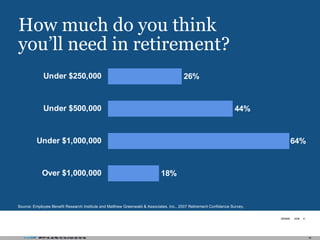
How much do you think you’ll need in retirement? Source: Employee Benefit Research Institute and Matthew Greenwald & Associates, Inc., 2007 Retirement Confidence Survey.
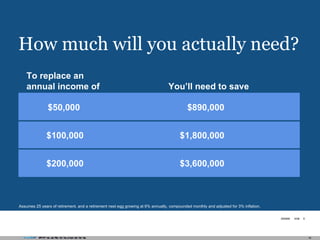
How much will you actually need? Assumes 25 years of retirement, and a retirement nest egg growing at 6% annually, compounded monthly and adjusted for 3% inflation. $1,800,000 $100,000  $3,600,000 $200,000  $890,000 $50,000  You’ll need to save To replace an annual income of
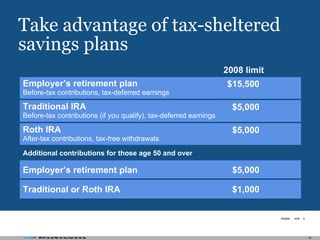
Take advantage of tax-sheltered savings plans Additional contributions for those age 50 and over $5,000 Employer’s retirement plan $1,000 Traditional or Roth IRA $5,000 Roth IRA After-tax contributions, tax-free withdrawals $5,000 Traditional IRA Before-tax contributions (if you qualify), tax-deferred earnings $15,500 Employer’s retirement plan Before-tax contributions, tax-deferred earnings 2008 limit
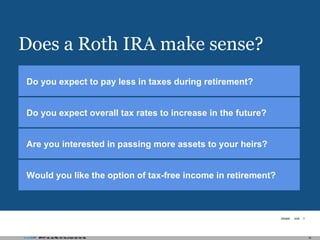
Does a Roth IRA make sense? Are you interested in passing more assets to your heirs? Would you like the option of tax-free income in retirement? Do you expect overall tax rates to increase in the future? Do you expect to pay less in taxes during retirement?
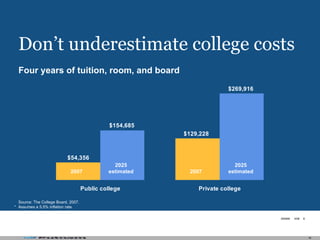
Don’t underestimate college costs Four years of tuition, room, and board Source: The College Board, 2007. * Assumes a 5.5% inflation rate. 2007 2007 2025 estimated 2025 estimated
A 529 college savings plan has unmatched benefits Tax advantages:  Account grows tax free, and there are no taxes on funds withdrawn for qualified higher education expenses Control:  Investor controls account assets after the beneficiary reaches legal age Flexibility:  Anyone can contribute — parents, grandparents, other family members, friends Do you have  existing custodial (UGMA/UTMA) accounts? Converting a custodial account to a 529  can help you benefit  from tax advantages while increasing a child’s eligibility for financial aid.
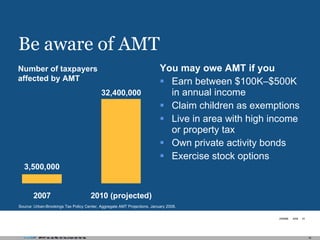
Be aware of AMT You may owe AMT if you Earn between $100K–$500K in annual income Claim children as exemptions Live in area with high income or property tax Own private activity bonds Exercise stock options Number of taxpayers affected by AMT 3,500,000 32,400,000 Source: Urban-Brookings Tax Policy Center, Aggregate AMT Projections, January 2008.
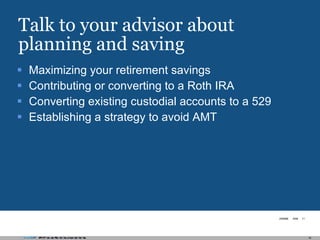
Talk to your advisor about planning and saving Maximizing your retirement savings Contributing or converting to a Roth IRA Converting existing custodial accounts to a 529 Establishing a strategy to avoid AMT
Managing retirement income
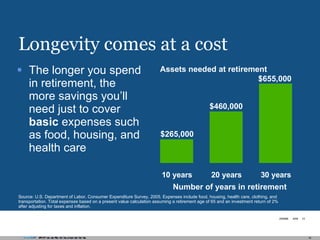
Longevity comes at a cost The longer you spend in retirement, the more savings you’ll need just to cover  basic  expenses such as food, housing, and health care Source: U.S. Department of Labor, Consumer Expenditure Survey, 2005. Expenses include food, housing, health care, clothing, and transportation. Total expenses based on a present value calculation assuming a retirement age of 65 and an investment return of 2% after adjusting for taxes and inflation. Assets needed at retirement Number of years in retirement $265,000 $460,000 $655,000
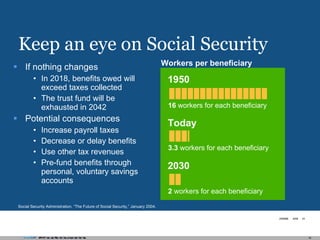
Keep an eye on Social Security If nothing changes In 2018, benefits owed will exceed taxes collected The trust fund will be  exhausted in 2042 Potential consequences Increase payroll taxes Decrease or delay benefits Use other tax revenues Pre-fund benefits through personal, voluntary savings accounts Social Security Administration, “The Future of Social Security,” January 2004. Workers per beneficiary 1950 16  workers for each beneficiary Today 3.3  workers for each beneficiary 2030 2  workers for each beneficiary
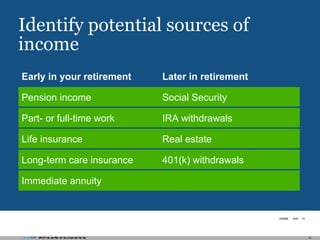
Identify potential sources of income Immediate annuity 401(k) withdrawals Long-term care insurance Real estate Life insurance IRA withdrawals Part- or full-time work Social Security Pension income Later in retirement Early in your retirement
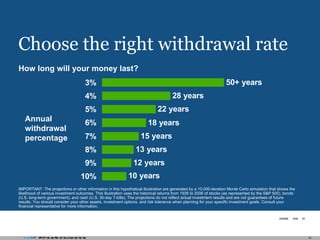
Choose the right withdrawal rate IMPORTANT: The projections or other information in this hypothetical illustration are generated by a 10,000-iteration Monte Carlo simulation that shows the likelihood of various investment outcomes. This illustration uses the historical returns from 1926 to 2006 of stocks (as represented by the S&P 500), bonds (U.S. long-term government), and cash (U.S. 30-day T-bills). The projections do not reflect actual investment results and are not guarantees of future results. You should consider your other assets, investment options, and risk tolerance when planning for your specific investment goals. Consult your financial representative for more information. How long will your money last? Annual withdrawal percentage
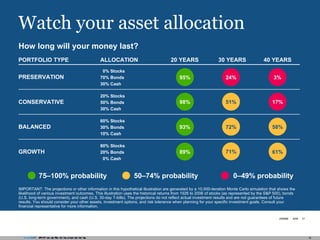
Watch your asset allocation 98% 93% 89% 51% 72% 17% 61% 75–100% probability 50–74% probability 0–49% probability How long will your money last? IMPORTANT: The projections or other information in this hypothetical illustration are generated by a 10,000-iteration Monte Carlo simulation that shows the likelihood of various investment outcomes. This illustration uses the historical returns from 1926 to 2006 of stocks (as represented by the S&P 500), bonds (U.S. long-term government), and cash (U.S. 30-day T-bills). The projections do not reflect actual investment results and are not guarantees of future results. You should consider your other assets, investment options, and risk tolerance when planning for your specific investment goals. Consult your financial representative for more information. 95% 24% 3% 71% 58% 0% Stocks 70% Bonds 30% Cash PRESERVATION 80% Stocks 20% Bonds 0% Cash GROWTH 60% Stocks 30% Bonds 10% Cash BALANCED 20% Stocks 50% Bonds 30% Cash CONSERVATIVE 40 YEARS 30 YEARS 20 YEARS ALLOCATION PORTFOLIO TYPE
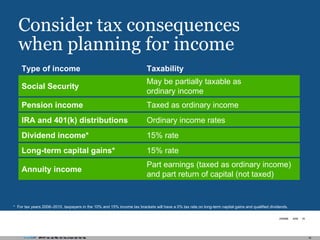
Consider tax consequences when planning for income * For tax years 2008–2010, taxpayers in the 10% and 15% income tax brackets will have a 0% tax rate on long-term capital gains and qualified dividends. Part earnings (taxed as ordinary income) and part return of capital (not taxed) Annuity income Taxability Type of income 15% rate Long-term capital gains* 15% rate Dividend income* Ordinary income rates  IRA and 401(k) distributions Taxed as ordinary income Pension income May be partially taxable as  ordinary income Social Security
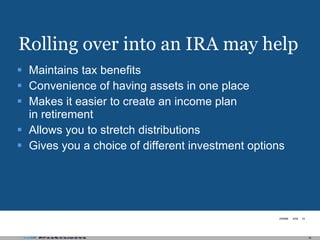
Rolling over into an IRA may help Maintains tax benefits Convenience of having assets in one place Makes it easier to create an income plan in retirement Allows you to stretch distributions Gives you a choice of different investment options
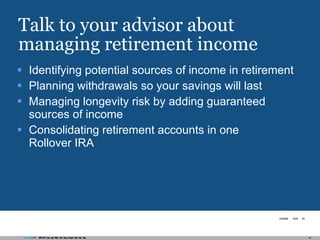
Talk to your advisor about managing retirement income Identifying potential sources of income in retirement Planning withdrawals so your savings will last Managing longevity risk by adding guaranteed sources of income Consolidating retirement accounts in one Rollover IRA
Transferring wealth
Do you need an estate plan? Do you have children who are minors? Are all of your assets owned jointly with  your spouse? Are most of your assets in real estate, a business, or a retirement plan? Do you have a durable power of attorney? Do you have a living will/health-care proxy? Do you own property in another state? Do you have children from a prior marriage?
Important documents for staying in control of your assets Durable power of attorney Living will  Health-care proxy Will
Disinherit Uncle Sam  Unlimited marital deduction — until 2010 Federal estate tax exclusion Keep beneficiary designations updated  Use IRAs and trusts to avoid unnecessary taxes Establish a gifting strategy
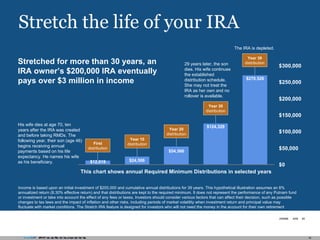
Stretch the life of your IRA Income is based upon an initial investment of $200,000 and cumulative annual distributions for 39 years. This hypothetical illustration assumes an 8% annualized return (8.30% effective return) and that distributions are kept to the required minimum. It does not represent the performance of any Putnam fund or investment or take into account the effect of any fees or taxes. Investors should consider various factors that can affect their decision, such as possible changes to tax laws and the impact of inflation and other risks, including periods of market volatility when investment return and principal value may fluctuate with market conditions. The Stretch IRA feature is designed for investors who will not need the money in the account for their own retirement needs. Stretched for more than 30 years, an IRA owner’s $200,000 IRA eventually pays over $3 million in income His wife dies at age 70, ten years after the IRA was created and before taking RMDs. The following year, their son (age 46) begins receiving annual payments based on his life expectancy. He names his wife as his beneficiary. This chart shows annual Required Minimum Distributions in selected years 29 years later, the son dies. His wife continues the established distribution schedule. She may not treat the IRA as her own and no rollover is available. The IRA is depleted. First  distribution Year 10  distribution Year 20  distribution Year 30  distribution Year 39  distribution
Use a 529 plan to protect assets Grandparents can reduce the size of their estate, maintain control of their assets, and help finance their grandchildren’s education Special gift-tax exclusion enables you to make five years’ worth of gifts (up to $60,000, or $120,000 for married couples) in a single year to a single beneficiary without triggering the federal gift tax* Cannot make additional gifts to the same beneficiary within five-year period If contributor dies before five-year period ends, portion attributable to remaining period reverts to contributor’s estate Account owner maintains control over the withdrawals and can Change beneficiaries Approve distributions for qualified higher education expenses Withdraw funds * If an account owner elects to treat a contribution as having been made over a 5-year period and dies before the end of the 5-year period, the portion of the contribution allocable to the remaining years in the 5-year period (not including the year in which the account owner died) would be included in computing the account owner’s gross estate for federal estate-tax purposes. Five-year gift election is made by filing a federal gift tax return. Account owners may wish to consult their tax or estate-planning counsel to ensure that they obtain the tax consequences they desire.
Talk to your advisor about transferring wealth Helping you identify your estate planning needs Taking advantage of a Stretch IRA Using a 529 plan as an efficient way to:  Remove appreciated assets from an estate  Help finance college education for family members The IRS has announced that it intends to repropose Section 529 regulations that will include certain changes and clarifications to existing proposed regulations. Although the exact content of the new proposed regulations, and the ultimate content of the final regulations, is not known at this time, the reproposed regulations could limit or require changes to, and affect tax consequences of, certain features of the Putnam CollegeAdvantage Program, including those described herein.
Plan for success Professional guidance Financial Advisor Accountant Lawyer Next steps
The Putnam difference A time-honored tradition in money management A prudent approach to investing Funds for every investment goal A commitment to doing what’s right for investors Industry-leading service
CollegeAdvantage is offered and overseen by the Ohio Tuition Trust Authority. Ohio taxpayers may obtain state tax benefits through the plan. However, anyone may invest in the plan and use the proceeds to attend school in any state. Before investing, consider whether your state's plan or that of your beneficiary offers tax and other benefits not available through CollegeAdvantage. If you withdraw money for something other than qualified higher education expenses, you will owe federal income tax and may face a 10% federal tax penalty on earnings. Consult your tax advisor. You should carefully consider the investment objectives, risks, charges, and expenses of the plan before investing. Ask your financial representative or call Putnam at 1-800-225-1581 for an offering statement containing this and other information for Putnam CollegeAdvantage, and read it carefully before investing. Putnam Retail Management, principal underwriter. Putnam Investment Management, investment manager. Investors  should carefully consider the investment objective, risks, charges, and expenses of a fund before investing. For a prospectus containing this and other information for any Putnam fund or product, call your financial representative or call Putnam at 1-800-225-1581. Please read the prospectus carefully before investing. This information is not meant as tax or legal advice. Please consult your legal or tax advisor before making any decisions. Shares of mutual funds are not deposits or obligations of, or guaranteed or endorsed by, any financial institution; are not insured by the Federal Deposit Insurance Corporation (FDIC), the Federal Reserve Board, or any other agency; and involve risk, including the possible loss of the principal amount invested. Putnam Retail Management  www.putnam.com

Wealth Management Strategies Seminar

  • 1.
    Wealth Management StrategiesTurn the money you have into the money you’ll need
  • 2.
    Transferring wealth Managingretirement income Planning and saving
  • 3.
  • 4.
    How much doyou think you’ll need in retirement? Source: Employee Benefit Research Institute and Matthew Greenwald & Associates, Inc., 2007 Retirement Confidence Survey.
  • 5.
    How much willyou actually need? Assumes 25 years of retirement, and a retirement nest egg growing at 6% annually, compounded monthly and adjusted for 3% inflation. $1,800,000 $100,000 $3,600,000 $200,000 $890,000 $50,000 You’ll need to save To replace an annual income of
  • 6.
    Take advantage oftax-sheltered savings plans Additional contributions for those age 50 and over $5,000 Employer’s retirement plan $1,000 Traditional or Roth IRA $5,000 Roth IRA After-tax contributions, tax-free withdrawals $5,000 Traditional IRA Before-tax contributions (if you qualify), tax-deferred earnings $15,500 Employer’s retirement plan Before-tax contributions, tax-deferred earnings 2008 limit
  • 7.
    Does a RothIRA make sense? Are you interested in passing more assets to your heirs? Would you like the option of tax-free income in retirement? Do you expect overall tax rates to increase in the future? Do you expect to pay less in taxes during retirement?
  • 8.
    Don’t underestimate collegecosts Four years of tuition, room, and board Source: The College Board, 2007. * Assumes a 5.5% inflation rate. 2007 2007 2025 estimated 2025 estimated
  • 9.
    A 529 collegesavings plan has unmatched benefits Tax advantages: Account grows tax free, and there are no taxes on funds withdrawn for qualified higher education expenses Control: Investor controls account assets after the beneficiary reaches legal age Flexibility: Anyone can contribute — parents, grandparents, other family members, friends Do you have existing custodial (UGMA/UTMA) accounts? Converting a custodial account to a 529 can help you benefit from tax advantages while increasing a child’s eligibility for financial aid.
  • 10.
    Be aware ofAMT You may owe AMT if you Earn between $100K–$500K in annual income Claim children as exemptions Live in area with high income or property tax Own private activity bonds Exercise stock options Number of taxpayers affected by AMT 3,500,000 32,400,000 Source: Urban-Brookings Tax Policy Center, Aggregate AMT Projections, January 2008.
  • 11.
    Talk to youradvisor about planning and saving Maximizing your retirement savings Contributing or converting to a Roth IRA Converting existing custodial accounts to a 529 Establishing a strategy to avoid AMT
  • 12.
  • 13.
    Longevity comes ata cost The longer you spend in retirement, the more savings you’ll need just to cover basic expenses such as food, housing, and health care Source: U.S. Department of Labor, Consumer Expenditure Survey, 2005. Expenses include food, housing, health care, clothing, and transportation. Total expenses based on a present value calculation assuming a retirement age of 65 and an investment return of 2% after adjusting for taxes and inflation. Assets needed at retirement Number of years in retirement $265,000 $460,000 $655,000
  • 14.
    Keep an eyeon Social Security If nothing changes In 2018, benefits owed will exceed taxes collected The trust fund will be exhausted in 2042 Potential consequences Increase payroll taxes Decrease or delay benefits Use other tax revenues Pre-fund benefits through personal, voluntary savings accounts Social Security Administration, “The Future of Social Security,” January 2004. Workers per beneficiary 1950 16 workers for each beneficiary Today 3.3 workers for each beneficiary 2030 2 workers for each beneficiary
  • 15.
    Identify potential sourcesof income Immediate annuity 401(k) withdrawals Long-term care insurance Real estate Life insurance IRA withdrawals Part- or full-time work Social Security Pension income Later in retirement Early in your retirement
  • 16.
    Choose the rightwithdrawal rate IMPORTANT: The projections or other information in this hypothetical illustration are generated by a 10,000-iteration Monte Carlo simulation that shows the likelihood of various investment outcomes. This illustration uses the historical returns from 1926 to 2006 of stocks (as represented by the S&P 500), bonds (U.S. long-term government), and cash (U.S. 30-day T-bills). The projections do not reflect actual investment results and are not guarantees of future results. You should consider your other assets, investment options, and risk tolerance when planning for your specific investment goals. Consult your financial representative for more information. How long will your money last? Annual withdrawal percentage
  • 17.
    Watch your assetallocation 98% 93% 89% 51% 72% 17% 61% 75–100% probability 50–74% probability 0–49% probability How long will your money last? IMPORTANT: The projections or other information in this hypothetical illustration are generated by a 10,000-iteration Monte Carlo simulation that shows the likelihood of various investment outcomes. This illustration uses the historical returns from 1926 to 2006 of stocks (as represented by the S&P 500), bonds (U.S. long-term government), and cash (U.S. 30-day T-bills). The projections do not reflect actual investment results and are not guarantees of future results. You should consider your other assets, investment options, and risk tolerance when planning for your specific investment goals. Consult your financial representative for more information. 95% 24% 3% 71% 58% 0% Stocks 70% Bonds 30% Cash PRESERVATION 80% Stocks 20% Bonds 0% Cash GROWTH 60% Stocks 30% Bonds 10% Cash BALANCED 20% Stocks 50% Bonds 30% Cash CONSERVATIVE 40 YEARS 30 YEARS 20 YEARS ALLOCATION PORTFOLIO TYPE
  • 18.
    Consider tax consequenceswhen planning for income * For tax years 2008–2010, taxpayers in the 10% and 15% income tax brackets will have a 0% tax rate on long-term capital gains and qualified dividends. Part earnings (taxed as ordinary income) and part return of capital (not taxed) Annuity income Taxability Type of income 15% rate Long-term capital gains* 15% rate Dividend income* Ordinary income rates IRA and 401(k) distributions Taxed as ordinary income Pension income May be partially taxable as ordinary income Social Security
  • 19.
    Rolling over intoan IRA may help Maintains tax benefits Convenience of having assets in one place Makes it easier to create an income plan in retirement Allows you to stretch distributions Gives you a choice of different investment options
  • 20.
    Talk to youradvisor about managing retirement income Identifying potential sources of income in retirement Planning withdrawals so your savings will last Managing longevity risk by adding guaranteed sources of income Consolidating retirement accounts in one Rollover IRA
  • 21.
  • 22.
    Do you needan estate plan? Do you have children who are minors? Are all of your assets owned jointly with your spouse? Are most of your assets in real estate, a business, or a retirement plan? Do you have a durable power of attorney? Do you have a living will/health-care proxy? Do you own property in another state? Do you have children from a prior marriage?
  • 23.
    Important documents forstaying in control of your assets Durable power of attorney Living will Health-care proxy Will
  • 24.
    Disinherit Uncle Sam Unlimited marital deduction — until 2010 Federal estate tax exclusion Keep beneficiary designations updated Use IRAs and trusts to avoid unnecessary taxes Establish a gifting strategy
  • 25.
    Stretch the lifeof your IRA Income is based upon an initial investment of $200,000 and cumulative annual distributions for 39 years. This hypothetical illustration assumes an 8% annualized return (8.30% effective return) and that distributions are kept to the required minimum. It does not represent the performance of any Putnam fund or investment or take into account the effect of any fees or taxes. Investors should consider various factors that can affect their decision, such as possible changes to tax laws and the impact of inflation and other risks, including periods of market volatility when investment return and principal value may fluctuate with market conditions. The Stretch IRA feature is designed for investors who will not need the money in the account for their own retirement needs. Stretched for more than 30 years, an IRA owner’s $200,000 IRA eventually pays over $3 million in income His wife dies at age 70, ten years after the IRA was created and before taking RMDs. The following year, their son (age 46) begins receiving annual payments based on his life expectancy. He names his wife as his beneficiary. This chart shows annual Required Minimum Distributions in selected years 29 years later, the son dies. His wife continues the established distribution schedule. She may not treat the IRA as her own and no rollover is available. The IRA is depleted. First distribution Year 10 distribution Year 20 distribution Year 30 distribution Year 39 distribution
  • 26.
    Use a 529plan to protect assets Grandparents can reduce the size of their estate, maintain control of their assets, and help finance their grandchildren’s education Special gift-tax exclusion enables you to make five years’ worth of gifts (up to $60,000, or $120,000 for married couples) in a single year to a single beneficiary without triggering the federal gift tax* Cannot make additional gifts to the same beneficiary within five-year period If contributor dies before five-year period ends, portion attributable to remaining period reverts to contributor’s estate Account owner maintains control over the withdrawals and can Change beneficiaries Approve distributions for qualified higher education expenses Withdraw funds * If an account owner elects to treat a contribution as having been made over a 5-year period and dies before the end of the 5-year period, the portion of the contribution allocable to the remaining years in the 5-year period (not including the year in which the account owner died) would be included in computing the account owner’s gross estate for federal estate-tax purposes. Five-year gift election is made by filing a federal gift tax return. Account owners may wish to consult their tax or estate-planning counsel to ensure that they obtain the tax consequences they desire.
  • 27.
    Talk to youradvisor about transferring wealth Helping you identify your estate planning needs Taking advantage of a Stretch IRA Using a 529 plan as an efficient way to: Remove appreciated assets from an estate Help finance college education for family members The IRS has announced that it intends to repropose Section 529 regulations that will include certain changes and clarifications to existing proposed regulations. Although the exact content of the new proposed regulations, and the ultimate content of the final regulations, is not known at this time, the reproposed regulations could limit or require changes to, and affect tax consequences of, certain features of the Putnam CollegeAdvantage Program, including those described herein.
  • 28.
    Plan for successProfessional guidance Financial Advisor Accountant Lawyer Next steps
  • 29.
    The Putnam differenceA time-honored tradition in money management A prudent approach to investing Funds for every investment goal A commitment to doing what’s right for investors Industry-leading service
  • 30.
    CollegeAdvantage is offeredand overseen by the Ohio Tuition Trust Authority. Ohio taxpayers may obtain state tax benefits through the plan. However, anyone may invest in the plan and use the proceeds to attend school in any state. Before investing, consider whether your state's plan or that of your beneficiary offers tax and other benefits not available through CollegeAdvantage. If you withdraw money for something other than qualified higher education expenses, you will owe federal income tax and may face a 10% federal tax penalty on earnings. Consult your tax advisor. You should carefully consider the investment objectives, risks, charges, and expenses of the plan before investing. Ask your financial representative or call Putnam at 1-800-225-1581 for an offering statement containing this and other information for Putnam CollegeAdvantage, and read it carefully before investing. Putnam Retail Management, principal underwriter. Putnam Investment Management, investment manager. Investors should carefully consider the investment objective, risks, charges, and expenses of a fund before investing. For a prospectus containing this and other information for any Putnam fund or product, call your financial representative or call Putnam at 1-800-225-1581. Please read the prospectus carefully before investing. This information is not meant as tax or legal advice. Please consult your legal or tax advisor before making any decisions. Shares of mutual funds are not deposits or obligations of, or guaranteed or endorsed by, any financial institution; are not insured by the Federal Deposit Insurance Corporation (FDIC), the Federal Reserve Board, or any other agency; and involve risk, including the possible loss of the principal amount invested. Putnam Retail Management www.putnam.com